FINGER PRINT SENSOR
AND ITS APPLICATIONS
SEMINAR PRESENTATION ON
Presented by:
ARNAB PODDER (Roll No.-
07)
ATUL RAJ (Roll No.- 08)
Department of Electronics and Instrumentation Engineering
Academy of Technology
Under the Supervision of
Prof. Jayjeet Sarkar
OVERVIEW
• Introduction
• Working
• Block Diagram
• Finger Print Characteristics
• Types of finger prints
• Types of finger print sensors
• Application of finger print sensor
• Advantages
• Disadvantages
• Future scope of finger print sensor
• Conclusion
INTRODUCTION
First used by the Babylonians then adapted
in China during 700 AD
In 1858, Sir William Herschel, then Chief
Magistrate of the Hooghly district in
Jungipoor, India, required residents to
record their fingerprints when signing
business documents.
Unique – So far no two prints from different
fingers have been found that are identical
WORKING
 It captures a digital image of the fingerprint pattern. The
captured image is called a live scan.
 This live scan is digitally processed to create a biometric
template (a collection of extracted features) which is
stored and used for matching.
 This scanned image is then compared with an earlier
existing finger print of yours to get the correct identity.
 The comparison is carried out by the processor and the
comparison is made between the valleys and ridges.
 Though your whole fingerprint is recorded, the computer
takes only parts of the print to compare with other
records.
BLOCK DIAGRAM
Fig : Block Diagram of a finger print sensor
FINGER PRINT CHARACTERISTICS
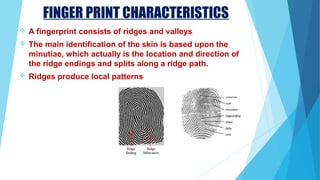
 A fingerprint consists of ridges and valleys
 The main identification of the skin is based upon the
minutiae, which actually is the location and direction of
the ridge endings and splits along a ridge path.
 Ridges produce local patterns
TYPES OF FINGER PRINTS
 Five main classes of
fingerprints
 Arch
 Tented Arch
 Left Loop
 Right Loop
 Whorl
TYPES OF FINGER PRINT SENSORS
 Six main classes of fingerprint sensors
 Capacitive type finger print sensor
 Optical type finger print sensor
 Thermal type finger print sensor
 Pressure type finger print sensor
 Low radio frequency (RF) type finger print
sensor
 Ultrasonic type finger print sensor
TYPES OF FINGER PRINT SENSORS
Fig: Capacitive type finger print sensor
Fig: Optical type finger print sensor
Fig: Thermal type finger print sensor
Fig: Pressure type finger print sensor
Fig: Low radio frequency (RF) type finger print sensor
Fig: Ultrasonic type finger print sensor
APPLICATION OF FINGER PRINT SENSORS
 Voter registration and identification
 Border control via passport verification
 Population census by using biometrics
 Lock/unlock devices and application software
 Weapon activation
 Theft protection
 Digital payments using ADHAR card
verification
ADVANTAGES
 Others can’t use one’s identity since physical
attributes can’t be duplicated like identity
cards.
 It is cheap, fast and easy to setup.
 You can't misplace your fingerprints and it
does not change with age or get affected by
any disease.
 It can’t be forgotten since it’s a physical
feature.
 Very high accuracy.
 Easy to use.
DISADVANTAGES
 For some people it is very intrusive, because
is still related to criminal identification.
 It can make mistakes with the dryness or dirty
of the finger’s skin, as well as with the age (is
not appropriate with children, because the
size of their fingerprint changes quickly).
 Image captured at 500 dots per inch (dpi).
Resolution: 8 bits per pixel. A 500 dpi
fingerprint image at 8 bits per pixel demands a
large memory space, 240 Kbytes
approximately → Compression required (a
factor of 10 approximately)
FUTURE SCOPE OF FINGER PRINT SENSOR
 If the Govt. Election may conduct using UID
card, then fake entries can be avoided.
 If the ATM Machine and Card may connect
with the UID card system then only allowed
people would transact money Authenticate by
Fingerprint Scanner at ATM.
 Other Scheme those can take advantage to
Fingerprint Scanned Images by UID are as
follow: Indian Post Office, NREGA
CONCLUSION
The important points concluded are as follows:
 Fingerprint Images are very easy to recognize
compared to other biometric technology
because it has specific pattern to classify.
 In case two Fingerprints of different person are
matched, then Fingerprints of other fingers can
never be match with other person’s fingerprints.
So, authenticity is very high.
 If the matching techniques discussed above
may compose into a single system then the
fingerprint verification results will optimized.
REFERENCE
 GOOGLE.CO.IN
https://www.google.co.in/webhp?sourceid=chromeinstant&ion=1&espv=2&ie=UTF-
8#q=firnger+print+sensor+and+its+application
 CIRCUITS TODAY.COM
http://www.circuitstoday.com/working-of-fingerprint-scanner-2
 360BIOMETRICS.COM
http://www.biometrika.it/eng/wp_fingintro.html
 CS.AUCKLAND.AC.NZ
https://www.cs.auckland.ac.nz/courses/compsci725s2c/archive/termpapers/bkaschte.pdf
 BIOMETRIKA.IT
http://www.biometrika.it/eng/wp_fingintro.html
 WIKIPEDIA.ORG
https://en.wikipedia.org/wiki/Fingerprint_recognition
Finger print sensor and its application

Finger print sensor and its application

  • 1.
    FINGER PRINT SENSOR ANDITS APPLICATIONS SEMINAR PRESENTATION ON Presented by: ARNAB PODDER (Roll No.- 07) ATUL RAJ (Roll No.- 08) Department of Electronics and Instrumentation Engineering Academy of Technology Under the Supervision of Prof. Jayjeet Sarkar
  • 2.
    OVERVIEW • Introduction • Working •Block Diagram • Finger Print Characteristics • Types of finger prints • Types of finger print sensors • Application of finger print sensor • Advantages • Disadvantages • Future scope of finger print sensor • Conclusion
  • 3.
    INTRODUCTION First used bythe Babylonians then adapted in China during 700 AD In 1858, Sir William Herschel, then Chief Magistrate of the Hooghly district in Jungipoor, India, required residents to record their fingerprints when signing business documents. Unique – So far no two prints from different fingers have been found that are identical
  • 4.
    WORKING  It capturesa digital image of the fingerprint pattern. The captured image is called a live scan.  This live scan is digitally processed to create a biometric template (a collection of extracted features) which is stored and used for matching.  This scanned image is then compared with an earlier existing finger print of yours to get the correct identity.  The comparison is carried out by the processor and the comparison is made between the valleys and ridges.  Though your whole fingerprint is recorded, the computer takes only parts of the print to compare with other records.
  • 5.
    BLOCK DIAGRAM Fig :Block Diagram of a finger print sensor
  • 6.
    FINGER PRINT CHARACTERISTICS A fingerprint consists of ridges and valleys  The main identification of the skin is based upon the minutiae, which actually is the location and direction of the ridge endings and splits along a ridge path.  Ridges produce local patterns
  • 7.
    TYPES OF FINGERPRINTS  Five main classes of fingerprints  Arch  Tented Arch  Left Loop  Right Loop  Whorl
  • 8.
    TYPES OF FINGERPRINT SENSORS  Six main classes of fingerprint sensors  Capacitive type finger print sensor  Optical type finger print sensor  Thermal type finger print sensor  Pressure type finger print sensor  Low radio frequency (RF) type finger print sensor  Ultrasonic type finger print sensor
  • 9.
    TYPES OF FINGERPRINT SENSORS Fig: Capacitive type finger print sensor Fig: Optical type finger print sensor Fig: Thermal type finger print sensor Fig: Pressure type finger print sensor Fig: Low radio frequency (RF) type finger print sensor Fig: Ultrasonic type finger print sensor
  • 10.
    APPLICATION OF FINGERPRINT SENSORS  Voter registration and identification  Border control via passport verification  Population census by using biometrics  Lock/unlock devices and application software  Weapon activation  Theft protection  Digital payments using ADHAR card verification
  • 11.
    ADVANTAGES  Others can’tuse one’s identity since physical attributes can’t be duplicated like identity cards.  It is cheap, fast and easy to setup.  You can't misplace your fingerprints and it does not change with age or get affected by any disease.  It can’t be forgotten since it’s a physical feature.  Very high accuracy.  Easy to use.
  • 12.
    DISADVANTAGES  For somepeople it is very intrusive, because is still related to criminal identification.  It can make mistakes with the dryness or dirty of the finger’s skin, as well as with the age (is not appropriate with children, because the size of their fingerprint changes quickly).  Image captured at 500 dots per inch (dpi). Resolution: 8 bits per pixel. A 500 dpi fingerprint image at 8 bits per pixel demands a large memory space, 240 Kbytes approximately → Compression required (a factor of 10 approximately)
  • 13.
    FUTURE SCOPE OFFINGER PRINT SENSOR  If the Govt. Election may conduct using UID card, then fake entries can be avoided.  If the ATM Machine and Card may connect with the UID card system then only allowed people would transact money Authenticate by Fingerprint Scanner at ATM.  Other Scheme those can take advantage to Fingerprint Scanned Images by UID are as follow: Indian Post Office, NREGA
  • 14.
    CONCLUSION The important pointsconcluded are as follows:  Fingerprint Images are very easy to recognize compared to other biometric technology because it has specific pattern to classify.  In case two Fingerprints of different person are matched, then Fingerprints of other fingers can never be match with other person’s fingerprints. So, authenticity is very high.  If the matching techniques discussed above may compose into a single system then the fingerprint verification results will optimized.
  • 15.
    REFERENCE  GOOGLE.CO.IN https://www.google.co.in/webhp?sourceid=chromeinstant&ion=1&espv=2&ie=UTF- 8#q=firnger+print+sensor+and+its+application  CIRCUITSTODAY.COM http://www.circuitstoday.com/working-of-fingerprint-scanner-2  360BIOMETRICS.COM http://www.biometrika.it/eng/wp_fingintro.html  CS.AUCKLAND.AC.NZ https://www.cs.auckland.ac.nz/courses/compsci725s2c/archive/termpapers/bkaschte.pdf  BIOMETRIKA.IT http://www.biometrika.it/eng/wp_fingintro.html  WIKIPEDIA.ORG https://en.wikipedia.org/wiki/Fingerprint_recognition