STUDY OF DIFFERENT FINGERPRINT RECOGNITION
TECHNIQUES FOR THE DESIGN AND
IMPLEMENTATION OF LOCK USING ARDUINO
By: -
Aastha Tiwari (1509013020)
Vaibhav Goyal (1509013073)
Vibhu Thakur (1509013075)
Yashbeer Singh Rathour (1509013078)
IEC COLLEGE OF ENGINEERING AND
TECHNOLOGY
Project Guide: -
Ms. Riti Kushwaha
INTRODUCTION
 Fingerprint verification is an important biometric technique for personal
identification.
 Biometric is a technology that uniquely identifies a person based on his physiological
or behavior characteristics.
 We describe the design and implementation of a prototype automatic identity
authentication system that uses fingerprint to authenticate the identity of an individual.
 No two persons have exactly the same arrangement of ridge patterns and of any one
individual remain unchanged throughout life.
MOTIVATION
 The motivation behind the work is growing need to identify a person for
security.
 To improve the quality of fingerprint and to extract the minutiae points.
 It is also used to identify individuals in groups that are under surveillance.
LITERATURE SURVEY 1
 In 1684 the English physician, botanist and grew microscopist N.Grew.
 He published the first scientific paper to describe the ridge structure of the skin
covering the fingers and palms.
 He used a microscope to study fingerprints.
 As a result, a number of researches have invested huge amount of efforts in
studying fingerprints.
 Everyone used to have brief study fingerprints after it.
 No mention of friction rich skin uniqueness or permanence.
LITERATURE SURVEY 2
 In 1788, German anatomist and Dr. J.C.A Mayor wrote the book anatomical
copper plates with appropriate explanation containing drawings of friction
ridge skin patterns.
 Mayor was the first to declare that friction ridge skin in unique.
 He marked the differences yet in spite of other peculiarity of arrangements.
 As a result, fingerprint was made unique.
 The fingerprints were easily recognized after that.
 The main disadvantage was the risk to security.
LITERATURE SURVEY 3
 In 1823, Jan Evangelista Purkinje anatomy professor at the university Breslau.
 He published his thesis discussing 9 fingerprint patterns.
 His techniques were minutiae matching.
 Other professor Herman Weckler studied friction ridge skin permanence by
printing is own right hand.
 He got brief minutiae points of patterns using 9 fingerprints.
 As a disadvantage, individuality and uniqueness were present.
LITERATURE SURVEY 4
 In 1888, Sir Francis Galton British anthropologist and a cousin of Charles Darwin
began his observation on fingerprints as a means of identification in the 80’s.
 He conducted an extensive study on fingerprints, and introduced the minutiae
features for single fingerprint classification.
 He used minutiae extraction algorithm as a technique.
 As a result, it was easy matching fingerprint classification.
 Full study of minutiae features was done.
 People didn’t know how to use the feature classification.
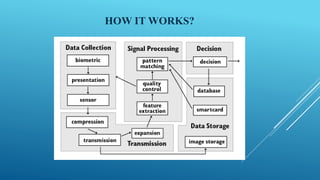
HOW IT WORKS?
DATA COLLECTION
 We will collect our data through NIST (National institute of standards and technology).
 We have database which includes over 3,248 images per person.
 There are images of 1,573 individuals (cases) which includes 1,495 males and 78
females.
 The images of variable size using PNG formatting with Metadata TXT files
corresponding each per image.
 Images scanned at 19.7 pixels per mm.
METHODOLOGY
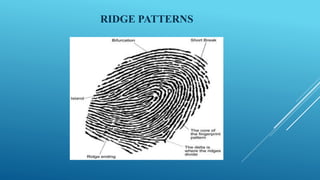
 The skin surface of any human finger consists of a pattern of dark lines of
ridges along with white lines or valleys between them.
 The ridges’ structures changes at points known as minutiae and can be either
bifurcated or of short length or two ridges can end on a single point.
 These details or patterns are unique in every human being.
 The flow of this ridges, their features, the intricate details of ridges and their
sequence is what defines the information for fingerprint identification.
RIDGE PATTERNS
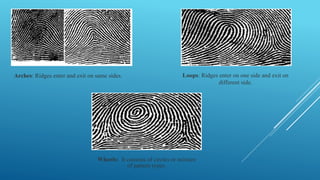
Arches: Ridges enter and exit on same sides. Loops: Ridges enter on one side and exit on
different side.
Whorls: It consists of circles or mixture
of pattern types.
DATA PRE-PROCESSING
 Data pre-processing is a data mining technique that involves transforming raw data
into an understandable format.
 Real world data is often incomplete, inconsistent and lacking in certain behavior or
trends and may contain many errors.
 We will pre process the image using MATLAB 9.0 (using functions ‘imread’ &
‘imshow’).
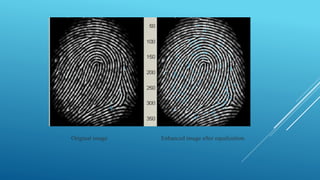
Here we used two method for image enhancement stage those are: -
 Histogram equalization
 Fourier transform
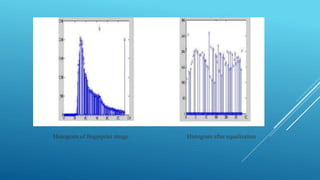
Histogram of fingerprint image Histogram after equalization
Original image Enhanced image after equalization
IMAGE BINARIZATION
 We binarize the image by extracting the lightness of the image that is, here, we
extract the brightness and density of the image as a feature amount from the
image.
 When we select a pixel in an image, a sensitivity is added to it and it is
subtracted, the selected pixel because here we have to set the range of
threshold value.
 When a new pixel is selected again a new threshold value range is set which
contains the calculation result and the previous threshold value.
 Then the pixel is extracted up to the same brightness whatever the selected
pixel and the extraction result is displayed.
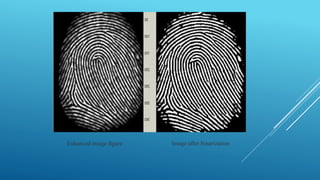
 Binarization is used to transform the 8-bit Gray fingerprint image to a 1- bit
image and here the value for the ridges is 0 where as it is 1 for the furrows.
Enhanced image figure Image after binarization
IMAGE SEGMENTATION
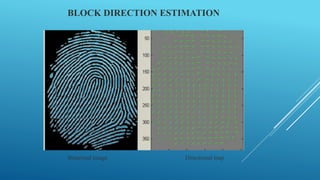
 We partitioning a digital image in to multiple segments that is a set of pixels, It
also well known as super pixels.
 Image segmentation is used to locate the objects and boundaries like the lines
and curves present in an images.
 Region of Interest (ROI) is very much useful for recognizing each fingerprint
image.
 The image area without effective ridges and furrows holds background
information. So the effective ridges and furrows deleted first, then the remaining
effective area is sketched.
To extract the ROI, we used a two-step approach that is: -
 Block direction estimation and direction variety check.
 Intrigued ROI extraction from some morphological operation.
Binarized image Directional map
BLOCK DIRECTION ESTIMATION
ROI EXTRACTION BY MORPHOLOGICAL
OPERATION
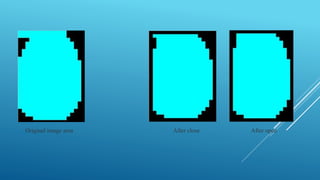
 ROI extraction can be done using two Morphological methods those are
“OPEN” and “CLOSE”.
 By using the “OPEN” operation we can enhance images and remove the peaks
caused by background noise and we use “CLOSE” operation to shrink the
images and to eliminate the small cavities.
Original image area After close After open
Final region of interest
MINUTIAE EXTRACTION
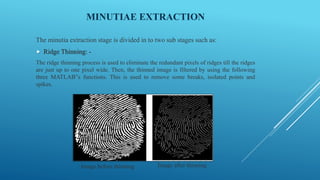
The minutia extraction stage is divided in to two sub stages such as:
 Ridge Thinning: -
The ridge thinning process is used to eliminate the redundant pixels of ridges till the ridges
are just up to one pixel wide. Then, the thinned image is filtered by using the following
three MATLAB‟s functions. This is used to remove some breaks, isolated points and
spikes.
Image before thinning Image after thinning
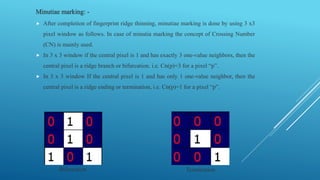
Minutiae marking: -
 After completion of fingerprint ridge thinning, minutiae marking is done by using 3 x3
pixel window as follows. In case of minutia marking the concept of Crossing Number
(CN) is mainly used.
 In 3 x 3 window if the central pixel is 1 and has exactly 3 one-value neighbors, then the
central pixel is a ridge branch or bifurcation. i.e. Cn(p)=3 for a pixel “p”.
 In 3 x 3 window If the central pixel is 1 and has only 1 one-value neighbor, then the
central pixel is a ridge ending or termination, i.e. Cn(p)=1 for a pixel “p”.
Bifurcation Termination
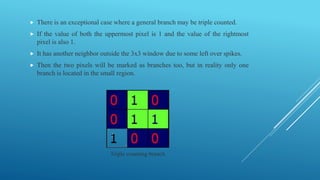
 There is an exceptional case where a general branch may be triple counted.
 If the value of both the uppermost pixel is 1 and the value of the rightmost
pixel is also 1.
 It has another neighbor outside the 3x3 window due to some left over spikes.
 Then the two pixels will be marked as branches too, but in reality only one
branch is located in the small region.
Triple counting branch
REFERENCES
 D. Maltoni, D. Maio, and A. Jain, S. Prabhakar, “4.3: Minutiae-based Methods‟ (extract) from Handbook
of Fingerprint Recognition”, Springer, New York, pp. 141-144, 2003.
 D. Maio, and D. Maltoni, “Direct grey-scale minutiae detection in fingerprints”, IEEE Transactions Pattern
Analysis and Machine Intelligence, vol. 19, pp. 27-40, 1997.
 L. Hong, "Automatic Personal Identification Using Fingerprints", Ph.D. Thesis, 1998.
 K. Nallaperumall, A. L. Fred and S. Padmapriya, “A Novel for Fingerprint Feature Extraction Using Fixed
Size Templates”, IEEE 2005 Conference, Fingerprint Recognition, Paper by WUZHILI (Department of
Computer Science & Engineering, Hong Kong Baptist University) 2002.
 Fingerprint Classification and Matching by Anil Jain (Department of Computer Science & Engineering,
Michigan State University) & Sharath Pankanti (Exploratory Computer Vision Group IBM T. J. Watson
Research Centre) 2000.
 Handbook of Fingerprint Recognition by Davide Maltoni, Dario Maio, Anil K. Jain & Salil Prabhakar.
 P. Komarinski, P. T. Higgins, and K. M. Higgins, K. Fox Lisa , “Automated Fingerprint Identification
Systems (AFIS)”, Elsevier Academic Press, pp. 1-118, 2005.
 Lin Hong, Student Member, IEEE, Yifei Wan, and Anil Jain, “Fingerprint Image Enhancement: Algorithm
and Performance Evaluation” IEEE TRANSACTIONS ON PATTERN ANALYSIS AND MACHINE
INTELLIGENCE, VOL. 20, pp. 777-787, 1998.
 A. K. Jain, L. Hong, and R. M. Bolle, ―On-line fingerprint verification‖, IEEE Trans. on Pattern Analysis
and Machine Intelligence, 19(4):302–313, April 1997.
 E. Henry, Classification and Uses of Finger Prints, Routledge, London, 1900.
 A. K. Jain, S. Prabhakar and S. Pankanti, ―Matching and Classification: A Case Study in Fingerprint
Domain‖, Proc. INSA-A (Indian National Science Academy), Vol. 67, A, No. 2, pp. 223-241, March 2001.
Thank You

Finger print recognition technique using arduino uno

  • 1.
    STUDY OF DIFFERENTFINGERPRINT RECOGNITION TECHNIQUES FOR THE DESIGN AND IMPLEMENTATION OF LOCK USING ARDUINO By: - Aastha Tiwari (1509013020) Vaibhav Goyal (1509013073) Vibhu Thakur (1509013075) Yashbeer Singh Rathour (1509013078) IEC COLLEGE OF ENGINEERING AND TECHNOLOGY Project Guide: - Ms. Riti Kushwaha
  • 2.
    INTRODUCTION  Fingerprint verificationis an important biometric technique for personal identification.  Biometric is a technology that uniquely identifies a person based on his physiological or behavior characteristics.  We describe the design and implementation of a prototype automatic identity authentication system that uses fingerprint to authenticate the identity of an individual.  No two persons have exactly the same arrangement of ridge patterns and of any one individual remain unchanged throughout life.
  • 3.
    MOTIVATION  The motivationbehind the work is growing need to identify a person for security.  To improve the quality of fingerprint and to extract the minutiae points.  It is also used to identify individuals in groups that are under surveillance.
  • 4.
    LITERATURE SURVEY 1 In 1684 the English physician, botanist and grew microscopist N.Grew.  He published the first scientific paper to describe the ridge structure of the skin covering the fingers and palms.  He used a microscope to study fingerprints.  As a result, a number of researches have invested huge amount of efforts in studying fingerprints.  Everyone used to have brief study fingerprints after it.  No mention of friction rich skin uniqueness or permanence.
  • 5.
    LITERATURE SURVEY 2 In 1788, German anatomist and Dr. J.C.A Mayor wrote the book anatomical copper plates with appropriate explanation containing drawings of friction ridge skin patterns.  Mayor was the first to declare that friction ridge skin in unique.  He marked the differences yet in spite of other peculiarity of arrangements.  As a result, fingerprint was made unique.  The fingerprints were easily recognized after that.  The main disadvantage was the risk to security.
  • 6.
    LITERATURE SURVEY 3 In 1823, Jan Evangelista Purkinje anatomy professor at the university Breslau.  He published his thesis discussing 9 fingerprint patterns.  His techniques were minutiae matching.  Other professor Herman Weckler studied friction ridge skin permanence by printing is own right hand.  He got brief minutiae points of patterns using 9 fingerprints.  As a disadvantage, individuality and uniqueness were present.
  • 7.
    LITERATURE SURVEY 4 In 1888, Sir Francis Galton British anthropologist and a cousin of Charles Darwin began his observation on fingerprints as a means of identification in the 80’s.  He conducted an extensive study on fingerprints, and introduced the minutiae features for single fingerprint classification.  He used minutiae extraction algorithm as a technique.  As a result, it was easy matching fingerprint classification.  Full study of minutiae features was done.  People didn’t know how to use the feature classification.
  • 8.
  • 9.
    DATA COLLECTION  Wewill collect our data through NIST (National institute of standards and technology).  We have database which includes over 3,248 images per person.  There are images of 1,573 individuals (cases) which includes 1,495 males and 78 females.  The images of variable size using PNG formatting with Metadata TXT files corresponding each per image.  Images scanned at 19.7 pixels per mm.
  • 10.
    METHODOLOGY  The skinsurface of any human finger consists of a pattern of dark lines of ridges along with white lines or valleys between them.  The ridges’ structures changes at points known as minutiae and can be either bifurcated or of short length or two ridges can end on a single point.  These details or patterns are unique in every human being.  The flow of this ridges, their features, the intricate details of ridges and their sequence is what defines the information for fingerprint identification.
  • 11.
  • 12.
    Arches: Ridges enterand exit on same sides. Loops: Ridges enter on one side and exit on different side. Whorls: It consists of circles or mixture of pattern types.
  • 13.
    DATA PRE-PROCESSING  Datapre-processing is a data mining technique that involves transforming raw data into an understandable format.  Real world data is often incomplete, inconsistent and lacking in certain behavior or trends and may contain many errors.  We will pre process the image using MATLAB 9.0 (using functions ‘imread’ & ‘imshow’). Here we used two method for image enhancement stage those are: -  Histogram equalization  Fourier transform
  • 14.
    Histogram of fingerprintimage Histogram after equalization
  • 15.
    Original image Enhancedimage after equalization
  • 16.
    IMAGE BINARIZATION  Webinarize the image by extracting the lightness of the image that is, here, we extract the brightness and density of the image as a feature amount from the image.  When we select a pixel in an image, a sensitivity is added to it and it is subtracted, the selected pixel because here we have to set the range of threshold value.  When a new pixel is selected again a new threshold value range is set which contains the calculation result and the previous threshold value.  Then the pixel is extracted up to the same brightness whatever the selected pixel and the extraction result is displayed.  Binarization is used to transform the 8-bit Gray fingerprint image to a 1- bit image and here the value for the ridges is 0 where as it is 1 for the furrows.
  • 17.
    Enhanced image figureImage after binarization
  • 18.
    IMAGE SEGMENTATION  Wepartitioning a digital image in to multiple segments that is a set of pixels, It also well known as super pixels.  Image segmentation is used to locate the objects and boundaries like the lines and curves present in an images.  Region of Interest (ROI) is very much useful for recognizing each fingerprint image.  The image area without effective ridges and furrows holds background information. So the effective ridges and furrows deleted first, then the remaining effective area is sketched. To extract the ROI, we used a two-step approach that is: -  Block direction estimation and direction variety check.  Intrigued ROI extraction from some morphological operation.
  • 19.
    Binarized image Directionalmap BLOCK DIRECTION ESTIMATION
  • 20.
    ROI EXTRACTION BYMORPHOLOGICAL OPERATION  ROI extraction can be done using two Morphological methods those are “OPEN” and “CLOSE”.  By using the “OPEN” operation we can enhance images and remove the peaks caused by background noise and we use “CLOSE” operation to shrink the images and to eliminate the small cavities.
  • 21.
    Original image areaAfter close After open
  • 22.
  • 23.
    MINUTIAE EXTRACTION The minutiaextraction stage is divided in to two sub stages such as:  Ridge Thinning: - The ridge thinning process is used to eliminate the redundant pixels of ridges till the ridges are just up to one pixel wide. Then, the thinned image is filtered by using the following three MATLAB‟s functions. This is used to remove some breaks, isolated points and spikes. Image before thinning Image after thinning
  • 24.
    Minutiae marking: - After completion of fingerprint ridge thinning, minutiae marking is done by using 3 x3 pixel window as follows. In case of minutia marking the concept of Crossing Number (CN) is mainly used.  In 3 x 3 window if the central pixel is 1 and has exactly 3 one-value neighbors, then the central pixel is a ridge branch or bifurcation. i.e. Cn(p)=3 for a pixel “p”.  In 3 x 3 window If the central pixel is 1 and has only 1 one-value neighbor, then the central pixel is a ridge ending or termination, i.e. Cn(p)=1 for a pixel “p”. Bifurcation Termination
  • 25.
     There isan exceptional case where a general branch may be triple counted.  If the value of both the uppermost pixel is 1 and the value of the rightmost pixel is also 1.  It has another neighbor outside the 3x3 window due to some left over spikes.  Then the two pixels will be marked as branches too, but in reality only one branch is located in the small region. Triple counting branch
  • 26.
    REFERENCES  D. Maltoni,D. Maio, and A. Jain, S. Prabhakar, “4.3: Minutiae-based Methods‟ (extract) from Handbook of Fingerprint Recognition”, Springer, New York, pp. 141-144, 2003.  D. Maio, and D. Maltoni, “Direct grey-scale minutiae detection in fingerprints”, IEEE Transactions Pattern Analysis and Machine Intelligence, vol. 19, pp. 27-40, 1997.  L. Hong, "Automatic Personal Identification Using Fingerprints", Ph.D. Thesis, 1998.  K. Nallaperumall, A. L. Fred and S. Padmapriya, “A Novel for Fingerprint Feature Extraction Using Fixed Size Templates”, IEEE 2005 Conference, Fingerprint Recognition, Paper by WUZHILI (Department of Computer Science & Engineering, Hong Kong Baptist University) 2002.  Fingerprint Classification and Matching by Anil Jain (Department of Computer Science & Engineering, Michigan State University) & Sharath Pankanti (Exploratory Computer Vision Group IBM T. J. Watson Research Centre) 2000.  Handbook of Fingerprint Recognition by Davide Maltoni, Dario Maio, Anil K. Jain & Salil Prabhakar.  P. Komarinski, P. T. Higgins, and K. M. Higgins, K. Fox Lisa , “Automated Fingerprint Identification Systems (AFIS)”, Elsevier Academic Press, pp. 1-118, 2005.  Lin Hong, Student Member, IEEE, Yifei Wan, and Anil Jain, “Fingerprint Image Enhancement: Algorithm and Performance Evaluation” IEEE TRANSACTIONS ON PATTERN ANALYSIS AND MACHINE INTELLIGENCE, VOL. 20, pp. 777-787, 1998.  A. K. Jain, L. Hong, and R. M. Bolle, ―On-line fingerprint verification‖, IEEE Trans. on Pattern Analysis and Machine Intelligence, 19(4):302–313, April 1997.  E. Henry, Classification and Uses of Finger Prints, Routledge, London, 1900.  A. K. Jain, S. Prabhakar and S. Pankanti, ―Matching and Classification: A Case Study in Fingerprint Domain‖, Proc. INSA-A (Indian National Science Academy), Vol. 67, A, No. 2, pp. 223-241, March 2001.
  • 27.