
By
Sagar Verma
1412213082
Biometrics
Fingerprint
CONTENTS
• Introduction : Biometrics
• Physical and behavioral Traits
• System Process Flow
• Fingerprint Patterns
• Fingerprint Matching Techniques
• Future Scope
• Advantages and Disadvantages
• Applications
• Biometrics Growth Graph
• Conclusion
INTRODUCTION
What is Biometrics?
• The study of automated identification, by use of
physical or behavioral traits.
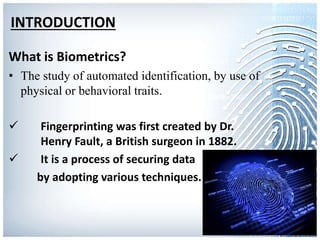
 Fingerprinting was first created by Dr.
Henry Fault, a British surgeon in 1882.
 It is a process of securing data
by adopting various techniques.
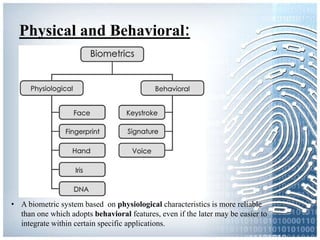
Physical and Behavioral:
• A biometric system based on physiological characteristics is more reliable
than one which adopts behavioral features, even if the later may be easier to
integrate within certain specific applications.
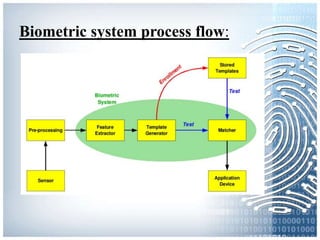
Biometric system process flow:
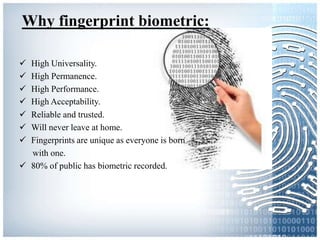
Why fingerprint biometric:
 High Universality.
 High Permanence.
 High Performance.
 High Acceptability.
 Reliable and trusted.
 Will never leave at home.
 Fingerprints are unique as everyone is born
with one.
 80% of public has biometric recorded.
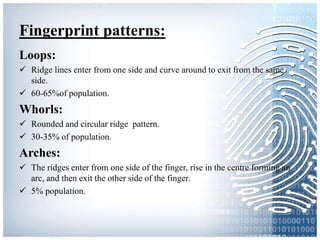
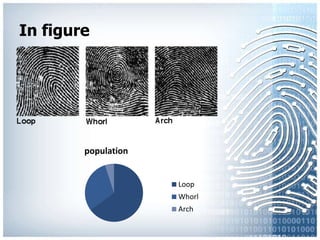
Fingerprint patterns:
Loops:
 Ridge lines enter from one side and curve around to exit from the same
side.
 60-65%of population.
Whorls:
 Rounded and circular ridge pattern.
 30-35% of population.
Arches:
 The ridges enter from one side of the finger, rise in the centre forming an
arc, and then exit the other side of the finger.
 5% population.
population
Loop
Whorl
Arch
In figure
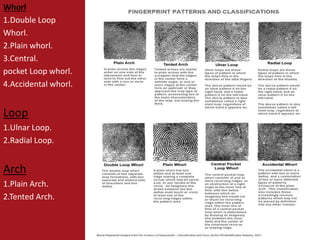
Whorl
1.Double Loop
Whorl.
2.Plain whorl.
3.Central.
pocket Loop whorl.
4.Accidental whorl.
Loop
1.Ulnar Loop.
2.Radial Loop.
Arch
1.Plain Arch.
2.Tented Arch.
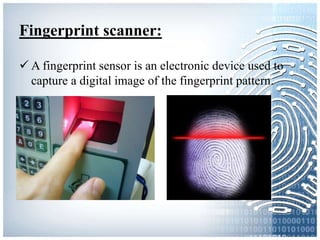
Fingerprint scanner:
 A fingerprint sensor is an electronic device used to
capture a digital image of the fingerprint pattern.
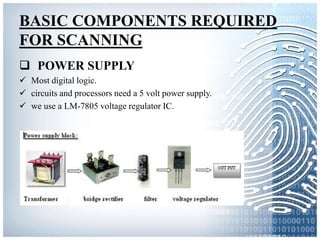
BASIC COMPONENTS REQUIRED
FOR SCANNING
 POWER SUPPLY
 Most digital logic.
 circuits and processors need a 5 volt power supply.
 we use a LM-7805 voltage regulator IC.
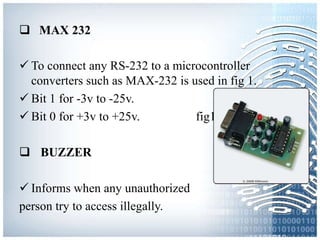
 MAX 232
 To connect any RS-232 to a microcontroller
converters such as MAX-232 is used in fig 1.
 Bit 1 for -3v to -25v.
 Bit 0 for +3v to +25v. fig1
 BUZZER
 Informs when any unauthorized
person try to access illegally.
 MICROCONTROLLER
 A Micro controller consists of a powerful CPU tightly
coupled with memory RAM, ROM or EPROM),
 Various I / O features such as Serial ports, Parallel
Ports, Timer/Counters, Interrupt Controller, Data
Acquisition interfaces-Analog to Digital Converter
(ADC), Digital to Analog Converter (ADC),
everything integrated onto a single Silicon Chip.
 LOCKER SYSTEM:
 DC motor as the Locker for the authorized persons in
the Locker system mode.
 EEPROM:
 This is the additional memory which we are using for
the storage of the data for a particular person.
 KEY PAD:
We are using two types of keypads
 The matrix keypad and
 Other is the normal key for selecting the mode of
operation.
LCD:
 Output device
 Clearly displayed on the LCD.
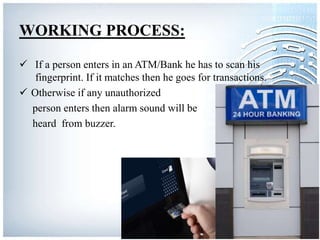
WORKING PROCESS:
 If a person enters in an ATM/Bank he has to scan his
fingerprint. If it matches then he goes for transactions.
 Otherwise if any unauthorized
person enters then alarm sound will be
heard from buzzer.
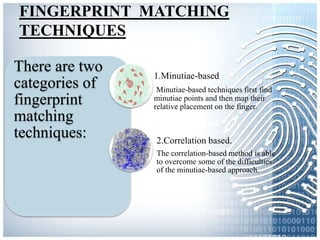
FINGERPRINT MATCHING
TECHNIQUES
There are two
categories of
fingerprint
matching
techniques:
1.Minutiae-based
Minutiae-based techniques first find
minutiae points and then map their
relative placement on the finger.
2.Correlation based.
The correlation-based method is able
to overcome some of the difficulties
of the minutiae-based approach.
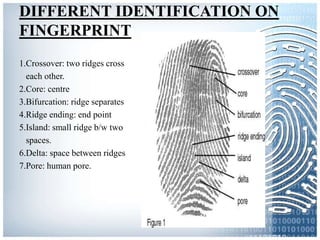
DIFFERENT IDENTIFICATION ON
FINGERPRINT
1.Crossover: two ridges cross
each other.
2.Core: centre
3.Bifurcation: ridge separates
4.Ridge ending: end point
5.Island: small ridge b/w two
spaces.
6.Delta: space between ridges
7.Pore: human pore.
Two main technologies used to capture
image of the fingerprint
1.Optical sensor – use light refracted through a prism.
An optical sensor based reader uses light to read and
acquire fingerprint images. Optical sensors can be
affected by a number of real life factors such as stray
light, surface contamination or even prior fingerprint
impressions present on the sensor surface. Hence it is
essential to clean the fingerprint reader glass on a
regular basis for optimal performance.
2.Capacitive sensor – detect voltage changes in skin
between ridges and valleys. Capacitive sensors use
electric current to sense a fingerprint and capture the
image. As sensors apply a small voltage to the finger, a
real fingerprint is required rather than a visual
impression of it. This technique makes the fingerprint
reader more reliable as it becomes harder to fake
enrolment.
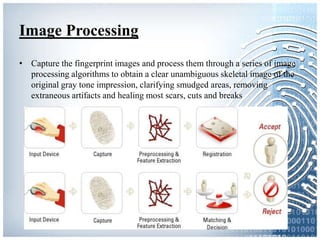
Image Processing
• Capture the fingerprint images and process them through a series of image
processing algorithms to obtain a clear unambiguous skeletal image of the
original gray tone impression, clarifying smudged areas, removing
extraneous artifacts and healing most scars, cuts and breaks
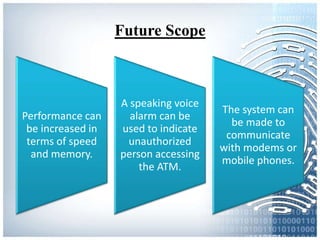
Future Scope
Performance can
be increased in
terms of speed
and memory.
A speaking voice
alarm can be
used to indicate
unauthorized
person accessing
the ATM.
The system can
be made to
communicate
with modems or
mobile phones.
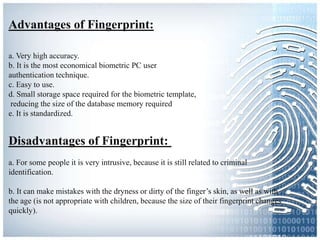
Advantages of Fingerprint:
a. Very high accuracy.
b. It is the most economical biometric PC user
authentication technique.
c. Easy to use.
d. Small storage space required for the biometric template,
reducing the size of the database memory required
e. It is standardized.
Disadvantages of Fingerprint:
a. For some people it is very intrusive, because it is still related to criminal
identification.
b. It can make mistakes with the dryness or dirty of the finger’s skin, as well as with
the age (is not appropriate with children, because the size of their fingerprint changes
quickly).
Applications
• Access control to computer systems (workstations) : USB fingerprint
readers, voice and face recognition software using standard camera and
microphone hardware, etc.
• Door security: doors with biometric locks using iris recognition,
fingerprint readers, etc.
• Portable media such as USB sticks and mobile hard drives with integrated
biometric access control and mostly encrypting your data using a built-in
algorithm.
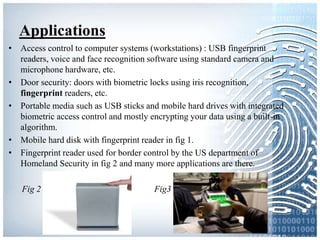
• Mobile hard disk with fingerprint reader in fig 1.
• Fingerprint reader used for border control by the US department of
Homeland Security in fig 2 and many more applications are there.
Fig 2 Fig3
• India's national ID program called Aadhaar is the largest biometric database
in the world. It is a biometrics-based digital identity assigned for a person's
lifetime, verifiable online instantly in the public domain, at any time, from
anywhere, in a paperless way.
• About 550 million residents have been enrolled and assigned 480 million
Aadhaar numbers as of 7 November 2013.It aims to cover the entire
population of 1.2 billion in a few years.
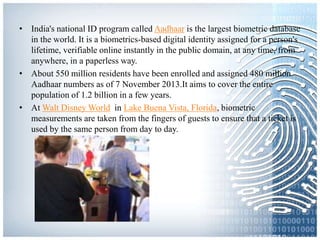
• At Walt Disney World in Lake Buena Vista, Florida, biometric
measurements are taken from the fingers of guests to ensure that a ticket is
used by the same person from day to day.
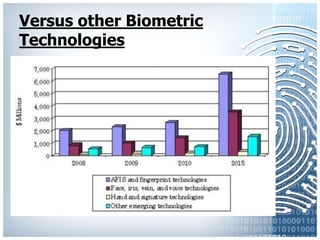
Versus other Biometric
Technologies
Conclusion:
 The microcontroller based system for securing the
transactions of the user and providing the security for
the locker system and even more for the PASSPORT
verification using a finger print scanner has been
followed.
THANK YOU

Biometrics fingerprint

  • 1.
  • 2.
    CONTENTS • Introduction :Biometrics • Physical and behavioral Traits • System Process Flow • Fingerprint Patterns • Fingerprint Matching Techniques • Future Scope • Advantages and Disadvantages • Applications • Biometrics Growth Graph • Conclusion
  • 3.
    INTRODUCTION What is Biometrics? •The study of automated identification, by use of physical or behavioral traits.  Fingerprinting was first created by Dr. Henry Fault, a British surgeon in 1882.  It is a process of securing data by adopting various techniques.
  • 4.
    Physical and Behavioral: •A biometric system based on physiological characteristics is more reliable than one which adopts behavioral features, even if the later may be easier to integrate within certain specific applications.
  • 5.
  • 6.
    Why fingerprint biometric: High Universality.  High Permanence.  High Performance.  High Acceptability.  Reliable and trusted.  Will never leave at home.  Fingerprints are unique as everyone is born with one.  80% of public has biometric recorded.
  • 7.
    Fingerprint patterns: Loops:  Ridgelines enter from one side and curve around to exit from the same side.  60-65%of population. Whorls:  Rounded and circular ridge pattern.  30-35% of population. Arches:  The ridges enter from one side of the finger, rise in the centre forming an arc, and then exit the other side of the finger.  5% population.
  • 8.
  • 9.
    Whorl 1.Double Loop Whorl. 2.Plain whorl. 3.Central. pocketLoop whorl. 4.Accidental whorl. Loop 1.Ulnar Loop. 2.Radial Loop. Arch 1.Plain Arch. 2.Tented Arch.
  • 10.
    Fingerprint scanner:  Afingerprint sensor is an electronic device used to capture a digital image of the fingerprint pattern.
  • 11.
    BASIC COMPONENTS REQUIRED FORSCANNING  POWER SUPPLY  Most digital logic.  circuits and processors need a 5 volt power supply.  we use a LM-7805 voltage regulator IC.
  • 12.
     MAX 232 To connect any RS-232 to a microcontroller converters such as MAX-232 is used in fig 1.  Bit 1 for -3v to -25v.  Bit 0 for +3v to +25v. fig1  BUZZER  Informs when any unauthorized person try to access illegally.
  • 13.
     MICROCONTROLLER  AMicro controller consists of a powerful CPU tightly coupled with memory RAM, ROM or EPROM),  Various I / O features such as Serial ports, Parallel Ports, Timer/Counters, Interrupt Controller, Data Acquisition interfaces-Analog to Digital Converter (ADC), Digital to Analog Converter (ADC), everything integrated onto a single Silicon Chip.
  • 14.
     LOCKER SYSTEM: DC motor as the Locker for the authorized persons in the Locker system mode.  EEPROM:  This is the additional memory which we are using for the storage of the data for a particular person.
  • 15.
     KEY PAD: Weare using two types of keypads  The matrix keypad and  Other is the normal key for selecting the mode of operation. LCD:  Output device  Clearly displayed on the LCD.
  • 16.
    WORKING PROCESS:  Ifa person enters in an ATM/Bank he has to scan his fingerprint. If it matches then he goes for transactions.  Otherwise if any unauthorized person enters then alarm sound will be heard from buzzer.
  • 17.
    FINGERPRINT MATCHING TECHNIQUES There aretwo categories of fingerprint matching techniques: 1.Minutiae-based Minutiae-based techniques first find minutiae points and then map their relative placement on the finger. 2.Correlation based. The correlation-based method is able to overcome some of the difficulties of the minutiae-based approach.
  • 18.
    DIFFERENT IDENTIFICATION ON FINGERPRINT 1.Crossover:two ridges cross each other. 2.Core: centre 3.Bifurcation: ridge separates 4.Ridge ending: end point 5.Island: small ridge b/w two spaces. 6.Delta: space between ridges 7.Pore: human pore.
  • 19.
    Two main technologiesused to capture image of the fingerprint 1.Optical sensor – use light refracted through a prism. An optical sensor based reader uses light to read and acquire fingerprint images. Optical sensors can be affected by a number of real life factors such as stray light, surface contamination or even prior fingerprint impressions present on the sensor surface. Hence it is essential to clean the fingerprint reader glass on a regular basis for optimal performance. 2.Capacitive sensor – detect voltage changes in skin between ridges and valleys. Capacitive sensors use electric current to sense a fingerprint and capture the image. As sensors apply a small voltage to the finger, a real fingerprint is required rather than a visual impression of it. This technique makes the fingerprint reader more reliable as it becomes harder to fake enrolment.
  • 20.
    Image Processing • Capturethe fingerprint images and process them through a series of image processing algorithms to obtain a clear unambiguous skeletal image of the original gray tone impression, clarifying smudged areas, removing extraneous artifacts and healing most scars, cuts and breaks
  • 21.
    Future Scope Performance can beincreased in terms of speed and memory. A speaking voice alarm can be used to indicate unauthorized person accessing the ATM. The system can be made to communicate with modems or mobile phones.
  • 22.
    Advantages of Fingerprint: a.Very high accuracy. b. It is the most economical biometric PC user authentication technique. c. Easy to use. d. Small storage space required for the biometric template, reducing the size of the database memory required e. It is standardized. Disadvantages of Fingerprint: a. For some people it is very intrusive, because it is still related to criminal identification. b. It can make mistakes with the dryness or dirty of the finger’s skin, as well as with the age (is not appropriate with children, because the size of their fingerprint changes quickly).
  • 23.
    Applications • Access controlto computer systems (workstations) : USB fingerprint readers, voice and face recognition software using standard camera and microphone hardware, etc. • Door security: doors with biometric locks using iris recognition, fingerprint readers, etc. • Portable media such as USB sticks and mobile hard drives with integrated biometric access control and mostly encrypting your data using a built-in algorithm. • Mobile hard disk with fingerprint reader in fig 1. • Fingerprint reader used for border control by the US department of Homeland Security in fig 2 and many more applications are there. Fig 2 Fig3
  • 24.
    • India's nationalID program called Aadhaar is the largest biometric database in the world. It is a biometrics-based digital identity assigned for a person's lifetime, verifiable online instantly in the public domain, at any time, from anywhere, in a paperless way. • About 550 million residents have been enrolled and assigned 480 million Aadhaar numbers as of 7 November 2013.It aims to cover the entire population of 1.2 billion in a few years. • At Walt Disney World in Lake Buena Vista, Florida, biometric measurements are taken from the fingers of guests to ensure that a ticket is used by the same person from day to day.
  • 25.
  • 26.
    Conclusion:  The microcontrollerbased system for securing the transactions of the user and providing the security for the locker system and even more for the PASSPORT verification using a finger print scanner has been followed.
  • 27.