How Fingerprint Scanners Work


                   s1150153   Kei Taniue
                   s1180178   Mariko Saito
                   s1180182   Kahori Shitomi
                   s1180187   Kazuki Tuda
Fingerprint Basics

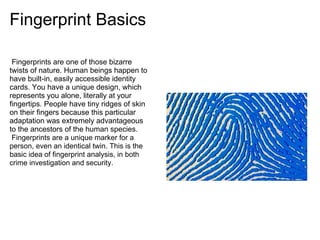
 Fingerprints are one of those bizarre
twists of nature. Human beings happen to
have built-in, easily accessible identity
cards. You have a unique design, which
represents you alone, literally at your
fingertips. People have tiny ridges of skin
on their fingers because this particular
adaptation was extremely advantageous
to the ancestors of the human species.
 Fingerprints are a unique marker for a
person, even an identical twin. This is the
basic idea of fingerprint analysis, in both
crime investigation and security.
Optical Scanner
 A fingerprint scanner system has two basic jobs -- it needs to get an image of your finger,
and it needs to determine whether the pattern of ridges and valleys in this image matches
the pattern of ridges and valleys in pre-scanned images. There are a number of different
ways to get an image of somebody's finger. The most common methods today are optical
scanning and capacitance scanning. Both types come up with the same sort of image, but
they go about it in completely different ways.

 The scanning process starts when you place your finger on a glass plate, and a CCD
camera takes a picture. The CCD system actually generates an inverted image of the finger,
with darker areas representing more reflected light (the ridges of the finger) and lighter areas
representing less reflected light (the valleys between the ridges). It checks the average pixel
darkness, or the overall values in a small sample, and rejects the scan if the overall image
is too dark or too light. If the image is rejected, the scanner adjusts the exposure time to let
in more or less light, and then tries the scan again.
Capacitance Scanner

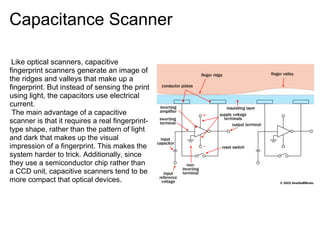
 Like optical scanners, capacitive
fingerprint scanners generate an image of
the ridges and valleys that make up a
fingerprint. But instead of sensing the print
using light, the capacitors use electrical
current.
 The main advantage of a capacitive
scanner is that it requires a real fingerprint-
type shape, rather than the pattern of light
and dark that makes up the visual                 The diagram shows a simple capacitive sensor.
impression of a fingerprint. This makes the
system harder to trick. Additionally, since
they use a semiconductor chip rather than
a CCD unit, capacitive scanners tend to be
more compact that optical devices.
Analysis

 In movies and TV shows, automated fingerprint analyzers typically overlay
various fingerprint images to find a match. In actuality, this isn't a particularly
practical way to compare fingerprints.

 The scanner system software uses highly complex algprithms to recognize and
analyze these minutiae. The basic idea is to measure the relative positions of
minutiae, in the same sort of way you might recognize a part of the sky by the
relative positions of stars. A simple way to think of it is to consider the shapes
that various minutia form when you draw straight lines between them. If two
prints have three ridge endings and two bifurcations, forming the same shape
with the same dimensions, there's a high likelihood they're from the same print.
Pros and Cons
There are several ways a security system can verify that somebody is an authorized
user. Most systems are looking for one or more of the following:
     What you have
     What you know
     Who you are
"Who you are" systems like fingerprint scanners have a number of advantages over other
systems. To name few:
     Physical attributes are much harder to fake than identity cards.
     You can't guess a fingerprint pattern like you can guess a password.
     You can't misplace your fingerprints, irises or voice like you can misplace an access
     card.
     You can't forget your fingerprints like you can forget a password.
To make these security systems more reliable, it's a good idea to combine the biometric
analysis with a conventional means of identification, such as a password (in the same
way an ATM requires a bank card and a PIN code).

Week12

  • 1.
    How Fingerprint ScannersWork s1150153 Kei Taniue s1180178 Mariko Saito s1180182 Kahori Shitomi s1180187 Kazuki Tuda
  • 2.
    Fingerprint Basics Fingerprintsare one of those bizarre twists of nature. Human beings happen to have built-in, easily accessible identity cards. You have a unique design, which represents you alone, literally at your fingertips. People have tiny ridges of skin on their fingers because this particular adaptation was extremely advantageous to the ancestors of the human species. Fingerprints are a unique marker for a person, even an identical twin. This is the basic idea of fingerprint analysis, in both crime investigation and security.
  • 3.
    Optical Scanner  A fingerprintscanner system has two basic jobs -- it needs to get an image of your finger, and it needs to determine whether the pattern of ridges and valleys in this image matches the pattern of ridges and valleys in pre-scanned images. There are a number of different ways to get an image of somebody's finger. The most common methods today are optical scanning and capacitance scanning. Both types come up with the same sort of image, but they go about it in completely different ways. The scanning process starts when you place your finger on a glass plate, and a CCD camera takes a picture. The CCD system actually generates an inverted image of the finger, with darker areas representing more reflected light (the ridges of the finger) and lighter areas representing less reflected light (the valleys between the ridges). It checks the average pixel darkness, or the overall values in a small sample, and rejects the scan if the overall image is too dark or too light. If the image is rejected, the scanner adjusts the exposure time to let in more or less light, and then tries the scan again.
  • 4.
    Capacitance Scanner Likeoptical scanners, capacitive fingerprint scanners generate an image of the ridges and valleys that make up a fingerprint. But instead of sensing the print using light, the capacitors use electrical current. The main advantage of a capacitive scanner is that it requires a real fingerprint- type shape, rather than the pattern of light and dark that makes up the visual The diagram shows a simple capacitive sensor. impression of a fingerprint. This makes the system harder to trick. Additionally, since they use a semiconductor chip rather than a CCD unit, capacitive scanners tend to be more compact that optical devices.
  • 5.
    Analysis In moviesand TV shows, automated fingerprint analyzers typically overlay various fingerprint images to find a match. In actuality, this isn't a particularly practical way to compare fingerprints. The scanner system software uses highly complex algprithms to recognize and analyze these minutiae. The basic idea is to measure the relative positions of minutiae, in the same sort of way you might recognize a part of the sky by the relative positions of stars. A simple way to think of it is to consider the shapes that various minutia form when you draw straight lines between them. If two prints have three ridge endings and two bifurcations, forming the same shape with the same dimensions, there's a high likelihood they're from the same print.
  • 6.
    Pros and Cons Thereare several ways a security system can verify that somebody is an authorized user. Most systems are looking for one or more of the following: What you have What you know Who you are "Who you are" systems like fingerprint scanners have a number of advantages over other systems. To name few: Physical attributes are much harder to fake than identity cards. You can't guess a fingerprint pattern like you can guess a password. You can't misplace your fingerprints, irises or voice like you can misplace an access card. You can't forget your fingerprints like you can forget a password. To make these security systems more reliable, it's a good idea to combine the biometric analysis with a conventional means of identification, such as a password (in the same way an ATM requires a bank card and a PIN code).