DEPARTMENT OF EEE
Presented By Guide By
1. 22308988 AJAY. G
Mr.B.RAJU
M.E
2. 22308989 AJAY .R
3. 22308990 AJAY SATHYA.S
4. 22309008 KARTHIKEYAN.M
5. 22309009 KARTHIKEYAN.R
Topic :
FINGERPRINT BASED
ATM SYSTEM
ABSTRACT
• The main purpose of our system is to make online transaction more secure and user-
friendly. Here we are using Fingerprint scanning biometric and iris scanning to provide access
to ATM machine. Data of a fingerprint and iris is stored in Aadhar database. Bank provide
authentication to the customer that can be access while performing transaction process. If the
fingerprint and iris match is found in data base then transaction take place. After verification,
if fingerprint and iris does not match transaction will be cancelled. Using fingerprint based
ATM system user can make secure transaction. Biometric can be used to identify physical and
behavioral characteristics of user fingerprints. There are many biometric devices like iris
detection, face recognition, fingerprint. In our Project, we are using fingerprint biometrics and
iris detection. Users fingerprint are scanned using biometric, eye ball are scanned through
camera and stored in database. All fingerprints have unique characteristics and patterns.
Fingerprint biometrics and camera are easy to use, cheap and most suitable for everyone.
Characteristics of fingerprint and iris vary from person to person. Fingerprint and iris is a
unique identity of user.
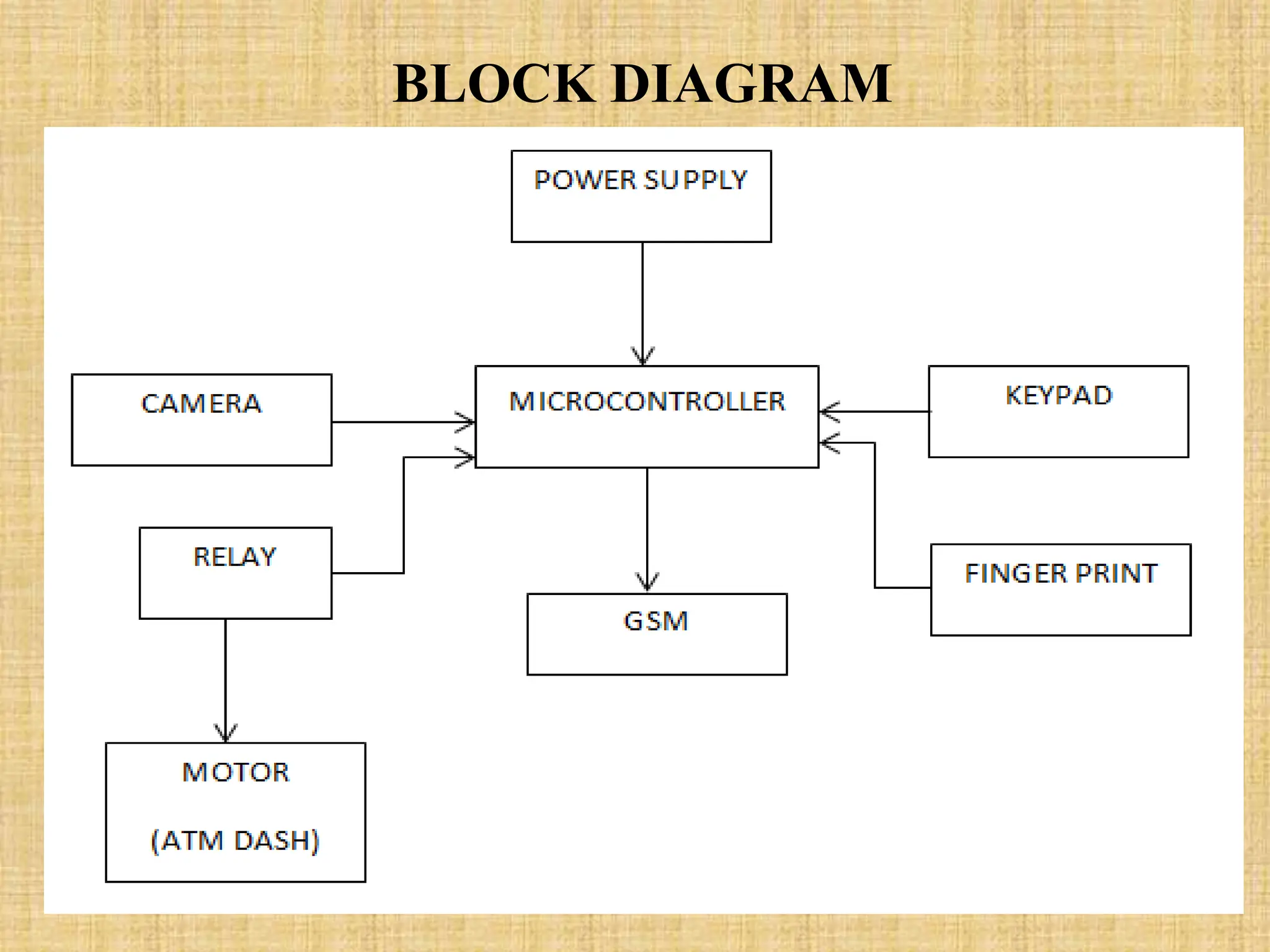
BLOCK DIAGRAM
• INTRODUCTION
• Fingerprint Based ATM is a desktop application where fingerprint of the user
is used as a authentication. The finger print minutiae features are different for each
human being so the user can be identified uniquely. Instead of using ATM card
Fingerprint based ATM is safer and secure. There is no worry of losing ATM card
and no need to carry ATM card in your wallet. You just have to use your fingerprint
in order to do any banking transaction. The user has to login using his fingerprint
and he has to enter the pin code in order to do further transaction. The user can
withdraw money from his account. User can transfer money to various accounts by
mentioning account number. In order to withdraw money user has to enter the
amount he want to withdraw .The user must have appropriate balance in his ATM
account to do transaction. User can view the balance available in his respective
account.
• PROPOSED SYSTEM
• Design Approach This project was developed using functional design approach. It is a modular
approach. Each module is a function of its own and as the modules are independent, the change in
functional implementation of module will affect the functional implementation of the other modules
minimally. Each authentication step in the proposed solution is identified into three independent
modules for implementation purposes and integrated. The first module implements a scrambling
keypad, second a color-coded password combination and finally a biometric fingerprint
authentication. Each functional module consists of its own implementation and sub modules. 2.2
Detailed Design This project consists of three steps of authentication: The 6-digits ATM PIN number
on a scrambling keypad, color-coded combination password identification and fingerprint
recognition. A user must first register with all three before accessing his records. The user records
are stored in a SQLite database in the form of rows. When a user authenticates using his account
details, they are matched against the records in the database and the result (“valid” or “invalid” user)
is returned. The registration and authentication processes are further explained with respective
activity, sequence and architecture diagrams. 7 2.2.1 Registration The activity diagram below shows
the workflow of activities for user registration process. In real world, a user swipes his debit/credit
card to authenticate and use a teller machine. The bank issues these cards to users with bank
accounts, so the user details are already registered with the bank. For demonstration purposes, this
project stores user details entered by the user and the user needs to enter his account number to
authenticate with the three steps
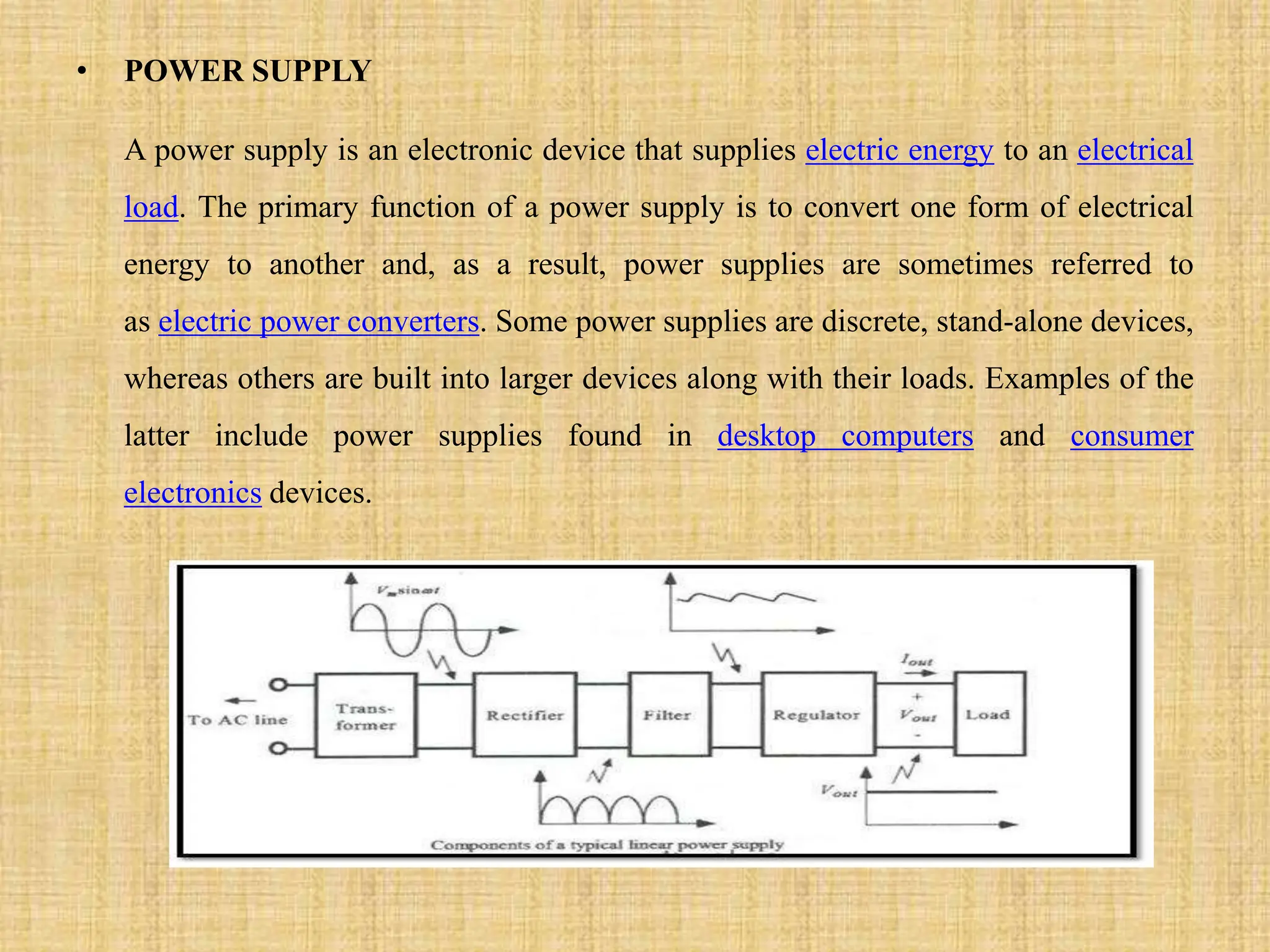
• POWER SUPPLY
A power supply is an electronic device that supplies electric energy to an electrical
load. The primary function of a power supply is to convert one form of electrical
energy to another and, as a result, power supplies are sometimes referred to
as electric power converters. Some power supplies are discrete, stand-alone devices,
whereas others are built into larger devices along with their loads. Examples of the
latter include power supplies found in desktop computers and consumer
electronics devices.
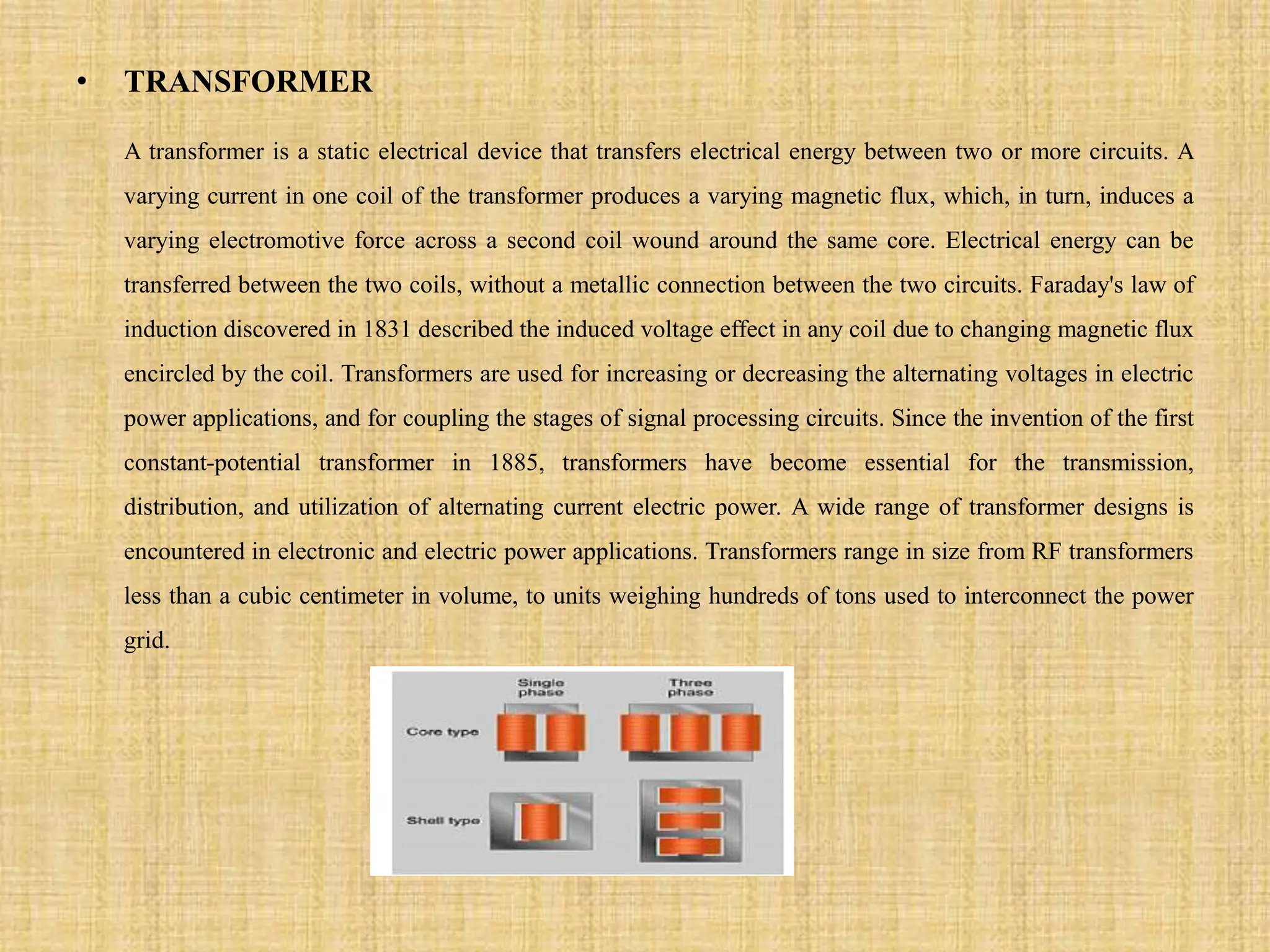
• TRANSFORMER
A transformer is a static electrical device that transfers electrical energy between two or more circuits. A
varying current in one coil of the transformer produces a varying magnetic flux, which, in turn, induces a
varying electromotive force across a second coil wound around the same core. Electrical energy can be
transferred between the two coils, without a metallic connection between the two circuits. Faraday's law of
induction discovered in 1831 described the induced voltage effect in any coil due to changing magnetic flux
encircled by the coil. Transformers are used for increasing or decreasing the alternating voltages in electric
power applications, and for coupling the stages of signal processing circuits. Since the invention of the first
constant-potential transformer in 1885, transformers have become essential for the transmission,
distribution, and utilization of alternating current electric power. A wide range of transformer designs is
encountered in electronic and electric power applications. Transformers range in size from RF transformers
less than a cubic centimeter in volume, to units weighing hundreds of tons used to interconnect the power
grid.
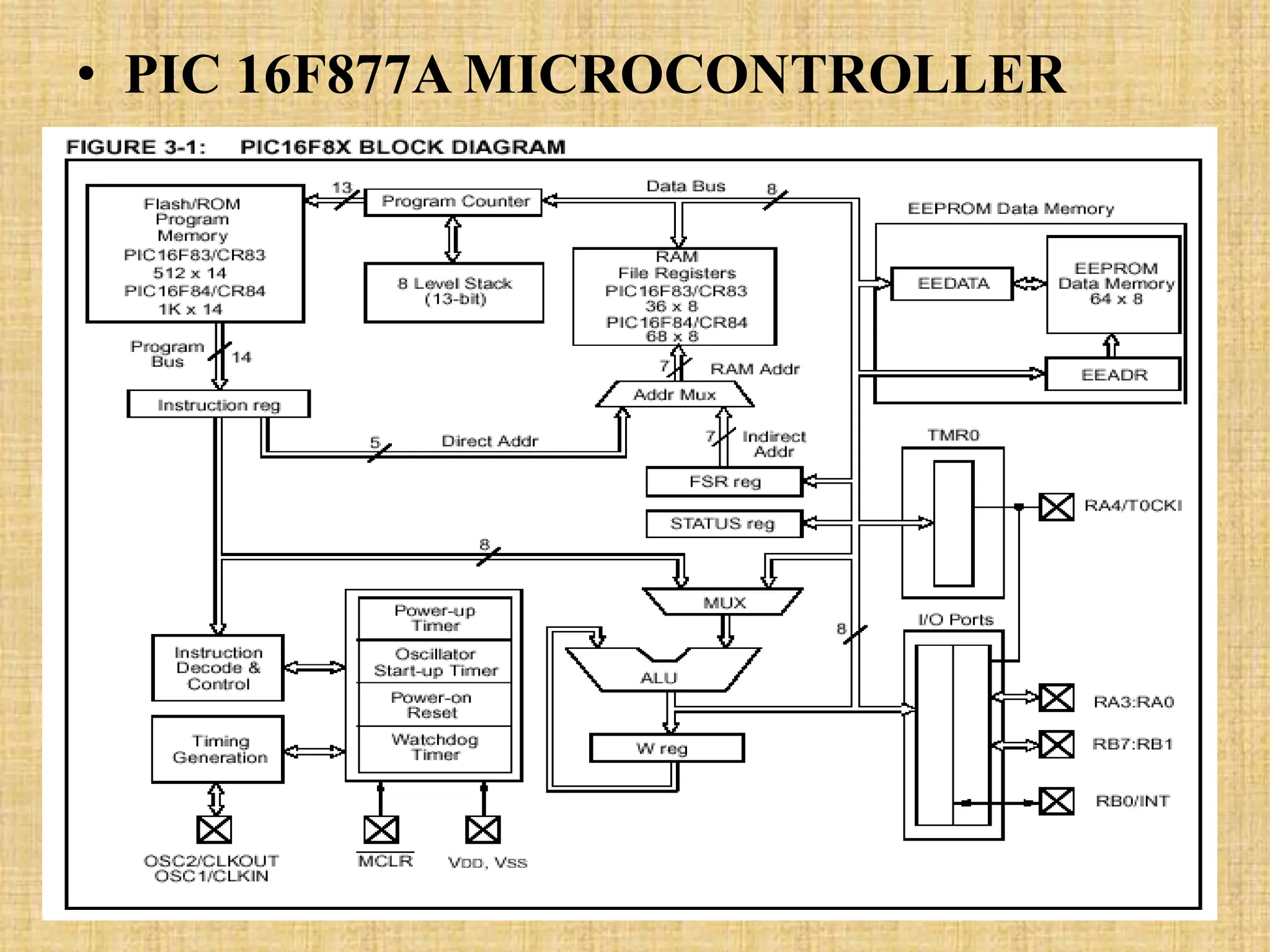
• PIC 16F877A MICROCONTROLLER
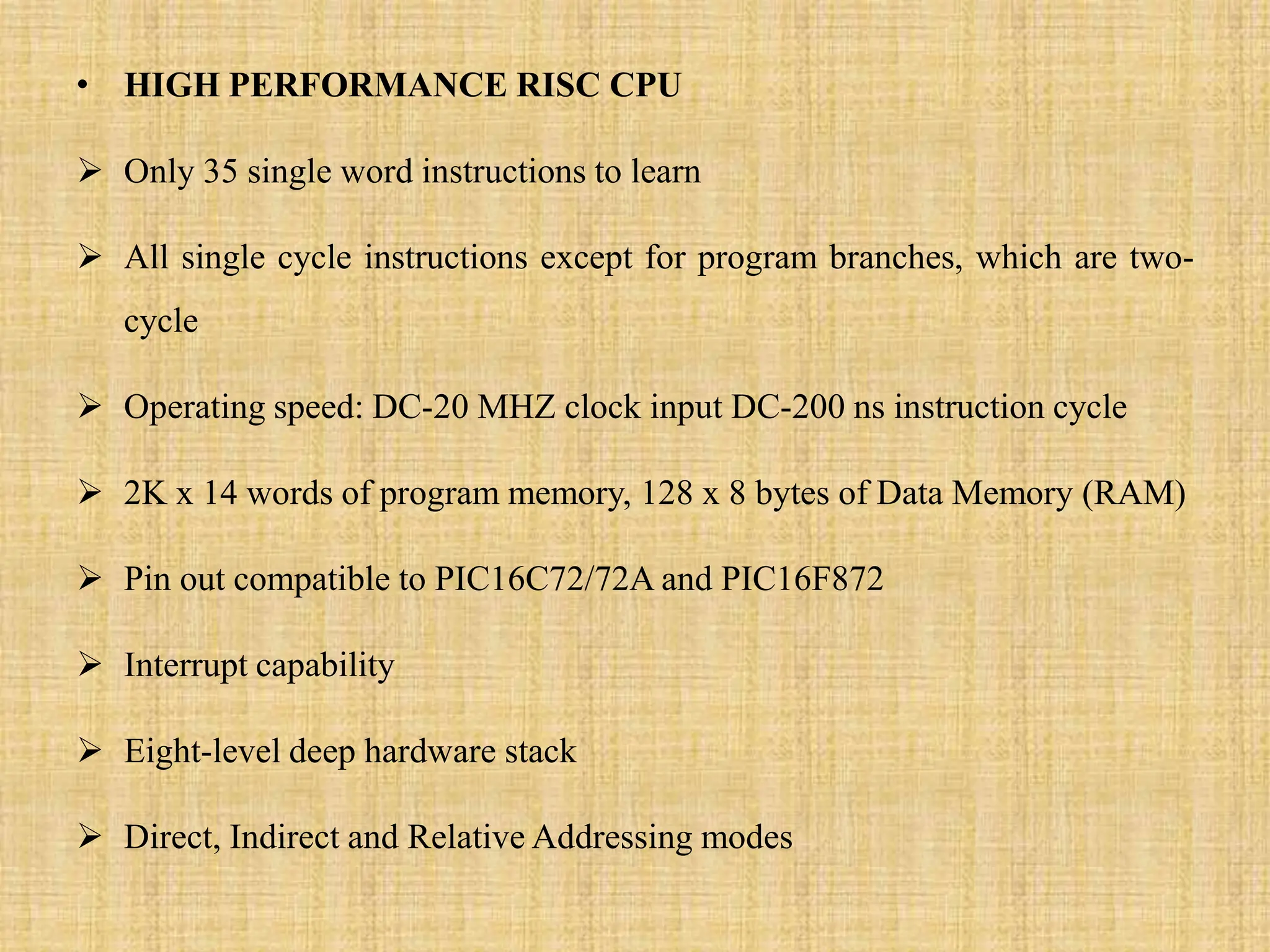
• HIGH PERFORMANCE RISC CPU
 Only 35 single word instructions to learn
 All single cycle instructions except for program branches, which are two-
cycle
 Operating speed: DC-20 MHZ clock input DC-200 ns instruction cycle
 2K x 14 words of program memory, 128 x 8 bytes of Data Memory (RAM)
 Pin out compatible to PIC16C72/72A and PIC16F872
 Interrupt capability
 Eight-level deep hardware stack
 Direct, Indirect and Relative Addressing modes
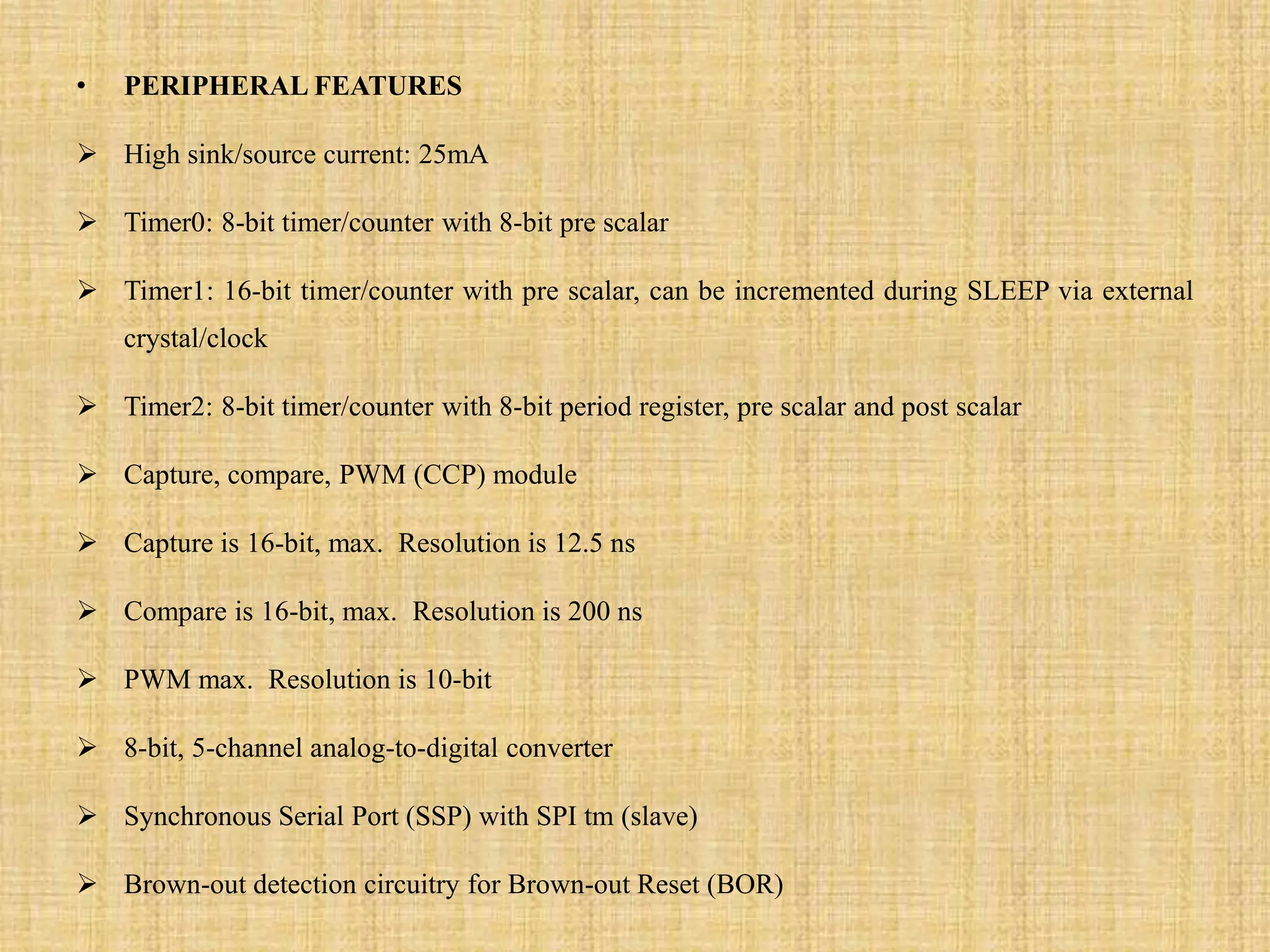
• PERIPHERAL FEATURES
 High sink/source current: 25mA
 Timer0: 8-bit timer/counter with 8-bit pre scalar
 Timer1: 16-bit timer/counter with pre scalar, can be incremented during SLEEP via external
crystal/clock
 Timer2: 8-bit timer/counter with 8-bit period register, pre scalar and post scalar
 Capture, compare, PWM (CCP) module
 Capture is 16-bit, max. Resolution is 12.5 ns
 Compare is 16-bit, max. Resolution is 200 ns
 PWM max. Resolution is 10-bit
 8-bit, 5-channel analog-to-digital converter
 Synchronous Serial Port (SSP) with SPI tm (slave)
 Brown-out detection circuitry for Brown-out Reset (BOR)
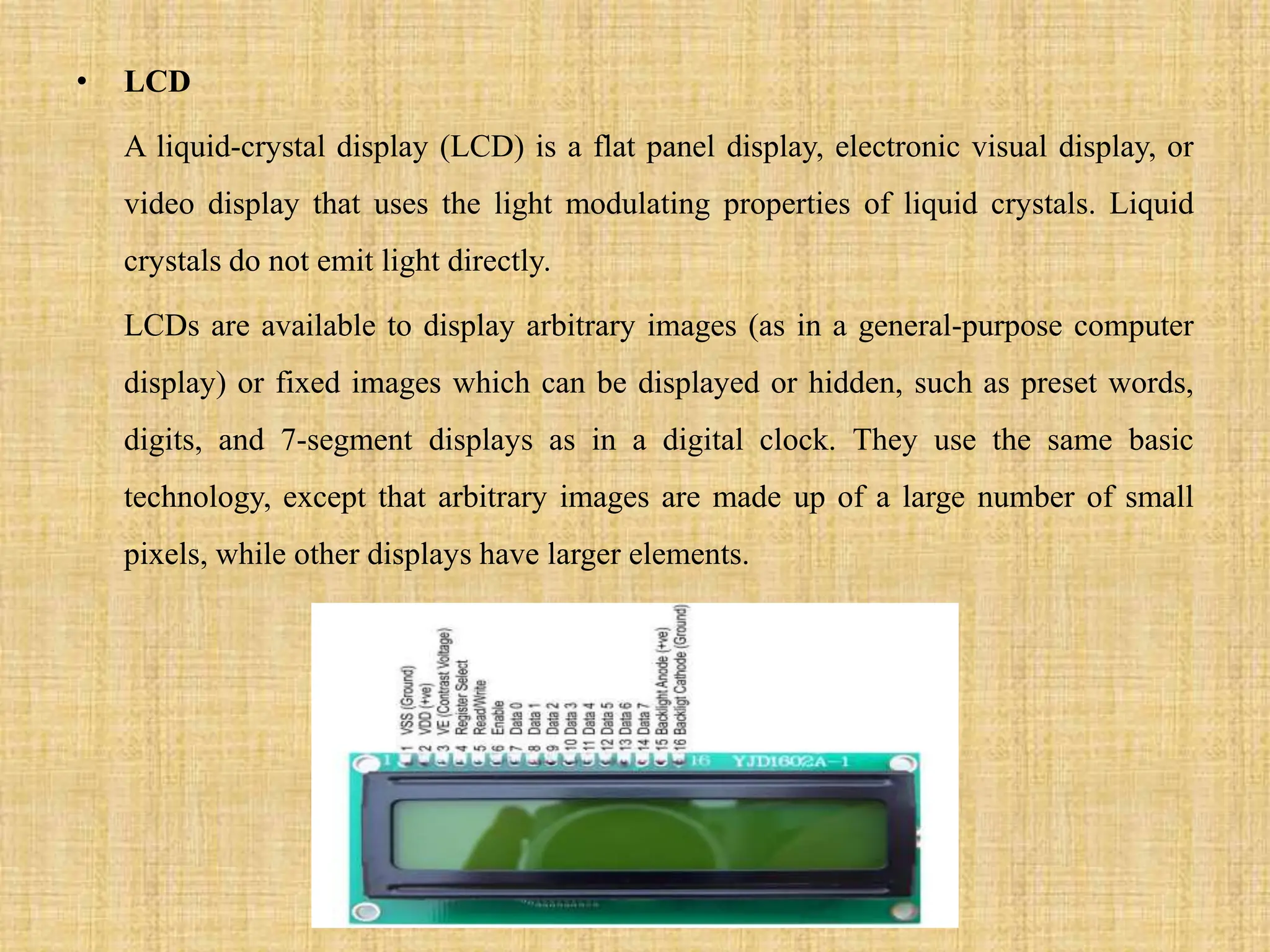
• LCD
A liquid-crystal display (LCD) is a flat panel display, electronic visual display, or
video display that uses the light modulating properties of liquid crystals. Liquid
crystals do not emit light directly.
LCDs are available to display arbitrary images (as in a general-purpose computer
display) or fixed images which can be displayed or hidden, such as preset words,
digits, and 7-segment displays as in a digital clock. They use the same basic
technology, except that arbitrary images are made up of a large number of small
pixels, while other displays have larger elements.
• LED
A light-emitting diode (LED) is a two-lead semiconductor light source. It is a pn-
junction diode, which emits light when activated.]When a suitable voltage is
applied to the leads, electrons are able to recombine with electron holes within the
device, releasing energy in the form of photons. This effect is called
electroluminescence, and the color of the light is determined by the energy band
gap of the semiconductor.
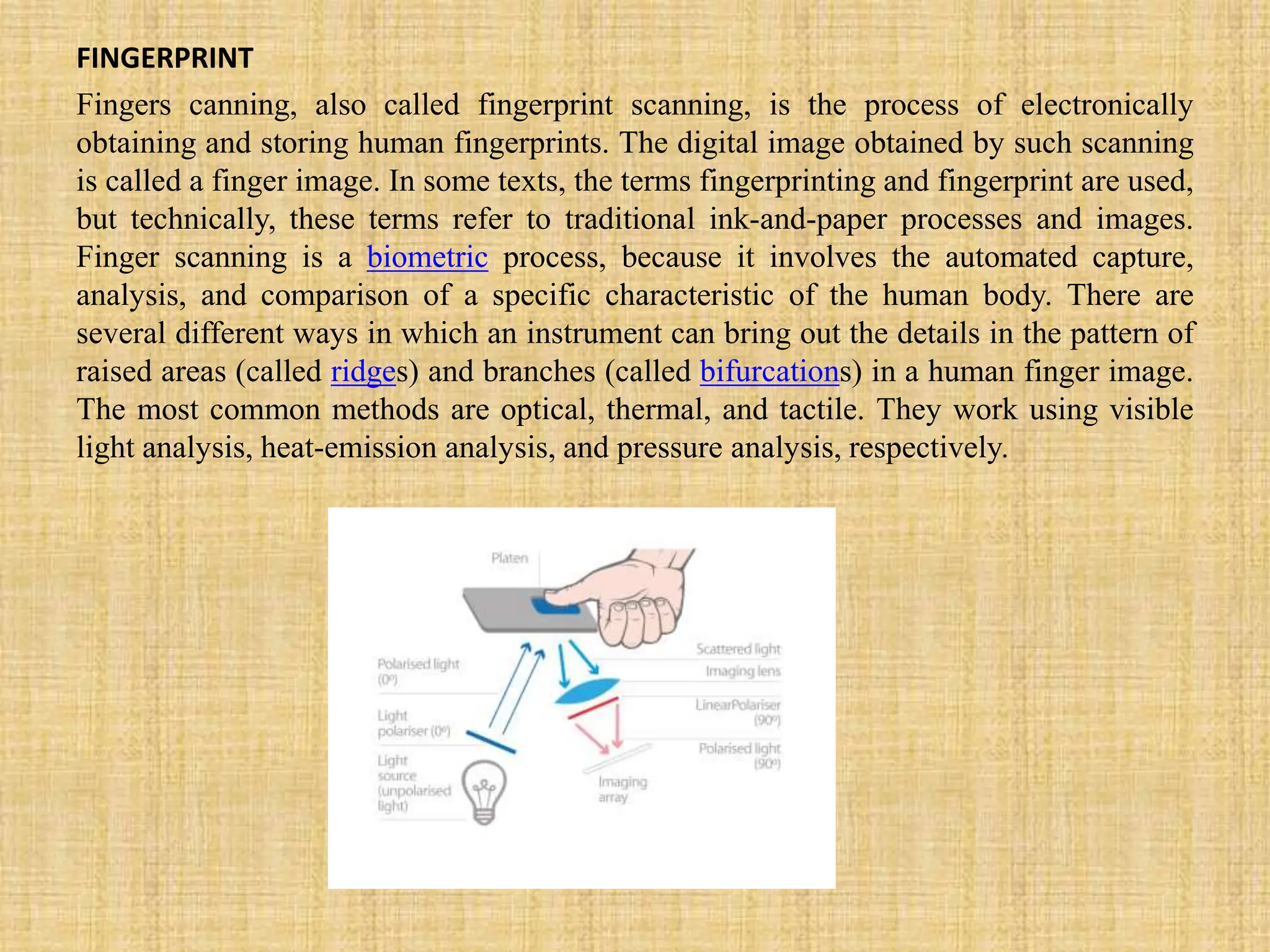
FINGERPRINT
Fingers canning, also called fingerprint scanning, is the process of electronically
obtaining and storing human fingerprints. The digital image obtained by such scanning
is called a finger image. In some texts, the terms fingerprinting and fingerprint are used,
but technically, these terms refer to traditional ink-and-paper processes and images.
Finger scanning is a biometric process, because it involves the automated capture,
analysis, and comparison of a specific characteristic of the human body. There are
several different ways in which an instrument can bring out the details in the pattern of
raised areas (called ridges) and branches (called bifurcations) in a human finger image.
The most common methods are optical, thermal, and tactile. They work using visible
light analysis, heat-emission analysis, and pressure analysis, respectively.
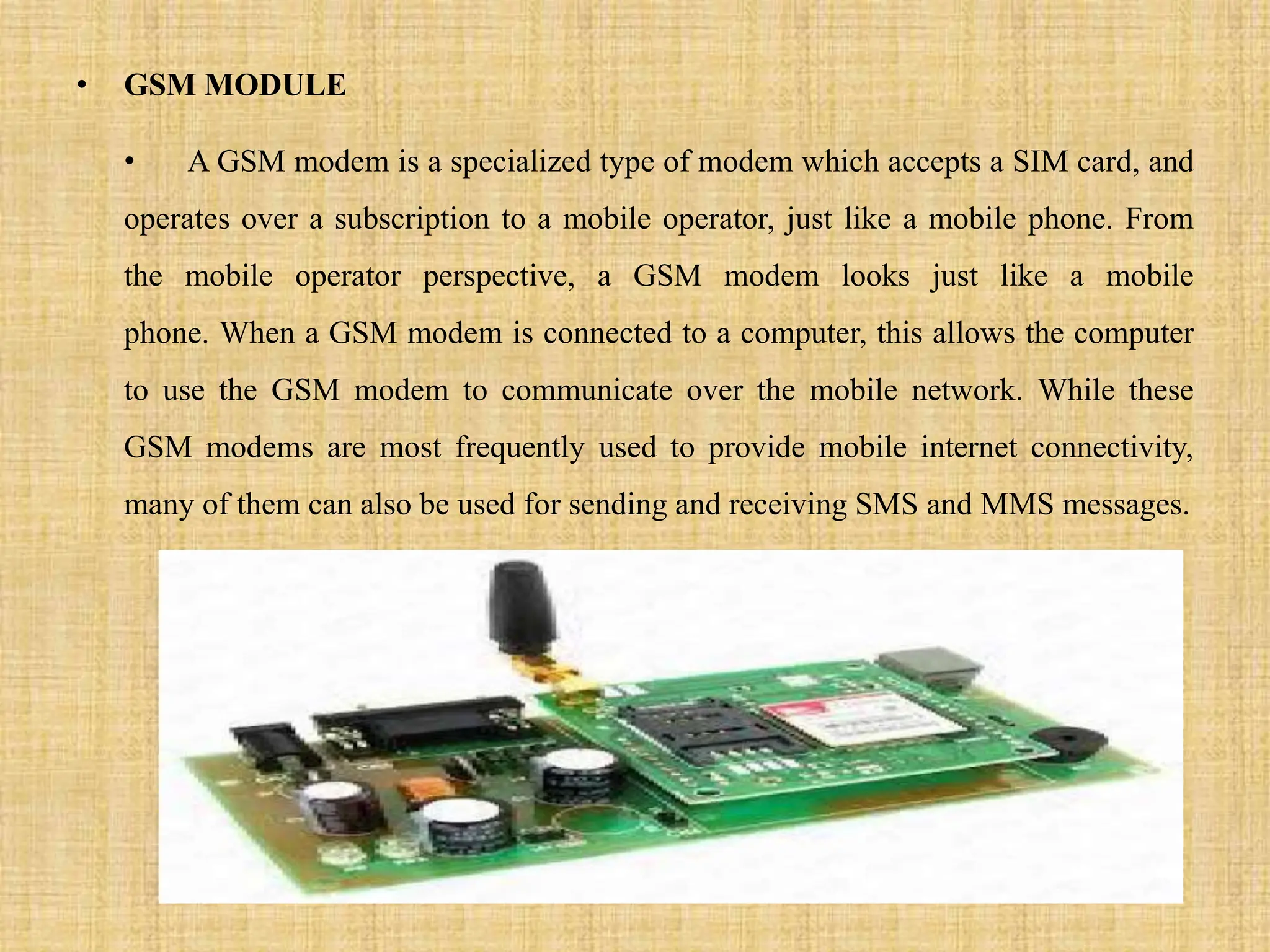
• GSM MODULE
• A GSM modem is a specialized type of modem which accepts a SIM card, and
operates over a subscription to a mobile operator, just like a mobile phone. From
the mobile operator perspective, a GSM modem looks just like a mobile
phone. When a GSM modem is connected to a computer, this allows the computer
to use the GSM modem to communicate over the mobile network. While these
GSM modems are most frequently used to provide mobile internet connectivity,
many of them can also be used for sending and receiving SMS and MMS messages.
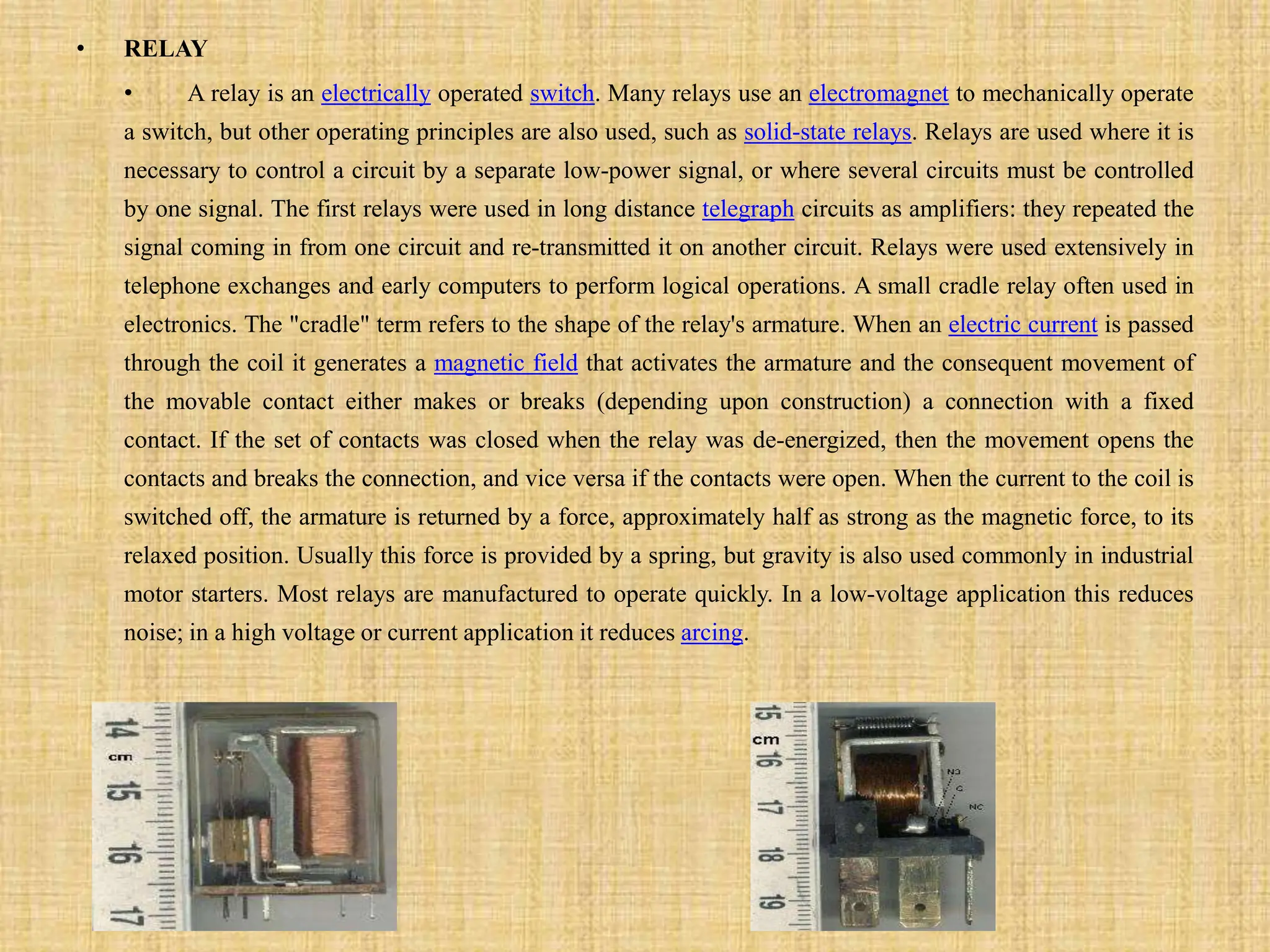
• RELAY
• A relay is an electrically operated switch. Many relays use an electromagnet to mechanically operate
a switch, but other operating principles are also used, such as solid-state relays. Relays are used where it is
necessary to control a circuit by a separate low-power signal, or where several circuits must be controlled
by one signal. The first relays were used in long distance telegraph circuits as amplifiers: they repeated the
signal coming in from one circuit and re-transmitted it on another circuit. Relays were used extensively in
telephone exchanges and early computers to perform logical operations. A small cradle relay often used in
electronics. The "cradle" term refers to the shape of the relay's armature. When an electric current is passed
through the coil it generates a magnetic field that activates the armature and the consequent movement of
the movable contact either makes or breaks (depending upon construction) a connection with a fixed
contact. If the set of contacts was closed when the relay was de-energized, then the movement opens the
contacts and breaks the connection, and vice versa if the contacts were open. When the current to the coil is
switched off, the armature is returned by a force, approximately half as strong as the magnetic force, to its
relaxed position. Usually this force is provided by a spring, but gravity is also used commonly in industrial
motor starters. Most relays are manufactured to operate quickly. In a low-voltage application this reduces
noise; in a high voltage or current application it reduces arcing.
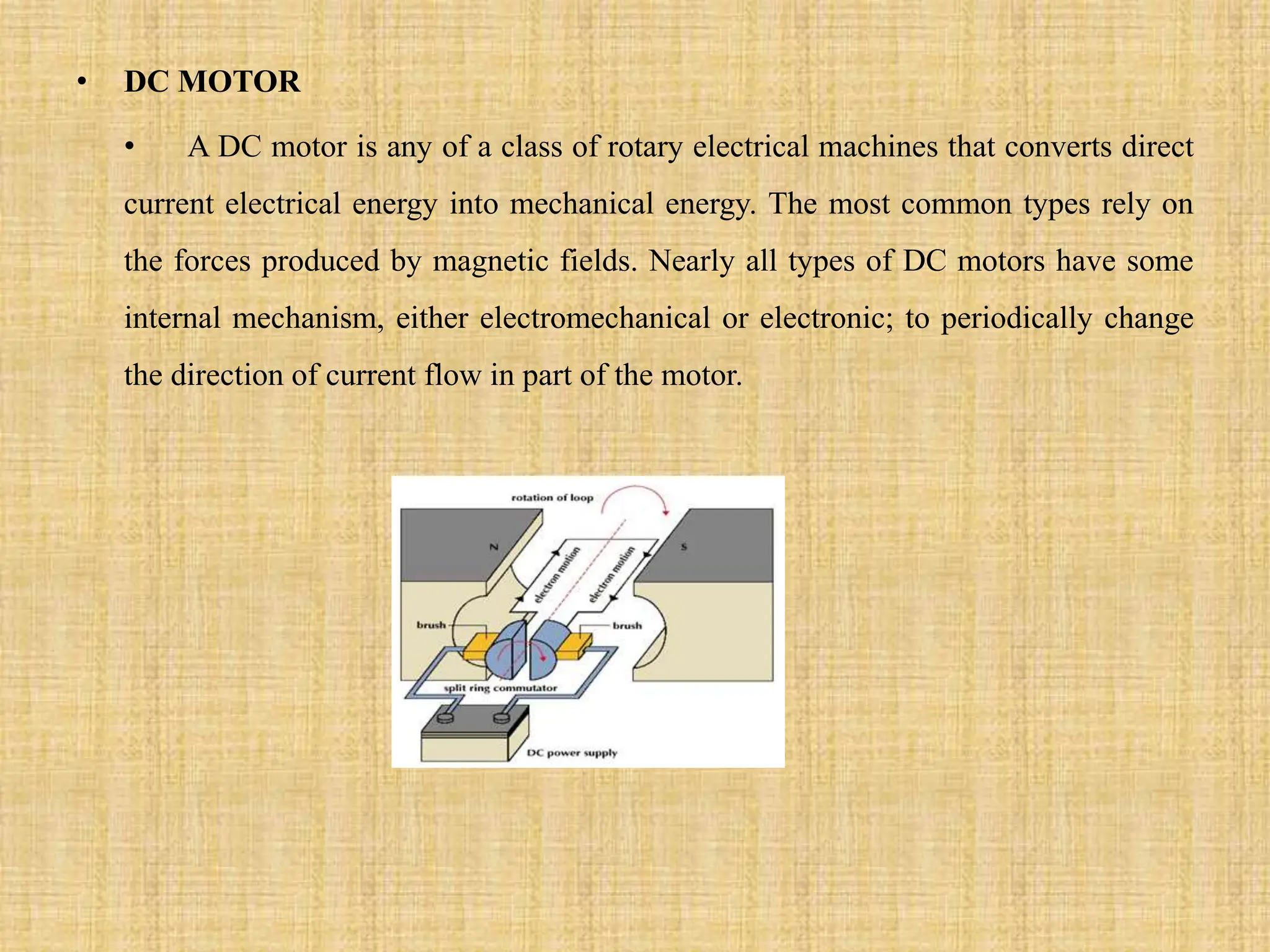
• DC MOTOR
• A DC motor is any of a class of rotary electrical machines that converts direct
current electrical energy into mechanical energy. The most common types rely on
the forces produced by magnetic fields. Nearly all types of DC motors have some
internal mechanism, either electromechanical or electronic; to periodically change
the direction of current flow in part of the motor.
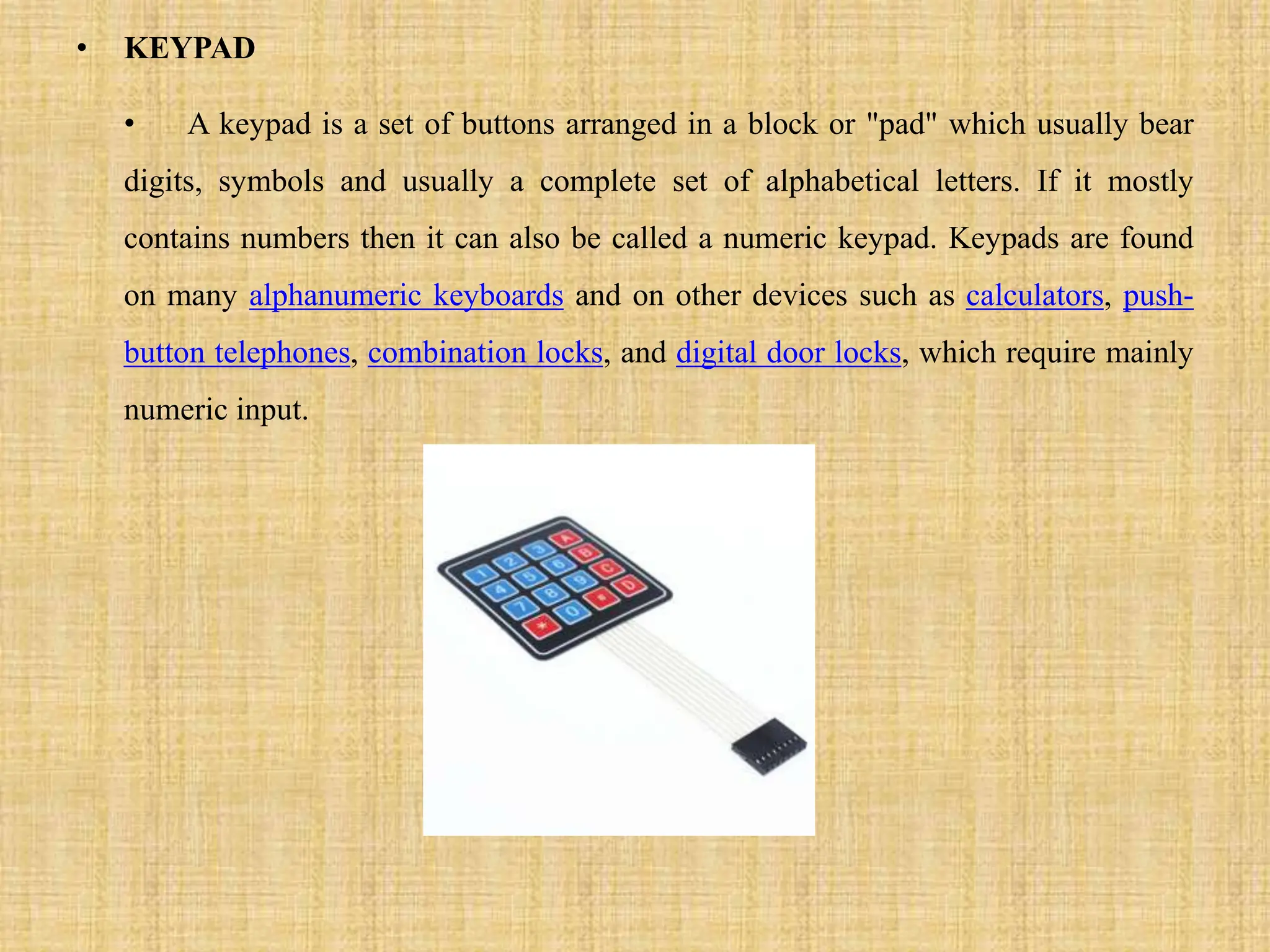
• KEYPAD
• A keypad is a set of buttons arranged in a block or "pad" which usually bear
digits, symbols and usually a complete set of alphabetical letters. If it mostly
contains numbers then it can also be called a numeric keypad. Keypads are found
on many alphanumeric keyboards and on other devices such as calculators, push-
button telephones, combination locks, and digital door locks, which require mainly
numeric input.
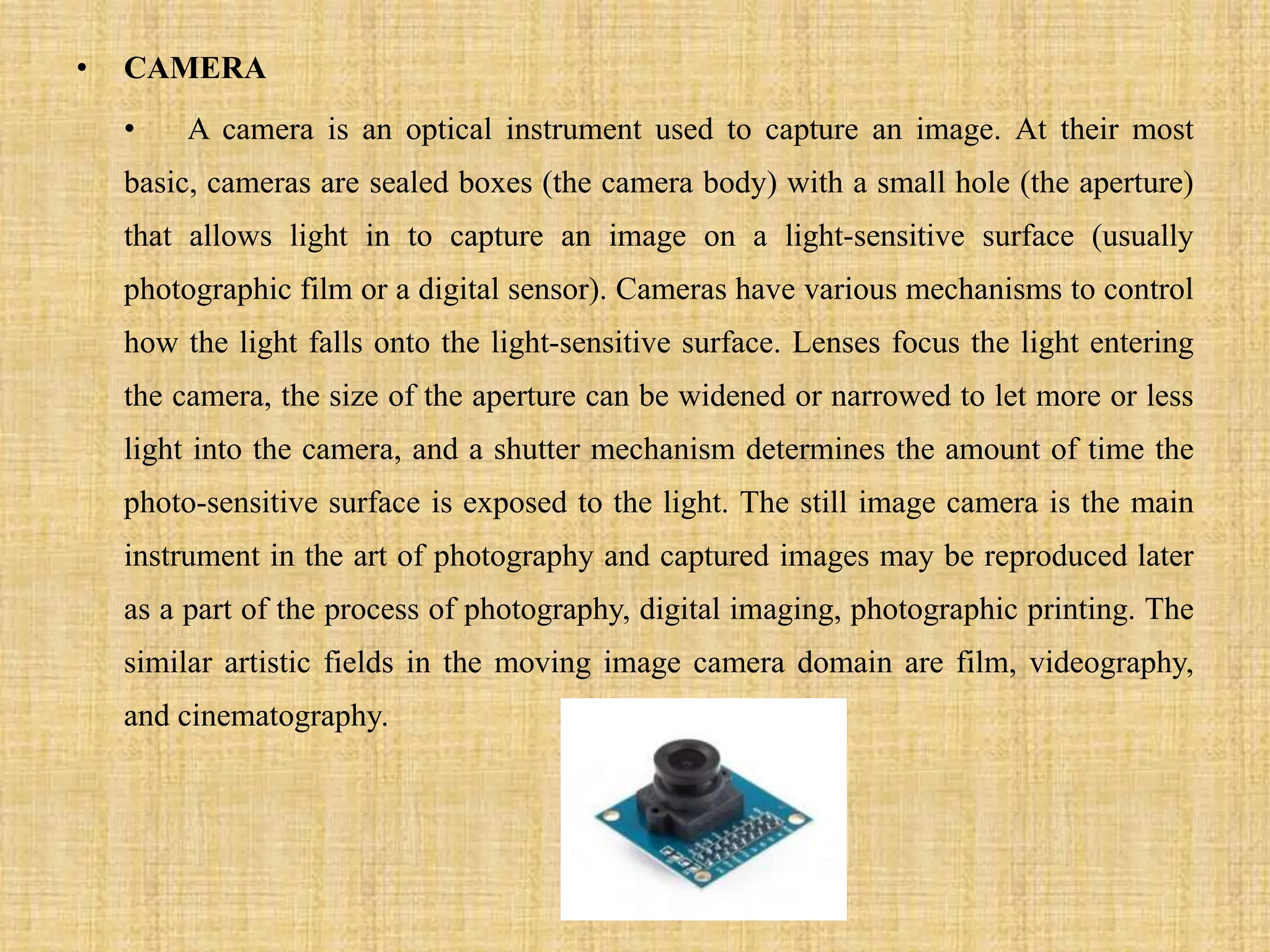
• CAMERA
• A camera is an optical instrument used to capture an image. At their most
basic, cameras are sealed boxes (the camera body) with a small hole (the aperture)
that allows light in to capture an image on a light-sensitive surface (usually
photographic film or a digital sensor). Cameras have various mechanisms to control
how the light falls onto the light-sensitive surface. Lenses focus the light entering
the camera, the size of the aperture can be widened or narrowed to let more or less
light into the camera, and a shutter mechanism determines the amount of time the
photo-sensitive surface is exposed to the light. The still image camera is the main
instrument in the art of photography and captured images may be reproduced later
as a part of the process of photography, digital imaging, photographic printing. The
similar artistic fields in the moving image camera domain are film, videography,
and cinematography.
• CONCLUSION
• After testing the system developed, we came to know that ATM prototype can
be efficiently used with fingerprint recognition. Since, password protection is not
bypassed in our system, the fingerprint recognition done after it yielded fast
response and is found to be of ease for use. Fingerprint images cannot be recreated
from templates; hence no one can misuse the system. LPC2148 and FIM3030
provide low power consumption platform. Speed of execution can be enhanced
with the use of more sophisticated microcontroller. The same hardware platform
can be used with IRIS scanner to put forward another potential biometric security to
the ATMs.
THANK YOU

FINGERPRINT BASED ATM SYSTEM...............

  • 1.
    DEPARTMENT OF EEE PresentedBy Guide By 1. 22308988 AJAY. G Mr.B.RAJU M.E 2. 22308989 AJAY .R 3. 22308990 AJAY SATHYA.S 4. 22309008 KARTHIKEYAN.M 5. 22309009 KARTHIKEYAN.R
  • 2.
  • 3.
    ABSTRACT • The mainpurpose of our system is to make online transaction more secure and user- friendly. Here we are using Fingerprint scanning biometric and iris scanning to provide access to ATM machine. Data of a fingerprint and iris is stored in Aadhar database. Bank provide authentication to the customer that can be access while performing transaction process. If the fingerprint and iris match is found in data base then transaction take place. After verification, if fingerprint and iris does not match transaction will be cancelled. Using fingerprint based ATM system user can make secure transaction. Biometric can be used to identify physical and behavioral characteristics of user fingerprints. There are many biometric devices like iris detection, face recognition, fingerprint. In our Project, we are using fingerprint biometrics and iris detection. Users fingerprint are scanned using biometric, eye ball are scanned through camera and stored in database. All fingerprints have unique characteristics and patterns. Fingerprint biometrics and camera are easy to use, cheap and most suitable for everyone. Characteristics of fingerprint and iris vary from person to person. Fingerprint and iris is a unique identity of user.
  • 4.
  • 5.
    • INTRODUCTION • FingerprintBased ATM is a desktop application where fingerprint of the user is used as a authentication. The finger print minutiae features are different for each human being so the user can be identified uniquely. Instead of using ATM card Fingerprint based ATM is safer and secure. There is no worry of losing ATM card and no need to carry ATM card in your wallet. You just have to use your fingerprint in order to do any banking transaction. The user has to login using his fingerprint and he has to enter the pin code in order to do further transaction. The user can withdraw money from his account. User can transfer money to various accounts by mentioning account number. In order to withdraw money user has to enter the amount he want to withdraw .The user must have appropriate balance in his ATM account to do transaction. User can view the balance available in his respective account.
  • 6.
    • PROPOSED SYSTEM •Design Approach This project was developed using functional design approach. It is a modular approach. Each module is a function of its own and as the modules are independent, the change in functional implementation of module will affect the functional implementation of the other modules minimally. Each authentication step in the proposed solution is identified into three independent modules for implementation purposes and integrated. The first module implements a scrambling keypad, second a color-coded password combination and finally a biometric fingerprint authentication. Each functional module consists of its own implementation and sub modules. 2.2 Detailed Design This project consists of three steps of authentication: The 6-digits ATM PIN number on a scrambling keypad, color-coded combination password identification and fingerprint recognition. A user must first register with all three before accessing his records. The user records are stored in a SQLite database in the form of rows. When a user authenticates using his account details, they are matched against the records in the database and the result (“valid” or “invalid” user) is returned. The registration and authentication processes are further explained with respective activity, sequence and architecture diagrams. 7 2.2.1 Registration The activity diagram below shows the workflow of activities for user registration process. In real world, a user swipes his debit/credit card to authenticate and use a teller machine. The bank issues these cards to users with bank accounts, so the user details are already registered with the bank. For demonstration purposes, this project stores user details entered by the user and the user needs to enter his account number to authenticate with the three steps
  • 7.
    • POWER SUPPLY Apower supply is an electronic device that supplies electric energy to an electrical load. The primary function of a power supply is to convert one form of electrical energy to another and, as a result, power supplies are sometimes referred to as electric power converters. Some power supplies are discrete, stand-alone devices, whereas others are built into larger devices along with their loads. Examples of the latter include power supplies found in desktop computers and consumer electronics devices.
  • 8.
    • TRANSFORMER A transformeris a static electrical device that transfers electrical energy between two or more circuits. A varying current in one coil of the transformer produces a varying magnetic flux, which, in turn, induces a varying electromotive force across a second coil wound around the same core. Electrical energy can be transferred between the two coils, without a metallic connection between the two circuits. Faraday's law of induction discovered in 1831 described the induced voltage effect in any coil due to changing magnetic flux encircled by the coil. Transformers are used for increasing or decreasing the alternating voltages in electric power applications, and for coupling the stages of signal processing circuits. Since the invention of the first constant-potential transformer in 1885, transformers have become essential for the transmission, distribution, and utilization of alternating current electric power. A wide range of transformer designs is encountered in electronic and electric power applications. Transformers range in size from RF transformers less than a cubic centimeter in volume, to units weighing hundreds of tons used to interconnect the power grid.
  • 9.
    • PIC 16F877AMICROCONTROLLER
  • 10.
    • HIGH PERFORMANCERISC CPU  Only 35 single word instructions to learn  All single cycle instructions except for program branches, which are two- cycle  Operating speed: DC-20 MHZ clock input DC-200 ns instruction cycle  2K x 14 words of program memory, 128 x 8 bytes of Data Memory (RAM)  Pin out compatible to PIC16C72/72A and PIC16F872  Interrupt capability  Eight-level deep hardware stack  Direct, Indirect and Relative Addressing modes
  • 11.
    • PERIPHERAL FEATURES High sink/source current: 25mA  Timer0: 8-bit timer/counter with 8-bit pre scalar  Timer1: 16-bit timer/counter with pre scalar, can be incremented during SLEEP via external crystal/clock  Timer2: 8-bit timer/counter with 8-bit period register, pre scalar and post scalar  Capture, compare, PWM (CCP) module  Capture is 16-bit, max. Resolution is 12.5 ns  Compare is 16-bit, max. Resolution is 200 ns  PWM max. Resolution is 10-bit  8-bit, 5-channel analog-to-digital converter  Synchronous Serial Port (SSP) with SPI tm (slave)  Brown-out detection circuitry for Brown-out Reset (BOR)
  • 12.
    • LCD A liquid-crystaldisplay (LCD) is a flat panel display, electronic visual display, or video display that uses the light modulating properties of liquid crystals. Liquid crystals do not emit light directly. LCDs are available to display arbitrary images (as in a general-purpose computer display) or fixed images which can be displayed or hidden, such as preset words, digits, and 7-segment displays as in a digital clock. They use the same basic technology, except that arbitrary images are made up of a large number of small pixels, while other displays have larger elements.
  • 13.
    • LED A light-emittingdiode (LED) is a two-lead semiconductor light source. It is a pn- junction diode, which emits light when activated.]When a suitable voltage is applied to the leads, electrons are able to recombine with electron holes within the device, releasing energy in the form of photons. This effect is called electroluminescence, and the color of the light is determined by the energy band gap of the semiconductor.
  • 14.
    FINGERPRINT Fingers canning, alsocalled fingerprint scanning, is the process of electronically obtaining and storing human fingerprints. The digital image obtained by such scanning is called a finger image. In some texts, the terms fingerprinting and fingerprint are used, but technically, these terms refer to traditional ink-and-paper processes and images. Finger scanning is a biometric process, because it involves the automated capture, analysis, and comparison of a specific characteristic of the human body. There are several different ways in which an instrument can bring out the details in the pattern of raised areas (called ridges) and branches (called bifurcations) in a human finger image. The most common methods are optical, thermal, and tactile. They work using visible light analysis, heat-emission analysis, and pressure analysis, respectively.
  • 15.
    • GSM MODULE •A GSM modem is a specialized type of modem which accepts a SIM card, and operates over a subscription to a mobile operator, just like a mobile phone. From the mobile operator perspective, a GSM modem looks just like a mobile phone. When a GSM modem is connected to a computer, this allows the computer to use the GSM modem to communicate over the mobile network. While these GSM modems are most frequently used to provide mobile internet connectivity, many of them can also be used for sending and receiving SMS and MMS messages.
  • 16.
    • RELAY • Arelay is an electrically operated switch. Many relays use an electromagnet to mechanically operate a switch, but other operating principles are also used, such as solid-state relays. Relays are used where it is necessary to control a circuit by a separate low-power signal, or where several circuits must be controlled by one signal. The first relays were used in long distance telegraph circuits as amplifiers: they repeated the signal coming in from one circuit and re-transmitted it on another circuit. Relays were used extensively in telephone exchanges and early computers to perform logical operations. A small cradle relay often used in electronics. The "cradle" term refers to the shape of the relay's armature. When an electric current is passed through the coil it generates a magnetic field that activates the armature and the consequent movement of the movable contact either makes or breaks (depending upon construction) a connection with a fixed contact. If the set of contacts was closed when the relay was de-energized, then the movement opens the contacts and breaks the connection, and vice versa if the contacts were open. When the current to the coil is switched off, the armature is returned by a force, approximately half as strong as the magnetic force, to its relaxed position. Usually this force is provided by a spring, but gravity is also used commonly in industrial motor starters. Most relays are manufactured to operate quickly. In a low-voltage application this reduces noise; in a high voltage or current application it reduces arcing.
  • 17.
    • DC MOTOR •A DC motor is any of a class of rotary electrical machines that converts direct current electrical energy into mechanical energy. The most common types rely on the forces produced by magnetic fields. Nearly all types of DC motors have some internal mechanism, either electromechanical or electronic; to periodically change the direction of current flow in part of the motor.
  • 18.
    • KEYPAD • Akeypad is a set of buttons arranged in a block or "pad" which usually bear digits, symbols and usually a complete set of alphabetical letters. If it mostly contains numbers then it can also be called a numeric keypad. Keypads are found on many alphanumeric keyboards and on other devices such as calculators, push- button telephones, combination locks, and digital door locks, which require mainly numeric input.
  • 19.
    • CAMERA • Acamera is an optical instrument used to capture an image. At their most basic, cameras are sealed boxes (the camera body) with a small hole (the aperture) that allows light in to capture an image on a light-sensitive surface (usually photographic film or a digital sensor). Cameras have various mechanisms to control how the light falls onto the light-sensitive surface. Lenses focus the light entering the camera, the size of the aperture can be widened or narrowed to let more or less light into the camera, and a shutter mechanism determines the amount of time the photo-sensitive surface is exposed to the light. The still image camera is the main instrument in the art of photography and captured images may be reproduced later as a part of the process of photography, digital imaging, photographic printing. The similar artistic fields in the moving image camera domain are film, videography, and cinematography.
  • 20.
    • CONCLUSION • Aftertesting the system developed, we came to know that ATM prototype can be efficiently used with fingerprint recognition. Since, password protection is not bypassed in our system, the fingerprint recognition done after it yielded fast response and is found to be of ease for use. Fingerprint images cannot be recreated from templates; hence no one can misuse the system. LPC2148 and FIM3030 provide low power consumption platform. Speed of execution can be enhanced with the use of more sophisticated microcontroller. The same hardware platform can be used with IRIS scanner to put forward another potential biometric security to the ATMs.
  • 21.