Finding Scholarly Sources 
SOCI 3680 
The Logic of Social Inquiry: Qualitative Methods 
October 15th, 2014 
library.yorku.ca
Research Help 
• Meet with a subject librarian in person. 
• Ask a question via email, chat or by 
phone. 
• Take part in a library workshop to hone 
your research skills. 
Don’t be shy, we’re here to help!
Visit the Library’s homepage 
www.library.yorku.ca 
1 
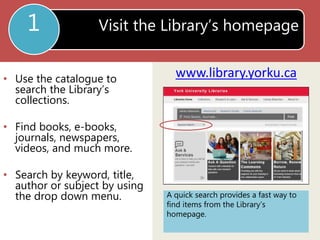
• Use the catalogue to 
search the Library’s 
collections. 
• Find books, e-books, 
journals, newspapers, 
videos, and much more. 
• Search by keyword, title, 
author or subject by using 
the drop down menu. A quick search provides a fast way to 
find items from the Library’s 
homepage.
Search the catalogue 
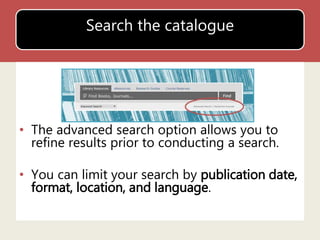
• The advanced search option allows you to 
refine results prior to conducting a search. 
• You can limit your search by publication date, 
format, location, and language.
Search the catalogue (advanced) 
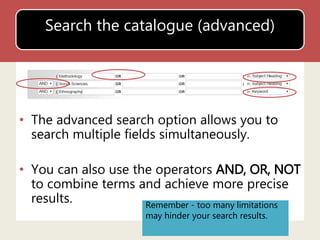
• The advanced search option allows you to 
search multiple fields simultaneously. 
• You can also use the operators AND, OR, NOT 
to combine terms and achieve more precise 
results. Remember - too many limitations 
may hinder your search results.
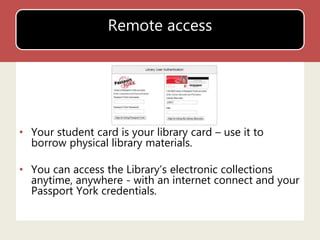
Remote access 
• Your student card is your library card – use it to 
borrow physical library materials. 
• You can access the Library’s electronic collections 
anytime, anywhere - with an internet connect and your 
Passport York credentials.
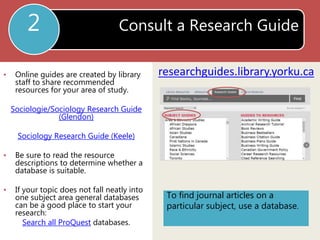
Consult a Research Guide 
researchguides.library.yorku.ca 
2 
• Online guides are created by library 
staff to share recommended 
resources for your area of study. 
Sociologie/Sociology Research Guide 
(Glendon) 
Sociology Research Guide (Keele) 
• Be sure to read the resource 
descriptions to determine whether a 
database is suitable. 
• If your topic does not fall neatly into 
one subject area general databases 
can be a good place to start your 
research: 
Search all ProQuest databases. 
To find journal articles on a 
particular subject, use a database.
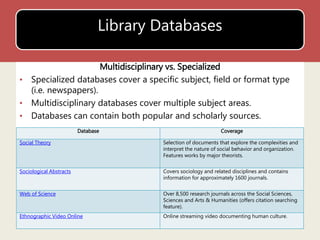
Library Databases 
Multidisciplinary vs. Specialized 
• Specialized databases cover a specific subject, field or format type 
(i.e. newspapers). 
• Multidisciplinary databases cover multiple subject areas. 
• Databases can contain both popular and scholarly sources. 
Database Coverage 
Social Theory Selection of documents that explore the complexities and 
interpret the nature of social behavior and organization. 
Features works by major theorists. 
Sociological Abstracts Covers sociology and related disciplines and contains 
information for approximately 1600 journals. 
Web of Science Over 8,500 research journals across the Social Sciences, 
Sciences and Arts & Humanities (offers citation searching 
feature). 
Ethnographic Video Online Online streaming video documenting human culture.
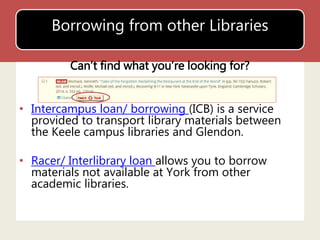
Borrowing from other Libraries 
Can’t find what you’re looking for? 
• Intercampus loan/ borrowing (ICB) is a service 
provided to transport library materials between 
the Keele campus libraries and Glendon. 
• Racer/ Interlibrary loan allows you to borrow 
materials not available at York from other 
academic libraries.
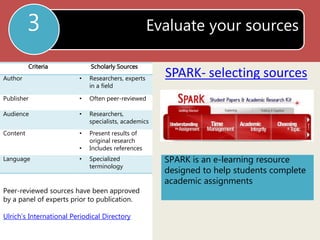
Evaluate your sources 
SPARK- selecting sources 
3 
Criteria Scholarly Sources 
Author • Researchers, experts 
in a field 
Publisher • Often peer-reviewed 
Audience • Researchers, 
specialists, academics 
Content • Present results of 
original research 
• Includes references 
Language • Specialized 
terminology 
Peer-reviewed sources have been approved 
by a panel of experts prior to publication. 
Ulrich’s International Periodical Directory 
SPARK is an e-learning resource 
designed to help students complete 
academic assignments
Research Evaluation and Journal Impact 
Web of Science 
• Search by cited author and create citation reports 
(provide information about an author’s publishing 
output). 
• Cited Reference Search – finds articles that cite the 
article being searched. 
Journal Citation Reports 
• Allows you to compare and evaluate some of the 
world's leading journals. 
Scientific Journal Rankings 
• Provides journal and country scientific indicators to 
allow you to compare journals (scopus database).
Cite your sources 
Citing Research Guide 
4 
Offers links to resources and general 
advice about creating bibliographies. 
• You can find citation style 
manuals by searching the library 
catalogue. 
Online Citation Management Tools 
• Allow you to generate 
bibliographies, organize your 
research, and share with others. 
Examples: 
• Refworks 
• Mendeley 
• Zotero 
Be sure to verify your work, 
computers can make mistakes.
Feedback 
Class Survey 
Your opinion matters! 
Please take a minute to share your feedback. Your comments will 
help us make improvements to future sessions. 
Thank you! 
Leigh Jackson, Librarian 
Leslie Frost Library 
leighj@yorku.ca

Finding library resources soci 3680

  • 1.
    Finding Scholarly Sources SOCI 3680 The Logic of Social Inquiry: Qualitative Methods October 15th, 2014 library.yorku.ca
  • 2.
    Research Help •Meet with a subject librarian in person. • Ask a question via email, chat or by phone. • Take part in a library workshop to hone your research skills. Don’t be shy, we’re here to help!
  • 3.
    Visit the Library’shomepage www.library.yorku.ca 1 • Use the catalogue to search the Library’s collections. • Find books, e-books, journals, newspapers, videos, and much more. • Search by keyword, title, author or subject by using the drop down menu. A quick search provides a fast way to find items from the Library’s homepage.
  • 4.
    Search the catalogue • The advanced search option allows you to refine results prior to conducting a search. • You can limit your search by publication date, format, location, and language.
  • 5.
    Search the catalogue(advanced) • The advanced search option allows you to search multiple fields simultaneously. • You can also use the operators AND, OR, NOT to combine terms and achieve more precise results. Remember - too many limitations may hinder your search results.
  • 6.
    Remote access •Your student card is your library card – use it to borrow physical library materials. • You can access the Library’s electronic collections anytime, anywhere - with an internet connect and your Passport York credentials.
  • 7.
    Consult a ResearchGuide researchguides.library.yorku.ca 2 • Online guides are created by library staff to share recommended resources for your area of study. Sociologie/Sociology Research Guide (Glendon) Sociology Research Guide (Keele) • Be sure to read the resource descriptions to determine whether a database is suitable. • If your topic does not fall neatly into one subject area general databases can be a good place to start your research: Search all ProQuest databases. To find journal articles on a particular subject, use a database.
  • 8.
    Library Databases Multidisciplinaryvs. Specialized • Specialized databases cover a specific subject, field or format type (i.e. newspapers). • Multidisciplinary databases cover multiple subject areas. • Databases can contain both popular and scholarly sources. Database Coverage Social Theory Selection of documents that explore the complexities and interpret the nature of social behavior and organization. Features works by major theorists. Sociological Abstracts Covers sociology and related disciplines and contains information for approximately 1600 journals. Web of Science Over 8,500 research journals across the Social Sciences, Sciences and Arts & Humanities (offers citation searching feature). Ethnographic Video Online Online streaming video documenting human culture.
  • 9.
    Borrowing from otherLibraries Can’t find what you’re looking for? • Intercampus loan/ borrowing (ICB) is a service provided to transport library materials between the Keele campus libraries and Glendon. • Racer/ Interlibrary loan allows you to borrow materials not available at York from other academic libraries.
  • 10.
    Evaluate your sources SPARK- selecting sources 3 Criteria Scholarly Sources Author • Researchers, experts in a field Publisher • Often peer-reviewed Audience • Researchers, specialists, academics Content • Present results of original research • Includes references Language • Specialized terminology Peer-reviewed sources have been approved by a panel of experts prior to publication. Ulrich’s International Periodical Directory SPARK is an e-learning resource designed to help students complete academic assignments
  • 11.
    Research Evaluation andJournal Impact Web of Science • Search by cited author and create citation reports (provide information about an author’s publishing output). • Cited Reference Search – finds articles that cite the article being searched. Journal Citation Reports • Allows you to compare and evaluate some of the world's leading journals. Scientific Journal Rankings • Provides journal and country scientific indicators to allow you to compare journals (scopus database).
  • 12.
    Cite your sources Citing Research Guide 4 Offers links to resources and general advice about creating bibliographies. • You can find citation style manuals by searching the library catalogue. Online Citation Management Tools • Allow you to generate bibliographies, organize your research, and share with others. Examples: • Refworks • Mendeley • Zotero Be sure to verify your work, computers can make mistakes.
  • 13.
    Feedback Class Survey Your opinion matters! Please take a minute to share your feedback. Your comments will help us make improvements to future sessions. Thank you! Leigh Jackson, Librarian Leslie Frost Library leighj@yorku.ca