Library & Learning Centre


Doing your literature review:
       an overview
            Katy Jordan
     Librarian, Social & Policy
             Sciences
Outline of session
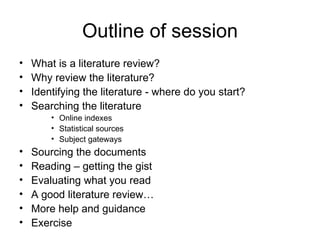
•   What is a literature review?
•   Why review the literature?
•   Identifying the literature - where do you start?
•   Searching the literature
        • Online indexes
        • Statistical sources
        • Subject gateways
•   Sourcing the documents
•   Reading – getting the gist
•   Evaluating what you read
•   A good literature review…
•   More help and guidance
•   Exercise
What is a literature review?
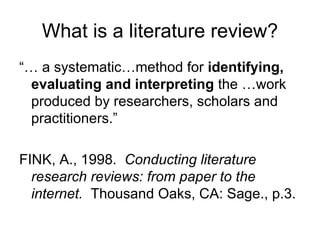
“… a systematic…method for identifying,
  evaluating and interpreting the …work
  produced by researchers, scholars and
  practitioners.”

FINK, A., 1998. Conducting literature
  research reviews: from paper to the
  internet. Thousand Oaks, CA: Sage., p.3.
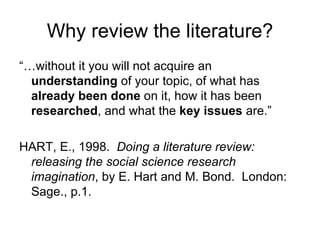
Why review the literature?
“…without it you will not acquire an
  understanding of your topic, of what has
  already been done on it, how it has been
  researched, and what the key issues are.”

HART, E., 1998. Doing a literature review:
 releasing the social science research
 imagination, by E. Hart and M. Bond. London:
 Sage., p.1.
Identifying the literature – where do
              you start?
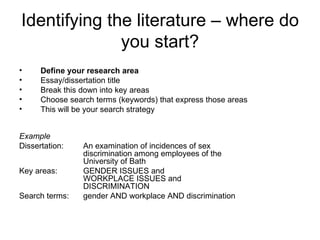
•     Define your research area
•     Essay/dissertation title
•     Break this down into key areas
•     Choose search terms (keywords) that express those areas
•     This will be your search strategy


Example
Dissertation:    An examination of incidences of sex
                 discrimination among employees of the
                 University of Bath
Key areas:       GENDER ISSUES and
                 WORKPLACE ISSUES and
                 DISCRIMINATION
Search terms:    gender AND workplace AND discrimination
Identifying the literature – where do
              you start?
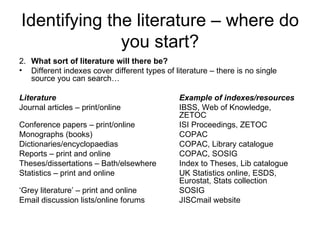
2. What sort of literature will there be?
• Different indexes cover different types of literature – there is no single
   source you can search…

Literature                                     Example of indexes/resources
Journal articles – print/online                IBSS, Web of Knowledge,
                                               ZETOC
Conference papers – print/online               ISI Proceedings, ZETOC
Monographs (books)                             COPAC
Dictionaries/encyclopaedias                    COPAC, Library catalogue
Reports – print and online                     COPAC, SOSIG
Theses/dissertations – Bath/elsewhere          Index to Theses, Lib catalogue
Statistics – print and online                  UK Statistics online, ESDS,
                                               Eurostat, Stats collection
‘Grey literature’ – print and online           SOSIG
Email discussion lists/online forums           JISCmail website
Identifying the literature – where do
              you start?
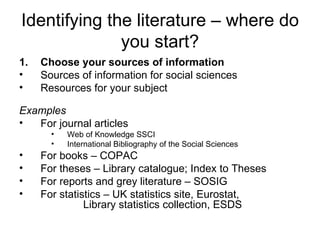
1.   Choose your sources of information
•    Sources of information for social sciences
•    Resources for your subject

Examples
•  For journal articles
       •   Web of Knowledge SSCI
       •   International Bibliography of the Social Sciences
•    For books – COPAC
•    For theses – Library catalogue; Index to Theses
•    For reports and grey literature – SOSIG
•    For statistics – UK statistics site, Eurostat,
               Library statistics collection, ESDS
Searching the literature
Sample searches
• Web of Knowledge
• COPAC
• UK Statistics
• SOSIG
Source your documents
From an online index
• Available online? – click on Links button
• Available in Library? – click on Links button
OR if your online index doesn’t have the Links
  button
• Available online? – check the A-Z of e-journals
• Available in Library? – check the Library
  catalogue
IF your document is not online or in the Library
• Use Inter-Library Loans to get a photocopy or
  borrow a book from the British Library
Reading - getting the gist
• Check the introduction, conclusion,
  abstract or executive summary for the
  main points
• Check contents pages of books and
  reports – pick out relevant
  chapters/sections
• Use the index of books or reports
• First or last sentences of paragraphs often
  summarise
Evaluating what you read
Think about…

• Relevance to your topic
• Intended audience
• Currency of the information
• Coverage of the topic that the information
  provides
• Accuracy of the information
• Authority of the author or information source
• Level of objectivity of the author
Record your sources
• Download references from online indexes
• Keep systematic notes of the full records – use A guide
  to citing references
• This will form the basis of your bibliography for your
  dissertation
• A good method is bibliographic software – the SORTED
  programme offers training in
       • Reference manager
       • Endnote
• Keep a note of the content of each document
• e.g. ‘Includes discussion of the idea of originality in
  postgraduate research projects.’
A good literature review…
• Goes beyond simply listing relevant literature
• Is a critical essay
• Refers to the bibliography at the end of your
  dissertation
• Assesses the range of literature available
• Is a critical summary of the literature
• Examines the background against which your
  own research is set
• Forms a significant section of your dissertation
A good literature review…
• Offers opinions and personal response to
  the different writings
• Relates different writings to each other,
  compares and contrasts
• Does not take the literature at face value
• Shows an awareness of the theories and
  values that underpin the research
• Uses particular language: authors assert,
  argue, state, conclude, contend
More help and guidance
• Books on social science research
  techniques at 300.001.5
• Resources for your subject
• A guide to citing references
• Your librarian in L5.01
• Your dissertation supervisor
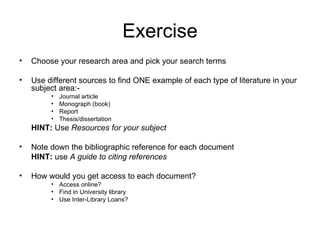
Exercise
•   Choose your research area and pick your search terms

•   Use different sources to find ONE example of each type of literature in your
    subject area:-
         •   Journal article
         •   Monograph (book)
         •   Report
         •   Thesis/dissertation
    HINT: Use Resources for your subject

•   Note down the bibliographic reference for each document
    HINT: use A guide to citing references

•   How would you get access to each document?
         • Access online?
         • Find in University library
         • Use Inter-Library Loans?

Sps doing your literature review

  • 1.
    Library & LearningCentre Doing your literature review: an overview Katy Jordan Librarian, Social & Policy Sciences
  • 2.
    Outline of session • What is a literature review? • Why review the literature? • Identifying the literature - where do you start? • Searching the literature • Online indexes • Statistical sources • Subject gateways • Sourcing the documents • Reading – getting the gist • Evaluating what you read • A good literature review… • More help and guidance • Exercise
  • 3.
    What is aliterature review? “… a systematic…method for identifying, evaluating and interpreting the …work produced by researchers, scholars and practitioners.” FINK, A., 1998. Conducting literature research reviews: from paper to the internet. Thousand Oaks, CA: Sage., p.3.
  • 4.
    Why review theliterature? “…without it you will not acquire an understanding of your topic, of what has already been done on it, how it has been researched, and what the key issues are.” HART, E., 1998. Doing a literature review: releasing the social science research imagination, by E. Hart and M. Bond. London: Sage., p.1.
  • 5.
    Identifying the literature– where do you start? • Define your research area • Essay/dissertation title • Break this down into key areas • Choose search terms (keywords) that express those areas • This will be your search strategy Example Dissertation: An examination of incidences of sex discrimination among employees of the University of Bath Key areas: GENDER ISSUES and WORKPLACE ISSUES and DISCRIMINATION Search terms: gender AND workplace AND discrimination
  • 6.
    Identifying the literature– where do you start? 2. What sort of literature will there be? • Different indexes cover different types of literature – there is no single source you can search… Literature Example of indexes/resources Journal articles – print/online IBSS, Web of Knowledge, ZETOC Conference papers – print/online ISI Proceedings, ZETOC Monographs (books) COPAC Dictionaries/encyclopaedias COPAC, Library catalogue Reports – print and online COPAC, SOSIG Theses/dissertations – Bath/elsewhere Index to Theses, Lib catalogue Statistics – print and online UK Statistics online, ESDS, Eurostat, Stats collection ‘Grey literature’ – print and online SOSIG Email discussion lists/online forums JISCmail website
  • 7.
    Identifying the literature– where do you start? 1. Choose your sources of information • Sources of information for social sciences • Resources for your subject Examples • For journal articles • Web of Knowledge SSCI • International Bibliography of the Social Sciences • For books – COPAC • For theses – Library catalogue; Index to Theses • For reports and grey literature – SOSIG • For statistics – UK statistics site, Eurostat, Library statistics collection, ESDS
  • 8.
    Searching the literature Samplesearches • Web of Knowledge • COPAC • UK Statistics • SOSIG
  • 9.
    Source your documents Froman online index • Available online? – click on Links button • Available in Library? – click on Links button OR if your online index doesn’t have the Links button • Available online? – check the A-Z of e-journals • Available in Library? – check the Library catalogue IF your document is not online or in the Library • Use Inter-Library Loans to get a photocopy or borrow a book from the British Library
  • 10.
    Reading - gettingthe gist • Check the introduction, conclusion, abstract or executive summary for the main points • Check contents pages of books and reports – pick out relevant chapters/sections • Use the index of books or reports • First or last sentences of paragraphs often summarise
  • 11.
    Evaluating what youread Think about… • Relevance to your topic • Intended audience • Currency of the information • Coverage of the topic that the information provides • Accuracy of the information • Authority of the author or information source • Level of objectivity of the author
  • 12.
    Record your sources •Download references from online indexes • Keep systematic notes of the full records – use A guide to citing references • This will form the basis of your bibliography for your dissertation • A good method is bibliographic software – the SORTED programme offers training in • Reference manager • Endnote • Keep a note of the content of each document • e.g. ‘Includes discussion of the idea of originality in postgraduate research projects.’
  • 13.
    A good literaturereview… • Goes beyond simply listing relevant literature • Is a critical essay • Refers to the bibliography at the end of your dissertation • Assesses the range of literature available • Is a critical summary of the literature • Examines the background against which your own research is set • Forms a significant section of your dissertation
  • 14.
    A good literaturereview… • Offers opinions and personal response to the different writings • Relates different writings to each other, compares and contrasts • Does not take the literature at face value • Shows an awareness of the theories and values that underpin the research • Uses particular language: authors assert, argue, state, conclude, contend
  • 15.
    More help andguidance • Books on social science research techniques at 300.001.5 • Resources for your subject • A guide to citing references • Your librarian in L5.01 • Your dissertation supervisor
  • 16.
    Exercise • Choose your research area and pick your search terms • Use different sources to find ONE example of each type of literature in your subject area:- • Journal article • Monograph (book) • Report • Thesis/dissertation HINT: Use Resources for your subject • Note down the bibliographic reference for each document HINT: use A guide to citing references • How would you get access to each document? • Access online? • Find in University library • Use Inter-Library Loans?