-- Research Process Checklist
-- Scholarly & Non-Scholarly Sources
-- Article Comparison
-- Analyze & Evaluate Resources
-- Primary & Secondary Sources
-- Types of Databases
-- Analyze Internet Sources
1
Purpose: To introduce library research strategies
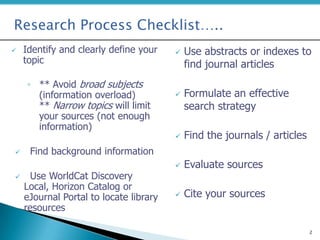
Research Process Checklist…..
 Use abstracts or indexes to
find journal articles
 Formulate an effective
search strategy
 Find the journals / articles
 Evaluate sources
 Cite your sources
 Identify and clearly define your
topic
◦ ** Avoid broad subjects
(information overload)
** Narrow topics will limit
your sources (not enough
information)
 Find background information
 Use WorldCat Discovery
Local, Horizon Catalog or
eJournal Portal to locate library
resources
2
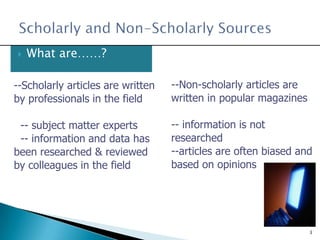
--Non-scholarly articles are
written in popular magazines
-- information is not
researched
--articles are often biased and
based on opinions
--Scholarly articles are written
by professionals in the field
-- subject matter experts
-- information and data has
been researched & reviewed
by colleagues in the field
 What are……?
3
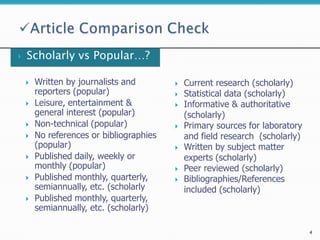
 Written by journalists and
reporters (popular)
 Leisure, entertainment &
general interest (popular)
 Non-technical (popular)
 No references or bibliographies
(popular)
 Published daily, weekly or
monthly (popular)
 Published monthly, quarterly,
semiannually, etc. (scholarly
 Published monthly, quarterly,
semiannually, etc. (scholarly)
 Current research (scholarly)
 Statistical data (scholarly)
 Informative & authoritative
(scholarly)
 Primary sources for laboratory
and field research (scholarly)
 Written by subject matter
experts (scholarly)
 Peer reviewed (scholarly)
 Bibliographies/References
included (scholarly)
 Scholarly vs Popular…?
4
1. Primary sources are first-
hand accounts of history
◦ Interviews, speeches or
personal narratives
◦ Photos, artifacts,
manuscripts or original
works
◦ Biographies
◦ Autobiographies
◦ Census, government or
historical documents
◦ Statistical data or
surveys
2. Secondary sources
are interpretations of primary
sources. Original research or
work has been analyzed and
evaluated
◦ Reviews, monographs
◦ Literary criticism
◦ Encyclopedias, dictionaries,
handbooks, etc
5
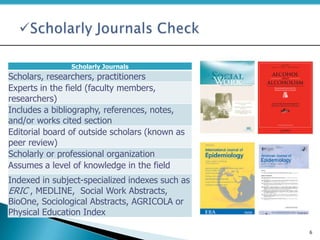
Scholarly Journals
Scholars, researchers, practitioners
Experts in the field (faculty members,
researchers)
Includes a bibliography, references, notes,
and/or works cited section
Editorial board of outside scholars (known as
peer review)
Scholarly or professional organization
Assumes a level of knowledge in the field
Indexed in subject-specialized indexes such as
ERIC , MEDLINE, Social Work Abstracts,
BioOne, Sociological Abstracts, AGRICOLA or
Physical Education Index
6
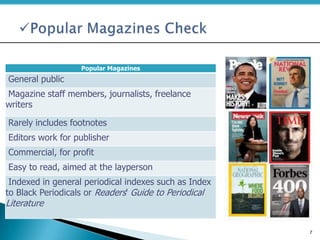
Popular Magazines
General public
Magazine staff members, journalists, freelance
writers
Rarely includes footnotes
Editors work for publisher
Commercial, for profit
Easy to read, aimed at the layperson
Indexed in general periodical indexes such as Index
to Black Periodicals or Readers' Guide to Periodical
Literature
7
Review and Evaluation Checklist
Have you selected primary or secondary sources?
Are your sources informative, authoritative, relevant,
objective & comprehensive?
Are your reference books subject specific?
Are your articles written by subject matter experts?
Are they peer reviewed?
Has the source been cited before?
8
 Full text databases - full text databases contain the entire
journal article and abstract
 Topics are subject specific or multidisciplinary
 Examples: BioOne, SAGE eJournals, LexisNexis,
SpringerLink eJournals, JSTOR, ACM Digital Library,
SPIE, Science Direct Subject Collections, EBSCOHost
Databases, ProQuest Databases, Oxford eJournals, Optics
InfoBase, Project Muse Basic Research and Annual
Reviews
9
 Abstract Databases - are not full text
 Provide citation or abstract information
 Topics are subject specific or multidisciplinary
◦ Examples: ERIC, FIRSTSEARCH, MEDLINE, AGRICOLA,
PROQUEST ABSTRACT Databases (ASFA: Aquatic Science
and Fisheries Abstracts, BioOne, Applied Social Sciences
Index and Abstracts, Physical Education Index, Design
and Applied Arts Index and more ), Social Work
Abstracts & PsyInfo
10
 Full collection of eBooks - the entire book is
available online
◦ Examples: Springer eBooks, ebrary, Sage
eReference, EBSCO eBooks, American Chemical
Society, CREDO Reference, Encyclopedia of Social
Work, Psychiatry Online and McGraw Hill Access
Science
11
12
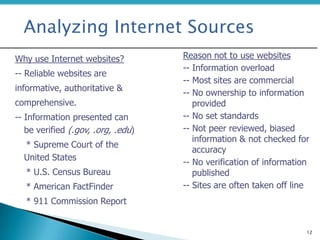
Why use Internet websites?
-- Reliable websites are
informative, authoritative &
comprehensive.
-- Information presented can
be verified (.gov, .org, .edu)
* Supreme Court of the
United States
* U.S. Census Bureau
* American FactFinder
* 911 Commission Report
Reason not to use websites
-- Information overload
-- Most sites are commercial
-- No ownership to information
provided
-- No set standards
-- Not peer reviewed, biased
information & not checked for
accuracy
-- No verification of information
published
-- Sites are often taken off line
Analyzing Internet Sources
13
CONTACT
(302) 857-6180 Reference and Research Consultation
(302) 857-6191 Circulation/Reserves
(302) 857-6193 / 7909 Interlibrary Loan
(302) 857-6135 Technology

Library information research strategies overview

  • 1.
    -- Research ProcessChecklist -- Scholarly & Non-Scholarly Sources -- Article Comparison -- Analyze & Evaluate Resources -- Primary & Secondary Sources -- Types of Databases -- Analyze Internet Sources 1 Purpose: To introduce library research strategies
  • 2.
    Research Process Checklist….. Use abstracts or indexes to find journal articles  Formulate an effective search strategy  Find the journals / articles  Evaluate sources  Cite your sources  Identify and clearly define your topic ◦ ** Avoid broad subjects (information overload) ** Narrow topics will limit your sources (not enough information)  Find background information  Use WorldCat Discovery Local, Horizon Catalog or eJournal Portal to locate library resources 2
  • 3.
    --Non-scholarly articles are writtenin popular magazines -- information is not researched --articles are often biased and based on opinions --Scholarly articles are written by professionals in the field -- subject matter experts -- information and data has been researched & reviewed by colleagues in the field  What are……? 3
  • 4.
     Written byjournalists and reporters (popular)  Leisure, entertainment & general interest (popular)  Non-technical (popular)  No references or bibliographies (popular)  Published daily, weekly or monthly (popular)  Published monthly, quarterly, semiannually, etc. (scholarly  Published monthly, quarterly, semiannually, etc. (scholarly)  Current research (scholarly)  Statistical data (scholarly)  Informative & authoritative (scholarly)  Primary sources for laboratory and field research (scholarly)  Written by subject matter experts (scholarly)  Peer reviewed (scholarly)  Bibliographies/References included (scholarly)  Scholarly vs Popular…? 4
  • 5.
    1. Primary sourcesare first- hand accounts of history ◦ Interviews, speeches or personal narratives ◦ Photos, artifacts, manuscripts or original works ◦ Biographies ◦ Autobiographies ◦ Census, government or historical documents ◦ Statistical data or surveys 2. Secondary sources are interpretations of primary sources. Original research or work has been analyzed and evaluated ◦ Reviews, monographs ◦ Literary criticism ◦ Encyclopedias, dictionaries, handbooks, etc 5
  • 6.
    Scholarly Journals Scholars, researchers,practitioners Experts in the field (faculty members, researchers) Includes a bibliography, references, notes, and/or works cited section Editorial board of outside scholars (known as peer review) Scholarly or professional organization Assumes a level of knowledge in the field Indexed in subject-specialized indexes such as ERIC , MEDLINE, Social Work Abstracts, BioOne, Sociological Abstracts, AGRICOLA or Physical Education Index 6
  • 7.
    Popular Magazines General public Magazinestaff members, journalists, freelance writers Rarely includes footnotes Editors work for publisher Commercial, for profit Easy to read, aimed at the layperson Indexed in general periodical indexes such as Index to Black Periodicals or Readers' Guide to Periodical Literature 7
  • 8.
    Review and EvaluationChecklist Have you selected primary or secondary sources? Are your sources informative, authoritative, relevant, objective & comprehensive? Are your reference books subject specific? Are your articles written by subject matter experts? Are they peer reviewed? Has the source been cited before? 8
  • 9.
     Full textdatabases - full text databases contain the entire journal article and abstract  Topics are subject specific or multidisciplinary  Examples: BioOne, SAGE eJournals, LexisNexis, SpringerLink eJournals, JSTOR, ACM Digital Library, SPIE, Science Direct Subject Collections, EBSCOHost Databases, ProQuest Databases, Oxford eJournals, Optics InfoBase, Project Muse Basic Research and Annual Reviews 9
  • 10.
     Abstract Databases- are not full text  Provide citation or abstract information  Topics are subject specific or multidisciplinary ◦ Examples: ERIC, FIRSTSEARCH, MEDLINE, AGRICOLA, PROQUEST ABSTRACT Databases (ASFA: Aquatic Science and Fisheries Abstracts, BioOne, Applied Social Sciences Index and Abstracts, Physical Education Index, Design and Applied Arts Index and more ), Social Work Abstracts & PsyInfo 10
  • 11.
     Full collectionof eBooks - the entire book is available online ◦ Examples: Springer eBooks, ebrary, Sage eReference, EBSCO eBooks, American Chemical Society, CREDO Reference, Encyclopedia of Social Work, Psychiatry Online and McGraw Hill Access Science 11
  • 12.
    12 Why use Internetwebsites? -- Reliable websites are informative, authoritative & comprehensive. -- Information presented can be verified (.gov, .org, .edu) * Supreme Court of the United States * U.S. Census Bureau * American FactFinder * 911 Commission Report Reason not to use websites -- Information overload -- Most sites are commercial -- No ownership to information provided -- No set standards -- Not peer reviewed, biased information & not checked for accuracy -- No verification of information published -- Sites are often taken off line Analyzing Internet Sources
  • 13.
    13 CONTACT (302) 857-6180 Referenceand Research Consultation (302) 857-6191 Circulation/Reserves (302) 857-6193 / 7909 Interlibrary Loan (302) 857-6135 Technology