FSC 406
Library Resources
     Linda Galloway
Syracuse University Library
         Spring 2012
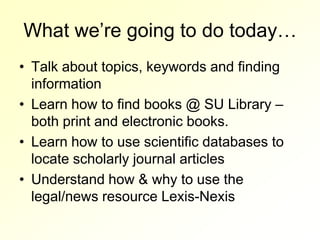
What we’re going to do today…
• Talk about topics, keywords and finding
  information
• Learn how to find books @ SU Library –
  both print and electronic books.
• Learn how to use scientific databases to
  locate scholarly journal articles
• Understand how & why to use the
  legal/news resource Lexis-Nexis
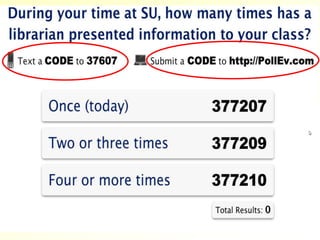
Poll Results
• http://www.polleverywhere.com/multiple_c
  hoice_polls/LTEyNTkxOTk2Mjk
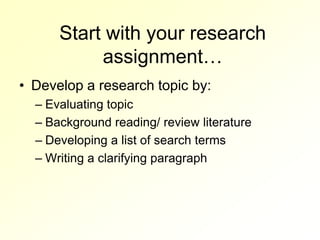
Start with your research
           assignment…
• Develop a research topic by:
  – Evaluating topic
  – Background reading/ review literature
  – Developing a list of search terms
  – Writing a clarifying paragraph
Choose a topic you are interested in.

Carefully define and develop your topic.
A well defined topic is easier to search.

   Do you always get to choose
           your topic???
Developing your Topic
1. Choose a topic that interests you.
2. Evaluate your topic.
3. Get a working knowledge of your
     topic. (develop keyword list)
4. Identify controversies or questions.
5. Develop your research question.
6. Write your clarifying paragraph.
Let’s develop our topic
1. Choose a topic that interests you (Criminal profiling)

2. Evaluate your topic (Too broad or narrow?)

3. Get a working knowledge of your topic. (develop
   keyword list) (How to do this??)

4. Identify controversies or questions (Background
   reading)

5. Develop your research question (Why?)

6. Write your clarifying paragraph (Or introduction, or
   abstract)
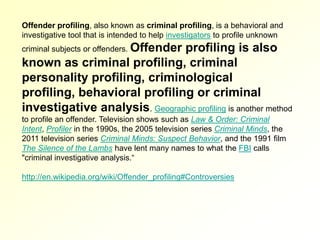
Offender profiling, also known as criminal profiling, is a behavioral and
investigative tool that is intended to help investigators to profile unknown
criminal subjects or offenders. Offender
                               profiling is also
known as criminal profiling, criminal
personality profiling, criminological
profiling, behavioral profiling or criminal
investigative analysis. Geographic profiling is another method
to profile an offender. Television shows such as Law & Order: Criminal
Intent, Profiler in the 1990s, the 2005 television series Criminal Minds, the
2011 television series Criminal Minds: Suspect Behavior, and the 1991 film
The Silence of the Lambs have lent many names to what the FBI calls
"criminal investigative analysis.“

http://en.wikipedia.org/wiki/Offender_profiling#Controversies
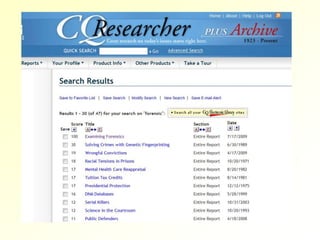
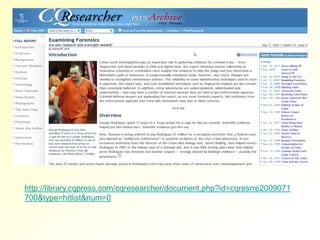
http://library.cqpress.com/cqresearcher/document.php?id=cqresrre2009071
700&type=hitlist&num=0
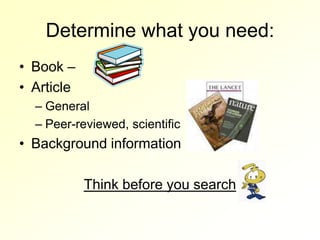
Determine what you need:
• Book –
• Article
  – General
  – Peer-reviewed, scientific
• Background information

            Think before you search
In print: HV8073 .H77 2010


          Finding Books


In print: QA276 .A264 2010                          Electronic Book
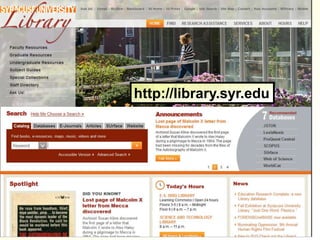
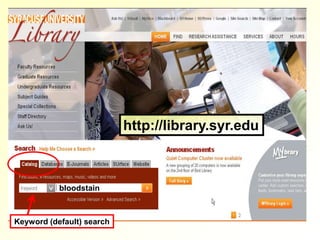
http://library.syr.edu


           bloodstain


Keyword (default) search
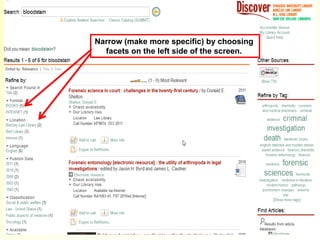
Narrow (make more specific) by choosing
  facets on the left side of the screen.
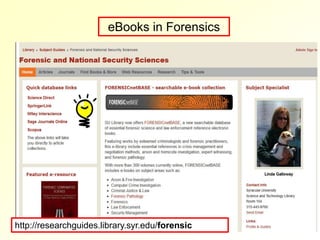
eBooks in Forensics


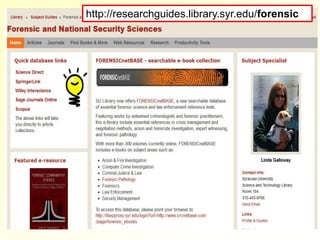
http://researchguides.library.syr.edu/forensic
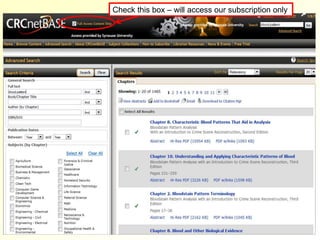
Check this box – will access our subscription only
Finding Articles
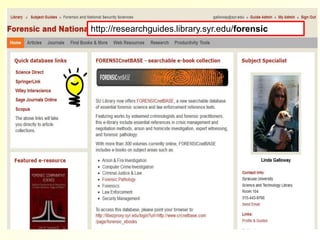
http://researchguides.library.syr.edu/forensic
Databases!
 Do you have your own
      database?

•Cell phone address book
•Online article collection
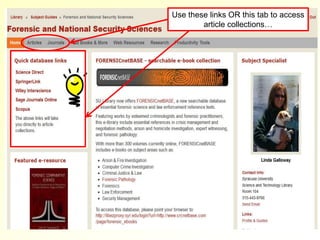
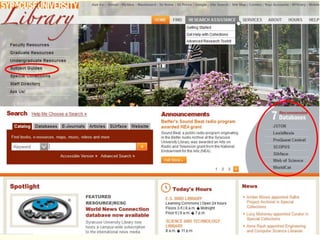
Use these links OR this tab to access
        article collections…
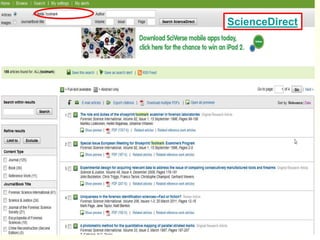
ScienceDirect
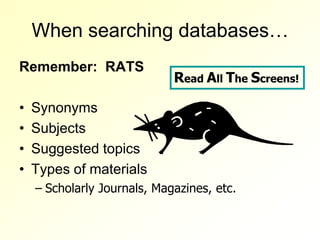
When searching databases…
Remember: RATS
                             Read All The Screens!

•   Synonyms
•   Subjects
•   Suggested topics
•   Types of materials
    – Scholarly Journals, Magazines, etc.
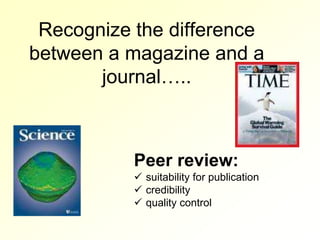
Recognize the difference
between a magazine and a
       journal…..


           Peer review:
            suitability for publication
            credibility
            quality control
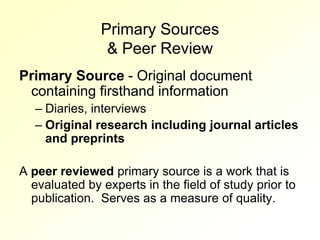
Primary Sources
                & Peer Review
Primary Source - Original document
 containing firsthand information
   – Diaries, interviews
   – Original research including journal articles
     and preprints

A peer reviewed primary source is a work that is
  evaluated by experts in the field of study prior to
  publication. Serves as a measure of quality.
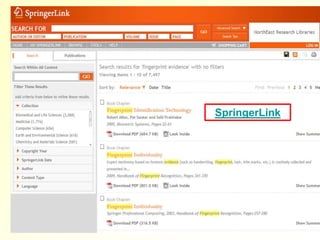
SpringerLink
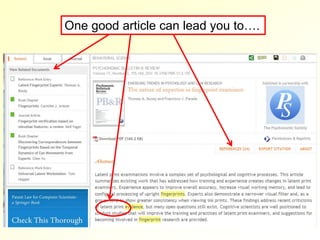
One good article can lead you to….
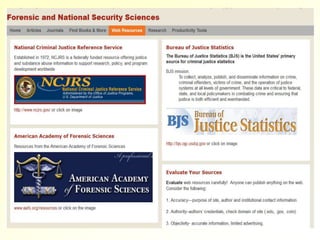
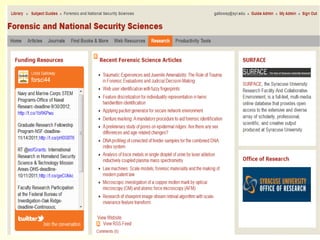
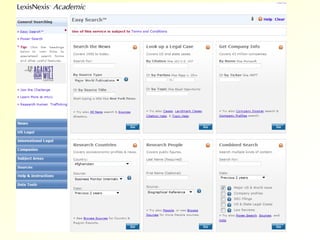
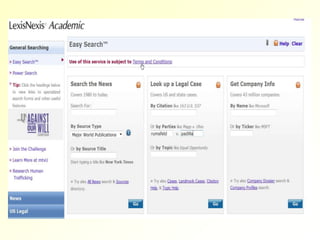
Legal & News Resources
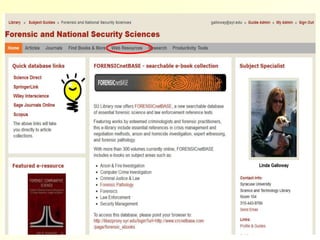
Web Resources
Final tips…
Before you begin your
            research…
• Define your topic
• Gain a working knowledge of your topic –
  background info, keywords, controversies
• Write your abstract/introduction AND your
  outline
• Make sure you know what you are looking
  for
• Find books in the….
• Find articles in the….
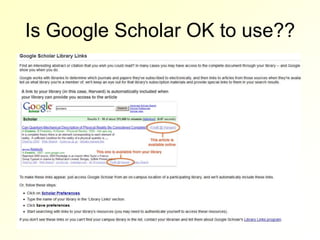
Is Google Scholar OK to use??
http://researchguides.library.syr.edu/forensic
Questions???

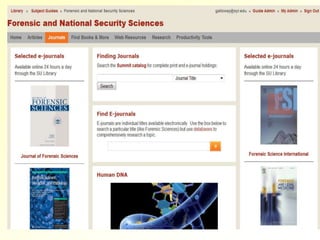
Forensic Science Resources

  • 1.
    FSC 406 Library Resources Linda Galloway Syracuse University Library Spring 2012
  • 2.
    What we’re goingto do today… • Talk about topics, keywords and finding information • Learn how to find books @ SU Library – both print and electronic books. • Learn how to use scientific databases to locate scholarly journal articles • Understand how & why to use the legal/news resource Lexis-Nexis
  • 4.
  • 5.
    Start with yourresearch assignment… • Develop a research topic by: – Evaluating topic – Background reading/ review literature – Developing a list of search terms – Writing a clarifying paragraph
  • 6.
    Choose a topicyou are interested in. Carefully define and develop your topic. A well defined topic is easier to search. Do you always get to choose your topic???
  • 7.
    Developing your Topic 1.Choose a topic that interests you. 2. Evaluate your topic. 3. Get a working knowledge of your topic. (develop keyword list) 4. Identify controversies or questions. 5. Develop your research question. 6. Write your clarifying paragraph.
  • 8.
    Let’s develop ourtopic 1. Choose a topic that interests you (Criminal profiling) 2. Evaluate your topic (Too broad or narrow?) 3. Get a working knowledge of your topic. (develop keyword list) (How to do this??) 4. Identify controversies or questions (Background reading) 5. Develop your research question (Why?) 6. Write your clarifying paragraph (Or introduction, or abstract)
  • 9.
    Offender profiling, alsoknown as criminal profiling, is a behavioral and investigative tool that is intended to help investigators to profile unknown criminal subjects or offenders. Offender profiling is also known as criminal profiling, criminal personality profiling, criminological profiling, behavioral profiling or criminal investigative analysis. Geographic profiling is another method to profile an offender. Television shows such as Law & Order: Criminal Intent, Profiler in the 1990s, the 2005 television series Criminal Minds, the 2011 television series Criminal Minds: Suspect Behavior, and the 1991 film The Silence of the Lambs have lent many names to what the FBI calls "criminal investigative analysis.“ http://en.wikipedia.org/wiki/Offender_profiling#Controversies
  • 11.
  • 14.
    Determine what youneed: • Book – • Article – General – Peer-reviewed, scientific • Background information Think before you search
  • 15.
    In print: HV8073.H77 2010 Finding Books In print: QA276 .A264 2010 Electronic Book
  • 16.
  • 17.
    http://library.syr.edu bloodstain Keyword (default) search
  • 18.
    Narrow (make morespecific) by choosing facets on the left side of the screen.
  • 19.
  • 20.
    Check this box– will access our subscription only
  • 21.
  • 22.
  • 23.
    Databases! Do youhave your own database? •Cell phone address book •Online article collection
  • 24.
    Use these linksOR this tab to access article collections…
  • 25.
  • 26.
    When searching databases… Remember:RATS Read All The Screens! • Synonyms • Subjects • Suggested topics • Types of materials – Scholarly Journals, Magazines, etc.
  • 27.
    Recognize the difference betweena magazine and a journal….. Peer review:  suitability for publication  credibility  quality control
  • 28.
    Primary Sources & Peer Review Primary Source - Original document containing firsthand information – Diaries, interviews – Original research including journal articles and preprints A peer reviewed primary source is a work that is evaluated by experts in the field of study prior to publication. Serves as a measure of quality.
  • 29.
  • 30.
    One good articlecan lead you to….
  • 32.
    Legal & NewsResources
  • 36.
  • 40.
  • 41.
    Before you beginyour research… • Define your topic • Gain a working knowledge of your topic – background info, keywords, controversies • Write your abstract/introduction AND your outline • Make sure you know what you are looking for • Find books in the…. • Find articles in the….
  • 42.
    Is Google ScholarOK to use??
  • 44.
  • 45.