Finding Common
Ground
#whatitiswhatitis
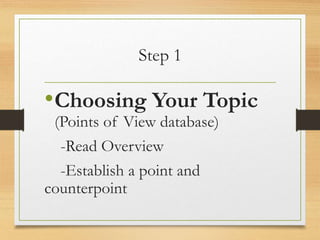
Step 1
•Choosing Your Topic
(Points of View database)
-Read Overview
-Establish a point and
counterpoint
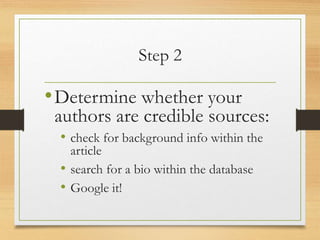
Step 2
•Determine whether your
authors are credible sources:
• check for background info within the
article
• search for a bio within the database
• Google it!
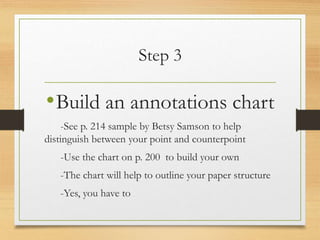
Step 3
•Build an annotations chart
-See p. 214 sample by Betsy Samson to help
distinguish between your point and counterpoint
-Use the chart on p. 200 to build your own
-The chart will help to outline your paper structure
-Yes, you have to
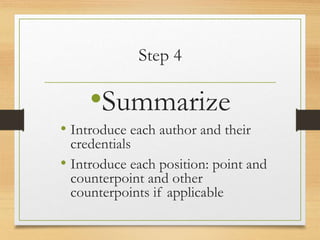
Step 4
•Summarize
• Introduce each author and their
credentials
• Introduce each position: point and
counterpoint and other
counterpoints if applicable
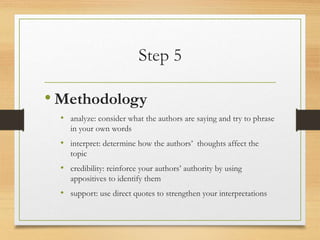
Step 5
• Methodology
• analyze: consider what the authors are saying and try to phrase
in your own words
• interpret: determine how the authors’ thoughts affect the
topic
• credibility: reinforce your authors’ authority by using
appositives to identify them
• support: use direct quotes to strengthen your interpretations
Checks and
Balances
#checkyourselfbeforeyouwreckyourself
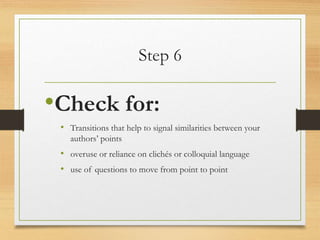
Step 6
•Check for:
• Transitions that help to signal similarities between your
authors’ points
• overuse or reliance on clichés or colloquial language
• use of questions to move from point to point
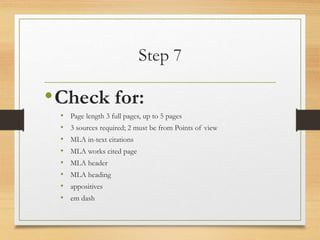
Step 7
•Check for:
• Page length 3 full pages, up to 5 pages
• 3 sources required; 2 must be from Points of view
• MLA in-text citations
• MLA works cited page
• MLA header
• MLA heading
• appositives
• em dash
Conclusion
#yourfinishwithaflourish
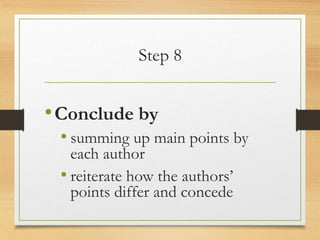
Step 8
•Conclude by
• summing up main points by
each author
• reiterate how the authors’
points differ and concede
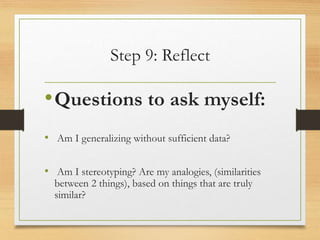
Step 9: Reflect
•Questions to ask myself:
• Am I generalizing without sufficient data?
• Am I stereotyping? Are my analogies, (similarities
between 2 things), based on things that are truly
similar?
Questions to Ask Myself, cont:
• Am I sure that my causes and
effects are really causes and
effects, and are not related to
something else instead?
• #randomthoughtsdonotbelong
Questions to Ask Myself, cont.:
• Do I have enough source material to give a fair
understanding of the issue being discussed? Not
much is really either one thing or another. There are
usually several sides to one argument.
• Am I attempting to reveal my personal thoughts
about the subject?
Questions to ask Myself, cont.:
• Are my conclusions fair interpretations of my
authors’ arguments?
• Am I being sure to present authors’ opinions that I
do not agree with as viable and intelligent

Finding common ground

  • 1.
  • 2.
    Step 1 •Choosing YourTopic (Points of View database) -Read Overview -Establish a point and counterpoint
  • 3.
    Step 2 •Determine whetheryour authors are credible sources: • check for background info within the article • search for a bio within the database • Google it!
  • 4.
    Step 3 •Build anannotations chart -See p. 214 sample by Betsy Samson to help distinguish between your point and counterpoint -Use the chart on p. 200 to build your own -The chart will help to outline your paper structure -Yes, you have to
  • 5.
    Step 4 •Summarize • Introduceeach author and their credentials • Introduce each position: point and counterpoint and other counterpoints if applicable
  • 6.
    Step 5 • Methodology •analyze: consider what the authors are saying and try to phrase in your own words • interpret: determine how the authors’ thoughts affect the topic • credibility: reinforce your authors’ authority by using appositives to identify them • support: use direct quotes to strengthen your interpretations
  • 7.
  • 8.
    Step 6 •Check for: •Transitions that help to signal similarities between your authors’ points • overuse or reliance on clichés or colloquial language • use of questions to move from point to point
  • 9.
    Step 7 •Check for: •Page length 3 full pages, up to 5 pages • 3 sources required; 2 must be from Points of view • MLA in-text citations • MLA works cited page • MLA header • MLA heading • appositives • em dash
  • 10.
  • 11.
    Step 8 •Conclude by •summing up main points by each author • reiterate how the authors’ points differ and concede
  • 12.
    Step 9: Reflect •Questionsto ask myself: • Am I generalizing without sufficient data? • Am I stereotyping? Are my analogies, (similarities between 2 things), based on things that are truly similar?
  • 13.
    Questions to AskMyself, cont: • Am I sure that my causes and effects are really causes and effects, and are not related to something else instead? • #randomthoughtsdonotbelong
  • 14.
    Questions to AskMyself, cont.: • Do I have enough source material to give a fair understanding of the issue being discussed? Not much is really either one thing or another. There are usually several sides to one argument. • Am I attempting to reveal my personal thoughts about the subject?
  • 15.
    Questions to askMyself, cont.: • Are my conclusions fair interpretations of my authors’ arguments? • Am I being sure to present authors’ opinions that I do not agree with as viable and intelligent