FINDING COMMON GROUND 
Establishing Goals & Connections Across Libraries 
to Improve Information Literacy
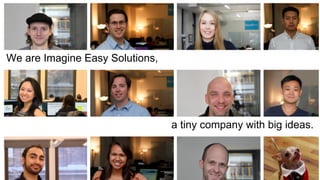
We are Imagine Easy Solutions, 
a tiny company with big ideas.
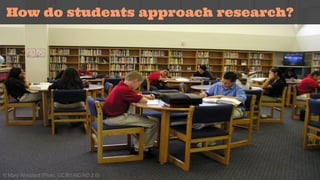
How do students approach research? 
© Mary Woodard (Flickr, CC BY-NC-ND 2.0)
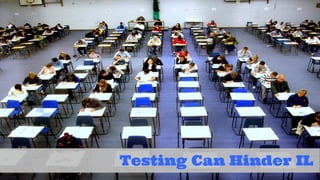
Testing Can Hinder IL
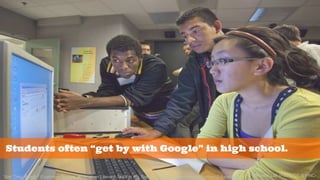
Students often “get by with Google” in high school. 
“Are They Ready? Exploring Student Information Literacy Skills in the Transition From Secondary to Tertiary Education.” 
© Berkeley Lab (Flickr, CC BY-NC-ND 
2.0
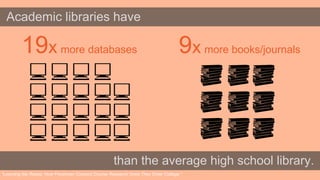
Academic libraries have 
19x more databases 
9x more books/journals 
than the average high school library. 
“Learning the Ropes: How Freshmen Conduct Course Research Once They Enter College.”
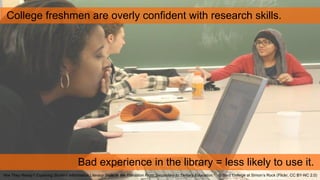
College freshmen are overly confident with research skills. 
Bad experience in the library = less likely to use it. 
“Are They Ready? Exploring Student Information Literacy Skills in the Transition From Secondary to Tertiary Education.” 
© Bard College at Simon’s Rock (Flickr, CC BY-NC 2.0)
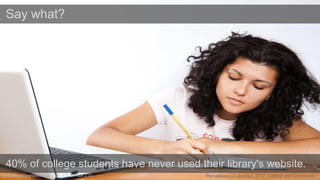
40% of college students have never used their library's website. 
“Perceptions of Libraries, 2010: Context and Community.” 
Say what? 
© CollegeDegrees360 (Flickr, CC BY-SA 2.0)
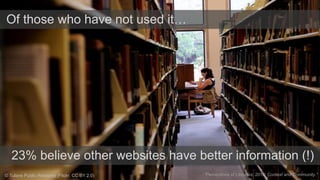
Of those who have not used it… 
23% believe other websites have better information (!) 
© Tulane Public Relations (Flickr, CC BY 2.0) “Perceptions of Libraries, 2010: Context and Community.”
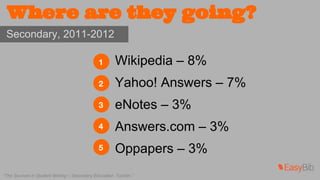
Where are they going? 
Secondary, 2011-2012 
Wikipedia – 8% 
Yahoo! Answers – 7% 
eNotes – 3% 
Answers.com – 3% 
Oppapers – 3% 
“The Sources in Student Writing – Secondary Education. Turnitin.”
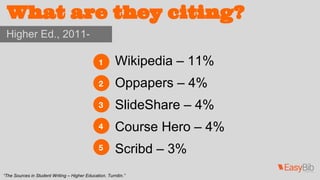
What are they citing? 
Higher Ed., 2011- 
2012 
Wikipedia – 11% 
Oppapers – 4% 
SlideShare – 4% 
Course Hero – 4% 
Scribd – 3% 
“The Sources in Student Writing – Higher Education. Turnitin.”
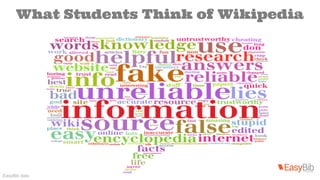
What Students Think of Wikipedia 
EasyBib data.
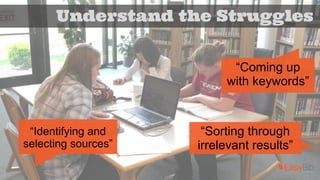
Understand the Struggles 
“Coming up 
with keywords” 
“Sorting through 
irrelevant results” 
“Identifying and 
selecting sources”
What About Educators? 
Cybrarian77, Flickr (CC BY-NC 2.0)
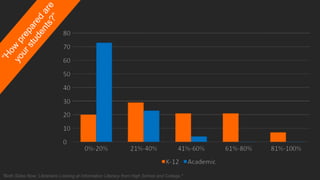
“How prepared are 
your students?” 
"Both Sides Now: Librarians Looking at Information Literacy from High School and College."
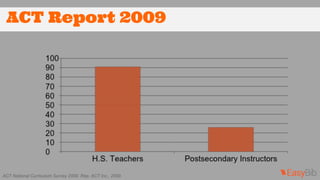
ACT Report 2009 
ACT National Curriculum Survey 2009. Rep. ACT Inc., 2009.
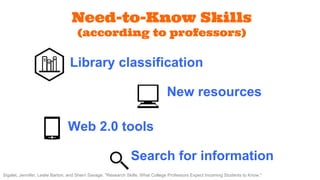
Need-to-Know Skills 
(according to professors) 
Library classification 
New resources 
Web 2.0 tools 
Search for information 
Sigalet, Jennifer, Leslie Barton, and Sherri Savage. "Research Skills: What College Professors Expect Incoming Students to Know."
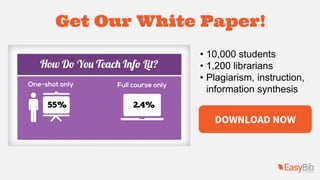
Get Our White Paper! 
• 10,000 students 
• 1,200 librarians 
• Plagiarism, instruction, 
information synthesis 
DOWNLOAD NOW
You may feel 
like this…
But it’s not so bad! 
© Sarah Reid (Flickr, CC BY 2.0)
“Are They Ready? Exploring Student Information Literacy Skills in the Transition From Secondary to 
Tertiary Education.” 
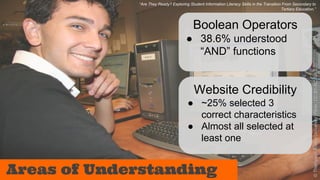
Boolean Operators 
● 38.6% understood 
“AND” functions 
Website Credibility 
● ~25% selected 3 
correct characteristics 
● Almost all selected at 
least one 
Areas of Understanding 
© Thompson Rivers University (Flickr, CC BY-NC-SA 2.0)
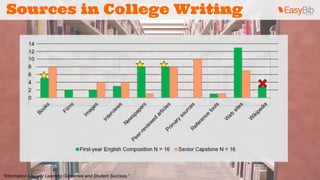
Sources in College Writing 
“Information Literacy Learning Outcomes and Student Success.”
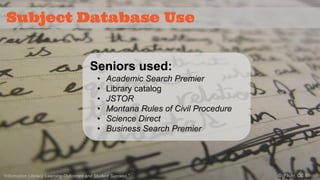
Subject Database Use 
Seniors used: 
• Academic Search Premier 
• Library catalog 
• JSTOR 
• Montana Rules of Civil Procedure 
• Science Direct 
• Business Search Premier 
“Information Literacy Learning Outcomes and Student Success.” © (Flickr, CC BY-SA 
2.0)
What can we do? 
© Stefan Baudy (Flickr, Attribution 2.0 Generic CC License)
There are solutions!
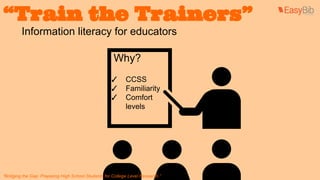
“Train the Trainers” 
Information literacy for educators 
Why? 
✓ CCSS 
✓ Familiarity 
✓ Comfort 
levels 
“Bridging the Gap: Preparing High School Students for College Level Research.”
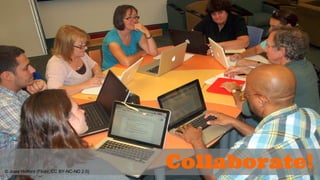
Collaborate! © Josie Holford (Flickr, CC BY-NC-ND 2.0)
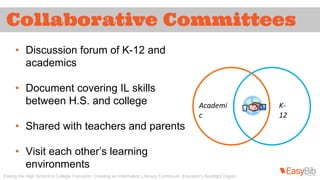
Collaborative Committees 
• Discussion forum of K-12 and 
academics 
• Document covering IL skills 
between H.S. and college 
• Shared with teachers and parents 
• Visit each other’s learning 
environments 
Academi 
c 
K- 
12 
Easing the High School to College Transition: Creating an Information Literacy Continuum. Educator's Spotlight Digest.
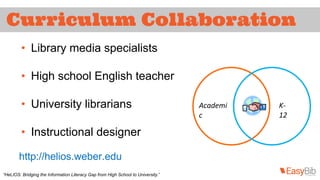
Curriculum Collaboration 
• Library media specialists 
• High school English teacher 
• University librarians 
• Instructional designer 
http://helios.weber.edu 
“HeLIOS: Bridging the Information Literacy Gap from High School to University.” 
Academi 
c 
K- 
12
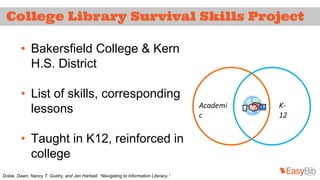
College Library Survival Skills Project 
• Bakersfield College & Kern 
H.S. District 
• List of skills, corresponding 
lessons 
• Taught in K12, reinforced in 
college 
Dobie, Dawn, Nancy T. Guidry, and Jan Hartsell. “Navigating to Information Literacy.” 
Academi 
c 
K- 
12
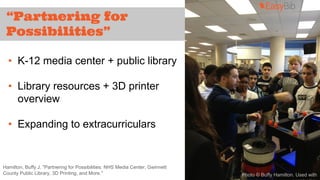
“Partnering for 
Possibilities” 
• K-12 media center + public library 
• Library resources + 3D printer 
overview 
• Expanding to extracurriculars 
Hamilton, Buffy J. "Partnering for Possibilities: NHS Media Center, Gwinnett 
County Public Library, 3D Printing, and More." Photo © Buffy Hamilton. Used with 
permission.
“Bridging the Gap: Preparing High School Students for College Level Research.” 
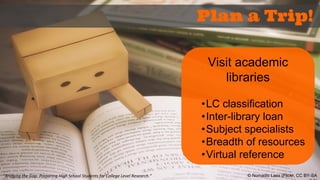
Plan a Trip! 
Visit academic 
libraries 
•LC classification 
•Inter-library loan 
•Subject specialists 
•Breadth of resources 
•Virtual reference 
© Nomadic Lass (Flickr, CC BY-SA 
2.0)
Horia Varlan, Flickr (CC BY 2.0)
Connect! 
Twitter 
• #infolit 
• #libchat 
• #highered 
JOIN THE CHAT 
© Jason Howie (Flickr, CC BY 2.0)
Connect! 
LinkedIn 
• Groups 
• Follow local colleges 
• Explore your network 
© Jason Howie (Flickr, CC BY 2.0)
Connect! 
List Servs 
• infolit-l 
• K-20 collaboration 
• http://lists.ala.org/sympa 
© Jason Howie (Flickr, CC BY 2.0)
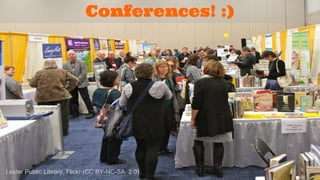
Conferences! :) 
Lester Public Library, Flickr (CC BY-NC-SA 2.0)
Bibliography 
ACT. ACT National Curriculum Survey 2009. Rep. ACT Inc., 2009. Web. 3 Oct. 2014. <http://www.act. 
org/research/policymakers/pdf/NationalCurriculumSurvey2009.pdf>. 
Ashbridge, Carole. Bridging the Gap for Information Literacy: Connecting High Schools, Colleges and the Workforce. Watertown, NY: 
Connections Abound, 2010. PDF. The document can be located at the following URL: http://connectionsabound.com/Bridging the Gap. 
pdf. 
Bayliss, Sarah. "Students Wary of Wikipedia But Still Use for Research, Study Finds." School Library Journal. Library Journal, 1 Oct. 2013. Web. 
25 Apr. 2014. <http://www.slj.com/2013/10/research/easybib-survey-students-wary-of-wikipedia-but-still-use-for-research/#_>. 
Burhanna, Kenneth J., ed. Informed Transitions: Libraries Supporting the High School to College Transition. Santa Barbara: Libraries Unlimited, 
2013. Print. 
De Rosa, Cathy, Joanne Cantrell, Matthew Carlson, Peggy Gallagher, Janet Hawk, and Charlotte Sturtz. Perceptions of Libraries, 2010: Context 
and Community. Rep. Ed. Brad Gauder. OCLC, 2011. Web. 29 Mar. 2012. 
Dobie, Dawn, Nancy T. Guidry, and Jan Hartsell. "Navigating to Information Literacy." CSLA Journal 34.2 (2010): 6-9. Academic Search Premier. 
Web. 3 Oct. 2014. 
EasyBib Student Survey. June 2013. Raw data. Imagine Easy Solutions, LLC, New York, NY. 
Hamilton, Buffy J. "Partnering for Possibilities: NHS Media Center, Gwinnett County Public Library, 3D Printing, and More." Web log post. The 
Unquiet Librarian. N.p., 19 Mar. 2014. Web. 8 Oct. 2014. <http://theunquietlibrarian.wordpress.com/2014/03/19/partnering-for-possibilities- 
nhs-media-center-gwinnett-county-public-library-3d-printing-and-more/>.
Bibliography 
Head, Alison J., and Michael B. Eisenberg. Truth Be Told: How College Students Evaluate and Use Information in the Digital Age. Seattle: 
Project Information Literacy, 1 Nov. 2010. PDF. The report can be found at the following URL: http://projectinfolit. 
org/images/pdfs/pil_fall2010_survey_fullreport1.pdf 
Head, Alison J. Learning the Ropes: How Freshmen Conduct Course Research Once They Enter College. Rep. Project Information Literacy, 5 
Dec. 2013. Web. 13 Feb. 2014. 
Kasowitz-Scheer, Abby. Easing the High School to College Transition: Creating an Information Literacy Continuum. N.p.: Educator's Spotlight 
Digest, Winter 2007. PDF. The report can be found at the following URL: http://www.informationliteracy.org/users_data/admin/V2I1- 
college.pdf 
Kinikin, JaNae. HeLIOS: Bridging the Information Literacy Gap from High School to University. Ogden, UT: Weber State University, 21 Apr. 2010. 
PDF. The report can be found at the following URL: http://www.mpla.us/documents/handouts/2010/kinikin.pdf 
Learning the Ropes: How Freshmen Conduct Course Research Once They Enter College. Rep. Project Information Literacy, 5 Dec. 2013. Web. 
16 Apr. 2014. <http://projectinfolit.org/images/pdfs/pil_2013_freshmenstudy_fullreport.pdf>. 
Lighthart, Matthew, and Creedence Spreder. "Partners in Lifelong Learning." Knowledge Quest 42.4 (2014): 32-37. Academic Search Complete. 
Web. 8 Oct. 2014. 
Nix, Donna E., Marianne Hageman, and Janice Kragness. Information Literacy and the Transition from High School to College. Publication. 
University of St. Thomas, Minnesota, 1 June 2011. Web. 25 Sept. 2013. 
Qmee. "Online in 60 Seconds - A Year Later." Qmee. Qmee, 8 July 2014. Web. 14 Oct. 2014. <http://blog.qmee.com/online-in-60-seconds-infographic- 
a-year-later/>.
Bibliography 
Salisbury, Fiona, and Sharon Karasmanis. "Are They Ready? Exploring Student Information Literacy Skills in the Transition from Secondary to 
Tertiary Education." Australian Academic & Research Libraries 41.1 (2011): 43-58. Print. 
Samson, Sue. "Information Literacy Learning Outcomes and Student Success." The Journal of Academic Librarianship 36.3 (2010): 202-10. 
ScienceDirect. Web. 2 Mar. 2013. 
Schein, Christine, Linda Conway, Rebecca Harner, Sue Byerley, and Shelley Harper. "Bridging the Gap: Preparing High School Students for 
College Level Research." Colorado Libraries 36.1 (2011): n. pag. 2011. Web. 25 Sept. 2013. The report can be found at the following 
URL: http://coloradolibrariesjournal.org/content/bridging-gap-preparing-high-school-students-college-level-research 
Schroeder, Robert. "Both Sides Now: Librarians Looking at Information Literacy from High School and College." Educator's Spotlight Digest 4.1 
(2009): 5 Pp. ERIC. Web. 28 Mar. 2013. 
Sigalet, Jennifer, Leslie Barton, and Sherri Savage. "Research Skills: What College Professors Expect Incoming Students to Know." Informed 
Transitions: Libraries Supporting the High School to College Transition. Ed. Kenneth Burhanna. Santa Barbara: Libraries Unlimited, 2013. 
39-49. Print. 
The Sources in Student Writing – Higher Education. Rep. Turnitin, Jan. 2013. Web. 17 Jan. 2013. The report can be found at the following URL: 
http://pages.turnitin.com/sources_in_writing_he_2012.html 
The Sources in Student Writing – Secondary Education. Rep. Turnitin, Jan. 2013. Web. 17 Jan. 2013. The report can be found at the following 
URL: http://pages.turnitin.com/sources_in_writing_sec_2012.html 
"What Happens Online in 60 Seconds? [Infographic]." Qmee. Qmee, 24 July 2013. Web. 25 Sept. 2013. <http://blog.qmee.com/qmee-online-in- 
60-seconds>.
Tackle plagiarism, promote ethical research skills and meet your school 
or district's standards for college and career readiness goals. 
Sign up for a free trial

Finding Common Ground for Librarians in Information Literacy

  • 1.
    FINDING COMMON GROUND Establishing Goals & Connections Across Libraries to Improve Information Literacy
  • 2.
    We are ImagineEasy Solutions, a tiny company with big ideas.
  • 3.
    How do studentsapproach research? © Mary Woodard (Flickr, CC BY-NC-ND 2.0)
  • 4.
  • 5.
    Students often “getby with Google” in high school. “Are They Ready? Exploring Student Information Literacy Skills in the Transition From Secondary to Tertiary Education.” © Berkeley Lab (Flickr, CC BY-NC-ND 2.0
  • 6.
    Academic libraries have 19x more databases 9x more books/journals than the average high school library. “Learning the Ropes: How Freshmen Conduct Course Research Once They Enter College.”
  • 7.
    College freshmen areoverly confident with research skills. Bad experience in the library = less likely to use it. “Are They Ready? Exploring Student Information Literacy Skills in the Transition From Secondary to Tertiary Education.” © Bard College at Simon’s Rock (Flickr, CC BY-NC 2.0)
  • 8.
    40% of collegestudents have never used their library's website. “Perceptions of Libraries, 2010: Context and Community.” Say what? © CollegeDegrees360 (Flickr, CC BY-SA 2.0)
  • 9.
    Of those whohave not used it… 23% believe other websites have better information (!) © Tulane Public Relations (Flickr, CC BY 2.0) “Perceptions of Libraries, 2010: Context and Community.”
  • 10.
    Where are theygoing? Secondary, 2011-2012 Wikipedia – 8% Yahoo! Answers – 7% eNotes – 3% Answers.com – 3% Oppapers – 3% “The Sources in Student Writing – Secondary Education. Turnitin.”
  • 11.
    What are theyciting? Higher Ed., 2011- 2012 Wikipedia – 11% Oppapers – 4% SlideShare – 4% Course Hero – 4% Scribd – 3% “The Sources in Student Writing – Higher Education. Turnitin.”
  • 12.
    What Students Thinkof Wikipedia EasyBib data.
  • 13.
    Understand the Struggles “Coming up with keywords” “Sorting through irrelevant results” “Identifying and selecting sources”
  • 14.
    What About Educators? Cybrarian77, Flickr (CC BY-NC 2.0)
  • 15.
    “How prepared are your students?” "Both Sides Now: Librarians Looking at Information Literacy from High School and College."
  • 16.
    ACT Report 2009 ACT National Curriculum Survey 2009. Rep. ACT Inc., 2009.
  • 17.
    Need-to-Know Skills (accordingto professors) Library classification New resources Web 2.0 tools Search for information Sigalet, Jennifer, Leslie Barton, and Sherri Savage. "Research Skills: What College Professors Expect Incoming Students to Know."
  • 18.
    Get Our WhitePaper! • 10,000 students • 1,200 librarians • Plagiarism, instruction, information synthesis DOWNLOAD NOW
  • 19.
    You may feel like this…
  • 20.
    But it’s notso bad! © Sarah Reid (Flickr, CC BY 2.0)
  • 21.
    “Are They Ready?Exploring Student Information Literacy Skills in the Transition From Secondary to Tertiary Education.” Boolean Operators ● 38.6% understood “AND” functions Website Credibility ● ~25% selected 3 correct characteristics ● Almost all selected at least one Areas of Understanding © Thompson Rivers University (Flickr, CC BY-NC-SA 2.0)
  • 22.
    Sources in CollegeWriting “Information Literacy Learning Outcomes and Student Success.”
  • 23.
    Subject Database Use Seniors used: • Academic Search Premier • Library catalog • JSTOR • Montana Rules of Civil Procedure • Science Direct • Business Search Premier “Information Literacy Learning Outcomes and Student Success.” © (Flickr, CC BY-SA 2.0)
  • 24.
    What can wedo? © Stefan Baudy (Flickr, Attribution 2.0 Generic CC License)
  • 25.
  • 26.
    “Train the Trainers” Information literacy for educators Why? ✓ CCSS ✓ Familiarity ✓ Comfort levels “Bridging the Gap: Preparing High School Students for College Level Research.”
  • 27.
    Collaborate! © JosieHolford (Flickr, CC BY-NC-ND 2.0)
  • 28.
    Collaborative Committees •Discussion forum of K-12 and academics • Document covering IL skills between H.S. and college • Shared with teachers and parents • Visit each other’s learning environments Academi c K- 12 Easing the High School to College Transition: Creating an Information Literacy Continuum. Educator's Spotlight Digest.
  • 29.
    Curriculum Collaboration •Library media specialists • High school English teacher • University librarians • Instructional designer http://helios.weber.edu “HeLIOS: Bridging the Information Literacy Gap from High School to University.” Academi c K- 12
  • 30.
    College Library SurvivalSkills Project • Bakersfield College & Kern H.S. District • List of skills, corresponding lessons • Taught in K12, reinforced in college Dobie, Dawn, Nancy T. Guidry, and Jan Hartsell. “Navigating to Information Literacy.” Academi c K- 12
  • 31.
    “Partnering for Possibilities” • K-12 media center + public library • Library resources + 3D printer overview • Expanding to extracurriculars Hamilton, Buffy J. "Partnering for Possibilities: NHS Media Center, Gwinnett County Public Library, 3D Printing, and More." Photo © Buffy Hamilton. Used with permission.
  • 32.
    “Bridging the Gap:Preparing High School Students for College Level Research.” Plan a Trip! Visit academic libraries •LC classification •Inter-library loan •Subject specialists •Breadth of resources •Virtual reference © Nomadic Lass (Flickr, CC BY-SA 2.0)
  • 33.
  • 34.
    Connect! Twitter •#infolit • #libchat • #highered JOIN THE CHAT © Jason Howie (Flickr, CC BY 2.0)
  • 35.
    Connect! LinkedIn •Groups • Follow local colleges • Explore your network © Jason Howie (Flickr, CC BY 2.0)
  • 36.
    Connect! List Servs • infolit-l • K-20 collaboration • http://lists.ala.org/sympa © Jason Howie (Flickr, CC BY 2.0)
  • 37.
    Conferences! :) LesterPublic Library, Flickr (CC BY-NC-SA 2.0)
  • 38.
    Bibliography ACT. ACTNational Curriculum Survey 2009. Rep. ACT Inc., 2009. Web. 3 Oct. 2014. <http://www.act. org/research/policymakers/pdf/NationalCurriculumSurvey2009.pdf>. Ashbridge, Carole. Bridging the Gap for Information Literacy: Connecting High Schools, Colleges and the Workforce. Watertown, NY: Connections Abound, 2010. PDF. The document can be located at the following URL: http://connectionsabound.com/Bridging the Gap. pdf. Bayliss, Sarah. "Students Wary of Wikipedia But Still Use for Research, Study Finds." School Library Journal. Library Journal, 1 Oct. 2013. Web. 25 Apr. 2014. <http://www.slj.com/2013/10/research/easybib-survey-students-wary-of-wikipedia-but-still-use-for-research/#_>. Burhanna, Kenneth J., ed. Informed Transitions: Libraries Supporting the High School to College Transition. Santa Barbara: Libraries Unlimited, 2013. Print. De Rosa, Cathy, Joanne Cantrell, Matthew Carlson, Peggy Gallagher, Janet Hawk, and Charlotte Sturtz. Perceptions of Libraries, 2010: Context and Community. Rep. Ed. Brad Gauder. OCLC, 2011. Web. 29 Mar. 2012. Dobie, Dawn, Nancy T. Guidry, and Jan Hartsell. "Navigating to Information Literacy." CSLA Journal 34.2 (2010): 6-9. Academic Search Premier. Web. 3 Oct. 2014. EasyBib Student Survey. June 2013. Raw data. Imagine Easy Solutions, LLC, New York, NY. Hamilton, Buffy J. "Partnering for Possibilities: NHS Media Center, Gwinnett County Public Library, 3D Printing, and More." Web log post. The Unquiet Librarian. N.p., 19 Mar. 2014. Web. 8 Oct. 2014. <http://theunquietlibrarian.wordpress.com/2014/03/19/partnering-for-possibilities- nhs-media-center-gwinnett-county-public-library-3d-printing-and-more/>.
  • 39.
    Bibliography Head, AlisonJ., and Michael B. Eisenberg. Truth Be Told: How College Students Evaluate and Use Information in the Digital Age. Seattle: Project Information Literacy, 1 Nov. 2010. PDF. The report can be found at the following URL: http://projectinfolit. org/images/pdfs/pil_fall2010_survey_fullreport1.pdf Head, Alison J. Learning the Ropes: How Freshmen Conduct Course Research Once They Enter College. Rep. Project Information Literacy, 5 Dec. 2013. Web. 13 Feb. 2014. Kasowitz-Scheer, Abby. Easing the High School to College Transition: Creating an Information Literacy Continuum. N.p.: Educator's Spotlight Digest, Winter 2007. PDF. The report can be found at the following URL: http://www.informationliteracy.org/users_data/admin/V2I1- college.pdf Kinikin, JaNae. HeLIOS: Bridging the Information Literacy Gap from High School to University. Ogden, UT: Weber State University, 21 Apr. 2010. PDF. The report can be found at the following URL: http://www.mpla.us/documents/handouts/2010/kinikin.pdf Learning the Ropes: How Freshmen Conduct Course Research Once They Enter College. Rep. Project Information Literacy, 5 Dec. 2013. Web. 16 Apr. 2014. <http://projectinfolit.org/images/pdfs/pil_2013_freshmenstudy_fullreport.pdf>. Lighthart, Matthew, and Creedence Spreder. "Partners in Lifelong Learning." Knowledge Quest 42.4 (2014): 32-37. Academic Search Complete. Web. 8 Oct. 2014. Nix, Donna E., Marianne Hageman, and Janice Kragness. Information Literacy and the Transition from High School to College. Publication. University of St. Thomas, Minnesota, 1 June 2011. Web. 25 Sept. 2013. Qmee. "Online in 60 Seconds - A Year Later." Qmee. Qmee, 8 July 2014. Web. 14 Oct. 2014. <http://blog.qmee.com/online-in-60-seconds-infographic- a-year-later/>.
  • 40.
    Bibliography Salisbury, Fiona,and Sharon Karasmanis. "Are They Ready? Exploring Student Information Literacy Skills in the Transition from Secondary to Tertiary Education." Australian Academic & Research Libraries 41.1 (2011): 43-58. Print. Samson, Sue. "Information Literacy Learning Outcomes and Student Success." The Journal of Academic Librarianship 36.3 (2010): 202-10. ScienceDirect. Web. 2 Mar. 2013. Schein, Christine, Linda Conway, Rebecca Harner, Sue Byerley, and Shelley Harper. "Bridging the Gap: Preparing High School Students for College Level Research." Colorado Libraries 36.1 (2011): n. pag. 2011. Web. 25 Sept. 2013. The report can be found at the following URL: http://coloradolibrariesjournal.org/content/bridging-gap-preparing-high-school-students-college-level-research Schroeder, Robert. "Both Sides Now: Librarians Looking at Information Literacy from High School and College." Educator's Spotlight Digest 4.1 (2009): 5 Pp. ERIC. Web. 28 Mar. 2013. Sigalet, Jennifer, Leslie Barton, and Sherri Savage. "Research Skills: What College Professors Expect Incoming Students to Know." Informed Transitions: Libraries Supporting the High School to College Transition. Ed. Kenneth Burhanna. Santa Barbara: Libraries Unlimited, 2013. 39-49. Print. The Sources in Student Writing – Higher Education. Rep. Turnitin, Jan. 2013. Web. 17 Jan. 2013. The report can be found at the following URL: http://pages.turnitin.com/sources_in_writing_he_2012.html The Sources in Student Writing – Secondary Education. Rep. Turnitin, Jan. 2013. Web. 17 Jan. 2013. The report can be found at the following URL: http://pages.turnitin.com/sources_in_writing_sec_2012.html "What Happens Online in 60 Seconds? [Infographic]." Qmee. Qmee, 24 July 2013. Web. 25 Sept. 2013. <http://blog.qmee.com/qmee-online-in- 60-seconds>.
  • 41.
    Tackle plagiarism, promoteethical research skills and meet your school or district's standards for college and career readiness goals. Sign up for a free trial