The Philippine Informal
Reading Inventory
Manual 2018
Department of Education Republic of the Philippines
G
o
v
e
r
n
m
e
n
t
P
r
o
p
e
r
t
y
N
O
T
F
O
R
S
A
L
E
Philippine Informal Reading Inventory Manual
First Edition, 2018
ISBN: ___________________
Republic Act 8293, Sections 176 states that, “No copyright shall subsist in any work
of the Government of the Philippines. However, prior approval of the government agency or
office wherein the work is created shall be necessary for exploitation of such work for profit.
Such agency or office may, among other things, impose as a condition, payment of royalties."
Borrowed materials included in this book are owned by the respective copyright
holders. Effort has been exerted to locate and seek permission to use these materials from
their respective copyright owners. The publishers and authors do not represent nor claim
ownership over them.
Published by the Department of Education
Secretary: Leonor Magtolis Briones
Undersecretary: Lorna Dig Dino
Assistant Secretary: Nepomuceno A. Malaluan
Printed in the Philippines by
Department of Education – Bureau of Learning Resources (DepEd-BLR)
Office Address: Ground Floor, Bonifacio Building, DepEd Complex
			 Meralco Avenue, Pasig City, Philippines 1600
			 (02) 634-1054; 634-1072; 631-4985
Email Address: blr.lrqad@deped.gov.ph / blr.lrpd@deped.gov.ph
Development Team of the Philippine Informal Reading Inventory Manual
Technical Consultants and Writers: Dr. Felicitas E. Pado, Dr. Leonor E. Diaz, Prof.
Maria Hazelle P. Ongtengco, Prof. Marie Yvette C. Alcazar, Prof. Ana Maria Margarita S.
Salvador, Dr. Fe Josefa G. Nava (University of the Philippines)
Review and Editing: Bonna Duron-Luder and Sierra Mae Paraan
Graphics and Lay-out: Roman Soriano-Esguerra
The Philippine Informal
Reading Inventory
Manual 2018
TABLE OF CONTENTS
Acknowledgement.....................................................................................................................i
Preface.....................................................................................................................................ii
A. EssentialInformationaboutthePhil-IRI..........................................................................1
1. What is the Phil-IRI?.....................................................................................................1
2. Why was the Phil-IRI developed?.................................................................................1
3. What adjustments were made in the Phil-IRI selections?..............................................1
4. What can Phil-IRI tell the teachers?...............................................................................2
5. What are flexible ways to use Phil-IRI?..........................................................................3
6. WhoneedstotakethePhil-IRI?.....................................................................................3
7. WhenshouldPhil-IRIbeadministered?.........................................................................3
8. How long does it take to administer the Phil-IRI.............................................................4
9. WhocanadministerthePhil-IRI?...................................................................................4
10. How do we get a copy of the Phil-IRI materials?..........................................................4
B. Description of the Phil-IRI Testing Kit.............................................................................4
1. Manual of Administration..............................................................................................4
2. The Phil-IRI Group Screening Test...............................................................................5
3. The Phil-IRI Graded Passages (Sets A, B, C and D).....................................................5
4. Phil-IRIForms...............................................................................................................6
a. for Group Screening Test..................................................................................6
b. for Graded Passages.......................................................................................7
C. General Directions for Administration:TheFour Stages.................................................7
1. Stage 1: Initial Screening Using the Phil-IRI Group Screening Test.............................8
2. Stage 2: Administration of the Phil-IRI Graded Passages (Pre-Test).........................10
3. Stage 3: Provision of Specialized Instruction..............................................................12
4. Stage 4: Administration of the Phil-IRI Graded Passages (Posttest)..........................12
D. Specific Directions for the Administration of the Phil-IRI Group Screening Test....12
E. Specific Directions for the Administration of the Phil-IRI Graded Passages..............15
1. Conducting the Phil-IRI Graded Passages Pretest......................................................15
a. Marking and Scoring the Miscues....................................................................17
b. Recording the Miscues...................................................................................18
c. Computing the Oral Reading Score per Passage...........................................19
d. Recording the Speed and Rate in Oral Reading.............................................20
e. Computing the Student’s Comprehension of the Passage.............................20
f. Analysis and Interpretation of Word Reading and Comprehension Level.......21
g. QualitativeAnalysis.........................................................................................22
2. The Phil-IRI Listening Comprehension and Silent Reading Test................................23
F. Conducting the Reading Intervention..........................................................................23
G. Conducting the Phil-IRI Graded Passages Posttest....................................................23
Glossary.................................................................................................................................24
References............................................................................................................................ 27
List of Appendices..................................................................................................................29
ACKNOWLEDGEMENT
The Department of Education through the Bureau of Learning Delivery extends its gratitude
to various individuals, writers and consultants who have contributed in the development of the
Philippine Informal Reading Inventory (Phil-IRI) Manual.
PROJECT MANAGEMENT AND DEVELOPMENT TEAM - DEPED
Lorna Dig Dino				 Undersecretary, Curriculum and Instruction
Marilette R. Almayda 				 Director III and OIC, Office of the Director IV
Rosalina J. Villaneza				 Chief, Teaching and Learning Division
Jocelyn S. Tuguinayo				 Supervising Education Program Specialist (TLD)
TECHNICAL CONSULTANTS AND WRITERS
Dr. Felicitas E. Pado				 University of the Philippines
Dr. Leonor E. Diaz				 University of the Philippines
Prof. Maria Hazelle P. Ongtengco		 University of the Philippines
Prof. Marie Yvette C. Alcazar			 University of the Philippines
Prof. Ana Maria Margarita S. Salvador University of the Philippines
Dr. Fe Josefa G. Nava			 University of the Philippines
Review and Editing: 		 Bonna Duron-Luder		 Save the Children Philippines
				 Sierra Mae Paraan		 Save the Children Philippines
Lay-out:			 Roman Soriano- Esguerra Save the Children Philippines
Special recognition is extended to the original team of writers (English and Filipino groups) from
DepEd regions and divisions - selected Education Program Supervisors, Master Teachers,
Principals, Assistant Schools Division Superintendents, Chief/Assistant Chief of Education
Divisions (2009) and private individuals who shared their expertise in the development of the
tools.
i
PREFACE
The Philippine Informal Reading Inventory (Phil-IRI) is an initiative of the Bureau of Learning
Delivery, Department of Education that directly addresses its thrust to make every Filipino child
a reader. It is anchored on the flagship program of the Department: “Every Child A Reader
Program,” which aims to make every Filipino child a reader and a writer at his/her grade level.
The Phil-IRI is an informal reading inventory composed of graded passages designed to
determine the individual student's performance in oral reading, silent reading and listening
comprehension. These three types of assessments aim to find the student’s independent,
instructional and frustration levels. The data from these measures could be used to design or
adjust classroom, small group or individualized instruction to fit the students’needs and abilities.
The Phil-IRI is not the sole assessment tool that provides the holistic reading performance of
the students; it only provides an approximation of the students' abilities and could be used in
combination with other reliable tools of assessment. The data shall also serve as one of the
bases in planning, designing/redesigning the reading programs or activities in the school to
improve the overall school reading performance.
The entire set or package of Phil-IRI materials consists of: 1) Manual of Administration,
2) Group Screening Test in Filipino (GST) from Grades III-VI, 3) Group Screening Test in
English from Grades IV to VI, 4) Graded Passages from Grade II to VII (Sets A, B, C, D) in
English and Grades I to VI in Filipino (Sets A, B, C, D) and, 5) Forms for recording purposes
both in English and Filipino.
It is important for the teachers to study the manual and be oriented on the proper administration
of the 2018 Phil-IRI.
ii
1
A. ESSENTIAL INFORMATION ABOUT THE PHIL-IRI
1. What is the Phil-IRI?
The Philippine Informal Reading Inventory (Phil-IRI) was created to provide classroom
teachers a tool for measuring and describing reading performance. It is an assessment
tool composed of graded passages designed to determine a student’s reading level. It is
important to note that the Phil-IRI only provides an approximation of the learner’s abilities and
may be used in combination with other reliable tools of assessment.
2. Why was the Phil-IRI developed?
The development of the Phil-IRI is one of the initiatives put in place in support of the Every
Child A Reader Program (ECARP). Before teachers can design and provide appropriate
reading instruction for their students, they should be armed with information about their
students’ current reading levels and abilities. This diagnostic approach to describing how
children read embraces inclusionary principles that emphasize the need for education that
is learner-oriented, responsive and culturally sensitive. The Phil-IRI is one of the diagnostic
tools that teachers can use to determine students' abilities and needs in reading.
3. What adjustments were made in the Phil-IRI selections?
The Revised Phil-IRI was prepared in early 2013, prior to the introduction of the K-12
Curriculum. The readability level of the selections for oral and silent reading were based on
the old English and Filipino curricula and were validated to pupils who were products of these
old curricula; they were taught to read in Filipino and in English starting in Grade 1.
Under the K-12 curriculum, the pupils are introduced to Reading in Filipino during the first
semester of Grade 2 while Reading in English is introduced during the second semester.
For example, the curriculum in Phonics and Word Recognition for Grade 2 English during the
second semester is reading short e, a and i words in consonant-vowel-consonant pattern. By
Grade 3, the curricular offering under word recognition is as follows:
First Quarter Second Quarter Third Quarter Fourth Quarter
Read words with
short o and u sounds
in CVC pattern and
common sight words;
read 2-syllable words
consisting of short
e to u sound (e.
g.: basket, hotdog,
sunset).
Read words with
initial consonant
blends (l, r and s
blends) followed
by short vowel
sounds, read words
with initial and final
consonant digraph
ch and sh.
Read words with
long a, i, o and u
sound (ending in
e) one syllable and
2-syllables.
Read words with
vowel digraphs ai
(pail), ay (bay), ea
(lead), ee (seed;
read words with
vowel diphthongs oy
(boy), oi (boil), ou
(out) and ow (bow);
read some irregularly
spelled words (e.g.
such as enough,
through, beautiful).
1
1
Flippo, R. (2014). Assessing readers qualitative diagnosis and instruction. 2nd Edition. Chapter 2 Retrieved from http://www.
reading.org/Libraries/books/assessing-readers--second-ed--chapter3.pdf Copublished with Routledge/Taylor & Francis
2
Aside from adjusting the readability level of the Phil-IRI selections based on the present
curriculum, the Phil-IRI constructed in 2013 was revalidated to the present group of learners in
2016 to give a better assurance that the readability levels of the selections are appropriate for
the grade levels for which they are assigned. Nineteen schools, each representing a particular
Mother Tongue, were chosen for the revalidation. Phil-IRI Filipino was administered to Grade
3 and 4 pupils while Phil-IRI English was administered to Grade 4 and 5 pupils. The MTB-MLE
coordinator/Master teacher/the subject teacher in Filipino and English/ the class adviser who
had a training in ELLN conducted the revalidation.
The result of the examination of the literacy curriculum in both English and Filipino as well as
the revalidation were the bases for adjusting the Phil-IRI selections both in the Screening Test
and the Pretest and Posttest.
4. What can Phil-IRI tell the teachers?
The Phil-IRI Group Screening Test (GST) can tell teachers whether students are reading at,
above, or below their grade levels. The individually administered Phil-IRI Graded Passages
can be used to assess students’ Oral Reading, Silent Reading Comprehension and/or
Listening Comprehension levels.
When used to assess oral reading skills, the Phil-IRI may be used to describe decoding
and word recognition, fluency and comprehension. The student’s performance in decoding
(the ability to read isolated words using phonics knowledge) and word recognition (the ability
to automatically identify words on sight) is measured through a Reading Miscue Inventory
(Phil-IRI Form 3A and 3B: Grade Level Passage Rating Sheet). The child is asked to read a
passage and each word read incorrectly is noted and marked. In terms of fluency (the ability
to read with speed, accuracy and prosody), the time taken by the child to read a passage is
recorded and the number of words that he/she can read per minute is computed. Furthermore,
a qualitative description of the child’s manner of reading is described via a checklist. Finally,
test taker’s comprehension skills (the ability to create meaning) may be gauged by having the
child answer five to eight questions of varying difficulty based on the graded passage after it
has been read.
When used to assess Silent Reading Comprehension, Phil-IRI may be used to describe
reading speed and comprehension. The student’s reading speed is measured by recording
the time it takes the child to read each passage completely. Silent reading comprehension is
measured by asking the student to answer five to eight questions of varying difficulty after a
passage has been read.
When used to assess listening comprehension, the Phil-IRI may be used by having the
student listen to the passages as they are read by the test administrator and answer five to
eight questions of varying difficulty about each passage.
For all three types of individual assessments (oral reading comprehension, listening
comprehension and silent reading comprehension), the aim is to find the learner’s independent,
instructional and frustration levels, so that teachers know what level of reading materials the
student can read and understand well, as well as what level of reading materials the student
is not ready for.
3
Since the Phil-IRI is administered at the start and at the end of the school year, it can also tell
teachers about the growth and changes in students’ reading skills and levels.
5. What are flexible ways to use Phil-IRI?
The Phil-IRI may be used to:
a. Group Reading Level
The Phil-IRI GST can be used to determine a whole class’ reading level, and identify
particular students who may need more assistance in performing reading tasks.
b. Individual Reading Level
The individually administered Phil-IRI Graded Passages can be used to determine a
student’s independent, instructional and frustration levels for three types of literacy
tasks: Oral Reading, Silent Reading, and Listening Comprehension.
c. Monitor Growth and Response to Intervention
Pretest and Posttest results of the Phil-IRI can be compared to monitor growth in
students’ reading skills, as well as determine the efficacy of the program or reading
interventions conducted by the school and/or classroom teachers.
d. Describe Reading Behaviors
The recording of the student’s oral reading behaviors during the conduct of the
individually administered Phil-IRI Graded Passages can help the teacher describe a
student’s reading performance and behavior. It specifies the number of words read
per minute, the cues used for identifying or recognizing words, manner of reading, etc.
Types of miscues as well as types of comprehension questions answered correctly can
also be analyzed by the teacher to help him/her design appropriate reading lessons
or interventions.
6. Who needs to take the Phil-IRI?
All students in Grades 3 to 6 will undergo the Phil-IRI Group Screening Test (GST) in Filipino,
while students in Grades 4 to 6 will undergo the GST in English. Students identified to be
performing below level of expectation (those with a total Raw Score below 14 in the Phil-
IRI GST) should undergo further assessment through the individually administered Phil-IRI
graded passages.
7. When should the Phil-IRI be administered?
The following table below shows the administration schedule of Group Screening Test and the
Individualized Phil-IRI assessments. Group assessments must be conducted within class time
while Individual assessments may be conducted outside class hours.
4
8. How long does it take to administer the Phil-IRI?
The administration of the Phil-IRI GST for a whole class takes approximately 30 minutes. The
time it takes to administer the Phil-IRI Graded Passages would vary for each student.
9. Who can administer the Phil-IRI?
All Filipino subject teachers for Grades 3 to 6 and English subject teachers for Grades 4 to 6
can administer the Phil-IRI Group Screening Tests in their respective classes. ELLN-trained
teachers can administer the Phil-IRI Graded Passages to individual students who need further
assessment.The region and/or division can also conduct training programs to teachers on
the conduct of the Phil-IRI. Teachers who will administer the Phil-IRI should read the manual
thoroughly and prepare all the necessary materials and forms prior to the scheduled date of
test administration.
10. How do we get a copy of the Phil-IRI materials?
The Phil-IRI materials will be uploaded to the Learning Resource Management Development
System (LRMDS) portal of the DepEd website which can be downloaded by the teachers,
school heads and education supervisors. Schools are advised to use the MOOE funds for the
reproduction and distribution of the materials to teachers.
B. DESCRIPTION OF THE PHIL-IRI TESTING KIT
The Phil-IRI Testing Kit consists of the Manual of Administration; Group Screening Tests for
both Filipino and English; Graded Passages with Comprehension Questions; and the Phil-IRI
Forms.
1. Manual of Administration
The manual includes information about the Phil-IRI, the directions for the administration of
the test, and instructions for recording and reporting results. It serves as a guide to teachers,
principals and supervisors in administering the tests as well as in recording results.
Filipino
(for Grade 3 to Grade 6
learners)
English
(for Grade 4 to Grade 6
learners)
Type of Test Pretest Posttest Pretest Posttest
Phil-IRI Group Screening
Test (GST)
Within
the first
or second
month of the
school year
Within
January to
February of
the school
year
Within
the first
or second
month of the
school year
Within
January to
February of
the school
year
Individualized Phil-IRI
Assessment (only for
pupils who did not pass
the GST)
Within a
month after
the GST is
administered
Within a
month after
the GST is
administered
Table 1. Schedule of Phil-IRI Administration
5
The manual should be studied carefully before administering the Phil-IRI Tests. The mechanics
of administration are the same for both Filipino and English. Thus, only one manual will be
printed for both languages. The manual also contains the Keys to Correction for both the
Group Screening Tests and the Phil-IRI Graded Passages in Filipino and English.
2. The Phil-IRI Group Screening Test
The Phil-IRI Group Screening Test (GST) is a silently-administered test in both Filipino and
English. Each tool is composed of a 20-item comprehension test based on a set of leveled
passages for each grade level covering Grades 3 to 6 in Filipino and Grades 4 to 6 in English.
The passages were written and selected based on concept load, level of vocabulary used,
sentence complexity, nature of themes and cohesion.
In consideration of Abadzi’s1
(2014) recommendations on the kind and size of font and spacing
options in between letters used in textbooks, the font features in Table 2 were followed in the
design of the tools.
Table 2: Font Size Used for the Passages for each Grade Level
Grade/Reading Level Recommended Font and Size
Kindergarten to 1st Grade Comic Sans, Font Size 18
2nd Grade Comic Sans, Font Size 16
3rd Grade Comic Sans, Font Size 14
4th to 7th Grade Comic Sans, Font Size 12
The objective of the GST is to identify students who need further testing. Appendix A1 to A4
presents the titles of passages, kinds of text, and number of questions per passage, as well as
the Keys to Correction for the GST for Grades 3 to 6 in Filipino and Grades 4 to 6 in English
respectively.
3. The Phil-IRI Graded Passages (Sets A, B, C and D)
The Phil-IRI Graded Passages is an informal individualized assessment tool used to record
the student’s performance in oral reading, silent reading and/or listening comprehension.
The Phil-IRI Oral Reading Test is administered in order to:
• identify the student’s miscues in oral reading;
• record the number of words that a student reads per minute; and
• find out how well a student understands the passage read.
1
1
Abadzi, H. (2014). Hidden insights from cognitive neuroscience. Retrieved from https://www.academia.edu/6429908/Mysteries_
and_Myths_of_Reading_Hidden_insights_from_cognitive_neuroscience
6
The Phil-IRI Listening Comprehension is administered when the student is identified as a
nonreader. The purpose is to find out how well a student understands the selection which
will be read by the test administrator.Then the test administrator reads the multiple choice
questions and the student answers them orally.
The Phil-IRI Silent Reading Test may be administered after the Oral Reading Test is
conducted to further check the student’s comprehension skill. This is an optional activity.
The Graded Passages range from Grade 2 to Grade 7 Readability levels for English and
Grade 1 to Grade 7 Readability levels for Filipino. The selections for Grade 2 to Grade 4 are
narrative texts, while those from Grades 5 to 7 are expository texts. The expository texts in
Filipino deal with Social Studies concepts, while those in English focus on Science concepts.
Phil-IRI Graded Passages are both in Filipino and English. For both languages, there are four
sets (Sets A, B, C and D) of passages with a readability level of Grade 2 to Grade 7 to be
used for the pre-test. Similarly, there are also four sets (Sets A, B, C and D) of posttest graded
passages. The pre-test and the posttest for each grade level are comparable in the following:
number of words, concept load, level of vocabulary used, sentence complexity, nature of
themes and cohesion. Appendix A5 to A12 presents the titles of passages used for the Phil-
IRI Graded Passages (Pre-Test and Post Test) in both Filipino and English.
4. The Phil-IRI Forms
a. Phil-IRI Forms for Group Screening Test
1) Phil-IRI Form 1A: Talaan ng Pangkatang Pagtatasa ng Klase (PPK) sa Phil-IRI
The Phil-IRI Form 1A is to be used for the GST in Filipino. The objectives of completing
and submitting this form include the following: a) to identify the types of questions
(literal, inferential or critical) that each child can answer; b) to classify the students
to be recommended for administration of the Phil-IRI tests, c) to capture the reading
performance of the class, thus design appropriate classroom instruction. This form
includes the class list, the itemized scores of the students according to the types of
questions answered, and their total score. A sample of this form is shown in Appendix
B1.
2) Phil-IRI Form 1B: Summary of the Phil-IRI Group Screening Test Class Reading
Record (CRR)
This form has the same content and objectives as the Phil-IRI Form 1A. Phil-IRI Form
1B is to be used for the GST in English. A sample of this form is shown in Appendix B2.
3) Phil-IRI Form 2: Talaan ng Paaralan sa Pagbabasa / School Reading Profile
(SRP)
This form presents a summary of a school’s performance in the GST. Furthermore,
it shows the school’s reading profile, which includes the number of students who are
reading at their level (test scores ≥ 14 out of 20 items), and those who are in need of
further Phil-IRI administration (test scores < 14). A sample of this form is shown in
Appendix C.
7
b. Phil-IRI Forms for Graded Passages
1) Phil-IRI Form 3A: Markahang Papel ng Panggradong Lebel na Teksto / Phil-IRI
Form 3B: Grade Level Passage Rating Sheet
This form is the rating sheet with the passage to be read (either orally or silently by the
student, or orally by the teacher). The teacher indicates the time spent by the student
in reading the passage. Likewise, the student’s miscues are marked and summarized,
and the comprehension responses are recorded in this form. This form will yield the
speed and rate in reading, and the reading level for the passage in both word reading
and comprehension. A sample of these forms are shown in Appendix D1 and D2.
2) Phil-IRI Form 4: Talaan ng Indibidwal na Pagbabasa / Individual Summary
Record (ISR)
This form summarizes the performance and level of each learner in word reading
and comprehension in all the administered Phil-IRI. It also indicates the oral reading
behaviors exhibited by the student. A sample of this form is shown in Appendix E.
C. General Directions for Administration: The Four Stages
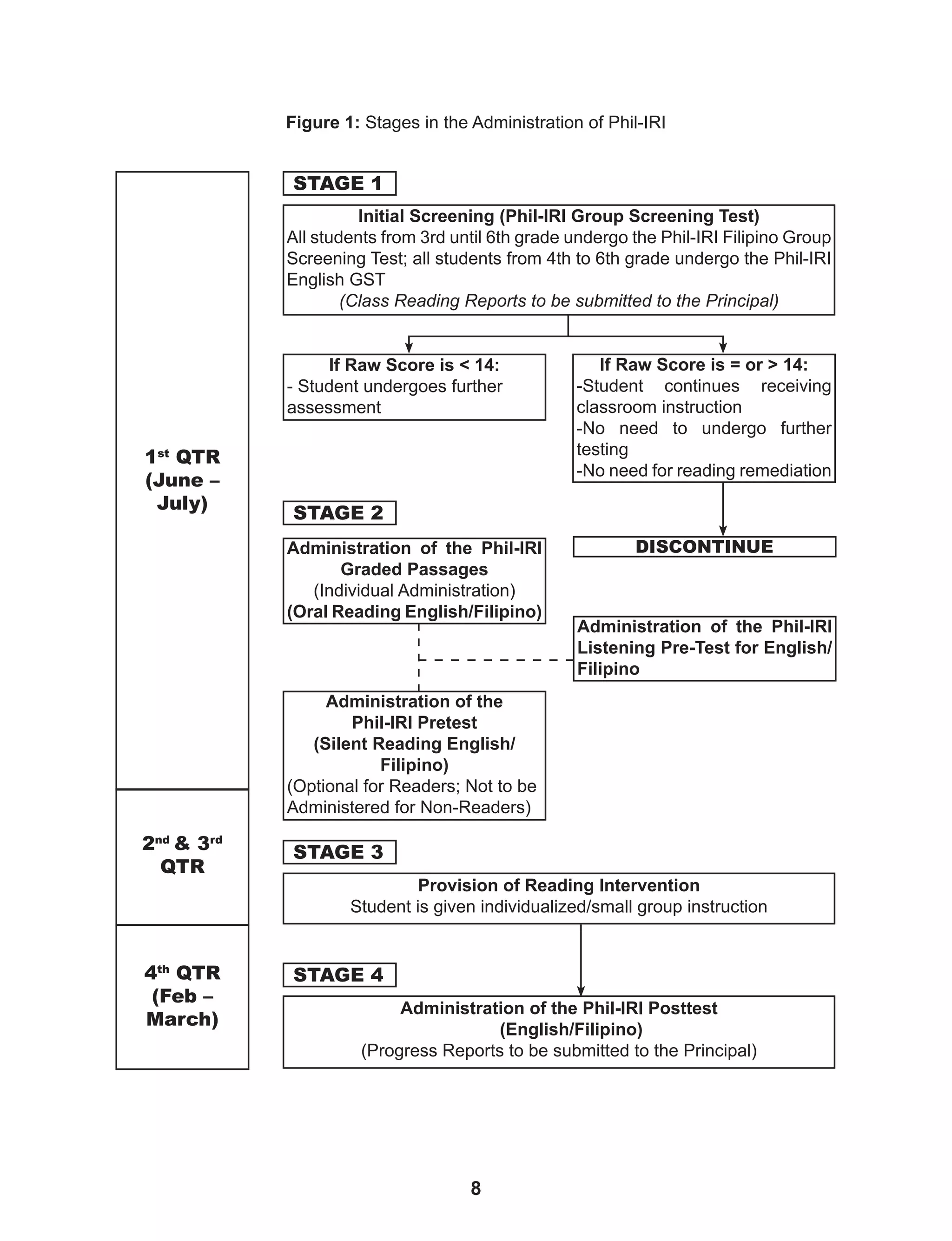
There are four stages in the administration of the Phil-IRI. Figure 1 on the next page presents
the four stages, namely:
Stage 1: Initial Screening Using the Phil-IRI Group Screening Test
Stage 2: Administration of the Phil-IRI Graded Passages (Pre-test)
Stage 3: Provision of Specialized Instruction/Intervention
Stage 4: Administration of the Phil-IRI Graded Passages (Post Test)
8
Administration of the Phil-IRI
Listening Pre-Test for English/
Filipino
DISCONTINUE
If Raw Score is = or > 14:
-Student continues receiving
classroom instruction
-No need to undergo further
testing
-No need for reading remediation
STAGE 1
1st
QTR
(June –
July)
2nd
& 3rd
QTR
4th
QTR
(Feb –
March)
If Raw Score is < 14:
- Student undergoes further
assessment
Administration of the Phil-IRI
Graded Passages
(Individual Administration)
(Oral Reading English/Filipino)
Administration of the
Phil-IRI Pretest
(Silent Reading English/
Filipino)
(Optional for Readers; Not to be
Administered for Non-Readers)
STAGE 2
STAGE 3
STAGE 4
Initial Screening (Phil-IRI Group Screening Test)
All students from 3rd until 6th grade undergo the Phil-IRI Filipino Group
Screening Test; all students from 4th to 6th grade undergo the Phil-IRI
English GST
(Class Reading Reports to be submitted to the Principal)
Provision of Reading Intervention
Student is given individualized/small group instruction
Administration of the Phil-IRI Posttest
(English/Filipino)
(Progress Reports to be submitted to the Principal)
Figure 1: Stages in the Administration of Phil-IRI
9
For SY 2018-2019, the Phil-IRI Group Screening Test (GST) in Filipino must be administered
to Grade 3 to 6 students while the GST in English must be administered to the Grade 4 to 6
students on the first month of the school year. It is a 20-item multiple choice test that the test
takers must accomplish within 30 minutes. This should be administered during class time. By
the end of July, the learner must have completed 2 tests (1 in English; 1 in Filipino).
Upon completion of the administration of the GST, the Class Reading Reports are submitted
to the Principal. These contain a summary of the students who performed equal or above and
below the cut-off score. Refer to Appendix B1, Form 1A: Talaan ng Pangkatang Pagtatasa ng
Klase (PPK) sa Phil-IRI for Filipino or Appendix B2, Form 1B: Class Reading Report (CRR)
for English.
As shown on Figure 1, students who garner a Raw Score that is equal to or greater than 14
(75%) need not undergo further testing. The first stage is done for these students.
However, students who garner a Raw Score that is lower than 14 (74%) need to undergo
further assessment, as this may be an indication that the student is experiencing difficulty
reading at-level text. It is thus necessary to conduct individualized assessment in order to
further describe the child’s reading performance. The learners will be assessed using the Phil-
IRI Graded Passages. If a student garners a score of 13 and below in the Filipino GST, s/he
will be given the Filipino Graded Passages Pre-Test. If the student garners a score of 13 or
below in the English GST, s/he will be given the English Graded Passages Pre-Test. Note that
it is possible for a student to undergo the Phil-IRI Graded Passages in one or both languages.
STAGE 2: Administration of the Phil-IRI Graded Passages (Pre-Test)
The Phil-IRI Graded Passages Pre-Tests have a total of four parallel sets (SETS A to D) that
the test-administrator can choose from. The administration of the Phil-IRI should begin with
the Oral Reading Test. Figure 2 presents the steps for Stage 2 in greater detail.
10
STAGE 2
Administration of the Oral Reading Test using Phil-IRI Graded Passages
(Optional) Step 3: Administer Listening Comprehension and Silent Reading
Figure 2. Flowchart for the Administration of the Phil-IRI: Stage 2
Step 1: Determine Starting Point of Graded Passages
(depending on Raw Score in Phil-IRI GST)
Step 2: For each passage, compute scores in Word Reading
and Comprehension to identify student’s Reading Levels
(Independent, Instructional, Frustration levels)
IF performance is at the
INDEPENDENT LEVEL,
give a grade level text
that is higher to find the
INSTRUCTIONAL LEVEL.
IF performance remains
INDEPENDENT, continue
giving a text that is a
grade level higher till
performance registers at the
INSTRUCTIONAL LEVEL.
Once the FRUSTRATION
LEVEL has been identified,
give a grade level text lower
than the starting point to find
the INDEPENDENT LEVEL.
Continue doing so until
performance registers at the
INDEPENDENT LEVEL is
identified.
STAGE 2a
The Listening Comprehension Test may
be administered to those found to be
poor/non-readers to describe their ability
to comprehend texts when the decoding
task is lifted.
STAGE 2b
The Silent Reading Comprehension test
may be administered to further describe
the kind of text that a child can read
independently. This helps in identifying
the kind of text that can be used for
classroom activities/seat work.
Once the INSTRUCTIONAL
LEVEL has been identified,
give a grade level text lower
to find the INDEPENDENT
LEVEL. Repeat instructions till
found.
IF performance is at the
INSTRUCTIONAL LEVEL,
give a text that is a grade
level higher to find the
FRUSTRATION LEVEL
IF performance is at the
INSTRUCTIONAL LEVEL,
give a grade level higher
than the last text read till
performance registers at the
FRUSTRATION LEVEL.
IF performance is at the
FRUSTRATION LEVEL,
give a grade level text
that is lower to find the
INSTRUCTIONAL LEVEL.
11
Step 1: Determine the Starting Point of Graded Passages.
The first passage that the child should be asked to read aloud must depend on the child’s raw
score in the GST.
a. If the child’s raw score in the GST is 0-7, he/she must be given a passage that is 3
grade levels below his current level.
b. If the child’s raw score in the GST is 8-13, he/she must be given a passage that is 2
grades below his current level.
To illustrate, if Pedro, a 5th grader, garnered a Raw Score of 6/20 in the Filipino GST, the first
selection that he must be asked to read should be at 2nd grade level. Once the first selection
to be read has been identified, the test administrator is ready for Step 2.
Step 2: For each passage, compute scores in Word Reading and Comprehension to identify
student’s Reading Levels (pages 21-29 details the procedures for computing the Word
Reading and Comprehension scores).
Using these graded passages, the test administrator must find the student’s independent,
instructional and frustration levels. Awareness of a child’s reading levels can help the teacher
identify materials that are suitable for developing the learner’s reading skills.
• Finding the independent level means that we are looking for the grade level
passage that the child can read on his/her own without any assistance. To find the
independent level, the test administrator continues to give a selection that is one
level lower than a given selection until the child is able to register performance
at 97 to 100% in word reading and 80 to 100% comprehension. It is important
to find the independent level so that we know the kind of text that the child is
already able to perform well in. Providing material at the independent level
may serve as a source of motivation or as a starting point for instruction.
• Finding the instructional level means that we are looking for the grade level
passage that the child can read with the support of a teacher. This is the level
where students make the most progress in reading. To find the instructional
level, the test administrator continues to give a selection that is one level
higher than the independent level passage until the learner is able to register
performance at 90 to 96% in word reading and 59 to 79% in comprehension.
• Finding the frustration level means that we are looking for the grade level passage that
the child can no longer read and understand on his own. To find the frustration level,
the test administrator continues to give a selection that is one level higher than the
instructional level passage until the learner’s oral reading score performance is at 89%
and below in Word Reading and 58% and below in Comprehension. It is important
to identify the frustration level so that we are aware of the kind of material that the
student is not yet ready for.
12
To illustrate, let us continue with our hypothetical 5th grade learner named Pedro. The
test administrator gave Pedro a 2nd grade passage, and his performance registered at
the independent level for that passage. The test administrator then gave him a higher level
passage (3rd grade) and Pedro's performance registered at the instructional level. Finally,
the test administrator gave him a text that is a grade level higher (4th grade), where his
performance registered at the frustration level. The test administrator now has Pedro’s
independent, instructional and frustration levels. He can proceed to Step 3.
Step 3: Administer Listening Comprehension Test (Stage 2a) and Silent Reading Test (Stage
2b). Note that both stages are optional.
STAGE 2a:
After administering the Oral Reading Test, if there is a need to describe the performance
of the child when the reading task is lifted (i.e. especially when the students have been
identified to be non-readers), the Listening Comprehension Test may be administered.
The process of finding the independent, instructional and frustration levels are the same
except that the passages are no longer read by the student and instead are read by
the test administrator. After each selection has been listened to, the test administrator
reads the multiple choice questions that the students must respond to orally.
STAGE 2b:
After administering the Listening Comprehension Test, if there is a need to describe the
performance of the child when doing the reading task on his/her own, the Silent Reading
Comprehension Test may be administered. The process of finding the independent,
instructional and frustration levels are the same except that the time it takes for the
student to finish reading each passage is recorded by the test administrator. After each
selection has been read, the test administrator reads the multiple choice questions
that the students must respond to orally.
STAGE 3: Provision of Specialized Instruction/Reading Intervention
Once all the data describing the child’s reading performance has been gathered, the teacher
may use this information to design an intervention program (i.e. remedial reading program) or
adjust classroom instruction.
(see Appendix H for a full discussion of the Handbook on Suggested Intervention)
STAGE 4: Administration of the Phil-IRI Graded Passages (Posttest)
After receiving specialized instruction, the students will be re-assessed using the Phil-IRI
Posttest Forms. The Phil-IRI Posttests have a total of 4 parallel sets (SETS A-D) that the test-
administrator can choose from. Using these graded passages, the test administrator must
again identify the student’s independent, instructional and frustration levels. The posttest
results may be compared with the pre-test results.
D. Specific Directions for the Administration of the Phil-IRI Group Screening Test
This section details the specific instructions for the Group Screening Test and the individually
administered Graded Passages accordingly. For general reminders on the conduct and
interpretation of assessment and assessment results, please see Appendix G.
13
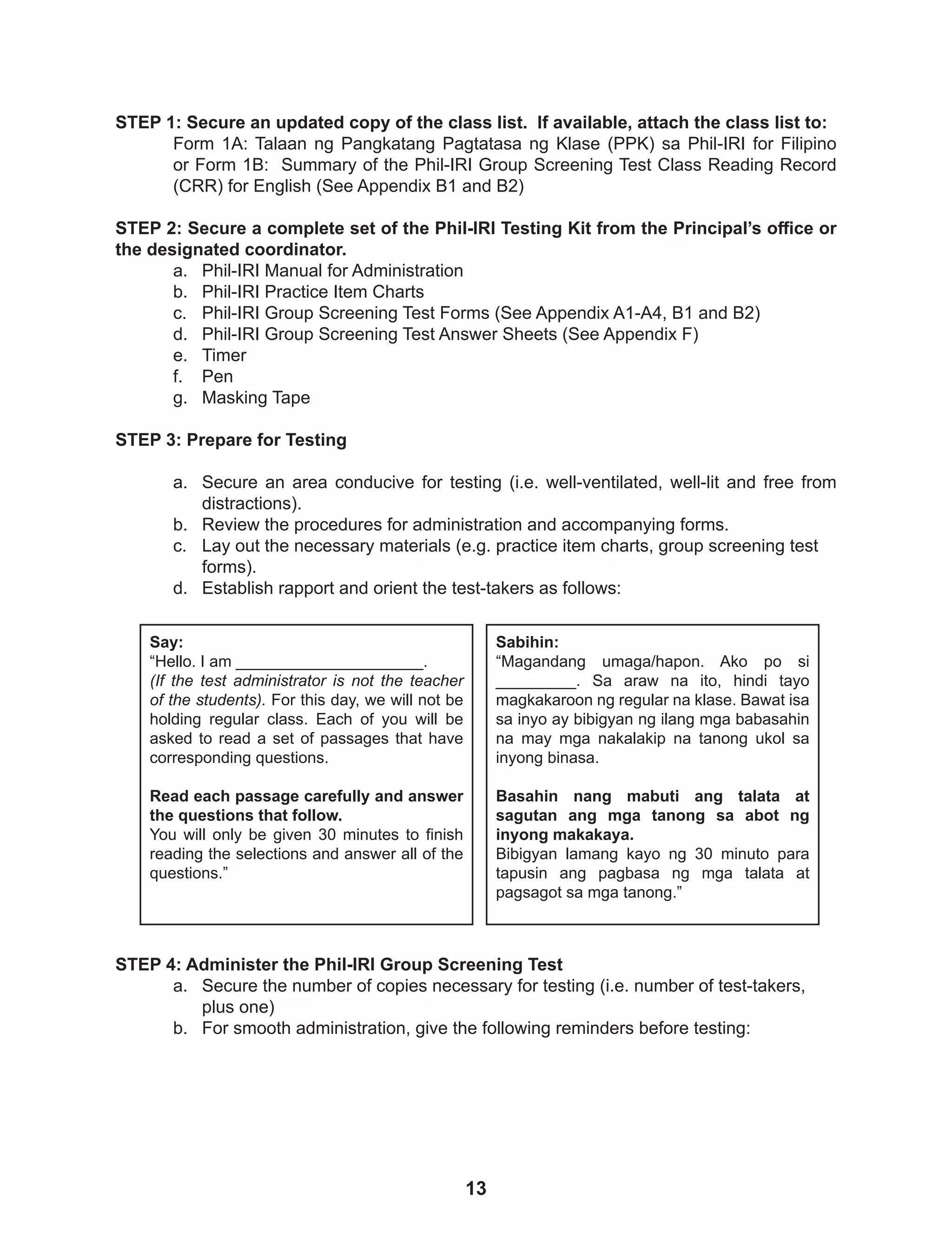
STEP 1: Secure an updated copy of the class list. If available, attach the class list to:
Form 1A: Talaan ng Pangkatang Pagtatasa ng Klase (PPK) sa Phil-IRI for Filipino
or Form 1B: Summary of the Phil-IRI Group Screening Test Class Reading Record
(CRR) for English (See Appendix B1 and B2)
STEP 2: Secure a complete set of the Phil-IRI Testing Kit from the Principal’s office or
the designated coordinator.
a. Phil-IRI Manual for Administration
b. Phil-IRI Practice Item Charts
c. Phil-IRI Group Screening Test Forms (See Appendix A1-A4, B1 and B2)
d. Phil-IRI Group Screening Test Answer Sheets (See Appendix F)
e. Timer
f. Pen
g. Masking Tape
STEP 3: Prepare for Testing
a. Secure an area conducive for testing (i.e. well-ventilated, well-lit and free from
distractions).
b. Review the procedures for administration and accompanying forms.
c. Lay out the necessary materials (e.g. practice item charts, group screening test
forms).
d. Establish rapport and orient the test-takers as follows:
Say:
“Hello. I am _____________________.
(If the test administrator is not the teacher
of the students). For this day, we will not be
holding regular class. Each of you will be
asked to read a set of passages that have
corresponding questions.
Read each passage carefully and answer
the questions that follow.
You will only be given 30 minutes to finish
reading the selections and answer all of the
questions.”
Sabihin:
“Magandang umaga/hapon. Ako po si
_________. Sa araw na ito, hindi tayo
magkakaroon ng regular na klase. Bawat isa
sa inyo ay bibigyan ng ilang mga babasahin
na may mga nakalakip na tanong ukol sa
inyong binasa.
Basahin nang mabuti ang talata at
sagutan ang mga tanong sa abot ng
inyong makakaya.
Bibigyan lamang kayo ng 30 minuto para
tapusin ang pagbasa ng mga talata at
pagsagot sa mga tanong.”
STEP 4: Administer the Phil-IRI Group Screening Test
a. Secure the number of copies necessary for testing (i.e. number of test-takers,
plus one)
b. For smooth administration, give the following reminders before testing:
14
REMINDERS
1. Avoid talking, eating, and going to the rest
room while testing is going on.
2. Do not write on the test booklet. Write your
answers on the answer sheet.
3. Read all of the selections as best as you
can.
4. Answer all of the questions that follow.
5. If you have a question, please raise your
hand. The teacher will approach you.
Say:
Write the following:
1. (Name, age, grade, section, name of
school and date of test).
2. Encircle MALE if you are male/a boy and
FEMALE if you are female/a girl.
3. REMINDER: Here is the sheet where you
will write your answers in (show the answer
sheet).
Read the following: (written on a chart or on
the board)
Say:
Where does one go when one wishes to
read and borrow a book?
a. clinic
b. library
c. market
d. playground
What is the answer to the question? The
correct answer b should be the letter written
on your answer sheet.
MGA PAALALA
1. Iwasan makipag-usap sa katabi at
magpunta sa banyo habang sinasagutan
ang pagsusulit na ito.
2. Iwasan ang pagsulat/pagmarka sa test
booklet. Isulat ang mga sagot sa sagutang
papel.
3. Basahin lahat ng seleksyon nang mabuti.
4. Sagutan lahat ng sumusunod na tanong.
5. Kung kinakailangan ang paglilinaw, itaas
ang kamay para malapitan kayo ng guro.
Sabihin:
Isulat ang sumusunod:
1. (Pangalan, edad, baitang, seksyon,
pangalan ng paaralan, petsa).
2. Bilugan ang LALAKI kung ikaw ay lalaki,
at bilugan ang BABAE kung ikaw ay babae.
3. PAALALA: Ito ang papel (ipakita ang
sagutang papel) kung saan ninyo isusulat
ang inyong mga sagot.
Basahin ang sumusunod: (nakasulat sa
pisara o sa tsart)
Sabihin:
Saan pupunta kung nais magbasa at
manghiram ng mga aklat?
a. klinik
b. silid-aklatan
c. palengke
d. palaruan
Ano ang tamang sagot sa tanong? Ang
tamang sagot na b ang dapat isulat sa
sagutang papel.
c. Distribute the answer sheets. Have the students fill in their personal information.
d. Using a chart, model how the test should be answered.
e. Distribute the test booklets.
f. If there are no questions, have them answer the test silently.
STEP 5: Report the Results
a. Fill out Form 1A (if Filipino GST is taken) or Form 1B (if English GST is taken).
b. Record the names of the students in the class. On the second column, put a
(check mark) if the student took the screening test; if not, mark with an X.
15
c. Refer to the GST booklet (Teacher’s copy) to identify the type of question for each
item in the test. Record the number of Literal, Inferential and Critical questions
answered in the test. (Ex: If Student A got 3 correct answers out of 5 literal
questions, record it as 3/5 under Literal column)
d. Record the total number of correct responses (over 20) of each student. Mark
with a (check mark) the appropriate column where each student’s score may be
classified (either ≥ 14, or < 14).
e. At the bottom of the form, indicate the total number of students for each column.
f. Submit the accomplished form/s and answer sheets to the Principal’s office.
E. Specific Directions for the Administration of the Phil-IRI Graded Passages
STEP 1: Secure a copy of the submitted Form A1 / A2
STEP 2: Secure a complete set of the Phil-IRI Testing Kit:
1. Phil-IRI Manual for Administration
2. Phil-IRI Test Booklets for one-on-one administration
a. Teacher’s Copy
b. Student’s Copy
3. Phil-IRI Form 3A/ 3B: Markahang Papel ng Panggradong Lebel na Teksto
/ Grade Level Passage Rating Sheet (Appendix D1 and D2)
4. Phil-IRI Form 4: Talaan ng Indibidwal na Pagbabasa / Individual Summary
Record (ISR) (Appendix E)
5. Timer
6. Pen
7. Recording device
STEP 3: Set Up the Testing Area
1. Secure an area conducive for testing (i.e. well-ventilated, well-lit and free
from distractions)
2. Make sure the testing kit is complete
3. Layout the necessary materials (e.g. booklets, score sheets)
STEP 4: Prepare for Testing
1. Review the procedures for administration and accompanying forms
2. Determine the kind of test to be administered
a. Oral Reading Comprehension
b. Listening Comprehension
c. Silent Reading Comprehension
4. Determine the Starting Point
16
If the raw score in the
GST is
Start with a Graded
Passage that is
Example:
0-7 points
Three (3) Grade levels
lower than current level
GST: Grade 6
Graded Passage: Grade 3
8-13 points
Two (2) Grade levels
lower than current level
GST: Grade 3
Graded Passage: Grade 1
14 points and above Discontinue testing
STEP 5: Assess Performance
a. Orient the test-taker, establish rapport, and administer the test:
1. Oral Reading Comprehension, or
2. Listening Comprehension, or
3. Silent Reading Comprehension
b. Procedure
1. Ask the motivation and motive questions. The teacher will have an idea about
the prior knowledge of the student on the topic that s/he will read based on the
response to the motivation question. The response to the motive question will
indicate the student’s ability to make predictions. The teacher may or may not
record the student’s responses.
2. Let the pupil read/listen to the selection.
3. After the child has listened to/read the selection, show the multiple choice items
on the student’s booklet. The student may read the question or the teacher may
read it for him/her and read the options which the test-taker will choose from.
Ask the child to answer the question by writing the letter of the option that he/she
thinks has the correct answer. Repeat the process until all questions are answered.
4. If the child answers the question with the response, “I don’t know,” mark the item
on the scoring sheet with an X.
5. If the student asks to go back to the selection to look for the answer, he/she may
do so. If the student is then able to answer correctly, mark the item on the scoring
sheet as correct and write LB (Looked Back)3
.
STEP 6: Report Results
a. Form 3A/3B
1. Fill out all the required student information and test details in Form 3A / 3B.
2. In Part A of the form, record the time when the student starts and ends reading
the passage. Then, compute the reading rate (Refer to Section G: Recording
the Speed and Rate in Reading).
If the student is asked to read orally:
3. As the child reads, record the student’s miscues. (Refer to Table 4 under
Section G.)
1
3
Caldwell, L. ( ). Qualitative Reading Inventory
Table 3. Starting Point for the Graded Passage
17
4. Then, record the student’s response to each question. Check the responses
of the student (Refer to Appendix A for the answer keys). Indicate the total
number of correct responses. Look for the equivalent percentage of the score
by referring to Table 6. Then, use Table 7 to indicate the reading level of the
student in comprehension.
5. In Part B of the form, get the total miscues of the student. Indicate the number
of words read correctly in the passage. Compute the word reading score (Refer
to Section K: Computing the Oral Reading Score). Finally, indicate the word
reading level by referring to Table 7.
b. Form 4
1. Use separate forms for the English and Filipino administered Phil-IRI.
2. Fill out the required student information and test details.
3. Record the word reading and comprehension levels of the student in all Phil-IRI
taken. Refer to Forms 3A and 3B for the details.
4. Fill out the Oral Reading Observation Checklist by marking each item with a
or an X.
5. To fill out the Summary of Comprehension Responses Table, refer to the Phil-IRI
booklet (Teacher’s copy) to identify the type of question for each item in the tests
taken. Record the number of Literal, Inferential and Critical questions answered in
each test. (Ex: If Student B got 1 correct answer out of 2 literal questions, record it
as 1/2 beside L=)
6. Indicate the Total Score, Percentage, and Reading Level for each test taken.
Refer to Forms 3A and 3B for the details.
The results of the Phil-IRI are analyzed quantitatively and qualitatively. Quantitative
analysis involves summing up the number of miscues observed; recording the
number of minutes it took the student to read the passage; and getting the number
of correctly answered comprehension questions about the passage. The combined
results of the word recognition and the answers to the comprehension questions
will give the reading level of the student per passage: whether s/he is in the
independent, instructional or frustration level.
The qualitative analysis consists of analyzing what types of miscues are made
and describing the student’s behavior while reading. Likewise, while the teacher
administers the oral reading test, s/he assesses whether the reading material
matches the learner’s reading performance. The teacher may give the student a
reading material with a lower readability level if s/he detects that the grade level
reading material is too difficult for the student.
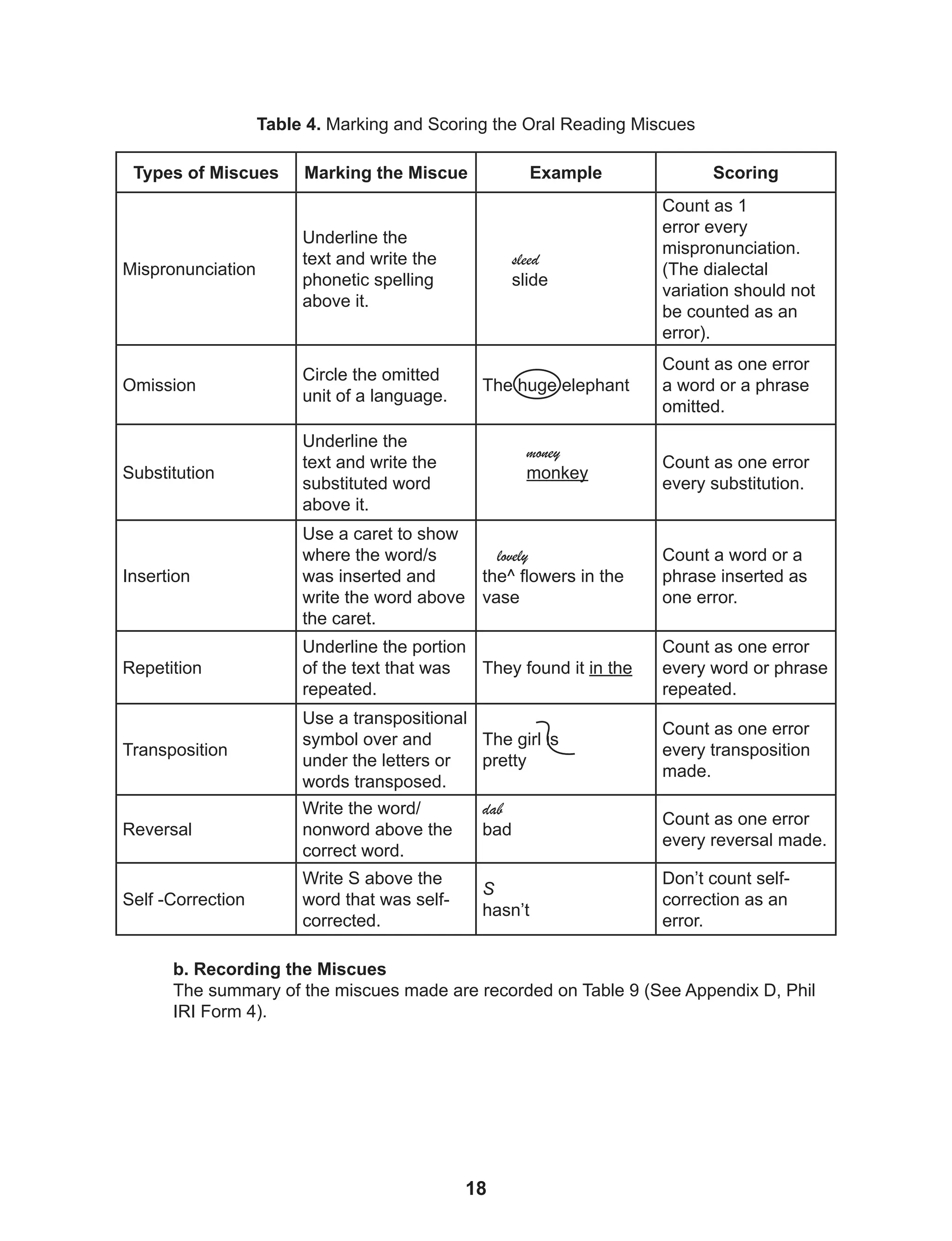
a. Marking and Scoring the Miscues
When administering the Phil-IRI Graded Passages, both the teacher and the student
need to have a copy of the passage to be read by the student. While the student is
reading a passage orally, the teacher records every miscue committed. The guide in
marking and scoring the miscues is shown in Table 4.
18
Types of Miscues Marking the Miscue Example Scoring
Mispronunciation
Underline the
text and write the
phonetic spelling
above it.
sleed
slide
Count as 1
error every
mispronunciation.
(The dialectal
variation should not
be counted as an
error).
Omission
Circle the omitted
unit of a language.
The huge elephant
Count as one error
a word or a phrase
omitted.
Substitution
Underline the
text and write the
substituted word
above it.
money
monkey
Count as one error
every substitution.
Insertion
Use a caret to show
where the word/s
was inserted and
write the word above
the caret.
lovely
the^ flowers in the
vase
Count a word or a
phrase inserted as
one error.
Repetition
Underline the portion
of the text that was
repeated.
They found it in the
Count as one error
every word or phrase
repeated.
Transposition
Use a transpositional
symbol over and
under the letters or
words transposed.
The girl is
pretty
Count as one error
every transposition
made.
Reversal
Write the word/
nonword above the
correct word.
dab
bad
Count as one error
every reversal made.
Self -Correction
Write S above the
word that was self-
corrected.
S
hasn’t
Don’t count self-
correction as an
error.
b. Recording the Miscues
The summary of the miscues made are recorded on Table 9 (See Appendix D, Phil
IRI Form 4).
Table 4. Marking and Scoring the Oral Reading Miscues
19
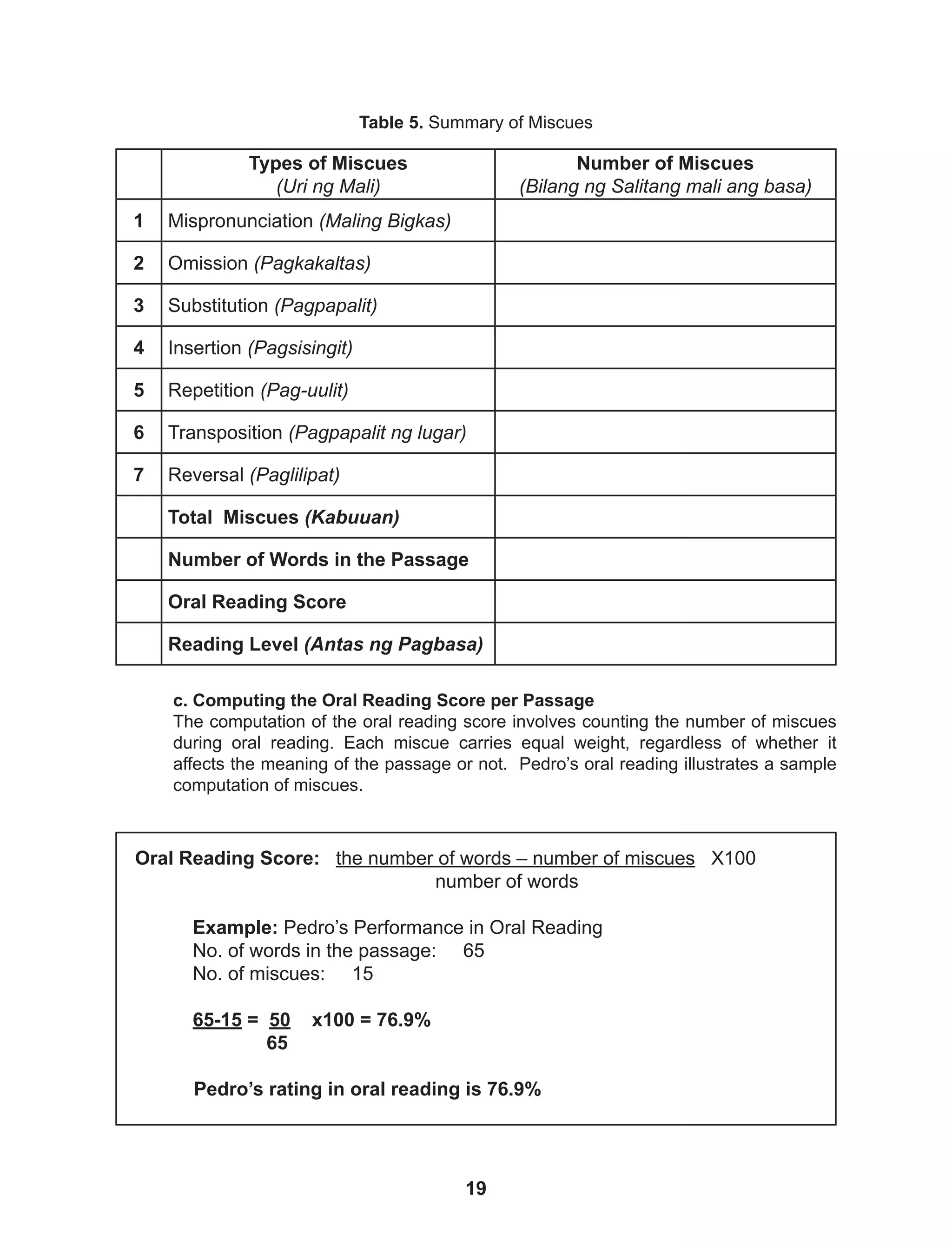
c. Computing the Oral Reading Score per Passage
The computation of the oral reading score involves counting the number of miscues
during oral reading. Each miscue carries equal weight, regardless of whether it
affects the meaning of the passage or not. Pedro’s oral reading illustrates a sample
computation of miscues.
Types of Miscues
(Uri ng Mali)
Number of Miscues
(Bilang ng Salitang mali ang basa)
1 Mispronunciation (Maling Bigkas)
2 Omission (Pagkakaltas)
3 Substitution (Pagpapalit)
4 Insertion (Pagsisingit)
5 Repetition (Pag-uulit)
6 Transposition (Pagpapalit ng lugar)
7 Reversal (Paglilipat)
Total Miscues (Kabuuan)
Number of Words in the Passage
Oral Reading Score
Reading Level (Antas ng Pagbasa)
Table 5. Summary of Miscues
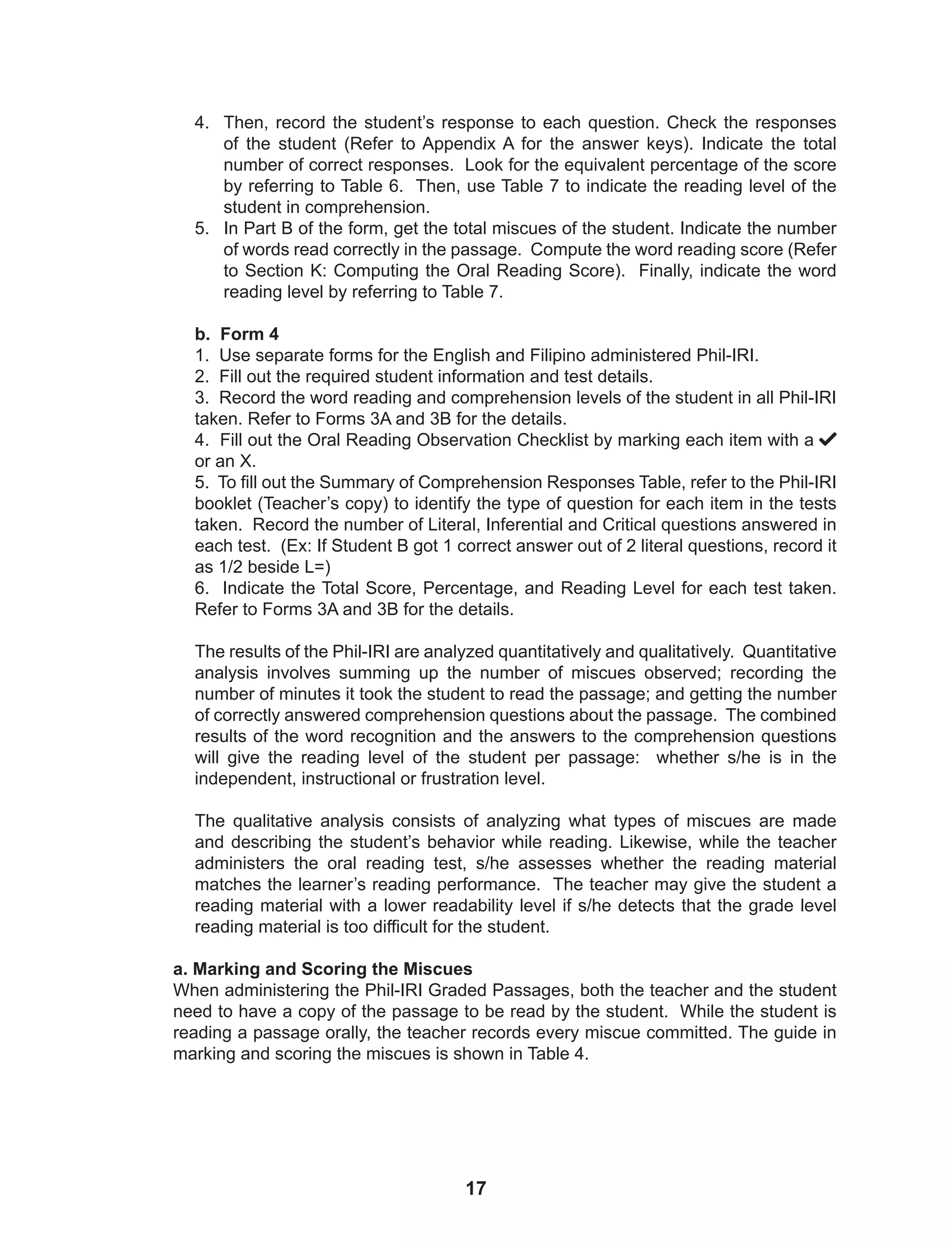
Oral Reading Score: the number of words – number of miscues X100
				 number of words
Example: Pedro’s Performance in Oral Reading
No. of words in the passage: 65
No. of miscues: 15
		
65-15 = 50 x100 = 76.9%
65
Pedro’s rating in oral reading is 76.9%
20
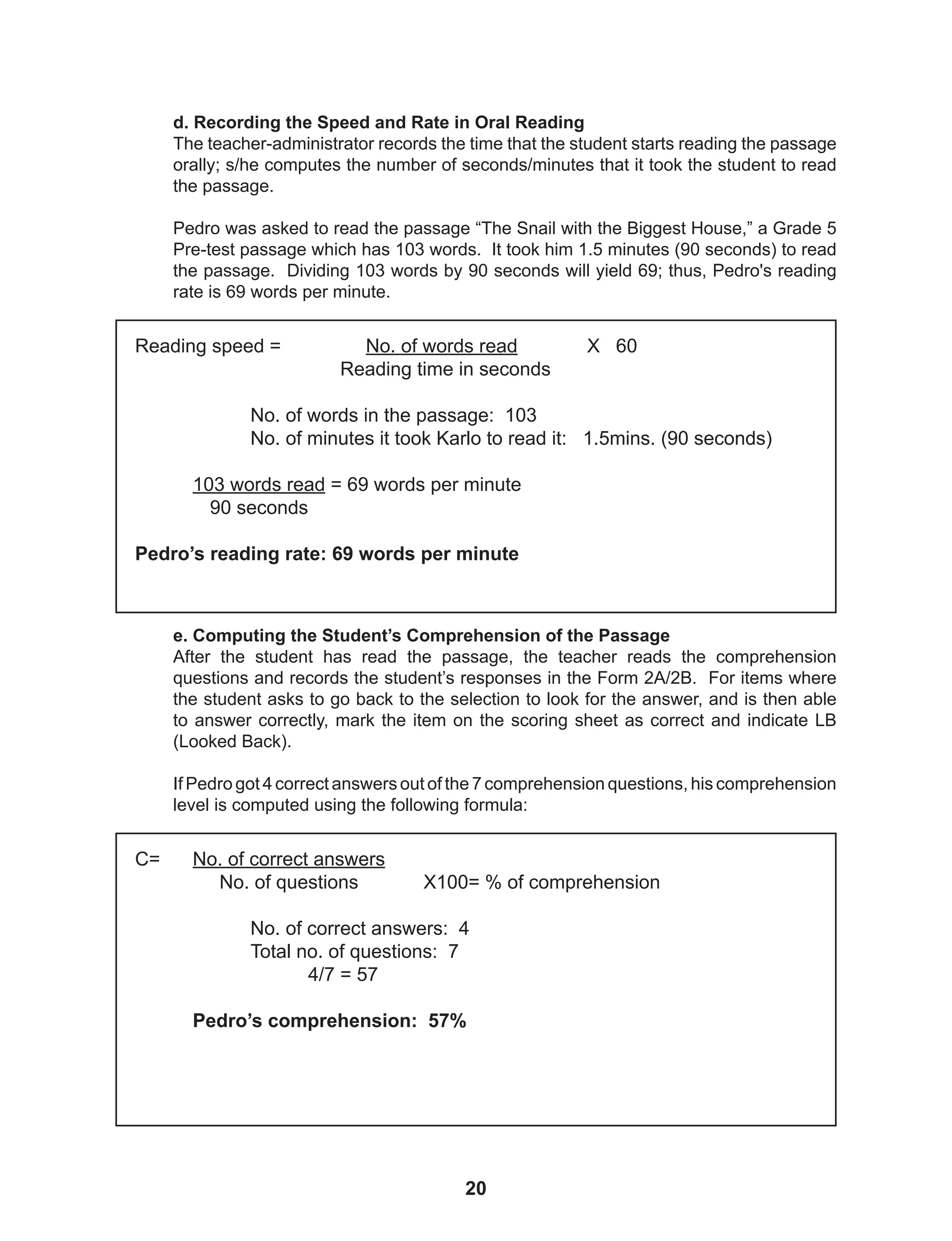
d. Recording the Speed and Rate in Oral Reading
The teacher-administrator records the time that the student starts reading the passage
orally; s/he computes the number of seconds/minutes that it took the student to read
the passage.
Pedro was asked to read the passage “The Snail with the Biggest House,” a Grade 5
Pre-test passage which has 103 words. It took him 1.5 minutes (90 seconds) to read
the passage. Dividing 103 words by 90 seconds will yield 69; thus, Pedro's reading
rate is 69 words per minute.
e. Computing the Student’s Comprehension of the Passage
After the student has read the passage, the teacher reads the comprehension
questions and records the student’s responses in the Form 2A/2B. For items where
the student asks to go back to the selection to look for the answer, and is then able
to answer correctly, mark the item on the scoring sheet as correct and indicate LB
(Looked Back).
If Pedro got 4 correct answers out of the 7 comprehension questions, his comprehension
level is computed using the following formula:
Reading speed =		 No. of words read X 60
			 Reading time in seconds
			
		 No. of words in the passage: 103
		 No. of minutes it took Karlo to read it: 1.5mins. (90 seconds)
103 words read = 69 words per minute
90 seconds
Pedro’s reading rate: 69 words per minute
C= No. of correct answers
No. of questions 		 X100= % of comprehension
		 No. of correct answers: 4		
		 Total no. of questions: 7
			 4/7 = 57
Pedro’s comprehension: 57%
21
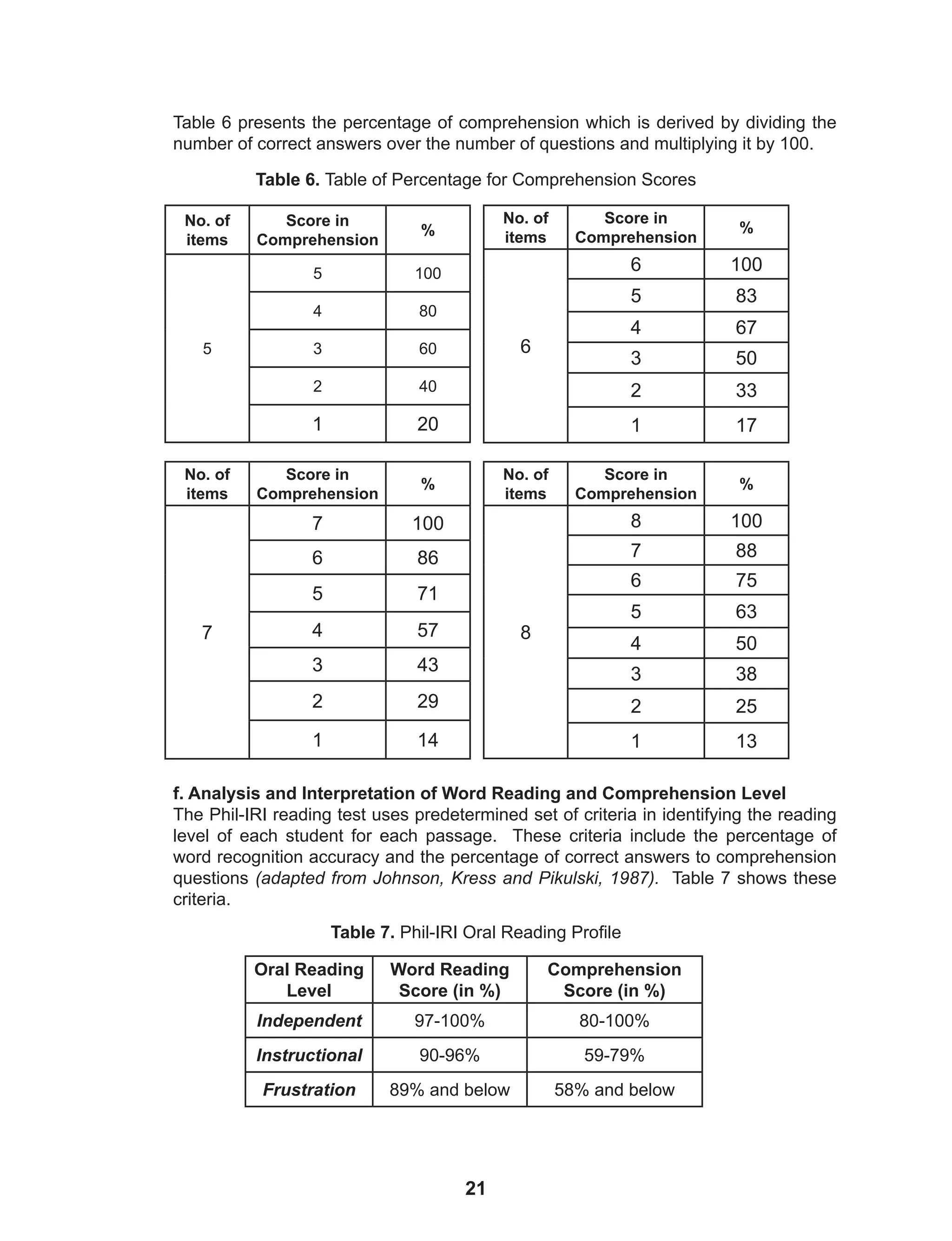
Table 6 presents the percentage of comprehension which is derived by dividing the
number of correct answers over the number of questions and multiplying it by 100.
f. Analysis and Interpretation of Word Reading and Comprehension Level
The Phil-IRI reading test uses predetermined set of criteria in identifying the reading
level of each student for each passage. These criteria include the percentage of
word recognition accuracy and the percentage of correct answers to comprehension
questions (adapted from Johnson, Kress and Pikulski, 1987). Table 7 shows these
criteria.
Table 6. Table of Percentage for Comprehension Scores
Table 7. Phil-IRI Oral Reading Profile
No. of
items
Score in
Comprehension
%
5
5 100
4 80
3 60
2 40
1 20
No. of
items
Score in
Comprehension
%
6
6 100
5 83
4 67
3 50
2 33
1 17
No. of
items
Score in
Comprehension
%
7
7 100
6 86
5 71
4 57
3 43
2 29
1 14
No. of
items
Score in
Comprehension
%
8
8 100
7 88
6 75
5 63
4 50
3 38
2 25
1 13
Oral Reading
Level
Word Reading
Score (in %)
Comprehension
Score (in %)
Independent 97-100% 80-100%
Instructional 90-96% 59-79%
Frustration 89% and below 58% and below
22
To illustrate, let us look at Karlo who is in Grade 4. His word reading and comprehension
scores are as follows:
The learner’s word reading score and comprehension score should be taken together
to determine a comprehensive reading profile for that passage. A description of the
student’s reading profile in word reading and comprehension per passage is presented
in Table 8.
Word reading score: 15 miscues = 76.9%: Frustration
Comprehension score: 4 out of 7= 57%: Frustration
Reading Rate: 69.5 words per minute
Karlo’s Oral Reading Profile: Frustration
Word Reading
Reading
Comprehension
Reading Profile per
passage
Independent Independent Independent
Independent Instructional Instructional
Instructional Independent Instructional
Instructional Frustration Frustration
Frustration Instructional Frustration
Frustration Frustration Frustration
Table 8. Student’s Reading Profile Per Passage
g. Qualitative Analysis
The teacher examines the type of miscues made and analyzes them:
What miscues are often committed?
Do these miscues affect the meaning of the passage?
The teacher likewise records the behavior of the student while reading using the
Observation Checklist in Table 13 (adapted from Gray Oral Reading Behavior). (See
Appendix D, Phil IRI Form 4).
Behaviors while Reading
Paraan ng Pagbabasa
or X
Does word-by-word reading
(Nagbabasa nang pa-isa isang salita)
Lacks expression; reads in a monotonous tone
(Walang damdamin; walang pagbabago ang tono)
Voice is hardly audible
(Hindi madaling marinig ang boses)
23
The Handbook on Reading Intervention discusses the causes of the student's behaviors
while reading and suggests ways of correcting them.
The Listening Comprehension and Silent Reading Test
After the administration of the Phil-IRI Oral Reading Test, the teacher may opt to
administer a Listening Comprehension for the nonreaders and a Silent Reading Test to
further assess the student’s reading speed and comprehension. These are, however,
optional activities.
F. Conducting the Reading Intervention
Based on the reading difficulty of the student, a reading intervention program is
designed for him/her.
Appendix H contains the Handbook on Reading Intervention. It discusses some cases
of different problems in reading of some pupils and the recommended intervention.
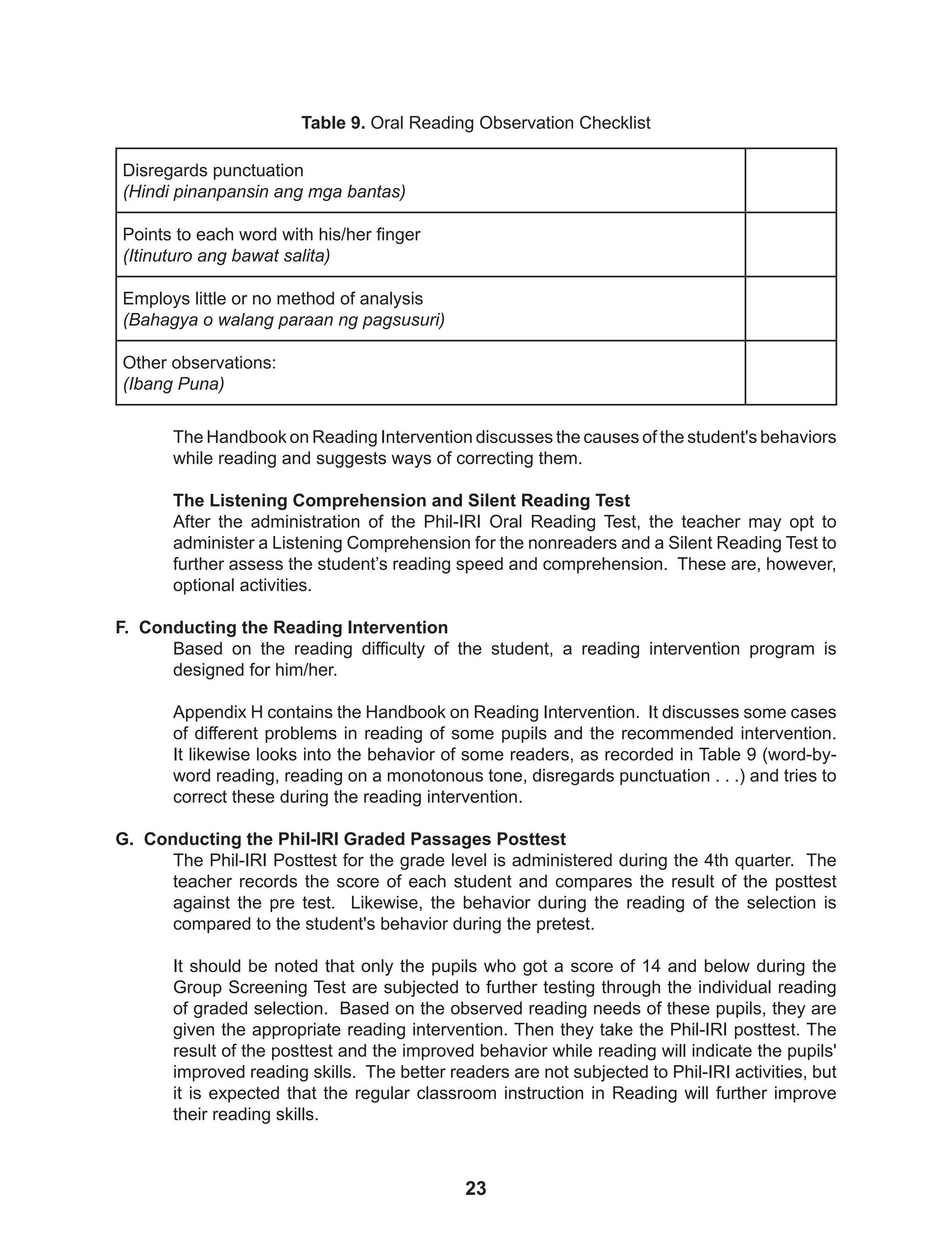
It likewise looks into the behavior of some readers, as recorded in Table 9 (word-by-
word reading, reading on a monotonous tone, disregards punctuation . . .) and tries to
correct these during the reading intervention.
G. Conducting the Phil-IRI Graded Passages Posttest
The Phil-IRI Posttest for the grade level is administered during the 4th quarter. The
teacher records the score of each student and compares the result of the posttest
against the pre test. Likewise, the behavior during the reading of the selection is
compared to the student's behavior during the pretest.
It should be noted that only the pupils who got a score of 14 and below during the
Group Screening Test are subjected to further testing through the individual reading
of graded selection. Based on the observed reading needs of these pupils, they are
given the appropriate reading intervention. Then they take the Phil-IRI posttest. The
result of the posttest and the improved behavior while reading will indicate the pupils'
improved reading skills. The better readers are not subjected to Phil-IRI activities, but
it is expected that the regular classroom instruction in Reading will further improve
their reading skills.
Table 9. Oral Reading Observation Checklist
Disregards punctuation
(Hindi pinanpansin ang mga bantas)
Points to each word with his/her finger
(Itinuturo ang bawat salita)
Employs little or no method of analysis
(Bahagya o walang paraan ng pagsusuri)
Other observations:
(Ibang Puna)
24
GLOSSARY
The following terms used in the manual are operationally defined as follows:
Assessment
a general term that includes all the ways in which information
is collected, synthesized, and interpreted in order to aid in
understanding learners and making instructional decisions
(Airasian, P.W., 2001).
Assessment Tool
an instrument used to describe a learner’s performance in
a particular skill
Comprehension understanding what one reads or listens to
Levels of Comprehension
questions that require varying cognitive skills;
types of questions include:
a) Literal
questions in which the answers are explicitly stated in the
text
b) Inferential
questions in which the answers are not explicitly stated in
the text. These questions require the reader to establish
relationships between what he/she knows and what is
stated in the text. Questions regarding vocabulary words
used in the text may also be considered inferential when
they require the reader to use context clues in order to
figure out word meanings
c) Critical
questions which require the learner to analyze, synthesize,
and make judgments on the author’s ideas
Comprehension Score
the percentage of items correctly answered over the total
number of items in a passage-specific comprehension test
Diagnostic Tool
an instrument used to assess learners’ needs and abilities
(in reading)
Dialectal Variations regional differences in pronunciation
Fluency the ability to read with speed, accuracy, and prosody
Graded Passage
a text that is grade level-appropriate in terms of content and
readability
25
Informal Reading Inventory
informal reading tests which consist of a set of graded
passages administered to individual learners; in contrast
to formal reading tests that are standardized and often
conducted for the purpose of comparing a student’s
performance with that of others (Weaver, 2014), informal
reading tests are designed to provide greater insight into
an individual learner’s reading level vis-à-vis a specific
passage in order to allow teachers to customize instruction
to the needs of their students (Rutledge, 1998)
Intervention
a set of activities designed to address student-specific
(reading) difficulties
Leveled Text see Graded Passage
Listening Comprehension
Assessment
when a learner listens to a selection read aloud in order to
assess his/her comprehension level
Miscues
unexpected responses a reader makes to a text (Goodman,
1996, in Martens, 1998)
Miscue Analysis
a way of looking at individual learners’ oral reading errors in
order to gain insight into their reading processes (Goodman,
1974, in Gunning, 2002)
Oral Reading
when a learner reads a selection aloud in order to
assess word recognition, reading fluency and reading
comprehension level
Philippine Informal Reading
Inventory
an informal reading inventory which consists of a set of
contextualized graded passages administered to individual
learners in order to determine their reading performance
and thus help teachers tailor instruction to fit their needs
and abilities
Prosody Reading with proper expression
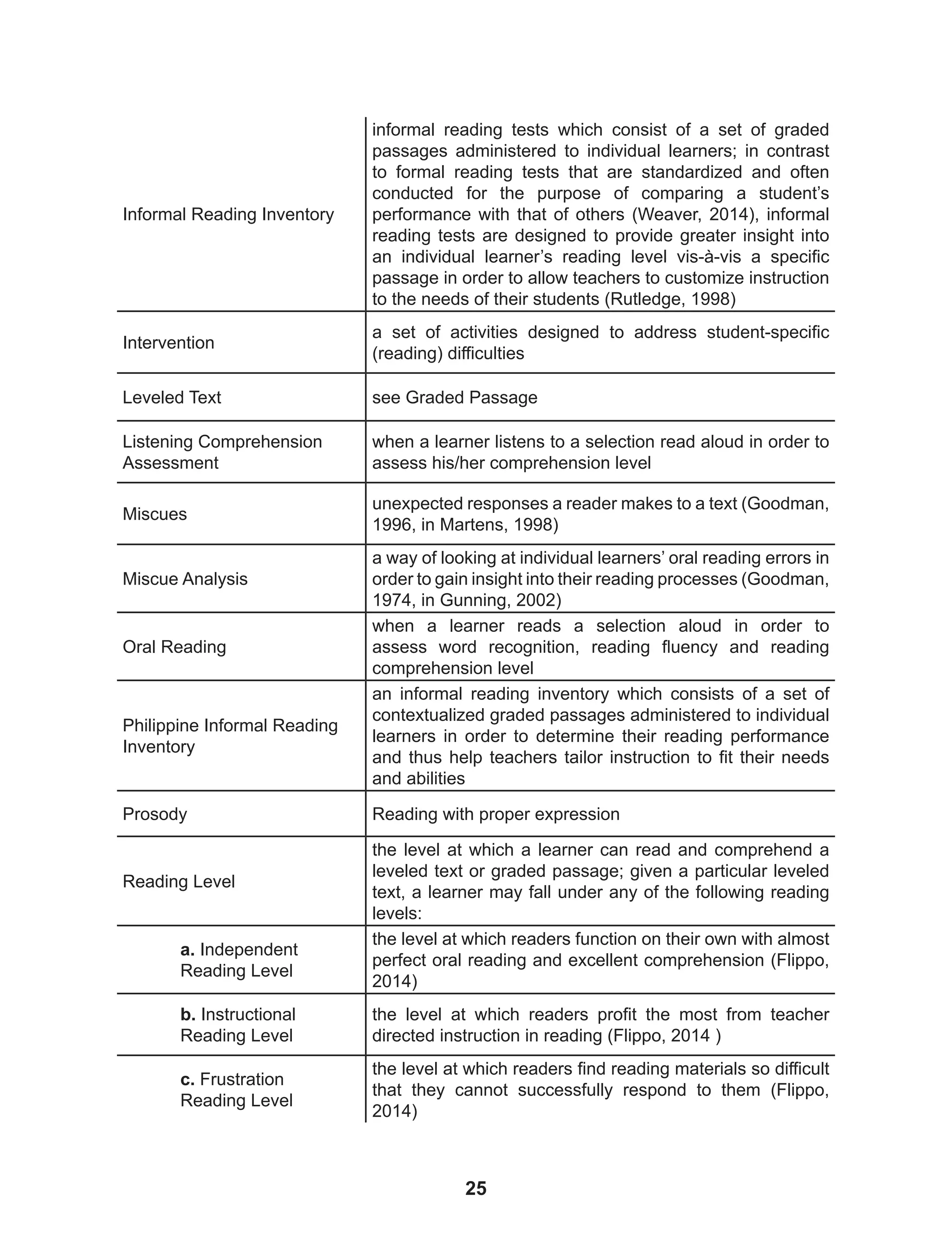
Reading Level
the level at which a learner can read and comprehend a
leveled text or graded passage; given a particular leveled
text, a learner may fall under any of the following reading
levels:
a. Independent
Reading Level
the level at which readers function on their own with almost
perfect oral reading and excellent comprehension (Flippo,
2014)
b. Instructional
Reading Level
the level at which readers profit the most from teacher
directed instruction in reading (Flippo, 2014 )
c. Frustration
Reading Level
the level at which readers find reading materials so difficult
that they cannot successfully respond to them (Flippo,
2014)
26
Reading Miscue Inventory
a recording of the errors that a reader makes, the amount
of time he/she takes in reading a passage, as well as the
number of correctly read words per minute
Reading Profile
a summary of a learner’s reading level based on his/
her word reading and comprehension scores in a given
passage
Readability
ease with which a book or other piece of written material
can be understood (Gunning, 2002)
Readability Level
the level at which a written material can be understood
using text characteristics such as the kinds of words, the
length of words and sentences used, as well as grade level
expectations as the standard
Reading Rate
the ratio between the number of words read in a passage
and the time it took for a reader to finish reading
Screening Test
a group-administered assessment tool made up of leveled
passages and comprehension questions to be read silently
and accomplished independently; intended to identify
students who need further testing
Silent Reading Assessment
when a learner reads a selection independently and answers
comprehension questions in order to assess reading rate
and reading comprehension level
Word Reading Score
the percentage of words correctly read over the total number
of words in a given passage
27
REFERENCES
Abadzi, H. (2014). Hidden insights from cognitive neuroscience. Retrieved from https://
www.academia.edu/6429908/Mysteries_and_Myths_of_Reading_Hidden_insights_from_
cognitive_neuroscience
Airasian, P. W. (2001). Classroom Assessment Concepts & Applications (Fourth ed., p. 4,
420). New York, NY: McGraw-Hill.
Bryant, B. R., & Wiederholt, J. (1991). Gray Oral Reading Tests, Diagnostic. Austin, TX: Pro-
ed.
Burkins, J.M, Croft, M. M. (2010), Preventing misguided reading: New strategies for
guided reading teachers. Retrieved from http://books.google.com.ph/books?id=Veu
rAAAAQBAJ&pg=PA102&lpg=PA102&dq=basal+and+ceiling+in+IRIs&source=bl&
ots=-3twcp_pLN&sig=KIrKCw3p-GIOP38ho2ql1dMH1e4&hl=en&sa=X&ei=8WiVU-
m4F9Hs8AWDrIKQCA&ved=0CCAQ6AEwAA#v=onepage&q=basal%20and%20ceiling%20
in%20IRIs&f=false
Cobb , C. (2004). Turning on a dime: Making change in literacy classrooms. The Reading
Teacher, 58, 104-106
Department Order No. 40, Series 2012. DepEd Child Protection Policy
Department Order No. 7, Series 2015. Policy Guidelines on Classroom Assessment for the
K to 12 Basic Education Program
Department of Education. Every Child A Reader Program (ECARP) Bureau of Elementary
Education Flagship Program
Flippo, R. (2014). Assessing readers qualitative diagnosis and instruction. 2nd Edition.
Chapter 2 Retrieved from http://www.reading.org/Libraries/books/assessing-readers--
second-ed--chapter3.pdf Copublished with Routledge/Taylor & Francis
Gunning, T. G. (2002). Assessing and Correcting Reading and Writing Difficulties (Second
ed., p. 104). Boston, MA: Allyn & Bacon.
Hoover, W. A., & Gough, P. B. (1990). The Simple View of Reading. Reading and Writing: An
Interdisciplinary Journal, 2, 127-160.
Johnson, M.J. , Kress, R.A., & Pikulski, P. L. (1987). INFORMAL READING INVENTORIES
(2ND ed.). Newark, DE: International Reading Association.
Leslie, L., & Caldwell, J. (2006). Qualitative Reading Inventory-4. Boston, MA: Pearson
Education, Inc.
Mariotti, A., & Homan, S. P. (2005). Linking Reading Assessment to Instruction (Fourth ed.).
Mahwah, NJ: Lawrence Erlbaum Associates, Inc.
28
Ocampo, D. S. (1997). EDR 210 Module: Trends in Reading Instruction, U.P. Open
University, Diliman Q. C.
Philippine Informal Reading Inventory. (2008-2009). N.p.: Department of Education.
R.A. 10533, The Enhanced Basic Education Act of 2013
Rutledge, S. (1998). Informal Reading Inventory. Retrieved from http://lrs.ed.uiuc.edu/
students/srutledg/iri.html
Vacca, J. L., Vacca, R. T., & Gove, M. K. (1991). Reading and Learning to Read (Second
ed.). New York, NY: Harper Collins Publishers.
Walker, B. (2004). Diagnostic teaching of reading (5th ed.). Upper Saddle River, NJ: Merrill
Prentice Hall.
Weaver, B. (2014). Formal vs Informal Assessments. Retrieved from http://lrs.ed.uiuc.edu/
students/srutledg/iri.html
29
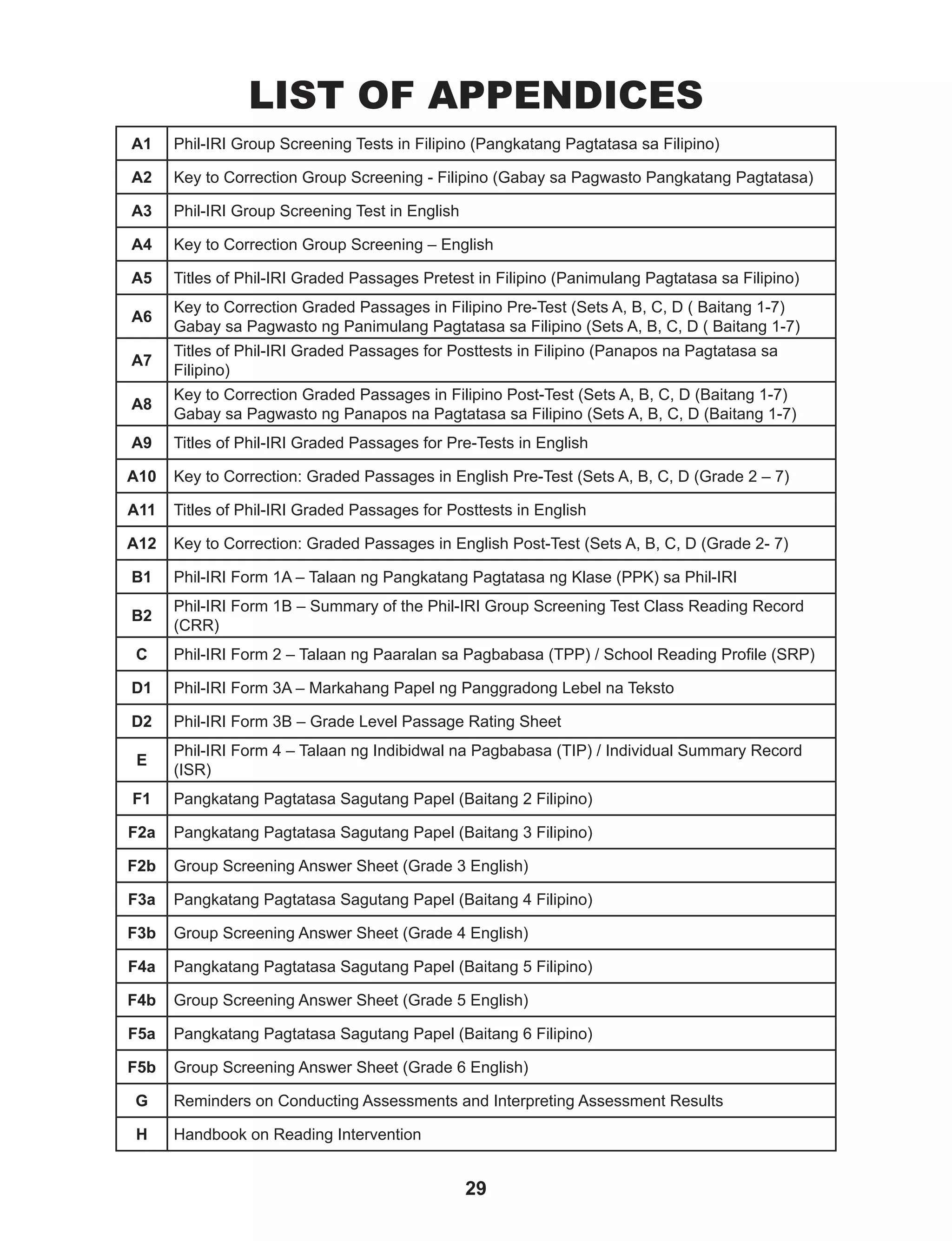
LIST OF APPENDICES
A1 Phil-IRI Group Screening Tests in Filipino (Pangkatang Pagtatasa sa Filipino)
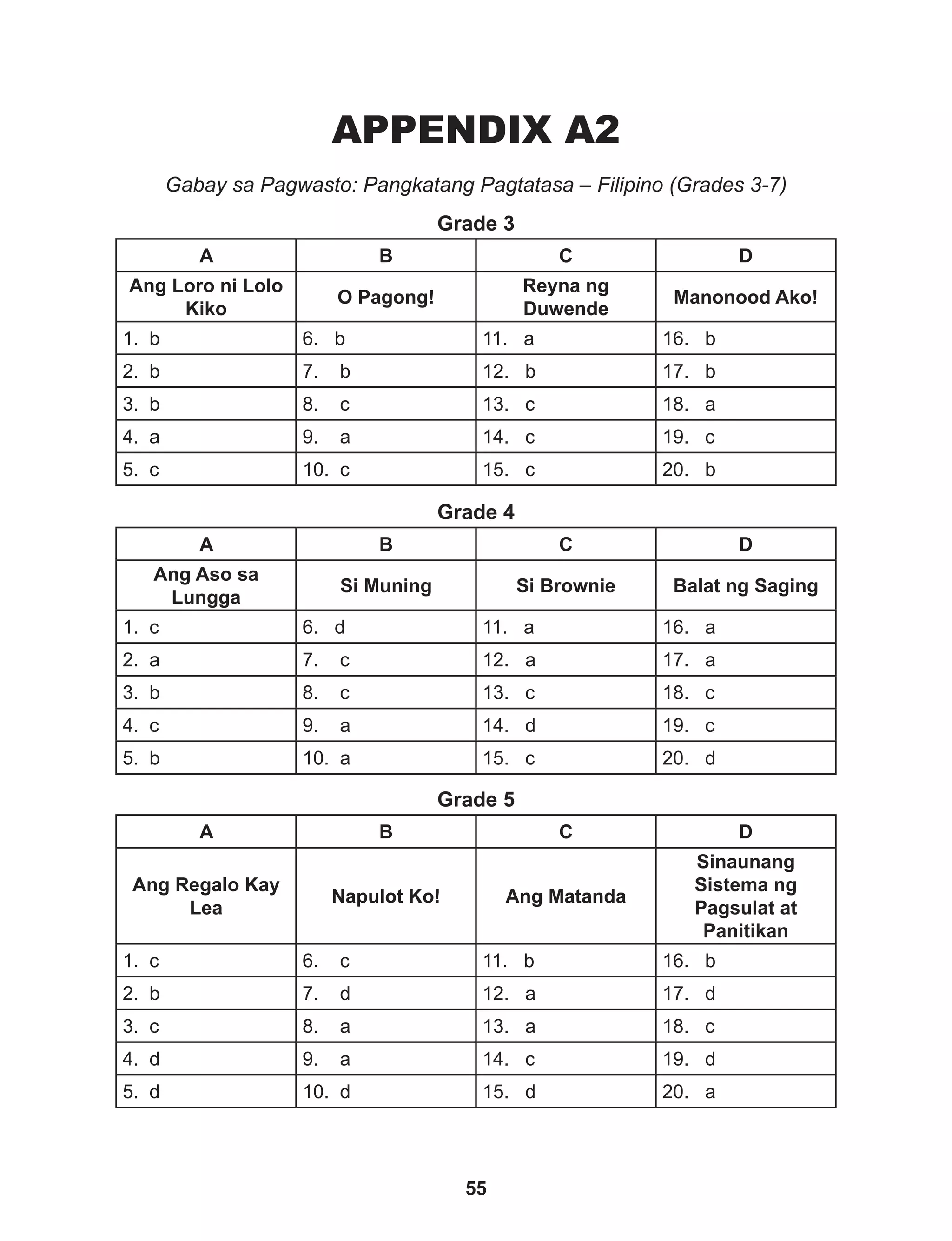
A2 Key to Correction Group Screening - Filipino (Gabay sa Pagwasto Pangkatang Pagtatasa)
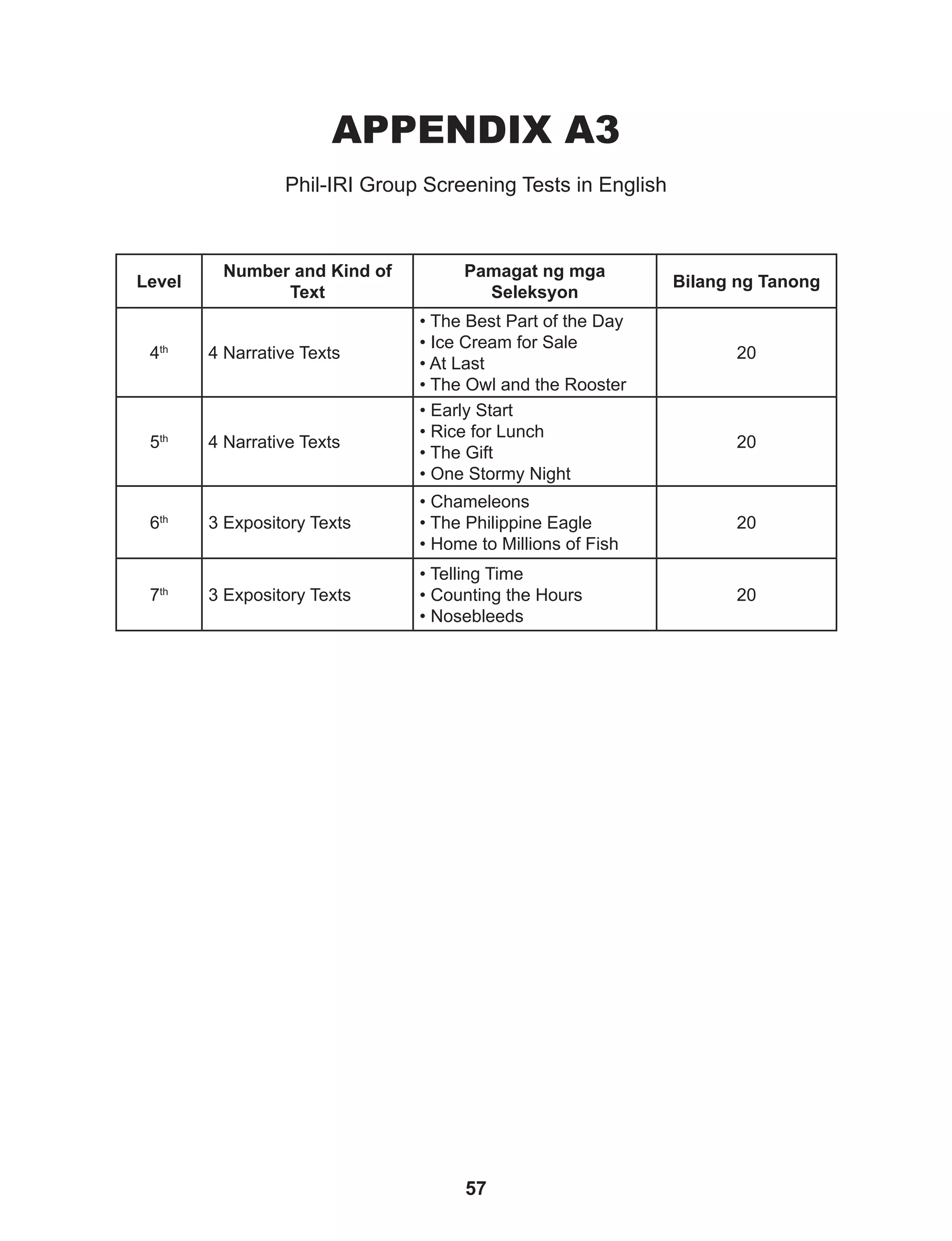
A3 Phil-IRI Group Screening Test in English
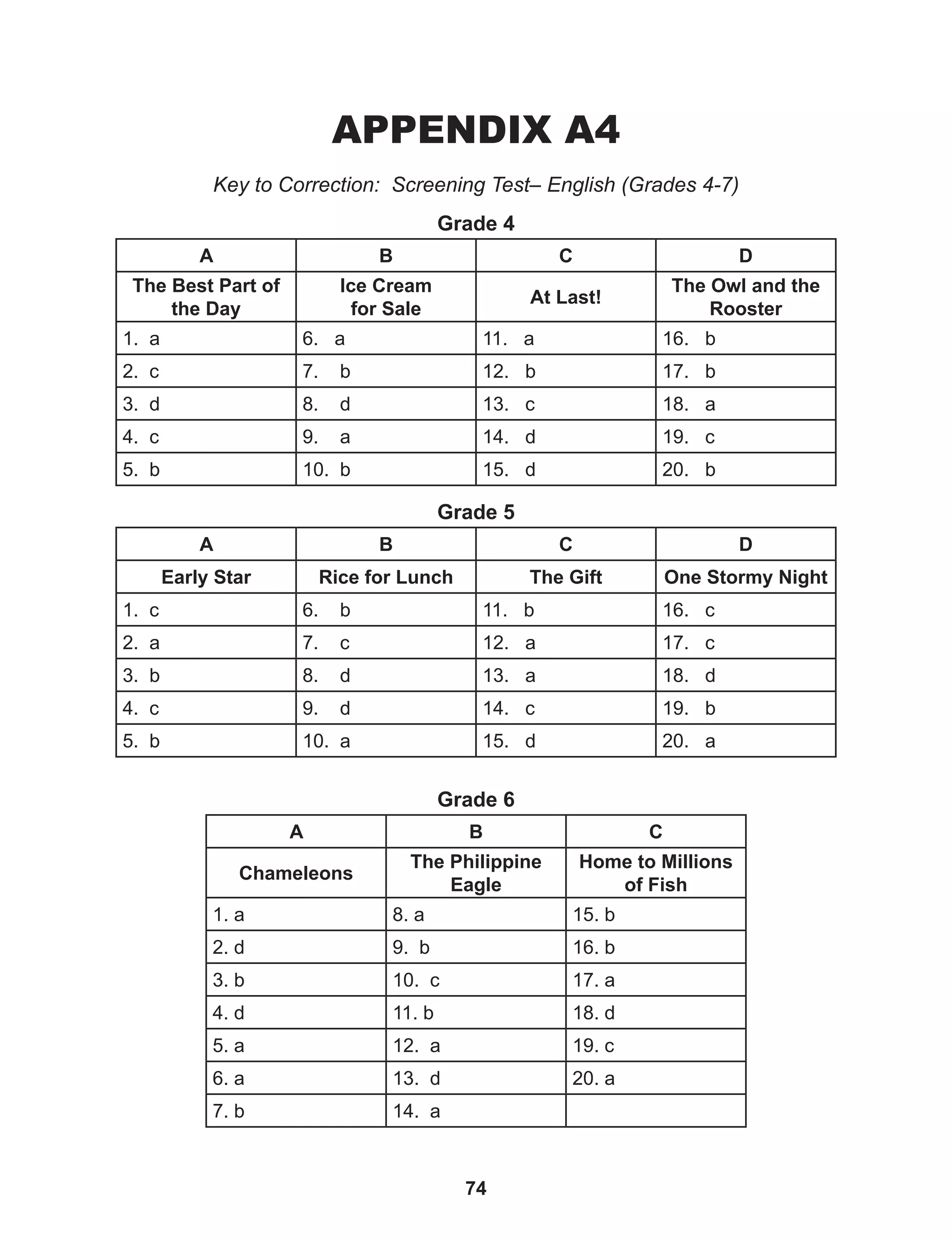
A4 Key to Correction Group Screening – English
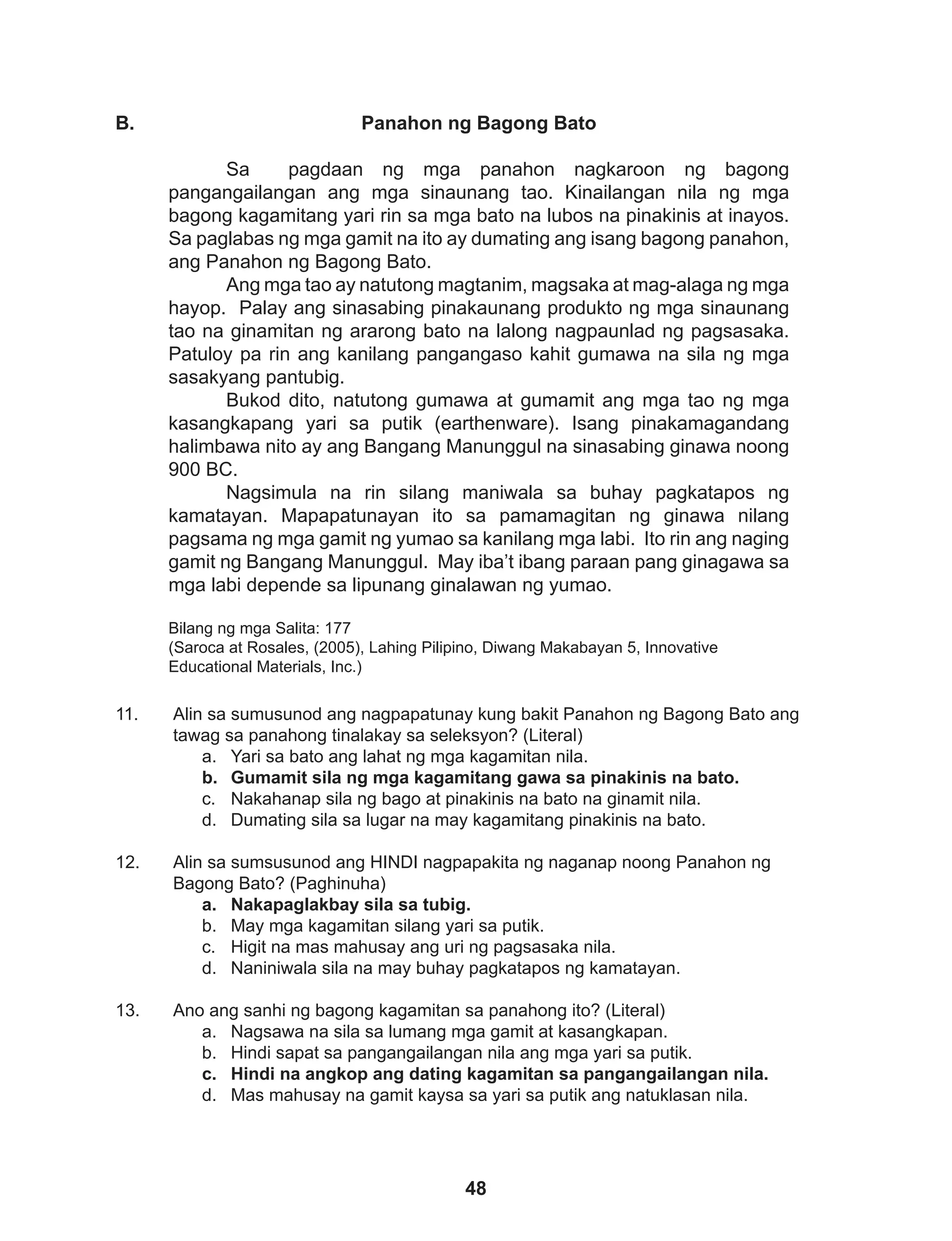
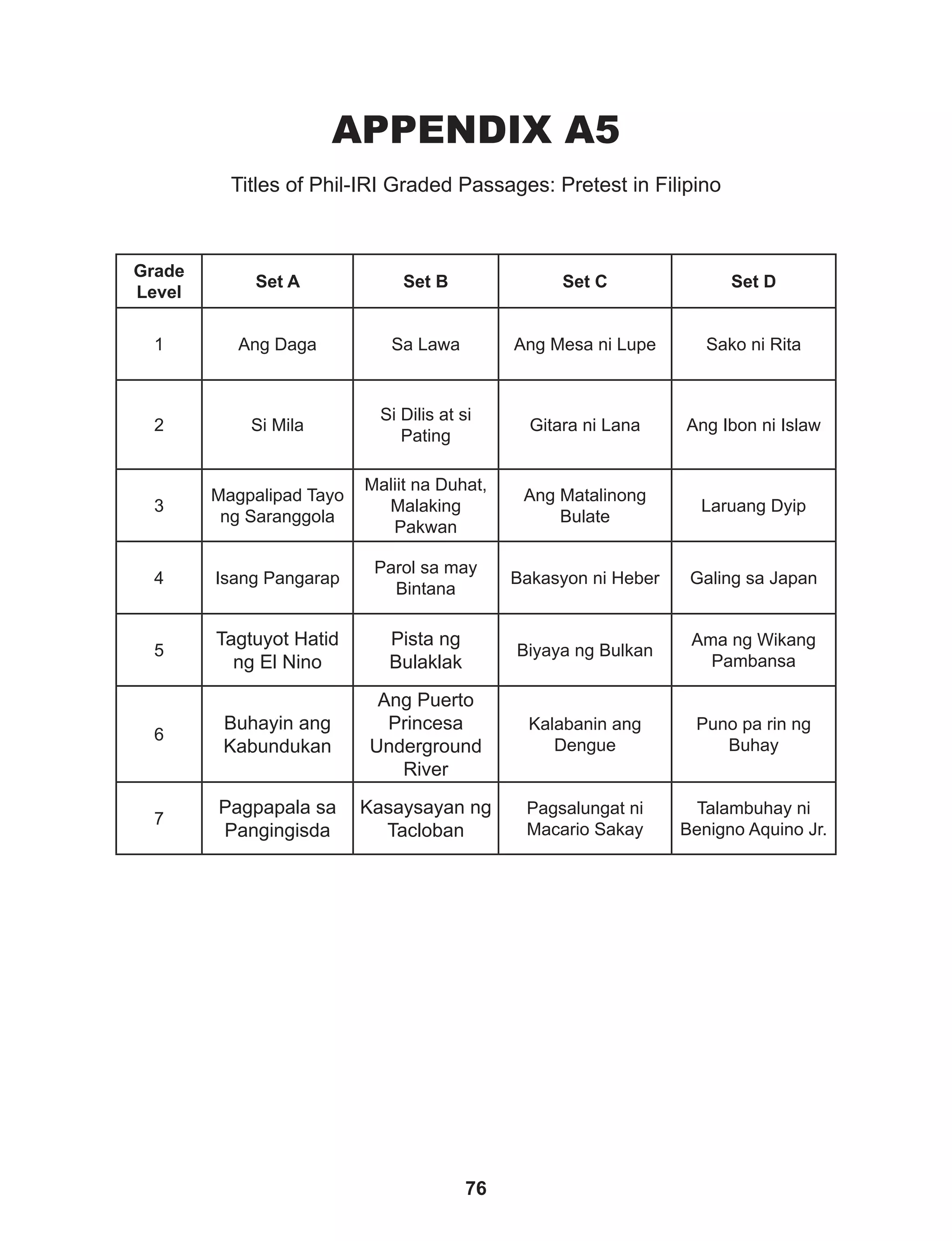
A5 Titles of Phil-IRI Graded Passages Pretest in Filipino (Panimulang Pagtatasa sa Filipino)
A6
Key to Correction Graded Passages in Filipino Pre-Test (Sets A, B, C, D ( Baitang 1-7)
Gabay sa Pagwasto ng Panimulang Pagtatasa sa Filipino (Sets A, B, C, D ( Baitang 1-7)
A7
Titles of Phil-IRI Graded Passages for Posttests in Filipino (Panapos na Pagtatasa sa
Filipino)
A8
Key to Correction Graded Passages in Filipino Post-Test (Sets A, B, C, D (Baitang 1-7)
Gabay sa Pagwasto ng Panapos na Pagtatasa sa Filipino (Sets A, B, C, D (Baitang 1-7)
A9 Titles of Phil-IRI Graded Passages for Pre-Tests in English
A10 Key to Correction: Graded Passages in English Pre-Test (Sets A, B, C, D (Grade 2 – 7)
A11 Titles of Phil-IRI Graded Passages for Posttests in English
A12 Key to Correction: Graded Passages in English Post-Test (Sets A, B, C, D (Grade 2- 7)
B1 Phil-IRI Form 1A – Talaan ng Pangkatang Pagtatasa ng Klase (PPK) sa Phil-IRI
B2
Phil-IRI Form 1B – Summary of the Phil-IRI Group Screening Test Class Reading Record
(CRR)
C Phil-IRI Form 2 – Talaan ng Paaralan sa Pagbabasa (TPP) / School Reading Profile (SRP)
D1 Phil-IRI Form 3A – Markahang Papel ng Panggradong Lebel na Teksto
D2 Phil-IRI Form 3B – Grade Level Passage Rating Sheet
E
Phil-IRI Form 4 – Talaan ng Indibidwal na Pagbabasa (TIP) / Individual Summary Record
(ISR)
F1 Pangkatang Pagtatasa Sagutang Papel (Baitang 2 Filipino)
F2a Pangkatang Pagtatasa Sagutang Papel (Baitang 3 Filipino)
F2b Group Screening Answer Sheet (Grade 3 English)
F3a Pangkatang Pagtatasa Sagutang Papel (Baitang 4 Filipino)
F3b Group Screening Answer Sheet (Grade 4 English)
F4a Pangkatang Pagtatasa Sagutang Papel (Baitang 5 Filipino)
F4b Group Screening Answer Sheet (Grade 5 English)
F5a Pangkatang Pagtatasa Sagutang Papel (Baitang 6 Filipino)
F5b Group Screening Answer Sheet (Grade 6 English)
G Reminders on Conducting Assessments and Interpreting Assessment Results
H Handbook on Reading Intervention
30
APPENDIX A1
Phil-IRI Group Screening Tests in Filipino
(Pangkatang Pagtatasa sa Filipino)
Antas Bilang at Uri ng Teksto
Pamagat ng mga
Seleksyon
Bilang ng Tanong
3rd
4 na kuwento
• Ang Loro ni Lolo Kiko
• O Pagong
• Reyna ng Duwende
• Manonood Ako
20
4th
4 na kuwento
• Ang Aso sa Lungga
• Si Muning
• Si Brownie
• Balat ng Saging
20
5th
4 na kuwento
• Ang Regalo Kay Lea
• Napulot ko!
• Ang Matanda
• Sinaunang Sistema ng
Pagsulat at Panitikan
20
6th
2 Sanaysay
• Paano Nabubuo ang Isang
Batas?
• Panahon ng Bagong Bato
20
7th
2 Sanaysay
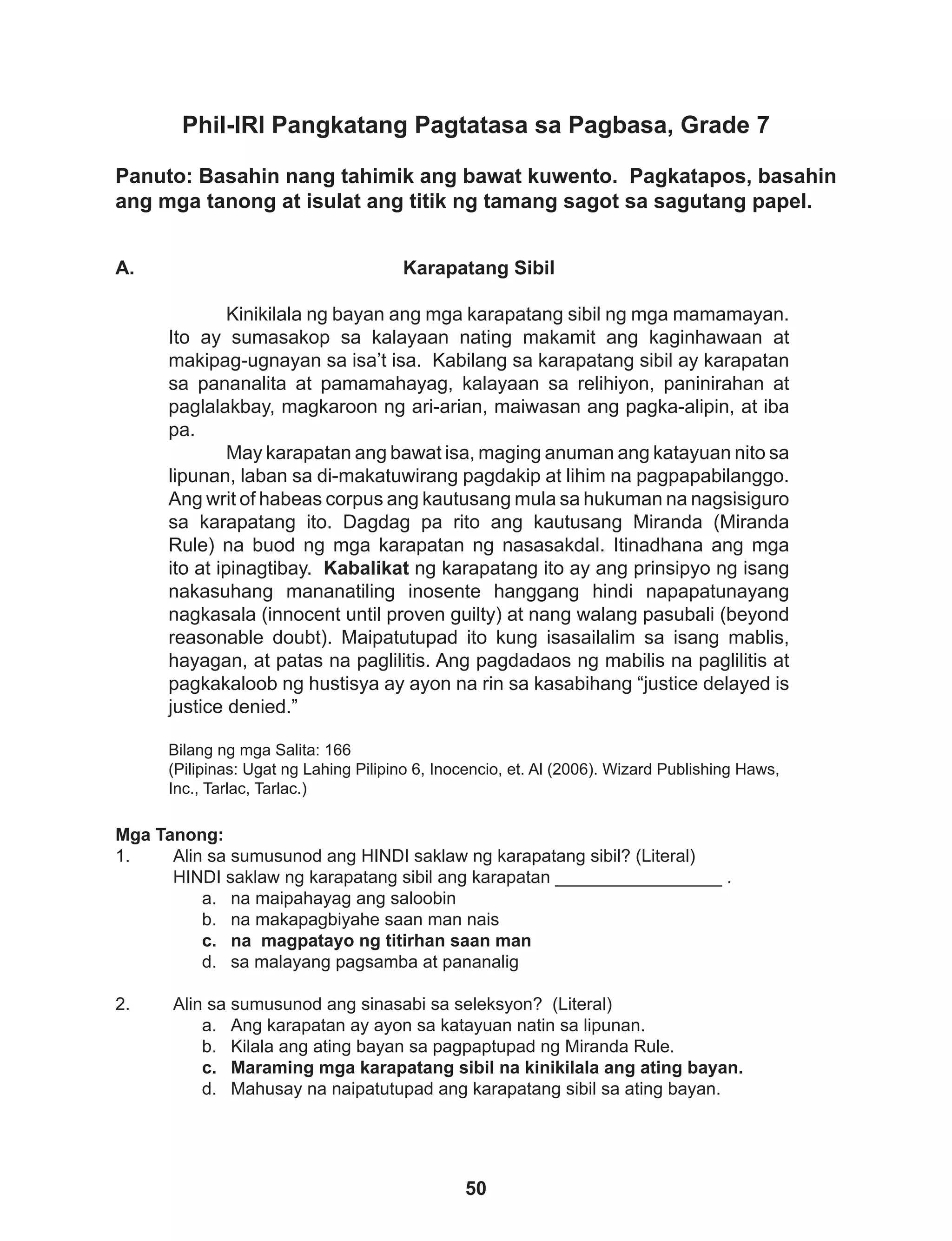
• Karapatang Sibil
• Ang Hukbong Paggawa ng
Pilipinas
20
31
Phil-IRI Pangkatang Pagtatasa sa Pagbasa, Baitang 3
Panuto: Basahin nang tahimik ang bawat kuwento. Pagkatapos, basahin ang
mga tanong at isulat ang titik ng tamang sagot sa sagutang papel.
1. Ano ang alaga ni Lolo Kiko? (Literal)
a. aso
b. loro
c. pusa
2. Ano ang paborito ng alaga ni Lolo? (Literal)
Paborito nito ang _________________ .
a. makalipad sa puno
b. makatikim ng keso
c. makausap si Lolo Kiko
3. Ano kaya ang naramdaman ni Lolo nang mawala ang loro? (Paghinuha)
a. masaya
b. malungkot
c. nagalit
4. Saan kaya naganap ang kuwento? (Paghinuha)
Naganap ang kuwento sa ____________ .
a. bahay
b. gubat
c. paaralan
5. Ano ang isa pang magandang pamagat sa kuwento? (Pagsusuri)
a. Si Lolo Kiko
b. Ang Loro sa Puno
c. Ang Alagang Loro
Ang Loro ni Lolo Kiko
May loro si Lolo Kiko.
Nagsasalita ang loro ni Lolo.
Keso ang paborito nito.
Aba! Nakawala ang loro!
Ay! Nasa puno na ang loro!
Bilang ng mga salita: 29
(Filipino: Wika ng Pagbabago, Medrano, Z.S., 2004
A.
32
6. Nasaan ang pagong sa kuwento? (Literal)
Ang pagong ay nasa ___________________ .
a. loob ng hardin
b. loob ng garapon
c. labas ng garapon
7. Alin sa sumusunod na mga salita ang nagsasabi tungkol sa pagong? (Literal)
a. mabait
b. maliit
c. masaya
8. Sino ang nag-uusap sa kuwento? (Paghinuha)
a. ang mga bata
b. ang mga pagong
c. ang bata at ang pagong
9. Ano kaya ang nararamdaman ng pagong sa kuwento? (Paghinuha)
Ang pagong ay ___________.
a. malungkot
b. masaya
c. galit
10. Bakit kaya sinulat ang kuwentong ito? (Pagsusuri)
a. Hatid nito ang isang balita.
b. Nais nitong magbigay-kaalaman.
c. Nais nitong magbigay ng aliw.
O Pagong!
O, pagong na maliit
sa garapon nakatira.
Ikaw ba ay sasaya
kapag nakawala ka na?
O, batang mabait
tulungan mo ako.
Paglabas ko rito
masaya talaga ako.
Bilang ng mga salita: 30
(Filipino: Wika ng Pagbabago, Medrano, Z.S., 2004)
B.
33
11. Para saan ang balde ng reyna? (Literal)
a. Upuan ito ng reyna.
b. Ginagamit ito sa paglalaba.
c. Lalagyan ito ng tubig ng reyna.
12. Ano ang nararamdaman ng reyna? (Literal)
______________ ang reyna.
a. Nag-aalala
b. Natutuwa
c. Napapagod
13. Alin sa sumusunod ang sinasabi sa kuwento? (Paghinuha)
a. Hinahawakan ng mga duwende ang korona.
b. Ang korona ay may mamahaling diamante.
c. Galing sa prutas ang korona ng reyna.
14. Saan kaya naganap ang kuwento?(Paghinuha)
Naganap ang kwento sa ______________ .
a. kaharian ng mga balde
b. kaharian ng mga saging
c. kaharian ng mga duwende
15. Bakit kaya sinulat ang “Reyna ng Duwende”? (Pagsusuri)
a. Hatid nito ang isang balita.
b. Nais nitong magbigay-aral.
c. Nais nitong magbigay ng aliw.
Reyna ng Duwende
Selina ang pangalan
ng reyna ng mga duwende.
Lagi siyang nakaupo
sa malaking balde.
Berdeng balde ang paborito niya
at balat ng saging
ang korona niya.
O! Kay saya ni Reyna Selina!
Bilang ng mga salita: 35
Sinulat ni:T. Nong
C.
34
16. Saan papunta ang bata sa kuwento? (Literal)
Papunta ang bata sa _____________ .
a. parada ng mga kotse
b. karera ng mga kotse
c. karera ng mga bisikleta
17. Alin sa sumusunod ang nagsasabi tungkol sa mapapanood ng bata? (Literal)
a. Madaming bisikleta rito.
b. Makukulay ang mga kotse rito.
c. Makukulay ang mga bisikleta rito.
18. Bakit kaya mabilis ang andar ng bata? (Paghinuha)
a. Gusto niyang mapanood ang karera.
b. Sasali siya sa makulay na parada.
c. May kaibigan siya sa karera.
19. Alin sa sumusunod ang nagpapakitang nasaktan ang bata sa kuwento? 			
(Paghinuha)
a. Mabilis and andar ko.
b. Naku! Dumulas ang bisikleta!
c. Aray! Kay daming putik ng tuhod ko!
20. Alin sa sumusunod ang isa pang magandang pamagat para sa kuwento? 			
(Pagsusuri)
a. Parada ng mga Kotse
b. Karera ng mga Kotse
c. Karera ng Bisikleta
Manonood Ako!
May karera ng kotse.
Makukulay raw ang mga kotse.
Manonood ako ng karera.
Magdadala ako ng kamera.
Magsisimula na ito.
Sasakay na ako sa bisikleta.
Mabilis ang andar ko.
Naku! Dumulas ang bisikleta!
Aray! Kay raming putik ng tuhod ko!
Bilang ng mga salita: 42
Sinulat ni:T. Nong
D.
35
Phil-IRI Pangkatang Pagtatasa sa Pagbasa, Baitang 4
Panuto: Basahin nang tahimik ang bawat kuwento. Pagkatapos, basahin
ang mga tanong at isulat ang titik ng tamang sagot sa sagutang papel.
1. Saan nangyari ang kuwento? (Literal)
a. sa bukid
b. sa gubat
c. sa kalsada
d. sa lansangan
2. Ano ang hinahanap ng aso? (Literal)
a. makakain
b. makakasama
c. mapapasyalan
d. matutulugan
3. Anong ugali ang ipinakita ng aso? (Paghinuha)
a. madamot
b. matakaw
c. masipag
d. mayabang
4. Bakit hindi makalabas ang aso sa lungga? (Paghinuha)
a. may harang ang labasan
b. may bitbit pa siyang pagkain
c. lubos na marami ang kinain niya
d. mali ang paraan ng paglabas niya
Ang Aso sa Lungga
Mayisangasonggutomnagutomnanaglalakadsakalsada.Habang
naglalakad, ibinubulong niya sa sarili na kailangan niyang makakita ng
isang lunggang puno ng pagkain. Nang makakita siya ng lungga sa dulo
ng kalsada, agad siyang pumasok dito. Kumain siya hanggang mabusog.
Pero kahit busog na siya, kumain pa rin at inubos ang lahat ng pagkain
sa loob ng lungga. Sa kanyang kabusugan, halos pumutok ang malaki
niyang tiyan. Nang lalabas na lamang siya, napansin niyang hindi na siya
magkasya sa labasan. Sumigaw siya upang humingi ng tulong. Dumating
ang isa pang aso at nalaman ang nangyari. Bago ito umalis, nagwika siya
sa kasamang aso, “Hintayin mo na lang umimpis ang tiyan mo.”
Bilang ng mga salita: 116
(Bagong Filipino sa Puso at Diwa 2, Aragon et al, 1989)
A.
36
5. Bakit kaya hindi siya natulungan ng isa pang aso? (Inferential)
a. natakot sa kanya ang aso
b. para matuto siya sa pangyayari
c. nainggit sa kanya ang isa pang aso
d. hindi rin ito makakalabas sa lungga
6. Sino ang naghahanap ng pusa? (Literal)
a. ang kuting
b. si Muning
c. si Nanay
d. si Susan
7. Bakit niya hinahanap ang pusa? (Paghinuha)
a. ipapasyal niya ito
b. paliliguan niya ito
c. pakakainin niya ito
d. patutulugin niya ito
8. Saan niya nakita ang pusa? (Literal)
a. sa silid
b. sa silong
c. sa kahon
d. sa kusina
Si Muning!
Muning! Muning!
Hanap nang hanap si Susan kay Muning. Dala ni Susan ang
lalagyan ng pagkain ni Muning. May laman na ang lalagyan, pero wala
si Muning. Wala siya sa kusina. Wala rin siya sa silid. Nasaan kaya si
Muning?
Bumaba ng bahay si Susan. Hinanap niya kung naroon si Muning.
Ikot na siya nang ikot, pero hindi pa rin niya nakita. Baka lumabas ito ng
bahay.
Ngiyaw! Ngiyaw!
Hayun si Muning! Ngiyaw siya nang ngiyaw. Nasa loob siya ng
kahon. May mga kasama si Muning sa loob ng kahon.
Nakita ni Susan ang kasama ni Muning. Mga kuting ang kasama ni
Muning sa kahon! May puti, itim at magkahalong puti at itim na kulay ng
kuting. Tuwang-tuwa si Susan!
Bilang ng mga salita: 122
(Yaman ng Panitik 1, Resuma et al, 1987)
B.
37
9. Sino ang mga kasama ni Muning sa kahon? (Paghinuha)
a. mga anak nito
b. mga kalaro nito
c. mga nahuli nito
d. mga kaibigan nito
10. Ano ang isa pang magandang pamagat ng kuwento?? (Pagsusuri)
a. Nasaan si Muning?
b. Nasaan ang Kahon?
c. Ang Kahon ni Susan
d. Ang Pagkain ini Muning
11. Saan naganap ang kuwento? (Literal)
a. sa bahay
b. sa paaralan
c. sa palengke
d. sa simbahan
12. Ano ang katangiang ipinakita ni Brownie? (Paghinuha)
a. matapang
b. masungit
c. maharot
d. malikot
Si Brownie
Si Brownie ay aking alagang aso. Ang aking aso ay masamang
magalit. Minsan ay may pumasok na malaking manok sa aming bakuran.
Kaagad niya itong tinahulan. Kung hindi lamang siya nakatali nang
mahigpit, malamang na habulin niya ito. Nagulat ang manok at tumakbo
ito nang mabilis palabas ng bakuran.
Kagabi ay hindi ko naitali si Brownie. Panay ang ungol niya. Maya-
maya ay may tinahulan siya nang malakas. Biglang lumukso si Brownie
sa kanyang tulugan at may hinabol. Dali-dali kong sinilip ang aking alaga.
May napatay siyang daga! Bahagya pa niyang ginalaw ang kanyang
buntot nang makita ako. Kaagad kong binitbit sa buntot ang daga at
ipinakita kay Tatay. Masayang hinimas ni Tatay si Brownie. “Talagang
maaasahan ang asong ito,” sabi niya.
Bilang ng mga salita: 122
(Bagong Filipino Saligang-Aklat II, Ibita et al, 1990)
C.
38
13. Ano ang napatay ni Brownie? (Literal)
a. pesteng ipis
b. pusang bahay
c. dagang bahay
d. ligaw na manok
14. Bakit kaya bahagyang ginalaw ni Brownie ang buntot nang makita ang amo? 		
(Paghinuha)
a. gusto niyang gisingin ang daga
b. nagulat siya sa kanyang ginawa
c. natakot siyang mapagalitan ng amo
d. upang ipakita sa amo ang kanyang ginawa
15. Bakit kaya sinulat ang kuwentong “Si Brownie”? (Pagsusuri)
a. Hatid nito ang isang balita.
b. Nais nitong magbigay-aral.
c. Gusto nitong magbigay ng aliw.
d. Nais nitong magbigay ng bagong kaalaman.
16. Sino ang nakatatandang kapatid? (Literal)
a. Mina
b. Lito
c. Lita
d. Tina
Balat ng Saging
“Lito! Lito!” Si Mina ang sumisigaw. Kay lakas ng kanyang sigaw.
“Bakit, Ate? Ano iyon?” Ito naman ang tanong ni Lito. Lumapit
siya kay Mina. Ayaw niyang sumigaw pa ang kanyang ate.
“Balat ng saging ito, hindi ba? Sino ang nagtapon nito?” Galit si
Mina. Galit siya sa nagtapon ng balat ng saging.
“Ako, Ate,” sagot ni Lito. Mahina ang kanyang sagot. Mahina ang
kanyang tinig.
“Sabi ko na nga ba. Huwag ka nang magtatapon dito, ha! Sa
basurahan ka magtatapon. Hayan ang basurahan natin. Hayan,
natapakan ko ang balat ng saging. Nadulas ako.”
“E... hindi ko sinasadya, Ate. Talaga, hindi ko sinasadya. Hindi
na ako magtatapon ng balat ng saging kahit saan. Sa basurahan na ako
magtatapon.”
“Mabuti. Mabuti kung gayon,” sabi ni Mina.
Bilang ng mga salita: 128
(Yaman ng Panitik 1, Resuma et al, 1987)
D.
39
17. Bakit sumisigaw si Mina? (Paghinuha)
a. galit siya
b. maingay kasi
c. tinatakot niya si Lito
d. hindi marinig ang boses niya
18. Ano ang naramdaman ni Lito nang tinanong siya ni Mina nang pasigaw? (Paghinuha)
a. nagalit siya		
b. natuwa siya		
c. natakot siya
d. nagtampo siya
19. Bakit nadulas si Mina? (Literal)
a. madulas ang sahig
b. di niya nakita ang nilalakaran
c. natapakan niya ang balat ng saging
d. natapakan niya ang basang bahagi ng sahig
20. Ano ang isa pang magandang pamagat ng kuwento? (Pagsusuri)
a. Ang Basurahan
b. Ang Saging ni Lito
c. Pulutin ang Saging
d. Ang Sigaw ni Mina
40
Phil-IRI Pangkatang Pagtatasa sa Pagbasa, Baitang 5
Panuto: Basahin nang tahimik ang bawat kuwento. Pagkatapos, basahin
ang mga tanong at isulat ang titik ng tamang sagot sa sagutang papel.
1. Ano ang nangyari kay Dagul? (Literal)
a. natapakan ng bata
b. nabundol ng kotse
c. nasagasaan ng dyip
d. nawala sa tindahan
2. Nasaan si Lea nang maaksidente ang tuta? (Paghinuha)
a. nasa tabi ng sa tindahan
b. nasa loob ng bahay
c. nakasakay sa dyip
d. nasa paaralan
3. Ano ang naramdaman ni Lea nang pumasok siya sa bahay? (Paghinuha)
a. nagalit
b. natakot
c. nalungkot
d. nangamba
Ang Regalo kay Lea
May biglang sumigaw sa labas ng bahay nina Lea. Narinig niya
ang malakas na ungol ni Dagul, ang alaga niyang tuta.
Dumungaw si Lea sa bintana. Nakita niya ang kanyang tuta sa
daan. Nakahiga at may dugo ito sa mukha. Tumakbo siya sa labas.
“Patay na si Dagul. Nasagasaan siya ng dyip,” malungkot na sabi
ng kanyang kapatid na si Bong.
“May bibilhin ako sa tindahan. Sumunod siya sa akin,” paliwanag
ni Bong.
Bumalik si Lea sa bahay. Ayaw niyang kumain at maglaro. Naiisip
niya si Dagul.
Kinabukasan ay Pasko na! Nagising si Lea sa ingay. Sa tabi niya
ay may basket na may kard. Nakasulat sa kard ang “Para kay Lea, mula
kina Daddy at Mommy.”
Inalis ni Lea ang takip ng basket. Nakita niya ang isang magandang
tuta. Ito ay katulad na katulad ni Dagul.
Inakap ni Lea ang tuta!
Bilang ng mga salita: 146
(Pagsulong sa Pagbasa 1, Ortiz-Baterna, 1990)
A.
41
4. Kailan nangyari ang aksidente? (Paghinuha)
a. sa araw ng Pasko
b. pagkatapos ng Pasko
c. sa araw ng Bagong Taon
d. isang araw bago mag-Pasko
5. Bakit kaya inisip ni Tatay regaluhan si Lea ng isa pang tuta? (Pagsusuri)
a. dahil ito ang nasa tindahan
b. dahil mura lang bilhin ang tuta
c. para maibigay kay Lea ang hiningi niya
d. para makalimutan ni Lea ang nangyari
6. Ano ang napulot ni Luis? (Literal)
a. pera
b. piso
c. pitaka
d. tarheta
7. Magkano ang laman ng pitaka? (Literal)
a. piso
b. dalawampiso
Ang Regalo kay Lea
“Kuya! May napulot ako sa daan.” Tuwang-tuwa si Luis.
“Anong napulot mo?” tanong ni Jun.
“Nakapulot ako ng pitakang may lamang pera.”
“Pera? Magkano ang pera, Luis?” tanong ni Jun.
“Sandaang piso, Kuya. May sandaang piso na ako. Mapalad ako,
hindi ba?” tuwang-tuwang sabi ni Luis.
“Hindi, Luis. Hindi iyo ang perang iyan. Isasauli natin ang pitaka
sa may ari,” sabi naman ni Jun.
“Kuya, napulot ko ito sa daan. Akin na ito, hindi ba?” Nagtataka si
Luis.
“Pero kawawa naman ang may-ari ng pitaka. Hala, tingnan mo
ang loob ng pitaka. Baka may pangalan sa loob,” utos pa ni Jun.
Tiningnan ng dalawa nang mabuti ang loob ng pitaka. Isang tarheta
ang nakita ni Luis.
“Isabelo Santos. Labing-isa, daang Sta. Elena, Sampalok.” Ito
ang nabasa ni Jun.
“Kilala ko ang may-ari ng pitaka, Kuya. Nakikita ko siya tuwing
umaga. Alam ko rin ang kanyang bahay. Sige, isauli natin ang pitaka,”
yaya ni Luis.
Bilang ng mga salita: 156
(Yaman ng Panitik 1, Resuma et al, 1987)
B.
42
c. sampung piso
d. sandaang piso
8. Ano ang nakita nila sa tarheta? (Inferential)
a. pangalan at tirahan ng may-ari
b. listahan ng bibilhin
c. pera ng may ari
d. tatak ng pitaka
9. Ano ang pinakitang ugali ng magkapatid sa katapusan ng kuwento? (Inferential)
a. matapat
b. masakim
c. matalino
d. palakaibigan
10. Bakit kaya sinulat ang kuwentong “Napulot Ko!”? (Critical)
a. Hatid nito ang isang balita.
b. Nais nitong magbigay ng mungkahi.
c. Nais nitong magbigay ng aliw sa mga bata.
d. Gusto nitong magbigay ng mabuting halimbawa.
Ang Matanda
Tanghaling tapat na. Marami sa mga mag-aaral ang nagmamadali
nang umuwi. Walang lilim na masisilungan kahit saan.
Sa gitna ng initan ay may isang matandang babaeng may dalang
malaking balutan. Palinga-linga ang matanda. Parang may hinahanap
ito. Maraming batang mabilis na nagdadaan sa tabi niya.
“Mga bata, ” ang sabi ng matanda. Nguni't hindi siya pinapansin ng
mga bata. Paminsan-minsan, may ilang batang napapalingon sa kanya,
ngunit patuloy pa rin ang matulin nilang lakad.
Dumating si Nelia. Nagmamadali rin si Nelia na makauwi.
Nagugutom na kasi siya.
Napansin niya ang matanda. Nakita niya ang nakakaawang ayos
nito.
“Bakit po, Lola?” ang tanong ni Nelia.
“Ay Ineng” ang sagot ng matanda. “Naligaw ako. Saan ba ang
papunta sa istasyon ng bus?”
“Doon lang iyon sa kabilang kanto, Lola.”
Kahit na pagod si Nelia, inihatid niya ang matanda.
Bago sumakay sa bus ang matanda ay hinaplos si Nelia sa ulo.
“Pagpapalain ka ng Diyos, Ineng,” ang sabi nito sa kanya.
Bilang ng mga salita: 160
(Bagong Filipino Saligang-Aklat II, Ibita et al, 1990)
C.
43
11. Saan naligaw ang matanda sa kuwento? (Inferential)
a. sa sakayan ng bus
b. sa labas ng paaralan
c. sa bahay nina Noel
d. sa labas ng simbahan
12. Ano ang panahon nang maganap ang kuwento? (Literal)
a. maaraw
b. mahangin
c. maulan
d. maulap
13. Ano-ano ang hindi pinansin ni Nelia habang kinakausap ang matanda? (Paghinuha)
a. gutom at pagod
b. nanay at tatay
c. ang bitbit niyang mga gamit
d. kung saan ang istasyon ng bus
14. Anong ugali ang ipinakita ni Nelia? (Paghinuha)
a. malinis
b. madasalin
c. matulungin
d. mapagmahal
15. Bakit kaya sinulat ang kuwentong “Ang Matanda”? (Pagsusuri)
a. Hatid nito ang isang balita.
b. Nais nitong magbigay ng mungkahi.
c. Nais nitong magbigay ng aliw sa mga bata.
d. Gusto nitong magbigay ng mabuting halimbawa.
44
16. Alin sa sumusunod ang nagsasabi tungkol sa sinaunang sistema ng pagsulat?
a. Binubuo ito ng 17 katinig at 3 patinig.
b. Matulis na kawayang patpat ang panulat.
c. Malapad na dahon at papel ang sinusulatan.
d. Mula itaas pababa at mula kanan pakaliwa ang pagsulat.
17. Alin sa sumusunod ang halimbawa ng sinaunang panitikan? (Literal)
a. kuwentong awit at epiko
b. tula at awiting salawikain
c. awiting bugtong at pabula
d. kuwentong bayan at alamat
18. Ano ang tinutukoy na baybayin sa seleksyon? (Paghinuha)
a. Ang direksyon ng pagsulat ang tinutukoy nito.
b. Ito ang paggamit ng panulat na mula sa kawayan.
c. Sistema ito ng pagsulat ng ating ninuno gamit ang 17 titik.
d. Ito ang sistema ng pagsulat na gamit natin sa kasalukuyan.
19. Ano ang sinasabi ng seleksyon tungkol sa mga ninuno natin? (Pagsusuri)
a. Mahilig sila sumulat ng mga alamat at epiko.
b. Nagtulungan sila kaya nabuo nila ang baybayin.
c. Hindi madali ang paghanap nila sa pansulat at susulatan.
d. Pinakita nila ang pagiging malikhain sa maraming paraan.
Sinaunang Sistema ng Pagsulat at Panitikan
Ang sistema ng pagsulat ng sinaunang Pilipino ay ang baybayin.
Binubuo ito ng 17 na titik – 14 na katinig at tatlong patinig. Ang pagsulat
ay mula itaas pababa at mula kaliwa pakanan. Ang sinusulatan ay balat
ng puno, buho ng kawayan, malapad na dahon, o hinabing himaymay ng
halaman. Ang panulat ay matulis na kawayang patpat o kahoy. Ang tinta
at tina ay mula sa dagta ng mga halaman.
Ang panitikan ay binubuo ng mga awiting bayan, kuwentong
bayan, alamat, pabula, salawikain, bugtong, at epiko. Halimbawa ng ating
mga alamat ay ang “Alamat ni Mariang Makiling,” “Alamat ni Malakas at
Maganda” at “Alamat ni Mariang Sinukuan.” Ang epiko naman ay isang
mahabang tula tungkol sa pakikipagsapalaran ng isang bayani. Nabibilang
sa mga epiko ng ating mga ninuno ang “Biag ni Lam-ang” nga mga Ilocano,
“Ibalon” ng mga Bicolano, at “Batugan” ng mga Maranao.
Bilang ng mga Salita: 148
(Agno, L. et. al. Kultura, kasaysayan at kabuhayan: Heograpiya, kasaysayan at sibika.
(2007). QC: Vibal Pub.)
D.
45
20. Ano ang ginamit ng may-akda ng seleksyon upang ipaabot ang mensahe nito? 		
(Pagsusuri)
a. Naglarawan ito at nagbigay ng mga halimbawa.
b. Binanggit ang kasaysayan ng sinaunang sistema ng pagsulat.
c. Nakasaad ang mga dahilan ng sinaunang sistema ng pagsusulat.
d. Tinalakay nito ang sanhi at bunga ng sinaunang sistema ng pagsusulat.
46
Phil-IRI Pangkatang Pagtatasa sa Pagbasa, Grade 6
Panuto: Basahin nang tahimik ang bawat kuwento. Pagkatapos, basahin
ang mga tanong at isulat ang titik ng tamang sagot sa sagutang papel.
Mga Tanong:
1. Alin sa sumusunod ang nagsasabi tungkol sa isang panukalang batas? (Literal)
a. Nilalagdaan ito ng pangulo bago ito pinagtitibay.
b. Kasama ang pangulo sa pagtitibay nito sa Kongreso.
c. Maaaaring tutulan ito ng pangulo bago maging batas.
d. Hinaharap ito sa pangulo bago pinagtitibay ng Kongreso.
2. Alin sa sumusunod ang unang nagaganap sa pagbuo ng isang batas? (Literal)
a. Hinaharap ang panukala sa pangulo upang lagdaan.
b. Ipinapamahagi ang kopya ng panukala sa mga kagawad.
c. Pinagtitibay ang panukala sa tatlong pagbasa sa Kongreso.
d. Ibinabalik ito ng pangulo sa Kongreso kung may mga tutol dito.
3. Kailan ginagamit ng pangulo ang kanyang kapangyarihang betohan ang isang 		
panukalang-batas ? (Paghinuha)
Ginagamit ng pangulo ang veto power kapag ______________________ .
a. sang-ayon siya sa panukalang batas
b. hindi sang-ayon ang Kongreso sa panukalang batas
c. may mga dahilan siyang tutulan ang panukalang batas
Paano Nabubuo ang Isang Batas?
May pinagdadaanang proseso ang isang panukalang-batas bago
ito tuluyang maging batas para maipatupad sa ating bansa. Ang bawat
panukalang-batas na pinagtibay ng Kongreso ay dapat sumaklaw ng
isang paksa lamang na dapat nakalahad sa pamagat nito.
Ang isang panukalang-batas ng anumang kapulungan ay
pinagtitibay sa tatlong pagbasa sa magkakahiwalay na araw. Tatlong araw
bago mapagtibay ito ay ipinag-uutos ang pamamahagi ng nakalimbag na
kopya nito sa mga kagawad ng kapulungan.
Ang bawat panukalang-batas na mapagtitibay ng Kongreso ay
ihaharap sa pangulo bago maging batas. Lalagdaan ito ng pangulo
kung sinasang-ayunan niya ito. Kung hindi naman, ipaiiral niya ang
kapangyarihang betohan ito at ibalik sa Kongreso. Kinikilala ito bilang
veto power. Kalakip nito ang kanyang mga tutol laban sa panukalang-
batas upang muling talakayin ang mga ito.
Bilang ng mga Salita: 130
(Inocencio, et. Al, Pilipinas: Ugat ng Lahing Pilipino 5 (2006). Wizard Publishing Haws,
Inc. Tarlac, Tarlac)
A.
47
d. hindi ipinagtibay ng tatlong beses ang panukalang batas
4. Ano ang salitang maaaring kasingkahulugan ng sumaklaw sa ikalawang 			
pangungusap ng seleskyon? (Paghinuha)
a. bumanggit
b. magsama
c. mag-usisa
d. tumalakay
5. Ano kaya ang dahilan kung bakit kinailangang makapagpatibay ng mga bagong 		
panukalang-batas? (Paghinuha)
a. Isinasaalang-alang nito ang ikabubuti ng Kongreso.
b. Kailangan ng batas para sa ikabubuti ng mga mamamayan.
c. Pinagtitibay ang batas para sundin ang panukala ng pangulo.
d. Trabaho ng Kongreso na makabuo at makapaglimbag na batas.
6. Ano kaya ang mangyayari kapag hindi napagpatibay ang isang batas sa Kongreso?
(Paghinuha)
a. Ito ay hindi maaaring maipatupad.
b. Madadagdagan ang batas na susundin.
c. Ipaaalam na ito sa lahat para ipatupad.
d. Hindi ito lalagdaan ng pangulo bilang pagtutol.
7. Alin sa sumusunod ang nagsasabi ng pangunahing ideya ng seleksyon? (Paghinuha)
a. Sa Kongreso nabubuo ang isang batas.
b. Maraming paraan para makabuo ng batas sa Kongreso.
c. May paraang pinagdaraanan ang pagbuo ng bagong batas.
d. Ang isang panukalang batas ay dapat sumaklaw sa isang paksa.
8. Saang bahagi ng seleksyon matatagpuan ang pangunahing ideya nito? (Pagsusuri)
Makikita ito sa ___________________ ng seleksyon.
a. gitna
b. katapusan
c. simula
d. simula at katapusan
9. Ano ang layunin ng sumulat ng seleksyon? (Pagsusuri)
a. Hatid nito ang isang balita.
b. Hangad nitong manghikayat.
c. Nais nitong magbigay ng kaalaman.
d. Gusto nitong magbigay ng mungkahi.
10. Ano ang ginamit ng may-akda ng seleksyon upang ipaabot ang mensahe nito? 		
(Pagsusuri)
a. Binanggit ang kasaysayan ng pagbuo ng batas.
b. Nakasaad ang mga dahilan ng pagbuo ng batas.
c. Inilarawan ang sanhi bunga ng pagbuo ng batas.
d. Tinalakay ang pinagdaraanan sa pabuo ng batas.
48
11. Alin sa sumusunod ang nagpapatunay kung bakit Panahon ng Bagong Bato ang 		
tawag sa panahong tinalakay sa seleksyon? (Literal)
a. Yari sa bato ang lahat ng mga kagamitan nila.
b. Gumamit sila ng mga kagamitang gawa sa pinakinis na bato.
c. Nakahanap sila ng bago at pinakinis na bato na ginamit nila.
d. Dumating sila sa lugar na may kagamitang pinakinis na bato.
12. Alin sa sumsusunod ang HINDI nagpapakita ng naganap noong Panahon ng
Bagong Bato? (Paghinuha)
a. Nakapaglakbay sila sa tubig.
b. May mga kagamitan silang yari sa putik.
c. Higit na mas mahusay ang uri ng pagsasaka nila.
d. Naniniwala sila na may buhay pagkatapos ng kamatayan.
13. Ano ang sanhi ng bagong kagamitan sa panahong ito? (Literal)
a. Nagsawa na sila sa lumang mga gamit at kasangkapan.
b. Hindi sapat sa pangangailangan nila ang mga yari sa putik.
c. Hindi na angkop ang dating kagamitan sa pangangailangan nila.
d. Mas mahusay na gamit kaysa sa yari sa putik ang natuklasan nila.
Panahon ng Bagong Bato
Sa pagdaan ng mga panahon nagkaroon ng bagong
pangangailangan ang mga sinaunang tao. Kinailangan nila ng mga
bagong kagamitang yari rin sa mga bato na lubos na pinakinis at inayos.
Sa paglabas ng mga gamit na ito ay dumating ang isang bagong panahon,
ang Panahon ng Bagong Bato.
Ang mga tao ay natutong magtanim, magsaka at mag-alaga ng mga
hayop. Palay ang sinasabing pinakaunang produkto ng mga sinaunang
tao na ginamitan ng ararong bato na lalong nagpaunlad ng pagsasaka.
Patuloy pa rin ang kanilang pangangaso kahit gumawa na sila ng mga
sasakyang pantubig.
Bukod dito, natutong gumawa at gumamit ang mga tao ng mga
kasangkapang yari sa putik (earthenware). Isang pinakamagandang
halimbawa nito ay ang Bangang Manunggul na sinasabing ginawa noong
900 BC.
Nagsimula na rin silang maniwala sa buhay pagkatapos ng
kamatayan. Mapapatunayan ito sa pamamagitan ng ginawa nilang
pagsama ng mga gamit ng yumao sa kanilang mga labi. Ito rin ang naging
gamit ng Bangang Manunggul. May iba’t ibang paraan pang ginagawa sa
mga labi depende sa lipunang ginalawan ng yumao.
Bilang ng mga Salita: 177
(Saroca at Rosales, (2005), Lahing Pilipino, Diwang Makabayan 5, Innovative
Educational Materials, Inc.)
B.
49
14. Ano ang kahulugan ng labi sa pangungusap sa loob ng kahon? (Paghinuha)
Ito ay __________________ _______ .
a. isang bahagi ng katawan
b. gamit ng namatay na tao
c. katawan ng namatay na tao
d. ang yumao na isinama sa putik
15. Anong mga katangian ng mga sinaunang tao ang ipinakita sa seleksyon?(Paghinuha)
Sila ay ____________________________.
a. matapang at magalang
b. masipag at maka-Diyos
c. mapamaraan at masipag
d. matulungin at mapamaraan
16. Ano kaya ang magiging bunga nang nakagawa ang mga sinaunang tao ng
sasakyang pantubig? (Paghinuha)
a. Maaari silang maglakbay sa tubig.
b. Walang pagbabago sa paglalakbay nila.
c. Makaaalis silang ligtas kapag may bagyo.
d. Magkakaroon na sila ng bago at ligtas na tirahan.
17. Ano ang naging halaga ng Bangang Manunggul sa panahong iyon? (Paghinuha)
a. Magandang pag-aari ito ng mga yumao.
b. Isinasama ito sa yumao sa kabilang buhay.
c. Ito ay tanda ng paniniwala sa kabilang buhay.
d. Magandang gamit ito na yari sa pinakinis na bato.
18. Alin sa sumusunod ang isa pang magandang pamagat para sa seleksyon? 		
(Pagsusuri)
a. Ibang Uri ng Kagamitang Bato
b. Pamumuhay ng Sinaunang Tao
c. Masisipag na mga Sinaunang Tao
d. Mga Kagamitan ng Panahon ng Bagong Bato
19. Ano ang layunin ng sumulat ng seleksyon? (Pagsusuri)
a. Hatid nito ang isang balita.
b. Hangad nitong manghikayat.
c. Gusto nitong magbigay ng aral.
d. Nais nitong magbigay ng kaalaman.
20. Ano ang ginamit ng may-akda upang ipaabot ang mensahe nito? (Pagsusuri)
a. Binanggit ang suliranin ng paksa.
b. Nakasaad ang mga solusyon sa paksa.
c. Tinalakay ang maraming sanhi ng paksa.
d. Inilarawan ang paksa gamit ang mga halimbawa.
May mga gamit ng yumao na isinama sa kanilang mga labi.
50
Phil-IRI Pangkatang Pagtatasa sa Pagbasa, Grade 7
Panuto: Basahin nang tahimik ang bawat kuwento. Pagkatapos, basahin
ang mga tanong at isulat ang titik ng tamang sagot sa sagutang papel.
Mga Tanong:
1. Alin sa sumusunod ang HINDI saklaw ng karapatang sibil? (Literal)
HINDI saklaw ng karapatang sibil ang karapatan _________________ .
a. na maipahayag ang saloobin
b. na makapagbiyahe saan man nais
c. na magpatayo ng titirhan saan man
d. sa malayang pagsamba at pananalig
2. Alin sa sumusunod ang sinasabi sa seleksyon? (Literal)
a. Ang karapatan ay ayon sa katayuan natin sa lipunan.
b. Kilala ang ating bayan sa pagpaptupad ng Miranda Rule.
c. Maraming mga karapatang sibil na kinikilala ang ating bayan.
d. Mahusay na naipatutupad ang karapatang sibil sa ating bayan.
Karapatang Sibil
Kinikilala ng bayan ang mga karapatang sibil ng mga mamamayan.
Ito ay sumasakop sa kalayaan nating makamit ang kaginhawaan at
makipag-ugnayan sa isa’t isa. Kabilang sa karapatang sibil ay karapatan
sa pananalita at pamamahayag, kalayaan sa relihiyon, paninirahan at
paglalakbay, magkaroon ng ari-arian, maiwasan ang pagka-alipin, at iba
pa.
May karapatan ang bawat isa, maging anuman ang katayuan nito sa
lipunan, laban sa di-makatuwirang pagdakip at lihim na pagpapabilanggo.
Ang writ of habeas corpus ang kautusang mula sa hukuman na nagsisiguro
sa karapatang ito. Dagdag pa rito ang kautusang Miranda (Miranda
Rule) na buod ng mga karapatan ng nasasakdal. Itinadhana ang mga
ito at ipinagtibay. Kabalikat ng karapatang ito ay ang prinsipyo ng isang
nakasuhang mananatiling inosente hanggang hindi napapatunayang
nagkasala (innocent until proven guilty) at nang walang pasubali (beyond
reasonable doubt). Maipatutupad ito kung isasailalim sa isang mablis,
hayagan, at patas na paglilitis. Ang pagdadaos ng mabilis na paglilitis at
pagkakaloob ng hustisya ay ayon na rin sa kasabihang “justice delayed is
justice denied.” 		
Bilang ng mga Salita: 166
(Pilipinas: Ugat ng Lahing Pilipino 6, Inocencio, et. Al (2006). Wizard Publishing Haws,
Inc., Tarlac, Tarlac.)
A.
51
3. Paano kaya ipinapakita ng ating bayan ang pagkilala sa karapatang sibil? (Inferntial)
a. Hindi ito nilalabag sa ating bansa.
b. Pinag-aaralan ang mga ito ng lahat ng mamamayan.
c. Inililimbag at ipinapaabot sa lahat ang tungkol dito.
d. May mga kautusang nagsisiguro sa pagkilala ng mga ito.
4. Ano ang panlaban natin sa di-makatuwirang pagdakip at lihim na pagpapabilanggo?
(Literal)
a. Ito ay napapaloob sa Miranda Rule.
b. Lilitisin at ikukulong ang nagkasala.
c. Makatarungan na paglilitis ang kasunod nito.
d. Tamang panangga rito ang writ of habeas corpus.
5. Ano ang nasasaad sa writ of habeaus corpus? (Literal)
a. Laban ito para hindi masampahan ng kaso.
b. Ito ay panangga sa di-makatwirang pagkadakip.
c. Nakalahad dito ang karapatan laban sa paglilitis.
d. Ipinapahayag nito ang karapatan na madama ang kaginhawahan.
6. Ano ang kahulugan ng pangungusap sa loob ng kahon? (Paghinuha)
a. Tunay na inosente ang nasasakdal na may prinsipyo.
b. Kabalikat ng taong nakasuhan ang kanyang prinsipyo.
c. May kabalikat ang taong nakasuhan lalo kung inosente.
d. May proteksyon ang nasasakdal hangga't hindi nasisiguro ang sala.
7. Ano ang layunin ng sumulat ng seleksyon? (Critical)
a. Hatid nito ang isang balita.
b. Gusto nitong magbigay ng aral.
c. Nais nitong magbigay ng kaalaman.
d. Hangad nitong magbigay ng pananaw.
8. Ano ang ginamit ng sumulat ng seleksyon upang ipaabot ang mensahe nito? (Critical)
a. Binanggit ang pinagmulan ng paksa.
b. Nakasaad ang mga suliranin ng paksa.
c. Tinalakay ang sanhi at mga bunga ng paksa.
d. Nagbigay ng mga halimbawa tungkol sa paksa.
9. Saan matatagpuan ang pangunahing ideya ng seleksyon? (Critical)
Ito ay makikita sa ______________________ ng seleksyon.
a. gitna
b. simula
c. katapusan
d. simula at katapusan
Kabalikat ng karapatang ito ay ang prinsipyo ng isang nakasuhang
mananatiling inosente hanggang hindi napapatunayang nagkasala.
52
11. Alin sa sumusunod ang HINDI kabilang sa hukbong paggawa? (Literal)
a. mga matatandang nasa opisina
b. retiradong patuloy na nagtatrabaho
c. mga mag-aaral na gumagawa ng aralin
d. mga inang tumutulong sa paghahanapbuhay
12. Alin sa sumusunod ang sinasabi ng seleksyon tungkol sa hukbong paggawa? 		
(Literal)
Lahat sila ay _______________________________ .
a. walang pagod sa paghahahanapbuhay
10. Alin sa sumusunod ang isa pang magandang pamagat para sa seleksyon? 		
(Critical)
a. Pagkilala sa Ating Karapatan
b. Mga Halimbawa ng Karapatan
c. Mga Dulot ng Sibil na Karapatan
d. Sibil na Karapatan sa Malayang Bansa
Ang Hukbong Paggawa ng Pilipinas
Ang hukbong paggawa ng ating bansa ay binubuo ng mga taong
may edad na 15 taong gulang pataas. Itinuturing silang may sapat nang
lakas, kasanayan, at kakayahan sa paggawa o produksyon. Ngunit hindi
lahat ng saklaw ng edad na 15 taon at pataas ay kasapi ng hukbong
paggawa. Kabilang nito ay ang mga kabataang nag-aaral, mga inang hindi
naghahapbuhay, yaong may mga kapansanan, mga matatanda na at hindi
na naghahanapbuhay, o ang mga nagretiro na sa paghahanapbuhay.
Nahahati sa iba’t ibang pangkat ang hukbong paggawa ng Pilipinas.
Nariyan ang sector ng agrikultura, industriya, serbisyo, at propesyonal.
Karamihan sa mga kasapi ng hukbong paggawa sa mga sektor na
nabanggit ay gumagamit ng lakas-bisig sa paggawa.
Subalit hindi lamang ito ang gamit sa produskyon. Nakatutulong
ding higit ang lakas-isip na nakukuha sa pag-aaral at pagsasanay. Ang
mga nagtatapos sa pag-aaral ng kusa ay maaaring pumasok ng trabaho
bilang mga propesyonal na doctor, guro, inhinyero, abogado, accountant,
at iba pa.
Hindi lamang sa loob ng bansa matatagpuan ang mga
manggagawang Pilipino. Mula noong taong 1975 ay mabilis na ang
pagtaas ng dami ng mga migranteng Pilipinong naghahanapbuhay sa
ibang bansa. Karaniwang trabaho nila ay bilang nars, caregivers, seaman,
domestic helpers, manggagawa sa konstruksyon, at kahit pa bilang mang-
aawit at mananayaw.
Bilang ng mga Salita: 212
(Inocencio, et. Al Pilipinas: Ugat ng Lahing Pilipino 6 (2006). Wizard Publishing Haws,
Inc. Tarlac, Tarlac)
B.
53
b. walang tigil ng pagpapalakas at pagsasanay
c. nangangarap maghanapbuhay sa ibang bansa
d. may kasanayan at kakayahan na makibahagi sa produksyon
13. Alin sa sumusunod ang HINDI kasama sa lakas-bisig sa paggawa? (Paghinuha)
a. doktor
b. hardinero
c. karpintero
d. mangingisda
14. Ano ang kahulugan ng pangungusap sa loob ng kahon? (Paghinuha)
a. Nasasanay ang nag-aaral na mag-isip.
b. Nahahasa ang kaisipan sa pag-aaral.
c. Nararapat na sanayin ang takbo ng pag-iisip.
d. Mauunawaan ng nag-iisip ang pinag-aaralan.
15. Sino sa sumusunod ang HINDI kasama sa hukbong paggawa? (Paghinuha)
a. isang pari na nagmimisa
b. isang dyanitor na may sakit
c. isang pulis na makikita sa lansangan
d. isang musmos na nagtitinda ng sampagita sa kalye
16. Saan matatagpuan ang pangunahing ideya ng seleksyon? (Critical)
Ito ay makikita sa ______________________ ng seleksyon.
a. gitna
b. simula
c. katapusan
d. simula at katapusan
17. Ano ang layunin ng sumulat ng seleksyon? (Critical)
a. Hatid nito ang isang balita.
b. Gusto nitong magbigay ng aral.
c. Nais nitong magbigay ng kaalaman.
d. Hangad nitong magbigay ng ibang pananaw.
18. Ano ang ginamit ng may-akda upang ipaabot ang mensahe nito? (Critical)
a. Binanggit ang pinagmulan ng paksa.
b. Nakasaad ang mga solusyon ng paksa.
c. Tinalakay ang sanhi at bunga ng paksa.
d. Nagbigay ito ng mga halimbawa sa seleksyon.
19. Alin sa sumusunod ang isa pang magandang pamagat para sa seleksyon? 		
(Pagsusuri)
a. Lakas-Bisig ng ating Bansa
b. Mga Manggagawa ng Ating Bayan
c. Mga Suliranin ng mga Manggagawa
d. Pinagmulan ng Hukbong Paggawa sa Pilipinas
Nakukuha ang lakas-isip sa pag-aaral at pagsasanay
54
20. Ano ang pangunaking ideya na tinalakay sa seleksyon? (Paghinuha)
Tinalakay sa seleksyon ang _______________________________.
a. mga problema ng hukbong paggawa
b. uri ng pamumuhay ng hukbong paggawa
c. iba’t ibang halimbawa ng hukbong paggawa
d. mga pagsasanay at mga paghihirap ng hukbong paggawa
55
APPENDIX A2
Gabay sa Pagwasto: Pangkatang Pagtatasa – Filipino (Grades 3-7)
Grade 3
Grade 4
Grade 5
A B C D
Ang Loro ni Lolo
Kiko
O Pagong!
Reyna ng
Duwende
Manonood Ako!
1. b 6. b 11. a 16. b
2. b 7. b 12. b 17. b
3. b 8. c 13. c 18. a
4. a 9. a 14. c 19. c
5. c 10. c 15. c 20. b
A B C D
Ang Aso sa
Lungga
Si Muning Si Brownie Balat ng Saging
1. c 6. d 11. a 16. a
2. a 7. c 12. a 17. a
3. b 8. c 13. c 18. c
4. c 9. a 14. d 19. c
5. b 10. a 15. c 20. d
A B C D
Ang Regalo Kay
Lea
Napulot Ko! Ang Matanda
Sinaunang
Sistema ng
Pagsulat at
Panitikan
1. c 6. c 11. b 16. b
2. b 7. d 12. a 17. d
3. c 8. a 13. a 18. c
4. d 9. a 14. c 19. d
5. d 10. d 15. d 20. a
56
Grade 6
A B
Paano Nabubuo
ang Isang Batas?
Panahon ng
Bagong Bato
1. c 11. b
2. b 12. a
3. c 13. c
4. d 14. c
5. b 15. c
6. a 16. a
7. c 17. b
8. c 18. b
9. c 19. d
10. d 20. d
Grade 7
A B
Karapatang Sibil
Ang Hukbong
Paggawa ng
Pilipinas
1. c 11. c
2. c 12. d
3. d 13. a
4. a 14. b
5. b 15. d
6. d 16. b
7. c 17. c
8. d 18. d
9. b 19. b
10. d 20. c
57
APPENDIX A3
Phil-IRI Group Screening Tests in English
Level
Number and Kind of
Text
Pamagat ng mga
Seleksyon
Bilang ng Tanong
4th
4 Narrative Texts
• The Best Part of the Day
• Ice Cream for Sale
• At Last
• The Owl and the Rooster
20
5th
4 Narrative Texts
• Early Start
• Rice for Lunch
• The Gift
• One Stormy Night
20
6th
3 Expository Texts
• Chameleons
• The Philippine Eagle
• Home to Millions of Fish
20
7th
3 Expository Texts
• Telling Time
• Counting the Hours
• Nosebleeds
20
58
Screening Test, Grade 4
Read each selection silently. Then read the questions that follow and write the
letter of the correct answer in the answer sheet:
1. At the beginning of the story, where was Mia? (Literal)
a. She was in her bedroom.
b. She was in the bathroom.
c. She was at the kitchen table.
d. She was on a bench outside.
2. What time of the day was it? (Inferential)
a. middle of the day
b. late in the evening
c. early in the morning
d. late in the afternoon
3. What do you think will happen next? (Inferential)
a. She will have lunch.
b. She will have dinner.
c. She will have a snack.
d. She will have breakfast.
4. What will she say when she gets up? (Inferential)
a. “Good evening.”
b. “Good afternoon!”
c. “Good morning!”
d. “Thank you very much!”
5. What other title can be given for this story? (Critical)
a. The End of the Day
b. The Start of the Day
c. Just Before Sleeping
d. The Middle of the Day
The Best Part of the Day
Mia was in her bedroom when she heard a rooster crow. Then
she heard a man yell, “Hot pandesal! Buy your hot pandesal!” Mia
wanted to sleep some more. But she knew she might be late for
school if she did. Finally, she began to smell fried eggs and fish.
“It’s time to get up,” she said. Mia jumped out of bed and ran down
the steps.
67 words
A.
59
6. Why did Benito and Nelia race out the door? (Inferential)
a. They wanted to buy something.
b. They wanted to open the door.
c. They wanted to find out what was going on.
d. They wanted to know what was making noise.
7. In the beginning, what did Benito plan to do? (Literal)
a. buy ice cream for himself and his sister
b. buy two scoops of ice cream for himself
c. buy two scoops of ice cream for his sister
d. reach the ice cream vendor ahead of his sister
8. Why were they smiling at the end of the story? (Inferential)
a. They each got a free ice cream cone.
b. They made the ice cream vendor happy.
c. They shared a cup with two scoops of ice cream.
d. They each had a scoop of ice cream on a cone.
9. A vendor is someone who ___________________. (Inferential)
a. sells things
b. buys things
c. counts things
d. gives things away
10. Which of the following best describes Benito? (Inferential)
a. He is selfish.
b. He is giving.
c. He is thrifty.
d. He is greedy.
Ice Cream for Sale
“Cling! Cling! Cling!” Benito and his sister Nelia raced out the door.
He took some coins from his pocket and counted them. “I can have
two scoops,” he thought. But then his little sister Nelia asked, “Can
I have an ice cream?” Benito looked at his coins again. “May I have
two cones?” he asked. The vendor nodded. Benito and Nelia left
with a smile.
65 words
B.
60
11. Where did the bird come from? (Literal)
a. an egg with lots of spots
b. an egg with many colors
c. an egg with only one color
d. an egg with plenty of stripes
12. Why was the bird afraid? (Inferential)
a. He did not have any friends.
b. He did not know how to fly.
c. He did not know his mother.
d. He did not see his brothers.
13. Why was the bird’s mother not in the nest? (Inferential)
a. She had to look for a nest to house the little bird.
b. She had to leave the bird so he will learn on his own.
c. She had to find food to feed the hungry little bird.
d. She had to look for something to help the little bird fly.
14. How did the bird learn to fly? (Inferential)
a. by studying and practicing
b. by watching other birds fly
c. by having his mother teach him
d. by accidentally flapping its wings
15. At the end of the passage, how did the little bird feel? (Inferential)
a. lonely
b. afraid
c. nervous
d. excited
At Last!
The spotted egg finally hatched. Out came a little bird who was
afraid. The tree where his mother built their nest was just too tall. “I
don’t know how to fly,” he thought. He looked around for his mother,
but she was not there. Where could she be? He looked down and
felt his legs shake. He started to get dizzy and fell out of his nest.
He quickly flapped his wings. At last – he was flying.
84 words
C.
61
16. What was the owl’s problem? (Inferential)
a. She slept in the morning.
b. She couldn’t hoot at night.
c. She was awake all night long.
d. She couldn’t wake the people up.
17. What was the rooster’s problem? (Literal)
a. He couldn’t hoot with the owl.
b. He couldn’t wake the people up.
c. He couldn’t sleep in the morning.
d. He couldn’t be with his friends.
18. The word rouse has a synonym in the selection. What is this word? (Inferential)
a. wake
b. solve
c. slept
d. hoot
19. How did the owl and the rooster feel at the end of the passage? (Inferential)
a. worried
b. alarmed
c. relieved
d. unhappy
20. What was the author's purpose when she wrote the selection? (Critical)
a. to inform
b. to entertain
c. to evaluate
d. to convince
The Owl and the Rooster
While the other owls slept in the day time, Hootie slept at night.
She always yawned and fell asleep when her friends asked her to
hoot with them. This made her sad because she liked hooting a lot.
One day, she met a rooster who could not wake up in the morning.
He could not awaken the villagers. This made the rooster unhappy.
Hootie said, “I know how to help you. I’ll hoot in the morning so you
can wake up to do your job!”
84 words
D.
62
Screening Test, Grade 5
Read each selection silently. Then read the questions that follow and write the
letter of the correct answer in the answer sheet:
1. Mara woke up with a start. When a person wakes up with a start, it means that one
got out of bed ____________________. (Inferential)
a. sad
b. happy
c. worried
d. excited
2. Why does Mara have to rush? (Literal)
a. so she would get to school on time
b. so she would be the first student in school
c. so she would be the fastest runner in school
d. so she could eat breakfast before going to school
3. What did Mara forget? (Inferential)
a. that she did not set her alarm clock early enough for the next day
b. that she did not need to rush because there were no classes today
c. that she cannot anymore eat breakfast if she was rushing to school
d. that she cannot anymore go to school because she was very late
4. How do you think did Mara feel after her mother talked to her? (Inferential)
a. anxious
b. nervous
c. relieved
d. unhappy
5. What did the author intend when she wrote the selection? (Critical)
a. to inform
b. to entertain
c. to evaluate
d. to convince
Early Start
Mara woke up with a start. “Oh no!” The sun was shining brightly
on her face. She looked at her alarm clock. She was not going to
make it to school. She hurriedly put on her uniform, gathered her
things and dumped them into her bag. She rushed so that she could
be in school before the bell rang. As she was going out the door,
her mother stopped her and asked, “Why are you rushing? Did you
forget? It’s Saturday today!”
82 words
A.
63
6. What did Anika want to do? (Inferential)
a. wash rice
b. cook rice
c. serve rice
d. measure rice
7. Why was she unable to do what she wanted to do? (Inferential)
a. The lid was very hot.
b. The clock was not working.
c. The stove was not plugged.
d. The pot had too much water.
8. Why did Anika look at the clock.? She looked at the clock to see if 			
_____________________. (Inferential)
a. the clock was still working
b. she still had time to watch TV.
c. the time on the clock was correct
d. the rice will be cooked in time for lunch.
9. What did Anika feel when she saw the clock? (Inferential)
a. glad
b. angry
c. excited
d. worried
10. What should Anika do to finish what she started? (Inferential)
a. She should plug the stove.
b. She should set the alarm clock.
c. She should wash the rice grains again.
d. She should add more water to the pot.
Rice for Lunch
Anika washed the rice grains. Then she put them into a pot. She
also put in two cups of water. Finally, she covered the pot and left it
on the electric stove. After twenty minutes, she went to check on the
pot. It was not hot. She saw that the plug was still on the floor. Anika
looked at the clock and shook her head. It was almost lunchtime.
69 words
B.
64
11. Why did Mario think the box was for him? (Literal)
a. It was Christmas.
b. It was his birthday.
c. It was New Year’s Eve.
d. It was Valentine’s day.
12. In the selection, it said that Mario saw the coolest-looking pair of shoes. (Inferential)
What does this mean?
a. The shoes were very fashionable.
b. The shoes kept his feet from being warm.
c. The shoes felt very cold when he touched them.
d. The shoes made him shiver when he wore them.
13. As Mario looked down, what did he think he needed to do? (Literal)
a. Clean the shoes.
b. Wrap the shoes.
c. Wear the shoes.
d. Hide the shoes.
14. How did Mario’s mother feel when she saw Mario? (Inferential)
a. happy
b. lonely
c. worried
d. excited
15. What do you think was Mario feeling when he saw his mother? (Inferential)
a. afraid
b. lonely
c. excited
d. nervous
The Gift
The colorfully-wrapped box was lying on the table when Mario got
home. Thinking that it was his parents’ birthday gift to him, he took
it and quickly tore it open. It was the coolest looking pair of shoes
he had ever seen. Mario put them on, walked out into the street and
jumped into a puddle. “Mario, why are you wearing your brother’s
shoes?” his Mother cried. When he looked down, he said, “Oh no,
that’s a lot of cleaning I have to do.”
83 words
C.
65
16. Why did they close the windows? (Inferential)
a. to keep their home clean
b. to make their feel cooler
c. to protect them from the rain
d. to prevent bats from coming in
17. Which of the following did Jessica and her mom do? (Inferential)
a. prayed hard
b. bought supplies
c. worked together
d. watched the wind
18. Which of the following best describes the characters in our story? (Inferential)
a. lucky
b. giving
c. loving
d. prepared
19. What does the word “blackout” mean? (Inferential)
a. There is a strong storm.
b. There is no electric power.
c. There are dark rain clouds.
d. There are no stars in the sky.
20. What did the mother feel at the end of the story? (Inferential)
a. relaxed
b. helpless
c. worried
d. unhappy
One Stormy Night
That night, Jessica helped her mother close the windows. The wind
was howling. Droplets of rain started pelting the roof. “Go find the
candles and I will get the matches,” said her mother. Lightning
flashed. A clap of thunder followed. Soon after, the lights went off.
“A blackout!” shouted Jessica. “Don’t be alarmed. It’s a good thing
we have what we need,” said mother.
58 words
D.
66
Screening Test, Grade 6
Read each selection silently. Then read the questions that follow and write the
letter of the correct answer in the answer sheet:
1. What is one unique characteristic of chameleons? (Literal)
a. Their color changes.
b. They live in trees.
c. They live in deserts.
d. They climb trees fast. They send messages to other animals.
2. What will happen to a chameleon on a cold day? (Inferential)
a. It will become invisible.
b. It will turn a shade lighter.
c. It will turn white.
d. It will turn a shade darker.
3. Changing its color is the chameleon’s way of ______________________. (Literal)
a. showing its special power
b. hiding itself from other animals
c. finding its family
d. shedding its skin
4. Chameleons are extraordinary animals. Another word for extraordinary
is ________________________. (Inferential)
a. amazing
b. not known
c. common
d. unusual
Chameleons
Chameleons are extraordinary animals. They are one of the few
animals that can change their color. This is their way of hiding
themselves. Chameleons that live in trees are often green. Those
that live in desert lands are usually brown.
It is also their way of keeping warm. Turning a darker shade
helps them absorb more heat. They also change colors to send
messages to other chameleons. Their bright colors may attract
another chameleon or warn enemies.
82 words
A.
67
5. What is the advantage of changing color? (Inferential)
a. It can hide itself.
b. It can kill enemies
c. It can join with other chameleons.
d. It can hold on to the branch as it climbs.
6. The main idea of the selection is (Critical)
a. why chameleons change colors.
b. how chameleons survive in the wild.
c. where chameleons come from.
d. where chameleons live.
7. The best title for this selection is (Critical)
a. How Chameleons Communicate with Other Animals
b. Why Chameleons Change Color
c. The Different Habitats of Chameleons
d. The Enemies of Chameleons
8. The Philippine Eagle is in danger of extinction. It means this type of eagle will
eventually ________________.(Inferential)
a. disappear
b. increase
c. migrate
d. starve
9. When birds are bred in captivity, they are _____________.(Inferential)
a. allowed to freely fly in the wide forest
b. cared for in a safe environment
c. caught and sold as pets
d. given a diet of bread
10. What is responsible for the decrease in the number of Philippine Eagles? (Inferential)
a. their migration to cooler countries
b. their transfer to warmer places
c. the activities of humans
d. lack of available food
The Philippine Eagle
The Philippine Eagle has replaced the maya as our national bird. It
is one of the three largest and strongest eagles in the world. But it
is in danger of extinction. Hunting and deforestation have caused
the number of Philippine Eagles to dwindle. Scientists have tried to
increase their number by breeding them in captivity. The first eagle
to be bred in captivity is Pag-asa. At 25 years old, Pag-asa is not yet
suited to be released to the wild as she has developed dependency
on her human keeper.
89 words
B.
68
15. Coral reefs are described as underground gardens because ___________. (Inferential)
a. they are full of flowers
b. there are many sea plants
c. they have many enormous fish
d. there are many types of pebbles
11. Pag-asa is the name of the first eagle which (Literal)
a. was discovered first in our country.
b. was born in captivity.
c. was kept in the wild
d. was given as a gift.
12. What is the problem posed in the selection? (Critical)
The Philippine Eagles _______________________________.
a. are in danger of being gone forever
b. are dying because of a disease
c. migrate to other countries
d. are not growing fast
13. The purpose for writing the selection is to (Critical)
a. invite researchers to study the Philippine eagle.
b. make the reader proud of the Philippine eagle.
c. warn the hunters not to harm the Philippine eagle.
d. raise an alarm about the possible disappearance of the Philippine Eagle.
14. A good title for this selection is (Critical)
a. Help Save the Philippine Eagle
b. See the Rare Philippine Eagle
c. Breeding the Philippine Eagle
d. The Effects of Deforestation
Home to Millions of Fish
Coral reefs are found in shallow areas of tropical ocean waters.
They are like beautiful underground gardens that grow in salty
waters. Millions of fish and sea plants make their home in the reefs
as these provide a safe sanctuary for them. They allow small fish to
hide from large predator fish.
But many coral reefs are in trouble. Water pollution is destroying
many reefs. Tourism likewise harms them. If reefs are damaged,
we will lose many of our most beautiful fish.
82 words
C.
69
16. Coral reefs provide a safe sanctuary to live for the small fish. A sanctuary is
synonymous to ______________________. (Inferential)
a. water
b. shelter
c. cage
d. cave
17. Which of these bodies of water would have coral reefs? (Inferential)
a. the sea
b. the lake
c. the river
d. the pond
18. Why are the small fish safer in the coral reefs than in the open sea? (Inferential)
a. The water is saltier.
b. The waves are not so big.
c. There is no pollution there.
d. It is less likely that the big fish will eat them.
19. How is the last paragraph of the selection developed? (Critical)
a. by giving a list of effects
b. by enumerating a series of sequenced events
c. by stating the main topic and giving examples
d. by defining the problem and the possible solution
20. Which cause of the destruction of coral reefs is mentioned in the last
paragraph? (Literal)
a. pollution
b. the presence of big fish
c. the strong wind and big waves
d. the increasing temperature of the ocean
70
Screening Test, Grade 7
Read each selection silently. Then read the questions that follow and write the
letter of the correct answer in the answer sheet:
1. Which of the following ways of telling time made use of sand? (Literal)
a. water clocks
b. hourglass
c. sundials
d. clock
2. None of the clocks used long ago were accurate. Accurate in the sentence means
(Inferential)
a. free from error
b. comparable
c. very useful
d. efficient
3. When men of long ago told time at night, they looked at the __________________ to
tell the time. (Literal)
a. cloud formation
b. moon
c. stars
d. sun
4. The sundials may not be useful in telling time ______________________. (Inferential)
a. at noontime
b. in the morning
c. during a rainy day
d. when the sun shines brightly
Telling Time
Humans have used different objects to tell time. In the beginning,
they used an hourglass. This is a cylindrical glass with a narrow
center which allows sand to flow from its upper to its lower portion.
Once all the sand has trickled to the lower portion, one knows that
an hour has passed. Using the same idea, water clocks were
constructed to measure time by having water flow through a narrow
passage from one container to another. On the other hand, sundials
allowed people to estimate an hour by looking at the position of the
shadow cast by the sun on a plate. At night, people measured time
by checking the alignment of the stars in the sky. None of these
were accurate, though. The clock was the first accurate instrument
for telling time.
134 words
A.
71
5. How are the hourglass and the water clock similar? (Inferential)
a. Both tell time by the hour.
b. Both use water to tell time.
c. Both are used only in the daytime.
d. Both have a narrow center through which something flows.
6. The best title of the selection is ______________________.(Critical)
a. The Uses of Clocks
b. Why People Need to Tell Time
c. Ways of Telling Time: Then and Now
d. Comparing the Different Types of Clocks
7. Which of these sentences is a topic sentence? (Critical)
a. The invention of the clock 600 years ago was the first accurate
measurement of time.
b. Hourglass contained sand that fell through one container to another.
c. Long ago people used simple tools such as the hour glass.
d. Humans have used different objects to tell the time.
8. When the day was divided into twenty-four hours, what numbers were used to
express time? (Literal)
a. one to six
b. one to twelve
c. one to thirty-six
d. one to twenty four
9. Having one number to express time twice caused confusion.
In this selection confusion may mean _______________________. (Inferential)
a. differences
b. discussions
c. problems
d. mistakes
Counting the Hours
When men decided to divide the day into twenty-four hours, they
used numbers one through twelve two times. As a result, there was
one o’clock during the day and another one o’clock after midnight.
This created confusion. If one was told to submit a project at six
o’clock, did this mean six o’clock in the morning or at night?
The Romans provided a solution to this problem. They thought that
noon time, the time when the sun is at its apex, is an important time.
They called noon Meridies and measured time by this. They called
the morning ante meridiem, which means “before noon” while “after
noon” was called post meridiem. Ante meridiem was shortened to
A.M. while post meridiem was shortened to P.M.
124 words
B.
72
10. The Romans thought of a solution. This means that
they provided _____________________. (Inferential)
a. an answer to the problem
b. a better interpretation
c. a new set of numbers
d. another clock
11. Meridies means _______________. (Literal)
a. apex
b. noon
c. before
d. daylight
12 The early Romans used the position of the sun to tell the time. When the sun
was at its apex, it was noon. What does apex mean?
a. highest point
b. lowest point
c. farthest point
d. nearest point
13. Another good title for this selection is _____________________________. (Critical)
a. Why There Are Twenty-Four Hours in a Day
b. Why Noontime is Important to Romans
c. How the Romans Told Time
d. The Meaning of A.M. and P.M.
14. When children experience epistaxis, we can observe that there
is ____________. (Literal)
a. a steady flow of nasal discharge
b. blood flow from the nasal passage
c. build up of mucus in our nasal cavity
d. blood stoppage in the nostrils
Nosebleeds
Having a nosebleed is a common occurrence. Children experience
epistaxis when blood flows out from either or both nostrils, often
for a short period of time. It may be caused by one’s behavior like
frequent nose picking or blowing too hard when one has a cold.
It may also be caused by certain physical factors such as an
allergy or abnormal growths in the nasal cavity. Or it may be due
to environmental conditions such as exposure to toxic fumes or
dryness of the air. While it is often thought that holding one’s head
back can treat a nosebleed, this can actually cause one to choke or
vomit. The best thing to do is to lean forward, pinch the top of the
nose and apply a cold compress. And if that doesn’t work, it’s best
to get professional help.
B.
73
15. When an experience is described as a common occurrence
it is _____________ .(Inferential)
a. an incident that is disappointing
b. an episode that is quite alarming
c. an event that is no longer surprising
d. an occasion that is overwhelming
16. Which of these options help treat a nosebleed? (Literal)
a. applying a cold compress on the nose
b. pinching the nostrils shut
c. holding the head back to keep the blood from flowing
d. applying a warm compress on the nose
17. Which of these causes of a nosebleed are within our control ? (Inferential)
a. allergies
b. picking one’s nose
c. dryness in the air
d. abnormal growth in the nasal cavity
18. Which of these factors that cause nosebleeds are directly within our control?
(Inferential)
a. physical factors
b. environmental factors
c. behavioral factors
d. social factors
19. This selection is mainly providing (Critical)
a. a description of a nosebleed.
b. the causes and effects of a nosebleed.
c. an explanation of what to do when one has a nosebleed.
d. a listing of the myths regarding treatment of a nosebleed.
20. Another good title for this selection is ______________________. (Critical)
a. Nosebleeds: A Cause for Concern
b. Nosebleeds: An Unavoidable Experience
c. Nosebleeds: A Common Childhood Experience
d. Nosebleeds: Common Myths and Misconceptions
74
APPENDIX A4
Key to Correction: Screening Test– English (Grades 4-7)
Grade 4
Grade 5
Grade 6
A B C D
The Best Part of
the Day
Ice Cream
for Sale
At Last!
The Owl and the
Rooster
1. a 6. a 11. a 16. b
2. c 7. b 12. b 17. b
3. d 8. d 13. c 18. a
4. c 9. a 14. d 19. c
5. b 10. b 15. d 20. b
A B C D
Early Star Rice for Lunch The Gift One Stormy Night
1. c 6. b 11. b 16. c
2. a 7. c 12. a 17. c
3. b 8. d 13. a 18. d
4. c 9. d 14. c 19. b
5. b 10. a 15. d 20. a
A B C
Chameleons
The Philippine
Eagle
Home to Millions
of Fish
1. a 8. a 15. b
2. d 9. b 16. b
3. b 10. c 17. a
4. d 11. b 18. d
5. a 12. a 19. c
6. a 13. d 20. a
7. b 14. a
75
Grade 7
References:
http://kids.nationalgeographic.com/animals/chameleon/#chameleon-sleepy.jp
http://www.livescience.com/51061-chameleon.html
http://animals.sandiegozoo.org/animals/chameleon
http://www.philippineeaglefoundation.org/the-philippine-eagle
http://www.philstar.com/headlines/2017/01/16/1663177/philippine-eagle-pag-
asa-turns-25
A B C
Telling Time
Counting the
Hours
Nosebleeds
1. b 8. b 14. b
2. a 9. c 15. c
3. c 10. a 16. a
4. c 11. b 17. b
5. d 12. a 18. c
6. c 13. c 19. a
7. d 20. c
76
APPENDIX A5
Titles of Phil-IRI Graded Passages: Pretest in Filipino
Grade
Level
Set A Set B Set C Set D
1 Ang Daga Sa Lawa Ang Mesa ni Lupe Sako ni Rita
2 Si Mila
Si Dilis at si
Pating
Gitara ni Lana Ang Ibon ni Islaw
3
Magpalipad Tayo
ng Saranggola
Maliit na Duhat,
Malaking
Pakwan
Ang Matalinong
Bulate
Laruang Dyip
4 Isang Pangarap
Parol sa may
Bintana
Bakasyon ni Heber Galing sa Japan
5
Tagtuyot Hatid
ng El Nino
Pista ng
Bulaklak
Biyaya ng Bulkan
Ama ng Wikang
Pambansa
6
Buhayin ang
Kabundukan
Ang Puerto
Princesa
Underground
River
Kalabanin ang
Dengue
Puno pa rin ng
Buhay
7
Pagpapala sa
Pangingisda
Kasaysayan ng
Tacloban
Pagsalungat ni
Macario Sakay
Talambuhay ni
Benigno Aquino Jr.
77
Level Pamagat ng mga seleksyon:
Grade 1 Ang Daga
Grade 2 Si Mila
Grade 3 Magpalipad Tayo ng Saranggola
Grade 4 Isang Pangarap
Grade 5 Tagtuyot Hatid ng El Niño
Grade 6 Buhayin ang Kabundukan
Grade 7 Pagpapala sa Pangingisda
PANIMULANG PAGTATASA
SA FILIPINO
SET A
78
ANG DAGA
Pumunta sa lawa si Tito.
Kasama niya si Lina sa lawa.
Malayo ang lawa.
Nakita nila ang palaka sa lawa.
Nakita nila ang bibe sa lawa.
Nakita rin nila ang buwaya.
Naku! Ang laki ng buwaya!
79
Mga Tanong:
1. Ano ang nasa mesa?
a. baso
b. daga
c. pusa
2. Anong mayroon ang daga?
a. damit
b. laruan
c. pagkain
3. Ano ang unang nangyari sa kuwento?
a. Nakita ng pusa ang daga.
b. Nakita ng daga ang keso.
c. Tumakas ang daga sa pusa.
4. Ano ang gagawin ng daga sa keso?
a. lulutuin
b. kakainin
c. paglalaruan
5. Bakit kaya nawala ang daga?
a. natakot sa pusa
b. nahuli ng bata
c. ayaw maagawan ng keso
80
SI MILA
Si Mila ay nakatira sa bukid.
Maraming hayop sa bukid.
Marami ring halaman sa bukid.
Maraming alagang hayop si Mila.
May alagang baboy si Mila.
May alaga din siyang baka at kambing.
Sa mga hayop niya, ang manok niya ang kanyang paborito.
Tiko ang pangalan ng manok niya.
Si Tiko ay kulay pula at puti.
Siya ang gumigising kay Mila tuwing umaga.
Masaya si Mila kapag naririnig ang tilaok ni Tiko.
81
Mga Tanong:
1. Sino ang may alaga?
a. si Mila
b. si Olla
c. si Tiko
2. Saan nakatira si Mila?
a. sa zoo
b. sa Maynila
c. sa probinsya
3. Ano ang alaga ni Mila?
a. isda
b. buwaya
c. tandang
4. Paano ginigising ni Tiko si Mila sa umaga?
a. tumatahol
b. tumitilaok		
c. umiiyak
5. Ano ang isa pang magandang pamagat ng kuwento?
a. Ang Tandang ni Mila
b. Ang Kambing ni Mila
c. Hayop sa Gubat
82
MAGPALIPAD TAYO NG
SARANGGOLA
Maganda ang panahon. Gustong maglaro ni Niko. Niyaya ni Niko na
maglaro ang kakambal na si Noli. Pumunta ang kambal sa labas. May dala
silang mga saranggola. Makukulay ang mga saranggola ng kambal.
Pinalipad agad nila ang mga saranggola. Mataas ang lipad ng
saranggola ni Niko.
Napansin ni Niko si Noli. Malungkot ang mukha ni Noli habang
nakatingin kay Niko.
“Halika, tuturuan kita kung paano paliparin ang saranggola.” sabi ni
Niko.
Tumingin si Noli. Ipinakita ni Niko kay Noli kung paano magpalipad.
Ilang saglit pa, nakangiti na si Noli.
“Salamat, Niko,” wika niya.
“Maraming salamat mga bata. Natatapos agad ang gawain kung
nagtutulungan,” sabi niya.
83
Mga Tanong:
1. Saan pumunta ang mga bata?
a. sa labas
b. sa paaralan
c. sa simbahan
2. Ano ang gusto nilang gawin?
a. kumain
b. maglaro
c. magpahinga
3. Anong panahon kaya magandang magpalipad ng saranggola?
a. maaraw		
b. mahangin		
c. maulan
4. Bakit kaya tinuruan ni Niko ng tamang paglipad si Noli?
a. Walang sariling saranggola si Niko.
b. Nasira ang hawak na saranggola ni Niko.
c. Hindi mapalipad ni Niko ang saranggola niya.
5. Anong uri ng kapatid si Niko?
a. maasikaso
b. magalang
c. matulungin
6. Bakit napangiti na si Noli sa katapusan ng kuwento?
a. Napalipad na niya ang saranggola.
b. Binigyan siya ng premyo.
c. Nanalo siya sa paglalaro.
84
ISANG PANGARAP
Kasama si Jamil, isang batang Muslim, sa sumalubong sa pagdating
ng kanyang tiyuhin.
“Tito Abdul, saan po ba kayo galing?” tanong ni Jamil.
“Galing ako sa Mecca, ang banal na sambahan nating mga Muslim.
Bawat isa sa atin ay nangangarap na makapunta roon. Mapalad ako dahil
narating ko iyon.”
“Bakit ngayon po kayo nagpunta roon?”
“Kasi, isinasagawa natin ngayon ang Ramadan, ang pinakabanal na
gawain ng mga Muslim. Pag-alala ito sa ating banal na aklat na tinatawag na
Koran. Doon ipinahayag na sugo ni Allah si Mohammed.”
“Alam ko po ang Ramadan. Nag-aayuno tayo at hindi kumakain mula
sa pagsikat ng araw hanggang hapon.”
“Oo. Isang paraan kasi natin ito upang ipakita ang pagsisisi sa nagawa
nating kasalanan.”
“Pangarap ko rin pong makapunta sa Mecca,” sabi ni Jamil.
85
Mga Tanong:
1. Saang banal na sambahan nanggaling si Tito Abdul?
a. sa Mecca
b. sa Israel
c. sa Jerusalem
d. sa Bethlehem
2. Ano ang tawag sa banal na aklat ng mga Muslim?
a. Bibliya			
b. Koran
c. Misal
d. Vedas
3. Ano ang pakiramdam ni Tito Abdul nang makarating siya sa Mecca?
a. nagsisi
b. napagod
c. nasiyahan
d. nanghinayang
4. Ano ang natupad sa pagpunta ni Tito Abdul sa Mecca?
a. ang pangako kay Allah
b. ang plano na makapangibang-bansa
c. ang tungkulin na makapagsisi sa mga kasalanan
d. ang pangarap na makapunta sa banal na sambahan
5. Anong katangian ang pinapakita nina Tito Abdul at Jamil?
a. magalang
b. masunurin		
c. maalalahanin
d. mapagbigay
6. Ano ang tingin ni Jamil sa kanyang Tito Abdul?
a. Mahusay siyang maglakbay.
b. Siya ay isang mapagmahal na ama.
c. Isa siyang masipag na mamamayan.
d. Siya ay isang magandang halimbawa.
7. Ano ang tinutukoy sa kuwento?
a. ang mga tungkulin ng mga Muslim
b. ang pagmamahalan sa pamilya
c. ang pamamasyal ni Tito Abdul
d. ang kagandahan ng Mecca
86
TAGTUYOT HATID NG EL NIÑO
Tagtuyot ang hatid ng El Niño. Dahil dito, bumababa ang water level
at nagkukulang sa suplay ng tubig sa mga anyong tubig, gaya ng mga ilog
at batis. Nagkukulang din sa suplay ng tubig sa mga imbakan gaya ng La
Mesa Dam na matatagpuan sa Lungsod Quezon at Angat Dam sa Bulacan.
Ang mga ito ang pinagkukunan ng tubig sa Kamaynilaan at sa mga karatig
probinsya nito.
Malaki ang epektong dulot ng El Niño sa buhay ng tao. Kukulangin
ang suplay ng tubig na inumin, pati na rin ang gagamiting tubig para sa iba
pang pangangailangan.
Hindi lamang tao ang mahihirapan sa epekto ng tagtuyot. Kung kulang
ang tubig, magkakasakit ang mga hayop at maaari rin silang mamatay.
Ang tubig ay kailangan din ng mga halaman at kagubatan. Maraming
apektadong taniman kung kulang ang patubig. Dahil sa sobrang init, maaaring
mag-apoy ang mga puno na nagdudulot ng sunog.
		
Isang malaking tulong sa panahon ng El Niño ay ang pagtitipid ng tubig.
Iwasang aksayahin at gamitin ang tubig sa hindi mahahalagang bagay.
87
Mga Tanong:
1. Ano ang nangyayari kapag may El Niño?
a. tagtuyo 		
b. red tide		
c. ipu-ipo		
d. bagyo
2. Maliban sa tao, ano-ano pa ang maaapektuhan sa El Niño?
a. hayop, halaman at gubat
b. hangin, lupa at buhangin
c. bato, semento at tubig		
d. ulap, araw at bituin
3. Ano ang HINDI nagaganap kapag tagtuyot?
a. pag-ihip ng hangin			
b. pag-ulan
c. pagdilim
d. pag-araw
4. Ano kaya ang nararamdaman ng mga tao kapag El Nino?
a. giniginaw
b. masigla
c. naiinitan
d. nanlalamig
5. Bakit kaya maaaring maraming magutom kapag tagtuyot?
a. Magkakasakit ang mga tao.
b. Tatamarin magluto ang mga tao.
c. Kukulangin ang tubig sa pagluluto.
d. Hindi makapagtatanim ang magsasaka.
88
6. Bakit kayang mahalaga na mabasa at maintindihan ang talatang ito?
a. para maiwasan ang pagkakaroon ng El Niño
b. para magtulungan sa pagtitipid ng tubig
c. para magkaroon ng lakas ng loob
d. para hindi maging handa sa tag-ulan
7. Ano ang HINDI nakasaad sa seleksyon?
a. ang dahilan ng El Nino
b. ang mga epekto ng El Nino
c. ang maaaring gawin kapag may El Nino
d. kung sino at ano ang apektado sa El Nino
89
BUHAYIN ANG KABUNDUKAN
Ang mga kabundukan ay isa sa magagandang tanawin sa ating
kapaligiran. Taglay nito ang mga punungkahoy na nagbibigay ng ating mga
pangangailangan. Makikita rito ang sari-saring mga halaman na nakalulunas
ng ibang karamdaman, mga orkidyas, mga ligaw na bulaklak at mga hayop.
Ang mga punungkahoy at iba pang halaman ay tumutulong sa pagpigil
ng erosyon o pagguho ng lupa dulot ng ulan o baha. Nagsisilbi rin itong
watershed para sa sapat na pagdaloy ng tubig.
Subalit marami sa mga kabundukan natin ang nanganganib. Ang dating
lugar na pinamumugaran ng mga ibon at mga ligaw na bulaklak ay unti-unti
nang nasisira. Dahil sa patuloy na pagputol ng mga punungkahoy, marami
na ang nagaganap na mga kalamidad tulad ng biglaang pagbaha sa iba’t
ibang pook.
Sa pangunguna at pakikipagtulungan ng Department of Environment
and Natural Resources (DENR), ang ahensya ng bansa na tumutugon sa
pag-aalaga ng kapaligiran at kalikasan, ang pagkasira ng kabundukan ay
nabigyan ng solusyon. Ang reforestation o muling pagtatanim ng puno kapalit
ng mga pinutol o namatay na mga puno ay isa sa mga programa ng DENR.
Maraming tao ang natuwa dito at inaasahan nila na darating ang panahon na
manunumbalik ang kagandahan at kasaganaan ng mga kabundukan.
90
Mga Tanong:
1. Ano ang nakukuha sa kabundukan na tumutugon sa pangangailangan ng
tao?
a. bato 		
b. ginto
c. lupa
d. punungkahoy
2. Ano ang ginagawa sa punungkahoy na nagiging sanhi ng mga kalamidad?
a. pagsunog ng puno		
b. pagtanim ng puno
c. pagputol ng puno		
d. pagparami ng puno
3. Bakit nawawalan ng hayop sa kabundukan kapag nagpuputol ng mga
puno?
a. Naliligaw sila sa gubat.
b. Wala silang matitirahan.
c. Nakakain sila ng ibang hayop.
d. Madali silang nahuhuli ng tao.
4. Ano ang salitang kasingkahuluganng pagguho ng lupa? (Literal)
a. erosyon
b. kalamidad
c. reforestation
d. watershed
5. Ano kayang ugali ang ipinapakita ng mga taong patuloy na nagpuputol
ng mga puno ng kagubatan?
a. mapagbigay			
b. masipag
c. sakim
d. tamad
91
6. Ano ang magandang maidudulot ng reforestation?
a. maiiwasan ang tagtuyot
b. maiiwasan ang pagbaha
c. maiiwasan ang pag-ulan
d. maiiwasan ang pagbagyo
7. Piliin ang angkop na kadugtong ng slogan na “Buhayin ang
Kabundukan: ______________________________________”
a. Magtanim ng Mga Puno
b. Ilagay sa Hawla Ang Mga Ibon
c. Ilipat sa Kapatagan Ang Mga Halaman
d. Iwasan ang Pagkuha ng Mga Bulaklak
8. Ano ang koneksyon ng pagputol ng mga puno sa kagubatan sa pagbaha
sa kapatagan?
a. Sa kabatagan na babagsak ang ulan.
b. Kapag wala ng puno, madalas na ang pag-ulan.
c. Wala ng mga hayop na magbabantay sa daloy ng tubig.
d. Wala nang pipigil sa pagdaloy ng tubig mula sa kabundukan.
92
PAGPAPALA SA PANGINGISDA
Ang ating bansa ay napaliligiran ng malawak na karagatan. Sagana ito
sa iba’t ibang uri ng isda. Kaya marami sa mga Pilipino ay pangingisda ang
ikinabubuhay.
Sa pakikipagtulungan ng mga pribadong kumpanya ng pangingisda,
ang ating pamahalaan ay nag-eeksport sa Hongkong at Taiwan. Iba’t ibang
uri ng isda ang dinadala natin sa mga bansang ito tulad ng tuna at lapu-lapu.
Malaki ang naitutulong nito sa hanapbuhay ng ating mga mangingisda. Subalit
ang kasaganahang ito ay malimit na inaabuso. May mga mangingisdang
gumagamit ng mga pampasabog at lasong kemikal para makahuli ng
maraming isda. Namamatay ang maliliit na isda na dapat sana ay lumaki
at dumami pa. Ang iba naman ay sinisira ang mga coral reefs na tirahan ng
mga isda.
Ang Kagawaran ng Agrikultura sa pangunguna ng Bureau of Fisheries
and Aquatic Resources (BFAR) ay patuloy na gumagawa ng mga hakbang
para masugpo ang mga mangingisdang lumalabag sa batas pagdating sa
paraan ng pangingisda. Ang BFAR ay nagsasagawa ng mga proyekto na
magpapaunlad sa produksyon ng isda. Kasama rito ang pagbabawal ng
pangingisda na nakasisira sa coral reefs, ang pagbubuo ng mga artificial
reefs, at pagmomonitor ng red tide sa iba’t ibang karagatan sa buong bansa.
Malaking bahagi ng ekonomiya ang nagbubuhat sa sektor ng mga
mangingisda. Maraming tao rin ang nakikinabang sa pagtatrabaho sa
industriya ng pangingisda tulad ng fish marketing, fish processing, net making,
boat-building at fish trading. Ito ang mga dahilan kung bakit kailangang alagaan
ang industriyang ito.
93
Mga Tanong:
1. Ano-anong isda ang ipinapadala sa ibang bansa?
a. dilis at tawilis		
b. tilapia at bangus
c. tuna at lapu-lapu
d. galunggong at bisugo
2. Alin sa sumusunod ang paraan ng pangingisda na ipinagbabawal?
(Paghinuha)
a. pamimingwit
b. paggamit ng lambat
c. ang paraang pagbubuslo
d. paggamit ng pampasabog
3. Anong tanggapan ang nangunguna sa pagsugpo sa labag na batas na
paraan ng pangingisda?
a. Bureau of Food and Drug
b. Metro Manila Development Authority
c. Bureau of Fisheries and Aquatic Resources
d. Department of Energy and Natural Resources
4. Bakit maraming Pilipinong may hanapbuhay na pangingisda?
a. Magaling lumangoy ang mga Pilipino.
b. Maraming hindi nais magtrabaho sa taniman.
c. Walang ibang makuhang trabaho ang mga Pilipino.
d. Napaliligiran ng malawak na karagatan ang Pilipinas.
5. Ano kaya ang masamang epekto ng paggamit ng pampasabog at lason
sa pangingisda sa tao?
a. Natatakot ang mga isda.
b. Hindi na lumalaki ang mga isda.
c. Wala nang makakaing isda ang mga tao.
d. Namamatay ang maliliit at batang isda.
94
6. Ano ang maaaring mangyari kung hindi ipagbawal ang maling paraan ng
pangingisda?
a. Mauubos ang mga isda sa dagat.
b. Mawawalan ng hanapbuhay ang mga mangingisda.
c. Matatakot na gumamit ng pampasabog ang mga tao.
d. Maraming gagamit ng tamang paraan ng pangingisda.
7. Anong ugali ang ipinakikita ng mga mangingisdang patuloy na gumagamit
ng maling paraan ng pangingisda?
a. mahilig sa gulo
b. matigas ang ulo		
c. malikhain sa trabaho
d. masipag maghanapbuhay
8. Ano ang layunin ng manunulat ng seleksyon? (Pagsusuri)
Nais ng manunulat na ________________________________________.
a. ipagmalaki ang Pilipinas bilang isang mayamang bansa
b. makilala ang Pilipinas bilang magandang pinagkukunan ng isda
c. ipaubaya sa pamahalaan ang pag-aalaga sa mga katubigan ng bansa
d. malaman ng tao na sa bawat gawain ay may kaakibat na responsibilidad
95
Level Pamagat ng mga seleksyon:
Grade 1 Sa Lawa
Grade 2 Si Dilis at Si Pating
Grade 3 Maliit na Duhat, Malaking Pakwan
Grade 4 Parol sa May Bintana
Grade 5 Pista ng Bulaklak
Grade 6 Ang Puerto Princesa Underground River
Grade 7 Kasaysayan ng Tacloban
PANIMULANG PAGTATASA
SA FILIPINO
SET B
96
SA LAWA
Pumunta sa lawa si Tito.
Kasama niya si Lina sa lawa.
Malayo ang lawa.
Nakita nila ang palaka sa lawa.
Nakita nila ang bibe sa lawa.
Nakita rin nila ang buwaya.
Naku! Ang laki ng buwaya!
97
Mga Tanong:
1. Sino-sino ang nasa lawa?
a. sina Tito at Lina		
b. sina Tito at Tita
c. si Lina
2. Ano-ano ang mga nakita niya sa lawa?
a. mga halaman
b. mga insekto
c. mga hayop
3. Ano ang hitsura ng buwaya?
a. maliit		
b. malaki
c. maganda
4. Ano ang naramdaman ni Tito nang makita ang buwaya?
a. nagulat 		
b. nagalit		
c. nalungkot
5. Ano kaya ang ginawa ni Tito?
a. lumangoy
b. naglaro		
c. sumigaw
98
SI DILIS AT SI PATING
Sa dagat nakatira si Dilis. Kalaro niya ang mga maliliit na isda. Sila ay
masaya.
Nasa dagat din si Pating. Malaki at mabangis ito. Takot si Dilis at ang
mga kalaro niyang isda kay Pating.
Minsan, hindi kaagad nakita ni Dilis si Pating. Gutom na gutom na si
Pating.
Mabilis si Dilis. Nagtago siya sa ilalim ng korales. Hindi siya nakain ni
Pating. Matalino talaga si Dilis.
Dapat maging matalino para matulungan ang sarili.
99
Mga Tanong:
1. Saan nakatira si Dilis?
a. sa dagat		
b. sa ilog		
c. sa sapa
2. Ano ang sama-samang ginagawa nina Dilis at ng maliliit na isda?
a. namamasyal
b. nagtatago
c. naglalaro
3. Bakit takot si Dilis kay Pating?
a. Baka awayin siya ni Pating.
b. Maaari siyang kainin ni Pating.
c. Baka agawan siya ni Pating ng pagkain.
4. Paano ipinakita ni Dilis ang pagiging matalino?
a. Mabilis siyang nakapagtago sa korales.
b. Tinulungan niya ang mga maliliit na isda.
c. Hindi siya nakipaglaro kay Pating.
5. Alin sa sumusunod ang isa pang magandang pamagat ng kuwento?
a. Sa Ilalim ng Dagat
b. Ang Gutom na Pating
c. Si Dilis, ang Mabangis na Isda
100
MALIIT NA DUHAT,
MALAKING PAKWAN
Nasa likod-bahay si Pido. Pumunta siya sa silong ng punong duhat.
Sabi niya, “Ang laki ng punong ito, ang liit naman ng bunga.”
Nakita rin niya sa may taniman ang halaman ng pakwan, “Ang pakwan
na gumagapang lamang sa lupa, kay laki ng bunga.” dagdag niyang sinabi.
“Mali kaya ang pagkagawa ng Diyos?”
Habang iniisip niya ang tanong sa sarili, biglang nalaglag ang isang
bunga ng duhat. “Aray!” sigaw niya. “Tama pala ang Diyos. Kung kasinlaki ng
pakwan ang duhat, may bukol ang ulo ko ngayon,” pailing na sinabi ni Pido.
101
Mga Tanong:
1. Sino ang nasa silong ng puno?
a. Diday
b. Pandoy
c. Pido
2. Ano ang ipinagtataka ni Pido tungkol sa puno ng duhat?
a. malaki ang puno maliit ang bunga
b. ang hugis ng prutas sa puno
c. ang kulay ng bunga ng punong duhat
3. Saan nalaglag ang bunga ng duhat?
a. sa sahig
b. sa basket
c. sa ulo ni Pido
4. Ano ang naramdaman ni Pido nang mahulugan siya ng bunga ng duhat?
a. nagalit		
b. natakot		
c. nasaktan
5. Ano ang mangyayari kay Pido kung malaki ang bunga ng duhat?
a. mapipilayan
b. mabubukulan
c. magkakasakit
6. Ano ang katangian ng Diyos ang naisip ni Pido?
a. maalalahanin
b. matalino
c. masipag
102
PAROL SA MAY BINTANA
Disyembre na naman.
Tumulo ang luha sa mga mata ni Julia. Nakita niya ang nakasabit na
parol sa sulok ng kanilang bahay. Gawa iyon ng kanilang ama. Nilagyan niya
ng ilaw ang parol at isinabit ito sa may bintana.
Kay ganda ng parol! Tumayo si Julia at hinawakan ang parol. Tandang-
tanda niya pa ang kasiyahan nilang mag-anak noong nakaraang Pasko.
“Huwag kayong malulungkot,” sabi ng kanyang ama. “Aalis ako upang
mabigyan kayo ng magandang kinabukasan.”
“Ingatan ninyo ang parol. Magsisilbi itong gabay sa inyong mga
gagawin,” paliwanag ng ama noong bago umalis sa kanilang bahay.
“Tama si Itay. Kahit nasa malayo siya, ang parol na ito ang magpapaalala
sa amin sa kanya at sa kanyang mga pangaral.”
Parang napawi ang lungkot ni Julia, napangiti siya sabay kuha sa parol.
103
Mga Tanong:
1. Anong mahalagang araw ang malapit nang sumapit?
a. Pasko
b. Mahal na Araw 		
c. Araw ng mga Puso
2. Ano ang unang naramdaman ni Julia nang makita niya ang parol?
a. nagalit
b. nalungkot
c. nasasabik
3. Sino ang naalala ni Julia tuwing makikita ang parol?
a. Ina		
b. Itay		
c. kapatid
4. Ano ang ibig sabihin ng ama ni Julia nang sinabi niya ang “Ingatan ninyo
ang parol, magsisilbi itong gabay sa inyong mga gagawin” ?
a. Huwag pabayaang masira ang parol.
b. Ang parol ang magpapaalala sa mga habilin ng ama.
c. Ang ilaw nito ang magpapaliwanag sa mga gawain nila.
5. Ano kaya ang ginagawa ng tatay ni Julia sa malayong lugar?
a. nag-aaral
b. nagtatrabaho
c. namamasyal
6. Bakit napangiti si Julia sa katapusan ng kuwento?
a. dahil may ilaw ang parol
b. dahil naintindihan nya ang ama niya
c. dahil malapit nang umuwi ang ama niya
104
PISTA NG BULAKLAK
Tuwing Pebrero, ipinagdiriwang ang pista ng mga bulaklak sa Lungsod
ng Baguio. Kilala rin ito sa tawag na Pista ng Panagbenga. Ang Panagbenga
ay salitang galing sa Cordillera na ang kahulugan ay panahon ng pagbukadkad
ng bulaklak. Binibigyang halaga sa pistang ito ang naggagandahang bulaklak
kung saan kilala ang lungsod na ito.
Nagsimula ang pagdiriwang ng Panagbenga noong 1995. Isinagawa
ng pistang ito para maiangat muli ang Lungsod ng Baguio mula sa malagim
na lindol noong 1990.
Maraming gawain ang makikita sa pagdiriwang ng Panagbenga.
Ang pinakasikat at inaabangang gawain tuwing pista ng bulaklak ay ang
parada. Kasama sa paradang ito ay sayawan sa kalsada at pagtugtog ng
mga banda. Pinakabida sa paradang ito ang mga higanteng karosa na puno
ng mga magaganda at mababangong bulaklak. Sa paggawa ng karosang
ito, ipinakikita ng mga Pilipino ang kanilang pagiging malikhain at pagiging
matulungin. Ipinaparada ang mga ito sa malalaking kalsada ng lungsod.
Maraming mga taong galing pa sa iba’t ibang bahagi ng Pilipinas ang
dumadayo sa Baguio upang mapanood ito.
105
Mga Tanong:
1. Anong buwan nagaganap ang Pista ng Panagbenga?
a. unang buwan ng taon
b. ikalawang buwan ng taon
c. ikatlong buwan ng taon
d. huling buwan ng taon
2. Kailan nagsimula ang pagdiriwang na ito?
a. 1908
b. 1990		
c. 1995
d. 2012
3. Ano ang inaabangang gawain sa pistang ito?
a. tugtog ng banda
b. palaro sa mga bata
c. parada ng bulaklak
d. sayawan sa kalsada
4. Ano-anong katangian ng mga Pilipino ang ipinakikita sa seleksyon?
(Pagsusuri)
a. pagiging matalino at palaisip		
b. pagiging masipag at matulungin
c. pagiging malikhain at masayahin
d. pagiging maalalahanin at palakaibigan
106
5. Bakit sinimulan ang Pista ng Panagbenga?
a. para maging sikat ang lalawigan
b. para hindi masayang ang mga bulaklak
c. para maiwasan ang pag-ulit ng lindol noong 1990
d. para mapaunlad muli ang lugar matapos ang lindol noong 1990
6. Bakit kaya maraming tao ang dumadayo sa pagdiriwang na ito?
a. ayaw nilang pumasok sa paaralan
b. gusto nilang makakita ng mga turista
c. maraming gustong makarating sa Baguio
d. Nais nilang makita ang mga karosa ng bulaklak
7. Ano ang tinutukoy sa seleksyon?
a. ang kagandahan ng Lungsod ng Baguio
b. ang kasaysayan ng Lungsod ng Baguio
c. ang isang kilalang pista sa Baguio
d. ang ugali ng mga tao sa Baguio
107
ANG PUERTO PRINCESA
UNDERGROUND RIVER
Ang Puerto Princesa Subterranean River National Park (PPSRNP) ay
makikita sa Palawan. Ito ay matatagpuan sa hilagang kanlurang bahagi ng
Puerto Princesa.
Ipinakikita sa tanyag na pook na ito ang mga higanteng limestone na
nasa kuwebang pinalolooban ng ilog. Iba’t ibang kamangha-manghang hugis
ang nabuo mula sa mga limestone sa loob ng kuweba. Ang ilog ay tinatayang
8.2 kilometro ang haba at ito ay tumutuloy sa dagat. Ang kagandahan nito ang
dahilan kung bakit nakilala ang Puerto Princesa Underground River bilang isa
sa Pitong New Wonders of Nature.
Makikita sa paligid ng ilog ang kabundukan at kagubatan. Ang makapal
na kagubatan ang nagsisilbing tahanan ng ilang hayop na pambihira at
endangered. Sa baybayin naman nito makikita ang halamang bakawan at
mga coral reefs.
Mula nang maitalaga ang Puerto Princesa Underground River bilang
isa sa Pitong New Wonders of Nature, dumami na ang mga taong gustong
makita ito, maging Pilipino man o dayuhan.
Maliban sa pagsakay sa bangka upang makita ang limestones sa
loob ng kuweba, marami pang maaaring gawin dito na ikasasaya ng mga
turista. Kinagigiliwan ng mga bisita rito ang jungle trekking, wildlife watching,
mangrove forest tour at ang paglangoy sa tabing-dagat na puti ang buhangin.
108
Mga Tanong:
1. Saang lalawigan matatagpuan ang Underground River?
a. sa Bicol		
b. sa Iloilo		
c. sa Mindoro		
d. sa Palawan
2. Anoangkamangha-manghangtingnansaloobngkuwebangUnderground
River?
a. ang napakalinaw na tubig-ilog
b. ang mga hayop sa loob ng kuweba
c. ang iba't-ibang hugis ng limestone
d. ang mga halaman sa loob ng kuweba
3. Bakit kaya dumami ang turistang bumibisita sa Underground River?
a. madali lang puntahan ito
b. nakamamangha ang tubig sa ilog
c. naging tanyag ito sa buong mundo
d. pambihira ang hugis ng kuweba sa ilog
4. Bakit dapat alagaan ang mga hayop na makikita sa kagubatan sa paligid
ng Underground River?
a. dahil ito ay endangered at pambihira 		
b. dahil may karapatan itong mabuhay
c. dahil makukulay ito at magaganda
d. dahil maaari itong pagkakitaan
109
5. Ano kaya ang kailangang gawin ng lokal na pamahalaan para sa
Underground River?
a. magtayo ng iba’t ibang water sports dito
b. lagyan ito ng mga bahay-bakasyunan
c. pangalagaan at proteksyonan ito
d. pagbawalan ang bumibisita rito
6. Ayon sa seleksyon, ano pa ang maaaring gawin ng mga pumupunta sa
Underground River maliban sa pagpasok sa kuweba?
a. mangisda sa ilog
b. maglaro sa kuweba		
c. lumangoy sa tabindagat
d. kumain ng masasarap na pagkain
7. Ano kaya ang naramdaman ng mga Pilipino nang mahirang ang
Underground River bilang isa sa Pitong New Wonders of Nature?
a. Nagulat dahil hindi ito dapat nangyari. 		
b. Natuwa dahil maipagmamalaki nila ito.
c. Nalito at nakipagtalo kung kailangang puntahan ito.
d. Nag-alala dahil magiging mahal na ang pagpunta rito.
8. Alin sa sumusunod ang pinakamagandang sabihin sa mga turistang
bumibisita sa Underground River? (Pagsusuri)
a. Kaunting halaman lamang ang kunin mula dito.
b. Ingatan ang kapaligiran sa Underground River.
c. Iwasang mag-ingay habang nasa loob ng kuweba.
d. Ingatan ang pagkuha ng litrato sa Underground River.
110
KASAYSAYAN NG TACLOBAN
Ang Tacloban ay kabisera ng lalawigan ng Leyte. Ang Leyte ay
matatagpuan sa Rehiyon 8 ng Pilipinas na bahagi ng Silangang Visayas.
Ang Tacloban ay unang nakilala bilang Kankabatok, na ang ibig sabihin
ay “pag-aari ng mga Kabatok." Kabatok ang tawag sa mga unang naninirahan
dito. Mayaman sa yamang tubig ang lugar na ito. May ginagamit silang isang
uri ng basket na panghuli sa mga isda at alimango. Ang tawag nila dito ay
“Taklub." Kapag may mga darayo sa lugar, ang sinasabi nila ay pupunta sila
sa “tarakluban." Pagtagal ay tinawag din itong Tacloban.
Ang Tacloban ay nakilala dahil sa ginampanang papel nito noong
Ikalawang Digmaang Pandaigdig. Dito naganap ang tanyag na pagbabalik ni
General Macarthur. Naganap ito sa baybayin ng “White Beach” ng Tacloban.
Dito rin nagtayo ng base militar ang pwersa ng mga Amerikano at ang
bayang ito ay ang unang napalaya mula sa mga puwersa ng mga Hapon.
Naging pansamantala itong kapital ng Pilipinas habang ang Maynila ay nasa
kapangyarihan pa ng mga Hapon.
Sa syudad na ito nanggaling ang dating Unang Ginang ng Pilipinas
na si Imelda Romualdez Marcos. Ang Pamilya Romualdez ay isa sa mga
kilalang pamilyang politiko sa lugar. Ang pangalan ng paliparan sa Tacloban
ay Romualdez airport.
Kakaunti lang ang nakakaalam kung kailan naging munisipalidad ang
Tacloban dahil ang mga dokumentong nakapagpapatunay rito ay nasira
ng bagyo. Pero marami ang naniniwala na ang Tacloban ay opisyal na na-
iproklamang munisipalidad noong 1770.
111
Mga Tanong:
1. Saan matatagpuan ang Tacloban?
a. sa Kanlurang Visayas
b. sa Silangang Visayas
c. sa Hilagang Visayas
d. sa Timog Visayas
2. Sino ang kilalang tao na dumako sa Tacloban noong Ikalawang Digmaang
pandaigdig?
a. Imelda Marcos
b. Emilio Aguinaldo
c. Imelda Romualdez
d. Douglas MacArthur
3. SinoangpangulongPilipinasnanakapangasawa ngisangtaga-Tacloban?
a. Pangulong Gloria Arroyo
b. Pangulong Fidel Ramos
c. Pangulong Ferdinand Marcos
d. Pangulong Diosdado Macapagal
4. Bakit naging kabisera ng Pilipinas ang Tacloban?
a. Marami ang may ayaw sa Maynila.
b. Maraming tanyag na tao sa Tacloban.
c. Ang Maynila ay sinasakop pa ng mga Hapon.
d. Maraming makapangyarihang politiko sa Tacloban.
5. Bakit kaya unang napalaya mula sa puwersa ng Hapon ang Tacloban?
a. Takot ang mga Hapon sa mga taga-Tacloban.
b. Kilala kasi ang mga taga-Tacloban na matatapang.
c. Walang maraming sundalong Hapon sa Tacloban.
d. Mayroong base militar ng mga Amerikano ang Tacloban.
112
6. Ano ang ikinabubuhay ng mga taong taga-Tacloban?
a. pangingisda
b. pagtatanim
c. pagtitinda
d. pagtutuba
7. Bakit kaya pinangalanang Romualdez airport ang paliparan sa Tacloban?
a. Malaki ang naitulong ng Romualdez sa lugar.
b. Malaki ang pamilya ng Romualdez sa Tacloban.
c. Maraming Romualdez ang nasa lokal na gobyerno.
d. Marami sa Romualdez ang madalas sumakay sa eroplano.
8. Ano ang layunin ng sumulat ng seleksyon?
a. Nais nitong hikayatin ang mambabasa na bumisita sa Tacloban.
b. Gusto nitong ipaalam ang pinagmulan at naganap sa Tacloban.
c. Hangad nitong maghatid ng aliw sa mambabasa.
d. Hatid nito ang isang mabuting halimbawa.
113
Level Pamagat ng mga seleksyon:
K Ang Mesa ni Lupe
Grade 1 Gitara ni Lana
Grade 2 Ang Matalinong Bulate
Grade 3 Bakasyon ni Herber
Grade 4 Kaarawan ni Samuel
Grade 5 Biyaya ng Bulkan
Grade 6 Kalabanin ang Dengue
Grade 7 Pagsalungat ni Macario Sakay
PANIMULANG PAGTATASA
SA FILIPINO
SET C
114
ANG MESA NI LUPE
Ito ang mesa ni Lupe.
Malaki ang mesa ni Lupe.
Nasa mesa ang relo ni Lupe.
May baso at tasa sa mesa ni Lupe.
May bola rin sa mesa.
Naku! Ang bola!
Tumama ang bola sa baso.
Hala! Nabasa ang relo sa mesa!
115
Mga Tanong:
1. Kanino ang mesa?
a. kay Lupe
b. kay Nanay		
c. kay Lani
2. Alin sa sumusunod ang wala sa mesa ni Lupe?
a. bola		
b. bote
c. relo
3. Ano ang nangyari sa baso?
a. nabasag
b. nahulog sa sahig ang baso
c. tumapon ang lamang tubig
4. Ano kaya ang mangyayari sa relo?
a. magagasgas
b. masisira
c. matutunaw
5. Ano kaya ang naramdaman ni Lupe?
a. nalungkot		
b. napagod
c. nasabik
116
GITARA NI LANA
May gitara si Lana.
Maganda ang gitara ni Lana.
Bago ang gitara niya.
Kulay pula at may bulaklak na puti ito.
Bigay ito ni Tita Ana.
Binigay niya ito noong kaarawan ni Lana.
Laging dala ni Lana ang gitara.
Lagi rin niyang pinatutugtog ito.
Hawak ni Lana ang gitara habang naglalakad.
Naglalakad siya papunta sa parke.
Tumama ang paa ni Lana sa isang malaking bato.
Aaaa! Nahulog sa bato ang gitara!
117
Mga Tanong:
1. Sino ang may gitara?
a. si Lana
b. si Mila
c. si Tita Ana
2. Kanino galing ang gitara?
a. sa isang kalaro
b. sa isang kaklase
c. sa isang kamag-anak
3. Ano ang kulay ng kanyang gitara?
a. asul
b. puti
c. pula
4. Saan naganap ang kuwento?
a. sa loob ng bahay
b. sa labas ng bahay
c. sa isang handaan
5. Ano kaya ang nangyari sa gitara ni Lana?
a. nabasa
b. ninakaw
c. nasira
118
ANG MATALINONG BULATE
Umaga na sa bukirin. Maagang lumabas si Bulate. Nais niyang
masikatan ng araw. Sa di kalayuan, nakita siya ni Tandang. Lumapit si
Tandang upang kainin si Bulate.
Nagulat si Bulate at nag-isip nang mabilis. Biglang nagsalita si Bulate
.
“Kaibigan,” simula ni Bulate, “Bago mo ako kainin, mayroon sana akong
hiling. Nais ko munang marinig ang maganda mong boses.”
Natuwa si Tandang sa sinabi ni Bulate. Alam ni Tandang na maganda
ang boses niya. Tumilaok siya nang mahaba. Ang hindi niya alam, nagtago
na si Bulate sa ilalim ng lupa.
119
Mga Tanong:
1. Sino ang gustong masikatan ng araw?
a. si Aso		
b. si Bulate		
c. si Tandang
2. Ano ang gustong gawin ni Tandang kay Bulate?
a. gawing kalaro		
b. gawing pagkain
c. gawing kaibigan
		
3. Anong salita ang ginamit para ipakitang umawit si Tandang?
a. kumanta		
b. tumilaok		
c. sumigaw
		
4. Ano kaya ang naramdaman ni Bulate nang makitang papalapit si Tandang?
a. ninerbiyos
b. nagalak			
c. nasabik
		
5. Anong katangian ang ipinakita ni Tandang?
a. katalinuhan
b. kayabangan		
c. kabutihan
6. Ano ang huling nangyari sa kuwento?
a. Kinausap ni Bulate si Tandang.
b. Tumakas si Bulate.
c. Lumabas si Bulate.
120
BAKASYON NI HEBER
Isinama si Heber ng kanyang Tito Mar sa Rizal upang makapag-
bakasyon. Masayang-masaya siya dahil nakita niya sa unang pagkakataon
ang Pista ng mga Higantes. Ang pistang ito ay naganap kahapon, ika-23 ng
Nobyembre. Ginugunita sa pistang ito ang patron ng mga mangingisda na si
San Clemente.
Pinakatampok sa pista ang matatangkad na tau-tauhang yari sa papel.
Dinamitan at nilagyan ng makukulay na palamuti upang mas maging kaakit-akit
sa manonood. Ang mga higante ay karaniwang may taas na apat hanggang
limang talampakan o sampu hanggang labindalawang talampakan. Ang mga
deboto naman ay nakasuot ng damit-mangingisda.
Hiniram ni Heber ang camera ni Tito Mar at kumuha siya ng maraming
litrato. Gusto niyang ipakita ang mga litrato sa kanyang mga magulang.
Ipakikita rin niya ang mga ito sa kanyang mga kaibigan at kaklase. Hinding
hindi niya makalilimutan ang araw na ito.
121
Mga Tanong:
1. Kanino sumama si Heber upang magbakasyon?
a. kay Rizal
b. kay Tito Mar
c. sa mga higante
2. Aling salita ang ginamit na ang kahulugan ay dekorasyon?
a. kaakit-akit
b. palamuti
c. makukulay
3. Anong petsa kaya isinulat ang kuwento?
a. Nobyembre 24
b. Nobyembre 23
c. Nobyembre 25
4. Paano inilalarawan sa kuwento ang higante?
a. matangkad na tau-tauhang yari sa papel
b. maitim, mahaba at magulo ang buhok, salbahe
c. matangkad, malaki ang katawan at malakas magsalita
5. Alin kaya sa sumusunod ang produkto sa Rizal?
a. isda
b. palay
c. perlas
6. Bakit kaya gusto niyang ipakita ang mga litrato sa kanyang mga magulang
at kaibigan?
a. Gusto niyang papuntahin sila sa lugar na iyon.
b. Gusto niyang mainggit ang mga ibang tao sa kanya.
c. Gusto niyang ibahagi ang kanyang karanasan sa kanila.
122
BIYAYA NG BULKAN
Isa sa mga ipinagmamalaking bulkan sa bansa ang Bulkang Mayon na
matatagpuan sa Albay. Tanyag ang bulkang ito dahil sa taglay nitong halos
perpektong hugis apa. Dinarayo ito ng mga dayuhang bisita, maging ng mga
kapwa Pilipino.
Sinasabing ang Bulkang Mayon ang pinakaaktibong bulkan sa Pilipinas
dahil sa dalas ng pagsabog nito. Pinakamatindi ang pagsabog nito noong
Pebrero 1, 1814, kung saan ang mga bayan sa paligid nito ay natabunan at
mahigit sa 1200 katao ang namatay. Maraming nasirang bahay sa paligid
ng bulkan, pati na rin ang malaking simbahan ng Cagsawa. Ang natitirang
alaala na lamang ng simbahan na ito ay ang tore nito na makikitang malapit
sa bulkan.
Bagamat mapanganib ang Bulkang Mayon, isa rin naman itong biyaya
sa mga naninirahan malapit doon. Ang mga umagos na lupa at abo sanhi ng
mga pagsabog ay nagsilbing pataba pagkalipas ng ilang taon.
Bilang patunay, itinuturing ang Albay na isa sa mga may mayayamang
lupang sakahan sa rehiyon ng Bicol. Sa mga lupang sakahang ito nagbubuhat
ang mga produktong abaka, niyog, palay at gulay.
123
Mga Tanong:
1. Saan matatagpuan ang Bulkang Mayon?
a. Albay
b. Camarines Norte
c. Mindoro
d. Samar
2. Bakit tanyag ang Bulkang Mayon?
a. Madalas ang pagsabog nito.
b. Ito ang pinakamalaking bulkan.
c. Halos perpekto ang hugis apa nito.
d. Matindi ang umagos na lupa at abo rito.
3. Bakit kaya tore lang ng Simbahan ng Cagsawa ang makikita ngayon?
a. Ito ang pinakasikat na bahagi ng simbahan.
b. Ito ang pinakabanal na bahagi ng simbahan.
c. Ito ang pinakamataas na bahagi ng simbahan.
d. ito ang pinakamatandang bahagi ng simbahan.
4. Ano kaya ang nararamdaman ng mga tao sa paligid ng bulkan kapag ito
ay malapit nang sumabog?
a. natutuwa
b. nasasabik
c. nagagalit
d. nangangamba
5. Alin kaya sa sumusunod na mga trabaho ang marami sa lalawigan ng
Albay?
a. inhinyero
b. karpintero
c. magsasaka
d. mangingisda
124
6. Ano ang magandang naidulot ng pagsabog ng bulkan?
a. naging malawak ng lupain
b. gumanda ang hugis ng bulkan
c. dumami ang bumibisita sa Mayon
d. naging magandang taniman ang lupa nito
7. Anong aral sa buhay ang maaari nating matutunan sa talatang ito?
a. Ang bawat trahedya ay malupit.
b. Ang bawat trahedya ay may biyayang kapalit.
c. Ang trahedya ang nagpapatanyag ng isang lugar.
d. Ang trahedya ang nagpapabagsak sa isang lugar.
125
KALABANIN ANG DENGUE
Ang dengue fever ay isang kondisyong dulot ng dengue virus. Ang
virus na ito ay dala ng ilang uri ng lamok gaya ng Aedes Aegypti. Kagat ng
lamok na may dalang dengue virus ang sanhi ng pagkakasakit.			
			
Patuloy na gumagawa ng hakbang ang Department of Health para
sugpuin ang dengue. Itong taon na ito, may naitala na mahigit na tatlumpung
libong kaso ng dengue. Kailangan na ng gobyernong gumawa ng mga bagong
paraan upang maibaba ang bilang ng mga kasong ito.
Ang isang dahilan kung bakit patuloy sa pagdami ang may sakit na
dengue ay dahil binibigyan ng pagkakataon ang mga lamok na mabuhay sa
paligid. Kailangan ng pakikipagtulungan ng lahat sa mga simpleng gawaing
makaiiwas sa sakit na ito.
Una, dapat malaman na ang lamok na Aedes aegypti ay nabubuhay sa
malinis na tubig. Palagi dapat sinusuri ang loob at labas ng bahay kung may
mga naipong tubig na hindi napapalitan. Kung minsan ay may mga programa
rin ang lokal na gobyerno para mapuksa ang mga lamok katulad ng fogging.
Iginiit ng DOH na sa lahat ng mga paraang ito, mahalaga talaga ang
pakikiisa ng bawat mamamayan sa komunidad. Ito ang pinakamabisang
paraan upang mapuksa ang sakit na ito.
126
Mga Tanong:
1. Ano ang kondisyon na dala ng ilang uri ng lamok tulad ng Aedes aegypti?
a. dengue fever
b. hepatitis
c. hika
d. malaria
2. Anong ahensya ng gobyerno ang namamahala sa paghanap ng solusyon
tungkol sa problema ng dengue?
a. Department of Health
b. Department of Education
c. Department of Science and Technology
d. Department of Public Works and Highways
3. Bakit patuloy ang pagdami ng may sakit na dengue?
a. patuloy na nagkakahawaan ang may sakit
b. patuloy na walang mainom na tamang gamot
c. patuloy na di kumakain nang tama ang mga tao
d. patuloy na nabubuhay ang lamok sa maruming paligid
4. Ano ang mararamdaman ng babasa ng unang bahagi ng seleksyong ito?
a. magagalit
b. mananabik
c. mangangamba
d. matutuwa
5. Ano ang kasingkahulugan ng sugpuin sa pangungusap sa kahon?
Patuloy na gumagawa ng paraan ang DOH upang sugpuin ang dengue.
a. pigilan
b. paalisin
c. subukan
d. tulungan
127
6. Ano ang maaaring mangyari kapag hindi nagtulong-tulong ang mga
mamamayan sa problemang nakasaad sa seleksyon?
a. Magiging marumi ang kapaligiran.
b. Patuloy ang pagkakaroon ng dengue.
c. Mag-aaway-away ang magkakapitbahay.
d. Hindi magagawa ang programang fogging.
7. Ano ang katangian ng mga tao sa DOH na patuloy na naghahanap ng
paraan upang malutas ang problema sa seleksyon?
a. maawain
b. magalang
c. matiyaga
d. mapagbigay
8. Ano kaya ang layunin ng sumulat ng seleksyong ito?
a. maghatid ng impormasyon sa tao
b. magbahagi ng ginawang pag-aaral
c. magbigay aliw sa mga may dengue
d. magbigay ng mabuting halimbawa
128
PAGSALUNGAT NI
MACARIO SAKAY
Maraming mga bayani ang namatay sa panahon ng pananakop ng
mga Amerikano. Isa rito si Macario Sakay. Isa siya sa orihinal na kasapi ng
Katipunan na binuo noong panahon ng pananakop ng mga Espanyol.
Si Macario Sakay ay salungat sa pakikipagkaibigan sa pamahalaang
Amerikano. Nagtatag siya ng pamahalaan sa Katagalugan. Siya at ang
kanyang mga kasama ay sumulat ng Saligang Batas na nagtakda ng
pamamaraan katulad ng sa unang Republika ng Pilipinas na itinatag ni
Aguinaldo sa Malolos. Ipinahayag niya ang pakikipaglaban sa mgaAmerikano
upang makamit ang kalayaan. Sa loob ng apat na taon ay naging matagumpay
ang kanyang kilusan at naging problema siya ng mga Amerikano.
Ginamit ng mga Amerikano, sa pamumuno ni Gobernador-Heneral
Henry C. Ide, ang isang kilalang lider ng mga manggagawa upang himuking
sumuko si Macario Sakay. Siya si Dominador Gomez, na isang Pilipino.
Nahimok ni Gomez si Sakay dahil sa pangakong hindi sila parurusahan at
sinabing sa kanyang pagsuko ay manunumbalik ang katahimikan ng bansa
at magiging simula ito ng pagtatag ng Asembleya ng Pilipinas. Naniwala si
Sakay sa mga sinabi ni Gomez. Naniwala siya na ang kanyang pagsuko ay
makapagpapadali sa pagtatag ng asembleya na binubuo ng mga Pilipino.
Nabigla si Sakay nang ang kanyang pangkat ay arestuhin ng mga Amerikano
at konstabularyang Pilipino sa isang kasiyahan. Pinaratangan ng maraming
kasalanan si Sakay ngunit di siya natinag. Ang tanging hangad niya ay
makamit ng bansa ang kalayaan. Hinatulan siya ng kamatayan at binitay
noong Setyembre 13, 1907.
129
Mga Tanong:
1. Sino ang ayaw makipagkaibigan sa pamahalaang Amerikano?
a. Dominador Gomez
b. Emilio Aguinaldo
c. Henry Ide
d. Macario Sakay
2. Ano ang isinulat ni Macario Sakay at ng kanyang mga kasama?
a. artikulo sa pahayagan
b. asembleya
c. nobela
d. Saligang batas
3. Bakit ayaw makipagkaibigan ni Macario Sakay sa sa pamahalaan ng
Amerika?
a. dahil Pilipino siya
b. gusto niyang makipag-away
c. gusto niyang makamit ang kalayaan
d. ayaw niyang pumunta sa Amerika
4. Sa linyang “sa kanyang pagsuko ay manunumbalik ang katahimikan,”
ang ibig sabihin ng salitang manunumbalik ay
a. magkakaroon muli
b. maririnig ng lahat
c. makukuha agad
d. dapat maiipon
130
5. Paano mo ilalarawan ang plano na gamitin si Dominador Gomez para
pasukuin si Macario Sakay?
a. mautak at tuso
b. hindi pinag-isipan
c. mapagmalaki at mayabang
d. mabait at may pakundangan
6. Anong katangian ang ipinakita ni Macario Sakay?
a. makabayan
b. matalino
c. masinop
d. masipag
7. Bakit kaya hangad ni Macario Sakay ang kalayaan ng Pilipinas?
a. galit siya sa mga Amerikano
b. gusto niyang mamuno sa bansa
c. mahal niya ang bansang Pilipinas
d. maraming makukuhang yaman sa bansa
8. Ang layunin ng talatang ito ay para ipaliwanag
a. ang dahilan ng pagkamatay ni Macario Sakay.
b. ang layunin ng pagsapi ni Macario Sakay sa Katipunan.
c. ang hangarin ni Macario Sakay sa pagpunta sa Malolos.
d. ang tungkulin ni Macario Sakay sa mga pinunong Amerikano.
131
Level Pamagat ng mga seleksyon:
Grade 1 Sako ni Rita
Grade 2 Ang Ibon ni Islaw
Grade 3 Laruang Dyip
Grade 4 Galing sa Japan
Grade 5 Ama ng Wikang Pambansa
Grade 6 Puno pa rin ng Buhay
Grade 7 Talambuhay ni Benigno Aquino Jr.
PANIMULANG PAGTATASA
SA FILIPINO
SET D
132
SAKO NI RITA
May sako si Rita.
Malaki ang sako.
Puti ang sako.
Nasa mesa ang sako ni Rita.
May saba ang sako.
Marami ang saba sa sako.
May tali ang sako.
Pula ang tali ng sako.
Aba! May laso pa sa tali ng sako!
133
Mga Tanong:
1. Sino ang may sako? (Literal)
a. Rita
b. Rico
c. Maya
2. Ano ang laman ng sako? (Literal)
a. laso
b. tali
c. saba
3. Ano kaya ang gagawin ni Rita? (Paghinuha)
a. mag-iipon ng sako
b. magtitinda ng saba
c. magpapakain ng baka
4. Ano ang damdamin na ipinahahayag sa katapusan ng kuwento?
(Paghinuha)
a. gulat
b. takot
c. lungkot
5. Ano pa ang puwedeng gawin sa sako? (Pagsusuri)
a. lalagyan ng gamit
b. panligo sa hayop
c. pagkain ng insekto
134
ANG IBON NI ISLAW
May alagang ibon si Islaw.
Ising ang pangalan ng ibon niya.
Puti si Ising. Maliit si Ising.
Nasa isang hawla si Ising.
Araw-araw ay binibigyan ng pagkain ni Islaw si Ising.
Masaya si Islaw sa alaga niya.
Isang araw, nakawala sa hawla si Ising.
Hinanap ni Islaw si Ising.
Hindi nakita ni Islaw si Ising.
Pag-uwi ni Islaw, naroon na si Ising.
Hinihintay na siya sa loob ng bahay.
135
Mga Tanong:
1. Ano ang alaga ni Islaw? (Literal)
a. tuta
b. pusa
c. ibon
2. Ano ang ginagawa ni Islaw kay Ising araw-araw? (Literal)
a. pinaliliguan
b. pinapasyal
c. pinakakain
3. Anong katangian ang ipinakikita ni Islaw? (Pagsusuri)
a. maalaga
b. masinop
c. maunawain
4. Ano ang naramdaman ni Islaw nang mawala si Ising? (Paghinuha)
a. nag-alala
b. natuwa
c. nagalit
5. Ano ang ginawa ni Islaw na nagpakita ng kanyang pagiging maalalahanin?
(Paghinuha)
a. Hinanap niya si Ising.
b. Pinamigay niya ang alaga.
c. Pinabayaan niya ang alagang mawala.
136
LARUANG DYIP
Araw na ng Sabado. Kausap ni Romy ang kaibigang si Bert. Gusto
nilang maglaro, pero pareho silang walang dalang laruan.
“Alam ko na! Gumawa tayo ng laruang dyip,” naisip ni Rom.
“Paano?” tanong ni Bert.
“Ihanda muna natin ang mga takip ng bote o tansan para sa gulong.
Pagkatapos, kailangan nating maghanap ng kahon ng posporo para sa
katawan. Manghingi naman tayo ng kapirasong tela kay Nanay para sa
upuan,” paliwanag ni Rom.
“Paano kaya ito tatakbo, kahit walang baterya?” tanong ni Bert.
“E, di talian natin at hilahin,” sagot ni Romy.
137
Mga Tanong:
1. Sino ang magkaibigan? (Literal)
a. Romy at Bert
b. Remy at Betty
c. Ronald at Ben
2. Ano ang gusto nilang buuin? (Paghinuha)
a. laruang kahon
b. laruang sasakyan
c. laruang telepono
3. Anong salita sa kuwento ang may ibig sabihin na maliit na bahagi?
(Paghinuha)
a. kailangan
b. kapiraso			
c. tansan
4. Bakit gusto nilang gumawa ng laruan? (Literal)
a. Wala silang laruan.
b. Gumaya sila sa kaklase.
c. Nainggit sila sa mga kalaro.
5. Ano ang mga ginamit nila upang buuin ang laruan? (Paghinuha)
a. mga lumang laruan
b. mga nakita nila sa halamanan
c. mga gamit na maaari nang ibasura
6. Anong katangian ang ipinakita ni Romy? (Pagsusuri)
a. masipag		
b. malikhain
c. maalalahanin
138
GALING SA JAPAN
Sabik na sabik na si Jose. Darating na kasi ang Nanay niyang si Aling
Malou. Dalawang taon ding nawala si Aling Malou. Galing siya sa Japan.
Sumama si Jose sa Tatay niya sa paliparan. Hiniram nila ang lumang
jeep ni Tito Boy para makapunta roon. Susunduin nila si Aling Malou.
Pagdating sa paliparan, naghintay pa sila. Hindi pa kasi dumarating
ang eroplanong sinakyan ni Aling Malou. Hindi nagtagal, may narinig na tinig
si Jose.
“Jose! Lito!” malakas na sigaw ni Aling Malou nang makita ang mag-
ama.
“Inay!” sigaw din ni Jose, sabay takbo nang mabilis palapit kay Aling
Malou.
“Marami akong pasalubong sa iyo, anak,” simula ni Aling Malou. “May
jacket, bag, damit at laruan.”
“Salamat, ‘Nay,” sagot ni Jose. “Pero ang mas gusto ko po, nandito ka
na! Kasama ka na namin uli!”
139
Mga Tanong:
1. Sino ang darating sa paliparan? (Literal)
a. si Jose
b. si Tito Boy
c. si Aling Malou
2. Ilang taon sa Japan si Aling Malou? (Literal)
a. dalawa
b. lima
c. isa
3. Ano kaya ang ginawa ni Aling Malou sa Japan? (Pagsusuri)
a. nagbakasyon
b. nagtrabaho
c. namasyal
4. Ano kaya ang naramdaman ni Jose habang naghihintay sa pagdating ng
nanay niya? (Paghinuha)
a. nasasabik
b. naiinip
c. naiinis
5. Bakit kaya maraming pasalubong si Aling Malou kay Jose? (Pagsusuri)
a. gusto niyang iparamdam ang kanyang pagmamahal
b. gusto niyang gastusin at gamitin ang kanyang pera
c. hindi niya gusto ang mga gamit dito sa Pilipinas
6. Ano ang kahulugan ng sinabi ni Jose na “Salamat, ‘Nay. Pero ang mas
gusto ko po, nandito ka na! Kasama ka na namin uli!” (Paghinuha)
a. ayaw niya ng mga binigay na pasalubong
b. di niya kailangan ng mga laruan, damit at bag
c. higit na mahalaga si Nanay kaysa pasalubong
140
AMA NG WIKANG PAMBANSA
Si Manuel Quezon ay isang masigla at masipag na lider. Anumang
gawaing ninanais niya ay isinasakatuparan niya agad. Ayaw niya na may
masayang na panahon dahil naniniwala siya na ang oras ay ginto. Mahalaga
ang bawat sandali kaya’t hindi niya ito inaaksaya. Ayon sa kanya, ang
magagawa ngayon ay hindi na dapat ipagpabukas pa.
Naging kawal siya noong panahon ng himagsikan. Naging gobernador
din siya, at matapos nito ay naging senador. Naging kinatawan pa siya ng
Pilipinas sa Washington, United States of America. Si Quezon ay mahusay
sa batas dahil siya ay isang abogado. Di nagtagal, siya ay naging pangulo ng
Senado ng Pilipinas at nahalal na pangulo ng Komonwelt o ng Malasariling
Pamahalaan noon.
Sa pamamagitan ng pagsasakatuparan ng Katarungang Panlipunan,
binigyan niya ng pantay na pagpapahalaga ang mahihirap at mayayaman.
Si Quezon din ang nagpasimula sa pagkakaroon natin ng pambansang wika.
Kung hindi dahil sa kanya, walang isang wika na magbubuklod sa lahat ng
Pilipino. Dahil dito, siya ay tinawag na “Ama ng Wikang Pambansa.”
141
Mga Tanong:
1. Sino ang Ama ng Wikang Pambansa? (Literal)
a. Andres Bonifacio
b. Diosdado Macapagal
c. Jose Rizal
d. Manuel Quezon
2. Bakit siya tinawag na Ama ng Wikang Pambansa? (Literal)
a. Tinuruan niyang magsalita ng Filipino ang mga tao.
b. Kilala siya sa pagiging magaling magsalita ng Filipino.
c. Sinimulan niya ang pagkakaroon ng pambansang wika.
d. Hinimok niya ang mga Filipino na isa lamang ang gamiting wika.
3. Alin sa sumusunod ang mga naging trabaho ni Quezon? (Literal)
a. guro, doktor, abogado
b. senador, modelo, kawal
c. alkalde, kongresista, pangulo
d. abogado, gobernador, senador
4. Bakit kaya niya sinabing ang magagawa ngayon ay hindi na dapat
ipagpabukas pa? (Pagsusuri)
a. Madali siyang mainip, kaya dapat tapusin agad ang gawain.
b. Pinapahalagahan niya ang oras, kaya hindi ito dapat sayangin.
c. Marami siyang ginagawa, kaya kailangang sundin ang iskedyul.
d. Lagi siyang nagmamadali, kaya hindi dapat nahuhuli sa gawain.
142
5. Alin sa sumusunod ang nagpapakita na makamahirap si Quezon?
(Paghinuha)
a. Tumira siya sa bahay ng mahihirap.
b. Binibigyan niya ng pera ang mahihirap.
c. Pinatupad niya ang Katarungang Panlipunan.
d. Iba ang tingin niya sa mahihirap at mayayaman.
6. Sa pangungusap na “Naging kawal siya noong panahon ng himagsikan,”
ano ang iba pang kahulugan ng salitang kawal? (Paghinuha)
a. bayani
b. doktor
c. manunulat
d. sundalo
7. Anong uri ng seleksyon ang binasa mo? (Pagsusuri)
a. alamat
b. kuwentong-bayan
c. pabula
d. talambuhay
143
PUNO PA RIN NG BUHAY
Sa kapaligiran ng bansang Pilipinas, marami ang makikitang punong
niyog. Kahit saang panig ng bansa, may mga produktong ibinebenta na
galing sa puno ng niyog.
Ang niyog ay tinaguriang puno ng buhay. Ang mga bahagi nito
mula ugat hanggang dahon ay napakikinabangan. Ang laman ng niyog ay
ginagawang buko salad, buko pie at minatamis. Ginagamit din ito bilang
sangkap sa paggawa ng arina, mantikilya, sabon, krudong langis, at iba pa.
Natuklasan ni Dr. Eufemio Macalalag, Jr., isang urologist na ang pag-
inom ng sabaw ng buko araw-araw ay nakatutulong sa kidney ng isang tao.
Nadiskubre rin niya na nakatutulong ang araw-araw na pag-inom nito para
maiwasan ang pagkabuo ng bato sa daanan ng ihi (urinary tract). Ginagamit
din itong pamalit ng dextrose.
Natuklasan pa na mas maraming protina ang nakukuha sa gata ng
niyog kaysa sa gatas ng baka. May 2.08 porsiyento ng protina ang gata
samantalang 1.63 porsyento lamang ang sa gatas ng baka. Ang langis ng
niyog ay nagagamit din bilang preservative, lubricant, pamahid sa anit, at iba
pa.
Ang bulaklak ng niyog ay ginagawang suka at alak. Ang ubod naman
ay ginagawang atsara, sariwang lumpiya, at panghalo sa mga lutuing karne o
lamang dagat. Pati ang ugat nito ay ginagamit pang panlunas sa iba’t ibang
karamdaman.
144
Mga Tanong:
1. Ano ang tinaguriang puno ng buhay? (Literal)
a. puno ng buko
b. puno ng narra
c. puno ng niyog
d. puno ng mangga
2. Alin sa sumusunod ang HINDI maaaring gawin sa laman ng niyog?
(Literal)
a. kendi
b. buko pie
c. dextrose
d. minatamis
3. Ilang porsiyento ng protina ang makukuha sa gata ng niyog? (Literal)
a. 1.63
b. 2.08
c. 2.9
d. 3.0
4. Sa anong bahagi ng katawan nakabubuti ang pag-inom ng sabaw ng
buko/niyog? (Paghinuha)
a. atay
b. baga
c. kidney
d. puso
145
5. Bakit mas mainam ang gata ng niyog kaysa gatas ng baka? (Paghinuha)
a. Mas masarap ito.
b. Mas mura ang niyog kaysa gatas.
c. Mas maraming pagkukuhanan ng niyog.
d. Mas maraming protina ang nakukuha rito.
6. Bakit tinaguriang puno ng buhay ang puno ng niyog? (Paghinuha)
a. Hanapbuhay ng maraming tao ang pagtatanim ng niyog.
b. Maraming nagbebenta ng produkto ng niyog.
c. Marami ang pakinabang sa niyog.
d. Marami ang niyog sa Pilipinas.
7. Ano ang tinitingnan ng isang urologist? (Pagsusuri)
a. ugat ng tao
b. dugo at atay
c. puso at dugo
d. urinary tract
8. Ano ang layunin ng sumulat ng seleksyon? (Pagsusuri)
a. Nais nitong hikayatin ang tao na magtanim ng puno ng niyog.
b. Gusto nitong ipaalam ang iba't ibang gamit ng niyog.
c. Hangad nitong magbenta tayo ng produkto ng niyog.
d. Nais nitong magbigay ng ikabubuhay ng tao.
146
TALAMBUHAY NI
BENIGNO AQUINO JR.
Si Benigno Aquino Jr. o kilalang si Ninoy Aquino ay ipinanganak
noong Nobyembre 27, 1932 sa Concepcion, Tarlac. Kumuha siya ng Law
sa Unibersidad ng Pilipinas ngunit tumigil siya at sa halip ay kumuha siya ng
Journalism. Pinakasalan niya si Corazon Aquino at nagkaroon sila ng limang
anak.
Siya ay naging alkalde ng Concepcion, Tarlac at pinakabatang bise-
gobernador ng Tarlac. Sa edad na 34, nahalal siya bilang senador.
Siya ay naging mahigpit na kritiko ni Pangulong Marcos at ng asawa
nitong si Imelda Marcos. Kilala siyang kalaban ni Pangulong Marcos tuwing
halalan. Nang ideklara ang Martial Law, si Benigno Aquino ang isa sa mga
unang dinampot ng militar upang ikulong.
Noong 1980, siya ay inatake sa puso at kinailangang operahan.
Pinayagan siya ni Imelda Marcos na lumabas ng bansa para magpagamot
sa kundisyong siya ay babalik at hindi magsasalita laban sa pamahalaan ni
Marcos. Si Aquino ay namalagi sa Estados Unidos ng tatlong taon.
Dahil sa balitang lumalalang sakit ni Pangulong Marcos, ipinasya ni
Aquino na umuwi upang bigyan ng pag-asa ang mga taong naghahangad ng
pagbabago sa pamahalaan.
Noong Agosto 21, 1983, bumalik siya sa Maynila subalit sa paliparan
pa lang ay binaril siya sa ulo. Ang libing ni Ninoy Aquino ay nagsimula ng
ika-9 ng umaga hanggang ika-9 ng gabi. Mahigit dalawang milyong tao ang
nag-abang sa pagdaan ng karosa ng kabaong ni Ninoy papunta sa Manila
Memorial Park.
147
Mga Tanong:
1. Saan ipinanganak si Ninoy Aquino? (Literal)
a. Tarlac, Tarlac
b. Capas, Tarlac
c. Camiling, Tarlac
d. Concepcion, Tarlac
2. Alin sa sumusunod ang naging posisyon sa pamahalaan ni NinoyAquino?
(Literal)
a. presidente, bise-presidente, senador
b. konsehal, kongresista, gobernador
c. alkalde, bise-gobernador, senador
d. bise-alkalde, konsehal, pangulo
3. Sinabi sa talata na si Ninoy Aquino ang mahigpit na kritiko ni Pangulong
Marcos. Ano ang ginagawa ng isang kritiko? (Paghinuha)
a. nakikipag-away
b. nag-iisip ng paghiganti
c. nagsasabi ng mga puna
d. nagpaplano ng ganti
4. Kung pangulo ng Pilipinas ang maaaring magpahayag ng martial law,
sino kaya ang nagdeklara nito noong panahong iyon? (Paghinuha)
a. Cory Aquino
b. Fidel Ramos
c. Imelda Marcos
d. Ferdinand Marcos
5. Bakit kaya ipinadampot si Ninoy Aquino noong martial law? (Paghinuha)
a. May inaway na alkalde si Ninoy Aquino.
b. May galit si Marcos sa pamilya ni Aquino.
c. Nahuli si Aquino na nagnanakaw sa pamahalaan.
d. Bawal kalabanin ang pangulo noong martial law.
148
6. Ano ang katangiang ipinakita ni Ninoy Aquino? (Pagsusuri)
a. maalalahanin
b. magalang
c. makabayan
d. mapagtiis
7. Bakit kaya marami ang nakiramay sa kamatayan ni Ninoy Aquino?
(Pagsusuri)
a. Isa siyang batang senador.
b. Naawa sila sa pamilya ni Aquino.
c. Pagmamahal sa bayan ang ipinakita niya.
d. Gusto ng mga taong makakita ng mga pulitiko.
8. AnoangdamdaminnainiwanniNinoyAquinosamgaPilipino?(Pagsusuri)
a. kasabikan
b. pag-asa
c. pagkatalo
d. pagkatakot
149
Level Pamagat ng mga seleksyon:
Grade 1 Ang Daga
Grade 2 Si Mila
Grade 3 Magpalipad Tayo ng Saranggola
Grade 4 Isang Pangarap
Grade 5 Tagtuyot Dala ng El Niño
Grade 6 Buhayin ang Kabundukan
Grade 7 Pagpapala sa Pangingisda
PANIMULANG PAGTATASA
SA FILIPINO
SET A
150
Pumunta sa lawa si Tito.
Kasama niya si Lina sa lawa.
Malayo ang lawa.
Nakita nila ang palaka sa lawa.
Nakita nila ang bibe sa lawa.
Nakita rin nila ang buwaya.
Naku! Ang laki ng buwaya!
Level: Grade 1
Bilang ng mga salita: 40
Itanong ang sumusunod.
Pagganyak:
Nakakita ka na ba ng daga? Saan mo ito nakita?
Pagtakda ng Layunin:
Tingnan natin kung saan makikita ang daga sa kuwento.
Babasahin ng guro ang pamagat:
Ang pamagat ng ating kuwento ay “Ang Daga”.
Basahin ang kuwento.
151
Makinig sa mga tanong at piliin ang tamang
sagot.
1. Ano ang nasa mesa?
a. baso
b. daga
c. pusa
2. Anong mayroon ang daga?
a. damit
b. laruan
c. pagkain
3. Ano ang unang nangyari sa kuwento?
a. Nakita ng pusa ang daga.
b. Nakita ng daga ang keso.
c. Tumakas ang daga sa pusa.
4. Ano ang gagawin ng daga sa keso?
a. lulutuin
b. kakainin
c. paglalaruan
5. Bakit kaya nawala ang daga?
a. natakot sa pusa
b. nahuli ng bata
c. ayaw maagawan ng keso
152
Si Mila ay nakatira sa bukid.
Maraming hayop sa bukid.
Marami ring halaman sa bukid.
Maraming alagang hayop si Mila.
May alagang baboy si Mila.
May alaga din siyang baka at kambing.
Sa mga hayop niya, ang manok niya ang kanyang paborito.
Tiko ang pangalan ng manok niya.
Si Tiko ay kulay pula at puti.
Siya ang gumigising kay Mila tuwing umaga.
Masaya si Mila kapag naririnig ang tilaok ni Tiko.
Level: Grade 2
Bilang ng mga salita: 71
Itanong ang sumusunod.
Pagganyak:
Mayroon ka bang alagang hayop?
Pagtakda ng Layunin:
Sa ating kuwento, ano kaya ang alagang hayop ni Mila?
Babasahin ng guro ang pamagat:
Ang pamagat ng ating kuwento ay “Si Mila”.
Basahin ang kuwento.
153
Makinig sa mga tanong at piliin ang tamang
sagot.
1. Sino ang may alaga?
a. si Mila
b. si Olla
c. si Tiko
2. Saan nakatira si Mila?
a. sa zoo
b. sa Maynila
c. sa probinsya
3. Ano ang alaga ni Mila?
a. isda
b. buwaya
c. tandang
4. Paano ginigising ni Tiko si Mila sa umaga?
a. tumatahol
b. tumitilaok		
c. umiiyak
5. Ano ang isa pang magandang pamagat ng kuwento?
a. Ang Tandang ni Mila
b. Ang Kambing ni Mila
c. Hayop sa Gubat
154
Maganda ang panahon. Gustong maglaro ni Niko. Niyaya ni Niko na
maglaro ang kakambal na si Noli. Pumunta ang kambal sa labas. May dala
silang mga saranggola. Makukulay ang mga saranggola ng kambal.
Pinalipad agad nila ang mga saranggola. Mataas ang lipad ng
saranggola ni Niko.
Napansin ni Niko si Noli. Malungkot ang mukha ni Noli habang
nakatingin kay Niko.
“Halika, tuturuan kita kung paano paliparin ang saranggola.” sabi ni
Niko.
Tumingin si Noli. Ipinakita ni Niko kay Noli kung paano magpalipad.
Ilang saglit pa, nakangiti na si Noli.
“Salamat, Niko,” wika niya.
“Maraming salamat mga bata. Natatapos agad ang gawain kung
nagtutulungan,” sabi niya.
Level: Grade 3
Bilang ng mga salita: 93
Itanong ang sumusunod.
Pagganyak:
Marunong ka bang magpalipad ng saranggola? Sino ang nagturo sa iyo?
Pagtakda ng Layunin:
Sino kaya ang nagturo kay Noling magpalipad ng saranggola?
Babasahin ng guro ang pamagat:
Ang pamagat ng ating kuwento ay “Magpalipad Tayo ng Saranggola.”.
Basahin ang kuwento.
155
Makinig sa mga tanong at piliin ang tamang
sagot.
1. Saan pumunta ang mga bata?
a. sa labas
b. sa paaralan
c. sa simbahan
2. Ano ang gusto nilang gawin?
a. kumain
b. maglaro
c. magpahinga
3. Anong panahon kaya ito na magandang magpalipad ng saranggola?
a. maaraw		
b. mahangin		
c. maulan
4. Bakit kaya tinuruan ni Niko ng tamang paglipad si Noli?
a. Walang sariling saranggola si Niko.
b. Nasira ang hawak na saranggola ni Niko.
c. Hindi mapalipad ni Niko ang saranggola niya.
5. Anong uri ng kapatid si Niko?
a. maasikaso
b. magalang
c. matulungin
6. Bakit napangiti na si Noli sa katapusan ng kuwento?
a. Napalipad na niya ang saranggola.
b. Binigyan siya ng premyo.
c. Nanalo siya sa paglalaro.
156
Kasama si Jamil, isang batang Muslim, sa sumalubong sa pagdating
ng kanyang tiyuhin.
“Tito Abdul, saan po ba kayo galing?” tanong ni Jamil.
“Galing ako sa Mecca, ang banal na sambahan nating mga Muslim.
Bawat isa sa atin ay nangangarap na makapunta roon. Mapalad ako dahil
narating ko iyon.”
“Bakit ngayon po kayo nagpunta roon?”
“Kasi, isinasagawa natin ngayon ang Ramadan, ang pinakabanal na
gawain ng mga Muslim. Pag-alala ito sa ating banal na aklat na tinatawag na
Koran. Doon ipinahayag na sugo ni Allah si Mohammed.”
“Alam ko po ang Ramadan. Nag-aayuno tayo at hindi kumakain mula
sa pagsikat ng araw hanggang hapon.”
“Oo. Isang paraan kasi natin ito upang ipakita ang pagsisisi sa nagawa
nating kasalanan.”
“Pangarap ko rin pong makapunta sa Mecca,” sabi ni Jamil.
Level: Grade 4
Bilang ng mga salita: 128
Itanong ang sumusunod.
Pagganyak:
Mayroon ka bang isang lugar na pangarap puntahan? Ano ito?
Pagtakda ng Layunin:
Saan kaya ang lugar na pangarap marating ng bida sa kuwento?
Babasahin ng guro ang pamagat:
Ang pamagat ng ating kuwento ay “Isang Pangarap”.
Basahin ang kuwento.
157
Makinig sa mga tanong at piliin ang tamang
sagot.
1. Saang banal na sambahan nanggaling si Tito Abdul?
a. sa Mecca
b. sa Israel
c. sa Jerusalem
d. sa Bethlehem
2. Ano ang tawag sa banal na aklat ng mga Muslim?
a. Bibliya			
b. Koran
c. Misal
d. Vedas
3. Ano ang pakiramdam ni Tito Abdul nang makarating siya sa Mecca?
a. nagsisi
b. napagod
c. nasiyahan
d. nanghinayang
4. Ano ang natupad sa pagpunta ni Tito Abdul sa Mecca?
a. ang pangako kay Allah
b. ang plano na makapangibang-bansa
c. ang tungkulin na makapagsisi sa mga kasalanan
d. ang pangarap na makapunta sa banal na sambahan
5. Anong katangian ang pinapakita nina Tito Abdul at Jamil?
a. magalang
b. masunurin		
c. maalalahanin
d. mapagbigay
6. Ano ang tingin ni Jamil sa kanyang Tito Abdul?
a. Mahusay siyang maglakbay.
b. Siya ay isang mapagmahal na ama.
c. Isa siyang masipag na mamamayan.
d. Siya ay isang magandang halimbawa.
7. Ano ang tinutukoy sa kuwento?
a. ang mga tungkulin ng mga Muslim
b. ang pagmamahalan sa pamilya
c. ang pamamasyal ni Tito Abdul
d. ang kagandahan ng Mecca
158
Tagtuyot ang hatid ng El Niño. Dahil dito, bumababa ang water level
at nagkukulang sa suplay ng tubig sa mga anyong tubig, gaya ng mga ilog
at batis. Nagkukulang din sa suplay ng tubig sa mga imbakan gaya ng La
Mesa Dam na matatagpuan sa Lungsod Quezon at Angat Dam sa Bulacan.
Ang mga ito ang pinagkukunan ng tubig sa Kamaynilaan at sa mga karatig
probinsya nito.
Malaki ang epektong dulot ng El Niño sa buhay ng tao. Kukulangin
ang suplay ng tubig na inumin, pati na rin ang gagamiting tubig para sa iba
pang pangangailangan.
Hindi lamang tao ang mahihirapan sa epekto ng tagtuyot. Kung kulang
ang tubig, magkakasakit ang mga hayop at maaari rin silang mamatay.
Ang tubig ay kailangan din ng mga halaman at kagubatan. Maraming
apektadong taniman kung kulang ang patubig. Dahil sa sobrang init, maaaring
mag-apoy ang mga puno na nagdudulot ng sunog.
		
Isang malaking tulong sa panahon ng El Niño ay ang pagtitipid ng tubig.
Iwasang aksayahin at gamitin ang tubig sa hindi mahahalagang bagay.
Level: Grade 5
Bilang ng mga salita: 171
Itanong ang sumusunod.
Pagganyak:
Nakaranas ka na ba ng tagtuyot?
Pagtakda ng Layunin:
Ano kaya ang nangyayari kung may tagtuyot?
Babasahin ng guro ang pamagat:
Ang pamagat ng ating kuwento ay “Tagtuyot Dala ng El Niňo.”.
Basahin ang seleksyon.
159
Makinig sa mga tanong at piliin ang tamang
sagot.
1. Ano ang nangyayari kapag may El Niño?
a. tagtuyo 		
b. red tide		
c. ipu-ipo		
d. bagyo
2. Maliban sa tao, ano-ano pa ang maaapektuhan sa El Niño?
a. hayop, halaman at gubat
b. hangin, lupa at buhangin
c. bato, semento at tubig		
d. ulap, araw at bituin
3. Ano ang HINDI nagaganap kapag tagtuyot?
a. pag-ihip ng hangin			
b. pag-ulan
c. pagdilim
d. pag-araw
4. Ano kaya ang nararamdaman ng mga tao kapag El Nino?
a. giniginaw
b. masigla
c. naiinitan
d. nanlalamig
5. Bakit kaya maaaring maraming magutom kapag tagtuyot?
a. Magkakasakit ang mga tao.
b. Tatamarin magluto ang mga tao.
c. Kukulangin ang tubig sa pagluluto.
d. Hindi makapagtatanim ang magsasaka.
160
6. Bakit kayang mahalaga na mabasa at maintindihan ang talatang ito?
a. para maiwasan ang pagkakaroon ng El Niño
b. para magtulungan sa pagtitipid ng tubig
c. para magkaroon ng lakas ng loob
d. para hindi maging handa sa tag-ulan
7. Ano ang HINDI nakasaad sa seleksyon?
a. ang dahilan ng El Nino
b. ang mga epekto ng El Nino
c. ang maaaring gawin kapag may El Nino
d. kung sino at ano ang apektado sa El Nino
161
Ang mga kabundukan ay isa sa magagandang tanawin sa ating
kapaligiran. Taglay nito ang mga punungkahoy na nagbibigay ng ating mga
pangangailangan. Makikita rito ang sari-saring mga halaman na nakalulunas
ng ibang karamdaman, mga orkidyas, mga ligaw na bulaklak at mga hayop.
Ang mga punungkahoy at iba pang halaman ay tumutulong sa pagpigil
ng erosyon o pagguho ng lupa dulot ng ulan o baha. Nagsisilbi rin itong
watershed para sa sapat na pagdaloy ng tubig.
Subalit marami sa mga kabundukan natin ang nanganganib. Ang dating
lugar na pinamumugaran ng mga ibon at mga ligaw na bulaklak ay unti-unti
nang nasisira. Dahil sa patuloy na pagputol ng mga punungkahoy, marami
na ang nagaganap na mga kalamidad tulad ng biglaang pagbaha sa iba’t
ibang pook.
Sa pangunguna at pakikipagtulungan ng Department of Environment
and Natural Resources (DENR), ang ahensya ng bansa na tumutugon sa
pag-aalaga ng kapaligiran at kalikasan, ang pagkasira ng kabundukan ay
nabigyan ng solusyon. Ang reforestation o muling pagtatanim ng puno kapalit
ng mga pinutol o namatay na mga puno ay isa sa mga programa ng DENR.
Maraming tao ang natuwa dito at inaasahan nila na darating ang panahon na
manunumbalik ang kagandahan at kasaganaan ng mga kabundukan.
Level: Grade 6
Bilang ng mga salita: 199
Itanong ang sumusunod.
Pagganyak:
Nakakita ka na ba ng kabundukan? Ano-anong mga bagay ang ginagamit
natin na galing dito?
Pagtakda ng Layunin:
Paano kaya natin maililigtas ang ating mga kabundukan?
Babasahin ng guro ang pamagat:
Ang pamagat ng ating kuwento ay “Buhayin ang Kabundukan.”
Basahin ang seleksyon.
162
Makinig sa mga tanong at piliin ang tamang
sagot.
1. Ano ang nakukuha sa kabundukan na tumutugon sa pangangailangan ng
tao?
a. bato 		
b. ginto
c. lupa
d. punungkahoy
2. Ano ang ginagawa sa punungkahoy na nagiging sanhi ng mga kalamidad?
a. pagsunog ng puno		
b. pagtanim ng puno
c. pagputol ng puno		
d. pagparami ng puno
3. Bakit nawawalan ng hayop sa kabundukan kapag nagpuputol ng mga
puno?
a. Naliligaw sila sa gubat.
b. Wala silang matitirahan.
c. Nakakain sila ng ibang hayop.
d. Madali silang nahuhuli ng tao.
4. Ano ang salitang kasingkahuluganng pagguho ng lupa? (Literal)
a. erosyon
b. kalamidad
c. reforestation
d. watershed
5. Ano kayang ugali ang ipinapakita ng mga taong patuloy na nagpuputol
ng mga puno ng kagubatan?
a. mapagbigay			
b. masipag
c. sakim
d. tamad
163
6. Ano ang magandang maidudulot ng reforestation?
a. maiiwasan ang tagtuyot
b. maiiwasan ang pagbaha
c. maiiwasan ang pag-ulan
d. maiiwasan ang pagbagyo
7. Piliin ang angkop na kadugtong ng slogan na “Buhayin ang
Kabundukan: ______________________________________”
a. Magtanim ng Mga Puno
b. Ilagay sa Hawla Ang Mga Ibon
c. Ilipat sa Kapatagan Ang Mga Halaman
d. Iwasan ang Pagkuha ng Mga Bulaklak
8. Ano ang koneksyon ng pagputol ng mga puno sa kagubatan sa pagbaha
sa kapatagan?
a. Sa kabatagan na babagsak ang ulan.
b. Kapag wala nang puno, madalas na ang pag-ulan.
c. Wala nang mga hayop na magbabantay sa daloy ng tubig.
d. Wala nang pipigil sa pagdaloy ng tubig mula sa kabundukan.
164
Ang ating bansa ay napaliligiran ng malawak na karagatan. Sagana ito
sa iba’t ibang uri ng isda. Kaya marami sa mga Pilipino ay pangingisda ang
ikinabubuhay.
Sa pakikipagtulungan ng mga pribadong kumpanya ng pangingisda,
ang ating pamahalaan ay nag-eeksport sa Hongkong at Taiwan. Iba’t ibang
uri ng isda ang dinadala natin sa mga bansang ito tulad ng tuna at lapu-lapu.
Malaki ang naitutulong nito sa hanapbuhay ng ating mga mangingisda. Subalit
ang kasaganahang ito ay malimit na inaabuso. May mga mangingisdang
gumagamit ng mga pampasabog at lasong kemikal para makahuli ng
maraming isda. Namamatay ang maliliit na isda na dapat sana ay lumaki
at dumami pa. Ang iba naman ay sinisira ang mga coral reefs na tirahan ng
mga isda.
Ang Kagawaran ng Agrikultura sa pangunguna ng Bureau of Fisheries
and Aquatic Resources (BFAR) ay patuloy na gumagawa ng mga hakbang
para masugpo ang mga mangingisdang lumalabag sa batas pagdating sa
paraan ng pangingisda. Ang BFAR ay nagsasagawa ng mga proyekto na
magpapaunlad sa produksyon ng isda. Kasama rito ang pagbabawal ng
pangingisda na nakasisira sa coral reefs, ang pagbubuo ng mga artificial
reefs, at pagmomonitor ng red tide sa iba’t ibang karagatan sa buong bansa.
Malaking bahagi ng ekonomiya ang nagbubuhat sa sektor ng mga
mangingisda. Maraming tao rin ang nakikinabang sa pagtatrabaho sa
industriya ng pangingisda tulad ng fish marketing, fish processing, net making,
boat-building at fish trading. Ito ang mga dahilan kung bakit kailangang
alagaan ang industriyang ito.
Level: Grade 7
Bilang ng mga salita: 241
Itanong ang sumusunod.
Pagganyak:
Nakakita ka na ba ng mga isdang matatagpuan sa ating bansa?
Pagtakda ng Layunin:
Anu-ano ang mga isdang ito? Paano kaya ito hindi mauubos?
Babasahin ng guro ang pamagat:
Ang pamagat ng ating kuwento ay “Pagpapala sa Pangingisda.”
Basahin ang seleksyon.
165
Makinig sa mga tanong at piliin ang tamang
sagot.
1. Ano-anong isda ang ipinapadala sa ibang bansa?
a. dilis at tawilis		
b. tilapia at bangus
c. tuna at lapu-lapu
d. galunggong at bisugo
2. Alin sa sumusunod ang paraan ng pangingisda na ipinagbabawal?
(Paghinuha)
a. pamimingwit
b. paggamit ng lambat
c. ang paraang pagbubuslo
d. paggamit ng pampasabog
3. Anong tanggapan ang nangunguna sa pagsugpo sa labag na batas na
paraan ng pangingisda?
a. Bureau of Food and Drug
b. Metro Manila Development Authority
c. Bureau of Fisheries and Aquatic Resources
d. Department of Energy and Natural Resources
4. Bakit maraming Pilipinong may hanapbuhay na pangingisda?
a. Magaling lumangoy ang mga Pilipino.
b. Maraming hindi nais magtrabaho sa taniman.
c. Walang ibang makuhang trabaho ang mga Pilipino.
d. Napaliligiran ng malawak na karagatan ang Pilipinas.
5. Ano kaya ang masamang epekto ng paggamit ng pampasabog at lason
sa pangingisda sa tao?
a. Natatakot ang mga isda.
b. Hindi na lumalaki ang mga isda.
c. Wala nang makakaing isda ang mga tao.
d. Namamatay ang maliliit at batang isda.
166
6. Ano ang maaaring mangyari kung hindi ipagbawal ang maling paraan ng
pangingisda?
a. Mauubos ang mga isda sa dagat.
b. Mawawalan ng hanapbuhay ang mga mangingisda.
c. Matatakot na gumamit ng pampasabog ang mga tao.
d. Maraming gagamit ng tamang paraan ng pangingisda.
7. Anong ugali ang ipinakikita ng mga mangingisdang patuloy na gumagamit
ng maling paraan ng pangingisda?
a. mahilig sa gulo
b. matigas ang ulo		
c. malikhain sa trabaho
d. masipag maghanapbuhay
8. Ano ang layunin ng manunulat ng seleksyon? (Pagsusuri)
Nais ng manunulat na ________________________________________.
a. ipagmalaki ang Pilipinas bilang isang mayamang bansa
b. makilala ang Pilipinas bilang magandang pinagkukunan ng isda
c. ipaubaya sa pamahalaan ang pag-aalaga sa mga katubigan ng bansa
d. malaman ng tao na sa bawat gawain ay may kaakibat na responsibilidad
167
Level Pamagat ng mga seleksyon:
Grade 1 Sa Lawa
Grade 2 Si Dilis at Si Pating
Grade 3 Maliit na Duhat, Malaking Pakwan
Grade 4 Parol sa May Bintana
Grade 5 Pista ng Bulaklak
Grade 6 Ang Puerto Princesa Underground River
Grade 7 Ang Kasaysayan ng Tacloban
PANIMULANG PAGTATASA
SA FILIPINO
SET B
168
Pumunta sa lawa si Tito.
Kasama niya si Lina sa lawa.
Malayo ang lawa.
Nakita nila ang palaka sa lawa.
Nakita nila ang bibe sa lawa.
Nakita rin nila ang buwaya.
Naku! Ang laki ng buwaya!
Level: Grade 1
Bilang ng mga salita: 36
Itanong ang sumusunod.
Pagganyak:
Nakakita ka na ba ng lawa? Ano-ano ang makikita mo rito?
Pagtakda ng Layunin:
Ano-ano kaya ang nakita ni Tito sa lawa?
Babasahin ng guro ang pamagat:
Ang pamagat ng ating kuwento ay “Sa Lawa.”
Basahin ang kuwento.
169
Makinig sa mga tanong at piliin ang tamang
sagot.
1. Sino-sino ang nasa lawa?
a. sina Tito at Lina		
b. sina Tito at Tita
c. si Lina
2. Ano-ano ang mga nakita niya sa lawa?
a. mga halaman
b. mga insekto
c. mga hayop
3. Ano ang hitsura ng buwaya?
a. maliit		
b. malaki
c. maganda
4. Ano ang naramdaman ni Tito nang makita ang buwaya?
a. nagulat 		
b. nagalit		
c. nalungkot
5. Ano kaya ang ginawa ni Tito?
a. lumangoy
b. naglaro		
c. sumigaw
170
Sa dagat nakatira si Dilis. Kalaro niya ang mga maliliit na isda. Sila ay
masaya.
Nasa dagat din si Pating. Malaki at mabangis ito. Takot si Dilis at ang
mga kalaro niyang isda kay Pating.
Minsan hindi kaagad nakita ni Dilis si Pating. Gutom na gutom na si
Pating.
Mabilis si Dilis. Nagtago siya sa ilalim ng korales. Hindi siya nakain ni
Pating. Matalino talaga si Dilis.
“Dapat maging matalino para matulungan ang sarili.”
Level: Grade 2
Bilang ng mga salita: 74
Medrano, Z., Alonzo. R. I. (Ed.). (2000). Si Dilis at si Pating. Pilipino sa bagong
milenyo,(p. 157). Marikina City: Instructional Coverage System Publishing
Inc.
Itanong ang sumusunod.
Pagganyak:
Mayroon ka bang kinatatakutan? Bakit ka takot dito?
Pagtakda ng Layunin:
Saan kaya takot si Dilis?
Babasahin ng guro ang pamagat:
Ang pamagat ng ating kuwento ay “Si Dilis at Si Pating.”
Basahin ang kuwento.
171
Makinig sa mga tanong at piliin ang tamang
sagot.
1. Saan nakatira si Dilis?
a. sa dagat		
b. sa ilog		
c. sa sapa
2. Ano ang sama-samang ginagawa nina Dilis at ng maliliit na isda?
a. namamasyal
b. nagtatago
c. naglalaro
3. Bakit takot si Dilis kay Pating?
a. Baka awayin siya ni Pating.
b. Maaari siyang kainin ni Pating.
c. Baka agawan siya ni Pating ng pagkain.
4. Paano ipinakita ni Dilis ang pagiging matalino?
a. Mabilis siyang nakapagtago sa korales.
b. Tinulungan niya ang mga maliliit na isda.
c. Hindi siya nakipaglaro kay Pating.
5. Alin sa sumusunod ang isa pang magandang pamagat ng kuwento?
a. Sa Ilalim ng Dagat
b. Ang Gutom na Pating
c. Si Dilis, ang Mabangis na Isda
172
Nasa likod-bahay si Pido. Pumunta siya sa silong ng punong duhat.
Sabi niya, “Ang laki ng punong ito, ang liit naman ng bunga.”
Nakita rin niya sa may taniman ang halaman ng pakwan, “Ang pakwan
na gumagapang lamang sa lupa, kaylaki ng bunga.” dagdag niyang sinabi.
“Mali kaya ang pagkagawa ng Diyos?”
Habang iniisip niya ang tanong sa sarili, biglang nalaglag ang isang
bunga ng duhat. “Aray!” sigaw niya. “Tama pala ang Diyos. Kung kasinlaki ng
pakwan ang duhat, may bukol ang ulo ko ngayon,” pailing na sinabi ni Pido.
Level: Grade 3
Bilang ng mga salita: 91
Itanong ang sumusunod.
Pagganyak:
Nakakita ka na ba ng duhat at pakwan? Alam mo ba ang itsura ng punong
duhat at halamang pakwan?
Pagtakda ng Layunin:
Tingnan natin kung bakit ganito ang itsura ng halaman nila?
Babasahin ng guro ang pamagat:
Ang pamagat ng ating kuwento ay “Maliit Na Duhat, Malaking Pakwan.”
Basahin ang kuwento.
173
Makinig sa mga tanong at piliin ang tamang
sagot.
1. Sino ang nasa silong ng puno?
a. Diday
b. Pandoy
c. Pido
2. Ano ang ipinagtataka ni Pido tungkol sa puno ng duhat?
a. malaki ang puno maliit ang bunga
b. ang hugis ng prutas sa puno
c. ang kulay ng bunga ng punong duhat
3. Saan nalaglag ang bunga ng duhat?
a. sa sahig
b. sa basket
c. sa ulo ni Pido
4. Ano ang naramdaman ni Pido nang mahulugan siya ng bunga ng duhat?
a. nagalit		
b. natakot		
c. nasaktan
5. Ano ang mangyayari kay Pido kung malaki ang bunga ng duhat?
a. mapipilayan
b. mabubukulan
c. magkakasakit
6. Ano ang katangian ng Diyos ang naisip ni Pido?
a. maalalahanin
b. matalino
c. masipag
174
Disyembre na naman.
Tumulo ang masaganang luha sa mga mata ni Julia. Nakita niya ang
nakasabit na parol sa sulok ng kanilang bahay. Gawa iyon ng kanilang ama.
Nilagyan niya ng ilaw ang parol at isinabit ito sa may bintana.
Kay ganda ng parol! Tumayo si Julia at hinawakan ang parol. Tandang-
tanda niya pa ang kasiyahan nilang mag-anak noong nakaraang Pasko.
“Huwag kayong malulungkot,” sabi ng kanyang ama. “Aalis ako upang
mabigyan kayo ng magandang kinabukasan.”
“Ingatan ninyo ang parol. Magsisilbi itong gabay sa inyong mga
gagawin,” paliwanag ng ama noong bago umalis sa kanilang bahay.
“Tama si Itay. Kahit nasa malayo siya, ang parol na ito ang
magpapaalaala sa amin sa kanya at sa kanyang mga pangaral.”
Parang napawi ang lungkot ni Julia, napangiti siya sabay kuha sa parol.
Level: Grade 4
Bilang ng mga salita: 130
Itanong ang sumusunod.
Pagganyak:
Mayroon ba kayong parol sa bahay kapag Pasko? Saan galing ang parol
ninyo? Sino ang gumawa ng parol ninyo?
Pagtakda ng Layunin:
Sino kaya ang gumawa ng parol na nakasabit sa bahay nina Julia?
Babasahin ng guro ang pamagat:
Ang pamagat ng ating kuwento ay “Parol Sa May Bintana.”
Basahin ang kuwento.
175
Makinig sa mga tanong at piliin ang tamang
sagot.
1. Anong mahalagang araw ang malapit nang sumapit?
a. Pasko
b. Mahal na Araw 		
c. Araw ng mga Puso
2. Ano ang unang naramdaman ni Julia nang makita niya ang parol?
a. nagalit
b. nalungkot
c. nasasabik
3. Sino ang naalala ni Julia tuwing makikita ang parol?
a. Ina		
b. Itay		
c. kapatid
4. Ano ang ibig sabihin ng ama ni Julia nang sinabi niya ang “Ingatan ninyo
ang parol, magsisilbi itong gabay sa inyong mga gagawin” ?
a. Huwag pabayaang masira ang parol.
b. Ang parol ang magpapaalala sa mga habilin ng ama.
c. Ang ilaw nito ang magpapaliwanag sa mga gawain nila.
5. Ano kaya ang ginagawa ng tatay ni Julia sa malayong lugar?
a. nag-aaral
b. nagtatrabaho
c. namamasyal
6. Bakit napangiti si Julia sa katapusan ng kuwento?
a. dahil may ilaw ang parol
b. dahil naintindihan nya ang ama niya
c. dahil malapit nang umuwi ang ama niya
176
Tuwing Pebrero, ipinagdiriwang ang pista ng mga bulaklak sa Lungsod
ng Baguio. Kilala rin ito sa tawag na Pista ng Panagbenga. Ang Panagbenga
ay salitang galing sa Cordillera na ang kahulugan ay panahon ng pagbukadkad
ng bulaklak. Binibigyang halaga sa pistang ito ang naggagandahang bulaklak
kung saan kilala ang lungsod na ito.
Nagsimula ang pagdiriwang ng Panagbenga noong 1995. Isinagawa
ng pistang ito para maiangat muli ang Lungsod ng Baguio mula sa malagim
na lindol noong 1990.
Maraming gawain ang makikita sa pagdiriwang ng Panagbenga.
Ang pinakasikat at inaabangang gawain tuwing pista ng bulaklak ay ang
parada. Kasama sa paradang ito ay sayawan sa kalsada at pagtugtog ng
mga banda. Pinakabida sa paradang ito ang mga higanteng karosa na puno
ng mga magaganda at mababangong bulaklak. Sa paggawa ng karosang
ito, ipinakikita ng mga Pilipino ang kanilang pagiging malikhain at pagiging
matulungin. Ipinaparada ang mga ito sa malalaking kalsada ng lungsod.
Maraming mga taong galing pa sa iba’t ibang bahagi ng Pilipinas ang
dumadayo sa Baguio upang mapanood ito.
Level: Grade 5
Bilang ng mga salita: 169
Itanong ang sumusunod.
Pagganyak:
Ano ang naiisip mo kapag nakakakita ka ng mga bulaklak? Nakakita ka na
ba ng parada ng mga bulaklak?
Pagtakda ng Layunin:
Saan kaya sa Pilipinas makikita ang parada ng mga bulaklak?
Babasahin ng guro ang pamagat:
Ang pamagat ng ating seleksyon ay “Pista ng Bulaklak.”
Basahin ang kuwento.
177
Makinig sa mga tanong at piliin ang tamang
sagot.
1. Anong buwan nagaganap ang Pista ng Panagbenga?
a. unang buwan ng taon
b. ikalawang buwan ng taon
c. ikatlong buwan ng taon
d. huling buwan ng taon
2. Kailan nagsimula ang pagdiriwang na ito?
a. 1908
b. 1990		
c. 1995
d. 2012
3. Ano ang inaabangang gawain sa pistang ito?
a. tugtog ng banda
b. palaro sa mga bata
c. parada ng bulaklak
d. sayawan sa kalsada
4. Ano-anong katangian ng mga Pilipino ang ipinakikita sa seleksyon?
(Pagsusuri)
a. pagiging matalino at palaisip		
b. pagiging masipag at matulungin
c. pagiging malikhain at masayahin
d. pagiging maalalahanin at palakaibigan
178
5. Bakit sinimulan ang Pista ng Panagbenga?
a. para maging sikat ang lalawigan
b. para hindi masayang ang mga bulaklak
c. para maiwasan ang pag-ulit ng lindol noong 1990
d. para mapaunlad muli ang lugar matapos ang lindol noong 1990
6. Bakit kaya maraming tao ang dumadayo sa pagdiriwang na ito?
a. ayaw nilang pumasok sa paaralan
b. gusto nilang makakita ng mga turista
c. maraming gustong makarating sa Baguio
d. Nais nilang makita ang mga karosa ng bulaklak
7. Ano ang tinutukoy sa seleksyon?
a. ang kagandahan ng Lungsod ng Baguio
b. ang kasaysayan ng Lungsod ng Baguio
c. ang isang kilalang pista sa Baguio
d. ang ugali ng mga tao sa Baguio
179
Ang Puerto Princesa Subterranean River National Park (PPSRNP) ay
makikita sa Palawan. Ito ay matatagpuan sa hilagang kanlurang bahagi ng
Puerto Princesa.
Ipinakikita sa tanyag na pook na ito ang mga higanteng limestone na
nasa kuwebang pinalolooban ng ilog. Iba’t ibang kamangha-manghang hugis
ang nabuo mula sa mga limestone sa loob ng kuweba. Ang ilog ay tinatayang
8.2 kilometro ang haba at ito ay tumutuloy sa dagat. Ang kagandahan nito ang
dahilan kung bakit nakilala ang Puerto Princesa Underground River bilang isa
sa Pitong New Wonders of Nature.
Makikita sa paligid ng ilog ang kabundukan at kagubatan. Ang makapal
na kagubatan ang nagsisilbing tahanan ng ilang hayop na pambihira at
endangered. Sa baybayin naman nito makikita ang halamang bakawan at
mga coral reefs.
Mula nang maitalaga ang Puerto Princesa Underground River bilang
isa sa Pitong New Wonders of Nature, dumami na ang mga taong gustong
makita ito, maging Pilipino man o dayuhan.
Maliban sa pagsakay sa bangka upang makita ang limestones sa
loob ng kuweba, marami pang maaaring gawin dito na ikasasaya ng mga
turista. Kinagigiliwan ng mga bisita rito ang jungle trekking, wildlife watching,
mangrove forest tour at ang paglangoy sa tabindagat na puti ang buhangin.
Level: Grade 6
Bilang ng mga salita: 197
Itanong ang sumusunod.
Pagganyak:
Nakita mo na ba ang sikat na Underground River sa Palawan?
Pagtakda ng Layunin:
Tingnan natin kung bakit ito nahirang na isa sa pitong New Wonders of
Nature.
Babasahin ng guro ang pamagat:
Ang pamagat ng ating seleksyon ay “Ang Puerto Princesa Underground
River.”
Basahin ang kuwento.
180
Makinig sa mga tanong at piliin ang tamang
sagot.
1. Saang lalawigan matatagpuan ang Underground River?
a. sa Bicol		
b. sa Iloilo		
c. sa Mindoro		
d. sa Palawan
2. Ano ang kamangha-manghang tignan sa loob ng kuweba ng Underground
River?
a. ang napakalinaw na tubig-ilog
b. ang mga hayop sa loob ng kuweba
c. ang iba-t ibang hugis ng limestone
d. ang mga halaman sa loob ng kuweba
3. Bakit kaya dumami ang turistang bumibisita sa Underground River?
a. madali lang puntahan ito
b. nakakamangha ang tubig sa ilog
c. naging tanyag ito sa buong mundo
d. pambihira ang hugis ng kuweba sa ilog
4. Bakit dapat alagaan ang mga hayop na makikita sa kagubatan sa paligid
ng Underground River?
a. dahil ito ay endangered at pambihira 		
b. dahil may karapatan itong mabuhay
c. dahil makukulay ito at magaganda
d. dahil maaari itong pagkakitaan
181
5. Ano kaya ang kailangang gawin ng lokal na pamahalaan para sa
Underground River?
a. magtayo ng iba’t ibang water sports dito
b. lagyan ito ng mga bahay-bakasyunan
c. pangalagaan at proteksyonan ito
d. pagbawalan ang bumibisita rito
6. Ayon sa seleksyon, ano pa ang maaaring gawin ng mga pumupunta sa
Underground River maliban sa pagpasok sa kuweba?
a. mangisda sa ilog
b. maglaro sa kuweba		
c. lumangoy sa tabindagat
d. kumain ng masasarap na pagkain
7. Ano kaya ang naramdaman ng mga Pilipino nang mahirang ang
Underground River bilang isa sa Pitong New Wonders of Nature?
a. Nagulat dahil hindi ito dapat nangyari. 		
b. Natuwa dahil maipagmamalaki nila ito.
c. Nalito at nakipagtalo kung kailangang puntahan ito.
d. Nag-alala dahil magiging mahal na ang pagpunta rito.
8. Alin sa sumusunod ang pinakamagandang sabihin sa mga turistang
bumibisita sa Underground River? (Pagsusuri)
a. Kaunting halaman lamang ang kunin mula dito.
b. Ingatan ang kapaligiran sa Underground River.
c. Iwasang mag-ingay habang nasa loob ng kuweba.
d. Ingatan ang pagkuha ng litrato sa Underground River
182
Ang Tacloban ay kabisera ng lalawigan ng Leyte. Ang Leyte ay
matatagpuan sa Rehiyon 8 ng Pilipinas na bahagi ng Silangang Visayas.
Ang Tacloban ay unang nakilala bilang Kankabatok, na ang ibig sabihin
ay “pag-aari ng mga Kabatok”. Kabatok ang tawag sa mga unang naninirahan
dito. Mayaman sa yamang tubig ang lugar na ito. May ginagamit silang isang
uri ng basket na panghuli sa mga isda at alimango. Ang tawag nila dito ay
“Taklub”. Kapag may mga darayo sa lugar, ang sinasabi nila ay pupunta sila
sa “tarakluban”. Pagtagal ay tinawag din itong Tacloban.
Ang Tacloban ay nakilala dahil sa ginampanang papel nito noong
Ikalawang Digmaang Pandaigdig. Dito naganap ang tanyag na pagbabalik ni
General Macarthur. Naganap ito sa baybayin ng “White Beach” ng Tacloban.
Dito rin nagtayo ng base-militar ang pwersa ng mga Amerikano at ang
bayang ito ay ang unang napalaya mula sa mga puwersa ng mga Hapon.
Naging pansamantala itong kapital ng Pilipinas habang ang Maynila ay nasa
kapangyarihan pa ng mga Hapon.
Sa syudad na ito nanggaling ang dating Unang Ginang ng Pilipinas
na si Imelda Romualdez Marcos. Ang Pamilya Romualdez ay isa sa mga
kilalang pamilyang politiko sa lugar. Ang pangalan ng paliparan sa Tacloban
ay Romualdez airport.
Kakaunti lang ang nakaka-alam kung kailan naging munisipalidad
ang Tacloban dahil ang mga dokumentong nakapagpapatunay rito ay nasira
ng bagyo. Pero marami ang naniniwala na ang Tacloban ay opisyal na na-
iproklamang munisipalidad noong 1770.
Level: Grade 7
Bilang ng mga salita: 237
Reference: http://www.tourisminthephilippines.com/city/Tacloban/tacloban-city-history-fil.
php; http://leytetravel.com/tacloban_city.html
Itanong ang sumusunod.
Pagganyak:
Alam mo ba ang kasaysayan ng iyong syudad?
Pagtakda ng Layunin:
Basahin natin ang kasaysayan ng isang kilalang syudad sa Visayas.
Babasahin ng guro ang pamagat:
Ang pamagat ng ating seleksyon ay “Ang Kasaysayan ng Tacloban.”
Basahin ang kuwento.
183
Makinig sa mga tanong at piliin ang tamang
sagot.
1. Saan matatagpuan ang Tacloban?
a. sa Kanlurang Visayas
b. sa Silangang Visayas
c. sa Hilagang Visayas
d. sa Timog Visayas
2. Sino ang kilalang tao na dumako sa Tacloban noong Ikalawang Digmaang
pandaigdig?
a. Imelda Marcos
b. Emilio Aguinaldo
c. Imelda Romualdez
d. Douglas MacArthur
3. SinoangpangulongPilipinasnanakapangasawa ngisangtaga-Tacloban?
a. Pangulong Gloria Arroyo
b. Pangulong Fidel Ramos
c. Pangulong Ferdinand Marcos
d. Pangulong Diosdado Macapagal
4. Bakit naging kabisera ng Pilipinas ang Tacloban?
a. Marami ang may ayaw sa Maynila.
b. Maraming tanyag na tao sa Tacloban.
c. Ang Maynila ay sinasakop pa ng mga Hapon.
d. Maraming makapangyarihang politiko sa Tacloban.
5. Bakit kaya unang napalaya mula sa puwersa ng Hapon ang Tacloban?
a. Takot ang mga Hapon sa mga taga-Tacloban.
b. Kilala kasi ang mga taga-Tacloban na matatapang.
c. Walang maraming sundalong Hapon sa Tacloban.
d. Mayroong base Militar ng mga Amerikano ang Tacloban.
184
6. Ano ang ikinabubuhay ng mga taong taga-Tacloban?
a. pangingisda
b. pagtatanim
c. pagtitinda
d. pagtu-tuba
7. Bakit kaya pinangalanang Romualdez airport ang paliparan sa Tacloban?
a. Malaki ang naitulong ng Romualdez sa lugar.
b. Malaki ang pamilya ng Romualdez sa Tacloban.
c. Maraming Romualdez ang nasa lokal na gobyerno.
d. Marami sa Romualdez ang madalas sumakay sa eroplano.
8. Ano ang layunin ng sumulat ng seleksyon?
a. Nais nitong hikayatin ang mambabasa na bumisita sa Tacloban.
b. Gusto nitong ipaalam ang pinagmulan at naganap sa Tacloban.
c. Hangad nitong maghatid ng aliw sa mambabasa.
d. Hatid nito ang isang mabuting halimbawa.
185
Level Pamagat ng mga seleksyon:
K Ang Mesa ni Lupe
Grade 1 Gitara ni Lana
Grade 2 Ang Matalinong Bulate
Grade 3 Bakasyon ni Herber
Grade 4 Kaarawan ni Samuel
Grade 5 Biyaya ng Bulkan
Grade 6 Kalabanin ang Dengue
Grade 7 Pagsalungat ni Macario Sakay
PANIMULANG PAGTATASA
SA FILIPINO
SET C
186
Ito ang mesa ni Lupe.
Malaki ang mesa ni Lupe.
Nasa mesa ang relo ni Lupe.
May baso at tasa sa mesa ni Lupe.
May bola rin sa mesa.
Naku! Ang bola!
Tumama ang bola sa baso.
Hala! Nabasa ang relo sa mesa!
Level: Grade 1
Bilang ng mga salita: 43
Itanong ang sumusunod.
Pagganyak:
Ano ang nasa ibabaw ng iyong mesa?
Pagtakda ng Layunin:
Tignan natin kung ano ang nasa ibabaw ng mesa ni Lupe.
Babasahin ng guro ang pamagat:
Ang pamagat ng ating kuwento ay “Ang Mesa Ni Lupe.”
Basahin ang kuwento.
187
Mga Tanong:
1. Kanino ang mesa?
a. kay Lupe
b. kay Nanay		
c. kay Lani
2. Alin sa sumusunod ang wala sa mesa ni Lupe?
a. bola		
b. bote
c. relo
3. Ano ang nangyari sa baso?
a. nabasag
b. nahulog sa sahig ang baso
c. tumapon ang lamang tubig
4. Ano kaya ang mangyayari sa relo?
a. magagasgas
b. masisira
c. matutunaw
5. Ano kaya ang naramdaman ni Lupe?
a. nalungkot		
b. napagod
c. nasabik
188
May gitara si Lana.
Maganda ang gitara ni Lana.
Bago ang gitara niya.
Kulay pula at may bulaklak na puti ito.
Bigay ito ni Tita Ana.
Binigay niya ito noong kaarawan ni Lana.
Laging dala ni Lana ang gitara.
Lagi rin niyang pinatutugtog ito.
Hawak ni Lana ang gitara habang naglalakad.
Naglalakad siya papunta sa parke.
Tumama ang paa ni Lana sa isang malaking bato.
Aaah! Nahulog sa bato ang gitara!
Level: Grade 2
Bilang ng mga salita: 71
Itanong ang sumusunod.
Pagganyak:
Mayroon ka bang gitara? Sino ang kilala mo na may gitara?
Pagtakda ng Layunin:
Sino kaya ang may gitara sa ating kuwento?
Babasahin ng guro ang pamagat:
Ang pamagat ng ating kuwento ay “Gitara Ni Lana.”
Basahin ang kuwento.
189
Mga Tanong:
1. Sino ang may gitara?
a. si Lana
b. si Mila
c. si Tita Ana
2. Kanino galing ang gitara?
a. sa isang kalaro
b. sa isang kaklase
c. sa isang kamag-anak
3. Ano ang kulay ng kanyang gitara?
a. asul
b. puti
c. pula
4. Saan naganap ang kuwento?
a. sa loob ng bahay
b. sa labas ng bahay
c. sa isang handaan
5. Ano kaya ang nangyari sa gitara ni Lana?
a. nabasa
b. ninakaw
c. nasira
190
Umaga na sa bukirin. Maagang lumabas si Bulate. Nais niyang
masikatan ng araw. Sa di kalayuan, nakita siya ni Tandang. Lumapit si
Tandang upang kainin si Bulate.
Nagulat si Bulate at nag-isip nang mabilis. Biglang nagsalita si Bulate
.
“Kaibigan,” simula ni Bulate, “bago mo ako kainin, mayroon sana akong
hiling. Nais ko munang marinig ang maganda mong boses.”
Natuwa si Tandang sa sinabi ni Bulate. Alam ni Tandang na maganda
ang boses niya. Tumilaok siya nang mahaba. Ang hindi niya alam, nagtago
na si Bulate sa ilalim ng lupa.
Level: Grade 3
Bilang ng mga salita: 89
Itanong ang sumusunod.
Pagganyak:
Nakakita ka na ba ng bulate? Ano ang madalas na kumakain sa bulate?
Pagtakda ng Layunin:
Tignan natin sa kuwento kung nakain ang bulate na ating bida.
Babasahin ng guro ang pamagat:
Ang pamagat ng ating kuwento ay “Ang Matalinong Bulate.”
Basahin ang kuwento.
191
Makinig sa mga tanong at piliin ang tamang
sagot.
1. Sino ang gustong masikatan ng araw?
a. si Aso		
b. si Bulate		
c. si Tandang
2. Ano ang gustong gawin ni Tandang kay Bulate?
a. gawing kalaro		
b. gawing pagkain
c. gawing kaibigan
		
3. Anong salita ang ginamit para ipakitang umawit si Tandang?
a. kumanta		
b. tumilaok		
c. sumigaw
		
4. Ano kaya ang naramdaman ni Bulate nang makitang papalapit si Tandang?
a. ninerbiyos
b. nagalak			
c. nasabik
		
5. Anong katangian ang ipinakita ni Tandang?
a. katalinuhan
b. kayabangan		
c. kabutihan
6. Ano ang huling nangyari sa kuwento?
a. Kinausap ni Bulate si Tandang.
b. Tumakas si Bulate.
c. Lumabas si Bulate.
192
Isinama si Heber ng kanyang Tito Mar sa Rizal upang makapag-
bakasyon. Masayang-masaya siya dahil nakita niya sa unang pagkakataon
ang Pista ng mga Higantes. Ang pistang ito ay naganap kahapon, ika-23 ng
Nobyembre. Ginugunita sa pistang ito ang patron ng mga mangingisda na si
San Clemente.
Pinakatampok sa pista ang matatangkad na tau-tauhang yari sa papel.
Dinamitan at nilagyan ng makukulay na palamuti upang mas maging kaakit-akit
sa manonood. Ang mga higante ay karaniwang may taas na apat hanggang
limang talampakan o sampu hanggang labindalawang talampakan. Ang mga
deboto naman ay nakasuot ng damit-mangingisda.
Hiniram ni Heber ang camera ni Tito Mar at kumuha siya ng maraming
litrato. Gusto niyang ipakita ang mga litrato sa kanyang mga magulang.
Ipakikita rin niya ang mga ito sa kanyang mga kaibigan at kaklase. Hinding
hindi niya makalilimutan ang araw na ito.
Level: Grade 4
Bilang ng mga salita: 138
Itanong ang sumusunod.
Pagganyak:
Mahilig ka bang mag-bakasyon? Saan ka pumupunta kapag walang
pasok?
Pagtakda ng Layunin:
Saan kaya pumunta si Heber, at ano ang nakita niya roon?
Babasahin ng guro ang pamagat:
Ang pamagat ng ating kuwento ay “Bakasyon ni Heber.”
Basahin ang kuwento.
193
Makinig sa mga tanong at piliin ang tamang
sagot.
1. Kanino sumama si Heber upang magbakasyon?
a. kay Rizal
b. kay Tito Mar
c. sa mga higante
2. Aling salita ang ginamit na ang kahulugan ay dekorasyon?
a. kaakit-akit
b. palamuti
c. makukulay
3. Anong petsa kaya isinulat ang kuwento?
a. Nobyembre 24
b. Nobyembre 23
c. Nobyembre 25
4. Paano inilalarawan sa kuwento ang higante?
a. matangkad na tau-tauhang yari sa papel
b. maitim, mahaba at magulo ang buhok, salbahe
c. matangkad, malaki ang katawan at malakas magsalita
5. Alin kaya sa mga sumusunod ang produkto sa Rizal?
a. isda
b. palay
c. perlas
6. Bakit kaya gusto niyang ipakita ang mga litrato sa kanyang mga magulang
at mga kaibigan?
a. Gusto niyang papuntahin sila sa lugar na iyon.
b. Gusto niyang mainggit ang mga ibang tao sa kaniya.
c. Gusto niyang ibahagi ang kanyang karanasan sa kanila.
194
Isa sa mga ipinagmamalaking bulkan sa bansa ang Bulkang Mayon na
matatagpuan sa Albay. Tanyag ang bulkang ito dahil sa taglay nitong halos
perpektong hugis apa. Dinarayo ito ng mga dayuhang bisita maging ng mga
kapwa Pilipino.
Sinasabing ang Bulkang Mayon ang pinakaaktibong bulkan sa Pilipinas
dahil sa dalas ng pagsabog nito. Pinakamatindi ang pagsabog nito noong
Pebrero 1, 1814, kung saan ang mga bayan sa paligid nito ay natabunan at
mahigit sa 1200 katao ang namatay. Maraming nasirang bahay sa paligid
ng bulkan, pati na rin ang malaking simbahan ng Cagsawa. Ang natitirang
alaala na lamang ng simbahang ito ay ang tore nito na makikitang malapit sa
bulkan.
Bagamat mapanganib ang Bulkang Mayon, isa rin naman itong biyaya
sa mga naninirahan malapit doon. Ang mga umagos na lupa at abo sanhi ng
mga pagsabog ay nagsilbing pataba pagkalipas ng ilang taon.
Bilang patunay, itinuturing ang Albay na isa sa mga may mayayamang
lupang sakahan sa rehiyon ng Bicol. Sa mga lupang sakahang ito nagbubuhat
ang mga produktong abaka, niyog, palay at gulay.
Level: Grade 5
Bilang ng mga salita: 174
Itanong ang sumusunod.
Pagganyak:
Nakita mo na ba ang Bulkang Mayon? Gusto mo ba itong mapuntahan?
Pagtakda ng Layunin:
Ano ba ang makikita natin sa Bulkang Mayon?
Babasahin ng guro ang pamagat:
Ang pamagat ng ating seleksyon ay “Biyaya ng Bulkan.”
Basahin ang kuwento.
195
Makinig sa mga tanong at piliin ang tamang
sagot.
1. Saan matatagpuan ang Bulkang Mayon?
a. Albay
b. Camarines Norte
c. Mindoro
d. Samar
2. Bakit tanyag ang Bulkang Mayon?
a. Madalas ang pagsabog nito.
b. Ito ang pinakamalaking bulkan.
c. Halos perpekto ang hugis apa nito.
d. Matindi ang umagos na lupa at abo rito.
3. Bakit kaya tore lang ng Simbahan ng Cagsawa ang makikita ngayon?
a. Ito ang pinakasikat na bahagi ng simbahan.
b. Ito ang pinakabanal na bahagi ng simbahan.
c. Ito ang pinakamataas na bahagi ng simbahan.
d. ito ang pinakamatandang bahagi ng simbahan.
4. Ano kaya ang nararamdaman ng mga tao sa paligid ng bulkan kapag ito
ay malapit nang sumabog?
a. natutuwa
b. nasasabik
c. nagagalit
d. nangangamba
5. Alin kaya sa mga sumusunod na trabaho ang marami sa lalawigan ng
Albay?
a. inhinyero
b. karpintero
c. magsasaka
d. mangingisda
196
6. Ano ang magandang naidulot ng pagsabog ng bulkan?
a. naging malawak ng lupain
b. gumanda ang hugis ng bulkan
c. dumami ang bumibisita sa Mayon
d. naging magandang taniman ang lupa nito
7. Anong aral sa buhay ang maaari nating matutunan sa talatang ito?
a. Ang bawat trahedya ay malupit.
b. Ang bawat trahedya ay may biyayang kapalit.
c. Ang trahedya ang nagpapatanyag ng isang lugar.
d. Ang trahedya ang nagpapabagsak sa isang lugar.
197
Ang dengue fever ay isang kondisyong dulot ng dengue virus. Ang
virus na ito ay dala ng ilang uri ng lamok gaya ng Aedes Aegypti. Kagat ng
lamok na may dalang dengue virus ang sanhi ng pagkakasakit.			
			
Patuloy na gumagawa ng hakbang ang Department of Health para
sugpuin ang dengue. Itong taon na ito, may naitala na mahigit na tatlumpung
libong kaso ng dengue. Kailangan na ng gobyernong gumawa ng mga bagong
paraan upang maibaba ang bilang ng mga kasong ito.
Ang isang dahilan kung bakit patuloy sa pagdami ang may sakit na
dengue ay dahil binibigyan ng pagkakataon ang mga lamok na mabuhay sa
paligid. Kailangan ng pakikipagtulungan ng lahat sa mga simpleng gawaing
makaiiwas sa sakit na ito.
Una, dapat malaman na ang lamok na Aedes aegypti ay nabubuhay sa
malinis na tubig. Palagi dapat sinusuri ang loob at labas ng bahay kung may
mga naipong tubig na hindi napapalitan. Kung minsan ay may mga programa
rin ang lokal na gobyerno para mapuksa ang mga lamok katulad ng fogging.
Iginiit ng DOH na sa lahat ng mga paraang ito, mahalaga talaga ang
pakikiisa ng bawat mamamayan sa komunidad. Ito ang pinakamabisang
paraan upang mapuksa ang mapahamak na sakit na ito.
Level: Grade 6
Bilang ng mga salita: 202
Sanggunian: http://kalusugan.ph/may-gamot-ba-sa-dengue-fever/;
http://www.pchrd.dost.gov.ph/index.php/
Itanong ang sumusunod.
Pagganyak:
May kakilala ba kayong nagkaroon na ng sakit na dengue?
Pagtakda ng Layunin:
Paano kaya natin kakalabanin ang sakit na ito?
Babasahin ng guro ang pamagat:
Ang pamagat ng ating kuwento ay “Kalabanin ang Dengue.”
Basahin ang kuwento.
198
Makinig sa mga tanong at piliin ang tamang
sagot.
1. Ano ang kondisyon na dala ng ilang uri ng lamok tulad ng Aedes aegypti?
a. dengue fever
b. hepatitis
c. hika
d. malaria
2. Anong ahensya ng gobyerno ang namamahala sa paghanap ng solusyon
tungkol sa problema ng dengue?
a. Department of Health
b. Department of Education
c. Department of Science and Technology
d. Department of Public Works and Highways
3. Bakit patuloy ang pagdami ng may sakit na dengue?
a. patuloy na nagkakahawahan ang may sakit
b. patuloy na walang mainom na tamang gamot
c. patuloy na di kumakain nang tama ang mga tao
d. patuloy na nabubuhay ang lamok sa maruming paligid
4. Ano ang mararamdaman ng babasa ng unang bahagi ng seleksyong ito?
a. magagalit
b. mananabik
c. mangangamba
d. matutuwa
5. Ano ang kasingkahulugan ng sugpuin sa pangungusap sa kahon?
“Patuloy na gumagawa ng paraan ang DOH upang sugpuin ang
dengue.”
a. pigilan
b. paalisin
c. subukan
d. tulungan
199
6. Ano ang maaaring mangyari kapag hindi nagtulong-tulong ang mga
mamamayan sa problemang nakasaad sa seleksyon?
a. Magiging marumi ang kapaligiran.
b. Patuloy ang pagkakaroon ng dengue.
c. Mag-aaway-away ang magkakapitbahay.
d. Hindi magagawa ang programang fogging.
7. Ano ang katangian ng mga tao sa DOH sa patuloy na paghahanap ng
paraan upang malutas ang problema sa seleksyon?
a. maawain
b. magalang
c. matiyaga
d. mapagbigay
8. Ano kaya ang layunin ng sumulat ng seleksyong ito?
a. maghatid ng impormasyon sa tao
b. magbahagi ng ginawang pag-aaral
c. magbigay aliw sa mga may dengue
d. magbigay ng mabuting halimbawa
200
Maraming mga bayani ang namatay sa panahon ng pananakop ng
mga Amerikano. Isa rito si Macario Sakay. Isa siya sa orihinal na kasapi ng
Katipunan na binuo noong panahon ng pananakop ng mga Espanyol.
Si Macario Sakay ay salungat sa pakikipagkaibigan sa pamahalaang
Amerikano. Nagtatag siya ng pamahalaan sa Katagalugan. Siya at ang
kanyang mga kasama ay sumulat ng Saligang Batas na nagtakda ng
pamamaraan katulad ng sa unang Republika ng Pilipinas na itinatag ni
Aguinaldo sa Malolos. Ipinahayag niya ang pakikipaglaban sa mgaAmerikano
upang makamit ang kalayaan. Sa loob ng apat na taon ay naging matagumpay
ang kanyang kilusan at naging problema siya ng mga Amerikano.
Ginamit ng mga Amerikano sa pamumuno ni Gobernador-Heneral
Henry C. Ide, ang isang kilalang lider ng mga manggagawa upang himuking
sumuko si Macario Sakay. Siya si Dominador Gomez, na isang Pilipino.
Nahimok ni Gomez si Sakay dahil sa pangakong hindi sila parurusahan at
sinabing sa kanyang pagsuko ay manunumbalik ang katahimikan ng bansa
at magiging simula ito ng pagtatag ng Asembleya ng Pilipinas. Naniwala si
Sakay sa mga sinabi ni Gomez. Naniwala siya na ang kanyang pagsuko ay
makapagpapadali sa pagtatag ng asembleya na binubuo ng mga Pilipino.
Nabigla si Sakay nang ang kanyang pangkat ay arestuhin ng mga Amerikano
at konstabularyang Pilipino sa isang kasiyahan. Pinaratangan ng maraming
kasalanan si Sakay ngunit di siya umamin. Ang tanging hangad niya ay
makamit ng bansa ang kalayaan. Hinatulan siya ng kamatayan at binitay
noong Setyembre 13, 1907.
Level: Grade 7
Bilang ng mga salita: 244
Reference: Yaman ng Pilipinas, Cruz, et al
Itanong ang sumusunod.
Pagganyak:
Kilala mo ba si Macario Sakay?
Pagtakda ng Layunin:
Ano ba ang ginawa niya para sa ating bansa?
Babasahin ng guro ang pamagat:
Ang pamagat ng ating seleksyon ay“Pagsalungat ni Macario Sakay.”
Basahin ang kuwento.
201
Makinig sa mga tanong at piliin ang tamang
sagot.
1. Sino ang ayaw makipagkaibigan sa pamahalaang Amerikano?
a. Dominador Gomez
b. Emilio Aguinaldo
c. Henry Ide
d. Macario Sakay
2. Ano ang isinulat ni Macario Sakay at ng kanyang mga kasama?
a. artikulo sa pahayagan
b. asembleya
c. nobela
d. Saligang batas
3. Bakit ayaw makipagkaibigan ni Macario Sakay sa sa pamahalaan ng
Amerika?
a. dahil Pilipino siya
b. gusto niyang makipag-away
c. gusto niyang makamit ang kalayaan
d. ayaw niyang pumunta sa Amerika
4. Sa linyang “sa kanyang pagsuko ay manunumbalik ang katahimikan”,
ang ibig sabihin ng salitang manunumbalik ay
a. magkakaroon muli
b. maririnig ng lahat
c. makukuha agad
d. dapat maiipon
202
5. Paano mo ilalarawan ang plano na gamitin si Dominador Gomez para
pasukuin si Macario Sakay?
a. mautak at tuso
b. hindi pinag-isipan
c. mapagmalaki at mayabang
d. mabait at may pakundangan
6. Anong katangian ang ipinakita ni Macario Sakay?
a. makabayan
b. matalino
c. masinop
d. masipag
7. Bakit kaya hangad ni Macario Sakay ang kalayaan ng Pilipinas?
a. galit siya sa mga Amerikano
b. gusto niyang mamuno sa bansa
c. mahal niya ang bansang Pilipinas
d. maraming makukuhang yaman sa bansa
8. Ang layunin ng talatang ito ay para ipaliwanag
a. ang dahilan ng pagkamatay ni Macario Sakay.
b. ang layunin ng pagsapi ni Macario Sakay sa Katipunan.
c. ang hangarin ni Macario Sakay sa pagpunta sa Malolos.
d. ang tungkulin ni Macario Sakay sa mga pinunong Amerikano.
203
Level Pamagat ng mga seleksyon:
Grade 1 Sako ni Rita
Grade 2 Ang Ibon ni Islaw
Grade 3 Laruang Dyip
Grade 4 Galing sa Japan
Grade 5 Ama ng Wikang Pambansa
Grade 6 Puno Pa Rin ng Buhay
Grade 7 Talambuhay ni Benigno Aquino, Jr.
PANIMULANG PAGTATASA
SA FILIPINO
SET D
204
May sako si Rita.
Malaki ang sako.
Puti ang sako.
Nasa mesa ang sako ni Rita.
May saba ang sako.
Marami ang saba sa sako.
May tali ang sako.
Pula ang tali ng sako.
Aba! May laso pa sa tali ng sako!
Level: Grade 1
Bilang ng mga salita: 42
Itanong ang mga sumusunod.
Pagganyak:
Nakakita ka na ba ng sako? Ano ang maaaring laman ng sako?
Pagtakda ng Layunin:
Ano-ano kaya ang laman ng sako ni Rita?
Babasahin ng guro ang pamagat:
Ang pamagat ng ating kuwento ay “Sako Ni Rita.”
Basahin ang kuwento.
205
Makinig sa mga tanong at piliin ang tamang
sagot.
1. Sino ang may sako? (Literal)
a. Rita
b. Rico
c. Maya
2. Ano ang laman ng sako? (Literal)
a. laso
b. tali
c. saba
3. Ano kaya ang gagawin ni Rita? (Paghinuha)
a. mag-iipon ng sako
b. magtitinda ng saba
c. magpapakain ng baka
4. Ano ang damdamin na ipinahahayag sa katapusan ng kuwento?
(Paghinuha)
a. gulat
b. takot
c. lungkot
5. Ano pa ang puwedeng gawin sa sako? (Pagsusuri)
a. lalagyan ng gamit
b. panligo sa hayop
c. pagkain ng insekto
206
May alagang ibon si Islaw.
Ising ang pangalan ng ibon niya.
Puti si Ising. Maliit si Ising.
Nasa isang hawla si Ising.
Araw-araw ay binibigyan ng pagkain ni Islaw si Ising.
Masaya si Islaw sa alaga niya.
Isang araw, nakawala sa hawla si Ising.
Hinanap ni Islaw si Ising.
Hindi nakita ni Islaw si Ising.
Pag-uwi ni Islaw, naroon na si Ising.
Hinihintay na siya sa loob ng bahay.
Level: Grade 2
Bilang ng mga salita: 69
Itanong ang mga sumusunod.
Pagganyak:
May alaga ka bang hayop? Paano mo ito inaalagaan?
Pagtakda ng Layunin:
Paano kaya inaalagaan ni Islaw ang alaga niya?
Babasahin ng guro ang pamagat:
Ang pamagat ng ating kuwento ay “Ang Ibon Ni Islaw.”
Basahin ang kuwento.
207
Makinig sa mga tanong at piliin ang tamang
sagot.
1. Ano ang alaga ni Islaw? (Literal)
a. tuta
b. pusa
c. ibon
2. Ano ang ginagawa ni Islaw kay Ising araw-araw? (Literal)
a. pinaliliguan
b. pinapasyal
c. pinakakain
3. Anong katangian ang ipinakikita ni Islaw? (Pagsusuri)
a. maalaga
b. masinop
c. maunawain
4. Ano ang naramdaman ni Islaw nang mawala si Ising? (Paghinuha)
a. nag-alala
b. natuwa
c. nagalit
5. Ano ang ginawa ni Islaw na nagpakita ng kanyang pagiging maalalahanin?
(Paghinuha)
a. Hinanap niya si Ising.
b. Pinamigay niya ang alaga.
c. Pinabayaan niya ang alagang mawala.
208
Itanong ang mga sumusunod.
Pagganyak:
Nakagawa ka na ba ng sarili mong laruan? Paano mo ito ginawa?
Pagtakda ng Layunin:
Paano kaya gagawin nina Romy at Bert ang laruan nila?
Babasahin ng guro ang pamagat:
Ang pamagat ng ating kuwento ay “Laruang Dyip.”
Basahin ang kuwento.
209
Makinig sa mga tanong at piliin ang tamang
sagot.
1. Sino ang magkaibigan? (Literal)
a. Romy at Bert
b. Remy at Betty
c. Ronald at Ben
2. Ano ang gusto nilang buuin? (Paghinuha)
a. laruang kahon
b. laruang sasakyan
c. laruang telepono
3. Anong salita sa kuwento ang may ibig sabihin na maliit na bahagi?
(Paghinuha)
a. kailangan
b. kapiraso			
c. tansan
4. Bakit gusto nilang gumawa ng laruan? (Literal)
a. Wala silang laruan.
b. Gumaya sila sa kaklase.
c. Nainggit sila sa mga kalaro.
5. Ano ang mga ginamit nila upang buuin ang laruan? (Paghinuha)
a. mga lumang laruan
b. mga nakita nila sa halamanan
c. mga gamit na maaari nang ibasura
6. Anong katangian ang ipinakita ni Romy? (Pagsusuri)
a. masipag		
b. malikhain
c. maalalahanin
210
Sabik na sabik na si Jose. Darating na kasi ang Nanay niyang si Aling
Malou. Dalawang taon ding nawala si Aling Malou. Galing siya sa Japan.
Sumama si Jose sa Tatay niya sa paliparan. Hiniram nila ang lumang
jeep ni Tito Boy para makapunta roon. Susunduin nila si Aling Malou.
Pagdating sa paliparan, naghintay pa sila. Hindi pa kasi dumarating
ang eroplanong sinakyan ni Aling Malou. Hindi nagtagal, may narinig na tinig
si Jose.
“Jose! Lito!” malakas na sigaw ni Aling Malou nang makita ang mag-
ama.
“Inay!” sigaw din ni Jose, sabay takbo nang mabilis palapit kay Aling
Malou.
“Marami akong pasalubong sa iyo, anak,” simula ni Aling Malou. “May
jacket, bag, damit at laruan.”
“Salamat, ‘Nay,” sagot ni Jose. “Pero ang mas gusto ko po, nandito ka
na! Kasama ka na namin uli!”
Level: Grade 4
Bilang ng mga salita: 134
Itanong ang mga sumusunod.
Pagganyak:
Mayroon ka bang kilalang nagtatrabaho sa ibang bansa?
Pagtakda ng Layunin:
Sa ating kuwento, sino kaya ang nagtatrabaho sa ibang bansa?
Babasahin ng guro ang pamagat:
Ang pamagat ng ating kuwento ay “Galing Sa Japan.”
Basahin ang kuwento.
211
Makinig sa mga tanong at piliin ang tamang
sagot.
1. Sino ang darating sa paliparan? (Literal)
a. si Jose
b. si Tito Boy
c. si Aling Malou
2. Ilang taon sa Japan si Aling Malou? (Literal)
a. dalawa
b. lima
c. isa
3. Ano kaya ang ginawa ni Aling Malou sa Japan? (Pagsusuri)
a. nagbakasyon
b. nagtrabaho
c. namasyal
4. Ano kaya ang naramdaman ni Jose habang naghihintay sa pagdating ng
nanay niya? (Paghinuha)
a. nasasabik
b. naiinip
c. naiinis
5. Bakit kaya maraming pasalubong si Aling Malou kay Jose? (Pagsusuri)
a. gusto niyang iparamdam ang kanyang pagmamahal
b. gusto niyang gastusin at gamitin ang kanyang pera
c. hindi niya gusto ang mga gamit dito sa Pilipinas
6. Ano ang kahulugan ng sinabi ni Jose na ““Salamat, ‘Nay. Pero ang mas
gusto ko po, nandito ka na! Kasama ka na namin uli!” (Paghinuha)
a. ayaw niya ng mga binigay na pasalubong
b. di niya kailangan ng mga laruan, damit, at bag
c. higit na mahalaga si Nanay kaysa sa pasalubong
212
Si Manuel Quezon ay isang masigla at masipag na lider. Anumang
gawaing ninanais niya ay isinasakatuparan niya agad. Ayaw niya na may
masayang na panahon dahil naniniwala siya na ang oras ay ginto. Mahalaga
ang bawat sandali kaya’t hindi niya ito inaaksaya. Ayon sa kanya, ang
magagawa ngayon ay hindi na dapat ipagpabukas pa.
Naging kawal siya noong panahon ng himagsikan. Naging gobernador
din siya, at matapos nito ay naging senador. Naging kinatawan pa siya ng
Pilipinas sa Washington, United States of America. Si Quezon ay mahusay
sa batas dahil siya ay isang abogado. Di nagtagal, siya ay naging pangulo ng
Senado ng Pilipinas at nahalal na pangulo ng Komonwelt o ng Malasariling
Pamahalaan noon.
Sa pamamagitan ng pagsasakatuparan ng Katarungang Panlipunan,
binigyan niya ng pantay na pagpapahalaga ang mahihirap at mayayaman.
Si Quezon din ang nagpasimula sa pagkakaroon natin ng pambansang wika.
Kung hindi dahil sa kanya, walang isang wika na magbubuklod sa lahat ng
Pilipino. Dahil dito, siya ay tinawag na “Ama ng Wikang Pambansa.”
Level: Grade 5
Bilang ng mga salita: 167
Itanong ang mga sumusunod.
Pagganyak:
Kilala mo ba si Manuel Quezon?
Pagtakda ng Layunin:
Bakit kaya siya tinawag na Ama ng Wikang Pambansa?
Babasahin ng guro ang pamagat:
Ang pamagat ng ating seleksyon ay ‘Ama ng Wikang Pambansa’.
Basahin ang kuwento.
213
Makinig sa mga tanong at piliin ang tamang
sagot.
1. Sino ang Ama ng Wikang Pambansa? (Literal)
a. Andres Bonifacio
b. Diosdado Macapagal
c. Jose Rizal
d. Manuel Quezon
2. Bakit siya tinawag na Ama ng Wikang Pambansa? (Literal)
a. Tinuruan niyang magsalita ng Filipino ang mga tao.
b. Kilala siya sa pagiging magaling magsalita ng Filipino.
c. Sinimulan niya ang pagkakaroon ng pambansang wika.
d. Hinimok niya ang mga Filipino na isa lamang ang gamiting wika.
3. Alin sa sumusunod ang mga naging trabaho ni Quezon? (Literal)
a. guro, doctor, abogado
b. senador, modelo, kawal
c. alkalde, kongresista, pangulo
d. abogado, gobernador, senador
4. Bakit kaya niya sinabing ang magagawa ngayon ay hindi na dapat
ipagpabukas pa? (Pagsusuri)
a. Madali siyang mainip, kaya dapat tapusin agad ang gawain.
b. Pinapahalagahan niya ang oras, kaya hindi ito dapat sayangin.
c. Marami siyang ginagawa, kaya kailangang sundin ang iskedyul.
d. Lagi siyang nagmamadali, kaya hindi dapat nahuhuli sa gawain.
214
5. Alin sa sumusunod ang nagpapakita na makamahirap si Quezon?
(Paghinuha)
a. Tumira siya sa bahay ng mahihirap.
b. Binibigyan niya ng pera ang mahihirap.
c. Pinatupad niya ang Katarungang Panlipunan.
d. Iba ang tingin niya sa mahihirap at mayayaman.
6. Sa pangungusap na “Naging kawal siya noong panahon ng himagsikan,”
ano ang iba pang kahulugan ng salitang kawal? (Paghinuha)
a. bayani
b. doktor
c. manunulat
d. sundalo
7. Anong uri ng seleksyon ang binasa mo? (Pagsusuri)
a. alamat
b. kuwentong-bayan
c. pabula
d. talambuhay
215
Sa kapaligiran ng bansang Pilipinas, marami ang makikitang punong
niyog. Kahit saang panig ng bansa, may mga produktong ibinebenta na
galing sa puno ng niyog.
Ang niyog ay tinaguriang puno ng buhay. Ang mga bahagi nito
mula ugat hanggang dahon ay napakikinabangan. Ang laman ng niyog ay
ginagawang buko salad, buko pie at minatamis. Ginagamit rin ito bilang
sangkap sa paggawa ng arina, mantikilya, sabon, krudong langis, at iba pa.
Natuklasan ni Dr. Eufemio Macalalag, Jr., isang urologist na ang pag-
inom ng sabaw ng buko araw-araw ay nakatutulong sa kidney ng isang tao.
Nadiskubre rin niya na nakatutulong ang araw-araw na pag-inom nito para
maiwasan ang pagkabuo ng bato sa daanan ng ihi (urinary tract). Ginagamit
din itong pamalit ng dextrose.
Natuklasan pa na mas maraming protina ang nakukuha sa gata ng
niyog kaysa sa gatas ng baka. May 2.08 porsiyento ng protina ang gata
samantalang 1.63 porsyento lamang ang sa gatas ng baka. Ang langis ng
niyog ay nagagamit din bilang preservative, lubricant, pamahid sa anit, at iba
pa.
Ang bulaklak ng niyog ay ginagawang suka at alak. Ang ubod naman
ay ginagawang atsara, sariwang lumpiya, at panghalo sa mga lutuing karne o
lamang dagat. Pati ang ugat nito ay ginagamit pang panlunas sa iba’t ibang
karamdaman.
Level: Grade 6
Bilang ng mga salita: 209
Itanong ang mga sumusunod.
Pagganyak:
Nakakita ka na ba ng puno ng niyog? Ano-ano ang alam mong gamit ng
niyog?
Pagtakda ng Layunin:
Sa babasahing seleksyon, alamin kung ano-ano pa ang alam mong gamit
ng niyog.
Babasahin ng guro ang pamagat:
Ang pamagat ng ating seleksyon ay “Puno Pa Rin ng Buhay.”
Basahin ang kuwento.
216
Makinig sa mga tanong at piliin ang tamang
sagot.
1. Ano ang tinaguriang puno ng buhay? (Literal)
a. puno ng buko
b. puno ng narra
c. puno ng niyog
d. puno ng mangga
2. Alin sa sumusunod ang HINDI maaaring gawin sa laman ng niyog?
(Literal)
a. kendi
b. buko pie
c. dextrose
d. minatamis
3. Ilang porsiyento ng protina ang makukuha sa gata ng niyog? (Literal)
a. 1.63
b. 2.08
c. 2.9
d. 3.0
4. Sa anong bahagi ng katawan nakabubuti ang pag-inom ng sabaw ng
buko/niyog? (Paghinuha)
a. atay
b. baga
c. kidney
d. puso
217
5. Bakit mas mainam ang gata ng niyog kaysa sa gatas ng baka? (Paghinuha)
a. Mas masarap ito.
b. Mas mura ang niyog kaysa gatas.
c. Mas maraming pagkukuhanan ng niyog.
d. Mas maraming protina ang nakukuha rito.
6. Bakit tinaguriang puno ng buhay ang puno ng niyog? (Paghinuha)
a. Hanapbuhay ng maraming tao ang pagtatanim ng niyog.
b. Maraming nagbebenta ng produkto ng niyog.
c. Marami ang pakinabang sa niyog.
d. Marami ang niyog sa Pilipinas.
7. Ano ang tinitingnan ng isang urologist ? (Pagsusuri)
a. ugat ng tao
b. dugo at atay
c. puso at dugo
d. urinary tract
8. Ano ang layunin ng sumulat ng seleksyon? (Pagsusuri)
a. Nais nitong hikayatin ang tao na magtanim ng puno ng niyog.
b. Gusto nitong ipaalam ang ibat ibang gamit ng niyog.
c. Hangad nitong magbenta tayo ng produkto ng niyog.
d. Nais nitong magbigay ng ikabubuhay ng tao.
218
Si Benigno Aquino, Jr., o kilalang si Ninoy Aquino, ay ipinanganak
noong Nobyembre 27, 1932 sa Concepcion, Tarlac. Kumuha siya ng Law
sa Unibersidad ng Pilipinas ngunit tumigil siya at sa halip ay kumuha siya ng
Journalism. Pinakasalan niya si Corazon Aquino at nagkaroon sila ng limang
anak.
Siya ay naging alkalde ng Concepcion, Tarlac, at pinakabatang bise-
gobernador ng Tarlac. Sa edad na 34, nahalal siya bilang senador.
Siya ay naging mahigpit na kritiko ni Pangulong Marcos at ng asawa
nitong si Imelda Marcos. Kilala siyang kalaban ni Pangulong Marcos tuwing
halalan. Nang ideklara ang Martial Law, si Benigno Aquino ang isa sa mga
unang dinampot ng militar upang ikulong.
Noong 1980, siya ay inatake sa puso at kinailangang operahan.
Pinayagan siya ni Imelda Marcos na lumabas ng bansa para magpagamot
sa kundisyong siya ay babalik at hindi magsasalita laban sa pamahalaan ni
Marcos. Si Aquino ay namalagi sa Estados Unidos ng tatlong taon.
Dahil sa balitang lumalalang sakit ni Pangulong Marcos, ipinasya ni
Aquino na umuwi upang bigyan ng pag-asa ang mga taong naghahangad ng
pagbabago sa pamahalaan.
Noong Agosto 21, 1983, bumalik siya sa Maynila subalit sa paliparan
pa lang ay binaril siya sa ulo. Ang libing ni Ninoy Aquino ay nagsimula ng
ika-9 ng umaga hanggang ika-9 ng gabi. Mahigit dalawang milyong tao ang
nag- abang sa pagdaan ng karosa ng kabaong ni Ninoy papunta sa Manila
Memorial Park.
Level: Grade 7
Bilang ng mga salita: 232
Sanggunian: http://tagalog-translator.blogspot.com/2008/08/talambuhay-ni-benigno-aquino-jr.html
Itanong ang mga sumusunod.
Pagganyak:
Kilala ba ninyo si Ninoy Aquino? Bakit siya mahalaga sa ating kasaysayan?
Pagtakda ng Layunin:
Kilalanin natin si Ninoy sa susunod na talambuhay.
Babasahin ng guro ang pamagat:
Ang pamagat ng ating seleksyon ay ‘Talambuhay ni Benigno Aquino, Jr.’
Basahin ang kuwento.
219
Makinig sa mga tanong at piliin ang tamang
sagot.
1. Saan ipinanganak si Ninoy Aquino? (Literal)
a. Tarlac, Tarlac
b. Capas, Tarlac
c. Camiling, Tarlac
d. Concepcion, Tarlac
2. Alin sa sumusunod ang naging posisyon sa pamahalaan ni NinoyAquino?
(Literal)
a. presidente, bise-presidente, senador
b. konsehal, kongresista, gobernador
c. alkalde, bise-gobernador, senador
d. bise-alkalde, konsehal, pangulo
3. Sinabi sa talata na si Ninoy Aquino ang mahigpit na kritiko ni Pangulong
Marcos. Ano ang ginagawa ng isang kritiko? (Paghinuha)
a. nakikipag-away
b. nag-iisip ng paghiganti
c. nagsasabi ng mga puna
d. nagpapaplano ng ganti
4. Kung pangulo ng Pilipinas ang maaaring magpahayag ng martial law,
sino kaya ang nagdeklara nito noong panahong iyon? (Paghinuha)
a. Cory Aquino
b. Fidel Ramos
c. Imelda Marcos
d. Ferdinand Marcos
5. Bakit kaya ipinadampot si Ninoy Aquino noong martial law? (Paghinuha)
a. May inaway na alkalde si Ninoy Aquino.
b. May galit si Marcos sa pamilya ni Aquino.
c. Nahuli si Aquino na nagnanakaw sa pamahalaan.
d. Bawal kalabanin ang pangulo noong martial law.
220
6. Ano ang katangiang ipinakita ni Ninoy Aquino? (Pagsusuri)
a. maalalahanin
b. magalang
c. makabayan
d. mapagtiis
7. Bakit kaya marami ang nakiramay sa kamatayan ni Ninoy Aquino?
(Pagsusuri)
a. Isa siyang batang senador.
b. Naawa sila sa pamilya ni Aquino.
c. Pagmamahal sa bayan ang ipinakita niya.
d. Gusto ng mga taong makakita ng mga pulitiko.
8. AnoangdamdaminnainiwanniNinoyAquinosamgaPilipino?(Pagsusuri)
a. kasabikan
b. pag-asa
c. pagkatalo
d. pagkatakot
221
APPENDIX A6
Gabay sa Pagwasto ng Panimulang Pagtatasa sa Filipino
Sets A, B, C, D (Baitang 1- 7)
Set A
Set B
Gr. 1 Gr. 2 Gr. 3 Gr. 4 Gr. 5 Gr. 6 Gr. 7
Ang
Daga
Si Mila Magpalipad
Tayo ng
Saranggola
Isang
Pangarap
Tagtuyot
Hatid ng El
Nino
Buhayin
ang
Kabundukan
Pagpapala
sa
Pangingisda
1. b 1. a 1. a 1. a 1. a 1. d 1. c
2. c 2. c 2. b 2. b 2. a 2. c 2. d
3. b 3. c 3. b 3. c 3. b 3. b 3. c
4. b 4. b 4. c 4. d 4. c 4. a 4. d
5. a 5. a 5. c 5. b 5. d 5. c 5. d
6. a 6. d 6. b 6. b 6. a
7. a 7. a 7. a 7. b
8. d 8. d
Gr. 1 Gr. 2 Gr. 3 Gr. 4 Gr. 5 Gr. 6 Gr. 7
Sa Lawa Si Dilis at
Si Pating
Maliit na
Duhat,
Malaking
Pakwan
Parol sa
may Bintana
Pista ng
Bulaklak
Ang Puerto
Princesa
Underground
River
Kasaysayan
ng Tacloban
1. a 1. a 1. c 1. a 1. b 1. d 1. b
2. c 2. c 2. a 2. b 2. c 2. c 2. d
3. b 3. b 3. c 3. b 3. c 3. c 3. c
4. a 4. a 4. c 4. b 4. b 4. a 4. c
5. c 5. a 5. b 5. b 5. d 5. c 5. d
6. b 6. b 6. d 6. c 6. a
7. c 7. b 7. a
8. b 8. b
222
Set C
Set D
Gr. 1 Gr. 2 Gr. 3 Gr. 4 Gr. 5 Gr. 6 Gr. 7
Ang
Mesa Ni
Lupe
Gitara ni
Lana
Ang
Matalinong
Bulate
Bakasyon ni
Heber
Biyaya ng
Bulkan
Kalabanin ang
Dengue
Pagsalungat
ni Macario
Sakay
1. a 1. a 1. b 1. b 1. a 1. a 1. d
2. b 2. c 2. b 2. b 2. c 2. a 2. d
3. c 3. c 3. b 3. a 3. c 3. d 3. d
4. b 4. b 4. a 4. a 4. d 4. c 4. a
5. a 5. c 5. b 5. a 5. c 5. a 5. a
6. b 6. c 6. d 6. b 6. a
7. b 7. c 7. c
8. a 8. a
Gr. 1 Gr. 2 Gr. 3 Gr. 4 Gr. 5 Gr. 6 Gr. 7
Sako ni
Rita
Ang Ibon
ni Islaw
Laruang Dyip Galing sa
Japan
Ama ng
Wikang
Pambansa
Puno pa rin ng
Buhay
Talambuhay
ni Benigno
Aquino Jr
1. a 1. c 1. a 1. c 1. d 1. c 1. d
2. c 2. c 2. b 2. a 2. c 2. c 2. c
3. b 3. a 3. b 3. b 3. d 3. b 3. c
4. a 4. a 4. a 4. a 4. b 4. c 4. d
5. a 5. a 5. c 5. a 5. c 5. d 5. d
6. b 6. c 6. d 6. c 6. c
7. d 7. d 7. c
8. b 8. b
223
APPENDIX A7
Titles of Phil-IRI Graded Passages for Posttests in Filipino
Grade
Level
Set A Set B Set C Set D
1 Laro Tayo!
Ano ang nasa
Mesa?
Ang Papaya at
Kamote
Sa Sapa
2
Ang Punong
Narra
Ang Mangga Laging Handa Papasok na si Nilo
3
Magtulungan
Tayo
Sabado na
naman
Si Paruparo at Si
Alitaptap
Ang Asong Gubat
4 Bote Dyaryo
Kay Daming
Gawain
Pahiyas Festival
Ang Kakaibang
Mundo
5 Kapaligiran
May
Magagawa
ba sa Isang
Tambak na
Basura?
Pagpapa-unlad ng
Kultura
Eid-ul-Fitr
6
Si Jose Rizal sa
Dapitan
Mga
Makabagong
Bayani
Alamin ang Iyong
Karapatan
Populasyon
7 Digmaan Terorismo Hinduismo Budhismo
224
Level Pamagat ng mga seleksyon:
Grade 1 Laro Tayo!
Grade 2 Ang Punong Narra
Grade 3 Magtulungan Tayo
Grade 4 Bote Dyaryo
Grade 5 Kapaligiran
Grade 6 Si Jose Rizal sa Dapitan
Grade 7 Digmaan
PANANAPOS NA
PAGTATASA SA FILIPINO
SET A
225
LARO TAYO!
May manika si Nina.
Madumi ang manika ni Nina.
May lobo si Tina.
Asul ang lobo ni Tina.
“Tara, laro tayo,” sabi ni Nina.
Naku! Nasa taas na ang lobo!
Hala! Nasa puno na ang lobo ni Tina!
226
Mga Tanong:
1. Ano ang madumi ?
a. lobo
b. manika
c. puno
2. Sino ang nagsabi ng “Laro tayo!”?
a. si Dina
b. si Nina
c. si Tina
3. Saan naganap ang kuwento?
a. sa sala
b. sa kusina
c. sa bakuran
4. Ano ang naramdaman ni Tina sa katapusan ng kuwento?
a. galit
b. masaya
c. malungkot
5. Bakit kaya nasa puno na ang lobo?
a. Nilipad ang lobo.
b. Tinali ni Tina ang lobo.
c. Tinago ni Nina ang lobo.
227
ANG PUNONG NARRA
Naglalaro sa bakuran ang mga bata.
“Kilala mo ba ang punong ito?
Ito ang puno ng narra.” wika ni Dan.
“Oo, matigas ang kahoy nito,” sabi ni Ana.
“Hindi madaling matumba ang mga punong narra.
Iyan ang sabi ni Tatay,” wika ni Dan.
“Ginagawa pang mga mesa ang kahoy ng narra.
“Sabi yan ni Nanay,” dagdag ni Ana.
“Tara, akyat tayo sa puno”, sabi ni Dan.
“O, baka kayo mahulog!”
228
Mga Tanong:
1. Ano ang ginagawa ng mga bata sa kuwento?
a. umaakyat sa puno
b. naglalaro sa bakuran
c. naglalaro ng kahoy ng puno
2. Sino and nagsabing, “Matigas ang kahoy nito” ?
a. si Ana
b. si Dan
c. si Tatay
3. Bakit kaya hindi madaling matumba ang punong narra?
a. Hindi malakas ang hangin.
b. Matanda na ang puno ng narra.
c. Matibay ang kahoy ng punong narra.
4. Ano pa kaya ang ibang bagay na gawa sa narra?
a. bintana
b. kama
c. lutuan
5. Ilan ang nag-uusap sa kuwento?
a. apat
b. dalawa
c. tatlo
229
MAGTULUNGAN TAYO
Papasok na ng paaralan ang tatlong mag-aaral. Nakita nila ang
nagkalat na mga sanga ng puno sa mahabang daan.
Katatapos lang ng malakas na bagyo at di pa nalilinis ang ilang kalsada.
Pagdating sa paaralan, gayundin ang kanilang nakita. Maputik ang
silid at madungis ang pader. Nagkalat ang mga dahon sa buong paligid.
“Halikayo,” tawag sa kanila ng mga kaklase. “Tulungan natin si Gng.
Ramos sa paglilinis.”
Mabilis na kumilos ang mga mag-aaral. Tahimik silang tinitingnan ni
Gng. Ramos.
“Maraming salamat mga bata. Natatapos agad ang gawain kung
nagtutulungan,” sabi niya.
230
Mga Tanong:
1. Ano ang nakita ng tatlong mag-aaral papunta sa paaralan?
Nakita nila ang ___________________________ .
a. malakas na bagyo
b. makalat na paligid
c. mga natumba na poste
2. Bakit marumi ang silid-aralan na nadatnan ng mga mag-aaral?
a. Matagal na walang pasok.
b. Katatapos lang dumaan ng bagyo.
c. Walang tigil ang pagkakalat ng mga mag-aaral.
3. Maputik ang silid at "madungis" ang pader.
Ang ibig sabihin ng "madungis" ay ________________ .
a. madilim
b. madumi
c. makalat
4. Anong katangian ang ipinakita ng mga mag-aaral?
Pinakita ng mag-aaral ang pagiging __________________.
a. matalino
b. magalang
c. matulungin
5. Ano kaya ang naramdaman ng guro sa ginawa ng mga mag-aaral? 		
________________ ang guro.
a. Masaya
b. Nagulat
c. Nalungkot
6. Alin sa sumusunod ang magandang pamagat ng kuwento?
a. Makalat na Paligid
b. Ang Masayang Guro
c. Pagkatapos ng Bagyo
231
BOTE DYARYO
Kapag bakasyon, maraming bata ang nag-iisip kung paano kikita ng
pera.
Nagtitinda ng dyaryo si Luis tuwing umaga. Nilagang mais at saging
naman ang itinitinda ni Karen.
“Luis, magkano ang kinikita mo sa pagtitinda ng dyaryo?” tanong ni
Karen.
“Humigit-kumulang sa isandaang piso araw-araw,” sagot ni Luis.
“Ibinibigay ko kay Nanay ang kalahati at inihuhulog ko sa alkansya ang
natitira,” dugtong pa niya. “Ikaw, magkano ang kinikita mo?” tanong ni Luis
kay Karen.
“Katulad mo rin. Nakapagbibigay din ako kay Inay at nakapag-iipon pa
ako,” sagot ni Karen.
“Dyaryoooo! Boteee!” ang sigaw ng isang binatilyo na may tulak ng
kariton.
“Malaki rin siguro ang kinikita ng namimili ng bote at lumang dyaryo,
ano,?” tanong ni Karen. “Tiyak iyon,”sagot ni Luis.
Para sa mga batang ito, ang marangal na gawain ay dapat ipagmalaki.
232
Mga Tanong:
1. Ano ang ginagawa ng mga bata sa kuwento?
a. Kumakain sila ng masarap na mais at saging.
b. Naglalaro sila ng inipong mga bote at dyaryo.
c. Naghahanap sila ng pagkakakitaan ng pera.
2. Ano ang ibig sabihin ng “humigit-kumulang sa isandaang piso”?
a. tiyak ang halaga ng pera
b. kulang ang halaga ng pera
c. hindi tiyak ang halaga ng pera
3. Ano kaya ang nararamdaman ng mga magulang nina Luis at Karen?
a. Nahihiya sila.
b. Natutuwa sila.
c. Nagugulat sila.
4. Ano-anong mga salita ang masasabi tungkol kina Luis at Karen?
Sila ay ___________________________ .
a. malinis at matipid
b. masipag at matipid
c. magalang at matulungin
5. Alin sa sumusunod ang nagpapakitang marangal ang ginagawa
nina Karen at Luis?
a. Pinag-uusapan nila ang kita nila.
b. Ipinagmamalaki nila ang pera sa alkansya.
c. Nais nilang gumawa ng paraan para kumita ng pera.
6. Ano ang mensaheng nais iparating ng kuwento?
a. Mainam kapag nakatutulong at nakaiipon.
b. Mainam kapag nagtatrabaho habang bata pa.
c. Malaki ang kita ng namimili ng bote at dyaryo.
233
KAPALIGIRAN
Dumaan ang habagat sa Luzon. Nagdulot ito ng pinsala sa tao.
Maraming lugar sa Maynila, Pampanga, Quezon, at Aurora ang lumubog
sa baha. Nagmistulang malaking karagatan ang mga ito. Lumutang din at
natangay ng baha ang tambak na basura. Malaking halaga ang nawala sa
libo-libong mamamayan. Maraming pananim ang nasira sanhi ng malakas
at patuloy na pag-ulan. Marami ring buhay ang nakitil. Nasira ang mga
bahay, tulay, at malalaking gusali. Isang dahilan nito ay ang pagguho ng lupa
o landslide.
Maiiwasan sana ang pagguho ng lupa sa mga kabundukan kung
isasagawa ng mga tao ang programa ng Kagawaran ng Pangangalaga sa
Kapaligiran at Likas na Yaman. Ang muling pagtatanim ng puno sa gubat o
reforestation sa mga nakalbong kabundukan ay makatutulong sa pag-iwas
ng pagguho ng lupa.
Malaki ang magagawa nating mga kabataan. Iwasan natin ang paggamit
ng mga plastik at ang pagtatapon ng basura kung saan-saan.Mag-umpisa
tayong maglinis ng paligid at magtanim ng mga puno sa mga bakanteng
lupa ng ating bakuran. Gawin itong luntian upang maging maganda ang
kapaligiran.
234
Mga Tanong:
1. Ano ang sanhi ng paglubog ang mga bahay at pananim?
a. Natumba ang mga puno.
b. Malakas ang hanging habagat.
c. Dumaan ang habagat sa maraming lugar.
d. Nagmistulang dagat ang maraming lugar.
2. Alin sa sumusunod ang kahulugan ng pangungusap sa kahon?
Nagmistulang malaking karagatan ang maraming lugar.
a. Maraming lugar ang lumubog sa karagatan.
b. Naging bahagi ng karagatan ang maraming lugar.
c. Malapit sa malawak na karagatan ang lugar na nabanggit.
d. Maihahambing sa karagatan ang nangyari sa maraming lugar.
3. Ano ang kasingkahulugan ng salitang nakitil sa binasang seleksyon?
a. naalanganin
b. nagkasakit
c. nagulo
d. nawala
4. Ano kaya ang sanhi ng pagguho ng lupa?
a. Walang bakod ang mga lupain.
b. Maraming mga puno ang pinuputol.
c. Kulang sa paghahanda ang mga tao.
d. Hindi agad nasabi ang pagdating ng habagat.
5. Bakit kailangang alagaan ang kapaligiran? Kailangang alagaan
ang kapaligiran upang __________________________.
a. maiwasan ang habagat
b. maiwasan ang pagbabaha
c. makatulong sa komunidad
d. maitayo ang nasirang mga bahay
235
6. Ano ang pangunahing ideya na tinalakay sa seleksyon?
Tinalakay sa seleksyon ang _______________________________.
a. sanhi ng habagat
b. mga tinamaan ng habagat
c. pangangalaga sa habagat
d. habagat at ang mga dulot nito
7. Ano ang ginamit ng may-akda upang ipaabot ang mensahe nito?
a. Tinalakay ang bunga at solusyon ng paksa.
b. Ibinigay ang mga problema tungkol sa paksa.
c. Inilahad ang pagkakasunud-sunod ng mga pangyayari.
d. Gumamit ng maraming halimbawa sa buong seleksyon.
236
SI JOSE RIZAL SA DAPITAN
Si Jose Rizal ay ipinatapon sa Dapitan noong Hulyo 17, 1892. Ginugol
niya ang kanyang oras sa mga makabuluhang gawain. Ginamot niya ang mga
maysakit. Matiyaga siyang nagsaka at maingat na nagplano ng patubigan
para sa mga tanim. Nagturo rin siya ng mga samahang sibiko. Gumawa
siya ng ilang eskultura at mga drowing. Sumulat din siya ng mga tula. Lubos
siyang hinangaan at iginalang ng mga taga-Dapitan, pati na rin ng kanilang
gobernadorsilyo.
Isang araw, nagulat si Rizal nang biglang dumating sa Dapitan si Pio
Valenzuela. Ibinalita nito ang pagkakatatag ng Katipunan at ang isang balak
na paghihimagsik sa pamahalaan. Binanggit din niya ang alok na ibibigay
ni Bonifacio kay Rizal, ang liderato ng Katipunan kung sakaling aanib ang
doktor sa kilusang ito.
Biglang tumayo si Rizal at sinabi na hindi pa panahon upang
maghimagsik. “Ang binabalak ninyo ay isang kabaliwan. Kung ako ang
tatanungin, dapat itigil agad ang inyong balak habang maaga. Sabihin mo
kay Bonifacio na dinaramdam kong hindi tanggapin ang kanyang iniaalok.”
Nagpasalamat siya at sinabing, “Mayroon pang ibang mapayapang paraan
upang makamit ang minimithi nating pagbabago para sa ating bayan.”
Malungkot na umalis sa bahay ni Rizal si Pio Valenzuela. Kinabukasan,
naglakbay siyang pabalik patungo sa Maynila.
237
Mga Tanong:
1. Alin sa sumusunod ang unang naganap sa seleksyon?
a. Naglakbay si Valenzuela papunta sa Dapitan.
b. Nalaman ni Rizal ang balak na paghihimagsik.
c. Hindi sang-ayon si Rizal na maging lider siya.
d. Hinangaan at iginalang si Rizal ng mga tao sa Dapitan.
2. Alin sa sumusunod ang HINDI nasasaad sa seleksyon?
a. May nagdala ng balita tungkol sa Katipunan kay Rizal.
b. Napabalita sa Dapitan ang magaganap na paghihimagsik.
c. Hindi sang-ayon si Rizal sa balak ni Bonifacio para sa bayan.
d. Naging mabuti ang buhay sa Dapitan nang dumating si Rizal.
3. Ano ang kahulugan ng salitang ginugol sa pangungusap sa kahon?
Ginugol niya ang kanyang oras sa mga makabuluhang gawain
a. ibinuhos
b. inayos
c. iningatan
d. plinano
4. Ano ang kahulugan ng salitang aanib sa pangungusap sa kahon?
Ang liderato ng Katipunan ay ibibigay kay Rizal kung sakaling aanib ang
doktor sa kilusan.
a. magsisilbi
b. sasali
c. sasang-ayon
d. susuporta
5. Ano kaya ang magiging reaksyon ni Bonifacio sa desisyon ni Rizal?
a. Magagalit siya sa tagadala ng balita.
b. Ipagdiriwang nila ang desisyon ni Rizal.
c. Aayon ang Katipunan sa paniniwala ni Rizal.
d. Hindi ikatutuwa ni Bonifacio ang maririnig na balita.
238
6. Alin ang ibig ipakahulugan ni Rizal sa “Mayroon pang ibang mapayapang
paraan upang makamit ang minimithi nating pagbabago para sa ating
bayan.”?
a. Pangarap pa rin ang minimithing pagbabago sa bayan.
b. Makakamit din ang kapayapaan pagdating ng panahon.
c. Himagsikan ang daan para makamit ang pagbabago ng bayan.
d. Hindi lang sa himagsikan magkakaroon ng pagbabago sa bayan.
7. Ano ang ginamit ng sumulat ng seleksyon upang ipaabot ang mensahe
nito?
a. Maingat na isinalaysay ang mga pangyayari.
b. Maliwanag ang solusyong nakasaad sa seleksyon.
c. Tinalakay ang mga sanhi at bunga ng himagsikan.
d. Nailarawan ang mga tauhan at ang tagpuan sa seleksyon.
8. Alin sa sumusunod ang isa pang magandang pamagat para sa seleksyon?
a. Ang Balita kay Rizal
b. Balita ng Katipunan
c. Ang Buhay ni Rizal sa Dapitan
d. Magandang Pagbabago sa Dapitan
239
DIGMAAN
Sa simula pa lang ng kasaysayan ng ating mundo, mayroon nang di-
pagkakasundo sa pagitan ng dalawang grupo ng tao. Anumang pag-aaway
na naglalayong sirain, talunin at pagharian ang bawat isa ay maituturing na
digmaan.
Ang digmaan, civil war, cold war o world war ay nagsisimula lamang
sa di-pagkakaunawaan sa isang maliit o hindi kaya ay malaking bagay.
Nagmimistulangbingiangmagkabilangpanigsapananawat pangangailangan
ng bawat isa kaya’t ito ay nagbubunga sa mas matinding pag-aaway.
Ang digmaan ay nagaganap kapag ang isang grupo o bansa ay handang
makidigma, makuha lamang ang ninanais.
Ang digmaan ay maihahalintulad sa pakikipag-away ng magkaibigan;
mas malawak lamang ang bunga at mas malupit ang kinahihinatnan. Ang
away ay nagsisimula dahil may nag-umpisa at sinusundan pa ito ng kampihan.
Mayroon ding tumatangging makisangkot at nanatiling neutral. Mayroon din
kung saan higit na makikinabang ay doon papanig; at kapag nagbago ang
kapalaran ng pinapanigan at nahalatang natatalo, lilipat na lamang sa panig
ng nananalo.
Sa kasalukuyan, maraming bansa ang handang makidigma. Bagaman
walang malawakang deklarasyon ng digmaan, nakakakita tayo ng maliliit
na hidwaan na nangyayari sa loob at labas ng ating bansa. Sa gitna ng
diplomatikong pag-uusap upang mapanatili ang kapayapaan sa buong
mundo, may ilang malalakas at malalaking bansa ang naghahanda kung
sakaling sumabog ang isang malawakang digmaan. Patuloy na pinapalawak
ng maraming bansa ang military at warfare nito. Halos kalahati ng mundo ay
naglalaanngbadyetsamilitarisasyonkaysasapangunahingpangangailangan
ng tao.
240
Mga Tanong:
1. Ano ang layunin ng isang digmaan?
Layunin ng isang digmaan na ____________________________________.
a. pagharian o talunin ang kabilang panig
b. maabot ang kapayapaan pagkatapos nito
c. manakot para mapakinggan ng kabilang panig
d. makisangkot sa mahahalagang kaganapan sa mundo
2. Paano naghahanda ang mga bansa para sa digmaan?
a. Humahanap sila ng maraming kakampi.
b. Pinapalakas nila ang bansang kaanib nila.
c. Naglalaan sila ng malaking badyet dito upang makapaghanda.
d. Pinapahalagahan nila ang pangunahing pangangailangan ng bayan.
3. Ano ang kahulugan ng pangungusap sa loob ng kahon?
Nagmimistulang bingi ang magkabilang panig sa pananaw ng bawat isa
kayat ito ay nagbubunga sa mas matinding pag-aaway.
a. Pinapakinggan lamang ang pananaw ng mga bingi.
b. Hindi mahalaga ang pananaw ng mga kakampi nila.
c. Hindi nais ng bawat panig na makinig sa pananaw ng iba.
d. Marami silang kasamang hindi sumasang-ayon sa pananaw ng iba.
4. Ano ang kahulugan ng salitang hidwaan sa sa loob ng kahon?
Nakakakita tayo ng maliliit na hidwaan na nangyayari sa loob at labas ng
ating bansa.
a. pagkatalo
b. pag-aaway
c. maliit na digmaan
d. di-pagkakaunawan
241
5. Ano kaya ang pinakamagandang paraan upang maiwasan ang digmaan?
a. Humanap ng malalakas na kakampi.
b. Sumang-ayon sa nais ng kabilang panig.
c. Sikaping pakinggan ang pananaw ng ibang panig.
d. Makisangkot sa nangunguna at malalakas na bansa.
6. Ano ang pangunaking ideya na tinalakay sa seleksyon?
Tinalakay sa seleksyon ang _______________________________.
a. sanhi ng digmaan
b. mga uri ng digmaan
c. solusyon sa digmaan
d. pag-iwas sa digmaan
7. Ano ang ginamit ng may-akda ng seleksyon upang ipaabot ang mensahe
nito?
a. Tinalakay nito ang mga salot na bunga ng digmaan.
b. Maingat na pananalita at paglalarawan ang ginamit.
c. Nagbigay ito ng mahusay na paglalahad ng mga pangyayari.
d. Nagmungkahi ito ng makatotohanang solusyon para sa problema.
8. Alin sa sumusunod ang isa pang magandang pamagat para sa seleksyon?
a. Mga Bunga ng Digmaan
b. Maiiwasan ang Digmaan
c. Paghahanda sa Digmaan
d. Digmaan: Ano Nga Ba Ito?
242
Level Pamagat ng mga seleksyon:
Grade 1 Ano ang nasa Mesa?
Grade 2 Ang Mangga
Grade 3 Sabado na naman
Grade 4 Kay Daming Gawain
Grade 5 May Magagawa ba sa Isang Tambak na Basura?
Grade 6 Mga Makabagong Bayani
Grade 7 Terorismo
PANANAPOS NA
PAGTATASA SA FILIPINO
SET B
243
ANO ANG NASA MESA?
May mani sa mesa.
May kamote sa mesa.
May tasa ng kape sa mesa.
May baso ng gatas sa mesa.
Naku, Ate! May pusa sa mesa!
Dali! May pusa sa mesa!
Hala! Nabasa ang mesa!
244
Mga Tanong:
1. Ano ang nasa tasa?
a. gatas
b. kape
c. mani
2. Alin sa sumusunod ang nasa mesa?
a. kape sa baso
b. mani at gatas
c. kamote at gatas
3. Saan naganap ang kuwento?
a. sa sala
b. sa kama
c. sa kusina
4. Bakit kaya nabasa ang mesa?
a. Nasa mesa ang pusa.
b. Nilinis ni Ate ang mesa.
c. Natapon ni Ate ang kape.
5. Ano ang nadama sa kuwento nang sinabi ang “Naku! May pusa sa
mesa!”?
a. galit
b. gulat
c. saya
245
ANG MANGGA
May punong mangga sa bakuran nina Ani.
Marami itong bunga, malalaki, at mabibilog pa. Kulay dilaw ang hinog nito.
Kulay berde naman kapag hilaw pa.
Kay gandang pagmasdan ng puno ng mangga.
Isang araw, pumitas ng mga mangga ang mga kalaro niAni. Maraming napitas
sina Dan, Nica at Alan.
“Masarap at matamis ang hinog na mga mangga,” sabi ni Ani.
“Maasim naman ang mga hilaw,” sabi ni Dan.
246
Mga Tanong:
1. Saan makikita ang punong mangga?
a. sa bukirin ni Ani
b. sa bakuran ni Ani
c. sa bakuran ni Alan
2. Bakit kay gandang pagmasdan ng puno ng mangga?
a. Hinog lahat ng bunga.
b. Kay dami ng mga bunga nito.
c. Marami itong berdeng bunga.
3. Sino ang nagsabing maasim ang berdeng mangga?
a. si Ani
b. si Dan
c. si Nica
4. Ano ang nadama ng mga bata pagkapitas ng mga mangga?
a. nahilo
b. nagulat
c. natuwa
5. Ilan ang mga bata sa kuwento?
a. apat
b. dalawa
c. tatlo
247
SABADO A NAMAN
Isang Sabado, maagang gumising si Pamela.
“Sabado na naman! Ah, tutulungan ko ang nanay sa mga gawaing
bahay. Marami pa naman siyang ginagawa kapag galing sa palengke,” sabi
ni Pamela.
Pagkakain ng almusal, naglinis mabuti ng bahay si Pamela. Mabilis
niyang iniligpit ang nakakalat na mga laruan sa sala. Maingat niyang pinunasan
ang mga bintana at sahig, saka siya nagwalis. Pagkatapos maglinis ay kinuha
niya ang kanyang manika. Masigla siyang lumabas ng bahay.
“Halika, Rosela, maglaro na tayo!,” masayang bati ni Pamela sa
kanyang kaibigan.
Masayang naglaro sina Pamela at Rosela.
248
Mga Tanong:
1. Ano ang ginawa ni Pamela sa kuwento?
a. Nilinis niya nang mabuti ang bintana at sahig.
b. Iniligpit niya ang nakakalat na manika sa sala.
c. Naghugas siya ng pinggan pagkatapos ng hapunan.
2. Bakit kaya maraming ginawa si Pamela sa bahay?
a. Nasa palengke pa si Nanay.
b. Wala siyang pasok kapag Sabado.
c. Nais niyang makapaglaro sa labas.
3. "Iniligpit" niya ang nakakalat na laruan.
Ang ibig sabihin ng iniligpit ay ____________________.
a. inayos
b. itinabi
c. pinagsama
4. Anong salita ang naglalarawan kay Pamela?
Si Pamela ay __________________ .
a. maingat
b. magalang
c. matulungin
5. Ano kaya ang naramdaman ng Nanay sa ginawa ni Pamela?
__________________ si Nanay.
a. Nagalit
b. Nagtaka
c. Natuwa
6. Alin sa sumusunod ang magandang pamagat ng kuwento?
a. Oras na para Maglaro
b. Oras na Para Tumulong
c. Araw ng Palengke ni Nanay
249
KAY DAMING GAWAIN
Maagang naghanda ng almusal si Nanay. Maaga ring gumising si Lita.
“Tutulungan ko kayo, Nanay,” wika ni Lita.
“Anong tulong ang gagawin mo?” tanong ng nanay.
“E, di maghahain po at maghuhugas ng pinggan,’ sagot ni Lita.
“Sana makatulong ka hanggang sa gumaling si Ana. Mahirap ang may
sakit ang ating katulong,” wika ng Nanay.
“Kahit po magaling na siya, tutulong pa rin ako,” wika ni Lita.
Pagkatapos hugasan ang pinggan, nilaro ni Lita si bunso upang
makapaglaba si Nanay. Mahigit dalawang oras siyang nag-alaga.
Sa gabi, tinulungan niya ang kapatid na gumawa ng takdang-aralin.
Maraming tanong ang matiyagang sinagot ni Lita.
“Meron tayong bagong katulong, Miguel,” wika ng nanay sa asawa.
“Talaga?,” tugon ni Mang Miguel.
“Tingnan mo si Lita,” wika ni Nanay. “Ipinagmamamalaki ko siya!”
Napangiti si Lita.
250
Mga Tanong:
1. Alin sa sumusunod ang unang nangyari sa kuwento?
a. Inalagaan ni Lita si bunso.
b. Naghugas si Lita ng pinggan.
c. Tinuruan ni Lita ang kapatid niya.
2. Bakit tumulong si Lita sa bahay?
a. Nagpapagaling si Ana.
b. Iyon ang utos at bilin sa kanya.
c. Walang pasok kapag Sabado si Lita.
3. Anong salita ang naglalarawan kay Lita?
a. Siya ay masipag at masunurin.
b. Siya ay matulungin at masipag.
c. Siya ay masunurin at magalang.
4. Bakit ipinagmamalaki ni Nanay si Lita?
a. Maraming naitulong si Lita sa bahay.
b. Namangha siya sa kayang gawin ni Lita.
c. Maraming naitulong sa paglalaba si Lita.
5. Alin sa sumusunod ang nagpapakitang nasiyahan si Nanay kay Lita?
a. Nakapagpahinga ang may sakit.
b. Maagang naghanda ng almusal si Nanay.
c. Pinag-usapan ng mag-asawa ang ginawa ng anak.
6. Ano ang mensaheng nais iparating ng kuwento?
a. Mainam kapag bago ang katulong.
b. Madali ang gawain kapag tulong-tulong.
c. Ipagmalaki ang mga ginagawa ng katulong.
251
MAY MAGAGAWA BA SA ISANG
TAMBAK NA BASURA
May napapansin ka bang pagbabago sa inyong lugar? Ang dating
malinis at malinaw na ilog, marumi na ba ngayon? Ang maayos na mga
daan, naging tambakan na ba ng basura?
Sino ang may sala sa mga pagbabagong ito sa ating kapaligiran?
Huwag na tayong magsisihan at magturuan. Magtulungan na lang tayo
upang hindi lumala ang sitwasyon. Hindi pa huli ang lahat.
Paghiwalayin ang mga basurang nabubulok at di-nabubulok. Ang
basurang nabubulok ay maaaring pampataba ng lupa na pagtataniman
ng mga halaman. Pumili ng isang lugar at humukay ng pagtatapunan ng
basurang nabubulok tulad ng balat ng prutas at tuyong dahon.
Muling magagamit ang ibang basurang di-nabubulok tulad ng mga
basyo ng lata, plastic, o bote. Maaaring gawing alkansya o plorera ang mga
basyo ng lata. Ang mga sirang bombilya naman ay nagagawang palamuti.
Ito ang pagreresaykel o ang paghahanap ng maaari pang gamit ng ating mga
itinatapon.
Malaki ang matutulong natin sa pagpapanatili ng kalinisan at kaayusan
sa ganitiong paraan. Bukod dito, kikita pa tayo dahil, “may pera sa basura”.
252
Mga Tanong:
1. Ano ang magagawa sa mga basurang di-nabubulok upang maging 		
kapaki-pakinabang? Maaring __________________________ ang mga
basurang di-nabubulok.
a. itago sa kahon
b. ilagay sa hukay
c. gawing pataba
d. gawing pandekorasyon
2. Bakit kailangang ibukod ang mga basurang nabubulok sa mga basurang
di nabubulok?
a. May paggagamitan ang mga basurang ito.
b. Matagal mabulok ang basura sa paraang ito.
c. Maiiwasan ang masamang amoy kapag ginawa ito.
d. Makagagawa ng pataba sa di-nabubulok na basura.
3. Alin sa sumusunod ang kahulugan ng may sala sa pangungusap sa
kahon?
Sino ang may sala sa hindi magandang pagbabago sa ating kapaligiran?
a. sumali
b. nagsimula
c. sumuporta
d. may kagagawan
4. Ano ang ibig sabihin ng “may pera sa basura”?
a. Maaaring makakuha ng pera sa basura.
b. Magkakapera kapag pinaghiwalay ang basura.
c. Maaaring pagkakitaan ng pera ang mga basura.
d. Makapagtitipid kapag alam ang pagtapon sa basura.
253
5. Ano ang pangunahing ideya na tinalakay sa seleksyon?
Tinalakay sa seleksyon ang ______________________________.
a. sanhi ng pagbabago
b. bunga ng maraming basura
c. maaaring gawin sa mga basura
d. pakinabang sa nabubulok na basura
6. Ano ang ginamit ng may-akda upang ipaabot ang mensahe nito?
a. Tinalakay ang mga sanhi ng pagtambak ng basura.
b. Maingat na inilarawan ang kalagayan ng kapaligiran.
c. Isinalaysay ang pagkakasunud-sunod ng mga pangyayari.
d. Malinaw na isinaad ang suliranin at solusyon sa seleksyon.
7. Alin kaya sa sumusunod ang HINDI magiging bunga kapag tayo ay
nagresaykel?
a. Magkakaroon tayo ng pagkakakitaan.
b. Mababawasan ang suliranin sa basura.
c. Lilinis at gaganda ang ating kapaligiran.
d. Maaaring patuloy na dumami ang basura.
254
MGA MAKABAGONG BAYANI
Dulot ng kakulangan ng mga hanapbuhay sa Pilipinas, maraming
Pilipino ang naghahanapbuhay sa labas ng bansa. Nagtitiis silang mawalay
sa pamilya upang makapaghanapbuhay at may maitustos sa pamilya. Higit sa
walong milyong Pilipino ang naghahanapbuhay sa iba’t ibang bansa ngayon.
Sila ang tinataguriang Overseas Filipino Workers (OFWs).
Ayon sa Bangko Sentral ng Pilipinas, may 8.5 bilyong dolyar ang
ipinasok sa Pilipinas ng mga manggagawang Pilipino na nasa iba’t ibang lugar
sa mundo noong 2004. Nakatutulong nang malaki sa kabuhayan ng Pilipinas
ang mga ipinadadalang dolyar gayundin sa kani-kanilang pamilya. Bunga
nito, ang OFWs ay binansagan na mga bagong bayani ng bayan. Bilang
pagkilala sa malaking kontribusyon nila sa ating bansa, pinagkaloooban sila
ng ating pamahalaan ng karapatang bumoto kahit sila ay nasa labas ng bansa.
Ang Embahada ng Pilipinas sa bansang kanilang pinaghahanapbuhayan ay
nagsisilbing sentro ng botohan.
Hindi rin pinagbabayad ng buwis paglalakbay ang mga OFWs. Maaari
silang bumili hanggang $2000 sa mga tindahang duty free. Nakahihiram pa
sila ng pera para sa pabahay sa ilalim ng PAG-IBIG Overseas Program.
Bukod dito, ang sinumang manggagawang Pilipino na bumalik
sa Pilipinas at nagnanais na muling magsilbi sa pamahalaan ay
binibigyan ng pagkakataon. Ito ay bilang pagkilala na rin sa kanilang
pagkamakabayan.
255
Mga Tanong:
1. Alin sa sumusunod ang sinasabing dahilan ng paghahanapbuhay
ng mga Pilipino sa ibang bansa?
a. Nais nilang makatulong sa kita ng Pilipinas.
b. Pangarap nilang makilalang bayani ng bayan.
c. Walang sapat na pagkakakitaan sa sariling bayan.
d. Hangad nilang maranasan ang maghanapbuhay sa ibang bansa.
2. Alin sa sumusunod ang HINDI nasasaad sa seleksyon?
a. Makaboboto ang OFW kahit nasa labas ng Pilipinas.
b. Nakatutulong sa kabuhayan ng Pilipinas ang mga OFW.
c. Libre sa pagbabayad ng buwis sa paglalakbay ang OFW.
d. Makahihiram ng pera ang OFW sa Pag-ibig Overseas Progam para
mapa-aral ang kanilang anak.
3. Ano ang kahulugan ng salitang maitustos sa pangungusap sa kahon?
Naghahanapbuhay sila sa ibang bansa upang may maitustos sa pamilya.
a. maitulong
b. mapaaral
c. mapaipon
d. pakinabang
4. Ano ang kahulugan ng salitang binansagan sa sa pangungusap sa kahon?
Ang OFWs ay binansagan na mga bagong bayani ng bayan.
a. kinilala
b. hinalintulad
c. ipinagmalaki
d. ipinamalita
256
5. Ano kaya ang katangiang nakatutulong sa OFW upang 			
makapaghanapbuhay sa ibang bansa? Nakatutulong sa OFW ang 		
__________________________.
a. pagiging magalang at palakaibigan
b. kagalingan sa pag-aaral ng ibang wika
c. pagiging matiisin at mahusay sa pakikisama
d. pagiging mapagbigay at mahilig nila sa paglalakbay
6. Alin sa sumusunod ang pangunahing kaisipan ng seleksyong
binasa?
a. Nakikinabang ang pamahalaan sa mga ginagawa ng OFW.
b. Malaki ang tinitiis ng mga OFW sa kanilang paghahanapbuhay.
c. Nararapat na kilalanin ang pagsisikap ng OFW at ang bunga nito sa
bansa.
d. Ang mga OFW ay nagtamo ng maraming benepisyo dahil sa ginagawa
nila para sa bansa.
7. Ano ang ginamit ng sumulat ng seleksyon upang ipaabot ang mensahe
nito?
a. Malinaw na isinaad ang suliranin sa seleksyon.
b. Maingat na pinaghambing ang kalagayan ng mga OFW.
c. Tinalakay ang mga sanhi at bunga ng pag-alis ng OFW sa bansa.
d. Isinalaysay ang pagkakasunod ng mga pangyayari sa buhay ng OFW.
8. Alin sa sumusunod ang isa pang magandang pamagat para sa seleksyon?
a. OFW : Para sa Bayan
b. OFW : Para sa Pamilya
c. Kay Hirap Maging OFW
d. OFW: Ating Ipagmalaki
257
TERORISMO
		 Nang atakihin at pasabugin ang naval base ng Pearl Harbor
noong 1941, alam ng Amerika kung sino ang nagsagawa nito at kung bakit
ito isinagawa. Hangad ng Hapon na papasukin ang Amerika sa Ikalawang
Digmaang Pandaigdig. Tulad ng nangyari sa Pearl Harbor, ang ginawang
pagpapasabog sa World Trade Center at Pentagon noong ika-11 ng
Setyembre, 2001 ay nagdulot ng malawakang bunga sa buhay at ekonomiya
hindi lamang sa Amerika kundi pati na rin sa buong daigdig. Ang pagkakaiba
nito sa Pearl Harbor ay hindi matukoy kung sino ang may kagagawan ng
karahasang ito. Ang kalaban ng Estados Unidos ay ang mga terorista, grupo
na naglalayong maghasik ng takot sa mga mamamayan.
Ang terorismo ay isang kakaibang uri ng karahasan na ginagamit sa
panahon ng kapayapaan, salungatan at digmaan. Maituturing na terorismo
ang walang katarungan at pakundangan na paggamit ng puwersa at
karahasan laban sa buhay at pag-aari ng mga inosenteng tao. Naglalayon
itong maghasik ng takot at kawalan ng pagtitiwala.
Malaki ang pagkakaiba ng terorismo sa digmaan. Ang digmaan ay
idinedeklara ng pamahalaan. Ito ay paglalaban ng militar. Mayroon itong
simula at mayroon din itong katapusan. Sa kabilang banda, ang terorismo
ay random acts of violence laban sa mga sibilyan. Hindi ito idinedeklara kung
kaya’t hindi matukoy kung sinu-sino ang may sala. May pinag-uugatan ito
subalit walang makapagsabi kung kailan ang katapusan. Ang digmaan ay
kumikilala sa rules of war subalit ang terorismo ay walang kinikilalang batas
o anumang kasunduan.
258
Mga Tanong:
1. Ano ang layunin ng terorismo?
Layunin ng terorismo na _______________________________________.
a. pagharian o talunin ang kabilang panig
b. magdala ng karahasan sa inosenteng sibilyan
c. makisangkot sa mga gumagamit ng pwersa sa mundo
d. magparamdam ng pagtitiwala sa panig na may pwersa
2. Alin sa sumusunod ang naglalarawan sa terorismo?
a. Ito ay idinedeklara ng pamahalaan.
b. Mahirap malaman ang katapusan nito.
c. Alam ng madla kung sino ang nagsagawa nito.
d. Kinikilala nito na may halaga ang ilang tao o bagay.
3. Ano ang kahulugan ng pangungusap sa loob ng kahon? (Paghinuha)
Ang terorismo ang walang pakundangan na paggamit ng puwersa laban sa
buhay at pag-aari ng inosenteng tao.
a. Kinikilala ng terorismo ang pag-aari ng inosenteng tao.
b. Ito ay hayagang gumagamit ng dahas kahit kanino at saan man.
c. Salat sa paggalang ang terorismo sa angking pwersa ng mga tao.
d. Walang katapusan ang dalang dahas ng terorismo sa mga inosenteng
tao.
4. Ano ang kahulugan ng salitang maghasik sa pangungusap sa kahon?
(Paghinuha)
Ang mga terorista ay grupo na naglalayong maghasik ng takot sa mga
a. magdala
b. magsalin
c. magdulot
d. magwakas
259
5. Alin sa sumusunod ang pagkakaiba ng terorismo at digmaan?
a. May katapusan ang terorismo at ang digmaan ay wala.
b. Idinedeklara ang terorismo at ang digmaan naman ay hindi.
c. Maituturo ang naghasik ng dahas sa terorismo at ang sa digmaan ay
hindi.
d. May ginagalang na batas ang digmaan samantalang ang terorismo ay
wala.
6. Ano ang pangunaking ideya na tinalakay sa seleksyon?
Tinalakay sa seleksyon ang _______________________________.
a. sanhi ng terorismo at digmaan
b. bunga ng terorismo at digmaan
c. pag-iwas sa terorismo at digmaan
d. paghahambing ng terorismo at digmaan
7. Ano ang ginamit ng sumulat ng seleksyon upang ipaabot ang mensahe
nito?
a. Isinaad ang solusyon sa terorismo.
b. Tinalakay ang mga salot na bunga ng terorismo.
c. Inilarawan ang mga sanhi ng terorismo at digmaan.
d. Maingat na pinaghambing ang digmaan at terorismo.
8. Alin sa sumusunod ang isa pang magandang pamagat para sa 		
seleksyon?
a. Terorismo: Ano Nga Ba Ito?
b. Ang Tahimik na Digmaan
c. Maiiwasan ang Terorismo
d. Paghahanda sa Terorismo
260
Level Pamagat ng mga seleksyon:
Grade 1 Ang Papaya at Kamote
Grade 2 Laging Handa
Grade 3 Si Paruparo at Alitaptap
Grade 4 Pahiyas Festival
Grade 5 Pagpapa-unlad ng Kultura
Grade 6 Alamin ang Iyong Karapatan
Grade 7 Hinduismo
PANANAPOS NA
PAGTATASA SA FILIPINO
SET C
261
ANG PAPAYA AT KAMOTE
Malaki ang mga papaya.
Nasa puno ang mga papaya kanina.
Kinuha ni Ate ang apat na papaya.
May kamote si Kuya.
Dalawa ang kamote ni Kuya.
“Tara!”, sabi ni Ate.
“Nasa mesa na ang mga papaya!
Halika! Nasa mesa na ang mga kamote!”
262
Mga Tanong:
1. Ano ang malaki?
a. ang mga mesa
b. ang mga kamote
c. ang mga papaya
2. Sino ang nagsabi ng “Nasa mesa ang kamote!”?
a. si Ate
b. si Kuya
c. ang ale
3. Saan naganap ang kuwento?
a. sa sala
b. sa kusina
c. sa bakuran
4. Ano ang nadama ni Ate at Kuya sa katapusan ng kuwento?
a. nagalit
b. nagulat
c. natuwa
5. Bakit kaya sinabi na “Halika! Nasa mesa na ang kamote!”?
a. Kakain na sila ng kamote.
b. Inilabas ni Ate ang kamote.
c. Nakita na ang nawawalang kamote.
263
LAGING HANDA
Kamping ng mga batang Iskawt.
Masaya silang umaawit habang naglalakad.
“ Narito, narito, narito kami!
Handa na! Handa na! Handa na kami!
Narito kami, para makiisa!”
“Tumulong sa pangkat. At mananalo tayo!”, wika ni Zen.
“Ang batang iskawt, ang batang iskawt ay laging handa!”, dagdag ni Dona.
Mabilis ang kilos ng lahat.
Malapit na magsimula ang palaro.
Oops! Naku! Bigla na lamang nadulas si Rica.
264
Mga Tanong:
1. Sino ang may kamping?
a. mga lider ng iskawt
b. mga lalaking iskawt
c. mga batang iskawt
2. Sino and nagsabing, “Ang batang iskawt ay laging handa” ?
a. si Zen
b. si Rica
c. si Dona
3. Ano kaya ang HINDI gagawin ng mga batang iskawt sa kamping?
a. Maglalaro sila.
b. Magpapaligsahan sila.
c. Mamimili sila ng mga gamit.
4. Ano kaya ang mangyayari sa katapusan ng kuwento?
a. Wala nang palaro para sa mga iskawt.
b. Aalamin nila kung nasaktan ang nadulas.
c. Hindi na magmamadali ang lahat ng mga iskawt.
5. Alin sa sumusunod ang isa pang magandang pamagat para sa kuwento?
a. Awitan sa Kamping
b. Handa na sa Kamping
c. Kamping ng mga Iskawt
265
SI PARUPARO AT ALITAPTAP
Malungkot siAlitaptap. Tatlong araw na siyang hindi kumakain. Masakit
na ang kanyang tiyan. Kahit malakas ang ulan, hinanap niya ang kaibigang si
Paruparo. Hihingi siya ng tulong dito.
Nabigla si Paruparo nang makita si Alitaptap. Basa at nanghihina ito.
Dali-dali niya itong pinatuloy at pinakain. Niyakap niya ito pagkatapos. Mahal
niya ang kaibigang si Alitaptap.
“Dalhin mo itong pagkain. Sa susunod, mag-imbak ka ng pagkain.
Sumama man ang panahon, di ka magugutom," payo ni Paruparo.
“Tatandaan ko, kaibigan. Salamat muli,” nakangiting wika ni Alitaptap.
Masaya itong lumipad pauwi.
266
Mga Tanong:
1. Bakit malungkot si Alitaptap sa simula ng kuwento?
a. Nabasa siya ng ulan.
b. Gusto na niyang kumain.
c. Walang tumutulong sa kanya.
2. Mag-imbak sa susunod para may makain ka.
Ang ibig sabihin ng mag-imbak ay ________________ .
a. maghanda
b. manghingi
c. mag-ipon
3. Anong katangian ang ipinakita ni Paruparo?
Ipinakita ng paruparo ang pagiging __________________ .
a. magalang
b. matalino
c. matulungin
4. Ano ang naramdaman ni Alitaptap sa ginawa ni Paruparo?
________________ ang alitaptap.
a. Nabigla
b. Natuwa
c. Nataranta
5. Alin sa sumusunod ang isa pang magandang pamagat ng kuwento?
a. Ang Mahalagang Bilin ng Paruparo
b. Nang Bisitahin ni Paruparo si Alitaptap
c. Ang Magkaibigang Paruparo at Alitaptap
6. Ano ang nais ipahatid ng sumulat ng kuwento?
a. Mainam ang nag-iimbak ng pagkain.
b. Manghihina ang mga nababasa sa ulan.
c. May tutulong sa atin kapag malakas ang ulan.
267
PAHIYAS FESTIVAL
Malapit na ang Pahiyas Festival! Isinasabuhay ito ng mga taga-
Lucban, Quezon tuwing ika-15 ng Mayo.
“Lubos na ipinagmamalaki natin ito,” sabi ni Nanay Sepa.
“Inaalala dito ang patron ng magsasaka na si San Isidro Labrador,”
wika ni Mang Kanor.
“Balita na ito hanggang kabisera. Walang tigil ang mga kababayan
natin sa paghahanda,” dagdag ni Nanay Sepa.
Buong bahay ay nilalagyan ng mga palamuti. Nagmumula ang mga
palamuti sa mga ani sa bukid. Gamit din bilang dekorasyon ang makukulay
at iba’t ibang hugis na kiping na mula sa bigas. Ang pinakamagandang bahay
ay makatatanggap ng malaking gantimpala.
“Ihahandakorinangatingkalabaw,”sabiniMangKanor.“Pababasbasan
natin ito para malayo sa sakit.”
“Sana maging masagana ang ating ani sa darating na panahon.
Hihilingin natin ito sa Dakilang Lumikha,” wika ni Nanay Sepa.
268
Mga Tanong:
1. Ano ang HINDI ginagawa tuwing Pahiyas Festival?
a. May parada ang lahat ng kalabaw na may sakit.
b. Binabasbasan ang mga magsasaka at mga kalabaw.
c. May paligsahan ng pinakamagandang palamuti sa mga bahay.
2. Isinasabuhay ang Pahiyas Festival sa Lucban, Quezon.
Ano ang ibig sabihin ng isinasabuhay sa pangungusap na ito?
a. Kinikilala ang mga taga-Lucban, Quezon.
b. Mabubuhay muli ang patron ng Pahiyas Festival.
c. Inaalala ang patron ng mga magsasaka sa Quezon.
3. Ano kaya ang makikita sa mga bahay sa Lucban tuwing Pahiyas Festival?
a. Iba’t ibang uri ng mga patron ang inihahanda rito.
b. May kiping at mga ani na palamuti sa mga bahay.
c. May makukulay at masasarap na tindang pagkain.
4. Ano kaya ang nararamdaman ng mga tao sa kuwento?
a. Nalilito sila.
b. Nasasabik sila.
c. Nagugulat sila.
5. Ano ang layunin ng sumulat ng kuwento?
a. Nais nitong magbigay ng kaalaman.
b. Hatid nito ang bagong balita.
c. Hangad nitong mang-aliw.
6. Ano ang ginamit ng sumulat ng kuwento para ihatid ang mensahe nito?
a. Gumamit ito ng maingat na paglalarawan.
b. Isinalaysay nito ang paulit-ulit na pangyayari.
c. Sinundan nito ang mahabang pinagmulan ng Pahiyas.
269
PAGPAPA-UNLAD NG KULTURA
Ang pagpapaunlad ng kultura ay yumabong nang lumaya ang bansa.
Maraming mga tao ang nakapagpasigla ng ating kultura sa larangan ng
pelikula, paglilok, literatura, at arkitektura.
Si Manuel Urbano ay kilala bilang Manuel Conde. Bagamat nagtapos
siya ng pagiging inhinyero sa Pamantasan ng Adamson, pag-aartista at
paggawa ng pelikula ang tinahak niyang landas. Pinakasikat sa mga pelikula
niya ang “Genghis Khan.”
Si Alejandro Abadilla ay nakilalang tagapagtaguyod ng malayang
taludturan sa pagsulat ng tula. Binago niya ang makalumang pagsulat nito
na kailangang may sukat at ritmo. Sa tula niyang “Ako ang Daigdig” ay
napatunayan na masining din ang tulang walang sukat at ritmo.
Si Guillermo Tolentino naman ay Pilipinong kilala sa larangan ng
paglilok. Kabilang sa kanyang mga likhang-sining ang monumento ni
Bonifacio na matatagpuan sa Lungsod ng Caloocan at Maynila at ang
“Oblation” sa Unibersidad ng Pilipinas. Nagpapaalala ang mga ito na puno
ng pag-asa ang buhay at ng pagmamahal sa kalayaan. Nagpapahiwatig din
ito na malulutas ang suliranin at matutupad ang mga mithiin kung hihilingin ito
sa Poong Maykapal.
270
Mga Tanong:
1. Ano ang sanhi ng pag-unlad ng kulturang Piilpino?
a. Naghanap ang mga Piipino ng ibang uri ng sining.
b. Nagsawa ang mga makata sa ritmo at sukat ng mga tula.
c. Lumaya ang ating bansa kaya’t umunlad ang ating kultura.
d. Nagkaloob ang pamahalaan ng gantimpala sa magpapasigla ng ating
kultura.
2. Alin sa sumusunod ang HINDI nasasaad sa seleksyon?
a. Higit na nakilala si Urbano kaysa kay Manuel Conde
b. Ang “Oblation” ay likhang-sining sa larangan ng paglililok.
c. Higit na naakit si Conde sa paggawa ng pelikula at pag-aartista.
d. Ang mga likhang-sining ni Tolentino ay may dalang mga mensahe.
3. Alin sa sumusunod ang kahulugan ng yumabong sa pangungusap sa
kahon?
Ang pagpapaunlad ng kultura ay yumabong nang lumaya ang bansa.
a. naging malalim
b. naging maunlad
c. nanatiling masigla
d. nanatiling tradisyonal
4. Ano ang kasingkahulugan ng tinahak niyang landas sa pangungusap sa
kahon?
Bagamat pagiging ininyero inhinyero ang natapos niya, pag-aartista at
paggawa ng pelikula ang tinahak niyang landas.
a. sinunod niyang bilin
b. larangan na napili niya
c. pinayo sa kanyang piliin
d. pinagpilian niyang gawin
271
5. Ano kaya ang dahilan kung bakit hindi umunlad ang kultura natin dati?
a. Kulang ng kaalaman kung paano mapapayabong ang sining.
b. Masaya na ang mga tao sa pagbabago sa gawaing-sining noon.
c. Kulang sa pagpapahalaga at laya sa pagpapaunlad ng gawang-sining.
d. Walang paghahanda sa mga tao na tanggapin ang makabagong sining.
6. Ano ang pangunaking ideya na tinalakay sa seleksyong binasa?
Tinalakay sa seleksyon ang _______________________________.
a. mga kilalang tao sa larangan ng sining
b. mga sanhi ng pagyabong ng ating kultura
c. mga halimbawa ng pagyabong ng ating kultura
d. hirap na dinaanan sa pagpapa-unlad ng ating kultura
7. Ano ang ginamit ng may-akda ng seleksyon upang ipaabot ang mensahe
nito?
a. Makulay na pananalita ang ginamit.
b. Maraming tauhan at tagpuan sa seleksyon.
c. Tinalakay ang mga sanhi at bunga ng paksa.
d. Mahusay ang pagbibigay ng mga halimbawa.
272
ALAMIN ANG IYONG KARAPATAN
Ang pagiging mamamayang Pilipino ay pagiging kasapi sa estado.
Nangangahulugan ito ng pakikibahagi sa tagumpay at kasawian ng bansa.
Kapag nakatamo ang bansa ng tagumpay, nakadarama ng pagmamalaki
ang mamamayan. Gayundin, kapag ang bansa ay napipintasan, kalungkutan
ang nananaig sa Piipino. Ang pagiging Pilipino ay nagpapahiwatig ng
pananagutang maging matapat sa bayan. Katumbas nito, may karapatan
ang bawat mamamayan na mabigyan ng proteksyon. Ang pangangalaga
sa kalayaan at karapatang tinatamasa ng mamamayan ay isa sa mga
pangunahing katangian ng lipunang demokratiko.
Kaugnay ng pagiging mamamayang Pilipino, may mga karapatan
ang bawat bata tulad ng karapatang maisilang at magkaroon ng pangalan.
Karapatan ng batang maprotektahan laban sa pananakit, magkaroon ng isang
pamilya, at magkaroon ng malusog at masiglang katawan. Kasama rin dito
ang karapatang magkaroon ng pagkakataong makapaglaro at maglibang.
Mahalaga rin sa bata ang karapatan sa maayos at may kalidad na edukasyon.
May karapatan ang mga magulang na pumili ng paaralang papasukan ng
bata.
Kalakip ng karapatan ay ang tungkulin at pananagutan ng mamamayan.
Tungkulin ng mga batang sumunod sa batas ng bansa at sa mga tuntunin sa
pinapasukang paaralan. Tungkulin ng mga batang tumupad sa mga utos ng
mga magulang. Tungkulin din nilang makibahagi sa kanilang lipunan ayon sa
kanilang kakayahan.
273
Mga Tanong:
1. Alin sa sumusunod ang HINDI sinasabi sa seleksyon tungkol sa ating
pagiging mamamayang Pilipino?
Ang pagiging mamayang Pilipino ay ____________________________.
a. pakikiramay sa kasawian ng iba
b. pakikiisa at pakikibahagi sa bayan
c. pagpapamalas ng pagmamalaki sa ating lahi
d. pagtupad sa karapatang proteksyonan ang bayan
2. Alin sa sumusunod ang nasasaad sa seleksyon?
a. May karapatan ang mga batang pumili ng paaralan.
b. Kasama ng mga karapatan ang mga tungkulin ng mga bata.
c. Ang paglilibang at paglalaro ay kabilang sa tungkulin ng mga bata.
d. Tungkulin ng mga batang makasama sa paggawa ng tuntunin sa 		
paaralan.
3. Ano ang kahulugan ng salitang nananaig sa pangungusap sa kahon?
Kapag ang bansa ay napipintasan, kalungkutan ang nananaig sa Piipino.
a. bumabalot
b. nararanasan
c. nangingibabaw
d. nauuna
4. Ano ang kahulugan ng salitang tinatamasa sa pangungusap sa kahon?
Ang karapatang tinatamasa ng mamamayan ay isang katangian ng
lipunang demokratiko.
a. nararanasan
b. pinapangarap
c. pinag-uusapan
d. nararamdaman
274
5. Alin sa sumusunod ang pangunahing ideya ng seleksyon?
a. Karapatan ng bawat Piipino na kilalanin ang kanyang mga tungkulin.
b. Kasama sa pagka- Pilipino ang pakikisapi sa iba’t ibang gawain sa 		
estado.
c. Nananaig sa pagiging Piipino ang matamasa ang karapatan kaysa 		
makilala ang tungkulin.
d. Katapat ng pagiging Pilipino ang matamasa ng mga karapatan at 		
gawin ang tungkulin.
6. Ano ang layunin ng sumulat ng seleksyon?
a. Hatid nito ang bagong balita.
b. Hangad nitong manghikayat.
c. Gusto nitong magbigay ng aral.
d. Nais nitong magbigay ng kaalaman.
7. Ano ang ginamit ng sumulat ng seleksyon upang ipaabot ang mensahe
nito?
a. Tinalakay ang mga sanhi at bunga ng paksa.
b. Nakasaad ang mga suliranin at solusyon ng paksa.
c. Maingat na isinalaysay ang mga pangyayari sa seleksyon.
d. Nagbigay ng mga halimbawa para maging maliwanag ang paksa .
8. Alin sa sumusunod ang isa pang magandang pamagat para sa
seleksyon?
a. Ang Pagiging Pilipino
b. Mga Tungkulin ng Pilipino
c. Makiisa sa Bayan bilang Pilipino
d. Karapatan Mong Maging Pilipino
275
HINDUISMO
AngHinduismoangpinakamatandangpangunahingrelihiyonsamundo.
May nagpapalagay na dinala ito ng mga mananakop na Aryan sa India noong
1200 BC. Pinaniniwalaang ang Hinduismo ay nagmula sa pinagsamang
paniniwala ng mga Aryan at mga tao mula sa Indus Valley. Bunga nito,
isa ang Hinduismo sa pinakakumplikadong relihiyon sa buong daigdig, na
may hindi mabilang na idolo, diyos at diyosa, at samu't saring paraan ng
pagsamba. Itinuturing na monismo ang relihiyon na ito na nagangahulugang
iisang ispirito lamang ang nananahan sa lahat ng mga nilalang.
Ang mga paniniwala ng Hinduismo ay nag-ugat sa Vedas, isang banal na
aklat ng mga kasulatang naglalaman ng mga dasal, himno, at iba pang mga
aral tungkol sa pananampalataya. Naniniwala ang mga Hindu na si Brahman,
na itinuturing na manlilikha, ang pinakamataas at pinakahuling katotohanan
sa mundo. Ang makabalik sa manlilikha ang huling hantungan ng bawat
nilalang. Upang makapiling si Brahman, may mga mas mababang diyos na
maaaring tumulong dito.
Isa pa sa mga paniniwala ng mga Hindu ay dumaranas ang lahat ng nilalang
ng paulit-ulit na pagsilang (reincarnation) hanggang maging karapat-dapat
na sumama kay Brahman. Ang antas ng bawat tao sa pagsilang ay batay sa
kanyang karma. Kapag masama sa nakalipas na buhay, isisilang siya muli sa
mas mababang katayuan. Kapag mabuting tao, isisilang siyang muli sa mas
mataas na antas. Sumusunod ang mabuting tao sa ahimsa, isang paraan ng
pamumuhay na umiiwas makasakit sa ibang nilalang sa isip, sa wika, at sa
gawa.
276
Mga Tanong:
1. Ano ang sanhi kung bakit pinakakomplikadong relihiyon ang Hinduismo?
(Literal)
a. May iba’t ibang antas ng buhay itong kinikilala.
b. Nagmula ito sa pinagsama-samang mga paniniwala.
c. Maraming idolo, diyos at diyosa ang sinasamba nito.
d. Naniniwala ito sa paulit-ulit na pagsilang ng bawat nilalang.
2. Alin sa sumusunod ang HINDI paniniwala ng Hinduismo?
a. Paulit-ulit na isinisilang ang mga tao.
b. Ang antas ng tao ay batay sa kanyang karma.
c. Nananahan ang iisang ispiritu sa buong kalikasan.
d. Ahimsa ang paraan ng hindi mabuting pamumuhay.
3. Ano ang kahulugan ng “samu't saring paraan ng pagsamba” sa
pangungusap sa kahon?
Ang Hinduismo ay may may hindi mabilang na idolo, diyos at diyosa at
samut-saring paraan ng pagsamba.
a. Mabibilang ang paraan ng pagsamba ng Hinduismo.
b. Maliwanag ang nabuong paraan ng pagsamba ng Hinduismo.
c. Malayang sumamba ang mga Hindu gamit ang maraming paraan.
d. May gabay ang magkakatulad na paraan ng pagsamba ng mga Hindu.
4. Ano ang kahulugan ng salitang nag-ugat sa pangungusap sa kahon?
Ang mga paniniwala ng Hinduismo ay nag-ugat sa Vedas.
a. inani
b. nagmula
c. nakatanim
d. napapaloob
277
5. Ano kaya ang dahilan kung bakit nasakop ng mga Aryan ang India?
Nasakop ng Aryan ang India dahil ________________________.
a. ito ang bilin ni Brahman sa kanila
b. hangad nilang sambahin sila ng India
c. nais nilang maisilang sa ibang antas ng buhay
d. hindi malakas ang laban ng India noong panahon na iyon
6. Ano ang pangunaking ideya na tinalakay sa seleksyong binasa?
Tinalakay sa seleksyon ang _______________________________.
a. mga aral ng Vedas
b. kalagayan ng Hinduismo
c. paniniwala ng Hinduismo
d. mga kasapi sa Hinduismo
7. Ano ang layunin ng sumulat ng seleksyon?
a. Hatid nito ang isang balita.
b. Hangad nitong manghikayat.
c. Gusto nitong magbigay ng aral.
d. Nais nitong magbigay ng kaalaman.
8. Ano ang ginamit ng sumulat ng seleksyon upang ipaabot ang mensahe
nito?
a. Pinaliwanag nito ang mga pinaniniwalaan ng Hinduismo.
b. Tinalakay sa buong seleksyon ang kasaysayan ng Hinduismo.
c. Nakasaad dito ang sanhi at bunga ng paglaganap ng Hinduismo.
d. Nakasaad rito ang suliranin at solusyon ng pagsasabuhay ng Hinduismo.
278
Level Pamagat ng mga seleksyon:
Grade 1 Sa Sapa
Grade 2 Papasok na si Nilo
Grade 3 Ang Asong Gubat
Grade 4 Ang Kakaibang Mundo
Grade 5 Eid-ul-Fitr
Grade 6 Populasyon
Grade 7 Budhismo
PANANAPOS NA
PAGTATASA SA FILIPINO
SET D
279
SA SAPA
Nasa may sapa si Dora.
Katabi ni Dora ang baka nila.
“Tara, laro tayo sa sapa,” sabi ni Lisa.
“Sige!,” sabi ni Dora.
“Naku! Palaka! “, sabi ni Dora.
Nadapa si Lisa.
“Mabuti, wala na ang palaka.”
Natawa si Lisa.
280
Mga Tanong:
1. Ano ang ginagawa ni Dora sa sapa?
a. Kalaro niya ang baka.
b. Hinuhuli niya ang palaka.
c. Kasama niya ang baka nila.
2. Sino ang nagsabi ng “Laro tayo sa sapa!”?
a. si Lita
b. si Lisa
c. si Dora
3. Ano ang nadama ni Dora nang sinabi niya ang “Naku! Palaka!”? 		
Nadama ni Dora ang __________.
a. galit
b. gulat
c. takot
4. Ilan ang bata sa kuwento? ___________ ang bata sa kuwento.
a. apat
b. dalawa
c. isa
5. Bakit kaya nadapa si Lisa?
a. Nagulat siya sa palaka.
b. Hinabol niya ang palaka.
c. Hinuhuli niya ang palaka.
281
PAPASOK NA SI NILO
Araw ng Lunes. Maagang gumising si Nilo.
Matapos maihanda ang sarili, nagpaalam siyang papasok na.
“Sandali lang, Nilo. Sumilip ka kaya muna sa salamin.
Masdan mo ang buo mong kasuotan,” utos ng ate.
“Naku, marumi pala ang aking sapatos,” wika ni Nilo.
Kumuha siya ng basahan at pinunasan ang sapatos.
“Ate, aalis na po ako,” paalam ni Nilo.
“O sige, mag-ingat ka,” tugon ng ate.
282
Mga Tanong:
1. Sino and nagsabing, “Sandali. Tumingin ka muna sa salamin!”
a. si ate
b. si Nilo
c. si nanay
2. Ano ang ibang salita para sa sumilip?
a. dumaan
b. tumingin
c. lumingon
3. Saan pupunta si Nilo? Pupunta si Nilo sa _____________.
a. handaan
b. paaralan
c. simbahan
4. Ano ang salitang nagsasabi tungkol kay Nilo?
a. malinis
b. masipag
c. magalang
5. Alin sa sumusunod ang isa pang magandang pamagat ng kuwento?
a. Ang Sapatos ni Nilo
b. Ang Maruming Sapatos
c. Handa na Pumasok si Nilo
283
ANG ASONG GUBAT
“Kaibigan, marami akong alam na hindi mo alam,” pagmamalaki ng
asong gubat sa pusa.
“Ang husay ko nga! Napakarami kong paraan para makalusot sa
kaaway. Madali ko silang maliligaw.”
“Mabuti ka pa,” sagot ng pusa. “Ako, iisa lang ang alam kong paraan.”
Dumating ang isang pangkat ng mga mangagaso. Mabilis na umakyat
sa puno ang pusa. Ang asong gubat naman ay nag-iisip pa kung ano ang
gagawin niya.
Nakarating na ang mga mangangaso ay natataranta pa sa pagtakas ang
asong gubat. Nahuli tuloy siya. Hinila siya patungo sa kanyang kamatayan.
284
Mga Tanong:
1. Sino ang nagmamalaki sa kuwento?
______________________ ang nagmamalaki sa kuwento.
a. Si pusa
b. Si asong gubat
c. Ang mga mangangaso
2. Bakit hindi nakatakas sa mangangaso si asong gubat? 				
Hindi nakatakas si asong gubat dahil _________________ .
a. nagpaliwanag pa siya sa pusa
b. mabilis kumilos ang mangangaso
c. hindi niya alam kung ano ang gagawin
3. Ano ang ibig sabihin ng pangungusap sa loob ng kahon?
Hinila siya patungo sa kanyang kamatayan.
a. Isinama siya upang siya ay patayin.
b. Namatay siya dahil matagal siyang hinila.
c. Kamatayan ang lugar na kanyang pupuntahan.
4. Ano ang naramdaman ni asong gubat nang dumating ang mangangaso?
Si asong gubat ay ____________________.
a. nagalit
b. nagyabang
c. nataranta
5. Ano ang nais ipahatid ng sumulat ng kuwento?
a. Iwasan ang pagyayabang.
b. Makaliligtas kung alam iligaw ang kaaway.
c. Siguradong makaliligtas kung marunong umakyat ng puno.
6. Alin sa sumusunod ang isa pang magandang pamagat ng kuwento?
a. Ang Mahusay na Asong Gubat
b. Ang Mayabang na Asong Gubat
c. Ang Walang Awa na mga Mangagaso
285
ANG KAKAIBANG MUNDO
Nakasisilaw na liwanag ang hindi inaasahang bumulaga sa akin.
Tumambad sa harap ko ang isang lugar na di ko pa nararating. Hindi mabilang
ang malalaki at maliliit na mga robot na kumikilos tulad ng mga tao. May
makukulay na mga sasakyang panghimpapawid na animo saranggolang
nakasabit sa langit. Marami ang mga sasakyang hindi ko malaman kung
kotse o dyip.
Iginala ko pa ang aking paningin. Malinis ang paligid, abala ang mga
tao. Matiwasay at masayang namumuhay ang komunidad.
Napadako ako sa malawak na hardin. May kakaibang hugis at laki ang
mga gulay at prutas. Makikita rin ang iba’t ibang uri ng hayop, matataba at
malulusog, malalaki at maliit. Tunay na kakaiba ang mundong ito!
“Ahhh, ano naman kaya ang makikita sa gawi roon?”
“Anak, gising na! Bangon na!,” marahang tapik ni Ina.
286
Mga Tanong:
1. Alin ang HINDI nasasaad sa kuwento?
a. May kakaibang halaman sa hardin.
b. Maraming saranggola ang lumilipad sa langit.
c. Iba’t iba ang laki ng mga robot sa lugar na iyon.
2. Tumambad sa harap ko ang isang lugar na di ko pa nararating.
Ang ibig sabihin ng tumambad ay ________________ .
a. dumaan
b. lumantad
c. nang-aakit
3. Sa iyong palagay, paano napunta sa kakaibang mundo ang 			
nagkukuwento?
a. Nag-iisip siya ng ganitong mundo.
b. Dulot ito ng kanyang imahinasyon.
c. Nakatulog siya ng mahimbing at nanaginip.
4. Ano kaya ang nararamdaman ng naglalahad ng kuwento?
a. Nalilito siya.
b. Nagtataka siya.
c. Natataranta siya.
5. Ano ang layunin ng sumulat ng kuwento?
a. Hangad nitong mang-aliw.
b. Hatid nito ang isang balita.
c. Taglay nito ang bagong kaalaman.
6. Ano ang ginamit ng sumulat ng kuwento para ihatid ang mensahe nito?
a. Gumamit ito ng makukulay na mga salita sa paglalarawan.
b. Kaakit-akit na mga lugar ang dinayo ng tauhan sa kuwento.
c. Maganda ang palitan ng pag-uusap ng mga tauhan sa kuwento.
287
EID-UL-FITR
Islam ang relihiyon ng mga Muslim. Hango sa mga salitang “pagsuko
sa Diyos” ang Islam. Itinuturing nila na sumuko sila sa kapangyarihan ng
Diyos. Si Allah ang kinikilala nilang panginoon. Ang banal na aklat ng Koran
ang gabay nila sa pamumuhay. Ginugunita nila sa Koran ang rebelasyon kay
Mohammed na isang propeta ng Islam.
Isang pagdiriwang ng mga Muslim ang Eid-ul-Fitr na isang uri
ng pagpapahayag ng pasasalamat. Ang Eid ay isang salitang Arabo na
nangangahulugang pagdiriwang samantalang ang Fitr naman ay may
pakahulugang wakas ng pag-aayuno. Kaya’t ang Eid-ul-Fitr ang tanda ng
wakas ng halos isang buwang pag-aayuno nila sa panahon ng Ramadan.
Nagsisimula ang Eid-ul-Fitr sa paggising sa mga Muslim gamit ang
malalakas na tambol. Nagbibihis sila ng magagarang kasuotan. Nagsusuot
ng mahabang belo sa mukha ang mga babaeng Muslim. Tinutungo nila ang
mosque upang doon manalangin. Habang nagdarasal ay sinasambit nila ang
“Allahu Akbar” na may kahulugang “Dakila si Allah.” Sa pagdiriwang na ito ay
samasama ang mga Muslim sa buong mundo na tunguhin ang pagkakaisa.
288
Mga Tanong:
1. Ano ang Eid-ul-Fitr? Ang Eid-ul-Fitr ay isang uri ng pagdiriwang ng 		
_________________________.
a. pagsuko ng mga Muslim
b. pag-aayuno ng mga Muslim
c. pagsasalamat ng mga Muslim
d. pagkakapatiran ng mga Muslim
2. Alin sa sumusunod ang nasasaad sa seleksyon?
a. Masayang idinaraos ang Ramadan.
b. Unang nagaganap ang Eid-ul-Fitr sa Ramadan.
c. Tanda ng wakas ng pag-aayuno ang Ramadan.
d. Masayang pagdiriwang ang Eid-ul-Fitr para sa Muslim.
3. Alin sa sumusunod ang hindi kahulugan ng hango sa pangungusap sa
kahon?
Hango sa mga salitang “pagsuko sa Diyos” ang Islam.
a. hiniram
b. nagmula
c. nag-ugat
d. nanggaling
4. Ano ang ibig sabihin ng “tunguhin” sa sa pangungusap sa kahon?
Sa pagdiriwang na ito ay samasama ang mga Muslim sa buong mundo na
tunguhin ang pagkaka-isa
a. alamin
b. isaisip
c. puntahan
d. panalangin
289
5. Bakit kaya mahalaga ang pagdiriwang ng Eid-ul-Fitr at Ramadan para
sa mga Muslim? Mahalaga ang mga ito para sa mga Muslim dahil ito ay
__________________________.
a. ginagawa sa mosque
b. paggunita ng rebelasyon ng Koran
c. masayang pagdiriwang para sa kanila
d. kaugalian at tradisyon ng mga tagasunod ng Islam
6. Ano ang pangunaking ideya na tinalakay sa seleksyong binasa?
Tinalakay sa seleksyon ang ______________________________.
a. kahulugan ng Islam
b. pinagmulan ng mga Muslim
c. mga paniniwala ng mga Muslim
d. pinanggalingan ng paniniwala ng Islam
7. Ano ang ginamit ng may-akda ng seleksyon upang ipaabot ang
mensahe nito?
a. Nagbigay ito ng maraming halimbawa.
b. Nakasaad dito ang sanhi at bunga ng paksa.
c. Tinalakay nito ang suliranin at solusyon sa seleksyon.
d. Malinaw ang pagkapaliwanag at paglalarawan ng paksa.
290
POPULASYON
Ang usapin ng populasyon ay mahalaga para sa pag-unlad ng isang
bansa. Angmabilisnapaglakingpopulasyonaykritikalsamadalingpagkaubos
ng likas na yaman. Kung ang likas na yaman ay isa sa pangunahing batayan ng
pag-unlad ng isang bansa, ang malaking populasyon ay nangangahulugang
maramihang paggamit sa likas ng yaman. Nangangahulugan ito ng mabagal
na pag-unlad. Marami ang naniniwalang ang malaking populasyon ng Piipinas
ang sanhi kung bakit karamihan sa Pilipino ay naghihirap.
Dahil sa malaking populasyon, hindi na matugunan ng pamahalaan
ang pagbibigay ng mga pangunahing pangangailangan ng mamamayan.
Kabilang dito ang pagkain, tirahan, pananamit, edukasyon at kalusugan.
Marami rin ang walang hanapbuhay kung kaya’t nangingibang-bansa
sila kung saan mas malaki ang kita. Bagamat malaki ang naitutulong ng
Pilipinong nagtatrabaho sa ibang bansa dahil sa kanilang dollar remittance,
napakalaking pagtitiis ang mawalay sa pamilya para lamang matugunan ang
pangangailangan nito.
Ang iba naman ay nakikisangkot sa iligal na gawain tulad ng
pagnanakaw, pagbebenta ng iligal na droga at iba pang krimen. Ang
krimen na dulot ng matinding kahirapan ay hadlang din sa pag-unlad ng
ekonomiya dahil sa kawalan ng seguridad sa lipunan. Nagiging dahilan din
ito upang mabigong mahikayat ang mga dayuhan na mamuhunan sa ating
bansa.
291
Mga Tanong:
1. Alin sa sumusunod ang HINDI nagpapakita ng bunga ng malaking 		
populasyon?
a. Napipilitang gumawa ng krimen ang ibang mamamayan.
b. Hindi mabilis ang pag-unlad ng ekonomiya sa bansa.
c. Nangingibang- bansa ang mga Piipino para maranasan ang ibang 		
kultura.
d. Hindilubosnanatutugunanangkalusuganatedukasyonngmamamayan.
2. Alin sa sumusunod ang HINDI nasasaad sa seleksyon?
a. Isang bunga ng malaking populasyon ang pagtaas ng krimen sa bansa.
b. Natutugunan ng pamahalaan sa pangunahing pangangailangan ng mga
Piipino.
c. Higit na maraming likas na yaman ang nagagamit ng mas malaking
populasyon.
d. May kaugnayan ang malaking populasyon sa paghahanapbuhay ng
mga Piipino sa ibang bansa.
3. Ano ang HINDI kahulugan ng salitang nakikisangkot sa pangungusap sa
kahon?
Ang iba naman ay nakikisangkot sa illegal na gawain tulad ng pagnanakaw,
pagbebenta ng illegal na droga at iba pang krimen.
a. nakikianib
b. nakikisama
c. nakikisuri
d. nakikisapi
4. Alin sa sumusunod ang kahulugan ng pangungusap sa loob ng kahon?
Nagiging dahilang ito upang mabigong mahikayat ang mga dayuhan na
mamuhunan sa bansa.
a. Bigo ang dayuhan sa paghihikayat sa ating bansa.
b. May dahilan na kombinsihin ang dayuhan na mamuhunan sa bansa.
c. Walang tagumpay ang pag-akit sa dayuhan na mamuhunan sa bansa.
d. Nabibigo ang dayuhan na hikayatin ang Pilipinas na maglabas ng 		
puhunan.
292
5. Alin sa sumusunod ang pangunahing ideya ng seleksyon?
a. May solusyon sa malaking populasyon.
b. Ang usapin sa populasyon ay akma sa ating bansa.
c. Maraming dulot na bunga ang malaking populasyon.
d. Kaugnay sa malaking populasyon ang hanapbuhay ng mamamayan.
6. Ano ang layunin ng sumulat ng seleksyon?
a. Hatid nito ang isang balita.
b. Hangad nitong manghikayat.
c. Gusto nitong magbigay ng aral.
d. Nais nitong magbigay ng kaalaman.
7. Ano ang ginamit ng sumulat ng seleksyon upang ipaabot ang mensahe
nito?
a. Binanggit ang problema sa bansa.
b. Tinalakay ang sanhi at mga bunga ng paksa.
c. Isinalaysay ang mga pangyayari sa seleksyon.
d. Nakasaad ang mga suliranin at solusyon ng paksa.
8. Alin sa sumusunod ang isa pang magandang pamagat para sa seleksyon?
a. Usapin sa Populasyon
b. Sanhi ng Malaking Populasyon
c. Solusyon sa Malaking Populasyon
d. Mga Bunga ng Malaking Populasyon
293
BUDHISMO
Ang Budhismo ay isa sa pinakamalaking relihiyon sa mundo na itinatag
sa India noong 600 B.C. Ang pananampalatayang ito ay batay sa mga turo ni
Siddharta Gautama na sa paglaon ay kinilalang Buddha.
Si Siddharta Gautama ay isang prinsipe sa hilagang India at anak ng
isang mayamang rajah. Lumaki siya sa gitna ng marangyang buhay subalit
tinalikuran niya ang lahat ng ito upang ibuhos ang oras niya sa pagninilay
ng kahulugan ng buhay. Naging palaisipan sa prinsipe ang pagtanda,
pagkamatay ng isang tao at kung bakit kailangan tayong dumanas ng
sakit. Hindi siya matahimik hanggat’ hindi niya nakikita ang sagot sa mga
tanong na ito. Nagpakalbo siya, nagsuot ng dilaw na damit at nanghingi
ng limos kasama ang mahihirap na tao. Lumapit siya sa mga guru upang
pag-aralan ang Upanishad subalit hindi pa rin siya nasiyahan. Makalipas ang
napakaaraming taon ng pag-aayuno ay naglakbay siya papuntang Gaya.
Sa ilalim ng isang puno ng Bo (wisdom tree) pagkatapos manalangin ng
maraming araw ay naliwanagan siya. Dahil dito ay tinawag si Siddharta na
Buddha "Ang Naliwanagan."
Ibinahagi niya ang kanyang mga natuklasan na tinawag na marangal
na katotohanan. Kasama rito ang tamang pananaw na ang pagdurusa ay
bunga ng makasariling hangarin. Ang tamang pagpapahalaga ay nababalot
sa pag-ibig. Dapat tayong gabayan ng tamang pananalita na mahinahon.
Ang tamang pag-uugali ay nag-uugat sa tamang pag-iisip at paggalang sa
lahat ng may buhay. Ang tamang kabuhayan naman ay dapat nakatutulong
sa kapwa.
294
Mga Tanong:
1. Alin sa sumusunod ang HINDI pinagdaanan ng prinsipe?
a. Nag-ayuno siya at nagnilay-nilay .
b. Nabuhay siya na parang isang pulubi.
c. Naging marangya ang buhay niya sa palasyo.
d. Pinag-aralan niya kung paano siya kikilalanin bilang Buddha.
2. Ano ang dahilan kung bakit kinilala ang prinsipe bilang Buddha? Kinilala
ang prinsipe bilang Buddha dahil ______________________________ .
a. matagal na panahon siyang nag-ayuno
b. naliwanagan siya sa kahulugan ng buhay
c. nasagot niya ang katanungan ng mga tao
d. linisan niya ang palasyo upang magnilay-nilay
3. Ano ang kahulugan ng pangungusap sa kahon?”
Lumaki siya sa gitna ng marangyang buhay subalit tinalikuran niya ito.
a. Umiwas siya na lumaki sa marangyang pamumuhay.
b. Tumatalikod siya kapag pinag-uusapan ang marangyang buhay.
c. Pinili niya ang mamuhay ng simple kahit kinalakihan niya ito.
d. Pinahayag niya na paglaki niya ay hindi na siya mamumuhay ng 		
marangya.
4. Ano ang kahulugan ng salitang pagninilay sa pangungusap sa kahon?”
Binuhos niya ang oras niya sa pagninilay ng kahulugan ng buhay.
a. pag-iisip
b. paghahanap
c. pangangarap
d. pagtatanong
295
5. Ano kaya ang mangyayari kung hindi nilisan ng prinsipe ang palasyo?
a. Sasadyain siya ng puno ng Bo.
b. Marangya ang magiging Buddha.
c. Maghihirap siya na parang pulubi.
d. Hindi siya kikilalanin bilang Buddha.
6. Ano ang pangunaking ideya na tinalakay sa seleksyong binasa?
Tinalakay sa seleksyon ang _______________________________.
a. pamumuhay ni Buddha
b. mga kasapi sa Budhismo
c. pinagmulan ng Budhismo
d. ang pagdiriwang sa Budhismo
7. Ano ang layunin ng sumulat ng seleksyon?
a. Gusto nitong magbigay-aral.
b. Hatid nito ang bagong balita.
c. Hangad nitong manghikayat.
d. Nais nitong magbigay ng kaalaman.
8. Ano ang ginamit ng sumulat ng seleksyon upang ipaabot ang mensahe
nito?
a. Isinalaysay ang pinagmulan ng Budhismo.
b. Tinalakay ang dahilan ng paglaganap ng Budhismo.
c. Ibinigay ang mga suliranin ng nagsasabuhay ng Budhismo.
d. Nakasaad ang mga kaugalian ng nagsasabuhay ng Budhismo.
296
Level Pamagat ng mga seleksyon:
Grade 1 Laro Tayo!
Grade 2 Ang Punong Narra
Grade 3 Magtulungan Tayo
Grade 4 Bote Dyaryo
Grade 5 Kapaligiran
Grade 6 Si Jose Rizal sa Dapitan
Grade 7 Digmaan
PANANAPOS NA
PAGTATASA SA FILIPINO
SET A
297
May manika si Nina.
Madumi ang manika ni Nina.
May lobo si Tina.
Asul ang lobo ni Tina.
“Tara, laro tayo,” sabi ni Nina.
Naku! Nasa taas na ang lobo!
Hala! Nasa puno na ang lobo ni Tina!
Level: Grade 1
Bilang ng mga salita: 39
Itanong ang mga sumusunod.
Pagganyak:
Ano-ano ang mga laruan mo?
Pagtakda ng Layunin:
Tingnan kung ano-ano ang laruan ng mga bata sa kuwento.
Babasahin ng guro ang pamagat:
Ang pamagat ng ating kuwento ay “Laro Tayo!”.
Basahin ang kuwento.
298
Makinig sa mga tanong at piliin ang tamang
sagot.
1. Ano ang madumi ?
a. lobo
b. manika
c. puno
2. Sino ang nagsabi ng “Laro tayo!”?
a. si Dina
b. si Nina
c. si Tina
3. Saan naganap ang kuwento?
a. sa sala
b. sa kusina
c. sa bakuran
4. Ano ang naramdaman ni Tina sa katapusan ng kuwento?
a. galit
b. masaya
c. malungkot
5. Bakit kaya nasa puno na ang lobo?
a. Nilipad ang lobo.
b. Tinali ni Tina ang lobo.
c. Tinago ni Nina ang lobo.
299
Naglalaro sa bakuran ang mga bata.
“Kilala mo ba ang punong ito?
Ito ang puno ng narra.” wika ni Dan.
“Oo, matigas ang kahoy nito.” sabi ni Ana.
“Hindi madaling matumba ang mga punong narra.
Iyan ang sabi ni Tatay,” wika ni Dan.
“Ginagawa pang mga mesa ang kahoy ng narra.
“Sabi yan ni Nanay,” dagdag ni Ana.
“Tara, akyat tayo sa puno”, sabi ni Dan.
“O, baka kayo mahulog!”
Level: Grade 2
Bilang ng mga salita: 70
Itanong ang mga sumusunod.
Pagganyak:
Ano-ano ang kilala o alam mong mga puno?
Pagtakda ng Layunin:
Tingnan kung anong uri ng puno ang pinag-uusapan sa kuwento.
Babasahin ng guro ang pamagat:
Ang pamagat ng ating kuwento ay “Ang Punong Narra”.
Basahin ang kuwento.
300
Makinig sa mga tanong at piliin ang tamang
sagot.
1. Ano ang ginagawa ng mga bata sa kuwento?
a. umaakyat sa puno
b. naglalaro sa bakuran
c. naglalaro ng kahoy ng puno
2. Sino and nagsabing , “Matigas ang kahoy nito” ?
a. si Ana
b. si Dan
c. si Tatay
3. Bakit kaya hindi madaling matumba ang punong narra?
a. Hindi malakas ang hangin.
b. Matanda na ang puno ng narra.
c. Matibay ang kahoy ng punong narra.
4. Ano pa kaya ang ibang bagay na gawa sa narra?
a. bintana
b. kama
c. lutuan
5. Ilan ang nag-uusap sa kuwento?
a. apat
b. dalawa
c. tatlo
301
Papasok na ng paaralan ang tatlong mag-aaral. Nakita nila ang
nagkalat na mga sanga ng puno sa mahabang daan.
Katatapos lang ng malakas na bagyo at di pa nalilinis ang ilang kalsada.
Pagdating sa paaralan, gayundin ang kanilang nakita. Maputik ang
silid at madungis ang pader. Nagkalat ang mga dahon sa buong paligid.
“Halikayo,” tawag sa kanila ng mga kaklase. “Tulungan natin si Gng.
Ramos sa paglilinis.”
Mabilis na kumilos ang mga mag-aaral. Tahimik silang tinitingnan ni
Gng. Ramos.
“Maraming salamat mga bata. Natatapos agad ang gawain kung
nagtutulungan,” sabi niya.
Level: Grade 3
Bilang ng mga salita: 92
Itanong ang mga sumusunod.
Pagganyak:
Ano-ano ang ginagawa mo pagkatapos ng bagyo?
Pagtakda ng Layunin:
Tingnan kung ano ang ginawa ng mga bata sa kuwento pagkatapos ng
bagyo.
Babasahin ng guro ang pamagat:
Ang pamagat ng ating kuwento ay “Magtulungan Tayo”.
Basahin ang kuwento.
302
Makinig sa mga tanong at piliin ang tamang
sagot.
1. Ano ang nakita ng tatlong mag-aaral papunta sa paaralan?
Nakita nila ang ___________________________ .
a. malakas na bagyo
b. makalat na paligid
c. mga natumba na poste
2. Bakit marumi ang silid-aralan na nadatnan ng mga mag-aaral?
a. Matagal na walang pasok.
b. Katatapos lang dumaan ng bagyo.
c. Walang tigil ang pagkakalat ng mga mag-aaral.
3. Maputik ang silid at ‘madungis’ ang pader.
Ang ibig sabihin ng ‘madungis’ ay ________________ .
a. madilim
b. madumi
c. makalat
4. Anong katangian ang ipinakita ng mga mag-aaral?
Pinakita ng mag-aaral ang pagiging __________________.
a. matalino
b. magalang
c. matulungin
5. Ano kaya ang naramdaman ng guro sa ginawa ng mga mag-aaral? 		
________________ ang guro.
a. Masaya
b. Nagulat
c. Nalungkot
6. Alin sa sumusunod ang magandang pamagat ng kuwento?
a. Makalat na Paligid
b. Ang Masayang Guro
c. Pagkatapos ng Bagyo
303
Kapag bakasyon, maraming bata ang nag-iisip kung paano kikita ng
pera.
Nagtitinda ng dyaryo si Luis tuwing umaga. Nilagang mais at saging
naman ang itinitinda ni Karen.
“Luis, magkano ang kinikita mo sa pagtitinda ng dyaryo?” tanong ni
Karen.
“Humigit-kumulang sa isandaang piso araw-araw,” sagot ni Luis.
“Ibinibigay ko kay Nanay ang kalahati at inihuhulog ko sa alkansya ang
natitira,” dugtong pa niya. “Ikaw, magkano ang kinikita mo?” tanong ni Luis
kay Karen.
“Katulad mo rin. Nakapagbibigay din ako kay Inay at nakapag-iipon pa
ako,” ni Karen.
“Dyaryoooo! Boteee!” ang sigaw ng isang binatilyo na may tulak ng
kariton.
“Malaki rin siguro ang kinikita ng namimili ng bote at lumang dyaryo,
ano,?” tanong ni Karen. “Tiyak iyon,”sagot ni Luis.
Para sa mga batang ito, ang marangal na gawain ay dapat ipagmalaki.
Level: Grade 4
Bilang ng mga salita: 131
Itanong ang mga sumusunod.
Pagganyak:
Ano ang ginagawa mo kapag bakasyon?
Pagtakda ng Layunin:
Ano kaya ang ginagawa ng mga bata sa kuwento kapag bakasyon?
Babasahin ng guro ang pamagat:
Ang pamagat ng ating kuwento ay “Bote Dyaryo”.
Basahin ang kuwento.
304
Makinig sa mga tanong at piliin ang tamang
sagot.
1. Ano ang ginagawa ng mga bata sa kuwento?
a. Kumakain sila ng masarap na mais at saging.
b. Naglalaro sila ng inipong mga bote at dyaryo.
c. Naghahanap sila ng pagkakakitaan ng pera.
2. Ano ang ibig sabihin ng “humigit-kumulang sa isandaang piso”?
a. tiyak ang halaga ng pera
b. kulang ang halaga ng pera
c. hindi tiyak ang halaga ng pera
3. Ano kaya ang nararamdaman ng mga magulang nina Luis at Karen?
a. Nahihiya sila.
b. Natutuwa sila.
c. Nagugulat sila.
4. Ano-anong mga salita ang nagsasabi tungkol kina Luis at Karen?
Sila ay ___________________________ .
a. malinis at matipid
b. masipag at matipid
c. magalang at matulungin
5. Alin sa sumusunod ang nagpapakitang marangal ang ginagawa
nina Karen at Luis?
a. Pinag-uusapan nila ang kita nila.
b. Ipinagmamalaki nila ang pera sa alkansya.
c. Nais nilang gumawa ng paraan para kumita ng pera.
6. Ano ang mensaheng nais iparating ng kuwento?
a. Mainam kapag nakatutulong at nakaiipon.
b. Mainam kapag nagtatrabaho habang bata pa.
c. Malaki ang kita ng namimili ng bote at dyaryo.
305
Dumaan ng habagat sa Luzon. Nagdulot ito ng pinsala sa tao. Maraming
lugar sa Maynila, Pampanga, Quezon, at Aurora ang lumubog sa baha.
Nagmistulang malaking karagatan ang mga ito. Lumutang din at natangay
ng baha ang tambak na basura. Malaking halaga ang nawala sa libo-libong
mamamayan. Maraming pananim ang nasira sanhi ng malakas at patuloy
na pag-ulan. Marami ring buhay ang nakitil. Nasira ang mga bahay, tulay, at
malalaking gusali. Isang dahilan nito ay ang pagguho ng lupa o landslide.
Maiiwasan sana ang pagguho ng lupa sa mga kabundukan kung
isasagawa ng mga tao ang programa ng Kagawaran ng Pangangalaga sa
Kapaligiran at Likas na Yaman. Ang muling pagtatanim ng puno sa gubat o
reforestation sa mga nakalbong kabundukan ay makatutulong sa pag-iwas
ng pagguho ng lupa.
Malaki ang magagawa nating mga kabataan. Iwasan natin ang paggamit
ng mga plastik at ang pagtatapon ng basura kung saan-saan.Mag-umpisa
tayong maglinis ng paligid at magtanim ng mga puno sa mga bakanteng
lupa ng ating bakuran. Gawin itong luntian upang maging maganda ang
kapaligiran.
Level: Grade 5
Bilang ng mga salita: 172
Itanong ang mga sumusunod.
Pagganyak:
Bakit nga ba bumabaha? Ano ang sanhi nito?
Pagtakda ng Layunin:
Alamin natin sa seleksyon.
Babasahin ng guro ang pamagat:
Ang pamagat ng ating seleksyon ay “Iligtas ang Kapaligiran”.
Basahin ang kuwento.
306
Makinig sa mga tanong at piliin ang tamang
sagot.
1. Ano ang sanhi ng paglubog ang mga bahay at pananim?
a. Natumba ang mga puno.
b. Malakas ang hanging habagat.
c. Dumaan ang habagat sa maraming lugar.
d. Nagmistulang dagat ang maraming lugar.
2. Alin sa sumusunod ang kahulugan ng pangungusap sa kahon?
Nagmistulang malaking karagatan ang maraming lugar.
a. Maraming lugar ang lumubog sa karagatan.
b. Naging bahagi ng karagatan ang maraming lugar.
c. Malapit sa malawak na karagatan ang lugar na nabanggit.
d. Maihahambing sa karagatan ang nangyari sa maraming lugar.
3. Ano ang kasingkahulugan ng salitang nakitil sa binasang seleksyon?
a. naalanganin
b. nagkasakit
c. nagulo
d. nawala
4. Ano kaya ang sanhi ng pagguho ng lupa?
a. Walang bakod ang mga lupain.
b. Maraming mga puno ang pinuputol.
c. Kulang sa paghahanda ang mga tao.
d. Hindi agad nasabi ang pagdating ng habagat.
5. Bakit kailangang alagaan ang kapaligiran? Kailangang alagaan
ang kapaligiran upang __________________________.
a. maiwasan ang habagat
b. maiwasan ang pagbabaha
c. makatulong sa komunidad
d. maitayo ang nasirang mga bahay
307
6. Ano ang pangunahing ideya na tinalakay sa seleksyon?
Tinalakay sa seleksyon ang _______________________________.
a. sanhi ng habagat
b. mga tinamaan ng habagat
c. pangangalaga sa habagat
d. habagat at ang mga dulot nito
7. Ano ang ginamit ng may-akda upang ipaabot ang mensahe nito?
a. Tinalakay ang bunga at solusyon ng paksa.
b. Ibinigay ang mga problema tungkol sa paksa.
c. Inilahad ang pagkakasunud-sunod ng mga pangyayari.
d. Gumamit ng maraming halimbawa sa buong seleksyon.
308
Si Jose Rizal ay ipinatapon sa Dapitan noong Hulyo 17, 1892. Ginugol
niya ang kanyang oras sa mga makabuluhang gawain. Ginamot niya ang mga
maysakit. Matiyaga siyang nagsaka at maingat na nagplano ng patubigan
para sa mga tanim. Nagturo rin siya ng mga samahang sibiko. Gumawa
siya ng ilang eskultura at mga drowing. Sumulat din siya ng mga tula. Lubos
siyang hinangaan at iginalang ng mga taga-Dapitan, pati na rin ng kanilang
gobernadorsilyo.
Isang araw, nagulat si Rizal nang biglang dumating sa Dapitan si Pio
Valenzuela. Ibinalita nito ang pagkakatatag ng Katipunan at ang isang balak
na paghihimagsik sa pamahalaan. Binanggit din niya ang alok na ibibigay
ni Bonifacio kay Rizal, ang liderato ng Katipunan kung sakaling aanib ang
doktor sa kilusang ito.
Biglang tumayo si Rizal at sinabi na hindi pa panahon upang
maghimagsik. “Ang binabalak ninyo ay isang kabaliwan. Kung ako ang
tatanungin, dapat itigil agad ang inyong balak habang maaga. Sabihin mo
kay Bonifacio na dinaramdam kong hindi tanggapin ang kanyang iniaalok.”
Nagpasalamat siya at sinabing, “Mayroon pang ibang mapayapang paraan
upang makamit ang minimithi nating pagbabago para sa ating bayan.”
Malungkot na umalis sa bahay ni Rizal si Pio Valenzuela. Kinabukasan,
naglakbay siyang pabalik patungo sa Maynila.
Level: Grade 6
Bilang ng mga salita: 195
Itanong ang mga sumusunod.
Pagganyak:
Ano-ano ang mga alam mo tungkol kay Jose Rizal?
Pagtakda ng Layunin:
Sa seleksyon na ito ay higit mo pang makikilala ang ating pambansang
bayani.
Babasahin ng guro ang pamagat:
Ang pamagat ng ating seleksyon ay “Si Jose Rizal sa Dapitan”.
Basahin ang kuwento.
309
Makinig sa mga tanong at piliin ang tamang
sagot.
1. Alin sa sumusunod ang unang naganap sa seleksyon?
a. Naglakbay si Valenzuela papunta sa Dapitan.
b. Nalaman ni Rizal ang balak na paghihimagsik.
c. Hindi sang-ayon si Rizal na maging lider siya.
d. Hinangaan at iginalang si Rizal ng mga tao sa Dapitan.
2. Alin sa sumusunod ang HINDI nasasaad sa seleksyon?
a. May nagdala ng balita tungkol sa Katipunan kay Rizal.
b. Napabalita sa Dapitan ang magaganap na paghihimagsik.
c. Hindi sang-ayon si Rizal sa balak ni Bonifacio para sa bayan.
d. Naging mabuti ang buhay sa Dapitan nang dumating si Rizal.
3. Ano ang kahulugan ng salitang ginugol sa pangungusap sa kahon?
Ginugol niya ang kanyang oras sa mga makabuluhang gawain
a. ibinuhos
b. inayos
c. iningatan
d. plinano
4. Ano ang kahulugan ng salitang aanib sa pangungusap sa kahon?
Ang liderato ng Katipunan ay ibibigay kay Rizal kung sakaling aanib ang
doktor sa kilusan.
a. magsisilbi
b. sasali
c. sasang-ayon
d. susuporta
5. Ano kaya ang magiging reaksyon ni Bonifacio sa desisyon ni Rizal?
a. Magagalit siya sa tagadala ng balita.
b. Ipagdiriwang nila ang desisyon ni Rizal.
c. Aayon ang Katipunan sa paniniwala ni Rizal.
d. Hindi ikatutuwa ni Bonifacio ang maririnig na balita.
310
6. Alin ang ibig ipakahulugan ni Rizal sa “Mayroon pang ibang mapayapang
paraan upang makamit ang minimithi nating pagbabago para sa ating
bayan.”?
a. Pangarap pa rin ang minimithing pagbabago sa bayan.
b. Makakamit din ang kapayapaan pagdating ng panahon.
c. Himagsikan ang daan para makamit ang pagbabago ng bayan.
d. Hindi lang sa himagsikan magkakaroon ng pagbabago sa bayan.
7. Ano ang ginamit ng sumulat ng seleksyon upang ipaabot ang mensahe
nito?
a. Maingat na isinalaysay ang mga pangyayari.
b. Maliwanag ang solusyong nakasaad sa seleksyon.
c. Tinalakay ang mga sanhi at bunga ng himagsikan.
d. Nailarawan ang mga tauhan at ang tagpuan sa seleksyon.
8. Alin sa sumusunod ang isa pang magandang pamagat para sa seleksyon?
a. Ang Balita kay Rizal
b. Balita ng Katipunan
c. Ang Buhay ni Rizal sa Dapitan
d. Magandang Pagbabago sa Dapitan
311
Sa simula pa lang ng kasaysayan ng ating mundo, mayroon nang di-
pagkakasundo sa pagitan ng dalawang grupo ng tao. Anumang pag-aaway
na naglalayong sirain, talunin at pagharian ang bawat isa ay maituturing na
digmaan.
Ang digmaan, civil war, cold war o world war ay nagsisimula lamang
sa di-pagkakaunawaan sa isang maliit o hindi kaya ay malaking bagay.
Nagmimistulangbingiangmagkabilangpanigsapananawat pangangailangan
ng bawat isa kaya’t ito ay nagbubunga sa mas matinding pag-aaway.
Ang digmaan ay nagaganap kapag ang isang grupo o bansa ay handang
makidigma, makuha lamang ang ninanais.
Ang digmaan ay maihahalintulad sa pakikipag-away ng magkaibigan;
mas malawak lamang ang bunga at mas malupit ang kinahihinatnan. Ang
away ay nagsisimula dahil may nag-umpisa at sinusundan pa ito ng kampihan.
Mayroon ding tumatangging makisangkot at nanatiling neutral. Mayroon din
kung saan higit na makikinabang ay doon papanig; at kapag nagbago ang
kapalaran ng pinapanigan at nahalatang natatalo, lilipat na lamang sa panig
ng nananalo.
Sa kasalukuyan, maraming bansa ang handang makidigma. Bagaman
walang malawakang deklarasyon ng digmaan, nakakakita tayo ng maliliit
na hidwaan na nangyayari sa loob at labas ng ating bansa. Sa gitna ng
diplomatikong pag-uusap upang mapanatili ang kapayapaan sa buong
mundo, may ilang malalakas at malalaking bansa ang naghahanda kung
sakaling sumabog ang isang malawakang digmaan. Patuloy na pinapalawak
ng maraming bansa ang military at warfare nito. Halos kalahati ng mundo ay
naglalaanngbadyetsamilitarisasyonkaysasapangunahingpangangailangan
ng tao.
Level: Grade 7
Bilang ng mga salita: 238
Itanong ang mga sumusunod.
Pagganyak:
Bakit nga ba may digmaan?
Pagtakda ng Layunin:
Alamin natin kung paano nga ba nagsisimula ang digmaan.
Babasahin ng guro ang pamagat:
Ang pamagat ng ating seleksyon ay “Digmaan”.
Basahin ang kuwento.
312
Makinig sa mga tanong at piliin ang tamang
sagot.
1. Ano ang layunin ng isang digmaan?
Layunin ng isang digmaan na ____________________________________.
a. pagharian o talunin ang kabilang panig
b. maabot ang kapayapaan pagkatapos nito
c. manakot para mapakinggan ng kabilang panig
d. makisangkot sa mahahalagang kaganapan sa mundo
2. Paano naghahanda ang mga bansa para sa digmaan?
a. Humahanap sila ng maraming kakampi.
b. Pinapalakas nila ang bansang kaanib nila.
c. Naglalaan sila ng malaking badyet dito upang makapaghanda.
d. Pinapahalagahan nila ang pangunahing pangangailangan ng bayan.
3. Ano ang kahulugan ng pangungusap sa loob ng kahon?
Nagmimistulang bingi ang magkabilang panig sa pananaw ng bawat
isa kayat ito ay nagbubunga sa mas matinding pag-aaway.
a. Pinapakinggan lamang ang pananaw ng mga bingi.
b. Hindi mahalaga ang pananaw ng mga kakampi nila.
c. Hindi nais ng bawat panig na makinig sa pananaw ng iba.
d. Marami silang kasamang hindi sumasang-ayon sa pananaw ng iba.
4. Ano ang kahulugan ng salitang hidwaan sa sa loob ng kahon?
Nakakakita tayo ng maliliit na hidwaan na nangyayari sa loob at labas
ng ating bansa.
a. pagkatalo
b. pag-aaway
c. maliit na digmaan
d. di-pagkakaunawan
313
5. Ano kaya ang pinakamagandang paraan upang maiwasan ang digmaan?
a. Humanap ng malalakas na kakampi.
b. Sumang-ayon sa nais ng kabilang panig.
c. Sikaping pakinggan ang pananaw ng ibang panig.
d. Makisangkot sa nangunguna at malalakas na bansa.
6. Ano ang pangunaking ideya na tinalakay sa seleksyon?
Tinalakay sa seleksyon ang _______________________________.
a. sanhi ng digmaan
b. mga uri ng digmaan
c. solusyon sa digmaan
d. pag-iwas sa digmaan
7. Ano ang ginamit ng may-akda ng seleksyon upang ipaabot ang mensahe
nito?
a. Tinalakay nito ang mga salot na bunga ng digmaan.
b. Maingat na pananalita at paglalarawan ang ginamit.
c. Nagbigay ito ng mahusay na paglalahad ng mga pangyayari.
d. Nagmungkahi ito ng makatotohanang solusyon para sa problema.
8. Alin sa sumusunod ang isa pang magandang pamagat para sa seleksyon?
a. Mga Bunga ng Digmaan
b. Maiiwasan ang Digmaan
c. Paghahanda sa Digmaan
d. Digmaan: Ano Nga Ba Ito?
314
Level Pamagat ng mga seleksyon:
Grade 1 Ano ang Nasa Mesa?
Grade 2 Ang Mangga
Grade 3 Sabado na Naman
Grade 4 Kay Daming Gawain
Grade 5 May Magagawa ba sa Isang Tambak na Basura?
Grade 6 Mga Makabagong Bayani
Grade 7 Terorismo
PANANAPOS NA
PAGTATASA SA FILIPINO
SET B
315
May mani sa mesa.
May kamote sa mesa.
May tasa ng kape sa mesa.
May baso ng gatas sa mesa.
Naku, Ate! May pusa sa mesa!
Dali! May pusa sa mesa!
Hala! Nabasa ang mesa!
Level: Grade 1
Bilang ng mga salita: 36
Itanong ang mga sumusunod.
Pagganyak:
Ano-ano ang makikita sa mesa?
Pagtakda ng Layunin:
Ano-ano kaya ang nasa mesa sa kuwento?
Babasahin ng guro ang pamagat:
Ang pamagat ng ating kuwento ay “Ano ang nasa Mesa?”.
Basahin ang kuwento.
316
Makinig sa mga tanong at piliin ang tamang
sagot.
1. Ano ang nasa tasa?
a. gatas
b. kape
c. man
2. Alin sa sumusunod ang nasa mesa?
a. kape sa baso
b. mani at gatas
c. kamote at gata
3. Saan naganap ang kuwento?
a. sa sala
b. sa kama
c. sa kusina
4. Bakit kaya nabasa ang mesa?
a. Nasa mesa ang pusa.
b. Nilinis ni Ate ang mesa.
c. Natapon ni Ate ang kape.
5. Ano ang nadama sa kuwento nang sinabi ang “Naku! May pusa sa
mesa!”?
a. galit
b. gulat
c. saya
317
May punong mangga sa bakuran nina Ani.
Marami itong bunga, malalaki, at mabibilog pa. Kulay dilaw ang hinog nito.
Kulay berde naman kapag hilaw pa.
Kay gandang pagmasdan ng puno ng mangga.
Isang araw, pumitas ng mga mangga ang mga kalaro niAni. Maraming napitas
sina Dan, Nica at Alan.
“Masarap at matamis ang hinog na nga mangga,” sabi ni Ani.
“Maasim naman ang mga hilaw,” sabi ni Dan.
Level: Grade 2
Bilang ng mga salita: 69
Itanong ang mga sumusunod.
Pagganyak:
Ano ang hilig mong kainin?
Pagtakda ng Layunin:
Tignan kung ano ang hilig kainin ng mga bata sa kuwento at kung ano pa
ang ginagawa nila?
Babasahin ng guro ang pamagat:
Ang pamagat ng ating kuwento ay “Ang Mangga”.
Basahin ang kuwento.
318
Makinig sa mga tanong at piliin ang tamang
sagot.
1. Saan makikita ang punong mangga?
a. sa bukirin ni Ani
b. sa bakuran ni Ani
c. sa bakuran ni Alan
2. Bakit kay gandang pagmasdan ng puno ng mangga?
a. Hinog lahat ng bunga.
b. Kay dami ng mga bunga nito.
c. Marami itong berdeng bunga.
3. Sino and nagsabing maasim ang berdeng mangga?
a. si Ani
b. si Dan
c. si Nica
4. Ano ang nadama ng mga bata pagkapitas ng mga mangga?
a. nahilo
b. nagulat
c. natuwa
5. Ilan ang mga bata sa kuwento?
a. apat
b. dalawa
c. tatlo
319
Isang Sabado, maagang gumising si Pamela.
“Sabado na naman! Ah, tutulungan ko ang nanay sa mga gawaing
bahay. Marami pa naman siyang ginagawa kapag galing sa palengke,” sabi
ni Pamela.
Pagkakain ng almusal, naglinis mabuti ng bahay si Pamela. Mabilis
niyang iniligpit ang nakakalat na mga laruan sa sala. Maingat niyang pinunasan
ang mga bintana at sahig, saka siya nagwalis. Pagkatapos maglinis ay kinuha
niya ang kanyang manika. Masigla siyang lumabas ng bahay.
“Halika, Rosela, maglaro na tayo!,” masayang bati ni Pamela sa
kanyang kaibigan.
Masayang naglaro sina Pamela at Rosela.
Level: Grade 3
Bilang ng mga salita: 91
Itanong ang mga sumusunod.
Pagganyak:
Ano ang ginagawa mo kapag Sabado?
Pagtakda ng Layunin:
Alamin kung ano-ano ang ginawa ng bata isang Sabado.
Babasahin ng guro ang pamagat:
Ang pamagat ng ating kuwento ay “Sabado na Naman”.
Basahin ang kuwento.
320
Makinig sa mga tanong at piliin ang tamang
sagot.
1. Ano ang ginawa ni Pamela sa kuwento?
a. Nilinis niya nang mabuti ang bintana at sahig.
b. Iniligpit niya ang nakakalat na manika sa sala.
c. Naghugas siya ng pinggan pagkatapos ng hapunan.
2. Bakit kaya maraming ginawa si Pamela sa bahay?
a. Nasa palengke pa si Nanay.
b. Wala siyang pasok kapag Sabado.
c. Nais niyang makapaglaro sa labas.
3. ‘Iniligpit’ niya ang nakakalat na laruan.
Ang ibig sabihin ng iniligpit ay ____________________.
a. inayos
b. itinabi
c. pinagsama
4. Anong salita ang naglalarawan kay Pamela?
Si Pamela ay __________________ .
a. maingat
b. magalang
c. matulungin
5. Ano kaya ang naramdaman ng Nanay sa ginawa ni Pamela?
__________________ si Nanay.
a. Nagalit
b. Nagtaka
c. Natuwa
6. Alin sa sumusunod ang magandang pamagat ng kuwento?
a. Oras na para Maglaro
b. Oras na Para Tumulong
c. Araw ng Palengke ni Nanay
321
Maagang naghanda ng almusal si Nanay. Maaga ring gumising si Lita.
“Tutulungan ko kayo, Nanay,”wika ni Lita.
“Anong tulong ang gagawin mo?” tanong ng Nanay.
“Eh, di maghahain po at maghuhugas ng pinggan,’ sagot ni Lita.
“Sana makatulong ka hanggang sa gumaling si Ana. Mahirap ang may
sakit ang ating katulong.” wika ng Nanay.
“Kahit po magaling na siya, tutulong pa rin ako,” wika ni Lita.
Pagkatapos hugasan ang pinggan, nilaro ni Lita si bunso upang
makapaglaba si Nanay. Mahigit dalawang oras siyang nag-alaga.
Sa gabi, tinulungan niya ang kapatid na gumawa ng takdang-aralin.
Maraming tanong ang matiyagang sinagot ni Lita.
“Meron tayong bagong katulong Miguel,” wika ng nanay sa asawa.
“Talaga?,” tugon ni Mang Miguel.
“Tingnan mo si Lita,” wika ni Nanay. “Ipinagmamamalaki ko siya!”
Napangiti si Lita.
Level: Grade 4
Bilang ng mga salita: 130
Itanong ang mga sumusunod.
Pagganyak:
Ano-ano ang ginagawa mong tulong sa bahay ninyo?
Pagtakda ng Layunin:
Tingnan kung paano at bakit tumulong sa bahay ang tauhan sa kuwento.
Babasahin ng guro ang pamagat:
Ang pamagat ng ating kuwento ay “Kay Daming Gawain”.
Basahin ang kuwento.
322
Makinig sa mga tanong at piliin ang tamang
sagot.
1. Alin sa sumusunod ang unang nangyari sa kuwento?
a. Inalagaan ni Lita si bunso.
b. Naghugas si Lita ng pinggan.
c. Tinuruan ni Lita ang kapatid niya.
2. Bakit tumulong si Lita sa bahay?
a. Nagpapagaling si Ana.
b. Iyon ang utos at bilin sa kanya.
c. Walang pasok kapag Sabado si Lita.
3. Anong salita ang naglalarawan kay Lita?
a. Siya ay masipag at masunurin.
b. Siya ay matulungin at masipag.
c. Siya ay masunurin at magalang.
4. Bakit ipinagmamalaki ni Nanay si Lita?
a. Maraming naitulong si Lita sa bahay.
b. Namangha siya sa kayang gawin ni Lita.
c. Maraming naitulong sa paglalaba si Lita.
5. Alin sa sumusunod ang nagpapakitang nasiyahan si Nanay kay Lita?
a. Nakapagpahinga ang may sakit.
b. Maagang naghanda ng almusal si Nanay.
c. Pinag-usapan ng mag-asawa ang ginawa ng anak.
6. Ano ang mensaheng nais iparating ng kuwento?
a. Mainam kapag bago ang katulong.
b. Madali ang gawain kapag tulong-tulong.
c. Ipagmalaki ang mga ginagawa ng katulong.
323
May napapansin ka bang pagbabago sa inyong lugar? Ang dating
malinis at malinaw na ilog, marumi na ba ngayon? Ang maayos na mga
daan, naging tambakan na ba ng basura?
Sino ang may sala sa mga pagbabagong ito sa ating kapaligitan?
Huwag na tayong magsisihan at magturuan. Magtulungan nalang tayo upang
hindi lumala ang sitwasyon. Hindi pa huli ang lahat.
Paghiwalayin ang mga basurang nabubulok at di-nabubulok. Ang
basurang nabubulok ay maaaring pampataba ng lupa na pagtataniman
ng mga halaman. Pumili ng isang lugar at humukay ng pagtatapunan ng
basurang nabubulok tulad ng balat ng prutas at tuyong dahon.
Muling magagamit ang ibang basurang di-nabubulok tulad ng mga
basyo ng lata, plastic, o bote. Maaaring gawing alkansya o plorera ang mga
basyo ng lata. Ang mga sirang bombilya naman ay nagagawang palamuti.
Ito ang pagreresaykel o ang paghahanap ng maaari pang gamit ng ating mga
itinatapon.
Malaki ang matutulong natin sa pagpapanatili ng kalinisan at kaayusan
sa ganitiong paraan. Bukod dito, kikita pa tayo dahil, “may pera sa basura”.
Level: Grade 5
Bilang ng mga salita: 169
Itanong ang mga sumusunod.
Pagganyak:
Ano-ano ang basurang itinatapon natin?
Pagtakda ng Layunin:
Alamin sa babasahin kung may magagawa nga ba tayo sa mga basura.
Babasahin ng guro ang pamagat:
Ang pamagat ng ating seleksyon ay “May Magagawa ba sa Isang Tambak
na Basura?”.
Basahin ang seleskyon.
324
Makinig sa mga tanong at piliin ang tamang
sagot.
1. Ano ang magagawa sa mga basurang di-nabubulok upang maging 		
kapaki-pakinabang? Maaring __________________________ ang mga
basurang di-nabubulok.
a. itago sa kahon
b. ilagay sa hukay
c. gawing pataba
d. gawing pandekorasyon
2. Bakit kailangang ibukod ang mga basurang nabubulok sa mga basurang
di nabubulok?
a. May paggagamitan ang mga basurang ito.
b. Matagal mabulok ang basura sa paraang ito.
c. Maiiwasan ang masamang amoy kapag ginawa ito.
d. Makagagawa ng pataba sa di-nabubulok na basura.
3. Alin sa sumusunod ang kahulugan ng may sala sa pangungusap sa
kahon?
Sinoangmaysalasahindimagandangpagbabagosaatingkapaligiran?
a. sumali
b. nagsimula
c. sumuporta
d. may kagagawan
4. Ano ang ibig sabihin ng “may pera sa basura”?
a. Maaaring makakuha ng pera sa basura.
b. Magkakapera kapag pinaghiwalay ang basura.
c. Maaaring pagkakitaan ng pera ang mga basura.
d. Makapagtitipid kapag alam ang pagtapon sa basura.
325
5. Ano ang pangunaking ideya na tinalakay sa seleksyon?
Tinalakay sa seleksyon ang ______________________________.
a. sanhi ng pagbabago
b. bunga ng maraming basura
c. maaaring gawin sa mga basura
d. pakinabang sa nabubulok na basura
6. Ano ang ginamit ng may-akda upang ipaabot ang mensahe nito?
a. Tinalakay ang mga sanhi ng pagtambak ng basura.
b. Maingat na inilarawan ang kalagayan ng kapaligiran.
c. Isinalaysay ang pagkakasunud-sunod ng mga pangyayari.
d. Malinaw na isinaad ang suliranin at solusyon sa seleksyon.
7. Alin kaya sa sumusunod ang HINDI magiging bunga kapag tayo ay
nagresaykel?
a. Magkakaroon tayo ng pagkakakitaan.
b. Mababawasan ang suliranin sa basura.
c. Lilinis at gaganda ang ating kapaligiran.
d. Maaaring patuloy na dumami ang basura.
326
Dulot ng kakulangan ng mga hanapbuhay sa Pilipinas, maraming
Pilipino ang naghahanapbuhay sa labas ng bansa. Nagtitiis silang mawalay
sa pamilya upang makapaghanapbuhay at may maitustos sa pamilya. Higit sa
walong milyong Pilipino ang naghahanapbuhay sa iba’t ibang bansa ngayon.
Sila ang tinataguriang Overseas Filipino Workers (OFWs).
Ayon sa Bangko Sentral ng Pilipinas, may 8.5 bilyong dolyar ang
ipinasok sa Pilipinas ng mga manggagawang Pilipino na nasa iba’t ibang lugar
sa mundo noong 2004. Nakatutulong nang malaki sa kabuhayan ng Pilipinas
ang mga ipinadadalang dolyar gayundin sa kani-kanilang pamilya. Bunga
nito, ang OFWs ay binansagan na mga bagong bayani ng bayan. Bilang
pagkilala sa malaking kontribusyon nila sa ating bansa, pinagkaloooban sila
ng ating pamahalaan ng karapatang bumoto kahit sila ay nasa labas ng bansa.
Ang Embahada ng Pilipinas sa bansang kanilang pinaghahanapbuhayan ay
nagsisilbing sentro ng botohan.
Hindi rin pinagbabayad ng buwis paglalakbay ang mga OFWs. Maaari
silang bumili hanggang $2000 sa mga tindahang duty free. Nakahihiram pa
sila ng pera para sa pabahay sa ilalim ng PAG-IBIG Overseas Program.
Bukod dito, ang sinumang manggagawang Pilipino na bumalik sa
Pilipinas at nagnanais na muling magsilbi sa pamahalaan ay binibigyan ng
pagkakataon. Ito ay bilang pagkilala na rin sa kanilang pagkamakabayan.
Level: Grade 6
Bilang ng mga salita: 201
Itanong ang mga sumusunod.
Pagganyak:
Sino-sino ang mga bayaning kilala mo?
Pagtakda ng Layunin:
Alamin sa seleksyon ang iba pang bayani sa kasalukuyan.
Babasahin ng guro ang pamagat:
Ang pamagat ng ating seleksyon ay “Mga Makabagong Bayani”.
Basahin ang seleksyon.
327
Makinig sa mga tanong at piliin ang tamang
sagot.
1. Alin sa sumusunod ang sinasabing dahilan ng paghahanapbuhay
ng mga Pilipino sa ibang bansa?
a. Nais nilang makatulong sa kita ng Pilipinas.
b. Pangarap nilang makilalang bayani ng bayan.
c. Walang sapat na pagkakakitaan sa sariling bayan.
d. Hangad nilang maranasan ang maghanapbuhay sa ibang bansa.
2. Alin sa sumusunod ang HINDI nasasaad sa seleksyon?
a. Makaboboto ang OFW kahit nasa labas ng Pilipinas.
b. Nakatutulong sa kabuhayan ng Pilipinas ang mga OFW.
c. Libre sa pagbabayad ng buwis sa paglalakbay ang OFW.
d. Makahihiram ng pera ang OFW sa Pag-ibig Overseas Progam para
mapa-aral ang kanilang anak.
3. Ano ang kahulugan ng salitang maitustos sa pangungusap sa kahon?
Naghahanapbuhay sila sa ibang bansa upang may maitustos sa
pamilya.
a. maitulong
b. mapaaral
c. mapaipon
d. pakinabang
4. Ano ang kahulugan ng salitang binansagan sa sa pangungusap sa kahon?
Ang OFWs ay binansagan na mga bagong bayani ng bayan.
a. kinilala
b. hinalintulad
c. ipinagmalaki
d. ipinamalita
328
5. AnokayaangkatangiangnakatutulongsaOFWupangmakapaghanapbuhay
saibangbansa?NakatutulongsaOFWang__________________________.
a. pagiging magalang at palakaibigan
b. kagalingan sa pag-aaral ng ibang wika
c. pagiging matiisin at mahusay sa pakikisama
d. pagiging mapagbigay at mahilig nila sa paglalakbay
6. Alin sa sumusunod ang pangunahing kaisipan ng seleksyong
binasa?
a. Nakikinabang ang pamahalaan sa mga ginagawa ng OFW.
b. Malaki ang tinitiis ng mga OFW sa kanilang paghahanapbuhay.
c. Nararapat na kilalanin ang pagsisikap ng OFW at ang bunga nito sa
bansa.
d. Ang mga OFW ay nagtamo ng maraming benepisyo dahil sa ginagawa
nila para sa bansa.
7. Ano ang ginamit ng sumulat ng seleksyon upang ipaabot ang mensahe
nito?
a. Malinaw na isinaad ang suliranin sa seleksyon.
b. Maingat na pinaghambing ang kalagayan ng mga OFW.
c. Tinalakay ang mga sanhi at bunga ng pag-alis ng OFW sa bansa.
d. Isinalaysay ang pagkakasunod ng mga pangyayari sa buhay ng OFW.
8. Alin sa sumusunod ang isa pang magandang pamagat para sa seleksyon?
a. OFW : Para sa Bayan
b. OFW : Para sa Pamilya
c. Kay Hirap Maging OFW
d. OFW: Ating Ipagmalaki
329
Nang atakihin at pasabugin ang naval base ng Pearl Harbor noong 1941,
alam ng Amerika kung sino ang nagsagawa nito at kung bakit ito isinagawa.
Hangad ng Hapon na papasukin ang Amerika sa Ikalawang Digmaang
Pandaigdig. Tulad ng nangyari sa Pearl Harbor, ang ginawang pagpapasabog
sa World Trade Center at Pentagon noong ika-11 ng Setyembre, 2001 ay
nagdulot ng malawakang bunga sa buhay at ekonomiya hindi lamang sa
Amerika kundi pati na rin sa buong daigdig. Ang pagkakaiba nito sa Pearl
Harbor ay hindi matukoy kung sino ang may kagagawan ng karahasang ito.
Ang kalaban ng Estados Unidos ay ang mga terorista, grupo na naglalayong
maghasik ng takot sa mga mamamayan.
Ang terorismo ay isang kakaibang uri ng karahasan na ginagamit sa
panahon ng kapayapaan, salungatan at digmaan. Maituturing na terorismo
ang walang katarungan at pakundangan na paggamit ng puwersa at
karahasan laban sa buhay at pag-aari ng mga inosenteng tao. Naglalayon
itong maghasik ng takot at kawalan ng pagtititwala.
Malaki ang pagkakaiba ng terorismo sa digmaan. Ang digmaan ay
idinedeklara ng pamahalaan. Ito ay paglalaban ng militar. Mayroon itong
simula at mayroon din itong katapusan. Sa kabilang banda, ang terorismo
ay random acts of violence laban sa mga sibilyan. Hindi ito idinedeklara kung
kaya’t hindi matukoy kung sinu-sino ang may sala. May pinag-uugatan ito
subalit walang makapagsabi kung kailan ang katapusan. Ang digmaan ay
kumikilala sa rules of war subalit ang terorismo ay walang kinikilalang batas
o anumang kasunduan.
Level: Grade 7
Bilang ng mga salita: 240
Sanggunian:
Pilipinas Kong Mahal 7: Edukasyon Tungo sa Kapayapaan
Sotto, et.al., Anvil Publishing , Inc., 2004
Itanong ang mga sumusunod.
Pagganyak:
Ano sa tingin mo ang terorismo? Anong balita ang naririnig mo tungkol
dito?
Pagtakda ng Layunin:
Ano nga ba talaga ang terorismo?
Babasahin ng guro ang pamagat:
Ang pamagat ng ating kuwento ay “Terorismo”.
Basahin ang seleksyon.
330
Makinig sa mga tanong at piliin ang tamang
sagot.
1. Ano ang layunin ng terorismo?
Layunin ng terorismo na _______________________________________.
a. pagharian o talunin ang kabilang panig
b. magdala ng karahasan sa inosenteng sibilyan
c. makisangkot sa mga gumagamit ng pwersa sa mundo
d. magparamdam ng pagtitiwala sa panig na may pwersa
2. Alin sa sumusunod ang naglalarawan sa terorismo?
a. Ito ay idinedeklara ng pamahalaan.
b. Mahirap malaman ang katapusan nito.
c. Alam ng madla kung sino ang nagsagawa nito.
d. Kinikilala nito na may halaga ang ilang tao o bagay.
3. Ano ang kahulugan ng pangungusap sa loob ng kahon? (Paghinuha)
Ang terorismo ang walang pakundangan na paggamit ng puwersa
laban sa buhay at pag-aari ng inosenteng tao.
a. Kinikilala ng terorismo ang pag-aari ng inosenteng tao.
b. Ito ay hayagang gumagamit ng dahas kahit kanino at saan man.
c. Salat sa paggalang ang terorismo sa angking pwersa ng mga tao.
d. Walang katapusan ang dalang dahas ng terorismo sa mga inosenteng
tao.
4. Ano ang kahulugan ng salitang maghasik sa pangungusap sa kahon?
(Paghinuha)
Ang mga terorista ay grupo na naglalayong maghasik ng takot sa mga
a. magdala
b. magsalin
c. magdulot
d. magwakas
331
5. Alin sa sumusunod ang pagkakaiba ng terorismo at digmaan?
a. May katapusan ang terorismo at ang digmaan ay wala.
b. Idinedeklara ang terorismo at ang digmaan naman ay hindi.
c. Maituturo ang naghasik ng dahas sa terorismo at ang sa digmaan ay
hindi.
d. May ginagalang na batas ang digmaan samantalang ang terorismo ay
wala.
6. Ano ang pangunaking ideya na tinalakay sa seleksyon?
Tinalakay sa seleksyon ang _______________________________.
a. sanhi ng terorismo at digmaan
b. bunga ng terorismo at digmaan
c. pag-iwas sa terorismo at digmaan
d. paghahambing ng terorismo at digmaan
7. Ano ang ginamit ng sumulat ng seleksyon upang ipaabot ang mensahe
nito?
a. Isinaad ang solusyon sa terorismo.
b. Tinalakay ang mga salot na bunga ng terorismo.
c. Inilarawan ang mga sanhi ng terorismo at digmaan.
d. Maingat na pinaghambing ang digmaan at terorismo.
8. Alin sa sumusunod ang isa pang magandang pamagat para sa seleksyon?
a. Terorismo: Ano Nga Ba Ito?
b. Ang Tahimik na Digmaan
c. Maiiwasan ang Terorismo
d. Paghahanda sa Terorismo
332
Level Pamagat ng mga seleksyon:
Grade 1 Ang Papaya at Kamote
Grade 2 Laging Handa
Grade 3 Si Paruparo at Alitaptap
Grade 4 Pahiyas Festival
Grade 5 Pagpapa-unlad ng Kultura
Grade 6 Alamin ang Iyong Karapatan
Grade 7 Hinduismo
PANANAPOS NA
PAGTATASA SA FILIPINO
SET C
333
Malaki ang mga papaya.
Nasa puno ang mga papaya kanina.
Kinuha ni Ate ang apat na papaya.
May kamote si Kuya.
Dalawa ang kamote ni Kuya.
“Tara!”, sabi ni Ate.
“Nasa mesa na ang mga papaya!
Halika! Nasa mesa na ang mga kamote!”
Level: Grade 1
Bilang ng mga salita: 43
Itanong ang mga sumusunod.
Pagganyak:
Nakakita na ba kayo ng kamote at papaya? Saan ninyo ito nakita?
Pagtakda ng Layunin:
Tingnan kung nasaan ang mga ito sa kuwento.
Babasahin ng guro ang pamagat:
Ang pamagat ng ating kuwento ay “Ang Papaya at Kamote”.
Basahin ang kuwento.
334
Makinig sa mga tanong at piliin ang tamang
sagot.
1. Ano ang malaki ?
a. ang mga mesa
b. ang mga kamote
c. ang mga papaya
2. Sino ang nagsabi ng “Nasa mesa ang kamote!”?
a. si Ate
b. si Kuya
c. ang ale
3. Saan naganap ang kuwento?
a. sa sala
b. sa kusina
c. sa bakuran
4. Ano ang nadama ni Ate at Kuya sa katapusan ng kuwento?
a. nagalit
b. nagulat
c. natuwa
5. Bakit kaya sinabi na “Halika! Nasa mesa na ang kamote!”?
a. Kakain na sila ng kamote.
b. Inilabas ni Ate ang kamote.
c. Nakita na ang nawawalang kamote.
335
Kamping ng mga batang Iskawt.
Masaya silang umaawit habang naglalakad.
“ Narito, narito, narito kami!
Handa na! Handa na! Handa na kami!
Narito kami, para makiisa!”
“Tumulong sa pangkat. At mananalo tayo!”, wika ni Zen.
“Ang batang iskawt, ang batang iskawt ay laging handa!”,dagdag ni Dona,
Mabilis ang kilos ng lahat.
Malapit na magsimula ang palaro.
Oops! Naku! Bigla na lamang nadulas si Rica.
Level: Grade 2
Bilang ng mga salita: 64
Itanong ang mga sumusunod.
Pagganyak:
Ano-ano ang mga ginagawa ng mga batang iskawt?
Pagtakda ng Layunin:
Ating alamin sa kuwentong babasahin.
Babasahin ng guro ang pamagat:
Ang pamagat ng ating kuwento ay “Laging Handa”.
Basahin ang kuwento.
336
Makinig sa mga tanong at piliin ang tamang
sagot.
1. Sino ang may kamping?
a. mga lider ng iskawt
b. mga lalaking iskawt
c. mga batang iskawt
2. Sino and nagsabing , “Ang batang iskawt ay laging handa” ?
a. si Zen
b. si Rica
c. si Dona
3. Ano kaya ang HINDI gagawin ng mga batang iskawt sa kamping?
a. Maglalaro sila.
b. Magpapaligsahan sila.
c. Mamimili sila ng mga gamit.
4. Ano kaya ang mangyayari sa katapusan ng kuwento?
a. Wala nang palaro para sa mga iskawt.
b. Aalamin nila kung nasaktan ang nadulas.
c. Hindi na magmamadali ang lahat ng mga iskawt.
5. Alin sa sumusunod ang isa pang magandang pamagat para sa kuwento?
a. Awitan sa Kamping
b. Handa na sa Kamping
c. Kamping ng mga Iskawt
337
Malungkot siAlitaptap. Tatlong araw na siyang hindi kumakain. Masakit
na ang kanyang tiyan. Kahit malakas ang ulan, hinanap niya ang kaibigang si
Paruparo. Hihingi siya ng tulong dito.
Nabigla si Paruparo nang makita si Alitaptap. Basa at nanghihina ito.
Dali-dali niya itong pinatuloy at pinakain. Niyakap niya ito pagkatapos. Mahal
niya ang kaibigang si Alitaptap.
“Dalhin mo itong pagkain. Sa susunod, mag-imbak ka ng pagkain.
Sumama man ang panahon, di ka magugutom, “ payo ni Paruparo.
“Tatandaan ko, kaibigan. Salamat muli,” nakangiting wika ni Alitaptap.
Masaya itong lumipad pauwi.
Level: Grade 3
Bilang ng mga salita: 90
Itanong ang mga sumusunod.
Pagganyak:
Kailan ka nalulungkot? Bakit ka nalulungkot?
Pagtakda ng Layunin:
Alamin kung sino ang malungkot sa kuwento. Bakit kaya siya malungkot?
Babasahin ng guro ang pamagat:
Ang pamagat ng ating kuwento ay “Si Paruparo at Si Alitaptap”.
Basahin ang kuwento.
338
Makinig sa mga tanong at piliin ang tamang
sagot.
1. Bakit malungkot si Alitaptap sa simula ng kuwento?
a. Nabasa siya ng ulan.
b. Gusto na niyang kumain.
c. Walang tumutulong sa kanya.
2. Mag-imbak sa susunod para may makain ka.
Ang ibig sabihin ng mag-imbak ay ________________ .
a. maghanda
b. manghingi
c. mag-ipon
3. Anong katangian ang ipinakita ni Paruparo?
Ipinakita ng Paruparo ang pagiging __________________ .
a. magalang
b. matalino
c. matulungin
4. Ano ang naramdaman ni Alitaptap sa ginawa ni Paruparo?
________________ ang alitaptap.
a. Nabigla
b. Natuwa
c. Nataranta
5. Alin sa sumusunod ang isa pang magandang pamagat ng kuwento?
a. Ang Mahalagang Bilin ng Paruparo
b. Nang Bisitahin ni Paruparo si Alitaptap
c. Ang Magkaibigang Paruparo at Alitaptap
6. Ano ang nais ipahatid ng sumulat ng kuwento?
a. Mainam ang nag-iimbak ng pagkain.
b. Manghihina ang mga nababasa sa ulan.
c. May tutulong sa atin kapag malakas ang ulan.
339
Malapit na ang Pahiyas Festival! Isinasabuhay ito ng mga taga-
Lucban, Quezon tuwing ika-15 ng Mayo.
“Lubos na ipinagmamalaki natin ito,” sabi ni Nanay Sepa.
“Inaalala dito ang patron ng magsasaka na si San Isidro Labrador,”
wika ni Mang Kanor.
“Balita na ito hanggang kabisera. Walang tigil ang mga kababayan
natin sa paghahanda,” dagdag ni Nanay Sepa.
Buong bahay ay nilalagyan ng mga palamuti. Nagmumula ang mga
palamuti sa mga ani sa bukid. Gamit din bilang dekorasyon ang makukulay
at iba’t ibang hugis na kiping na mula sa bigas. Ang pinakamagandang bahay
ay makatatanggap ng malaking gantimpala.
“Ihahandakorinangatingkalabaw”,sabiniMangKanor.“Pababasbasan
natin ito para malayo sa sakit.”
“Sana maging masagana ang ating ani sa darating na panahon.
Hihilingin natin ito sa Dakilang Lumikha,” wika ni Nanay Sepa.
Level: Grade 4
Bilang ng mga salita: 132
Itanong ang mga sumusunod.
Pagganyak:
May napuntahan ka na bang fiesta? Ano ang mga nakita mo?
Pagtakda ng Layunin:
Alamin sa kuwento kung ano ang ginagawa tuwing Pahiyas Festival.
Babasahin ng guro ang pamagat:
Ang pamagat ng ating kuwento ay “Pahiyas Festival”.
Basahin ang sanaysay.
340
Makinig sa mga tanong at piliin ang tamang
sagot.
1. Ano ang HINDI ginagawa tuwing Pahiyas Festival?
a. May parada ang lahat ng kalabaw na may sakit.
b. Binabasbasan ang mga magsasaka at mga kalabaw.
c. May paligsahan ng pinakamagandang palamuti sa mga bahay.
2. Isinasabuhay ang Pahiyas Festival sa Lucban, Quezon.
Ano ang ibig sabihin ng isinasabuhay sa pangungusap na ito?
a. Kinikilala ang mga taga-Lucban, Quezon.
b. Mabubuhay muli ang patron ng Pahiyas Festival.
c. Inaalala ang patron ng mga magsasaka sa Quezon.
3. Ano kaya ang makikita sa mga bahay sa Lucban tuwing Pahiyas Festival?
a. Iba’t ibang uri ng mga patron ang inihahanda rito.
b. May kiping at mga ani na palamuti sa mga bahay.
c. May makukulay at masasarap na tindang pagkain.
4. Ano kaya ang nararamdaman ng mga tao sa kuwento?
a. Nalilito sila.
b. Nasasabik sila.
c. Nagugulat sila.
5. Ano ang layunin ng sumulat ng kuwento?
a. Nais nitong magbigay ng kaalaman.
b. Hatid nito ang bagong balita.
c. Hangad nitong mang-aliw.
6. Ano ang ginamit ng sumulat ng kuwento para ihatid ang mensahe nito?
a. Gumamit ito ng maingat na paglalarawan.
b. Isinalaysay nito ang paulit-ulit na pangyayari.
c. Sinundan nito ang mahabang pinagmulan ng Pahiyas.
341
Ang pagpapaunlad ng kultura ay yumabong nang lumaya ang bansa.
Maraming mga tao ang nakapagpasigla ng ating kultura sa larangan ng
pelikula, paglilok, literatura, at arkitektura.
Si Manuel Urbano ay kilala bilang Manuel Conde. Bagamat nagtapos
siya ng pagiging inhinyero sa Pamantasan ng Adamson, pag-aartista at
paggawa ng pelikula ang tinahak niyang landas. Pinakasikat sa mga pelikula
niya ang “Genghis Khan.”
Si Alejandro Abadilla ay nakilalang tagapagtaguyod ng malayang
taludturan sa pagsulat ng tula. Binago niya ang makalumang pagsulat nito
na kailangang may sukat at ritmo. Sa tula niyang “Ako ang Daigdig” ay
napatunayan na masining din ang tulang walang sukat at ritmo.
Si Guillermo Tolentino naman ay Pilipinong kilala sa larangan ng
paglilok. Kabilang sa kanyang mg likhang-sining ang monumento ni Bonifacio
na matatagpuan sa Lungsod ng Caloocan at Maynila at ang “Oblation” sa
Unibersidad ng Pilipinas. Nagpapaalala ang mga ito na puno ng pag-asa ang
buhay at ng pagmamahal sa kalayaan. Nagpapahiwatig din ito na malulutas
ang suliranin at matutupad ang mga mithiin kung hihilingin ito sa Poong
Maykapal.
Level: Grade 5
Bilang ng mga salita: 171
Itanong ang mga sumusunod.
Pagganyak:
Sino ang kilala mong tumulong sa pag-unlad ng ating kultura? Ano ang
kanilang ginawa?
Pagtakda ng Layunin:
Alamin sa selksyon kung sino pa ang ibang taong may kinalaman sa
mayaman nating kultura.
Babasahin ng guro ang pamagat:
Ang pamagat ng ating sanaysay ay “Pagpapa-unlad ng Kultura”.
Basahin ang sanaysay.
342
Makinig sa mga tanong at piliin ang tamang
sagot.
1. Ano ang sanhi ng pag-unlad ng kulturang Piilpino?
a. Naghanap ang mga Piipino ng ibang uri ng sining.
b. Nagsawa ang mga makata sa ritmo at sukat ng mga tula.
c. Lumaya ang ating bansa kaya’t umunlad ang ating kultura.
d. Nagkaloob ang pamahalaan ng gantimpala sa magpapasigla ng ating
kultura.
2. Alin sa sumusunod ang HINDI nasasaad sa seleksyon?
a. Higit na nakilala si Urbano kaysa kay Manuel Conde
b. Ang “Oblation” ay likhang-sining sa larangan ng paglililok.
c. HIgit na naakit si Conde sa paggawa ng pelikula at pag-aartista.
d. Ang mga likhang-sining ni Tolentino ay may dalang mga mensahe.
3. Alin sa sumusunod ang kahulugan ng yumabong sa pangungusap sa
kahon?
Ang pagpapaunlad ng kultura ay yumabong nang lumaya ang bansa.
a. naging malalim
b. naging maunlad
c. nanatiling masigla
d. nanatiling tradisyonal
4. Ano ang kasingkahulugan ng tinahak niyang landas sa pangungusap sa
kahon?
Bagamat pagiging ininyero inhinyero ang natapos niya, pag-aartista
at paggawa ng pelikula ang tinahak niyang landas.
a. sinunod niyang bilin
b. larangan na napili niya
c. pinayo sa kanyang piliin
d. pinagpilian niyang gawin
343
5. Ano kaya ang dahilan kung bakit hindi umunlad ang kultura natin dati?
a. Kulang ng kaalaman kung paano mapapayabong ang sining.
b. Masaya na ang mga tao sa pagbabago sa gawaing-sining noon.
c. Kulang sa pagpapahalaga at laya sa pagpapaunlad ng gawang-sining.
d. Walang paghahanda sa mga tao na tanggapin ang makabagong sining.
6. Ano ang pangunaking ideya na tinalakay sa seleksyong binasa?
Tinalakay sa seleksyon ang _______________________________.
a. mga kilalang tao sa larangan ng sining
b. mga sanhi ng pagyabong ng ating kultura
c. mga halimbawa ng pagyabong ng ating kultura
d. hirap na dinaanan sa pagpapa-unlad ng ating kultura
7. Ano ang ginamit ng may-akda ng seleksyon upang ipaabot ang mensahe
nito?
a. Makulay na pananalita ang ginamit.
b. Maraming tauhan at tagpuan sa seleksyon.
c. Tinalakay ang mga sanhi at bunga ng paksa.
d. Mahusay ang pagbibigay ng mga halimbawa.
344
Ang pagiging mamamayang Pilipino ay pagiging kasapi sa estado.
Nangangahulugan ito ng pakikibahagi sa tagumpay at kasawian ng bansa.
Kapag nakatamo ang bansa ng tagumpay, nakadarama ng pagmamalaki
ang mamamayan. Gayundin, kapag ang bansa ay napipintasan, kalungkutan
ang nananaig sa Piipino. Ang pagiging Pilipino ay nagpapahiwatig ng
pananagutang maging matapat sa bayan. Katumbas nito, may karapatan
ang bawat mamamayan na mabigyan ng proteksyon. Ang pangangalaga
sa kalayaan at karapatang tinatamasa ng mamamayan ay isa sa mga
pangunahing katangian ng lipunang demokratiko.
Kaugnay ng pagiging mamamayang Pilipino, may mga karapatan
ang bawat bata tulad ng karapatang maisilang at magkaroon ng pangalan.
Karapatan ng batang maprotektahan laban sa pananakit, magkaroon ng isang
pamilya, at magkaroon ng malusog at masiglang katawan. Kasama rin dito
ang karapatang magkaroon ng pagkakataong makapaglaro at maglibang.
Mahalaga rin sa bata ang karapatan sa maayos at may kalidad na edukasyon.
May karapatan ang mga magulang na pumili ng paaralang papasukan ng
bata.
Kalakip ng karapatan ay ang tungkulin at pananagutan ng mamamayan.
Tungkulin ng mga batang sumunod sa batas ng bansa at sa mga tuntunin sa
pinapasukang paaralan. Tungkulin ng mga batang tumupad sa mga utos ng
mga magulang. Tungkulin din nilang makibahagi sa kanilang lipunan ayon sa
kanilang kakayahan.
Level: Grade 6
Bilang ng mga salita: 202
Itanong ang mga sumusunod.
Pagganyak:
Sa tingin mo, ano ang mga karapatan mo bilang bata?
Pagtakda ng Layunin:
Sa seleksyon na ito, higit mo pang mauunawaan ang iyong mga karapatan.
Babasahin ng guro ang pamagat:
Ang pamagat ng ating seleksyon ay “Alamin ang Iyong Karapatan”.
Basahin ang sanaysay.
345
Makinig sa mga tanong at piliin ang tamang
sagot.
1. Alin sa sumusunod ang HINDI sinasabi sa seleksyon tungkol sa ating
pagiging mamamayang Pilipino?
Ang pagiging mamayang Pilipino ay ____________________________.
a. pakikiramay sa kasawian ng iba
b. pakikiisa at pakikibahagi sa bayan
c. pagpapamalas ng pagmamalaki sa ating lahi
d. pagtupad sa karapatang proteksyonan ang bayan
2. Alin sa sumusunod ang nasasaad sa seleksyon?
a. May karapatan ang mga batang pumili ng paaralan.
b. Kasama ng mga karapatan ang mga tungkulin ng mga bata.
c. Ang paglilibang at paglalaro ay kabilang sa tungkulin ng mga bata.
d. Tungkulin ng mga batang makasama sa paggawa ng tuntunin sa
paaralan.
3. Ano ang kahulugan ng salitang nananaig sa pangungusap sa kahon?
Kapag ang bansa ay napipintasan, kalungkutan ang nananaig sa
Piipino.
a. bumabalot
b. nararanasan
c. nangingibabaw
d. nauuna
4. Ano ang kahulugan ng salitang tinatamasa sa pangungusap sa kahon?
Ang karapatang tinatamasa ng mamamayan ay isang katangian ng
lipunang demokratiko.
a. nararanasan
b. pinapangarap
c. pinag-uusapan
d. nararamdaman
346
5. Alin sa sumusunod ang pangunahing ideya ng seleksyon?
a. Karpatan ng bawat Piipino na kilalanin ang kanyang mga tungkulin.
b. Kasama sa pagka- Pilipino ang pakikisapi sa iba’t ibang gawain sa
estado .
c. Nananaig sa pagiging Piipino ang matamasa ang karapatan kaysa
makilala ang tungkulin.
d. Katapat ng pagiging Pilipino ang matamasa ng mga karapatan at
gawin ang tungkulin.
6. Ano ang layunin ng sumulat ng seleksyon?
a. Hatid nito ang bagong balita.
b. Hangad nitong manghikayat.
c. Gusto nitong magbigay ng aral.
d. Nais nitong magbigay ng kaalaman.
7. Ano ang ginamit ng sumulat ng seleksyon upang ipaabot ang mensahe
nito?
a. Tinalakay ang mga sanhi at bunga ng paksa.
b. Nakasaad ang mga suliranin at solusyon ng paksa.
c. Maingat na isinalaysay ang mga pangyayari sa seleksyon.
d. Nagbigay ng mga halimbawa para maging maliwanag ang paksa .
8. Alin sa sumusunod ang isa pang magandang pamagat para sa
seleksyon?
a. Ang Pagiging Pilipino
b. Mga Tungkulin ng Pilipino
c. Makiisa sa Bayan bilang Pilipino
d. Karapatan Mong Maging Pilipino
347
Ang Hinduismo ang pinakamatandang pangunahing relihiyon sa
mundo. May nagpapalagay na dinala ito ng mga mananakop na Aryan
sa India noong 1200 BC. Pinaniniwalaang ang Hinduismo ay nagmula sa
pinagsamang paniniwala ng mgaAryan at mga tao mula sa Indus Valley. Bunga
nito, isa ang Hinduismo sa pinakakumplikadong relihiyon sa buong daigdig,
na may hindi mabilang na idolo, diyos at diyosa, at samut-saring paraan ng
pagsamba. Itinuturing na monismo ang relihiyon na ito na nagangahulugang
iisang ispirito lamang ang nananahan sa lahat ng mga nilalang.
Ang mga paniniwala ng Hinduismo ay nag-ugat sa Vedas, isang banal na
aklat ng mga kasulatang naglalaman ng mga dasal, himno, at iba pang mga
aral tungkol sa pananampalataya. Naniniwala ang mga Hindu na si Brahman,
na itinuturing na manlilikha, ang pinakamataas at pinakahuling katotohanan
sa mundo. Ang makabalik sa manlilikha ang huling hantungan ng bawat
nilalang. Upang makapiling si Brahman, may mga mas mababang diyos na
maaaring tumulong dito.
Isa pa sa mga paniniwala ng mga Hindu ay dumaranas ang lahat ng nilalang
ng paulit-ulit na pagsilang (reincarnation) hanggang maging karapat-dapat
na sumama kay Brahman. Ang antas ng bawat tao sa pagsilang ay batay sa
kanyang karma. Kapag masama sa nakalipas na buhay, isisilang siya muli sa
mas mababang katayuan. Kapag mabuting tao, isisilang siyang muli sa mas
mataas na antas. Sumusunod ang mabuting tao sa ahimsa, isang paraan ng
pamumuhay na umiiwas makasakit sa ibang nilalang sa isip, sa wika, at sa
gawa.
Level: Grade 7
Bilang ng mga salita: 240
Sanggunian:
Pilipinas Kong Mahal 7: Edukasyon Tungo sa Kapayapaan
Sotto, et.al., Anvil Publishing , Inc., 2004
Itanong ang mga sumusunod.
Pagganyak:
Ano ang mga paniniwala ng relihiyon mo?
Pagtakda ng Layunin:
Alamin natin kung ano naman ang mga paniniwala ng Hinduismo.
Babasahin ng guro ang pamagat:
Ang pamagat ng ating selesksyon ay “Hinduismo”.
Basahin ang seleksyon.
348
Makinig sa mga tanong at piliin ang tamang
sagot.
1. Ano ang sanhi kung bakit pinakakomplikadong relihiyon ang Hinduismo?
(Literal)
a. May iba’t ibang antas ng buhay itong kinikilala.
b. Nagmula ito sa pinagsamasamang mga paniniwala.
c. Maraming idolo, diyos at diyosa ang sinasamba nito.
d. Naniniwala ito sa paulit-ulit na pagsilang ng bawat nilalang.
2. Alin sa sumusunod ang HINDI paniniwala ng Hinduismo?
a. Paulit-ulit na isinisilang ang mga tao.
b. Ang antas ng tao ay batay sa kanyang karma.
c. Nananahan ang iisang ispiritu sa buong kalikasan.
d. Ahimsa ang paraan ng hindi mabuting pamumuhay.
3. Ano ang kahulugan ng “samut saring paraan ng pagsamba” sa
pangungusap sa kahon?
Ang Hinduismo ay may may hindi mabilang na idolo, diyos at diyosa
at samut-saring paraan ng pagsamba.
a. Mabibilang ang paraan ng pagsamba ng Hinduismo.
b. Maliwanag ang nabuong paraan ng pagsamba ng Hinduismo.
c. Malayang sumamba ang mga Hindu gamit ang maraming paraan.
d. May gabay ang magkakatulad na paraan ng pagsamba ng mga Hindu.
4. Ano ang kahulugan ng salitang nag-ugat sa pangungusap sa kahon?
Ang mga paniniwala ng Hinduismo ay nag-ugat sa Vedas.
a. inani
b. nagmula
c. nakatanim
d. napapaloob
349
5. Ano kaya ang dahilan kung bakit nasakop ng mga Aryan ang India?
Nasakop ng Aryan ang India dahil ________________________.
a. ito ang bilin ni Brahman sa kanila
b. hangad nilang sambahin sila ng India
c. nais nilang maisilang sa ibang antas ng buhay
d. hindi malakas ang laban ng India noong panahon na iyon
6. Ano ang pangunaking ideya na tinalakay sa seleksyong binasa?
Tinalakay sa seleksyon ang _______________________________.
a. mga aral ng Vedas
b. kalagayan ng Hinduismo
c. paniniwala ng Hinduismo
d. mga kasapi sa Hinduismo
7. Ano ang layunin ng sumulat ng seleksyon?
a. Hatid nito ang isang balita.
b. Hangad nitong manghikayat.
c. Gusto nitong magbigay ng aral.
d. Nais nitong magbigay ng kaalaman.
8. Ano ang ginamit ng sumulat ng seleksyon upang ipaabot ang mensahe
nito?
a. Pinaliwanag nito ang mga pinaniniwalaan ng Hinduismo.
b. Tinalakay sa buong seleksyon ang kasaysayan ng Hinduismo.
c. Nakasaad dito ang sanhi at bunga ng paglaganap ng Hinduismo.
d. Nakasaad rito ang suliranin at solusyon ng pagsasabuhay ng Hinduismo.
350
Level Pamagat ng mga seleksyon:
Grade 1 Sa Sapa
Grade 2 Papasok na si Nilo
Grade 3 Ang Asong Gubat
Grade 4 Ang Kakaibang Mundo
Grade 5 Eid-ul-Fitr
Grade 6 Populasyon
Grade 7 Budhismo
PANANAPOS NA
PAGTATASA SA FILIPINO
SET D
351
Nasa may sapa si Dora.
Katabi ni Dora ang baka nila.
“Tara, laro tayo sa sapa,” sabi ni Lisa.
“Sige!,” sabi ni Dora.
“Naku! Palaka! “, sabi ni Dora.
Nadapa si Lisa.
“Mabuti , wala na ang palaka.”
Natawa si Lisa.
Level: Grade 1
Bilang ng mga salita: 42
Itanong ang mga sumusunod.
Pagganyak:
Ano-ano ba ang nakikita sa sapa?
Pagtakda ng Layunin:
Tingnan kung ano-ano ang nasa sapa sa kuwento.
Babasahin ng guro ang pamagat:
Ang pamagat ng ating kuwento ay “Sa Sapa”.
Basahin ang kuwento.
352
Makinig sa mga tanong at piliin ang tamang
sagot.
1. Ano ang ginagawa ni Dora sa sapa?
a. Kalaro niya ang baka.
b. Hinuhuli niya ang palaka.
c. Kasama niya ang baka nila.
2. Sino ang nagsabi ng “Laro tayo sa sapa!”?
a. si Lita
b. si Lisa
c. si Dora
3. Ano ang nadama ni Dora nang sinabi niya ang “Naku! Palaka!”? 		
Nadama ni Dora ang __________.
a. galit
b. gulat
c. takot
4. Ilan ang bata sa kuwento? ___________ ang bata sa kuwento.
a. apat
b. dalawa
c. isa
5. Bakit kaya nadapa si Lisa?
a. Nagulat siya sa palaka.
b. Hinabol niya ang palaka.
c. Hinuhuli niya ang palaka.
353
Araw ng Lunes. Maagang gumising si Nilo.
Matapos maihanda ang sarili, nagpaalam siyang papasok na.
“Sandali lang, Nilo. Sumilip ka kaya muna sa salamin.
Masdan mo ang buo mong kasuotan,” utos ng ate.
“Naku, marumi pala ang aking sapatos,” wika ni Nilo.
Kumuha siya ng basahan at pinunasan ang sapatos.
“Ate, aalis na po ako,” paalam ni Nilo.
“O sige, mag-ingat ka,” tugon ng ate.
Level: Grade 2
Bilang ng mga salita: 63
Itanong ang mga sumusunod.
Pagganyak:
Ano ang ginagawa mo paggising mo?
Pagtakda ng Layunin:
Alamin kung ano ang ginawa ni Nilo pagkagising niya?
Babasahin ng guro ang pamagat:
Ang pamagat ng ating kuwento ay “Papasok na si Nilo”.
Basahin ang kuwento.
354
Makinig sa mga tanong at piliin ang tamang
sagot.
1. Sino and nagsabing , “Sandali. Tumingin ka muna sa salamin!”
a. si ate
b. si Nilo
c. si nanay
2. Ano ang ibang salita para sa sumilip?
a. dumaan
b. tumingin
c. lumingon
3. Saan pupunta si Nilo? Pupunta si Nilo sa _____________.
a. handaan
b. paaralan
c. simbahan
4. Ano ang salitang nagsasabi tungkol kay Nilo?
a. malinis
b. masipag
c. magalang
5. Alin sa sumusunod ang isa pang magandang pamagat ng kuwento?
a. Ang Sapatos ni Nilo
b. Ang Maruming Sapatos
c. Handa na Pumasok si Nilo
355
“Kaibigan, marami akong alam na hindi mo alam,” pagmamalaki ng
asong gubat sa pusa.
“Ang husay ko nga! Napakarami kong paraan para makalusot sa
kaaway. Madali ko silang maliligaw.”
“Mabuti ka pa,” sagot ng pusa. “ako, iisa lang ang alam kong paraan.”
Dumating ang isang pangkat ng mga mangagaso. Mabilis na umakyat
sa puno ang pusa. Ang asong gubat naman ay nag-iisip pa kung ano ang
gagawin niya.
Nakarating na ang mga mangangaso ay natataranta pa sa pagtakas ang
asong gubat. Nahuli tuloy siya. Hinila siya patungo sa kanyang kamatayan.
Level: Grade 3
Bilang ng mga salita: 90
Itanong ang mga sumusunod.
Pagganyak:
Sino ang kaibigan mo? Ano ang pinag-uusapan ninyo?
Pagtakda ng Layunin:
Tingnan kung ano ang pinag-uusapan ng magkaibigan sa kuwento.
Babasahin ng guro ang pamagat:
Ang pamagat ng ating kuwento ay “Ang Asong Gubat”.
Basahin ang kuwento.
356
Makinig sa mga tanong at piliin ang tamang
sagot.
1. Sino ang nagmamalaki sa kuwento?
______________________ ang nagmamalaki sa kuwento.
a. Si pusa
b. Si asong gubat
c. Ang mga mangangaso
2. Bakit hindi nakatakas sa mangangaso si asong gubat? 				
Hindi nakatakas si asong gubat dahil _________________ .
a. nagpaliwanag pa siya sa pusa
b. mabilis kumilos ang mangangaso
c. hindi niya alam kung ano ang gagawin
3. Ano ang ibig sabihin ng pangungusap sa loob ng kahon?
Hinila siya patungo sa kanyang kamatayan.
a. Isinama siya upang siya ay patayin.
b. Namatay siya dahil matagal siyang hinila.
c. Kamatayan ang lugar na kanyang pupuntahan.
4. Ano ang naramdaman ni asong gubat nang dumating ang mangangaso?
Si asong gubat ay ____________________.
a. nagalit
b. nagyabang
c. nataranta
5. Ano ang nais ipahatid ng sumulat ng kuwento?
a. Iwasan ang pagyayabang.
b. Makaliligtas kung alam iligaw ang kaaway.
c. Siguradong makaliligtas kung marunong umakyat ng puno.
6. Alin sa sumusunod ang isa pang magandang pamagat ng kuwento?
a. Ang Mahusay na Asong Gubat
b. Ang Mayabang na Asong Gubat
c. Ang Walang Awa na mga Mangagaso
357
Nakasisilaw na liwanag ang hindi inaasahang bumulaga sa akin.
Tumambad sa harap ko ang isang lugar na di ko pa nararating. Hindi mabilang
ang malalaki at maliliit na mga robot na kumikilos tulad ng mga tao. May
makukulay na mga sasakyang panghimpapawid na animo saranggolang
nakasabit sa langit. Marami ang mga sasakyang hindi ko malaman kung
kotse o dyip.
Iginala ko pa ang aking paningin. Malinis ang paligid, abala ang mga
tao. Matiwasay at masayang namumuhay ang komunidad.
Napadako ako sa malawak na hardin. May kakaibang hugis at laki ang
mga gulay at prutas. Makikita rin ang iba’t ibang uri ng hayop, matataba at
malulusog, malalaki at maliit. Tunay na kakaiba ang mundong ito!
“Ahhh, ano naman kaya ang makikita sa gawi roon ?”
“Anak, gising na! Bangon na!,” marahang tapik ni Ina.
Level: Grade 4
Bilang ng mga salita: 134
Itanong ang mga sumusunod.
Pagganyak:
Nakakita ka na ba ng kakaibang lugar? Saan ito?
Pagtakda ng Layunin:
Alamin kung ano ang kakaibang lugar na pinuntahan ng tauhan sa kuwento.
Babasahin ng guro ang pamagat:
Ang pamagat ng ating kuwento ay “Ang Kakaibang Mundo”.
Basahin ang kuwento.
358
Makinig sa mga tanong at piliin ang tamang
sagot.
1. Alin ang HINDI nasasaad sa kuwento?
a. May kakaibang halaman sa hardin.
b. Maraming saranggola ang lumilipad sa langit.
c. Iba’t iba ang laki ng mga robot sa lugar na iyon.
2. Tumambad sa harap ko ang isang lugar na di ko pa nararating.
Ang ibig sabihin ng tumambad ay ________________ .
a. dumaan
b. lumantad
c. nang-aakit
3. Saiyongpalagay,paanonapuntasakakaibangmundoangnagkukuwento?
a. Nag-iisip siya ng ganitong mundo.
b. Dulot ito ng kanyang imahinasyon.
c. Nakatulog siya ng mahimbing at nanaginip.
4. Ano kaya ang nararamdaman ng naglalahad ng kuwento?
a. Nalilito siya.
b. Nagtataka siya.
c. Natataranta siya.
5. Ano ang layunin ng sumulat ng kuwento?
a. Hangad nitong mang-aliw.
b. Hatid nito ang isang balita.
c. Taglay nito ang bagong kaalaman.
6. Ano ang ginamit ng sumulat ng kuwento para ihatid ang mensahe nito?
a. Gumamit ito ng makukulay na mga salita sa paglalarawan.
b. Kaakit-akit na mga lugar ang dinayo ng tauhan sa kuwento.
c. Maganda ang palitan ng pag-uusap ng mga tauhan sa kuwento.
359
Islam ang relihiyon ng mga Muslim. Hango sa mga salitang “pagsuko
sa Diyos” ang Islam. Itinuturing nila na sumuko sila sa kapangyarihan ng
Diyos. Si Allah ang kinikilala nilang panginoon. Ang banal na aklat ng Koran
ang gabay nila sa pamumuhay. Ginugunita nila sa Koran ang rebelasyon kay
Mohammed na isang propeta ng Islam.
Isang pagdiriwang ng mga Muslim ang Eid-ul-Fitr na isang uri
ng pagpapahayag ng pasasalamat. Ang Eid ay isang salitang Arabo na
nangangahulugang pagdiriwang samantalang ang Fitr naman ay may
pakahulugang wakas ng pag-aayuno. Kaya’t ang Eid-ul-Fitr ang tanda ng
wakas ng halos isang buwang pag-aayuno nila sa panahon ng Ramadan.
Nagsisimula ang Eid-ul-Fitr sa paggising sa mga Muslim gamit ang
malalakas na tambol. Nagbibihis sila ng magagarang kasuotan. Nagsusuot
ng mahabang belo sa mukha ang mga babaeng Muslim. Tinutungo nila ang
mosque upang doon manalangin. Habang nagdarasal ay sinasambit nila ang
“Allahu Akbar” na may kahulugang “Dakila si Allah”. Sa pagdiriwang na ito ay
samasama ang mga Muslim sa buong mundo na tunguhin ang pagkaka-isa.
Level: Grade 5
Bilang ng mga salita: 169
Itanong ang mga sumusunod.
Pagganyak:
Ano-ano ang ipinagdiriwang ninyo sa inyong relihiyon?
Pagtakda ng Layunin:
Alamin sa sanaysay kung ano naman ang ipinagdiriwang ng mga Muslim.
Babasahin ng guro ang pamagat:
Ang pamagat ng ating sanaysay ay “Eid-ul-Fitr”.
Basahin ang sanaysay.
360
Makinig sa mga tanong at piliin ang tamang
sagot.
1. Ano ang Eid-ul-Fitr? Ang Eid-ul-Fitr ay isang uri ng pagdiriwang ng 		
_________________________.
a. pagsuko ng mga Muslim
b. pag-aayuno ng mga Muslim
c. pagsasalamat ng mga Muslim
d. pagkakapatiran ng mga Muslim
2. Alin sa sumusunod ang nasasaad sa seleksyon?
a. Masayang idinaraos ang Ramadan.
b. Unang nagaganap ang Eid-ul-Fitr sa Ramadan.
c. Tanda ng wakas ng pag-aayuno ang Ramadan.
d. Masayang pagdiriwang ang Eid-ul-Fitr para sa Muslim.
3. Alin sa sumusunod ang hindi kahulugan ng hango sa pangungusap sa
kahon?
Hango sa mga salitang “pagsuko sa Diyos” ang Islam.
a. hiniram
b. nagmula
c. nag-ugat
d. nanggaling
4. Ano ang ibig sabihin ng “tunguhin” sa sa pangungusap sa kahon?
Sa pagdiriwang na ito ay samasama ang mga Muslim sa buong mundo
na tunguhin ang pagkaka-isa
a. alamin
b. isaisip
c. puntahan
d. panalangin
361
5. Bakit kaya mahalaga ang pagdiriwang ng Eid-ul-Fitr at Ramadan para
sa mga Muslim? Mahalaga ang mga ito para sa mga Muslim dahil ito ay
__________________________.
a. ginagawa sa mosque
b. paggunita ng rebelasyon ng Koran
c. masayang pagdiriwang para sa kanila
d. kaugalian at tradisyon ng mga tagasunod ng Islam
6. Ano ang pangunaking ideya na tinalakay sa seleksyong binasa?
Tinalakay sa seleksyon ang ______________________________.
a. kahulugan ng Islam
b. pinagmulan ng mga Muslim
c. mga paniniwala ng mga Muslim
d. pinanggalingan ng paniniwala ng Islam
7. Ano ang ginamit ng may-akda ng seleksyon upang ipaabot ang
mensahe nito?
a. Nagbigay ito ng maraming halimbawa.
b. Nakasaad dito ang sanhi at bunga ng paksa.
c. Tinalakay nito ang suliranin at solusyon sa seleksyon.
d. Malinaw ang pagkapaliwanag at paglalarawan ng paksa.
362
Ang usapin ng populasyon ay mahalaga para sa pag-unlad ng isang
bansa. Angmabilisnapaglakingpopulasyonaykritikalsamadalingpagkaubos
ng likas na yaman. Kung ang likas na yaman ay isa sa pangunahing batayan ng
pag-unlad ng isang bansa, ang malaking populasyon ay nangangahulugang
maramihang paggamit sa likas ng yaman. Nangangahulugan ito ng mabagal
na pag-unlad. Marami ang naniniwalang ang malaking populasyon ng Piipinas
ang sanhi kung bakit karamihan sa Pilipino ay naghihirap.
Dahil sa malaking populasyon, hindi na matugunan ng pamahalaan
ang pagbibigay ng mga pangunahing pangangailangan ng mamamayan.
Kabilang dito ang pagkain, tirahan, pananamit, edukasyon at kalusugan.
Marami rin ang walang hanapbuhay kung kaya’t nangingibang -bansa
sila kung saan mas malaki ang kita. Bagamat malaki ang naitutulong ng
Pilipinong nagtatrabaho sa ibang bansa dahil sa kanilang dollar remittance,
napakalaking pagtitiis ang mawalay sa pamilya para lamang matugunan ang
pangangailangan nito.
Ang iba naman ay nakikisangkot sa illegal na gawain tulad ng
pagnanakaw, pagbebenta ng illegal na droga at iba pang krimen. Ang krimen
na dulot ng matinding kahirapan ay hadlang din sa pag-unlad ng ekonomiya
dahil sa kawalan ng seguridad sa lipunan. Nagiging dahilan din ito upang
mabigong mahikayat ang mga dayuhan na mamuhunan sa ating bansa.
Level: Grade 6
Bilang ng mga salita: 202
Sanggunian:
Kabihasnang Pilipino
Boncan , C.P., et, al.
Vibal Publising House Inc., 2005
Itanong ang mga sumusunod.
Pagganyak:
Ano sa tingin mo ang mahalaga sa pag-unlad ng bansa?
Pagtakda ng Layunin:
Alamin sa selesksyon ang isang mahalagang bagay sa pag-unlad ng
Pilipinas.
Babasahin ng guro ang pamagat:
Ang pamagat ng ating kuwento ay “Populasyon”.
Basahin ang seleksyon.
363
Makinig sa mga tanong at piliin ang tamang
sagot.
1. Alin sa sumusunod ang HINDI nagpapakita ng bunga ng malaking 		
populasyon?
a. Napipilitang gumawa ng krimen ang ibang mamamayan.
b. HIndi mabilis ang pag-unlad ng ekonomiya sa bansa.
c. Nangingibang- bansa ang mga Piipino para maranasan ang ibang
kultura.
d. Hindilubosnanatutugunanangkalusuganatedukasyonngmamamayan.
2. Alin sa sumusunod ang HINDI nasasaad sa seleksyon?
a. Isang bunga ng malaking populasyon ang pagtaas ng krimen sa bansa.
b. Natutugunan ng pamahalaan sa pangunahing pangangailangan ng mga
Piipino.
c. Higit na maraming likas na yaman ang nagagamit ng mas malaking
populasyon.
d. May kaugnayan ang malaking populasyon sa paghahanapbuhay ng
mga Piipino sa ibang bansa.
3. Ano ang HINDI kahulugan ng salitang nakikisangkot sa pangungusap sa
kahon?
Ang iba naman ay nakikisangkot sa illegal na gawain tulad ng
pagnanakaw, pagbebenta ng illegal na droga at iba pang krimen.
a. nakikianib
b. nakikisama
c. nakikisuri
d. nakikisapi
4. Alin sa sumusunod ang kahulugan ng pangungusap sa loob ng kahon?
Nagiging dahilang ito upang mabigong mahikayat ang mga dayuhan
na mamuhunan sa bansa.
a. Bigo ang dayuhan sa paghihikayat sa ating bansa.
b. May dahilan na kombinsihin ang dayuhan na mamuhunan sa bansa.
c. Walang tagumpay ang pag-akit sa dayuhan na mamuhunan sa bansa.
d. Nabibigo ang dayuhan na hikayatin ang Pilipinas na maglabas ng
puhunan.
364
5. Alin sa sumusunod ang pangunahing ideya ng seleksyon?
a. May solusyon sa malaking populasyon.
b. Ang usapin sa populasyon ay akma sa ating bansa.
c. Maraming dulot na bunga ang malaking populasyon.
d. Kaugnay sa malaking populasyon ang hanapbuhay ng mamamayan.
6. Ano ang layunin ng sumulat ng seleksyon?
a. Hatid nito ang isang balita.
b. Hangad nitong manghikayat.
c. Gusto nitong magbigay ng aral.
d. Nais nitong magbigay ng kaalaman.
7. Ano ang ginamit ng sumulat ng seleksyon upang ipaabot ang mensahe
nito?
a. Binanggit ang problema sa bansa .
b. Tinalakay ang sanhi at mga bunga ng paksa.
c. Isinalaysay ang mga pangyayari sa seleksyon.
d. Nakasaad ang mga suliranin at solusyon ng paksa.
8. Alin sa sumusunod ang isa pang magandang pamagat para sa seleksyon?
a. Usapin sa Populasyon
b. Sanhi ng Malaking Populasyon
c. Solusyon sa Malaking Populasyon
d. Mga Bunga ng Malaking Populasyon
365
Ang Budhismo ay isa sa pinakamalaking relihiyon sa mundo na itinatag
sa India noong 600 B.C. Ang pananampalatayang ito ay batay sa mga turo ni
Siddharta Gautama na sa paglaon ay kinilalang Buddha.
Si Siddharta Gautama ay isang prinsipe sa hilagang India at anak ng
isang mayamang rajah. Lumaki siya sa gitna ng marangyang buhay subalit
tinalikuran niya ang lahat ng ito upang ibuhos ang oras niya sa pagninilay
ng kahulugan ng buhay. Naging palaisipan sa prinsipe ang pagtanda,
pagkamatay ng isang tao at kung bakit kailangan tayong dumanas ng
sakit. Hindi siya matahimik hanggat’t hindi niya nakikita ang sagot sa mga
tanong na ito. Nagpakalbo siya, nagsuot ng dilaw na damit at nanghingi
ng limos kasama ang mahihirap na tao. Lumapit siya sa mga guru upang
pag-aralan ang Upanishad subalit hindi pa rin siya nasiyahan. Makalipas ang
napakaaraming taon ng pag-aayuno ay naglakbay siya papuntang Gaya.
Sa ilalim ng isang puno ng Bo (wisdom tree) pagkatapos manalangin ng
maraming araw ay naliwanagan siya. Dahil dito ay tinawag si Siddharta na
Buddha “ Ang Naliwanagan”.
Ibinahagi niya ang kanyang mga natuklasan na tinawag na marangal
na katotohanan. Kasama rito ang tamang pananaw na ang pagdurusa ay
bunga ng makasariling hangarin. Ang tamang pagpapahalaga ay nababalot
sa pag-ibig. Dapat tayong gabayan ng tamang pananalita na mahinahon.
Ang tamang pag-uugali ay nag-uugat sa tamang pag-iisip at paggalang sa
lahat ng may buhay. Ang tamang kabuhayan naman ay dapat nakatutulong
sa kapwa.
Level: Grade 7
Bilang ng mga salita: 240
Sanggunian:
Pilipinas Kong Mahal 7: Edukasyon Tungo sa Kapayapaan
Sotto, et.al., Anvil Publishing , Inc., 2004
Itanong ang mga sumusunod.
Pagganyak:
Ano ang iyong relihiyon? Ano ang mga paniniwala nito?
Pagtakda ng Layunin:
Alamin kung ano naman ang Budhismo.
Babasahin ng guro ang pamagat:
Ang pamagat ng ating kuwento ay “Budhismo”.
Basahin ang seleksyon.
366
Makinig sa mga tanong at piliin ang tamang
sagot.
1. Alin sa sumusunod ang HINDI pinagdaanan ng prinsipe?
a. Nag-ayuno siya at nagnilay-nilay .
b. Nabuhay siya na parang isang pulubi.
c. Naging marangya ang buhay niya sa palasyo.
d. Pinag-aralan niya kung paano siya kikilalanin bilang Buddha.
2. Ano ang dahilan kung bakit kinilala ang prinsipe bilang Buddha? Kinilala
ang prinsipe bilang Buddha dahil ______________________________ .
a. matagal na panahon siyang nag-ayuno
b. naliwanagan siya sa kahulugan ng buhay
c. nasagot niya ang katanungan ng mga tao
d. linisan niya ang palasyo upang magnilay-nilay
3. Ano ang kahulugan ng pangungusap sa kahon?”
Lumaki siya sa gitna ng marangyang buhay subalit tinalikuran niya ito
a. Umiwas siya na lumaki sa marangyang pamumuhay.
b. Tumatalikod siya kapag pinag-uusapan ang marangyang buhay.
c. Pinili niya ang mamuhay ng simple kahit kinalakihan niya ito.
d. Pinahayag niya na paglaki niya ay hindi na siya mamumuhay ng
marangya.
4. Ano ang kahulugan ng salitang pagninilay sa pangungusap sa kahon?”
Binuhos niya ang oras niya sa pagninilay ng kahulugan ng buhay.
a. pag-iisip
b. paghahanap
c. pangangarap
d. pagtatanong
367
5. Ano kaya ang mangyayari kung hindi nilisan ng prinsipe ang palasyo?
a. Sasadyain siya ng puno ng Bo.
b. Marangya ang magiging Buddha.
c. Maghihirap siya na parang pulubi.
d. Hindi siya kikilalanin bilang Buddha.
6. Ano ang pangunaking ideya na tinalakay sa seleksyong binasa?
Tinalakay sa seleksyon ang _______________________________.
a. pamumuhay ni Buddha
b. mga kasapi sa Budhismo
c. pinagmulan ng Budhismo
d. ang pagdiriwang sa Budhismo
7. Ano ang layunin ng sumulat ng seleksyon?
a. Gusto nitong magbigay-aral.
b. Hatid nito ang bagong balita.
c. Hangad nitong manghikayat.
d. Nais nitong magbigay ng kaalaman.
8. Ano ang ginamit ng sumulat ng seleksyon upang ipaabot ang mensahe
nito?
a. Isinalaysay ang pinagmulan ng Budhismo.
b. Tinalakay ang dahilan ng paglaganap ng Budhismo.
c. Ibinigay ang mga suliranin ng nagsasabuhay ng Budhismo.
d. Nakasaad ang mga kaugalian ng nagsasabuhay ng Budhismo.
368
APPENDIX A8
Gabay sa Pagwastong Panapos na Pagtatasa sa Filipino
Sets A, B, C, D (Baitang 1 – Baitang 7)
Set A
Set B
Gr. 1 Gr. 2 Gr. 3 Gr. 4 Gr. 5 Gr. 6 Gr. 7
Laro
Tayo!
Ang
Punong
Narra
Magtulungan
Tayo
Bote Dyaryo Kapaligiran Si Jose Rizal
sa Dapitan
Digmaan
1.b 1.b 1.b 1.c 1.c 1.d 1.a
2.b 2.a 2.b 2.c 2.d 2.b 2.c
3.c 3.c 3.b 3.b 3.d 3.a 3.c
4.c 4.b 4.c 4.b 4.b 4.b 4.d
5.a 5.c 5.a 5.c 5.b 5.d 5.c
6.c 6.a 6.d 6.d 6.a
7.a 7.a 7.b
8. c 8.d
Gr. 1 Gr. 2 Gr. 3 Gr. 4 Gr. 5 Gr. 6 Gr. 7
Anoang
nasa
Mesa?
Ang
Mangga
Sabado na
Naman
Kay Daming
Gawain
May
Magagawa
ba sa Isang
Tambak ng
Basura?
Mga
Makabagong
Bayani
Terorismo
1.b 1.b 1.a 1.b 1.d 1.c 1.b
2.b 2.b 2.c 2.a 2.a 2.d 2.b
3.c 3.b 3.b 3.b 3.d 3.a 3.b
4.c 4.c 4.c 4.a 4.c 4.a 4.c
5.b 5.a 5.c 5.c 5.c 5.c 5.d
6.b 6.b 6.d 6.c 6.d
7.d 7.c 7.d
8.d 8.a
369
Set C
Set D
Gr. 1 Gr. 2 Gr. 3 Gr. 4 Gr. 5 Gr. 6 Gr. 7
Ang
Papaya
at
Kamote
Laging
Handa
Si Paruparo
at Alitaptap
Pahiyas
Festival
Pagpapa-
unlad ng
Kultura
Alamin ang
Iyong
Karapatan
Hinduismo
1. c 1. c 1. b 1. a 1. c 1. d 1. b
2. a 2. c 2. c 2. c 2. a 2. b 2. d
3. b 3. c 3. c 3. b 3. b 3. c 3. c
4. c 4. b 4. b 4. b 4. b 4. a 4. b
5. a 5. c 5. c 5. a 5. c 5. d 5. d
6. a 6. a 6. a 6. d 6. c
7. d 7. d 7. d
8. a 8. a
Gr. 1 Gr. 2 Gr. 3 Gr. 4 Gr. 5 Gr. 6 Gr. 7
Sa Sapa Papasok
Na si Nilo
Ang Asong
Gubat
Ang
Kakaibang
Mundo
Eid-Ul-Fitr Populasyon Budhismo
1. c 1. a 1. b 1. b 1. c 1. c 1. d
2. b 2. b 2. c 2. b 2. d 2. b 2. b
3. b 3. b 3. a 3. c 3. a 3. c 3. c
4. b 4. a 4. c 4. b 4. c 4. c 4. a
5. a 5. c 5. a 5. a 5. d 5.c 5. d
6. b 6. a 6. c 6. d 6. a
7. d 7. b 7. d
8. d 8. a
370
APPENDIX A9
Titles of Phil-IRI Graded Passages for Pre-Tests in English
Grade
Level
Set A Set B Set C Set D
2 Pam’s Cat A Hot Day Al’s Bag Nat Takes a Nap
3 Summer Fun A Rainy Day Ben’s Store
Waiting for Her
Sister
4 Get Up, Jacky!
Waiting for the
Peddler
Anansi’s Web Wake Up!
5 Frog’s Lunch
The Cow and
the Carabao
Pedrito’s Snack
Amy’s Good
Deed
6 Yawning Laughter Effects of Anger Dreams
7 Dark Chocolate Sneezing Dust Pain
371
ENGLISH PRE-TEST
SET A
Level Title of the Selection
Grade 2
Pam’s Cat
Narrative
Grade 3
Summer Fun
Narrative
Grade 4
Get Up, Jacky!
Narrative
Grade 5
Frog’s Lunch
Narrative
Grade 6
Yawning
Expository
Grade 7
Dark Chocolate
Expository
372
Pam has a cat.
It is on the bed.
It can nap. It can sit.
“Oh no!” says Pam.
“The cat fell off the bed!”
Is the cat sad?
No. It is on the mat.
PAM’S CAT
373
Questions
1. Who has a pet?
a. Pat
b. Pam
c. Paz
2. What is her pet?
a. dog
b. pig
c. cat
3. Why did Pam say “Oh no!”?
a. She was mad.
b. She was happy.
c. She was worried.
4. Why did she feel this way?
a. Her cat can do tricks.
b. Her cat made a mess.
c. Her cat might be hurt.
5. How do we know that the cat is ok?
a. It is on the bed.
b. It is on the mat.
c. It has a rat.
374
“Let’s have some fun this summer,” says Leo.
“Let’s swim in the river,” says Lina.
“Let’s get some star apples from the tree,” says Leo.
“Let’s pick flowers,” says Lina.
“That is so much fun!” says Mama.
“But can you help me dust the shelves too?”
“Yes, we can Mama,” they say.
“Helping can be fun too!”
SUMMER FUN
375
Questions
1. Who were talking to each other?
a. Lita and Lito
b. Lina and Lino
c. Lina and Leo
2. What were they talking about?
a. what to do during the summer
b. what to have during the summer
c. what to wear during the summer
3. The children in the story could be _______
a. brother and sister
b. neighbors
c. cousins
4. Which of these will they do if they are hungry?
a. pick flowers
b. pick guavas
c. go swimming
5. Doing something "fun" means ______________.
a. doing something in the summer
b. doing something in the house
c. doing something that we like
6. Which these is the best example of being helpful?
a. picking flowers
b. cleaning up
c. swimming
376
“Ring! Ring!” rang the clock.
But Jacky did not get up.
“Wake up, Jacky! Time for school,” yelled Mom.
And yet Jacky did not get up.
“Beep! Beep!” honked the horn of the bus.
Jacky still laid snug on the bed.
Suddenly, a rooster crowed out loud
and sat on the window sill.
Jacky got up and said with cheer,
“I will get up now. I will!”
GET UP, JACKY!
377
Questions
1. Who is the main character in our story?
a. Jock
b. Jicky
c. Jacky
2. Why did the main character need to wake up early?
a. to get to school on time
b. to get to work on time
c. to get to bed on time
3. What woke the character up?
a. the ringing of the alarm clock
b. the crowing of the rooster
c. Mom’s yelling
4. What did the character think as he/she "laid snug" on the bed?
a. “I do not want to get up yet.”
b. “I do not want to be late today.”
c. “I want to be extra early today.”
5. What does it mean to say something "with cheer?"
a. We say it sadly.
b. We say it happily.
c. We say it with fear.
6. Which of these statements fits the story?
a. Jacky liked being woken up by a clock.
b. Jacky liked being woken up by a bus horn.
c. Jacky liked being woken up by a rooster.
378
One day, a frog sat on a lily pad, still as a rock.
A fish swam by.
“Hello, Mr. Frog! What are you waiting for?”
“I am waiting for my lunch,” said the frog.
“Oh, good luck!” said the fish and swam away.
Then, a duck waddled by.
“Hello, Mr. Frog! What are you waiting for?”
“I am waiting for my lunch,” said the frog.
“Oh, good luck!” said the duck and waddled away.
Then a bug came buzzing by.
“Hello, Mr. Frog! What are you doing?” asked the bug.
“I’m having my lunch! Slurp!” said the frog.
Mr. Frog smiled.
FROG’S LUNCH
379
Questions
1. Who is the main character in the story?
a. the bug
b. the duck
c. the fish
d. the frog
2. What was he doing?
a. resting on a lily pad
b. chatting with a bug
c. hunting for his food
d. waiting for the rain
3. In what way was he able to get his lunch?
a. He was able to fool the fish.
b. He was able to fool the duck.
c. He was able to fool the rock.
d. He was able to fool the bug.
4. Why should the frog be “still as a rock?”
a. so that he will not scare the other animals away
b. so that he can catch his lunch
c. so that the other animals will think he is friendly
d. so that the fish will say nice things about him
5. Which of these words describe the duck?
a. patient
b. eager
c. curious
d. careful
380
6. Which of these words describe Mr. Frog?
a. patient
b. eager
c. curious
d. careful
7. Which of these characteristics would have helped the bug?
a. being patient
b. being eager
c. being curious
d. being careful
381
What makes us yawn? Yawning is something that we
cannot control. Even in the mother’s womb, eleven-week-old
babies have been observed to yawn. But why do we do it?
One popular explanation for yawning is that a person may be
tired or bored. Although many believe this to be true, it cannot
explain why athletes yawn before an event or why dogs yawn
before an attack.
It is said that yawning is caused by a lack of oxygen and
excess carbon dioxide. A good example of this is when we yawn
in groups. We yawn because we are competing for air.
Others even believe that we yawn to cool our brains off.
Cool brains allow us to think more clearly so yawning is said to
help us become more alert.
Reference: McManus, M. R. (2001). What makes us Yawn? Retrieved from: Howstuffworks
com http://science.howstuffworks.com/life/inside-the-mind/human-brain/question572.htm
YAWNING
382
Questions
1. What is a fact about yawning?
a. It is something we cannot control.
b. It is something only humans do
c. It is a result of boredom.
d. It happens after birth.
2. Which of the following might make us yawn?
a. reading a book
b. being in a crowded room
c. being around plants
d. being in a small air-conditioned car
3. What does the word "involuntary" mean?
a. expected
b. unexpected
c. within control
d. uncontrollable
4. Which of the following may be a benefit of yawning?
a. It warns us of possible attacks by dogs.
b. It provides us the carbon dioxide we need.
c. It cools our brains.
d. It balances the amount of oxygen and carbon dioxide.
5. According to the selection, what is most likely to happen after we yawn?
a. We will become more alert.
b. We will be less tired.
c. We will be less sleepy.
d. We will be calmer.
6. In the selection, how is the word 'compete' used in the phrase 			
"competing for air?"
a. struggling to take in some air
b. arguing about breathing
c. battling it out for oxygen
d. racing to breathe more air
383
7. Which of the following shows evidence that "yawning" is "competing for
air?"
a. The passengers in an elevator yawned.
b. Several people yawned while picnicking at an open field.
c. Two people yawned inside a room with air-conditioning.
d. Three students yawned in a big empty room.
8. Which of the following is the best response when we see a person/animal
yawn?
a. Have the person eat a food item that is a good source of energy.
b. Change the topic of conversation to a more interesting one.
c. Turn on an electric fan or source of ventilation.
d. Run away to avoid being attacked.
384
Dark chocolate finds its way into the best ice creams,
biscuits and cakes. Although eating chocolate usually comes
with a warning that it is fattening, it is also believed by some
to have magical and medicinal effects. In fact, cacao trees are
sometimes called Theobroma cacao which means “food of the
gods.”
Dark chocolate has been found out to be helpful in small
quantities. One of its benefits is that it has some of the most
important minerals and vitamins that people need. It has
antioxidants that help protect the heart. Another important
benefit is that the fat content of chocolate does not raise the
level of cholesterol in the blood stream. A third benefit is that it
helps address respiratory problems. Also, it has been found out
to help ease coughs and respiratory concerns. Finally, chocolate
increases serotonin levels in the brain. This is what gives us a
feeling of well-being.
Reference: Schnoll, R. (2012). Choocolate: Food for the Gods, Retrieved from http://
academic.brooklyn.cuny.edu/health/rschnoll/contact/documents/chocolatefacultycircle.
pdf
DARK CHOCOLATE
385
Questions
1. Why was chocolate called Theobroma cacao?
It is considered to be _____.
a. fattening food
b. magical tree
c. medicinal candy
d. food of the gods
2. Which statement is true?
a. All chocolates have medicinal properties.
b. In small doses, dark chocolate is fattening.
c. Dark chocolate has minerals and vitamins.
d. Chocolate raises the level of cholesterol.
3. What is found in dark chocolate that will help encourage its consumption?
a. antioxidants
b. sugar
c. fats
d. milk
4. After we eat chocolate, which of these is responsible for making
us feel good?
a. cacao
b. theobroma
c. serotonin
d. antioxidants
5. If a person coughs and is asked to have some chocolate, why would this
be good advice?
a. Dark chocolate helps respiratory problems.
b. Dark chocolate helps circulation.
c. Dark chocolate does not raise the level of cholesterol.
d. Dark chocolate has vitamins and minerals.
386
6. Which of the following body systems does not directly benefit from the
consumption of dark chocolate?
a. Circulatory system
b. Respiratory system
c. Excretory system
d. Nervous system
7. Which important fact shows that dark chocolate may be safe for the
heart?
a. It may ease coughs.
b. It helps address respiratory problems.
c. It does not raise the level of cholesterol.
d. In small quantities, dark chocolate has been said to be medicinal.
8. What does “address” mean in the second paragraph?
a. to locate
b. to identify
c. to deal with
d. to recognize
387
ENGLISH PRE-TEST
SET B
Level Title of the Selection
Grade 2
A Hot Day
Narrative
Grade 3
A Rainy Day
Narrative
Grade 4
Waiting for the Peddler
Narrative
Grade 5
The Cow and the Carabao
Narrative
Grade 6
Laughter
Expository
Grade 7
Sneezing
Expository
388
The sun is up.
“Is it a hot day, Matt?” asks Sal.
“Yes, it is,” says Matt.
Sal gets her fan.
Matt gets his hat.
Sal and Matt go out to play.
Sal and Matt have fun.
A HOT DAY
389
Questions
1. Who are the children in the story?
a. Sam and Matt
b. Sal and Max
c. Matt and Sal
2. What kind of day was it?
a. a sunny day
b. a cloudy day
c. a rainy day
3. What did the little girl do so that she will not feel hot?
a. She stayed inside.
b. She got a hat.
c. She got a fan.
4. What did the little boy do so that he will not feel hot?
a. He stayed inside.
b. He got a hat.
c. He got a fan.
5. What is the message of the story?
a. We can have fun on a hot day.
b. We can have fun on a cool day.
c. We can have fun on a cloudy day.
390
Nina and Ria are looking out the window.
“I do not like getting wet in the rain,” says Nina.
“What can we do?” asks Ria.
“We can play house,” says Nina.
“Or we can play tag,” says Ria.
“Okay, let’s play tag. You’re it!” says Nina.
Nina runs from Ria and bumps a lamp.
“Oh no!” says Nina.
“We must not play tag in the house.”
A RAINY DAY
391
Questions
1. What is it that Ria does not like?
a. playing tag
b. playing house
c. getting wet in the rain
2. What does Nina want to do?
a. play tag
b. play house
c. get wet in the rain
3. Who wants to play tag?
a. Ria
b. Nina
c. Ria and Nina
4. What is "tag?"
a. a card game
b. a video game
c. a running game
5. Why wasn’t it a good idea to play tag in the house?
a. Something might break
b. Someone might get tired
c. Something might get lost
6. Which word tells what Ria and Nina should be?
a. careless
b. careful
c. curious
392
Mama was feeling sick.
“Lisa, I cannot make you a snack,” she said.
“Can you watch out for the peddler while I rest?”
“Yes Mama,” Lisa answered.
Soon, a man shouted, “Taho! Taho!”
Lisa ran. “Two cups please,” she said.
Lisa paid the man.
She got one cup of taho and gave the other to Mama.
“Thank you, Lisa. I feel much better now,” said Mama.
“You’re welcome, Mama!”
WAITING FOR THE
PEDDLER
393
Questions
1. What is it that Mama could NOT do?
a. She could not go out.
b. She could not make Lisa a snack.
c. She could not wait for the peddler.
2. Which of the following did NOT happen in the story?
a. Lisa went out to buy taho.
b. Lisa waited for the peddler.
c. Lisa made a snack for Mama.
3. Which of the following words best describes Lisa?
a. obedient
b. resourceful
c. hardworking
4. Which statement tells us what a peddler can do?
a. A peddler sells snacks.
b. A peddler visits the sick.
c. A peddler brings medicine.
5. When we “watch out” for something or someone, we ____?
a. look at something
b. wait for something
c. go away from something
6. Which statement best fits the story?
a. It is good to visit the sick.
b. It is best to buy from a peddler.
c. Those who help us sometimes need help, too.
394
Long ago, a farmer had a carabao and a cow. The
carabao was bigger but the cow worked just as hard.
One day the farmer said, “I can get more from my farm
if my carabao works all day and my cow works all night.” This
went on for a month 'til finally, the carabao cried, “It is just too
hot to work all day!” “Want to go for a swim?” asked the cow.
“It will cool you off.” The carabao happily agreed. They went
off without the farmer’s consent.
Before swimming, they hung their skins on a tree branch.
But it wasn’t long till the farmer went looking for them. Upon
seeing the farmer, they rushed to put on their skins. In their
rush, the carabao had worn the cow’s skin and the cow had
worn the carabao’s skin.
From then on, cows have sagging skin while carabaos
have tight skin.
Reference: Adapted from: http://www.philsites.net/folklore/stories/legend2.html
THE COW AND THE
CARABAO
395
Questions
1. At the beginning of the story, what was one major difference between the
cow and the carabao?
a. The carabao was bigger than the cow.
b. The cow had sagging skin while the carabao had tight skin.
c. The carabao had sagging skin while the cow had tight skin.
d. The carabao worked at night while the cow worked in the day.
2. What did the farmer decide one day?
a. The cow and the carabao will work together.
b. The cow and the carabao should not leave the farm.
c. The carabao will work in the day while the cow will work at night.
d. The cow will work in the day while the carabao will work at night.
3. What word describes the farmer in the story?
a. kind
b. cruel
c. grumpy
d. hardworking
4. How did the farmer’s decision affect the cow and the carabao?
a. They did not have time to rest.
b. They hardly saw each other.
c. They did not eat enough.
d. They were always tired.
5. What does the phrase “without consent” mean?
a. did not have permission
b. was not informed
c. has not rested
d. did not know
396
6. Which of the following events happened last?
a. The carabao cried out that it was so hot.
b. The cow and the carabao decided to swim.
c. The farmer came while the animals were swimming.
d. The cow and the carabao hurriedly put on their skins.
7. What kind of story is this?
a. myth
b. parable
c. legend
d. fairy tale
397
People love to laugh. We love it so much when there are
jokes, jobs, and shows that are made to make us laugh. Even
though laughing seems natural, not many species are able to do
so.
Laughing involves the performance of rhythmic, involuntary
movements, and the production of sounds. We are able to
laugh using fifteen facial muscles, our respiratory system, and
sometimes even our tear ducts.
We are lucky that we are able to laugh because there is
strong evidence that laughter can help improve health. Laughter
boosts the immune system and adds another layer of protection
from disease. Since laughter also increases blood flow, it
improves the function of blood vessels that helps protect the
heart. Laughter also relaxes the whole body by relieving tension
and stress. Finally, laughter also brings out the body’s natural
feel-good chemicals that promote well-being.
Reference: http://science.howstuffworks.com/life/inside-the-mind/emotions/laughter.htm
LAUGHTER
398
Questions
1. What is laughing?
a. It is the voluntary reception of sounds.
b. It is the voluntary production of sounds.
c. It is the involuntary production of sounds.
d. It is the voluntary use of our facial muscles.
2. What does the statement, “There are jokes, jobs, and shows that are made
to make us laugh,” imply in this selection?
a. Laughter is something we have to work at.
b. Comedy shows are good sources of income.
c. Laughter is an important part of our life.
d. Jokes and comedy shows are expensive ways to make us laugh.
3. In what way does laughing prevent us from getting sick?
a. It lets us have full use of our respiratory system.
b. It helps boost our immune system.
c. It allows us to use our tear ducts.
d. It exercises our facial muscles.
4. If laughter increases blood flow, which body system does it help?
a. nervous system
b. respiratory system
c. excretory system
d. circulatory system
5. Which word CANNOT be used to describe laughing?
a. rhythmic
b. voluntary
c. uncontrollable
d. functional
6. Which of the following facts about laughter would be helpful to a
hardworking secretary at a busy office?
a. Laughter uses fifteen facial muscles.
b. Laughter keeps tension and stress away.
c. Laughter may help protect us from diseases.
d. Laughter brings out the ‘feel good’ chemicals.
399
7. Which of the following is the best title for the selection?
a. Laughter is the answer.
b. Laughter is the best medicine.
c. Laughter is what sets humans apart.
d. Laughter affects the human condition.
8. Which of the following would be the most ideal place to spread the good
effects of laughter?
a. sari-sari store
b. gas station
c. hospital
d. market
400
Sneezing happens when our body is trying to remove an
irritation found inside the nose. A special name for this process
is sternutation.
How does a sneeze happen? When your nose is tickled,
the sneeze center in our brain receives a message. Soon, the
other parts of the body that work together to create a sneeze
such as the abdominal muscles, chest muscles, the diaphragm,
the muscles of the vocal chords, the back of the throat, and
the eyelids receive this message. An explosion as fast as 161
kilometers per hour sends the irritant speeding out of your nose.
Examples of irritants in the air are dust, pepper, or allergens such
as pollen. Some experience having a photic reflex and sneeze
as soon as they are under the bright sun. Now, if it ever happens
that a sneeze of yours gets stuck, look towards a bright light to
unstick your stuck sneeze.
Reference: http://kidshealth.org/kid/talk/qa/sneeze.html
SNEEZING
401
Questions
1. What is sternutation?
a. the voluntary process of expelling dirt and dust from inside our nose
b. the involuntary process of removing an irritation inside the nose
c. a person’s natural reaction to bright light
d. an explosion of allergens
2. Sneezing happens ____________________________.
a. to release energy
b. to expel an irritant
c. to remove nose hair
d. in response to a cough
3. Which of the following is NOT an example of an allergic reaction?
a. sneezing in a dusty room
b. pepper-induced sternutation
c. photic reflex from sun exposure
d. Sneezing when exposed to pollen
4. Which of the following does NOT help to create a sneeze?
a. abdominal muscles
b. chest muscles
c. nasal passages
d. voice box
5. Which is the best advice to follow to unstick a sneeze?
a. look towards a bright light
b. tickle our nostrils
c. blow one’s nose
d. cough out loud
402
6. Why must we cover our nose when we sneeze?
a. to prevent the further intake of pepper powder
b. to prevent the allergens from multiplying
c. to prevent irritants from spreading
d. to prevent ourselves from sneezing
7. Which of the following is the best thing to do if you feel a sneeze coming
along?
a. Take cold medicine.
b. Have a body check-up.
c. Move away from others.
d. Open a window that faces a garden.
8. The main idea of this selection is
a. the different kinds of sneeze
b. how sneezing happens
c. the cure for sneezing
d. the origin of sneezing
403
ENGLISH PRE-TEST
SET C
Level Title of the Selection
Grade 2
Al’s Bag
Narrative
Grade 3
Ben’s Store
Narrative
Grade 4
Anansi’s Web
Narrative
Grade 5
Pedrito’s Snack
Narrative
Grade 6
Effects of Anger
Expository
Grade 7
Dust
Expository
404
Al has a bag.
It has a mat.
It has buns.
It has bananas.
But it has ants too!
“Ants! Ants!” says Al.
Al lets the bag go.
AL’S BAG
405
Questions
1. What is the name of the boy in the story?
a. Al
b. Alf
c. Ants
2. What does he have in his bag?
a. a mat
b. an apple
c. an orange
3. What will he do?
a. have a nap
b. have a party
c. have a snack
4. Why does he let his bag go?
a. He is afraid.
b. He is glad.
c. He is mad.
5. Which sentence tells us why it is a good idea for the boy to let go of his
bag?
a. So the ants cannot get the food
b. So the ants cannot bite him
c. So the ants will be free
406
Ben has his own store.
“Do you sell eggs?” asks Mel.
“Yes, come in,” says Ben.
“Do you sell milk?” asks Dante.
“Yes, come in,” says Ben.
“Do you sell hats?” asks Lala.
“No, we do not sell hats,” says Ben.
“But you can come in and have a look.”
Lala goes in. She gets a banana.
BEN’S STORE
407
Questions
1. Who is the main character in the story?
a. Ben
b. Lala
c. Mel
2. What does he have?
a. a school
b. a store
c. a hat
3. What is the store for?
a. a place used for fixing things
b. a place used for selling things
c. a place used for keeping things
4. What do you think does it sell?
a. Ben’s store sells hats.
b. Ben’s store sells toys.
c. Ben’s store sells food.
5. Why was it important for Lala to go in and "have a look?"
a. to find out what she can sell
b. to find out what she can buy
c. to find out what she can keep
6. Which of these words best describes Ben?
a. helpful
b. greedy
c. giving
408
Anansi was tired of her web. So one day, she said “I will go
live with the ant.”
Now, the ant lived in a small hill. Once in the hill Anansi
cried, “This place is too dark! I will go live with the bees.”
When she got to the beehive, Anansi cried, “This place is
too hot and sticky! I will go live with the beetle.”
But on her way to beetle’s home she saw her web. “Maybe
a web is the best place after all."
ANANSI’S WEB
409
Questions
1. Where does Anansi live?
a. in a beehive
b. in a web
c. in a hill
2. What was her problem?
a. She was tired of living in other insects’ homes.
b. She was tired of living in a web.
c. She was tired of being a spider.
3. Which of the following happened last?
a. She went to beetle’s house.
b. She went back to the web.
c. She went to the beehive.
4. What would she have said at beetle’s home?
a. “This place is not for me.”
b. “This place can be better.”
c. “This place is exactly like my web.”
5. Which of the following solved her problem?
a. She tried out other insects’ homes.
b. She stayed at home all day.
c. She made a new home.
6. At the end of the story, which statement do you think is she going to say?
a. “My home is your home.”
b. “Homes should be shared.”
c. “There’s no place like home. “
410
The bell rang. “It’s snack time!” Pedrito shouted and ran out of
the room. He sat on a bench under a tall tree.
In Pedrito’s lunch bag were three soft buns. He got the first
one and took a bite. “Mmmm,” said Pedrito. Just then, a sparrow
sat on the bench. It was looking at him. Pedrito didn’t mind. He
went on and finished his bun.
Then Pedrito got his second bun. He took a big bite and
said “Mmmm!” The sparrow was still looking at him. It also moved
closer. But still, Pedrito did not mind. He went on and finished his
bun.
Finally, Pedrito got his last bun. He was about to take a bite
when the sparrow flew up to his shoulder. Pedrito smiled, cut the
bun in two and said to himself, “I think someone also likes bread
and butter.”
PEDRITO’S SNACK
411
Questions
1. What was Pedrito excited about?
a. having his favorite snack
b. going to the bench
c. being with the birds
d. finding a friend
2. Which of the statements explains the sentence, “Pedrito didn’t mind.”
a. Pedrito was not thinking.
b. Pedrito was not bothered.
c. Pedrito did not want to think.
d. Pedrito did not want to be bothered.
3. Which of these was NOT mentioned in the story?
a. The sparrow looked at the bread.
b. The sparrow sat down on the bench.
c. The sparrow moved closer to Pedrito.
d. The sparrow flew onto Pedrito’s shoulder.
4. What does the word ‘finished’ mean in the phrase "finished his bun?"
a. The bun was eaten.
b. The bun was prepared.
c. The bun was thrown away.
d. The bun was already spoiled.
412
5. Why was the sparrow looking at him?
a. It wanted to be a pet.
b. It wanted to watch Pedrito as he ate.
c. It wanted to have a share of the bun.
d. It wanted to listen more closely to Pedrito.
6. Why did Pedrito have to break the third bun in two?
a. So that he can eat the bun in two bites.
b. So that he can cut up the bun some more.
c. So that he can share it with the sparrow.
d. So that he can save the other half for later.
7. Which of the following sentences best shows what Pedrito thought of at
the end of the story?
a. “Sharing is only true among friends.”
b. “Ask and you shall receive.”
c. “One good turn deserves another.”
d. “Something good is even better when shared.”
413
Anger is often viewed as harmful. It does not only affect the
person feeling this anger but those around him or her. As these
feelings get stronger, changes occur in our body. Our faces turn
red and carry a frown. Our teeth are clenched and our hands are
closed tight. Our breathing becomes heavy and this makes our
heart beat faster. Our shoulder and neck muscles become stiff
and our blood pressure begins to rise. All these things happen
because our body is preparing for something. It is preparing for
action. However, this action does not have to be harmful.
People are often guilty about feeling angry. But, anger can
be viewed positively. Feelings of anger tell you that something is
not right and that something needs to change. The challenge lies
in making sure that actions resulting from anger will help rather
than harm. Expressing our feelings can help others understand
the source of our anger rather than fear its consequences.
Reference: Adapted from http://vmarano.tumblr.com/post/4955945239/good-news-about-
anger
EFFECTS OF ANGER
414
Questions
1. Which is NOT an observed change in our body when we get angry?
a. Our face turns red.
b. Our heart beats faster.
c. Our shoulders become stiff.
d. Our breathing becomes slow.
2. In the sentence, “Changes occur in our body,” which of the following
words is a synonym for the word occur?
a. stay
b. form
c. happen
d. transform
3. Why do people sometimes feel guilty for being angry?
a. Anger may hurt others.
b. Anger is not a feeling you should show to other people.
c. Anger may cause us to create positive change in the world.
d. Anger may cause us to be motivated to act on something.
4. Which of these actions is based on anger as a positive form of expression?
a. focusing on what is wrong
b. saying hurtful words
c. identifying the root of the problem
d. keeping our emotions bottled up inside of us
5. Which of these actions are based on anger as a form of motivation?
a. asking the person we are angry at to think of how the problem can be
resolved
b. giving the person that we are angry at the silent treatment
c. kicking a chair aside and screaming out loud
d. seeking the help of a third person to side with you
415
6. What is one benefit of feeling angry?
a. It provides a form of exercise for our heart and blood vessels.
b. It prepares us for future occasions that we might feel angry.
c. It serves as a signal that something is not right.
d. It changes how our mind works.
7. In the selection, what is the meaning of the word "challenge?"
a. It refers to a task that is new.
b. It refers to a task that is different
c. It refers to a task that is assigned to us.
d. It refers to a task that is difficult to do.
8. In the selection, which trait would be most helpful when trying to use our
anger in a positive way?
a. being obedient
b. being honest
c. being thoughtful
d. being hardworking
416
No matter how often we sweep the floor of our homes, we
are still able to gather together a considerable amount of dust.
Dust is all around us. It gathers on bookshelves, on furniture -
old or new. These particles rest on any still object – undisturbed
until touched or wiped clean.
Dust, which was first believed to be made of dead skin has
been found to be a mix of different things. Some of the common
ingredients of dust particles include animal fur, dead insects,
food, fiber from clothes, beddings, soil and other chemicals.
Although most of household dust comes from the outside
through doors, windows and shoes, other dust particles come
from within. Scientists have discovered that the mix of dust from
each household actually depends on four things: the climate, the
age of the house, the number of persons who live in it and their
individual cooking, cleaning and smoking habits.
Making our homes free of dust may not be possible but
lessening the amount of dust that we keep in our homes will help
avoid possible allergies and allow us to breathe well.
DUST
417
Questions
1. Which of the following is NOT true about dust?
a. Dust causes allergies.
b. Dust is made of dead skin only.
c. Dust comes from both within the home and outside of it.
d. The amount of dust in the house may depend on the climate.
2. Knowing the contents of the dust in our homes will determine ________.
a. how dust can be cleaned up
b. where the dust is coming from
c. what one might add to one’s home
d. the lifestyle of the occupants
3. Among the sources of dust, which is NOT within one’s control?
a. the personal habits of family members
b. the number of persons in the home
c. the age of the house
d. the climate
4. What is the greatest risk that one faces in having a dusty house? A dusty
house might ________.
a. cause the incidence of allergies
b. be a reason for accidents in the house
c. increase the temperature of the environment
d. result in the early destruction of the furniture
5. Knowing the composition of dust will especially help persons with ______.
a. motor difficulties
b. physical disabilities
c. circulatory concerns
d. respiratory problems
418
6. In this selection, the word “habits” refers to ________.
a. one’s unusual behavior
b. being addicted to something
c. the work one occasionally performs
d. the manner by which one repeatedly does a task
7. How did the writer develop this selection about dust?
a. by giving examples
b. by narrating some events
c. by stating the cause and effect
d. by identifying the problem and the solutions
8. Which is an appropriate title of this selection?
a. Keeping the Houses Dust-Free
b. Sources of Dust in Our Homes
c. Effects of Dusty Homes
d. Diseases Due to Dust
419
ENGLISH PRE-TEST
SET D
Level Title of the Selection
Grade 2
Nat Takes a Nap
Narrative
Grade 3
Waiting for Her Sister
Narrative
Grade 4
Wake Up!
Narrative
Grade 5
Amy’s Good Deed
Narrative
Grade 6
Dreams
Expository
Grade 7
Pain
Expository
420
Nat will nap.
He will nap on his bed.
But Nat wet the bed.
He cannot nap.
Nat is sad.
Mama gets Nat.
Nat has his nap.
NAT TAKES A NAP
421
Questions
1. Who will nap?
a. Matt
b. Nat
c. Pat
2. Where did he want to nap?
a. in the bed
b. up the bed
c. on the bed
3. Why was he not able to take a nap?
a. Mama was not there.
b. It was not time to nap.
c. He did not want to get wet.
4. Who helped him have his nap?
a. Mama
b. Papa
c. No one
5. What did he feel when Mama got him?
a. glad
b. sad
c. afraid
422
Mara sat by the school gate.
It was the end of the day.
Mara looked at her watch.
“Where is Ate Mila?” she asked.
Mara looked at her watch again.
At last, Mila has come to pick her up.
“Let’s go home. Mama said it’s time for dinner,”
says Mila.
“I am glad you are here,” says Mara.
WAITING FOR HER
SISTER
423
Questions
1. What did Mara want to do?
a. go home
b. go to school
c. go on a long trip
2. Why was Mara by the school gate?
a. She could not carry her big school bag.
b. She was waiting for her sister.
c. She wanted to know the time.
3. What part of the day was it?
a. the start of the school day
b. the middle of the school day
c. the end of the school day
4. What does the phrase "pick up" mean?
a. to get from the floor
b. to fetch someone and bring them home
c. to deliver something from one place to another
5. Why did Mara keep looking at her watch?
a. She wanted to check for the time.
b. She was worried that it was getting late.
c. She wanted to know the time that Mila left.
6. Which of these is the best thing for Mila to do so that Mara will not be so
worried? Mila should ________________.
a. come on time
b. give her a big hug
c. bring a friend along
424
Every Saturday, Manuel goes to market with his father,
Mang Ador. They always pass by Aling Juaning’s stall to buy
meat. They go to Mang Tinoy’s for fresh vegetables. They also
visit Aling Tita’s seafood section.
Whenever MangAdor buys something, Manuel always tries
to predict what his father will cook for lunch. Today, Mang Ador
bought tamarind, tomatoes, string beans, radish, and shrimp.
“I know what we will have for lunch,” says Manuel happily.
Can you guess it, too?
WAKE UP!
425
Questions
1. What woke Toto’s family up?
a. a fire truck
b. a loud knock
c. shouts from the neighbors
2. Which of these details tells us that this story happened in the evening?
a. Toto’s family was home.
b. Toto’s family was asleep.
c. Toto’s family had to dress up.
3. Which answer best explains why his family was in a hurry?
a. The fire fighters were almost there.
b. The fire was very near.
c. It was getting late.
4. Who helped them fled from the fire?
a. the firefighters
b. the neighbors
c. their relative
5. Which of these words best describes the family?
a. alert
b. helpful
c. trustworthy
6. Which advice in the story tells us how to avoid getting burned?
a. call for help
b. dress up quickly
c. wrap yourself in a wet towel
426
Amy loves walking home from school to see the colors of
the leaves and listen to the birds sing. But one day, she heard
a soft cry. It came from under a bush. “Should I go near?” Amy
wondered. As it grew louder, Amy decided she must help the
poor thing.
Amy crept closer and held her arm out. Just when she was
about to reach out, she saw a pair of eyes and heard a loud
“Hissss!!!!” She also felt a sharp pain. “Ouch!” Amy cried. Her
arm had four long scratch marks. Amy was upset. She really
thought she was doing a good deed.
AMY’S GOOD DEED
427
Questions
1. What does Amy love to do?
a. catching animals
b. listening to the trees
c. walking home from school
d. seeing the colors of the birds
2. What did she find unusual?
a. the thorny bush
b. the cry of an animal
c. the colors of the leaves
d. the singing of the birds
3. What did Amy want to do?
a. She wanted to save the animal.
b. She wanted to scare the animal.
c. She wanted to hurt the animal.
d. She wanted to keep the animal.
4. What happened when she tried to help?
a. She was yelled at.
b. She was scratched.
c. She was bitten.
d. She was pulled forward.
5. Why did the animal react that way?
a. The animal was getting ready to attack.
b. The animal wanted to be friends.
c. The animal was scared of Amy.
d. The animal wanted to play.
428
6. What for Amy is a "good deed?"
a. a surprise
b. a harmful act
c. a brave action
d. an act of kindness
7. Which phrase best describes Amy?
a. a hardworking girl
b. a brave pet owner
c. a caring person
d. a diligent student
429
We often say “Sweet dreams,” but have you ever wondered
why we dream? Some say that dreaming is our brain’s way
of exercising. While we sleep, our brain may be testing the
connections and pathways to see if they are working well. Others
believe that dreaming is our brain’s way of sorting out problems.
Problems that have not been addressed during the day are
sometimes resolved in our sleep. Yet another explanation is
that dreaming is our brain’s way of fixing and organizing all the
information we have. While sleeping, our brains have a chance
to sort out the information that we want to keep from the stuff we
no longer want. Still another idea is that dreams are just another
form of thinking. Will we ever get to know the answer to this
question? Maybe we should sleep on it.
Reference: Adapted from http://science.howstuffworks.com/life/inside-the-mind/human-
brain/dream1.htm; http://learnenglish.britishcouncil.org/en/magazine/what-are-dreams
DREAMS
430
Questions
1. Based on the selection, what does our brain exercise through sleeping?
a. the connections and pathways
b. the left and right hemispheres
c. the content and concepts
d. the gray matter
2. Which of the statements does NOT show how dreams fix our problems?
a. As we dream, we constantly think about what we have learned or 		
experienced.
b. Our dreams help us focus on things we are unable to notice during the
day.
c. Our brain comes up with solutions in our sleep.
d. Our brain sorts and files information.
3. How does a brain - through dreams - perform the function of an office
clerk?
a. It sorts information we need from what we don’t need.
b. It files what we know into fixed categories.
c. It clears the board to store new information.
d. It functions alone.
4. Based on how it is used in the selection, which of the following words is
a synonym for the word "resolved?"
a. accommodated
b. reflected
c. decided
d. fixed
5. Which of the following statements is NOT true about the brain?
a. Our brain makes connections.
b. Our brain never stops thinking.
c. Sleeping is our brain’s way of shutting down.
d. Our brain replays our experiences as we sleep.
431
6. Which question is the selection trying to answer?
a. What are the types of dreams?
b. Why are our reasons for dreaming?
c. Are all dreams sweet?
d. How can we stop from dreaming?
7. In the selection, what does it mean to “sleep on it?"
a. ignore it
b. take a nap
c. think about it
d. forget about it
8. Which could be a good title for this selection?
a. Dreaming: Explained
b. Preventing Our Dreams
c. Interpreting One’s Dream
d. Finding Solutions to Dreaming
432
How do we sense pain? The human body has nociceptors
to receive an electrical impulse that is sent to part of the brain
that recognizes pain. Memories of these sensations are formed
to help us avoid painful objects and experiences and prevents us
from repeating past mistakes that may have hurt us in some way.
But pain is more complex. It is not only a physical experience but
an emotional and psychological one as well. When all of these
come together, it is called suffering.
The mind is not alone in recognizing pain. The nervous
system is also able to store such information. Even when a
person loses a finger or a limb, the pain that was once felt may
become a chronic one – one that keeps recurring. The best way
to avoid this is to prevent pain memories from forming. The use
of anesthesia prevents the mind from creating these memories.
Drugs that prevent pain such as analgesics help lessen the pain
sensed.
PAIN
433
Questions
1. What are "nociceptors?"
a. electrical impulses
b. memories of pain
c. nerve receptors
d. sensations of pain
2. How do memories of pain help us?
a. These constantly remind us of what hurts.
b. These help dull the senses.
c. These help us re-experience the pain.
d. These inform us on what to watch out for.
3. Suffering is the complex mix of __________________.
a. physical, mental and spiritual experiences
b. physical, psychological and social influences
c. physical, sociological and cognitive factors
d. physical, emotional and psychological experiences
4. Which of the following is an example of how memories of pain help us?
a. A baby crying at the sight of the needle
b. Drinking a pain killer once a headache starts
c. Asking if a dental procedure will hurt
d. We relive these experiences through our dreams
5. Which is an example of helping the body avoid the creation of memories
for pain?
a. Avoiding the use of anesthesia
b. Drinking a painkiller once a headache starts
c. Talking about a painful experience with a friend
d. Being given an anesthetic before a dental procedure
434
6. In the selection, how was the word 'chronic' used in the phrase “chronic
pain?"
a. continuous
b. in-born
c. throbbing
d. worsening
7. Which of the following adjectives best describes our memories’ role in
managing pain?
a. curative
b. corrective
c. preventive
d. restorative
8. In the selection, what does it mean to ‘sense pain’?
a. create pain
b. recognize pain
c. remember pain
d. understand pain
435
ENGLISH PRE-TEST
SET A
Level Title of the Selection
Grade 2
Pam’s Cat
Narrative
Grade 3
Summer Fun
Narrative
Grade 4
Get Up, Jacky!
Narrative
Grade 5
Frog’s Lunch
Narrative
Grade 6
Yawning
Expository
Grade 7
Dark Chocolate
Expository
436
Pam has a cat.
It is on the bed.
It can nap. It can sit.
“Oh no!” says Pam.
“The cat fell off the bed!”
Is the cat sad?
No. It is on the mat.
Ask the following questions.
Motivation: 			 What can cats do?
Motive Question: 		 In the story, let’s find out what Pam’s cat can do.
Teacher reads the title. The title of the selection is “Pam’s Cat.”
Now, read the selection.
437
Listen to each question. Choose the letter of
the correct answer.
1. Who has a pet?
a. Pat
b. Pam
c. Paz
2. What is her pet?
a. dog
b. pig
c. cat
3. Why did Pam say “Oh no!”?
a. She was mad.
b. She was happy.
c. She was worried.
4. Why did she feel this way?
a. Her cat can do tricks.
b. Her cat made a mess.
c. Her cat might be hurt.
5. How do we know that the cat is ok?
a. It is on the bed.
b. It is on the mat.
c. It has a rat.
438
“Let’s have some fun this summer,” says Leo.
“Let’s swim in the river,” says Lina.
“Let’s get some star apples from the tree,” says Leo.
“Let’s pick flowers,” says Lina.
“That is so much fun!” says Mama.
“But can you help me dust the shelves too?”
“Yes, we can Mama,” they say.
“Helping can be fun too!”
Ask the following questions.
Motivation: 			 What do you do when it is summer time?
Motive Question: 		 In the story, let’s find out what the children will do
					in the summer.
Teacher reads the title. The title of the selection is “Summer Fun.”
Now, read the selection.
439
Listen to each question. Choose the letter of
the correct answer.
1. Who were talking to each other?
a. Lita and Lito
b. Lina and Lino
c. Lina and Leo
2. What were they talking about?
a. what to do during the summer
b. what to have during the summer
c. what to wear during the summer
3. The children in the story could be _______
a. brother and sister
b. neighbors
c. cousins
4. Which of these will they do if they are hungry?
a. pick flowers
b. pick guavas
c. go swimming
5. Doing something "fun" means ______________.
a. doing something in the summer
b. doing something in the house
c. doing something that we like
6. Which these is the best example of being helpful?
a. picking flowers
b. cleaning up
c. swimming
440
“Ring! Ring!” rang the clock.
But Jacky did not get up.
“Wake up Jacky! Time for school,” yelled Mom.
And yet Jacky did not get up.
“Beep! Beep!” honked the horn of the bus.
Jacky still laid snug on the bed.
Suddenly, a rooster crowed out loud
and sat on the window sill.
Jacky got up and said with cheer,
“I will get up now. I will!”
Ask the following questions.
Motivation: 			 What makes you get up in the morning?
Motive Question: 		 In the story, let’s find out what made the child get
					up.
Teacher reads the title. The title of the selection is “Get up, Jacky!”
Now, read the selection.
441
Listen to each question. Choose the letter of
the correct answer.
1. Who is the main character in our story?
a. Jock
b. Jicky
c. Jacky
2. Why did the main character need to wake up early?
a. to get to school on time
b. to get to work on time
c. to get to bed on time
3. What woke the character up?
a. the ringing of the alarm clock
b. the crowing of the rooster
c. Mom’s yelling
4. What did the character think as he/she "laid snug" on the bed?
a. “I do not want to get up yet.”
b. “I do not want to be late today.”
c. “I want to be extra early today.”
5. What does it mean to say something "with cheer?"
a. We say it sadly.
b. We say it happily.
c. We say it with fear.
6. Which of these statements fits the story?
a. Jacky liked being woken up by a clock.
b. Jacky liked being woken up by a bus horn.
c. Jacky liked being woken up by a rooster.
442
One day, a frog sat on a lily pad, still as a rock.
A fish swam by.
“Hello, Mr. Frog! What are you waiting for?”
“I am waiting for my lunch,” said the frog.
“Oh, good luck!” said the fish and swam away.
Then, a duck waddled by.
“Hello Mr. Frog! What are you waiting for?”
“I am waiting for my lunch,” said the frog.
“Oh, good luck!” said the duck and waddled away.
Then a bug came buzzing by.
“Hello Mr. Frog! What are you doing?” asked the bug.
“I’m having my lunch! Slurp!” said the frog.
Mr. Frog smiled.
Ask the following questions.
Motivation: 			 What do frogs eat?
Motive Question: 		 In the story, what did the frog eat?
Teacher reads the title. The title of the selection is “Frog’s Lunch.”
Now, read the selection.
443
Listen to each question. Choose the letter of
the correct answer.
1. Who is the main character in the story?
a. the bug
b. the duck
c. the fish
d. the frog
2. What was he doing?
a. resting on a lily pad
b. chatting with a bug
c. hunting for his food
d. waiting for the rain
3. In what way was he able to get his lunch?
a. He was able to fool the fish.
b. He was able to fool the duck.
c. He was able to fool the rock.
d. He was able to fool the bug.
4. Why should the frog be “still as a rock?”
a. so that he will not scare the other animals away
b. so that he can catch his lunch
c. so that the other animals will think he is friendly
d. so that the fish will say nice things about him
5. Which of these words describe the duck?
a. patient
b. eager
c. curious
d. careful
444
6. Which of these words describe Mr. Frog?
a. patient
b. eager
c. curious
d. careful
7. Which of these characteristics would have helped the bug?
a. being patient
b. being eager
c. being curious
d. being careful
445
What makes us yawn? Yawning is something that we
cannot control. Even in the mother’s womb, eleven-week-old
babies have been observed to yawn. But why do we do it?
One popular explanation for yawning is that a person may be
tired or bored. Although many believe this to be true, it cannot
explain why athletes yawn before an event or why dogs yawn
before an attack.
It is said that yawning is caused by a lack of oxygen and
excess carbon dioxide. A good example of this is when we yawn
in groups. We yawn because we are competing for air.
Others even believe that we yawn to cool our brains off.
Cool brains allow us to think more clearly so yawning is said to
help us become more alert.
Reference: McManus, M. R. (2001). What makes us Yawn? Retrieved from: Howstuffworks
com http://science.howstuffworks.com/life/inside-the-mind/human-brain/question572.htm
Ask the following questions.
Motivation: 			 Have you ever yawned? When do you do so?
Motive Question: 		 In this selection, let’s find out why we yawn.
Teacher reads the title. The title of the selection is “Yawning.”
Now, read the selection.
446
Listen to each question. Choose the letter of
the correct answer.
1. What is a fact about yawning?
a. It is something we cannot control.
b. It is something only humans do
c. It is a result of boredom.
d. It happens after birth.
2. Which of the following might make us yawn?
a. reading a book
b. being in a crowded room
c. being around plants
d. being in a small air-conditioned car
3. What does the word "involuntary" mean?
a. expected
b. unexpected
c. within control
d. uncontrollable
4. Which of the following may be a benefit of yawning?
a. It warns us of possible attacks by dogs.
b. It provides us the carbon dioxide we need.
c. It cools our brains.
d. It balances the amount of oxygen and carbon dioxide.
5. According to the selection, what is most likely to happen after we yawn?
a. We will become more alert.
b. We will be less tired.
c. We will be less sleepy.
d. We will be calmer.
6. In the selection, how is the word 'compete' used in the phrase 			
"competing for air?"
a. struggling to take in some air
b. arguing about breathing
c. battling it out for oxygen
d. racing to breathe more air
447
7. Which of the following shows evidence that "yawning" is "competing for
air?"
a. The passengers in an elevator yawned.
b. Several people yawned while picnicking at an open field.
c. Two people yawned inside a room with air-conditioning.
d. Three students yawned in a big empty room.
8. Which of the following is the best response when we see a person/animal
yawn?
a. Have the person eat a food item that is a good source of energy.
b. Change the topic of conversation to a more interesting one.
c. Turn on an electric fan or source of ventilation.
d. Run away to avoid being attacked.
448
Dark chocolate finds its way into the best ice creams,
biscuits and cakes. Although eating chocolate usually comes
with a warning that it is fattening, it is also believed by some
to have magical and medicinal effects. In fact, cacao trees are
sometimes called Theobroma cacao which means “food of the
gods.”
Dark chocolate has been found out to be helpful in small
quantities. One of its benefits is that it has some of the most
important minerals and vitamins that people need. It has
antioxidants that help protect the heart. Another important
benefit is that the fat content of chocolate does not raise the
level of cholesterol in the blood stream. A third benefit is that it
helps address respiratory problems. Also, it has been found out
to help ease coughs and respiratory concerns. Finally, chocolate
increases serotonin levels in the brain. This is what gives us a
feeling of well-being.
Reference: Schnoll, R. (2012). Choocolate: Food for the Gods, Retrieved from http://
academic.brooklyn.cuny.edu/health/rschnoll/contact/documents/chocolatefacultycircle.
pdf
Ask the following questions.
Motivation: 			 What is the effect of eating dark chocolates?
Motive Question: 		 In this selection, let’s find out the benefits of eating
					dark chocolate.
Teacher reads the title. The title of the selection is “Dark Chocolate.”
Now, read the selection.
449
Listen to each question. Choose the letter of
the correct answer.
1. Why was chocolate called Theobroma cacao?
It is considered to be _____.
a. fattening food
b. magical tree
c. medicinal candy
d. food of the gods
2. Which statement is true?
a. All chocolates have medicinal properties.
b. In small doses, dark chocolate is fattening.
c. Dark chocolate has minerals and vitamins.
d. Chocolate raises the level of cholesterol.
3. What is found in dark chocolate that will help encourage its consumption?
a. antioxidants
b. sugar
c. fats
d. milk
4. After we eat chocolate, which of these is responsible for making
us feel good?
a. cacao
b. theobroma
c. serotonin
d. antioxidants
5. If a person coughs and is asked to have some chocolate, why would this
be good advice?
a. Dark chocolate helps respiratory problems.
b. Dark chocolate helps circulation.
c. Dark chocolate does not raise the level of cholesterol.
d. Dark chocolate has vitamins and minerals.
450
6. Which of the following body systems does not directly benefit from the
consumption of dark chocolate?
a. Circulatory system
b. Respiratory system
c. Excretory system
d. Nervous system
7. Which important fact shows that dark chocolate may be safe for the
heart?
a. It may ease coughs.
b. It helps address respiratory problems.
c. It does not raise the level of cholesterol.
d. In small quantities, dark chocolate has been said to be medicinal.
8. What does “address” mean in the second paragraph?
a. to locate
b. to identify
c. to deal with
d. to recognize
451
ENGLISH PRE-TEST
SET B
Level Title of the Selection
Grade 2
A Hot Day
Narrative
Grade 3
A Rainy Day
Narrative
Grade 4
Waiting for the Peddler
Narrative
Grade 5
The Cow and the Carabao
Narrative
Grade 6
Laughter
Expository
Grade 7
Sneezing
Expository
452
The sun is up.
“Is it a hot day, Matt?” asks Sal.
“Yes, it is,” says Matt.
Sal gets her fan.
Matt gets his hat.
Sal and Matt go out to play.
Sal and Matt have fun.
Ask the following questions.
Motivation: 			 What do you do to feel cool on a hot day?		
Motive Question: 		 What did characters in the story do to feel cool on
					a hot day?
Teacher reads the title. The title of the selection is “A Hot Day.”
Now, read the selection.
453
Listen to each question. Choose the letter of
the correct answer.
1. Who are the children in the story?
a. Sam and Matt
b. Sal and Max
c. Matt and Sal
2. What kind of day was it?
a. a sunny day
b. a cloudy day
c. a rainy day
3. What did the little girl do so that she will not feel hot?
a. She stayed inside.
b. She got a hat.
c. She got a fan.
4. What did the little boy do so that he will not feel hot?
a. He stayed inside.
b. He got a hat.
c. He got a fan.
5. What is the message of the story?
a. We can have fun on a hot day.
b. We can have fun on a cool day.
c. We can have fun on a cloudy day.
454
Nina and Ria are looking out the window.
“I do not like getting wet in the rain,” says Nina.
“What can we do?” asks Ria.
“We can play house,” says Nina.
“Or we can play tag,” says Ria.
“Okay, let’s play tag. You’re it!” says Nina.
Nina runs from Ria and bumps a lamp.
“Oh no!” says Nina.
“We must not play tag in the house.”
Ask the following questions.
Motivation: 			 Which games do you play inside the house on a
rainy day?
Motive Question: 		 In the story, let’s find out what game they will play.
Teacher reads the title. The title of the selection is “A Rainy Day.”
Now, read the selection.
455
Listen to each question. Choose the letter of
the correct answer.
1. What is it that Ria does not like?
a. playing tag
b. playing house
c. getting wet in the rain
2. What does Nina want to do?
a. play tag
b. play house
c. get wet in the rain
3. Who wants to play tag?
a. Ria
b. Nina
c. Ria and Nina
4. What is "tag?"
a. a card game
b. a video game
c. a running game
5. Why wasn’t it a good idea to play tag in the house?
a. Something might break
b. Someone might get tired
c. Something might get lost
6. Which word tells what Ria and Nina should be?
a. careless
b. careful
c. curious
456
Mama was feeling sick.
“Lisa, I cannot make you a snack,” she said.
“Can you watch out for the peddler while I rest?”
“Yes Mama,” Lisa answered.
Soon, a man shouted, “Taho! Taho!”
Lisa ran. “Two cups please,” she said.
Lisa paid the man.
She got one cup of taho and gave the other to Mama.
“Thank you, Lisa. I feel much better now,” said Mama.
“You’re welcome, Mama!”
Ask the following questions.
Motivation: 			 What do the peddlers in your neighborhood shout
					out loud?
Motive Question: 		 In the story, let’s find out what the peddler says out
					loud.
Teacher reads the title. The title of the selection is “Waiting for the 		
					Peddler.”
Now, read the selection.
457
Listen to each question. Choose the letter of
the correct answer.
1. What is it that Mama could NOT do?
a. She could not go out.
b. She could not make Lisa a snack.
c. She could not wait for the peddler.
2. Which of the following did NOT happen in the story?
a. Lisa went out to buy taho.
b. Lisa waited for the peddler.
c. Lisa made a snack for Mama.
3. Which of the following words best describes Lisa?
a. obedient
b. resourceful
c. hardworking
4. Which statement tells us what a peddler can do?
a. A peddler sells snacks.
b. A peddler visits the sick.
c. A peddler brings medicine.
5. When we “watch out” for something or someone, we ____?
a. look at something
b. wait for something
c. go away from something
6. Which statement best fits the story?
a. It is good to visit the sick.
b. It is best to buy from a peddler.
c. Those who help us sometimes need help, too.
458
Long ago, a farmer had a carabao and a cow. The
carabao was bigger but the cow worked just as hard.
One day the farmer said, “I can get more from my farm
if my carabao works all day and my cow works all night.” This
went on for a month till finally, the carabao cried, “It is just too
hot to work all day!” “Want to go for a swim?” asked the cow.
“It will cool you off.” The carabao happily agreed. They went
off without the farmer’s consent.
Before swimming, they hung their skins on a tree branch.
But it wasn’t long till the farmer went looking for them. Upon
seeing the farmer, they rushed to put on their skins. In their
rush, the carabao had worn the cow’s skin and the cow had
worn the carabao’s skin.
From then on, cows have sagging skin while carabaos
have tight skin.
Reference: Adapted from: http://www.philsites.net/folklore/stories/legend2.html
Ask the following questions.
Motivation: 			 What do cows and carabaos look like?
Motive Question: 		 In the story, let’s find out how the cow and carabao
					 ended up looking the way they do.
Teacher reads the title. The title of the selection is “The Cow and the 		
					 Carabao.”
Now, read the selection.
459
Listen to each question. Choose the letter of
the correct answer.
1. At the beginning of the story, what was one major difference between the
cow and the carabao?
a. The carabao was bigger than the cow.
b. The cow had sagging skin while the carabao had tight skin.
c. The carabao had sagging skin while the cow had tight skin.
d. The carabao worked at night while the cow worked in the day.
2. What did the farmer decide one day?
a. The cow and the carabao will work together.
b. The cow and the carabao should not leave the farm.
c. The carabao will work in the day while the cow will work at night.
d. The cow will work in the day while the carabao will work at night.
3. What word describes the farmer in the story?
a. kind
b. cruel
c. grumpy
d. hardworking
4. How did the farmer’s decision affect the cow and the carabao?
a. They did not have time to rest.
b. They hardly saw each other.
c. They did not eat enough.
d. They were always tired.
5. What does the phrase “without consent” mean?
a. did not have permission
b. was not informed
c. has not rested
d. did not know
460
6. Which of the following events happened last?
a. The carabao cried out that it was so hot.
b. The cow and the carabao decided to swim.
c. The farmer came while the animals were swimming.
d. The cow and the carabao hurriedly put on their skins.
7. What kind of story is this?
a. myth
b. parable
c. legend
d. fairy tale
461
People love to laugh. We love it so much when there are
jokes, jobs, and shows that are made to make us laugh. Even
though laughing seems natural, not many species are able to do
so.
Laughing involves the performance of rhythmic, involuntary
movements, and the production of sounds. We are able to
laugh using fifteen facial muscles, our respiratory system, and
sometimes even our tear ducts.
We are lucky that we are able to laugh because there is
strong evidence that laughter can help improve health. Laughter
boosts the immune system and adds another layer of protection
from disease. Since laughter also increases blood flow, it
improves the function of blood vessels that helps protect the
heart. Laughter also relaxes the whole body by relieving tension
and stress. Finally, laughter also brings out the body’s natural
feel-good chemicals that promote well-being.
Reference: http://science.howstuffworks.com/life/inside-the-mind/emotions/laughter.htm
Ask the following questions.
Motivation: 			 What happens when you laugh?
Motive Question: 		 In the selection, let’s find out what happens when
					one laughs.
Teacher reads the title. The title of the selection is “Laughter.”
Now, read the selection.
462
Listen to each question. Choose the letter of
the correct answer.
1. What is laughing?
a. It is the voluntary reception of sounds.
b. It is the voluntary production of sounds.
c. It is the involuntary production of sounds.
d. It is the voluntary use of our facial muscles.
2. What does the statement, “There are jokes, jobs, and shows that are made
to make us laugh,” imply in this selection?
a. Laughter is something we have to work at.
b. Comedy shows are good sources of income.
c. Laughter is an important part of our life.
d. Jokes and comedy shows are expensive ways to make us laugh.
3. In what way does laughing prevent us from getting sick?
a. It lets us have full use of our respiratory system.
b. It helps boost our immune system.
c. It allows us to use our tear ducts.
d. It exercises our facial muscles.
4. If laughter increases blood flow, which body system does it help?
a. nervous system
b. respiratory system
c. excretory system
d. circulatory system
5. Which word CANNOT be used to describe laughing?
a. rhythmic
b. voluntary
c. uncontrollable
d. functional
6. Which of the following facts about laughter would be helpful to a
hardworking secretary at a busy office?
a. Laughter uses fifteen facial muscles.
b. Laughter keeps tension and stress away.
c. Laughter may help protect us from diseases.
d. Laughter brings out the ‘feel good’ chemicals.
463
7. Which of the following is the best title for the selection?
a. Laughter is the answer.
b. Laughter is the best medicine.
c. Laughter is what sets humans apart.
d. Laughter affects the human condition.
8. Which of the following would be the most ideal place to spread the good
effects of laughter?
a. sari-sari store
b. gas station
c. hospital
d. market
464
Sneezing happens when our body is trying to remove an
irritation found inside the nose. A special name for this process
is sternutation.
How does a sneeze happen? When your nose is tickled,
the sneeze center in our brain receives a message. Soon, the
other parts of the body that work together to create a sneeze
such as the abdominal muscles, chest muscles, the diaphragm,
the muscles of the vocal chords, the back of the throat, and
the eyelids receive this message. An explosion as fast as 161
kilometers per hour sends the irritant speeding out of your nose.
Examples of irritants in the air are dust, pepper, or allergens such
as pollen. Some experience having a photic reflex and sneeze
as soon as they are under the bright sun. Now, if it ever happens
that a sneeze of yours gets stuck, look towards a bright light to
unstick your stuck sneeze.
Reference: http://kidshealth.org/kid/talk/qa/sneeze.html
Ask the following questions.
Motivation: 			 When do you usually sneeze?
Motive Question: 		 In the selection, let’s find out what makes one 		
					sneeze.
Teacher reads the title. The title of the selection is “Sneezing.”
Now, read the selection.
465
Listen to each question. Choose the letter of
the correct answer.
1. What is sternutation?
a. the voluntary process of expelling dirt and dust from inside our nose
b. the involuntary process of removing an irritation inside the nose
c. a person’s natural reaction to bright light
d. an explosion of allergens
2. Sneezing happens ____________________________.
a. to release energy
b. to expel an irritant
c. to remove nose hair
d. in response to a cough
3. Which of the following is NOT an example of an allergic reaction?
a. sneezing in a dusty room
b. pepper-induced sternutation
c. photic reflex from sun exposure
d. Sneezing when exposed to pollen
4. Which of the following does NOT help to create a sneeze?
a. abdominal muscles
b. chest muscles
c. nasal passages
d. voice box
5. Which is the best advice to follow to unstick a sneeze?
a. look towards a bright light
b. tickle our nostrils
c. blow one’s nose
d. cough out loud
466
6. Why must we cover our nose when we sneeze?
a. to prevent the further intake of pepper powder
b. to prevent the allergens from multiplying
c. to prevent irritants from spreading
d. to prevent ourselves from sneezing
7. Which of the following is the best thing to do if you feel a sneeze coming
along?
a. Take cold medicine.
b. Have a body check-up.
c. Move away from others.
d. Open a window that faces a garden.
8. The main idea of this selection is
a. the different kinds of sneeze
b. how sneezing happens
c. the cure for sneezing
d. the origin of sneezing
467
ENGLISH PRE-TEST
SET C
Level Title of the Selection
Grade 2
Al’s Bag
Narrative
Grade 3
Ben’s Store
Narrative
Grade 4
Anansi’s Web
Narrative
Grade 5
Pedrito’s Snack
Narrative
Grade 6
Effects of Anger
Expository
Grade 7
Dust
Expository
468
Al has a bag.
It has a mat.
It has buns.
It has bananas.
But it has ants too!
“Ants! Ants!” says Al.
Al lets the bag go.
Ask the following questions.
Motivation: 			 What can you put in a basket?
Motive Question: In the story, let’s find out what Al had in his basket.
Teacher reads the title. The title of the selection is “Al’s Bag.”
Now, read the selection.
469
Listen to each question. Choose the letter of
the correct answer.
1. What is the name of the boy in the story?
a. Al
b. Alf
c. Ants
2. What does he have in his bag?
a. a mat
b. an apple
c. an orange
3. What will he do?
a. have a nap
b. have a party
c. have a snack
4. Why does he let his bag go?
a. He is afraid.
b. He is glad.
c. He is mad.
5. Which sentence tells us why it is a good idea for the boy to let go of his
bag?
a. So the ants cannot get the food
b. So the ants cannot bite him
c. So the ants will be free
470
Ben has his own store.
“Do you sell eggs?” asks Mel.
“Yes, come in,” says Ben.
“Do you sell milk?” asks Dante.
“Yes, come in,” says Ben.
“Do you sell hats?” asks Lala.
“No, we do not sell hats,” says Ben.
“But you can come in and have a look.”
Lala goes in. She gets a banana.
Ask the following questions.
Motivation: 			 What do you buy at the store?
Motive Question: 		 In the story, let’s find out what is in Ben’s store.
Teacher reads the title. The title of the selection is “Ben’s Store.”
Now, read the selection.
471
Listen to each question. Choose the letter of
the correct answer.
1. Who is the main character in the story?
a. Ben
b. Lala
c. Mel
2. What does he have?
a. a school
b. a store
c. a hat
3. What is the store for?
a. a place used for fixing things
b. a place used for selling things
c. a place used for keeping things
4. What do you think does it sell?
a. Ben’s store sells hats.
b. Ben’s store sells toys.
c. Ben’s store sells food.
5. Why was it important for Lala to go in and "have a look?"
a. to find out what she can sell
b. to find out what she can buy
c. to find out what she can keep
6. Which of these words best describes Ben?
a. helpful
b. greedy
c. giving
472
Anansi was tired of her web. So one day, she said “I will go
live with the ant.”
Now, the ant lived in a small hill. Once in the hill Anansi
cried, “This place is too dark! I will go live with the bees.”
When she got to the beehive, Anansi cried, “This place is
too hot and sticky! I will go live with the beetle.”
But on her way to beetle’s home she saw her web. “Maybe
a web is the best place after all."
Ask the following questions.
Motivation: 		 Why does a spider make itself a web?
Motive Question: 		 In the story, let’s find out why a spider makes a 		
					 web.
Teacher reads the title. The title of the selection is “Anansi’s Web.”
Now, read the selection.
473
Listen to each question. Choose the letter of
the correct answer.
1. Where does Anansi live?
a. in a beehive
b. in a web
c. in a hill
2. What was her problem?
a. She was tired of living in other insects’ homes.
b. She was tired of living in a web.
c. She was tired of being a spider.
3. Which of the following happened last?
a. She went to beetle’s house.
b. She went back to the web.
c. She went to the beehive.
4. What would she have said at beetle’s home?
a. “This place is not for me.”
b. “This place can be better.”
c. “This place is exactly like my web.”
5. Which of the following solved her problem?
a. She tried out other insects’ homes.
b. She stayed at home all day.
c. She made a new home.
6. At the end of the story, which statement do you think is she going to say?
a. “My home is your home.”
b. “Homes should be shared.”
c. “There’s no place like home. “
474
The bell rang. “It’s snack time!” Pedrito shouted and ran
out of the room. He sat on a bench under a tall tree.
In Pedrito’s lunch bag were three soft buns. He got the first
one and took a bite. “Mmmm,” said Pedrito. Just then, a sparrow
sat on the bench. It was looking at him. Pedrito didn’t mind. He
went on and finished his bun.
Then Pedrito got his second bun. He took a big bite and
said “Mmmm!” The sparrow was still looking at him. It also moved
closer. But still, Pedrito did not mind. He went on and finished his
bun.
Finally, Pedrito got his last bun. He was about to take a bite
when the sparrow flew up to his shoulder. Pedrito smiled, cut the
bun in two and said to himself, “I think someone also likes bread
and butter.”
Ask the following questions.
Motivation: 			 What is your favorite snack? With whom did you
					share it?
Motive Question: 		 In the story, what did Pedrito do with his favorite
					 snack? With whom did he share it?
Teacher reads the title. The title of the selection is “Pedrito’s Snack.”
Now, read the selection.
475
Listen to each question. Choose the letter of
the correct answer.
1. What was Pedrito excited about?
a. having his favorite snack
b. going to the bench
c. being with the birds
d. finding a friend
2. Which of the statements explains the sentence, “Pedrito didn’t mind.”
a. Pedrito was not thinking.
b. Pedrito was not bothered.
c. Pedrito did not want to think.
d. Pedrito did not want to be bothered.
3. Which of these was NOT mentioned in the story?
a. The sparrow looked at the bread.
b. The sparrow sat down on the bench.
c. The sparrow moved closer to Pedrito.
d. The sparrow flew onto Pedrito’s shoulder.
4. What does the word ‘finished’ mean in the phrase "finished his bun?"
a. The bun was eaten.
b. The bun was prepared.
c. The bun was thrown away.
d. The bun was already spoiled.
476
5. Why was the sparrow looking at him?
a. It wanted to be a pet.
b. It wanted to watch Pedrito as he ate.
c. It wanted to have a share of the bun.
d. It wanted to listen more closely to Pedrito.
6. Why did Pedrito have to break the third bun in two?
a. So that he can eat the bun in two bites.
b. So that he can cut up the bun some more.
c. So that he can share it with the sparrow.
d. So that he can save the other half for later.
7. Which of the following sentences best shows what Pedrito thought of at
the end of the story?
a. “Sharing is only true among friends.”
b. “Ask and you shall receive.”
c. “One good turn deserves another.”
d. “Something good is even better when shared.”
477
Anger is often viewed as harmful. It does not only affect the
person feeling this anger but those around him or her. As these
feelings get stronger, changes occur in our body. Our faces turn
red and carry a frown. Our teeth are clenched and our hands are
closed tight. Our breathing becomes heavy and this makes our
heart beat faster. Our shoulder and neck muscles become stiff
and our blood pressure begins to rise. All these things happen
because our body is preparing for something. It is preparing for
action. However, this action does not have to be harmful.
People are often guilty about feeling angry. But, anger can
be viewed positively. Feelings of anger tell you that something is
not right and that something needs to change. The challenge lies
in making sure that actions resulting from anger will help rather
than harm. Expressing our feelings can help others understand
the source of our anger rather than fear its consequences.
Reference: Adapted from http://vmarano.tumblr.com/post/4955945239/good-news-about-
anger
Ask the following questions.
Motivation: 			 What happens to your body when you are angry?
Motive Question: 		 In this selection, let’s find out what happens
					 to our body when we are angry.
Teacher reads the title. The title of the selection is “Effects of Anger.”
Now, read the selection.
478
Listen to each question. Choose the letter of
the correct answer.
1. Which is NOT an observed change in our body when we get angry?
a. Our face turns red.
b. Our heart beats faster.
c. Our shoulders become stiff.
d. Our breathing becomes slow.
2. In the sentence, “Changes occur in our body,” which of the following
words is a synonym for the word occur?
a. stay
b. form
c. happen
d. transform
3. Why do people sometimes feel guilty for being angry?
a. Anger may hurt others.
b. Anger is not a feeling you should show to other people.
c. Anger may cause us to create positive change in the world.
d. Anger may cause us to be motivated to act on something.
4. Which of these actions is based on anger as a positive form of expression?
a. focusing on what is wrong
b. saying hurtful words
c. identifying the root of the problem
d. keeping our emotions bottled up inside of us
5. Which of these actions are based on anger as a form of motivation?
a. asking the person we are angry at to think of how the problem can be
resolved
b. giving the person that we are angry at the silent treatment
c. kicking a chair aside and screaming out loud
d. seeking the help of a third person to side with you
479
6. What is one benefit of feeling angry?
a. It provides a form of exercise for our heart and blood vessels.
b. It prepares us for future occasions that we might feel angry.
c. It serves as a signal that something is not right.
d. It changes how our mind works.
7. In the selection, what is the meaning of the word "challenge?"
a. It refers to a task that is new.
b. It refers to a task that is different
c. It refers to a task that is assigned to us.
d. It refers to a task that is difficult to do.
8. In the selection, which trait would be most helpful when trying to use our
anger in a positive way?
a. being obedient
b. being honest
c. being thoughtful
d. being hardworking
480
No matter how often we sweep the floor of our homes, we
are still able to gather together a considerable amount of dust.
Dust is all around us. It gathers on bookshelves, on furniture -
old or new. These particles rest on any still object – undisturbed
until touched or wiped clean.
Dust, which was first believed to be made of dead skin has
been found to be a mix of different things. Some of the common
ingredients of dust particles include animal fur, dead insects,
food, fiber from clothes, beddings, soil and other chemicals.
Although most of household dust comes from the outside
through doors, windows and shoes, other dust particles come
from within. Scientists have discovered that the mix of dust from
each household actually depends on four things: the climate, the
age of the house, the number of persons who live in it and their
individual cooking, cleaning and smoking habits.
Making our homes free of dust may not be possible but
lessening the amount of dust that we keep in our homes will help
avoid possible allergies and allow us to breathe well.
Ask the following questions.
Motivation: 		 Do you have dust at home?
Motive Question: 		 In the story, let’s find out what dust is made of
Teacher reads the title. The title of the selection is “Dust.”
Now, read the selection.
481
Listen to each question. Choose the letter of
the correct answer.
1. Which of the following is NOT true about dust?
a. Dust causes allergies.
b. Dust is made of dead skin only.
c. Dust comes from both within the home and outside of it.
d. The amount of dust in the house may depend on the climate.
2. Knowing the contents of the dust in our homes will determine ________.
a. how dust can be cleaned up
b. where the dust is coming from
c. what one might add to one’s home
d. the lifestyle of the occupants
3. Among the sources of dust, which is NOT within one’s control?
a. the personal habits of family members
b. the number of persons in the home
c. the age of the house
d. the climate
4. What is the greatest risk that one faces in having a dusty house? A dusty
house might ________.
a. cause the incidence of allergies
b. be a reason for accidents in the house
c. increase the temperature of the environment
d. result in the early destruction of the furniture
5. Knowing the composition of dust will especially help persons with ______.
a. motor difficulties
b. physical disabilities
c. circulatory concerns
d. respiratory problems
482
6. In this selection, the word “habits” refers to ________.
a. one’s unusual behavior
b. being addicted to something
c. the work one occasionally performs
d. the manner by which one repeatedly does a task
7. How did the writer develop this selection about dust?
a. by giving examples
b. by narrating some events
c. by stating the cause and effect
d. by identifying the problem and the solutions
8. Which is an appropriate title of this selection?
a. Keeping the Houses Dust-Free
b. Sources of Dust in Our Homes
c. Effects of Dusty Homes
d. Diseases Due to Dust
483
ENGLISH PRE-TEST
SET D
Level Title of the Selection
Grade 2
Nat Takes a Nap
Narrative
Grade 3
Waiting for Her Sister
Narrative
Grade 4
Wake Up!
Narrative
Grade 5
Amy’s Good Deed
Narrative
Grade 6
Dreams
Expository
Grade 7
Pain
Expository
484
Nat will nap.
He will nap on his bed.
But Nat wet the bed.
He cannot nap.
Nat is sad.
Mama gets Nat.
Nat has his nap.
Ask the following questions.
Motivation: 			 Who helps you fall asleep?
Motive Question: 		 In the story, let’s find out who helped Nat fall 		
					asleep.
Teacher reads the title. The title of the selection is “Nat Takes a Nap.”
Now, read the selection.
485
Listen to each question. Choose the letter of
the correct answer.
1. Who will nap?
a. Matt
b. Nat
c. Pat
2. Where did he want to nap?
a. in the bed
b. up the bed
c. on the bed
3. Why was he not able to take a nap?
a. Mama was not there.
b. It was not time to nap.
c. He did not want to get wet.
4. Who helped him have his nap?
a. Mama
b. Papa
c. No one
5. What did he feel when Mama got him?
a. glad
b. sad
c. afraid
486
Mara sat by the school gate.
It was the end of the day.
Mara looked at her watch.
“Where is Ate Mila?” she asked.
Mara looked at her watch again.
At last, Mila has come to pick her up.
“Let’s go home. Mama said it’s time for dinner,”
says Mila.
“I am glad you are here,” says Mara.
Ask the following questions.
Motivation: 			 What do you do if you are picked up late from 		
					school?
Motive Question: 		 In the story, let’s find out what Mara did when
					she was picked up late.
Teacher reads the title. The title of the selection is “Waiting for Her Sister.”
Now, read the selection.
487
Listen to each question. Choose the letter of
the correct answer.
1. What did Mara want to do?
a. go home
b. go to school
c. go on a long trip
2. Why was Mara by the school gate?
a. She could not carry her big school bag.
b. She was waiting for her sister.
c. She wanted to know the time.
3. What part of the day was it?
a. the start of the school day
b. the middle of the school day
c. the end of the school day
4. What does the phrase "pick up" mean?
a. to get from the floor
b. to fetch someone and bring them home
c. to deliver something from one place to another
5. Why did Mara keep looking at her watch?
a. She wanted to check for the time.
b. She was worried that it was getting late.
c. She wanted to know the time that Mila left.
6. Which of these is the best thing for Mila to do so that Mara will not be so
worried? Mila should ________________.
a. come on time
b. give her a big hug
c. bring a friend along
488
Every Saturday, Manuel goes to market with his father,
Mang Ador. They always pass by Aling Juaning’s stall to buy
meat. They go to Mang Tinoy’s for fresh vegetables. They also
visit Aling Tita’s seafood section.
Whenever MangAdor buys something, Manuel always tries
to predict what his father will cook for lunch. Today, Mang Ador
bought tamarind, tomatoes, string beans, radish, and shrimp.
“I know what we will have for lunch,” says Manuel happily.
Can you guess it, too?
Ask the following questions.
Motivation: 			 What has woken you up at night?
Motive Question: 		 In the story, let’s find out, what woke Toto up.
Teacher reads the title. The title of the selection is “Wake Up!”
Now, read the selection.
489
Listen to each question. Choose the letter of
the correct answer.
1. What woke Toto’s family up?
a. a fire truck
b. a loud knock
c. shouts from the neighbors
2. Which of these details tells us that this story happened in the evening?
a. Toto’s family was home.
b. Toto’s family was asleep.
c. Toto’s family had to dress up.
3. Which answer best explains why his family was in a hurry?
a. The fire fighters were almost there.
b. The fire was very near.
c. It was getting late.
4. Who helped them fled from the fire?
a. the firefighters
b. the neighbors
c. their relative
5. Which of these words best describes the family?
a. alert
b. helpful
c. trustworthy
6. Which advice in the story tells us how to avoid getting burned?
a. call for help
b. dress up quickly
c. wrap yourself in a wet towel
490
Amy loves walking home from school to see the colors of
the leaves and listen to the birds sing. But one day, she heard
a soft cry. It came from under a bush. “Should I go near?” Amy
wondered. As it grew louder, Amy decided she must help the
poor thing.
Amy crept closer and held her arm out. Just when she was
about to reach out, she saw a pair of eyes and heard a loud
“Hissss!!!!” She also felt a sharp pain. “Ouch!” Amy cried. Her
arm had four long scratch marks. Amy was upset. She really
thought she was doing a good deed.
Ask the following questions.
Motivation: 			 What are examples of good deeds?
Motive Question: 		 In the story, what was Amy’s good deed?
Teacher reads the title. The title of the selection is “Amy’s Good Deed.”
Now, read the selection.
491
Listen to each question. Choose the letter of
the correct answer.
1. What does Amy love to do?
a. catching animals
b. listening to the trees
c. walking home from school
d. seeing the colors of the birds
2. What did she find unusual?
a. the thorny bush
b. the cry of an animal
c. the colors of the leaves
d. the singing of the birds
3. What did Amy want to do?
a. She wanted to save the animal.
b. She wanted to scare the animal.
c. She wanted to hurt the animal.
d. She wanted to keep the animal.
4. What happened when she tried to help?
a. She was yelled at.
b. She was scratched.
c. She was bitten.
d. She was pulled forward.
5. Why did the animal react that way?
a. The animal was getting ready to attack.
b. The animal wanted to be friends.
c. The animal was scared of Amy.
d. The animal wanted to play.
492
6. What for Amy is a "good deed?"
a. a surprise
b. a harmful act
c. a brave action
d. an act of kindness
7. Which phrase best describes Amy?
a. a hardworking girl
b. a brave pet owner
c. a caring person
d. a diligent student
493
We often say “Sweet dreams,” but have you ever wondered
why we dream? Some say that dreaming is our brain’s way
of exercising. While we sleep, our brain may be testing the
connections and pathways to see if they are working well. Others
believe that dreaming is our brain’s way of sorting out problems.
Problems that have not been addressed during the day are
sometimes resolved in our sleep. Yet another explanation is
that dreaming is our brain’s way of fixing and organizing all the
information we have. While sleeping, our brains have a chance
to sort out the information that we want to keep from the stuff we
no longer want. Still another idea is that dreams are just another
form of thinking. Will we ever get to know the answer to this
question? Maybe we should sleep on it.
Reference: Adapted from http://science.howstuffworks.com/life/inside-the-mind/human-
brain/dream1.htm; http://learnenglish.britishcouncil.org/en/magazine/what-are-dreams
Ask the following questions.
Motivation: 			 Have you ever had a dream?
Motive Question: 		 Why do we dream?
Teacher reads the title. The title of the selection is “Dreams.”
Now, read the selection.
494
Listen to each question. Choose the letter of
the correct answer.
1. Based on the selection, what does our brain exercise through sleeping?
a. the connections and pathways
b. the left and right hemispheres
c. the content and concepts
d. the gray matter
2. Which of the statements does NOT show how dreams fix our problems?
a. As we dream, we constantly think about what we have learned or 		
experienced.
b. Our dreams help us focus on things we are unable to notice during the
day.
c. Our brain comes up with solutions in our sleep.
d. Our brain sorts and files information.
3. How does a brain - through dreams - perform the function of an office
clerk?
a. It sorts information we need from what we don’t need.
b. It files what we know into fixed categories.
c. It clears the board to store new information.
d. It functions alone.
4. Based on how it is used in the selection, which of the following words is
a synonym for the word "resolved?"
a. accommodated
b. reflected
c. decided
d. fixed
5. Which of the following statements is NOT true about the brain?
a. Our brain makes connections.
b. Our brain never stops thinking.
c. Sleeping is our brain’s way of shutting down.
d. Our brain replays our experiences as we sleep.
495
6. Which question is the selection trying to answer?
a. What are the types of dreams?
b. Why are our reasons for dreaming?
c. Are all dreams sweet?
d. How can we stop from dreaming?
7. In the selection, what does it mean to “sleep on it”?
a. ignore it
b. take a nap
c. think about it
d. forget about it
8. Which could be a good title for this selection?
a. Dreaming: Explained
b. Preventing Our Dreams
c. Interpreting One’s Dream
d. Finding Solutions to Dreaming
496
How do we sense pain? The human body has nociceptors
to receive an electrical impulse that is sent to part of the brain
that recognizes pain. Memories of these sensations are formed
to help us avoid painful objects and experiences and prevents us
from repeating past mistakes that may have hurt us in some way.
But pain is more complex. It is not only a physical experience but
an emotional and psychological one as well. When all of these
come together, it is called suffering.
The mind is not alone in recognizing pain. The nervous
system is also able to store such information. Even when a
person loses a finger or a limb, the pain that was once felt may
become a chronic one – one that keeps recurring. The best way
to avoid this is to prevent pain memories from forming. The use
of anesthesia prevents the mind from creating these memories.
Drugs that prevent pain such as analgesics help lessen the pain
sensed.
Ask the following questions.
Motivation: 			 Have you ever felt pain?
Motive Question: 		 In this selection, let’s find out how the body senses
					pain.
Teacher reads the title. The title of the selection is “Pain.”
Now, read the selection.
497
Listen to each question. Choose the letter of
the correct answer.
1. What are "nociceptors?"
a. electrical impulses
b. memories of pain
c. nerve receptors
d. sensations of pain
2. How do memories of pain help us?
a. These constantly remind us of what hurts.
b. These help dull the senses.
c. These help us re-experience the pain.
d. These inform us on what to watch out for.
3. Suffering is the complex mix of __________________.
a. physical, mental and spiritual experiences
b. physical, psychological and social influences
c. physical, sociological, and cognitive factors
d. physical, emotional and psychological experiences
4. Which of the following is an example of how memories of pain help us?
a. A baby crying at the sight of the needle
b. Drinking a pain killer once a headache starts
c. Asking if a dental procedure will hurt
d. We relive these experiences through our dreams
5. Which is an example of helping the body avoid the creation of memories
for pain?
a. Avoiding the use of anesthesia
b. Drinking a painkiller once a headache starts
c. Talking about a painful experience with a friend
d. Being given an anesthetic before a dental procedure
498
6. In the selection, how was the word chronic used in the phrase “chronic
pain”?
a. continuous
b. in-born
c. throbbing
d. worsening
7. Which of the following adjectives best describes our memories’ role in
managing pain?
a. curative
b. corrective
c. preventive
d. restorative
8. In the selection, what does it mean to ‘sense pain’?
a. create pain
b. recognize pain
c. remember pain
d. understand pain
499
APPENDIX A10
Key to Correction:
Graded Passages in in English Pre-Test (Sets A to D)
Set A
Set B
Gr. 2 Gr. 3 Gr. 4 Gr. 5 Gr. 6 Gr. 7
Pam’s Cat Summer Fun Get Up, Jacky! Frog’s Lunch Yawning
Dark
Chocolate
1.b 1.c 1.c 1.d 1.a 1.d
2.c 2.a 2.a 2.c 2.b 2.c
3.c 3.a 3.b 3.d 3.d 3.a
4.c 4.b 4.a 4.b 4.c 4.c
5.b 5.c 5.b 5.c 5.a 5.a
6.b 6.c 6.a 6.a 6.c
7.d 7.a 7.c
8.c 8.c
Gr. 2 Gr. 3 Gr. 4 Gr. 5 Gr. 6 Gr. 7
A Hot Day A Rainy Day
Waiting for the
Peddler
The Cow and
the Carabao
Laughter Sneezing
1.c 1.c 1.b 1.a 1.c 1.b
2.a 2.b 2.c 2.c 2.c 2.b
3.c 3.c 3.a 3.b 3.b 3.c
4.b 4.c 4.a 4.b 4.d 4.d
5.a 5.a 5.b 5.a 5.b 5.a
6.b 6.c 6.d 6.b 6.c
7.c 7.b 7.c
8.c 8.b
500
Set C
Set D
Gr. 2 Gr. 3 Gr. 4 Gr. 5 Gr. 6 Gr. 7
Al’s Basket Ben’s Store Anansi’s Web
Pedrito’s
Snack
Effects of
Anger
Dust
1.a 1.a 1.b 1.a 1.d 1.b
2.a 2.b 2.b 2.b 2.c 2.d
3.c 3.b 3.b 3.a 3.a 3.d
4.a 4.c 4.a 4.a 4.c 4.a
5.b 5.b 5.a 5.c 5.a 5.d
6.a 6.c 6.c 6.c 6.d
7.d 7.d 7.a
8.b 8.b
Gr. 2 Gr. 3 Gr. 4 Gr. 5 Gr. 6 Gr. 7
Nat Takes a
Nap
Waiting for Her
Sister
Wake up!
Amy’s Good
Deed
Dreams Pain
1.b 1.a 1.b 1.c 1.a 1.c
2.c 2.b 2.b 2.b 2.d 2.d
3.c 3.c 3.b 3.a 3.a 3.d
4.a 4.b 4.c 4.b 4.d 4.b
5.a 5.b 5.a 5.c 5.c 5.d
6.a 6.c 6.d 6.b 6.a
7.c 7.c 7.c
8.a 8.b
501
APPENDIX A11
Titles of Phil-IRI Graded Passages for Posttests in English
Grade
Level
Set A Set B Set C Set D
2 The Bib Bam and Tagpi Pets
Where the Pets
Sat
3
The Egg on the
Grass
The Caps and
the Kittens
A Happy Place In the Park
4
The Tricycle
Man
Cat and Mouse
Marian’s
Experiment
On Market Day
5
The Snail with
the Biggest
House
The Great
Runner
Trading Places
The Legend of
the Firefly
6
Rocks from
Outer Space
Beetles Just How Fast Flying Rocks
7 Diving The Brain Air Currents Ecosystems
502
ENGLISH POSTTEST
SET A
Level Title of the Selection
Grade 2
The Bib
Narrative
Grade 3
The Egg on the Grass
Narrative
Grade 4
The Tricycle Man
Narrative
Grade 5
The Snail with the Biggest House
Narrative
Grade 6
Rocks from Outer Space
Expository
Grade 7
Diving
Expository
503
Bim-bim has a bib.
It is from Tina.
The bib is red.
It is pretty.
But the bib is big.
Will this fit?
“I will get a pin,” says Dad.
“There. It fits!”
THE BIB
504
Questions
1. Who has a bib?
a. Den-den
b. Bim-bim
c. Tin-tin
2. What is the color of the bib?
a. red
b. pink
c. yellow
3. Who gave the bib?
a. Dad
b. Mama
c. Tina
4. What is the problem with the bib?
a. It is big.
b. It is wet.
c. It has a rip.
5. How did the bib fit Bim-bim?
a. Mama cut it.
b. Grandma fixed it.
c. Dad put a pin on it.
505
Duck, Hen, and Bird are in the garden.
“I see a big, round egg on the grass,” says Bird.
“It is not my egg,” says Hen.
“My egg is in the nest.”
“It is not my egg,” says Duck.
“My eggs just hatched.”
“It is not an egg,” says Ben.
“It’s my rubber ball.”
THE EGG ON THE
GRASS
506
Questions
1. Where are Bird, Hen, and Duck?
a. in the nest
b. in the garden
c. in the farmhouse
2. Who saw the egg first?
a. the hen
b. the duck
c. the bird
3. What word tells about the egg?
a. big and round
b. white and shiny
c. tiny and colorful
4. Who among the animals has a new baby?
a. the hen
b. the bird
c. the duck
5. What was the “egg” that the animals saw?
a. a large top
b. a rubber ball
c. a plastic cup
6. Why did the animals think that the rubber ball is an egg?
a. It is tiny.
b. It is white.
c. It is round.
507
Nick is a tricycle man. He waits for riders every morning.
“Please take me to the bus station,” says Mr. Perez.
“Please take me to the market,” says Mrs. Pardo.
“Please take us to school,” say Mike and Kris.
“But I can take only one of you,” says Nick to the children.
“Oh, I can sit behind you Nick,” says Mr. Perez.
“Kris or Mike can take my seat."
“Thank you, Mr. Perez,” say Mike and Kris.
THE TRICYCLE MAN
508
Questions
1. Who is the tricycle man?
a. Mike
b. Nick
c. Mr. Perez
2. What was Nick’s problem?
a. There was a lot of traffic.
b. He could not take the children to school.
c. There was only one seat for either Kris or Mike.
3. How many riders did the tricycle man have?
a. two
b. four
c. three
4. Who helped solve Nick’s problem?
a. Mr. Perez
b. Mrs. Pardo
c. another tricycle driver
5. Which word describes Mr. Perez?
a. kind
b. strict
c. proud
6. Which happened last?
a. Mr. Perez told Nick to take him to the bus station.
b. Mrs. Pardo told Nick to take her to the market.
c. Kris and Mike told Nick to take them to school.
509
A little snail told his father, “I want to have the biggest house.”
“Keep your house light and easy to carry,” said his father.
But, the snail ate a lot until his house grew enormous.
“You now have the biggest house,” said the snails.
After a while, the snails have eaten all the grass in the farm.
They decided to move to another place.
“Help! I cannot move,” said the snail with the biggest house.
The snails tried to help but the house was too heavy.
So the snail with the biggest house was left behind.
Reference: The Biggest House in the World
Leo Lionni
THE SNAIL WITH THE
BIGGEST HOUSE
510
Questions
1. What kind of house did the father snail want the little snail to have?
a. big and tidy
b. hard and durable
c. large and colorful
d. light and easy to carry
2. The house grew enormous. A synonym of enormous is
a. huge
b. lovely
c. different
d. expensive
3. Why will the snails move to another place?
a. Their enemies bother them
b. They want to see other places.
c. They have eaten all the grass in the farm.
d. They don’t want to be with the snail with the biggest house.
4. What was the little snail’s problem when they were about to move?
a. “Will I build another house?”
b. “How can I carry my very big house?”
c. “What will happen to my biggest house?”
d. “What if another snail will have a house bigger than mine?”
5. Why did the other snails leave the little snail behind?
a. He eats too much grass.
b. They did not want to be with him.
c. They could not move his very big house.
d. The little snail did not want to leave its house.
6. Which of the following did the little snail think at the end?
a. “My friends did not help me at all.”
b. “I should have stored more grass and leaves in my house.”
c. “Father was right. I should have a house that is easy to carry.”
d. “Never mind if I stay behind. I have the biggest house anyway.”
7. Which of the following will most likely happen to the little snail?
a. It will die of hunger.
b. It will destroy its house.
c. It will follow the other snails.
d. It will live happily in the farm.
511
The pieces of rocks that come from outer space have three
names: meteor, meteorite, and meteoroid.
A meteoroid is a piece of matter moving in space. It moves
as fast as 40 miles a second. It may be large or small. Most
meteoroids are smaller than a grain of sand.
As a meteoroid comes into the air near the earth, it catches
fire. Most meteoroids burn up before they hit the earth. The
flash of light from the burning meteoroid is called a meteor. If a
piece of meteoroid falls to the ground, it is called a meteorite.
People have studied these rocks for many years. They
wanted to research ways to keep meteoroids from making holes
in spacecrafts. Thick walls may help. Or perhaps spacecrafts
can be covered with a metal skin that will seal itself.
ROCKS FROM OUTER
SPACE
512
Questions
1. Where do the meteoroids originate?
a. from the outer layer of the earth
b. from the other planets
c. from the outer space
d. from the moon
2. A meteoroid catches fire when
a. it hits the earth.
b. it falls to the ground.
c. it collides with a spacecraft.
d. it comes into the air near the earth.
3. When is a meteoroid dangerous?
a. when it falls to earth and burns down houses
b. when it makes holes in a spacecraft
c. when it hits the airplanes
d. when it catches fire
4. The rocks from outer space are studied to find out ________________.
a. the time that they fall on earth.
b. how these rocks could be used
c. how to avoid their fall on earth
d. how to keep them from making holes in spacecraft
5. What is true of meteoroids, meteorites, and meteors?
a. They are all small.
b. They are all rocks.
c. They all fall to the earth.
d. They all turn into balls of fire.
6. When one sees a flash of light in space, he may exclaim _____________.
a. “That’s a meteor.”
b. “There’s a meteorite.”
c. “That’s a meteoroid.”
d. “A meteoroid hit a spacecraft.”
513
7. Which is the best definition of a meteorite?
a. a flash of light from a burning meteoroid
b. a piece of meteoroid that falls to the ground
c. a piece of rock from outer space that hit a spacecraft
d. a piece of rock from outer space that burn up before hitting the
ground
8. In the sentence, “They research ways to keep meteoroids from making
holes in the spacecraft,” another word for research is ____________.
a. study
b. solve
c. conclude
d. experiment
514
Humans do not have the capacity to breathe underwater
unaidedbyexternaldevices.Adiverwhowantstostayunderwater
for more than a few minutes must breathe air on a special mixture
of gases. He can wear diving suits and have air pumped to him
from above or he can carry tanks of air on his back and breathe
through a hose and a mouthpiece.
Early divers discovered that it is not enough to supply air
to breathe comfortably underwater. The diver’s body is under
great pressure in deep water because water weighs 800 times
as much as air. Tons of water push against the diver deep in the
sea. When this happens, his blood takes in some of the gases
he breathes.
When the diver rises to the surface, the water pressure
becomes less. If he rises too quickly, the gases in his blood form
bubbles that make breathing difficult. He suffers from bends,
causing him to double up in pain.
DIVING
515
Questions
1. What is the purpose of the diving suit?
a. to track the diver’s location
b. to make the diver stay afloat
c. to dive to the bottom of the sea faster
d. to pump air from the surface of the sea
2. The hose and the mouthpiece of the diver are used _______________.
a. for breathing
b. for finding direction
c. for lighting the way
d. for communicating
3. The second paragraph informs the reader that ___________________.
a. water is heavier than air
b. it is easy to float on the water
c. it is exciting to stay under water
d. it is difficult to breathe while diving
4. It is easy for swimmers to float in the water’s surface because 			
______________________.
a. they can see where they are heading for
b. there is lesser water pressure
c. there is more air to breathe
d. there is minimal danger.
5. From the phrase ‘a diver suffers from bends,’ the reader can guess that
a bend is ____________________________.
a. a reverse turn
b. an intense pain
c. a wrong direction
d. an incorrect information
6. To avoid pain when rising to the surface, a diving instructor should tell a
swimmer to _______________________________.
a. “go up as fast as you can”
b. “swim to the surface slowly”
c. “avoid bringing things from undersea”
d. “inspect your hose and mouthpiece first”
516
7. Which statement is true in the selection?
Water pressure ___________________________________.
a. is heavier on the sea surface
b. is greater in the deep part of the sea
c. feels more while one is going up the surface
d. is the same on the surface and in the deep part of the sea
8. Who among the following readers will benefit most from this selection?
a. the sea divers
b. the coast guards
c. the sea travelers
d. the swimming instructors
517
ENGLISH POSTTEST
SET B
Level Title of the Selection
Grade 2
Bam and Tagpi
Narrative
Grade 3
The Caps and the Kittens
Narrative
Grade 4
Cat and Mouse
Narrative
Grade 5
The Great Runner
Narrative
Grade 6
Beetles
Expository
Grade 7
The Brain
Expository
518
Bam is sad.
“Where is Tagpi?”
Where is my pet dog?
I want to play with him.
He is not in the room.”
“Aw! Aw!”
“Where are you, Tagpi?
Oh, you are in the garden.”
BAM AND TAGPI
519
Questions
1. Who is Tagpi?
a. the pet dog of Bam
b. the brother of Bam
c. the classmate of Bam
2. Where did Bam first look for Tagpi?
a. in the room
b. in the kitchen
c. in the garden
3. Why did Bam look for Tagpi?
a. He wants to feed Tagpi.
b. He wants to play with Tagpi.
c. He wants to give Tagpi a bath.
4. Where did Bam find Tagpi?
a. in the hut
b. in the garden
c. under the bed
5. What did Bam feel when he found Tagpi?
a. sad
b. mad
c. glad
520
Dan and Pepe will play.
“But the sun is hot,” says Pepe.
“Let us get our caps,” says Dan.
“My cap is not on my bed,” says Pepe.
“My cap is not in my bag,” says Dan.
“Look boys! Our cat has kittens,” says Mama.
“ Mik-mik has four kittens!” says Dan.
“Yay! The kittens nap in our caps!”
THE CAPS AND THE
KITTENS
521
Questions
1. Why did Dan and Pepe need their caps?
a. The sun is hot.
b. They will play with their caps.
c. They will give the caps to the kittens.
2. What did Mama want them to look at?
a. the bag
b. the bed
c. the kittens
3. Who is Mik-mik?
a. the pet cat
b. the fat kitten
c. the big dog
4. What did the kittens use the caps for?
a. for playing
b. for sleeping on
c. for keeping them free from the hot sun
5. What did the boys feel when they saw the kittens?
a. sad
b. mad
c. happy
6. What do you think will the boys do after?
a. The boys will send the kittens away.
b. The boys will take the caps from the kittens.
c. The boys will let the kittens sleep on their caps.
522
Amouse and a cat lived in an old house. The mouse stayed
in a hole while the cat slept under the table.
One night, the mouse got out of its hole. “Mmm, Cheese!” it
thought, as it went up the table. As it started nibbling the cheese,
a fork fell. It woke the cat up so it ran up the table. But the mouse
was too fast for the cat. It quickly dashed to its hole. Safe at last!
CAT AND MOUSE
523
Questions
1. Where did the cat and the mouse live?
a. in a big hole
b. in an old house
c. under the dining table
2. Why did the mouse get out of its hole?
a. to find a mate
b. to look for food
c. to play with the cat
3. Why did the cat wake up?
a. It smelled the food.
b. The mouse asked it to play.
c. It heard the noise made by the fork.
4. In order to catch the mouse, what could the cat do next time?
a. run faster
b. sleep later
c. stay alert for loud sounds
5. Which happened last in the story?
a. The mouse smelled the food on the table.
b. The cat woke up and chased the mouse.
c. The mouse ran to its hole.
6. Why was the mouse thankful at the end of the story?
a. It was able to get away from the cat.
b. It ate bread and cheese.
c. It saw the cat.
524
Atalanta is a lovely princess and a great runner.
One day, her father told her, “It’s time you get married.”
“I will marry a man who will beat me in a race,” replied
Atalanta.
Many young men tried their luck. But they all lost.
Hippomenes asked the goddess of love for help.
“Here are three golden apples,” she said. “During the race,
throw one apple in front of Atalanta. She will stop to pick it up.
That should slow her down.”
Hippomenes heeded her advice and won the race. Thus,
Atalanta became his wife.
THE GREAT RUNNER
525
Questions
1. Which sentence says something about Atalanta?
a. She did not want to get married.
b. She was an obedient daughter.
c. She was a great runner.
d. She loved Hippomenes.
2. What kind of man would she marry?
a. a kind prince
b. a clever ruler
c. a great runner
d. a handsome man
3. Hippomenes became Atalanta’s __________________.
a. friend
b. enemy
c. adviser
d. husband
4. Many tried their luck. When one tries his luck, he ___________
a. always wins.
b. is sure to win.
c. really wants to win.
d. attempts to win.
5. Hippomenes heeded Aphrodite’s advice. The synonym of heeded is
a. followed
b. disobeyed
c. laughed at
d. disregarded
6. Who was Aphrodite?
a. the godmother of Hippomenes
b. the mother of Atalanta
c. the goddess of love
d. the great teacher
7. How did the golden apples help Hippomenes win?
a. They had magic powers.
b. They made Atalanta sleepy.
c. They delayed Atalanta during the race.
d. They gave Hippomenes strength in running.
526
Beetles can adapt to any kind of environment. They can be
found crawling, burrowing, flying, and swimming on every part
of the earth except the ocean. Why do beetles survive well on
our planet? First, they have tough compact bodies. These help
them hide, find food, and lay eggs in places where other insects
could never go.
Almost all beetles have tough front wings which are colorful
and carry beautiful patterns. These wings also act as suit of
armor to protect the beetles’ transparent hind wings which are
used for flying.
Beetles have mouth parts designed for chewing different
food. They eat other insects, animal dung, and even cloth. They
also feed on the bark, leaves, flowers, and fruits of any kind
of plant. They can even chew around the stems of poisonous
plants to let the deadly sap drain.
BEETLES
527
Questions
1. In which of these places WON’T you find beetles?
a. in the mountain
b. in the plains
c. in the sea
d. in the hill
2. In the sentence Beetles can adapt to any kind of environment, which is
a synonym of adapt?
a. get used to
b. change
c. crawl
d. eat
3. What pair of words describe the beetles’ front wings?
a. transparent and thick
b. tough and colorful
c. wide and thick
d. silky and soft
4. What is the use of the beetles’ hind wings?
a. for protecting the front wings
b. for covering the body
c. for finding food
d. for flying
5. Which of the following states the main idea of this selection?
a. reasons why beetles can survive anywhere
b. places where one can find beetles
c. the compact body of the beetles
d. the food that beetles eat
528
6. What action of the beetle means making a hole in the ground?
a. burrowing
b. swimming
c. crawling
d. flying
7. The front wings of most beetles ______________.
a. are transparent
b. hide the beetles
c. protect the hind wings
d. maybe used for swimming
8. If someone says, “You eat like a beetle” it means that _____________.
a. You are a picky eater.
b. You can eat anything.
c. You don’t have appetite.
d. You eat very little amount of food.
529
The brain is the center of the nervous system. It interprets
stimuli and tells the body how to react.
The brain has three major parts. The part that controls
balance, coordination and muscle movement is called the
cerebellum. It makes sure that the muscles work well together.
For example, a gymnast is able to balance on a beam because
of the cerebellum.
The medulla is a long stem that connects the brain to the
spinal cord. It tells one’s body to do things without thinking
about them. Digesting food or breathing even while asleep are
examples of these involuntary actions.
On the other hand, there are actions that one decides
to do. It is the largest part of the brain—the cerebrum—that is
responsible for these voluntary movements. Without it, one will
not be able to kick a ball or dance at all.
The brain might seem small but it is so powerful as it
controls one’s entire body.
THE BRAIN
530
Questions
1. Which is the best description of the brain?
a. It makes people intelligent.
b. It keeps one’s body healthy.
c. It helps everyone think well.
d. It dictates how the body will react to stimuli.
2. In the sentence, “The brain interprets stimuli,” the meaning of interpret
is __________.
a. assign roles
b. recall facts
c. discuss ideas
d. make sense of
3. What will the brain likely tell you if you happen to hold on to something
hot?
a. “I wonder how hot it is.”
b. “Don’t drop it!”
c. “Hold tight!”
d. “Let go!”
4. Which is an example of involuntary action?
a. circulating blood all over the body
b. punching one’s classmate
c. clapping your hands
d. tickling your friend
5. Which part of the brain connects to the spinal cord?
a. the nerves
b. the medulla
c. the cerebrum
d. the cerebellum
531
6. What is the function of the cerebellum?
a. It sends messages to the cerebrum.
b. It connects the medulla to the cerebrum.
c. It controls balance and muscle movements.
d. It tells the parts of the body how they should function.
7. When you want someone to think of the right answer, you might say,
a. “Use your senses.”
b. “Sharpen your cerebrum.”
c. “Give your medulla a job.”
d. “Let your cerebellum function.”
8. What is the main idea of the selection?
a. The brain controls the senses.
b. The brain interprets all actions.
c. The brain has three main parts.
d. The brain controls one’s entire body
532
ENGLISH POSTTEST
SET C
Level Title of the Selection
Grade 2
Pets
Narrative
Grade 3
A Happy Place
Narrative
Grade 4
Marian’s Experiment
Narrative
Grade 5
Trading Places
Narrative
Grade 6
Just How Fast
Expository
Grade 7
Air Currents
Expository
533
I am Pat.
I have a pet cat.
I am Ben.
I have a pet hen.
I am Mig.
I have a pet pig.
I am Det.
I too will have a pet.
PETS
534
Questions
1. What is Pat’s pet?
a. pig
b. cat
c. hen
2. Who has a pet pig?
a. Mig
b. Pat
c. Ben
3. How many children have pets?
a. two
b. four
c. three
4. Who has a pet that can lay eggs?
a. Mig
b. Ben
c. Det
5. What is the message of the story?
a. People can have three pets.
b. People can have the same pet.
c. People can have different pets.
535
“Come with me,” says Dan.
“Where will we go?” Mina asks.
“We will go to a happy place
that has lots of balloons.”
			
“We will play, dance, and run.
We will have so much fun.
We will eat orange cake
that our mom and dad baked.”
			
“And then we will sing,
Happy birthday, dear Benny!”
A HAPPY PLACE
536
Questions
1. Who asked Mina to go to a happy place?
a. Mom
b. Dan
c. Dad
2. What word says something about the happy place?
a. quiet
b. noisy
c. far
3. What will the children do in the happy place?
a. They will sing, skip and hop.
b. They will read, write and count.
c. They will dance, run and play.
4. Whose birthday is it?
a. Dan
b. Mina
c. Benny
5. Which word tells what Dan feels?
a. sad
b. afraid
c. excited
6. What is the best response that Benny can make after seeing Dan and
Mina?
a. I’m glad you came.
b. I can’t wait to go home.
c. I want to sing with you.
537
Marian came home from school. She went to the kitchen
and saw her mother cooking.
“Mama, do we have mongo seeds?” asked Marian. “I will
do an experiment.”
“Yes, we have some in the cabinet,” answered Mama.
Marian got some seeds and planted them in a wooden
box. She watered the seeds every day. She made sure they got
enough sun. After three days, Marian was happy to see stems
and leaves sprouting. Her mongo seeds grew into young plants.
Reference: Philippine Informal Reading Inventory 2008-2009 Edition
MARIAN’S
EXPERIMENT
538
Questions
1. What did Marian look for in the kitchen?
a. mango seeds
b. mongo seeds
c. melon seeds
2. What did she do with the seeds?
a. She played with them.
b. She cooked them.
c. She planted them.
3. Which of the following events happened last?
a. Some stems and leaves sprouted from the seeds.
b. Marian planted the mongo seeds in a wooden box.
c. Marian watered the soil where the seeds were planted.
4. What did Marian know about planting seeds?
a. Seeds should be placed in a wooden box in the house.
b. Seeds grow whether or not one takes care of them.
c. Seeds need water and sunlight in order to grow.
5. What can one learn from Marian?
a. It is good to be happy.
b. It is good to be curious.
c. It is good to be obedient.
6. Which sentence tells that Marian’s experiment was successful?
a. Mother said there were mongo seeds in the cabinet.
b. Stems and leaves started to sprout from the seeds.
c. The mongo seeds had enough water and sunlight.
539
On a trip to a university, the driver told the professor, “I’ve
heard you give this speech many times. I can deliver it for you.”
The professor said, “The people in this university haven’t
seen me yet. Give the lecture. I’ll pretend to be your driver.”
When they arrived, the driver was introduced to be the
professor. He gave an excellent speech. Everybody applauded.
Afterwards, somebody asked a question which the driver could’t
answer. In order to get out of the sticky situation, he said, “Oh,
that’s such an easy question. Even my driver can give you the
answer!”
Reference: http://www.puffun.com/stories/chauffer.phtml
TRADING PLACES
540
Questions
1. Why did the university invite the professor?
a. to give a test
b. to give a lecture
c. to donate books
d. to attend classes
2. Why was it easy for the driver to pretend he was the professor?
a. The professor looked like the driver.
b. The driver dressed up like the professor.
c. The driver was as intelligent as the professor.
d. The participants have not seen the professor yet.
3. Why was the selection entitled Trading Places?
a. The driver could answer the question asked.
b. The professor exchanged roles with the driver.
c. The driver exchanged seats with the professor.
d. The professor seated himself with the audience.
4. Based on the selection, how would you describe the professor?
a. a boring lecturer
b. an excellent driver
c. a humorous person
d. a generous employer
541
5. The driver tried to get out of a sticky situation.
What was the sticky situation?
a. A participant recognized the professor.
b. The driver could not deliver the lecture.
c. The professor could not move from his seat.
d. The driver did not know what to answer.
6. Why did the driver say “Even my driver can give you
the answer!”?
a. to admit that even he did not know how to answer
b. to stop the audience from asking more questions
c. to stop the real professor from answering the question
d. to prove to the participants that the question was easy
7. He gave a very good speech and everybody applauded.
Another word for applauded is ________________________.
a. kept very quiet
b. started to leave
c. clapped their hands
d. asked him to speak louder
542
Many things around us move at different rates. Glaciers,
which are frozen rivers of snow, move less than one foot in a
day. A box turtle travels about ten feet per minute, while a snail
travels five inches per hour. A chimney swift flies almost ninety
miles per hour. This is the fastest speed recorded for any living
creature.
A hydroplane skims across the top of the water at nearly
300 miles an hour. Some racing cars travel more than 500 miles
per hour. The wind in a tornado may move at 600 miles per hour
but sound waves are faster with a speed of up to 740 miles per
hour.
The Earth moves around the sun at 67,000 miles per hour.
At 186,000 miles per second, light is faster! Science has yet to
discover anything that would surpass this speed.
Reference: Philippine Informal Reading Inventory 2008-2009 Edition
JUST HOW FAST
543
Questions
1. Which living creature has the highest recorded speed?
a. a box turtle
b. light waves
c. sound waves
d. a chimney swift
2. Among the following, which has the slowest rate of movement?
a. a snail
b. a glacier
c. a box turtle
d. a chimney swift
3. What does this statement mean? “Science has yet to discover
anything that would surpass the speed of light.”
a. Someday, something faster than light will be discovered.
b. Of all moving objects, only light waves will never slow down.
c. Among all things, light waves will always have the fastest speed.
d. Of all that has been observed, light waves have the fastest speed.
4. Which among these statements is true?
a. A box turtle is faster than a snail.
b. A snail is faster than a box turtle.
c. A hydroplane is slower than a glacier.
d. A glacier is faster than a hydroplane.
5. Which among these statements is NOT supported by the selection?
a. Tornadoes are around double the speed of a hydroplane.
b. Sound waves are about two times the speed of light waves.
c. A hydroplane is about half the speed of the wind in a tornado.
d. The speed of light is faster than the speed of the earth’s rotation.
544
6. “Science has yet to discover anything that would surpass this speed.”
The synonym of surpass is ____________.
a. equal
b. reduce
c. accede
d. exceed
7. Which among these statements is an opinion?
a. Sound waves move faster than the wind.
b. There will never be anything faster than light.
c. Many things differ in their rates of movement.
d. The earth orbits the sun at 67,000 miles per hour.
8. Which sentence states the main idea of the selection?
a. A hydroplane skims across the top of the water at nearly 300 miles an
hour.
b. There are many things found around us that move at different rates.
c. The chimney swift has the fastest recorded speed among living things.
d. The Earth orbits the sun at 67,000 miles per hour but light moves faster.
545
Wind is the natural movement of the air from one place to
another. It affects the climate of a place. There are three major
air streams that greatly affect our climate.
From November to February, mornings are colder because
of the northeast monsoon wind. It blows from Siberia which is a
very frigid place. It brings along temperature and rain that make
us shiver.
The wind from June to October, is warm and humid. During
this time, the western section of our country experiences strong
rains brought about by the southwest monsoon wind blowing
from Australia.
From March to early May, trade winds coming from the east
or northeast reach the Philippines. It brings rains to the eastern
part of our country. Trade winds are warm and moist and bring
hot temperature with little rain.
Isn’t it amazing that each one of these air streams brings
some amount of rain to the Philippines?
Reference: Philippine Informal Reading Inventory 2008-2009 Edition
AIR CURRENTS
546
Questions
1. The northeast monsoon wind blowing from Siberia causes _________.
a. heavy rains
b. windy days
c. hot temperature
d. cold temperature
2. Which of the following statements is true about the wind?
a. The wind attracts tourists to visit a place.
b. The wind affects the climate of a place.
c. The wind always comes from one direction.
d. The wind moves at select times of the year.
3. Siberia is a very frigid place. What is an antonym for the word frigid?
a. very moist
b. very cold
c. very hot
d. very windy
4. You are going on a vacation at your cousin’s province in the eastern part
of the country in March. What type of clothes should you bring?
a. new
b. thin
c. thick
d. modern
5. Among these different air streams in the Philippines, which is the most
appropriate for wearing very heavy clothes?
a. trade winds
b. easterly winds
c. southeast monsoons
d. northeast monsoons
547
6. Which among these statements is backed up by the selection?
a. Northeast monsoons account for strong rains during
the June opening of classes.
b. Southwest monsoons bring some amount of rain to
the country even in May.
c. Eastern portions of the country experience strong rains
from June to October.
d. Western portions of the country experience strong rains
from June to October.
7. What device did the author use to develop the selection?
a. examples
b. cause and effect
c. a series of events
d. problem and solution
8. Which could be another title of the selection?
a. Different Causes of Heavy Rains
b. How Air Streams Affect Climate
c. Northwest and Southwest Monsoons
d. Hot and Cold Temperature in the Country
548
ENGLISH POSTTEST
SET D
Level Title of the Selection
Grade 2
Where the Pets Sat
Narrative
Grade 3
In the Park
Narrative
Grade 4
On Market Day
Narrative
Grade 5
The Legend of the Firefly
Narrative
Grade 6
Flying Rocks
Expository
Grade 7
Ecosystem
Expository
549
Mat is a cat.
Mat sat on a hat.
Jig is a pig.
Jig sat on a wig.
Len is a hen.
Len did not sit on a hat or a wig.
Len sat on ten eggs!
WHERE THE PETS SAT
550
Questions
1. Where did the pig sit?
a. on a hat
b. on a wig
c. on ten eggs
2. What did the cat do?
a. sat on eggs
b. sat on a wig
c. sat on a hat
3. Which animal sits on something that can break?
a. the hen
b. the cat
c. the pig
4. Why was it good for Len to sit on the eggs?
a. so the eggs will not get lost
b. so the eggs will hatch into chicks
c. so the eggs will stay on the nest
5. Which of the following will happen last?
a. The hen will lay eggs.
b. The hen will sit on the eggs.
c. The hen will have chicks.
551
Today, Sam and Ria will go to the park.
What will they do there?
They will sit on the grass
and look at some bugs.
			
They will look at the holes
that the worms have just dug.
			
That is where they will stay
on this warm summer day.
			
But they must leave the park
before it gets dark.
IN THE PARK
552
Questions
1. Who will go to the park?
a. Cam and Mia
b. Dan and Iya
c. Sam and Ria
2. What will the children do in the park?
a. play with other children
b. observe the insects
c. watch the clouds
3. Why are the children not in school?
a. It is their Christmas break.
b. They are on a class field trip.
c. It is their summer vacation.
4. When should the children leave the park?
a. night time
b. lunch time
c. late afternoon
5. What else can the two children do at the park?
a. play with others
b. watch the stars
c. eat their dinner
6. What is the message of the story?
a. There are children who do not like the park.
b. There are people who tell others to visit the park.
c. There are many things to see and do at the park.
553
Every Saturday, Manuel goes to market with his father,
Mang Ador. They always pass by Aling Juaning’s stall to buy
meat. They go to Mang Tinoy’s for fresh vegetables. They also
visit Aling Tita’s seafood section.
Whenever MangAdor buys something, Manuel always tries
to predict what his father will cook for lunch. Today Mang Ador
bought tamarind, tomatoes, string beans, radish, and shrimp.
“I know what we will have for lunch,” says Manuel happily.
Can you guess it, too?
ON MARKET DAY
554
Questions
1. Who is the father in the selection?
a. Ador
b. Tinoy
c. Manuel
2. Which stall do the father and son get their fish from?
a. Mang Tinoy’s stall
b. Aling Tita’s stall
c. Aling Juaning’s stall
3. What section of the market do the father and son always go to?
a. fish, meat, and fruits sections
b. vegetable, fish, and fruit sections
c. vegetable, seafood, and meat sections
4. In the story, the boy tries to predict what they will have for lunch.
When one tries to predict, one tries to ______.
a. ask
b. hear
c. guess
5. The boy in the story shows us that a person can find out what his
family will have for lunch by ______________.
a. looking at what his father buys from the market
b. asking his mother what she thinks his father will cook
c. smelling the scents in the kitchen as his father cooks
6. What do you think does Manuel say on their way to the market?
a. “I’m tired.”
b. “I’m excited.”
c. “I‘m nervous.”
555
There was a time when young and old stars could talk to
Bathala. One day, the young stars learned that they become
part of a black hole when they grow old. The young stars feared
losing their light. They asked Bathala for help.
“I have a solution. But you have to give up a lot,” said
Bathala. “You need to leave the heavens and live on land.” Some
of the younger stars agreed.
On a dark night, you might chance upon these stars. They
have turned into tiny twinkling bugs whose tails flicker as they fly
from place to place.
THE LEGEND OF THE
FIREFLY
556
Questions
1. What did the younger stars fear?
a. asking for help
b. becoming insects
c. losing their light
d. leaving the heavens
2. What was Bathala’s solution to the younger stars’ problem?
a. He will make them young forever.
b. He will turn them into bugs with lights.
c. He will give them their light for eternity.
d. He will give them a new life in the heavens.
3. “One might chance upon these stars on a very dark night.”
Which statement below means the same thing?
a. One will always see these stars on a very dark night.
b. One will never see the stars on a very dark night.
c. One will surely see these stars on a very dark night.
d. One will possibly see these stars on a very dark night.
4. The story is a legend. This means that _________________.
a. It is a real story about a person’s life.
b. It is a story which could really happen.
c. It is a story about where things came from.
d. It is a story where there are talking animals.
5. According to the selection, what is a firefly?
a. a bug that wants so much to be a star
b. an old star that already lost its energy
c. an insect that died and went to heaven
d. a young star that became a glowing insect
557
6. Which statement is NOT explicitly stated in the given selection?
Fireflies are _____________________.
a. young stars that did not want to lose their energy
b. twinkling bugs that used to be fearful young stars
c. insects with chemicals that make their bodies glow
d. young stars that once lived in the heavens with old stars
7. Why did Bathala say “you would have to give up much” to the young
stars?
a. Life on earth will give them less light.
b. The young stars will give up their lives.
c. The young stars will not be happy on earth.
d. Life was better in the heavens than on earth.
558
There are rocks in our Solar System that never flocked together to
form planets. Larger ones called asteroids gather in the Asteroid
Belt, a strip found between Mars and Jupiter. Some asteroids
don’t move along this belt but have paths that bring them close
to the earth. These are called Apollo Asteroids.
There may be half a million asteroids whose diameters
are bigger than one kilometer. The largest asteroid is over 1000
kilometers across. It is speculated that many asteroids were
once larger but they collided with each other and became small
fragments.
Unlike asteroids, meteoroids are small rocky bodies, that
are scattered in space and do not orbit the sun. They cross
the Earth’s orbit and are often seen burning up in the Earth’s
atmosphere at night. The faint flashes of light they make are
called shooting stars.
FLYING ROCKS
559
Questions
1. What are asteroids?
a. Large fragments of rock in the Solar System
b. Large fragments of rock that circle the moon
c. Small fragments of rock that do not circle the sun
d. Small fragments of rock that do not circle the planets
2. What are meteoroids?
a. Large fragments of rock that circle the sun
b. Large fragments of rock that circle the planets
c. Small bits of rock that do not circle the sun
d. Small bits of rock that do not cross the planets’ orbits
3. Which among the following statements is NOT true?
a. Some asteroids move close to the earth.
b. Large rocks flock together in the Asteroid Belt.
c. All rocks in our Solar System have formed planets.
d. The Asteroid Belt is found between Mars and Jupiter.
4. “It is speculated that many asteroids were once larger.”
What does the word speculated mean?
a. written
b. guessed
c. confirmed
d. questioned
5. What is a possible reason behind the fact that asteroids are not
anymore as large as they were first thought to be?
a. They could have shrunk when they got closer to the sun.
b. They could have hit one another and broken into pieces.
c. They could have burned up and eventually become smaller.
d. They could have rammed into some planet and broken apart.
560
6. Which of the following statements is TRUE of asteroids and meteoroids?
a. Both asteroids and meteoroids can be seen in a belt of rocks 		
between Jupiter and Mars.
b. Both asteroids and meteoroids circle the Earth and can be seen
as faint flashes of light.
c. Both asteroids and meteoroids are composed of rocky
particles found in the Solar System.
d. Both asteroids and meteoroids are scattered randomly across
in space and do not orbit the sun.
7. Many asteroids must have collided with one another. What is a synonym
of the word “collided?”
a. trapped into
b. crashed into
c. converged with
d. connected with
8. If you see faint flashes of light in the night sky, which of the following
could have happened?
a. Flames shoot up from the sun and come closer to the earth.
b. Meteoroids have just crossed the earth’s orbit and burned up.
c. Meteoroids have just crossed paths with the sun and burned up.
d. There are moments when the earth orbits a lot closer to the sun.
561
Ecosystems consist of living and non-living organisms in an area.
These include plants, animals, microbes, and elements like soil,
water, and air. The living organisms depend on both living and
non-living aspects of an ecosystem.
An ecosystem can be as small as a puddle or as big as
an ocean. It is a very delicate balance, with these life forms
sustaining one another. Disruptions to an ecosystem may prove
disastrous to all its organisms.
When a new plant or animal is suddenly placed in an
ecosystem, it will surely compete with the original inhabitants
for resources. This stranger may even push out the natural
organisms, causing them to be extinct. The organisms that
depended on the extinct organisms will definitely be affected.
The balance in ecosystems have been unsettled by natural
disasters such as fires, floods, storms, and volcanic eruptions.
However, in recent years and ironically, in the name of progress,
human activity has affected many ecosystems around the
world.					
ECOSYSTEMS
562
Questions
1. Which among the following is NOT a good description for an ecosystem?
a. animals and plants relying on each other to survive
b. a place where people are friendly to the environment
c. a biological community where organisms affect each other
d. a variety of living and non-living things in a particular area
2. Why is an ecosystem considered to be a delicate balance?
a. There are big ecosystems and small ecosystems that have to be 		
balanced.
b. Not all ecosystems weigh the same so their weight needs to be
distributed.
c. A change in an ecosystem can have tremendous effects on all its
organisms.
d. Different organisms always have equal importance in any given
ecosystem.
3. Which of the following is NOT one of the natural disasters that have
caused ecosystems to be unsettled?
a. fires
b. floods
c. storms
d. humans
4. Based on the selection, which of the following is true about human
progress and ecosystems?
a. Human progress sometimes causes ecosystems to suffer.
b. Human activity promotes the development of ecosystems.
c. Human activity helps find solutions to ecological problems.
d. Human progress causes different ecosystems to be progressive.
5. According to the selection, a new organism introduced in an ecosystem
can have an effect on an original inhabitant when _________________.
a. it fights with and eventually eats the original inhabitant
b. it consumes resources intended for the original inhabitant
c. it makes the original inhabitant feel strange in the ecosystem
d. it contributes to disasters that upset the balance in the system
563
6. What should human beings do in order to maintain the balance in
different ecosystems?
a. Cut down a lot of trees so that there is more space for animals to live in.
b. Take corals from the sea so that fish would have more freedom to swim.
c. Plant more trees in order to replace those that have been cut down.
d. Catch a lot of tuna so that nothing will eat the mackerel or the small fish.
7. The diagram below shows an ocean ecosystem. The arrows point to the
food source of the succeeding organism. If a new organism is introduced
into the system and it eats the shrimplike creatures, how will this indirectly
affect the mackerel?
a. The mackerel will have no more shrimplike creatures to eat.
b. The mackerel will still be eaten by the tuna fish as it continues to 		
consume the small fish.
c. The mackerel will be eaten by the small fish which now has to look for
a new food source.
d. The mackerel might lose its food since without a food source, the small
fish could die.
		
7. Using the same diagram, which of the following statements is 			
FALSE?
a. The small fish depends solely on shrimplike creatures for food.
b. The tuna fish depends solely on the mackerel as its food source.
c. The large shark depends solely on the tuna fish as its food source.
d. The shrimplike creatures depend solely on one-celled life for food.
564
ENGLISH POSTTEST
SET A
Level Title of the Selection
Grade 2
The Bib
Narrative
Grade 3
The Egg on the Grass
Narrative
Grade 4
The Tricycle Man
Narrative
Grade 5
The Snail with the Biggest House
Narrative
Grade 6
Rocks from Outer Space
Expository
Grade 7
Diving
Expository
565
Bim-bim has a bib.
It is from Tina.
The bib is red.
It is pretty.
But the bib is big.
Will this fit?
“I will get a pin,” says Dad.
“There. It fits!”
Ask the following questions.
Motivation: 			 Did you use a bib when you were a baby?
Motive Question: 		 In the story, let’s find out who uses a bib.
Teacher reads the title. The title of the selection is “The Bib.”
Now, read the selection.
566
Listen to each question. Choose the letter of
the correct answer.
1. Who has a bib?
a. Den-den
b. Bim-bim
c. Tin-tin
2. What is the color of the bib?
a. red
b. pink
c. yellow
3. Who gave the bib?
a. Dad
b. Mama
c. Tina
4. What is the problem with the bib?
a. It is big.
b. It is wet.
c. It has a rip.
5. How did the bib fit Bim-bim?
a. Mama cut it.
b. Grandma fixed it.
c. Dad put a pin on it.
567
Duck, Hen, and Bird are in the garden.
“I see a big, round egg on the grass,” says Bird.
“It is not my egg,” says Hen.
“My egg is in the nest.”
“It is not my egg,” says Duck.
“My eggs just hatched.”
“It is not an egg,” says Ben.
“It’s my rubber ball.”
Ask the following questions.
Motivation: 			 Give me words that describe an egg.
Motive Question: 		 What words describe the egg on the grass?
Teacher reads the title. The title of the selection is “The Egg on the Grass.”
Now, read the selection.
568
Listen to each question. Choose the letter of
the correct answer.
1. Where are Bird, Hen, and Duck?
a. in the nest
b. in the garden
c. in the farmhouse
2. Who saw the egg first?
a. the hen
b. the duck
c. the bird
3. What word tells about the egg?
a. big and round
b. white and shiny
c. tiny and colorful
4. Who among the animals has a new baby?
a. the hen
b. the bird
c. the duck
5. What was the “egg” that the animals saw?
a. a large top
b. a rubber ball
c. a plastic cup
6. Why did the animals think that the rubber ball is an egg?
a. It is tiny.
b. It is white.
c. It is round.
569
Nick is a tricycle man. He waits for riders every morning.
“Please take me to the bus station,” says Mr. Perez.
“Please take me to the market,” says Mrs. Pardo.
“Please take us to school,” say Mike and Kris.
“But I can take only one of you,” says Nick to the children.
“Oh, I can sit behind you Nick,” says Mr. Perez.
“Kris or Mike can take my seat."
“Thank you, Mr. Perez,” say Mike and Kris.
Ask the following questions.
Motivation: 			 Do you ride a tricycle?
Motive Question: 		 In the story, who rode the tricycle?
Teacher reads the title. The title of the selection is “The Tricycle Man.”
Now, read the selection.
570
Listen to each question. Choose the letter of
the correct answer.
1. Who is the tricycle man?
a. Mike
b. Nick
c. Mr. Perez
2. What was Nick’s problem?
a. There was a lot of traffic.
b. He could not take the children to school.
c. There was only one seat for either Kris or Mike.
3. How many riders did the tricycle man have?
a. two
b. four
c. three
4. Who helped solve Nick’s problem?
a. Mr. Perez
b. Mrs. Pardo
c. another tricycle driver
5. Which word describes Mr. Perez?
a. kind
b. strict
c. proud
6. Which happened last?
a. Mr. Perez told Nick to take him to the bus station.
b. Mrs. Pardo told Nick to take her to the market.
c. Kris and Mike told Nick to take them to school.
571
A little snail told his father, “I want to have the biggest house.”
“Keep your house light and easy to carry,” said his father.
But, the snail ate a lot until his house grew enormous.
“You now have the biggest house,” said the snails.
After a while, the snails have eaten all the grass in the farm.
They decided to move to another place.
“Help! I cannot move,” said the snail with the biggest house.
The snails tried to help but the house was too heavy.
So the snail with the biggest house was left behind.
Reference: The Biggest House in the World, Leo Lionni
Ask the following questions.
Motivation: 			 A snail carries its house on its back. What will 		
					 happen if its house becomes too big and heavy?
Motive Question: 		 In the story, find out: What happened to the snail
					 with a very big house?
Teacher reads the title. The title of the selection is “The Snail with the 		
					Biggest House.”
Now, read the selection.
572
Listen to each question. Choose the letter of
the correct answer.
1. What kind of house did the father snail want the little snail to have?
a. big and tidy
b. hard and durable
c. large and colorful
d. light and easy to carry
2. The house grew enormous. A synonym of enormous is
a. huge
b. lovely
c. different
d. expensive
3. Why will the snails move to another place?
a. Their enemies bother them
b. They want to see other places.
c. They have eaten all the grass in the farm.
d. They don’t want to be with the snail with the biggest house.
4. What was the little snail’s problem when they were about to move?
a. “Will I build another house?”
b. “How can I carry my very big house?”
c. “What will happen to my biggest house?”
d. “What if another snail will have a house bigger than mine?”
5. Why did the other snails leave the little snail behind?
a. He eats too much grass.
b. They did not want to be with him.
c. They could not move his very big house.
d. The little snail did not want to leave its house.
6. Which of the following did the little snail think at the end?
a. “My friends did not help me at all.”
b. “I should have stored more grass and leaves in my house.”
c. “Father was right. I should have a house that is easy to carry.”
d. “Never mind if I stay behind. I have the biggest house anyway.”
7. Which of the following will most likely happen to the little snail?
a. It will die of hunger.
b. It will destroy its house.
c. It will follow the other snails.
d. It will live happily in the farm.
573
The pieces of rocks that come from outer space have three
names: meteor, meteorite, and meteoroid.
A meteoroid is a piece of matter moving in space. It moves
as fast as 40 miles a second. It may be large or small. Most
meteoroids are smaller than a grain of sand.
As a meteoroid comes into the air near the earth, it catches
fire. Most meteoroids burn up before they hit the earth. The
flash of light from the burning meteoroid is called a meteor. If a
piece of meteoroid falls to the ground, it is called a meteorite.
People have studied these rocks for many years. They
wanted to research ways to keep meteoroids from making holes
in spacecrafts. Thick walls may help. Or perhaps spacecrafts
can be covered with a metal skin that will seal itself.
Ask the following questions.
Motivation: 			 Have you seen a falling star?
					Where does it come from?
Motive Question: 		 As you read the selection, find out where a
					falling star comes from.
Teacher reads the title. The title of the selection is “Rocks from Outer space.”
Now, read the selection.
574
Listen to each question. Choose the letter of
the correct answer.
1. Where do the meteoroids originate?
a. from the outer layer of the earth
b. from the other planets
c. from the outer space
d. from the moon
2. A meteoroid catches fire when
a. it hits the earth.
b. it falls to the ground.
c. it collides with a spacecraft.
d. it comes into the air near the earth.
3. When is a meteoroid dangerous?
a. when it falls to earth and burns down houses
b. when it makes holes in a spacecraft
c. when it hits the airplanes
d. when it catches fire
4. The rocks from outer space are studied to find out ________________.
a. the time that they fall on earth.
b. how these rocks could be used
c. how to avoid their fall on earth
d. how to keep them from making holes in spacecraft
5. What is true of meteoroids, meteorites, and meteors?
a. They are all small.
b. They are all rocks.
c. They all fall to the earth.
d. They all turn into balls of fire.
6. When one sees a flash of light in space, he may exclaim _____________.
a. “That’s a meteor.”
b. “There’s a meteorite.”
c. “That’s a meteoroid.”
d. “A meteoroid hit a spacecraft.”
575
7. Which is the best definition of a meteorite?
a. a flash of light from a burning meteoroid
b. a piece of meteoroid that falls to the ground
c. a piece of rock from outer space that hit a spacecraft
d. a piece of rock from outer space that burn up before hitting the
ground
8. In the sentence, “They research ways to keep meteoroids from making
holes in the spacecraft,” another word for research is ____________.
a. study
b. solve
c. conclude
d. experiment
576
Humans do not have the capacity to breathe underwater
unaidedbyexternaldevices.Adiverwhowantstostayunderwater
for more than a few minutes must breathe air on a special mixture
of gases. He can wear diving suits and have air pumped to him
from above or he can carry tanks of air on his back and breathe
through a hose and a mouthpiece.
Early divers discovered that it is not enough to supply air
to breathe comfortably underwater. The diver’s body is under
great pressure in deep water because water weighs 800 times
as much as air. Tons of water push against the diver deep in the
sea. When this happens, his blood takes in some of the gases
he breathes.
When the diver rises to the surface, the water pressure
becomes less. If he rises too quickly, the gases in his blood form
bubbles that make breathing difficult. He suffers from bends,
causing him to double up in pain.
Ask the following questions.
Motivation: 			 Some people explore the sea through diving.
					 But they should be able to breathe.
					 How do the divers breathe underwater?
Motive Question: 		 In the passage that you are going to read, find out:
					 how divers breathe underwater.
Teacher reads the title. The title of the selection is “Diving.”
Now, read the selection.
577
Listen to each question. Choose the letter of
the correct answer.
1. What is the purpose of the diving suit?
a. to track the diver’s location
b. to make the diver stay afloat
c. to dive to the bottom of the sea faster
d. to pump air from the surface of the sea
2. The hose and the mouthpiece of the diver are used _______________.
a. for breathing
b. for finding direction
c. for lighting the way
d. for communicating
3. The second paragraph informs the reader that ___________________.
a. water is heavier than air
b. it is easy to float on the water
c. it is exciting to stay under water
d. it is difficult to breathe while diving
4. It is easy for swimmers to float in the water’s surface because 			
______________________.
a. they can see where they are heading for
b. there is lesser water pressure
c. there is more air to breathe
d. there is minimal danger
5. From the phrase ‘a diver suffers from bends,’ the reader can guess that
a bend is ____________________________.
a. a reverse turn
b. an intense pain
c. a wrong direction
d. an incorrect information
6. To avoid pain when rising to the surface, a diving instructor should tell a
swimmer to _______________________________.
a. “go up as fast as you can”
b. “swim to the surface slowly”
c. “avoid bringing things from undersea.
d. “inspect your hose and mouthpiece first"
578
7. Which statement is true in the selection?
Water pressure ___________________________________.
a. is heavier on the sea surface
b. is greater in the deep part of the sea
c. feels more while one is going up the surface
d. is the same on the surface and in the deep part of the sea
8. Who among the following readers will benefit most from this selection?
a. the sea divers
b. the coast guards
c. the sea travelers
d. the swimming instructors
579
ENGLISH POSTTEST
SET B
Level Title of the Selection
Grade 2
Bam and Tagpi
Narrative
Grade 3
The Caps and the Kittens
Narrative
Grade 4
Cat and Mouse
Narrative
Grade 5
The Great Runner
Narrative
Grade 6
Beetles
Expository
Grade 7
The Brain
Expository
580
Bam is sad.
“Where is Tagpi?”
Where is my pet dog?
I want to play with him.
He is not in the room.”
“Aw! Aw!”
“Where are you, Tagpi?
Oh, you are in the garden.”
Ask the following questions.
Motivation: 			 Do you have a pet dog?
					 What do you do with your pet dog?
Motive Question: 		 In the story, let’s find out: Who has a pet dog?
What does he do with his pet dog?
Teacher reads the title. The title of the selection is “Bam and Tagpi.”
Now, read the selection.
581
Listen to each question. Choose the letter of
the correct answer.
1. Who is Tagpi?
a. the pet dog of Bam
b. the brother of Bam
c. the classmate of Bam
2. Where did Bam first look for Tagpi?
a. in the room
b. in the kitchen
c. in the garden
3. Why did Bam look for Tagpi?
a. He wants to feed Tagpi.
b. He wants to play with Tagpi.
c. He wants to give Tagpi a bath.
4. Where did Bam find Tagpi?
a. in the hut
b. in the garden
c. under the bed
5. What did Bam feel when he found Tagpi?
a. sad
b. mad
c. glad
582
Dan and Pepe will play.
“But the sun is hot,” says Pepe.
“Let us get our caps,” says Dan.
“My cap is not on my bed,” says Pepe.
“My cap is not in my bag,” says Dan.
“Look boys! Our cat has kittens,” says Mama.
“ Mik-mik has four kittens!” says Dan.
“Yay! The kittens nap in our caps!”
Ask the following questions.
Motivation: 			 What do you use a cap for?
Motive Question: 		 In the story, let’s find out: What do the kittens use
the cap for?
Teacher reads the title. The title of the selection is “The Caps and the
		 Kittens.”
Now, read the selection.
583
Listen to each question. Choose the letter of
the correct answer.
1. Why did Dan and Pepe need their caps?
a. The sun is hot.
b. They will play with their caps.
c. They will give the caps to the kittens.
2. What did Mama want them to look at?
a. the bag
b. the bed
c. the kittens
3. Who is Mik-mik?
a. the pet cat
b. the fat kitten
c. the big dog
4. What did the kittens use the caps for?
a. for playing
b. for sleeping on
c. for keeping them free from the hot sun
5. What did the boys feel when they saw the kittens?
a. sad
b. mad
c. happy
6. What do you think will the boys do after?
a. The boys will send the kittens away.
b. The boys will take the caps from the kittens.
c. The boys will let the kittens sleep on their caps.
584
Amouse and a cat lived in an old house. The mouse stayed
in a hole while the cat slept under the table.
One night, the mouse got out of its hole. “Mmm, Cheese!” it
thought, as it went up the table. As it started nibbling the cheese,
a fork fell. It woke the cat up so it ran up the table. But the mouse
was too fast for the cat. It quickly dashed to its hole. Safe at last!
Ask the following questions.
Motivation: 			 What do you know about a cat?
					 What do you know about a mouse?
Motive Question: 		 In the story, let’s find out the characteristics of the
		 cat and the mouse.
Teacher reads the title. The title of the selection is “Cat and Mouse.”
Now, read the selection.
585
Listen to each question. Choose the letter of
the correct answer.
1. Where did the cat and the mouse live?
a. in a big hole
b. in an old house
c. under the dining table
2. Why did the mouse get out of its hole?
a. to find a mate
b. to look for food
c. to play with the cat
3. Why did the cat wake up?
a. It smelled the food.
b. The mouse asked it to play.
c. It heard the noise made by the fork.
4. In order to catch the mouse, what could the cat do next time?
a. run faster
b. sleep later
c. stay alert for loud sounds
5. Which happened last in the story?
a. The mouse smelled the food on the table.
b. The cat woke up and chased the mouse.
c. The mouse ran to its hole.
6. Why was the mouse thankful at the end of the story?
a. It was able to get away from the cat.
b. It ate bread and cheese.
c. It saw the cat.
586
Atalanta is a lovely princess and a great runner.
One day, her father told her, “It’s time you get married.”
“I will marry a man who will beat me in a race,” replied
Atalanta.
Many young men tried their luck. But they all lost.
Hippomenes asked the goddess of love for help.
“Here are three golden apples,” she said. “During the race,
throw one apple in front of Atalanta. She will stop to pick it up.
That should slow her down.”
Hippomenes heeded her advice and won the race. Thus,
Atalanta became his wife.
Ask the following questions.
Motivation: 			 Are you a great runner?
					 Who can beat you in a race?
Motive Question: 		 In the selection that you will read, find out: Who is
					 a great runner? Who beat her in a race?
Teacher reads the title. The title of the selection is “The Great Runner.”
Now, read the selection.
587
Listen to each question. Choose the letter of
the correct answer.
1. Which sentence says something about Atalanta?
a. She did not want to get married.
b. She was an obedient daughter.
c. She was a great runner.
d. She loved Hippomenes.
2. What kind of man would she marry?
a. a kind prince
b. a clever ruler
c. a great runner
d. a handsome man
3. Hippomenes became Atalanta’s __________________.
a. friend
b. enemy
c. adviser
d. husband
4. Many tried their luck. When one tries his luck, he ___________
a. always wins.
b. is sure to win.
c. really wants to win.
d. attempts to win.
5. Hippomenes heeded Aphrodite’s advice. The synonym of heeded is
a. followed
b. disobeyed
c. laughed at
d. disregarded
6. Who was Aphrodite?
a. the godmother of Hippomenes
b. the mother of Atalanta
c. the goddess of love
d. the great teacher
7. How did the golden apples help Hippomenes win?
a. They had magic powers.
b. They made Atalanta sleepy.
c. They delayed Atalanta during the race.
d. They gave Hippomenes strength in running.
588
Beetles can adapt to any kind of environment. They can be
found crawling, burrowing, flying, and swimming on every part
of the earth except the ocean. Why do beetles survive well on
our planet? First, they have tough compact bodies. These help
them hide, find food, and lay eggs in places where other insects
could never go.
Almost all beetles have tough front wings which are colorful
and carry beautiful patterns. These wings also act as suit of
armor to protect the beetles’ transparent hind wings which are
used for flying.
Beetles have mouth parts designed for chewing different
food. They eat other insects, animal dung, and even cloth. They
also feed on the bark, leaves, flowers, and fruits of any kind
of plant. They can even chew around the stems of poisonous
plants to let the deadly sap drain.
Ask the following questions.
Motivation: 			 Where do you find beetles?
Motive Question: 		 In the selection, find out: Where are beetles found?
					Why do they survive anywhere?
Teacher reads the title. The title of the selection is “Beetles.”
Now, read the selection.
589
Listen to each question. Choose the letter of
the correct answer.
1. In which of these places WON’T you find beetles?
a. in the mountain
b. in the plains
c. in the sea
d. in the hill
2. In the sentence Beetles can adapt to any kind of environment, which is
a synonym of adapt?
a. get used to
b. change
c. crawl
d. eat
3. What pair of words describe the beetles’ front wings?
a. transparent and thick
b. tough and colorful
c. wide and thick
d. silky and soft
4. What is the use of the beetles’ hind wings?
a. for protecting the front wings
b. for covering the body
c. for finding food
d. for flying
5. Which of the following states the main idea of this selection?
a. reasons why beetles can survive anywhere
b. places where one can find beetles
c. the compact body of the beetles
d. the food that beetles eat
590
6. What action of the beetle means making a hole in the ground?
a. burrowing
b. swimming
c. crawling
d. flying
7. The front wings of most beetles ______________.
a. are transparent
b. hide the beetles
c. protect the hind wings
d. maybe used for swimming
8. If someone says, “You eat like a beetle” it means that _____________.
a. You are a picky eater.
b. You can eat anything.
c. You don’t have appetite.
d. You eat very little amount of food.
591
The brain is the center of the nervous system. It interprets
stimuli and tells the body how to react.
The brain has three major parts. The part that controls
balance, coordination and muscle movement is called the
cerebellum. It makes sure that the muscles work well together.
For example, a gymnast is able to balance on a beam because
of the cerebellum.
The medulla is a long stem that connects the brain to the
spinal cord. It tells one’s body to do things without thinking
about them. Digesting food or breathing even while asleep are
examples of these involuntary actions.
On the other hand, there are actions that one decides
to do. It is the largest part of the brain—the cerebrum—that is
responsible for these voluntary movements. Without it, one will
not be able to kick a ball or dance at all.
The brain might seem small but it is so powerful as it
controls one’s entire body.
Ask the following questions.
Motivation: 			 When we are asked difficult questions, we are told
					 “Use your brain.”What do you know about the 		
					 functions of the brain?
Motive Question: 		 Compare your answer with what the selection says.
Teacher reads the title. The title of the selection is “The Brain.”
Now, read the selection.
592
Listen to each question. Choose the letter of
the correct answer.
1. Which is the best description of the brain?
a. It makes people intelligent.
b. It keeps one’s body healthy.
c. It helps everyone think well.
d. It dictates how the body will react to stimuli.
2. In the sentence, “The brain interprets stimuli,” the meaning of interpret
is __________.
a. assign roles
b. recall facts
c. discuss ideas
d. make sense of
3. What will the brain likely tell you if you happen to hold on to something
hot?
a. “I wonder how hot it is.”
b. “Don’t drop it!”
c. “Hold tight!”
d. “Let go!”
4. Which is an example of involuntary action?
a. circulating blood all over the body
b. punching one’s classmate
c. clapping your hands
d. tickling your friend
5. Which part of the brain connects to the spinal cord?
a. the nerves
b. the medulla
c. the cerebrum
d. the cerebellum
593
6. What is the function of the cerebellum?
a. It sends messages to the cerebrum.
b. It connects the medulla to the cerebrum.
c. It controls balance and muscle movements.
d. It tells the parts of the body how they should function.
7. When you want someone to think of the right answer, you might say,
a. “Use your senses.”
b. “Sharpen your cerebrum.”
c. “Give your medulla a job.”
d. “Let your cerebellum function.”
8. What is the main idea of the selection?
a. The brain controls the senses.
b. The brain interprets all actions.
c. The brain has three main parts.
d. The brain controls one’s entire body
594
ENGLISH POSTTEST
SET C
Level Title of the Selection
Grade 2
Pets
Narrative
Grade 3
A Happy Place
Narrative
Grade 4
Marian’s Experiment
Narrative
Grade 5
Trading Places
Narrative
Grade 6
Just How Fast
Expository
Grade 7
Air Currents
Expository
595
I am Pat.
I have a pet cat.
I am Ben.
I have a pet hen.
I am Mig.
I have a pet pig.
I am Det.
I too will have a pet.
Ask the following questions.
Motivation: 			 Do you have a pet?
Motive Question: 		 What is your pet?
Teacher reads the title. The title of the selection is “Pets.”
Now, read the selection.
596
Listen to each question. Choose the letter of
the correct answer.
1. What is Pat’s pet?
a. pig
b. cat
c. hen
2. Who has a pet pig?
a. Mig
b. Pat
c. Ben
3. How many children have pets?
a. two
b. four
c. three
4. Who has a pet that can lay eggs?
a. Mig
b. Ben
c. Det
5. What is the message of the story?
a. People can have three pets.
b. People can have the same pet.
c. People can have different pets.
597
“Come with me,” says Dan.
“Where will we go?” Mina asks.
“We will go to a happy place
that has lots of balloons.”
			
“We will play, dance, and run.
We will have so much fun.
We will eat orange cake
that our mom and dad baked.”
			
“And then we will sing,
Happy birthday, dear Benny!”
Ask the following questions.
Motivation: 			 What do you consider to be a happy place?		
Motive Question: 		 In this story, what does Dan consider to be a happy
					place?
Teacher reads the title. The title of the selection is “Beetles.”
Now, read the selection.
598
Listen to each question. Choose the letter of
the correct answer.
1. Who asked Mina to go to a happy place?
a. Mom
b. Dan
c. Dad
2. What word says something about the happy place?
a. quiet
b. noisy
c. far
3. What will the children do in the happy place?
a. They will sing, skip and hop.
b. They will read, write and count.
c. They will dance, run and play.
4. Whose birthday is it?
a. Dan
b. Mina
c. Benny
5. Which word tells what Dan feels?
a. sad
b. afraid
c. excited
6. What is the best response that Benny can make after seeing Dan and
Mina?
a. I’m glad you came.
b. I can’t wait to go home.
c. I want to sing with you.
599
Marian came home from school. She went to the kitchen
and saw her mother cooking.
“Mama, do we have mongo seeds?” asked Marian. “I will
do an experiment.”
“Yes, we have some in the cabinet,” answered Mama.
Marian got some seeds and planted them in a wooden
box. She watered the seeds every day. She made sure they got
enough sun. After three days, Marian was happy to see stems
and leaves sprouting. Her mongo seeds grew into young plants.
Reference: Philippine Informal Reading Inventory 2008-2009 Edition
Ask the following questions.
Motivation: 			 What science experiment have you done?		
Motive Question: 		 In this selection, what was Marian’s experiment?
Teacher reads the title. The title of the selection is “Marian’s Experiment.”
Now, read the selection.
600
Listen to each question. Choose the letter of
the correct answer.
1. What did Marian look for in the kitchen?
a. mango seeds
b. mongo seeds
c. melon seeds
2. What did she do with the seeds?
a. She played with them.
b. She cooked them.
c. She planted them.
3. Which of the following events happened last?
a. Some stems and leaves sprouted from the seeds.
b. Marian planted the mongo seeds in a wooden box.
c. Marian watered the soil where the seeds were planted.
4. What did Marian know about planting seeds?
a. Seeds should be placed in a wooden box in the house.
b. Seeds grow whether or not one takes care of them.
c. Seeds need water and sunlight in order to grow.
5. What can one learn from Marian?
a. It is good to be happy.
b. It is good to be curious.
c. It is good to be obedient.
6. Which sentence tells that Marian’s experiment was successful?
a. Mother said there were mongo seeds in the cabinet.
b. Stems and leaves started to sprout from the seeds.
c. The mongo seeds had enough water and sunlight.
601
On a trip to a university, the driver told the professor, “I’ve
heard you give this speech many times. I can deliver it for you.”
The professor said, “The people in this university haven’t
seen me yet. Give the lecture. I’ll pretend to be your driver.”
When they arrived, the driver was introduced to be the
professor. He gave an excellent speech. Everybody applauded.
Afterwards, somebody asked a question which the driver could’t
answer. In order to get out of the sticky situation, he said, “Oh,
that’s such an easy question. Even my driver can give you the
answer!”
Reference: http://www.puffun.com/stories/chauffer.phtml
Ask the following questions.
Motivation: 			 Have you ever pretended to be someone else?		
Motive Question: 		 In this selection, find out what the 			
					 main character pretended to be.
Teacher reads the title. The title of the selection is “Trading Places.”
Now, read the selection.
602
Listen to each question. Choose the letter of
the correct answer.
1. Why did the university invite the professor?
a. to give a test
b. to give a lecture
c. to donate books
d. to attend classes
2. Why was it easy for the driver to pretend he was the professor?
a. The professor looked like the driver.
b. The driver dressed up like the professor.
c. The driver was as intelligent as the professor.
d. The participants have not seen the professor yet.
3. Why was the selection entitled Trading Places?
a. The driver could answer the question asked.
b. The professor exchanged roles with the driver.
c. The driver exchanged seats with the professor.
d. The professor seated himself with the audience.
4. Based on the selection, how would you describe the professor?
a. a boring lecturer
b. an excellent driver
c. a humorous person
d. a generous employer
603
5. The driver tried to get out of a sticky situation.
What was the sticky situation?
a. A participant recognized the professor.
b. The driver could not deliver the lecture.
c. The professor could not move from his seat.
d. The driver did not know what to answer.
6. Why did the driver say “Even my driver can give you
the answer!”?
a. to admit that even he did not know how to answer
b. to stop the audience from asking more questions
c. to stop the real professor from answering the question
d. to prove to the participants that the question was easy
7. He gave a very good speech and everybody applauded.
Another word for applauded is ________________________.
a. kept very quiet
b. started to leave
c. clapped their hands
d. asked him to speak louder
604
Many things around us move at different rates. Glaciers,
which are frozen rivers of snow, move less than one foot in a
day. A box turtle travels about ten feet per minute, while a snail
travels five inches per hour. A chimney swift flies almost ninety
miles per hour. This is the fastest speed recorded for any living
creature.
A hydroplane skims across the top of the water at nearly
300 miles an hour. Some racing cars travel more than 500 miles
per hour. The wind in a tornado may move at 600 miles per hour
but sound waves are faster with a speed of up to 740 miles per
hour.
The Earth moves around the sun at 67,000 miles per hour.
At 186,000 miles per second, light is faster! Science has yet to
discover anything that would surpass this speed.
Reference: Philippine Informal Reading Inventory 2008-2009 Edition
Ask the following questions.
Motivation: 			 How fast can you move?
Motive Question: 		 In the selection, find out just how different things
					can move
Teacher reads the title. The title of the selection is “Just How Fast.”
Now, read the selection.
605
Listen to each question. Choose the letter of
the correct answer.
1. Which living creature has the highest recorded speed?
a. a box turtle
b. light waves
c. sound waves
d. a chimney swift
2. Among the following, which has the slowest rate of movement?
a. a snail
b. a glacier
c. a box turtle
d. a chimney swift
3. What does this statement mean? “Science has yet to discover
anything that would surpass the speed of light.”
a. Someday, something faster than light will be discovered.
b. Of all moving objects, only light waves will never slow down.
c. Among all things, light waves will always have the fastest speed.
d. Of all that has been observed, light waves have the fastest speed.
4. Which among these statements is true?
a. A box turtle is faster than a snail.
b. A snail is faster than a box turtle.
c. A hydroplane is slower than a glacier.
d. A glacier is faster than a hydroplane.
5. Which among these statements is NOT supported by the selection?
a. Tornadoes are around double the speed of a hydroplane.
b. Sound waves are about two times the speed of light waves.
c. A hydroplane is about half the speed of the wind in a tornado.
d. The speed of light is faster than the speed of the earth’s rotation.
606
6. “Science has yet to discover anything that would surpass this speed.”
The synonym of surpass is ____________.
a. equal
b. reduce
c. accede
d. exceed
7. Which among these statements is an opinion?
a. Sound waves move faster than the wind.
b. There will never be anything faster than light.
c. Many things differ in their rates of movement.
d. The earth orbits the sun at 67,000 miles per hour.
8. Which sentence states the main idea of the selection?
a. A hydroplane skims across the top of the water at nearly 300 miles an
hour.
b. There are many things found around us that move at different rates.
c. The chimney swift has the fastest recorded speed among living things.
d. The Earth orbits the sun at 67,000 miles per hour but light moves faster.
607
Wind is the natural movement of the air from one place to
another. It affects the climate of a place. There are three major
air streams that greatly affect our climate.
From November to February, mornings are colder because
of the northeast monsoon wind. It blows from Siberia which is a
very frigid place. It brings along temperature and rain that make
us shiver.
The wind from June to October, is warm and humid. During
this time, the western section of our country experiences strong
rains brought about by the southwest monsoon wind blowing
from Australia.
From March to early May, trade winds coming from the east
or northeast reach the Philippines. It brings rains to the eastern
part of our country. Trade winds are warm and moist and bring
hot temperature with little rain.
Isn’t it amazing that each one of these air streams brings
some amount of rain to the Philippines?
Reference: Philippine Informal Reading Inventory 2008-2009 Edition
Ask the following questions.
Motivation: 			 When do you experience rain in the Philippines
Motive Question: 		 In the selection, find out which parts of the country
					 experience rain during certain months of the year
Teacher reads the title. The title of the selection is “Air Currents.”
Now, read the selection.
608
Listen to each question. Choose the letter of
the correct answer.
1. The northeast monsoon wind blowing from Siberia causes _________.
a. heavy rains
b. windy days
c. hot temperature
d. cold temperature
2. Which of the following statements is true about the wind?
a. The wind attracts tourists to visit a place.
b. The wind affects the climate of a place.
c. The wind always comes from one direction.
d. The wind moves at select times of the year.
3. Siberia is a very frigid place. What is an antonym for the word frigid?
a. very moist
b. very cold
c. very hot
d. very windy
4. You are going on a vacation at your cousin’s province in the eastern part
of the country in March. What type of clothes should you bring?
a. new
b. thin
c. thick
d. modern
5. Among these different air streams in the Philippines, which is the most
appropriate for wearing very heavy clothes?
a. trade winds
b. easterly winds
c. southeast monsoons
d. northeast monsoons
609
6. Which among these statements is backed up by the selection?
a. Northeast monsoons account for strong rains during
the June opening of classes.
b. Southwest monsoons bring some amount of rain to
the country even in May.
c. Eastern portions of the country experience strong rains
from June to October.
d. Western portions of the country experience strong rains
from June to October.
7. What device did the author use to develop the selection?
a. examples
b. cause and effect
c. a series of events
d. problem and solution
8. Which could be another title of the selection?
a. Different Causes of Heavy Rains
b. How Air Streams Affect Climate
c. Northwest and Southwest Monsoons
d. Hot and Cold Temperature in the Country
610
ENGLISH POSTTEST
SET D
Level Title of the Selection
Grade 2
Where the Pets Sat
Narrative
Grade 3
In the Park
Narrative
Grade 4
On Market Day
Narrative
Grade 5
The Legend of the Firefly
Narrative
Grade 6
Flying Rocks
Expository
Grade 7
Ecosystem
Expository
611
Mat is a cat.
Mat sat on a hat.
Jig is a pig.
Jig sat on a wig.
Len is a hen.
Len did not sit on a hat or a wig.
Len sat on ten eggs!
Ask the following questions.
Motivation: 			 Where do you often sit?
Motive Question: 		 Where did the pets sit?
Teacher reads the title. The title of the selection is “Where the Pets Sat.”
Now, read the selection.
612
Listen to each question. Choose the letter of
the correct answer.
1. Where did the pig sit?
a. on a hat
b. on a wig
c. on ten eggs
2. What did the cat do?
a. sat on eggs
b. sat on a wig
c. sat on a hat
3. Which animal sits on something that can break?
a. the hen
b. the cat
c. the pig
4. Why was it good for Len to sit on the eggs?
a. so the eggs will not get lost
b. so the eggs will hatch into chicks
c. so the eggs will stay on the nest
5. Which of the following will happen last?
a. The hen will lay eggs.
b. The hen will sit on the eggs.
c. The hen will have chicks.
613
Today, Sam and Ria will go to the park.
What will they do there?
They will sit on the grass
and look at some bugs.
			
They will look at the holes
that the worms have just dug.
			
That is where they will stay
on this warm summer day.
			
But they must leave the park
before it gets dark.
Ask the following questions.
Motivation: 			 What do you like to do in the park?
Motive Question: 		 What do the children like to do in the park?
Teacher reads the title. The title of the selection is “In the Park.”
Now, read the selection.
614
Listen to each question. Choose the letter of
the correct answer.
1. Who will go to the park?
a. Cam and Mia
b. Dan and Iya
c. Sam and Ria
2. What will the children do in the park?
a. play with other children
b. observe the insects
c. watch the clouds
3. Why are the children not in school?
a. It is their Christmas break.
b. They are on a class field trip.
c. It is their summer vacation.
4. When should the children leave the park?
a. night time
b. lunch time
c. late afternoon
5. What else can the two children do at the park?
a. play with others
b. watch the stars
c. eat their dinner
6. What is the message of the story?
a. There are children who do not like the park.
b. There are people who tell others to visit the park.
c. There are many things to see and do at the park.
615
Every Saturday, Manuel goes to market with his father,
Mang Ador. They always pass by Aling Juaning’s stall to buy
meat. They go to Mang Tinoy’s for fresh vegetables. They also
visit Aling Tita’s seafood section.
Whenever MangAdor buys something, Manuel always tries
to predict what his father will cook for lunch. Today Mang Ador
bought tamarind, tomatoes, string beans, radish, and shrimp.
“I know what we will have for lunch,” says Manuel happily.
Can you guess it, too?
Ask the following questions.
Motivation: 			 Where do you go with your parents every 		
					Saturday?
Motive Question: 		 Where did Manuel go with his father on Saturday?
Teacher reads the title. The title of the selection is “On Market Day.”
Now, read the selection.
616
Listen to each question. Choose the letter of
the correct answer.
1. Who is the father in the selection?
a. Ador
b. Tinoy
c. Manuel
2. Which stall do the father and son get their fish from?
a. Mang Tinoy’s stall
b. Aling Tita’s stall
c. Aling Juaning’s stall
3. What section of the market do the father and son always go to?
a. fish, meat, and fruits sections
b. vegetable, fish, and fruit sections
c. vegetable, seafood, and meat sections
4. In the story, the boy tries to predict what they will have for lunch.
When one tries to predict, one tries to ______.
a. ask
b. hear
c. guess
5. The boy in the story shows us that a person can find out what his
family will have for lunch by ______________.
a. looking at what his father buys from the market
b. asking his mother what she thinks his father will cook
c. smelling the scents in the kitchen as his father cooks
6. What do you think does Manuel say on their way to the market?
a. “I’m tired.”
b. “I’m excited.”
c. “I‘m nervous.”
617
There was a time when young and old stars could talk to
Bathala. One day, the young stars learned that they become
part of a black hole when they grow old. The young stars feared
losing their light. They asked Bathala for help.
“I have a solution. But you have to give up a lot,” said
Bathala. “You need to leave the heavens and live on land.” Some
of the younger stars agreed.
On a dark night, you might chance upon these stars. They
have turned into tiny twinkling bugs whose tails flicker as they fly
from place to place.
Ask the following questions.
Motivation: 			 What are you most afraid of?
Motive Question: 		 What are the stars most afraid of?
Teacher reads the title. The title of the selection is ‘The Legend of the 		
					 Firefly.”
Now, read the selection.
618
Listen to each question. Choose the letter of
the correct answer.
1. What did the younger stars fear?
a. asking for help
b. becoming insects
c. losing their light
d. leaving the heavens
2. What was Bathala’s solution to the younger stars’ problem?
a. He will make them young forever.
b. He will turn them into bugs with lights.
c. He will give them their light for eternity.
d. He will give them a new life in the heavens.
3. “One might chance upon these stars on a very dark night.”
Which statement below means the same thing?
a. One will always see these stars on a very dark night.
b. One will never see the stars on a very dark night.
c. One will surely see these stars on a very dark night.
d. One will possibly see these stars on a very dark night.
4. The story is a legend. This means that _________________.
a. It is a real story about a person’s life.
b. It is a story which could really happen.
c. It is a story about where things came from.
d. It is a story where there are talking animals.
5. According to the selection, what is a firefly?
a. a bug that wants so much to be a star
b. an old star that already lost its energy
c. an insect that died and went to heaven
d. a young star that became a glowing insect
619
6. Which statement is NOT explicitly stated in the given selection?
Fireflies are _____________________.
a. young stars that did not want to lose their energy
b. twinkling bugs that used to be fearful young stars
c. insects with chemicals that make their bodies glow
d. young stars that once lived in the heavens with old stars
7. Why did Bathala say “you would have to give up much” to the young
stars?
a. Life on earth will give them less light.
b. The young stars will give up their lives.
c. The young stars will not be happy on earth.
d. Life was better in the heavens than on earth.
620
There are rocks in our Solar System that never flocked together to
form planets. Larger ones called asteroids gather in the Asteroid
Belt, a strip found between Mars and Jupiter. Some asteroids
don’t move along this belt but have paths that bring them close
to the earth. These are called Apollo Asteroids.
There may be half a million asteroids whose diameters
are bigger than one kilometer. The largest asteroid is over 1000
kilometers across. It is speculated that many asteroids were
once larger but they collided with each other and became small
fragments.
Unlike asteroids, meteoroids are small rocky bodies, that
are scattered in space and do not orbit the sun. They cross
the Earth’s orbit and are often seen burning up in the Earth’s
atmosphere at night. The faint flashes of light they make are
called shooting stars.
Ask the following questions.
Motivation: 			 What can be found in the solar system?
Motive Question: 		 In this selection, find out what other things can be
					found in the solar system.
Teacher reads the title. The title of the selection is “Flying Rocks.”
Now, read the selection.
621
Listen to each question. Choose the letter of
the correct answer.
1. What are asteroids?
a. Large fragments of rock in the Solar System
b. Large fragments of rock that circle the moon
c. Small fragments of rock that do not circle the sun
d. Small fragments of rock that do not circle the planets
2. What are meteoroids?
a. Large fragments of rock that circle the sun
b. Large fragments of rock that circle the planets
c. Small bits of rock that do not circle the sun
d. Small bits of rock that do not cross the planets’ orbits
3. Which among the following statements is NOT true?
a. Some asteroids move close to the earth.
b. Large rocks flock together in the Asteroid Belt.
c. All rocks in our Solar System have formed planets.
d. The Asteroid Belt is found between Mars and Jupiter.
4. “It is speculated that many asteroids were once larger.”
What does the word speculated mean?
a. written
b. guessed
c. confirmed
d. questioned
5. What is a possible reason behind the fact that asteroids are not
anymore as large as they were first thought to be?
a. They could have shrunk when they got closer to the sun.
b. They could have hit one another and broken into pieces.
c. They could have burned up and eventually become smaller.
d. They could have rammed into some planet and broken apart.
622
6. Which of the following statements is TRUE of asteroids and meteoroids?
a. Both asteroids and meteoroids can be seen in a belt of rocks 		
between Jupiter and Mars.
b. Both asteroids and meteoroids circle the Earth and can be seen
as faint flashes of light.
c. Both asteroids and meteoroids are composed of rocky
particles found in the Solar System.
d. Both asteroids and meteoroids are scattered randomly across
in space and do not orbit the sun.
7. Many asteroids must have collided with one another. What is a synonym
of the word “collided?"
a. trapped into
b. crashed into
c. converged with
d. connected with
8. If you see faint flashes of light in the night sky, which of the following
could have happened?
a. Flames shoot up from the sun and come closer to the earth.
b. Meteoroids have just crossed the earth’s orbit and burned up.
c. Meteoroids have just crossed paths with the sun and burned up.
d. There are moments when the earth orbits a lot closer to the sun.
623
Ecosystems consist of living and non-living organisms in an area.
These include plants, animals, microbes, and elements like soil,
water, and air. The living organisms depend on both living and
non-living aspects of an ecosystem.
An ecosystem can be as small as a puddle or as big as
an ocean. It is a very delicate balance, with these life forms
sustaining one another. Disruptions to an ecosystem may prove
disastrous to all its organisms.
When a new plant or animal is suddenly placed in an
ecosystem, it will surely compete with the original inhabitants
for resources. This stranger may even push out the natural
organisms, causing them to be extinct. The organisms that
depended on the extinct organisms will definitely be affected.
The balance in ecosystems have been unsettled by natural
disasters such as fires, floods, storms, and volcanic eruptions.
However, in recent years and ironically, in the name of progress,
human activity has affected many ecosystems around the
world.					
Ask the following questions.
Motivation: 			 How would you react if there is a stranger in your
					house?
Motive Question: 		 In this selection, find out how organisms react if a
					 new organism came to their homes.
Teacher reads the title. The title of the selection is “Rcosystems.”
Now, read the selection.
624
Listen to each question. Choose the letter of
the correct answer.
1. Which among the following is NOT a good description for an ecosystem?
a. animals and plants relying on each other to survive
b. a place where people are friendly to the environment
c. a biological community where organisms affect each other
d. a variety of living and non-living things in a particular area
2. Why is an ecosystem considered to be a delicate balance?
a. There are big ecosystems and small ecosystems that have to be 		
balanced.
b. Not all ecosystems weigh the same so their weight needs to be
distributed.
c. A change in an ecosystem can have tremendous effects on all its
organisms.
d. Different organisms always have equal importance in any given
ecosystem.
3. Which of the following is NOT one of the natural disasters that have
caused ecosystems to be unsettled?
a. fires
b. floods
c. storms
d. humans
4. Based on the selection, which of the following is true about human
progress and ecosystems?
a. Human progress sometimes causes ecosystems to suffer.
b. Human activity promotes the development of ecosystems.
c. Human activity helps find solutions to ecological problems.
d. Human progress causes different ecosystems to be progressive.
5. According to the selection, a new organism introduced in an ecosystem
can have an effect on an original inhabitant when _________________.
a. it fights with and eventually eats the original inhabitant
b. it consumes resources intended for the original inhabitant
c. it makes the original inhabitant feel strange in the ecosystem
d. it contributes to disasters that upset the balance in the system
625
6. What should human beings do in order to maintain the balance in
different ecosystems?
a. Cut down a lot of trees so that there is more space for animals to live in.
b. Take corals from the sea so that fish would have more freedom to swim.
c. Plant more trees in order to replace those that have been cut down.
d. Catch a lot of tuna so that nothing will eat the mackerel or the small fish.
7. The diagram below shows an ocean ecosystem. The arrows point to the
food source of the succeeding organism. If a new organism is introduced
into the system and it eats the shrimplike creatures, how will this indirectly
affect the mackerel?
a. The mackerel will have no more shrimplike creatures to eat.
b. The mackerel will still be eaten by the tuna fish as it continues to 		
consume the small fish.
c. The mackerel will be eaten by the small fish which now has to look for
a new food source.
d. The mackerel might lose its food since without a food source, the small
fish could die.
		
7. Using the same diagram, which of the following statements is 			
FALSE?
a. The small fish depends solely on shrimplike creatures for food.
b. The tuna fish depends solely on the mackerel as its food source.
c. The large shark depends solely on the tuna fish as its food source.
d. The shrimplike creatures depend solely on one-celled life for food.
626
APPENDIX A12
Key to Correction:
Graded Passages in English Post-Test Sets A, B, C, D
Set A
Set B
Gr. 2 Gr. 3 Gr. 4 Gr. 5 Gr. 6 Gr. 7
The Bib
The Egg on
the Grass
The Tricycle
Man
The Snail with
the Biggest
House
Rocks from
Outer Space
Diving
1.b 1.b 1.b 1.d 1.c 1.d
2.a 2.c 2.c 2.a 2.d 2.a
3.c 3.a 3.b 3.c 3.b 3.a
4.a 4.c 4.a 4.b 4.d 4.b
5.c 5.b 5.a 5.c 5.b 5.b
6.c 6.c 6.c 6.a 6.b
7.a 7.b 7.b
8.a 8.a
Gr. 2 Gr. 3 Gr. 4 Gr. 5 Gr. 6 Gr. 7
Bam and Tagpi
The Caps and
the Kittens
Cat and
Mouse
The Great
Runner
Beetles The Brain
1.a 1.a 1.b 1.c 1.c 1.d
2.a 2.c 2.b 2.c 2.a 2.d
3.b 3.a 3.c 3.d 3.b 3.d
4.b 4.b 4.a 4.d 4.d 4.a
5.c 5.c 5.c 5.a 5.a 5.b
6.c 6.a 6.c 6.a 6.c
7.c 7.c 7.b
8.b 8.d
627
Set C
Set D
Gr. 2 Gr. 3 Gr. 4 Gr. 5 Gr. 6 Gr. 7
Pets A Happy Place
Marian’s
Experiment
Trading Places Just How Fast Air Currents
1.b 1.b 1.b 1.b 1.d 1.d
2.a 2.b 2.c 2.d 2.b 2.b
3.c 3.c 3.a 3.b 3.d 3.b
4.b 4.c 4.c 4.c 4.a 4.b
5.c 5.c 5.b 5.d 5.b 5.d
6.a 6.b 6.b 6.d 6.d
7.c 7.b 7.b
8.b 8.b
Gr. 2 Gr. 3 Gr. 4 Gr. 5 Gr. 6 Gr. 7
Where the
Pets Sat
In the Park
On Market
Day
The Legend of
the Firefly
Flying Rocks Ecosystems
1.b 1.c 1.a 1.c 1.a 1.b
2.c 2.b 2.b 2.b 2.c 2.c
3.a 3.c 3.c 3.d 3.c 3.d
4.b 4.c 4.c 4.c 4.b 4.a
5.c 5.a 5.a 5.d 5.b 5.b
6.c 6.b 6.c 6.c 6.c
7.d 7.b 7.d
8.b 8.b
628
APPENDIX B1
Phil-IRI Form 1A
Talaan ng Pangkatang Pagtatasa ng Klase (TPPK)
Nakuha
ang
Pagtatasa
Bilang ng Tamang Sagot
(ayon sa Uri ng Tanong)
Kabuuang
Marka
Markang
< 14
Markang
≥ 14 *
Pangalan o X Literal
Paghihinuha
(Inferential)
Kritikal
1. __ /__ __ /__ __ /__ / 20
2.
3.
4.
5.
6.
7.
8.
9.
10.
11.
12.
13.
14.
15.
16.
17.
Kabuuang Bilang ng Mag-
aaral
Baitang______________ Seksyon _______________ Guro _____________________________
Paaralan: ________________________________________________________________________
Antas ng Pangkatang Pagtatasa : ____________ Petsa:___________________________
*Ang mag-aaral na nagtamo ng kabuuang marka na ≥ 14/20 ay hindi na kailangang kumuha ng Phil IRI.
629
Phil-IRI Form 1A
Talaan ng Pangkatang Pagtatasa ng Klase (TPPK)
Nakuha
ang
Pagtatasa
Bilang ng Tamang Sagot
(ayon sa Uri ng Tanong)
Kabuuang
Marka
Markang
< 14
Markang
≥ 14 *
Pangalan o X Literal
Paghihinuha
(Inferential)
Kritikal
1.Bunga, Jaime 4/7 4/7 5/6 13/ 20
2.Esdicul, Angelita 4/7 1/7 0/6 5/ 20
3.Garcia, Teresita 5/7 5/7 4/6 14/ 20
4.Granadozin, Glenda 5/7 4/7 0/6 9/ 20
5.Ilagan, Ligaya 5/7 5/7 5/6 15/ 20
6.Mercado, Christine 5/7 2/7 1/6 8/ 20
7.Owit, Elizabeth 4/7 2/7 0/6 6/ 20
8.Torres, Michael 6/7 5/7 3/6 14/ 20
9.
10.
11.
12.
13.
14.
15.
16.
17.
Kabuuang Bilang ng
Mag-aaral
8 5 3
Baitang: 4 Seksyon: Kamia Guro: Ms. Joy Masayahin
Paaralan: Mababang Paaralan ng Emilio Aguinaldo
Antas ng Pangkatang Pagtatasa: 4 Petsa: 15 Hunyo 2014
*Ang mag-aaral na nagtamo ng kabuuang marka na ≥ 14/20 ay hindi na kailangang kumuha ng Phil IRI.
Halimbawa ng Nasagot na TPPK
630
APPENDIX B2
Phil-IRI Form 1B
Screening Test Class Reading Record (STCRR)
Test Taken Number of Correct Responses
Kabuuang
Marka
Markang
< 14
Markang
≥ 14 *
Name or X Literal Inferential Critical
1. __ /__ __ /__ __ /__ / 20
2.
3.
4.
5.
6.
7.
8.
9.
10.
11.
12.
13.
14.
15.
16.
17.
Total Number of Students
Grade: ______________ Section: _______________ Teacher:_____________________________
School: __________________________________________________________________________
Screening Test Level: ____________ Date:___________________________
*Students with a total score of ≥ 14/20 need not take the PHIL IRI.
631
Phil-IRI Form 1B
Screening Test Class Reading Record (STCRR)
Test Taken Number of Correct Responses
Kabuuang
Marka
Markang
< 14
Markang
≥ 14 *
Name or X Literal Inferential Critical
1.Bunga, Jaime 4/7 4/7 5/6 13/ 20
2.Esdicul, Angelita 4/7 1/7 0/6 5/ 20
3.Garcia, Teresita 5/7 5/7 4/6 14/ 20
4.Granadozin, Glenda 5/7 4/7 0/6 9/ 20
5.Ilagan, Ligaya 5/7 5/7 5/6 15/ 20
6.Mercado, Christine 5/7 2/7 1/6 8/ 20
7.Owit, Elizabeth 4/7 2/7 0/6 6/ 20
8.Torres, Michael 6/7 5/7 3/6 14/ 20
9.
10.
11.
12.
13.
14.
15.
16.
17.
Total Number of Students 8 5 3
Grade: 4 Section: Sampaguita Teacher: Mrs. Delia Masapiag
School: Mababang Paaralan ng Emilio Aguinaldo
Screening Test Level: ____________ Date:___________________________
*Students with a total score of ≥ 14/20 need not take the PHIL IRI.
Sample of Accomplished STCRR
632
APPENDIX C
Talaan ng Paaralan sa Pagbabasa (TPP) /
School Reading Profile (SRP)
Phil-IRI Form 2
School: ____________________________
District: ____________________________
Division: _________________________
Region: _________________________
Grade Sections Enrolment Score (Marka)
Markang ≥ 14 Markang < 14
III
Ilang-ilang
Jasmine
Kamia
Sampaguita
IV
Aguila
Kalapati
Maya
Pipit
V
Aguinaldo
Bonifacio
Rizal
Silang
VI Apo
Cordillera
Makiling
Samat
Total
633
Talaan ng Paaralan sa Pagbabasa (TPP) /
School Reading Profile (SRP)
Phil-IRI Form 2
Sample Accomplished Form
School: ____________________________
District: ____________________________
Division: _________________________
Region: _________________________
Grade Sections Enrolment Score (Marka)
Markang ≥ 14 Markang < 14
III 200 89 111
Ilang-ilang 52 20 32
Jasmine 49 19 30
Kamia 48 23 25
Sampaguita 51 27 24
IV 207 88 119
Aguila 55 20 35
Kalapati 53 21 32
Maya 50 22 28
Pipit 49 25 24
V
203 84 119
Aguinaldo 51 24 27
Bonifacio 49 20 29
Rizal 48 19 29
Silang 55 21 34
VI
199 80 119
Apo 47 19 28
Cordillera 49 18 31
Makiling 50 21 29
Samat 53 22 31
Total
1418 593 825
634
APPENDIX D1
Markahang Papel ng Panggradong Lebel na Teksto
Panimulang Pagtatasa sa Filipino
Set A (Grade 4)
"Isang Pangarap"
Phil-IRI Form 3A, Pahina 1
Kasama si Jamil, isang batang Muslim, sa sumalubong sa pagdating ng
kanyang tiyuhin.
“Tito Abdul, saan po ba kayo galing?” tanong ni Jamil.
“Galing ako sa Mecca, ang banal na sambahan nating mga Muslim. Bawat
isa sa atin ay nangangarap na makapunta roon. Mapalad ako dahil narating ko
iyon.”
“Bakit ngayon po kayo nagpunta roon?”
“Kasi, isinasagawa natin ngayon ang Ramadan, ang pinakabanal na gawain
ng mga Muslim. Pag-alala ito sa ating banal na aklat na tinatawag na Koran. Doon
ipinahayag na sugo ni Allah si Mohammed.”
“Alam ko po ang Ramadan. Nag-aayuno tayo at hindi kumakain mula sa
pagsikat ng araw hanggang hapon.”
“Oo. Isang paraan kasi natin ito upang ipakita ang pagsisisi sa nagawa
nating kasalanan.”
“Ang pagtatapos ng Ramadan,” dagdag pa ni Tito Abdul, “ay masayang
ipinagdiriwang din nating mga Muslim.”
“Pangarap ko rin pong makapunta sa Mecca,” sabi ni Jamil.
Level: Grade 4
Bilang ng mga salita: 144
635
PART A
Kabuuang Oras ng Pagbasa: ____ minuto Rate ng Pagbasa: ______salita /minuto
Sagot sa mga Tanong: Marka: ______ %=_______ Comprehension Level: __________
1. 			5.
2. 			6.
3. 			7.
4.
PART B
Word Reading (Pagbasa)
Seleksyon: _____________		 Level: ____		 Set: ____
Phil-IRI Form 3A, Pahina 2
Types of Miscues
(Uri ng Mali)
Number of Miscues
(Bilang ng Salitang mali ang
basa)
1 Mispronunciation (Maling Bigkas)
2 Omission (Pagkakaltas)
3 Substitution (Pagpapalit)
4 Insertion (Pagsisingit)
5 Repetition (Pag-uulit)
6 Transposition (Pagpapalit ng lugar)
7 Reversal (Paglilipat)
Total Miscues (Kabuuan)
Number of Words in the Passage
Word Reading Score
Word Reading Level (Antas ng Pagbasa)
636
Markahang Papel ng Panggradong Lebel na Teksto
Halimbawa ng Nasagutang Markahang Papel
"Isang Pangarap"
Phil-IRI Form 3A, Pahina 3
Kasama si Jamil, isang batang Muslim, sa sumalubong sa pagdating ng
kanyang tiyuhin.
“Tito Abdul, saan po ba kayo galing?” tanong ni Jamil.
“Galing ako sa Mecca, ang banal na sambahan nating mga Muslim. Bawat
isa sa atin ay nangangarap na makapunta roon. Mapalad ako dahil narating ko
iyon.”
“Bakit ngayon po kayo nagpunta roon?”
“Kasi, isinasagawa natin ngayon ang Ramadan, ang pinakabanal na gawain
ng mga Muslim. Pag-alala ito sa ating banal na aklat na tinatawag na Koran. Doon
ipinahayag na sugo ni Allah si Mohammed.”
“Alam ko po ang Ramadan. Nag-aayuno tayo at hindi kumakain mula sa
pagsikat ng araw hanggang hapon.”
“Oo. Isang paraan kasi natin ito upang ipakita ang pagsisisi sa nagawa
nating kasalanan.”
“Ang pagtatapos ng Ramadan,” dagdag pa ni Tito Abdul, “ay masayang
ipinagdiriwang din nating mga Muslim.”
“Pangarap ko rin pong makapunta sa Mecca,” sabi ni Jamil.
Level: Grade 4
Bilang ng mga salita: 144
Name: Karlo Roman 		 Age: 12 		 Baitang /Section: 6-Rizal
School: Emilio Aguinaldo Elementary School 		 Teacher: Ms. Joy Masayahin
Pre-Test: Post test: Level: 4 Set A B C D Date: 17-Hunyo, 2014
simbahan
Abul
nangarap
S
pala
^
S
637
PART A
Kabuuang Oras ng Pagbasa: 1.50 minuto Rate ng Pagbasa: 78 salita /minuto
Sagot sa mga Tanong: Marka: 4 %= 57% Comprehension Level: Frustration
1. a 			5. c
2. b 			6. a
3. b 			7. b
4. d
PART B
Word Reading (Pagbasa)
Seleksyon: Isang Pangako 		 Level: 4 		 Set: A
Phil-IRI Form 3A, Pahina 4
Types of Miscues
(Uri ng Mali)
Number of Miscues
(Bilang ng Salitang mali ang
basa)
1 Mispronunciation (Maling Bigkas) 1
2 Omission (Pagkakaltas) 1
3 Substitution (Pagpapalit) 2
4 Insertion (Pagsisingit) 1
5 Repetition (Pag-uulit) 3
6 Transposition (Pagpapalit ng lugar) 1
7 Reversal (Paglilipat)
Total Miscues (Kabuuan) 9
Number of Words in the Passage 144
Word Reading Score 93.75%
Word Reading Level (Antas ng Pagbasa) Instructional
638
Grade Level Passage Rating Sheet
“Frog’s Lunch”
Phil-IRI Form 3B, Page 1
One day a frog sat on a lily pad, still as a rock.
A fish swam by.
“Hello Mr. Frog! What are you waiting for?”
“I am waiting for my lunch,” said the frog.
“Oh, good luck!” said the fish and swam away.
Then, a duck waddled by.
“Hello Mr. Frog! What are you waiting for?”
“I am waiting for my lunch,” said the frog.
“Oh, good luck!” said the duck and waddled away.
Then a bug came buzzing by.
“Hello Mr. Frog! What are you doing?” asked the bug.
“I’m having my lunch! Slurp!” said the frog.
Mr. Frog smiled.
Level: Grade 4
Total Time in Reading the Text: ______ minutes Reading Rate: ___words per minute
Responses to Questions:
1. 			5.
2. 			6.
3. 			7.
4.
APPENDIX D2
639
PART A
Total Time in Reading the Text: ____ minutes Reading Rate: ___words per minute
Responses to Questions: Score: ___ %=_______ Comprehension Level: __________
1. 			5.
2. 			6.
3. 			7.
4.
PART B
Word Reading (Pagbasa)
Passage: _____________		 Level: ____		
Phil-IRI Form 3B, Page 2
Types of Miscues
(Uri ng Mali)
Number of Miscues
(Bilang ng Salitang mali ang
basa)
1 Mispronunciation (Maling Bigkas) 1
2 Omission (Pagkakaltas) 1
3 Substitution (Pagpapalit) 2
4 Insertion (Pagsisingit) 1
5 Repetition (Pag-uulit) 3
6 Transposition (Pagpapalit ng lugar) 1
7 Reversal (Paglilipat)
Total Miscues (Kabuuan) 9
Number of Words in the Passage 144
Word Reading Score 93.75%
Word Reading Level (Antas ng Pagbasa) Instructional
640
Grade Level Passage Rating Sheet
Sample Accomplished Form
Phil-IRI Form 3B, Page 3
Name: Karlo Roman 		 Age: 12 		 Grade /Section: 6-Rizal
School: Emilio Aguinaldo Elementary School 		 Teacher: Ms. Joy Masayahin
Pre-Test: Post test: Level: 4 Set A B C D Date: 20-June, 2014
“Frog’s Lunch”
One day a frog sat on a lily pad, still as a rock.
A fish swam by.
“Hello Mr. Frog! What are you waiting for?”
“I am waiting for my lunch,” said the frog.
“Oh, good luck!” said the fish and swam away.
Then, a duck waddled by.
“Hello Mr. Frog! What are you waiting for?”
“I am waiting for my lunch,” said the frog.
“Oh, good luck!” said the duck and waddled away.
Then a bug came buzzing by.
“Hello Mr. Frog! What are you doing?” asked the bug.
“I’m having my lunch! Slurp!” said the frog.
Mr. Frog smiled.
Level: Grade 4
No. of words: 101
an
sam
wadded
wadded
S
^
641
PART A
Total Time in Reading the Text: 1.10 minutes Reading Rate: 86 words per minute
Responses to Questions: Score: 3 %= 43 Comprehension Level: Frustration
1. a 			5. c LB
2. b 			6. b
3. d 			7. b
4. b
PART B
Word Reading (Pagbasa)
Passage: Frog's Lunch 		 Level: 4 		 Set: A 		
Phil-IRI Form 3A, Page 4
Types of Miscues
(Uri ng Mali)
Number of Miscues
(Bilang ng Salitang mali ang
basa)
1 Mispronunciation (Maling Bigkas) 2
2 Omission (Pagkakaltas) 1
3 Substitution (Pagpapalit) 1
4 Insertion (Pagsisingit) 1
5 Repetition (Pag-uulit) 5
6 Transposition (Pagpapalit ng lugar) 2
7 Reversal (Paglilipat) 0
Total Miscues (Kabuuan) 12
Number of Words in the Passage 101
Word Reading Score 88 %
Word Reading Level (Antas ng Pagbasa) Frustration
642
APPENDIX E
Individual Summary Record (ISR)
Talaan ng Indibidwal na Pagbabasa (TIP)
Oral Reading Observation Checklist:
Talaan ng mga Puna Habang Nagbabasa
Name: Age: Grade/Section:
School: Teacher:
Legend: Ind- Independent; Ins- Instructional; Frus- Frustration
English: Filipino:
Phil-IRI Form 4, Page 1
Level
Started
Level Set Word Reading Comprehension
Date
Taken
Mark
with
an *
Indicate
if A. B.
C. or D
Ind Ins Frus Ind Ins Frus
K
I
II
III
IV
V
VI
VII
Behaviors while Reading (Paraan ng Pagbabasa) or X
Does word-by-word reading (Nagbabasa nang pa-isa isang salita)
Lacks expression; reads in a monotonous tone (Walang damdamin; walang
pagbabago ang tono)
Voice is hardly audible (Hindi madaling marinig ang boses)
Disregards punctuation (Hindi pinanpansin ang mga bantas)
Points to each word with his/her finger (Itinuturo ang bawat salita)
Employs little or no method of analysis (Bahagya o walang paraan ng
pagsusuri)
Other observations: (Ibang Puna)
643
Individual Summary Record (ISR)
Talaan ng Indibidwal na Pagbabasa (TIP)
Summary of Comprehension Responses (Talaan ng Pag-unawa)
Phil-IRI Form 4, Page 2
English: Filipino:
Passage
Level
Pre-Test Post Test
Panimulang Pagtatasa Panapos na Pagtatasa
A
B
C
D
Responses to Questions
Sagot sa mga Tanong
Score per
Type of
Question
Score
Marka
% Reading
Level
Antas ng
Pagbasa
Q1 Q2 Q3 Q4 Q5 Q6 Q7 Q8
I L=_ /_
I=_ /_
C=_ /_
II L=_ /_
I=_ /_
C=_ /_
III L=_ /_
I=_ /_
C=_ /_
IV L=_ /_
I=_ /_
C=_ /_
V L=_ /_
I=_ /_
C=_ /_
VI L=_ /_
I=_ /_
C=_ /_
VII L=_ /_
I=_ /_
C=_ /_
Legend: L- Literal; I- Inferential; C- Critical
644
Individual Summary Record (ISR)
Talaan ng Indibidwal na Pagbabasa (TIP)
Sample Accomplished Form
Oral Reading Observation Checklist:
Talaan ng mga Puna Habang Nagbabasa
Name: Karlo Roman 		 Age: 12 		 Grade /Section: 6-Rizal
School: Emilio Aguinaldo Elementary School 		 Teacher: Ms. Joy Masayahin
Legend: Ind- Independent; Ins- Instructional; Frus- Frustration
English: Filipino:
Phil-IRI Form 4, Page 3
Level
Started
Level Set Word Reading Comprehension
Date
Taken
Mark
with
an *
Indicate
if A. B.
C. or D
Ind Ins Frus Ind Ins Frus
K
I
II
III
* IV 20 June
V
VI
VII
Behaviors while Reading (Paraan ng Pagbabasa) or X
Does word-by-word reading (Nagbabasa nang pa-isa isang salita) X bihira
Lacks expression; reads in a monotonous tone (Walang damdamin; walang
pagbabago ang tono)
X
Voice is hardly audible (Hindi madaling marinig ang boses) X
Disregards punctuation (Hindi pinanpansin ang mga bantas)
Points to each word with his/her finger (Itinuturo ang bawat salita) X bihira
Employs little or no method of analysis (Bahagya o walang paraan ng
pagsusuri)
X bihira
Other observations: (Ibang Puna)
645
Individual Summary Record (ISR)
Talaan ng Indibidwal na Pagbabasa (TIP)
Summary of Comprehension Responses (Talaan ng Pag-unawa)
Phil-IRI Form 4, Page 4
English: Filipino:
Passage
Level
Pre-Test Post Test
Panimulang Pagtatasa Panapos na Pagtatasa
A
B
C
D
Responses to Questions
Sagot sa mga Tanong
Score per
Type of
Question
Score
Marka
% Reading
Level
Antas ng
Pagbasa
Q1 Q2 Q3 Q4 Q5 Q6 Q7 Q8
I
L=_ /_
I=_ /_
C=_ /_
II
L=_ /_
I=_ /_
C=_ /_
III
L=_ /_
I=_ /_
C=_ /_
IV x x x
L=_ /_
I=_ /_
C=_ /_
4/7 57 Frustration
V
L=_ /_
I=_ /_
C=_ /_
VI
L=_ /_
I=_ /_
C=_ /_
VII
L=_ /_
I=_ /_
C=_ /_
Legend: L- Literal; I- Inferential; C- Critical
646
APPENDIX F1A
Phil-IRI Pangkatang Pagtatasa: Sagutang Papel
BAITANG 2: FILIPINO
Pangalan: _____________________________ Edad: ______
Antas at Seksyon: _______________________ Kasarian: Lalaki o Babae
Paaralan: ______________________________ Petsa: ____________
BAITANG 2: FILIPINO
Pangalan: _____________________________ Edad: ______
Antas at Seksyon: _______________________ Kasarian: Lalaki o Babae
Paaralan: ______________________________ Petsa: ____________
A.
1. _____________
2. _____________
3. _____________
4. _____________
5. _____________
B.
6. _____________
7. _____________
8. _____________
9. _____________
10. _____________
C.
11. _____________
12. _____________
13. _____________
14. _____________
15. _____________
D.
16. _____________
17. _____________
18. _____________
19. _____________
20. _____________
A.
1. _____________
2. _____________
3. _____________
4. _____________
5. _____________
B.
6. _____________
7. _____________
8. _____________
9. _____________
10. _____________
C.
11. _____________
12. _____________
13. _____________
14. _____________
15. _____________
D.
16. _____________
17. _____________
18. _____________
19. _____________
20. _____________
647
APPENDIX F2A
Phil-IRI Pangkatang Pagtatasa: Sagutang Papel
BAITANG 3: FILIPINO
Pangalan: _____________________________ Edad: ______
Antas at Seksyon: _______________________ Kasarian: Lalaki o Babae
Paaralan: ______________________________ Petsa: ____________
BAITANG 3: FILIPINO
Pangalan: _____________________________ Edad: ______
Antas at Seksyon: _______________________ Kasarian: Lalaki o Babae
Paaralan: ______________________________ Petsa: ____________
A.
1. _____________
2. _____________
3. _____________
4. _____________
5. _____________
B.
6. _____________
7. _____________
8. _____________
9. _____________
10. _____________
C.
11. _____________
12. _____________
13. _____________
14. _____________
15. _____________
D.
16. _____________
17. _____________
18. _____________
19. _____________
20. _____________
A.
1. _____________
2. _____________
3. _____________
4. _____________
5. _____________
B.
6. _____________
7. _____________
8. _____________
9. _____________
10. _____________
C.
11. _____________
12. _____________
13. _____________
14. _____________
15. _____________
D.
16. _____________
17. _____________
18. _____________
19. _____________
20. _____________
648
APPENDIX F2B
Phil-IRI Group Screening Answer Sheet
GRADE 3: ENGLISH
Name: _______________________________ Age: ______
Grade & Section: _______________________ Sex: Male or Female
School: _______________________________ Date: ____________
GRADE 3: ENGLISH
Name: _____________________________		 Age: ______
Grade & Section: _______________________ Sex: Male or Female
School: ______________________________ Date: ____________
A.
1. _____________
2. _____________
3. _____________
4. _____________
5. _____________
B.
6. _____________
7. _____________
8. _____________
9. _____________
10. _____________
C.
11. _____________
12. _____________
13. _____________
14. _____________
15. _____________
D.
16. _____________
17. _____________
18. _____________
19. _____________
20. _____________
A.
1. _____________
2. _____________
3. _____________
4. _____________
5. _____________
B.
6. _____________
7. _____________
8. _____________
9. _____________
10. _____________
C.
11. _____________
12. _____________
13. _____________
14. _____________
15. _____________
D.
16. _____________
17. _____________
18. _____________
19. _____________
20. _____________
649
APPENDIX F3A
Phil-IRI Pangkatang Pagtatasa: Sagutang Papel
BAITANG 4: FILIPINO
Pangalan: _____________________________ Edad: ______
Antas at Seksyon: _______________________ Kasarian: Lalaki o Babae
Paaralan: ______________________________ Petsa: ____________
BAITANG 4: FILIPINO
Pangalan: _____________________________ Edad: ______
Antas at Seksyon: _______________________ Kasarian: Lalaki o Babae
Paaralan: ______________________________ Petsa: ____________
A.
1. _____________
2. _____________
3. _____________
4. _____________
5. _____________
B.
6. _____________
7. _____________
8. _____________
9. _____________
10. _____________
C.
11. _____________
12. _____________
13. _____________
14. _____________
15. _____________
D.
16. _____________
17. _____________
18. _____________
19. _____________
20. _____________
A.
1. _____________
2. _____________
3. _____________
4. _____________
5. _____________
B.
6. _____________
7. _____________
8. _____________
9. _____________
10. _____________
C.
11. _____________
12. _____________
13. _____________
14. _____________
15. _____________
D.
16. _____________
17. _____________
18. _____________
19. _____________
20. _____________
650
APPENDIX F3B
Phil-IRI Group Screening Answer Sheet
GRADE 4: ENGLISH
Name: _______________________________ Age: ______
Grade & Section: _______________________ Sex: Male or Female
School: _______________________________ Date: ____________
GRADE 4: ENGLISH
Name: _____________________________		 Age: ______
Grade & Section: _______________________ Sex: Male or Female
School: ______________________________ Date: ____________
A.
1. _____________
2. _____________
3. _____________
4. _____________
5. _____________
B.
6. _____________
7. _____________
8. _____________
9. _____________
10. _____________
C.
11. _____________
12. _____________
13. _____________
14. _____________
15. _____________
D.
16. _____________
17. _____________
18. _____________
19. _____________
20. _____________
A.
1. _____________
2. _____________
3. _____________
4. _____________
5. _____________
B.
6. _____________
7. _____________
8. _____________
9. _____________
10. _____________
C.
11. _____________
12. _____________
13. _____________
14. _____________
15. _____________
D.
16. _____________
17. _____________
18. _____________
19. _____________
20. _____________
651
APPENDIX F4A
Phil-IRI Pangkatang Pagtatasa: Sagutang Papel
BAITANG 5: FILIPINO
Pangalan: _____________________________ Edad: ______
Antas at Seksyon: _______________________ Kasarian: Lalaki o Babae
Paaralan: ______________________________ Petsa: ____________
A.
1. _____________
2. _____________
3. _____________
4. _____________
5. _____________
6. _____________
7. _____________
8. _____________
9. _____________
10. ____________
B.
11. _____________
12. _____________
13. _____________
14. _____________
15. _____________
16. _____________
17. _____________
18. _____________
19. _____________
20. _____________
652
APPENDIX F4B
Phil-IRI Group Screening Answer Sheet
GRADE 5: ENGLISH
Name: _______________________________ Age: ______
Grade & Section: _______________________ Sex: Male or Female
School: _______________________________ Date: ____________
A.
1. _____________
2. _____________
3. _____________
4. _____________
5. _____________
6. _____________
7. _____________
B.
8. _____________
9. _____________
10. _____________
11. _____________
12. _____________
13. _____________
14. _____________
C.
15. _____________
16. _____________
17. _____________
18. _____________
19. _____________
20. _____________
653
APPENDIX F5A
Phil-IRI Pangkatang Pagtatasa: Sagutang Papel
BAITANG 6: FILIPINO
Pangalan: _____________________________ Edad: ______
Antas at Seksyon: _______________________ Kasarian: Lalaki o Babae
Paaralan: ______________________________ Petsa: ____________
A.
1. _____________
2. _____________
3. _____________
4. _____________
5. _____________
6. _____________
7. _____________
8. _____________
9. _____________
10. ____________
B.
11. _____________
12. _____________
13. _____________
14. _____________
15. _____________
16. _____________
17. _____________
18. _____________
19. _____________
20. _____________
654
APPENDIX F5B
Phil-IRI Group Screening Answer Sheet
GRADE 6: ENGLISH
Name: _______________________________ Age: ______
Grade & Section: _______________________ Sex: Male or Female
School: _______________________________ Date: ____________
A.
1. _____________
2. _____________
3. _____________
4. _____________
5. _____________
6. _____________
7. _____________
B.
8. _____________
9. _____________
10. _____________
11. _____________
12. _____________
13. _____________
14. _____________
C.
15. _____________
16. _____________
17. _____________
18. _____________
19. _____________
20. _____________
655
APPENDIX G
Reminders on Conducting Assessments
and Interpreting Assessment Results
1. Guidelines on Conducting Assessment
a. Recognize your role as an assessor. The purpose of assessment is to gather
information about the learner and describe his/her performance and not to instruct.
b. Develop rapport. Be in a pleasant disposition when conducting the assessments.
Create an atmosphere that is conducive to learners that will encourage them to perform
at their best. Clarify that this will not compromise their performance in class.
c. Clarify your purpose. Explain to the learners how the results will be used. The
primary reason for conducting these assessments is to gather information so that the
teacher may design/adjust instruction.
d. Recognize diversity. Understand that cultural differences do not imply cultural
deficits.
e. Regard the learners with respect. The conduct of the assessments must be in a
non-threatening environment that treats learners in a friendly, amicable manner.
2. Guidelines on Interpreting Assessment Results
a. Assessment information describes performance. Assessments are isolated
events and may not be able to describe the learner’s behavior in less-threatening
environments. Consider the results with other contextual factors in mind.
b. Assessment information provides an estimate. The data gathered must not be used
to sum up the learner’s performance but must provide useful information regarding
where to begin instruction.
c. Refrain from stereotyping. Be cautious about drawing conclusions based on the
assessment tool. Know that the results of this informal reading inventory must not be
used in isolation but rather in combination with other assessment measures.
d. Assessment should inform instruction. The results of this assessment must not be
used as a means for making decisions regarding promotion nor retention. The data
gathered must be used for designing instruction/intervention.
656
3. Ethical Issues and Responsibilities
The tests have been reviewed and written with the Filipino child in mind. The themes
and selections were drawn from an understanding of the nature of the developing child in the
Philippines. It embraces learners’ diversity such that dialectal variations are not considered as
errors. The tests have been written so that terms and examples are not offensive to students
of different gender, race, religion, culture or nationality.
The child must be treated with respect at all times. It must take place in a non-threatening
environment with adequate conditions that will encourage optimal learner performance. The
administration of this test must adhere to the DepEd Child Protection Policy4
(specifically
Section 3. L.3 that states the need to protect children from psychological harm).
1
4
Department Order No. 40, Series 2012. DepEd Child Protection Policy
657
APPENDIX H
Handbook on
Reading Intervention
658
TABLE OF CONTENTS
PART I
On Reading Assessment and Intervention....................................................................660
A. View of Reading..........................................................................................................660
B. On Assessment..........................................................................................................661
Introduction to Assessment.....................................................................................661
Guidelines on Conducting Assessment...................................................................661
Guidelines on Interpreting Assessment Results......................................................662
Ethical Issues and Responsibilities..........................................................................662
PART II
Planning for Instruction: The Literacy Curriculum........................................................663
A. A Quick Review of the Domains of Literacy................................................................663
B. The Literacy Domains Assessed by Phil-IRI...............................................................665
During Oral Reading of Selections
Word Recognition..............................................................................................665
Miscues, Possible Causes and Suggested Intervention.......................................665
Phonological Awareness, Alphabet Knowledge and Word Recognition...............667
Teaching Word Recognition in the Mother Tongue and Filipino...........................668
Shifting to Word Recognition in English...............................................................674
The Importance of Developing Oral Language.....................................................674
Alphabet Knowledge and Word Recognition in English........................................674
Sequence of Presentation of Words in English: The Word Families...................675
Fluency............................................................................................................... 684
Components of Fluency........................................................................................684
Reading Behaviors that Demonstrate Fluency.....................................................684
Skills for Fluency Development.............................................................................685
Relationship of Fluency to Reading Comprehension...........................................685
Developing Fluent Reading..................................................................................686
One Minute Reading............................................................................................687
Comprehension of Selections...........................................................................688
Listening and Comprehension..............................................................................688
Factors that Affect Listening Comprehension.......................................................688
Strategies to Improve Listening Comprehension..................................................688
ReadingComprehension......................................................................................690
Factors that Affect Reading Comprehension........................................................690
Major Comprehension Strategies.........................................................................691
MethodofTeachingtheComprehensionStrategies................................................692
PART III
Asessment as Basis for Intervention: The Phil-IRI Results........................................694
ThePhil-IRI.....................................................................................................................694
Stages of Administration.................................................................................................694
659
Gathering Information Using the Group Screening Test.................................................695
Analysis of Results of the Group Screening Test............................................................695
The Case of S32............................................................................................................696
Analysis of Results of the Individualized Assessment.....................................................698
TappingBackgroundInformation.....................................................................................698
Other Sample Cases and Recommended Intervention...................................................700
Case Study 1..........................................................................................................700
Case Study 2..........................................................................................................700
Case Study 3..........................................................................................................701
Case Study 4..........................................................................................................702
Case Study 5..........................................................................................................703
Case Study 6..........................................................................................................705
PART IV
Reading Remediation in a School Reading Program...................................................706
Components of a Complete School Reading Program.....................................................706
Specialized Teaching of Reading....................................................................................706
Principles of Remediation................................................................................................707
Reading Intervention Within A Regular Class.................................................................708
Differentiated Instruction During A Reading Class..........................................................708
Conducting Reading Intervention Outside the Reading Class...........................................710
REFERENCES..............................................................................................................712
660
PART I.
ON READING, ASSESSMENT
AND INTERVENTION
A. A View of Reading
In order to fully appreciate the rationale for developing Phil-IRI, it is important to have
a basic understanding of how children develop reading skills. A view of reading that informs
literacy instruction is The Simple View of Reading by Hoover and Gough1
. This model of
reading in Figure 1 posits that reading comprehension can be achieved when the reader has
adequate decoding skills and linguistic comprehension (Hoover & Gough, 1990). Decoding
refers to efficient word recognition. This focuses more on the mechanical aspect of the
reading process. Language comprehension on the other hand refers to the ability to take
lexical information and derive sentence and discourse interpretations. This focuses more on
the meaning aspect of the process. Hoover and Gough present an equation that best explains
their theory:
Decoding (D) and language comprehension (LC) are both necessary for reading
(R). The development of one of these constructs will positively influence the development of
the other. And though distinguishable, in order for one to be considered a good reader, good
performance in both these areas are required which therefore make these skills inseparable. It
is important then to be able to describe both elements of this equation in order to fully describe
reading performance. This may be achieved through the use of an informal assessment tool.
Traditional assessments tend to identify only the weakness of children in the reading
task. According to Carr, Vogt and Shearer, the traditional model does not seek to find students’
strengths, only their most vulnerable areas (2003). The Phil-IRI is an attempt to move away
from a deficit model towards a growth paradigm. Rather than looking solely for causes of
reading difficulties, the diagnostic teacher also tries to record what children can do (Walker,
2004). These become points for development2
. By discovering the needs and strengths of
the child, the teacher can come up with suitable reading experiences. This relationship and
interconnectedness of assessment and instruction is depicted in Figure 2.
R = D X LC
Reading 		 Decoding or			 Language
Comprehension Word Reading Comprehension
Figure 1. The Simple View of Reading by Wesley Hoover and Philip B. Gough (1990)
1
1
Hoover, W. A., & Gough, P. B. (1990). The Simple View of Reading. Reading and Writing: An Interdisciplinary Journal, 2, 127-
160.
2
Cobb , C. (2004). Turning on a dime: Making change in literacy classrooms. The Reading Teacher, 58, 104-106
661
B. On Assessment
Introduction to Assessment
Teachers assess for many purposes because they are required to make many different
kinds of decisions. Its primary purpose is to gather enough information about a learner’s
performance to facilitate effective decision-making (Airasian, 2001).3
Assessment is the
process of collecting, synthesizing and interpreting classroom information. It may be gathered
by group-administering, a sit-down paper and pencil test or by conducting individualized one-
on-one assessments. It requires that teachers pay constant attention to the child’s response to
these measures. Once the information is gathered, the classroom teacher has an opportunity
to review the quality of each learner’s performance and design instruction accordingly.
Guidelines on Conducting Assessment
a. Recognize your role as an assessor. The purpose of assessment is to gather
information about the learner and describe his/her performance and not to instruct.
b. Develop rapport. Be in a pleasant disposition when conducting the assessments.
Create an atmosphere that is conducive to learners that will encourage them to
perform at their best. Clarify that this will not compromise their performance in class.
c. Clarify your purpose. Explain to the learners how the results will be used. The primary
reason for conducting these assessments is to gather information so that the teacher
may design instruction.
d. Recognize diversity. Understand that cultural differences do not imply cultural deficits.
e. Regard the learners with respect. The conduct of the assessments must be in a non-
threatening environment that treats learners in a friendly, amicable manner.
Figure 2. Assessment and Instruction for Reading Development
Child’s Reading
Performance at
the beginning of
the year
Child’s Reading
Performance at
the end of the
year
Classroom
assessment
Classroom Instruction
Informed by Assessment
Specialized Instruction
Informed by Assessment
Individual
assessment
1
3
Airasian, P.W. (2001). The classroom as an assessment environment. New York, McGraw-Hill.
662
Guidelines on Interpreting Assessment Results
a. Assessment information describes performance. Assessments are isolated events
and may not be able to describe the learner’s behavior in less-threatening environments.
Consider the results with other contextual factors in mind.
b. Assessment information provides an estimate. The data gathered must not be used to
sum up the learner’s performance but must provide useful information regarding where
to begin instruction.
c. Refrain from stereotyping. Be cautious about drawing conclusions based on the
assessment tool. Know that the results of this informal reading inventory must not be
used in isolation but rather in combination with other assessment measures.
d. Assessment should inform instruction. The results of this assessment must not be
used as a means for making decisions regarding promotion nor retention. The data
gathered must be used for designing instruction/intervention.
Ethical Issues and Responsibilities
The tests have been reviewed and written with the Filipino learner in mind. The themes
and selections were drawn from an understanding of the nature of the developing child in the
Philippines. It embraces learners’ diversity such that dialectal variations are not considered as
errors. The tests have been written so that terms and examples are not offensive to students
of different gender, race, religion, culture or nationality.
The child must be treated with respect at all times. It must take place in a non-threatening
environment with adequate conditions that will encourage optimal learner performance. The
administration of this test must adhere to the DepEd Child Protection Policy, (specifically
Section 3, L3 that states the need to protect children from psychological harm).
663
PART II.
PLANNING FOR INSTRUCTION:
THE LITERACY CURRICULUM
A. A Quick Review of the Domains of Literacy
In the Literacy Curriculum of the Department of Education, the competencies in the
following domains are gradually developed in the Mother Tongue, Filipino and English:
1. Oral Language (Wikang Binibigkas)
2. Phonological Awareness (Kamalayang Ponolohiya)
3. Book and Print Orientation (Kaalaman sa Aklat at Limbag)
4. Alphabet Knowledge (Pagkilala ng mga Letra/Titik sa Alpabeto)
5. Phonics and Word Recognition (Palabigkasan at Pagbasa ng Salita)
6. Fluency (Matatas na Pagbasa)
7. Spelling (Pagbaybay)
8. Writing and Composition (Komposisyon)
9. Grammar Awareness and Structure (Gramatika o Kayarian ng Wika)
10. Vocabulary Development (Pag-unlad ng Talasalitaan)
11. Listening Comprehension (Pag-unawa sa Napakinggan)
12. Reading Comprehension (Pag-unawa sa Binasa)
13. Attitude towards Language, Literacy and Literature (Pagpapahalaga sa Wika,
Literasi at Panitikan)
14. Study Skills (Estratehiya sa Pag-aaral)
664
A brief definition of each domain is given below:
1. Oral Language Development refers to one’s knowledge and use of the structure,
meanings and uses of the language of literacy.
2. Phonological Awareness refers to working with rhymes, words, syllables, and onsets
and rimes. Learners should be able to identify the rhyming words, the number of syllables
in each word and detect the beginning sound (onset) and ending sound (rime) in the
words they hear.
3. Book and Print Knowledge refers to knowing and being acquainted with books and
how print works.
4. Alphabet Knowledge refers to recognizing, naming, and sounding out all the upper
and lower case letters of the alphabet.
5. Word Recognition refers to the ability to identify a written word by sight or by
deciphering the relationship between the sounds of spoken language and the letters in
written language.
6. Fluency refers to the ability to read orally with speed, accuracy and proper expression.
7. Spelling refers to being able to convert oral language sounds into printed language
symbols.
8. Grammar Awareness refers to one’s knowledge of language features and sentence
structures in written language as this differs from oral language.
9. Composing refers to being able to formulate ideas into sentences or longer texts and
represent them in the conventional orthographic patterns of written language.
10. Vocabulary refers to one’s knowledge of words and their meanings in both oral and
print representations.
11. Listening Comprehension refers to the complex and active process in which
vocabulary knowledge is a crucial component and which requires an intentional and
thoughtful interaction between the listener and the text.
12. Reading Comprehension refers to a complex and active process in which vocabulary
knowledge is a crucial component and which requires an intentional and thoughtful
interaction between the reader and the text.
13. Positive attitude towards literacy, language and literature refers to having a
sense of being a reader and developing individual choices of and tastes for texts to read
for various purposes such as for learning or for pleasure.
14. Study Skills refers to a general term for those techniques and strategies that help a
person read or listen for specific purposes with the intent to remember.
665
B. The Domains of Literacy Assessed by Phil-IRI
Among the domains of literacy discussed above, competencies on word recognition,
fluency and comprehension are directly assessed by the Phil-IRI. However, other domains
influence the performance of the pupils. As they read a selection orally, a child’s word
recognition skill may be influenced by his/her phonological awareness skills and alphabet
knowledge. Fluency is influenced by word recognition skill. One’s ability to understand a
selection listened to is influenced by vocabulary development while his ability to understand a
selection read is influenced by fluency, oral language and vocabulary development.
While the teacher administers the oral reading test, s/he assesses whether the reading
material matches the learner’s reading performance. The teacher examines the type of
miscues made and analyzes them:
What miscues are often committed?
Do these miscues affect the meaning of the passage?
Word Recognition
While a pupil reads a selection, the teacher holds a copy of the same selection and
records the miscues committed such as omission, substitution, mispronunciation, insertion,
repetition, transposition, and reversal. A short explanation of these miscues and their possible
causes are discussed below:
Miscues, Possible Causes and Suggested Intervention
a. Omission: an omission error occurs when the reader omits a unit of written language, such
as a word, parts of words, several words or a sentence. There are several possible causes
for omitting a word or parts of a word, a phrase or a sentence:
• the reader reads fast that he unconsciously omits reading a word, part of a word, a phrase
or a sentence.
• the reader does not know how to read the word, part of a word, phrase or sentence so he
consciously omits it.
The first cause is easier to remedy; the teacher advises the reader to slow down in reading
so that he is able to see and read each word. Likewise, the reader may be advised to use
a marker while reading so that s/he can track the lines. However, the second cause is an
indication that a pupil has a problem reading the words which are expected to be read in his
grade level.
b. Substitution: a substitution error is noted when a real word (or words) is substituted for
the word in the text. A reader may substitute a word for the following reasons:
• the reader can’t decode the whole word but he recognizes some letters in it; he guesses
the word.
Example: text: The children are playing in the ground.
		 reader: The children are playing in the group.
Group is very similar to ground so the reader substitutes group for ground.
666
• the reader does not know the word but he can read the other words in the sentence; hence,
he substitutes the unknown word in the sentence with a word that will fit the context.
Example: text: There is a parrot in the cage.
reader: There is a monkey in the cage.
In both cases, the meaning of the sentence was changed. The substitution made by
the first reader was based on the graphic similarity of the word group to ground; apparently
he can’t decode ground but he recognized some letters in it. The second reader based his
substitution on context; a monkey could be in a cage.
The first reader may have a problem with decoding; s/he should be encouraged to look
carefully at the details in a word. The second reader may be advised to slow down, look at
each word carefully and avoid guessing.
c. Mispronunciation: a mispronunciation miscue is one in which the word is pronounced
incorrectly. There are several causes for the mispronunciation:
• the mispronunciation could be due to regional interference. In some regions, short
e sounds like long e in their Mother Tongue; there is a carry-over when the pupil
reads the Filipino and/or English words. However, since the Grade 3 children have
enough exposure reading in Filipino, while the Grade 4 children have sufficient
exposure reading in English, these mispronunciations are considered as miscues.
• the reader is reading the English words phonetically. It should be noted that the pupils
started reading in the Mother Tongue and in Filipino where the words are phonetically
consistent (Kung ano ang baybay, ganoon din ang bigkas). When a reader reads in
English, s/he may read the words in the same manner.
In the first case, the teacher should emphasize correct pronunciation of words when
reading in Filipino and English; in the second case, the teacher should note that the pupil
should be given extra instruction in reading English words.
d. insertion: The insertion miscue results when a word or words is inserted in the passage.
The pupil inserts some words in the text that s/he is reading for some reasons:
• s/he reads fast that s/he anticipates some words that are not actually part of the text.
• it is common for some pupils to insert the article in the sentences. For example, in
the sentence: The children are in school; some readers automatically read it as The
children are in the school.
In both cases, the teacher should call the reader’s attention to look carefully at the text.
e. Repetition: This miscue occurs when a word or phrase is repeated. A reader may repeat
a word or a phrase in the sentence for some reasons:
667
• in order to give him time to recognize the next word which s/he finds difficult to decode
• he needs time to fully understand what he reads.
Example: The men are working in the in the factory.
The problem of the first reader could be on word recognition; the second reader may
have problem on comprehension.
f. Transposition/reversal: This error occurs when the order of a word or words in the text is
reversed or transposed.
Why does a reader reverse the order of words in a phrase?
• Sometimes the reader recognizes a familiar word at the end of a sentence, so he
reads it first.
• Sometimes he intends to omit a difficult word in a sentence, then goes back and tries
to read it.
Why does s/he reverse the order of letters in words?
• It is likewise common for a reader to read the word saw as was; on as no; dear as read
because the second word is more common or easier to read.
The teacher should ask the reader to reread the sentence or word. If the problem persists,
there could be a problem on word recognition.
Phonological Awareness, Alphabet Knowledge and Word Recognition
Beyond these problems on miscues are the more basic problems of some pupils: the
slow and the nonreaders. Slow readers are sometimes termed struggling readers because
decoding the printed symbols is a constant struggle for them. Then there are the nonreaders
- pupils who couldn’t make sense of the printed symbols. How could they be helped?
More often, the problem in word recognition may be traced to lack of phonological
awareness and alphabet knowledge.
Phonological Awareness activities involve work with rhymes, words, syllables, and
onsets and rimes. Learners should be able to listen carefully to the sounds of the words
and detect the beginning sound (onset) and ending sound (rime) in the words they hear.
Phonemic awareness is awareness of sounds in spoken words while phonics is the relation
between letters and sounds in written words.
Phonemic awareness is an important precursor to success in reading, especially in
reading English words. The reader must be able to listen to the onset and rime of a word.
The onset refers to the initial consonant or consonant blend. The onset of cat is c; the onset
of clap is cl. Rime is the part of the word from the vowel to the final consonant. The rime of
cat is -at; the rime of clap is -ap.
A reader who finds it difficult to recognize a word may be given oral drills on sounding
out the beginning (onset) or ending (rime) sound of a word.
668
Example: What is the beginning sound of hat?
		 What is the ending sound of bug?
Reading in an alphabetic orthography system is founded on phonological processing.
This means that in order to read words, children have to be able to develop an ability to
make an accurate translation from the visual stimulus, the printed word, to its phonological
counterpart, its spoken equivalent.
Alphabet knowledge refers to recognizing, naming, and sounding out all the upper and
lower case letters of the alphabet. Beginning readers should learn three things about each
letter of the alphabet: its name, its sound, and how the big and small letters are written. The
sound of each letter is important; more often, it becomes the clue on how a word is read.
For the words in the Mother Tongue and in Filipino, each vowel has only one sound.
However, in English each vowel has more than one sound. That is why, as will be observed in
the next pages, the approach in teaching word recognition in the Mother Tongue and Filipino
differs from teaching word recognition in English. Most consonants have one sound each,
except C and G which have two sounds. In the Mother Tongue and in Filipino, J has two
sounds too,
One effective approach in teaching word recognition in the Mother Tongue and in
Filipino is the Marungko Approach. The modified Marungko Approach is discussed in detail in
the next section.
Teaching Word Recognition in Mother Tongue and in Filipino
In teaching word recognition in Mother Tongue and in Filipino, the modified Marungko
Approach is used. In this approach, letters of the alphabet are introduced, and these letters
are combined to form words. Then phrases, sentences and short stories are formed from
these words.
This approach is described in detail below.
1. The letters of the alphabet are taught starting from the letter that is easiest to
sound. The suggested sequence in teaching the letters is as follows:
1. Mm		 8. Uu		 15. Ng ng
2. Ss 9. Tt		 16. Pp
3. Aa 10. Kk		 17. Rr
4. Ii		 11. Ll		 18. Dd
5. Oo		 12. Yy		 19. Hh
6. Bb		 13. Nn		 20. Ww
7. Ee		 14. Gg		 Mga Titik Banyaga
669
(2) Vocabulary development is embedded in every lesson.
The sequence in the presentation of the lessons is detailed below:
Leksyon 1: Titik M
1. Paglinang ng Talasalitaan
May mga larawan ako dito. Sino ang makakapagsabi ng pangalan ng bawat
larawan?
Magkontest tayo. Paunahan sa pagturo ng larawan ng sasabihin kong salita.
2. Letter name and letter sound are introduced.
• Pagbigay ng pangalan ng titik M
Ang pangalan ng mga larawan ay nag-uumpisa sa titk Mm. Sabihin nga natin ang
pangalan ng titik na ito.
• Pagbigay ng tunog ng titk M
Ang tunog ng M ay mmmm . . . “Tunugin natin ang M. Ito ang tunog na sinasabi
natin kapag may naaamoy tayong masarap na pagkain sa mesa.”
3. Writing the upper and the lower case of each letter is part of the instruction.
• Pagsulat ng titik M at m.
“Ganito ang pagsulat ng malaking M (Isusulat ito ng guro sa pisara).
“Itaas ang kamay-pansulat. Gayahin ang kamay ko habang isinusulat ko ang M
sa hangin... sa likod ng kaklase... sa mesa...”
Sino ang makakasulat ng malaking M sa pisara?” (Gawin din ito sa maliit na m).
670
4. Exercises are given.
Mga Pagsasanay
• Bilugan ang larawan na nag-uumpisa sa M ang pangalan.
6. The next letter is introduced and the same steps are followed.
Leksyon 2: Titik Ss
• Paglinang ng Talasalitaan
• Pagbigay ng pangalan at tunog ng titik Ss.
• Pagsulat ng titik S at s.
• Mga Pagsasanay
7. The third letter introduced is vowel A. Here, the teacher introduces the
learners to reading syllables and words by combining the letters m, s and a.
Leksyon 3: Titik Aa
• Paglinang ng Talasalitaan
• Pagbigay ng pangalan at tunog ng titik Aa.
• Pagsulat ng titik A at a.
• Mga Pagsasanay
• Pagbasa ng pantig
Tunugin ang m. Tunugin ang a. Basahin natin ang ma.
Tunugin ang s. Tunugin ang a. Basahin ang sa.
• Hanapin at bilugan ang titik M o m sa mga sumusunod na salita:
mais		 ama		 maya		 Max
		
Mark		kama		Mina		mesa
671
• Pagbasa ng salita
		 Basahin din ang mga salita na binubuo ng m, s at a.
			ama		mama		sama
			 sasama masama
			 sama – sama
The teacher should explain the meaning of each word that is presented.
Vocabulary development should be part of the lesson on reading words.
• Pagsasanay
Tingnan ang mga larawan. Pagdugtungin ang larawan at ang pangalan nito:
		ama				a man
		
		mama				father and son
		masama			playing with matches
• Pagbasa ng Parirala
		 sasama sa ama
sasama sa mama
			
• Pagbasa ng Pangungusap
Sasama si Asa sa ama.
		 Sasama si mama kay ama.
• Pagbasa ng kuwento at pagsagot ng tanong.
Sasama si Mama kay ama.
Sasama si Asa sa ama.
Sama sama sina ama, Mama at Asa.
		 Sino-sino ang sasama kay ama?
8. The next letters introduced follow the same procedure as the lesson on Titik
A. The words to be introduced for reading combine the present lesson (letter
being introduced) with the letters already learned.
Leksyon 4: Ii (mga natutuhan ng titik: m, s, a)
• Pagsasanay 1-5 (1. talasalitaan, 2. pagbigay ng pangalan, 3. pagbigay ng
tunog, 4. pagsulat ng titik, 5. mga pagsasanay)
• Pagbasa at pagsulat ng mga salita na binubuo ng m, s, a, i
		 Mimi		 Ami		 isa
		 misa mami
672
Mga pagsasanay sa pagbasa at pagsulat ng mga salita
• Pagbasa at pagsulat ng mga parirala
			 Halimbawa:
			 mami ni Ami
			sasama sa misa
• Pagbasa ng mga pangungusap at pagsagot ng Sino, Ano, Nasaan, Ilan
tungkol dito.
			 May mami si Mimi.
			 Sino ang may mami?
			 Isa ang sasama sa mama.
			 Ilan ang sasama sa mama?
• Pagbasa ng Kuwento
673
Kasalukuyang Leksyon
Mga Napag-aralan ng Titik
(na kasama sa pagbuo ng mga salita)
Leksyon 5: Oo m, s, a, i
Leksyon 6: Bb m, s, a, i, o
Leksyon 7: Ee m, s, a, i, o, b
Leksyon 8: Uu m, s, a, i, o, b, e
Leksyon 9: Tt m, s, a, i, o, b, e, u
Leksyon 10: Kk m, s, a, i, o, b, e, u, t
Leksyo 11: Ll m, s, a, i, o, b, e, u, t, k
Leksyon 12: Yy m, s, a, i, o, b, e, u, t, k, l
Leksyon 13: Nn m, s, a, i, o, b, e, u, t, k, l, y
Leksyon 14: Gg m, s, a, i, o, b, e, u, t, k, l, y, n
Leksyon 15: Ng, ng m, s, a, i, o, b, e, u, t, k, l, y, n, g
Leksyon 16: Pp m, s, a, i, o, b, e, u, t, k, l, y, n, g, ng
Leksyon 17: Rr m, s, a, i, o, b, e, u, t, k, l, y, n, g, ng, p
Leksyon 18: Dd m, s, a, i, o, b, e, u, t, k, l, y, n, g, ng, p, r
Leksyon 19: Hh m, s, a, i, o, b, e, u, t, k, l, y, n, g, ng, p, r, d
Leksyon 20: Ww m, s, a, i, o, b, e, u, t, k, l, y, n, g, ng, p, r, d, h
Leksyon 21: Cc m, s, a, i, o, b, e, u, t, k, l, y, n, g, ng, p, r, d, h, w
Leksyon 22: Ff m, s, a, i, o, b, e, u, t, k, l, y, n, g, ng, p, r, d, h, w, c
Leksyon 23: Jj m, s, a, i, o, b, e, u, t, k, l, y, n, g, ng, p, r, d, h, w, c, f
Leksyon 24: Ññ m, s, a, i, o, b, e, u, t, k, l, y, n, g, ng, p, r, d, h, w, c, f, j
Leksyon 25: Qq m, s, a, i, o, b, e, u, t, k, l, y, n, g, ng, p, r, d, h, w, c, f, j, ñ
Leksyon 26: Vv m, s, a, i, o, b, e, u, t, k, l, y, n, g, ng, p, r, d, h, w, c, f, j, ñ, q
Leksyon 27: Xx m, s, a, i, o, b, e, u, t, k, l, y, n, g, ng, p, r, d, h, w, c, f, j, v
Leksyon 28: Review m, s, a, i, o, b, e, u, t, k, l, y, n, g, ng, p, r, d, h, w, c, f, j, v, x
674
Shifting to Word Recognition in English
The Importance of Developing the Oral Language in English
The following diagram illustrates the importance of developing the child’s oral language in
English prior to and while learning to read in the language.
Word Recognition in the MT and in Filipino:
Shifting to Word Recognition in English L2
The diagram shows that it is easier for the learners to learn to read with understanding
in MT and Filipino because the words, sentences and stories that they will read are based
on their experiences, using the language that they understand. Reading in English is more
difficult than reading in the Mother Tongue and Filipino because for most Filipino children,
English is a second or even a foreign language. They do not know what most words mean.
The teacher should see to it that the children know the meaning of each word that they are
taught to read. Moreover, Mother Tongue and Filipino have a transparent orthography. “Kung
ano ang baybay, siya ang bigkas.” This is not true with English words. Not all the words in
English are pronounced the way they are spelled. That is why, reading English words poses
more difficulty.
Alphabet Knowledge and Word Recognition in English
The discussion on teaching word recognition in Filipino using the Marungko Approach
showed that after teaching the first two consonants, m and s, the next letter taught is vowel
a. After knowing its letter name and sound and writing the letter form, the reader is taught to
blend the letters m, s and a to form syllables and words, and with the introduction of some
sight words, they read phrases and sentences.
The technique in teaching reading in English is different; the consonants are introduced
first. When a reader can identify each consonant, can sound it correctly, and can write its
upper and lower case, then the words are introduced as word families. The vowels are not
taught in isolation because each vowel in English has more than one sound.
Learner’s
Experience
Instruction of
Oral Language
in L2
What the
Learner will
Read, L2
Learner’s Oral
Language, L1.
What the
Learner will
Read, L1
675
Sequence of Presentation of Words in English: The Word Families.
The lessons in word recognition in English are grouped into word families. The first
word family is termed the short vowel words in consonant-vowel-consonant pattern (CVC).
This is followed by words with initial and final consonant blends, words with consonant digraphs
(ch and sh), long vowel words ending in silent e, words with vowel digraphs and words with
vowel diphthongs. This sequence of words are listed below:
(a) Short vowel words in CVC pattern
short e as in pen
short a as in bat
short i as in pin
short o as in mop
short u as in bug
(b) Consonant blends
Consonant blends are two or three consonants grouped together but each
consonant retains its original sound.
Words with consonant blends
• Initial blends
l blends as in bless
r blends as in crib
s blends as in stop
• Final blends
-nd as in send
-nt as in tent
-st as in best
-lt as in belt...
(c) Consonant digraphs are two or more consonants which when combined
produce a new sound.
Words with consonant digraphs:
beginning and ending ch as in chop, hatch
beginning and ending sh as in shop, fish
(d) Long vowel words ending in silent e
long a as in bake
long i as in like
long o as in nose
long u as in tube
(e) Words with vowel digraphs
Vowel digraphs are two vowels that are adjacent to one another. The first vowel
usually has a long sound and the second vowel is silent.
676
Words with vowel digraphs
oa as in goat
ee as in sheep
ea as in beat
ai as in pail
ay as in bay
(f) Words with vowel diphthongs
Vowel diphthongs are words that consist of a blend of two separate vowel sounds.
• Words with vowel diphthongs
oi as in oil
oy as in toy
aw as in saw
ou as in out
ow as in how
(4) Sequence in Presenting the Word Recognition Lesson
Short (e) words
Lesson 1: short e words ending in -et
1. Introduce the words, one column at a time. Show pictures for pet, jet, met,
net, wet, vet, set, . . .
The girl has a pet cat.
get
let
met
net
pet
set
vet
wet
yet
den
hen
men
pen
ten
beg
leg
peg
egg
bed
fed
led
red
wed
bell
fell
sell
tell
well
yell
677
I want to ride in a jet plane.
Thegirlmetintheplayground.
He sets the table.
Avet is an animal doctor.
This is a net.
678
2. Introduce the short e words ending in -et.
Let’s read the words:
get
let
met
net
pet
set
vet
wet
yet
3. Give exercises on vocabulary, reading and writing the words.
4. Introduce the phrases.
• Introduce the sight words: in, on, under, is, are, the, has, of
• Let them read in thought groups, using the sight words and the words that they
have studied (Teaching fluency starts.)
• Introduce the writing of phrases, observing spaces between words.
		
		 in the net		 has a pet
		
		 a wet net		 met the vet
5. Introduce the reading of sentences and answering Wh- questions. (Teaching
reading comprehension starts)
		
		 The vet has a pet.
		 Who has a pet? _____________
		
		 The net is wet.
		 What is wet. ______________
		 Let is in the jet.
		 Where is Let? ______________
6. Let them read a “story” and answer Wh- questions.
		 The Wet Pet
		 Jet has a pet.
		 His pet is in the net.
		 His pet is wet.
		
		 Who has a pet? ___________
		 Where is the pet? ___________
		 What is wet? ____________
679
B. Short e words ending in -en
1. Vocabulary Development
2. Reading the words ending in -en
hen, pen, men, ten
3. Exercises on reading and writing -en and -et words.
4. Reading phrases
a pet hen		 has a pen
the ten men		 met the men
5. Reading sentences and answering Who, What and Where questions.
Ben has a pet hen.
Who has a pet hen?
The men are in the jet.
Where are the men?
Den has a pen.
Who has a pen?
The hen is in the net.
What is in the net?
6. Reading a short story.
The Pen
Jen has a pen.
Ben gets the pen.
“No, Ben.
Don’t get my pen.”
Who has a pen? ________________
Who gets the pen? ______________
After reading the words with short e words, and the phrases, sentences and short stories
consisting of short e words and some sight words, the next word families that the pupils will
read are the following:
680
Short a words
Short i words
Short o words
Short u words
It should be noted that the first three words families are taught in Grade 2 second semester
and they are reviewed when the learners go to Grade 3. The English curriculum in Grade 3
tackle the following word families:
bat
cat
fat
hat
mat
pat
rat
sat
vat
can
fan
man
pan
ran
tan
cap
lap
map
nap
tap
bag
lag
rag
tag
bad
dad
had
lad
mad
pad
sad
cot
dot
got
hot
lot
not
pot
rot
tot
cop
hop
mop
pop
top
cob
rob
mob
sob
dog
fog
hog
log
ox
box
fox
cub
rub
tub
bud
mud
sud
bug
dug
hug
jug
mug
rug
tug
gum
hum
sum
fun
fun
gun
nun
run
sun
cut
hut
nut
bit
fit
hit
lit
pit
sit
bin
fin
pin
tin
win
big
dig
fig
pig
wig
dip
hip
lip
rip
sip
tip
bill
fill
hill
mill
pill
till
681
After introducing one-syllable words with short vowel sounds, the learners are
challenged to read two syllable words consisting of short e, a, i, o and u sounds such as
basket, magnet, sunset, hotdog, cobweb, rotten, pigpen, piglet, kitten...
Sight words such as the, for, in, on, under, with . . . should be introduced. The learners
maybe challenged to read longer stories consisting of words with short vowel sounds and
sight words. Comprehension questions maybe asked after reading the stories.
The next word families consist of words with initial and final consonant blends. Words
with consonant blends have two or more consonants that appear together and the sound of
each consonant is heard. The most common initial consonant blends are:
• l blends: bl-, cl-, fl-, gl-, and pl-
• r blends: br-, cr-, dr-, fr-, gr-, pr-, tr-
• s blends: sc-, sk-, sl-, st-, sw-
Words with I blends
Words with s blends
Words with r blends
black
blanket
bless
blend
block
clam
clap
class
clock
click
clip
flag
flap
flat
flip
flock
glad
glass
plan
plant
plug
plus
slap
slack
slim
slip
slot
slacks
slam
slap
slim
slip
slot
stand
sting
stamp
stump
swan
swim
swing
spin
span
spill
spit
skip
skin
skit
brag
brat
bring
brush
crab
crash
crib
crop
drag
dress
drum
drug
frog
from
front
grab
grand
grass
press
print
present
track
trick
truck
trap
trip
682
Words with ending consonant blends
Words with Beginning and Ending Consonant Digraphs
Consonant digraphs are combination of two consonants that make one sound.
Examples of consonant digraphs are words that start or end in ch, sh.
It should be noted that the words with consonant blends and digraphs are followed
by short vowel words. It is advisable that words beginning or ending with consonant blends
which have long vowel sound may not yet be included. For example, slide starts in sl- but
since the next letter has the long i sound, which is not yet taken up, this word is not yet in the
list of words to be taken up.
Words with Long Vowel Sound with Silent e at the End
The next word families consist of words with long vowel sound, with silent e at the end.
best
nest
pest
rest
test
west
camp
damp
lamp
stamp
bent
dent
lent
rent
sent
tent
band
land
stand
wand
raft
left
gift
lift
sift
Beginning sh Ending sh Beginning ch Ending ch
shell
shed
shelf
shall
shot
shut
shift
cash
dash
mash
rash
rush
brush
wash
dish
fish
wish
check
chess
chick
chill
chop
chum
champ
batch
catch
hatch
match
snatch
patch
watch
witch
switch
bake
cake
lake
make
rake
sake
take
wake
brake
male
pale
sale
tale
scale
stale
cape
nape
tape
grape
shape
date
gate
late
mate
hate
grate
cane
lane
mane
pane
crane
683
take
wake
brake
fade
made
blade
grade
case
base
vase
erase
chase
cave
shave
Lace
race
brace
ice
dice
lice
mice
nice
spice
twice
hide
ride
side
bride
slide
dine
fine
line
mine
shine
file
mile
tile
pile
pipe
ripe
stripe
bite
kite
cite
site
dive
five
live
alive
lime
time
slime
chime
life
wife
hose
nose
rose
chose
hole
mole
pole
stole
flagpole
bone
cone
stone
telephone
lobe
robe
globe
bathrobe
stove
drove
grove
rode note
vote
joke
broke
dome
Rome
hope
rope
cube
tube
tune
June
cure
pure
sure
use
fuse
muse
amuse
cute
mute
mule music huge perfume
Long i words
Long o words
Long u words
Let us remember:
The purpose of phonics instruction is not for children sound out words. The purpose
is that they learn to recognize words quickly and automatically, so that they can turn their
attention to comprehension of the text. If the children are devoting too much energy to
sounding out words, they will not be able to direct their attention to comprehension (Samuels,
1988). Moreover, phonics instruction should occur in meaningful language situations (Vacca,
2011).
684
Fluency
Fluency is an important component of reading development and success. Fluency
refers to reading aloud with appropriate speed, accuracy, and expression (Huey, 1968 in
Allington, 2009).4
Components of Fluency. There are three components of fluency: speed, accuracy
and proper expression. Speed, which is sometimes referred to as reading rate, indicates how
fast one can read. This is associated with automatic word recognition. Reading rate is usually
measured in words per minute. “Accuracy is the percentage of words read correctly in one
minute” (Marshall & Campbell in Schumm, 2006 p. 191). When a student reads accurately,
this usually indicates that s/he can decode words with minimal effort. In line with fluency, we
want to determine the speed at which the student reads accurately. This is assessed through
words correct per minute (wcpm). However, aside from speed and accuracy, the manner by
which the students read matters in fluency. Expression refers to how students read using
the proper tone, pauses, and intonation. Fluent reading resembles conversational speaking,
that is; students read accurately without effort and with expression. Short pauses between
words and longer pauses between sentences are evident. Reading with appropriate raising
or lowering of the voice that indicate awareness of the differences among different kinds of
statements is noticeable.
Reading Behaviors that Demonstrate Fluency. Word-by-word reading is common
at the earliest stage of beginning reading (Chall 1983 in Allington, 2009). The student may
track or point to each word as s/he reads. This is considered a significant phase as the reader
starts to understand the concept of a “word” as s/he actually attends to print. Initially, there
may be minimal or lack of expression as text is read. Reading may also be at a slow pace and
laborious with frequent pauses, repetitions, or hesitations. The student’s voice may sometimes
be hardly audible or heard. These characteristics may be evident among beginning readers
since they are using all their resources to focus on associating sounds to letters and blending
the sounds to form words. The hesitations, pauses, and repetitions of sounds or syllables may
indicate that the student is concentrating hard to tap his or her phonics knowledge to make
sense of the text. Speaking in a soft, inaudible voice may suggest uncertainty on the accuracy
of the words being read.
Over time, word-by-word reading progresses to random two-or-three-word units, then
to reading in phrases. Word groupings may initially seem awkward. Even when a student
reads accurately with automatic word recognition, lack of expression may still be evident.
Reading may be in monotone like reading a list of words rather than connected text. One
possible reason for this could be the student is not reading in phrase units.
In the following sentences, a beginning reader may be using random clustering of
words as s/he reads. Pauses may be done in inappropriate parts of the sentence.
The cat in / the box fell / in the well.
Nahulog ba sa / balon ang / pusa sa kahon?
May ahas na / malaki sa / paa ni lolo!
1
4
Allington, R. (2009). What really matters in fluency, research-based practices across the curriculum. MA: Pearson Education
Inc.
685
Reading with automaticity develops as the student gets repeated exposures and practice to
read appropriate texts at his or her level. Fluent readers typically read with proper phrasing.
They may reread the text to get the phrasing right. Somehow they connect how print is read to
how one hears it in spoken language. They read the following statements in larger, meaningful
phrases:
The cat /in the box / fell in the well.
Nahulog ba / sa balon/ ang pusa/ sa kahon?
May ahas na malaki/ sa paa ni lolo!
Fluent readers also use their knowledge of punctuation marks such as commas,
periods, question marks, and exclamation points as clues for phrasing and intonation. In the
above examples, the end punctuation marks indicate the proper tone to be used as the text
is read. Fluent readers would read Nahulog ba / sa balon/ ang pusa /sa kahon? with a raised
tone. Similarly, the last statement May ahas na malaki/ sa paa ni lolo! would be read with
emphasis and perhaps with a louder voice. The exclamation point provides the cue for this.
Skills for Fluency. To become fluent readers, students need to develop the following
(Allington, 2009)5
• Appropriate decoding skills and strategies
• Wide vocabulary of words that they understand
• A set of words they can read with automaticity
• The ability to monitor how they read
• Appropriate comprehension strategies as they read
• The motivation to read on their own and with purpose
Relationship of Fluency to Reading Comprehension. It is important that teachers
focus on how students read. Beginning readers use all their resources on blending sounds
to form words and words to read sentences. They may read at a particularly slow pace with
a lot of hesitations and awkward pauses that they may not understand what they have read
at the end of a sentence. Some may read accurately but may lack speed and the appropriate
expression. Word-by-word reading reduces their automaticity and often this has a critical
impact on their comprehension (Allington, 2009).6
In contrast, fluent readers read with speed
and accuracy. They focus less on word recognition; thus, they can concentrate on making
sense of what the print means. They can pay attention to the connections about the ideas
presented in the text and their background knowledge (Ambruster, 2009).7
Their cognitive
resources are used to make sense of what they read. Fluent readers can focus on decoding
words and comprehending text at the same time. They can self-monitor as they read. Pauses
and rereadings are done to correct their miscues or to pay attention to appropriate phrasing
and punctuations so that they can make sense of what is read. Fluency is the link between
decoding and comprehension.
1
5
Allington, R. (2009). What really matters in fluency, research-based practices across the curriculum. MA: Pearson Education
Inc.
6
Allington, R. (2009). What really matters in fluency, research-based practices across the curriculum. MA: Pearson Education
Inc.
7
Armbruster, B. B., Lehr, F., Osborn, J., Adler, C. R., & National Institute for Literacy (2009).Put reading first: The research
building blocks of reading instruction : kindergarten through grade 3 (3rd ed.). Washington, D.C.: National Institute for Literacy.
686
In the classroom, it is important to pay attention to how our students read if we are to develop
fluency. We have to take note if any of the following behaviors is evident as the student reads
(Allington, 2009).
• Lacks recognition of many high-frequency words at a glance
• Slowly decodes words, usually letter by letter
• Lacks decoding skills appropriate for the level
• Lacks understanding of words that are read
• Ignores punctuation
• Attempts to read fast but does not focus on understanding what is read
• Shows anxiety and discomfort while reading aloud
• Lacks self- monitoring while reading
• Reads fast but lacks understanding of the text
• Reads with fluency if the text is read silently before it is read aloud
Careful observation of the student’s behaviors while reading can help monitor and
keep track of their progress. It can also guide teachers in planning the types of activities that
will help them become fluent readers.
Developing Fluency. In working with struggling readers, teachers have to assist
them to perform at their current level rather than at their grade level. It is important to make
them feel successful and confident. A critical aspect of this is the provision of appropriate
texts.
Teachers should focus on developing fluency at the level these students are currently
in before providing more difficult materials or at-grade level texts. These students should
exhibit behaviors that show fluent reading. The teacher’s goal then is to help them transition
from being struggling readers to being good readers.
Modelled reading presents to students how fluent reading should happen. A
teacher should model how smooth reading occurs with appropriate speed, phrasing, and
correct expression and intonation. Reading suitable texts in front of the class facilitates the
development of fluency. The teacher can discuss with the students how chunking of words
in thought units should be done and how the punctuation influences the intonation used in
reading texts.
The value of repeated reading to develop fluency has been established by research.
Fluency is the bridge that allows word decoding and comprehension to take place at the same
time. As students practice reading, their speed and accuracy improves. They are able to
read with appropriate phrasing and with expression. They become better and more confident
readers. Repeated reading assists automatic decoding among average and struggling
readers (Kuhn & Stahl, 2003). Individual feedback is important when rereadings are done. It
is recommended that teachers allow the student to decode words or sentences and observe
how self-monitoring takes place if this is evident at all. Immediate correction of a word read
inaccurately may not be helpful at times since a student may reread and self-correct at the end
of a sentence. This may mean that s/he is self-monitoring while reading and upon reaching
the end of a statement; the text may not have made sense. Repeated rereadings facilitate
fluency development as well as comprehension.
687
To monitor fluency development, the teacher can do regular one-minute oral reading of
texts for individual students. This may be done quarterly or as you find the need to monitor the
students’ oral reading level. Determine oral reading fluency scores at the start of the year as
baseline data. The correct selection of the passages to be read is crucial. Use appropriate text
at the student’s level (which may be different to grade-level texts) and have the student read a
selected passage for a minute. Record oral fluency scores while doing a miscue analysis and
computing the accuracy and speed in reading. Count the number of words read correctly in
one minute. Carefully observe how reading is done as well. Check the significant behaviors
that have to be noted as the child reads. In recording miscues, be guided by the important
points discussed in the relevant section discussed earlier. Keep track of and compare the oral
fluency scores at different parts of the year. Examine if there is an improvement in the fluency
scores in reading the same level of texts. As classroom intervention, do repeated reading
of texts at the child’s level until the child demonstrates confidence and success in reading.
Specific instruction on doing the One Minute Reading is detailed below:
One Minute Reading
1. Select 2 or 3 brief passages from a grade level – basal text or a text appropriate
for a learner’s readability level.
2. Have individual students read each passage aloud for exactly one minute.
3. Count the total number of words made on each passage.Compute the average
number of words per minute.
4. Count the number of errors the student made on each passage. Compute the
average number of errors per minute.
5. Subtract the average no. of errors read per minute from the average total no. of
words read per minute.The result is the average number of words correctly read
per minute (WCPM).
The table below would summarize the result of the learner’s oral reading:
1. Total no. of words made on each passage: ______
2. The average no. of words per minute: _____
3. Total no. of errors made on each passage: ______
4. The average no. of errors made on each passage: ______
Words correct read per minute =
average no. of words - average no. of errors read
Repeat the procedure several times during the year. Graph the students WCPM
throughout the year to monitor their reading growth.
When there is noticeable increase in the oral reading score, a text of a higher gradient
of difficulty may be given to the student. Monitor the oral reading score and move up to the
next level of challenging text until the child has reached his optimum performance
688
Comprehension of Selections
Listening and Reading Comprehension. When a teacher reads a selection to a pupil, then
s/he asks questions about the selection listened to, the teacher aims to gauge the pupil’s
listening comprehension. When a pupil is asked to read a selection, then answer the questions
about it, the aim is to assess the pupil’s reading comprehension.
			
Listening Comprehension is a complex and active process in which vocabulary knowledge
is a crucial component and which requires an intentional and thoughtful interaction between
the listener and the text.
Factors That Affect Listening Comprehension. Listening comprehension is affected by a
learner’s schema and vocabulary.
1. Aschema(orpriorknowledge)isacollectionofinformationinourbrainsthatcontains
related concepts, events, emotions, and roles taken from our life experiences
(Rumelhart, 1981 in Reutzel and Cooter, 2007). For example, if a child hears the
word “breakfast”, his notion about it will be what he has previously experienced
eating during breakfast, like rice and dried fish, hotdogs, champorado, etc. If he
listens to a story about a child eating an apple and a glass of milk for breakfast,
this would already cause confusion in his understading of the concept of breakfast.
2. As explained in the section on the domains of literacy, vocabulary is the knowledge
of words and their meaning. “Listening vocabulary are the words we need to know
to understand what we hear” (Armbruster, et al, National Institute for Literacy, 2003).
The success of listening comprehension would partly depend on the kind of words
that are used and how the child understands these words. Once a child hears a
word that he does not understand, it will already be a hindrance in comprehending
a story that he is listening to.
Strategies to Improve Listening Comprehension (Palmer, 2004):
Before-listening strategies
a. Connect. Ask questions to make the students think of things that they already
know about the topic. Doing this will help them build connections between what
they presently know and the new information that they will be hearing.
b. Predict. Guide the students to make guesses about what they may learn as they
listen. Predicting helps the brain focus on certain concepts. Reassure the students
that it is all right if they make the wrong predictions.
c. Talk about new words. Select vocabulary words from the text that you think the
students will have a difficult time understanding. Talk about the words and use
strategies that would improve vocabulary building.
689
During-listening strategies
a. Listen for Answers. You may ask motivation questions before making the students
listen to the text. This way, the students will be listening to look for answers to
questions that you posted.
b. Quick Check. You may ask a few questions to check if the students’ attention is
still with the text being read. Make sure that the during-listening questions would
have very short answers. Avoid questions that would ask the students to explain.
Questions that will ask them to predict what may happen next may likewise be
asked. Before the teacher continues reading a story, s/he may ask questions that
will challenge them to guess what will likely happen next.
After-listening strategies
a. Respond. Responding may entail engagement activities about the elements of the
story that they listened to. These activities may be done individually or in small
groups. Some examples of engagement activities are:
• Inferring Characteristics: character checklist, literary report cards, character
profile, comparison chart, Venn diagram, wanted poster
• Inferring Feelings: feelings chart, dramatization, interviews, journal entries
• Recalling events: sequencing of events, illustrating scenes from the story
• Mapping the setting: drawing the places in the story, making a post card
• The students may also respond by answering questions about the story.
In formulating questions about the text, use questions with different levels of comprehension.
• First level – Literal Comprehension. These are questions that deal with
low-level type of understanding by using only information explicitly stated in
the text. (examples are questions that ask for clearly stated facts and details)
• Second level – Interpretation / Inferential Comprehension. These questions
require answers that are not directly stated in the text but are suggested or
implied. (example: questions that ask for implications, comparisons and
contrasts, identification of character traits and emotions)
• Third level – Evaluation / Critical Reading. These questions involve the
making of personal judgment on the text by the reader. The children’s answers
are usually based on their experiences. (examples: evaluation of accuracy and
truthfulness, discrimination of fact and opinion, identification of the author’s
purpose, evaluation of values presented)
• Fourth level – Integration / Application to self or life. These questions
will involve the students to put themselves in place of the character. These
questions would bring out practical purposes and values clarification. (example:
“If you were the character in the story…”)
• Fifth level – Creative Reading. These are questions that would involve
coming up with new ideas or reproducing the text information in other forms:
dramatizing, writing another ending, writing a letter, musical interpretation.
690
Reading Comprehension is a complex and active process in which vocabulary knowledge
is a crucial component and which requires an intentional and thoughtful interaction between
the reader and the text.
What is our goal for our students in teaching them to read? We use the words
“understanding,” “knowledge,” and “comprehension” in describing our end-goal in reading
(Scharer, 2012). In Marie Clay’s definition of reading, it says that reading is a message-
getting, problem-solving activity (Clay, 2001 in Zoeller, 2015). The reader anticipates, attempts
and confirms if his attempt was correct or incorrect.
Factors that Affect Reading Comprehension:
1. Schema. As a child reads a story, he is filling in information about the text
that is not written in the text. He gets this information from his previous
experience. These information or schema is being used by the child as he
processes concepts in the story to summarize, predict, identify cause and effect.
2. Vocabulary. Reading vocabulary are the words we need to know to understand
what we read (Armbruster, et al, National Institute for Literacy, 2003). “To
be proficient readers and writers, students must build their vocabularies
and learn strategies for coping with difficult words” (Gunning 2008, p.226).
Graves (1987) suggested six tasks in word knowledge:
Task 1: Learning to read known words. This is when children learn to sound out words
that they already understand but do not yet recognize in print.
Task 2: Learning new meanings for known words. Most words have more than one
meaning. Having the students learn the different meanings of a word will help increase
their vocabulary.
Task 3: Learning new words that represent known concepts. This is learning a new
label for something that is already familiar. This may include learning synonyms for a
word.
Task 4: Learning new words that represent new concepts.
Task 5: Clarifying and enriching the meanings of known words. The students look for
connections among known words and answer exercises to ensure greater depth of
understanding.
Task 6: Moving words from receptive to expressive vocabulary. This is when the
students use the vocabulary words correctly in their speaking and writing activities.
(Gunning, 2008)
691
Major Comprehension Strategies (Gunning, 2008)
3.
4.
Fluency refers to reading with accuracy, speed and proper expression. Lack of
fluency may lead to the reader not being able to pick up on the author’s tone and
other implied connotations in the selection. If these points are missed out because
of the wrong use of pauses, phrasing and expression, getting the meaning of the
selection may be hindered, thus greatly affecting comprehension. Word
Word Recognition refers to the ability to identify a written word by sight or by
deciphering the relationship between the sounds of spoken language and the
letters in written language. If there is difficulty in word recognition in reading a
particular selection, there is going to be a gap in the understanding of the text.
This gap will post a problem in the readers’ comprehension of the selection.
Preparational Strategies are the processes needed for the reader to get ready to construct
meaning.
• ActivatingPriorKnowledge. Theteachercanhelpthestudentsrelatetheunknown
to the known by using questioning. Activating prior knowledge is maximized when
both the subject knowledge and the personal knowledge are activated.
• Setting Purpose and Goals. This works in tandem with activating prior knowledge.
The teacher can post a question to set the purpose for reading. Activities can also
be given for the students to set their own goals for reading.
• Previewing. This acts as the orientation of the text to be read. The students may
read the selection’s title, headings, introduction, and summary, or may look at the
illustrations. Doing these will give them an overview of what the selection will be
about. Previewing may be used with predicting.
• Predicting. This activates the reader’s schema because predictions or guesses
are made on the basis of previous knowledge and experience. This also gives
a purpose for the reader, as they would want to know if they made correct or
incorrect predictions.
Preparational
Strategies
Organizational
Strategies
Elaboration
Strategies
Metacognitive
(Monitoring)
Strategies
• Activating prior
knowledge
• Setting purpose
and goals
• Previewing
• Predicting
• Comprehending
the main idea
• Determining
important
details
• Organizing
details
• Sequencing
• Following
directions
• Summarizing
• Making
inferences
• Imaging
• Generating
questions
• Regulating
• Checking
• Repairing
692
Organizational Strategies are activities that help the readers construct relationships among
the ideas and concepts in the text.
• Comprehending the main idea. Identifying the main idea provides a framework
for organizing, understanding and remembering important details of a selection.
• Classifying / Organizing. Categorizing is one of the most basic thinking skills.
Teach the students to classify by identifying groups in which ideas and concepts of
a text will be put together.
• Sequencing. This is when some details need to be organized in a specific order.
Sequencing can be done for information that entail historical or biographical events,
steps in a process, and directions.
• Following Directions. This is directly in connection with sequencing. This
strategy will help the students be familiar with cue words like first, next and last.
• Summarizing. This involves identifying the main idea, and supporting ideas in
the selection. Summarizing improves comprehension and increases retention.
Elaboration Strategies include exercises that build associations between the information
being read and the prior knowledge.
• Making Inferences. Schema-based inferences are highly influence by prior
knowledge. Text-based inferences require putting together two or more pieces of
information from the text.
• Imaging. Make the students create images about what they read. Imaging helps
foster understanding, retain information, and monitoring for meaning.
• Generating questions. Have the students think of their own questions about
the selection. This encourages the readers to set their own purposes for reading,
as they are transformed from being passive observers to active participants.
Metacognitive or Monitoring Strategies involve activities that help the student be aware of
his comprehension and regulating it.
• Regulating. “In regulating, the student knows what to read and how to read it and
is able to put that knowledge to use.” (Gunning, 2008, p. 302).
• Checking. Let the students evaluate their reading performance. By doing this,
they would be able to see their strengths and weaknesses when it comes to
comprehension.
• Repairing. Help the students take corrective action when comprehension falters.
Let them be able to identify the source of difficulty as well as think of ways to
address it.
Method of Teaching Comprehension Strategies (Explicit Instructions) (Gunning, 2008)
Instruction of a Comprehension Strategy follows six key steps:
Step 1: Introducing the Strategy. Present and explain what the strategy is, including the
rationale why it is being taught, and how, when and where it might be used.
693
Step 2: Demonstrating and Modeling the Strategy. Show how the strategy will be used.
Present activities that will demonstrate how the strategy is done. Provide additional examples
of situations of how this strategy is used. Share experiences of the success in using this
comprehension strategy.
Step 3: Guided Practice. Very structured guidance will begin this step. Gradual release
of responsibility is then given to the students. Brief and relatively easy materials are
recommended in the initial stages of guided practice.
Step 4: Independent practice and application. Application of the strategy tends to be
limited to the context or subject in which it was learned. Afterwards, let the students apply the
strategy to different materials and to other content areas to promote transfer.
Step 5: Assessment and reteaching. To confirm if the students apply the strategy effectively,
observation is very essential. Written assessment can also be given. If necessary, review or
reteach the strategy, depending on the result of the assessment.
694
PART III.
ASSESSMENT AS BASIS FOR INTERVENTION:
THE PHIL-IRI RESULTS
The Phil-IRI
There are several Phil-IRI tests: the Phil-IRI Group Screening Test (GST), oral
reading test, and silent reading test.
The Phil-IRI Group Screening Test (GST) can tell teachers whether students are
reading at, or below, their grade levels while the individually administered Phil-IRI Graded
Passages, can be used to assess students’ Oral Reading, Silent Reading Comprehension
and Listening Comprehension levels.
When used to assess oral reading skills, the Phil-IRI may be used to describe
decoding and word recognition, fluency and comprehension. The student’s performance in
decoding (the ability to read isolated words using phonics knowledge) and word recognition
(the ability to automatically identify words on sight) is measured through a Reading Miscue
Inventory.
When used to assess silent reading comprehension, Phil-IRI may be used to
describe reading speed and comprehension. The student’s reading speed is measured
by recording the time it takes the child to read each passage completely. Silent reading
comprehension is measured by asking the student to answer five to eight questions of varying
difficulty after a passage has been read.
When used to assess listening comprehension, the Phil-IRI may be used by having
the student listen to the passages as they are read by the test administrator and answer five
to eight questions of varying difficulty about each passage.
A Growth Paradigm. The Phil-IRI is an attempt to move away from a deficit model
towards a growth paradigm. Rather than looking solely for causes of reading difficulties, the
diagnostic teacher also tries to record what children can do (Walker, 2004). These become
points for development.
Stages of Administration
There are four stages in the administration of Phil-IRI:
Stage 1: Initial Screening Using the Phil-IRI Group Screening Test
Stage 2: Administration of the Phil-IRI Graded Passages (Pre-test)
Stage 3: Provision of Specialized Instruction/Intervention
Stage 4: Administration of the Phil-IRI Graded Passages (Post Test)
695
Gathering Information Using the Group Screening Test of the Phil-IRI
The Phil-IRI Group Screening Test (GST) can tell teachers whether students are
reading at, or below, their grade placement. The GST has the following features:
• There is a screening test for each grade level.
• Each test includes 3-4 selections.
• There is a Filipino and an English version.
• Each selection has multiple-choice items.
• The total number of test items is worth 20 points.
• The cut-off point for referral is a raw score of 14. Those who score 13 points and
below are referred for further testing.
Analysis of Results of the Group Screening Tests
The Group Screening Test (GST) in Filipino was administered to a second grade class
of 41 students in an average-performing public school in Quezon City. After an hour of test-
taking the session yielded the following results:
Figure 5. Results of GST for Second Grade Students (Filipino Version)
Percentage of students above and below the cut-off
Based on the results of the GST, 26 students passed the test and no longer need
further testing, However, 15 students scored below the cut-off score which comprises 37%
of the whole class. The conduct of the Phil-IRI individualized assessment need only be given
to 15 students instead of the entire class. This also shows that 15 students will be needing
specialized reading instruction.
Level: 			Second Grade
Total GST Takers:		 41 students
Takers who passed:		 26 students (63%)
Takes below cut-off:		 15 students (37%)
Good news: The IRI need not be done for all students
Challenge(s):
1. The conduct of the Phil-IRI to 15 students within the
first month and the last month of the school year.
2. The provision of individualized instruction.
Results of the Group Screening Test
696
Figure 6. Results of GST for Second Grade Students (Filipino Version)
Students Identified to be in Need of Specialized Intervention
Figure 7. Student case upon closer examination (Performance of S32)
The Case of S32
Apart from using the results of the screening test, it is important to compare this
information to other sources of data. (e.g. Teacher referral and written work). To illustrate,
student 32 (S32) registered a raw score of 15/20. When his class adviser was consulted
regarding his performance, he was identified to be one of the non-readers from her class. This
information may cause us to wonder how he scored above the cut-off. Let us analyze his test
paper.
A closer examination of S32’s GST sheet yielded several red flags:
(1) His initial answers to the test did not follow the multiple - choice format. The student
instead wrote the words tama (correct) and mali (wrong) to signify his answers.
*S32 scored above the cut-off. Upon closer
examination of his work he was kept on the
referral list.
Working Towards Evidence-
Based Referrals
697
(2) His erasures also show that he had changed his answers from those he had
originally written. He may have noticed that his answers differed from those of his
seatmates and therefore, changed them to conform to the format.
(3) His score was above the cut-off which is inconsistent with the referral made by his
classroomteacher.Histeacherhadearlierrecommendedhimforone-on-oneinstruction
because he was identified to be that of a non-reader. If conditions in the classroom
(e.g. Limited space, sharing of tables) were not addressed, it may be possible that his
adequate performance be attributed to having copied from his classmate’s work.
Examples of other kinds of information taken from the GST:
(a) Difficulty filling in personal information (Grade & Section, Name of School)
(b) Difficulty writing personal information (age)
(c) Difficulty writing the date
698
B. Analyzing Results from Individualized Assessment
The Phil-IRI Individualized Assessment Tool. The Phil-IRI Individual Assessment
Tool (IAT) can describe the kind of material that the child is able to perform well in and or has
difficulty with. The individually administered Phil-IRI Graded Passages, can be used to assess
the performance of students in three ways:
• Oral Reading & Comprehension
• Listening Comprehension
• Silent Reading Comprehension
When used to assess oral reading skills, the Phil-IRI may be used to describe:
1. decoding and word recognition
2. fluency
3. comprehension
Tapping Background Information
Before the read aloud, the student is asked to indicate whether the topic of the selection
is familiar to him or her. This helps inform the teacher if the material that the child is reading
about is something that he/she can relate to. Familiarity with the experience indicated in the
text will allow for the tapping of background knowledge which in turn aids comprehension. A
closer look at the individualized assessment of case of S32, the student was able to display
familiarity with the topic of the selection which is mice.
Figure 8. Familiarity with the Text
Given that S32 has presented difficulties in the GST, the student was asked to read a text
passage 2 levels below his grade level placement. Figure 9 shows his performance when
given a kindergarten level text in Filipino.
PHIL-IRI: Pagbasa sa Filipino (Talaan ng guro) Panimulang Pantatasa SET A
Pangalan ng bata: S32 Baitang: Gr.2 Antas: Kindergarten
Pagbasa ng Malakas sa Filipino
Oral Reading Performance of S32
Mga Tanong: Sagot ng Mag-aaral
Pagganyak:
Nakakita ka na ba ng daga? Saan mo ito nakita?
Opo. Dun sa maruruning
kanina ‘Pag kumakain
sila.
Paglaan ng Motibo:
Tingnan natin, saan makikita ang daga sa kuwento?
Prediksyon:
699
Figure 9. Oral Reading Miscue and Comprehension Performance Sheet
Figure 10. Level of Performance in Word Reading and Comprehension (S32)
Figure 11. Sample Specialized Program for S32
The student (S32) was only able to read 4 words out of a 40-word selection. When he was
asked to answer questions after having read the selection, he was able to answer 3 out of 5
questions. When the text was reread to him and he was asked to answer the same questions,
he performed better and answered 4 out of 5 questions correctly.
A summary of S32’s performance shows that when provided kindergarten level text, his ability
to read the text is at the frustration level and ability to comprehend is at the instructional level.
Domain of Literacy Objectives
Oral Language and Vocabulary
To identify words with the target letter and provide their
meanings
Phonological and Phonemic
Awareness
To be able to identify sounds (sentence, word, syllable and
phoneme level)
Alphabet Knowledge To identify letter form, soundm key word
Book/Print Orientation and Listening To b able to handle books while reading
Decoding Repetitive Texts To be able to decode words and repetitive texts
Comprehension To be able to note details and make predictions
Writing To be able to write down words and share one’s opinions
When reading K-level text
Word Reading Score Comprehension Score
2% 60%
Frustration Level Instructional Level
700
C. Other Sample Case Studies and Recommended Intervention
Case Study 1:
Grade level: Grade 3
Reading level in Filipino: Grade 1
Poor word recognition in Filipino; it follows that fluency and reading comprehension
are likewise poor
Andro is in Grade 3. He was asked to read a short story in Filipino with a Grade 3 readability
level. He tried to read each word by reading each syllable (Ka-pag . . . Kapag. . . ba-kas-. .
. bakas-. . . syon . . . bakasyon. . .) Then he reads the whole word. As a result, it took him a
long time to finish reading the selection. When asked questions about the selection read, he
was not able to remember most of the details. Out of the six comprehension questions, he
was able to answer correctly only one item.
Obviously, Andro has a problem in word recognition. Since it was laborious for him
to identify the whole word at once and had to resort to reading in syllables, he was not able
to read with proper phrasing; fluency was not attained. And because Andro spent all his
attention and energy on figuring out the words, it was difficult for him to recall the details of
what was read. Comprehension suffered because of his basic problem of word recognition.
Recommended intervention:
Andro needs intensive training on word recognition. Marungko Approach in teaching
this will help him a lot. (Refer to the sequence of lessons of the Marungko Approach). Andro
specifically needs help with blending (a skill that influences decoding) and segmenting (a skill
that influences spelling) sounds in a word. Practice with word lists and multisyllabic words will
help develop fluency in word reading. Once Andro’s word reading performance has picked up,
reading phrases and sentences should be taught next.
Case Study 2:
Grade level: Grade 4
Reading level in Filipino: Grade 4; Reading level in English: Grade 2
Poor word recognition and fluency in English; vocabulary in English is likewise
limited
Gina is in Grade 4. She read the selection in Filipino with few miscues. She manifested
good fluency. She only had one error in Reading comprehension. However, when she was
asked to read the Grade 4 selection in English, she did not perform as well. She read the
words phonetically. Her miscues in reading included mispronunciations, repetition and refusal
to read some words. She did not know the meaning of most words in the English selection that
she read. Her score in Reading comprehension is one out of the 7 items.
Gina’s reading problem is typical of pupils who started to read in the Mother Tongue
and in Filipino. Reading the English words phonetically is a carry-over of her reading in MT
and Filipino where the words are phonetically consistent.
701
Recommended Intervention:
Let us remember that poor performance in reading English text should not be used
to interpret the child’s cognitive abilities. Her literacy performance in her Mother Tongue
(Filipino) should help inform us if the comprehension difficulty stems from decoding or from
poor background knowledge. Gina’s ability to read phonetically in Filipino should be used as
an advantage to reading in English.
Intensive instruction on word recognition in English should be given. The lessons on
word families (probably starting with a review of short vowel words, then proceeding to words
with consonant blends and digraphs, words with long vowel sounds . . .) will help Gina a lot.
Moreover, a drill on the sight words will make word recognition in English an attainable task
for her.
Her performance will also greatly improve if decoding is taught hand-in-hand with
vocabulary. Some level of prediction of the word will occur if there is word knowledge.
Readers are better able to retain the manner by which words are read if the words are familiar
to them and part of their everyday language. Oral language development will help increase
familiarity with the English language. While Gina may be still struggling with reading words in
English, how English words are read may be modeled to her using a read aloud. Gina can still
engage in a listening comprehension exercise to expose her to the language and hone her
comprehension skills.
Case Study 3:
Grade level is Grade 5;
Reading performance in Filipino and English is Grade 3. Case manifested good
listening comprehension but poor decoding and fluency.
Let us consider a Grade 5 boy named Luis. Results of the group screening test and
further oral /silent reading tests indicated that he is performing at the Grade 3 level both in
Filipino and English. A Grade 3 at-level reader should be able to read a variety of texts of
varying lengths in Filipino. On the other hand, a Grade 3 at-level reader in English should be
able to read CVC words with short sounds. Luis’ reading behaviors in Filipino and English
include the following:
• good listening comprehension skills
• word-by-word decoding of text
• lack of expression in oral reading
• hardly rereads text
• anxious while reading
• ignores punctuation
An analysis of Luis’ reading behaviors shows that while he demonstrates good listening
comprehension skills, he would need assistance in decoding. It is important to take note that
Luis’ listening vocabulary is different from his reading vocabulary. The word-by-word reading
of text may be due to lack of phonics knowledge and a good reading vocabulary.
702
Recommended Intervention:
It is clear that Luis need support in phonics and word recognition. See the earlier
section on this. Take note that the teacher has to refer to the Grade 3 content of words to be
read (both in Filipino and English). This should be the focus of phonics and word recognition
activities. Giving texts at his independent reading level should be the starting point. Getting
him to perform as a good reader at Grade 3 is the initial objective.
To facilitate decoding of the target Grade 3 Filipino/English words, a rich oral language
that uses these words should be developed. The goal is to further enrich Luis’ listening
vocabulary since he displays good listening comprehension. In the process of doing this,
his speaking and reading vocabulary would eventually expand. Ways to enrich his reading
vocabulary may focus on providing a lot of exposures to the words to be read. This may come
in the form of listening activities and games. Matching words read by the teacher to its correct
picture would be a good start. If possible, he should recite poems and sing rhymes that use
the target words to be read. Allow Luis to use these words as he speaks. Let him use the
words as he talks about pictures related to the word. Repeated exposures to the words with
matching pictures would help him make sense of text without pictorial aids eventually.
To develop fluency in reading the target Grade 3 words, see the section on fluency.
Case Study 4:
Grade level: Grade 3;
Reading performance: Grade 1
Good listening comprehension; poor decoding and fluency in Filipino
Let us consider a Grade 3 girl named Marissa. Filipino is not her mother tongue. Results
of the group screening test and the oral /silent reading tests indicated that she is performing
at Grade 1 level in Filipino. At the end of Grade 1, students were already immersed in the
Filipino language through a wide exposure to listening and speaking exercises. Marissa’s
reading behaviors in Filipino include the following:
• good listening comprehension skills
• lacks decoding skills appropriate for the level
• slowly decodes words, usually letter by letter, with a lot of pauses, hesitations, and
miscues
• rereads words a number of times
• lacks understanding of words that are read
An examination of Marissa’s reading behaviors shows that her good listening
comprehension skills would be a good starting point. Her listening vocabulary can be enriched
so this can be expanded to be part of her reading vocabulary. Her laborious reading may be
due to lack of phonological awareness and alphabet knowledge. Thus, phonics and word
recognition are tedious tasks for her.
703
Recommended Intervention:
Marissa needs support in phonological awareness, alphabet knowledge, and phonics
and word recognition. See the earlier section on this. Take note that the teacher has to refer
to the Grade 2 systematic and explicit instruction of beginning reading in Filipino.
Develop her reading vocabulary through varied exposures to the Filipino words to be
read including opportunities to meet these words through listening and speaking activities.
Make use of meaningful and fun games. Recite rhymes and poems and sing songs that use
the words to be read. When Marissa reads words that she is familiar with, then she can make
sense of print.
To develop fluency in reading target Grade 2 words, see the section on fluency.
Case Study 5:
Grade 5; Reading level: Grade 3
Poor comprehension skills (language-based difficulty)		
Sam’s literacy behaviors are as follows:
• Can identify letter sounds, letter forms and letter names
• Can read and understand simple written instructions
• Can decode two related sentences in L1
• Can create simple written text for others to read
• Has difficulty predicting what will happen next in read-aloud stories
• Can answer comprehension questions in the literal comprehension level
• Refuses to answer how, why and what-if questions
• Cannot describe new information gained by listening to a story
• Cannot think of a synonym of a familiar word
Sam seems to have no problem in alphabet knowledge. He can in fact decode
written instructions, and even two related sentences in L1. Sam has difficulty understanding
a selection, whether it is oral or written. This is evident with the behavior that he can only
answer questions in the literal level, which means, he can identify details of a story if they are
explicitly stated in the text. Sam has difficulty processing information that entails higher level
of comprehension, like predicting, inferring and answering critical comprehension questions.
His difficulty in comprehension may also be a result of his lack of vocabulary development.
This is evident in the behavior that he cannot think of a synonym of a familiar word.
With this demonstrated behaviors, it can be assumed that Sam is good in decoding,
but is poor in comprehension skill, for both listening and reading.
704
Recommended Intervention Per Domain
1. Oral Language
a. Listening to story read aloud by the teacher.
b. Singing together and/or reciting poems and rhymes.
c. Using play activities to enhance oral language, like telephone play, pretend play
using puppets or toys.
d. Let students participate in small group activities.
e. Provide opportunities for the students to have interactions with classmates, and
teachers.
f. Use creative drama.
g. Story retelling by the children.
h. Provide opportunities for the children to create/compose their own stories.
2. Vocabulary
a. Story read aloud by the teacher
b. In teaching vocabulary words, use the three critical notions of Integration
(connecting the new vocabulary to their prior knowledge); Repetition (encountering/
using the term many times), and Meaningful use (multiple opportunities to use the
new words in oral and written language) (Nagy, 1988).
c. Brief strategies for Vocabulary Development (Stahl, 1999)
• Teach synonyms.
• Teach antonyms.
• Paraphrase definitions.
• Provide examples.
• Provide nonexamples.
• Ask for sentences that “show you know.”
• Teach word sorting.
3. Listening Comprehension (see section on Listening and Reading Comprehension)
4. Fluency (see section on Fluency)
705
Case Study 6:
Good fluency and reading comprehension in Filipino;
Poor fluency and reading comprehension in English
Mateo’s literacy behaviors:
• Reads aloud with fluency and comprehension text in Filipino.
• Can decode words with short vowel sounds in English. Mateo lacks fluency in
reading the words in English.
• Can answer multi-level comprehension questions in Filipino but not in English for
both listening and reading.
• Can easily explain the meaning of a word in Filipino, but not in English.
Mateo has no problem with reading with fluency and comprehension in the first
language. In reading in English, however, there are a number of identified difficulties. Mateo
is used to reading in Filipino. One difference of the Filipino written language and English is
that Filipino is very phonetic in nature. This is the reason why Mateo can only decode words
with short vowel sounds in English. This shows that he also lacks word recognition skills in
English; he needs to get used to the structure of the sounds of words in English. If Mateo
can answer multi-level comprehension in Filipino, but not in English, it can be assumed that
his oral language development in English is weak. Finally, he also has difficulty in giving
meaning to words in English. This shows that his vocabulary development in English needs
to be improved.
1. Oral language and Vocabulary development in English
2. Word recognition in English (see section on word recognition in English)
3. Fluency in English
4. Listening and Reading Comprehension in English
706
PART IV.
READING REMEDIATION IN
A SCHOOL READING PROGRAM
A. Components of a Complete School Reading Program
Basic education, in order to be effective, must have within its system the components
of a complete school-based reading program. Hermosa, as adapted from a model by Dupois
and Askov (1982) exerts that a complete reading program should include developmental
reading - the teaching of reading in the primary, intermediate, secondary and tertiary levels,
content-area reading - reading done in content-areas such as science, health and social
studies and remedial reading instruction or specialized reading instruction adjusted to the
needs of a student (Ocampo, 1997). Of the three components of a complete reading program,
the Philippine Educational System is now moving towards enabling teachers to provide
remedial instruction.
B. Specialized Teaching of Reading
The specialized teaching of reading or reading remediation is the application of teaching
strategies designed to give the struggling readers the skills, competencies or behaviors that
they need in order to improve their performance. It is the kind of instruction undertaken to
enable children experiencing difficulties in aspects of reading performance to catch up or
develop in appropriate ways. As shown in Figure 3, the goal of reading remediation is to
create positive change.
K 1 2 3 4 5 6 7 I II III IV College
(Beginning
Reading)
Remedial Programs
Content Heading Programs
• Developmental
• Content
• Remedial
(Changing Emphasis on the
Components of the Reading program)
Components of a School Reading Program
707
To create positive change, the reading teacher tries to present the reading task and
material in a different way, slant or orientation. This kind of instruction is focused and targets
specific domains of literacy that have been observed to be areas of weakness in the child while
acknowledging his/her areas of strength. These lessons are delivered differently from regular
classroom instruction and vary in terms of frequency or intensity depending on the child’s
needs. Given that literacy “is a fundamental human right,” (Global Monitoring Report, 2006)
every person should enjoy fair and equal access to literacy education and have opportunities
for personal growth and development. It is therefore important to provide instruction that is
tailored to the students’ needs and abilities in order to develop their ability to construct meaning
when reading and heighten engagement in the task itself (Snow et. Al, 1998).
Who needs it?
• Children who may not be benefiting as much from regular classroom instruction
• Children who are developing differently from other children
• Children whose educational needs may be different than most children
Principles of Remediation
1. Develop a pleasant rapport between teacher and student.
2. Choose methods and materials with flexibility.
3. Begin at a low enough level and with small enough steps to ensure initial success.
4. Use a tracking device to record progress toward important objectives.
5. Keep open lines of communication with the child’s teachers and parents.
6. Celebrate the child’s success. Give praise and support.
7. Always connect reading to daily needs and activities.
8. Keep in mind the particular reading skills that may need to be developed in an
individualized situation.
9. Maintain the child in the reading program only until sufficient skills have been
acquired for the regular reading program and for reading on one’s own.
10. Believe in the child.
Establish
1. An area where support services are to be provided
2. Frequency/Regularity of Session (2 to 3 times a week)
3. Program for Specialized Instruction
4. Mechanism for supervision, consultation and monitoring of progress
Performance
Application of Teaching Strategies
Intervention
Development of skills
CHANGE
What is reading remediation?
708
One factor that greatly contributes to literacy development is the environment. Certain
aspects of the home environment, such as access to books, opportunities to read/write and
shared reading benefit children’s development. Other preschool environments, such as
childcare, can also have positive effects. But children from low-income environments do not
have these kinds of opportunities.
Children who lack such opportunities for acquiring these pre-reading skills can suffer
later reading problems and delays in the development of language skills (Whitehurst, 1998).
Given that students who exhibit poor early reading skills are likely to continue as poor readers,
more popularly referred to as the Matthew Effect, there is a need for early intervention
programs if we are to stop this cycle of failure (Good, 1998). According to Taylor in 1992, the
best way to break the cycle of failure experienced by poor readers is to provide intervention
as early as possible (Santos, 2007).
Elbum et. Al. reiterates in their meta-analysis that “one-to-one tutoring can aid many
students whose poor reading places them at risk for academic difficulties. It is well-designed
and effectively implemented. More importantly, the quality of instruction mattered more than
the duration of the instruction is important (Elbaum, 2000). Some specific guidelines that
could aid the planning for effective tutoring include (1) having a knowledgable coordinator
who provides expert guidance to tutors; (2) structure in lessons; (3) tutor training; and (4)
coordination between classroom instruction and the tutoring program (Wasik, 1998).
READING INTERVENTION WITHIN A REGULAR READING CLASS
Differentiated Instruction During a Regular Reading Class
Group remediation or reading intervention for a group of slow readers may be done
by a classroom teacher during the regular Filipino or English class through differentiated
activities. The teacher divides the class into two groups: the students who are performing
well in Reading and the students who need reading intervention. The sample plan is detailed
below:
Students who are performing in
Reading according to the Grade level
expectation
Students Who Need Intervention
Regular lesson: The lesson and activities
are:
Lessons/activities that address their
reading needs. The lesson and activities
are:
• planned for group progress
• generally oriented towards the
strengths, needs and interests of
groups rather than individuals
• have well-balanced skills and typical
developmental progress are assumed
• orientedtowardsthespecificstrengths
and needs of the individuals “who
have not kept up” with the others in
their age group
• orientedtowardsthespecificstrengths
and weaknesses of the particular
individuals.
709
Illustration of a Differentiated Lesson During the Reading of a Selection:
Prereading Activities: (whole class)
• Unlocking of difficult words
• Motivation
• Motive Questions
Reading the Selection (differentiated activities)
Students who are performing according
to Grade level
Students who need Reading intervention
Independent activity
■
■ Silent Reading of the selection
With the teacher
■
■ Oral Reading of the Selection
• teacher asks questions about the
part of the selection read after
reading a paragraph or part of a
selection
After Reading (differentiated activities)
Independent activity
■
■ Pupils are asked to answer questions
about the selection read (written
activity)
• comprehension: noting details,
sequencing events, cause and
effect . . .
• vocabulary: words with multiple
meanings, synonyms . . .
With the teacher
■
■ Pupils are asked to answer oral
exercises about the selection read.
The exercises focus on particular
skills that they have not learned:
• vocabulary
• omprehension: noting details,
sequencing events, . . .
After Reading (differentiated activities)
Oral work with the teacher
■
■ Discussion of the story, answering the
written exercises, other activities
Independent activity
■
■ written activity: follow-up of the oral
exercise
710
Conducting Reading Intervention Outside the Reading Class:
When the students’ reading level is way below the expectation of the grade level,
a remedial reading activity outside of the regular class hours may be done. The following
procedure is suggested:
1. Plan activities according to the reading level of the student(s).
2. Plan a tentative, weekly plan, where there is a balance of activities to be done.
3. Build self-esteem and confidence along the way.
4. Continuously diagnose and adjust instruction based on present performance.
Example:
Activity: Listening comprehension
a. Unlocking difficult words
b. Motivation and Motive question
c. Teacher reads the story while pupil/s listen intently.
d. While reading the story, pause after a paragraph or two and ask questions about
what was read. This will monitor comprehension.
e. After reading the story, give oral exercises on comprehension: may focus on one
comprehension skill and drill on this. (noting details, sequencing events, inferring
f. feelings . . .
Activity: Word Recognition
a. Pick out words from the story. If the lesson is Filipino, the lesson(s ) in Marungko
may be followed. If the lesson is in English, the sequence of word families may
be followed.
b. Vocabulary study. Unlock the words through various techniques: use of realia,
pictures, demonstration, synonyms and antonyms and context clues.
c. Drill the pupils on the reading of the words. Remind them that it is easier to read
each word if the beginning letter is sounded.
d. Ask them to give a sentence for the word (vocabulary development is integrated).
e. Let them write the word/s that they can successfully read (spelling is integrated).
Activity: Drill on Fluency
a. Write on word cards some words from the story. Let them read the words.
b. Let them read some sight words from the story
Filipino: may, mga, at, ng, nang . . .; English: the, there, then, at, of, with . . .
c. Write the phrases on phrase cards or on the board. Let them read these correctly
(accuracy, speed (reading fast) and proper expression (They should avoid word
by word reading).
711
Activity: Drill on Vocabulary
a. Pick out 3 -5 words from the selection read.
b. Let them match each word with its picture.
c. Write the name of each picture.
d. Show each word. Act it out.
e. Use each word in their own sentence.
f. Choose the synonym or antonym of each word.
Activity: Drill on Reading Comprehension
a. Choose the words in the story that are difficult to decode. Let them read the words.
b. Write the phrases for these words. Let them do phrase reading.
c. Unlock the difficult words.
d. Give the Motivation and Motive Questions
e. Let the pupils take turns reading a part of the story.
f. Ask questions about the part of the story that was read.
g. After the full story is read, let them answer written questions.
h. Discuss their answers. If their answer is not correct, let them go back to the story
and read the part that contains the correct answer.
712
References:
Airasian, P.W. (2001). The classroom as an assessment environment. New York, McGraw-
Hill.
Allington, R. (2009). What really matters in fluency, research-based practices across the
curriculum. MA: Pearson Education Inc.
Armbruster, B, Lehr, F., Osborn, J. (2003) The research building blocks for teaching children
to read: Put Reading First. National Institute for Literacy.
Cobb, C. (2004). Turning on a dime: Making change in literacy classrooms. The Reading
Teacher, 58, 104-106
Gunning, T. (2008). creating literacy instruction for all students 6th
Ed. Boston, USA:
Pearson Education, Inc.
Hoover, W. A., & Gough, P. B. (1990). The simple view of reading. Reading and Writing: An
Interdisciplinary Journal, 2, 127-160.
Palmer, R. 9 Listening strategies that develop active listeners. TESOL Connections:
Keeping English language professionals connected. TESOL International Association.http://
newsmanager.commpartners.com/tesolc/issues/2014-06-01/3.html retrieved March 31,
2016.
Reutzel, R. Cooter, R, Jr. (2007). Strategies for reading assessment and instruction;
helping every child succeed, 3rd. Ed. NY: Pearson Education, Inc.
Scharer, P. (2012). Policy into practice, Issue #1, October 2012, Ohio Resource Center,
Ohio State University.
Vacca, J., Vacca, T. and Gove, M. (2011) Reading and learning to read. NY: Allyn and
Bacon
Zoeller, E. (2015). Comprehension and the bilingual reader: thinking within a decodable
text. Center for Teaching Biliteracy Building. Madison Metropolitan School District
713
For inquiries or feedback, please write or call:
Department of Education - Bureau of Learning Resources (DepEd-BLR)
Ground Floor, Bonifacio Bldg., DepEd Complex
Meralco Avenue, Pasig City, Philippines 1600
Telefax: (632) 634-1072; 634-1054; 631-4985
Email Address: blr.lrqad@deped.gov.ph * blr.lrpd@deped.gov.ph
Supported by:

Phil-IRI Full Package v1 (1).pdf

  • 1.
    The Philippine Informal ReadingInventory Manual 2018 Department of Education Republic of the Philippines G o v e r n m e n t P r o p e r t y N O T F O R S A L E
  • 2.
    Philippine Informal ReadingInventory Manual First Edition, 2018 ISBN: ___________________ Republic Act 8293, Sections 176 states that, “No copyright shall subsist in any work of the Government of the Philippines. However, prior approval of the government agency or office wherein the work is created shall be necessary for exploitation of such work for profit. Such agency or office may, among other things, impose as a condition, payment of royalties." Borrowed materials included in this book are owned by the respective copyright holders. Effort has been exerted to locate and seek permission to use these materials from their respective copyright owners. The publishers and authors do not represent nor claim ownership over them. Published by the Department of Education Secretary: Leonor Magtolis Briones Undersecretary: Lorna Dig Dino Assistant Secretary: Nepomuceno A. Malaluan Printed in the Philippines by Department of Education – Bureau of Learning Resources (DepEd-BLR) Office Address: Ground Floor, Bonifacio Building, DepEd Complex Meralco Avenue, Pasig City, Philippines 1600 (02) 634-1054; 634-1072; 631-4985 Email Address: blr.lrqad@deped.gov.ph / blr.lrpd@deped.gov.ph Development Team of the Philippine Informal Reading Inventory Manual Technical Consultants and Writers: Dr. Felicitas E. Pado, Dr. Leonor E. Diaz, Prof. Maria Hazelle P. Ongtengco, Prof. Marie Yvette C. Alcazar, Prof. Ana Maria Margarita S. Salvador, Dr. Fe Josefa G. Nava (University of the Philippines) Review and Editing: Bonna Duron-Luder and Sierra Mae Paraan Graphics and Lay-out: Roman Soriano-Esguerra
  • 4.
    The Philippine Informal ReadingInventory Manual 2018
  • 5.
    TABLE OF CONTENTS Acknowledgement.....................................................................................................................i Preface.....................................................................................................................................ii A.EssentialInformationaboutthePhil-IRI..........................................................................1 1. What is the Phil-IRI?.....................................................................................................1 2. Why was the Phil-IRI developed?.................................................................................1 3. What adjustments were made in the Phil-IRI selections?..............................................1 4. What can Phil-IRI tell the teachers?...............................................................................2 5. What are flexible ways to use Phil-IRI?..........................................................................3 6. WhoneedstotakethePhil-IRI?.....................................................................................3 7. WhenshouldPhil-IRIbeadministered?.........................................................................3 8. How long does it take to administer the Phil-IRI.............................................................4 9. WhocanadministerthePhil-IRI?...................................................................................4 10. How do we get a copy of the Phil-IRI materials?..........................................................4 B. Description of the Phil-IRI Testing Kit.............................................................................4 1. Manual of Administration..............................................................................................4 2. The Phil-IRI Group Screening Test...............................................................................5 3. The Phil-IRI Graded Passages (Sets A, B, C and D).....................................................5 4. Phil-IRIForms...............................................................................................................6 a. for Group Screening Test..................................................................................6 b. for Graded Passages.......................................................................................7 C. General Directions for Administration:TheFour Stages.................................................7 1. Stage 1: Initial Screening Using the Phil-IRI Group Screening Test.............................8 2. Stage 2: Administration of the Phil-IRI Graded Passages (Pre-Test).........................10 3. Stage 3: Provision of Specialized Instruction..............................................................12 4. Stage 4: Administration of the Phil-IRI Graded Passages (Posttest)..........................12 D. Specific Directions for the Administration of the Phil-IRI Group Screening Test....12 E. Specific Directions for the Administration of the Phil-IRI Graded Passages..............15 1. Conducting the Phil-IRI Graded Passages Pretest......................................................15 a. Marking and Scoring the Miscues....................................................................17 b. Recording the Miscues...................................................................................18 c. Computing the Oral Reading Score per Passage...........................................19 d. Recording the Speed and Rate in Oral Reading.............................................20 e. Computing the Student’s Comprehension of the Passage.............................20 f. Analysis and Interpretation of Word Reading and Comprehension Level.......21 g. QualitativeAnalysis.........................................................................................22 2. The Phil-IRI Listening Comprehension and Silent Reading Test................................23 F. Conducting the Reading Intervention..........................................................................23 G. Conducting the Phil-IRI Graded Passages Posttest....................................................23 Glossary.................................................................................................................................24 References............................................................................................................................ 27 List of Appendices..................................................................................................................29
  • 6.
    ACKNOWLEDGEMENT The Department ofEducation through the Bureau of Learning Delivery extends its gratitude to various individuals, writers and consultants who have contributed in the development of the Philippine Informal Reading Inventory (Phil-IRI) Manual. PROJECT MANAGEMENT AND DEVELOPMENT TEAM - DEPED Lorna Dig Dino Undersecretary, Curriculum and Instruction Marilette R. Almayda Director III and OIC, Office of the Director IV Rosalina J. Villaneza Chief, Teaching and Learning Division Jocelyn S. Tuguinayo Supervising Education Program Specialist (TLD) TECHNICAL CONSULTANTS AND WRITERS Dr. Felicitas E. Pado University of the Philippines Dr. Leonor E. Diaz University of the Philippines Prof. Maria Hazelle P. Ongtengco University of the Philippines Prof. Marie Yvette C. Alcazar University of the Philippines Prof. Ana Maria Margarita S. Salvador University of the Philippines Dr. Fe Josefa G. Nava University of the Philippines Review and Editing: Bonna Duron-Luder Save the Children Philippines Sierra Mae Paraan Save the Children Philippines Lay-out: Roman Soriano- Esguerra Save the Children Philippines Special recognition is extended to the original team of writers (English and Filipino groups) from DepEd regions and divisions - selected Education Program Supervisors, Master Teachers, Principals, Assistant Schools Division Superintendents, Chief/Assistant Chief of Education Divisions (2009) and private individuals who shared their expertise in the development of the tools. i
  • 7.
    PREFACE The Philippine InformalReading Inventory (Phil-IRI) is an initiative of the Bureau of Learning Delivery, Department of Education that directly addresses its thrust to make every Filipino child a reader. It is anchored on the flagship program of the Department: “Every Child A Reader Program,” which aims to make every Filipino child a reader and a writer at his/her grade level. The Phil-IRI is an informal reading inventory composed of graded passages designed to determine the individual student's performance in oral reading, silent reading and listening comprehension. These three types of assessments aim to find the student’s independent, instructional and frustration levels. The data from these measures could be used to design or adjust classroom, small group or individualized instruction to fit the students’needs and abilities. The Phil-IRI is not the sole assessment tool that provides the holistic reading performance of the students; it only provides an approximation of the students' abilities and could be used in combination with other reliable tools of assessment. The data shall also serve as one of the bases in planning, designing/redesigning the reading programs or activities in the school to improve the overall school reading performance. The entire set or package of Phil-IRI materials consists of: 1) Manual of Administration, 2) Group Screening Test in Filipino (GST) from Grades III-VI, 3) Group Screening Test in English from Grades IV to VI, 4) Graded Passages from Grade II to VII (Sets A, B, C, D) in English and Grades I to VI in Filipino (Sets A, B, C, D) and, 5) Forms for recording purposes both in English and Filipino. It is important for the teachers to study the manual and be oriented on the proper administration of the 2018 Phil-IRI. ii
  • 8.
    1 A. ESSENTIAL INFORMATIONABOUT THE PHIL-IRI 1. What is the Phil-IRI? The Philippine Informal Reading Inventory (Phil-IRI) was created to provide classroom teachers a tool for measuring and describing reading performance. It is an assessment tool composed of graded passages designed to determine a student’s reading level. It is important to note that the Phil-IRI only provides an approximation of the learner’s abilities and may be used in combination with other reliable tools of assessment. 2. Why was the Phil-IRI developed? The development of the Phil-IRI is one of the initiatives put in place in support of the Every Child A Reader Program (ECARP). Before teachers can design and provide appropriate reading instruction for their students, they should be armed with information about their students’ current reading levels and abilities. This diagnostic approach to describing how children read embraces inclusionary principles that emphasize the need for education that is learner-oriented, responsive and culturally sensitive. The Phil-IRI is one of the diagnostic tools that teachers can use to determine students' abilities and needs in reading. 3. What adjustments were made in the Phil-IRI selections? The Revised Phil-IRI was prepared in early 2013, prior to the introduction of the K-12 Curriculum. The readability level of the selections for oral and silent reading were based on the old English and Filipino curricula and were validated to pupils who were products of these old curricula; they were taught to read in Filipino and in English starting in Grade 1. Under the K-12 curriculum, the pupils are introduced to Reading in Filipino during the first semester of Grade 2 while Reading in English is introduced during the second semester. For example, the curriculum in Phonics and Word Recognition for Grade 2 English during the second semester is reading short e, a and i words in consonant-vowel-consonant pattern. By Grade 3, the curricular offering under word recognition is as follows: First Quarter Second Quarter Third Quarter Fourth Quarter Read words with short o and u sounds in CVC pattern and common sight words; read 2-syllable words consisting of short e to u sound (e. g.: basket, hotdog, sunset). Read words with initial consonant blends (l, r and s blends) followed by short vowel sounds, read words with initial and final consonant digraph ch and sh. Read words with long a, i, o and u sound (ending in e) one syllable and 2-syllables. Read words with vowel digraphs ai (pail), ay (bay), ea (lead), ee (seed; read words with vowel diphthongs oy (boy), oi (boil), ou (out) and ow (bow); read some irregularly spelled words (e.g. such as enough, through, beautiful). 1 1 Flippo, R. (2014). Assessing readers qualitative diagnosis and instruction. 2nd Edition. Chapter 2 Retrieved from http://www. reading.org/Libraries/books/assessing-readers--second-ed--chapter3.pdf Copublished with Routledge/Taylor & Francis
  • 9.
    2 Aside from adjustingthe readability level of the Phil-IRI selections based on the present curriculum, the Phil-IRI constructed in 2013 was revalidated to the present group of learners in 2016 to give a better assurance that the readability levels of the selections are appropriate for the grade levels for which they are assigned. Nineteen schools, each representing a particular Mother Tongue, were chosen for the revalidation. Phil-IRI Filipino was administered to Grade 3 and 4 pupils while Phil-IRI English was administered to Grade 4 and 5 pupils. The MTB-MLE coordinator/Master teacher/the subject teacher in Filipino and English/ the class adviser who had a training in ELLN conducted the revalidation. The result of the examination of the literacy curriculum in both English and Filipino as well as the revalidation were the bases for adjusting the Phil-IRI selections both in the Screening Test and the Pretest and Posttest. 4. What can Phil-IRI tell the teachers? The Phil-IRI Group Screening Test (GST) can tell teachers whether students are reading at, above, or below their grade levels. The individually administered Phil-IRI Graded Passages can be used to assess students’ Oral Reading, Silent Reading Comprehension and/or Listening Comprehension levels. When used to assess oral reading skills, the Phil-IRI may be used to describe decoding and word recognition, fluency and comprehension. The student’s performance in decoding (the ability to read isolated words using phonics knowledge) and word recognition (the ability to automatically identify words on sight) is measured through a Reading Miscue Inventory (Phil-IRI Form 3A and 3B: Grade Level Passage Rating Sheet). The child is asked to read a passage and each word read incorrectly is noted and marked. In terms of fluency (the ability to read with speed, accuracy and prosody), the time taken by the child to read a passage is recorded and the number of words that he/she can read per minute is computed. Furthermore, a qualitative description of the child’s manner of reading is described via a checklist. Finally, test taker’s comprehension skills (the ability to create meaning) may be gauged by having the child answer five to eight questions of varying difficulty based on the graded passage after it has been read. When used to assess Silent Reading Comprehension, Phil-IRI may be used to describe reading speed and comprehension. The student’s reading speed is measured by recording the time it takes the child to read each passage completely. Silent reading comprehension is measured by asking the student to answer five to eight questions of varying difficulty after a passage has been read. When used to assess listening comprehension, the Phil-IRI may be used by having the student listen to the passages as they are read by the test administrator and answer five to eight questions of varying difficulty about each passage. For all three types of individual assessments (oral reading comprehension, listening comprehension and silent reading comprehension), the aim is to find the learner’s independent, instructional and frustration levels, so that teachers know what level of reading materials the student can read and understand well, as well as what level of reading materials the student is not ready for.
  • 10.
    3 Since the Phil-IRIis administered at the start and at the end of the school year, it can also tell teachers about the growth and changes in students’ reading skills and levels. 5. What are flexible ways to use Phil-IRI? The Phil-IRI may be used to: a. Group Reading Level The Phil-IRI GST can be used to determine a whole class’ reading level, and identify particular students who may need more assistance in performing reading tasks. b. Individual Reading Level The individually administered Phil-IRI Graded Passages can be used to determine a student’s independent, instructional and frustration levels for three types of literacy tasks: Oral Reading, Silent Reading, and Listening Comprehension. c. Monitor Growth and Response to Intervention Pretest and Posttest results of the Phil-IRI can be compared to monitor growth in students’ reading skills, as well as determine the efficacy of the program or reading interventions conducted by the school and/or classroom teachers. d. Describe Reading Behaviors The recording of the student’s oral reading behaviors during the conduct of the individually administered Phil-IRI Graded Passages can help the teacher describe a student’s reading performance and behavior. It specifies the number of words read per minute, the cues used for identifying or recognizing words, manner of reading, etc. Types of miscues as well as types of comprehension questions answered correctly can also be analyzed by the teacher to help him/her design appropriate reading lessons or interventions. 6. Who needs to take the Phil-IRI? All students in Grades 3 to 6 will undergo the Phil-IRI Group Screening Test (GST) in Filipino, while students in Grades 4 to 6 will undergo the GST in English. Students identified to be performing below level of expectation (those with a total Raw Score below 14 in the Phil- IRI GST) should undergo further assessment through the individually administered Phil-IRI graded passages. 7. When should the Phil-IRI be administered? The following table below shows the administration schedule of Group Screening Test and the Individualized Phil-IRI assessments. Group assessments must be conducted within class time while Individual assessments may be conducted outside class hours.
  • 11.
    4 8. How longdoes it take to administer the Phil-IRI? The administration of the Phil-IRI GST for a whole class takes approximately 30 minutes. The time it takes to administer the Phil-IRI Graded Passages would vary for each student. 9. Who can administer the Phil-IRI? All Filipino subject teachers for Grades 3 to 6 and English subject teachers for Grades 4 to 6 can administer the Phil-IRI Group Screening Tests in their respective classes. ELLN-trained teachers can administer the Phil-IRI Graded Passages to individual students who need further assessment.The region and/or division can also conduct training programs to teachers on the conduct of the Phil-IRI. Teachers who will administer the Phil-IRI should read the manual thoroughly and prepare all the necessary materials and forms prior to the scheduled date of test administration. 10. How do we get a copy of the Phil-IRI materials? The Phil-IRI materials will be uploaded to the Learning Resource Management Development System (LRMDS) portal of the DepEd website which can be downloaded by the teachers, school heads and education supervisors. Schools are advised to use the MOOE funds for the reproduction and distribution of the materials to teachers. B. DESCRIPTION OF THE PHIL-IRI TESTING KIT The Phil-IRI Testing Kit consists of the Manual of Administration; Group Screening Tests for both Filipino and English; Graded Passages with Comprehension Questions; and the Phil-IRI Forms. 1. Manual of Administration The manual includes information about the Phil-IRI, the directions for the administration of the test, and instructions for recording and reporting results. It serves as a guide to teachers, principals and supervisors in administering the tests as well as in recording results. Filipino (for Grade 3 to Grade 6 learners) English (for Grade 4 to Grade 6 learners) Type of Test Pretest Posttest Pretest Posttest Phil-IRI Group Screening Test (GST) Within the first or second month of the school year Within January to February of the school year Within the first or second month of the school year Within January to February of the school year Individualized Phil-IRI Assessment (only for pupils who did not pass the GST) Within a month after the GST is administered Within a month after the GST is administered Table 1. Schedule of Phil-IRI Administration
  • 12.
    5 The manual shouldbe studied carefully before administering the Phil-IRI Tests. The mechanics of administration are the same for both Filipino and English. Thus, only one manual will be printed for both languages. The manual also contains the Keys to Correction for both the Group Screening Tests and the Phil-IRI Graded Passages in Filipino and English. 2. The Phil-IRI Group Screening Test The Phil-IRI Group Screening Test (GST) is a silently-administered test in both Filipino and English. Each tool is composed of a 20-item comprehension test based on a set of leveled passages for each grade level covering Grades 3 to 6 in Filipino and Grades 4 to 6 in English. The passages were written and selected based on concept load, level of vocabulary used, sentence complexity, nature of themes and cohesion. In consideration of Abadzi’s1 (2014) recommendations on the kind and size of font and spacing options in between letters used in textbooks, the font features in Table 2 were followed in the design of the tools. Table 2: Font Size Used for the Passages for each Grade Level Grade/Reading Level Recommended Font and Size Kindergarten to 1st Grade Comic Sans, Font Size 18 2nd Grade Comic Sans, Font Size 16 3rd Grade Comic Sans, Font Size 14 4th to 7th Grade Comic Sans, Font Size 12 The objective of the GST is to identify students who need further testing. Appendix A1 to A4 presents the titles of passages, kinds of text, and number of questions per passage, as well as the Keys to Correction for the GST for Grades 3 to 6 in Filipino and Grades 4 to 6 in English respectively. 3. The Phil-IRI Graded Passages (Sets A, B, C and D) The Phil-IRI Graded Passages is an informal individualized assessment tool used to record the student’s performance in oral reading, silent reading and/or listening comprehension. The Phil-IRI Oral Reading Test is administered in order to: • identify the student’s miscues in oral reading; • record the number of words that a student reads per minute; and • find out how well a student understands the passage read. 1 1 Abadzi, H. (2014). Hidden insights from cognitive neuroscience. Retrieved from https://www.academia.edu/6429908/Mysteries_ and_Myths_of_Reading_Hidden_insights_from_cognitive_neuroscience
  • 13.
    6 The Phil-IRI ListeningComprehension is administered when the student is identified as a nonreader. The purpose is to find out how well a student understands the selection which will be read by the test administrator.Then the test administrator reads the multiple choice questions and the student answers them orally. The Phil-IRI Silent Reading Test may be administered after the Oral Reading Test is conducted to further check the student’s comprehension skill. This is an optional activity. The Graded Passages range from Grade 2 to Grade 7 Readability levels for English and Grade 1 to Grade 7 Readability levels for Filipino. The selections for Grade 2 to Grade 4 are narrative texts, while those from Grades 5 to 7 are expository texts. The expository texts in Filipino deal with Social Studies concepts, while those in English focus on Science concepts. Phil-IRI Graded Passages are both in Filipino and English. For both languages, there are four sets (Sets A, B, C and D) of passages with a readability level of Grade 2 to Grade 7 to be used for the pre-test. Similarly, there are also four sets (Sets A, B, C and D) of posttest graded passages. The pre-test and the posttest for each grade level are comparable in the following: number of words, concept load, level of vocabulary used, sentence complexity, nature of themes and cohesion. Appendix A5 to A12 presents the titles of passages used for the Phil- IRI Graded Passages (Pre-Test and Post Test) in both Filipino and English. 4. The Phil-IRI Forms a. Phil-IRI Forms for Group Screening Test 1) Phil-IRI Form 1A: Talaan ng Pangkatang Pagtatasa ng Klase (PPK) sa Phil-IRI The Phil-IRI Form 1A is to be used for the GST in Filipino. The objectives of completing and submitting this form include the following: a) to identify the types of questions (literal, inferential or critical) that each child can answer; b) to classify the students to be recommended for administration of the Phil-IRI tests, c) to capture the reading performance of the class, thus design appropriate classroom instruction. This form includes the class list, the itemized scores of the students according to the types of questions answered, and their total score. A sample of this form is shown in Appendix B1. 2) Phil-IRI Form 1B: Summary of the Phil-IRI Group Screening Test Class Reading Record (CRR) This form has the same content and objectives as the Phil-IRI Form 1A. Phil-IRI Form 1B is to be used for the GST in English. A sample of this form is shown in Appendix B2. 3) Phil-IRI Form 2: Talaan ng Paaralan sa Pagbabasa / School Reading Profile (SRP) This form presents a summary of a school’s performance in the GST. Furthermore, it shows the school’s reading profile, which includes the number of students who are reading at their level (test scores ≥ 14 out of 20 items), and those who are in need of further Phil-IRI administration (test scores < 14). A sample of this form is shown in Appendix C.
  • 14.
    7 b. Phil-IRI Formsfor Graded Passages 1) Phil-IRI Form 3A: Markahang Papel ng Panggradong Lebel na Teksto / Phil-IRI Form 3B: Grade Level Passage Rating Sheet This form is the rating sheet with the passage to be read (either orally or silently by the student, or orally by the teacher). The teacher indicates the time spent by the student in reading the passage. Likewise, the student’s miscues are marked and summarized, and the comprehension responses are recorded in this form. This form will yield the speed and rate in reading, and the reading level for the passage in both word reading and comprehension. A sample of these forms are shown in Appendix D1 and D2. 2) Phil-IRI Form 4: Talaan ng Indibidwal na Pagbabasa / Individual Summary Record (ISR) This form summarizes the performance and level of each learner in word reading and comprehension in all the administered Phil-IRI. It also indicates the oral reading behaviors exhibited by the student. A sample of this form is shown in Appendix E. C. General Directions for Administration: The Four Stages There are four stages in the administration of the Phil-IRI. Figure 1 on the next page presents the four stages, namely: Stage 1: Initial Screening Using the Phil-IRI Group Screening Test Stage 2: Administration of the Phil-IRI Graded Passages (Pre-test) Stage 3: Provision of Specialized Instruction/Intervention Stage 4: Administration of the Phil-IRI Graded Passages (Post Test)
  • 15.
    8 Administration of thePhil-IRI Listening Pre-Test for English/ Filipino DISCONTINUE If Raw Score is = or > 14: -Student continues receiving classroom instruction -No need to undergo further testing -No need for reading remediation STAGE 1 1st QTR (June – July) 2nd & 3rd QTR 4th QTR (Feb – March) If Raw Score is < 14: - Student undergoes further assessment Administration of the Phil-IRI Graded Passages (Individual Administration) (Oral Reading English/Filipino) Administration of the Phil-IRI Pretest (Silent Reading English/ Filipino) (Optional for Readers; Not to be Administered for Non-Readers) STAGE 2 STAGE 3 STAGE 4 Initial Screening (Phil-IRI Group Screening Test) All students from 3rd until 6th grade undergo the Phil-IRI Filipino Group Screening Test; all students from 4th to 6th grade undergo the Phil-IRI English GST (Class Reading Reports to be submitted to the Principal) Provision of Reading Intervention Student is given individualized/small group instruction Administration of the Phil-IRI Posttest (English/Filipino) (Progress Reports to be submitted to the Principal) Figure 1: Stages in the Administration of Phil-IRI
  • 16.
    9 For SY 2018-2019,the Phil-IRI Group Screening Test (GST) in Filipino must be administered to Grade 3 to 6 students while the GST in English must be administered to the Grade 4 to 6 students on the first month of the school year. It is a 20-item multiple choice test that the test takers must accomplish within 30 minutes. This should be administered during class time. By the end of July, the learner must have completed 2 tests (1 in English; 1 in Filipino). Upon completion of the administration of the GST, the Class Reading Reports are submitted to the Principal. These contain a summary of the students who performed equal or above and below the cut-off score. Refer to Appendix B1, Form 1A: Talaan ng Pangkatang Pagtatasa ng Klase (PPK) sa Phil-IRI for Filipino or Appendix B2, Form 1B: Class Reading Report (CRR) for English. As shown on Figure 1, students who garner a Raw Score that is equal to or greater than 14 (75%) need not undergo further testing. The first stage is done for these students. However, students who garner a Raw Score that is lower than 14 (74%) need to undergo further assessment, as this may be an indication that the student is experiencing difficulty reading at-level text. It is thus necessary to conduct individualized assessment in order to further describe the child’s reading performance. The learners will be assessed using the Phil- IRI Graded Passages. If a student garners a score of 13 and below in the Filipino GST, s/he will be given the Filipino Graded Passages Pre-Test. If the student garners a score of 13 or below in the English GST, s/he will be given the English Graded Passages Pre-Test. Note that it is possible for a student to undergo the Phil-IRI Graded Passages in one or both languages. STAGE 2: Administration of the Phil-IRI Graded Passages (Pre-Test) The Phil-IRI Graded Passages Pre-Tests have a total of four parallel sets (SETS A to D) that the test-administrator can choose from. The administration of the Phil-IRI should begin with the Oral Reading Test. Figure 2 presents the steps for Stage 2 in greater detail.
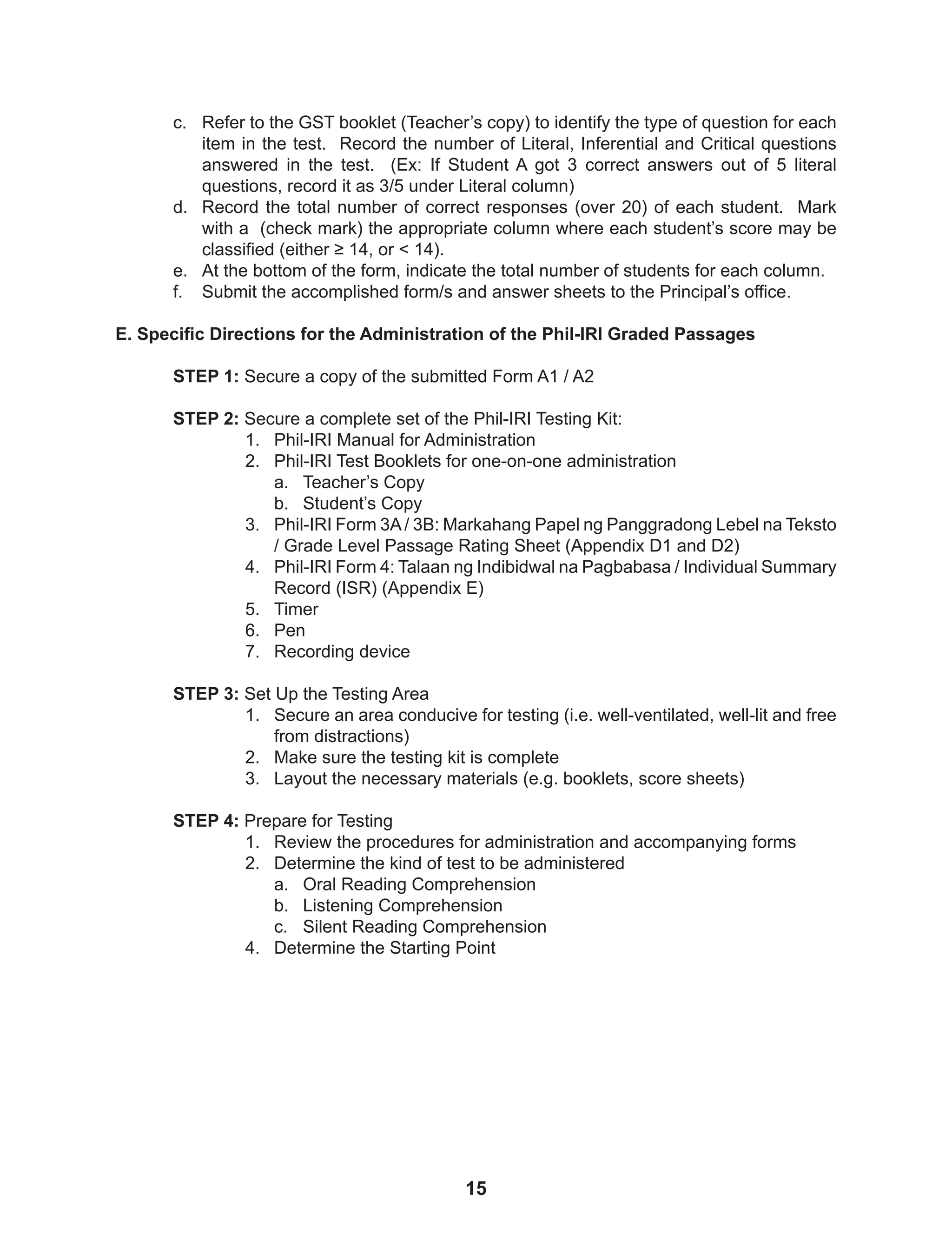
  • 17.
    10 STAGE 2 Administration ofthe Oral Reading Test using Phil-IRI Graded Passages (Optional) Step 3: Administer Listening Comprehension and Silent Reading Figure 2. Flowchart for the Administration of the Phil-IRI: Stage 2 Step 1: Determine Starting Point of Graded Passages (depending on Raw Score in Phil-IRI GST) Step 2: For each passage, compute scores in Word Reading and Comprehension to identify student’s Reading Levels (Independent, Instructional, Frustration levels) IF performance is at the INDEPENDENT LEVEL, give a grade level text that is higher to find the INSTRUCTIONAL LEVEL. IF performance remains INDEPENDENT, continue giving a text that is a grade level higher till performance registers at the INSTRUCTIONAL LEVEL. Once the FRUSTRATION LEVEL has been identified, give a grade level text lower than the starting point to find the INDEPENDENT LEVEL. Continue doing so until performance registers at the INDEPENDENT LEVEL is identified. STAGE 2a The Listening Comprehension Test may be administered to those found to be poor/non-readers to describe their ability to comprehend texts when the decoding task is lifted. STAGE 2b The Silent Reading Comprehension test may be administered to further describe the kind of text that a child can read independently. This helps in identifying the kind of text that can be used for classroom activities/seat work. Once the INSTRUCTIONAL LEVEL has been identified, give a grade level text lower to find the INDEPENDENT LEVEL. Repeat instructions till found. IF performance is at the INSTRUCTIONAL LEVEL, give a text that is a grade level higher to find the FRUSTRATION LEVEL IF performance is at the INSTRUCTIONAL LEVEL, give a grade level higher than the last text read till performance registers at the FRUSTRATION LEVEL. IF performance is at the FRUSTRATION LEVEL, give a grade level text that is lower to find the INSTRUCTIONAL LEVEL.
  • 18.
    11 Step 1: Determinethe Starting Point of Graded Passages. The first passage that the child should be asked to read aloud must depend on the child’s raw score in the GST. a. If the child’s raw score in the GST is 0-7, he/she must be given a passage that is 3 grade levels below his current level. b. If the child’s raw score in the GST is 8-13, he/she must be given a passage that is 2 grades below his current level. To illustrate, if Pedro, a 5th grader, garnered a Raw Score of 6/20 in the Filipino GST, the first selection that he must be asked to read should be at 2nd grade level. Once the first selection to be read has been identified, the test administrator is ready for Step 2. Step 2: For each passage, compute scores in Word Reading and Comprehension to identify student’s Reading Levels (pages 21-29 details the procedures for computing the Word Reading and Comprehension scores). Using these graded passages, the test administrator must find the student’s independent, instructional and frustration levels. Awareness of a child’s reading levels can help the teacher identify materials that are suitable for developing the learner’s reading skills. • Finding the independent level means that we are looking for the grade level passage that the child can read on his/her own without any assistance. To find the independent level, the test administrator continues to give a selection that is one level lower than a given selection until the child is able to register performance at 97 to 100% in word reading and 80 to 100% comprehension. It is important to find the independent level so that we know the kind of text that the child is already able to perform well in. Providing material at the independent level may serve as a source of motivation or as a starting point for instruction. • Finding the instructional level means that we are looking for the grade level passage that the child can read with the support of a teacher. This is the level where students make the most progress in reading. To find the instructional level, the test administrator continues to give a selection that is one level higher than the independent level passage until the learner is able to register performance at 90 to 96% in word reading and 59 to 79% in comprehension. • Finding the frustration level means that we are looking for the grade level passage that the child can no longer read and understand on his own. To find the frustration level, the test administrator continues to give a selection that is one level higher than the instructional level passage until the learner’s oral reading score performance is at 89% and below in Word Reading and 58% and below in Comprehension. It is important to identify the frustration level so that we are aware of the kind of material that the student is not yet ready for.
  • 19.
    12 To illustrate, letus continue with our hypothetical 5th grade learner named Pedro. The test administrator gave Pedro a 2nd grade passage, and his performance registered at the independent level for that passage. The test administrator then gave him a higher level passage (3rd grade) and Pedro's performance registered at the instructional level. Finally, the test administrator gave him a text that is a grade level higher (4th grade), where his performance registered at the frustration level. The test administrator now has Pedro’s independent, instructional and frustration levels. He can proceed to Step 3. Step 3: Administer Listening Comprehension Test (Stage 2a) and Silent Reading Test (Stage 2b). Note that both stages are optional. STAGE 2a: After administering the Oral Reading Test, if there is a need to describe the performance of the child when the reading task is lifted (i.e. especially when the students have been identified to be non-readers), the Listening Comprehension Test may be administered. The process of finding the independent, instructional and frustration levels are the same except that the passages are no longer read by the student and instead are read by the test administrator. After each selection has been listened to, the test administrator reads the multiple choice questions that the students must respond to orally. STAGE 2b: After administering the Listening Comprehension Test, if there is a need to describe the performance of the child when doing the reading task on his/her own, the Silent Reading Comprehension Test may be administered. The process of finding the independent, instructional and frustration levels are the same except that the time it takes for the student to finish reading each passage is recorded by the test administrator. After each selection has been read, the test administrator reads the multiple choice questions that the students must respond to orally. STAGE 3: Provision of Specialized Instruction/Reading Intervention Once all the data describing the child’s reading performance has been gathered, the teacher may use this information to design an intervention program (i.e. remedial reading program) or adjust classroom instruction. (see Appendix H for a full discussion of the Handbook on Suggested Intervention) STAGE 4: Administration of the Phil-IRI Graded Passages (Posttest) After receiving specialized instruction, the students will be re-assessed using the Phil-IRI Posttest Forms. The Phil-IRI Posttests have a total of 4 parallel sets (SETS A-D) that the test- administrator can choose from. Using these graded passages, the test administrator must again identify the student’s independent, instructional and frustration levels. The posttest results may be compared with the pre-test results. D. Specific Directions for the Administration of the Phil-IRI Group Screening Test This section details the specific instructions for the Group Screening Test and the individually administered Graded Passages accordingly. For general reminders on the conduct and interpretation of assessment and assessment results, please see Appendix G.
  • 20.
    13 STEP 1: Securean updated copy of the class list. If available, attach the class list to: Form 1A: Talaan ng Pangkatang Pagtatasa ng Klase (PPK) sa Phil-IRI for Filipino or Form 1B: Summary of the Phil-IRI Group Screening Test Class Reading Record (CRR) for English (See Appendix B1 and B2) STEP 2: Secure a complete set of the Phil-IRI Testing Kit from the Principal’s office or the designated coordinator. a. Phil-IRI Manual for Administration b. Phil-IRI Practice Item Charts c. Phil-IRI Group Screening Test Forms (See Appendix A1-A4, B1 and B2) d. Phil-IRI Group Screening Test Answer Sheets (See Appendix F) e. Timer f. Pen g. Masking Tape STEP 3: Prepare for Testing a. Secure an area conducive for testing (i.e. well-ventilated, well-lit and free from distractions). b. Review the procedures for administration and accompanying forms. c. Lay out the necessary materials (e.g. practice item charts, group screening test forms). d. Establish rapport and orient the test-takers as follows: Say: “Hello. I am _____________________. (If the test administrator is not the teacher of the students). For this day, we will not be holding regular class. Each of you will be asked to read a set of passages that have corresponding questions. Read each passage carefully and answer the questions that follow. You will only be given 30 minutes to finish reading the selections and answer all of the questions.” Sabihin: “Magandang umaga/hapon. Ako po si _________. Sa araw na ito, hindi tayo magkakaroon ng regular na klase. Bawat isa sa inyo ay bibigyan ng ilang mga babasahin na may mga nakalakip na tanong ukol sa inyong binasa. Basahin nang mabuti ang talata at sagutan ang mga tanong sa abot ng inyong makakaya. Bibigyan lamang kayo ng 30 minuto para tapusin ang pagbasa ng mga talata at pagsagot sa mga tanong.” STEP 4: Administer the Phil-IRI Group Screening Test a. Secure the number of copies necessary for testing (i.e. number of test-takers, plus one) b. For smooth administration, give the following reminders before testing:
  • 21.
    14 REMINDERS 1. Avoid talking,eating, and going to the rest room while testing is going on. 2. Do not write on the test booklet. Write your answers on the answer sheet. 3. Read all of the selections as best as you can. 4. Answer all of the questions that follow. 5. If you have a question, please raise your hand. The teacher will approach you. Say: Write the following: 1. (Name, age, grade, section, name of school and date of test). 2. Encircle MALE if you are male/a boy and FEMALE if you are female/a girl. 3. REMINDER: Here is the sheet where you will write your answers in (show the answer sheet). Read the following: (written on a chart or on the board) Say: Where does one go when one wishes to read and borrow a book? a. clinic b. library c. market d. playground What is the answer to the question? The correct answer b should be the letter written on your answer sheet. MGA PAALALA 1. Iwasan makipag-usap sa katabi at magpunta sa banyo habang sinasagutan ang pagsusulit na ito. 2. Iwasan ang pagsulat/pagmarka sa test booklet. Isulat ang mga sagot sa sagutang papel. 3. Basahin lahat ng seleksyon nang mabuti. 4. Sagutan lahat ng sumusunod na tanong. 5. Kung kinakailangan ang paglilinaw, itaas ang kamay para malapitan kayo ng guro. Sabihin: Isulat ang sumusunod: 1. (Pangalan, edad, baitang, seksyon, pangalan ng paaralan, petsa). 2. Bilugan ang LALAKI kung ikaw ay lalaki, at bilugan ang BABAE kung ikaw ay babae. 3. PAALALA: Ito ang papel (ipakita ang sagutang papel) kung saan ninyo isusulat ang inyong mga sagot. Basahin ang sumusunod: (nakasulat sa pisara o sa tsart) Sabihin: Saan pupunta kung nais magbasa at manghiram ng mga aklat? a. klinik b. silid-aklatan c. palengke d. palaruan Ano ang tamang sagot sa tanong? Ang tamang sagot na b ang dapat isulat sa sagutang papel. c. Distribute the answer sheets. Have the students fill in their personal information. d. Using a chart, model how the test should be answered. e. Distribute the test booklets. f. If there are no questions, have them answer the test silently. STEP 5: Report the Results a. Fill out Form 1A (if Filipino GST is taken) or Form 1B (if English GST is taken). b. Record the names of the students in the class. On the second column, put a (check mark) if the student took the screening test; if not, mark with an X.
  • 22.
    15 c. Refer tothe GST booklet (Teacher’s copy) to identify the type of question for each item in the test. Record the number of Literal, Inferential and Critical questions answered in the test. (Ex: If Student A got 3 correct answers out of 5 literal questions, record it as 3/5 under Literal column) d. Record the total number of correct responses (over 20) of each student. Mark with a (check mark) the appropriate column where each student’s score may be classified (either ≥ 14, or < 14). e. At the bottom of the form, indicate the total number of students for each column. f. Submit the accomplished form/s and answer sheets to the Principal’s office. E. Specific Directions for the Administration of the Phil-IRI Graded Passages STEP 1: Secure a copy of the submitted Form A1 / A2 STEP 2: Secure a complete set of the Phil-IRI Testing Kit: 1. Phil-IRI Manual for Administration 2. Phil-IRI Test Booklets for one-on-one administration a. Teacher’s Copy b. Student’s Copy 3. Phil-IRI Form 3A/ 3B: Markahang Papel ng Panggradong Lebel na Teksto / Grade Level Passage Rating Sheet (Appendix D1 and D2) 4. Phil-IRI Form 4: Talaan ng Indibidwal na Pagbabasa / Individual Summary Record (ISR) (Appendix E) 5. Timer 6. Pen 7. Recording device STEP 3: Set Up the Testing Area 1. Secure an area conducive for testing (i.e. well-ventilated, well-lit and free from distractions) 2. Make sure the testing kit is complete 3. Layout the necessary materials (e.g. booklets, score sheets) STEP 4: Prepare for Testing 1. Review the procedures for administration and accompanying forms 2. Determine the kind of test to be administered a. Oral Reading Comprehension b. Listening Comprehension c. Silent Reading Comprehension 4. Determine the Starting Point
  • 23.
    16 If the rawscore in the GST is Start with a Graded Passage that is Example: 0-7 points Three (3) Grade levels lower than current level GST: Grade 6 Graded Passage: Grade 3 8-13 points Two (2) Grade levels lower than current level GST: Grade 3 Graded Passage: Grade 1 14 points and above Discontinue testing STEP 5: Assess Performance a. Orient the test-taker, establish rapport, and administer the test: 1. Oral Reading Comprehension, or 2. Listening Comprehension, or 3. Silent Reading Comprehension b. Procedure 1. Ask the motivation and motive questions. The teacher will have an idea about the prior knowledge of the student on the topic that s/he will read based on the response to the motivation question. The response to the motive question will indicate the student’s ability to make predictions. The teacher may or may not record the student’s responses. 2. Let the pupil read/listen to the selection. 3. After the child has listened to/read the selection, show the multiple choice items on the student’s booklet. The student may read the question or the teacher may read it for him/her and read the options which the test-taker will choose from. Ask the child to answer the question by writing the letter of the option that he/she thinks has the correct answer. Repeat the process until all questions are answered. 4. If the child answers the question with the response, “I don’t know,” mark the item on the scoring sheet with an X. 5. If the student asks to go back to the selection to look for the answer, he/she may do so. If the student is then able to answer correctly, mark the item on the scoring sheet as correct and write LB (Looked Back)3 . STEP 6: Report Results a. Form 3A/3B 1. Fill out all the required student information and test details in Form 3A / 3B. 2. In Part A of the form, record the time when the student starts and ends reading the passage. Then, compute the reading rate (Refer to Section G: Recording the Speed and Rate in Reading). If the student is asked to read orally: 3. As the child reads, record the student’s miscues. (Refer to Table 4 under Section G.) 1 3 Caldwell, L. ( ). Qualitative Reading Inventory Table 3. Starting Point for the Graded Passage
  • 24.
    17 4. Then, recordthe student’s response to each question. Check the responses of the student (Refer to Appendix A for the answer keys). Indicate the total number of correct responses. Look for the equivalent percentage of the score by referring to Table 6. Then, use Table 7 to indicate the reading level of the student in comprehension. 5. In Part B of the form, get the total miscues of the student. Indicate the number of words read correctly in the passage. Compute the word reading score (Refer to Section K: Computing the Oral Reading Score). Finally, indicate the word reading level by referring to Table 7. b. Form 4 1. Use separate forms for the English and Filipino administered Phil-IRI. 2. Fill out the required student information and test details. 3. Record the word reading and comprehension levels of the student in all Phil-IRI taken. Refer to Forms 3A and 3B for the details. 4. Fill out the Oral Reading Observation Checklist by marking each item with a or an X. 5. To fill out the Summary of Comprehension Responses Table, refer to the Phil-IRI booklet (Teacher’s copy) to identify the type of question for each item in the tests taken. Record the number of Literal, Inferential and Critical questions answered in each test. (Ex: If Student B got 1 correct answer out of 2 literal questions, record it as 1/2 beside L=) 6. Indicate the Total Score, Percentage, and Reading Level for each test taken. Refer to Forms 3A and 3B for the details. The results of the Phil-IRI are analyzed quantitatively and qualitatively. Quantitative analysis involves summing up the number of miscues observed; recording the number of minutes it took the student to read the passage; and getting the number of correctly answered comprehension questions about the passage. The combined results of the word recognition and the answers to the comprehension questions will give the reading level of the student per passage: whether s/he is in the independent, instructional or frustration level. The qualitative analysis consists of analyzing what types of miscues are made and describing the student’s behavior while reading. Likewise, while the teacher administers the oral reading test, s/he assesses whether the reading material matches the learner’s reading performance. The teacher may give the student a reading material with a lower readability level if s/he detects that the grade level reading material is too difficult for the student. a. Marking and Scoring the Miscues When administering the Phil-IRI Graded Passages, both the teacher and the student need to have a copy of the passage to be read by the student. While the student is reading a passage orally, the teacher records every miscue committed. The guide in marking and scoring the miscues is shown in Table 4.
  • 25.
    18 Types of MiscuesMarking the Miscue Example Scoring Mispronunciation Underline the text and write the phonetic spelling above it. sleed slide Count as 1 error every mispronunciation. (The dialectal variation should not be counted as an error). Omission Circle the omitted unit of a language. The huge elephant Count as one error a word or a phrase omitted. Substitution Underline the text and write the substituted word above it. money monkey Count as one error every substitution. Insertion Use a caret to show where the word/s was inserted and write the word above the caret. lovely the^ flowers in the vase Count a word or a phrase inserted as one error. Repetition Underline the portion of the text that was repeated. They found it in the Count as one error every word or phrase repeated. Transposition Use a transpositional symbol over and under the letters or words transposed. The girl is pretty Count as one error every transposition made. Reversal Write the word/ nonword above the correct word. dab bad Count as one error every reversal made. Self -Correction Write S above the word that was self- corrected. S hasn’t Don’t count self- correction as an error. b. Recording the Miscues The summary of the miscues made are recorded on Table 9 (See Appendix D, Phil IRI Form 4). Table 4. Marking and Scoring the Oral Reading Miscues
  • 26.
    19 c. Computing theOral Reading Score per Passage The computation of the oral reading score involves counting the number of miscues during oral reading. Each miscue carries equal weight, regardless of whether it affects the meaning of the passage or not. Pedro’s oral reading illustrates a sample computation of miscues. Types of Miscues (Uri ng Mali) Number of Miscues (Bilang ng Salitang mali ang basa) 1 Mispronunciation (Maling Bigkas) 2 Omission (Pagkakaltas) 3 Substitution (Pagpapalit) 4 Insertion (Pagsisingit) 5 Repetition (Pag-uulit) 6 Transposition (Pagpapalit ng lugar) 7 Reversal (Paglilipat) Total Miscues (Kabuuan) Number of Words in the Passage Oral Reading Score Reading Level (Antas ng Pagbasa) Table 5. Summary of Miscues Oral Reading Score: the number of words – number of miscues X100 number of words Example: Pedro’s Performance in Oral Reading No. of words in the passage: 65 No. of miscues: 15 65-15 = 50 x100 = 76.9% 65 Pedro’s rating in oral reading is 76.9%
  • 27.
    20 d. Recording theSpeed and Rate in Oral Reading The teacher-administrator records the time that the student starts reading the passage orally; s/he computes the number of seconds/minutes that it took the student to read the passage. Pedro was asked to read the passage “The Snail with the Biggest House,” a Grade 5 Pre-test passage which has 103 words. It took him 1.5 minutes (90 seconds) to read the passage. Dividing 103 words by 90 seconds will yield 69; thus, Pedro's reading rate is 69 words per minute. e. Computing the Student’s Comprehension of the Passage After the student has read the passage, the teacher reads the comprehension questions and records the student’s responses in the Form 2A/2B. For items where the student asks to go back to the selection to look for the answer, and is then able to answer correctly, mark the item on the scoring sheet as correct and indicate LB (Looked Back). If Pedro got 4 correct answers out of the 7 comprehension questions, his comprehension level is computed using the following formula: Reading speed = No. of words read X 60 Reading time in seconds No. of words in the passage: 103 No. of minutes it took Karlo to read it: 1.5mins. (90 seconds) 103 words read = 69 words per minute 90 seconds Pedro’s reading rate: 69 words per minute C= No. of correct answers No. of questions X100= % of comprehension No. of correct answers: 4 Total no. of questions: 7 4/7 = 57 Pedro’s comprehension: 57%
  • 28.
    21 Table 6 presentsthe percentage of comprehension which is derived by dividing the number of correct answers over the number of questions and multiplying it by 100. f. Analysis and Interpretation of Word Reading and Comprehension Level The Phil-IRI reading test uses predetermined set of criteria in identifying the reading level of each student for each passage. These criteria include the percentage of word recognition accuracy and the percentage of correct answers to comprehension questions (adapted from Johnson, Kress and Pikulski, 1987). Table 7 shows these criteria. Table 6. Table of Percentage for Comprehension Scores Table 7. Phil-IRI Oral Reading Profile No. of items Score in Comprehension % 5 5 100 4 80 3 60 2 40 1 20 No. of items Score in Comprehension % 6 6 100 5 83 4 67 3 50 2 33 1 17 No. of items Score in Comprehension % 7 7 100 6 86 5 71 4 57 3 43 2 29 1 14 No. of items Score in Comprehension % 8 8 100 7 88 6 75 5 63 4 50 3 38 2 25 1 13 Oral Reading Level Word Reading Score (in %) Comprehension Score (in %) Independent 97-100% 80-100% Instructional 90-96% 59-79% Frustration 89% and below 58% and below
  • 29.
    22 To illustrate, letus look at Karlo who is in Grade 4. His word reading and comprehension scores are as follows: The learner’s word reading score and comprehension score should be taken together to determine a comprehensive reading profile for that passage. A description of the student’s reading profile in word reading and comprehension per passage is presented in Table 8. Word reading score: 15 miscues = 76.9%: Frustration Comprehension score: 4 out of 7= 57%: Frustration Reading Rate: 69.5 words per minute Karlo’s Oral Reading Profile: Frustration Word Reading Reading Comprehension Reading Profile per passage Independent Independent Independent Independent Instructional Instructional Instructional Independent Instructional Instructional Frustration Frustration Frustration Instructional Frustration Frustration Frustration Frustration Table 8. Student’s Reading Profile Per Passage g. Qualitative Analysis The teacher examines the type of miscues made and analyzes them: What miscues are often committed? Do these miscues affect the meaning of the passage? The teacher likewise records the behavior of the student while reading using the Observation Checklist in Table 13 (adapted from Gray Oral Reading Behavior). (See Appendix D, Phil IRI Form 4). Behaviors while Reading Paraan ng Pagbabasa or X Does word-by-word reading (Nagbabasa nang pa-isa isang salita) Lacks expression; reads in a monotonous tone (Walang damdamin; walang pagbabago ang tono) Voice is hardly audible (Hindi madaling marinig ang boses)
  • 30.
    23 The Handbook onReading Intervention discusses the causes of the student's behaviors while reading and suggests ways of correcting them. The Listening Comprehension and Silent Reading Test After the administration of the Phil-IRI Oral Reading Test, the teacher may opt to administer a Listening Comprehension for the nonreaders and a Silent Reading Test to further assess the student’s reading speed and comprehension. These are, however, optional activities. F. Conducting the Reading Intervention Based on the reading difficulty of the student, a reading intervention program is designed for him/her. Appendix H contains the Handbook on Reading Intervention. It discusses some cases of different problems in reading of some pupils and the recommended intervention. It likewise looks into the behavior of some readers, as recorded in Table 9 (word-by- word reading, reading on a monotonous tone, disregards punctuation . . .) and tries to correct these during the reading intervention. G. Conducting the Phil-IRI Graded Passages Posttest The Phil-IRI Posttest for the grade level is administered during the 4th quarter. The teacher records the score of each student and compares the result of the posttest against the pre test. Likewise, the behavior during the reading of the selection is compared to the student's behavior during the pretest. It should be noted that only the pupils who got a score of 14 and below during the Group Screening Test are subjected to further testing through the individual reading of graded selection. Based on the observed reading needs of these pupils, they are given the appropriate reading intervention. Then they take the Phil-IRI posttest. The result of the posttest and the improved behavior while reading will indicate the pupils' improved reading skills. The better readers are not subjected to Phil-IRI activities, but it is expected that the regular classroom instruction in Reading will further improve their reading skills. Table 9. Oral Reading Observation Checklist Disregards punctuation (Hindi pinanpansin ang mga bantas) Points to each word with his/her finger (Itinuturo ang bawat salita) Employs little or no method of analysis (Bahagya o walang paraan ng pagsusuri) Other observations: (Ibang Puna)
  • 31.
    24 GLOSSARY The following termsused in the manual are operationally defined as follows: Assessment a general term that includes all the ways in which information is collected, synthesized, and interpreted in order to aid in understanding learners and making instructional decisions (Airasian, P.W., 2001). Assessment Tool an instrument used to describe a learner’s performance in a particular skill Comprehension understanding what one reads or listens to Levels of Comprehension questions that require varying cognitive skills; types of questions include: a) Literal questions in which the answers are explicitly stated in the text b) Inferential questions in which the answers are not explicitly stated in the text. These questions require the reader to establish relationships between what he/she knows and what is stated in the text. Questions regarding vocabulary words used in the text may also be considered inferential when they require the reader to use context clues in order to figure out word meanings c) Critical questions which require the learner to analyze, synthesize, and make judgments on the author’s ideas Comprehension Score the percentage of items correctly answered over the total number of items in a passage-specific comprehension test Diagnostic Tool an instrument used to assess learners’ needs and abilities (in reading) Dialectal Variations regional differences in pronunciation Fluency the ability to read with speed, accuracy, and prosody Graded Passage a text that is grade level-appropriate in terms of content and readability
  • 32.
    25 Informal Reading Inventory informalreading tests which consist of a set of graded passages administered to individual learners; in contrast to formal reading tests that are standardized and often conducted for the purpose of comparing a student’s performance with that of others (Weaver, 2014), informal reading tests are designed to provide greater insight into an individual learner’s reading level vis-à-vis a specific passage in order to allow teachers to customize instruction to the needs of their students (Rutledge, 1998) Intervention a set of activities designed to address student-specific (reading) difficulties Leveled Text see Graded Passage Listening Comprehension Assessment when a learner listens to a selection read aloud in order to assess his/her comprehension level Miscues unexpected responses a reader makes to a text (Goodman, 1996, in Martens, 1998) Miscue Analysis a way of looking at individual learners’ oral reading errors in order to gain insight into their reading processes (Goodman, 1974, in Gunning, 2002) Oral Reading when a learner reads a selection aloud in order to assess word recognition, reading fluency and reading comprehension level Philippine Informal Reading Inventory an informal reading inventory which consists of a set of contextualized graded passages administered to individual learners in order to determine their reading performance and thus help teachers tailor instruction to fit their needs and abilities Prosody Reading with proper expression Reading Level the level at which a learner can read and comprehend a leveled text or graded passage; given a particular leveled text, a learner may fall under any of the following reading levels: a. Independent Reading Level the level at which readers function on their own with almost perfect oral reading and excellent comprehension (Flippo, 2014) b. Instructional Reading Level the level at which readers profit the most from teacher directed instruction in reading (Flippo, 2014 ) c. Frustration Reading Level the level at which readers find reading materials so difficult that they cannot successfully respond to them (Flippo, 2014)
  • 33.
    26 Reading Miscue Inventory arecording of the errors that a reader makes, the amount of time he/she takes in reading a passage, as well as the number of correctly read words per minute Reading Profile a summary of a learner’s reading level based on his/ her word reading and comprehension scores in a given passage Readability ease with which a book or other piece of written material can be understood (Gunning, 2002) Readability Level the level at which a written material can be understood using text characteristics such as the kinds of words, the length of words and sentences used, as well as grade level expectations as the standard Reading Rate the ratio between the number of words read in a passage and the time it took for a reader to finish reading Screening Test a group-administered assessment tool made up of leveled passages and comprehension questions to be read silently and accomplished independently; intended to identify students who need further testing Silent Reading Assessment when a learner reads a selection independently and answers comprehension questions in order to assess reading rate and reading comprehension level Word Reading Score the percentage of words correctly read over the total number of words in a given passage
  • 34.
    27 REFERENCES Abadzi, H. (2014).Hidden insights from cognitive neuroscience. Retrieved from https:// www.academia.edu/6429908/Mysteries_and_Myths_of_Reading_Hidden_insights_from_ cognitive_neuroscience Airasian, P. W. (2001). Classroom Assessment Concepts & Applications (Fourth ed., p. 4, 420). New York, NY: McGraw-Hill. Bryant, B. R., & Wiederholt, J. (1991). Gray Oral Reading Tests, Diagnostic. Austin, TX: Pro- ed. Burkins, J.M, Croft, M. M. (2010), Preventing misguided reading: New strategies for guided reading teachers. Retrieved from http://books.google.com.ph/books?id=Veu rAAAAQBAJ&pg=PA102&lpg=PA102&dq=basal+and+ceiling+in+IRIs&source=bl& ots=-3twcp_pLN&sig=KIrKCw3p-GIOP38ho2ql1dMH1e4&hl=en&sa=X&ei=8WiVU- m4F9Hs8AWDrIKQCA&ved=0CCAQ6AEwAA#v=onepage&q=basal%20and%20ceiling%20 in%20IRIs&f=false Cobb , C. (2004). Turning on a dime: Making change in literacy classrooms. The Reading Teacher, 58, 104-106 Department Order No. 40, Series 2012. DepEd Child Protection Policy Department Order No. 7, Series 2015. Policy Guidelines on Classroom Assessment for the K to 12 Basic Education Program Department of Education. Every Child A Reader Program (ECARP) Bureau of Elementary Education Flagship Program Flippo, R. (2014). Assessing readers qualitative diagnosis and instruction. 2nd Edition. Chapter 2 Retrieved from http://www.reading.org/Libraries/books/assessing-readers-- second-ed--chapter3.pdf Copublished with Routledge/Taylor & Francis Gunning, T. G. (2002). Assessing and Correcting Reading and Writing Difficulties (Second ed., p. 104). Boston, MA: Allyn & Bacon. Hoover, W. A., & Gough, P. B. (1990). The Simple View of Reading. Reading and Writing: An Interdisciplinary Journal, 2, 127-160. Johnson, M.J. , Kress, R.A., & Pikulski, P. L. (1987). INFORMAL READING INVENTORIES (2ND ed.). Newark, DE: International Reading Association. Leslie, L., & Caldwell, J. (2006). Qualitative Reading Inventory-4. Boston, MA: Pearson Education, Inc. Mariotti, A., & Homan, S. P. (2005). Linking Reading Assessment to Instruction (Fourth ed.). Mahwah, NJ: Lawrence Erlbaum Associates, Inc.
  • 35.
    28 Ocampo, D. S.(1997). EDR 210 Module: Trends in Reading Instruction, U.P. Open University, Diliman Q. C. Philippine Informal Reading Inventory. (2008-2009). N.p.: Department of Education. R.A. 10533, The Enhanced Basic Education Act of 2013 Rutledge, S. (1998). Informal Reading Inventory. Retrieved from http://lrs.ed.uiuc.edu/ students/srutledg/iri.html Vacca, J. L., Vacca, R. T., & Gove, M. K. (1991). Reading and Learning to Read (Second ed.). New York, NY: Harper Collins Publishers. Walker, B. (2004). Diagnostic teaching of reading (5th ed.). Upper Saddle River, NJ: Merrill Prentice Hall. Weaver, B. (2014). Formal vs Informal Assessments. Retrieved from http://lrs.ed.uiuc.edu/ students/srutledg/iri.html
  • 36.
    29 LIST OF APPENDICES A1Phil-IRI Group Screening Tests in Filipino (Pangkatang Pagtatasa sa Filipino) A2 Key to Correction Group Screening - Filipino (Gabay sa Pagwasto Pangkatang Pagtatasa) A3 Phil-IRI Group Screening Test in English A4 Key to Correction Group Screening – English A5 Titles of Phil-IRI Graded Passages Pretest in Filipino (Panimulang Pagtatasa sa Filipino) A6 Key to Correction Graded Passages in Filipino Pre-Test (Sets A, B, C, D ( Baitang 1-7) Gabay sa Pagwasto ng Panimulang Pagtatasa sa Filipino (Sets A, B, C, D ( Baitang 1-7) A7 Titles of Phil-IRI Graded Passages for Posttests in Filipino (Panapos na Pagtatasa sa Filipino) A8 Key to Correction Graded Passages in Filipino Post-Test (Sets A, B, C, D (Baitang 1-7) Gabay sa Pagwasto ng Panapos na Pagtatasa sa Filipino (Sets A, B, C, D (Baitang 1-7) A9 Titles of Phil-IRI Graded Passages for Pre-Tests in English A10 Key to Correction: Graded Passages in English Pre-Test (Sets A, B, C, D (Grade 2 – 7) A11 Titles of Phil-IRI Graded Passages for Posttests in English A12 Key to Correction: Graded Passages in English Post-Test (Sets A, B, C, D (Grade 2- 7) B1 Phil-IRI Form 1A – Talaan ng Pangkatang Pagtatasa ng Klase (PPK) sa Phil-IRI B2 Phil-IRI Form 1B – Summary of the Phil-IRI Group Screening Test Class Reading Record (CRR) C Phil-IRI Form 2 – Talaan ng Paaralan sa Pagbabasa (TPP) / School Reading Profile (SRP) D1 Phil-IRI Form 3A – Markahang Papel ng Panggradong Lebel na Teksto D2 Phil-IRI Form 3B – Grade Level Passage Rating Sheet E Phil-IRI Form 4 – Talaan ng Indibidwal na Pagbabasa (TIP) / Individual Summary Record (ISR) F1 Pangkatang Pagtatasa Sagutang Papel (Baitang 2 Filipino) F2a Pangkatang Pagtatasa Sagutang Papel (Baitang 3 Filipino) F2b Group Screening Answer Sheet (Grade 3 English) F3a Pangkatang Pagtatasa Sagutang Papel (Baitang 4 Filipino) F3b Group Screening Answer Sheet (Grade 4 English) F4a Pangkatang Pagtatasa Sagutang Papel (Baitang 5 Filipino) F4b Group Screening Answer Sheet (Grade 5 English) F5a Pangkatang Pagtatasa Sagutang Papel (Baitang 6 Filipino) F5b Group Screening Answer Sheet (Grade 6 English) G Reminders on Conducting Assessments and Interpreting Assessment Results H Handbook on Reading Intervention
  • 37.
    30 APPENDIX A1 Phil-IRI GroupScreening Tests in Filipino (Pangkatang Pagtatasa sa Filipino) Antas Bilang at Uri ng Teksto Pamagat ng mga Seleksyon Bilang ng Tanong 3rd 4 na kuwento • Ang Loro ni Lolo Kiko • O Pagong • Reyna ng Duwende • Manonood Ako 20 4th 4 na kuwento • Ang Aso sa Lungga • Si Muning • Si Brownie • Balat ng Saging 20 5th 4 na kuwento • Ang Regalo Kay Lea • Napulot ko! • Ang Matanda • Sinaunang Sistema ng Pagsulat at Panitikan 20 6th 2 Sanaysay • Paano Nabubuo ang Isang Batas? • Panahon ng Bagong Bato 20 7th 2 Sanaysay • Karapatang Sibil • Ang Hukbong Paggawa ng Pilipinas 20
  • 38.
    31 Phil-IRI Pangkatang Pagtatasasa Pagbasa, Baitang 3 Panuto: Basahin nang tahimik ang bawat kuwento. Pagkatapos, basahin ang mga tanong at isulat ang titik ng tamang sagot sa sagutang papel. 1. Ano ang alaga ni Lolo Kiko? (Literal) a. aso b. loro c. pusa 2. Ano ang paborito ng alaga ni Lolo? (Literal) Paborito nito ang _________________ . a. makalipad sa puno b. makatikim ng keso c. makausap si Lolo Kiko 3. Ano kaya ang naramdaman ni Lolo nang mawala ang loro? (Paghinuha) a. masaya b. malungkot c. nagalit 4. Saan kaya naganap ang kuwento? (Paghinuha) Naganap ang kuwento sa ____________ . a. bahay b. gubat c. paaralan 5. Ano ang isa pang magandang pamagat sa kuwento? (Pagsusuri) a. Si Lolo Kiko b. Ang Loro sa Puno c. Ang Alagang Loro Ang Loro ni Lolo Kiko May loro si Lolo Kiko. Nagsasalita ang loro ni Lolo. Keso ang paborito nito. Aba! Nakawala ang loro! Ay! Nasa puno na ang loro! Bilang ng mga salita: 29 (Filipino: Wika ng Pagbabago, Medrano, Z.S., 2004 A.
  • 39.
    32 6. Nasaan angpagong sa kuwento? (Literal) Ang pagong ay nasa ___________________ . a. loob ng hardin b. loob ng garapon c. labas ng garapon 7. Alin sa sumusunod na mga salita ang nagsasabi tungkol sa pagong? (Literal) a. mabait b. maliit c. masaya 8. Sino ang nag-uusap sa kuwento? (Paghinuha) a. ang mga bata b. ang mga pagong c. ang bata at ang pagong 9. Ano kaya ang nararamdaman ng pagong sa kuwento? (Paghinuha) Ang pagong ay ___________. a. malungkot b. masaya c. galit 10. Bakit kaya sinulat ang kuwentong ito? (Pagsusuri) a. Hatid nito ang isang balita. b. Nais nitong magbigay-kaalaman. c. Nais nitong magbigay ng aliw. O Pagong! O, pagong na maliit sa garapon nakatira. Ikaw ba ay sasaya kapag nakawala ka na? O, batang mabait tulungan mo ako. Paglabas ko rito masaya talaga ako. Bilang ng mga salita: 30 (Filipino: Wika ng Pagbabago, Medrano, Z.S., 2004) B.
  • 40.
    33 11. Para saanang balde ng reyna? (Literal) a. Upuan ito ng reyna. b. Ginagamit ito sa paglalaba. c. Lalagyan ito ng tubig ng reyna. 12. Ano ang nararamdaman ng reyna? (Literal) ______________ ang reyna. a. Nag-aalala b. Natutuwa c. Napapagod 13. Alin sa sumusunod ang sinasabi sa kuwento? (Paghinuha) a. Hinahawakan ng mga duwende ang korona. b. Ang korona ay may mamahaling diamante. c. Galing sa prutas ang korona ng reyna. 14. Saan kaya naganap ang kuwento?(Paghinuha) Naganap ang kwento sa ______________ . a. kaharian ng mga balde b. kaharian ng mga saging c. kaharian ng mga duwende 15. Bakit kaya sinulat ang “Reyna ng Duwende”? (Pagsusuri) a. Hatid nito ang isang balita. b. Nais nitong magbigay-aral. c. Nais nitong magbigay ng aliw. Reyna ng Duwende Selina ang pangalan ng reyna ng mga duwende. Lagi siyang nakaupo sa malaking balde. Berdeng balde ang paborito niya at balat ng saging ang korona niya. O! Kay saya ni Reyna Selina! Bilang ng mga salita: 35 Sinulat ni:T. Nong C.
  • 41.
    34 16. Saan papuntaang bata sa kuwento? (Literal) Papunta ang bata sa _____________ . a. parada ng mga kotse b. karera ng mga kotse c. karera ng mga bisikleta 17. Alin sa sumusunod ang nagsasabi tungkol sa mapapanood ng bata? (Literal) a. Madaming bisikleta rito. b. Makukulay ang mga kotse rito. c. Makukulay ang mga bisikleta rito. 18. Bakit kaya mabilis ang andar ng bata? (Paghinuha) a. Gusto niyang mapanood ang karera. b. Sasali siya sa makulay na parada. c. May kaibigan siya sa karera. 19. Alin sa sumusunod ang nagpapakitang nasaktan ang bata sa kuwento? (Paghinuha) a. Mabilis and andar ko. b. Naku! Dumulas ang bisikleta! c. Aray! Kay daming putik ng tuhod ko! 20. Alin sa sumusunod ang isa pang magandang pamagat para sa kuwento? (Pagsusuri) a. Parada ng mga Kotse b. Karera ng mga Kotse c. Karera ng Bisikleta Manonood Ako! May karera ng kotse. Makukulay raw ang mga kotse. Manonood ako ng karera. Magdadala ako ng kamera. Magsisimula na ito. Sasakay na ako sa bisikleta. Mabilis ang andar ko. Naku! Dumulas ang bisikleta! Aray! Kay raming putik ng tuhod ko! Bilang ng mga salita: 42 Sinulat ni:T. Nong D.
  • 42.
    35 Phil-IRI Pangkatang Pagtatasasa Pagbasa, Baitang 4 Panuto: Basahin nang tahimik ang bawat kuwento. Pagkatapos, basahin ang mga tanong at isulat ang titik ng tamang sagot sa sagutang papel. 1. Saan nangyari ang kuwento? (Literal) a. sa bukid b. sa gubat c. sa kalsada d. sa lansangan 2. Ano ang hinahanap ng aso? (Literal) a. makakain b. makakasama c. mapapasyalan d. matutulugan 3. Anong ugali ang ipinakita ng aso? (Paghinuha) a. madamot b. matakaw c. masipag d. mayabang 4. Bakit hindi makalabas ang aso sa lungga? (Paghinuha) a. may harang ang labasan b. may bitbit pa siyang pagkain c. lubos na marami ang kinain niya d. mali ang paraan ng paglabas niya Ang Aso sa Lungga Mayisangasonggutomnagutomnanaglalakadsakalsada.Habang naglalakad, ibinubulong niya sa sarili na kailangan niyang makakita ng isang lunggang puno ng pagkain. Nang makakita siya ng lungga sa dulo ng kalsada, agad siyang pumasok dito. Kumain siya hanggang mabusog. Pero kahit busog na siya, kumain pa rin at inubos ang lahat ng pagkain sa loob ng lungga. Sa kanyang kabusugan, halos pumutok ang malaki niyang tiyan. Nang lalabas na lamang siya, napansin niyang hindi na siya magkasya sa labasan. Sumigaw siya upang humingi ng tulong. Dumating ang isa pang aso at nalaman ang nangyari. Bago ito umalis, nagwika siya sa kasamang aso, “Hintayin mo na lang umimpis ang tiyan mo.” Bilang ng mga salita: 116 (Bagong Filipino sa Puso at Diwa 2, Aragon et al, 1989) A.
  • 43.
    36 5. Bakit kayahindi siya natulungan ng isa pang aso? (Inferential) a. natakot sa kanya ang aso b. para matuto siya sa pangyayari c. nainggit sa kanya ang isa pang aso d. hindi rin ito makakalabas sa lungga 6. Sino ang naghahanap ng pusa? (Literal) a. ang kuting b. si Muning c. si Nanay d. si Susan 7. Bakit niya hinahanap ang pusa? (Paghinuha) a. ipapasyal niya ito b. paliliguan niya ito c. pakakainin niya ito d. patutulugin niya ito 8. Saan niya nakita ang pusa? (Literal) a. sa silid b. sa silong c. sa kahon d. sa kusina Si Muning! Muning! Muning! Hanap nang hanap si Susan kay Muning. Dala ni Susan ang lalagyan ng pagkain ni Muning. May laman na ang lalagyan, pero wala si Muning. Wala siya sa kusina. Wala rin siya sa silid. Nasaan kaya si Muning? Bumaba ng bahay si Susan. Hinanap niya kung naroon si Muning. Ikot na siya nang ikot, pero hindi pa rin niya nakita. Baka lumabas ito ng bahay. Ngiyaw! Ngiyaw! Hayun si Muning! Ngiyaw siya nang ngiyaw. Nasa loob siya ng kahon. May mga kasama si Muning sa loob ng kahon. Nakita ni Susan ang kasama ni Muning. Mga kuting ang kasama ni Muning sa kahon! May puti, itim at magkahalong puti at itim na kulay ng kuting. Tuwang-tuwa si Susan! Bilang ng mga salita: 122 (Yaman ng Panitik 1, Resuma et al, 1987) B.
  • 44.
    37 9. Sino angmga kasama ni Muning sa kahon? (Paghinuha) a. mga anak nito b. mga kalaro nito c. mga nahuli nito d. mga kaibigan nito 10. Ano ang isa pang magandang pamagat ng kuwento?? (Pagsusuri) a. Nasaan si Muning? b. Nasaan ang Kahon? c. Ang Kahon ni Susan d. Ang Pagkain ini Muning 11. Saan naganap ang kuwento? (Literal) a. sa bahay b. sa paaralan c. sa palengke d. sa simbahan 12. Ano ang katangiang ipinakita ni Brownie? (Paghinuha) a. matapang b. masungit c. maharot d. malikot Si Brownie Si Brownie ay aking alagang aso. Ang aking aso ay masamang magalit. Minsan ay may pumasok na malaking manok sa aming bakuran. Kaagad niya itong tinahulan. Kung hindi lamang siya nakatali nang mahigpit, malamang na habulin niya ito. Nagulat ang manok at tumakbo ito nang mabilis palabas ng bakuran. Kagabi ay hindi ko naitali si Brownie. Panay ang ungol niya. Maya- maya ay may tinahulan siya nang malakas. Biglang lumukso si Brownie sa kanyang tulugan at may hinabol. Dali-dali kong sinilip ang aking alaga. May napatay siyang daga! Bahagya pa niyang ginalaw ang kanyang buntot nang makita ako. Kaagad kong binitbit sa buntot ang daga at ipinakita kay Tatay. Masayang hinimas ni Tatay si Brownie. “Talagang maaasahan ang asong ito,” sabi niya. Bilang ng mga salita: 122 (Bagong Filipino Saligang-Aklat II, Ibita et al, 1990) C.
  • 45.
    38 13. Ano angnapatay ni Brownie? (Literal) a. pesteng ipis b. pusang bahay c. dagang bahay d. ligaw na manok 14. Bakit kaya bahagyang ginalaw ni Brownie ang buntot nang makita ang amo? (Paghinuha) a. gusto niyang gisingin ang daga b. nagulat siya sa kanyang ginawa c. natakot siyang mapagalitan ng amo d. upang ipakita sa amo ang kanyang ginawa 15. Bakit kaya sinulat ang kuwentong “Si Brownie”? (Pagsusuri) a. Hatid nito ang isang balita. b. Nais nitong magbigay-aral. c. Gusto nitong magbigay ng aliw. d. Nais nitong magbigay ng bagong kaalaman. 16. Sino ang nakatatandang kapatid? (Literal) a. Mina b. Lito c. Lita d. Tina Balat ng Saging “Lito! Lito!” Si Mina ang sumisigaw. Kay lakas ng kanyang sigaw. “Bakit, Ate? Ano iyon?” Ito naman ang tanong ni Lito. Lumapit siya kay Mina. Ayaw niyang sumigaw pa ang kanyang ate. “Balat ng saging ito, hindi ba? Sino ang nagtapon nito?” Galit si Mina. Galit siya sa nagtapon ng balat ng saging. “Ako, Ate,” sagot ni Lito. Mahina ang kanyang sagot. Mahina ang kanyang tinig. “Sabi ko na nga ba. Huwag ka nang magtatapon dito, ha! Sa basurahan ka magtatapon. Hayan ang basurahan natin. Hayan, natapakan ko ang balat ng saging. Nadulas ako.” “E... hindi ko sinasadya, Ate. Talaga, hindi ko sinasadya. Hindi na ako magtatapon ng balat ng saging kahit saan. Sa basurahan na ako magtatapon.” “Mabuti. Mabuti kung gayon,” sabi ni Mina. Bilang ng mga salita: 128 (Yaman ng Panitik 1, Resuma et al, 1987) D.
  • 46.
    39 17. Bakit sumisigawsi Mina? (Paghinuha) a. galit siya b. maingay kasi c. tinatakot niya si Lito d. hindi marinig ang boses niya 18. Ano ang naramdaman ni Lito nang tinanong siya ni Mina nang pasigaw? (Paghinuha) a. nagalit siya b. natuwa siya c. natakot siya d. nagtampo siya 19. Bakit nadulas si Mina? (Literal) a. madulas ang sahig b. di niya nakita ang nilalakaran c. natapakan niya ang balat ng saging d. natapakan niya ang basang bahagi ng sahig 20. Ano ang isa pang magandang pamagat ng kuwento? (Pagsusuri) a. Ang Basurahan b. Ang Saging ni Lito c. Pulutin ang Saging d. Ang Sigaw ni Mina
  • 47.
    40 Phil-IRI Pangkatang Pagtatasasa Pagbasa, Baitang 5 Panuto: Basahin nang tahimik ang bawat kuwento. Pagkatapos, basahin ang mga tanong at isulat ang titik ng tamang sagot sa sagutang papel. 1. Ano ang nangyari kay Dagul? (Literal) a. natapakan ng bata b. nabundol ng kotse c. nasagasaan ng dyip d. nawala sa tindahan 2. Nasaan si Lea nang maaksidente ang tuta? (Paghinuha) a. nasa tabi ng sa tindahan b. nasa loob ng bahay c. nakasakay sa dyip d. nasa paaralan 3. Ano ang naramdaman ni Lea nang pumasok siya sa bahay? (Paghinuha) a. nagalit b. natakot c. nalungkot d. nangamba Ang Regalo kay Lea May biglang sumigaw sa labas ng bahay nina Lea. Narinig niya ang malakas na ungol ni Dagul, ang alaga niyang tuta. Dumungaw si Lea sa bintana. Nakita niya ang kanyang tuta sa daan. Nakahiga at may dugo ito sa mukha. Tumakbo siya sa labas. “Patay na si Dagul. Nasagasaan siya ng dyip,” malungkot na sabi ng kanyang kapatid na si Bong. “May bibilhin ako sa tindahan. Sumunod siya sa akin,” paliwanag ni Bong. Bumalik si Lea sa bahay. Ayaw niyang kumain at maglaro. Naiisip niya si Dagul. Kinabukasan ay Pasko na! Nagising si Lea sa ingay. Sa tabi niya ay may basket na may kard. Nakasulat sa kard ang “Para kay Lea, mula kina Daddy at Mommy.” Inalis ni Lea ang takip ng basket. Nakita niya ang isang magandang tuta. Ito ay katulad na katulad ni Dagul. Inakap ni Lea ang tuta! Bilang ng mga salita: 146 (Pagsulong sa Pagbasa 1, Ortiz-Baterna, 1990) A.
  • 48.
    41 4. Kailan nangyariang aksidente? (Paghinuha) a. sa araw ng Pasko b. pagkatapos ng Pasko c. sa araw ng Bagong Taon d. isang araw bago mag-Pasko 5. Bakit kaya inisip ni Tatay regaluhan si Lea ng isa pang tuta? (Pagsusuri) a. dahil ito ang nasa tindahan b. dahil mura lang bilhin ang tuta c. para maibigay kay Lea ang hiningi niya d. para makalimutan ni Lea ang nangyari 6. Ano ang napulot ni Luis? (Literal) a. pera b. piso c. pitaka d. tarheta 7. Magkano ang laman ng pitaka? (Literal) a. piso b. dalawampiso Ang Regalo kay Lea “Kuya! May napulot ako sa daan.” Tuwang-tuwa si Luis. “Anong napulot mo?” tanong ni Jun. “Nakapulot ako ng pitakang may lamang pera.” “Pera? Magkano ang pera, Luis?” tanong ni Jun. “Sandaang piso, Kuya. May sandaang piso na ako. Mapalad ako, hindi ba?” tuwang-tuwang sabi ni Luis. “Hindi, Luis. Hindi iyo ang perang iyan. Isasauli natin ang pitaka sa may ari,” sabi naman ni Jun. “Kuya, napulot ko ito sa daan. Akin na ito, hindi ba?” Nagtataka si Luis. “Pero kawawa naman ang may-ari ng pitaka. Hala, tingnan mo ang loob ng pitaka. Baka may pangalan sa loob,” utos pa ni Jun. Tiningnan ng dalawa nang mabuti ang loob ng pitaka. Isang tarheta ang nakita ni Luis. “Isabelo Santos. Labing-isa, daang Sta. Elena, Sampalok.” Ito ang nabasa ni Jun. “Kilala ko ang may-ari ng pitaka, Kuya. Nakikita ko siya tuwing umaga. Alam ko rin ang kanyang bahay. Sige, isauli natin ang pitaka,” yaya ni Luis. Bilang ng mga salita: 156 (Yaman ng Panitik 1, Resuma et al, 1987) B.
  • 49.
    42 c. sampung piso d.sandaang piso 8. Ano ang nakita nila sa tarheta? (Inferential) a. pangalan at tirahan ng may-ari b. listahan ng bibilhin c. pera ng may ari d. tatak ng pitaka 9. Ano ang pinakitang ugali ng magkapatid sa katapusan ng kuwento? (Inferential) a. matapat b. masakim c. matalino d. palakaibigan 10. Bakit kaya sinulat ang kuwentong “Napulot Ko!”? (Critical) a. Hatid nito ang isang balita. b. Nais nitong magbigay ng mungkahi. c. Nais nitong magbigay ng aliw sa mga bata. d. Gusto nitong magbigay ng mabuting halimbawa. Ang Matanda Tanghaling tapat na. Marami sa mga mag-aaral ang nagmamadali nang umuwi. Walang lilim na masisilungan kahit saan. Sa gitna ng initan ay may isang matandang babaeng may dalang malaking balutan. Palinga-linga ang matanda. Parang may hinahanap ito. Maraming batang mabilis na nagdadaan sa tabi niya. “Mga bata, ” ang sabi ng matanda. Nguni't hindi siya pinapansin ng mga bata. Paminsan-minsan, may ilang batang napapalingon sa kanya, ngunit patuloy pa rin ang matulin nilang lakad. Dumating si Nelia. Nagmamadali rin si Nelia na makauwi. Nagugutom na kasi siya. Napansin niya ang matanda. Nakita niya ang nakakaawang ayos nito. “Bakit po, Lola?” ang tanong ni Nelia. “Ay Ineng” ang sagot ng matanda. “Naligaw ako. Saan ba ang papunta sa istasyon ng bus?” “Doon lang iyon sa kabilang kanto, Lola.” Kahit na pagod si Nelia, inihatid niya ang matanda. Bago sumakay sa bus ang matanda ay hinaplos si Nelia sa ulo. “Pagpapalain ka ng Diyos, Ineng,” ang sabi nito sa kanya. Bilang ng mga salita: 160 (Bagong Filipino Saligang-Aklat II, Ibita et al, 1990) C.
  • 50.
    43 11. Saan naligawang matanda sa kuwento? (Inferential) a. sa sakayan ng bus b. sa labas ng paaralan c. sa bahay nina Noel d. sa labas ng simbahan 12. Ano ang panahon nang maganap ang kuwento? (Literal) a. maaraw b. mahangin c. maulan d. maulap 13. Ano-ano ang hindi pinansin ni Nelia habang kinakausap ang matanda? (Paghinuha) a. gutom at pagod b. nanay at tatay c. ang bitbit niyang mga gamit d. kung saan ang istasyon ng bus 14. Anong ugali ang ipinakita ni Nelia? (Paghinuha) a. malinis b. madasalin c. matulungin d. mapagmahal 15. Bakit kaya sinulat ang kuwentong “Ang Matanda”? (Pagsusuri) a. Hatid nito ang isang balita. b. Nais nitong magbigay ng mungkahi. c. Nais nitong magbigay ng aliw sa mga bata. d. Gusto nitong magbigay ng mabuting halimbawa.
  • 51.
    44 16. Alin sasumusunod ang nagsasabi tungkol sa sinaunang sistema ng pagsulat? a. Binubuo ito ng 17 katinig at 3 patinig. b. Matulis na kawayang patpat ang panulat. c. Malapad na dahon at papel ang sinusulatan. d. Mula itaas pababa at mula kanan pakaliwa ang pagsulat. 17. Alin sa sumusunod ang halimbawa ng sinaunang panitikan? (Literal) a. kuwentong awit at epiko b. tula at awiting salawikain c. awiting bugtong at pabula d. kuwentong bayan at alamat 18. Ano ang tinutukoy na baybayin sa seleksyon? (Paghinuha) a. Ang direksyon ng pagsulat ang tinutukoy nito. b. Ito ang paggamit ng panulat na mula sa kawayan. c. Sistema ito ng pagsulat ng ating ninuno gamit ang 17 titik. d. Ito ang sistema ng pagsulat na gamit natin sa kasalukuyan. 19. Ano ang sinasabi ng seleksyon tungkol sa mga ninuno natin? (Pagsusuri) a. Mahilig sila sumulat ng mga alamat at epiko. b. Nagtulungan sila kaya nabuo nila ang baybayin. c. Hindi madali ang paghanap nila sa pansulat at susulatan. d. Pinakita nila ang pagiging malikhain sa maraming paraan. Sinaunang Sistema ng Pagsulat at Panitikan Ang sistema ng pagsulat ng sinaunang Pilipino ay ang baybayin. Binubuo ito ng 17 na titik – 14 na katinig at tatlong patinig. Ang pagsulat ay mula itaas pababa at mula kaliwa pakanan. Ang sinusulatan ay balat ng puno, buho ng kawayan, malapad na dahon, o hinabing himaymay ng halaman. Ang panulat ay matulis na kawayang patpat o kahoy. Ang tinta at tina ay mula sa dagta ng mga halaman. Ang panitikan ay binubuo ng mga awiting bayan, kuwentong bayan, alamat, pabula, salawikain, bugtong, at epiko. Halimbawa ng ating mga alamat ay ang “Alamat ni Mariang Makiling,” “Alamat ni Malakas at Maganda” at “Alamat ni Mariang Sinukuan.” Ang epiko naman ay isang mahabang tula tungkol sa pakikipagsapalaran ng isang bayani. Nabibilang sa mga epiko ng ating mga ninuno ang “Biag ni Lam-ang” nga mga Ilocano, “Ibalon” ng mga Bicolano, at “Batugan” ng mga Maranao. Bilang ng mga Salita: 148 (Agno, L. et. al. Kultura, kasaysayan at kabuhayan: Heograpiya, kasaysayan at sibika. (2007). QC: Vibal Pub.) D.
  • 52.
    45 20. Ano angginamit ng may-akda ng seleksyon upang ipaabot ang mensahe nito? (Pagsusuri) a. Naglarawan ito at nagbigay ng mga halimbawa. b. Binanggit ang kasaysayan ng sinaunang sistema ng pagsulat. c. Nakasaad ang mga dahilan ng sinaunang sistema ng pagsusulat. d. Tinalakay nito ang sanhi at bunga ng sinaunang sistema ng pagsusulat.
  • 53.
    46 Phil-IRI Pangkatang Pagtatasasa Pagbasa, Grade 6 Panuto: Basahin nang tahimik ang bawat kuwento. Pagkatapos, basahin ang mga tanong at isulat ang titik ng tamang sagot sa sagutang papel. Mga Tanong: 1. Alin sa sumusunod ang nagsasabi tungkol sa isang panukalang batas? (Literal) a. Nilalagdaan ito ng pangulo bago ito pinagtitibay. b. Kasama ang pangulo sa pagtitibay nito sa Kongreso. c. Maaaaring tutulan ito ng pangulo bago maging batas. d. Hinaharap ito sa pangulo bago pinagtitibay ng Kongreso. 2. Alin sa sumusunod ang unang nagaganap sa pagbuo ng isang batas? (Literal) a. Hinaharap ang panukala sa pangulo upang lagdaan. b. Ipinapamahagi ang kopya ng panukala sa mga kagawad. c. Pinagtitibay ang panukala sa tatlong pagbasa sa Kongreso. d. Ibinabalik ito ng pangulo sa Kongreso kung may mga tutol dito. 3. Kailan ginagamit ng pangulo ang kanyang kapangyarihang betohan ang isang panukalang-batas ? (Paghinuha) Ginagamit ng pangulo ang veto power kapag ______________________ . a. sang-ayon siya sa panukalang batas b. hindi sang-ayon ang Kongreso sa panukalang batas c. may mga dahilan siyang tutulan ang panukalang batas Paano Nabubuo ang Isang Batas? May pinagdadaanang proseso ang isang panukalang-batas bago ito tuluyang maging batas para maipatupad sa ating bansa. Ang bawat panukalang-batas na pinagtibay ng Kongreso ay dapat sumaklaw ng isang paksa lamang na dapat nakalahad sa pamagat nito. Ang isang panukalang-batas ng anumang kapulungan ay pinagtitibay sa tatlong pagbasa sa magkakahiwalay na araw. Tatlong araw bago mapagtibay ito ay ipinag-uutos ang pamamahagi ng nakalimbag na kopya nito sa mga kagawad ng kapulungan. Ang bawat panukalang-batas na mapagtitibay ng Kongreso ay ihaharap sa pangulo bago maging batas. Lalagdaan ito ng pangulo kung sinasang-ayunan niya ito. Kung hindi naman, ipaiiral niya ang kapangyarihang betohan ito at ibalik sa Kongreso. Kinikilala ito bilang veto power. Kalakip nito ang kanyang mga tutol laban sa panukalang- batas upang muling talakayin ang mga ito. Bilang ng mga Salita: 130 (Inocencio, et. Al, Pilipinas: Ugat ng Lahing Pilipino 5 (2006). Wizard Publishing Haws, Inc. Tarlac, Tarlac) A.
  • 54.
    47 d. hindi ipinagtibayng tatlong beses ang panukalang batas 4. Ano ang salitang maaaring kasingkahulugan ng sumaklaw sa ikalawang pangungusap ng seleskyon? (Paghinuha) a. bumanggit b. magsama c. mag-usisa d. tumalakay 5. Ano kaya ang dahilan kung bakit kinailangang makapagpatibay ng mga bagong panukalang-batas? (Paghinuha) a. Isinasaalang-alang nito ang ikabubuti ng Kongreso. b. Kailangan ng batas para sa ikabubuti ng mga mamamayan. c. Pinagtitibay ang batas para sundin ang panukala ng pangulo. d. Trabaho ng Kongreso na makabuo at makapaglimbag na batas. 6. Ano kaya ang mangyayari kapag hindi napagpatibay ang isang batas sa Kongreso? (Paghinuha) a. Ito ay hindi maaaring maipatupad. b. Madadagdagan ang batas na susundin. c. Ipaaalam na ito sa lahat para ipatupad. d. Hindi ito lalagdaan ng pangulo bilang pagtutol. 7. Alin sa sumusunod ang nagsasabi ng pangunahing ideya ng seleksyon? (Paghinuha) a. Sa Kongreso nabubuo ang isang batas. b. Maraming paraan para makabuo ng batas sa Kongreso. c. May paraang pinagdaraanan ang pagbuo ng bagong batas. d. Ang isang panukalang batas ay dapat sumaklaw sa isang paksa. 8. Saang bahagi ng seleksyon matatagpuan ang pangunahing ideya nito? (Pagsusuri) Makikita ito sa ___________________ ng seleksyon. a. gitna b. katapusan c. simula d. simula at katapusan 9. Ano ang layunin ng sumulat ng seleksyon? (Pagsusuri) a. Hatid nito ang isang balita. b. Hangad nitong manghikayat. c. Nais nitong magbigay ng kaalaman. d. Gusto nitong magbigay ng mungkahi. 10. Ano ang ginamit ng may-akda ng seleksyon upang ipaabot ang mensahe nito? (Pagsusuri) a. Binanggit ang kasaysayan ng pagbuo ng batas. b. Nakasaad ang mga dahilan ng pagbuo ng batas. c. Inilarawan ang sanhi bunga ng pagbuo ng batas. d. Tinalakay ang pinagdaraanan sa pabuo ng batas.
  • 55.
    48 11. Alin sasumusunod ang nagpapatunay kung bakit Panahon ng Bagong Bato ang tawag sa panahong tinalakay sa seleksyon? (Literal) a. Yari sa bato ang lahat ng mga kagamitan nila. b. Gumamit sila ng mga kagamitang gawa sa pinakinis na bato. c. Nakahanap sila ng bago at pinakinis na bato na ginamit nila. d. Dumating sila sa lugar na may kagamitang pinakinis na bato. 12. Alin sa sumsusunod ang HINDI nagpapakita ng naganap noong Panahon ng Bagong Bato? (Paghinuha) a. Nakapaglakbay sila sa tubig. b. May mga kagamitan silang yari sa putik. c. Higit na mas mahusay ang uri ng pagsasaka nila. d. Naniniwala sila na may buhay pagkatapos ng kamatayan. 13. Ano ang sanhi ng bagong kagamitan sa panahong ito? (Literal) a. Nagsawa na sila sa lumang mga gamit at kasangkapan. b. Hindi sapat sa pangangailangan nila ang mga yari sa putik. c. Hindi na angkop ang dating kagamitan sa pangangailangan nila. d. Mas mahusay na gamit kaysa sa yari sa putik ang natuklasan nila. Panahon ng Bagong Bato Sa pagdaan ng mga panahon nagkaroon ng bagong pangangailangan ang mga sinaunang tao. Kinailangan nila ng mga bagong kagamitang yari rin sa mga bato na lubos na pinakinis at inayos. Sa paglabas ng mga gamit na ito ay dumating ang isang bagong panahon, ang Panahon ng Bagong Bato. Ang mga tao ay natutong magtanim, magsaka at mag-alaga ng mga hayop. Palay ang sinasabing pinakaunang produkto ng mga sinaunang tao na ginamitan ng ararong bato na lalong nagpaunlad ng pagsasaka. Patuloy pa rin ang kanilang pangangaso kahit gumawa na sila ng mga sasakyang pantubig. Bukod dito, natutong gumawa at gumamit ang mga tao ng mga kasangkapang yari sa putik (earthenware). Isang pinakamagandang halimbawa nito ay ang Bangang Manunggul na sinasabing ginawa noong 900 BC. Nagsimula na rin silang maniwala sa buhay pagkatapos ng kamatayan. Mapapatunayan ito sa pamamagitan ng ginawa nilang pagsama ng mga gamit ng yumao sa kanilang mga labi. Ito rin ang naging gamit ng Bangang Manunggul. May iba’t ibang paraan pang ginagawa sa mga labi depende sa lipunang ginalawan ng yumao. Bilang ng mga Salita: 177 (Saroca at Rosales, (2005), Lahing Pilipino, Diwang Makabayan 5, Innovative Educational Materials, Inc.) B.
  • 56.
    49 14. Ano angkahulugan ng labi sa pangungusap sa loob ng kahon? (Paghinuha) Ito ay __________________ _______ . a. isang bahagi ng katawan b. gamit ng namatay na tao c. katawan ng namatay na tao d. ang yumao na isinama sa putik 15. Anong mga katangian ng mga sinaunang tao ang ipinakita sa seleksyon?(Paghinuha) Sila ay ____________________________. a. matapang at magalang b. masipag at maka-Diyos c. mapamaraan at masipag d. matulungin at mapamaraan 16. Ano kaya ang magiging bunga nang nakagawa ang mga sinaunang tao ng sasakyang pantubig? (Paghinuha) a. Maaari silang maglakbay sa tubig. b. Walang pagbabago sa paglalakbay nila. c. Makaaalis silang ligtas kapag may bagyo. d. Magkakaroon na sila ng bago at ligtas na tirahan. 17. Ano ang naging halaga ng Bangang Manunggul sa panahong iyon? (Paghinuha) a. Magandang pag-aari ito ng mga yumao. b. Isinasama ito sa yumao sa kabilang buhay. c. Ito ay tanda ng paniniwala sa kabilang buhay. d. Magandang gamit ito na yari sa pinakinis na bato. 18. Alin sa sumusunod ang isa pang magandang pamagat para sa seleksyon? (Pagsusuri) a. Ibang Uri ng Kagamitang Bato b. Pamumuhay ng Sinaunang Tao c. Masisipag na mga Sinaunang Tao d. Mga Kagamitan ng Panahon ng Bagong Bato 19. Ano ang layunin ng sumulat ng seleksyon? (Pagsusuri) a. Hatid nito ang isang balita. b. Hangad nitong manghikayat. c. Gusto nitong magbigay ng aral. d. Nais nitong magbigay ng kaalaman. 20. Ano ang ginamit ng may-akda upang ipaabot ang mensahe nito? (Pagsusuri) a. Binanggit ang suliranin ng paksa. b. Nakasaad ang mga solusyon sa paksa. c. Tinalakay ang maraming sanhi ng paksa. d. Inilarawan ang paksa gamit ang mga halimbawa. May mga gamit ng yumao na isinama sa kanilang mga labi.
  • 57.
    50 Phil-IRI Pangkatang Pagtatasasa Pagbasa, Grade 7 Panuto: Basahin nang tahimik ang bawat kuwento. Pagkatapos, basahin ang mga tanong at isulat ang titik ng tamang sagot sa sagutang papel. Mga Tanong: 1. Alin sa sumusunod ang HINDI saklaw ng karapatang sibil? (Literal) HINDI saklaw ng karapatang sibil ang karapatan _________________ . a. na maipahayag ang saloobin b. na makapagbiyahe saan man nais c. na magpatayo ng titirhan saan man d. sa malayang pagsamba at pananalig 2. Alin sa sumusunod ang sinasabi sa seleksyon? (Literal) a. Ang karapatan ay ayon sa katayuan natin sa lipunan. b. Kilala ang ating bayan sa pagpaptupad ng Miranda Rule. c. Maraming mga karapatang sibil na kinikilala ang ating bayan. d. Mahusay na naipatutupad ang karapatang sibil sa ating bayan. Karapatang Sibil Kinikilala ng bayan ang mga karapatang sibil ng mga mamamayan. Ito ay sumasakop sa kalayaan nating makamit ang kaginhawaan at makipag-ugnayan sa isa’t isa. Kabilang sa karapatang sibil ay karapatan sa pananalita at pamamahayag, kalayaan sa relihiyon, paninirahan at paglalakbay, magkaroon ng ari-arian, maiwasan ang pagka-alipin, at iba pa. May karapatan ang bawat isa, maging anuman ang katayuan nito sa lipunan, laban sa di-makatuwirang pagdakip at lihim na pagpapabilanggo. Ang writ of habeas corpus ang kautusang mula sa hukuman na nagsisiguro sa karapatang ito. Dagdag pa rito ang kautusang Miranda (Miranda Rule) na buod ng mga karapatan ng nasasakdal. Itinadhana ang mga ito at ipinagtibay. Kabalikat ng karapatang ito ay ang prinsipyo ng isang nakasuhang mananatiling inosente hanggang hindi napapatunayang nagkasala (innocent until proven guilty) at nang walang pasubali (beyond reasonable doubt). Maipatutupad ito kung isasailalim sa isang mablis, hayagan, at patas na paglilitis. Ang pagdadaos ng mabilis na paglilitis at pagkakaloob ng hustisya ay ayon na rin sa kasabihang “justice delayed is justice denied.” Bilang ng mga Salita: 166 (Pilipinas: Ugat ng Lahing Pilipino 6, Inocencio, et. Al (2006). Wizard Publishing Haws, Inc., Tarlac, Tarlac.) A.
  • 58.
    51 3. Paano kayaipinapakita ng ating bayan ang pagkilala sa karapatang sibil? (Inferntial) a. Hindi ito nilalabag sa ating bansa. b. Pinag-aaralan ang mga ito ng lahat ng mamamayan. c. Inililimbag at ipinapaabot sa lahat ang tungkol dito. d. May mga kautusang nagsisiguro sa pagkilala ng mga ito. 4. Ano ang panlaban natin sa di-makatuwirang pagdakip at lihim na pagpapabilanggo? (Literal) a. Ito ay napapaloob sa Miranda Rule. b. Lilitisin at ikukulong ang nagkasala. c. Makatarungan na paglilitis ang kasunod nito. d. Tamang panangga rito ang writ of habeas corpus. 5. Ano ang nasasaad sa writ of habeaus corpus? (Literal) a. Laban ito para hindi masampahan ng kaso. b. Ito ay panangga sa di-makatwirang pagkadakip. c. Nakalahad dito ang karapatan laban sa paglilitis. d. Ipinapahayag nito ang karapatan na madama ang kaginhawahan. 6. Ano ang kahulugan ng pangungusap sa loob ng kahon? (Paghinuha) a. Tunay na inosente ang nasasakdal na may prinsipyo. b. Kabalikat ng taong nakasuhan ang kanyang prinsipyo. c. May kabalikat ang taong nakasuhan lalo kung inosente. d. May proteksyon ang nasasakdal hangga't hindi nasisiguro ang sala. 7. Ano ang layunin ng sumulat ng seleksyon? (Critical) a. Hatid nito ang isang balita. b. Gusto nitong magbigay ng aral. c. Nais nitong magbigay ng kaalaman. d. Hangad nitong magbigay ng pananaw. 8. Ano ang ginamit ng sumulat ng seleksyon upang ipaabot ang mensahe nito? (Critical) a. Binanggit ang pinagmulan ng paksa. b. Nakasaad ang mga suliranin ng paksa. c. Tinalakay ang sanhi at mga bunga ng paksa. d. Nagbigay ng mga halimbawa tungkol sa paksa. 9. Saan matatagpuan ang pangunahing ideya ng seleksyon? (Critical) Ito ay makikita sa ______________________ ng seleksyon. a. gitna b. simula c. katapusan d. simula at katapusan Kabalikat ng karapatang ito ay ang prinsipyo ng isang nakasuhang mananatiling inosente hanggang hindi napapatunayang nagkasala.
  • 59.
    52 11. Alin sasumusunod ang HINDI kabilang sa hukbong paggawa? (Literal) a. mga matatandang nasa opisina b. retiradong patuloy na nagtatrabaho c. mga mag-aaral na gumagawa ng aralin d. mga inang tumutulong sa paghahanapbuhay 12. Alin sa sumusunod ang sinasabi ng seleksyon tungkol sa hukbong paggawa? (Literal) Lahat sila ay _______________________________ . a. walang pagod sa paghahahanapbuhay 10. Alin sa sumusunod ang isa pang magandang pamagat para sa seleksyon? (Critical) a. Pagkilala sa Ating Karapatan b. Mga Halimbawa ng Karapatan c. Mga Dulot ng Sibil na Karapatan d. Sibil na Karapatan sa Malayang Bansa Ang Hukbong Paggawa ng Pilipinas Ang hukbong paggawa ng ating bansa ay binubuo ng mga taong may edad na 15 taong gulang pataas. Itinuturing silang may sapat nang lakas, kasanayan, at kakayahan sa paggawa o produksyon. Ngunit hindi lahat ng saklaw ng edad na 15 taon at pataas ay kasapi ng hukbong paggawa. Kabilang nito ay ang mga kabataang nag-aaral, mga inang hindi naghahapbuhay, yaong may mga kapansanan, mga matatanda na at hindi na naghahanapbuhay, o ang mga nagretiro na sa paghahanapbuhay. Nahahati sa iba’t ibang pangkat ang hukbong paggawa ng Pilipinas. Nariyan ang sector ng agrikultura, industriya, serbisyo, at propesyonal. Karamihan sa mga kasapi ng hukbong paggawa sa mga sektor na nabanggit ay gumagamit ng lakas-bisig sa paggawa. Subalit hindi lamang ito ang gamit sa produskyon. Nakatutulong ding higit ang lakas-isip na nakukuha sa pag-aaral at pagsasanay. Ang mga nagtatapos sa pag-aaral ng kusa ay maaaring pumasok ng trabaho bilang mga propesyonal na doctor, guro, inhinyero, abogado, accountant, at iba pa. Hindi lamang sa loob ng bansa matatagpuan ang mga manggagawang Pilipino. Mula noong taong 1975 ay mabilis na ang pagtaas ng dami ng mga migranteng Pilipinong naghahanapbuhay sa ibang bansa. Karaniwang trabaho nila ay bilang nars, caregivers, seaman, domestic helpers, manggagawa sa konstruksyon, at kahit pa bilang mang- aawit at mananayaw. Bilang ng mga Salita: 212 (Inocencio, et. Al Pilipinas: Ugat ng Lahing Pilipino 6 (2006). Wizard Publishing Haws, Inc. Tarlac, Tarlac) B.
  • 60.
    53 b. walang tigilng pagpapalakas at pagsasanay c. nangangarap maghanapbuhay sa ibang bansa d. may kasanayan at kakayahan na makibahagi sa produksyon 13. Alin sa sumusunod ang HINDI kasama sa lakas-bisig sa paggawa? (Paghinuha) a. doktor b. hardinero c. karpintero d. mangingisda 14. Ano ang kahulugan ng pangungusap sa loob ng kahon? (Paghinuha) a. Nasasanay ang nag-aaral na mag-isip. b. Nahahasa ang kaisipan sa pag-aaral. c. Nararapat na sanayin ang takbo ng pag-iisip. d. Mauunawaan ng nag-iisip ang pinag-aaralan. 15. Sino sa sumusunod ang HINDI kasama sa hukbong paggawa? (Paghinuha) a. isang pari na nagmimisa b. isang dyanitor na may sakit c. isang pulis na makikita sa lansangan d. isang musmos na nagtitinda ng sampagita sa kalye 16. Saan matatagpuan ang pangunahing ideya ng seleksyon? (Critical) Ito ay makikita sa ______________________ ng seleksyon. a. gitna b. simula c. katapusan d. simula at katapusan 17. Ano ang layunin ng sumulat ng seleksyon? (Critical) a. Hatid nito ang isang balita. b. Gusto nitong magbigay ng aral. c. Nais nitong magbigay ng kaalaman. d. Hangad nitong magbigay ng ibang pananaw. 18. Ano ang ginamit ng may-akda upang ipaabot ang mensahe nito? (Critical) a. Binanggit ang pinagmulan ng paksa. b. Nakasaad ang mga solusyon ng paksa. c. Tinalakay ang sanhi at bunga ng paksa. d. Nagbigay ito ng mga halimbawa sa seleksyon. 19. Alin sa sumusunod ang isa pang magandang pamagat para sa seleksyon? (Pagsusuri) a. Lakas-Bisig ng ating Bansa b. Mga Manggagawa ng Ating Bayan c. Mga Suliranin ng mga Manggagawa d. Pinagmulan ng Hukbong Paggawa sa Pilipinas Nakukuha ang lakas-isip sa pag-aaral at pagsasanay
  • 61.
    54 20. Ano angpangunaking ideya na tinalakay sa seleksyon? (Paghinuha) Tinalakay sa seleksyon ang _______________________________. a. mga problema ng hukbong paggawa b. uri ng pamumuhay ng hukbong paggawa c. iba’t ibang halimbawa ng hukbong paggawa d. mga pagsasanay at mga paghihirap ng hukbong paggawa
  • 62.
    55 APPENDIX A2 Gabay saPagwasto: Pangkatang Pagtatasa – Filipino (Grades 3-7) Grade 3 Grade 4 Grade 5 A B C D Ang Loro ni Lolo Kiko O Pagong! Reyna ng Duwende Manonood Ako! 1. b 6. b 11. a 16. b 2. b 7. b 12. b 17. b 3. b 8. c 13. c 18. a 4. a 9. a 14. c 19. c 5. c 10. c 15. c 20. b A B C D Ang Aso sa Lungga Si Muning Si Brownie Balat ng Saging 1. c 6. d 11. a 16. a 2. a 7. c 12. a 17. a 3. b 8. c 13. c 18. c 4. c 9. a 14. d 19. c 5. b 10. a 15. c 20. d A B C D Ang Regalo Kay Lea Napulot Ko! Ang Matanda Sinaunang Sistema ng Pagsulat at Panitikan 1. c 6. c 11. b 16. b 2. b 7. d 12. a 17. d 3. c 8. a 13. a 18. c 4. d 9. a 14. c 19. d 5. d 10. d 15. d 20. a
  • 63.
    56 Grade 6 A B PaanoNabubuo ang Isang Batas? Panahon ng Bagong Bato 1. c 11. b 2. b 12. a 3. c 13. c 4. d 14. c 5. b 15. c 6. a 16. a 7. c 17. b 8. c 18. b 9. c 19. d 10. d 20. d Grade 7 A B Karapatang Sibil Ang Hukbong Paggawa ng Pilipinas 1. c 11. c 2. c 12. d 3. d 13. a 4. a 14. b 5. b 15. d 6. d 16. b 7. c 17. c 8. d 18. d 9. b 19. b 10. d 20. c
  • 64.
    57 APPENDIX A3 Phil-IRI GroupScreening Tests in English Level Number and Kind of Text Pamagat ng mga Seleksyon Bilang ng Tanong 4th 4 Narrative Texts • The Best Part of the Day • Ice Cream for Sale • At Last • The Owl and the Rooster 20 5th 4 Narrative Texts • Early Start • Rice for Lunch • The Gift • One Stormy Night 20 6th 3 Expository Texts • Chameleons • The Philippine Eagle • Home to Millions of Fish 20 7th 3 Expository Texts • Telling Time • Counting the Hours • Nosebleeds 20
  • 65.
    58 Screening Test, Grade4 Read each selection silently. Then read the questions that follow and write the letter of the correct answer in the answer sheet: 1. At the beginning of the story, where was Mia? (Literal) a. She was in her bedroom. b. She was in the bathroom. c. She was at the kitchen table. d. She was on a bench outside. 2. What time of the day was it? (Inferential) a. middle of the day b. late in the evening c. early in the morning d. late in the afternoon 3. What do you think will happen next? (Inferential) a. She will have lunch. b. She will have dinner. c. She will have a snack. d. She will have breakfast. 4. What will she say when she gets up? (Inferential) a. “Good evening.” b. “Good afternoon!” c. “Good morning!” d. “Thank you very much!” 5. What other title can be given for this story? (Critical) a. The End of the Day b. The Start of the Day c. Just Before Sleeping d. The Middle of the Day The Best Part of the Day Mia was in her bedroom when she heard a rooster crow. Then she heard a man yell, “Hot pandesal! Buy your hot pandesal!” Mia wanted to sleep some more. But she knew she might be late for school if she did. Finally, she began to smell fried eggs and fish. “It’s time to get up,” she said. Mia jumped out of bed and ran down the steps. 67 words A.
  • 66.
    59 6. Why didBenito and Nelia race out the door? (Inferential) a. They wanted to buy something. b. They wanted to open the door. c. They wanted to find out what was going on. d. They wanted to know what was making noise. 7. In the beginning, what did Benito plan to do? (Literal) a. buy ice cream for himself and his sister b. buy two scoops of ice cream for himself c. buy two scoops of ice cream for his sister d. reach the ice cream vendor ahead of his sister 8. Why were they smiling at the end of the story? (Inferential) a. They each got a free ice cream cone. b. They made the ice cream vendor happy. c. They shared a cup with two scoops of ice cream. d. They each had a scoop of ice cream on a cone. 9. A vendor is someone who ___________________. (Inferential) a. sells things b. buys things c. counts things d. gives things away 10. Which of the following best describes Benito? (Inferential) a. He is selfish. b. He is giving. c. He is thrifty. d. He is greedy. Ice Cream for Sale “Cling! Cling! Cling!” Benito and his sister Nelia raced out the door. He took some coins from his pocket and counted them. “I can have two scoops,” he thought. But then his little sister Nelia asked, “Can I have an ice cream?” Benito looked at his coins again. “May I have two cones?” he asked. The vendor nodded. Benito and Nelia left with a smile. 65 words B.
  • 67.
    60 11. Where didthe bird come from? (Literal) a. an egg with lots of spots b. an egg with many colors c. an egg with only one color d. an egg with plenty of stripes 12. Why was the bird afraid? (Inferential) a. He did not have any friends. b. He did not know how to fly. c. He did not know his mother. d. He did not see his brothers. 13. Why was the bird’s mother not in the nest? (Inferential) a. She had to look for a nest to house the little bird. b. She had to leave the bird so he will learn on his own. c. She had to find food to feed the hungry little bird. d. She had to look for something to help the little bird fly. 14. How did the bird learn to fly? (Inferential) a. by studying and practicing b. by watching other birds fly c. by having his mother teach him d. by accidentally flapping its wings 15. At the end of the passage, how did the little bird feel? (Inferential) a. lonely b. afraid c. nervous d. excited At Last! The spotted egg finally hatched. Out came a little bird who was afraid. The tree where his mother built their nest was just too tall. “I don’t know how to fly,” he thought. He looked around for his mother, but she was not there. Where could she be? He looked down and felt his legs shake. He started to get dizzy and fell out of his nest. He quickly flapped his wings. At last – he was flying. 84 words C.
  • 68.
    61 16. What wasthe owl’s problem? (Inferential) a. She slept in the morning. b. She couldn’t hoot at night. c. She was awake all night long. d. She couldn’t wake the people up. 17. What was the rooster’s problem? (Literal) a. He couldn’t hoot with the owl. b. He couldn’t wake the people up. c. He couldn’t sleep in the morning. d. He couldn’t be with his friends. 18. The word rouse has a synonym in the selection. What is this word? (Inferential) a. wake b. solve c. slept d. hoot 19. How did the owl and the rooster feel at the end of the passage? (Inferential) a. worried b. alarmed c. relieved d. unhappy 20. What was the author's purpose when she wrote the selection? (Critical) a. to inform b. to entertain c. to evaluate d. to convince The Owl and the Rooster While the other owls slept in the day time, Hootie slept at night. She always yawned and fell asleep when her friends asked her to hoot with them. This made her sad because she liked hooting a lot. One day, she met a rooster who could not wake up in the morning. He could not awaken the villagers. This made the rooster unhappy. Hootie said, “I know how to help you. I’ll hoot in the morning so you can wake up to do your job!” 84 words D.
  • 69.
    62 Screening Test, Grade5 Read each selection silently. Then read the questions that follow and write the letter of the correct answer in the answer sheet: 1. Mara woke up with a start. When a person wakes up with a start, it means that one got out of bed ____________________. (Inferential) a. sad b. happy c. worried d. excited 2. Why does Mara have to rush? (Literal) a. so she would get to school on time b. so she would be the first student in school c. so she would be the fastest runner in school d. so she could eat breakfast before going to school 3. What did Mara forget? (Inferential) a. that she did not set her alarm clock early enough for the next day b. that she did not need to rush because there were no classes today c. that she cannot anymore eat breakfast if she was rushing to school d. that she cannot anymore go to school because she was very late 4. How do you think did Mara feel after her mother talked to her? (Inferential) a. anxious b. nervous c. relieved d. unhappy 5. What did the author intend when she wrote the selection? (Critical) a. to inform b. to entertain c. to evaluate d. to convince Early Start Mara woke up with a start. “Oh no!” The sun was shining brightly on her face. She looked at her alarm clock. She was not going to make it to school. She hurriedly put on her uniform, gathered her things and dumped them into her bag. She rushed so that she could be in school before the bell rang. As she was going out the door, her mother stopped her and asked, “Why are you rushing? Did you forget? It’s Saturday today!” 82 words A.
  • 70.
    63 6. What didAnika want to do? (Inferential) a. wash rice b. cook rice c. serve rice d. measure rice 7. Why was she unable to do what she wanted to do? (Inferential) a. The lid was very hot. b. The clock was not working. c. The stove was not plugged. d. The pot had too much water. 8. Why did Anika look at the clock.? She looked at the clock to see if _____________________. (Inferential) a. the clock was still working b. she still had time to watch TV. c. the time on the clock was correct d. the rice will be cooked in time for lunch. 9. What did Anika feel when she saw the clock? (Inferential) a. glad b. angry c. excited d. worried 10. What should Anika do to finish what she started? (Inferential) a. She should plug the stove. b. She should set the alarm clock. c. She should wash the rice grains again. d. She should add more water to the pot. Rice for Lunch Anika washed the rice grains. Then she put them into a pot. She also put in two cups of water. Finally, she covered the pot and left it on the electric stove. After twenty minutes, she went to check on the pot. It was not hot. She saw that the plug was still on the floor. Anika looked at the clock and shook her head. It was almost lunchtime. 69 words B.
  • 71.
    64 11. Why didMario think the box was for him? (Literal) a. It was Christmas. b. It was his birthday. c. It was New Year’s Eve. d. It was Valentine’s day. 12. In the selection, it said that Mario saw the coolest-looking pair of shoes. (Inferential) What does this mean? a. The shoes were very fashionable. b. The shoes kept his feet from being warm. c. The shoes felt very cold when he touched them. d. The shoes made him shiver when he wore them. 13. As Mario looked down, what did he think he needed to do? (Literal) a. Clean the shoes. b. Wrap the shoes. c. Wear the shoes. d. Hide the shoes. 14. How did Mario’s mother feel when she saw Mario? (Inferential) a. happy b. lonely c. worried d. excited 15. What do you think was Mario feeling when he saw his mother? (Inferential) a. afraid b. lonely c. excited d. nervous The Gift The colorfully-wrapped box was lying on the table when Mario got home. Thinking that it was his parents’ birthday gift to him, he took it and quickly tore it open. It was the coolest looking pair of shoes he had ever seen. Mario put them on, walked out into the street and jumped into a puddle. “Mario, why are you wearing your brother’s shoes?” his Mother cried. When he looked down, he said, “Oh no, that’s a lot of cleaning I have to do.” 83 words C.
  • 72.
    65 16. Why didthey close the windows? (Inferential) a. to keep their home clean b. to make their feel cooler c. to protect them from the rain d. to prevent bats from coming in 17. Which of the following did Jessica and her mom do? (Inferential) a. prayed hard b. bought supplies c. worked together d. watched the wind 18. Which of the following best describes the characters in our story? (Inferential) a. lucky b. giving c. loving d. prepared 19. What does the word “blackout” mean? (Inferential) a. There is a strong storm. b. There is no electric power. c. There are dark rain clouds. d. There are no stars in the sky. 20. What did the mother feel at the end of the story? (Inferential) a. relaxed b. helpless c. worried d. unhappy One Stormy Night That night, Jessica helped her mother close the windows. The wind was howling. Droplets of rain started pelting the roof. “Go find the candles and I will get the matches,” said her mother. Lightning flashed. A clap of thunder followed. Soon after, the lights went off. “A blackout!” shouted Jessica. “Don’t be alarmed. It’s a good thing we have what we need,” said mother. 58 words D.
  • 73.
    66 Screening Test, Grade6 Read each selection silently. Then read the questions that follow and write the letter of the correct answer in the answer sheet: 1. What is one unique characteristic of chameleons? (Literal) a. Their color changes. b. They live in trees. c. They live in deserts. d. They climb trees fast. They send messages to other animals. 2. What will happen to a chameleon on a cold day? (Inferential) a. It will become invisible. b. It will turn a shade lighter. c. It will turn white. d. It will turn a shade darker. 3. Changing its color is the chameleon’s way of ______________________. (Literal) a. showing its special power b. hiding itself from other animals c. finding its family d. shedding its skin 4. Chameleons are extraordinary animals. Another word for extraordinary is ________________________. (Inferential) a. amazing b. not known c. common d. unusual Chameleons Chameleons are extraordinary animals. They are one of the few animals that can change their color. This is their way of hiding themselves. Chameleons that live in trees are often green. Those that live in desert lands are usually brown. It is also their way of keeping warm. Turning a darker shade helps them absorb more heat. They also change colors to send messages to other chameleons. Their bright colors may attract another chameleon or warn enemies. 82 words A.
  • 74.
    67 5. What isthe advantage of changing color? (Inferential) a. It can hide itself. b. It can kill enemies c. It can join with other chameleons. d. It can hold on to the branch as it climbs. 6. The main idea of the selection is (Critical) a. why chameleons change colors. b. how chameleons survive in the wild. c. where chameleons come from. d. where chameleons live. 7. The best title for this selection is (Critical) a. How Chameleons Communicate with Other Animals b. Why Chameleons Change Color c. The Different Habitats of Chameleons d. The Enemies of Chameleons 8. The Philippine Eagle is in danger of extinction. It means this type of eagle will eventually ________________.(Inferential) a. disappear b. increase c. migrate d. starve 9. When birds are bred in captivity, they are _____________.(Inferential) a. allowed to freely fly in the wide forest b. cared for in a safe environment c. caught and sold as pets d. given a diet of bread 10. What is responsible for the decrease in the number of Philippine Eagles? (Inferential) a. their migration to cooler countries b. their transfer to warmer places c. the activities of humans d. lack of available food The Philippine Eagle The Philippine Eagle has replaced the maya as our national bird. It is one of the three largest and strongest eagles in the world. But it is in danger of extinction. Hunting and deforestation have caused the number of Philippine Eagles to dwindle. Scientists have tried to increase their number by breeding them in captivity. The first eagle to be bred in captivity is Pag-asa. At 25 years old, Pag-asa is not yet suited to be released to the wild as she has developed dependency on her human keeper. 89 words B.
  • 75.
    68 15. Coral reefsare described as underground gardens because ___________. (Inferential) a. they are full of flowers b. there are many sea plants c. they have many enormous fish d. there are many types of pebbles 11. Pag-asa is the name of the first eagle which (Literal) a. was discovered first in our country. b. was born in captivity. c. was kept in the wild d. was given as a gift. 12. What is the problem posed in the selection? (Critical) The Philippine Eagles _______________________________. a. are in danger of being gone forever b. are dying because of a disease c. migrate to other countries d. are not growing fast 13. The purpose for writing the selection is to (Critical) a. invite researchers to study the Philippine eagle. b. make the reader proud of the Philippine eagle. c. warn the hunters not to harm the Philippine eagle. d. raise an alarm about the possible disappearance of the Philippine Eagle. 14. A good title for this selection is (Critical) a. Help Save the Philippine Eagle b. See the Rare Philippine Eagle c. Breeding the Philippine Eagle d. The Effects of Deforestation Home to Millions of Fish Coral reefs are found in shallow areas of tropical ocean waters. They are like beautiful underground gardens that grow in salty waters. Millions of fish and sea plants make their home in the reefs as these provide a safe sanctuary for them. They allow small fish to hide from large predator fish. But many coral reefs are in trouble. Water pollution is destroying many reefs. Tourism likewise harms them. If reefs are damaged, we will lose many of our most beautiful fish. 82 words C.
  • 76.
    69 16. Coral reefsprovide a safe sanctuary to live for the small fish. A sanctuary is synonymous to ______________________. (Inferential) a. water b. shelter c. cage d. cave 17. Which of these bodies of water would have coral reefs? (Inferential) a. the sea b. the lake c. the river d. the pond 18. Why are the small fish safer in the coral reefs than in the open sea? (Inferential) a. The water is saltier. b. The waves are not so big. c. There is no pollution there. d. It is less likely that the big fish will eat them. 19. How is the last paragraph of the selection developed? (Critical) a. by giving a list of effects b. by enumerating a series of sequenced events c. by stating the main topic and giving examples d. by defining the problem and the possible solution 20. Which cause of the destruction of coral reefs is mentioned in the last paragraph? (Literal) a. pollution b. the presence of big fish c. the strong wind and big waves d. the increasing temperature of the ocean
  • 77.
    70 Screening Test, Grade7 Read each selection silently. Then read the questions that follow and write the letter of the correct answer in the answer sheet: 1. Which of the following ways of telling time made use of sand? (Literal) a. water clocks b. hourglass c. sundials d. clock 2. None of the clocks used long ago were accurate. Accurate in the sentence means (Inferential) a. free from error b. comparable c. very useful d. efficient 3. When men of long ago told time at night, they looked at the __________________ to tell the time. (Literal) a. cloud formation b. moon c. stars d. sun 4. The sundials may not be useful in telling time ______________________. (Inferential) a. at noontime b. in the morning c. during a rainy day d. when the sun shines brightly Telling Time Humans have used different objects to tell time. In the beginning, they used an hourglass. This is a cylindrical glass with a narrow center which allows sand to flow from its upper to its lower portion. Once all the sand has trickled to the lower portion, one knows that an hour has passed. Using the same idea, water clocks were constructed to measure time by having water flow through a narrow passage from one container to another. On the other hand, sundials allowed people to estimate an hour by looking at the position of the shadow cast by the sun on a plate. At night, people measured time by checking the alignment of the stars in the sky. None of these were accurate, though. The clock was the first accurate instrument for telling time. 134 words A.
  • 78.
    71 5. How arethe hourglass and the water clock similar? (Inferential) a. Both tell time by the hour. b. Both use water to tell time. c. Both are used only in the daytime. d. Both have a narrow center through which something flows. 6. The best title of the selection is ______________________.(Critical) a. The Uses of Clocks b. Why People Need to Tell Time c. Ways of Telling Time: Then and Now d. Comparing the Different Types of Clocks 7. Which of these sentences is a topic sentence? (Critical) a. The invention of the clock 600 years ago was the first accurate measurement of time. b. Hourglass contained sand that fell through one container to another. c. Long ago people used simple tools such as the hour glass. d. Humans have used different objects to tell the time. 8. When the day was divided into twenty-four hours, what numbers were used to express time? (Literal) a. one to six b. one to twelve c. one to thirty-six d. one to twenty four 9. Having one number to express time twice caused confusion. In this selection confusion may mean _______________________. (Inferential) a. differences b. discussions c. problems d. mistakes Counting the Hours When men decided to divide the day into twenty-four hours, they used numbers one through twelve two times. As a result, there was one o’clock during the day and another one o’clock after midnight. This created confusion. If one was told to submit a project at six o’clock, did this mean six o’clock in the morning or at night? The Romans provided a solution to this problem. They thought that noon time, the time when the sun is at its apex, is an important time. They called noon Meridies and measured time by this. They called the morning ante meridiem, which means “before noon” while “after noon” was called post meridiem. Ante meridiem was shortened to A.M. while post meridiem was shortened to P.M. 124 words B.
  • 79.
    72 10. The Romansthought of a solution. This means that they provided _____________________. (Inferential) a. an answer to the problem b. a better interpretation c. a new set of numbers d. another clock 11. Meridies means _______________. (Literal) a. apex b. noon c. before d. daylight 12 The early Romans used the position of the sun to tell the time. When the sun was at its apex, it was noon. What does apex mean? a. highest point b. lowest point c. farthest point d. nearest point 13. Another good title for this selection is _____________________________. (Critical) a. Why There Are Twenty-Four Hours in a Day b. Why Noontime is Important to Romans c. How the Romans Told Time d. The Meaning of A.M. and P.M. 14. When children experience epistaxis, we can observe that there is ____________. (Literal) a. a steady flow of nasal discharge b. blood flow from the nasal passage c. build up of mucus in our nasal cavity d. blood stoppage in the nostrils Nosebleeds Having a nosebleed is a common occurrence. Children experience epistaxis when blood flows out from either or both nostrils, often for a short period of time. It may be caused by one’s behavior like frequent nose picking or blowing too hard when one has a cold. It may also be caused by certain physical factors such as an allergy or abnormal growths in the nasal cavity. Or it may be due to environmental conditions such as exposure to toxic fumes or dryness of the air. While it is often thought that holding one’s head back can treat a nosebleed, this can actually cause one to choke or vomit. The best thing to do is to lean forward, pinch the top of the nose and apply a cold compress. And if that doesn’t work, it’s best to get professional help. B.
  • 80.
    73 15. When anexperience is described as a common occurrence it is _____________ .(Inferential) a. an incident that is disappointing b. an episode that is quite alarming c. an event that is no longer surprising d. an occasion that is overwhelming 16. Which of these options help treat a nosebleed? (Literal) a. applying a cold compress on the nose b. pinching the nostrils shut c. holding the head back to keep the blood from flowing d. applying a warm compress on the nose 17. Which of these causes of a nosebleed are within our control ? (Inferential) a. allergies b. picking one’s nose c. dryness in the air d. abnormal growth in the nasal cavity 18. Which of these factors that cause nosebleeds are directly within our control? (Inferential) a. physical factors b. environmental factors c. behavioral factors d. social factors 19. This selection is mainly providing (Critical) a. a description of a nosebleed. b. the causes and effects of a nosebleed. c. an explanation of what to do when one has a nosebleed. d. a listing of the myths regarding treatment of a nosebleed. 20. Another good title for this selection is ______________________. (Critical) a. Nosebleeds: A Cause for Concern b. Nosebleeds: An Unavoidable Experience c. Nosebleeds: A Common Childhood Experience d. Nosebleeds: Common Myths and Misconceptions
  • 81.
    74 APPENDIX A4 Key toCorrection: Screening Test– English (Grades 4-7) Grade 4 Grade 5 Grade 6 A B C D The Best Part of the Day Ice Cream for Sale At Last! The Owl and the Rooster 1. a 6. a 11. a 16. b 2. c 7. b 12. b 17. b 3. d 8. d 13. c 18. a 4. c 9. a 14. d 19. c 5. b 10. b 15. d 20. b A B C D Early Star Rice for Lunch The Gift One Stormy Night 1. c 6. b 11. b 16. c 2. a 7. c 12. a 17. c 3. b 8. d 13. a 18. d 4. c 9. d 14. c 19. b 5. b 10. a 15. d 20. a A B C Chameleons The Philippine Eagle Home to Millions of Fish 1. a 8. a 15. b 2. d 9. b 16. b 3. b 10. c 17. a 4. d 11. b 18. d 5. a 12. a 19. c 6. a 13. d 20. a 7. b 14. a
  • 82.
  • 83.
    76 APPENDIX A5 Titles ofPhil-IRI Graded Passages: Pretest in Filipino Grade Level Set A Set B Set C Set D 1 Ang Daga Sa Lawa Ang Mesa ni Lupe Sako ni Rita 2 Si Mila Si Dilis at si Pating Gitara ni Lana Ang Ibon ni Islaw 3 Magpalipad Tayo ng Saranggola Maliit na Duhat, Malaking Pakwan Ang Matalinong Bulate Laruang Dyip 4 Isang Pangarap Parol sa may Bintana Bakasyon ni Heber Galing sa Japan 5 Tagtuyot Hatid ng El Nino Pista ng Bulaklak Biyaya ng Bulkan Ama ng Wikang Pambansa 6 Buhayin ang Kabundukan Ang Puerto Princesa Underground River Kalabanin ang Dengue Puno pa rin ng Buhay 7 Pagpapala sa Pangingisda Kasaysayan ng Tacloban Pagsalungat ni Macario Sakay Talambuhay ni Benigno Aquino Jr.
  • 84.
    77 Level Pamagat ngmga seleksyon: Grade 1 Ang Daga Grade 2 Si Mila Grade 3 Magpalipad Tayo ng Saranggola Grade 4 Isang Pangarap Grade 5 Tagtuyot Hatid ng El Niño Grade 6 Buhayin ang Kabundukan Grade 7 Pagpapala sa Pangingisda PANIMULANG PAGTATASA SA FILIPINO SET A
  • 85.
    78 ANG DAGA Pumunta salawa si Tito. Kasama niya si Lina sa lawa. Malayo ang lawa. Nakita nila ang palaka sa lawa. Nakita nila ang bibe sa lawa. Nakita rin nila ang buwaya. Naku! Ang laki ng buwaya!
  • 86.
    79 Mga Tanong: 1. Anoang nasa mesa? a. baso b. daga c. pusa 2. Anong mayroon ang daga? a. damit b. laruan c. pagkain 3. Ano ang unang nangyari sa kuwento? a. Nakita ng pusa ang daga. b. Nakita ng daga ang keso. c. Tumakas ang daga sa pusa. 4. Ano ang gagawin ng daga sa keso? a. lulutuin b. kakainin c. paglalaruan 5. Bakit kaya nawala ang daga? a. natakot sa pusa b. nahuli ng bata c. ayaw maagawan ng keso
  • 87.
    80 SI MILA Si Milaay nakatira sa bukid. Maraming hayop sa bukid. Marami ring halaman sa bukid. Maraming alagang hayop si Mila. May alagang baboy si Mila. May alaga din siyang baka at kambing. Sa mga hayop niya, ang manok niya ang kanyang paborito. Tiko ang pangalan ng manok niya. Si Tiko ay kulay pula at puti. Siya ang gumigising kay Mila tuwing umaga. Masaya si Mila kapag naririnig ang tilaok ni Tiko.
  • 88.
    81 Mga Tanong: 1. Sinoang may alaga? a. si Mila b. si Olla c. si Tiko 2. Saan nakatira si Mila? a. sa zoo b. sa Maynila c. sa probinsya 3. Ano ang alaga ni Mila? a. isda b. buwaya c. tandang 4. Paano ginigising ni Tiko si Mila sa umaga? a. tumatahol b. tumitilaok c. umiiyak 5. Ano ang isa pang magandang pamagat ng kuwento? a. Ang Tandang ni Mila b. Ang Kambing ni Mila c. Hayop sa Gubat
  • 89.
    82 MAGPALIPAD TAYO NG SARANGGOLA Magandaang panahon. Gustong maglaro ni Niko. Niyaya ni Niko na maglaro ang kakambal na si Noli. Pumunta ang kambal sa labas. May dala silang mga saranggola. Makukulay ang mga saranggola ng kambal. Pinalipad agad nila ang mga saranggola. Mataas ang lipad ng saranggola ni Niko. Napansin ni Niko si Noli. Malungkot ang mukha ni Noli habang nakatingin kay Niko. “Halika, tuturuan kita kung paano paliparin ang saranggola.” sabi ni Niko. Tumingin si Noli. Ipinakita ni Niko kay Noli kung paano magpalipad. Ilang saglit pa, nakangiti na si Noli. “Salamat, Niko,” wika niya. “Maraming salamat mga bata. Natatapos agad ang gawain kung nagtutulungan,” sabi niya.
  • 90.
    83 Mga Tanong: 1. Saanpumunta ang mga bata? a. sa labas b. sa paaralan c. sa simbahan 2. Ano ang gusto nilang gawin? a. kumain b. maglaro c. magpahinga 3. Anong panahon kaya magandang magpalipad ng saranggola? a. maaraw b. mahangin c. maulan 4. Bakit kaya tinuruan ni Niko ng tamang paglipad si Noli? a. Walang sariling saranggola si Niko. b. Nasira ang hawak na saranggola ni Niko. c. Hindi mapalipad ni Niko ang saranggola niya. 5. Anong uri ng kapatid si Niko? a. maasikaso b. magalang c. matulungin 6. Bakit napangiti na si Noli sa katapusan ng kuwento? a. Napalipad na niya ang saranggola. b. Binigyan siya ng premyo. c. Nanalo siya sa paglalaro.
  • 91.
    84 ISANG PANGARAP Kasama siJamil, isang batang Muslim, sa sumalubong sa pagdating ng kanyang tiyuhin. “Tito Abdul, saan po ba kayo galing?” tanong ni Jamil. “Galing ako sa Mecca, ang banal na sambahan nating mga Muslim. Bawat isa sa atin ay nangangarap na makapunta roon. Mapalad ako dahil narating ko iyon.” “Bakit ngayon po kayo nagpunta roon?” “Kasi, isinasagawa natin ngayon ang Ramadan, ang pinakabanal na gawain ng mga Muslim. Pag-alala ito sa ating banal na aklat na tinatawag na Koran. Doon ipinahayag na sugo ni Allah si Mohammed.” “Alam ko po ang Ramadan. Nag-aayuno tayo at hindi kumakain mula sa pagsikat ng araw hanggang hapon.” “Oo. Isang paraan kasi natin ito upang ipakita ang pagsisisi sa nagawa nating kasalanan.” “Pangarap ko rin pong makapunta sa Mecca,” sabi ni Jamil.
  • 92.
    85 Mga Tanong: 1. Saangbanal na sambahan nanggaling si Tito Abdul? a. sa Mecca b. sa Israel c. sa Jerusalem d. sa Bethlehem 2. Ano ang tawag sa banal na aklat ng mga Muslim? a. Bibliya b. Koran c. Misal d. Vedas 3. Ano ang pakiramdam ni Tito Abdul nang makarating siya sa Mecca? a. nagsisi b. napagod c. nasiyahan d. nanghinayang 4. Ano ang natupad sa pagpunta ni Tito Abdul sa Mecca? a. ang pangako kay Allah b. ang plano na makapangibang-bansa c. ang tungkulin na makapagsisi sa mga kasalanan d. ang pangarap na makapunta sa banal na sambahan 5. Anong katangian ang pinapakita nina Tito Abdul at Jamil? a. magalang b. masunurin c. maalalahanin d. mapagbigay 6. Ano ang tingin ni Jamil sa kanyang Tito Abdul? a. Mahusay siyang maglakbay. b. Siya ay isang mapagmahal na ama. c. Isa siyang masipag na mamamayan. d. Siya ay isang magandang halimbawa. 7. Ano ang tinutukoy sa kuwento? a. ang mga tungkulin ng mga Muslim b. ang pagmamahalan sa pamilya c. ang pamamasyal ni Tito Abdul d. ang kagandahan ng Mecca
  • 93.
    86 TAGTUYOT HATID NGEL NIÑO Tagtuyot ang hatid ng El Niño. Dahil dito, bumababa ang water level at nagkukulang sa suplay ng tubig sa mga anyong tubig, gaya ng mga ilog at batis. Nagkukulang din sa suplay ng tubig sa mga imbakan gaya ng La Mesa Dam na matatagpuan sa Lungsod Quezon at Angat Dam sa Bulacan. Ang mga ito ang pinagkukunan ng tubig sa Kamaynilaan at sa mga karatig probinsya nito. Malaki ang epektong dulot ng El Niño sa buhay ng tao. Kukulangin ang suplay ng tubig na inumin, pati na rin ang gagamiting tubig para sa iba pang pangangailangan. Hindi lamang tao ang mahihirapan sa epekto ng tagtuyot. Kung kulang ang tubig, magkakasakit ang mga hayop at maaari rin silang mamatay. Ang tubig ay kailangan din ng mga halaman at kagubatan. Maraming apektadong taniman kung kulang ang patubig. Dahil sa sobrang init, maaaring mag-apoy ang mga puno na nagdudulot ng sunog. Isang malaking tulong sa panahon ng El Niño ay ang pagtitipid ng tubig. Iwasang aksayahin at gamitin ang tubig sa hindi mahahalagang bagay.
  • 94.
    87 Mga Tanong: 1. Anoang nangyayari kapag may El Niño? a. tagtuyo b. red tide c. ipu-ipo d. bagyo 2. Maliban sa tao, ano-ano pa ang maaapektuhan sa El Niño? a. hayop, halaman at gubat b. hangin, lupa at buhangin c. bato, semento at tubig d. ulap, araw at bituin 3. Ano ang HINDI nagaganap kapag tagtuyot? a. pag-ihip ng hangin b. pag-ulan c. pagdilim d. pag-araw 4. Ano kaya ang nararamdaman ng mga tao kapag El Nino? a. giniginaw b. masigla c. naiinitan d. nanlalamig 5. Bakit kaya maaaring maraming magutom kapag tagtuyot? a. Magkakasakit ang mga tao. b. Tatamarin magluto ang mga tao. c. Kukulangin ang tubig sa pagluluto. d. Hindi makapagtatanim ang magsasaka.
  • 95.
    88 6. Bakit kayangmahalaga na mabasa at maintindihan ang talatang ito? a. para maiwasan ang pagkakaroon ng El Niño b. para magtulungan sa pagtitipid ng tubig c. para magkaroon ng lakas ng loob d. para hindi maging handa sa tag-ulan 7. Ano ang HINDI nakasaad sa seleksyon? a. ang dahilan ng El Nino b. ang mga epekto ng El Nino c. ang maaaring gawin kapag may El Nino d. kung sino at ano ang apektado sa El Nino
  • 96.
    89 BUHAYIN ANG KABUNDUKAN Angmga kabundukan ay isa sa magagandang tanawin sa ating kapaligiran. Taglay nito ang mga punungkahoy na nagbibigay ng ating mga pangangailangan. Makikita rito ang sari-saring mga halaman na nakalulunas ng ibang karamdaman, mga orkidyas, mga ligaw na bulaklak at mga hayop. Ang mga punungkahoy at iba pang halaman ay tumutulong sa pagpigil ng erosyon o pagguho ng lupa dulot ng ulan o baha. Nagsisilbi rin itong watershed para sa sapat na pagdaloy ng tubig. Subalit marami sa mga kabundukan natin ang nanganganib. Ang dating lugar na pinamumugaran ng mga ibon at mga ligaw na bulaklak ay unti-unti nang nasisira. Dahil sa patuloy na pagputol ng mga punungkahoy, marami na ang nagaganap na mga kalamidad tulad ng biglaang pagbaha sa iba’t ibang pook. Sa pangunguna at pakikipagtulungan ng Department of Environment and Natural Resources (DENR), ang ahensya ng bansa na tumutugon sa pag-aalaga ng kapaligiran at kalikasan, ang pagkasira ng kabundukan ay nabigyan ng solusyon. Ang reforestation o muling pagtatanim ng puno kapalit ng mga pinutol o namatay na mga puno ay isa sa mga programa ng DENR. Maraming tao ang natuwa dito at inaasahan nila na darating ang panahon na manunumbalik ang kagandahan at kasaganaan ng mga kabundukan.
  • 97.
    90 Mga Tanong: 1. Anoang nakukuha sa kabundukan na tumutugon sa pangangailangan ng tao? a. bato b. ginto c. lupa d. punungkahoy 2. Ano ang ginagawa sa punungkahoy na nagiging sanhi ng mga kalamidad? a. pagsunog ng puno b. pagtanim ng puno c. pagputol ng puno d. pagparami ng puno 3. Bakit nawawalan ng hayop sa kabundukan kapag nagpuputol ng mga puno? a. Naliligaw sila sa gubat. b. Wala silang matitirahan. c. Nakakain sila ng ibang hayop. d. Madali silang nahuhuli ng tao. 4. Ano ang salitang kasingkahuluganng pagguho ng lupa? (Literal) a. erosyon b. kalamidad c. reforestation d. watershed 5. Ano kayang ugali ang ipinapakita ng mga taong patuloy na nagpuputol ng mga puno ng kagubatan? a. mapagbigay b. masipag c. sakim d. tamad
  • 98.
    91 6. Ano angmagandang maidudulot ng reforestation? a. maiiwasan ang tagtuyot b. maiiwasan ang pagbaha c. maiiwasan ang pag-ulan d. maiiwasan ang pagbagyo 7. Piliin ang angkop na kadugtong ng slogan na “Buhayin ang Kabundukan: ______________________________________” a. Magtanim ng Mga Puno b. Ilagay sa Hawla Ang Mga Ibon c. Ilipat sa Kapatagan Ang Mga Halaman d. Iwasan ang Pagkuha ng Mga Bulaklak 8. Ano ang koneksyon ng pagputol ng mga puno sa kagubatan sa pagbaha sa kapatagan? a. Sa kabatagan na babagsak ang ulan. b. Kapag wala ng puno, madalas na ang pag-ulan. c. Wala ng mga hayop na magbabantay sa daloy ng tubig. d. Wala nang pipigil sa pagdaloy ng tubig mula sa kabundukan.
  • 99.
    92 PAGPAPALA SA PANGINGISDA Angating bansa ay napaliligiran ng malawak na karagatan. Sagana ito sa iba’t ibang uri ng isda. Kaya marami sa mga Pilipino ay pangingisda ang ikinabubuhay. Sa pakikipagtulungan ng mga pribadong kumpanya ng pangingisda, ang ating pamahalaan ay nag-eeksport sa Hongkong at Taiwan. Iba’t ibang uri ng isda ang dinadala natin sa mga bansang ito tulad ng tuna at lapu-lapu. Malaki ang naitutulong nito sa hanapbuhay ng ating mga mangingisda. Subalit ang kasaganahang ito ay malimit na inaabuso. May mga mangingisdang gumagamit ng mga pampasabog at lasong kemikal para makahuli ng maraming isda. Namamatay ang maliliit na isda na dapat sana ay lumaki at dumami pa. Ang iba naman ay sinisira ang mga coral reefs na tirahan ng mga isda. Ang Kagawaran ng Agrikultura sa pangunguna ng Bureau of Fisheries and Aquatic Resources (BFAR) ay patuloy na gumagawa ng mga hakbang para masugpo ang mga mangingisdang lumalabag sa batas pagdating sa paraan ng pangingisda. Ang BFAR ay nagsasagawa ng mga proyekto na magpapaunlad sa produksyon ng isda. Kasama rito ang pagbabawal ng pangingisda na nakasisira sa coral reefs, ang pagbubuo ng mga artificial reefs, at pagmomonitor ng red tide sa iba’t ibang karagatan sa buong bansa. Malaking bahagi ng ekonomiya ang nagbubuhat sa sektor ng mga mangingisda. Maraming tao rin ang nakikinabang sa pagtatrabaho sa industriya ng pangingisda tulad ng fish marketing, fish processing, net making, boat-building at fish trading. Ito ang mga dahilan kung bakit kailangang alagaan ang industriyang ito.
  • 100.
    93 Mga Tanong: 1. Ano-anongisda ang ipinapadala sa ibang bansa? a. dilis at tawilis b. tilapia at bangus c. tuna at lapu-lapu d. galunggong at bisugo 2. Alin sa sumusunod ang paraan ng pangingisda na ipinagbabawal? (Paghinuha) a. pamimingwit b. paggamit ng lambat c. ang paraang pagbubuslo d. paggamit ng pampasabog 3. Anong tanggapan ang nangunguna sa pagsugpo sa labag na batas na paraan ng pangingisda? a. Bureau of Food and Drug b. Metro Manila Development Authority c. Bureau of Fisheries and Aquatic Resources d. Department of Energy and Natural Resources 4. Bakit maraming Pilipinong may hanapbuhay na pangingisda? a. Magaling lumangoy ang mga Pilipino. b. Maraming hindi nais magtrabaho sa taniman. c. Walang ibang makuhang trabaho ang mga Pilipino. d. Napaliligiran ng malawak na karagatan ang Pilipinas. 5. Ano kaya ang masamang epekto ng paggamit ng pampasabog at lason sa pangingisda sa tao? a. Natatakot ang mga isda. b. Hindi na lumalaki ang mga isda. c. Wala nang makakaing isda ang mga tao. d. Namamatay ang maliliit at batang isda.
  • 101.
    94 6. Ano angmaaaring mangyari kung hindi ipagbawal ang maling paraan ng pangingisda? a. Mauubos ang mga isda sa dagat. b. Mawawalan ng hanapbuhay ang mga mangingisda. c. Matatakot na gumamit ng pampasabog ang mga tao. d. Maraming gagamit ng tamang paraan ng pangingisda. 7. Anong ugali ang ipinakikita ng mga mangingisdang patuloy na gumagamit ng maling paraan ng pangingisda? a. mahilig sa gulo b. matigas ang ulo c. malikhain sa trabaho d. masipag maghanapbuhay 8. Ano ang layunin ng manunulat ng seleksyon? (Pagsusuri) Nais ng manunulat na ________________________________________. a. ipagmalaki ang Pilipinas bilang isang mayamang bansa b. makilala ang Pilipinas bilang magandang pinagkukunan ng isda c. ipaubaya sa pamahalaan ang pag-aalaga sa mga katubigan ng bansa d. malaman ng tao na sa bawat gawain ay may kaakibat na responsibilidad
  • 102.
    95 Level Pamagat ngmga seleksyon: Grade 1 Sa Lawa Grade 2 Si Dilis at Si Pating Grade 3 Maliit na Duhat, Malaking Pakwan Grade 4 Parol sa May Bintana Grade 5 Pista ng Bulaklak Grade 6 Ang Puerto Princesa Underground River Grade 7 Kasaysayan ng Tacloban PANIMULANG PAGTATASA SA FILIPINO SET B
  • 103.
    96 SA LAWA Pumunta salawa si Tito. Kasama niya si Lina sa lawa. Malayo ang lawa. Nakita nila ang palaka sa lawa. Nakita nila ang bibe sa lawa. Nakita rin nila ang buwaya. Naku! Ang laki ng buwaya!
  • 104.
    97 Mga Tanong: 1. Sino-sinoang nasa lawa? a. sina Tito at Lina b. sina Tito at Tita c. si Lina 2. Ano-ano ang mga nakita niya sa lawa? a. mga halaman b. mga insekto c. mga hayop 3. Ano ang hitsura ng buwaya? a. maliit b. malaki c. maganda 4. Ano ang naramdaman ni Tito nang makita ang buwaya? a. nagulat b. nagalit c. nalungkot 5. Ano kaya ang ginawa ni Tito? a. lumangoy b. naglaro c. sumigaw
  • 105.
    98 SI DILIS ATSI PATING Sa dagat nakatira si Dilis. Kalaro niya ang mga maliliit na isda. Sila ay masaya. Nasa dagat din si Pating. Malaki at mabangis ito. Takot si Dilis at ang mga kalaro niyang isda kay Pating. Minsan, hindi kaagad nakita ni Dilis si Pating. Gutom na gutom na si Pating. Mabilis si Dilis. Nagtago siya sa ilalim ng korales. Hindi siya nakain ni Pating. Matalino talaga si Dilis. Dapat maging matalino para matulungan ang sarili.
  • 106.
    99 Mga Tanong: 1. Saannakatira si Dilis? a. sa dagat b. sa ilog c. sa sapa 2. Ano ang sama-samang ginagawa nina Dilis at ng maliliit na isda? a. namamasyal b. nagtatago c. naglalaro 3. Bakit takot si Dilis kay Pating? a. Baka awayin siya ni Pating. b. Maaari siyang kainin ni Pating. c. Baka agawan siya ni Pating ng pagkain. 4. Paano ipinakita ni Dilis ang pagiging matalino? a. Mabilis siyang nakapagtago sa korales. b. Tinulungan niya ang mga maliliit na isda. c. Hindi siya nakipaglaro kay Pating. 5. Alin sa sumusunod ang isa pang magandang pamagat ng kuwento? a. Sa Ilalim ng Dagat b. Ang Gutom na Pating c. Si Dilis, ang Mabangis na Isda
  • 107.
    100 MALIIT NA DUHAT, MALAKINGPAKWAN Nasa likod-bahay si Pido. Pumunta siya sa silong ng punong duhat. Sabi niya, “Ang laki ng punong ito, ang liit naman ng bunga.” Nakita rin niya sa may taniman ang halaman ng pakwan, “Ang pakwan na gumagapang lamang sa lupa, kay laki ng bunga.” dagdag niyang sinabi. “Mali kaya ang pagkagawa ng Diyos?” Habang iniisip niya ang tanong sa sarili, biglang nalaglag ang isang bunga ng duhat. “Aray!” sigaw niya. “Tama pala ang Diyos. Kung kasinlaki ng pakwan ang duhat, may bukol ang ulo ko ngayon,” pailing na sinabi ni Pido.
  • 108.
    101 Mga Tanong: 1. Sinoang nasa silong ng puno? a. Diday b. Pandoy c. Pido 2. Ano ang ipinagtataka ni Pido tungkol sa puno ng duhat? a. malaki ang puno maliit ang bunga b. ang hugis ng prutas sa puno c. ang kulay ng bunga ng punong duhat 3. Saan nalaglag ang bunga ng duhat? a. sa sahig b. sa basket c. sa ulo ni Pido 4. Ano ang naramdaman ni Pido nang mahulugan siya ng bunga ng duhat? a. nagalit b. natakot c. nasaktan 5. Ano ang mangyayari kay Pido kung malaki ang bunga ng duhat? a. mapipilayan b. mabubukulan c. magkakasakit 6. Ano ang katangian ng Diyos ang naisip ni Pido? a. maalalahanin b. matalino c. masipag
  • 109.
    102 PAROL SA MAYBINTANA Disyembre na naman. Tumulo ang luha sa mga mata ni Julia. Nakita niya ang nakasabit na parol sa sulok ng kanilang bahay. Gawa iyon ng kanilang ama. Nilagyan niya ng ilaw ang parol at isinabit ito sa may bintana. Kay ganda ng parol! Tumayo si Julia at hinawakan ang parol. Tandang- tanda niya pa ang kasiyahan nilang mag-anak noong nakaraang Pasko. “Huwag kayong malulungkot,” sabi ng kanyang ama. “Aalis ako upang mabigyan kayo ng magandang kinabukasan.” “Ingatan ninyo ang parol. Magsisilbi itong gabay sa inyong mga gagawin,” paliwanag ng ama noong bago umalis sa kanilang bahay. “Tama si Itay. Kahit nasa malayo siya, ang parol na ito ang magpapaalala sa amin sa kanya at sa kanyang mga pangaral.” Parang napawi ang lungkot ni Julia, napangiti siya sabay kuha sa parol.
  • 110.
    103 Mga Tanong: 1. Anongmahalagang araw ang malapit nang sumapit? a. Pasko b. Mahal na Araw c. Araw ng mga Puso 2. Ano ang unang naramdaman ni Julia nang makita niya ang parol? a. nagalit b. nalungkot c. nasasabik 3. Sino ang naalala ni Julia tuwing makikita ang parol? a. Ina b. Itay c. kapatid 4. Ano ang ibig sabihin ng ama ni Julia nang sinabi niya ang “Ingatan ninyo ang parol, magsisilbi itong gabay sa inyong mga gagawin” ? a. Huwag pabayaang masira ang parol. b. Ang parol ang magpapaalala sa mga habilin ng ama. c. Ang ilaw nito ang magpapaliwanag sa mga gawain nila. 5. Ano kaya ang ginagawa ng tatay ni Julia sa malayong lugar? a. nag-aaral b. nagtatrabaho c. namamasyal 6. Bakit napangiti si Julia sa katapusan ng kuwento? a. dahil may ilaw ang parol b. dahil naintindihan nya ang ama niya c. dahil malapit nang umuwi ang ama niya
  • 111.
    104 PISTA NG BULAKLAK TuwingPebrero, ipinagdiriwang ang pista ng mga bulaklak sa Lungsod ng Baguio. Kilala rin ito sa tawag na Pista ng Panagbenga. Ang Panagbenga ay salitang galing sa Cordillera na ang kahulugan ay panahon ng pagbukadkad ng bulaklak. Binibigyang halaga sa pistang ito ang naggagandahang bulaklak kung saan kilala ang lungsod na ito. Nagsimula ang pagdiriwang ng Panagbenga noong 1995. Isinagawa ng pistang ito para maiangat muli ang Lungsod ng Baguio mula sa malagim na lindol noong 1990. Maraming gawain ang makikita sa pagdiriwang ng Panagbenga. Ang pinakasikat at inaabangang gawain tuwing pista ng bulaklak ay ang parada. Kasama sa paradang ito ay sayawan sa kalsada at pagtugtog ng mga banda. Pinakabida sa paradang ito ang mga higanteng karosa na puno ng mga magaganda at mababangong bulaklak. Sa paggawa ng karosang ito, ipinakikita ng mga Pilipino ang kanilang pagiging malikhain at pagiging matulungin. Ipinaparada ang mga ito sa malalaking kalsada ng lungsod. Maraming mga taong galing pa sa iba’t ibang bahagi ng Pilipinas ang dumadayo sa Baguio upang mapanood ito.
  • 112.
    105 Mga Tanong: 1. Anongbuwan nagaganap ang Pista ng Panagbenga? a. unang buwan ng taon b. ikalawang buwan ng taon c. ikatlong buwan ng taon d. huling buwan ng taon 2. Kailan nagsimula ang pagdiriwang na ito? a. 1908 b. 1990 c. 1995 d. 2012 3. Ano ang inaabangang gawain sa pistang ito? a. tugtog ng banda b. palaro sa mga bata c. parada ng bulaklak d. sayawan sa kalsada 4. Ano-anong katangian ng mga Pilipino ang ipinakikita sa seleksyon? (Pagsusuri) a. pagiging matalino at palaisip b. pagiging masipag at matulungin c. pagiging malikhain at masayahin d. pagiging maalalahanin at palakaibigan
  • 113.
    106 5. Bakit sinimulanang Pista ng Panagbenga? a. para maging sikat ang lalawigan b. para hindi masayang ang mga bulaklak c. para maiwasan ang pag-ulit ng lindol noong 1990 d. para mapaunlad muli ang lugar matapos ang lindol noong 1990 6. Bakit kaya maraming tao ang dumadayo sa pagdiriwang na ito? a. ayaw nilang pumasok sa paaralan b. gusto nilang makakita ng mga turista c. maraming gustong makarating sa Baguio d. Nais nilang makita ang mga karosa ng bulaklak 7. Ano ang tinutukoy sa seleksyon? a. ang kagandahan ng Lungsod ng Baguio b. ang kasaysayan ng Lungsod ng Baguio c. ang isang kilalang pista sa Baguio d. ang ugali ng mga tao sa Baguio
  • 114.
    107 ANG PUERTO PRINCESA UNDERGROUNDRIVER Ang Puerto Princesa Subterranean River National Park (PPSRNP) ay makikita sa Palawan. Ito ay matatagpuan sa hilagang kanlurang bahagi ng Puerto Princesa. Ipinakikita sa tanyag na pook na ito ang mga higanteng limestone na nasa kuwebang pinalolooban ng ilog. Iba’t ibang kamangha-manghang hugis ang nabuo mula sa mga limestone sa loob ng kuweba. Ang ilog ay tinatayang 8.2 kilometro ang haba at ito ay tumutuloy sa dagat. Ang kagandahan nito ang dahilan kung bakit nakilala ang Puerto Princesa Underground River bilang isa sa Pitong New Wonders of Nature. Makikita sa paligid ng ilog ang kabundukan at kagubatan. Ang makapal na kagubatan ang nagsisilbing tahanan ng ilang hayop na pambihira at endangered. Sa baybayin naman nito makikita ang halamang bakawan at mga coral reefs. Mula nang maitalaga ang Puerto Princesa Underground River bilang isa sa Pitong New Wonders of Nature, dumami na ang mga taong gustong makita ito, maging Pilipino man o dayuhan. Maliban sa pagsakay sa bangka upang makita ang limestones sa loob ng kuweba, marami pang maaaring gawin dito na ikasasaya ng mga turista. Kinagigiliwan ng mga bisita rito ang jungle trekking, wildlife watching, mangrove forest tour at ang paglangoy sa tabing-dagat na puti ang buhangin.
  • 115.
    108 Mga Tanong: 1. Saanglalawigan matatagpuan ang Underground River? a. sa Bicol b. sa Iloilo c. sa Mindoro d. sa Palawan 2. Anoangkamangha-manghangtingnansaloobngkuwebangUnderground River? a. ang napakalinaw na tubig-ilog b. ang mga hayop sa loob ng kuweba c. ang iba't-ibang hugis ng limestone d. ang mga halaman sa loob ng kuweba 3. Bakit kaya dumami ang turistang bumibisita sa Underground River? a. madali lang puntahan ito b. nakamamangha ang tubig sa ilog c. naging tanyag ito sa buong mundo d. pambihira ang hugis ng kuweba sa ilog 4. Bakit dapat alagaan ang mga hayop na makikita sa kagubatan sa paligid ng Underground River? a. dahil ito ay endangered at pambihira b. dahil may karapatan itong mabuhay c. dahil makukulay ito at magaganda d. dahil maaari itong pagkakitaan
  • 116.
    109 5. Ano kayaang kailangang gawin ng lokal na pamahalaan para sa Underground River? a. magtayo ng iba’t ibang water sports dito b. lagyan ito ng mga bahay-bakasyunan c. pangalagaan at proteksyonan ito d. pagbawalan ang bumibisita rito 6. Ayon sa seleksyon, ano pa ang maaaring gawin ng mga pumupunta sa Underground River maliban sa pagpasok sa kuweba? a. mangisda sa ilog b. maglaro sa kuweba c. lumangoy sa tabindagat d. kumain ng masasarap na pagkain 7. Ano kaya ang naramdaman ng mga Pilipino nang mahirang ang Underground River bilang isa sa Pitong New Wonders of Nature? a. Nagulat dahil hindi ito dapat nangyari. b. Natuwa dahil maipagmamalaki nila ito. c. Nalito at nakipagtalo kung kailangang puntahan ito. d. Nag-alala dahil magiging mahal na ang pagpunta rito. 8. Alin sa sumusunod ang pinakamagandang sabihin sa mga turistang bumibisita sa Underground River? (Pagsusuri) a. Kaunting halaman lamang ang kunin mula dito. b. Ingatan ang kapaligiran sa Underground River. c. Iwasang mag-ingay habang nasa loob ng kuweba. d. Ingatan ang pagkuha ng litrato sa Underground River.
  • 117.
    110 KASAYSAYAN NG TACLOBAN AngTacloban ay kabisera ng lalawigan ng Leyte. Ang Leyte ay matatagpuan sa Rehiyon 8 ng Pilipinas na bahagi ng Silangang Visayas. Ang Tacloban ay unang nakilala bilang Kankabatok, na ang ibig sabihin ay “pag-aari ng mga Kabatok." Kabatok ang tawag sa mga unang naninirahan dito. Mayaman sa yamang tubig ang lugar na ito. May ginagamit silang isang uri ng basket na panghuli sa mga isda at alimango. Ang tawag nila dito ay “Taklub." Kapag may mga darayo sa lugar, ang sinasabi nila ay pupunta sila sa “tarakluban." Pagtagal ay tinawag din itong Tacloban. Ang Tacloban ay nakilala dahil sa ginampanang papel nito noong Ikalawang Digmaang Pandaigdig. Dito naganap ang tanyag na pagbabalik ni General Macarthur. Naganap ito sa baybayin ng “White Beach” ng Tacloban. Dito rin nagtayo ng base militar ang pwersa ng mga Amerikano at ang bayang ito ay ang unang napalaya mula sa mga puwersa ng mga Hapon. Naging pansamantala itong kapital ng Pilipinas habang ang Maynila ay nasa kapangyarihan pa ng mga Hapon. Sa syudad na ito nanggaling ang dating Unang Ginang ng Pilipinas na si Imelda Romualdez Marcos. Ang Pamilya Romualdez ay isa sa mga kilalang pamilyang politiko sa lugar. Ang pangalan ng paliparan sa Tacloban ay Romualdez airport. Kakaunti lang ang nakakaalam kung kailan naging munisipalidad ang Tacloban dahil ang mga dokumentong nakapagpapatunay rito ay nasira ng bagyo. Pero marami ang naniniwala na ang Tacloban ay opisyal na na- iproklamang munisipalidad noong 1770.
  • 118.
    111 Mga Tanong: 1. Saanmatatagpuan ang Tacloban? a. sa Kanlurang Visayas b. sa Silangang Visayas c. sa Hilagang Visayas d. sa Timog Visayas 2. Sino ang kilalang tao na dumako sa Tacloban noong Ikalawang Digmaang pandaigdig? a. Imelda Marcos b. Emilio Aguinaldo c. Imelda Romualdez d. Douglas MacArthur 3. SinoangpangulongPilipinasnanakapangasawa ngisangtaga-Tacloban? a. Pangulong Gloria Arroyo b. Pangulong Fidel Ramos c. Pangulong Ferdinand Marcos d. Pangulong Diosdado Macapagal 4. Bakit naging kabisera ng Pilipinas ang Tacloban? a. Marami ang may ayaw sa Maynila. b. Maraming tanyag na tao sa Tacloban. c. Ang Maynila ay sinasakop pa ng mga Hapon. d. Maraming makapangyarihang politiko sa Tacloban. 5. Bakit kaya unang napalaya mula sa puwersa ng Hapon ang Tacloban? a. Takot ang mga Hapon sa mga taga-Tacloban. b. Kilala kasi ang mga taga-Tacloban na matatapang. c. Walang maraming sundalong Hapon sa Tacloban. d. Mayroong base militar ng mga Amerikano ang Tacloban.
  • 119.
    112 6. Ano angikinabubuhay ng mga taong taga-Tacloban? a. pangingisda b. pagtatanim c. pagtitinda d. pagtutuba 7. Bakit kaya pinangalanang Romualdez airport ang paliparan sa Tacloban? a. Malaki ang naitulong ng Romualdez sa lugar. b. Malaki ang pamilya ng Romualdez sa Tacloban. c. Maraming Romualdez ang nasa lokal na gobyerno. d. Marami sa Romualdez ang madalas sumakay sa eroplano. 8. Ano ang layunin ng sumulat ng seleksyon? a. Nais nitong hikayatin ang mambabasa na bumisita sa Tacloban. b. Gusto nitong ipaalam ang pinagmulan at naganap sa Tacloban. c. Hangad nitong maghatid ng aliw sa mambabasa. d. Hatid nito ang isang mabuting halimbawa.
  • 120.
    113 Level Pamagat ngmga seleksyon: K Ang Mesa ni Lupe Grade 1 Gitara ni Lana Grade 2 Ang Matalinong Bulate Grade 3 Bakasyon ni Herber Grade 4 Kaarawan ni Samuel Grade 5 Biyaya ng Bulkan Grade 6 Kalabanin ang Dengue Grade 7 Pagsalungat ni Macario Sakay PANIMULANG PAGTATASA SA FILIPINO SET C
  • 121.
    114 ANG MESA NILUPE Ito ang mesa ni Lupe. Malaki ang mesa ni Lupe. Nasa mesa ang relo ni Lupe. May baso at tasa sa mesa ni Lupe. May bola rin sa mesa. Naku! Ang bola! Tumama ang bola sa baso. Hala! Nabasa ang relo sa mesa!
  • 122.
    115 Mga Tanong: 1. Kaninoang mesa? a. kay Lupe b. kay Nanay c. kay Lani 2. Alin sa sumusunod ang wala sa mesa ni Lupe? a. bola b. bote c. relo 3. Ano ang nangyari sa baso? a. nabasag b. nahulog sa sahig ang baso c. tumapon ang lamang tubig 4. Ano kaya ang mangyayari sa relo? a. magagasgas b. masisira c. matutunaw 5. Ano kaya ang naramdaman ni Lupe? a. nalungkot b. napagod c. nasabik
  • 123.
    116 GITARA NI LANA Maygitara si Lana. Maganda ang gitara ni Lana. Bago ang gitara niya. Kulay pula at may bulaklak na puti ito. Bigay ito ni Tita Ana. Binigay niya ito noong kaarawan ni Lana. Laging dala ni Lana ang gitara. Lagi rin niyang pinatutugtog ito. Hawak ni Lana ang gitara habang naglalakad. Naglalakad siya papunta sa parke. Tumama ang paa ni Lana sa isang malaking bato. Aaaa! Nahulog sa bato ang gitara!
  • 124.
    117 Mga Tanong: 1. Sinoang may gitara? a. si Lana b. si Mila c. si Tita Ana 2. Kanino galing ang gitara? a. sa isang kalaro b. sa isang kaklase c. sa isang kamag-anak 3. Ano ang kulay ng kanyang gitara? a. asul b. puti c. pula 4. Saan naganap ang kuwento? a. sa loob ng bahay b. sa labas ng bahay c. sa isang handaan 5. Ano kaya ang nangyari sa gitara ni Lana? a. nabasa b. ninakaw c. nasira
  • 125.
    118 ANG MATALINONG BULATE Umagana sa bukirin. Maagang lumabas si Bulate. Nais niyang masikatan ng araw. Sa di kalayuan, nakita siya ni Tandang. Lumapit si Tandang upang kainin si Bulate. Nagulat si Bulate at nag-isip nang mabilis. Biglang nagsalita si Bulate . “Kaibigan,” simula ni Bulate, “Bago mo ako kainin, mayroon sana akong hiling. Nais ko munang marinig ang maganda mong boses.” Natuwa si Tandang sa sinabi ni Bulate. Alam ni Tandang na maganda ang boses niya. Tumilaok siya nang mahaba. Ang hindi niya alam, nagtago na si Bulate sa ilalim ng lupa.
  • 126.
    119 Mga Tanong: 1. Sinoang gustong masikatan ng araw? a. si Aso b. si Bulate c. si Tandang 2. Ano ang gustong gawin ni Tandang kay Bulate? a. gawing kalaro b. gawing pagkain c. gawing kaibigan 3. Anong salita ang ginamit para ipakitang umawit si Tandang? a. kumanta b. tumilaok c. sumigaw 4. Ano kaya ang naramdaman ni Bulate nang makitang papalapit si Tandang? a. ninerbiyos b. nagalak c. nasabik 5. Anong katangian ang ipinakita ni Tandang? a. katalinuhan b. kayabangan c. kabutihan 6. Ano ang huling nangyari sa kuwento? a. Kinausap ni Bulate si Tandang. b. Tumakas si Bulate. c. Lumabas si Bulate.
  • 127.
    120 BAKASYON NI HEBER Isinamasi Heber ng kanyang Tito Mar sa Rizal upang makapag- bakasyon. Masayang-masaya siya dahil nakita niya sa unang pagkakataon ang Pista ng mga Higantes. Ang pistang ito ay naganap kahapon, ika-23 ng Nobyembre. Ginugunita sa pistang ito ang patron ng mga mangingisda na si San Clemente. Pinakatampok sa pista ang matatangkad na tau-tauhang yari sa papel. Dinamitan at nilagyan ng makukulay na palamuti upang mas maging kaakit-akit sa manonood. Ang mga higante ay karaniwang may taas na apat hanggang limang talampakan o sampu hanggang labindalawang talampakan. Ang mga deboto naman ay nakasuot ng damit-mangingisda. Hiniram ni Heber ang camera ni Tito Mar at kumuha siya ng maraming litrato. Gusto niyang ipakita ang mga litrato sa kanyang mga magulang. Ipakikita rin niya ang mga ito sa kanyang mga kaibigan at kaklase. Hinding hindi niya makalilimutan ang araw na ito.
  • 128.
    121 Mga Tanong: 1. Kaninosumama si Heber upang magbakasyon? a. kay Rizal b. kay Tito Mar c. sa mga higante 2. Aling salita ang ginamit na ang kahulugan ay dekorasyon? a. kaakit-akit b. palamuti c. makukulay 3. Anong petsa kaya isinulat ang kuwento? a. Nobyembre 24 b. Nobyembre 23 c. Nobyembre 25 4. Paano inilalarawan sa kuwento ang higante? a. matangkad na tau-tauhang yari sa papel b. maitim, mahaba at magulo ang buhok, salbahe c. matangkad, malaki ang katawan at malakas magsalita 5. Alin kaya sa sumusunod ang produkto sa Rizal? a. isda b. palay c. perlas 6. Bakit kaya gusto niyang ipakita ang mga litrato sa kanyang mga magulang at kaibigan? a. Gusto niyang papuntahin sila sa lugar na iyon. b. Gusto niyang mainggit ang mga ibang tao sa kanya. c. Gusto niyang ibahagi ang kanyang karanasan sa kanila.
  • 129.
    122 BIYAYA NG BULKAN Isasa mga ipinagmamalaking bulkan sa bansa ang Bulkang Mayon na matatagpuan sa Albay. Tanyag ang bulkang ito dahil sa taglay nitong halos perpektong hugis apa. Dinarayo ito ng mga dayuhang bisita, maging ng mga kapwa Pilipino. Sinasabing ang Bulkang Mayon ang pinakaaktibong bulkan sa Pilipinas dahil sa dalas ng pagsabog nito. Pinakamatindi ang pagsabog nito noong Pebrero 1, 1814, kung saan ang mga bayan sa paligid nito ay natabunan at mahigit sa 1200 katao ang namatay. Maraming nasirang bahay sa paligid ng bulkan, pati na rin ang malaking simbahan ng Cagsawa. Ang natitirang alaala na lamang ng simbahan na ito ay ang tore nito na makikitang malapit sa bulkan. Bagamat mapanganib ang Bulkang Mayon, isa rin naman itong biyaya sa mga naninirahan malapit doon. Ang mga umagos na lupa at abo sanhi ng mga pagsabog ay nagsilbing pataba pagkalipas ng ilang taon. Bilang patunay, itinuturing ang Albay na isa sa mga may mayayamang lupang sakahan sa rehiyon ng Bicol. Sa mga lupang sakahang ito nagbubuhat ang mga produktong abaka, niyog, palay at gulay.
  • 130.
    123 Mga Tanong: 1. Saanmatatagpuan ang Bulkang Mayon? a. Albay b. Camarines Norte c. Mindoro d. Samar 2. Bakit tanyag ang Bulkang Mayon? a. Madalas ang pagsabog nito. b. Ito ang pinakamalaking bulkan. c. Halos perpekto ang hugis apa nito. d. Matindi ang umagos na lupa at abo rito. 3. Bakit kaya tore lang ng Simbahan ng Cagsawa ang makikita ngayon? a. Ito ang pinakasikat na bahagi ng simbahan. b. Ito ang pinakabanal na bahagi ng simbahan. c. Ito ang pinakamataas na bahagi ng simbahan. d. ito ang pinakamatandang bahagi ng simbahan. 4. Ano kaya ang nararamdaman ng mga tao sa paligid ng bulkan kapag ito ay malapit nang sumabog? a. natutuwa b. nasasabik c. nagagalit d. nangangamba 5. Alin kaya sa sumusunod na mga trabaho ang marami sa lalawigan ng Albay? a. inhinyero b. karpintero c. magsasaka d. mangingisda
  • 131.
    124 6. Ano angmagandang naidulot ng pagsabog ng bulkan? a. naging malawak ng lupain b. gumanda ang hugis ng bulkan c. dumami ang bumibisita sa Mayon d. naging magandang taniman ang lupa nito 7. Anong aral sa buhay ang maaari nating matutunan sa talatang ito? a. Ang bawat trahedya ay malupit. b. Ang bawat trahedya ay may biyayang kapalit. c. Ang trahedya ang nagpapatanyag ng isang lugar. d. Ang trahedya ang nagpapabagsak sa isang lugar.
  • 132.
    125 KALABANIN ANG DENGUE Angdengue fever ay isang kondisyong dulot ng dengue virus. Ang virus na ito ay dala ng ilang uri ng lamok gaya ng Aedes Aegypti. Kagat ng lamok na may dalang dengue virus ang sanhi ng pagkakasakit. Patuloy na gumagawa ng hakbang ang Department of Health para sugpuin ang dengue. Itong taon na ito, may naitala na mahigit na tatlumpung libong kaso ng dengue. Kailangan na ng gobyernong gumawa ng mga bagong paraan upang maibaba ang bilang ng mga kasong ito. Ang isang dahilan kung bakit patuloy sa pagdami ang may sakit na dengue ay dahil binibigyan ng pagkakataon ang mga lamok na mabuhay sa paligid. Kailangan ng pakikipagtulungan ng lahat sa mga simpleng gawaing makaiiwas sa sakit na ito. Una, dapat malaman na ang lamok na Aedes aegypti ay nabubuhay sa malinis na tubig. Palagi dapat sinusuri ang loob at labas ng bahay kung may mga naipong tubig na hindi napapalitan. Kung minsan ay may mga programa rin ang lokal na gobyerno para mapuksa ang mga lamok katulad ng fogging. Iginiit ng DOH na sa lahat ng mga paraang ito, mahalaga talaga ang pakikiisa ng bawat mamamayan sa komunidad. Ito ang pinakamabisang paraan upang mapuksa ang sakit na ito.
  • 133.
    126 Mga Tanong: 1. Anoang kondisyon na dala ng ilang uri ng lamok tulad ng Aedes aegypti? a. dengue fever b. hepatitis c. hika d. malaria 2. Anong ahensya ng gobyerno ang namamahala sa paghanap ng solusyon tungkol sa problema ng dengue? a. Department of Health b. Department of Education c. Department of Science and Technology d. Department of Public Works and Highways 3. Bakit patuloy ang pagdami ng may sakit na dengue? a. patuloy na nagkakahawaan ang may sakit b. patuloy na walang mainom na tamang gamot c. patuloy na di kumakain nang tama ang mga tao d. patuloy na nabubuhay ang lamok sa maruming paligid 4. Ano ang mararamdaman ng babasa ng unang bahagi ng seleksyong ito? a. magagalit b. mananabik c. mangangamba d. matutuwa 5. Ano ang kasingkahulugan ng sugpuin sa pangungusap sa kahon? Patuloy na gumagawa ng paraan ang DOH upang sugpuin ang dengue. a. pigilan b. paalisin c. subukan d. tulungan
  • 134.
    127 6. Ano angmaaaring mangyari kapag hindi nagtulong-tulong ang mga mamamayan sa problemang nakasaad sa seleksyon? a. Magiging marumi ang kapaligiran. b. Patuloy ang pagkakaroon ng dengue. c. Mag-aaway-away ang magkakapitbahay. d. Hindi magagawa ang programang fogging. 7. Ano ang katangian ng mga tao sa DOH na patuloy na naghahanap ng paraan upang malutas ang problema sa seleksyon? a. maawain b. magalang c. matiyaga d. mapagbigay 8. Ano kaya ang layunin ng sumulat ng seleksyong ito? a. maghatid ng impormasyon sa tao b. magbahagi ng ginawang pag-aaral c. magbigay aliw sa mga may dengue d. magbigay ng mabuting halimbawa
  • 135.
    128 PAGSALUNGAT NI MACARIO SAKAY Maramingmga bayani ang namatay sa panahon ng pananakop ng mga Amerikano. Isa rito si Macario Sakay. Isa siya sa orihinal na kasapi ng Katipunan na binuo noong panahon ng pananakop ng mga Espanyol. Si Macario Sakay ay salungat sa pakikipagkaibigan sa pamahalaang Amerikano. Nagtatag siya ng pamahalaan sa Katagalugan. Siya at ang kanyang mga kasama ay sumulat ng Saligang Batas na nagtakda ng pamamaraan katulad ng sa unang Republika ng Pilipinas na itinatag ni Aguinaldo sa Malolos. Ipinahayag niya ang pakikipaglaban sa mgaAmerikano upang makamit ang kalayaan. Sa loob ng apat na taon ay naging matagumpay ang kanyang kilusan at naging problema siya ng mga Amerikano. Ginamit ng mga Amerikano, sa pamumuno ni Gobernador-Heneral Henry C. Ide, ang isang kilalang lider ng mga manggagawa upang himuking sumuko si Macario Sakay. Siya si Dominador Gomez, na isang Pilipino. Nahimok ni Gomez si Sakay dahil sa pangakong hindi sila parurusahan at sinabing sa kanyang pagsuko ay manunumbalik ang katahimikan ng bansa at magiging simula ito ng pagtatag ng Asembleya ng Pilipinas. Naniwala si Sakay sa mga sinabi ni Gomez. Naniwala siya na ang kanyang pagsuko ay makapagpapadali sa pagtatag ng asembleya na binubuo ng mga Pilipino. Nabigla si Sakay nang ang kanyang pangkat ay arestuhin ng mga Amerikano at konstabularyang Pilipino sa isang kasiyahan. Pinaratangan ng maraming kasalanan si Sakay ngunit di siya natinag. Ang tanging hangad niya ay makamit ng bansa ang kalayaan. Hinatulan siya ng kamatayan at binitay noong Setyembre 13, 1907.
  • 136.
    129 Mga Tanong: 1. Sinoang ayaw makipagkaibigan sa pamahalaang Amerikano? a. Dominador Gomez b. Emilio Aguinaldo c. Henry Ide d. Macario Sakay 2. Ano ang isinulat ni Macario Sakay at ng kanyang mga kasama? a. artikulo sa pahayagan b. asembleya c. nobela d. Saligang batas 3. Bakit ayaw makipagkaibigan ni Macario Sakay sa sa pamahalaan ng Amerika? a. dahil Pilipino siya b. gusto niyang makipag-away c. gusto niyang makamit ang kalayaan d. ayaw niyang pumunta sa Amerika 4. Sa linyang “sa kanyang pagsuko ay manunumbalik ang katahimikan,” ang ibig sabihin ng salitang manunumbalik ay a. magkakaroon muli b. maririnig ng lahat c. makukuha agad d. dapat maiipon
  • 137.
    130 5. Paano moilalarawan ang plano na gamitin si Dominador Gomez para pasukuin si Macario Sakay? a. mautak at tuso b. hindi pinag-isipan c. mapagmalaki at mayabang d. mabait at may pakundangan 6. Anong katangian ang ipinakita ni Macario Sakay? a. makabayan b. matalino c. masinop d. masipag 7. Bakit kaya hangad ni Macario Sakay ang kalayaan ng Pilipinas? a. galit siya sa mga Amerikano b. gusto niyang mamuno sa bansa c. mahal niya ang bansang Pilipinas d. maraming makukuhang yaman sa bansa 8. Ang layunin ng talatang ito ay para ipaliwanag a. ang dahilan ng pagkamatay ni Macario Sakay. b. ang layunin ng pagsapi ni Macario Sakay sa Katipunan. c. ang hangarin ni Macario Sakay sa pagpunta sa Malolos. d. ang tungkulin ni Macario Sakay sa mga pinunong Amerikano.
  • 138.
    131 Level Pamagat ngmga seleksyon: Grade 1 Sako ni Rita Grade 2 Ang Ibon ni Islaw Grade 3 Laruang Dyip Grade 4 Galing sa Japan Grade 5 Ama ng Wikang Pambansa Grade 6 Puno pa rin ng Buhay Grade 7 Talambuhay ni Benigno Aquino Jr. PANIMULANG PAGTATASA SA FILIPINO SET D
  • 139.
    132 SAKO NI RITA Maysako si Rita. Malaki ang sako. Puti ang sako. Nasa mesa ang sako ni Rita. May saba ang sako. Marami ang saba sa sako. May tali ang sako. Pula ang tali ng sako. Aba! May laso pa sa tali ng sako!
  • 140.
    133 Mga Tanong: 1. Sinoang may sako? (Literal) a. Rita b. Rico c. Maya 2. Ano ang laman ng sako? (Literal) a. laso b. tali c. saba 3. Ano kaya ang gagawin ni Rita? (Paghinuha) a. mag-iipon ng sako b. magtitinda ng saba c. magpapakain ng baka 4. Ano ang damdamin na ipinahahayag sa katapusan ng kuwento? (Paghinuha) a. gulat b. takot c. lungkot 5. Ano pa ang puwedeng gawin sa sako? (Pagsusuri) a. lalagyan ng gamit b. panligo sa hayop c. pagkain ng insekto
  • 141.
    134 ANG IBON NIISLAW May alagang ibon si Islaw. Ising ang pangalan ng ibon niya. Puti si Ising. Maliit si Ising. Nasa isang hawla si Ising. Araw-araw ay binibigyan ng pagkain ni Islaw si Ising. Masaya si Islaw sa alaga niya. Isang araw, nakawala sa hawla si Ising. Hinanap ni Islaw si Ising. Hindi nakita ni Islaw si Ising. Pag-uwi ni Islaw, naroon na si Ising. Hinihintay na siya sa loob ng bahay.
  • 142.
    135 Mga Tanong: 1. Anoang alaga ni Islaw? (Literal) a. tuta b. pusa c. ibon 2. Ano ang ginagawa ni Islaw kay Ising araw-araw? (Literal) a. pinaliliguan b. pinapasyal c. pinakakain 3. Anong katangian ang ipinakikita ni Islaw? (Pagsusuri) a. maalaga b. masinop c. maunawain 4. Ano ang naramdaman ni Islaw nang mawala si Ising? (Paghinuha) a. nag-alala b. natuwa c. nagalit 5. Ano ang ginawa ni Islaw na nagpakita ng kanyang pagiging maalalahanin? (Paghinuha) a. Hinanap niya si Ising. b. Pinamigay niya ang alaga. c. Pinabayaan niya ang alagang mawala.
  • 143.
    136 LARUANG DYIP Araw nang Sabado. Kausap ni Romy ang kaibigang si Bert. Gusto nilang maglaro, pero pareho silang walang dalang laruan. “Alam ko na! Gumawa tayo ng laruang dyip,” naisip ni Rom. “Paano?” tanong ni Bert. “Ihanda muna natin ang mga takip ng bote o tansan para sa gulong. Pagkatapos, kailangan nating maghanap ng kahon ng posporo para sa katawan. Manghingi naman tayo ng kapirasong tela kay Nanay para sa upuan,” paliwanag ni Rom. “Paano kaya ito tatakbo, kahit walang baterya?” tanong ni Bert. “E, di talian natin at hilahin,” sagot ni Romy.
  • 144.
    137 Mga Tanong: 1. Sinoang magkaibigan? (Literal) a. Romy at Bert b. Remy at Betty c. Ronald at Ben 2. Ano ang gusto nilang buuin? (Paghinuha) a. laruang kahon b. laruang sasakyan c. laruang telepono 3. Anong salita sa kuwento ang may ibig sabihin na maliit na bahagi? (Paghinuha) a. kailangan b. kapiraso c. tansan 4. Bakit gusto nilang gumawa ng laruan? (Literal) a. Wala silang laruan. b. Gumaya sila sa kaklase. c. Nainggit sila sa mga kalaro. 5. Ano ang mga ginamit nila upang buuin ang laruan? (Paghinuha) a. mga lumang laruan b. mga nakita nila sa halamanan c. mga gamit na maaari nang ibasura 6. Anong katangian ang ipinakita ni Romy? (Pagsusuri) a. masipag b. malikhain c. maalalahanin
  • 145.
    138 GALING SA JAPAN Sabikna sabik na si Jose. Darating na kasi ang Nanay niyang si Aling Malou. Dalawang taon ding nawala si Aling Malou. Galing siya sa Japan. Sumama si Jose sa Tatay niya sa paliparan. Hiniram nila ang lumang jeep ni Tito Boy para makapunta roon. Susunduin nila si Aling Malou. Pagdating sa paliparan, naghintay pa sila. Hindi pa kasi dumarating ang eroplanong sinakyan ni Aling Malou. Hindi nagtagal, may narinig na tinig si Jose. “Jose! Lito!” malakas na sigaw ni Aling Malou nang makita ang mag- ama. “Inay!” sigaw din ni Jose, sabay takbo nang mabilis palapit kay Aling Malou. “Marami akong pasalubong sa iyo, anak,” simula ni Aling Malou. “May jacket, bag, damit at laruan.” “Salamat, ‘Nay,” sagot ni Jose. “Pero ang mas gusto ko po, nandito ka na! Kasama ka na namin uli!”
  • 146.
    139 Mga Tanong: 1. Sinoang darating sa paliparan? (Literal) a. si Jose b. si Tito Boy c. si Aling Malou 2. Ilang taon sa Japan si Aling Malou? (Literal) a. dalawa b. lima c. isa 3. Ano kaya ang ginawa ni Aling Malou sa Japan? (Pagsusuri) a. nagbakasyon b. nagtrabaho c. namasyal 4. Ano kaya ang naramdaman ni Jose habang naghihintay sa pagdating ng nanay niya? (Paghinuha) a. nasasabik b. naiinip c. naiinis 5. Bakit kaya maraming pasalubong si Aling Malou kay Jose? (Pagsusuri) a. gusto niyang iparamdam ang kanyang pagmamahal b. gusto niyang gastusin at gamitin ang kanyang pera c. hindi niya gusto ang mga gamit dito sa Pilipinas 6. Ano ang kahulugan ng sinabi ni Jose na “Salamat, ‘Nay. Pero ang mas gusto ko po, nandito ka na! Kasama ka na namin uli!” (Paghinuha) a. ayaw niya ng mga binigay na pasalubong b. di niya kailangan ng mga laruan, damit at bag c. higit na mahalaga si Nanay kaysa pasalubong
  • 147.
    140 AMA NG WIKANGPAMBANSA Si Manuel Quezon ay isang masigla at masipag na lider. Anumang gawaing ninanais niya ay isinasakatuparan niya agad. Ayaw niya na may masayang na panahon dahil naniniwala siya na ang oras ay ginto. Mahalaga ang bawat sandali kaya’t hindi niya ito inaaksaya. Ayon sa kanya, ang magagawa ngayon ay hindi na dapat ipagpabukas pa. Naging kawal siya noong panahon ng himagsikan. Naging gobernador din siya, at matapos nito ay naging senador. Naging kinatawan pa siya ng Pilipinas sa Washington, United States of America. Si Quezon ay mahusay sa batas dahil siya ay isang abogado. Di nagtagal, siya ay naging pangulo ng Senado ng Pilipinas at nahalal na pangulo ng Komonwelt o ng Malasariling Pamahalaan noon. Sa pamamagitan ng pagsasakatuparan ng Katarungang Panlipunan, binigyan niya ng pantay na pagpapahalaga ang mahihirap at mayayaman. Si Quezon din ang nagpasimula sa pagkakaroon natin ng pambansang wika. Kung hindi dahil sa kanya, walang isang wika na magbubuklod sa lahat ng Pilipino. Dahil dito, siya ay tinawag na “Ama ng Wikang Pambansa.”
  • 148.
    141 Mga Tanong: 1. Sinoang Ama ng Wikang Pambansa? (Literal) a. Andres Bonifacio b. Diosdado Macapagal c. Jose Rizal d. Manuel Quezon 2. Bakit siya tinawag na Ama ng Wikang Pambansa? (Literal) a. Tinuruan niyang magsalita ng Filipino ang mga tao. b. Kilala siya sa pagiging magaling magsalita ng Filipino. c. Sinimulan niya ang pagkakaroon ng pambansang wika. d. Hinimok niya ang mga Filipino na isa lamang ang gamiting wika. 3. Alin sa sumusunod ang mga naging trabaho ni Quezon? (Literal) a. guro, doktor, abogado b. senador, modelo, kawal c. alkalde, kongresista, pangulo d. abogado, gobernador, senador 4. Bakit kaya niya sinabing ang magagawa ngayon ay hindi na dapat ipagpabukas pa? (Pagsusuri) a. Madali siyang mainip, kaya dapat tapusin agad ang gawain. b. Pinapahalagahan niya ang oras, kaya hindi ito dapat sayangin. c. Marami siyang ginagawa, kaya kailangang sundin ang iskedyul. d. Lagi siyang nagmamadali, kaya hindi dapat nahuhuli sa gawain.
  • 149.
    142 5. Alin sasumusunod ang nagpapakita na makamahirap si Quezon? (Paghinuha) a. Tumira siya sa bahay ng mahihirap. b. Binibigyan niya ng pera ang mahihirap. c. Pinatupad niya ang Katarungang Panlipunan. d. Iba ang tingin niya sa mahihirap at mayayaman. 6. Sa pangungusap na “Naging kawal siya noong panahon ng himagsikan,” ano ang iba pang kahulugan ng salitang kawal? (Paghinuha) a. bayani b. doktor c. manunulat d. sundalo 7. Anong uri ng seleksyon ang binasa mo? (Pagsusuri) a. alamat b. kuwentong-bayan c. pabula d. talambuhay
  • 150.
    143 PUNO PA RINNG BUHAY Sa kapaligiran ng bansang Pilipinas, marami ang makikitang punong niyog. Kahit saang panig ng bansa, may mga produktong ibinebenta na galing sa puno ng niyog. Ang niyog ay tinaguriang puno ng buhay. Ang mga bahagi nito mula ugat hanggang dahon ay napakikinabangan. Ang laman ng niyog ay ginagawang buko salad, buko pie at minatamis. Ginagamit din ito bilang sangkap sa paggawa ng arina, mantikilya, sabon, krudong langis, at iba pa. Natuklasan ni Dr. Eufemio Macalalag, Jr., isang urologist na ang pag- inom ng sabaw ng buko araw-araw ay nakatutulong sa kidney ng isang tao. Nadiskubre rin niya na nakatutulong ang araw-araw na pag-inom nito para maiwasan ang pagkabuo ng bato sa daanan ng ihi (urinary tract). Ginagamit din itong pamalit ng dextrose. Natuklasan pa na mas maraming protina ang nakukuha sa gata ng niyog kaysa sa gatas ng baka. May 2.08 porsiyento ng protina ang gata samantalang 1.63 porsyento lamang ang sa gatas ng baka. Ang langis ng niyog ay nagagamit din bilang preservative, lubricant, pamahid sa anit, at iba pa. Ang bulaklak ng niyog ay ginagawang suka at alak. Ang ubod naman ay ginagawang atsara, sariwang lumpiya, at panghalo sa mga lutuing karne o lamang dagat. Pati ang ugat nito ay ginagamit pang panlunas sa iba’t ibang karamdaman.
  • 151.
    144 Mga Tanong: 1. Anoang tinaguriang puno ng buhay? (Literal) a. puno ng buko b. puno ng narra c. puno ng niyog d. puno ng mangga 2. Alin sa sumusunod ang HINDI maaaring gawin sa laman ng niyog? (Literal) a. kendi b. buko pie c. dextrose d. minatamis 3. Ilang porsiyento ng protina ang makukuha sa gata ng niyog? (Literal) a. 1.63 b. 2.08 c. 2.9 d. 3.0 4. Sa anong bahagi ng katawan nakabubuti ang pag-inom ng sabaw ng buko/niyog? (Paghinuha) a. atay b. baga c. kidney d. puso
  • 152.
    145 5. Bakit masmainam ang gata ng niyog kaysa gatas ng baka? (Paghinuha) a. Mas masarap ito. b. Mas mura ang niyog kaysa gatas. c. Mas maraming pagkukuhanan ng niyog. d. Mas maraming protina ang nakukuha rito. 6. Bakit tinaguriang puno ng buhay ang puno ng niyog? (Paghinuha) a. Hanapbuhay ng maraming tao ang pagtatanim ng niyog. b. Maraming nagbebenta ng produkto ng niyog. c. Marami ang pakinabang sa niyog. d. Marami ang niyog sa Pilipinas. 7. Ano ang tinitingnan ng isang urologist? (Pagsusuri) a. ugat ng tao b. dugo at atay c. puso at dugo d. urinary tract 8. Ano ang layunin ng sumulat ng seleksyon? (Pagsusuri) a. Nais nitong hikayatin ang tao na magtanim ng puno ng niyog. b. Gusto nitong ipaalam ang iba't ibang gamit ng niyog. c. Hangad nitong magbenta tayo ng produkto ng niyog. d. Nais nitong magbigay ng ikabubuhay ng tao.
  • 153.
    146 TALAMBUHAY NI BENIGNO AQUINOJR. Si Benigno Aquino Jr. o kilalang si Ninoy Aquino ay ipinanganak noong Nobyembre 27, 1932 sa Concepcion, Tarlac. Kumuha siya ng Law sa Unibersidad ng Pilipinas ngunit tumigil siya at sa halip ay kumuha siya ng Journalism. Pinakasalan niya si Corazon Aquino at nagkaroon sila ng limang anak. Siya ay naging alkalde ng Concepcion, Tarlac at pinakabatang bise- gobernador ng Tarlac. Sa edad na 34, nahalal siya bilang senador. Siya ay naging mahigpit na kritiko ni Pangulong Marcos at ng asawa nitong si Imelda Marcos. Kilala siyang kalaban ni Pangulong Marcos tuwing halalan. Nang ideklara ang Martial Law, si Benigno Aquino ang isa sa mga unang dinampot ng militar upang ikulong. Noong 1980, siya ay inatake sa puso at kinailangang operahan. Pinayagan siya ni Imelda Marcos na lumabas ng bansa para magpagamot sa kundisyong siya ay babalik at hindi magsasalita laban sa pamahalaan ni Marcos. Si Aquino ay namalagi sa Estados Unidos ng tatlong taon. Dahil sa balitang lumalalang sakit ni Pangulong Marcos, ipinasya ni Aquino na umuwi upang bigyan ng pag-asa ang mga taong naghahangad ng pagbabago sa pamahalaan. Noong Agosto 21, 1983, bumalik siya sa Maynila subalit sa paliparan pa lang ay binaril siya sa ulo. Ang libing ni Ninoy Aquino ay nagsimula ng ika-9 ng umaga hanggang ika-9 ng gabi. Mahigit dalawang milyong tao ang nag-abang sa pagdaan ng karosa ng kabaong ni Ninoy papunta sa Manila Memorial Park.
  • 154.
    147 Mga Tanong: 1. Saanipinanganak si Ninoy Aquino? (Literal) a. Tarlac, Tarlac b. Capas, Tarlac c. Camiling, Tarlac d. Concepcion, Tarlac 2. Alin sa sumusunod ang naging posisyon sa pamahalaan ni NinoyAquino? (Literal) a. presidente, bise-presidente, senador b. konsehal, kongresista, gobernador c. alkalde, bise-gobernador, senador d. bise-alkalde, konsehal, pangulo 3. Sinabi sa talata na si Ninoy Aquino ang mahigpit na kritiko ni Pangulong Marcos. Ano ang ginagawa ng isang kritiko? (Paghinuha) a. nakikipag-away b. nag-iisip ng paghiganti c. nagsasabi ng mga puna d. nagpaplano ng ganti 4. Kung pangulo ng Pilipinas ang maaaring magpahayag ng martial law, sino kaya ang nagdeklara nito noong panahong iyon? (Paghinuha) a. Cory Aquino b. Fidel Ramos c. Imelda Marcos d. Ferdinand Marcos 5. Bakit kaya ipinadampot si Ninoy Aquino noong martial law? (Paghinuha) a. May inaway na alkalde si Ninoy Aquino. b. May galit si Marcos sa pamilya ni Aquino. c. Nahuli si Aquino na nagnanakaw sa pamahalaan. d. Bawal kalabanin ang pangulo noong martial law.
  • 155.
    148 6. Ano angkatangiang ipinakita ni Ninoy Aquino? (Pagsusuri) a. maalalahanin b. magalang c. makabayan d. mapagtiis 7. Bakit kaya marami ang nakiramay sa kamatayan ni Ninoy Aquino? (Pagsusuri) a. Isa siyang batang senador. b. Naawa sila sa pamilya ni Aquino. c. Pagmamahal sa bayan ang ipinakita niya. d. Gusto ng mga taong makakita ng mga pulitiko. 8. AnoangdamdaminnainiwanniNinoyAquinosamgaPilipino?(Pagsusuri) a. kasabikan b. pag-asa c. pagkatalo d. pagkatakot
  • 156.
    149 Level Pamagat ngmga seleksyon: Grade 1 Ang Daga Grade 2 Si Mila Grade 3 Magpalipad Tayo ng Saranggola Grade 4 Isang Pangarap Grade 5 Tagtuyot Dala ng El Niño Grade 6 Buhayin ang Kabundukan Grade 7 Pagpapala sa Pangingisda PANIMULANG PAGTATASA SA FILIPINO SET A
  • 157.
    150 Pumunta sa lawasi Tito. Kasama niya si Lina sa lawa. Malayo ang lawa. Nakita nila ang palaka sa lawa. Nakita nila ang bibe sa lawa. Nakita rin nila ang buwaya. Naku! Ang laki ng buwaya! Level: Grade 1 Bilang ng mga salita: 40 Itanong ang sumusunod. Pagganyak: Nakakita ka na ba ng daga? Saan mo ito nakita? Pagtakda ng Layunin: Tingnan natin kung saan makikita ang daga sa kuwento. Babasahin ng guro ang pamagat: Ang pamagat ng ating kuwento ay “Ang Daga”. Basahin ang kuwento.
  • 158.
    151 Makinig sa mgatanong at piliin ang tamang sagot. 1. Ano ang nasa mesa? a. baso b. daga c. pusa 2. Anong mayroon ang daga? a. damit b. laruan c. pagkain 3. Ano ang unang nangyari sa kuwento? a. Nakita ng pusa ang daga. b. Nakita ng daga ang keso. c. Tumakas ang daga sa pusa. 4. Ano ang gagawin ng daga sa keso? a. lulutuin b. kakainin c. paglalaruan 5. Bakit kaya nawala ang daga? a. natakot sa pusa b. nahuli ng bata c. ayaw maagawan ng keso
  • 159.
    152 Si Mila aynakatira sa bukid. Maraming hayop sa bukid. Marami ring halaman sa bukid. Maraming alagang hayop si Mila. May alagang baboy si Mila. May alaga din siyang baka at kambing. Sa mga hayop niya, ang manok niya ang kanyang paborito. Tiko ang pangalan ng manok niya. Si Tiko ay kulay pula at puti. Siya ang gumigising kay Mila tuwing umaga. Masaya si Mila kapag naririnig ang tilaok ni Tiko. Level: Grade 2 Bilang ng mga salita: 71 Itanong ang sumusunod. Pagganyak: Mayroon ka bang alagang hayop? Pagtakda ng Layunin: Sa ating kuwento, ano kaya ang alagang hayop ni Mila? Babasahin ng guro ang pamagat: Ang pamagat ng ating kuwento ay “Si Mila”. Basahin ang kuwento.
  • 160.
    153 Makinig sa mgatanong at piliin ang tamang sagot. 1. Sino ang may alaga? a. si Mila b. si Olla c. si Tiko 2. Saan nakatira si Mila? a. sa zoo b. sa Maynila c. sa probinsya 3. Ano ang alaga ni Mila? a. isda b. buwaya c. tandang 4. Paano ginigising ni Tiko si Mila sa umaga? a. tumatahol b. tumitilaok c. umiiyak 5. Ano ang isa pang magandang pamagat ng kuwento? a. Ang Tandang ni Mila b. Ang Kambing ni Mila c. Hayop sa Gubat
  • 161.
    154 Maganda ang panahon.Gustong maglaro ni Niko. Niyaya ni Niko na maglaro ang kakambal na si Noli. Pumunta ang kambal sa labas. May dala silang mga saranggola. Makukulay ang mga saranggola ng kambal. Pinalipad agad nila ang mga saranggola. Mataas ang lipad ng saranggola ni Niko. Napansin ni Niko si Noli. Malungkot ang mukha ni Noli habang nakatingin kay Niko. “Halika, tuturuan kita kung paano paliparin ang saranggola.” sabi ni Niko. Tumingin si Noli. Ipinakita ni Niko kay Noli kung paano magpalipad. Ilang saglit pa, nakangiti na si Noli. “Salamat, Niko,” wika niya. “Maraming salamat mga bata. Natatapos agad ang gawain kung nagtutulungan,” sabi niya. Level: Grade 3 Bilang ng mga salita: 93 Itanong ang sumusunod. Pagganyak: Marunong ka bang magpalipad ng saranggola? Sino ang nagturo sa iyo? Pagtakda ng Layunin: Sino kaya ang nagturo kay Noling magpalipad ng saranggola? Babasahin ng guro ang pamagat: Ang pamagat ng ating kuwento ay “Magpalipad Tayo ng Saranggola.”. Basahin ang kuwento.
  • 162.
    155 Makinig sa mgatanong at piliin ang tamang sagot. 1. Saan pumunta ang mga bata? a. sa labas b. sa paaralan c. sa simbahan 2. Ano ang gusto nilang gawin? a. kumain b. maglaro c. magpahinga 3. Anong panahon kaya ito na magandang magpalipad ng saranggola? a. maaraw b. mahangin c. maulan 4. Bakit kaya tinuruan ni Niko ng tamang paglipad si Noli? a. Walang sariling saranggola si Niko. b. Nasira ang hawak na saranggola ni Niko. c. Hindi mapalipad ni Niko ang saranggola niya. 5. Anong uri ng kapatid si Niko? a. maasikaso b. magalang c. matulungin 6. Bakit napangiti na si Noli sa katapusan ng kuwento? a. Napalipad na niya ang saranggola. b. Binigyan siya ng premyo. c. Nanalo siya sa paglalaro.
  • 163.
    156 Kasama si Jamil,isang batang Muslim, sa sumalubong sa pagdating ng kanyang tiyuhin. “Tito Abdul, saan po ba kayo galing?” tanong ni Jamil. “Galing ako sa Mecca, ang banal na sambahan nating mga Muslim. Bawat isa sa atin ay nangangarap na makapunta roon. Mapalad ako dahil narating ko iyon.” “Bakit ngayon po kayo nagpunta roon?” “Kasi, isinasagawa natin ngayon ang Ramadan, ang pinakabanal na gawain ng mga Muslim. Pag-alala ito sa ating banal na aklat na tinatawag na Koran. Doon ipinahayag na sugo ni Allah si Mohammed.” “Alam ko po ang Ramadan. Nag-aayuno tayo at hindi kumakain mula sa pagsikat ng araw hanggang hapon.” “Oo. Isang paraan kasi natin ito upang ipakita ang pagsisisi sa nagawa nating kasalanan.” “Pangarap ko rin pong makapunta sa Mecca,” sabi ni Jamil. Level: Grade 4 Bilang ng mga salita: 128 Itanong ang sumusunod. Pagganyak: Mayroon ka bang isang lugar na pangarap puntahan? Ano ito? Pagtakda ng Layunin: Saan kaya ang lugar na pangarap marating ng bida sa kuwento? Babasahin ng guro ang pamagat: Ang pamagat ng ating kuwento ay “Isang Pangarap”. Basahin ang kuwento.
  • 164.
    157 Makinig sa mgatanong at piliin ang tamang sagot. 1. Saang banal na sambahan nanggaling si Tito Abdul? a. sa Mecca b. sa Israel c. sa Jerusalem d. sa Bethlehem 2. Ano ang tawag sa banal na aklat ng mga Muslim? a. Bibliya b. Koran c. Misal d. Vedas 3. Ano ang pakiramdam ni Tito Abdul nang makarating siya sa Mecca? a. nagsisi b. napagod c. nasiyahan d. nanghinayang 4. Ano ang natupad sa pagpunta ni Tito Abdul sa Mecca? a. ang pangako kay Allah b. ang plano na makapangibang-bansa c. ang tungkulin na makapagsisi sa mga kasalanan d. ang pangarap na makapunta sa banal na sambahan 5. Anong katangian ang pinapakita nina Tito Abdul at Jamil? a. magalang b. masunurin c. maalalahanin d. mapagbigay 6. Ano ang tingin ni Jamil sa kanyang Tito Abdul? a. Mahusay siyang maglakbay. b. Siya ay isang mapagmahal na ama. c. Isa siyang masipag na mamamayan. d. Siya ay isang magandang halimbawa. 7. Ano ang tinutukoy sa kuwento? a. ang mga tungkulin ng mga Muslim b. ang pagmamahalan sa pamilya c. ang pamamasyal ni Tito Abdul d. ang kagandahan ng Mecca
  • 165.
    158 Tagtuyot ang hatidng El Niño. Dahil dito, bumababa ang water level at nagkukulang sa suplay ng tubig sa mga anyong tubig, gaya ng mga ilog at batis. Nagkukulang din sa suplay ng tubig sa mga imbakan gaya ng La Mesa Dam na matatagpuan sa Lungsod Quezon at Angat Dam sa Bulacan. Ang mga ito ang pinagkukunan ng tubig sa Kamaynilaan at sa mga karatig probinsya nito. Malaki ang epektong dulot ng El Niño sa buhay ng tao. Kukulangin ang suplay ng tubig na inumin, pati na rin ang gagamiting tubig para sa iba pang pangangailangan. Hindi lamang tao ang mahihirapan sa epekto ng tagtuyot. Kung kulang ang tubig, magkakasakit ang mga hayop at maaari rin silang mamatay. Ang tubig ay kailangan din ng mga halaman at kagubatan. Maraming apektadong taniman kung kulang ang patubig. Dahil sa sobrang init, maaaring mag-apoy ang mga puno na nagdudulot ng sunog. Isang malaking tulong sa panahon ng El Niño ay ang pagtitipid ng tubig. Iwasang aksayahin at gamitin ang tubig sa hindi mahahalagang bagay. Level: Grade 5 Bilang ng mga salita: 171 Itanong ang sumusunod. Pagganyak: Nakaranas ka na ba ng tagtuyot? Pagtakda ng Layunin: Ano kaya ang nangyayari kung may tagtuyot? Babasahin ng guro ang pamagat: Ang pamagat ng ating kuwento ay “Tagtuyot Dala ng El Niňo.”. Basahin ang seleksyon.
  • 166.
    159 Makinig sa mgatanong at piliin ang tamang sagot. 1. Ano ang nangyayari kapag may El Niño? a. tagtuyo b. red tide c. ipu-ipo d. bagyo 2. Maliban sa tao, ano-ano pa ang maaapektuhan sa El Niño? a. hayop, halaman at gubat b. hangin, lupa at buhangin c. bato, semento at tubig d. ulap, araw at bituin 3. Ano ang HINDI nagaganap kapag tagtuyot? a. pag-ihip ng hangin b. pag-ulan c. pagdilim d. pag-araw 4. Ano kaya ang nararamdaman ng mga tao kapag El Nino? a. giniginaw b. masigla c. naiinitan d. nanlalamig 5. Bakit kaya maaaring maraming magutom kapag tagtuyot? a. Magkakasakit ang mga tao. b. Tatamarin magluto ang mga tao. c. Kukulangin ang tubig sa pagluluto. d. Hindi makapagtatanim ang magsasaka.
  • 167.
    160 6. Bakit kayangmahalaga na mabasa at maintindihan ang talatang ito? a. para maiwasan ang pagkakaroon ng El Niño b. para magtulungan sa pagtitipid ng tubig c. para magkaroon ng lakas ng loob d. para hindi maging handa sa tag-ulan 7. Ano ang HINDI nakasaad sa seleksyon? a. ang dahilan ng El Nino b. ang mga epekto ng El Nino c. ang maaaring gawin kapag may El Nino d. kung sino at ano ang apektado sa El Nino
  • 168.
    161 Ang mga kabundukanay isa sa magagandang tanawin sa ating kapaligiran. Taglay nito ang mga punungkahoy na nagbibigay ng ating mga pangangailangan. Makikita rito ang sari-saring mga halaman na nakalulunas ng ibang karamdaman, mga orkidyas, mga ligaw na bulaklak at mga hayop. Ang mga punungkahoy at iba pang halaman ay tumutulong sa pagpigil ng erosyon o pagguho ng lupa dulot ng ulan o baha. Nagsisilbi rin itong watershed para sa sapat na pagdaloy ng tubig. Subalit marami sa mga kabundukan natin ang nanganganib. Ang dating lugar na pinamumugaran ng mga ibon at mga ligaw na bulaklak ay unti-unti nang nasisira. Dahil sa patuloy na pagputol ng mga punungkahoy, marami na ang nagaganap na mga kalamidad tulad ng biglaang pagbaha sa iba’t ibang pook. Sa pangunguna at pakikipagtulungan ng Department of Environment and Natural Resources (DENR), ang ahensya ng bansa na tumutugon sa pag-aalaga ng kapaligiran at kalikasan, ang pagkasira ng kabundukan ay nabigyan ng solusyon. Ang reforestation o muling pagtatanim ng puno kapalit ng mga pinutol o namatay na mga puno ay isa sa mga programa ng DENR. Maraming tao ang natuwa dito at inaasahan nila na darating ang panahon na manunumbalik ang kagandahan at kasaganaan ng mga kabundukan. Level: Grade 6 Bilang ng mga salita: 199 Itanong ang sumusunod. Pagganyak: Nakakita ka na ba ng kabundukan? Ano-anong mga bagay ang ginagamit natin na galing dito? Pagtakda ng Layunin: Paano kaya natin maililigtas ang ating mga kabundukan? Babasahin ng guro ang pamagat: Ang pamagat ng ating kuwento ay “Buhayin ang Kabundukan.” Basahin ang seleksyon.
  • 169.
    162 Makinig sa mgatanong at piliin ang tamang sagot. 1. Ano ang nakukuha sa kabundukan na tumutugon sa pangangailangan ng tao? a. bato b. ginto c. lupa d. punungkahoy 2. Ano ang ginagawa sa punungkahoy na nagiging sanhi ng mga kalamidad? a. pagsunog ng puno b. pagtanim ng puno c. pagputol ng puno d. pagparami ng puno 3. Bakit nawawalan ng hayop sa kabundukan kapag nagpuputol ng mga puno? a. Naliligaw sila sa gubat. b. Wala silang matitirahan. c. Nakakain sila ng ibang hayop. d. Madali silang nahuhuli ng tao. 4. Ano ang salitang kasingkahuluganng pagguho ng lupa? (Literal) a. erosyon b. kalamidad c. reforestation d. watershed 5. Ano kayang ugali ang ipinapakita ng mga taong patuloy na nagpuputol ng mga puno ng kagubatan? a. mapagbigay b. masipag c. sakim d. tamad
  • 170.
    163 6. Ano angmagandang maidudulot ng reforestation? a. maiiwasan ang tagtuyot b. maiiwasan ang pagbaha c. maiiwasan ang pag-ulan d. maiiwasan ang pagbagyo 7. Piliin ang angkop na kadugtong ng slogan na “Buhayin ang Kabundukan: ______________________________________” a. Magtanim ng Mga Puno b. Ilagay sa Hawla Ang Mga Ibon c. Ilipat sa Kapatagan Ang Mga Halaman d. Iwasan ang Pagkuha ng Mga Bulaklak 8. Ano ang koneksyon ng pagputol ng mga puno sa kagubatan sa pagbaha sa kapatagan? a. Sa kabatagan na babagsak ang ulan. b. Kapag wala nang puno, madalas na ang pag-ulan. c. Wala nang mga hayop na magbabantay sa daloy ng tubig. d. Wala nang pipigil sa pagdaloy ng tubig mula sa kabundukan.
  • 171.
    164 Ang ating bansaay napaliligiran ng malawak na karagatan. Sagana ito sa iba’t ibang uri ng isda. Kaya marami sa mga Pilipino ay pangingisda ang ikinabubuhay. Sa pakikipagtulungan ng mga pribadong kumpanya ng pangingisda, ang ating pamahalaan ay nag-eeksport sa Hongkong at Taiwan. Iba’t ibang uri ng isda ang dinadala natin sa mga bansang ito tulad ng tuna at lapu-lapu. Malaki ang naitutulong nito sa hanapbuhay ng ating mga mangingisda. Subalit ang kasaganahang ito ay malimit na inaabuso. May mga mangingisdang gumagamit ng mga pampasabog at lasong kemikal para makahuli ng maraming isda. Namamatay ang maliliit na isda na dapat sana ay lumaki at dumami pa. Ang iba naman ay sinisira ang mga coral reefs na tirahan ng mga isda. Ang Kagawaran ng Agrikultura sa pangunguna ng Bureau of Fisheries and Aquatic Resources (BFAR) ay patuloy na gumagawa ng mga hakbang para masugpo ang mga mangingisdang lumalabag sa batas pagdating sa paraan ng pangingisda. Ang BFAR ay nagsasagawa ng mga proyekto na magpapaunlad sa produksyon ng isda. Kasama rito ang pagbabawal ng pangingisda na nakasisira sa coral reefs, ang pagbubuo ng mga artificial reefs, at pagmomonitor ng red tide sa iba’t ibang karagatan sa buong bansa. Malaking bahagi ng ekonomiya ang nagbubuhat sa sektor ng mga mangingisda. Maraming tao rin ang nakikinabang sa pagtatrabaho sa industriya ng pangingisda tulad ng fish marketing, fish processing, net making, boat-building at fish trading. Ito ang mga dahilan kung bakit kailangang alagaan ang industriyang ito. Level: Grade 7 Bilang ng mga salita: 241 Itanong ang sumusunod. Pagganyak: Nakakita ka na ba ng mga isdang matatagpuan sa ating bansa? Pagtakda ng Layunin: Anu-ano ang mga isdang ito? Paano kaya ito hindi mauubos? Babasahin ng guro ang pamagat: Ang pamagat ng ating kuwento ay “Pagpapala sa Pangingisda.” Basahin ang seleksyon.
  • 172.
    165 Makinig sa mgatanong at piliin ang tamang sagot. 1. Ano-anong isda ang ipinapadala sa ibang bansa? a. dilis at tawilis b. tilapia at bangus c. tuna at lapu-lapu d. galunggong at bisugo 2. Alin sa sumusunod ang paraan ng pangingisda na ipinagbabawal? (Paghinuha) a. pamimingwit b. paggamit ng lambat c. ang paraang pagbubuslo d. paggamit ng pampasabog 3. Anong tanggapan ang nangunguna sa pagsugpo sa labag na batas na paraan ng pangingisda? a. Bureau of Food and Drug b. Metro Manila Development Authority c. Bureau of Fisheries and Aquatic Resources d. Department of Energy and Natural Resources 4. Bakit maraming Pilipinong may hanapbuhay na pangingisda? a. Magaling lumangoy ang mga Pilipino. b. Maraming hindi nais magtrabaho sa taniman. c. Walang ibang makuhang trabaho ang mga Pilipino. d. Napaliligiran ng malawak na karagatan ang Pilipinas. 5. Ano kaya ang masamang epekto ng paggamit ng pampasabog at lason sa pangingisda sa tao? a. Natatakot ang mga isda. b. Hindi na lumalaki ang mga isda. c. Wala nang makakaing isda ang mga tao. d. Namamatay ang maliliit at batang isda.
  • 173.
    166 6. Ano angmaaaring mangyari kung hindi ipagbawal ang maling paraan ng pangingisda? a. Mauubos ang mga isda sa dagat. b. Mawawalan ng hanapbuhay ang mga mangingisda. c. Matatakot na gumamit ng pampasabog ang mga tao. d. Maraming gagamit ng tamang paraan ng pangingisda. 7. Anong ugali ang ipinakikita ng mga mangingisdang patuloy na gumagamit ng maling paraan ng pangingisda? a. mahilig sa gulo b. matigas ang ulo c. malikhain sa trabaho d. masipag maghanapbuhay 8. Ano ang layunin ng manunulat ng seleksyon? (Pagsusuri) Nais ng manunulat na ________________________________________. a. ipagmalaki ang Pilipinas bilang isang mayamang bansa b. makilala ang Pilipinas bilang magandang pinagkukunan ng isda c. ipaubaya sa pamahalaan ang pag-aalaga sa mga katubigan ng bansa d. malaman ng tao na sa bawat gawain ay may kaakibat na responsibilidad
  • 174.
    167 Level Pamagat ngmga seleksyon: Grade 1 Sa Lawa Grade 2 Si Dilis at Si Pating Grade 3 Maliit na Duhat, Malaking Pakwan Grade 4 Parol sa May Bintana Grade 5 Pista ng Bulaklak Grade 6 Ang Puerto Princesa Underground River Grade 7 Ang Kasaysayan ng Tacloban PANIMULANG PAGTATASA SA FILIPINO SET B
  • 175.
    168 Pumunta sa lawasi Tito. Kasama niya si Lina sa lawa. Malayo ang lawa. Nakita nila ang palaka sa lawa. Nakita nila ang bibe sa lawa. Nakita rin nila ang buwaya. Naku! Ang laki ng buwaya! Level: Grade 1 Bilang ng mga salita: 36 Itanong ang sumusunod. Pagganyak: Nakakita ka na ba ng lawa? Ano-ano ang makikita mo rito? Pagtakda ng Layunin: Ano-ano kaya ang nakita ni Tito sa lawa? Babasahin ng guro ang pamagat: Ang pamagat ng ating kuwento ay “Sa Lawa.” Basahin ang kuwento.
  • 176.
    169 Makinig sa mgatanong at piliin ang tamang sagot. 1. Sino-sino ang nasa lawa? a. sina Tito at Lina b. sina Tito at Tita c. si Lina 2. Ano-ano ang mga nakita niya sa lawa? a. mga halaman b. mga insekto c. mga hayop 3. Ano ang hitsura ng buwaya? a. maliit b. malaki c. maganda 4. Ano ang naramdaman ni Tito nang makita ang buwaya? a. nagulat b. nagalit c. nalungkot 5. Ano kaya ang ginawa ni Tito? a. lumangoy b. naglaro c. sumigaw
  • 177.
    170 Sa dagat nakatirasi Dilis. Kalaro niya ang mga maliliit na isda. Sila ay masaya. Nasa dagat din si Pating. Malaki at mabangis ito. Takot si Dilis at ang mga kalaro niyang isda kay Pating. Minsan hindi kaagad nakita ni Dilis si Pating. Gutom na gutom na si Pating. Mabilis si Dilis. Nagtago siya sa ilalim ng korales. Hindi siya nakain ni Pating. Matalino talaga si Dilis. “Dapat maging matalino para matulungan ang sarili.” Level: Grade 2 Bilang ng mga salita: 74 Medrano, Z., Alonzo. R. I. (Ed.). (2000). Si Dilis at si Pating. Pilipino sa bagong milenyo,(p. 157). Marikina City: Instructional Coverage System Publishing Inc. Itanong ang sumusunod. Pagganyak: Mayroon ka bang kinatatakutan? Bakit ka takot dito? Pagtakda ng Layunin: Saan kaya takot si Dilis? Babasahin ng guro ang pamagat: Ang pamagat ng ating kuwento ay “Si Dilis at Si Pating.” Basahin ang kuwento.
  • 178.
    171 Makinig sa mgatanong at piliin ang tamang sagot. 1. Saan nakatira si Dilis? a. sa dagat b. sa ilog c. sa sapa 2. Ano ang sama-samang ginagawa nina Dilis at ng maliliit na isda? a. namamasyal b. nagtatago c. naglalaro 3. Bakit takot si Dilis kay Pating? a. Baka awayin siya ni Pating. b. Maaari siyang kainin ni Pating. c. Baka agawan siya ni Pating ng pagkain. 4. Paano ipinakita ni Dilis ang pagiging matalino? a. Mabilis siyang nakapagtago sa korales. b. Tinulungan niya ang mga maliliit na isda. c. Hindi siya nakipaglaro kay Pating. 5. Alin sa sumusunod ang isa pang magandang pamagat ng kuwento? a. Sa Ilalim ng Dagat b. Ang Gutom na Pating c. Si Dilis, ang Mabangis na Isda
  • 179.
    172 Nasa likod-bahay siPido. Pumunta siya sa silong ng punong duhat. Sabi niya, “Ang laki ng punong ito, ang liit naman ng bunga.” Nakita rin niya sa may taniman ang halaman ng pakwan, “Ang pakwan na gumagapang lamang sa lupa, kaylaki ng bunga.” dagdag niyang sinabi. “Mali kaya ang pagkagawa ng Diyos?” Habang iniisip niya ang tanong sa sarili, biglang nalaglag ang isang bunga ng duhat. “Aray!” sigaw niya. “Tama pala ang Diyos. Kung kasinlaki ng pakwan ang duhat, may bukol ang ulo ko ngayon,” pailing na sinabi ni Pido. Level: Grade 3 Bilang ng mga salita: 91 Itanong ang sumusunod. Pagganyak: Nakakita ka na ba ng duhat at pakwan? Alam mo ba ang itsura ng punong duhat at halamang pakwan? Pagtakda ng Layunin: Tingnan natin kung bakit ganito ang itsura ng halaman nila? Babasahin ng guro ang pamagat: Ang pamagat ng ating kuwento ay “Maliit Na Duhat, Malaking Pakwan.” Basahin ang kuwento.
  • 180.
    173 Makinig sa mgatanong at piliin ang tamang sagot. 1. Sino ang nasa silong ng puno? a. Diday b. Pandoy c. Pido 2. Ano ang ipinagtataka ni Pido tungkol sa puno ng duhat? a. malaki ang puno maliit ang bunga b. ang hugis ng prutas sa puno c. ang kulay ng bunga ng punong duhat 3. Saan nalaglag ang bunga ng duhat? a. sa sahig b. sa basket c. sa ulo ni Pido 4. Ano ang naramdaman ni Pido nang mahulugan siya ng bunga ng duhat? a. nagalit b. natakot c. nasaktan 5. Ano ang mangyayari kay Pido kung malaki ang bunga ng duhat? a. mapipilayan b. mabubukulan c. magkakasakit 6. Ano ang katangian ng Diyos ang naisip ni Pido? a. maalalahanin b. matalino c. masipag
  • 181.
    174 Disyembre na naman. Tumuloang masaganang luha sa mga mata ni Julia. Nakita niya ang nakasabit na parol sa sulok ng kanilang bahay. Gawa iyon ng kanilang ama. Nilagyan niya ng ilaw ang parol at isinabit ito sa may bintana. Kay ganda ng parol! Tumayo si Julia at hinawakan ang parol. Tandang- tanda niya pa ang kasiyahan nilang mag-anak noong nakaraang Pasko. “Huwag kayong malulungkot,” sabi ng kanyang ama. “Aalis ako upang mabigyan kayo ng magandang kinabukasan.” “Ingatan ninyo ang parol. Magsisilbi itong gabay sa inyong mga gagawin,” paliwanag ng ama noong bago umalis sa kanilang bahay. “Tama si Itay. Kahit nasa malayo siya, ang parol na ito ang magpapaalaala sa amin sa kanya at sa kanyang mga pangaral.” Parang napawi ang lungkot ni Julia, napangiti siya sabay kuha sa parol. Level: Grade 4 Bilang ng mga salita: 130 Itanong ang sumusunod. Pagganyak: Mayroon ba kayong parol sa bahay kapag Pasko? Saan galing ang parol ninyo? Sino ang gumawa ng parol ninyo? Pagtakda ng Layunin: Sino kaya ang gumawa ng parol na nakasabit sa bahay nina Julia? Babasahin ng guro ang pamagat: Ang pamagat ng ating kuwento ay “Parol Sa May Bintana.” Basahin ang kuwento.
  • 182.
    175 Makinig sa mgatanong at piliin ang tamang sagot. 1. Anong mahalagang araw ang malapit nang sumapit? a. Pasko b. Mahal na Araw c. Araw ng mga Puso 2. Ano ang unang naramdaman ni Julia nang makita niya ang parol? a. nagalit b. nalungkot c. nasasabik 3. Sino ang naalala ni Julia tuwing makikita ang parol? a. Ina b. Itay c. kapatid 4. Ano ang ibig sabihin ng ama ni Julia nang sinabi niya ang “Ingatan ninyo ang parol, magsisilbi itong gabay sa inyong mga gagawin” ? a. Huwag pabayaang masira ang parol. b. Ang parol ang magpapaalala sa mga habilin ng ama. c. Ang ilaw nito ang magpapaliwanag sa mga gawain nila. 5. Ano kaya ang ginagawa ng tatay ni Julia sa malayong lugar? a. nag-aaral b. nagtatrabaho c. namamasyal 6. Bakit napangiti si Julia sa katapusan ng kuwento? a. dahil may ilaw ang parol b. dahil naintindihan nya ang ama niya c. dahil malapit nang umuwi ang ama niya
  • 183.
    176 Tuwing Pebrero, ipinagdiriwangang pista ng mga bulaklak sa Lungsod ng Baguio. Kilala rin ito sa tawag na Pista ng Panagbenga. Ang Panagbenga ay salitang galing sa Cordillera na ang kahulugan ay panahon ng pagbukadkad ng bulaklak. Binibigyang halaga sa pistang ito ang naggagandahang bulaklak kung saan kilala ang lungsod na ito. Nagsimula ang pagdiriwang ng Panagbenga noong 1995. Isinagawa ng pistang ito para maiangat muli ang Lungsod ng Baguio mula sa malagim na lindol noong 1990. Maraming gawain ang makikita sa pagdiriwang ng Panagbenga. Ang pinakasikat at inaabangang gawain tuwing pista ng bulaklak ay ang parada. Kasama sa paradang ito ay sayawan sa kalsada at pagtugtog ng mga banda. Pinakabida sa paradang ito ang mga higanteng karosa na puno ng mga magaganda at mababangong bulaklak. Sa paggawa ng karosang ito, ipinakikita ng mga Pilipino ang kanilang pagiging malikhain at pagiging matulungin. Ipinaparada ang mga ito sa malalaking kalsada ng lungsod. Maraming mga taong galing pa sa iba’t ibang bahagi ng Pilipinas ang dumadayo sa Baguio upang mapanood ito. Level: Grade 5 Bilang ng mga salita: 169 Itanong ang sumusunod. Pagganyak: Ano ang naiisip mo kapag nakakakita ka ng mga bulaklak? Nakakita ka na ba ng parada ng mga bulaklak? Pagtakda ng Layunin: Saan kaya sa Pilipinas makikita ang parada ng mga bulaklak? Babasahin ng guro ang pamagat: Ang pamagat ng ating seleksyon ay “Pista ng Bulaklak.” Basahin ang kuwento.
  • 184.
    177 Makinig sa mgatanong at piliin ang tamang sagot. 1. Anong buwan nagaganap ang Pista ng Panagbenga? a. unang buwan ng taon b. ikalawang buwan ng taon c. ikatlong buwan ng taon d. huling buwan ng taon 2. Kailan nagsimula ang pagdiriwang na ito? a. 1908 b. 1990 c. 1995 d. 2012 3. Ano ang inaabangang gawain sa pistang ito? a. tugtog ng banda b. palaro sa mga bata c. parada ng bulaklak d. sayawan sa kalsada 4. Ano-anong katangian ng mga Pilipino ang ipinakikita sa seleksyon? (Pagsusuri) a. pagiging matalino at palaisip b. pagiging masipag at matulungin c. pagiging malikhain at masayahin d. pagiging maalalahanin at palakaibigan
  • 185.
    178 5. Bakit sinimulanang Pista ng Panagbenga? a. para maging sikat ang lalawigan b. para hindi masayang ang mga bulaklak c. para maiwasan ang pag-ulit ng lindol noong 1990 d. para mapaunlad muli ang lugar matapos ang lindol noong 1990 6. Bakit kaya maraming tao ang dumadayo sa pagdiriwang na ito? a. ayaw nilang pumasok sa paaralan b. gusto nilang makakita ng mga turista c. maraming gustong makarating sa Baguio d. Nais nilang makita ang mga karosa ng bulaklak 7. Ano ang tinutukoy sa seleksyon? a. ang kagandahan ng Lungsod ng Baguio b. ang kasaysayan ng Lungsod ng Baguio c. ang isang kilalang pista sa Baguio d. ang ugali ng mga tao sa Baguio
  • 186.
    179 Ang Puerto PrincesaSubterranean River National Park (PPSRNP) ay makikita sa Palawan. Ito ay matatagpuan sa hilagang kanlurang bahagi ng Puerto Princesa. Ipinakikita sa tanyag na pook na ito ang mga higanteng limestone na nasa kuwebang pinalolooban ng ilog. Iba’t ibang kamangha-manghang hugis ang nabuo mula sa mga limestone sa loob ng kuweba. Ang ilog ay tinatayang 8.2 kilometro ang haba at ito ay tumutuloy sa dagat. Ang kagandahan nito ang dahilan kung bakit nakilala ang Puerto Princesa Underground River bilang isa sa Pitong New Wonders of Nature. Makikita sa paligid ng ilog ang kabundukan at kagubatan. Ang makapal na kagubatan ang nagsisilbing tahanan ng ilang hayop na pambihira at endangered. Sa baybayin naman nito makikita ang halamang bakawan at mga coral reefs. Mula nang maitalaga ang Puerto Princesa Underground River bilang isa sa Pitong New Wonders of Nature, dumami na ang mga taong gustong makita ito, maging Pilipino man o dayuhan. Maliban sa pagsakay sa bangka upang makita ang limestones sa loob ng kuweba, marami pang maaaring gawin dito na ikasasaya ng mga turista. Kinagigiliwan ng mga bisita rito ang jungle trekking, wildlife watching, mangrove forest tour at ang paglangoy sa tabindagat na puti ang buhangin. Level: Grade 6 Bilang ng mga salita: 197 Itanong ang sumusunod. Pagganyak: Nakita mo na ba ang sikat na Underground River sa Palawan? Pagtakda ng Layunin: Tingnan natin kung bakit ito nahirang na isa sa pitong New Wonders of Nature. Babasahin ng guro ang pamagat: Ang pamagat ng ating seleksyon ay “Ang Puerto Princesa Underground River.” Basahin ang kuwento.
  • 187.
    180 Makinig sa mgatanong at piliin ang tamang sagot. 1. Saang lalawigan matatagpuan ang Underground River? a. sa Bicol b. sa Iloilo c. sa Mindoro d. sa Palawan 2. Ano ang kamangha-manghang tignan sa loob ng kuweba ng Underground River? a. ang napakalinaw na tubig-ilog b. ang mga hayop sa loob ng kuweba c. ang iba-t ibang hugis ng limestone d. ang mga halaman sa loob ng kuweba 3. Bakit kaya dumami ang turistang bumibisita sa Underground River? a. madali lang puntahan ito b. nakakamangha ang tubig sa ilog c. naging tanyag ito sa buong mundo d. pambihira ang hugis ng kuweba sa ilog 4. Bakit dapat alagaan ang mga hayop na makikita sa kagubatan sa paligid ng Underground River? a. dahil ito ay endangered at pambihira b. dahil may karapatan itong mabuhay c. dahil makukulay ito at magaganda d. dahil maaari itong pagkakitaan
  • 188.
    181 5. Ano kayaang kailangang gawin ng lokal na pamahalaan para sa Underground River? a. magtayo ng iba’t ibang water sports dito b. lagyan ito ng mga bahay-bakasyunan c. pangalagaan at proteksyonan ito d. pagbawalan ang bumibisita rito 6. Ayon sa seleksyon, ano pa ang maaaring gawin ng mga pumupunta sa Underground River maliban sa pagpasok sa kuweba? a. mangisda sa ilog b. maglaro sa kuweba c. lumangoy sa tabindagat d. kumain ng masasarap na pagkain 7. Ano kaya ang naramdaman ng mga Pilipino nang mahirang ang Underground River bilang isa sa Pitong New Wonders of Nature? a. Nagulat dahil hindi ito dapat nangyari. b. Natuwa dahil maipagmamalaki nila ito. c. Nalito at nakipagtalo kung kailangang puntahan ito. d. Nag-alala dahil magiging mahal na ang pagpunta rito. 8. Alin sa sumusunod ang pinakamagandang sabihin sa mga turistang bumibisita sa Underground River? (Pagsusuri) a. Kaunting halaman lamang ang kunin mula dito. b. Ingatan ang kapaligiran sa Underground River. c. Iwasang mag-ingay habang nasa loob ng kuweba. d. Ingatan ang pagkuha ng litrato sa Underground River
  • 189.
    182 Ang Tacloban aykabisera ng lalawigan ng Leyte. Ang Leyte ay matatagpuan sa Rehiyon 8 ng Pilipinas na bahagi ng Silangang Visayas. Ang Tacloban ay unang nakilala bilang Kankabatok, na ang ibig sabihin ay “pag-aari ng mga Kabatok”. Kabatok ang tawag sa mga unang naninirahan dito. Mayaman sa yamang tubig ang lugar na ito. May ginagamit silang isang uri ng basket na panghuli sa mga isda at alimango. Ang tawag nila dito ay “Taklub”. Kapag may mga darayo sa lugar, ang sinasabi nila ay pupunta sila sa “tarakluban”. Pagtagal ay tinawag din itong Tacloban. Ang Tacloban ay nakilala dahil sa ginampanang papel nito noong Ikalawang Digmaang Pandaigdig. Dito naganap ang tanyag na pagbabalik ni General Macarthur. Naganap ito sa baybayin ng “White Beach” ng Tacloban. Dito rin nagtayo ng base-militar ang pwersa ng mga Amerikano at ang bayang ito ay ang unang napalaya mula sa mga puwersa ng mga Hapon. Naging pansamantala itong kapital ng Pilipinas habang ang Maynila ay nasa kapangyarihan pa ng mga Hapon. Sa syudad na ito nanggaling ang dating Unang Ginang ng Pilipinas na si Imelda Romualdez Marcos. Ang Pamilya Romualdez ay isa sa mga kilalang pamilyang politiko sa lugar. Ang pangalan ng paliparan sa Tacloban ay Romualdez airport. Kakaunti lang ang nakaka-alam kung kailan naging munisipalidad ang Tacloban dahil ang mga dokumentong nakapagpapatunay rito ay nasira ng bagyo. Pero marami ang naniniwala na ang Tacloban ay opisyal na na- iproklamang munisipalidad noong 1770. Level: Grade 7 Bilang ng mga salita: 237 Reference: http://www.tourisminthephilippines.com/city/Tacloban/tacloban-city-history-fil. php; http://leytetravel.com/tacloban_city.html Itanong ang sumusunod. Pagganyak: Alam mo ba ang kasaysayan ng iyong syudad? Pagtakda ng Layunin: Basahin natin ang kasaysayan ng isang kilalang syudad sa Visayas. Babasahin ng guro ang pamagat: Ang pamagat ng ating seleksyon ay “Ang Kasaysayan ng Tacloban.” Basahin ang kuwento.
  • 190.
    183 Makinig sa mgatanong at piliin ang tamang sagot. 1. Saan matatagpuan ang Tacloban? a. sa Kanlurang Visayas b. sa Silangang Visayas c. sa Hilagang Visayas d. sa Timog Visayas 2. Sino ang kilalang tao na dumako sa Tacloban noong Ikalawang Digmaang pandaigdig? a. Imelda Marcos b. Emilio Aguinaldo c. Imelda Romualdez d. Douglas MacArthur 3. SinoangpangulongPilipinasnanakapangasawa ngisangtaga-Tacloban? a. Pangulong Gloria Arroyo b. Pangulong Fidel Ramos c. Pangulong Ferdinand Marcos d. Pangulong Diosdado Macapagal 4. Bakit naging kabisera ng Pilipinas ang Tacloban? a. Marami ang may ayaw sa Maynila. b. Maraming tanyag na tao sa Tacloban. c. Ang Maynila ay sinasakop pa ng mga Hapon. d. Maraming makapangyarihang politiko sa Tacloban. 5. Bakit kaya unang napalaya mula sa puwersa ng Hapon ang Tacloban? a. Takot ang mga Hapon sa mga taga-Tacloban. b. Kilala kasi ang mga taga-Tacloban na matatapang. c. Walang maraming sundalong Hapon sa Tacloban. d. Mayroong base Militar ng mga Amerikano ang Tacloban.
  • 191.
    184 6. Ano angikinabubuhay ng mga taong taga-Tacloban? a. pangingisda b. pagtatanim c. pagtitinda d. pagtu-tuba 7. Bakit kaya pinangalanang Romualdez airport ang paliparan sa Tacloban? a. Malaki ang naitulong ng Romualdez sa lugar. b. Malaki ang pamilya ng Romualdez sa Tacloban. c. Maraming Romualdez ang nasa lokal na gobyerno. d. Marami sa Romualdez ang madalas sumakay sa eroplano. 8. Ano ang layunin ng sumulat ng seleksyon? a. Nais nitong hikayatin ang mambabasa na bumisita sa Tacloban. b. Gusto nitong ipaalam ang pinagmulan at naganap sa Tacloban. c. Hangad nitong maghatid ng aliw sa mambabasa. d. Hatid nito ang isang mabuting halimbawa.
  • 192.
    185 Level Pamagat ngmga seleksyon: K Ang Mesa ni Lupe Grade 1 Gitara ni Lana Grade 2 Ang Matalinong Bulate Grade 3 Bakasyon ni Herber Grade 4 Kaarawan ni Samuel Grade 5 Biyaya ng Bulkan Grade 6 Kalabanin ang Dengue Grade 7 Pagsalungat ni Macario Sakay PANIMULANG PAGTATASA SA FILIPINO SET C
  • 193.
    186 Ito ang mesani Lupe. Malaki ang mesa ni Lupe. Nasa mesa ang relo ni Lupe. May baso at tasa sa mesa ni Lupe. May bola rin sa mesa. Naku! Ang bola! Tumama ang bola sa baso. Hala! Nabasa ang relo sa mesa! Level: Grade 1 Bilang ng mga salita: 43 Itanong ang sumusunod. Pagganyak: Ano ang nasa ibabaw ng iyong mesa? Pagtakda ng Layunin: Tignan natin kung ano ang nasa ibabaw ng mesa ni Lupe. Babasahin ng guro ang pamagat: Ang pamagat ng ating kuwento ay “Ang Mesa Ni Lupe.” Basahin ang kuwento.
  • 194.
    187 Mga Tanong: 1. Kaninoang mesa? a. kay Lupe b. kay Nanay c. kay Lani 2. Alin sa sumusunod ang wala sa mesa ni Lupe? a. bola b. bote c. relo 3. Ano ang nangyari sa baso? a. nabasag b. nahulog sa sahig ang baso c. tumapon ang lamang tubig 4. Ano kaya ang mangyayari sa relo? a. magagasgas b. masisira c. matutunaw 5. Ano kaya ang naramdaman ni Lupe? a. nalungkot b. napagod c. nasabik
  • 195.
    188 May gitara siLana. Maganda ang gitara ni Lana. Bago ang gitara niya. Kulay pula at may bulaklak na puti ito. Bigay ito ni Tita Ana. Binigay niya ito noong kaarawan ni Lana. Laging dala ni Lana ang gitara. Lagi rin niyang pinatutugtog ito. Hawak ni Lana ang gitara habang naglalakad. Naglalakad siya papunta sa parke. Tumama ang paa ni Lana sa isang malaking bato. Aaah! Nahulog sa bato ang gitara! Level: Grade 2 Bilang ng mga salita: 71 Itanong ang sumusunod. Pagganyak: Mayroon ka bang gitara? Sino ang kilala mo na may gitara? Pagtakda ng Layunin: Sino kaya ang may gitara sa ating kuwento? Babasahin ng guro ang pamagat: Ang pamagat ng ating kuwento ay “Gitara Ni Lana.” Basahin ang kuwento.
  • 196.
    189 Mga Tanong: 1. Sinoang may gitara? a. si Lana b. si Mila c. si Tita Ana 2. Kanino galing ang gitara? a. sa isang kalaro b. sa isang kaklase c. sa isang kamag-anak 3. Ano ang kulay ng kanyang gitara? a. asul b. puti c. pula 4. Saan naganap ang kuwento? a. sa loob ng bahay b. sa labas ng bahay c. sa isang handaan 5. Ano kaya ang nangyari sa gitara ni Lana? a. nabasa b. ninakaw c. nasira
  • 197.
    190 Umaga na sabukirin. Maagang lumabas si Bulate. Nais niyang masikatan ng araw. Sa di kalayuan, nakita siya ni Tandang. Lumapit si Tandang upang kainin si Bulate. Nagulat si Bulate at nag-isip nang mabilis. Biglang nagsalita si Bulate . “Kaibigan,” simula ni Bulate, “bago mo ako kainin, mayroon sana akong hiling. Nais ko munang marinig ang maganda mong boses.” Natuwa si Tandang sa sinabi ni Bulate. Alam ni Tandang na maganda ang boses niya. Tumilaok siya nang mahaba. Ang hindi niya alam, nagtago na si Bulate sa ilalim ng lupa. Level: Grade 3 Bilang ng mga salita: 89 Itanong ang sumusunod. Pagganyak: Nakakita ka na ba ng bulate? Ano ang madalas na kumakain sa bulate? Pagtakda ng Layunin: Tignan natin sa kuwento kung nakain ang bulate na ating bida. Babasahin ng guro ang pamagat: Ang pamagat ng ating kuwento ay “Ang Matalinong Bulate.” Basahin ang kuwento.
  • 198.
    191 Makinig sa mgatanong at piliin ang tamang sagot. 1. Sino ang gustong masikatan ng araw? a. si Aso b. si Bulate c. si Tandang 2. Ano ang gustong gawin ni Tandang kay Bulate? a. gawing kalaro b. gawing pagkain c. gawing kaibigan 3. Anong salita ang ginamit para ipakitang umawit si Tandang? a. kumanta b. tumilaok c. sumigaw 4. Ano kaya ang naramdaman ni Bulate nang makitang papalapit si Tandang? a. ninerbiyos b. nagalak c. nasabik 5. Anong katangian ang ipinakita ni Tandang? a. katalinuhan b. kayabangan c. kabutihan 6. Ano ang huling nangyari sa kuwento? a. Kinausap ni Bulate si Tandang. b. Tumakas si Bulate. c. Lumabas si Bulate.
  • 199.
    192 Isinama si Heberng kanyang Tito Mar sa Rizal upang makapag- bakasyon. Masayang-masaya siya dahil nakita niya sa unang pagkakataon ang Pista ng mga Higantes. Ang pistang ito ay naganap kahapon, ika-23 ng Nobyembre. Ginugunita sa pistang ito ang patron ng mga mangingisda na si San Clemente. Pinakatampok sa pista ang matatangkad na tau-tauhang yari sa papel. Dinamitan at nilagyan ng makukulay na palamuti upang mas maging kaakit-akit sa manonood. Ang mga higante ay karaniwang may taas na apat hanggang limang talampakan o sampu hanggang labindalawang talampakan. Ang mga deboto naman ay nakasuot ng damit-mangingisda. Hiniram ni Heber ang camera ni Tito Mar at kumuha siya ng maraming litrato. Gusto niyang ipakita ang mga litrato sa kanyang mga magulang. Ipakikita rin niya ang mga ito sa kanyang mga kaibigan at kaklase. Hinding hindi niya makalilimutan ang araw na ito. Level: Grade 4 Bilang ng mga salita: 138 Itanong ang sumusunod. Pagganyak: Mahilig ka bang mag-bakasyon? Saan ka pumupunta kapag walang pasok? Pagtakda ng Layunin: Saan kaya pumunta si Heber, at ano ang nakita niya roon? Babasahin ng guro ang pamagat: Ang pamagat ng ating kuwento ay “Bakasyon ni Heber.” Basahin ang kuwento.
  • 200.
    193 Makinig sa mgatanong at piliin ang tamang sagot. 1. Kanino sumama si Heber upang magbakasyon? a. kay Rizal b. kay Tito Mar c. sa mga higante 2. Aling salita ang ginamit na ang kahulugan ay dekorasyon? a. kaakit-akit b. palamuti c. makukulay 3. Anong petsa kaya isinulat ang kuwento? a. Nobyembre 24 b. Nobyembre 23 c. Nobyembre 25 4. Paano inilalarawan sa kuwento ang higante? a. matangkad na tau-tauhang yari sa papel b. maitim, mahaba at magulo ang buhok, salbahe c. matangkad, malaki ang katawan at malakas magsalita 5. Alin kaya sa mga sumusunod ang produkto sa Rizal? a. isda b. palay c. perlas 6. Bakit kaya gusto niyang ipakita ang mga litrato sa kanyang mga magulang at mga kaibigan? a. Gusto niyang papuntahin sila sa lugar na iyon. b. Gusto niyang mainggit ang mga ibang tao sa kaniya. c. Gusto niyang ibahagi ang kanyang karanasan sa kanila.
  • 201.
    194 Isa sa mgaipinagmamalaking bulkan sa bansa ang Bulkang Mayon na matatagpuan sa Albay. Tanyag ang bulkang ito dahil sa taglay nitong halos perpektong hugis apa. Dinarayo ito ng mga dayuhang bisita maging ng mga kapwa Pilipino. Sinasabing ang Bulkang Mayon ang pinakaaktibong bulkan sa Pilipinas dahil sa dalas ng pagsabog nito. Pinakamatindi ang pagsabog nito noong Pebrero 1, 1814, kung saan ang mga bayan sa paligid nito ay natabunan at mahigit sa 1200 katao ang namatay. Maraming nasirang bahay sa paligid ng bulkan, pati na rin ang malaking simbahan ng Cagsawa. Ang natitirang alaala na lamang ng simbahang ito ay ang tore nito na makikitang malapit sa bulkan. Bagamat mapanganib ang Bulkang Mayon, isa rin naman itong biyaya sa mga naninirahan malapit doon. Ang mga umagos na lupa at abo sanhi ng mga pagsabog ay nagsilbing pataba pagkalipas ng ilang taon. Bilang patunay, itinuturing ang Albay na isa sa mga may mayayamang lupang sakahan sa rehiyon ng Bicol. Sa mga lupang sakahang ito nagbubuhat ang mga produktong abaka, niyog, palay at gulay. Level: Grade 5 Bilang ng mga salita: 174 Itanong ang sumusunod. Pagganyak: Nakita mo na ba ang Bulkang Mayon? Gusto mo ba itong mapuntahan? Pagtakda ng Layunin: Ano ba ang makikita natin sa Bulkang Mayon? Babasahin ng guro ang pamagat: Ang pamagat ng ating seleksyon ay “Biyaya ng Bulkan.” Basahin ang kuwento.
  • 202.
    195 Makinig sa mgatanong at piliin ang tamang sagot. 1. Saan matatagpuan ang Bulkang Mayon? a. Albay b. Camarines Norte c. Mindoro d. Samar 2. Bakit tanyag ang Bulkang Mayon? a. Madalas ang pagsabog nito. b. Ito ang pinakamalaking bulkan. c. Halos perpekto ang hugis apa nito. d. Matindi ang umagos na lupa at abo rito. 3. Bakit kaya tore lang ng Simbahan ng Cagsawa ang makikita ngayon? a. Ito ang pinakasikat na bahagi ng simbahan. b. Ito ang pinakabanal na bahagi ng simbahan. c. Ito ang pinakamataas na bahagi ng simbahan. d. ito ang pinakamatandang bahagi ng simbahan. 4. Ano kaya ang nararamdaman ng mga tao sa paligid ng bulkan kapag ito ay malapit nang sumabog? a. natutuwa b. nasasabik c. nagagalit d. nangangamba 5. Alin kaya sa mga sumusunod na trabaho ang marami sa lalawigan ng Albay? a. inhinyero b. karpintero c. magsasaka d. mangingisda
  • 203.
    196 6. Ano angmagandang naidulot ng pagsabog ng bulkan? a. naging malawak ng lupain b. gumanda ang hugis ng bulkan c. dumami ang bumibisita sa Mayon d. naging magandang taniman ang lupa nito 7. Anong aral sa buhay ang maaari nating matutunan sa talatang ito? a. Ang bawat trahedya ay malupit. b. Ang bawat trahedya ay may biyayang kapalit. c. Ang trahedya ang nagpapatanyag ng isang lugar. d. Ang trahedya ang nagpapabagsak sa isang lugar.
  • 204.
    197 Ang dengue feveray isang kondisyong dulot ng dengue virus. Ang virus na ito ay dala ng ilang uri ng lamok gaya ng Aedes Aegypti. Kagat ng lamok na may dalang dengue virus ang sanhi ng pagkakasakit. Patuloy na gumagawa ng hakbang ang Department of Health para sugpuin ang dengue. Itong taon na ito, may naitala na mahigit na tatlumpung libong kaso ng dengue. Kailangan na ng gobyernong gumawa ng mga bagong paraan upang maibaba ang bilang ng mga kasong ito. Ang isang dahilan kung bakit patuloy sa pagdami ang may sakit na dengue ay dahil binibigyan ng pagkakataon ang mga lamok na mabuhay sa paligid. Kailangan ng pakikipagtulungan ng lahat sa mga simpleng gawaing makaiiwas sa sakit na ito. Una, dapat malaman na ang lamok na Aedes aegypti ay nabubuhay sa malinis na tubig. Palagi dapat sinusuri ang loob at labas ng bahay kung may mga naipong tubig na hindi napapalitan. Kung minsan ay may mga programa rin ang lokal na gobyerno para mapuksa ang mga lamok katulad ng fogging. Iginiit ng DOH na sa lahat ng mga paraang ito, mahalaga talaga ang pakikiisa ng bawat mamamayan sa komunidad. Ito ang pinakamabisang paraan upang mapuksa ang mapahamak na sakit na ito. Level: Grade 6 Bilang ng mga salita: 202 Sanggunian: http://kalusugan.ph/may-gamot-ba-sa-dengue-fever/; http://www.pchrd.dost.gov.ph/index.php/ Itanong ang sumusunod. Pagganyak: May kakilala ba kayong nagkaroon na ng sakit na dengue? Pagtakda ng Layunin: Paano kaya natin kakalabanin ang sakit na ito? Babasahin ng guro ang pamagat: Ang pamagat ng ating kuwento ay “Kalabanin ang Dengue.” Basahin ang kuwento.
  • 205.
    198 Makinig sa mgatanong at piliin ang tamang sagot. 1. Ano ang kondisyon na dala ng ilang uri ng lamok tulad ng Aedes aegypti? a. dengue fever b. hepatitis c. hika d. malaria 2. Anong ahensya ng gobyerno ang namamahala sa paghanap ng solusyon tungkol sa problema ng dengue? a. Department of Health b. Department of Education c. Department of Science and Technology d. Department of Public Works and Highways 3. Bakit patuloy ang pagdami ng may sakit na dengue? a. patuloy na nagkakahawahan ang may sakit b. patuloy na walang mainom na tamang gamot c. patuloy na di kumakain nang tama ang mga tao d. patuloy na nabubuhay ang lamok sa maruming paligid 4. Ano ang mararamdaman ng babasa ng unang bahagi ng seleksyong ito? a. magagalit b. mananabik c. mangangamba d. matutuwa 5. Ano ang kasingkahulugan ng sugpuin sa pangungusap sa kahon? “Patuloy na gumagawa ng paraan ang DOH upang sugpuin ang dengue.” a. pigilan b. paalisin c. subukan d. tulungan
  • 206.
    199 6. Ano angmaaaring mangyari kapag hindi nagtulong-tulong ang mga mamamayan sa problemang nakasaad sa seleksyon? a. Magiging marumi ang kapaligiran. b. Patuloy ang pagkakaroon ng dengue. c. Mag-aaway-away ang magkakapitbahay. d. Hindi magagawa ang programang fogging. 7. Ano ang katangian ng mga tao sa DOH sa patuloy na paghahanap ng paraan upang malutas ang problema sa seleksyon? a. maawain b. magalang c. matiyaga d. mapagbigay 8. Ano kaya ang layunin ng sumulat ng seleksyong ito? a. maghatid ng impormasyon sa tao b. magbahagi ng ginawang pag-aaral c. magbigay aliw sa mga may dengue d. magbigay ng mabuting halimbawa
  • 207.
    200 Maraming mga bayaniang namatay sa panahon ng pananakop ng mga Amerikano. Isa rito si Macario Sakay. Isa siya sa orihinal na kasapi ng Katipunan na binuo noong panahon ng pananakop ng mga Espanyol. Si Macario Sakay ay salungat sa pakikipagkaibigan sa pamahalaang Amerikano. Nagtatag siya ng pamahalaan sa Katagalugan. Siya at ang kanyang mga kasama ay sumulat ng Saligang Batas na nagtakda ng pamamaraan katulad ng sa unang Republika ng Pilipinas na itinatag ni Aguinaldo sa Malolos. Ipinahayag niya ang pakikipaglaban sa mgaAmerikano upang makamit ang kalayaan. Sa loob ng apat na taon ay naging matagumpay ang kanyang kilusan at naging problema siya ng mga Amerikano. Ginamit ng mga Amerikano sa pamumuno ni Gobernador-Heneral Henry C. Ide, ang isang kilalang lider ng mga manggagawa upang himuking sumuko si Macario Sakay. Siya si Dominador Gomez, na isang Pilipino. Nahimok ni Gomez si Sakay dahil sa pangakong hindi sila parurusahan at sinabing sa kanyang pagsuko ay manunumbalik ang katahimikan ng bansa at magiging simula ito ng pagtatag ng Asembleya ng Pilipinas. Naniwala si Sakay sa mga sinabi ni Gomez. Naniwala siya na ang kanyang pagsuko ay makapagpapadali sa pagtatag ng asembleya na binubuo ng mga Pilipino. Nabigla si Sakay nang ang kanyang pangkat ay arestuhin ng mga Amerikano at konstabularyang Pilipino sa isang kasiyahan. Pinaratangan ng maraming kasalanan si Sakay ngunit di siya umamin. Ang tanging hangad niya ay makamit ng bansa ang kalayaan. Hinatulan siya ng kamatayan at binitay noong Setyembre 13, 1907. Level: Grade 7 Bilang ng mga salita: 244 Reference: Yaman ng Pilipinas, Cruz, et al Itanong ang sumusunod. Pagganyak: Kilala mo ba si Macario Sakay? Pagtakda ng Layunin: Ano ba ang ginawa niya para sa ating bansa? Babasahin ng guro ang pamagat: Ang pamagat ng ating seleksyon ay“Pagsalungat ni Macario Sakay.” Basahin ang kuwento.
  • 208.
    201 Makinig sa mgatanong at piliin ang tamang sagot. 1. Sino ang ayaw makipagkaibigan sa pamahalaang Amerikano? a. Dominador Gomez b. Emilio Aguinaldo c. Henry Ide d. Macario Sakay 2. Ano ang isinulat ni Macario Sakay at ng kanyang mga kasama? a. artikulo sa pahayagan b. asembleya c. nobela d. Saligang batas 3. Bakit ayaw makipagkaibigan ni Macario Sakay sa sa pamahalaan ng Amerika? a. dahil Pilipino siya b. gusto niyang makipag-away c. gusto niyang makamit ang kalayaan d. ayaw niyang pumunta sa Amerika 4. Sa linyang “sa kanyang pagsuko ay manunumbalik ang katahimikan”, ang ibig sabihin ng salitang manunumbalik ay a. magkakaroon muli b. maririnig ng lahat c. makukuha agad d. dapat maiipon
  • 209.
    202 5. Paano moilalarawan ang plano na gamitin si Dominador Gomez para pasukuin si Macario Sakay? a. mautak at tuso b. hindi pinag-isipan c. mapagmalaki at mayabang d. mabait at may pakundangan 6. Anong katangian ang ipinakita ni Macario Sakay? a. makabayan b. matalino c. masinop d. masipag 7. Bakit kaya hangad ni Macario Sakay ang kalayaan ng Pilipinas? a. galit siya sa mga Amerikano b. gusto niyang mamuno sa bansa c. mahal niya ang bansang Pilipinas d. maraming makukuhang yaman sa bansa 8. Ang layunin ng talatang ito ay para ipaliwanag a. ang dahilan ng pagkamatay ni Macario Sakay. b. ang layunin ng pagsapi ni Macario Sakay sa Katipunan. c. ang hangarin ni Macario Sakay sa pagpunta sa Malolos. d. ang tungkulin ni Macario Sakay sa mga pinunong Amerikano.
  • 210.
    203 Level Pamagat ngmga seleksyon: Grade 1 Sako ni Rita Grade 2 Ang Ibon ni Islaw Grade 3 Laruang Dyip Grade 4 Galing sa Japan Grade 5 Ama ng Wikang Pambansa Grade 6 Puno Pa Rin ng Buhay Grade 7 Talambuhay ni Benigno Aquino, Jr. PANIMULANG PAGTATASA SA FILIPINO SET D
  • 211.
    204 May sako siRita. Malaki ang sako. Puti ang sako. Nasa mesa ang sako ni Rita. May saba ang sako. Marami ang saba sa sako. May tali ang sako. Pula ang tali ng sako. Aba! May laso pa sa tali ng sako! Level: Grade 1 Bilang ng mga salita: 42 Itanong ang mga sumusunod. Pagganyak: Nakakita ka na ba ng sako? Ano ang maaaring laman ng sako? Pagtakda ng Layunin: Ano-ano kaya ang laman ng sako ni Rita? Babasahin ng guro ang pamagat: Ang pamagat ng ating kuwento ay “Sako Ni Rita.” Basahin ang kuwento.
  • 212.
    205 Makinig sa mgatanong at piliin ang tamang sagot. 1. Sino ang may sako? (Literal) a. Rita b. Rico c. Maya 2. Ano ang laman ng sako? (Literal) a. laso b. tali c. saba 3. Ano kaya ang gagawin ni Rita? (Paghinuha) a. mag-iipon ng sako b. magtitinda ng saba c. magpapakain ng baka 4. Ano ang damdamin na ipinahahayag sa katapusan ng kuwento? (Paghinuha) a. gulat b. takot c. lungkot 5. Ano pa ang puwedeng gawin sa sako? (Pagsusuri) a. lalagyan ng gamit b. panligo sa hayop c. pagkain ng insekto
  • 213.
    206 May alagang ibonsi Islaw. Ising ang pangalan ng ibon niya. Puti si Ising. Maliit si Ising. Nasa isang hawla si Ising. Araw-araw ay binibigyan ng pagkain ni Islaw si Ising. Masaya si Islaw sa alaga niya. Isang araw, nakawala sa hawla si Ising. Hinanap ni Islaw si Ising. Hindi nakita ni Islaw si Ising. Pag-uwi ni Islaw, naroon na si Ising. Hinihintay na siya sa loob ng bahay. Level: Grade 2 Bilang ng mga salita: 69 Itanong ang mga sumusunod. Pagganyak: May alaga ka bang hayop? Paano mo ito inaalagaan? Pagtakda ng Layunin: Paano kaya inaalagaan ni Islaw ang alaga niya? Babasahin ng guro ang pamagat: Ang pamagat ng ating kuwento ay “Ang Ibon Ni Islaw.” Basahin ang kuwento.
  • 214.
    207 Makinig sa mgatanong at piliin ang tamang sagot. 1. Ano ang alaga ni Islaw? (Literal) a. tuta b. pusa c. ibon 2. Ano ang ginagawa ni Islaw kay Ising araw-araw? (Literal) a. pinaliliguan b. pinapasyal c. pinakakain 3. Anong katangian ang ipinakikita ni Islaw? (Pagsusuri) a. maalaga b. masinop c. maunawain 4. Ano ang naramdaman ni Islaw nang mawala si Ising? (Paghinuha) a. nag-alala b. natuwa c. nagalit 5. Ano ang ginawa ni Islaw na nagpakita ng kanyang pagiging maalalahanin? (Paghinuha) a. Hinanap niya si Ising. b. Pinamigay niya ang alaga. c. Pinabayaan niya ang alagang mawala.
  • 215.
    208 Itanong ang mgasumusunod. Pagganyak: Nakagawa ka na ba ng sarili mong laruan? Paano mo ito ginawa? Pagtakda ng Layunin: Paano kaya gagawin nina Romy at Bert ang laruan nila? Babasahin ng guro ang pamagat: Ang pamagat ng ating kuwento ay “Laruang Dyip.” Basahin ang kuwento.
  • 216.
    209 Makinig sa mgatanong at piliin ang tamang sagot. 1. Sino ang magkaibigan? (Literal) a. Romy at Bert b. Remy at Betty c. Ronald at Ben 2. Ano ang gusto nilang buuin? (Paghinuha) a. laruang kahon b. laruang sasakyan c. laruang telepono 3. Anong salita sa kuwento ang may ibig sabihin na maliit na bahagi? (Paghinuha) a. kailangan b. kapiraso c. tansan 4. Bakit gusto nilang gumawa ng laruan? (Literal) a. Wala silang laruan. b. Gumaya sila sa kaklase. c. Nainggit sila sa mga kalaro. 5. Ano ang mga ginamit nila upang buuin ang laruan? (Paghinuha) a. mga lumang laruan b. mga nakita nila sa halamanan c. mga gamit na maaari nang ibasura 6. Anong katangian ang ipinakita ni Romy? (Pagsusuri) a. masipag b. malikhain c. maalalahanin
  • 217.
    210 Sabik na sabikna si Jose. Darating na kasi ang Nanay niyang si Aling Malou. Dalawang taon ding nawala si Aling Malou. Galing siya sa Japan. Sumama si Jose sa Tatay niya sa paliparan. Hiniram nila ang lumang jeep ni Tito Boy para makapunta roon. Susunduin nila si Aling Malou. Pagdating sa paliparan, naghintay pa sila. Hindi pa kasi dumarating ang eroplanong sinakyan ni Aling Malou. Hindi nagtagal, may narinig na tinig si Jose. “Jose! Lito!” malakas na sigaw ni Aling Malou nang makita ang mag- ama. “Inay!” sigaw din ni Jose, sabay takbo nang mabilis palapit kay Aling Malou. “Marami akong pasalubong sa iyo, anak,” simula ni Aling Malou. “May jacket, bag, damit at laruan.” “Salamat, ‘Nay,” sagot ni Jose. “Pero ang mas gusto ko po, nandito ka na! Kasama ka na namin uli!” Level: Grade 4 Bilang ng mga salita: 134 Itanong ang mga sumusunod. Pagganyak: Mayroon ka bang kilalang nagtatrabaho sa ibang bansa? Pagtakda ng Layunin: Sa ating kuwento, sino kaya ang nagtatrabaho sa ibang bansa? Babasahin ng guro ang pamagat: Ang pamagat ng ating kuwento ay “Galing Sa Japan.” Basahin ang kuwento.
  • 218.
    211 Makinig sa mgatanong at piliin ang tamang sagot. 1. Sino ang darating sa paliparan? (Literal) a. si Jose b. si Tito Boy c. si Aling Malou 2. Ilang taon sa Japan si Aling Malou? (Literal) a. dalawa b. lima c. isa 3. Ano kaya ang ginawa ni Aling Malou sa Japan? (Pagsusuri) a. nagbakasyon b. nagtrabaho c. namasyal 4. Ano kaya ang naramdaman ni Jose habang naghihintay sa pagdating ng nanay niya? (Paghinuha) a. nasasabik b. naiinip c. naiinis 5. Bakit kaya maraming pasalubong si Aling Malou kay Jose? (Pagsusuri) a. gusto niyang iparamdam ang kanyang pagmamahal b. gusto niyang gastusin at gamitin ang kanyang pera c. hindi niya gusto ang mga gamit dito sa Pilipinas 6. Ano ang kahulugan ng sinabi ni Jose na ““Salamat, ‘Nay. Pero ang mas gusto ko po, nandito ka na! Kasama ka na namin uli!” (Paghinuha) a. ayaw niya ng mga binigay na pasalubong b. di niya kailangan ng mga laruan, damit, at bag c. higit na mahalaga si Nanay kaysa sa pasalubong
  • 219.
    212 Si Manuel Quezonay isang masigla at masipag na lider. Anumang gawaing ninanais niya ay isinasakatuparan niya agad. Ayaw niya na may masayang na panahon dahil naniniwala siya na ang oras ay ginto. Mahalaga ang bawat sandali kaya’t hindi niya ito inaaksaya. Ayon sa kanya, ang magagawa ngayon ay hindi na dapat ipagpabukas pa. Naging kawal siya noong panahon ng himagsikan. Naging gobernador din siya, at matapos nito ay naging senador. Naging kinatawan pa siya ng Pilipinas sa Washington, United States of America. Si Quezon ay mahusay sa batas dahil siya ay isang abogado. Di nagtagal, siya ay naging pangulo ng Senado ng Pilipinas at nahalal na pangulo ng Komonwelt o ng Malasariling Pamahalaan noon. Sa pamamagitan ng pagsasakatuparan ng Katarungang Panlipunan, binigyan niya ng pantay na pagpapahalaga ang mahihirap at mayayaman. Si Quezon din ang nagpasimula sa pagkakaroon natin ng pambansang wika. Kung hindi dahil sa kanya, walang isang wika na magbubuklod sa lahat ng Pilipino. Dahil dito, siya ay tinawag na “Ama ng Wikang Pambansa.” Level: Grade 5 Bilang ng mga salita: 167 Itanong ang mga sumusunod. Pagganyak: Kilala mo ba si Manuel Quezon? Pagtakda ng Layunin: Bakit kaya siya tinawag na Ama ng Wikang Pambansa? Babasahin ng guro ang pamagat: Ang pamagat ng ating seleksyon ay ‘Ama ng Wikang Pambansa’. Basahin ang kuwento.
  • 220.
    213 Makinig sa mgatanong at piliin ang tamang sagot. 1. Sino ang Ama ng Wikang Pambansa? (Literal) a. Andres Bonifacio b. Diosdado Macapagal c. Jose Rizal d. Manuel Quezon 2. Bakit siya tinawag na Ama ng Wikang Pambansa? (Literal) a. Tinuruan niyang magsalita ng Filipino ang mga tao. b. Kilala siya sa pagiging magaling magsalita ng Filipino. c. Sinimulan niya ang pagkakaroon ng pambansang wika. d. Hinimok niya ang mga Filipino na isa lamang ang gamiting wika. 3. Alin sa sumusunod ang mga naging trabaho ni Quezon? (Literal) a. guro, doctor, abogado b. senador, modelo, kawal c. alkalde, kongresista, pangulo d. abogado, gobernador, senador 4. Bakit kaya niya sinabing ang magagawa ngayon ay hindi na dapat ipagpabukas pa? (Pagsusuri) a. Madali siyang mainip, kaya dapat tapusin agad ang gawain. b. Pinapahalagahan niya ang oras, kaya hindi ito dapat sayangin. c. Marami siyang ginagawa, kaya kailangang sundin ang iskedyul. d. Lagi siyang nagmamadali, kaya hindi dapat nahuhuli sa gawain.
  • 221.
    214 5. Alin sasumusunod ang nagpapakita na makamahirap si Quezon? (Paghinuha) a. Tumira siya sa bahay ng mahihirap. b. Binibigyan niya ng pera ang mahihirap. c. Pinatupad niya ang Katarungang Panlipunan. d. Iba ang tingin niya sa mahihirap at mayayaman. 6. Sa pangungusap na “Naging kawal siya noong panahon ng himagsikan,” ano ang iba pang kahulugan ng salitang kawal? (Paghinuha) a. bayani b. doktor c. manunulat d. sundalo 7. Anong uri ng seleksyon ang binasa mo? (Pagsusuri) a. alamat b. kuwentong-bayan c. pabula d. talambuhay
  • 222.
    215 Sa kapaligiran ngbansang Pilipinas, marami ang makikitang punong niyog. Kahit saang panig ng bansa, may mga produktong ibinebenta na galing sa puno ng niyog. Ang niyog ay tinaguriang puno ng buhay. Ang mga bahagi nito mula ugat hanggang dahon ay napakikinabangan. Ang laman ng niyog ay ginagawang buko salad, buko pie at minatamis. Ginagamit rin ito bilang sangkap sa paggawa ng arina, mantikilya, sabon, krudong langis, at iba pa. Natuklasan ni Dr. Eufemio Macalalag, Jr., isang urologist na ang pag- inom ng sabaw ng buko araw-araw ay nakatutulong sa kidney ng isang tao. Nadiskubre rin niya na nakatutulong ang araw-araw na pag-inom nito para maiwasan ang pagkabuo ng bato sa daanan ng ihi (urinary tract). Ginagamit din itong pamalit ng dextrose. Natuklasan pa na mas maraming protina ang nakukuha sa gata ng niyog kaysa sa gatas ng baka. May 2.08 porsiyento ng protina ang gata samantalang 1.63 porsyento lamang ang sa gatas ng baka. Ang langis ng niyog ay nagagamit din bilang preservative, lubricant, pamahid sa anit, at iba pa. Ang bulaklak ng niyog ay ginagawang suka at alak. Ang ubod naman ay ginagawang atsara, sariwang lumpiya, at panghalo sa mga lutuing karne o lamang dagat. Pati ang ugat nito ay ginagamit pang panlunas sa iba’t ibang karamdaman. Level: Grade 6 Bilang ng mga salita: 209 Itanong ang mga sumusunod. Pagganyak: Nakakita ka na ba ng puno ng niyog? Ano-ano ang alam mong gamit ng niyog? Pagtakda ng Layunin: Sa babasahing seleksyon, alamin kung ano-ano pa ang alam mong gamit ng niyog. Babasahin ng guro ang pamagat: Ang pamagat ng ating seleksyon ay “Puno Pa Rin ng Buhay.” Basahin ang kuwento.
  • 223.
    216 Makinig sa mgatanong at piliin ang tamang sagot. 1. Ano ang tinaguriang puno ng buhay? (Literal) a. puno ng buko b. puno ng narra c. puno ng niyog d. puno ng mangga 2. Alin sa sumusunod ang HINDI maaaring gawin sa laman ng niyog? (Literal) a. kendi b. buko pie c. dextrose d. minatamis 3. Ilang porsiyento ng protina ang makukuha sa gata ng niyog? (Literal) a. 1.63 b. 2.08 c. 2.9 d. 3.0 4. Sa anong bahagi ng katawan nakabubuti ang pag-inom ng sabaw ng buko/niyog? (Paghinuha) a. atay b. baga c. kidney d. puso
  • 224.
    217 5. Bakit masmainam ang gata ng niyog kaysa sa gatas ng baka? (Paghinuha) a. Mas masarap ito. b. Mas mura ang niyog kaysa gatas. c. Mas maraming pagkukuhanan ng niyog. d. Mas maraming protina ang nakukuha rito. 6. Bakit tinaguriang puno ng buhay ang puno ng niyog? (Paghinuha) a. Hanapbuhay ng maraming tao ang pagtatanim ng niyog. b. Maraming nagbebenta ng produkto ng niyog. c. Marami ang pakinabang sa niyog. d. Marami ang niyog sa Pilipinas. 7. Ano ang tinitingnan ng isang urologist ? (Pagsusuri) a. ugat ng tao b. dugo at atay c. puso at dugo d. urinary tract 8. Ano ang layunin ng sumulat ng seleksyon? (Pagsusuri) a. Nais nitong hikayatin ang tao na magtanim ng puno ng niyog. b. Gusto nitong ipaalam ang ibat ibang gamit ng niyog. c. Hangad nitong magbenta tayo ng produkto ng niyog. d. Nais nitong magbigay ng ikabubuhay ng tao.
  • 225.
    218 Si Benigno Aquino,Jr., o kilalang si Ninoy Aquino, ay ipinanganak noong Nobyembre 27, 1932 sa Concepcion, Tarlac. Kumuha siya ng Law sa Unibersidad ng Pilipinas ngunit tumigil siya at sa halip ay kumuha siya ng Journalism. Pinakasalan niya si Corazon Aquino at nagkaroon sila ng limang anak. Siya ay naging alkalde ng Concepcion, Tarlac, at pinakabatang bise- gobernador ng Tarlac. Sa edad na 34, nahalal siya bilang senador. Siya ay naging mahigpit na kritiko ni Pangulong Marcos at ng asawa nitong si Imelda Marcos. Kilala siyang kalaban ni Pangulong Marcos tuwing halalan. Nang ideklara ang Martial Law, si Benigno Aquino ang isa sa mga unang dinampot ng militar upang ikulong. Noong 1980, siya ay inatake sa puso at kinailangang operahan. Pinayagan siya ni Imelda Marcos na lumabas ng bansa para magpagamot sa kundisyong siya ay babalik at hindi magsasalita laban sa pamahalaan ni Marcos. Si Aquino ay namalagi sa Estados Unidos ng tatlong taon. Dahil sa balitang lumalalang sakit ni Pangulong Marcos, ipinasya ni Aquino na umuwi upang bigyan ng pag-asa ang mga taong naghahangad ng pagbabago sa pamahalaan. Noong Agosto 21, 1983, bumalik siya sa Maynila subalit sa paliparan pa lang ay binaril siya sa ulo. Ang libing ni Ninoy Aquino ay nagsimula ng ika-9 ng umaga hanggang ika-9 ng gabi. Mahigit dalawang milyong tao ang nag- abang sa pagdaan ng karosa ng kabaong ni Ninoy papunta sa Manila Memorial Park. Level: Grade 7 Bilang ng mga salita: 232 Sanggunian: http://tagalog-translator.blogspot.com/2008/08/talambuhay-ni-benigno-aquino-jr.html Itanong ang mga sumusunod. Pagganyak: Kilala ba ninyo si Ninoy Aquino? Bakit siya mahalaga sa ating kasaysayan? Pagtakda ng Layunin: Kilalanin natin si Ninoy sa susunod na talambuhay. Babasahin ng guro ang pamagat: Ang pamagat ng ating seleksyon ay ‘Talambuhay ni Benigno Aquino, Jr.’ Basahin ang kuwento.
  • 226.
    219 Makinig sa mgatanong at piliin ang tamang sagot. 1. Saan ipinanganak si Ninoy Aquino? (Literal) a. Tarlac, Tarlac b. Capas, Tarlac c. Camiling, Tarlac d. Concepcion, Tarlac 2. Alin sa sumusunod ang naging posisyon sa pamahalaan ni NinoyAquino? (Literal) a. presidente, bise-presidente, senador b. konsehal, kongresista, gobernador c. alkalde, bise-gobernador, senador d. bise-alkalde, konsehal, pangulo 3. Sinabi sa talata na si Ninoy Aquino ang mahigpit na kritiko ni Pangulong Marcos. Ano ang ginagawa ng isang kritiko? (Paghinuha) a. nakikipag-away b. nag-iisip ng paghiganti c. nagsasabi ng mga puna d. nagpapaplano ng ganti 4. Kung pangulo ng Pilipinas ang maaaring magpahayag ng martial law, sino kaya ang nagdeklara nito noong panahong iyon? (Paghinuha) a. Cory Aquino b. Fidel Ramos c. Imelda Marcos d. Ferdinand Marcos 5. Bakit kaya ipinadampot si Ninoy Aquino noong martial law? (Paghinuha) a. May inaway na alkalde si Ninoy Aquino. b. May galit si Marcos sa pamilya ni Aquino. c. Nahuli si Aquino na nagnanakaw sa pamahalaan. d. Bawal kalabanin ang pangulo noong martial law.
  • 227.
    220 6. Ano angkatangiang ipinakita ni Ninoy Aquino? (Pagsusuri) a. maalalahanin b. magalang c. makabayan d. mapagtiis 7. Bakit kaya marami ang nakiramay sa kamatayan ni Ninoy Aquino? (Pagsusuri) a. Isa siyang batang senador. b. Naawa sila sa pamilya ni Aquino. c. Pagmamahal sa bayan ang ipinakita niya. d. Gusto ng mga taong makakita ng mga pulitiko. 8. AnoangdamdaminnainiwanniNinoyAquinosamgaPilipino?(Pagsusuri) a. kasabikan b. pag-asa c. pagkatalo d. pagkatakot
  • 228.
    221 APPENDIX A6 Gabay saPagwasto ng Panimulang Pagtatasa sa Filipino Sets A, B, C, D (Baitang 1- 7) Set A Set B Gr. 1 Gr. 2 Gr. 3 Gr. 4 Gr. 5 Gr. 6 Gr. 7 Ang Daga Si Mila Magpalipad Tayo ng Saranggola Isang Pangarap Tagtuyot Hatid ng El Nino Buhayin ang Kabundukan Pagpapala sa Pangingisda 1. b 1. a 1. a 1. a 1. a 1. d 1. c 2. c 2. c 2. b 2. b 2. a 2. c 2. d 3. b 3. c 3. b 3. c 3. b 3. b 3. c 4. b 4. b 4. c 4. d 4. c 4. a 4. d 5. a 5. a 5. c 5. b 5. d 5. c 5. d 6. a 6. d 6. b 6. b 6. a 7. a 7. a 7. a 7. b 8. d 8. d Gr. 1 Gr. 2 Gr. 3 Gr. 4 Gr. 5 Gr. 6 Gr. 7 Sa Lawa Si Dilis at Si Pating Maliit na Duhat, Malaking Pakwan Parol sa may Bintana Pista ng Bulaklak Ang Puerto Princesa Underground River Kasaysayan ng Tacloban 1. a 1. a 1. c 1. a 1. b 1. d 1. b 2. c 2. c 2. a 2. b 2. c 2. c 2. d 3. b 3. b 3. c 3. b 3. c 3. c 3. c 4. a 4. a 4. c 4. b 4. b 4. a 4. c 5. c 5. a 5. b 5. b 5. d 5. c 5. d 6. b 6. b 6. d 6. c 6. a 7. c 7. b 7. a 8. b 8. b
  • 229.
    222 Set C Set D Gr.1 Gr. 2 Gr. 3 Gr. 4 Gr. 5 Gr. 6 Gr. 7 Ang Mesa Ni Lupe Gitara ni Lana Ang Matalinong Bulate Bakasyon ni Heber Biyaya ng Bulkan Kalabanin ang Dengue Pagsalungat ni Macario Sakay 1. a 1. a 1. b 1. b 1. a 1. a 1. d 2. b 2. c 2. b 2. b 2. c 2. a 2. d 3. c 3. c 3. b 3. a 3. c 3. d 3. d 4. b 4. b 4. a 4. a 4. d 4. c 4. a 5. a 5. c 5. b 5. a 5. c 5. a 5. a 6. b 6. c 6. d 6. b 6. a 7. b 7. c 7. c 8. a 8. a Gr. 1 Gr. 2 Gr. 3 Gr. 4 Gr. 5 Gr. 6 Gr. 7 Sako ni Rita Ang Ibon ni Islaw Laruang Dyip Galing sa Japan Ama ng Wikang Pambansa Puno pa rin ng Buhay Talambuhay ni Benigno Aquino Jr 1. a 1. c 1. a 1. c 1. d 1. c 1. d 2. c 2. c 2. b 2. a 2. c 2. c 2. c 3. b 3. a 3. b 3. b 3. d 3. b 3. c 4. a 4. a 4. a 4. a 4. b 4. c 4. d 5. a 5. a 5. c 5. a 5. c 5. d 5. d 6. b 6. c 6. d 6. c 6. c 7. d 7. d 7. c 8. b 8. b
  • 230.
    223 APPENDIX A7 Titles ofPhil-IRI Graded Passages for Posttests in Filipino Grade Level Set A Set B Set C Set D 1 Laro Tayo! Ano ang nasa Mesa? Ang Papaya at Kamote Sa Sapa 2 Ang Punong Narra Ang Mangga Laging Handa Papasok na si Nilo 3 Magtulungan Tayo Sabado na naman Si Paruparo at Si Alitaptap Ang Asong Gubat 4 Bote Dyaryo Kay Daming Gawain Pahiyas Festival Ang Kakaibang Mundo 5 Kapaligiran May Magagawa ba sa Isang Tambak na Basura? Pagpapa-unlad ng Kultura Eid-ul-Fitr 6 Si Jose Rizal sa Dapitan Mga Makabagong Bayani Alamin ang Iyong Karapatan Populasyon 7 Digmaan Terorismo Hinduismo Budhismo
  • 231.
    224 Level Pamagat ngmga seleksyon: Grade 1 Laro Tayo! Grade 2 Ang Punong Narra Grade 3 Magtulungan Tayo Grade 4 Bote Dyaryo Grade 5 Kapaligiran Grade 6 Si Jose Rizal sa Dapitan Grade 7 Digmaan PANANAPOS NA PAGTATASA SA FILIPINO SET A
  • 232.
    225 LARO TAYO! May manikasi Nina. Madumi ang manika ni Nina. May lobo si Tina. Asul ang lobo ni Tina. “Tara, laro tayo,” sabi ni Nina. Naku! Nasa taas na ang lobo! Hala! Nasa puno na ang lobo ni Tina!
  • 233.
    226 Mga Tanong: 1. Anoang madumi ? a. lobo b. manika c. puno 2. Sino ang nagsabi ng “Laro tayo!”? a. si Dina b. si Nina c. si Tina 3. Saan naganap ang kuwento? a. sa sala b. sa kusina c. sa bakuran 4. Ano ang naramdaman ni Tina sa katapusan ng kuwento? a. galit b. masaya c. malungkot 5. Bakit kaya nasa puno na ang lobo? a. Nilipad ang lobo. b. Tinali ni Tina ang lobo. c. Tinago ni Nina ang lobo.
  • 234.
    227 ANG PUNONG NARRA Naglalarosa bakuran ang mga bata. “Kilala mo ba ang punong ito? Ito ang puno ng narra.” wika ni Dan. “Oo, matigas ang kahoy nito,” sabi ni Ana. “Hindi madaling matumba ang mga punong narra. Iyan ang sabi ni Tatay,” wika ni Dan. “Ginagawa pang mga mesa ang kahoy ng narra. “Sabi yan ni Nanay,” dagdag ni Ana. “Tara, akyat tayo sa puno”, sabi ni Dan. “O, baka kayo mahulog!”
  • 235.
    228 Mga Tanong: 1. Anoang ginagawa ng mga bata sa kuwento? a. umaakyat sa puno b. naglalaro sa bakuran c. naglalaro ng kahoy ng puno 2. Sino and nagsabing, “Matigas ang kahoy nito” ? a. si Ana b. si Dan c. si Tatay 3. Bakit kaya hindi madaling matumba ang punong narra? a. Hindi malakas ang hangin. b. Matanda na ang puno ng narra. c. Matibay ang kahoy ng punong narra. 4. Ano pa kaya ang ibang bagay na gawa sa narra? a. bintana b. kama c. lutuan 5. Ilan ang nag-uusap sa kuwento? a. apat b. dalawa c. tatlo
  • 236.
    229 MAGTULUNGAN TAYO Papasok nang paaralan ang tatlong mag-aaral. Nakita nila ang nagkalat na mga sanga ng puno sa mahabang daan. Katatapos lang ng malakas na bagyo at di pa nalilinis ang ilang kalsada. Pagdating sa paaralan, gayundin ang kanilang nakita. Maputik ang silid at madungis ang pader. Nagkalat ang mga dahon sa buong paligid. “Halikayo,” tawag sa kanila ng mga kaklase. “Tulungan natin si Gng. Ramos sa paglilinis.” Mabilis na kumilos ang mga mag-aaral. Tahimik silang tinitingnan ni Gng. Ramos. “Maraming salamat mga bata. Natatapos agad ang gawain kung nagtutulungan,” sabi niya.
  • 237.
    230 Mga Tanong: 1. Anoang nakita ng tatlong mag-aaral papunta sa paaralan? Nakita nila ang ___________________________ . a. malakas na bagyo b. makalat na paligid c. mga natumba na poste 2. Bakit marumi ang silid-aralan na nadatnan ng mga mag-aaral? a. Matagal na walang pasok. b. Katatapos lang dumaan ng bagyo. c. Walang tigil ang pagkakalat ng mga mag-aaral. 3. Maputik ang silid at "madungis" ang pader. Ang ibig sabihin ng "madungis" ay ________________ . a. madilim b. madumi c. makalat 4. Anong katangian ang ipinakita ng mga mag-aaral? Pinakita ng mag-aaral ang pagiging __________________. a. matalino b. magalang c. matulungin 5. Ano kaya ang naramdaman ng guro sa ginawa ng mga mag-aaral? ________________ ang guro. a. Masaya b. Nagulat c. Nalungkot 6. Alin sa sumusunod ang magandang pamagat ng kuwento? a. Makalat na Paligid b. Ang Masayang Guro c. Pagkatapos ng Bagyo
  • 238.
    231 BOTE DYARYO Kapag bakasyon,maraming bata ang nag-iisip kung paano kikita ng pera. Nagtitinda ng dyaryo si Luis tuwing umaga. Nilagang mais at saging naman ang itinitinda ni Karen. “Luis, magkano ang kinikita mo sa pagtitinda ng dyaryo?” tanong ni Karen. “Humigit-kumulang sa isandaang piso araw-araw,” sagot ni Luis. “Ibinibigay ko kay Nanay ang kalahati at inihuhulog ko sa alkansya ang natitira,” dugtong pa niya. “Ikaw, magkano ang kinikita mo?” tanong ni Luis kay Karen. “Katulad mo rin. Nakapagbibigay din ako kay Inay at nakapag-iipon pa ako,” sagot ni Karen. “Dyaryoooo! Boteee!” ang sigaw ng isang binatilyo na may tulak ng kariton. “Malaki rin siguro ang kinikita ng namimili ng bote at lumang dyaryo, ano,?” tanong ni Karen. “Tiyak iyon,”sagot ni Luis. Para sa mga batang ito, ang marangal na gawain ay dapat ipagmalaki.
  • 239.
    232 Mga Tanong: 1. Anoang ginagawa ng mga bata sa kuwento? a. Kumakain sila ng masarap na mais at saging. b. Naglalaro sila ng inipong mga bote at dyaryo. c. Naghahanap sila ng pagkakakitaan ng pera. 2. Ano ang ibig sabihin ng “humigit-kumulang sa isandaang piso”? a. tiyak ang halaga ng pera b. kulang ang halaga ng pera c. hindi tiyak ang halaga ng pera 3. Ano kaya ang nararamdaman ng mga magulang nina Luis at Karen? a. Nahihiya sila. b. Natutuwa sila. c. Nagugulat sila. 4. Ano-anong mga salita ang masasabi tungkol kina Luis at Karen? Sila ay ___________________________ . a. malinis at matipid b. masipag at matipid c. magalang at matulungin 5. Alin sa sumusunod ang nagpapakitang marangal ang ginagawa nina Karen at Luis? a. Pinag-uusapan nila ang kita nila. b. Ipinagmamalaki nila ang pera sa alkansya. c. Nais nilang gumawa ng paraan para kumita ng pera. 6. Ano ang mensaheng nais iparating ng kuwento? a. Mainam kapag nakatutulong at nakaiipon. b. Mainam kapag nagtatrabaho habang bata pa. c. Malaki ang kita ng namimili ng bote at dyaryo.
  • 240.
    233 KAPALIGIRAN Dumaan ang habagatsa Luzon. Nagdulot ito ng pinsala sa tao. Maraming lugar sa Maynila, Pampanga, Quezon, at Aurora ang lumubog sa baha. Nagmistulang malaking karagatan ang mga ito. Lumutang din at natangay ng baha ang tambak na basura. Malaking halaga ang nawala sa libo-libong mamamayan. Maraming pananim ang nasira sanhi ng malakas at patuloy na pag-ulan. Marami ring buhay ang nakitil. Nasira ang mga bahay, tulay, at malalaking gusali. Isang dahilan nito ay ang pagguho ng lupa o landslide. Maiiwasan sana ang pagguho ng lupa sa mga kabundukan kung isasagawa ng mga tao ang programa ng Kagawaran ng Pangangalaga sa Kapaligiran at Likas na Yaman. Ang muling pagtatanim ng puno sa gubat o reforestation sa mga nakalbong kabundukan ay makatutulong sa pag-iwas ng pagguho ng lupa. Malaki ang magagawa nating mga kabataan. Iwasan natin ang paggamit ng mga plastik at ang pagtatapon ng basura kung saan-saan.Mag-umpisa tayong maglinis ng paligid at magtanim ng mga puno sa mga bakanteng lupa ng ating bakuran. Gawin itong luntian upang maging maganda ang kapaligiran.
  • 241.
    234 Mga Tanong: 1. Anoang sanhi ng paglubog ang mga bahay at pananim? a. Natumba ang mga puno. b. Malakas ang hanging habagat. c. Dumaan ang habagat sa maraming lugar. d. Nagmistulang dagat ang maraming lugar. 2. Alin sa sumusunod ang kahulugan ng pangungusap sa kahon? Nagmistulang malaking karagatan ang maraming lugar. a. Maraming lugar ang lumubog sa karagatan. b. Naging bahagi ng karagatan ang maraming lugar. c. Malapit sa malawak na karagatan ang lugar na nabanggit. d. Maihahambing sa karagatan ang nangyari sa maraming lugar. 3. Ano ang kasingkahulugan ng salitang nakitil sa binasang seleksyon? a. naalanganin b. nagkasakit c. nagulo d. nawala 4. Ano kaya ang sanhi ng pagguho ng lupa? a. Walang bakod ang mga lupain. b. Maraming mga puno ang pinuputol. c. Kulang sa paghahanda ang mga tao. d. Hindi agad nasabi ang pagdating ng habagat. 5. Bakit kailangang alagaan ang kapaligiran? Kailangang alagaan ang kapaligiran upang __________________________. a. maiwasan ang habagat b. maiwasan ang pagbabaha c. makatulong sa komunidad d. maitayo ang nasirang mga bahay
  • 242.
    235 6. Ano angpangunahing ideya na tinalakay sa seleksyon? Tinalakay sa seleksyon ang _______________________________. a. sanhi ng habagat b. mga tinamaan ng habagat c. pangangalaga sa habagat d. habagat at ang mga dulot nito 7. Ano ang ginamit ng may-akda upang ipaabot ang mensahe nito? a. Tinalakay ang bunga at solusyon ng paksa. b. Ibinigay ang mga problema tungkol sa paksa. c. Inilahad ang pagkakasunud-sunod ng mga pangyayari. d. Gumamit ng maraming halimbawa sa buong seleksyon.
  • 243.
    236 SI JOSE RIZALSA DAPITAN Si Jose Rizal ay ipinatapon sa Dapitan noong Hulyo 17, 1892. Ginugol niya ang kanyang oras sa mga makabuluhang gawain. Ginamot niya ang mga maysakit. Matiyaga siyang nagsaka at maingat na nagplano ng patubigan para sa mga tanim. Nagturo rin siya ng mga samahang sibiko. Gumawa siya ng ilang eskultura at mga drowing. Sumulat din siya ng mga tula. Lubos siyang hinangaan at iginalang ng mga taga-Dapitan, pati na rin ng kanilang gobernadorsilyo. Isang araw, nagulat si Rizal nang biglang dumating sa Dapitan si Pio Valenzuela. Ibinalita nito ang pagkakatatag ng Katipunan at ang isang balak na paghihimagsik sa pamahalaan. Binanggit din niya ang alok na ibibigay ni Bonifacio kay Rizal, ang liderato ng Katipunan kung sakaling aanib ang doktor sa kilusang ito. Biglang tumayo si Rizal at sinabi na hindi pa panahon upang maghimagsik. “Ang binabalak ninyo ay isang kabaliwan. Kung ako ang tatanungin, dapat itigil agad ang inyong balak habang maaga. Sabihin mo kay Bonifacio na dinaramdam kong hindi tanggapin ang kanyang iniaalok.” Nagpasalamat siya at sinabing, “Mayroon pang ibang mapayapang paraan upang makamit ang minimithi nating pagbabago para sa ating bayan.” Malungkot na umalis sa bahay ni Rizal si Pio Valenzuela. Kinabukasan, naglakbay siyang pabalik patungo sa Maynila.
  • 244.
    237 Mga Tanong: 1. Alinsa sumusunod ang unang naganap sa seleksyon? a. Naglakbay si Valenzuela papunta sa Dapitan. b. Nalaman ni Rizal ang balak na paghihimagsik. c. Hindi sang-ayon si Rizal na maging lider siya. d. Hinangaan at iginalang si Rizal ng mga tao sa Dapitan. 2. Alin sa sumusunod ang HINDI nasasaad sa seleksyon? a. May nagdala ng balita tungkol sa Katipunan kay Rizal. b. Napabalita sa Dapitan ang magaganap na paghihimagsik. c. Hindi sang-ayon si Rizal sa balak ni Bonifacio para sa bayan. d. Naging mabuti ang buhay sa Dapitan nang dumating si Rizal. 3. Ano ang kahulugan ng salitang ginugol sa pangungusap sa kahon? Ginugol niya ang kanyang oras sa mga makabuluhang gawain a. ibinuhos b. inayos c. iningatan d. plinano 4. Ano ang kahulugan ng salitang aanib sa pangungusap sa kahon? Ang liderato ng Katipunan ay ibibigay kay Rizal kung sakaling aanib ang doktor sa kilusan. a. magsisilbi b. sasali c. sasang-ayon d. susuporta 5. Ano kaya ang magiging reaksyon ni Bonifacio sa desisyon ni Rizal? a. Magagalit siya sa tagadala ng balita. b. Ipagdiriwang nila ang desisyon ni Rizal. c. Aayon ang Katipunan sa paniniwala ni Rizal. d. Hindi ikatutuwa ni Bonifacio ang maririnig na balita.
  • 245.
    238 6. Alin angibig ipakahulugan ni Rizal sa “Mayroon pang ibang mapayapang paraan upang makamit ang minimithi nating pagbabago para sa ating bayan.”? a. Pangarap pa rin ang minimithing pagbabago sa bayan. b. Makakamit din ang kapayapaan pagdating ng panahon. c. Himagsikan ang daan para makamit ang pagbabago ng bayan. d. Hindi lang sa himagsikan magkakaroon ng pagbabago sa bayan. 7. Ano ang ginamit ng sumulat ng seleksyon upang ipaabot ang mensahe nito? a. Maingat na isinalaysay ang mga pangyayari. b. Maliwanag ang solusyong nakasaad sa seleksyon. c. Tinalakay ang mga sanhi at bunga ng himagsikan. d. Nailarawan ang mga tauhan at ang tagpuan sa seleksyon. 8. Alin sa sumusunod ang isa pang magandang pamagat para sa seleksyon? a. Ang Balita kay Rizal b. Balita ng Katipunan c. Ang Buhay ni Rizal sa Dapitan d. Magandang Pagbabago sa Dapitan
  • 246.
    239 DIGMAAN Sa simula palang ng kasaysayan ng ating mundo, mayroon nang di- pagkakasundo sa pagitan ng dalawang grupo ng tao. Anumang pag-aaway na naglalayong sirain, talunin at pagharian ang bawat isa ay maituturing na digmaan. Ang digmaan, civil war, cold war o world war ay nagsisimula lamang sa di-pagkakaunawaan sa isang maliit o hindi kaya ay malaking bagay. Nagmimistulangbingiangmagkabilangpanigsapananawat pangangailangan ng bawat isa kaya’t ito ay nagbubunga sa mas matinding pag-aaway. Ang digmaan ay nagaganap kapag ang isang grupo o bansa ay handang makidigma, makuha lamang ang ninanais. Ang digmaan ay maihahalintulad sa pakikipag-away ng magkaibigan; mas malawak lamang ang bunga at mas malupit ang kinahihinatnan. Ang away ay nagsisimula dahil may nag-umpisa at sinusundan pa ito ng kampihan. Mayroon ding tumatangging makisangkot at nanatiling neutral. Mayroon din kung saan higit na makikinabang ay doon papanig; at kapag nagbago ang kapalaran ng pinapanigan at nahalatang natatalo, lilipat na lamang sa panig ng nananalo. Sa kasalukuyan, maraming bansa ang handang makidigma. Bagaman walang malawakang deklarasyon ng digmaan, nakakakita tayo ng maliliit na hidwaan na nangyayari sa loob at labas ng ating bansa. Sa gitna ng diplomatikong pag-uusap upang mapanatili ang kapayapaan sa buong mundo, may ilang malalakas at malalaking bansa ang naghahanda kung sakaling sumabog ang isang malawakang digmaan. Patuloy na pinapalawak ng maraming bansa ang military at warfare nito. Halos kalahati ng mundo ay naglalaanngbadyetsamilitarisasyonkaysasapangunahingpangangailangan ng tao.
  • 247.
    240 Mga Tanong: 1. Anoang layunin ng isang digmaan? Layunin ng isang digmaan na ____________________________________. a. pagharian o talunin ang kabilang panig b. maabot ang kapayapaan pagkatapos nito c. manakot para mapakinggan ng kabilang panig d. makisangkot sa mahahalagang kaganapan sa mundo 2. Paano naghahanda ang mga bansa para sa digmaan? a. Humahanap sila ng maraming kakampi. b. Pinapalakas nila ang bansang kaanib nila. c. Naglalaan sila ng malaking badyet dito upang makapaghanda. d. Pinapahalagahan nila ang pangunahing pangangailangan ng bayan. 3. Ano ang kahulugan ng pangungusap sa loob ng kahon? Nagmimistulang bingi ang magkabilang panig sa pananaw ng bawat isa kayat ito ay nagbubunga sa mas matinding pag-aaway. a. Pinapakinggan lamang ang pananaw ng mga bingi. b. Hindi mahalaga ang pananaw ng mga kakampi nila. c. Hindi nais ng bawat panig na makinig sa pananaw ng iba. d. Marami silang kasamang hindi sumasang-ayon sa pananaw ng iba. 4. Ano ang kahulugan ng salitang hidwaan sa sa loob ng kahon? Nakakakita tayo ng maliliit na hidwaan na nangyayari sa loob at labas ng ating bansa. a. pagkatalo b. pag-aaway c. maliit na digmaan d. di-pagkakaunawan
  • 248.
    241 5. Ano kayaang pinakamagandang paraan upang maiwasan ang digmaan? a. Humanap ng malalakas na kakampi. b. Sumang-ayon sa nais ng kabilang panig. c. Sikaping pakinggan ang pananaw ng ibang panig. d. Makisangkot sa nangunguna at malalakas na bansa. 6. Ano ang pangunaking ideya na tinalakay sa seleksyon? Tinalakay sa seleksyon ang _______________________________. a. sanhi ng digmaan b. mga uri ng digmaan c. solusyon sa digmaan d. pag-iwas sa digmaan 7. Ano ang ginamit ng may-akda ng seleksyon upang ipaabot ang mensahe nito? a. Tinalakay nito ang mga salot na bunga ng digmaan. b. Maingat na pananalita at paglalarawan ang ginamit. c. Nagbigay ito ng mahusay na paglalahad ng mga pangyayari. d. Nagmungkahi ito ng makatotohanang solusyon para sa problema. 8. Alin sa sumusunod ang isa pang magandang pamagat para sa seleksyon? a. Mga Bunga ng Digmaan b. Maiiwasan ang Digmaan c. Paghahanda sa Digmaan d. Digmaan: Ano Nga Ba Ito?
  • 249.
    242 Level Pamagat ngmga seleksyon: Grade 1 Ano ang nasa Mesa? Grade 2 Ang Mangga Grade 3 Sabado na naman Grade 4 Kay Daming Gawain Grade 5 May Magagawa ba sa Isang Tambak na Basura? Grade 6 Mga Makabagong Bayani Grade 7 Terorismo PANANAPOS NA PAGTATASA SA FILIPINO SET B
  • 250.
    243 ANO ANG NASAMESA? May mani sa mesa. May kamote sa mesa. May tasa ng kape sa mesa. May baso ng gatas sa mesa. Naku, Ate! May pusa sa mesa! Dali! May pusa sa mesa! Hala! Nabasa ang mesa!
  • 251.
    244 Mga Tanong: 1. Anoang nasa tasa? a. gatas b. kape c. mani 2. Alin sa sumusunod ang nasa mesa? a. kape sa baso b. mani at gatas c. kamote at gatas 3. Saan naganap ang kuwento? a. sa sala b. sa kama c. sa kusina 4. Bakit kaya nabasa ang mesa? a. Nasa mesa ang pusa. b. Nilinis ni Ate ang mesa. c. Natapon ni Ate ang kape. 5. Ano ang nadama sa kuwento nang sinabi ang “Naku! May pusa sa mesa!”? a. galit b. gulat c. saya
  • 252.
    245 ANG MANGGA May punongmangga sa bakuran nina Ani. Marami itong bunga, malalaki, at mabibilog pa. Kulay dilaw ang hinog nito. Kulay berde naman kapag hilaw pa. Kay gandang pagmasdan ng puno ng mangga. Isang araw, pumitas ng mga mangga ang mga kalaro niAni. Maraming napitas sina Dan, Nica at Alan. “Masarap at matamis ang hinog na mga mangga,” sabi ni Ani. “Maasim naman ang mga hilaw,” sabi ni Dan.
  • 253.
    246 Mga Tanong: 1. Saanmakikita ang punong mangga? a. sa bukirin ni Ani b. sa bakuran ni Ani c. sa bakuran ni Alan 2. Bakit kay gandang pagmasdan ng puno ng mangga? a. Hinog lahat ng bunga. b. Kay dami ng mga bunga nito. c. Marami itong berdeng bunga. 3. Sino ang nagsabing maasim ang berdeng mangga? a. si Ani b. si Dan c. si Nica 4. Ano ang nadama ng mga bata pagkapitas ng mga mangga? a. nahilo b. nagulat c. natuwa 5. Ilan ang mga bata sa kuwento? a. apat b. dalawa c. tatlo
  • 254.
    247 SABADO A NAMAN IsangSabado, maagang gumising si Pamela. “Sabado na naman! Ah, tutulungan ko ang nanay sa mga gawaing bahay. Marami pa naman siyang ginagawa kapag galing sa palengke,” sabi ni Pamela. Pagkakain ng almusal, naglinis mabuti ng bahay si Pamela. Mabilis niyang iniligpit ang nakakalat na mga laruan sa sala. Maingat niyang pinunasan ang mga bintana at sahig, saka siya nagwalis. Pagkatapos maglinis ay kinuha niya ang kanyang manika. Masigla siyang lumabas ng bahay. “Halika, Rosela, maglaro na tayo!,” masayang bati ni Pamela sa kanyang kaibigan. Masayang naglaro sina Pamela at Rosela.
  • 255.
    248 Mga Tanong: 1. Anoang ginawa ni Pamela sa kuwento? a. Nilinis niya nang mabuti ang bintana at sahig. b. Iniligpit niya ang nakakalat na manika sa sala. c. Naghugas siya ng pinggan pagkatapos ng hapunan. 2. Bakit kaya maraming ginawa si Pamela sa bahay? a. Nasa palengke pa si Nanay. b. Wala siyang pasok kapag Sabado. c. Nais niyang makapaglaro sa labas. 3. "Iniligpit" niya ang nakakalat na laruan. Ang ibig sabihin ng iniligpit ay ____________________. a. inayos b. itinabi c. pinagsama 4. Anong salita ang naglalarawan kay Pamela? Si Pamela ay __________________ . a. maingat b. magalang c. matulungin 5. Ano kaya ang naramdaman ng Nanay sa ginawa ni Pamela? __________________ si Nanay. a. Nagalit b. Nagtaka c. Natuwa 6. Alin sa sumusunod ang magandang pamagat ng kuwento? a. Oras na para Maglaro b. Oras na Para Tumulong c. Araw ng Palengke ni Nanay
  • 256.
    249 KAY DAMING GAWAIN Maagangnaghanda ng almusal si Nanay. Maaga ring gumising si Lita. “Tutulungan ko kayo, Nanay,” wika ni Lita. “Anong tulong ang gagawin mo?” tanong ng nanay. “E, di maghahain po at maghuhugas ng pinggan,’ sagot ni Lita. “Sana makatulong ka hanggang sa gumaling si Ana. Mahirap ang may sakit ang ating katulong,” wika ng Nanay. “Kahit po magaling na siya, tutulong pa rin ako,” wika ni Lita. Pagkatapos hugasan ang pinggan, nilaro ni Lita si bunso upang makapaglaba si Nanay. Mahigit dalawang oras siyang nag-alaga. Sa gabi, tinulungan niya ang kapatid na gumawa ng takdang-aralin. Maraming tanong ang matiyagang sinagot ni Lita. “Meron tayong bagong katulong, Miguel,” wika ng nanay sa asawa. “Talaga?,” tugon ni Mang Miguel. “Tingnan mo si Lita,” wika ni Nanay. “Ipinagmamamalaki ko siya!” Napangiti si Lita.
  • 257.
    250 Mga Tanong: 1. Alinsa sumusunod ang unang nangyari sa kuwento? a. Inalagaan ni Lita si bunso. b. Naghugas si Lita ng pinggan. c. Tinuruan ni Lita ang kapatid niya. 2. Bakit tumulong si Lita sa bahay? a. Nagpapagaling si Ana. b. Iyon ang utos at bilin sa kanya. c. Walang pasok kapag Sabado si Lita. 3. Anong salita ang naglalarawan kay Lita? a. Siya ay masipag at masunurin. b. Siya ay matulungin at masipag. c. Siya ay masunurin at magalang. 4. Bakit ipinagmamalaki ni Nanay si Lita? a. Maraming naitulong si Lita sa bahay. b. Namangha siya sa kayang gawin ni Lita. c. Maraming naitulong sa paglalaba si Lita. 5. Alin sa sumusunod ang nagpapakitang nasiyahan si Nanay kay Lita? a. Nakapagpahinga ang may sakit. b. Maagang naghanda ng almusal si Nanay. c. Pinag-usapan ng mag-asawa ang ginawa ng anak. 6. Ano ang mensaheng nais iparating ng kuwento? a. Mainam kapag bago ang katulong. b. Madali ang gawain kapag tulong-tulong. c. Ipagmalaki ang mga ginagawa ng katulong.
  • 258.
    251 MAY MAGAGAWA BASA ISANG TAMBAK NA BASURA May napapansin ka bang pagbabago sa inyong lugar? Ang dating malinis at malinaw na ilog, marumi na ba ngayon? Ang maayos na mga daan, naging tambakan na ba ng basura? Sino ang may sala sa mga pagbabagong ito sa ating kapaligiran? Huwag na tayong magsisihan at magturuan. Magtulungan na lang tayo upang hindi lumala ang sitwasyon. Hindi pa huli ang lahat. Paghiwalayin ang mga basurang nabubulok at di-nabubulok. Ang basurang nabubulok ay maaaring pampataba ng lupa na pagtataniman ng mga halaman. Pumili ng isang lugar at humukay ng pagtatapunan ng basurang nabubulok tulad ng balat ng prutas at tuyong dahon. Muling magagamit ang ibang basurang di-nabubulok tulad ng mga basyo ng lata, plastic, o bote. Maaaring gawing alkansya o plorera ang mga basyo ng lata. Ang mga sirang bombilya naman ay nagagawang palamuti. Ito ang pagreresaykel o ang paghahanap ng maaari pang gamit ng ating mga itinatapon. Malaki ang matutulong natin sa pagpapanatili ng kalinisan at kaayusan sa ganitiong paraan. Bukod dito, kikita pa tayo dahil, “may pera sa basura”.
  • 259.
    252 Mga Tanong: 1. Anoang magagawa sa mga basurang di-nabubulok upang maging kapaki-pakinabang? Maaring __________________________ ang mga basurang di-nabubulok. a. itago sa kahon b. ilagay sa hukay c. gawing pataba d. gawing pandekorasyon 2. Bakit kailangang ibukod ang mga basurang nabubulok sa mga basurang di nabubulok? a. May paggagamitan ang mga basurang ito. b. Matagal mabulok ang basura sa paraang ito. c. Maiiwasan ang masamang amoy kapag ginawa ito. d. Makagagawa ng pataba sa di-nabubulok na basura. 3. Alin sa sumusunod ang kahulugan ng may sala sa pangungusap sa kahon? Sino ang may sala sa hindi magandang pagbabago sa ating kapaligiran? a. sumali b. nagsimula c. sumuporta d. may kagagawan 4. Ano ang ibig sabihin ng “may pera sa basura”? a. Maaaring makakuha ng pera sa basura. b. Magkakapera kapag pinaghiwalay ang basura. c. Maaaring pagkakitaan ng pera ang mga basura. d. Makapagtitipid kapag alam ang pagtapon sa basura.
  • 260.
    253 5. Ano angpangunahing ideya na tinalakay sa seleksyon? Tinalakay sa seleksyon ang ______________________________. a. sanhi ng pagbabago b. bunga ng maraming basura c. maaaring gawin sa mga basura d. pakinabang sa nabubulok na basura 6. Ano ang ginamit ng may-akda upang ipaabot ang mensahe nito? a. Tinalakay ang mga sanhi ng pagtambak ng basura. b. Maingat na inilarawan ang kalagayan ng kapaligiran. c. Isinalaysay ang pagkakasunud-sunod ng mga pangyayari. d. Malinaw na isinaad ang suliranin at solusyon sa seleksyon. 7. Alin kaya sa sumusunod ang HINDI magiging bunga kapag tayo ay nagresaykel? a. Magkakaroon tayo ng pagkakakitaan. b. Mababawasan ang suliranin sa basura. c. Lilinis at gaganda ang ating kapaligiran. d. Maaaring patuloy na dumami ang basura.
  • 261.
    254 MGA MAKABAGONG BAYANI Dulotng kakulangan ng mga hanapbuhay sa Pilipinas, maraming Pilipino ang naghahanapbuhay sa labas ng bansa. Nagtitiis silang mawalay sa pamilya upang makapaghanapbuhay at may maitustos sa pamilya. Higit sa walong milyong Pilipino ang naghahanapbuhay sa iba’t ibang bansa ngayon. Sila ang tinataguriang Overseas Filipino Workers (OFWs). Ayon sa Bangko Sentral ng Pilipinas, may 8.5 bilyong dolyar ang ipinasok sa Pilipinas ng mga manggagawang Pilipino na nasa iba’t ibang lugar sa mundo noong 2004. Nakatutulong nang malaki sa kabuhayan ng Pilipinas ang mga ipinadadalang dolyar gayundin sa kani-kanilang pamilya. Bunga nito, ang OFWs ay binansagan na mga bagong bayani ng bayan. Bilang pagkilala sa malaking kontribusyon nila sa ating bansa, pinagkaloooban sila ng ating pamahalaan ng karapatang bumoto kahit sila ay nasa labas ng bansa. Ang Embahada ng Pilipinas sa bansang kanilang pinaghahanapbuhayan ay nagsisilbing sentro ng botohan. Hindi rin pinagbabayad ng buwis paglalakbay ang mga OFWs. Maaari silang bumili hanggang $2000 sa mga tindahang duty free. Nakahihiram pa sila ng pera para sa pabahay sa ilalim ng PAG-IBIG Overseas Program. Bukod dito, ang sinumang manggagawang Pilipino na bumalik sa Pilipinas at nagnanais na muling magsilbi sa pamahalaan ay binibigyan ng pagkakataon. Ito ay bilang pagkilala na rin sa kanilang pagkamakabayan.
  • 262.
    255 Mga Tanong: 1. Alinsa sumusunod ang sinasabing dahilan ng paghahanapbuhay ng mga Pilipino sa ibang bansa? a. Nais nilang makatulong sa kita ng Pilipinas. b. Pangarap nilang makilalang bayani ng bayan. c. Walang sapat na pagkakakitaan sa sariling bayan. d. Hangad nilang maranasan ang maghanapbuhay sa ibang bansa. 2. Alin sa sumusunod ang HINDI nasasaad sa seleksyon? a. Makaboboto ang OFW kahit nasa labas ng Pilipinas. b. Nakatutulong sa kabuhayan ng Pilipinas ang mga OFW. c. Libre sa pagbabayad ng buwis sa paglalakbay ang OFW. d. Makahihiram ng pera ang OFW sa Pag-ibig Overseas Progam para mapa-aral ang kanilang anak. 3. Ano ang kahulugan ng salitang maitustos sa pangungusap sa kahon? Naghahanapbuhay sila sa ibang bansa upang may maitustos sa pamilya. a. maitulong b. mapaaral c. mapaipon d. pakinabang 4. Ano ang kahulugan ng salitang binansagan sa sa pangungusap sa kahon? Ang OFWs ay binansagan na mga bagong bayani ng bayan. a. kinilala b. hinalintulad c. ipinagmalaki d. ipinamalita
  • 263.
    256 5. Ano kayaang katangiang nakatutulong sa OFW upang makapaghanapbuhay sa ibang bansa? Nakatutulong sa OFW ang __________________________. a. pagiging magalang at palakaibigan b. kagalingan sa pag-aaral ng ibang wika c. pagiging matiisin at mahusay sa pakikisama d. pagiging mapagbigay at mahilig nila sa paglalakbay 6. Alin sa sumusunod ang pangunahing kaisipan ng seleksyong binasa? a. Nakikinabang ang pamahalaan sa mga ginagawa ng OFW. b. Malaki ang tinitiis ng mga OFW sa kanilang paghahanapbuhay. c. Nararapat na kilalanin ang pagsisikap ng OFW at ang bunga nito sa bansa. d. Ang mga OFW ay nagtamo ng maraming benepisyo dahil sa ginagawa nila para sa bansa. 7. Ano ang ginamit ng sumulat ng seleksyon upang ipaabot ang mensahe nito? a. Malinaw na isinaad ang suliranin sa seleksyon. b. Maingat na pinaghambing ang kalagayan ng mga OFW. c. Tinalakay ang mga sanhi at bunga ng pag-alis ng OFW sa bansa. d. Isinalaysay ang pagkakasunod ng mga pangyayari sa buhay ng OFW. 8. Alin sa sumusunod ang isa pang magandang pamagat para sa seleksyon? a. OFW : Para sa Bayan b. OFW : Para sa Pamilya c. Kay Hirap Maging OFW d. OFW: Ating Ipagmalaki
  • 264.
    257 TERORISMO Nang atakihinat pasabugin ang naval base ng Pearl Harbor noong 1941, alam ng Amerika kung sino ang nagsagawa nito at kung bakit ito isinagawa. Hangad ng Hapon na papasukin ang Amerika sa Ikalawang Digmaang Pandaigdig. Tulad ng nangyari sa Pearl Harbor, ang ginawang pagpapasabog sa World Trade Center at Pentagon noong ika-11 ng Setyembre, 2001 ay nagdulot ng malawakang bunga sa buhay at ekonomiya hindi lamang sa Amerika kundi pati na rin sa buong daigdig. Ang pagkakaiba nito sa Pearl Harbor ay hindi matukoy kung sino ang may kagagawan ng karahasang ito. Ang kalaban ng Estados Unidos ay ang mga terorista, grupo na naglalayong maghasik ng takot sa mga mamamayan. Ang terorismo ay isang kakaibang uri ng karahasan na ginagamit sa panahon ng kapayapaan, salungatan at digmaan. Maituturing na terorismo ang walang katarungan at pakundangan na paggamit ng puwersa at karahasan laban sa buhay at pag-aari ng mga inosenteng tao. Naglalayon itong maghasik ng takot at kawalan ng pagtitiwala. Malaki ang pagkakaiba ng terorismo sa digmaan. Ang digmaan ay idinedeklara ng pamahalaan. Ito ay paglalaban ng militar. Mayroon itong simula at mayroon din itong katapusan. Sa kabilang banda, ang terorismo ay random acts of violence laban sa mga sibilyan. Hindi ito idinedeklara kung kaya’t hindi matukoy kung sinu-sino ang may sala. May pinag-uugatan ito subalit walang makapagsabi kung kailan ang katapusan. Ang digmaan ay kumikilala sa rules of war subalit ang terorismo ay walang kinikilalang batas o anumang kasunduan.
  • 265.
    258 Mga Tanong: 1. Anoang layunin ng terorismo? Layunin ng terorismo na _______________________________________. a. pagharian o talunin ang kabilang panig b. magdala ng karahasan sa inosenteng sibilyan c. makisangkot sa mga gumagamit ng pwersa sa mundo d. magparamdam ng pagtitiwala sa panig na may pwersa 2. Alin sa sumusunod ang naglalarawan sa terorismo? a. Ito ay idinedeklara ng pamahalaan. b. Mahirap malaman ang katapusan nito. c. Alam ng madla kung sino ang nagsagawa nito. d. Kinikilala nito na may halaga ang ilang tao o bagay. 3. Ano ang kahulugan ng pangungusap sa loob ng kahon? (Paghinuha) Ang terorismo ang walang pakundangan na paggamit ng puwersa laban sa buhay at pag-aari ng inosenteng tao. a. Kinikilala ng terorismo ang pag-aari ng inosenteng tao. b. Ito ay hayagang gumagamit ng dahas kahit kanino at saan man. c. Salat sa paggalang ang terorismo sa angking pwersa ng mga tao. d. Walang katapusan ang dalang dahas ng terorismo sa mga inosenteng tao. 4. Ano ang kahulugan ng salitang maghasik sa pangungusap sa kahon? (Paghinuha) Ang mga terorista ay grupo na naglalayong maghasik ng takot sa mga a. magdala b. magsalin c. magdulot d. magwakas
  • 266.
    259 5. Alin sasumusunod ang pagkakaiba ng terorismo at digmaan? a. May katapusan ang terorismo at ang digmaan ay wala. b. Idinedeklara ang terorismo at ang digmaan naman ay hindi. c. Maituturo ang naghasik ng dahas sa terorismo at ang sa digmaan ay hindi. d. May ginagalang na batas ang digmaan samantalang ang terorismo ay wala. 6. Ano ang pangunaking ideya na tinalakay sa seleksyon? Tinalakay sa seleksyon ang _______________________________. a. sanhi ng terorismo at digmaan b. bunga ng terorismo at digmaan c. pag-iwas sa terorismo at digmaan d. paghahambing ng terorismo at digmaan 7. Ano ang ginamit ng sumulat ng seleksyon upang ipaabot ang mensahe nito? a. Isinaad ang solusyon sa terorismo. b. Tinalakay ang mga salot na bunga ng terorismo. c. Inilarawan ang mga sanhi ng terorismo at digmaan. d. Maingat na pinaghambing ang digmaan at terorismo. 8. Alin sa sumusunod ang isa pang magandang pamagat para sa seleksyon? a. Terorismo: Ano Nga Ba Ito? b. Ang Tahimik na Digmaan c. Maiiwasan ang Terorismo d. Paghahanda sa Terorismo
  • 267.
    260 Level Pamagat ngmga seleksyon: Grade 1 Ang Papaya at Kamote Grade 2 Laging Handa Grade 3 Si Paruparo at Alitaptap Grade 4 Pahiyas Festival Grade 5 Pagpapa-unlad ng Kultura Grade 6 Alamin ang Iyong Karapatan Grade 7 Hinduismo PANANAPOS NA PAGTATASA SA FILIPINO SET C
  • 268.
    261 ANG PAPAYA ATKAMOTE Malaki ang mga papaya. Nasa puno ang mga papaya kanina. Kinuha ni Ate ang apat na papaya. May kamote si Kuya. Dalawa ang kamote ni Kuya. “Tara!”, sabi ni Ate. “Nasa mesa na ang mga papaya! Halika! Nasa mesa na ang mga kamote!”
  • 269.
    262 Mga Tanong: 1. Anoang malaki? a. ang mga mesa b. ang mga kamote c. ang mga papaya 2. Sino ang nagsabi ng “Nasa mesa ang kamote!”? a. si Ate b. si Kuya c. ang ale 3. Saan naganap ang kuwento? a. sa sala b. sa kusina c. sa bakuran 4. Ano ang nadama ni Ate at Kuya sa katapusan ng kuwento? a. nagalit b. nagulat c. natuwa 5. Bakit kaya sinabi na “Halika! Nasa mesa na ang kamote!”? a. Kakain na sila ng kamote. b. Inilabas ni Ate ang kamote. c. Nakita na ang nawawalang kamote.
  • 270.
    263 LAGING HANDA Kamping ngmga batang Iskawt. Masaya silang umaawit habang naglalakad. “ Narito, narito, narito kami! Handa na! Handa na! Handa na kami! Narito kami, para makiisa!” “Tumulong sa pangkat. At mananalo tayo!”, wika ni Zen. “Ang batang iskawt, ang batang iskawt ay laging handa!”, dagdag ni Dona. Mabilis ang kilos ng lahat. Malapit na magsimula ang palaro. Oops! Naku! Bigla na lamang nadulas si Rica.
  • 271.
    264 Mga Tanong: 1. Sinoang may kamping? a. mga lider ng iskawt b. mga lalaking iskawt c. mga batang iskawt 2. Sino and nagsabing, “Ang batang iskawt ay laging handa” ? a. si Zen b. si Rica c. si Dona 3. Ano kaya ang HINDI gagawin ng mga batang iskawt sa kamping? a. Maglalaro sila. b. Magpapaligsahan sila. c. Mamimili sila ng mga gamit. 4. Ano kaya ang mangyayari sa katapusan ng kuwento? a. Wala nang palaro para sa mga iskawt. b. Aalamin nila kung nasaktan ang nadulas. c. Hindi na magmamadali ang lahat ng mga iskawt. 5. Alin sa sumusunod ang isa pang magandang pamagat para sa kuwento? a. Awitan sa Kamping b. Handa na sa Kamping c. Kamping ng mga Iskawt
  • 272.
    265 SI PARUPARO ATALITAPTAP Malungkot siAlitaptap. Tatlong araw na siyang hindi kumakain. Masakit na ang kanyang tiyan. Kahit malakas ang ulan, hinanap niya ang kaibigang si Paruparo. Hihingi siya ng tulong dito. Nabigla si Paruparo nang makita si Alitaptap. Basa at nanghihina ito. Dali-dali niya itong pinatuloy at pinakain. Niyakap niya ito pagkatapos. Mahal niya ang kaibigang si Alitaptap. “Dalhin mo itong pagkain. Sa susunod, mag-imbak ka ng pagkain. Sumama man ang panahon, di ka magugutom," payo ni Paruparo. “Tatandaan ko, kaibigan. Salamat muli,” nakangiting wika ni Alitaptap. Masaya itong lumipad pauwi.
  • 273.
    266 Mga Tanong: 1. Bakitmalungkot si Alitaptap sa simula ng kuwento? a. Nabasa siya ng ulan. b. Gusto na niyang kumain. c. Walang tumutulong sa kanya. 2. Mag-imbak sa susunod para may makain ka. Ang ibig sabihin ng mag-imbak ay ________________ . a. maghanda b. manghingi c. mag-ipon 3. Anong katangian ang ipinakita ni Paruparo? Ipinakita ng paruparo ang pagiging __________________ . a. magalang b. matalino c. matulungin 4. Ano ang naramdaman ni Alitaptap sa ginawa ni Paruparo? ________________ ang alitaptap. a. Nabigla b. Natuwa c. Nataranta 5. Alin sa sumusunod ang isa pang magandang pamagat ng kuwento? a. Ang Mahalagang Bilin ng Paruparo b. Nang Bisitahin ni Paruparo si Alitaptap c. Ang Magkaibigang Paruparo at Alitaptap 6. Ano ang nais ipahatid ng sumulat ng kuwento? a. Mainam ang nag-iimbak ng pagkain. b. Manghihina ang mga nababasa sa ulan. c. May tutulong sa atin kapag malakas ang ulan.
  • 274.
    267 PAHIYAS FESTIVAL Malapit naang Pahiyas Festival! Isinasabuhay ito ng mga taga- Lucban, Quezon tuwing ika-15 ng Mayo. “Lubos na ipinagmamalaki natin ito,” sabi ni Nanay Sepa. “Inaalala dito ang patron ng magsasaka na si San Isidro Labrador,” wika ni Mang Kanor. “Balita na ito hanggang kabisera. Walang tigil ang mga kababayan natin sa paghahanda,” dagdag ni Nanay Sepa. Buong bahay ay nilalagyan ng mga palamuti. Nagmumula ang mga palamuti sa mga ani sa bukid. Gamit din bilang dekorasyon ang makukulay at iba’t ibang hugis na kiping na mula sa bigas. Ang pinakamagandang bahay ay makatatanggap ng malaking gantimpala. “Ihahandakorinangatingkalabaw,”sabiniMangKanor.“Pababasbasan natin ito para malayo sa sakit.” “Sana maging masagana ang ating ani sa darating na panahon. Hihilingin natin ito sa Dakilang Lumikha,” wika ni Nanay Sepa.
  • 275.
    268 Mga Tanong: 1. Anoang HINDI ginagawa tuwing Pahiyas Festival? a. May parada ang lahat ng kalabaw na may sakit. b. Binabasbasan ang mga magsasaka at mga kalabaw. c. May paligsahan ng pinakamagandang palamuti sa mga bahay. 2. Isinasabuhay ang Pahiyas Festival sa Lucban, Quezon. Ano ang ibig sabihin ng isinasabuhay sa pangungusap na ito? a. Kinikilala ang mga taga-Lucban, Quezon. b. Mabubuhay muli ang patron ng Pahiyas Festival. c. Inaalala ang patron ng mga magsasaka sa Quezon. 3. Ano kaya ang makikita sa mga bahay sa Lucban tuwing Pahiyas Festival? a. Iba’t ibang uri ng mga patron ang inihahanda rito. b. May kiping at mga ani na palamuti sa mga bahay. c. May makukulay at masasarap na tindang pagkain. 4. Ano kaya ang nararamdaman ng mga tao sa kuwento? a. Nalilito sila. b. Nasasabik sila. c. Nagugulat sila. 5. Ano ang layunin ng sumulat ng kuwento? a. Nais nitong magbigay ng kaalaman. b. Hatid nito ang bagong balita. c. Hangad nitong mang-aliw. 6. Ano ang ginamit ng sumulat ng kuwento para ihatid ang mensahe nito? a. Gumamit ito ng maingat na paglalarawan. b. Isinalaysay nito ang paulit-ulit na pangyayari. c. Sinundan nito ang mahabang pinagmulan ng Pahiyas.
  • 276.
    269 PAGPAPA-UNLAD NG KULTURA Angpagpapaunlad ng kultura ay yumabong nang lumaya ang bansa. Maraming mga tao ang nakapagpasigla ng ating kultura sa larangan ng pelikula, paglilok, literatura, at arkitektura. Si Manuel Urbano ay kilala bilang Manuel Conde. Bagamat nagtapos siya ng pagiging inhinyero sa Pamantasan ng Adamson, pag-aartista at paggawa ng pelikula ang tinahak niyang landas. Pinakasikat sa mga pelikula niya ang “Genghis Khan.” Si Alejandro Abadilla ay nakilalang tagapagtaguyod ng malayang taludturan sa pagsulat ng tula. Binago niya ang makalumang pagsulat nito na kailangang may sukat at ritmo. Sa tula niyang “Ako ang Daigdig” ay napatunayan na masining din ang tulang walang sukat at ritmo. Si Guillermo Tolentino naman ay Pilipinong kilala sa larangan ng paglilok. Kabilang sa kanyang mga likhang-sining ang monumento ni Bonifacio na matatagpuan sa Lungsod ng Caloocan at Maynila at ang “Oblation” sa Unibersidad ng Pilipinas. Nagpapaalala ang mga ito na puno ng pag-asa ang buhay at ng pagmamahal sa kalayaan. Nagpapahiwatig din ito na malulutas ang suliranin at matutupad ang mga mithiin kung hihilingin ito sa Poong Maykapal.
  • 277.
    270 Mga Tanong: 1. Anoang sanhi ng pag-unlad ng kulturang Piilpino? a. Naghanap ang mga Piipino ng ibang uri ng sining. b. Nagsawa ang mga makata sa ritmo at sukat ng mga tula. c. Lumaya ang ating bansa kaya’t umunlad ang ating kultura. d. Nagkaloob ang pamahalaan ng gantimpala sa magpapasigla ng ating kultura. 2. Alin sa sumusunod ang HINDI nasasaad sa seleksyon? a. Higit na nakilala si Urbano kaysa kay Manuel Conde b. Ang “Oblation” ay likhang-sining sa larangan ng paglililok. c. Higit na naakit si Conde sa paggawa ng pelikula at pag-aartista. d. Ang mga likhang-sining ni Tolentino ay may dalang mga mensahe. 3. Alin sa sumusunod ang kahulugan ng yumabong sa pangungusap sa kahon? Ang pagpapaunlad ng kultura ay yumabong nang lumaya ang bansa. a. naging malalim b. naging maunlad c. nanatiling masigla d. nanatiling tradisyonal 4. Ano ang kasingkahulugan ng tinahak niyang landas sa pangungusap sa kahon? Bagamat pagiging ininyero inhinyero ang natapos niya, pag-aartista at paggawa ng pelikula ang tinahak niyang landas. a. sinunod niyang bilin b. larangan na napili niya c. pinayo sa kanyang piliin d. pinagpilian niyang gawin
  • 278.
    271 5. Ano kayaang dahilan kung bakit hindi umunlad ang kultura natin dati? a. Kulang ng kaalaman kung paano mapapayabong ang sining. b. Masaya na ang mga tao sa pagbabago sa gawaing-sining noon. c. Kulang sa pagpapahalaga at laya sa pagpapaunlad ng gawang-sining. d. Walang paghahanda sa mga tao na tanggapin ang makabagong sining. 6. Ano ang pangunaking ideya na tinalakay sa seleksyong binasa? Tinalakay sa seleksyon ang _______________________________. a. mga kilalang tao sa larangan ng sining b. mga sanhi ng pagyabong ng ating kultura c. mga halimbawa ng pagyabong ng ating kultura d. hirap na dinaanan sa pagpapa-unlad ng ating kultura 7. Ano ang ginamit ng may-akda ng seleksyon upang ipaabot ang mensahe nito? a. Makulay na pananalita ang ginamit. b. Maraming tauhan at tagpuan sa seleksyon. c. Tinalakay ang mga sanhi at bunga ng paksa. d. Mahusay ang pagbibigay ng mga halimbawa.
  • 279.
    272 ALAMIN ANG IYONGKARAPATAN Ang pagiging mamamayang Pilipino ay pagiging kasapi sa estado. Nangangahulugan ito ng pakikibahagi sa tagumpay at kasawian ng bansa. Kapag nakatamo ang bansa ng tagumpay, nakadarama ng pagmamalaki ang mamamayan. Gayundin, kapag ang bansa ay napipintasan, kalungkutan ang nananaig sa Piipino. Ang pagiging Pilipino ay nagpapahiwatig ng pananagutang maging matapat sa bayan. Katumbas nito, may karapatan ang bawat mamamayan na mabigyan ng proteksyon. Ang pangangalaga sa kalayaan at karapatang tinatamasa ng mamamayan ay isa sa mga pangunahing katangian ng lipunang demokratiko. Kaugnay ng pagiging mamamayang Pilipino, may mga karapatan ang bawat bata tulad ng karapatang maisilang at magkaroon ng pangalan. Karapatan ng batang maprotektahan laban sa pananakit, magkaroon ng isang pamilya, at magkaroon ng malusog at masiglang katawan. Kasama rin dito ang karapatang magkaroon ng pagkakataong makapaglaro at maglibang. Mahalaga rin sa bata ang karapatan sa maayos at may kalidad na edukasyon. May karapatan ang mga magulang na pumili ng paaralang papasukan ng bata. Kalakip ng karapatan ay ang tungkulin at pananagutan ng mamamayan. Tungkulin ng mga batang sumunod sa batas ng bansa at sa mga tuntunin sa pinapasukang paaralan. Tungkulin ng mga batang tumupad sa mga utos ng mga magulang. Tungkulin din nilang makibahagi sa kanilang lipunan ayon sa kanilang kakayahan.
  • 280.
    273 Mga Tanong: 1. Alinsa sumusunod ang HINDI sinasabi sa seleksyon tungkol sa ating pagiging mamamayang Pilipino? Ang pagiging mamayang Pilipino ay ____________________________. a. pakikiramay sa kasawian ng iba b. pakikiisa at pakikibahagi sa bayan c. pagpapamalas ng pagmamalaki sa ating lahi d. pagtupad sa karapatang proteksyonan ang bayan 2. Alin sa sumusunod ang nasasaad sa seleksyon? a. May karapatan ang mga batang pumili ng paaralan. b. Kasama ng mga karapatan ang mga tungkulin ng mga bata. c. Ang paglilibang at paglalaro ay kabilang sa tungkulin ng mga bata. d. Tungkulin ng mga batang makasama sa paggawa ng tuntunin sa paaralan. 3. Ano ang kahulugan ng salitang nananaig sa pangungusap sa kahon? Kapag ang bansa ay napipintasan, kalungkutan ang nananaig sa Piipino. a. bumabalot b. nararanasan c. nangingibabaw d. nauuna 4. Ano ang kahulugan ng salitang tinatamasa sa pangungusap sa kahon? Ang karapatang tinatamasa ng mamamayan ay isang katangian ng lipunang demokratiko. a. nararanasan b. pinapangarap c. pinag-uusapan d. nararamdaman
  • 281.
    274 5. Alin sasumusunod ang pangunahing ideya ng seleksyon? a. Karapatan ng bawat Piipino na kilalanin ang kanyang mga tungkulin. b. Kasama sa pagka- Pilipino ang pakikisapi sa iba’t ibang gawain sa estado. c. Nananaig sa pagiging Piipino ang matamasa ang karapatan kaysa makilala ang tungkulin. d. Katapat ng pagiging Pilipino ang matamasa ng mga karapatan at gawin ang tungkulin. 6. Ano ang layunin ng sumulat ng seleksyon? a. Hatid nito ang bagong balita. b. Hangad nitong manghikayat. c. Gusto nitong magbigay ng aral. d. Nais nitong magbigay ng kaalaman. 7. Ano ang ginamit ng sumulat ng seleksyon upang ipaabot ang mensahe nito? a. Tinalakay ang mga sanhi at bunga ng paksa. b. Nakasaad ang mga suliranin at solusyon ng paksa. c. Maingat na isinalaysay ang mga pangyayari sa seleksyon. d. Nagbigay ng mga halimbawa para maging maliwanag ang paksa . 8. Alin sa sumusunod ang isa pang magandang pamagat para sa seleksyon? a. Ang Pagiging Pilipino b. Mga Tungkulin ng Pilipino c. Makiisa sa Bayan bilang Pilipino d. Karapatan Mong Maging Pilipino
  • 282.
    275 HINDUISMO AngHinduismoangpinakamatandangpangunahingrelihiyonsamundo. May nagpapalagay nadinala ito ng mga mananakop na Aryan sa India noong 1200 BC. Pinaniniwalaang ang Hinduismo ay nagmula sa pinagsamang paniniwala ng mga Aryan at mga tao mula sa Indus Valley. Bunga nito, isa ang Hinduismo sa pinakakumplikadong relihiyon sa buong daigdig, na may hindi mabilang na idolo, diyos at diyosa, at samu't saring paraan ng pagsamba. Itinuturing na monismo ang relihiyon na ito na nagangahulugang iisang ispirito lamang ang nananahan sa lahat ng mga nilalang. Ang mga paniniwala ng Hinduismo ay nag-ugat sa Vedas, isang banal na aklat ng mga kasulatang naglalaman ng mga dasal, himno, at iba pang mga aral tungkol sa pananampalataya. Naniniwala ang mga Hindu na si Brahman, na itinuturing na manlilikha, ang pinakamataas at pinakahuling katotohanan sa mundo. Ang makabalik sa manlilikha ang huling hantungan ng bawat nilalang. Upang makapiling si Brahman, may mga mas mababang diyos na maaaring tumulong dito. Isa pa sa mga paniniwala ng mga Hindu ay dumaranas ang lahat ng nilalang ng paulit-ulit na pagsilang (reincarnation) hanggang maging karapat-dapat na sumama kay Brahman. Ang antas ng bawat tao sa pagsilang ay batay sa kanyang karma. Kapag masama sa nakalipas na buhay, isisilang siya muli sa mas mababang katayuan. Kapag mabuting tao, isisilang siyang muli sa mas mataas na antas. Sumusunod ang mabuting tao sa ahimsa, isang paraan ng pamumuhay na umiiwas makasakit sa ibang nilalang sa isip, sa wika, at sa gawa.
  • 283.
    276 Mga Tanong: 1. Anoang sanhi kung bakit pinakakomplikadong relihiyon ang Hinduismo? (Literal) a. May iba’t ibang antas ng buhay itong kinikilala. b. Nagmula ito sa pinagsama-samang mga paniniwala. c. Maraming idolo, diyos at diyosa ang sinasamba nito. d. Naniniwala ito sa paulit-ulit na pagsilang ng bawat nilalang. 2. Alin sa sumusunod ang HINDI paniniwala ng Hinduismo? a. Paulit-ulit na isinisilang ang mga tao. b. Ang antas ng tao ay batay sa kanyang karma. c. Nananahan ang iisang ispiritu sa buong kalikasan. d. Ahimsa ang paraan ng hindi mabuting pamumuhay. 3. Ano ang kahulugan ng “samu't saring paraan ng pagsamba” sa pangungusap sa kahon? Ang Hinduismo ay may may hindi mabilang na idolo, diyos at diyosa at samut-saring paraan ng pagsamba. a. Mabibilang ang paraan ng pagsamba ng Hinduismo. b. Maliwanag ang nabuong paraan ng pagsamba ng Hinduismo. c. Malayang sumamba ang mga Hindu gamit ang maraming paraan. d. May gabay ang magkakatulad na paraan ng pagsamba ng mga Hindu. 4. Ano ang kahulugan ng salitang nag-ugat sa pangungusap sa kahon? Ang mga paniniwala ng Hinduismo ay nag-ugat sa Vedas. a. inani b. nagmula c. nakatanim d. napapaloob
  • 284.
    277 5. Ano kayaang dahilan kung bakit nasakop ng mga Aryan ang India? Nasakop ng Aryan ang India dahil ________________________. a. ito ang bilin ni Brahman sa kanila b. hangad nilang sambahin sila ng India c. nais nilang maisilang sa ibang antas ng buhay d. hindi malakas ang laban ng India noong panahon na iyon 6. Ano ang pangunaking ideya na tinalakay sa seleksyong binasa? Tinalakay sa seleksyon ang _______________________________. a. mga aral ng Vedas b. kalagayan ng Hinduismo c. paniniwala ng Hinduismo d. mga kasapi sa Hinduismo 7. Ano ang layunin ng sumulat ng seleksyon? a. Hatid nito ang isang balita. b. Hangad nitong manghikayat. c. Gusto nitong magbigay ng aral. d. Nais nitong magbigay ng kaalaman. 8. Ano ang ginamit ng sumulat ng seleksyon upang ipaabot ang mensahe nito? a. Pinaliwanag nito ang mga pinaniniwalaan ng Hinduismo. b. Tinalakay sa buong seleksyon ang kasaysayan ng Hinduismo. c. Nakasaad dito ang sanhi at bunga ng paglaganap ng Hinduismo. d. Nakasaad rito ang suliranin at solusyon ng pagsasabuhay ng Hinduismo.
  • 285.
    278 Level Pamagat ngmga seleksyon: Grade 1 Sa Sapa Grade 2 Papasok na si Nilo Grade 3 Ang Asong Gubat Grade 4 Ang Kakaibang Mundo Grade 5 Eid-ul-Fitr Grade 6 Populasyon Grade 7 Budhismo PANANAPOS NA PAGTATASA SA FILIPINO SET D
  • 286.
    279 SA SAPA Nasa maysapa si Dora. Katabi ni Dora ang baka nila. “Tara, laro tayo sa sapa,” sabi ni Lisa. “Sige!,” sabi ni Dora. “Naku! Palaka! “, sabi ni Dora. Nadapa si Lisa. “Mabuti, wala na ang palaka.” Natawa si Lisa.
  • 287.
    280 Mga Tanong: 1. Anoang ginagawa ni Dora sa sapa? a. Kalaro niya ang baka. b. Hinuhuli niya ang palaka. c. Kasama niya ang baka nila. 2. Sino ang nagsabi ng “Laro tayo sa sapa!”? a. si Lita b. si Lisa c. si Dora 3. Ano ang nadama ni Dora nang sinabi niya ang “Naku! Palaka!”? Nadama ni Dora ang __________. a. galit b. gulat c. takot 4. Ilan ang bata sa kuwento? ___________ ang bata sa kuwento. a. apat b. dalawa c. isa 5. Bakit kaya nadapa si Lisa? a. Nagulat siya sa palaka. b. Hinabol niya ang palaka. c. Hinuhuli niya ang palaka.
  • 288.
    281 PAPASOK NA SINILO Araw ng Lunes. Maagang gumising si Nilo. Matapos maihanda ang sarili, nagpaalam siyang papasok na. “Sandali lang, Nilo. Sumilip ka kaya muna sa salamin. Masdan mo ang buo mong kasuotan,” utos ng ate. “Naku, marumi pala ang aking sapatos,” wika ni Nilo. Kumuha siya ng basahan at pinunasan ang sapatos. “Ate, aalis na po ako,” paalam ni Nilo. “O sige, mag-ingat ka,” tugon ng ate.
  • 289.
    282 Mga Tanong: 1. Sinoand nagsabing, “Sandali. Tumingin ka muna sa salamin!” a. si ate b. si Nilo c. si nanay 2. Ano ang ibang salita para sa sumilip? a. dumaan b. tumingin c. lumingon 3. Saan pupunta si Nilo? Pupunta si Nilo sa _____________. a. handaan b. paaralan c. simbahan 4. Ano ang salitang nagsasabi tungkol kay Nilo? a. malinis b. masipag c. magalang 5. Alin sa sumusunod ang isa pang magandang pamagat ng kuwento? a. Ang Sapatos ni Nilo b. Ang Maruming Sapatos c. Handa na Pumasok si Nilo
  • 290.
    283 ANG ASONG GUBAT “Kaibigan,marami akong alam na hindi mo alam,” pagmamalaki ng asong gubat sa pusa. “Ang husay ko nga! Napakarami kong paraan para makalusot sa kaaway. Madali ko silang maliligaw.” “Mabuti ka pa,” sagot ng pusa. “Ako, iisa lang ang alam kong paraan.” Dumating ang isang pangkat ng mga mangagaso. Mabilis na umakyat sa puno ang pusa. Ang asong gubat naman ay nag-iisip pa kung ano ang gagawin niya. Nakarating na ang mga mangangaso ay natataranta pa sa pagtakas ang asong gubat. Nahuli tuloy siya. Hinila siya patungo sa kanyang kamatayan.
  • 291.
    284 Mga Tanong: 1. Sinoang nagmamalaki sa kuwento? ______________________ ang nagmamalaki sa kuwento. a. Si pusa b. Si asong gubat c. Ang mga mangangaso 2. Bakit hindi nakatakas sa mangangaso si asong gubat? Hindi nakatakas si asong gubat dahil _________________ . a. nagpaliwanag pa siya sa pusa b. mabilis kumilos ang mangangaso c. hindi niya alam kung ano ang gagawin 3. Ano ang ibig sabihin ng pangungusap sa loob ng kahon? Hinila siya patungo sa kanyang kamatayan. a. Isinama siya upang siya ay patayin. b. Namatay siya dahil matagal siyang hinila. c. Kamatayan ang lugar na kanyang pupuntahan. 4. Ano ang naramdaman ni asong gubat nang dumating ang mangangaso? Si asong gubat ay ____________________. a. nagalit b. nagyabang c. nataranta 5. Ano ang nais ipahatid ng sumulat ng kuwento? a. Iwasan ang pagyayabang. b. Makaliligtas kung alam iligaw ang kaaway. c. Siguradong makaliligtas kung marunong umakyat ng puno. 6. Alin sa sumusunod ang isa pang magandang pamagat ng kuwento? a. Ang Mahusay na Asong Gubat b. Ang Mayabang na Asong Gubat c. Ang Walang Awa na mga Mangagaso
  • 292.
    285 ANG KAKAIBANG MUNDO Nakasisilawna liwanag ang hindi inaasahang bumulaga sa akin. Tumambad sa harap ko ang isang lugar na di ko pa nararating. Hindi mabilang ang malalaki at maliliit na mga robot na kumikilos tulad ng mga tao. May makukulay na mga sasakyang panghimpapawid na animo saranggolang nakasabit sa langit. Marami ang mga sasakyang hindi ko malaman kung kotse o dyip. Iginala ko pa ang aking paningin. Malinis ang paligid, abala ang mga tao. Matiwasay at masayang namumuhay ang komunidad. Napadako ako sa malawak na hardin. May kakaibang hugis at laki ang mga gulay at prutas. Makikita rin ang iba’t ibang uri ng hayop, matataba at malulusog, malalaki at maliit. Tunay na kakaiba ang mundong ito! “Ahhh, ano naman kaya ang makikita sa gawi roon?” “Anak, gising na! Bangon na!,” marahang tapik ni Ina.
  • 293.
    286 Mga Tanong: 1. Alinang HINDI nasasaad sa kuwento? a. May kakaibang halaman sa hardin. b. Maraming saranggola ang lumilipad sa langit. c. Iba’t iba ang laki ng mga robot sa lugar na iyon. 2. Tumambad sa harap ko ang isang lugar na di ko pa nararating. Ang ibig sabihin ng tumambad ay ________________ . a. dumaan b. lumantad c. nang-aakit 3. Sa iyong palagay, paano napunta sa kakaibang mundo ang nagkukuwento? a. Nag-iisip siya ng ganitong mundo. b. Dulot ito ng kanyang imahinasyon. c. Nakatulog siya ng mahimbing at nanaginip. 4. Ano kaya ang nararamdaman ng naglalahad ng kuwento? a. Nalilito siya. b. Nagtataka siya. c. Natataranta siya. 5. Ano ang layunin ng sumulat ng kuwento? a. Hangad nitong mang-aliw. b. Hatid nito ang isang balita. c. Taglay nito ang bagong kaalaman. 6. Ano ang ginamit ng sumulat ng kuwento para ihatid ang mensahe nito? a. Gumamit ito ng makukulay na mga salita sa paglalarawan. b. Kaakit-akit na mga lugar ang dinayo ng tauhan sa kuwento. c. Maganda ang palitan ng pag-uusap ng mga tauhan sa kuwento.
  • 294.
    287 EID-UL-FITR Islam ang relihiyonng mga Muslim. Hango sa mga salitang “pagsuko sa Diyos” ang Islam. Itinuturing nila na sumuko sila sa kapangyarihan ng Diyos. Si Allah ang kinikilala nilang panginoon. Ang banal na aklat ng Koran ang gabay nila sa pamumuhay. Ginugunita nila sa Koran ang rebelasyon kay Mohammed na isang propeta ng Islam. Isang pagdiriwang ng mga Muslim ang Eid-ul-Fitr na isang uri ng pagpapahayag ng pasasalamat. Ang Eid ay isang salitang Arabo na nangangahulugang pagdiriwang samantalang ang Fitr naman ay may pakahulugang wakas ng pag-aayuno. Kaya’t ang Eid-ul-Fitr ang tanda ng wakas ng halos isang buwang pag-aayuno nila sa panahon ng Ramadan. Nagsisimula ang Eid-ul-Fitr sa paggising sa mga Muslim gamit ang malalakas na tambol. Nagbibihis sila ng magagarang kasuotan. Nagsusuot ng mahabang belo sa mukha ang mga babaeng Muslim. Tinutungo nila ang mosque upang doon manalangin. Habang nagdarasal ay sinasambit nila ang “Allahu Akbar” na may kahulugang “Dakila si Allah.” Sa pagdiriwang na ito ay samasama ang mga Muslim sa buong mundo na tunguhin ang pagkakaisa.
  • 295.
    288 Mga Tanong: 1. Anoang Eid-ul-Fitr? Ang Eid-ul-Fitr ay isang uri ng pagdiriwang ng _________________________. a. pagsuko ng mga Muslim b. pag-aayuno ng mga Muslim c. pagsasalamat ng mga Muslim d. pagkakapatiran ng mga Muslim 2. Alin sa sumusunod ang nasasaad sa seleksyon? a. Masayang idinaraos ang Ramadan. b. Unang nagaganap ang Eid-ul-Fitr sa Ramadan. c. Tanda ng wakas ng pag-aayuno ang Ramadan. d. Masayang pagdiriwang ang Eid-ul-Fitr para sa Muslim. 3. Alin sa sumusunod ang hindi kahulugan ng hango sa pangungusap sa kahon? Hango sa mga salitang “pagsuko sa Diyos” ang Islam. a. hiniram b. nagmula c. nag-ugat d. nanggaling 4. Ano ang ibig sabihin ng “tunguhin” sa sa pangungusap sa kahon? Sa pagdiriwang na ito ay samasama ang mga Muslim sa buong mundo na tunguhin ang pagkaka-isa a. alamin b. isaisip c. puntahan d. panalangin
  • 296.
    289 5. Bakit kayamahalaga ang pagdiriwang ng Eid-ul-Fitr at Ramadan para sa mga Muslim? Mahalaga ang mga ito para sa mga Muslim dahil ito ay __________________________. a. ginagawa sa mosque b. paggunita ng rebelasyon ng Koran c. masayang pagdiriwang para sa kanila d. kaugalian at tradisyon ng mga tagasunod ng Islam 6. Ano ang pangunaking ideya na tinalakay sa seleksyong binasa? Tinalakay sa seleksyon ang ______________________________. a. kahulugan ng Islam b. pinagmulan ng mga Muslim c. mga paniniwala ng mga Muslim d. pinanggalingan ng paniniwala ng Islam 7. Ano ang ginamit ng may-akda ng seleksyon upang ipaabot ang mensahe nito? a. Nagbigay ito ng maraming halimbawa. b. Nakasaad dito ang sanhi at bunga ng paksa. c. Tinalakay nito ang suliranin at solusyon sa seleksyon. d. Malinaw ang pagkapaliwanag at paglalarawan ng paksa.
  • 297.
    290 POPULASYON Ang usapin ngpopulasyon ay mahalaga para sa pag-unlad ng isang bansa. Angmabilisnapaglakingpopulasyonaykritikalsamadalingpagkaubos ng likas na yaman. Kung ang likas na yaman ay isa sa pangunahing batayan ng pag-unlad ng isang bansa, ang malaking populasyon ay nangangahulugang maramihang paggamit sa likas ng yaman. Nangangahulugan ito ng mabagal na pag-unlad. Marami ang naniniwalang ang malaking populasyon ng Piipinas ang sanhi kung bakit karamihan sa Pilipino ay naghihirap. Dahil sa malaking populasyon, hindi na matugunan ng pamahalaan ang pagbibigay ng mga pangunahing pangangailangan ng mamamayan. Kabilang dito ang pagkain, tirahan, pananamit, edukasyon at kalusugan. Marami rin ang walang hanapbuhay kung kaya’t nangingibang-bansa sila kung saan mas malaki ang kita. Bagamat malaki ang naitutulong ng Pilipinong nagtatrabaho sa ibang bansa dahil sa kanilang dollar remittance, napakalaking pagtitiis ang mawalay sa pamilya para lamang matugunan ang pangangailangan nito. Ang iba naman ay nakikisangkot sa iligal na gawain tulad ng pagnanakaw, pagbebenta ng iligal na droga at iba pang krimen. Ang krimen na dulot ng matinding kahirapan ay hadlang din sa pag-unlad ng ekonomiya dahil sa kawalan ng seguridad sa lipunan. Nagiging dahilan din ito upang mabigong mahikayat ang mga dayuhan na mamuhunan sa ating bansa.
  • 298.
    291 Mga Tanong: 1. Alinsa sumusunod ang HINDI nagpapakita ng bunga ng malaking populasyon? a. Napipilitang gumawa ng krimen ang ibang mamamayan. b. Hindi mabilis ang pag-unlad ng ekonomiya sa bansa. c. Nangingibang- bansa ang mga Piipino para maranasan ang ibang kultura. d. Hindilubosnanatutugunanangkalusuganatedukasyonngmamamayan. 2. Alin sa sumusunod ang HINDI nasasaad sa seleksyon? a. Isang bunga ng malaking populasyon ang pagtaas ng krimen sa bansa. b. Natutugunan ng pamahalaan sa pangunahing pangangailangan ng mga Piipino. c. Higit na maraming likas na yaman ang nagagamit ng mas malaking populasyon. d. May kaugnayan ang malaking populasyon sa paghahanapbuhay ng mga Piipino sa ibang bansa. 3. Ano ang HINDI kahulugan ng salitang nakikisangkot sa pangungusap sa kahon? Ang iba naman ay nakikisangkot sa illegal na gawain tulad ng pagnanakaw, pagbebenta ng illegal na droga at iba pang krimen. a. nakikianib b. nakikisama c. nakikisuri d. nakikisapi 4. Alin sa sumusunod ang kahulugan ng pangungusap sa loob ng kahon? Nagiging dahilang ito upang mabigong mahikayat ang mga dayuhan na mamuhunan sa bansa. a. Bigo ang dayuhan sa paghihikayat sa ating bansa. b. May dahilan na kombinsihin ang dayuhan na mamuhunan sa bansa. c. Walang tagumpay ang pag-akit sa dayuhan na mamuhunan sa bansa. d. Nabibigo ang dayuhan na hikayatin ang Pilipinas na maglabas ng puhunan.
  • 299.
    292 5. Alin sasumusunod ang pangunahing ideya ng seleksyon? a. May solusyon sa malaking populasyon. b. Ang usapin sa populasyon ay akma sa ating bansa. c. Maraming dulot na bunga ang malaking populasyon. d. Kaugnay sa malaking populasyon ang hanapbuhay ng mamamayan. 6. Ano ang layunin ng sumulat ng seleksyon? a. Hatid nito ang isang balita. b. Hangad nitong manghikayat. c. Gusto nitong magbigay ng aral. d. Nais nitong magbigay ng kaalaman. 7. Ano ang ginamit ng sumulat ng seleksyon upang ipaabot ang mensahe nito? a. Binanggit ang problema sa bansa. b. Tinalakay ang sanhi at mga bunga ng paksa. c. Isinalaysay ang mga pangyayari sa seleksyon. d. Nakasaad ang mga suliranin at solusyon ng paksa. 8. Alin sa sumusunod ang isa pang magandang pamagat para sa seleksyon? a. Usapin sa Populasyon b. Sanhi ng Malaking Populasyon c. Solusyon sa Malaking Populasyon d. Mga Bunga ng Malaking Populasyon
  • 300.
    293 BUDHISMO Ang Budhismo ayisa sa pinakamalaking relihiyon sa mundo na itinatag sa India noong 600 B.C. Ang pananampalatayang ito ay batay sa mga turo ni Siddharta Gautama na sa paglaon ay kinilalang Buddha. Si Siddharta Gautama ay isang prinsipe sa hilagang India at anak ng isang mayamang rajah. Lumaki siya sa gitna ng marangyang buhay subalit tinalikuran niya ang lahat ng ito upang ibuhos ang oras niya sa pagninilay ng kahulugan ng buhay. Naging palaisipan sa prinsipe ang pagtanda, pagkamatay ng isang tao at kung bakit kailangan tayong dumanas ng sakit. Hindi siya matahimik hanggat’ hindi niya nakikita ang sagot sa mga tanong na ito. Nagpakalbo siya, nagsuot ng dilaw na damit at nanghingi ng limos kasama ang mahihirap na tao. Lumapit siya sa mga guru upang pag-aralan ang Upanishad subalit hindi pa rin siya nasiyahan. Makalipas ang napakaaraming taon ng pag-aayuno ay naglakbay siya papuntang Gaya. Sa ilalim ng isang puno ng Bo (wisdom tree) pagkatapos manalangin ng maraming araw ay naliwanagan siya. Dahil dito ay tinawag si Siddharta na Buddha "Ang Naliwanagan." Ibinahagi niya ang kanyang mga natuklasan na tinawag na marangal na katotohanan. Kasama rito ang tamang pananaw na ang pagdurusa ay bunga ng makasariling hangarin. Ang tamang pagpapahalaga ay nababalot sa pag-ibig. Dapat tayong gabayan ng tamang pananalita na mahinahon. Ang tamang pag-uugali ay nag-uugat sa tamang pag-iisip at paggalang sa lahat ng may buhay. Ang tamang kabuhayan naman ay dapat nakatutulong sa kapwa.
  • 301.
    294 Mga Tanong: 1. Alinsa sumusunod ang HINDI pinagdaanan ng prinsipe? a. Nag-ayuno siya at nagnilay-nilay . b. Nabuhay siya na parang isang pulubi. c. Naging marangya ang buhay niya sa palasyo. d. Pinag-aralan niya kung paano siya kikilalanin bilang Buddha. 2. Ano ang dahilan kung bakit kinilala ang prinsipe bilang Buddha? Kinilala ang prinsipe bilang Buddha dahil ______________________________ . a. matagal na panahon siyang nag-ayuno b. naliwanagan siya sa kahulugan ng buhay c. nasagot niya ang katanungan ng mga tao d. linisan niya ang palasyo upang magnilay-nilay 3. Ano ang kahulugan ng pangungusap sa kahon?” Lumaki siya sa gitna ng marangyang buhay subalit tinalikuran niya ito. a. Umiwas siya na lumaki sa marangyang pamumuhay. b. Tumatalikod siya kapag pinag-uusapan ang marangyang buhay. c. Pinili niya ang mamuhay ng simple kahit kinalakihan niya ito. d. Pinahayag niya na paglaki niya ay hindi na siya mamumuhay ng marangya. 4. Ano ang kahulugan ng salitang pagninilay sa pangungusap sa kahon?” Binuhos niya ang oras niya sa pagninilay ng kahulugan ng buhay. a. pag-iisip b. paghahanap c. pangangarap d. pagtatanong
  • 302.
    295 5. Ano kayaang mangyayari kung hindi nilisan ng prinsipe ang palasyo? a. Sasadyain siya ng puno ng Bo. b. Marangya ang magiging Buddha. c. Maghihirap siya na parang pulubi. d. Hindi siya kikilalanin bilang Buddha. 6. Ano ang pangunaking ideya na tinalakay sa seleksyong binasa? Tinalakay sa seleksyon ang _______________________________. a. pamumuhay ni Buddha b. mga kasapi sa Budhismo c. pinagmulan ng Budhismo d. ang pagdiriwang sa Budhismo 7. Ano ang layunin ng sumulat ng seleksyon? a. Gusto nitong magbigay-aral. b. Hatid nito ang bagong balita. c. Hangad nitong manghikayat. d. Nais nitong magbigay ng kaalaman. 8. Ano ang ginamit ng sumulat ng seleksyon upang ipaabot ang mensahe nito? a. Isinalaysay ang pinagmulan ng Budhismo. b. Tinalakay ang dahilan ng paglaganap ng Budhismo. c. Ibinigay ang mga suliranin ng nagsasabuhay ng Budhismo. d. Nakasaad ang mga kaugalian ng nagsasabuhay ng Budhismo.
  • 303.
    296 Level Pamagat ngmga seleksyon: Grade 1 Laro Tayo! Grade 2 Ang Punong Narra Grade 3 Magtulungan Tayo Grade 4 Bote Dyaryo Grade 5 Kapaligiran Grade 6 Si Jose Rizal sa Dapitan Grade 7 Digmaan PANANAPOS NA PAGTATASA SA FILIPINO SET A
  • 304.
    297 May manika siNina. Madumi ang manika ni Nina. May lobo si Tina. Asul ang lobo ni Tina. “Tara, laro tayo,” sabi ni Nina. Naku! Nasa taas na ang lobo! Hala! Nasa puno na ang lobo ni Tina! Level: Grade 1 Bilang ng mga salita: 39 Itanong ang mga sumusunod. Pagganyak: Ano-ano ang mga laruan mo? Pagtakda ng Layunin: Tingnan kung ano-ano ang laruan ng mga bata sa kuwento. Babasahin ng guro ang pamagat: Ang pamagat ng ating kuwento ay “Laro Tayo!”. Basahin ang kuwento.
  • 305.
    298 Makinig sa mgatanong at piliin ang tamang sagot. 1. Ano ang madumi ? a. lobo b. manika c. puno 2. Sino ang nagsabi ng “Laro tayo!”? a. si Dina b. si Nina c. si Tina 3. Saan naganap ang kuwento? a. sa sala b. sa kusina c. sa bakuran 4. Ano ang naramdaman ni Tina sa katapusan ng kuwento? a. galit b. masaya c. malungkot 5. Bakit kaya nasa puno na ang lobo? a. Nilipad ang lobo. b. Tinali ni Tina ang lobo. c. Tinago ni Nina ang lobo.
  • 306.
    299 Naglalaro sa bakuranang mga bata. “Kilala mo ba ang punong ito? Ito ang puno ng narra.” wika ni Dan. “Oo, matigas ang kahoy nito.” sabi ni Ana. “Hindi madaling matumba ang mga punong narra. Iyan ang sabi ni Tatay,” wika ni Dan. “Ginagawa pang mga mesa ang kahoy ng narra. “Sabi yan ni Nanay,” dagdag ni Ana. “Tara, akyat tayo sa puno”, sabi ni Dan. “O, baka kayo mahulog!” Level: Grade 2 Bilang ng mga salita: 70 Itanong ang mga sumusunod. Pagganyak: Ano-ano ang kilala o alam mong mga puno? Pagtakda ng Layunin: Tingnan kung anong uri ng puno ang pinag-uusapan sa kuwento. Babasahin ng guro ang pamagat: Ang pamagat ng ating kuwento ay “Ang Punong Narra”. Basahin ang kuwento.
  • 307.
    300 Makinig sa mgatanong at piliin ang tamang sagot. 1. Ano ang ginagawa ng mga bata sa kuwento? a. umaakyat sa puno b. naglalaro sa bakuran c. naglalaro ng kahoy ng puno 2. Sino and nagsabing , “Matigas ang kahoy nito” ? a. si Ana b. si Dan c. si Tatay 3. Bakit kaya hindi madaling matumba ang punong narra? a. Hindi malakas ang hangin. b. Matanda na ang puno ng narra. c. Matibay ang kahoy ng punong narra. 4. Ano pa kaya ang ibang bagay na gawa sa narra? a. bintana b. kama c. lutuan 5. Ilan ang nag-uusap sa kuwento? a. apat b. dalawa c. tatlo
  • 308.
    301 Papasok na ngpaaralan ang tatlong mag-aaral. Nakita nila ang nagkalat na mga sanga ng puno sa mahabang daan. Katatapos lang ng malakas na bagyo at di pa nalilinis ang ilang kalsada. Pagdating sa paaralan, gayundin ang kanilang nakita. Maputik ang silid at madungis ang pader. Nagkalat ang mga dahon sa buong paligid. “Halikayo,” tawag sa kanila ng mga kaklase. “Tulungan natin si Gng. Ramos sa paglilinis.” Mabilis na kumilos ang mga mag-aaral. Tahimik silang tinitingnan ni Gng. Ramos. “Maraming salamat mga bata. Natatapos agad ang gawain kung nagtutulungan,” sabi niya. Level: Grade 3 Bilang ng mga salita: 92 Itanong ang mga sumusunod. Pagganyak: Ano-ano ang ginagawa mo pagkatapos ng bagyo? Pagtakda ng Layunin: Tingnan kung ano ang ginawa ng mga bata sa kuwento pagkatapos ng bagyo. Babasahin ng guro ang pamagat: Ang pamagat ng ating kuwento ay “Magtulungan Tayo”. Basahin ang kuwento.
  • 309.
    302 Makinig sa mgatanong at piliin ang tamang sagot. 1. Ano ang nakita ng tatlong mag-aaral papunta sa paaralan? Nakita nila ang ___________________________ . a. malakas na bagyo b. makalat na paligid c. mga natumba na poste 2. Bakit marumi ang silid-aralan na nadatnan ng mga mag-aaral? a. Matagal na walang pasok. b. Katatapos lang dumaan ng bagyo. c. Walang tigil ang pagkakalat ng mga mag-aaral. 3. Maputik ang silid at ‘madungis’ ang pader. Ang ibig sabihin ng ‘madungis’ ay ________________ . a. madilim b. madumi c. makalat 4. Anong katangian ang ipinakita ng mga mag-aaral? Pinakita ng mag-aaral ang pagiging __________________. a. matalino b. magalang c. matulungin 5. Ano kaya ang naramdaman ng guro sa ginawa ng mga mag-aaral? ________________ ang guro. a. Masaya b. Nagulat c. Nalungkot 6. Alin sa sumusunod ang magandang pamagat ng kuwento? a. Makalat na Paligid b. Ang Masayang Guro c. Pagkatapos ng Bagyo
  • 310.
    303 Kapag bakasyon, maramingbata ang nag-iisip kung paano kikita ng pera. Nagtitinda ng dyaryo si Luis tuwing umaga. Nilagang mais at saging naman ang itinitinda ni Karen. “Luis, magkano ang kinikita mo sa pagtitinda ng dyaryo?” tanong ni Karen. “Humigit-kumulang sa isandaang piso araw-araw,” sagot ni Luis. “Ibinibigay ko kay Nanay ang kalahati at inihuhulog ko sa alkansya ang natitira,” dugtong pa niya. “Ikaw, magkano ang kinikita mo?” tanong ni Luis kay Karen. “Katulad mo rin. Nakapagbibigay din ako kay Inay at nakapag-iipon pa ako,” ni Karen. “Dyaryoooo! Boteee!” ang sigaw ng isang binatilyo na may tulak ng kariton. “Malaki rin siguro ang kinikita ng namimili ng bote at lumang dyaryo, ano,?” tanong ni Karen. “Tiyak iyon,”sagot ni Luis. Para sa mga batang ito, ang marangal na gawain ay dapat ipagmalaki. Level: Grade 4 Bilang ng mga salita: 131 Itanong ang mga sumusunod. Pagganyak: Ano ang ginagawa mo kapag bakasyon? Pagtakda ng Layunin: Ano kaya ang ginagawa ng mga bata sa kuwento kapag bakasyon? Babasahin ng guro ang pamagat: Ang pamagat ng ating kuwento ay “Bote Dyaryo”. Basahin ang kuwento.
  • 311.
    304 Makinig sa mgatanong at piliin ang tamang sagot. 1. Ano ang ginagawa ng mga bata sa kuwento? a. Kumakain sila ng masarap na mais at saging. b. Naglalaro sila ng inipong mga bote at dyaryo. c. Naghahanap sila ng pagkakakitaan ng pera. 2. Ano ang ibig sabihin ng “humigit-kumulang sa isandaang piso”? a. tiyak ang halaga ng pera b. kulang ang halaga ng pera c. hindi tiyak ang halaga ng pera 3. Ano kaya ang nararamdaman ng mga magulang nina Luis at Karen? a. Nahihiya sila. b. Natutuwa sila. c. Nagugulat sila. 4. Ano-anong mga salita ang nagsasabi tungkol kina Luis at Karen? Sila ay ___________________________ . a. malinis at matipid b. masipag at matipid c. magalang at matulungin 5. Alin sa sumusunod ang nagpapakitang marangal ang ginagawa nina Karen at Luis? a. Pinag-uusapan nila ang kita nila. b. Ipinagmamalaki nila ang pera sa alkansya. c. Nais nilang gumawa ng paraan para kumita ng pera. 6. Ano ang mensaheng nais iparating ng kuwento? a. Mainam kapag nakatutulong at nakaiipon. b. Mainam kapag nagtatrabaho habang bata pa. c. Malaki ang kita ng namimili ng bote at dyaryo.
  • 312.
    305 Dumaan ng habagatsa Luzon. Nagdulot ito ng pinsala sa tao. Maraming lugar sa Maynila, Pampanga, Quezon, at Aurora ang lumubog sa baha. Nagmistulang malaking karagatan ang mga ito. Lumutang din at natangay ng baha ang tambak na basura. Malaking halaga ang nawala sa libo-libong mamamayan. Maraming pananim ang nasira sanhi ng malakas at patuloy na pag-ulan. Marami ring buhay ang nakitil. Nasira ang mga bahay, tulay, at malalaking gusali. Isang dahilan nito ay ang pagguho ng lupa o landslide. Maiiwasan sana ang pagguho ng lupa sa mga kabundukan kung isasagawa ng mga tao ang programa ng Kagawaran ng Pangangalaga sa Kapaligiran at Likas na Yaman. Ang muling pagtatanim ng puno sa gubat o reforestation sa mga nakalbong kabundukan ay makatutulong sa pag-iwas ng pagguho ng lupa. Malaki ang magagawa nating mga kabataan. Iwasan natin ang paggamit ng mga plastik at ang pagtatapon ng basura kung saan-saan.Mag-umpisa tayong maglinis ng paligid at magtanim ng mga puno sa mga bakanteng lupa ng ating bakuran. Gawin itong luntian upang maging maganda ang kapaligiran. Level: Grade 5 Bilang ng mga salita: 172 Itanong ang mga sumusunod. Pagganyak: Bakit nga ba bumabaha? Ano ang sanhi nito? Pagtakda ng Layunin: Alamin natin sa seleksyon. Babasahin ng guro ang pamagat: Ang pamagat ng ating seleksyon ay “Iligtas ang Kapaligiran”. Basahin ang kuwento.
  • 313.
    306 Makinig sa mgatanong at piliin ang tamang sagot. 1. Ano ang sanhi ng paglubog ang mga bahay at pananim? a. Natumba ang mga puno. b. Malakas ang hanging habagat. c. Dumaan ang habagat sa maraming lugar. d. Nagmistulang dagat ang maraming lugar. 2. Alin sa sumusunod ang kahulugan ng pangungusap sa kahon? Nagmistulang malaking karagatan ang maraming lugar. a. Maraming lugar ang lumubog sa karagatan. b. Naging bahagi ng karagatan ang maraming lugar. c. Malapit sa malawak na karagatan ang lugar na nabanggit. d. Maihahambing sa karagatan ang nangyari sa maraming lugar. 3. Ano ang kasingkahulugan ng salitang nakitil sa binasang seleksyon? a. naalanganin b. nagkasakit c. nagulo d. nawala 4. Ano kaya ang sanhi ng pagguho ng lupa? a. Walang bakod ang mga lupain. b. Maraming mga puno ang pinuputol. c. Kulang sa paghahanda ang mga tao. d. Hindi agad nasabi ang pagdating ng habagat. 5. Bakit kailangang alagaan ang kapaligiran? Kailangang alagaan ang kapaligiran upang __________________________. a. maiwasan ang habagat b. maiwasan ang pagbabaha c. makatulong sa komunidad d. maitayo ang nasirang mga bahay
  • 314.
    307 6. Ano angpangunahing ideya na tinalakay sa seleksyon? Tinalakay sa seleksyon ang _______________________________. a. sanhi ng habagat b. mga tinamaan ng habagat c. pangangalaga sa habagat d. habagat at ang mga dulot nito 7. Ano ang ginamit ng may-akda upang ipaabot ang mensahe nito? a. Tinalakay ang bunga at solusyon ng paksa. b. Ibinigay ang mga problema tungkol sa paksa. c. Inilahad ang pagkakasunud-sunod ng mga pangyayari. d. Gumamit ng maraming halimbawa sa buong seleksyon.
  • 315.
    308 Si Jose Rizalay ipinatapon sa Dapitan noong Hulyo 17, 1892. Ginugol niya ang kanyang oras sa mga makabuluhang gawain. Ginamot niya ang mga maysakit. Matiyaga siyang nagsaka at maingat na nagplano ng patubigan para sa mga tanim. Nagturo rin siya ng mga samahang sibiko. Gumawa siya ng ilang eskultura at mga drowing. Sumulat din siya ng mga tula. Lubos siyang hinangaan at iginalang ng mga taga-Dapitan, pati na rin ng kanilang gobernadorsilyo. Isang araw, nagulat si Rizal nang biglang dumating sa Dapitan si Pio Valenzuela. Ibinalita nito ang pagkakatatag ng Katipunan at ang isang balak na paghihimagsik sa pamahalaan. Binanggit din niya ang alok na ibibigay ni Bonifacio kay Rizal, ang liderato ng Katipunan kung sakaling aanib ang doktor sa kilusang ito. Biglang tumayo si Rizal at sinabi na hindi pa panahon upang maghimagsik. “Ang binabalak ninyo ay isang kabaliwan. Kung ako ang tatanungin, dapat itigil agad ang inyong balak habang maaga. Sabihin mo kay Bonifacio na dinaramdam kong hindi tanggapin ang kanyang iniaalok.” Nagpasalamat siya at sinabing, “Mayroon pang ibang mapayapang paraan upang makamit ang minimithi nating pagbabago para sa ating bayan.” Malungkot na umalis sa bahay ni Rizal si Pio Valenzuela. Kinabukasan, naglakbay siyang pabalik patungo sa Maynila. Level: Grade 6 Bilang ng mga salita: 195 Itanong ang mga sumusunod. Pagganyak: Ano-ano ang mga alam mo tungkol kay Jose Rizal? Pagtakda ng Layunin: Sa seleksyon na ito ay higit mo pang makikilala ang ating pambansang bayani. Babasahin ng guro ang pamagat: Ang pamagat ng ating seleksyon ay “Si Jose Rizal sa Dapitan”. Basahin ang kuwento.
  • 316.
    309 Makinig sa mgatanong at piliin ang tamang sagot. 1. Alin sa sumusunod ang unang naganap sa seleksyon? a. Naglakbay si Valenzuela papunta sa Dapitan. b. Nalaman ni Rizal ang balak na paghihimagsik. c. Hindi sang-ayon si Rizal na maging lider siya. d. Hinangaan at iginalang si Rizal ng mga tao sa Dapitan. 2. Alin sa sumusunod ang HINDI nasasaad sa seleksyon? a. May nagdala ng balita tungkol sa Katipunan kay Rizal. b. Napabalita sa Dapitan ang magaganap na paghihimagsik. c. Hindi sang-ayon si Rizal sa balak ni Bonifacio para sa bayan. d. Naging mabuti ang buhay sa Dapitan nang dumating si Rizal. 3. Ano ang kahulugan ng salitang ginugol sa pangungusap sa kahon? Ginugol niya ang kanyang oras sa mga makabuluhang gawain a. ibinuhos b. inayos c. iningatan d. plinano 4. Ano ang kahulugan ng salitang aanib sa pangungusap sa kahon? Ang liderato ng Katipunan ay ibibigay kay Rizal kung sakaling aanib ang doktor sa kilusan. a. magsisilbi b. sasali c. sasang-ayon d. susuporta 5. Ano kaya ang magiging reaksyon ni Bonifacio sa desisyon ni Rizal? a. Magagalit siya sa tagadala ng balita. b. Ipagdiriwang nila ang desisyon ni Rizal. c. Aayon ang Katipunan sa paniniwala ni Rizal. d. Hindi ikatutuwa ni Bonifacio ang maririnig na balita.
  • 317.
    310 6. Alin angibig ipakahulugan ni Rizal sa “Mayroon pang ibang mapayapang paraan upang makamit ang minimithi nating pagbabago para sa ating bayan.”? a. Pangarap pa rin ang minimithing pagbabago sa bayan. b. Makakamit din ang kapayapaan pagdating ng panahon. c. Himagsikan ang daan para makamit ang pagbabago ng bayan. d. Hindi lang sa himagsikan magkakaroon ng pagbabago sa bayan. 7. Ano ang ginamit ng sumulat ng seleksyon upang ipaabot ang mensahe nito? a. Maingat na isinalaysay ang mga pangyayari. b. Maliwanag ang solusyong nakasaad sa seleksyon. c. Tinalakay ang mga sanhi at bunga ng himagsikan. d. Nailarawan ang mga tauhan at ang tagpuan sa seleksyon. 8. Alin sa sumusunod ang isa pang magandang pamagat para sa seleksyon? a. Ang Balita kay Rizal b. Balita ng Katipunan c. Ang Buhay ni Rizal sa Dapitan d. Magandang Pagbabago sa Dapitan
  • 318.
    311 Sa simula palang ng kasaysayan ng ating mundo, mayroon nang di- pagkakasundo sa pagitan ng dalawang grupo ng tao. Anumang pag-aaway na naglalayong sirain, talunin at pagharian ang bawat isa ay maituturing na digmaan. Ang digmaan, civil war, cold war o world war ay nagsisimula lamang sa di-pagkakaunawaan sa isang maliit o hindi kaya ay malaking bagay. Nagmimistulangbingiangmagkabilangpanigsapananawat pangangailangan ng bawat isa kaya’t ito ay nagbubunga sa mas matinding pag-aaway. Ang digmaan ay nagaganap kapag ang isang grupo o bansa ay handang makidigma, makuha lamang ang ninanais. Ang digmaan ay maihahalintulad sa pakikipag-away ng magkaibigan; mas malawak lamang ang bunga at mas malupit ang kinahihinatnan. Ang away ay nagsisimula dahil may nag-umpisa at sinusundan pa ito ng kampihan. Mayroon ding tumatangging makisangkot at nanatiling neutral. Mayroon din kung saan higit na makikinabang ay doon papanig; at kapag nagbago ang kapalaran ng pinapanigan at nahalatang natatalo, lilipat na lamang sa panig ng nananalo. Sa kasalukuyan, maraming bansa ang handang makidigma. Bagaman walang malawakang deklarasyon ng digmaan, nakakakita tayo ng maliliit na hidwaan na nangyayari sa loob at labas ng ating bansa. Sa gitna ng diplomatikong pag-uusap upang mapanatili ang kapayapaan sa buong mundo, may ilang malalakas at malalaking bansa ang naghahanda kung sakaling sumabog ang isang malawakang digmaan. Patuloy na pinapalawak ng maraming bansa ang military at warfare nito. Halos kalahati ng mundo ay naglalaanngbadyetsamilitarisasyonkaysasapangunahingpangangailangan ng tao. Level: Grade 7 Bilang ng mga salita: 238 Itanong ang mga sumusunod. Pagganyak: Bakit nga ba may digmaan? Pagtakda ng Layunin: Alamin natin kung paano nga ba nagsisimula ang digmaan. Babasahin ng guro ang pamagat: Ang pamagat ng ating seleksyon ay “Digmaan”. Basahin ang kuwento.
  • 319.
    312 Makinig sa mgatanong at piliin ang tamang sagot. 1. Ano ang layunin ng isang digmaan? Layunin ng isang digmaan na ____________________________________. a. pagharian o talunin ang kabilang panig b. maabot ang kapayapaan pagkatapos nito c. manakot para mapakinggan ng kabilang panig d. makisangkot sa mahahalagang kaganapan sa mundo 2. Paano naghahanda ang mga bansa para sa digmaan? a. Humahanap sila ng maraming kakampi. b. Pinapalakas nila ang bansang kaanib nila. c. Naglalaan sila ng malaking badyet dito upang makapaghanda. d. Pinapahalagahan nila ang pangunahing pangangailangan ng bayan. 3. Ano ang kahulugan ng pangungusap sa loob ng kahon? Nagmimistulang bingi ang magkabilang panig sa pananaw ng bawat isa kayat ito ay nagbubunga sa mas matinding pag-aaway. a. Pinapakinggan lamang ang pananaw ng mga bingi. b. Hindi mahalaga ang pananaw ng mga kakampi nila. c. Hindi nais ng bawat panig na makinig sa pananaw ng iba. d. Marami silang kasamang hindi sumasang-ayon sa pananaw ng iba. 4. Ano ang kahulugan ng salitang hidwaan sa sa loob ng kahon? Nakakakita tayo ng maliliit na hidwaan na nangyayari sa loob at labas ng ating bansa. a. pagkatalo b. pag-aaway c. maliit na digmaan d. di-pagkakaunawan
  • 320.
    313 5. Ano kayaang pinakamagandang paraan upang maiwasan ang digmaan? a. Humanap ng malalakas na kakampi. b. Sumang-ayon sa nais ng kabilang panig. c. Sikaping pakinggan ang pananaw ng ibang panig. d. Makisangkot sa nangunguna at malalakas na bansa. 6. Ano ang pangunaking ideya na tinalakay sa seleksyon? Tinalakay sa seleksyon ang _______________________________. a. sanhi ng digmaan b. mga uri ng digmaan c. solusyon sa digmaan d. pag-iwas sa digmaan 7. Ano ang ginamit ng may-akda ng seleksyon upang ipaabot ang mensahe nito? a. Tinalakay nito ang mga salot na bunga ng digmaan. b. Maingat na pananalita at paglalarawan ang ginamit. c. Nagbigay ito ng mahusay na paglalahad ng mga pangyayari. d. Nagmungkahi ito ng makatotohanang solusyon para sa problema. 8. Alin sa sumusunod ang isa pang magandang pamagat para sa seleksyon? a. Mga Bunga ng Digmaan b. Maiiwasan ang Digmaan c. Paghahanda sa Digmaan d. Digmaan: Ano Nga Ba Ito?
  • 321.
    314 Level Pamagat ngmga seleksyon: Grade 1 Ano ang Nasa Mesa? Grade 2 Ang Mangga Grade 3 Sabado na Naman Grade 4 Kay Daming Gawain Grade 5 May Magagawa ba sa Isang Tambak na Basura? Grade 6 Mga Makabagong Bayani Grade 7 Terorismo PANANAPOS NA PAGTATASA SA FILIPINO SET B
  • 322.
    315 May mani samesa. May kamote sa mesa. May tasa ng kape sa mesa. May baso ng gatas sa mesa. Naku, Ate! May pusa sa mesa! Dali! May pusa sa mesa! Hala! Nabasa ang mesa! Level: Grade 1 Bilang ng mga salita: 36 Itanong ang mga sumusunod. Pagganyak: Ano-ano ang makikita sa mesa? Pagtakda ng Layunin: Ano-ano kaya ang nasa mesa sa kuwento? Babasahin ng guro ang pamagat: Ang pamagat ng ating kuwento ay “Ano ang nasa Mesa?”. Basahin ang kuwento.
  • 323.
    316 Makinig sa mgatanong at piliin ang tamang sagot. 1. Ano ang nasa tasa? a. gatas b. kape c. man 2. Alin sa sumusunod ang nasa mesa? a. kape sa baso b. mani at gatas c. kamote at gata 3. Saan naganap ang kuwento? a. sa sala b. sa kama c. sa kusina 4. Bakit kaya nabasa ang mesa? a. Nasa mesa ang pusa. b. Nilinis ni Ate ang mesa. c. Natapon ni Ate ang kape. 5. Ano ang nadama sa kuwento nang sinabi ang “Naku! May pusa sa mesa!”? a. galit b. gulat c. saya
  • 324.
    317 May punong manggasa bakuran nina Ani. Marami itong bunga, malalaki, at mabibilog pa. Kulay dilaw ang hinog nito. Kulay berde naman kapag hilaw pa. Kay gandang pagmasdan ng puno ng mangga. Isang araw, pumitas ng mga mangga ang mga kalaro niAni. Maraming napitas sina Dan, Nica at Alan. “Masarap at matamis ang hinog na nga mangga,” sabi ni Ani. “Maasim naman ang mga hilaw,” sabi ni Dan. Level: Grade 2 Bilang ng mga salita: 69 Itanong ang mga sumusunod. Pagganyak: Ano ang hilig mong kainin? Pagtakda ng Layunin: Tignan kung ano ang hilig kainin ng mga bata sa kuwento at kung ano pa ang ginagawa nila? Babasahin ng guro ang pamagat: Ang pamagat ng ating kuwento ay “Ang Mangga”. Basahin ang kuwento.
  • 325.
    318 Makinig sa mgatanong at piliin ang tamang sagot. 1. Saan makikita ang punong mangga? a. sa bukirin ni Ani b. sa bakuran ni Ani c. sa bakuran ni Alan 2. Bakit kay gandang pagmasdan ng puno ng mangga? a. Hinog lahat ng bunga. b. Kay dami ng mga bunga nito. c. Marami itong berdeng bunga. 3. Sino and nagsabing maasim ang berdeng mangga? a. si Ani b. si Dan c. si Nica 4. Ano ang nadama ng mga bata pagkapitas ng mga mangga? a. nahilo b. nagulat c. natuwa 5. Ilan ang mga bata sa kuwento? a. apat b. dalawa c. tatlo
  • 326.
    319 Isang Sabado, maaganggumising si Pamela. “Sabado na naman! Ah, tutulungan ko ang nanay sa mga gawaing bahay. Marami pa naman siyang ginagawa kapag galing sa palengke,” sabi ni Pamela. Pagkakain ng almusal, naglinis mabuti ng bahay si Pamela. Mabilis niyang iniligpit ang nakakalat na mga laruan sa sala. Maingat niyang pinunasan ang mga bintana at sahig, saka siya nagwalis. Pagkatapos maglinis ay kinuha niya ang kanyang manika. Masigla siyang lumabas ng bahay. “Halika, Rosela, maglaro na tayo!,” masayang bati ni Pamela sa kanyang kaibigan. Masayang naglaro sina Pamela at Rosela. Level: Grade 3 Bilang ng mga salita: 91 Itanong ang mga sumusunod. Pagganyak: Ano ang ginagawa mo kapag Sabado? Pagtakda ng Layunin: Alamin kung ano-ano ang ginawa ng bata isang Sabado. Babasahin ng guro ang pamagat: Ang pamagat ng ating kuwento ay “Sabado na Naman”. Basahin ang kuwento.
  • 327.
    320 Makinig sa mgatanong at piliin ang tamang sagot. 1. Ano ang ginawa ni Pamela sa kuwento? a. Nilinis niya nang mabuti ang bintana at sahig. b. Iniligpit niya ang nakakalat na manika sa sala. c. Naghugas siya ng pinggan pagkatapos ng hapunan. 2. Bakit kaya maraming ginawa si Pamela sa bahay? a. Nasa palengke pa si Nanay. b. Wala siyang pasok kapag Sabado. c. Nais niyang makapaglaro sa labas. 3. ‘Iniligpit’ niya ang nakakalat na laruan. Ang ibig sabihin ng iniligpit ay ____________________. a. inayos b. itinabi c. pinagsama 4. Anong salita ang naglalarawan kay Pamela? Si Pamela ay __________________ . a. maingat b. magalang c. matulungin 5. Ano kaya ang naramdaman ng Nanay sa ginawa ni Pamela? __________________ si Nanay. a. Nagalit b. Nagtaka c. Natuwa 6. Alin sa sumusunod ang magandang pamagat ng kuwento? a. Oras na para Maglaro b. Oras na Para Tumulong c. Araw ng Palengke ni Nanay
  • 328.
    321 Maagang naghanda ngalmusal si Nanay. Maaga ring gumising si Lita. “Tutulungan ko kayo, Nanay,”wika ni Lita. “Anong tulong ang gagawin mo?” tanong ng Nanay. “Eh, di maghahain po at maghuhugas ng pinggan,’ sagot ni Lita. “Sana makatulong ka hanggang sa gumaling si Ana. Mahirap ang may sakit ang ating katulong.” wika ng Nanay. “Kahit po magaling na siya, tutulong pa rin ako,” wika ni Lita. Pagkatapos hugasan ang pinggan, nilaro ni Lita si bunso upang makapaglaba si Nanay. Mahigit dalawang oras siyang nag-alaga. Sa gabi, tinulungan niya ang kapatid na gumawa ng takdang-aralin. Maraming tanong ang matiyagang sinagot ni Lita. “Meron tayong bagong katulong Miguel,” wika ng nanay sa asawa. “Talaga?,” tugon ni Mang Miguel. “Tingnan mo si Lita,” wika ni Nanay. “Ipinagmamamalaki ko siya!” Napangiti si Lita. Level: Grade 4 Bilang ng mga salita: 130 Itanong ang mga sumusunod. Pagganyak: Ano-ano ang ginagawa mong tulong sa bahay ninyo? Pagtakda ng Layunin: Tingnan kung paano at bakit tumulong sa bahay ang tauhan sa kuwento. Babasahin ng guro ang pamagat: Ang pamagat ng ating kuwento ay “Kay Daming Gawain”. Basahin ang kuwento.
  • 329.
    322 Makinig sa mgatanong at piliin ang tamang sagot. 1. Alin sa sumusunod ang unang nangyari sa kuwento? a. Inalagaan ni Lita si bunso. b. Naghugas si Lita ng pinggan. c. Tinuruan ni Lita ang kapatid niya. 2. Bakit tumulong si Lita sa bahay? a. Nagpapagaling si Ana. b. Iyon ang utos at bilin sa kanya. c. Walang pasok kapag Sabado si Lita. 3. Anong salita ang naglalarawan kay Lita? a. Siya ay masipag at masunurin. b. Siya ay matulungin at masipag. c. Siya ay masunurin at magalang. 4. Bakit ipinagmamalaki ni Nanay si Lita? a. Maraming naitulong si Lita sa bahay. b. Namangha siya sa kayang gawin ni Lita. c. Maraming naitulong sa paglalaba si Lita. 5. Alin sa sumusunod ang nagpapakitang nasiyahan si Nanay kay Lita? a. Nakapagpahinga ang may sakit. b. Maagang naghanda ng almusal si Nanay. c. Pinag-usapan ng mag-asawa ang ginawa ng anak. 6. Ano ang mensaheng nais iparating ng kuwento? a. Mainam kapag bago ang katulong. b. Madali ang gawain kapag tulong-tulong. c. Ipagmalaki ang mga ginagawa ng katulong.
  • 330.
    323 May napapansin kabang pagbabago sa inyong lugar? Ang dating malinis at malinaw na ilog, marumi na ba ngayon? Ang maayos na mga daan, naging tambakan na ba ng basura? Sino ang may sala sa mga pagbabagong ito sa ating kapaligitan? Huwag na tayong magsisihan at magturuan. Magtulungan nalang tayo upang hindi lumala ang sitwasyon. Hindi pa huli ang lahat. Paghiwalayin ang mga basurang nabubulok at di-nabubulok. Ang basurang nabubulok ay maaaring pampataba ng lupa na pagtataniman ng mga halaman. Pumili ng isang lugar at humukay ng pagtatapunan ng basurang nabubulok tulad ng balat ng prutas at tuyong dahon. Muling magagamit ang ibang basurang di-nabubulok tulad ng mga basyo ng lata, plastic, o bote. Maaaring gawing alkansya o plorera ang mga basyo ng lata. Ang mga sirang bombilya naman ay nagagawang palamuti. Ito ang pagreresaykel o ang paghahanap ng maaari pang gamit ng ating mga itinatapon. Malaki ang matutulong natin sa pagpapanatili ng kalinisan at kaayusan sa ganitiong paraan. Bukod dito, kikita pa tayo dahil, “may pera sa basura”. Level: Grade 5 Bilang ng mga salita: 169 Itanong ang mga sumusunod. Pagganyak: Ano-ano ang basurang itinatapon natin? Pagtakda ng Layunin: Alamin sa babasahin kung may magagawa nga ba tayo sa mga basura. Babasahin ng guro ang pamagat: Ang pamagat ng ating seleksyon ay “May Magagawa ba sa Isang Tambak na Basura?”. Basahin ang seleskyon.
  • 331.
    324 Makinig sa mgatanong at piliin ang tamang sagot. 1. Ano ang magagawa sa mga basurang di-nabubulok upang maging kapaki-pakinabang? Maaring __________________________ ang mga basurang di-nabubulok. a. itago sa kahon b. ilagay sa hukay c. gawing pataba d. gawing pandekorasyon 2. Bakit kailangang ibukod ang mga basurang nabubulok sa mga basurang di nabubulok? a. May paggagamitan ang mga basurang ito. b. Matagal mabulok ang basura sa paraang ito. c. Maiiwasan ang masamang amoy kapag ginawa ito. d. Makagagawa ng pataba sa di-nabubulok na basura. 3. Alin sa sumusunod ang kahulugan ng may sala sa pangungusap sa kahon? Sinoangmaysalasahindimagandangpagbabagosaatingkapaligiran? a. sumali b. nagsimula c. sumuporta d. may kagagawan 4. Ano ang ibig sabihin ng “may pera sa basura”? a. Maaaring makakuha ng pera sa basura. b. Magkakapera kapag pinaghiwalay ang basura. c. Maaaring pagkakitaan ng pera ang mga basura. d. Makapagtitipid kapag alam ang pagtapon sa basura.
  • 332.
    325 5. Ano angpangunaking ideya na tinalakay sa seleksyon? Tinalakay sa seleksyon ang ______________________________. a. sanhi ng pagbabago b. bunga ng maraming basura c. maaaring gawin sa mga basura d. pakinabang sa nabubulok na basura 6. Ano ang ginamit ng may-akda upang ipaabot ang mensahe nito? a. Tinalakay ang mga sanhi ng pagtambak ng basura. b. Maingat na inilarawan ang kalagayan ng kapaligiran. c. Isinalaysay ang pagkakasunud-sunod ng mga pangyayari. d. Malinaw na isinaad ang suliranin at solusyon sa seleksyon. 7. Alin kaya sa sumusunod ang HINDI magiging bunga kapag tayo ay nagresaykel? a. Magkakaroon tayo ng pagkakakitaan. b. Mababawasan ang suliranin sa basura. c. Lilinis at gaganda ang ating kapaligiran. d. Maaaring patuloy na dumami ang basura.
  • 333.
    326 Dulot ng kakulanganng mga hanapbuhay sa Pilipinas, maraming Pilipino ang naghahanapbuhay sa labas ng bansa. Nagtitiis silang mawalay sa pamilya upang makapaghanapbuhay at may maitustos sa pamilya. Higit sa walong milyong Pilipino ang naghahanapbuhay sa iba’t ibang bansa ngayon. Sila ang tinataguriang Overseas Filipino Workers (OFWs). Ayon sa Bangko Sentral ng Pilipinas, may 8.5 bilyong dolyar ang ipinasok sa Pilipinas ng mga manggagawang Pilipino na nasa iba’t ibang lugar sa mundo noong 2004. Nakatutulong nang malaki sa kabuhayan ng Pilipinas ang mga ipinadadalang dolyar gayundin sa kani-kanilang pamilya. Bunga nito, ang OFWs ay binansagan na mga bagong bayani ng bayan. Bilang pagkilala sa malaking kontribusyon nila sa ating bansa, pinagkaloooban sila ng ating pamahalaan ng karapatang bumoto kahit sila ay nasa labas ng bansa. Ang Embahada ng Pilipinas sa bansang kanilang pinaghahanapbuhayan ay nagsisilbing sentro ng botohan. Hindi rin pinagbabayad ng buwis paglalakbay ang mga OFWs. Maaari silang bumili hanggang $2000 sa mga tindahang duty free. Nakahihiram pa sila ng pera para sa pabahay sa ilalim ng PAG-IBIG Overseas Program. Bukod dito, ang sinumang manggagawang Pilipino na bumalik sa Pilipinas at nagnanais na muling magsilbi sa pamahalaan ay binibigyan ng pagkakataon. Ito ay bilang pagkilala na rin sa kanilang pagkamakabayan. Level: Grade 6 Bilang ng mga salita: 201 Itanong ang mga sumusunod. Pagganyak: Sino-sino ang mga bayaning kilala mo? Pagtakda ng Layunin: Alamin sa seleksyon ang iba pang bayani sa kasalukuyan. Babasahin ng guro ang pamagat: Ang pamagat ng ating seleksyon ay “Mga Makabagong Bayani”. Basahin ang seleksyon.
  • 334.
    327 Makinig sa mgatanong at piliin ang tamang sagot. 1. Alin sa sumusunod ang sinasabing dahilan ng paghahanapbuhay ng mga Pilipino sa ibang bansa? a. Nais nilang makatulong sa kita ng Pilipinas. b. Pangarap nilang makilalang bayani ng bayan. c. Walang sapat na pagkakakitaan sa sariling bayan. d. Hangad nilang maranasan ang maghanapbuhay sa ibang bansa. 2. Alin sa sumusunod ang HINDI nasasaad sa seleksyon? a. Makaboboto ang OFW kahit nasa labas ng Pilipinas. b. Nakatutulong sa kabuhayan ng Pilipinas ang mga OFW. c. Libre sa pagbabayad ng buwis sa paglalakbay ang OFW. d. Makahihiram ng pera ang OFW sa Pag-ibig Overseas Progam para mapa-aral ang kanilang anak. 3. Ano ang kahulugan ng salitang maitustos sa pangungusap sa kahon? Naghahanapbuhay sila sa ibang bansa upang may maitustos sa pamilya. a. maitulong b. mapaaral c. mapaipon d. pakinabang 4. Ano ang kahulugan ng salitang binansagan sa sa pangungusap sa kahon? Ang OFWs ay binansagan na mga bagong bayani ng bayan. a. kinilala b. hinalintulad c. ipinagmalaki d. ipinamalita
  • 335.
    328 5. AnokayaangkatangiangnakatutulongsaOFWupangmakapaghanapbuhay saibangbansa?NakatutulongsaOFWang__________________________. a. pagigingmagalang at palakaibigan b. kagalingan sa pag-aaral ng ibang wika c. pagiging matiisin at mahusay sa pakikisama d. pagiging mapagbigay at mahilig nila sa paglalakbay 6. Alin sa sumusunod ang pangunahing kaisipan ng seleksyong binasa? a. Nakikinabang ang pamahalaan sa mga ginagawa ng OFW. b. Malaki ang tinitiis ng mga OFW sa kanilang paghahanapbuhay. c. Nararapat na kilalanin ang pagsisikap ng OFW at ang bunga nito sa bansa. d. Ang mga OFW ay nagtamo ng maraming benepisyo dahil sa ginagawa nila para sa bansa. 7. Ano ang ginamit ng sumulat ng seleksyon upang ipaabot ang mensahe nito? a. Malinaw na isinaad ang suliranin sa seleksyon. b. Maingat na pinaghambing ang kalagayan ng mga OFW. c. Tinalakay ang mga sanhi at bunga ng pag-alis ng OFW sa bansa. d. Isinalaysay ang pagkakasunod ng mga pangyayari sa buhay ng OFW. 8. Alin sa sumusunod ang isa pang magandang pamagat para sa seleksyon? a. OFW : Para sa Bayan b. OFW : Para sa Pamilya c. Kay Hirap Maging OFW d. OFW: Ating Ipagmalaki
  • 336.
    329 Nang atakihin atpasabugin ang naval base ng Pearl Harbor noong 1941, alam ng Amerika kung sino ang nagsagawa nito at kung bakit ito isinagawa. Hangad ng Hapon na papasukin ang Amerika sa Ikalawang Digmaang Pandaigdig. Tulad ng nangyari sa Pearl Harbor, ang ginawang pagpapasabog sa World Trade Center at Pentagon noong ika-11 ng Setyembre, 2001 ay nagdulot ng malawakang bunga sa buhay at ekonomiya hindi lamang sa Amerika kundi pati na rin sa buong daigdig. Ang pagkakaiba nito sa Pearl Harbor ay hindi matukoy kung sino ang may kagagawan ng karahasang ito. Ang kalaban ng Estados Unidos ay ang mga terorista, grupo na naglalayong maghasik ng takot sa mga mamamayan. Ang terorismo ay isang kakaibang uri ng karahasan na ginagamit sa panahon ng kapayapaan, salungatan at digmaan. Maituturing na terorismo ang walang katarungan at pakundangan na paggamit ng puwersa at karahasan laban sa buhay at pag-aari ng mga inosenteng tao. Naglalayon itong maghasik ng takot at kawalan ng pagtititwala. Malaki ang pagkakaiba ng terorismo sa digmaan. Ang digmaan ay idinedeklara ng pamahalaan. Ito ay paglalaban ng militar. Mayroon itong simula at mayroon din itong katapusan. Sa kabilang banda, ang terorismo ay random acts of violence laban sa mga sibilyan. Hindi ito idinedeklara kung kaya’t hindi matukoy kung sinu-sino ang may sala. May pinag-uugatan ito subalit walang makapagsabi kung kailan ang katapusan. Ang digmaan ay kumikilala sa rules of war subalit ang terorismo ay walang kinikilalang batas o anumang kasunduan. Level: Grade 7 Bilang ng mga salita: 240 Sanggunian: Pilipinas Kong Mahal 7: Edukasyon Tungo sa Kapayapaan Sotto, et.al., Anvil Publishing , Inc., 2004 Itanong ang mga sumusunod. Pagganyak: Ano sa tingin mo ang terorismo? Anong balita ang naririnig mo tungkol dito? Pagtakda ng Layunin: Ano nga ba talaga ang terorismo? Babasahin ng guro ang pamagat: Ang pamagat ng ating kuwento ay “Terorismo”. Basahin ang seleksyon.
  • 337.
    330 Makinig sa mgatanong at piliin ang tamang sagot. 1. Ano ang layunin ng terorismo? Layunin ng terorismo na _______________________________________. a. pagharian o talunin ang kabilang panig b. magdala ng karahasan sa inosenteng sibilyan c. makisangkot sa mga gumagamit ng pwersa sa mundo d. magparamdam ng pagtitiwala sa panig na may pwersa 2. Alin sa sumusunod ang naglalarawan sa terorismo? a. Ito ay idinedeklara ng pamahalaan. b. Mahirap malaman ang katapusan nito. c. Alam ng madla kung sino ang nagsagawa nito. d. Kinikilala nito na may halaga ang ilang tao o bagay. 3. Ano ang kahulugan ng pangungusap sa loob ng kahon? (Paghinuha) Ang terorismo ang walang pakundangan na paggamit ng puwersa laban sa buhay at pag-aari ng inosenteng tao. a. Kinikilala ng terorismo ang pag-aari ng inosenteng tao. b. Ito ay hayagang gumagamit ng dahas kahit kanino at saan man. c. Salat sa paggalang ang terorismo sa angking pwersa ng mga tao. d. Walang katapusan ang dalang dahas ng terorismo sa mga inosenteng tao. 4. Ano ang kahulugan ng salitang maghasik sa pangungusap sa kahon? (Paghinuha) Ang mga terorista ay grupo na naglalayong maghasik ng takot sa mga a. magdala b. magsalin c. magdulot d. magwakas
  • 338.
    331 5. Alin sasumusunod ang pagkakaiba ng terorismo at digmaan? a. May katapusan ang terorismo at ang digmaan ay wala. b. Idinedeklara ang terorismo at ang digmaan naman ay hindi. c. Maituturo ang naghasik ng dahas sa terorismo at ang sa digmaan ay hindi. d. May ginagalang na batas ang digmaan samantalang ang terorismo ay wala. 6. Ano ang pangunaking ideya na tinalakay sa seleksyon? Tinalakay sa seleksyon ang _______________________________. a. sanhi ng terorismo at digmaan b. bunga ng terorismo at digmaan c. pag-iwas sa terorismo at digmaan d. paghahambing ng terorismo at digmaan 7. Ano ang ginamit ng sumulat ng seleksyon upang ipaabot ang mensahe nito? a. Isinaad ang solusyon sa terorismo. b. Tinalakay ang mga salot na bunga ng terorismo. c. Inilarawan ang mga sanhi ng terorismo at digmaan. d. Maingat na pinaghambing ang digmaan at terorismo. 8. Alin sa sumusunod ang isa pang magandang pamagat para sa seleksyon? a. Terorismo: Ano Nga Ba Ito? b. Ang Tahimik na Digmaan c. Maiiwasan ang Terorismo d. Paghahanda sa Terorismo
  • 339.
    332 Level Pamagat ngmga seleksyon: Grade 1 Ang Papaya at Kamote Grade 2 Laging Handa Grade 3 Si Paruparo at Alitaptap Grade 4 Pahiyas Festival Grade 5 Pagpapa-unlad ng Kultura Grade 6 Alamin ang Iyong Karapatan Grade 7 Hinduismo PANANAPOS NA PAGTATASA SA FILIPINO SET C
  • 340.
    333 Malaki ang mgapapaya. Nasa puno ang mga papaya kanina. Kinuha ni Ate ang apat na papaya. May kamote si Kuya. Dalawa ang kamote ni Kuya. “Tara!”, sabi ni Ate. “Nasa mesa na ang mga papaya! Halika! Nasa mesa na ang mga kamote!” Level: Grade 1 Bilang ng mga salita: 43 Itanong ang mga sumusunod. Pagganyak: Nakakita na ba kayo ng kamote at papaya? Saan ninyo ito nakita? Pagtakda ng Layunin: Tingnan kung nasaan ang mga ito sa kuwento. Babasahin ng guro ang pamagat: Ang pamagat ng ating kuwento ay “Ang Papaya at Kamote”. Basahin ang kuwento.
  • 341.
    334 Makinig sa mgatanong at piliin ang tamang sagot. 1. Ano ang malaki ? a. ang mga mesa b. ang mga kamote c. ang mga papaya 2. Sino ang nagsabi ng “Nasa mesa ang kamote!”? a. si Ate b. si Kuya c. ang ale 3. Saan naganap ang kuwento? a. sa sala b. sa kusina c. sa bakuran 4. Ano ang nadama ni Ate at Kuya sa katapusan ng kuwento? a. nagalit b. nagulat c. natuwa 5. Bakit kaya sinabi na “Halika! Nasa mesa na ang kamote!”? a. Kakain na sila ng kamote. b. Inilabas ni Ate ang kamote. c. Nakita na ang nawawalang kamote.
  • 342.
    335 Kamping ng mgabatang Iskawt. Masaya silang umaawit habang naglalakad. “ Narito, narito, narito kami! Handa na! Handa na! Handa na kami! Narito kami, para makiisa!” “Tumulong sa pangkat. At mananalo tayo!”, wika ni Zen. “Ang batang iskawt, ang batang iskawt ay laging handa!”,dagdag ni Dona, Mabilis ang kilos ng lahat. Malapit na magsimula ang palaro. Oops! Naku! Bigla na lamang nadulas si Rica. Level: Grade 2 Bilang ng mga salita: 64 Itanong ang mga sumusunod. Pagganyak: Ano-ano ang mga ginagawa ng mga batang iskawt? Pagtakda ng Layunin: Ating alamin sa kuwentong babasahin. Babasahin ng guro ang pamagat: Ang pamagat ng ating kuwento ay “Laging Handa”. Basahin ang kuwento.
  • 343.
    336 Makinig sa mgatanong at piliin ang tamang sagot. 1. Sino ang may kamping? a. mga lider ng iskawt b. mga lalaking iskawt c. mga batang iskawt 2. Sino and nagsabing , “Ang batang iskawt ay laging handa” ? a. si Zen b. si Rica c. si Dona 3. Ano kaya ang HINDI gagawin ng mga batang iskawt sa kamping? a. Maglalaro sila. b. Magpapaligsahan sila. c. Mamimili sila ng mga gamit. 4. Ano kaya ang mangyayari sa katapusan ng kuwento? a. Wala nang palaro para sa mga iskawt. b. Aalamin nila kung nasaktan ang nadulas. c. Hindi na magmamadali ang lahat ng mga iskawt. 5. Alin sa sumusunod ang isa pang magandang pamagat para sa kuwento? a. Awitan sa Kamping b. Handa na sa Kamping c. Kamping ng mga Iskawt
  • 344.
    337 Malungkot siAlitaptap. Tatlongaraw na siyang hindi kumakain. Masakit na ang kanyang tiyan. Kahit malakas ang ulan, hinanap niya ang kaibigang si Paruparo. Hihingi siya ng tulong dito. Nabigla si Paruparo nang makita si Alitaptap. Basa at nanghihina ito. Dali-dali niya itong pinatuloy at pinakain. Niyakap niya ito pagkatapos. Mahal niya ang kaibigang si Alitaptap. “Dalhin mo itong pagkain. Sa susunod, mag-imbak ka ng pagkain. Sumama man ang panahon, di ka magugutom, “ payo ni Paruparo. “Tatandaan ko, kaibigan. Salamat muli,” nakangiting wika ni Alitaptap. Masaya itong lumipad pauwi. Level: Grade 3 Bilang ng mga salita: 90 Itanong ang mga sumusunod. Pagganyak: Kailan ka nalulungkot? Bakit ka nalulungkot? Pagtakda ng Layunin: Alamin kung sino ang malungkot sa kuwento. Bakit kaya siya malungkot? Babasahin ng guro ang pamagat: Ang pamagat ng ating kuwento ay “Si Paruparo at Si Alitaptap”. Basahin ang kuwento.
  • 345.
    338 Makinig sa mgatanong at piliin ang tamang sagot. 1. Bakit malungkot si Alitaptap sa simula ng kuwento? a. Nabasa siya ng ulan. b. Gusto na niyang kumain. c. Walang tumutulong sa kanya. 2. Mag-imbak sa susunod para may makain ka. Ang ibig sabihin ng mag-imbak ay ________________ . a. maghanda b. manghingi c. mag-ipon 3. Anong katangian ang ipinakita ni Paruparo? Ipinakita ng Paruparo ang pagiging __________________ . a. magalang b. matalino c. matulungin 4. Ano ang naramdaman ni Alitaptap sa ginawa ni Paruparo? ________________ ang alitaptap. a. Nabigla b. Natuwa c. Nataranta 5. Alin sa sumusunod ang isa pang magandang pamagat ng kuwento? a. Ang Mahalagang Bilin ng Paruparo b. Nang Bisitahin ni Paruparo si Alitaptap c. Ang Magkaibigang Paruparo at Alitaptap 6. Ano ang nais ipahatid ng sumulat ng kuwento? a. Mainam ang nag-iimbak ng pagkain. b. Manghihina ang mga nababasa sa ulan. c. May tutulong sa atin kapag malakas ang ulan.
  • 346.
    339 Malapit na angPahiyas Festival! Isinasabuhay ito ng mga taga- Lucban, Quezon tuwing ika-15 ng Mayo. “Lubos na ipinagmamalaki natin ito,” sabi ni Nanay Sepa. “Inaalala dito ang patron ng magsasaka na si San Isidro Labrador,” wika ni Mang Kanor. “Balita na ito hanggang kabisera. Walang tigil ang mga kababayan natin sa paghahanda,” dagdag ni Nanay Sepa. Buong bahay ay nilalagyan ng mga palamuti. Nagmumula ang mga palamuti sa mga ani sa bukid. Gamit din bilang dekorasyon ang makukulay at iba’t ibang hugis na kiping na mula sa bigas. Ang pinakamagandang bahay ay makatatanggap ng malaking gantimpala. “Ihahandakorinangatingkalabaw”,sabiniMangKanor.“Pababasbasan natin ito para malayo sa sakit.” “Sana maging masagana ang ating ani sa darating na panahon. Hihilingin natin ito sa Dakilang Lumikha,” wika ni Nanay Sepa. Level: Grade 4 Bilang ng mga salita: 132 Itanong ang mga sumusunod. Pagganyak: May napuntahan ka na bang fiesta? Ano ang mga nakita mo? Pagtakda ng Layunin: Alamin sa kuwento kung ano ang ginagawa tuwing Pahiyas Festival. Babasahin ng guro ang pamagat: Ang pamagat ng ating kuwento ay “Pahiyas Festival”. Basahin ang sanaysay.
  • 347.
    340 Makinig sa mgatanong at piliin ang tamang sagot. 1. Ano ang HINDI ginagawa tuwing Pahiyas Festival? a. May parada ang lahat ng kalabaw na may sakit. b. Binabasbasan ang mga magsasaka at mga kalabaw. c. May paligsahan ng pinakamagandang palamuti sa mga bahay. 2. Isinasabuhay ang Pahiyas Festival sa Lucban, Quezon. Ano ang ibig sabihin ng isinasabuhay sa pangungusap na ito? a. Kinikilala ang mga taga-Lucban, Quezon. b. Mabubuhay muli ang patron ng Pahiyas Festival. c. Inaalala ang patron ng mga magsasaka sa Quezon. 3. Ano kaya ang makikita sa mga bahay sa Lucban tuwing Pahiyas Festival? a. Iba’t ibang uri ng mga patron ang inihahanda rito. b. May kiping at mga ani na palamuti sa mga bahay. c. May makukulay at masasarap na tindang pagkain. 4. Ano kaya ang nararamdaman ng mga tao sa kuwento? a. Nalilito sila. b. Nasasabik sila. c. Nagugulat sila. 5. Ano ang layunin ng sumulat ng kuwento? a. Nais nitong magbigay ng kaalaman. b. Hatid nito ang bagong balita. c. Hangad nitong mang-aliw. 6. Ano ang ginamit ng sumulat ng kuwento para ihatid ang mensahe nito? a. Gumamit ito ng maingat na paglalarawan. b. Isinalaysay nito ang paulit-ulit na pangyayari. c. Sinundan nito ang mahabang pinagmulan ng Pahiyas.
  • 348.
    341 Ang pagpapaunlad ngkultura ay yumabong nang lumaya ang bansa. Maraming mga tao ang nakapagpasigla ng ating kultura sa larangan ng pelikula, paglilok, literatura, at arkitektura. Si Manuel Urbano ay kilala bilang Manuel Conde. Bagamat nagtapos siya ng pagiging inhinyero sa Pamantasan ng Adamson, pag-aartista at paggawa ng pelikula ang tinahak niyang landas. Pinakasikat sa mga pelikula niya ang “Genghis Khan.” Si Alejandro Abadilla ay nakilalang tagapagtaguyod ng malayang taludturan sa pagsulat ng tula. Binago niya ang makalumang pagsulat nito na kailangang may sukat at ritmo. Sa tula niyang “Ako ang Daigdig” ay napatunayan na masining din ang tulang walang sukat at ritmo. Si Guillermo Tolentino naman ay Pilipinong kilala sa larangan ng paglilok. Kabilang sa kanyang mg likhang-sining ang monumento ni Bonifacio na matatagpuan sa Lungsod ng Caloocan at Maynila at ang “Oblation” sa Unibersidad ng Pilipinas. Nagpapaalala ang mga ito na puno ng pag-asa ang buhay at ng pagmamahal sa kalayaan. Nagpapahiwatig din ito na malulutas ang suliranin at matutupad ang mga mithiin kung hihilingin ito sa Poong Maykapal. Level: Grade 5 Bilang ng mga salita: 171 Itanong ang mga sumusunod. Pagganyak: Sino ang kilala mong tumulong sa pag-unlad ng ating kultura? Ano ang kanilang ginawa? Pagtakda ng Layunin: Alamin sa selksyon kung sino pa ang ibang taong may kinalaman sa mayaman nating kultura. Babasahin ng guro ang pamagat: Ang pamagat ng ating sanaysay ay “Pagpapa-unlad ng Kultura”. Basahin ang sanaysay.
  • 349.
    342 Makinig sa mgatanong at piliin ang tamang sagot. 1. Ano ang sanhi ng pag-unlad ng kulturang Piilpino? a. Naghanap ang mga Piipino ng ibang uri ng sining. b. Nagsawa ang mga makata sa ritmo at sukat ng mga tula. c. Lumaya ang ating bansa kaya’t umunlad ang ating kultura. d. Nagkaloob ang pamahalaan ng gantimpala sa magpapasigla ng ating kultura. 2. Alin sa sumusunod ang HINDI nasasaad sa seleksyon? a. Higit na nakilala si Urbano kaysa kay Manuel Conde b. Ang “Oblation” ay likhang-sining sa larangan ng paglililok. c. HIgit na naakit si Conde sa paggawa ng pelikula at pag-aartista. d. Ang mga likhang-sining ni Tolentino ay may dalang mga mensahe. 3. Alin sa sumusunod ang kahulugan ng yumabong sa pangungusap sa kahon? Ang pagpapaunlad ng kultura ay yumabong nang lumaya ang bansa. a. naging malalim b. naging maunlad c. nanatiling masigla d. nanatiling tradisyonal 4. Ano ang kasingkahulugan ng tinahak niyang landas sa pangungusap sa kahon? Bagamat pagiging ininyero inhinyero ang natapos niya, pag-aartista at paggawa ng pelikula ang tinahak niyang landas. a. sinunod niyang bilin b. larangan na napili niya c. pinayo sa kanyang piliin d. pinagpilian niyang gawin
  • 350.
    343 5. Ano kayaang dahilan kung bakit hindi umunlad ang kultura natin dati? a. Kulang ng kaalaman kung paano mapapayabong ang sining. b. Masaya na ang mga tao sa pagbabago sa gawaing-sining noon. c. Kulang sa pagpapahalaga at laya sa pagpapaunlad ng gawang-sining. d. Walang paghahanda sa mga tao na tanggapin ang makabagong sining. 6. Ano ang pangunaking ideya na tinalakay sa seleksyong binasa? Tinalakay sa seleksyon ang _______________________________. a. mga kilalang tao sa larangan ng sining b. mga sanhi ng pagyabong ng ating kultura c. mga halimbawa ng pagyabong ng ating kultura d. hirap na dinaanan sa pagpapa-unlad ng ating kultura 7. Ano ang ginamit ng may-akda ng seleksyon upang ipaabot ang mensahe nito? a. Makulay na pananalita ang ginamit. b. Maraming tauhan at tagpuan sa seleksyon. c. Tinalakay ang mga sanhi at bunga ng paksa. d. Mahusay ang pagbibigay ng mga halimbawa.
  • 351.
    344 Ang pagiging mamamayangPilipino ay pagiging kasapi sa estado. Nangangahulugan ito ng pakikibahagi sa tagumpay at kasawian ng bansa. Kapag nakatamo ang bansa ng tagumpay, nakadarama ng pagmamalaki ang mamamayan. Gayundin, kapag ang bansa ay napipintasan, kalungkutan ang nananaig sa Piipino. Ang pagiging Pilipino ay nagpapahiwatig ng pananagutang maging matapat sa bayan. Katumbas nito, may karapatan ang bawat mamamayan na mabigyan ng proteksyon. Ang pangangalaga sa kalayaan at karapatang tinatamasa ng mamamayan ay isa sa mga pangunahing katangian ng lipunang demokratiko. Kaugnay ng pagiging mamamayang Pilipino, may mga karapatan ang bawat bata tulad ng karapatang maisilang at magkaroon ng pangalan. Karapatan ng batang maprotektahan laban sa pananakit, magkaroon ng isang pamilya, at magkaroon ng malusog at masiglang katawan. Kasama rin dito ang karapatang magkaroon ng pagkakataong makapaglaro at maglibang. Mahalaga rin sa bata ang karapatan sa maayos at may kalidad na edukasyon. May karapatan ang mga magulang na pumili ng paaralang papasukan ng bata. Kalakip ng karapatan ay ang tungkulin at pananagutan ng mamamayan. Tungkulin ng mga batang sumunod sa batas ng bansa at sa mga tuntunin sa pinapasukang paaralan. Tungkulin ng mga batang tumupad sa mga utos ng mga magulang. Tungkulin din nilang makibahagi sa kanilang lipunan ayon sa kanilang kakayahan. Level: Grade 6 Bilang ng mga salita: 202 Itanong ang mga sumusunod. Pagganyak: Sa tingin mo, ano ang mga karapatan mo bilang bata? Pagtakda ng Layunin: Sa seleksyon na ito, higit mo pang mauunawaan ang iyong mga karapatan. Babasahin ng guro ang pamagat: Ang pamagat ng ating seleksyon ay “Alamin ang Iyong Karapatan”. Basahin ang sanaysay.
  • 352.
    345 Makinig sa mgatanong at piliin ang tamang sagot. 1. Alin sa sumusunod ang HINDI sinasabi sa seleksyon tungkol sa ating pagiging mamamayang Pilipino? Ang pagiging mamayang Pilipino ay ____________________________. a. pakikiramay sa kasawian ng iba b. pakikiisa at pakikibahagi sa bayan c. pagpapamalas ng pagmamalaki sa ating lahi d. pagtupad sa karapatang proteksyonan ang bayan 2. Alin sa sumusunod ang nasasaad sa seleksyon? a. May karapatan ang mga batang pumili ng paaralan. b. Kasama ng mga karapatan ang mga tungkulin ng mga bata. c. Ang paglilibang at paglalaro ay kabilang sa tungkulin ng mga bata. d. Tungkulin ng mga batang makasama sa paggawa ng tuntunin sa paaralan. 3. Ano ang kahulugan ng salitang nananaig sa pangungusap sa kahon? Kapag ang bansa ay napipintasan, kalungkutan ang nananaig sa Piipino. a. bumabalot b. nararanasan c. nangingibabaw d. nauuna 4. Ano ang kahulugan ng salitang tinatamasa sa pangungusap sa kahon? Ang karapatang tinatamasa ng mamamayan ay isang katangian ng lipunang demokratiko. a. nararanasan b. pinapangarap c. pinag-uusapan d. nararamdaman
  • 353.
    346 5. Alin sasumusunod ang pangunahing ideya ng seleksyon? a. Karpatan ng bawat Piipino na kilalanin ang kanyang mga tungkulin. b. Kasama sa pagka- Pilipino ang pakikisapi sa iba’t ibang gawain sa estado . c. Nananaig sa pagiging Piipino ang matamasa ang karapatan kaysa makilala ang tungkulin. d. Katapat ng pagiging Pilipino ang matamasa ng mga karapatan at gawin ang tungkulin. 6. Ano ang layunin ng sumulat ng seleksyon? a. Hatid nito ang bagong balita. b. Hangad nitong manghikayat. c. Gusto nitong magbigay ng aral. d. Nais nitong magbigay ng kaalaman. 7. Ano ang ginamit ng sumulat ng seleksyon upang ipaabot ang mensahe nito? a. Tinalakay ang mga sanhi at bunga ng paksa. b. Nakasaad ang mga suliranin at solusyon ng paksa. c. Maingat na isinalaysay ang mga pangyayari sa seleksyon. d. Nagbigay ng mga halimbawa para maging maliwanag ang paksa . 8. Alin sa sumusunod ang isa pang magandang pamagat para sa seleksyon? a. Ang Pagiging Pilipino b. Mga Tungkulin ng Pilipino c. Makiisa sa Bayan bilang Pilipino d. Karapatan Mong Maging Pilipino
  • 354.
    347 Ang Hinduismo angpinakamatandang pangunahing relihiyon sa mundo. May nagpapalagay na dinala ito ng mga mananakop na Aryan sa India noong 1200 BC. Pinaniniwalaang ang Hinduismo ay nagmula sa pinagsamang paniniwala ng mgaAryan at mga tao mula sa Indus Valley. Bunga nito, isa ang Hinduismo sa pinakakumplikadong relihiyon sa buong daigdig, na may hindi mabilang na idolo, diyos at diyosa, at samut-saring paraan ng pagsamba. Itinuturing na monismo ang relihiyon na ito na nagangahulugang iisang ispirito lamang ang nananahan sa lahat ng mga nilalang. Ang mga paniniwala ng Hinduismo ay nag-ugat sa Vedas, isang banal na aklat ng mga kasulatang naglalaman ng mga dasal, himno, at iba pang mga aral tungkol sa pananampalataya. Naniniwala ang mga Hindu na si Brahman, na itinuturing na manlilikha, ang pinakamataas at pinakahuling katotohanan sa mundo. Ang makabalik sa manlilikha ang huling hantungan ng bawat nilalang. Upang makapiling si Brahman, may mga mas mababang diyos na maaaring tumulong dito. Isa pa sa mga paniniwala ng mga Hindu ay dumaranas ang lahat ng nilalang ng paulit-ulit na pagsilang (reincarnation) hanggang maging karapat-dapat na sumama kay Brahman. Ang antas ng bawat tao sa pagsilang ay batay sa kanyang karma. Kapag masama sa nakalipas na buhay, isisilang siya muli sa mas mababang katayuan. Kapag mabuting tao, isisilang siyang muli sa mas mataas na antas. Sumusunod ang mabuting tao sa ahimsa, isang paraan ng pamumuhay na umiiwas makasakit sa ibang nilalang sa isip, sa wika, at sa gawa. Level: Grade 7 Bilang ng mga salita: 240 Sanggunian: Pilipinas Kong Mahal 7: Edukasyon Tungo sa Kapayapaan Sotto, et.al., Anvil Publishing , Inc., 2004 Itanong ang mga sumusunod. Pagganyak: Ano ang mga paniniwala ng relihiyon mo? Pagtakda ng Layunin: Alamin natin kung ano naman ang mga paniniwala ng Hinduismo. Babasahin ng guro ang pamagat: Ang pamagat ng ating selesksyon ay “Hinduismo”. Basahin ang seleksyon.
  • 355.
    348 Makinig sa mgatanong at piliin ang tamang sagot. 1. Ano ang sanhi kung bakit pinakakomplikadong relihiyon ang Hinduismo? (Literal) a. May iba’t ibang antas ng buhay itong kinikilala. b. Nagmula ito sa pinagsamasamang mga paniniwala. c. Maraming idolo, diyos at diyosa ang sinasamba nito. d. Naniniwala ito sa paulit-ulit na pagsilang ng bawat nilalang. 2. Alin sa sumusunod ang HINDI paniniwala ng Hinduismo? a. Paulit-ulit na isinisilang ang mga tao. b. Ang antas ng tao ay batay sa kanyang karma. c. Nananahan ang iisang ispiritu sa buong kalikasan. d. Ahimsa ang paraan ng hindi mabuting pamumuhay. 3. Ano ang kahulugan ng “samut saring paraan ng pagsamba” sa pangungusap sa kahon? Ang Hinduismo ay may may hindi mabilang na idolo, diyos at diyosa at samut-saring paraan ng pagsamba. a. Mabibilang ang paraan ng pagsamba ng Hinduismo. b. Maliwanag ang nabuong paraan ng pagsamba ng Hinduismo. c. Malayang sumamba ang mga Hindu gamit ang maraming paraan. d. May gabay ang magkakatulad na paraan ng pagsamba ng mga Hindu. 4. Ano ang kahulugan ng salitang nag-ugat sa pangungusap sa kahon? Ang mga paniniwala ng Hinduismo ay nag-ugat sa Vedas. a. inani b. nagmula c. nakatanim d. napapaloob
  • 356.
    349 5. Ano kayaang dahilan kung bakit nasakop ng mga Aryan ang India? Nasakop ng Aryan ang India dahil ________________________. a. ito ang bilin ni Brahman sa kanila b. hangad nilang sambahin sila ng India c. nais nilang maisilang sa ibang antas ng buhay d. hindi malakas ang laban ng India noong panahon na iyon 6. Ano ang pangunaking ideya na tinalakay sa seleksyong binasa? Tinalakay sa seleksyon ang _______________________________. a. mga aral ng Vedas b. kalagayan ng Hinduismo c. paniniwala ng Hinduismo d. mga kasapi sa Hinduismo 7. Ano ang layunin ng sumulat ng seleksyon? a. Hatid nito ang isang balita. b. Hangad nitong manghikayat. c. Gusto nitong magbigay ng aral. d. Nais nitong magbigay ng kaalaman. 8. Ano ang ginamit ng sumulat ng seleksyon upang ipaabot ang mensahe nito? a. Pinaliwanag nito ang mga pinaniniwalaan ng Hinduismo. b. Tinalakay sa buong seleksyon ang kasaysayan ng Hinduismo. c. Nakasaad dito ang sanhi at bunga ng paglaganap ng Hinduismo. d. Nakasaad rito ang suliranin at solusyon ng pagsasabuhay ng Hinduismo.
  • 357.
    350 Level Pamagat ngmga seleksyon: Grade 1 Sa Sapa Grade 2 Papasok na si Nilo Grade 3 Ang Asong Gubat Grade 4 Ang Kakaibang Mundo Grade 5 Eid-ul-Fitr Grade 6 Populasyon Grade 7 Budhismo PANANAPOS NA PAGTATASA SA FILIPINO SET D
  • 358.
    351 Nasa may sapasi Dora. Katabi ni Dora ang baka nila. “Tara, laro tayo sa sapa,” sabi ni Lisa. “Sige!,” sabi ni Dora. “Naku! Palaka! “, sabi ni Dora. Nadapa si Lisa. “Mabuti , wala na ang palaka.” Natawa si Lisa. Level: Grade 1 Bilang ng mga salita: 42 Itanong ang mga sumusunod. Pagganyak: Ano-ano ba ang nakikita sa sapa? Pagtakda ng Layunin: Tingnan kung ano-ano ang nasa sapa sa kuwento. Babasahin ng guro ang pamagat: Ang pamagat ng ating kuwento ay “Sa Sapa”. Basahin ang kuwento.
  • 359.
    352 Makinig sa mgatanong at piliin ang tamang sagot. 1. Ano ang ginagawa ni Dora sa sapa? a. Kalaro niya ang baka. b. Hinuhuli niya ang palaka. c. Kasama niya ang baka nila. 2. Sino ang nagsabi ng “Laro tayo sa sapa!”? a. si Lita b. si Lisa c. si Dora 3. Ano ang nadama ni Dora nang sinabi niya ang “Naku! Palaka!”? Nadama ni Dora ang __________. a. galit b. gulat c. takot 4. Ilan ang bata sa kuwento? ___________ ang bata sa kuwento. a. apat b. dalawa c. isa 5. Bakit kaya nadapa si Lisa? a. Nagulat siya sa palaka. b. Hinabol niya ang palaka. c. Hinuhuli niya ang palaka.
  • 360.
    353 Araw ng Lunes.Maagang gumising si Nilo. Matapos maihanda ang sarili, nagpaalam siyang papasok na. “Sandali lang, Nilo. Sumilip ka kaya muna sa salamin. Masdan mo ang buo mong kasuotan,” utos ng ate. “Naku, marumi pala ang aking sapatos,” wika ni Nilo. Kumuha siya ng basahan at pinunasan ang sapatos. “Ate, aalis na po ako,” paalam ni Nilo. “O sige, mag-ingat ka,” tugon ng ate. Level: Grade 2 Bilang ng mga salita: 63 Itanong ang mga sumusunod. Pagganyak: Ano ang ginagawa mo paggising mo? Pagtakda ng Layunin: Alamin kung ano ang ginawa ni Nilo pagkagising niya? Babasahin ng guro ang pamagat: Ang pamagat ng ating kuwento ay “Papasok na si Nilo”. Basahin ang kuwento.
  • 361.
    354 Makinig sa mgatanong at piliin ang tamang sagot. 1. Sino and nagsabing , “Sandali. Tumingin ka muna sa salamin!” a. si ate b. si Nilo c. si nanay 2. Ano ang ibang salita para sa sumilip? a. dumaan b. tumingin c. lumingon 3. Saan pupunta si Nilo? Pupunta si Nilo sa _____________. a. handaan b. paaralan c. simbahan 4. Ano ang salitang nagsasabi tungkol kay Nilo? a. malinis b. masipag c. magalang 5. Alin sa sumusunod ang isa pang magandang pamagat ng kuwento? a. Ang Sapatos ni Nilo b. Ang Maruming Sapatos c. Handa na Pumasok si Nilo
  • 362.
    355 “Kaibigan, marami akongalam na hindi mo alam,” pagmamalaki ng asong gubat sa pusa. “Ang husay ko nga! Napakarami kong paraan para makalusot sa kaaway. Madali ko silang maliligaw.” “Mabuti ka pa,” sagot ng pusa. “ako, iisa lang ang alam kong paraan.” Dumating ang isang pangkat ng mga mangagaso. Mabilis na umakyat sa puno ang pusa. Ang asong gubat naman ay nag-iisip pa kung ano ang gagawin niya. Nakarating na ang mga mangangaso ay natataranta pa sa pagtakas ang asong gubat. Nahuli tuloy siya. Hinila siya patungo sa kanyang kamatayan. Level: Grade 3 Bilang ng mga salita: 90 Itanong ang mga sumusunod. Pagganyak: Sino ang kaibigan mo? Ano ang pinag-uusapan ninyo? Pagtakda ng Layunin: Tingnan kung ano ang pinag-uusapan ng magkaibigan sa kuwento. Babasahin ng guro ang pamagat: Ang pamagat ng ating kuwento ay “Ang Asong Gubat”. Basahin ang kuwento.
  • 363.
    356 Makinig sa mgatanong at piliin ang tamang sagot. 1. Sino ang nagmamalaki sa kuwento? ______________________ ang nagmamalaki sa kuwento. a. Si pusa b. Si asong gubat c. Ang mga mangangaso 2. Bakit hindi nakatakas sa mangangaso si asong gubat? Hindi nakatakas si asong gubat dahil _________________ . a. nagpaliwanag pa siya sa pusa b. mabilis kumilos ang mangangaso c. hindi niya alam kung ano ang gagawin 3. Ano ang ibig sabihin ng pangungusap sa loob ng kahon? Hinila siya patungo sa kanyang kamatayan. a. Isinama siya upang siya ay patayin. b. Namatay siya dahil matagal siyang hinila. c. Kamatayan ang lugar na kanyang pupuntahan. 4. Ano ang naramdaman ni asong gubat nang dumating ang mangangaso? Si asong gubat ay ____________________. a. nagalit b. nagyabang c. nataranta 5. Ano ang nais ipahatid ng sumulat ng kuwento? a. Iwasan ang pagyayabang. b. Makaliligtas kung alam iligaw ang kaaway. c. Siguradong makaliligtas kung marunong umakyat ng puno. 6. Alin sa sumusunod ang isa pang magandang pamagat ng kuwento? a. Ang Mahusay na Asong Gubat b. Ang Mayabang na Asong Gubat c. Ang Walang Awa na mga Mangagaso
  • 364.
    357 Nakasisilaw na liwanagang hindi inaasahang bumulaga sa akin. Tumambad sa harap ko ang isang lugar na di ko pa nararating. Hindi mabilang ang malalaki at maliliit na mga robot na kumikilos tulad ng mga tao. May makukulay na mga sasakyang panghimpapawid na animo saranggolang nakasabit sa langit. Marami ang mga sasakyang hindi ko malaman kung kotse o dyip. Iginala ko pa ang aking paningin. Malinis ang paligid, abala ang mga tao. Matiwasay at masayang namumuhay ang komunidad. Napadako ako sa malawak na hardin. May kakaibang hugis at laki ang mga gulay at prutas. Makikita rin ang iba’t ibang uri ng hayop, matataba at malulusog, malalaki at maliit. Tunay na kakaiba ang mundong ito! “Ahhh, ano naman kaya ang makikita sa gawi roon ?” “Anak, gising na! Bangon na!,” marahang tapik ni Ina. Level: Grade 4 Bilang ng mga salita: 134 Itanong ang mga sumusunod. Pagganyak: Nakakita ka na ba ng kakaibang lugar? Saan ito? Pagtakda ng Layunin: Alamin kung ano ang kakaibang lugar na pinuntahan ng tauhan sa kuwento. Babasahin ng guro ang pamagat: Ang pamagat ng ating kuwento ay “Ang Kakaibang Mundo”. Basahin ang kuwento.
  • 365.
    358 Makinig sa mgatanong at piliin ang tamang sagot. 1. Alin ang HINDI nasasaad sa kuwento? a. May kakaibang halaman sa hardin. b. Maraming saranggola ang lumilipad sa langit. c. Iba’t iba ang laki ng mga robot sa lugar na iyon. 2. Tumambad sa harap ko ang isang lugar na di ko pa nararating. Ang ibig sabihin ng tumambad ay ________________ . a. dumaan b. lumantad c. nang-aakit 3. Saiyongpalagay,paanonapuntasakakaibangmundoangnagkukuwento? a. Nag-iisip siya ng ganitong mundo. b. Dulot ito ng kanyang imahinasyon. c. Nakatulog siya ng mahimbing at nanaginip. 4. Ano kaya ang nararamdaman ng naglalahad ng kuwento? a. Nalilito siya. b. Nagtataka siya. c. Natataranta siya. 5. Ano ang layunin ng sumulat ng kuwento? a. Hangad nitong mang-aliw. b. Hatid nito ang isang balita. c. Taglay nito ang bagong kaalaman. 6. Ano ang ginamit ng sumulat ng kuwento para ihatid ang mensahe nito? a. Gumamit ito ng makukulay na mga salita sa paglalarawan. b. Kaakit-akit na mga lugar ang dinayo ng tauhan sa kuwento. c. Maganda ang palitan ng pag-uusap ng mga tauhan sa kuwento.
  • 366.
    359 Islam ang relihiyonng mga Muslim. Hango sa mga salitang “pagsuko sa Diyos” ang Islam. Itinuturing nila na sumuko sila sa kapangyarihan ng Diyos. Si Allah ang kinikilala nilang panginoon. Ang banal na aklat ng Koran ang gabay nila sa pamumuhay. Ginugunita nila sa Koran ang rebelasyon kay Mohammed na isang propeta ng Islam. Isang pagdiriwang ng mga Muslim ang Eid-ul-Fitr na isang uri ng pagpapahayag ng pasasalamat. Ang Eid ay isang salitang Arabo na nangangahulugang pagdiriwang samantalang ang Fitr naman ay may pakahulugang wakas ng pag-aayuno. Kaya’t ang Eid-ul-Fitr ang tanda ng wakas ng halos isang buwang pag-aayuno nila sa panahon ng Ramadan. Nagsisimula ang Eid-ul-Fitr sa paggising sa mga Muslim gamit ang malalakas na tambol. Nagbibihis sila ng magagarang kasuotan. Nagsusuot ng mahabang belo sa mukha ang mga babaeng Muslim. Tinutungo nila ang mosque upang doon manalangin. Habang nagdarasal ay sinasambit nila ang “Allahu Akbar” na may kahulugang “Dakila si Allah”. Sa pagdiriwang na ito ay samasama ang mga Muslim sa buong mundo na tunguhin ang pagkaka-isa. Level: Grade 5 Bilang ng mga salita: 169 Itanong ang mga sumusunod. Pagganyak: Ano-ano ang ipinagdiriwang ninyo sa inyong relihiyon? Pagtakda ng Layunin: Alamin sa sanaysay kung ano naman ang ipinagdiriwang ng mga Muslim. Babasahin ng guro ang pamagat: Ang pamagat ng ating sanaysay ay “Eid-ul-Fitr”. Basahin ang sanaysay.
  • 367.
    360 Makinig sa mgatanong at piliin ang tamang sagot. 1. Ano ang Eid-ul-Fitr? Ang Eid-ul-Fitr ay isang uri ng pagdiriwang ng _________________________. a. pagsuko ng mga Muslim b. pag-aayuno ng mga Muslim c. pagsasalamat ng mga Muslim d. pagkakapatiran ng mga Muslim 2. Alin sa sumusunod ang nasasaad sa seleksyon? a. Masayang idinaraos ang Ramadan. b. Unang nagaganap ang Eid-ul-Fitr sa Ramadan. c. Tanda ng wakas ng pag-aayuno ang Ramadan. d. Masayang pagdiriwang ang Eid-ul-Fitr para sa Muslim. 3. Alin sa sumusunod ang hindi kahulugan ng hango sa pangungusap sa kahon? Hango sa mga salitang “pagsuko sa Diyos” ang Islam. a. hiniram b. nagmula c. nag-ugat d. nanggaling 4. Ano ang ibig sabihin ng “tunguhin” sa sa pangungusap sa kahon? Sa pagdiriwang na ito ay samasama ang mga Muslim sa buong mundo na tunguhin ang pagkaka-isa a. alamin b. isaisip c. puntahan d. panalangin
  • 368.
    361 5. Bakit kayamahalaga ang pagdiriwang ng Eid-ul-Fitr at Ramadan para sa mga Muslim? Mahalaga ang mga ito para sa mga Muslim dahil ito ay __________________________. a. ginagawa sa mosque b. paggunita ng rebelasyon ng Koran c. masayang pagdiriwang para sa kanila d. kaugalian at tradisyon ng mga tagasunod ng Islam 6. Ano ang pangunaking ideya na tinalakay sa seleksyong binasa? Tinalakay sa seleksyon ang ______________________________. a. kahulugan ng Islam b. pinagmulan ng mga Muslim c. mga paniniwala ng mga Muslim d. pinanggalingan ng paniniwala ng Islam 7. Ano ang ginamit ng may-akda ng seleksyon upang ipaabot ang mensahe nito? a. Nagbigay ito ng maraming halimbawa. b. Nakasaad dito ang sanhi at bunga ng paksa. c. Tinalakay nito ang suliranin at solusyon sa seleksyon. d. Malinaw ang pagkapaliwanag at paglalarawan ng paksa.
  • 369.
    362 Ang usapin ngpopulasyon ay mahalaga para sa pag-unlad ng isang bansa. Angmabilisnapaglakingpopulasyonaykritikalsamadalingpagkaubos ng likas na yaman. Kung ang likas na yaman ay isa sa pangunahing batayan ng pag-unlad ng isang bansa, ang malaking populasyon ay nangangahulugang maramihang paggamit sa likas ng yaman. Nangangahulugan ito ng mabagal na pag-unlad. Marami ang naniniwalang ang malaking populasyon ng Piipinas ang sanhi kung bakit karamihan sa Pilipino ay naghihirap. Dahil sa malaking populasyon, hindi na matugunan ng pamahalaan ang pagbibigay ng mga pangunahing pangangailangan ng mamamayan. Kabilang dito ang pagkain, tirahan, pananamit, edukasyon at kalusugan. Marami rin ang walang hanapbuhay kung kaya’t nangingibang -bansa sila kung saan mas malaki ang kita. Bagamat malaki ang naitutulong ng Pilipinong nagtatrabaho sa ibang bansa dahil sa kanilang dollar remittance, napakalaking pagtitiis ang mawalay sa pamilya para lamang matugunan ang pangangailangan nito. Ang iba naman ay nakikisangkot sa illegal na gawain tulad ng pagnanakaw, pagbebenta ng illegal na droga at iba pang krimen. Ang krimen na dulot ng matinding kahirapan ay hadlang din sa pag-unlad ng ekonomiya dahil sa kawalan ng seguridad sa lipunan. Nagiging dahilan din ito upang mabigong mahikayat ang mga dayuhan na mamuhunan sa ating bansa. Level: Grade 6 Bilang ng mga salita: 202 Sanggunian: Kabihasnang Pilipino Boncan , C.P., et, al. Vibal Publising House Inc., 2005 Itanong ang mga sumusunod. Pagganyak: Ano sa tingin mo ang mahalaga sa pag-unlad ng bansa? Pagtakda ng Layunin: Alamin sa selesksyon ang isang mahalagang bagay sa pag-unlad ng Pilipinas. Babasahin ng guro ang pamagat: Ang pamagat ng ating kuwento ay “Populasyon”. Basahin ang seleksyon.
  • 370.
    363 Makinig sa mgatanong at piliin ang tamang sagot. 1. Alin sa sumusunod ang HINDI nagpapakita ng bunga ng malaking populasyon? a. Napipilitang gumawa ng krimen ang ibang mamamayan. b. HIndi mabilis ang pag-unlad ng ekonomiya sa bansa. c. Nangingibang- bansa ang mga Piipino para maranasan ang ibang kultura. d. Hindilubosnanatutugunanangkalusuganatedukasyonngmamamayan. 2. Alin sa sumusunod ang HINDI nasasaad sa seleksyon? a. Isang bunga ng malaking populasyon ang pagtaas ng krimen sa bansa. b. Natutugunan ng pamahalaan sa pangunahing pangangailangan ng mga Piipino. c. Higit na maraming likas na yaman ang nagagamit ng mas malaking populasyon. d. May kaugnayan ang malaking populasyon sa paghahanapbuhay ng mga Piipino sa ibang bansa. 3. Ano ang HINDI kahulugan ng salitang nakikisangkot sa pangungusap sa kahon? Ang iba naman ay nakikisangkot sa illegal na gawain tulad ng pagnanakaw, pagbebenta ng illegal na droga at iba pang krimen. a. nakikianib b. nakikisama c. nakikisuri d. nakikisapi 4. Alin sa sumusunod ang kahulugan ng pangungusap sa loob ng kahon? Nagiging dahilang ito upang mabigong mahikayat ang mga dayuhan na mamuhunan sa bansa. a. Bigo ang dayuhan sa paghihikayat sa ating bansa. b. May dahilan na kombinsihin ang dayuhan na mamuhunan sa bansa. c. Walang tagumpay ang pag-akit sa dayuhan na mamuhunan sa bansa. d. Nabibigo ang dayuhan na hikayatin ang Pilipinas na maglabas ng puhunan.
  • 371.
    364 5. Alin sasumusunod ang pangunahing ideya ng seleksyon? a. May solusyon sa malaking populasyon. b. Ang usapin sa populasyon ay akma sa ating bansa. c. Maraming dulot na bunga ang malaking populasyon. d. Kaugnay sa malaking populasyon ang hanapbuhay ng mamamayan. 6. Ano ang layunin ng sumulat ng seleksyon? a. Hatid nito ang isang balita. b. Hangad nitong manghikayat. c. Gusto nitong magbigay ng aral. d. Nais nitong magbigay ng kaalaman. 7. Ano ang ginamit ng sumulat ng seleksyon upang ipaabot ang mensahe nito? a. Binanggit ang problema sa bansa . b. Tinalakay ang sanhi at mga bunga ng paksa. c. Isinalaysay ang mga pangyayari sa seleksyon. d. Nakasaad ang mga suliranin at solusyon ng paksa. 8. Alin sa sumusunod ang isa pang magandang pamagat para sa seleksyon? a. Usapin sa Populasyon b. Sanhi ng Malaking Populasyon c. Solusyon sa Malaking Populasyon d. Mga Bunga ng Malaking Populasyon
  • 372.
    365 Ang Budhismo ayisa sa pinakamalaking relihiyon sa mundo na itinatag sa India noong 600 B.C. Ang pananampalatayang ito ay batay sa mga turo ni Siddharta Gautama na sa paglaon ay kinilalang Buddha. Si Siddharta Gautama ay isang prinsipe sa hilagang India at anak ng isang mayamang rajah. Lumaki siya sa gitna ng marangyang buhay subalit tinalikuran niya ang lahat ng ito upang ibuhos ang oras niya sa pagninilay ng kahulugan ng buhay. Naging palaisipan sa prinsipe ang pagtanda, pagkamatay ng isang tao at kung bakit kailangan tayong dumanas ng sakit. Hindi siya matahimik hanggat’t hindi niya nakikita ang sagot sa mga tanong na ito. Nagpakalbo siya, nagsuot ng dilaw na damit at nanghingi ng limos kasama ang mahihirap na tao. Lumapit siya sa mga guru upang pag-aralan ang Upanishad subalit hindi pa rin siya nasiyahan. Makalipas ang napakaaraming taon ng pag-aayuno ay naglakbay siya papuntang Gaya. Sa ilalim ng isang puno ng Bo (wisdom tree) pagkatapos manalangin ng maraming araw ay naliwanagan siya. Dahil dito ay tinawag si Siddharta na Buddha “ Ang Naliwanagan”. Ibinahagi niya ang kanyang mga natuklasan na tinawag na marangal na katotohanan. Kasama rito ang tamang pananaw na ang pagdurusa ay bunga ng makasariling hangarin. Ang tamang pagpapahalaga ay nababalot sa pag-ibig. Dapat tayong gabayan ng tamang pananalita na mahinahon. Ang tamang pag-uugali ay nag-uugat sa tamang pag-iisip at paggalang sa lahat ng may buhay. Ang tamang kabuhayan naman ay dapat nakatutulong sa kapwa. Level: Grade 7 Bilang ng mga salita: 240 Sanggunian: Pilipinas Kong Mahal 7: Edukasyon Tungo sa Kapayapaan Sotto, et.al., Anvil Publishing , Inc., 2004 Itanong ang mga sumusunod. Pagganyak: Ano ang iyong relihiyon? Ano ang mga paniniwala nito? Pagtakda ng Layunin: Alamin kung ano naman ang Budhismo. Babasahin ng guro ang pamagat: Ang pamagat ng ating kuwento ay “Budhismo”. Basahin ang seleksyon.
  • 373.
    366 Makinig sa mgatanong at piliin ang tamang sagot. 1. Alin sa sumusunod ang HINDI pinagdaanan ng prinsipe? a. Nag-ayuno siya at nagnilay-nilay . b. Nabuhay siya na parang isang pulubi. c. Naging marangya ang buhay niya sa palasyo. d. Pinag-aralan niya kung paano siya kikilalanin bilang Buddha. 2. Ano ang dahilan kung bakit kinilala ang prinsipe bilang Buddha? Kinilala ang prinsipe bilang Buddha dahil ______________________________ . a. matagal na panahon siyang nag-ayuno b. naliwanagan siya sa kahulugan ng buhay c. nasagot niya ang katanungan ng mga tao d. linisan niya ang palasyo upang magnilay-nilay 3. Ano ang kahulugan ng pangungusap sa kahon?” Lumaki siya sa gitna ng marangyang buhay subalit tinalikuran niya ito a. Umiwas siya na lumaki sa marangyang pamumuhay. b. Tumatalikod siya kapag pinag-uusapan ang marangyang buhay. c. Pinili niya ang mamuhay ng simple kahit kinalakihan niya ito. d. Pinahayag niya na paglaki niya ay hindi na siya mamumuhay ng marangya. 4. Ano ang kahulugan ng salitang pagninilay sa pangungusap sa kahon?” Binuhos niya ang oras niya sa pagninilay ng kahulugan ng buhay. a. pag-iisip b. paghahanap c. pangangarap d. pagtatanong
  • 374.
    367 5. Ano kayaang mangyayari kung hindi nilisan ng prinsipe ang palasyo? a. Sasadyain siya ng puno ng Bo. b. Marangya ang magiging Buddha. c. Maghihirap siya na parang pulubi. d. Hindi siya kikilalanin bilang Buddha. 6. Ano ang pangunaking ideya na tinalakay sa seleksyong binasa? Tinalakay sa seleksyon ang _______________________________. a. pamumuhay ni Buddha b. mga kasapi sa Budhismo c. pinagmulan ng Budhismo d. ang pagdiriwang sa Budhismo 7. Ano ang layunin ng sumulat ng seleksyon? a. Gusto nitong magbigay-aral. b. Hatid nito ang bagong balita. c. Hangad nitong manghikayat. d. Nais nitong magbigay ng kaalaman. 8. Ano ang ginamit ng sumulat ng seleksyon upang ipaabot ang mensahe nito? a. Isinalaysay ang pinagmulan ng Budhismo. b. Tinalakay ang dahilan ng paglaganap ng Budhismo. c. Ibinigay ang mga suliranin ng nagsasabuhay ng Budhismo. d. Nakasaad ang mga kaugalian ng nagsasabuhay ng Budhismo.
  • 375.
    368 APPENDIX A8 Gabay saPagwastong Panapos na Pagtatasa sa Filipino Sets A, B, C, D (Baitang 1 – Baitang 7) Set A Set B Gr. 1 Gr. 2 Gr. 3 Gr. 4 Gr. 5 Gr. 6 Gr. 7 Laro Tayo! Ang Punong Narra Magtulungan Tayo Bote Dyaryo Kapaligiran Si Jose Rizal sa Dapitan Digmaan 1.b 1.b 1.b 1.c 1.c 1.d 1.a 2.b 2.a 2.b 2.c 2.d 2.b 2.c 3.c 3.c 3.b 3.b 3.d 3.a 3.c 4.c 4.b 4.c 4.b 4.b 4.b 4.d 5.a 5.c 5.a 5.c 5.b 5.d 5.c 6.c 6.a 6.d 6.d 6.a 7.a 7.a 7.b 8. c 8.d Gr. 1 Gr. 2 Gr. 3 Gr. 4 Gr. 5 Gr. 6 Gr. 7 Anoang nasa Mesa? Ang Mangga Sabado na Naman Kay Daming Gawain May Magagawa ba sa Isang Tambak ng Basura? Mga Makabagong Bayani Terorismo 1.b 1.b 1.a 1.b 1.d 1.c 1.b 2.b 2.b 2.c 2.a 2.a 2.d 2.b 3.c 3.b 3.b 3.b 3.d 3.a 3.b 4.c 4.c 4.c 4.a 4.c 4.a 4.c 5.b 5.a 5.c 5.c 5.c 5.c 5.d 6.b 6.b 6.d 6.c 6.d 7.d 7.c 7.d 8.d 8.a
  • 376.
    369 Set C Set D Gr.1 Gr. 2 Gr. 3 Gr. 4 Gr. 5 Gr. 6 Gr. 7 Ang Papaya at Kamote Laging Handa Si Paruparo at Alitaptap Pahiyas Festival Pagpapa- unlad ng Kultura Alamin ang Iyong Karapatan Hinduismo 1. c 1. c 1. b 1. a 1. c 1. d 1. b 2. a 2. c 2. c 2. c 2. a 2. b 2. d 3. b 3. c 3. c 3. b 3. b 3. c 3. c 4. c 4. b 4. b 4. b 4. b 4. a 4. b 5. a 5. c 5. c 5. a 5. c 5. d 5. d 6. a 6. a 6. a 6. d 6. c 7. d 7. d 7. d 8. a 8. a Gr. 1 Gr. 2 Gr. 3 Gr. 4 Gr. 5 Gr. 6 Gr. 7 Sa Sapa Papasok Na si Nilo Ang Asong Gubat Ang Kakaibang Mundo Eid-Ul-Fitr Populasyon Budhismo 1. c 1. a 1. b 1. b 1. c 1. c 1. d 2. b 2. b 2. c 2. b 2. d 2. b 2. b 3. b 3. b 3. a 3. c 3. a 3. c 3. c 4. b 4. a 4. c 4. b 4. c 4. c 4. a 5. a 5. c 5. a 5. a 5. d 5.c 5. d 6. b 6. a 6. c 6. d 6. a 7. d 7. b 7. d 8. d 8. a
  • 377.
    370 APPENDIX A9 Titles ofPhil-IRI Graded Passages for Pre-Tests in English Grade Level Set A Set B Set C Set D 2 Pam’s Cat A Hot Day Al’s Bag Nat Takes a Nap 3 Summer Fun A Rainy Day Ben’s Store Waiting for Her Sister 4 Get Up, Jacky! Waiting for the Peddler Anansi’s Web Wake Up! 5 Frog’s Lunch The Cow and the Carabao Pedrito’s Snack Amy’s Good Deed 6 Yawning Laughter Effects of Anger Dreams 7 Dark Chocolate Sneezing Dust Pain
  • 378.
    371 ENGLISH PRE-TEST SET A LevelTitle of the Selection Grade 2 Pam’s Cat Narrative Grade 3 Summer Fun Narrative Grade 4 Get Up, Jacky! Narrative Grade 5 Frog’s Lunch Narrative Grade 6 Yawning Expository Grade 7 Dark Chocolate Expository
  • 379.
    372 Pam has acat. It is on the bed. It can nap. It can sit. “Oh no!” says Pam. “The cat fell off the bed!” Is the cat sad? No. It is on the mat. PAM’S CAT
  • 380.
    373 Questions 1. Who hasa pet? a. Pat b. Pam c. Paz 2. What is her pet? a. dog b. pig c. cat 3. Why did Pam say “Oh no!”? a. She was mad. b. She was happy. c. She was worried. 4. Why did she feel this way? a. Her cat can do tricks. b. Her cat made a mess. c. Her cat might be hurt. 5. How do we know that the cat is ok? a. It is on the bed. b. It is on the mat. c. It has a rat.
  • 381.
    374 “Let’s have somefun this summer,” says Leo. “Let’s swim in the river,” says Lina. “Let’s get some star apples from the tree,” says Leo. “Let’s pick flowers,” says Lina. “That is so much fun!” says Mama. “But can you help me dust the shelves too?” “Yes, we can Mama,” they say. “Helping can be fun too!” SUMMER FUN
  • 382.
    375 Questions 1. Who weretalking to each other? a. Lita and Lito b. Lina and Lino c. Lina and Leo 2. What were they talking about? a. what to do during the summer b. what to have during the summer c. what to wear during the summer 3. The children in the story could be _______ a. brother and sister b. neighbors c. cousins 4. Which of these will they do if they are hungry? a. pick flowers b. pick guavas c. go swimming 5. Doing something "fun" means ______________. a. doing something in the summer b. doing something in the house c. doing something that we like 6. Which these is the best example of being helpful? a. picking flowers b. cleaning up c. swimming
  • 383.
    376 “Ring! Ring!” rangthe clock. But Jacky did not get up. “Wake up, Jacky! Time for school,” yelled Mom. And yet Jacky did not get up. “Beep! Beep!” honked the horn of the bus. Jacky still laid snug on the bed. Suddenly, a rooster crowed out loud and sat on the window sill. Jacky got up and said with cheer, “I will get up now. I will!” GET UP, JACKY!
  • 384.
    377 Questions 1. Who isthe main character in our story? a. Jock b. Jicky c. Jacky 2. Why did the main character need to wake up early? a. to get to school on time b. to get to work on time c. to get to bed on time 3. What woke the character up? a. the ringing of the alarm clock b. the crowing of the rooster c. Mom’s yelling 4. What did the character think as he/she "laid snug" on the bed? a. “I do not want to get up yet.” b. “I do not want to be late today.” c. “I want to be extra early today.” 5. What does it mean to say something "with cheer?" a. We say it sadly. b. We say it happily. c. We say it with fear. 6. Which of these statements fits the story? a. Jacky liked being woken up by a clock. b. Jacky liked being woken up by a bus horn. c. Jacky liked being woken up by a rooster.
  • 385.
    378 One day, afrog sat on a lily pad, still as a rock. A fish swam by. “Hello, Mr. Frog! What are you waiting for?” “I am waiting for my lunch,” said the frog. “Oh, good luck!” said the fish and swam away. Then, a duck waddled by. “Hello, Mr. Frog! What are you waiting for?” “I am waiting for my lunch,” said the frog. “Oh, good luck!” said the duck and waddled away. Then a bug came buzzing by. “Hello, Mr. Frog! What are you doing?” asked the bug. “I’m having my lunch! Slurp!” said the frog. Mr. Frog smiled. FROG’S LUNCH
  • 386.
    379 Questions 1. Who isthe main character in the story? a. the bug b. the duck c. the fish d. the frog 2. What was he doing? a. resting on a lily pad b. chatting with a bug c. hunting for his food d. waiting for the rain 3. In what way was he able to get his lunch? a. He was able to fool the fish. b. He was able to fool the duck. c. He was able to fool the rock. d. He was able to fool the bug. 4. Why should the frog be “still as a rock?” a. so that he will not scare the other animals away b. so that he can catch his lunch c. so that the other animals will think he is friendly d. so that the fish will say nice things about him 5. Which of these words describe the duck? a. patient b. eager c. curious d. careful
  • 387.
    380 6. Which ofthese words describe Mr. Frog? a. patient b. eager c. curious d. careful 7. Which of these characteristics would have helped the bug? a. being patient b. being eager c. being curious d. being careful
  • 388.
    381 What makes usyawn? Yawning is something that we cannot control. Even in the mother’s womb, eleven-week-old babies have been observed to yawn. But why do we do it? One popular explanation for yawning is that a person may be tired or bored. Although many believe this to be true, it cannot explain why athletes yawn before an event or why dogs yawn before an attack. It is said that yawning is caused by a lack of oxygen and excess carbon dioxide. A good example of this is when we yawn in groups. We yawn because we are competing for air. Others even believe that we yawn to cool our brains off. Cool brains allow us to think more clearly so yawning is said to help us become more alert. Reference: McManus, M. R. (2001). What makes us Yawn? Retrieved from: Howstuffworks com http://science.howstuffworks.com/life/inside-the-mind/human-brain/question572.htm YAWNING
  • 389.
    382 Questions 1. What isa fact about yawning? a. It is something we cannot control. b. It is something only humans do c. It is a result of boredom. d. It happens after birth. 2. Which of the following might make us yawn? a. reading a book b. being in a crowded room c. being around plants d. being in a small air-conditioned car 3. What does the word "involuntary" mean? a. expected b. unexpected c. within control d. uncontrollable 4. Which of the following may be a benefit of yawning? a. It warns us of possible attacks by dogs. b. It provides us the carbon dioxide we need. c. It cools our brains. d. It balances the amount of oxygen and carbon dioxide. 5. According to the selection, what is most likely to happen after we yawn? a. We will become more alert. b. We will be less tired. c. We will be less sleepy. d. We will be calmer. 6. In the selection, how is the word 'compete' used in the phrase "competing for air?" a. struggling to take in some air b. arguing about breathing c. battling it out for oxygen d. racing to breathe more air
  • 390.
    383 7. Which ofthe following shows evidence that "yawning" is "competing for air?" a. The passengers in an elevator yawned. b. Several people yawned while picnicking at an open field. c. Two people yawned inside a room with air-conditioning. d. Three students yawned in a big empty room. 8. Which of the following is the best response when we see a person/animal yawn? a. Have the person eat a food item that is a good source of energy. b. Change the topic of conversation to a more interesting one. c. Turn on an electric fan or source of ventilation. d. Run away to avoid being attacked.
  • 391.
    384 Dark chocolate findsits way into the best ice creams, biscuits and cakes. Although eating chocolate usually comes with a warning that it is fattening, it is also believed by some to have magical and medicinal effects. In fact, cacao trees are sometimes called Theobroma cacao which means “food of the gods.” Dark chocolate has been found out to be helpful in small quantities. One of its benefits is that it has some of the most important minerals and vitamins that people need. It has antioxidants that help protect the heart. Another important benefit is that the fat content of chocolate does not raise the level of cholesterol in the blood stream. A third benefit is that it helps address respiratory problems. Also, it has been found out to help ease coughs and respiratory concerns. Finally, chocolate increases serotonin levels in the brain. This is what gives us a feeling of well-being. Reference: Schnoll, R. (2012). Choocolate: Food for the Gods, Retrieved from http:// academic.brooklyn.cuny.edu/health/rschnoll/contact/documents/chocolatefacultycircle. pdf DARK CHOCOLATE
  • 392.
    385 Questions 1. Why waschocolate called Theobroma cacao? It is considered to be _____. a. fattening food b. magical tree c. medicinal candy d. food of the gods 2. Which statement is true? a. All chocolates have medicinal properties. b. In small doses, dark chocolate is fattening. c. Dark chocolate has minerals and vitamins. d. Chocolate raises the level of cholesterol. 3. What is found in dark chocolate that will help encourage its consumption? a. antioxidants b. sugar c. fats d. milk 4. After we eat chocolate, which of these is responsible for making us feel good? a. cacao b. theobroma c. serotonin d. antioxidants 5. If a person coughs and is asked to have some chocolate, why would this be good advice? a. Dark chocolate helps respiratory problems. b. Dark chocolate helps circulation. c. Dark chocolate does not raise the level of cholesterol. d. Dark chocolate has vitamins and minerals.
  • 393.
    386 6. Which ofthe following body systems does not directly benefit from the consumption of dark chocolate? a. Circulatory system b. Respiratory system c. Excretory system d. Nervous system 7. Which important fact shows that dark chocolate may be safe for the heart? a. It may ease coughs. b. It helps address respiratory problems. c. It does not raise the level of cholesterol. d. In small quantities, dark chocolate has been said to be medicinal. 8. What does “address” mean in the second paragraph? a. to locate b. to identify c. to deal with d. to recognize
  • 394.
    387 ENGLISH PRE-TEST SET B LevelTitle of the Selection Grade 2 A Hot Day Narrative Grade 3 A Rainy Day Narrative Grade 4 Waiting for the Peddler Narrative Grade 5 The Cow and the Carabao Narrative Grade 6 Laughter Expository Grade 7 Sneezing Expository
  • 395.
    388 The sun isup. “Is it a hot day, Matt?” asks Sal. “Yes, it is,” says Matt. Sal gets her fan. Matt gets his hat. Sal and Matt go out to play. Sal and Matt have fun. A HOT DAY
  • 396.
    389 Questions 1. Who arethe children in the story? a. Sam and Matt b. Sal and Max c. Matt and Sal 2. What kind of day was it? a. a sunny day b. a cloudy day c. a rainy day 3. What did the little girl do so that she will not feel hot? a. She stayed inside. b. She got a hat. c. She got a fan. 4. What did the little boy do so that he will not feel hot? a. He stayed inside. b. He got a hat. c. He got a fan. 5. What is the message of the story? a. We can have fun on a hot day. b. We can have fun on a cool day. c. We can have fun on a cloudy day.
  • 397.
    390 Nina and Riaare looking out the window. “I do not like getting wet in the rain,” says Nina. “What can we do?” asks Ria. “We can play house,” says Nina. “Or we can play tag,” says Ria. “Okay, let’s play tag. You’re it!” says Nina. Nina runs from Ria and bumps a lamp. “Oh no!” says Nina. “We must not play tag in the house.” A RAINY DAY
  • 398.
    391 Questions 1. What isit that Ria does not like? a. playing tag b. playing house c. getting wet in the rain 2. What does Nina want to do? a. play tag b. play house c. get wet in the rain 3. Who wants to play tag? a. Ria b. Nina c. Ria and Nina 4. What is "tag?" a. a card game b. a video game c. a running game 5. Why wasn’t it a good idea to play tag in the house? a. Something might break b. Someone might get tired c. Something might get lost 6. Which word tells what Ria and Nina should be? a. careless b. careful c. curious
  • 399.
    392 Mama was feelingsick. “Lisa, I cannot make you a snack,” she said. “Can you watch out for the peddler while I rest?” “Yes Mama,” Lisa answered. Soon, a man shouted, “Taho! Taho!” Lisa ran. “Two cups please,” she said. Lisa paid the man. She got one cup of taho and gave the other to Mama. “Thank you, Lisa. I feel much better now,” said Mama. “You’re welcome, Mama!” WAITING FOR THE PEDDLER
  • 400.
    393 Questions 1. What isit that Mama could NOT do? a. She could not go out. b. She could not make Lisa a snack. c. She could not wait for the peddler. 2. Which of the following did NOT happen in the story? a. Lisa went out to buy taho. b. Lisa waited for the peddler. c. Lisa made a snack for Mama. 3. Which of the following words best describes Lisa? a. obedient b. resourceful c. hardworking 4. Which statement tells us what a peddler can do? a. A peddler sells snacks. b. A peddler visits the sick. c. A peddler brings medicine. 5. When we “watch out” for something or someone, we ____? a. look at something b. wait for something c. go away from something 6. Which statement best fits the story? a. It is good to visit the sick. b. It is best to buy from a peddler. c. Those who help us sometimes need help, too.
  • 401.
    394 Long ago, afarmer had a carabao and a cow. The carabao was bigger but the cow worked just as hard. One day the farmer said, “I can get more from my farm if my carabao works all day and my cow works all night.” This went on for a month 'til finally, the carabao cried, “It is just too hot to work all day!” “Want to go for a swim?” asked the cow. “It will cool you off.” The carabao happily agreed. They went off without the farmer’s consent. Before swimming, they hung their skins on a tree branch. But it wasn’t long till the farmer went looking for them. Upon seeing the farmer, they rushed to put on their skins. In their rush, the carabao had worn the cow’s skin and the cow had worn the carabao’s skin. From then on, cows have sagging skin while carabaos have tight skin. Reference: Adapted from: http://www.philsites.net/folklore/stories/legend2.html THE COW AND THE CARABAO
  • 402.
    395 Questions 1. At thebeginning of the story, what was one major difference between the cow and the carabao? a. The carabao was bigger than the cow. b. The cow had sagging skin while the carabao had tight skin. c. The carabao had sagging skin while the cow had tight skin. d. The carabao worked at night while the cow worked in the day. 2. What did the farmer decide one day? a. The cow and the carabao will work together. b. The cow and the carabao should not leave the farm. c. The carabao will work in the day while the cow will work at night. d. The cow will work in the day while the carabao will work at night. 3. What word describes the farmer in the story? a. kind b. cruel c. grumpy d. hardworking 4. How did the farmer’s decision affect the cow and the carabao? a. They did not have time to rest. b. They hardly saw each other. c. They did not eat enough. d. They were always tired. 5. What does the phrase “without consent” mean? a. did not have permission b. was not informed c. has not rested d. did not know
  • 403.
    396 6. Which ofthe following events happened last? a. The carabao cried out that it was so hot. b. The cow and the carabao decided to swim. c. The farmer came while the animals were swimming. d. The cow and the carabao hurriedly put on their skins. 7. What kind of story is this? a. myth b. parable c. legend d. fairy tale
  • 404.
    397 People love tolaugh. We love it so much when there are jokes, jobs, and shows that are made to make us laugh. Even though laughing seems natural, not many species are able to do so. Laughing involves the performance of rhythmic, involuntary movements, and the production of sounds. We are able to laugh using fifteen facial muscles, our respiratory system, and sometimes even our tear ducts. We are lucky that we are able to laugh because there is strong evidence that laughter can help improve health. Laughter boosts the immune system and adds another layer of protection from disease. Since laughter also increases blood flow, it improves the function of blood vessels that helps protect the heart. Laughter also relaxes the whole body by relieving tension and stress. Finally, laughter also brings out the body’s natural feel-good chemicals that promote well-being. Reference: http://science.howstuffworks.com/life/inside-the-mind/emotions/laughter.htm LAUGHTER
  • 405.
    398 Questions 1. What islaughing? a. It is the voluntary reception of sounds. b. It is the voluntary production of sounds. c. It is the involuntary production of sounds. d. It is the voluntary use of our facial muscles. 2. What does the statement, “There are jokes, jobs, and shows that are made to make us laugh,” imply in this selection? a. Laughter is something we have to work at. b. Comedy shows are good sources of income. c. Laughter is an important part of our life. d. Jokes and comedy shows are expensive ways to make us laugh. 3. In what way does laughing prevent us from getting sick? a. It lets us have full use of our respiratory system. b. It helps boost our immune system. c. It allows us to use our tear ducts. d. It exercises our facial muscles. 4. If laughter increases blood flow, which body system does it help? a. nervous system b. respiratory system c. excretory system d. circulatory system 5. Which word CANNOT be used to describe laughing? a. rhythmic b. voluntary c. uncontrollable d. functional 6. Which of the following facts about laughter would be helpful to a hardworking secretary at a busy office? a. Laughter uses fifteen facial muscles. b. Laughter keeps tension and stress away. c. Laughter may help protect us from diseases. d. Laughter brings out the ‘feel good’ chemicals.
  • 406.
    399 7. Which ofthe following is the best title for the selection? a. Laughter is the answer. b. Laughter is the best medicine. c. Laughter is what sets humans apart. d. Laughter affects the human condition. 8. Which of the following would be the most ideal place to spread the good effects of laughter? a. sari-sari store b. gas station c. hospital d. market
  • 407.
    400 Sneezing happens whenour body is trying to remove an irritation found inside the nose. A special name for this process is sternutation. How does a sneeze happen? When your nose is tickled, the sneeze center in our brain receives a message. Soon, the other parts of the body that work together to create a sneeze such as the abdominal muscles, chest muscles, the diaphragm, the muscles of the vocal chords, the back of the throat, and the eyelids receive this message. An explosion as fast as 161 kilometers per hour sends the irritant speeding out of your nose. Examples of irritants in the air are dust, pepper, or allergens such as pollen. Some experience having a photic reflex and sneeze as soon as they are under the bright sun. Now, if it ever happens that a sneeze of yours gets stuck, look towards a bright light to unstick your stuck sneeze. Reference: http://kidshealth.org/kid/talk/qa/sneeze.html SNEEZING
  • 408.
    401 Questions 1. What issternutation? a. the voluntary process of expelling dirt and dust from inside our nose b. the involuntary process of removing an irritation inside the nose c. a person’s natural reaction to bright light d. an explosion of allergens 2. Sneezing happens ____________________________. a. to release energy b. to expel an irritant c. to remove nose hair d. in response to a cough 3. Which of the following is NOT an example of an allergic reaction? a. sneezing in a dusty room b. pepper-induced sternutation c. photic reflex from sun exposure d. Sneezing when exposed to pollen 4. Which of the following does NOT help to create a sneeze? a. abdominal muscles b. chest muscles c. nasal passages d. voice box 5. Which is the best advice to follow to unstick a sneeze? a. look towards a bright light b. tickle our nostrils c. blow one’s nose d. cough out loud
  • 409.
    402 6. Why mustwe cover our nose when we sneeze? a. to prevent the further intake of pepper powder b. to prevent the allergens from multiplying c. to prevent irritants from spreading d. to prevent ourselves from sneezing 7. Which of the following is the best thing to do if you feel a sneeze coming along? a. Take cold medicine. b. Have a body check-up. c. Move away from others. d. Open a window that faces a garden. 8. The main idea of this selection is a. the different kinds of sneeze b. how sneezing happens c. the cure for sneezing d. the origin of sneezing
  • 410.
    403 ENGLISH PRE-TEST SET C LevelTitle of the Selection Grade 2 Al’s Bag Narrative Grade 3 Ben’s Store Narrative Grade 4 Anansi’s Web Narrative Grade 5 Pedrito’s Snack Narrative Grade 6 Effects of Anger Expository Grade 7 Dust Expository
  • 411.
    404 Al has abag. It has a mat. It has buns. It has bananas. But it has ants too! “Ants! Ants!” says Al. Al lets the bag go. AL’S BAG
  • 412.
    405 Questions 1. What isthe name of the boy in the story? a. Al b. Alf c. Ants 2. What does he have in his bag? a. a mat b. an apple c. an orange 3. What will he do? a. have a nap b. have a party c. have a snack 4. Why does he let his bag go? a. He is afraid. b. He is glad. c. He is mad. 5. Which sentence tells us why it is a good idea for the boy to let go of his bag? a. So the ants cannot get the food b. So the ants cannot bite him c. So the ants will be free
  • 413.
    406 Ben has hisown store. “Do you sell eggs?” asks Mel. “Yes, come in,” says Ben. “Do you sell milk?” asks Dante. “Yes, come in,” says Ben. “Do you sell hats?” asks Lala. “No, we do not sell hats,” says Ben. “But you can come in and have a look.” Lala goes in. She gets a banana. BEN’S STORE
  • 414.
    407 Questions 1. Who isthe main character in the story? a. Ben b. Lala c. Mel 2. What does he have? a. a school b. a store c. a hat 3. What is the store for? a. a place used for fixing things b. a place used for selling things c. a place used for keeping things 4. What do you think does it sell? a. Ben’s store sells hats. b. Ben’s store sells toys. c. Ben’s store sells food. 5. Why was it important for Lala to go in and "have a look?" a. to find out what she can sell b. to find out what she can buy c. to find out what she can keep 6. Which of these words best describes Ben? a. helpful b. greedy c. giving
  • 415.
    408 Anansi was tiredof her web. So one day, she said “I will go live with the ant.” Now, the ant lived in a small hill. Once in the hill Anansi cried, “This place is too dark! I will go live with the bees.” When she got to the beehive, Anansi cried, “This place is too hot and sticky! I will go live with the beetle.” But on her way to beetle’s home she saw her web. “Maybe a web is the best place after all." ANANSI’S WEB
  • 416.
    409 Questions 1. Where doesAnansi live? a. in a beehive b. in a web c. in a hill 2. What was her problem? a. She was tired of living in other insects’ homes. b. She was tired of living in a web. c. She was tired of being a spider. 3. Which of the following happened last? a. She went to beetle’s house. b. She went back to the web. c. She went to the beehive. 4. What would she have said at beetle’s home? a. “This place is not for me.” b. “This place can be better.” c. “This place is exactly like my web.” 5. Which of the following solved her problem? a. She tried out other insects’ homes. b. She stayed at home all day. c. She made a new home. 6. At the end of the story, which statement do you think is she going to say? a. “My home is your home.” b. “Homes should be shared.” c. “There’s no place like home. “
  • 417.
    410 The bell rang.“It’s snack time!” Pedrito shouted and ran out of the room. He sat on a bench under a tall tree. In Pedrito’s lunch bag were three soft buns. He got the first one and took a bite. “Mmmm,” said Pedrito. Just then, a sparrow sat on the bench. It was looking at him. Pedrito didn’t mind. He went on and finished his bun. Then Pedrito got his second bun. He took a big bite and said “Mmmm!” The sparrow was still looking at him. It also moved closer. But still, Pedrito did not mind. He went on and finished his bun. Finally, Pedrito got his last bun. He was about to take a bite when the sparrow flew up to his shoulder. Pedrito smiled, cut the bun in two and said to himself, “I think someone also likes bread and butter.” PEDRITO’S SNACK
  • 418.
    411 Questions 1. What wasPedrito excited about? a. having his favorite snack b. going to the bench c. being with the birds d. finding a friend 2. Which of the statements explains the sentence, “Pedrito didn’t mind.” a. Pedrito was not thinking. b. Pedrito was not bothered. c. Pedrito did not want to think. d. Pedrito did not want to be bothered. 3. Which of these was NOT mentioned in the story? a. The sparrow looked at the bread. b. The sparrow sat down on the bench. c. The sparrow moved closer to Pedrito. d. The sparrow flew onto Pedrito’s shoulder. 4. What does the word ‘finished’ mean in the phrase "finished his bun?" a. The bun was eaten. b. The bun was prepared. c. The bun was thrown away. d. The bun was already spoiled.
  • 419.
    412 5. Why wasthe sparrow looking at him? a. It wanted to be a pet. b. It wanted to watch Pedrito as he ate. c. It wanted to have a share of the bun. d. It wanted to listen more closely to Pedrito. 6. Why did Pedrito have to break the third bun in two? a. So that he can eat the bun in two bites. b. So that he can cut up the bun some more. c. So that he can share it with the sparrow. d. So that he can save the other half for later. 7. Which of the following sentences best shows what Pedrito thought of at the end of the story? a. “Sharing is only true among friends.” b. “Ask and you shall receive.” c. “One good turn deserves another.” d. “Something good is even better when shared.”
  • 420.
    413 Anger is oftenviewed as harmful. It does not only affect the person feeling this anger but those around him or her. As these feelings get stronger, changes occur in our body. Our faces turn red and carry a frown. Our teeth are clenched and our hands are closed tight. Our breathing becomes heavy and this makes our heart beat faster. Our shoulder and neck muscles become stiff and our blood pressure begins to rise. All these things happen because our body is preparing for something. It is preparing for action. However, this action does not have to be harmful. People are often guilty about feeling angry. But, anger can be viewed positively. Feelings of anger tell you that something is not right and that something needs to change. The challenge lies in making sure that actions resulting from anger will help rather than harm. Expressing our feelings can help others understand the source of our anger rather than fear its consequences. Reference: Adapted from http://vmarano.tumblr.com/post/4955945239/good-news-about- anger EFFECTS OF ANGER
  • 421.
    414 Questions 1. Which isNOT an observed change in our body when we get angry? a. Our face turns red. b. Our heart beats faster. c. Our shoulders become stiff. d. Our breathing becomes slow. 2. In the sentence, “Changes occur in our body,” which of the following words is a synonym for the word occur? a. stay b. form c. happen d. transform 3. Why do people sometimes feel guilty for being angry? a. Anger may hurt others. b. Anger is not a feeling you should show to other people. c. Anger may cause us to create positive change in the world. d. Anger may cause us to be motivated to act on something. 4. Which of these actions is based on anger as a positive form of expression? a. focusing on what is wrong b. saying hurtful words c. identifying the root of the problem d. keeping our emotions bottled up inside of us 5. Which of these actions are based on anger as a form of motivation? a. asking the person we are angry at to think of how the problem can be resolved b. giving the person that we are angry at the silent treatment c. kicking a chair aside and screaming out loud d. seeking the help of a third person to side with you
  • 422.
    415 6. What isone benefit of feeling angry? a. It provides a form of exercise for our heart and blood vessels. b. It prepares us for future occasions that we might feel angry. c. It serves as a signal that something is not right. d. It changes how our mind works. 7. In the selection, what is the meaning of the word "challenge?" a. It refers to a task that is new. b. It refers to a task that is different c. It refers to a task that is assigned to us. d. It refers to a task that is difficult to do. 8. In the selection, which trait would be most helpful when trying to use our anger in a positive way? a. being obedient b. being honest c. being thoughtful d. being hardworking
  • 423.
    416 No matter howoften we sweep the floor of our homes, we are still able to gather together a considerable amount of dust. Dust is all around us. It gathers on bookshelves, on furniture - old or new. These particles rest on any still object – undisturbed until touched or wiped clean. Dust, which was first believed to be made of dead skin has been found to be a mix of different things. Some of the common ingredients of dust particles include animal fur, dead insects, food, fiber from clothes, beddings, soil and other chemicals. Although most of household dust comes from the outside through doors, windows and shoes, other dust particles come from within. Scientists have discovered that the mix of dust from each household actually depends on four things: the climate, the age of the house, the number of persons who live in it and their individual cooking, cleaning and smoking habits. Making our homes free of dust may not be possible but lessening the amount of dust that we keep in our homes will help avoid possible allergies and allow us to breathe well. DUST
  • 424.
    417 Questions 1. Which ofthe following is NOT true about dust? a. Dust causes allergies. b. Dust is made of dead skin only. c. Dust comes from both within the home and outside of it. d. The amount of dust in the house may depend on the climate. 2. Knowing the contents of the dust in our homes will determine ________. a. how dust can be cleaned up b. where the dust is coming from c. what one might add to one’s home d. the lifestyle of the occupants 3. Among the sources of dust, which is NOT within one’s control? a. the personal habits of family members b. the number of persons in the home c. the age of the house d. the climate 4. What is the greatest risk that one faces in having a dusty house? A dusty house might ________. a. cause the incidence of allergies b. be a reason for accidents in the house c. increase the temperature of the environment d. result in the early destruction of the furniture 5. Knowing the composition of dust will especially help persons with ______. a. motor difficulties b. physical disabilities c. circulatory concerns d. respiratory problems
  • 425.
    418 6. In thisselection, the word “habits” refers to ________. a. one’s unusual behavior b. being addicted to something c. the work one occasionally performs d. the manner by which one repeatedly does a task 7. How did the writer develop this selection about dust? a. by giving examples b. by narrating some events c. by stating the cause and effect d. by identifying the problem and the solutions 8. Which is an appropriate title of this selection? a. Keeping the Houses Dust-Free b. Sources of Dust in Our Homes c. Effects of Dusty Homes d. Diseases Due to Dust
  • 426.
    419 ENGLISH PRE-TEST SET D LevelTitle of the Selection Grade 2 Nat Takes a Nap Narrative Grade 3 Waiting for Her Sister Narrative Grade 4 Wake Up! Narrative Grade 5 Amy’s Good Deed Narrative Grade 6 Dreams Expository Grade 7 Pain Expository
  • 427.
    420 Nat will nap. Hewill nap on his bed. But Nat wet the bed. He cannot nap. Nat is sad. Mama gets Nat. Nat has his nap. NAT TAKES A NAP
  • 428.
    421 Questions 1. Who willnap? a. Matt b. Nat c. Pat 2. Where did he want to nap? a. in the bed b. up the bed c. on the bed 3. Why was he not able to take a nap? a. Mama was not there. b. It was not time to nap. c. He did not want to get wet. 4. Who helped him have his nap? a. Mama b. Papa c. No one 5. What did he feel when Mama got him? a. glad b. sad c. afraid
  • 429.
    422 Mara sat bythe school gate. It was the end of the day. Mara looked at her watch. “Where is Ate Mila?” she asked. Mara looked at her watch again. At last, Mila has come to pick her up. “Let’s go home. Mama said it’s time for dinner,” says Mila. “I am glad you are here,” says Mara. WAITING FOR HER SISTER
  • 430.
    423 Questions 1. What didMara want to do? a. go home b. go to school c. go on a long trip 2. Why was Mara by the school gate? a. She could not carry her big school bag. b. She was waiting for her sister. c. She wanted to know the time. 3. What part of the day was it? a. the start of the school day b. the middle of the school day c. the end of the school day 4. What does the phrase "pick up" mean? a. to get from the floor b. to fetch someone and bring them home c. to deliver something from one place to another 5. Why did Mara keep looking at her watch? a. She wanted to check for the time. b. She was worried that it was getting late. c. She wanted to know the time that Mila left. 6. Which of these is the best thing for Mila to do so that Mara will not be so worried? Mila should ________________. a. come on time b. give her a big hug c. bring a friend along
  • 431.
    424 Every Saturday, Manuelgoes to market with his father, Mang Ador. They always pass by Aling Juaning’s stall to buy meat. They go to Mang Tinoy’s for fresh vegetables. They also visit Aling Tita’s seafood section. Whenever MangAdor buys something, Manuel always tries to predict what his father will cook for lunch. Today, Mang Ador bought tamarind, tomatoes, string beans, radish, and shrimp. “I know what we will have for lunch,” says Manuel happily. Can you guess it, too? WAKE UP!
  • 432.
    425 Questions 1. What wokeToto’s family up? a. a fire truck b. a loud knock c. shouts from the neighbors 2. Which of these details tells us that this story happened in the evening? a. Toto’s family was home. b. Toto’s family was asleep. c. Toto’s family had to dress up. 3. Which answer best explains why his family was in a hurry? a. The fire fighters were almost there. b. The fire was very near. c. It was getting late. 4. Who helped them fled from the fire? a. the firefighters b. the neighbors c. their relative 5. Which of these words best describes the family? a. alert b. helpful c. trustworthy 6. Which advice in the story tells us how to avoid getting burned? a. call for help b. dress up quickly c. wrap yourself in a wet towel
  • 433.
    426 Amy loves walkinghome from school to see the colors of the leaves and listen to the birds sing. But one day, she heard a soft cry. It came from under a bush. “Should I go near?” Amy wondered. As it grew louder, Amy decided she must help the poor thing. Amy crept closer and held her arm out. Just when she was about to reach out, she saw a pair of eyes and heard a loud “Hissss!!!!” She also felt a sharp pain. “Ouch!” Amy cried. Her arm had four long scratch marks. Amy was upset. She really thought she was doing a good deed. AMY’S GOOD DEED
  • 434.
    427 Questions 1. What doesAmy love to do? a. catching animals b. listening to the trees c. walking home from school d. seeing the colors of the birds 2. What did she find unusual? a. the thorny bush b. the cry of an animal c. the colors of the leaves d. the singing of the birds 3. What did Amy want to do? a. She wanted to save the animal. b. She wanted to scare the animal. c. She wanted to hurt the animal. d. She wanted to keep the animal. 4. What happened when she tried to help? a. She was yelled at. b. She was scratched. c. She was bitten. d. She was pulled forward. 5. Why did the animal react that way? a. The animal was getting ready to attack. b. The animal wanted to be friends. c. The animal was scared of Amy. d. The animal wanted to play.
  • 435.
    428 6. What forAmy is a "good deed?" a. a surprise b. a harmful act c. a brave action d. an act of kindness 7. Which phrase best describes Amy? a. a hardworking girl b. a brave pet owner c. a caring person d. a diligent student
  • 436.
    429 We often say“Sweet dreams,” but have you ever wondered why we dream? Some say that dreaming is our brain’s way of exercising. While we sleep, our brain may be testing the connections and pathways to see if they are working well. Others believe that dreaming is our brain’s way of sorting out problems. Problems that have not been addressed during the day are sometimes resolved in our sleep. Yet another explanation is that dreaming is our brain’s way of fixing and organizing all the information we have. While sleeping, our brains have a chance to sort out the information that we want to keep from the stuff we no longer want. Still another idea is that dreams are just another form of thinking. Will we ever get to know the answer to this question? Maybe we should sleep on it. Reference: Adapted from http://science.howstuffworks.com/life/inside-the-mind/human- brain/dream1.htm; http://learnenglish.britishcouncil.org/en/magazine/what-are-dreams DREAMS
  • 437.
    430 Questions 1. Based onthe selection, what does our brain exercise through sleeping? a. the connections and pathways b. the left and right hemispheres c. the content and concepts d. the gray matter 2. Which of the statements does NOT show how dreams fix our problems? a. As we dream, we constantly think about what we have learned or experienced. b. Our dreams help us focus on things we are unable to notice during the day. c. Our brain comes up with solutions in our sleep. d. Our brain sorts and files information. 3. How does a brain - through dreams - perform the function of an office clerk? a. It sorts information we need from what we don’t need. b. It files what we know into fixed categories. c. It clears the board to store new information. d. It functions alone. 4. Based on how it is used in the selection, which of the following words is a synonym for the word "resolved?" a. accommodated b. reflected c. decided d. fixed 5. Which of the following statements is NOT true about the brain? a. Our brain makes connections. b. Our brain never stops thinking. c. Sleeping is our brain’s way of shutting down. d. Our brain replays our experiences as we sleep.
  • 438.
    431 6. Which questionis the selection trying to answer? a. What are the types of dreams? b. Why are our reasons for dreaming? c. Are all dreams sweet? d. How can we stop from dreaming? 7. In the selection, what does it mean to “sleep on it?" a. ignore it b. take a nap c. think about it d. forget about it 8. Which could be a good title for this selection? a. Dreaming: Explained b. Preventing Our Dreams c. Interpreting One’s Dream d. Finding Solutions to Dreaming
  • 439.
    432 How do wesense pain? The human body has nociceptors to receive an electrical impulse that is sent to part of the brain that recognizes pain. Memories of these sensations are formed to help us avoid painful objects and experiences and prevents us from repeating past mistakes that may have hurt us in some way. But pain is more complex. It is not only a physical experience but an emotional and psychological one as well. When all of these come together, it is called suffering. The mind is not alone in recognizing pain. The nervous system is also able to store such information. Even when a person loses a finger or a limb, the pain that was once felt may become a chronic one – one that keeps recurring. The best way to avoid this is to prevent pain memories from forming. The use of anesthesia prevents the mind from creating these memories. Drugs that prevent pain such as analgesics help lessen the pain sensed. PAIN
  • 440.
    433 Questions 1. What are"nociceptors?" a. electrical impulses b. memories of pain c. nerve receptors d. sensations of pain 2. How do memories of pain help us? a. These constantly remind us of what hurts. b. These help dull the senses. c. These help us re-experience the pain. d. These inform us on what to watch out for. 3. Suffering is the complex mix of __________________. a. physical, mental and spiritual experiences b. physical, psychological and social influences c. physical, sociological and cognitive factors d. physical, emotional and psychological experiences 4. Which of the following is an example of how memories of pain help us? a. A baby crying at the sight of the needle b. Drinking a pain killer once a headache starts c. Asking if a dental procedure will hurt d. We relive these experiences through our dreams 5. Which is an example of helping the body avoid the creation of memories for pain? a. Avoiding the use of anesthesia b. Drinking a painkiller once a headache starts c. Talking about a painful experience with a friend d. Being given an anesthetic before a dental procedure
  • 441.
    434 6. In theselection, how was the word 'chronic' used in the phrase “chronic pain?" a. continuous b. in-born c. throbbing d. worsening 7. Which of the following adjectives best describes our memories’ role in managing pain? a. curative b. corrective c. preventive d. restorative 8. In the selection, what does it mean to ‘sense pain’? a. create pain b. recognize pain c. remember pain d. understand pain
  • 442.
    435 ENGLISH PRE-TEST SET A LevelTitle of the Selection Grade 2 Pam’s Cat Narrative Grade 3 Summer Fun Narrative Grade 4 Get Up, Jacky! Narrative Grade 5 Frog’s Lunch Narrative Grade 6 Yawning Expository Grade 7 Dark Chocolate Expository
  • 443.
    436 Pam has acat. It is on the bed. It can nap. It can sit. “Oh no!” says Pam. “The cat fell off the bed!” Is the cat sad? No. It is on the mat. Ask the following questions. Motivation: What can cats do? Motive Question: In the story, let’s find out what Pam’s cat can do. Teacher reads the title. The title of the selection is “Pam’s Cat.” Now, read the selection.
  • 444.
    437 Listen to eachquestion. Choose the letter of the correct answer. 1. Who has a pet? a. Pat b. Pam c. Paz 2. What is her pet? a. dog b. pig c. cat 3. Why did Pam say “Oh no!”? a. She was mad. b. She was happy. c. She was worried. 4. Why did she feel this way? a. Her cat can do tricks. b. Her cat made a mess. c. Her cat might be hurt. 5. How do we know that the cat is ok? a. It is on the bed. b. It is on the mat. c. It has a rat.
  • 445.
    438 “Let’s have somefun this summer,” says Leo. “Let’s swim in the river,” says Lina. “Let’s get some star apples from the tree,” says Leo. “Let’s pick flowers,” says Lina. “That is so much fun!” says Mama. “But can you help me dust the shelves too?” “Yes, we can Mama,” they say. “Helping can be fun too!” Ask the following questions. Motivation: What do you do when it is summer time? Motive Question: In the story, let’s find out what the children will do in the summer. Teacher reads the title. The title of the selection is “Summer Fun.” Now, read the selection.
  • 446.
    439 Listen to eachquestion. Choose the letter of the correct answer. 1. Who were talking to each other? a. Lita and Lito b. Lina and Lino c. Lina and Leo 2. What were they talking about? a. what to do during the summer b. what to have during the summer c. what to wear during the summer 3. The children in the story could be _______ a. brother and sister b. neighbors c. cousins 4. Which of these will they do if they are hungry? a. pick flowers b. pick guavas c. go swimming 5. Doing something "fun" means ______________. a. doing something in the summer b. doing something in the house c. doing something that we like 6. Which these is the best example of being helpful? a. picking flowers b. cleaning up c. swimming
  • 447.
    440 “Ring! Ring!” rangthe clock. But Jacky did not get up. “Wake up Jacky! Time for school,” yelled Mom. And yet Jacky did not get up. “Beep! Beep!” honked the horn of the bus. Jacky still laid snug on the bed. Suddenly, a rooster crowed out loud and sat on the window sill. Jacky got up and said with cheer, “I will get up now. I will!” Ask the following questions. Motivation: What makes you get up in the morning? Motive Question: In the story, let’s find out what made the child get up. Teacher reads the title. The title of the selection is “Get up, Jacky!” Now, read the selection.
  • 448.
    441 Listen to eachquestion. Choose the letter of the correct answer. 1. Who is the main character in our story? a. Jock b. Jicky c. Jacky 2. Why did the main character need to wake up early? a. to get to school on time b. to get to work on time c. to get to bed on time 3. What woke the character up? a. the ringing of the alarm clock b. the crowing of the rooster c. Mom’s yelling 4. What did the character think as he/she "laid snug" on the bed? a. “I do not want to get up yet.” b. “I do not want to be late today.” c. “I want to be extra early today.” 5. What does it mean to say something "with cheer?" a. We say it sadly. b. We say it happily. c. We say it with fear. 6. Which of these statements fits the story? a. Jacky liked being woken up by a clock. b. Jacky liked being woken up by a bus horn. c. Jacky liked being woken up by a rooster.
  • 449.
    442 One day, afrog sat on a lily pad, still as a rock. A fish swam by. “Hello, Mr. Frog! What are you waiting for?” “I am waiting for my lunch,” said the frog. “Oh, good luck!” said the fish and swam away. Then, a duck waddled by. “Hello Mr. Frog! What are you waiting for?” “I am waiting for my lunch,” said the frog. “Oh, good luck!” said the duck and waddled away. Then a bug came buzzing by. “Hello Mr. Frog! What are you doing?” asked the bug. “I’m having my lunch! Slurp!” said the frog. Mr. Frog smiled. Ask the following questions. Motivation: What do frogs eat? Motive Question: In the story, what did the frog eat? Teacher reads the title. The title of the selection is “Frog’s Lunch.” Now, read the selection.
  • 450.
    443 Listen to eachquestion. Choose the letter of the correct answer. 1. Who is the main character in the story? a. the bug b. the duck c. the fish d. the frog 2. What was he doing? a. resting on a lily pad b. chatting with a bug c. hunting for his food d. waiting for the rain 3. In what way was he able to get his lunch? a. He was able to fool the fish. b. He was able to fool the duck. c. He was able to fool the rock. d. He was able to fool the bug. 4. Why should the frog be “still as a rock?” a. so that he will not scare the other animals away b. so that he can catch his lunch c. so that the other animals will think he is friendly d. so that the fish will say nice things about him 5. Which of these words describe the duck? a. patient b. eager c. curious d. careful
  • 451.
    444 6. Which ofthese words describe Mr. Frog? a. patient b. eager c. curious d. careful 7. Which of these characteristics would have helped the bug? a. being patient b. being eager c. being curious d. being careful
  • 452.
    445 What makes usyawn? Yawning is something that we cannot control. Even in the mother’s womb, eleven-week-old babies have been observed to yawn. But why do we do it? One popular explanation for yawning is that a person may be tired or bored. Although many believe this to be true, it cannot explain why athletes yawn before an event or why dogs yawn before an attack. It is said that yawning is caused by a lack of oxygen and excess carbon dioxide. A good example of this is when we yawn in groups. We yawn because we are competing for air. Others even believe that we yawn to cool our brains off. Cool brains allow us to think more clearly so yawning is said to help us become more alert. Reference: McManus, M. R. (2001). What makes us Yawn? Retrieved from: Howstuffworks com http://science.howstuffworks.com/life/inside-the-mind/human-brain/question572.htm Ask the following questions. Motivation: Have you ever yawned? When do you do so? Motive Question: In this selection, let’s find out why we yawn. Teacher reads the title. The title of the selection is “Yawning.” Now, read the selection.
  • 453.
    446 Listen to eachquestion. Choose the letter of the correct answer. 1. What is a fact about yawning? a. It is something we cannot control. b. It is something only humans do c. It is a result of boredom. d. It happens after birth. 2. Which of the following might make us yawn? a. reading a book b. being in a crowded room c. being around plants d. being in a small air-conditioned car 3. What does the word "involuntary" mean? a. expected b. unexpected c. within control d. uncontrollable 4. Which of the following may be a benefit of yawning? a. It warns us of possible attacks by dogs. b. It provides us the carbon dioxide we need. c. It cools our brains. d. It balances the amount of oxygen and carbon dioxide. 5. According to the selection, what is most likely to happen after we yawn? a. We will become more alert. b. We will be less tired. c. We will be less sleepy. d. We will be calmer. 6. In the selection, how is the word 'compete' used in the phrase "competing for air?" a. struggling to take in some air b. arguing about breathing c. battling it out for oxygen d. racing to breathe more air
  • 454.
    447 7. Which ofthe following shows evidence that "yawning" is "competing for air?" a. The passengers in an elevator yawned. b. Several people yawned while picnicking at an open field. c. Two people yawned inside a room with air-conditioning. d. Three students yawned in a big empty room. 8. Which of the following is the best response when we see a person/animal yawn? a. Have the person eat a food item that is a good source of energy. b. Change the topic of conversation to a more interesting one. c. Turn on an electric fan or source of ventilation. d. Run away to avoid being attacked.
  • 455.
    448 Dark chocolate findsits way into the best ice creams, biscuits and cakes. Although eating chocolate usually comes with a warning that it is fattening, it is also believed by some to have magical and medicinal effects. In fact, cacao trees are sometimes called Theobroma cacao which means “food of the gods.” Dark chocolate has been found out to be helpful in small quantities. One of its benefits is that it has some of the most important minerals and vitamins that people need. It has antioxidants that help protect the heart. Another important benefit is that the fat content of chocolate does not raise the level of cholesterol in the blood stream. A third benefit is that it helps address respiratory problems. Also, it has been found out to help ease coughs and respiratory concerns. Finally, chocolate increases serotonin levels in the brain. This is what gives us a feeling of well-being. Reference: Schnoll, R. (2012). Choocolate: Food for the Gods, Retrieved from http:// academic.brooklyn.cuny.edu/health/rschnoll/contact/documents/chocolatefacultycircle. pdf Ask the following questions. Motivation: What is the effect of eating dark chocolates? Motive Question: In this selection, let’s find out the benefits of eating dark chocolate. Teacher reads the title. The title of the selection is “Dark Chocolate.” Now, read the selection.
  • 456.
    449 Listen to eachquestion. Choose the letter of the correct answer. 1. Why was chocolate called Theobroma cacao? It is considered to be _____. a. fattening food b. magical tree c. medicinal candy d. food of the gods 2. Which statement is true? a. All chocolates have medicinal properties. b. In small doses, dark chocolate is fattening. c. Dark chocolate has minerals and vitamins. d. Chocolate raises the level of cholesterol. 3. What is found in dark chocolate that will help encourage its consumption? a. antioxidants b. sugar c. fats d. milk 4. After we eat chocolate, which of these is responsible for making us feel good? a. cacao b. theobroma c. serotonin d. antioxidants 5. If a person coughs and is asked to have some chocolate, why would this be good advice? a. Dark chocolate helps respiratory problems. b. Dark chocolate helps circulation. c. Dark chocolate does not raise the level of cholesterol. d. Dark chocolate has vitamins and minerals.
  • 457.
    450 6. Which ofthe following body systems does not directly benefit from the consumption of dark chocolate? a. Circulatory system b. Respiratory system c. Excretory system d. Nervous system 7. Which important fact shows that dark chocolate may be safe for the heart? a. It may ease coughs. b. It helps address respiratory problems. c. It does not raise the level of cholesterol. d. In small quantities, dark chocolate has been said to be medicinal. 8. What does “address” mean in the second paragraph? a. to locate b. to identify c. to deal with d. to recognize
  • 458.
    451 ENGLISH PRE-TEST SET B LevelTitle of the Selection Grade 2 A Hot Day Narrative Grade 3 A Rainy Day Narrative Grade 4 Waiting for the Peddler Narrative Grade 5 The Cow and the Carabao Narrative Grade 6 Laughter Expository Grade 7 Sneezing Expository
  • 459.
    452 The sun isup. “Is it a hot day, Matt?” asks Sal. “Yes, it is,” says Matt. Sal gets her fan. Matt gets his hat. Sal and Matt go out to play. Sal and Matt have fun. Ask the following questions. Motivation: What do you do to feel cool on a hot day? Motive Question: What did characters in the story do to feel cool on a hot day? Teacher reads the title. The title of the selection is “A Hot Day.” Now, read the selection.
  • 460.
    453 Listen to eachquestion. Choose the letter of the correct answer. 1. Who are the children in the story? a. Sam and Matt b. Sal and Max c. Matt and Sal 2. What kind of day was it? a. a sunny day b. a cloudy day c. a rainy day 3. What did the little girl do so that she will not feel hot? a. She stayed inside. b. She got a hat. c. She got a fan. 4. What did the little boy do so that he will not feel hot? a. He stayed inside. b. He got a hat. c. He got a fan. 5. What is the message of the story? a. We can have fun on a hot day. b. We can have fun on a cool day. c. We can have fun on a cloudy day.
  • 461.
    454 Nina and Riaare looking out the window. “I do not like getting wet in the rain,” says Nina. “What can we do?” asks Ria. “We can play house,” says Nina. “Or we can play tag,” says Ria. “Okay, let’s play tag. You’re it!” says Nina. Nina runs from Ria and bumps a lamp. “Oh no!” says Nina. “We must not play tag in the house.” Ask the following questions. Motivation: Which games do you play inside the house on a rainy day? Motive Question: In the story, let’s find out what game they will play. Teacher reads the title. The title of the selection is “A Rainy Day.” Now, read the selection.
  • 462.
    455 Listen to eachquestion. Choose the letter of the correct answer. 1. What is it that Ria does not like? a. playing tag b. playing house c. getting wet in the rain 2. What does Nina want to do? a. play tag b. play house c. get wet in the rain 3. Who wants to play tag? a. Ria b. Nina c. Ria and Nina 4. What is "tag?" a. a card game b. a video game c. a running game 5. Why wasn’t it a good idea to play tag in the house? a. Something might break b. Someone might get tired c. Something might get lost 6. Which word tells what Ria and Nina should be? a. careless b. careful c. curious
  • 463.
    456 Mama was feelingsick. “Lisa, I cannot make you a snack,” she said. “Can you watch out for the peddler while I rest?” “Yes Mama,” Lisa answered. Soon, a man shouted, “Taho! Taho!” Lisa ran. “Two cups please,” she said. Lisa paid the man. She got one cup of taho and gave the other to Mama. “Thank you, Lisa. I feel much better now,” said Mama. “You’re welcome, Mama!” Ask the following questions. Motivation: What do the peddlers in your neighborhood shout out loud? Motive Question: In the story, let’s find out what the peddler says out loud. Teacher reads the title. The title of the selection is “Waiting for the Peddler.” Now, read the selection.
  • 464.
    457 Listen to eachquestion. Choose the letter of the correct answer. 1. What is it that Mama could NOT do? a. She could not go out. b. She could not make Lisa a snack. c. She could not wait for the peddler. 2. Which of the following did NOT happen in the story? a. Lisa went out to buy taho. b. Lisa waited for the peddler. c. Lisa made a snack for Mama. 3. Which of the following words best describes Lisa? a. obedient b. resourceful c. hardworking 4. Which statement tells us what a peddler can do? a. A peddler sells snacks. b. A peddler visits the sick. c. A peddler brings medicine. 5. When we “watch out” for something or someone, we ____? a. look at something b. wait for something c. go away from something 6. Which statement best fits the story? a. It is good to visit the sick. b. It is best to buy from a peddler. c. Those who help us sometimes need help, too.
  • 465.
    458 Long ago, afarmer had a carabao and a cow. The carabao was bigger but the cow worked just as hard. One day the farmer said, “I can get more from my farm if my carabao works all day and my cow works all night.” This went on for a month till finally, the carabao cried, “It is just too hot to work all day!” “Want to go for a swim?” asked the cow. “It will cool you off.” The carabao happily agreed. They went off without the farmer’s consent. Before swimming, they hung their skins on a tree branch. But it wasn’t long till the farmer went looking for them. Upon seeing the farmer, they rushed to put on their skins. In their rush, the carabao had worn the cow’s skin and the cow had worn the carabao’s skin. From then on, cows have sagging skin while carabaos have tight skin. Reference: Adapted from: http://www.philsites.net/folklore/stories/legend2.html Ask the following questions. Motivation: What do cows and carabaos look like? Motive Question: In the story, let’s find out how the cow and carabao ended up looking the way they do. Teacher reads the title. The title of the selection is “The Cow and the Carabao.” Now, read the selection.
  • 466.
    459 Listen to eachquestion. Choose the letter of the correct answer. 1. At the beginning of the story, what was one major difference between the cow and the carabao? a. The carabao was bigger than the cow. b. The cow had sagging skin while the carabao had tight skin. c. The carabao had sagging skin while the cow had tight skin. d. The carabao worked at night while the cow worked in the day. 2. What did the farmer decide one day? a. The cow and the carabao will work together. b. The cow and the carabao should not leave the farm. c. The carabao will work in the day while the cow will work at night. d. The cow will work in the day while the carabao will work at night. 3. What word describes the farmer in the story? a. kind b. cruel c. grumpy d. hardworking 4. How did the farmer’s decision affect the cow and the carabao? a. They did not have time to rest. b. They hardly saw each other. c. They did not eat enough. d. They were always tired. 5. What does the phrase “without consent” mean? a. did not have permission b. was not informed c. has not rested d. did not know
  • 467.
    460 6. Which ofthe following events happened last? a. The carabao cried out that it was so hot. b. The cow and the carabao decided to swim. c. The farmer came while the animals were swimming. d. The cow and the carabao hurriedly put on their skins. 7. What kind of story is this? a. myth b. parable c. legend d. fairy tale
  • 468.
    461 People love tolaugh. We love it so much when there are jokes, jobs, and shows that are made to make us laugh. Even though laughing seems natural, not many species are able to do so. Laughing involves the performance of rhythmic, involuntary movements, and the production of sounds. We are able to laugh using fifteen facial muscles, our respiratory system, and sometimes even our tear ducts. We are lucky that we are able to laugh because there is strong evidence that laughter can help improve health. Laughter boosts the immune system and adds another layer of protection from disease. Since laughter also increases blood flow, it improves the function of blood vessels that helps protect the heart. Laughter also relaxes the whole body by relieving tension and stress. Finally, laughter also brings out the body’s natural feel-good chemicals that promote well-being. Reference: http://science.howstuffworks.com/life/inside-the-mind/emotions/laughter.htm Ask the following questions. Motivation: What happens when you laugh? Motive Question: In the selection, let’s find out what happens when one laughs. Teacher reads the title. The title of the selection is “Laughter.” Now, read the selection.
  • 469.
    462 Listen to eachquestion. Choose the letter of the correct answer. 1. What is laughing? a. It is the voluntary reception of sounds. b. It is the voluntary production of sounds. c. It is the involuntary production of sounds. d. It is the voluntary use of our facial muscles. 2. What does the statement, “There are jokes, jobs, and shows that are made to make us laugh,” imply in this selection? a. Laughter is something we have to work at. b. Comedy shows are good sources of income. c. Laughter is an important part of our life. d. Jokes and comedy shows are expensive ways to make us laugh. 3. In what way does laughing prevent us from getting sick? a. It lets us have full use of our respiratory system. b. It helps boost our immune system. c. It allows us to use our tear ducts. d. It exercises our facial muscles. 4. If laughter increases blood flow, which body system does it help? a. nervous system b. respiratory system c. excretory system d. circulatory system 5. Which word CANNOT be used to describe laughing? a. rhythmic b. voluntary c. uncontrollable d. functional 6. Which of the following facts about laughter would be helpful to a hardworking secretary at a busy office? a. Laughter uses fifteen facial muscles. b. Laughter keeps tension and stress away. c. Laughter may help protect us from diseases. d. Laughter brings out the ‘feel good’ chemicals.
  • 470.
    463 7. Which ofthe following is the best title for the selection? a. Laughter is the answer. b. Laughter is the best medicine. c. Laughter is what sets humans apart. d. Laughter affects the human condition. 8. Which of the following would be the most ideal place to spread the good effects of laughter? a. sari-sari store b. gas station c. hospital d. market
  • 471.
    464 Sneezing happens whenour body is trying to remove an irritation found inside the nose. A special name for this process is sternutation. How does a sneeze happen? When your nose is tickled, the sneeze center in our brain receives a message. Soon, the other parts of the body that work together to create a sneeze such as the abdominal muscles, chest muscles, the diaphragm, the muscles of the vocal chords, the back of the throat, and the eyelids receive this message. An explosion as fast as 161 kilometers per hour sends the irritant speeding out of your nose. Examples of irritants in the air are dust, pepper, or allergens such as pollen. Some experience having a photic reflex and sneeze as soon as they are under the bright sun. Now, if it ever happens that a sneeze of yours gets stuck, look towards a bright light to unstick your stuck sneeze. Reference: http://kidshealth.org/kid/talk/qa/sneeze.html Ask the following questions. Motivation: When do you usually sneeze? Motive Question: In the selection, let’s find out what makes one sneeze. Teacher reads the title. The title of the selection is “Sneezing.” Now, read the selection.
  • 472.
    465 Listen to eachquestion. Choose the letter of the correct answer. 1. What is sternutation? a. the voluntary process of expelling dirt and dust from inside our nose b. the involuntary process of removing an irritation inside the nose c. a person’s natural reaction to bright light d. an explosion of allergens 2. Sneezing happens ____________________________. a. to release energy b. to expel an irritant c. to remove nose hair d. in response to a cough 3. Which of the following is NOT an example of an allergic reaction? a. sneezing in a dusty room b. pepper-induced sternutation c. photic reflex from sun exposure d. Sneezing when exposed to pollen 4. Which of the following does NOT help to create a sneeze? a. abdominal muscles b. chest muscles c. nasal passages d. voice box 5. Which is the best advice to follow to unstick a sneeze? a. look towards a bright light b. tickle our nostrils c. blow one’s nose d. cough out loud
  • 473.
    466 6. Why mustwe cover our nose when we sneeze? a. to prevent the further intake of pepper powder b. to prevent the allergens from multiplying c. to prevent irritants from spreading d. to prevent ourselves from sneezing 7. Which of the following is the best thing to do if you feel a sneeze coming along? a. Take cold medicine. b. Have a body check-up. c. Move away from others. d. Open a window that faces a garden. 8. The main idea of this selection is a. the different kinds of sneeze b. how sneezing happens c. the cure for sneezing d. the origin of sneezing
  • 474.
    467 ENGLISH PRE-TEST SET C LevelTitle of the Selection Grade 2 Al’s Bag Narrative Grade 3 Ben’s Store Narrative Grade 4 Anansi’s Web Narrative Grade 5 Pedrito’s Snack Narrative Grade 6 Effects of Anger Expository Grade 7 Dust Expository
  • 475.
    468 Al has abag. It has a mat. It has buns. It has bananas. But it has ants too! “Ants! Ants!” says Al. Al lets the bag go. Ask the following questions. Motivation: What can you put in a basket? Motive Question: In the story, let’s find out what Al had in his basket. Teacher reads the title. The title of the selection is “Al’s Bag.” Now, read the selection.
  • 476.
    469 Listen to eachquestion. Choose the letter of the correct answer. 1. What is the name of the boy in the story? a. Al b. Alf c. Ants 2. What does he have in his bag? a. a mat b. an apple c. an orange 3. What will he do? a. have a nap b. have a party c. have a snack 4. Why does he let his bag go? a. He is afraid. b. He is glad. c. He is mad. 5. Which sentence tells us why it is a good idea for the boy to let go of his bag? a. So the ants cannot get the food b. So the ants cannot bite him c. So the ants will be free
  • 477.
    470 Ben has hisown store. “Do you sell eggs?” asks Mel. “Yes, come in,” says Ben. “Do you sell milk?” asks Dante. “Yes, come in,” says Ben. “Do you sell hats?” asks Lala. “No, we do not sell hats,” says Ben. “But you can come in and have a look.” Lala goes in. She gets a banana. Ask the following questions. Motivation: What do you buy at the store? Motive Question: In the story, let’s find out what is in Ben’s store. Teacher reads the title. The title of the selection is “Ben’s Store.” Now, read the selection.
  • 478.
    471 Listen to eachquestion. Choose the letter of the correct answer. 1. Who is the main character in the story? a. Ben b. Lala c. Mel 2. What does he have? a. a school b. a store c. a hat 3. What is the store for? a. a place used for fixing things b. a place used for selling things c. a place used for keeping things 4. What do you think does it sell? a. Ben’s store sells hats. b. Ben’s store sells toys. c. Ben’s store sells food. 5. Why was it important for Lala to go in and "have a look?" a. to find out what she can sell b. to find out what she can buy c. to find out what she can keep 6. Which of these words best describes Ben? a. helpful b. greedy c. giving
  • 479.
    472 Anansi was tiredof her web. So one day, she said “I will go live with the ant.” Now, the ant lived in a small hill. Once in the hill Anansi cried, “This place is too dark! I will go live with the bees.” When she got to the beehive, Anansi cried, “This place is too hot and sticky! I will go live with the beetle.” But on her way to beetle’s home she saw her web. “Maybe a web is the best place after all." Ask the following questions. Motivation: Why does a spider make itself a web? Motive Question: In the story, let’s find out why a spider makes a web. Teacher reads the title. The title of the selection is “Anansi’s Web.” Now, read the selection.
  • 480.
    473 Listen to eachquestion. Choose the letter of the correct answer. 1. Where does Anansi live? a. in a beehive b. in a web c. in a hill 2. What was her problem? a. She was tired of living in other insects’ homes. b. She was tired of living in a web. c. She was tired of being a spider. 3. Which of the following happened last? a. She went to beetle’s house. b. She went back to the web. c. She went to the beehive. 4. What would she have said at beetle’s home? a. “This place is not for me.” b. “This place can be better.” c. “This place is exactly like my web.” 5. Which of the following solved her problem? a. She tried out other insects’ homes. b. She stayed at home all day. c. She made a new home. 6. At the end of the story, which statement do you think is she going to say? a. “My home is your home.” b. “Homes should be shared.” c. “There’s no place like home. “
  • 481.
    474 The bell rang.“It’s snack time!” Pedrito shouted and ran out of the room. He sat on a bench under a tall tree. In Pedrito’s lunch bag were three soft buns. He got the first one and took a bite. “Mmmm,” said Pedrito. Just then, a sparrow sat on the bench. It was looking at him. Pedrito didn’t mind. He went on and finished his bun. Then Pedrito got his second bun. He took a big bite and said “Mmmm!” The sparrow was still looking at him. It also moved closer. But still, Pedrito did not mind. He went on and finished his bun. Finally, Pedrito got his last bun. He was about to take a bite when the sparrow flew up to his shoulder. Pedrito smiled, cut the bun in two and said to himself, “I think someone also likes bread and butter.” Ask the following questions. Motivation: What is your favorite snack? With whom did you share it? Motive Question: In the story, what did Pedrito do with his favorite snack? With whom did he share it? Teacher reads the title. The title of the selection is “Pedrito’s Snack.” Now, read the selection.
  • 482.
    475 Listen to eachquestion. Choose the letter of the correct answer. 1. What was Pedrito excited about? a. having his favorite snack b. going to the bench c. being with the birds d. finding a friend 2. Which of the statements explains the sentence, “Pedrito didn’t mind.” a. Pedrito was not thinking. b. Pedrito was not bothered. c. Pedrito did not want to think. d. Pedrito did not want to be bothered. 3. Which of these was NOT mentioned in the story? a. The sparrow looked at the bread. b. The sparrow sat down on the bench. c. The sparrow moved closer to Pedrito. d. The sparrow flew onto Pedrito’s shoulder. 4. What does the word ‘finished’ mean in the phrase "finished his bun?" a. The bun was eaten. b. The bun was prepared. c. The bun was thrown away. d. The bun was already spoiled.
  • 483.
    476 5. Why wasthe sparrow looking at him? a. It wanted to be a pet. b. It wanted to watch Pedrito as he ate. c. It wanted to have a share of the bun. d. It wanted to listen more closely to Pedrito. 6. Why did Pedrito have to break the third bun in two? a. So that he can eat the bun in two bites. b. So that he can cut up the bun some more. c. So that he can share it with the sparrow. d. So that he can save the other half for later. 7. Which of the following sentences best shows what Pedrito thought of at the end of the story? a. “Sharing is only true among friends.” b. “Ask and you shall receive.” c. “One good turn deserves another.” d. “Something good is even better when shared.”
  • 484.
    477 Anger is oftenviewed as harmful. It does not only affect the person feeling this anger but those around him or her. As these feelings get stronger, changes occur in our body. Our faces turn red and carry a frown. Our teeth are clenched and our hands are closed tight. Our breathing becomes heavy and this makes our heart beat faster. Our shoulder and neck muscles become stiff and our blood pressure begins to rise. All these things happen because our body is preparing for something. It is preparing for action. However, this action does not have to be harmful. People are often guilty about feeling angry. But, anger can be viewed positively. Feelings of anger tell you that something is not right and that something needs to change. The challenge lies in making sure that actions resulting from anger will help rather than harm. Expressing our feelings can help others understand the source of our anger rather than fear its consequences. Reference: Adapted from http://vmarano.tumblr.com/post/4955945239/good-news-about- anger Ask the following questions. Motivation: What happens to your body when you are angry? Motive Question: In this selection, let’s find out what happens to our body when we are angry. Teacher reads the title. The title of the selection is “Effects of Anger.” Now, read the selection.
  • 485.
    478 Listen to eachquestion. Choose the letter of the correct answer. 1. Which is NOT an observed change in our body when we get angry? a. Our face turns red. b. Our heart beats faster. c. Our shoulders become stiff. d. Our breathing becomes slow. 2. In the sentence, “Changes occur in our body,” which of the following words is a synonym for the word occur? a. stay b. form c. happen d. transform 3. Why do people sometimes feel guilty for being angry? a. Anger may hurt others. b. Anger is not a feeling you should show to other people. c. Anger may cause us to create positive change in the world. d. Anger may cause us to be motivated to act on something. 4. Which of these actions is based on anger as a positive form of expression? a. focusing on what is wrong b. saying hurtful words c. identifying the root of the problem d. keeping our emotions bottled up inside of us 5. Which of these actions are based on anger as a form of motivation? a. asking the person we are angry at to think of how the problem can be resolved b. giving the person that we are angry at the silent treatment c. kicking a chair aside and screaming out loud d. seeking the help of a third person to side with you
  • 486.
    479 6. What isone benefit of feeling angry? a. It provides a form of exercise for our heart and blood vessels. b. It prepares us for future occasions that we might feel angry. c. It serves as a signal that something is not right. d. It changes how our mind works. 7. In the selection, what is the meaning of the word "challenge?" a. It refers to a task that is new. b. It refers to a task that is different c. It refers to a task that is assigned to us. d. It refers to a task that is difficult to do. 8. In the selection, which trait would be most helpful when trying to use our anger in a positive way? a. being obedient b. being honest c. being thoughtful d. being hardworking
  • 487.
    480 No matter howoften we sweep the floor of our homes, we are still able to gather together a considerable amount of dust. Dust is all around us. It gathers on bookshelves, on furniture - old or new. These particles rest on any still object – undisturbed until touched or wiped clean. Dust, which was first believed to be made of dead skin has been found to be a mix of different things. Some of the common ingredients of dust particles include animal fur, dead insects, food, fiber from clothes, beddings, soil and other chemicals. Although most of household dust comes from the outside through doors, windows and shoes, other dust particles come from within. Scientists have discovered that the mix of dust from each household actually depends on four things: the climate, the age of the house, the number of persons who live in it and their individual cooking, cleaning and smoking habits. Making our homes free of dust may not be possible but lessening the amount of dust that we keep in our homes will help avoid possible allergies and allow us to breathe well. Ask the following questions. Motivation: Do you have dust at home? Motive Question: In the story, let’s find out what dust is made of Teacher reads the title. The title of the selection is “Dust.” Now, read the selection.
  • 488.
    481 Listen to eachquestion. Choose the letter of the correct answer. 1. Which of the following is NOT true about dust? a. Dust causes allergies. b. Dust is made of dead skin only. c. Dust comes from both within the home and outside of it. d. The amount of dust in the house may depend on the climate. 2. Knowing the contents of the dust in our homes will determine ________. a. how dust can be cleaned up b. where the dust is coming from c. what one might add to one’s home d. the lifestyle of the occupants 3. Among the sources of dust, which is NOT within one’s control? a. the personal habits of family members b. the number of persons in the home c. the age of the house d. the climate 4. What is the greatest risk that one faces in having a dusty house? A dusty house might ________. a. cause the incidence of allergies b. be a reason for accidents in the house c. increase the temperature of the environment d. result in the early destruction of the furniture 5. Knowing the composition of dust will especially help persons with ______. a. motor difficulties b. physical disabilities c. circulatory concerns d. respiratory problems
  • 489.
    482 6. In thisselection, the word “habits” refers to ________. a. one’s unusual behavior b. being addicted to something c. the work one occasionally performs d. the manner by which one repeatedly does a task 7. How did the writer develop this selection about dust? a. by giving examples b. by narrating some events c. by stating the cause and effect d. by identifying the problem and the solutions 8. Which is an appropriate title of this selection? a. Keeping the Houses Dust-Free b. Sources of Dust in Our Homes c. Effects of Dusty Homes d. Diseases Due to Dust
  • 490.
    483 ENGLISH PRE-TEST SET D LevelTitle of the Selection Grade 2 Nat Takes a Nap Narrative Grade 3 Waiting for Her Sister Narrative Grade 4 Wake Up! Narrative Grade 5 Amy’s Good Deed Narrative Grade 6 Dreams Expository Grade 7 Pain Expository
  • 491.
    484 Nat will nap. Hewill nap on his bed. But Nat wet the bed. He cannot nap. Nat is sad. Mama gets Nat. Nat has his nap. Ask the following questions. Motivation: Who helps you fall asleep? Motive Question: In the story, let’s find out who helped Nat fall asleep. Teacher reads the title. The title of the selection is “Nat Takes a Nap.” Now, read the selection.
  • 492.
    485 Listen to eachquestion. Choose the letter of the correct answer. 1. Who will nap? a. Matt b. Nat c. Pat 2. Where did he want to nap? a. in the bed b. up the bed c. on the bed 3. Why was he not able to take a nap? a. Mama was not there. b. It was not time to nap. c. He did not want to get wet. 4. Who helped him have his nap? a. Mama b. Papa c. No one 5. What did he feel when Mama got him? a. glad b. sad c. afraid
  • 493.
    486 Mara sat bythe school gate. It was the end of the day. Mara looked at her watch. “Where is Ate Mila?” she asked. Mara looked at her watch again. At last, Mila has come to pick her up. “Let’s go home. Mama said it’s time for dinner,” says Mila. “I am glad you are here,” says Mara. Ask the following questions. Motivation: What do you do if you are picked up late from school? Motive Question: In the story, let’s find out what Mara did when she was picked up late. Teacher reads the title. The title of the selection is “Waiting for Her Sister.” Now, read the selection.
  • 494.
    487 Listen to eachquestion. Choose the letter of the correct answer. 1. What did Mara want to do? a. go home b. go to school c. go on a long trip 2. Why was Mara by the school gate? a. She could not carry her big school bag. b. She was waiting for her sister. c. She wanted to know the time. 3. What part of the day was it? a. the start of the school day b. the middle of the school day c. the end of the school day 4. What does the phrase "pick up" mean? a. to get from the floor b. to fetch someone and bring them home c. to deliver something from one place to another 5. Why did Mara keep looking at her watch? a. She wanted to check for the time. b. She was worried that it was getting late. c. She wanted to know the time that Mila left. 6. Which of these is the best thing for Mila to do so that Mara will not be so worried? Mila should ________________. a. come on time b. give her a big hug c. bring a friend along
  • 495.
    488 Every Saturday, Manuelgoes to market with his father, Mang Ador. They always pass by Aling Juaning’s stall to buy meat. They go to Mang Tinoy’s for fresh vegetables. They also visit Aling Tita’s seafood section. Whenever MangAdor buys something, Manuel always tries to predict what his father will cook for lunch. Today, Mang Ador bought tamarind, tomatoes, string beans, radish, and shrimp. “I know what we will have for lunch,” says Manuel happily. Can you guess it, too? Ask the following questions. Motivation: What has woken you up at night? Motive Question: In the story, let’s find out, what woke Toto up. Teacher reads the title. The title of the selection is “Wake Up!” Now, read the selection.
  • 496.
    489 Listen to eachquestion. Choose the letter of the correct answer. 1. What woke Toto’s family up? a. a fire truck b. a loud knock c. shouts from the neighbors 2. Which of these details tells us that this story happened in the evening? a. Toto’s family was home. b. Toto’s family was asleep. c. Toto’s family had to dress up. 3. Which answer best explains why his family was in a hurry? a. The fire fighters were almost there. b. The fire was very near. c. It was getting late. 4. Who helped them fled from the fire? a. the firefighters b. the neighbors c. their relative 5. Which of these words best describes the family? a. alert b. helpful c. trustworthy 6. Which advice in the story tells us how to avoid getting burned? a. call for help b. dress up quickly c. wrap yourself in a wet towel
  • 497.
    490 Amy loves walkinghome from school to see the colors of the leaves and listen to the birds sing. But one day, she heard a soft cry. It came from under a bush. “Should I go near?” Amy wondered. As it grew louder, Amy decided she must help the poor thing. Amy crept closer and held her arm out. Just when she was about to reach out, she saw a pair of eyes and heard a loud “Hissss!!!!” She also felt a sharp pain. “Ouch!” Amy cried. Her arm had four long scratch marks. Amy was upset. She really thought she was doing a good deed. Ask the following questions. Motivation: What are examples of good deeds? Motive Question: In the story, what was Amy’s good deed? Teacher reads the title. The title of the selection is “Amy’s Good Deed.” Now, read the selection.
  • 498.
    491 Listen to eachquestion. Choose the letter of the correct answer. 1. What does Amy love to do? a. catching animals b. listening to the trees c. walking home from school d. seeing the colors of the birds 2. What did she find unusual? a. the thorny bush b. the cry of an animal c. the colors of the leaves d. the singing of the birds 3. What did Amy want to do? a. She wanted to save the animal. b. She wanted to scare the animal. c. She wanted to hurt the animal. d. She wanted to keep the animal. 4. What happened when she tried to help? a. She was yelled at. b. She was scratched. c. She was bitten. d. She was pulled forward. 5. Why did the animal react that way? a. The animal was getting ready to attack. b. The animal wanted to be friends. c. The animal was scared of Amy. d. The animal wanted to play.
  • 499.
    492 6. What forAmy is a "good deed?" a. a surprise b. a harmful act c. a brave action d. an act of kindness 7. Which phrase best describes Amy? a. a hardworking girl b. a brave pet owner c. a caring person d. a diligent student
  • 500.
    493 We often say“Sweet dreams,” but have you ever wondered why we dream? Some say that dreaming is our brain’s way of exercising. While we sleep, our brain may be testing the connections and pathways to see if they are working well. Others believe that dreaming is our brain’s way of sorting out problems. Problems that have not been addressed during the day are sometimes resolved in our sleep. Yet another explanation is that dreaming is our brain’s way of fixing and organizing all the information we have. While sleeping, our brains have a chance to sort out the information that we want to keep from the stuff we no longer want. Still another idea is that dreams are just another form of thinking. Will we ever get to know the answer to this question? Maybe we should sleep on it. Reference: Adapted from http://science.howstuffworks.com/life/inside-the-mind/human- brain/dream1.htm; http://learnenglish.britishcouncil.org/en/magazine/what-are-dreams Ask the following questions. Motivation: Have you ever had a dream? Motive Question: Why do we dream? Teacher reads the title. The title of the selection is “Dreams.” Now, read the selection.
  • 501.
    494 Listen to eachquestion. Choose the letter of the correct answer. 1. Based on the selection, what does our brain exercise through sleeping? a. the connections and pathways b. the left and right hemispheres c. the content and concepts d. the gray matter 2. Which of the statements does NOT show how dreams fix our problems? a. As we dream, we constantly think about what we have learned or experienced. b. Our dreams help us focus on things we are unable to notice during the day. c. Our brain comes up with solutions in our sleep. d. Our brain sorts and files information. 3. How does a brain - through dreams - perform the function of an office clerk? a. It sorts information we need from what we don’t need. b. It files what we know into fixed categories. c. It clears the board to store new information. d. It functions alone. 4. Based on how it is used in the selection, which of the following words is a synonym for the word "resolved?" a. accommodated b. reflected c. decided d. fixed 5. Which of the following statements is NOT true about the brain? a. Our brain makes connections. b. Our brain never stops thinking. c. Sleeping is our brain’s way of shutting down. d. Our brain replays our experiences as we sleep.
  • 502.
    495 6. Which questionis the selection trying to answer? a. What are the types of dreams? b. Why are our reasons for dreaming? c. Are all dreams sweet? d. How can we stop from dreaming? 7. In the selection, what does it mean to “sleep on it”? a. ignore it b. take a nap c. think about it d. forget about it 8. Which could be a good title for this selection? a. Dreaming: Explained b. Preventing Our Dreams c. Interpreting One’s Dream d. Finding Solutions to Dreaming
  • 503.
    496 How do wesense pain? The human body has nociceptors to receive an electrical impulse that is sent to part of the brain that recognizes pain. Memories of these sensations are formed to help us avoid painful objects and experiences and prevents us from repeating past mistakes that may have hurt us in some way. But pain is more complex. It is not only a physical experience but an emotional and psychological one as well. When all of these come together, it is called suffering. The mind is not alone in recognizing pain. The nervous system is also able to store such information. Even when a person loses a finger or a limb, the pain that was once felt may become a chronic one – one that keeps recurring. The best way to avoid this is to prevent pain memories from forming. The use of anesthesia prevents the mind from creating these memories. Drugs that prevent pain such as analgesics help lessen the pain sensed. Ask the following questions. Motivation: Have you ever felt pain? Motive Question: In this selection, let’s find out how the body senses pain. Teacher reads the title. The title of the selection is “Pain.” Now, read the selection.
  • 504.
    497 Listen to eachquestion. Choose the letter of the correct answer. 1. What are "nociceptors?" a. electrical impulses b. memories of pain c. nerve receptors d. sensations of pain 2. How do memories of pain help us? a. These constantly remind us of what hurts. b. These help dull the senses. c. These help us re-experience the pain. d. These inform us on what to watch out for. 3. Suffering is the complex mix of __________________. a. physical, mental and spiritual experiences b. physical, psychological and social influences c. physical, sociological, and cognitive factors d. physical, emotional and psychological experiences 4. Which of the following is an example of how memories of pain help us? a. A baby crying at the sight of the needle b. Drinking a pain killer once a headache starts c. Asking if a dental procedure will hurt d. We relive these experiences through our dreams 5. Which is an example of helping the body avoid the creation of memories for pain? a. Avoiding the use of anesthesia b. Drinking a painkiller once a headache starts c. Talking about a painful experience with a friend d. Being given an anesthetic before a dental procedure
  • 505.
    498 6. In theselection, how was the word chronic used in the phrase “chronic pain”? a. continuous b. in-born c. throbbing d. worsening 7. Which of the following adjectives best describes our memories’ role in managing pain? a. curative b. corrective c. preventive d. restorative 8. In the selection, what does it mean to ‘sense pain’? a. create pain b. recognize pain c. remember pain d. understand pain
  • 506.
    499 APPENDIX A10 Key toCorrection: Graded Passages in in English Pre-Test (Sets A to D) Set A Set B Gr. 2 Gr. 3 Gr. 4 Gr. 5 Gr. 6 Gr. 7 Pam’s Cat Summer Fun Get Up, Jacky! Frog’s Lunch Yawning Dark Chocolate 1.b 1.c 1.c 1.d 1.a 1.d 2.c 2.a 2.a 2.c 2.b 2.c 3.c 3.a 3.b 3.d 3.d 3.a 4.c 4.b 4.a 4.b 4.c 4.c 5.b 5.c 5.b 5.c 5.a 5.a 6.b 6.c 6.a 6.a 6.c 7.d 7.a 7.c 8.c 8.c Gr. 2 Gr. 3 Gr. 4 Gr. 5 Gr. 6 Gr. 7 A Hot Day A Rainy Day Waiting for the Peddler The Cow and the Carabao Laughter Sneezing 1.c 1.c 1.b 1.a 1.c 1.b 2.a 2.b 2.c 2.c 2.c 2.b 3.c 3.c 3.a 3.b 3.b 3.c 4.b 4.c 4.a 4.b 4.d 4.d 5.a 5.a 5.b 5.a 5.b 5.a 6.b 6.c 6.d 6.b 6.c 7.c 7.b 7.c 8.c 8.b
  • 507.
    500 Set C Set D Gr.2 Gr. 3 Gr. 4 Gr. 5 Gr. 6 Gr. 7 Al’s Basket Ben’s Store Anansi’s Web Pedrito’s Snack Effects of Anger Dust 1.a 1.a 1.b 1.a 1.d 1.b 2.a 2.b 2.b 2.b 2.c 2.d 3.c 3.b 3.b 3.a 3.a 3.d 4.a 4.c 4.a 4.a 4.c 4.a 5.b 5.b 5.a 5.c 5.a 5.d 6.a 6.c 6.c 6.c 6.d 7.d 7.d 7.a 8.b 8.b Gr. 2 Gr. 3 Gr. 4 Gr. 5 Gr. 6 Gr. 7 Nat Takes a Nap Waiting for Her Sister Wake up! Amy’s Good Deed Dreams Pain 1.b 1.a 1.b 1.c 1.a 1.c 2.c 2.b 2.b 2.b 2.d 2.d 3.c 3.c 3.b 3.a 3.a 3.d 4.a 4.b 4.c 4.b 4.d 4.b 5.a 5.b 5.a 5.c 5.c 5.d 6.a 6.c 6.d 6.b 6.a 7.c 7.c 7.c 8.a 8.b
  • 508.
    501 APPENDIX A11 Titles ofPhil-IRI Graded Passages for Posttests in English Grade Level Set A Set B Set C Set D 2 The Bib Bam and Tagpi Pets Where the Pets Sat 3 The Egg on the Grass The Caps and the Kittens A Happy Place In the Park 4 The Tricycle Man Cat and Mouse Marian’s Experiment On Market Day 5 The Snail with the Biggest House The Great Runner Trading Places The Legend of the Firefly 6 Rocks from Outer Space Beetles Just How Fast Flying Rocks 7 Diving The Brain Air Currents Ecosystems
  • 509.
    502 ENGLISH POSTTEST SET A LevelTitle of the Selection Grade 2 The Bib Narrative Grade 3 The Egg on the Grass Narrative Grade 4 The Tricycle Man Narrative Grade 5 The Snail with the Biggest House Narrative Grade 6 Rocks from Outer Space Expository Grade 7 Diving Expository
  • 510.
    503 Bim-bim has abib. It is from Tina. The bib is red. It is pretty. But the bib is big. Will this fit? “I will get a pin,” says Dad. “There. It fits!” THE BIB
  • 511.
    504 Questions 1. Who hasa bib? a. Den-den b. Bim-bim c. Tin-tin 2. What is the color of the bib? a. red b. pink c. yellow 3. Who gave the bib? a. Dad b. Mama c. Tina 4. What is the problem with the bib? a. It is big. b. It is wet. c. It has a rip. 5. How did the bib fit Bim-bim? a. Mama cut it. b. Grandma fixed it. c. Dad put a pin on it.
  • 512.
    505 Duck, Hen, andBird are in the garden. “I see a big, round egg on the grass,” says Bird. “It is not my egg,” says Hen. “My egg is in the nest.” “It is not my egg,” says Duck. “My eggs just hatched.” “It is not an egg,” says Ben. “It’s my rubber ball.” THE EGG ON THE GRASS
  • 513.
    506 Questions 1. Where areBird, Hen, and Duck? a. in the nest b. in the garden c. in the farmhouse 2. Who saw the egg first? a. the hen b. the duck c. the bird 3. What word tells about the egg? a. big and round b. white and shiny c. tiny and colorful 4. Who among the animals has a new baby? a. the hen b. the bird c. the duck 5. What was the “egg” that the animals saw? a. a large top b. a rubber ball c. a plastic cup 6. Why did the animals think that the rubber ball is an egg? a. It is tiny. b. It is white. c. It is round.
  • 514.
    507 Nick is atricycle man. He waits for riders every morning. “Please take me to the bus station,” says Mr. Perez. “Please take me to the market,” says Mrs. Pardo. “Please take us to school,” say Mike and Kris. “But I can take only one of you,” says Nick to the children. “Oh, I can sit behind you Nick,” says Mr. Perez. “Kris or Mike can take my seat." “Thank you, Mr. Perez,” say Mike and Kris. THE TRICYCLE MAN
  • 515.
    508 Questions 1. Who isthe tricycle man? a. Mike b. Nick c. Mr. Perez 2. What was Nick’s problem? a. There was a lot of traffic. b. He could not take the children to school. c. There was only one seat for either Kris or Mike. 3. How many riders did the tricycle man have? a. two b. four c. three 4. Who helped solve Nick’s problem? a. Mr. Perez b. Mrs. Pardo c. another tricycle driver 5. Which word describes Mr. Perez? a. kind b. strict c. proud 6. Which happened last? a. Mr. Perez told Nick to take him to the bus station. b. Mrs. Pardo told Nick to take her to the market. c. Kris and Mike told Nick to take them to school.
  • 516.
    509 A little snailtold his father, “I want to have the biggest house.” “Keep your house light and easy to carry,” said his father. But, the snail ate a lot until his house grew enormous. “You now have the biggest house,” said the snails. After a while, the snails have eaten all the grass in the farm. They decided to move to another place. “Help! I cannot move,” said the snail with the biggest house. The snails tried to help but the house was too heavy. So the snail with the biggest house was left behind. Reference: The Biggest House in the World Leo Lionni THE SNAIL WITH THE BIGGEST HOUSE
  • 517.
    510 Questions 1. What kindof house did the father snail want the little snail to have? a. big and tidy b. hard and durable c. large and colorful d. light and easy to carry 2. The house grew enormous. A synonym of enormous is a. huge b. lovely c. different d. expensive 3. Why will the snails move to another place? a. Their enemies bother them b. They want to see other places. c. They have eaten all the grass in the farm. d. They don’t want to be with the snail with the biggest house. 4. What was the little snail’s problem when they were about to move? a. “Will I build another house?” b. “How can I carry my very big house?” c. “What will happen to my biggest house?” d. “What if another snail will have a house bigger than mine?” 5. Why did the other snails leave the little snail behind? a. He eats too much grass. b. They did not want to be with him. c. They could not move his very big house. d. The little snail did not want to leave its house. 6. Which of the following did the little snail think at the end? a. “My friends did not help me at all.” b. “I should have stored more grass and leaves in my house.” c. “Father was right. I should have a house that is easy to carry.” d. “Never mind if I stay behind. I have the biggest house anyway.” 7. Which of the following will most likely happen to the little snail? a. It will die of hunger. b. It will destroy its house. c. It will follow the other snails. d. It will live happily in the farm.
  • 518.
    511 The pieces ofrocks that come from outer space have three names: meteor, meteorite, and meteoroid. A meteoroid is a piece of matter moving in space. It moves as fast as 40 miles a second. It may be large or small. Most meteoroids are smaller than a grain of sand. As a meteoroid comes into the air near the earth, it catches fire. Most meteoroids burn up before they hit the earth. The flash of light from the burning meteoroid is called a meteor. If a piece of meteoroid falls to the ground, it is called a meteorite. People have studied these rocks for many years. They wanted to research ways to keep meteoroids from making holes in spacecrafts. Thick walls may help. Or perhaps spacecrafts can be covered with a metal skin that will seal itself. ROCKS FROM OUTER SPACE
  • 519.
    512 Questions 1. Where dothe meteoroids originate? a. from the outer layer of the earth b. from the other planets c. from the outer space d. from the moon 2. A meteoroid catches fire when a. it hits the earth. b. it falls to the ground. c. it collides with a spacecraft. d. it comes into the air near the earth. 3. When is a meteoroid dangerous? a. when it falls to earth and burns down houses b. when it makes holes in a spacecraft c. when it hits the airplanes d. when it catches fire 4. The rocks from outer space are studied to find out ________________. a. the time that they fall on earth. b. how these rocks could be used c. how to avoid their fall on earth d. how to keep them from making holes in spacecraft 5. What is true of meteoroids, meteorites, and meteors? a. They are all small. b. They are all rocks. c. They all fall to the earth. d. They all turn into balls of fire. 6. When one sees a flash of light in space, he may exclaim _____________. a. “That’s a meteor.” b. “There’s a meteorite.” c. “That’s a meteoroid.” d. “A meteoroid hit a spacecraft.”
  • 520.
    513 7. Which isthe best definition of a meteorite? a. a flash of light from a burning meteoroid b. a piece of meteoroid that falls to the ground c. a piece of rock from outer space that hit a spacecraft d. a piece of rock from outer space that burn up before hitting the ground 8. In the sentence, “They research ways to keep meteoroids from making holes in the spacecraft,” another word for research is ____________. a. study b. solve c. conclude d. experiment
  • 521.
    514 Humans do nothave the capacity to breathe underwater unaidedbyexternaldevices.Adiverwhowantstostayunderwater for more than a few minutes must breathe air on a special mixture of gases. He can wear diving suits and have air pumped to him from above or he can carry tanks of air on his back and breathe through a hose and a mouthpiece. Early divers discovered that it is not enough to supply air to breathe comfortably underwater. The diver’s body is under great pressure in deep water because water weighs 800 times as much as air. Tons of water push against the diver deep in the sea. When this happens, his blood takes in some of the gases he breathes. When the diver rises to the surface, the water pressure becomes less. If he rises too quickly, the gases in his blood form bubbles that make breathing difficult. He suffers from bends, causing him to double up in pain. DIVING
  • 522.
    515 Questions 1. What isthe purpose of the diving suit? a. to track the diver’s location b. to make the diver stay afloat c. to dive to the bottom of the sea faster d. to pump air from the surface of the sea 2. The hose and the mouthpiece of the diver are used _______________. a. for breathing b. for finding direction c. for lighting the way d. for communicating 3. The second paragraph informs the reader that ___________________. a. water is heavier than air b. it is easy to float on the water c. it is exciting to stay under water d. it is difficult to breathe while diving 4. It is easy for swimmers to float in the water’s surface because ______________________. a. they can see where they are heading for b. there is lesser water pressure c. there is more air to breathe d. there is minimal danger. 5. From the phrase ‘a diver suffers from bends,’ the reader can guess that a bend is ____________________________. a. a reverse turn b. an intense pain c. a wrong direction d. an incorrect information 6. To avoid pain when rising to the surface, a diving instructor should tell a swimmer to _______________________________. a. “go up as fast as you can” b. “swim to the surface slowly” c. “avoid bringing things from undersea” d. “inspect your hose and mouthpiece first”
  • 523.
    516 7. Which statementis true in the selection? Water pressure ___________________________________. a. is heavier on the sea surface b. is greater in the deep part of the sea c. feels more while one is going up the surface d. is the same on the surface and in the deep part of the sea 8. Who among the following readers will benefit most from this selection? a. the sea divers b. the coast guards c. the sea travelers d. the swimming instructors
  • 524.
    517 ENGLISH POSTTEST SET B LevelTitle of the Selection Grade 2 Bam and Tagpi Narrative Grade 3 The Caps and the Kittens Narrative Grade 4 Cat and Mouse Narrative Grade 5 The Great Runner Narrative Grade 6 Beetles Expository Grade 7 The Brain Expository
  • 525.
    518 Bam is sad. “Whereis Tagpi?” Where is my pet dog? I want to play with him. He is not in the room.” “Aw! Aw!” “Where are you, Tagpi? Oh, you are in the garden.” BAM AND TAGPI
  • 526.
    519 Questions 1. Who isTagpi? a. the pet dog of Bam b. the brother of Bam c. the classmate of Bam 2. Where did Bam first look for Tagpi? a. in the room b. in the kitchen c. in the garden 3. Why did Bam look for Tagpi? a. He wants to feed Tagpi. b. He wants to play with Tagpi. c. He wants to give Tagpi a bath. 4. Where did Bam find Tagpi? a. in the hut b. in the garden c. under the bed 5. What did Bam feel when he found Tagpi? a. sad b. mad c. glad
  • 527.
    520 Dan and Pepewill play. “But the sun is hot,” says Pepe. “Let us get our caps,” says Dan. “My cap is not on my bed,” says Pepe. “My cap is not in my bag,” says Dan. “Look boys! Our cat has kittens,” says Mama. “ Mik-mik has four kittens!” says Dan. “Yay! The kittens nap in our caps!” THE CAPS AND THE KITTENS
  • 528.
    521 Questions 1. Why didDan and Pepe need their caps? a. The sun is hot. b. They will play with their caps. c. They will give the caps to the kittens. 2. What did Mama want them to look at? a. the bag b. the bed c. the kittens 3. Who is Mik-mik? a. the pet cat b. the fat kitten c. the big dog 4. What did the kittens use the caps for? a. for playing b. for sleeping on c. for keeping them free from the hot sun 5. What did the boys feel when they saw the kittens? a. sad b. mad c. happy 6. What do you think will the boys do after? a. The boys will send the kittens away. b. The boys will take the caps from the kittens. c. The boys will let the kittens sleep on their caps.
  • 529.
    522 Amouse and acat lived in an old house. The mouse stayed in a hole while the cat slept under the table. One night, the mouse got out of its hole. “Mmm, Cheese!” it thought, as it went up the table. As it started nibbling the cheese, a fork fell. It woke the cat up so it ran up the table. But the mouse was too fast for the cat. It quickly dashed to its hole. Safe at last! CAT AND MOUSE
  • 530.
    523 Questions 1. Where didthe cat and the mouse live? a. in a big hole b. in an old house c. under the dining table 2. Why did the mouse get out of its hole? a. to find a mate b. to look for food c. to play with the cat 3. Why did the cat wake up? a. It smelled the food. b. The mouse asked it to play. c. It heard the noise made by the fork. 4. In order to catch the mouse, what could the cat do next time? a. run faster b. sleep later c. stay alert for loud sounds 5. Which happened last in the story? a. The mouse smelled the food on the table. b. The cat woke up and chased the mouse. c. The mouse ran to its hole. 6. Why was the mouse thankful at the end of the story? a. It was able to get away from the cat. b. It ate bread and cheese. c. It saw the cat.
  • 531.
    524 Atalanta is alovely princess and a great runner. One day, her father told her, “It’s time you get married.” “I will marry a man who will beat me in a race,” replied Atalanta. Many young men tried their luck. But they all lost. Hippomenes asked the goddess of love for help. “Here are three golden apples,” she said. “During the race, throw one apple in front of Atalanta. She will stop to pick it up. That should slow her down.” Hippomenes heeded her advice and won the race. Thus, Atalanta became his wife. THE GREAT RUNNER
  • 532.
    525 Questions 1. Which sentencesays something about Atalanta? a. She did not want to get married. b. She was an obedient daughter. c. She was a great runner. d. She loved Hippomenes. 2. What kind of man would she marry? a. a kind prince b. a clever ruler c. a great runner d. a handsome man 3. Hippomenes became Atalanta’s __________________. a. friend b. enemy c. adviser d. husband 4. Many tried their luck. When one tries his luck, he ___________ a. always wins. b. is sure to win. c. really wants to win. d. attempts to win. 5. Hippomenes heeded Aphrodite’s advice. The synonym of heeded is a. followed b. disobeyed c. laughed at d. disregarded 6. Who was Aphrodite? a. the godmother of Hippomenes b. the mother of Atalanta c. the goddess of love d. the great teacher 7. How did the golden apples help Hippomenes win? a. They had magic powers. b. They made Atalanta sleepy. c. They delayed Atalanta during the race. d. They gave Hippomenes strength in running.
  • 533.
    526 Beetles can adaptto any kind of environment. They can be found crawling, burrowing, flying, and swimming on every part of the earth except the ocean. Why do beetles survive well on our planet? First, they have tough compact bodies. These help them hide, find food, and lay eggs in places where other insects could never go. Almost all beetles have tough front wings which are colorful and carry beautiful patterns. These wings also act as suit of armor to protect the beetles’ transparent hind wings which are used for flying. Beetles have mouth parts designed for chewing different food. They eat other insects, animal dung, and even cloth. They also feed on the bark, leaves, flowers, and fruits of any kind of plant. They can even chew around the stems of poisonous plants to let the deadly sap drain. BEETLES
  • 534.
    527 Questions 1. In whichof these places WON’T you find beetles? a. in the mountain b. in the plains c. in the sea d. in the hill 2. In the sentence Beetles can adapt to any kind of environment, which is a synonym of adapt? a. get used to b. change c. crawl d. eat 3. What pair of words describe the beetles’ front wings? a. transparent and thick b. tough and colorful c. wide and thick d. silky and soft 4. What is the use of the beetles’ hind wings? a. for protecting the front wings b. for covering the body c. for finding food d. for flying 5. Which of the following states the main idea of this selection? a. reasons why beetles can survive anywhere b. places where one can find beetles c. the compact body of the beetles d. the food that beetles eat
  • 535.
    528 6. What actionof the beetle means making a hole in the ground? a. burrowing b. swimming c. crawling d. flying 7. The front wings of most beetles ______________. a. are transparent b. hide the beetles c. protect the hind wings d. maybe used for swimming 8. If someone says, “You eat like a beetle” it means that _____________. a. You are a picky eater. b. You can eat anything. c. You don’t have appetite. d. You eat very little amount of food.
  • 536.
    529 The brain isthe center of the nervous system. It interprets stimuli and tells the body how to react. The brain has three major parts. The part that controls balance, coordination and muscle movement is called the cerebellum. It makes sure that the muscles work well together. For example, a gymnast is able to balance on a beam because of the cerebellum. The medulla is a long stem that connects the brain to the spinal cord. It tells one’s body to do things without thinking about them. Digesting food or breathing even while asleep are examples of these involuntary actions. On the other hand, there are actions that one decides to do. It is the largest part of the brain—the cerebrum—that is responsible for these voluntary movements. Without it, one will not be able to kick a ball or dance at all. The brain might seem small but it is so powerful as it controls one’s entire body. THE BRAIN
  • 537.
    530 Questions 1. Which isthe best description of the brain? a. It makes people intelligent. b. It keeps one’s body healthy. c. It helps everyone think well. d. It dictates how the body will react to stimuli. 2. In the sentence, “The brain interprets stimuli,” the meaning of interpret is __________. a. assign roles b. recall facts c. discuss ideas d. make sense of 3. What will the brain likely tell you if you happen to hold on to something hot? a. “I wonder how hot it is.” b. “Don’t drop it!” c. “Hold tight!” d. “Let go!” 4. Which is an example of involuntary action? a. circulating blood all over the body b. punching one’s classmate c. clapping your hands d. tickling your friend 5. Which part of the brain connects to the spinal cord? a. the nerves b. the medulla c. the cerebrum d. the cerebellum
  • 538.
    531 6. What isthe function of the cerebellum? a. It sends messages to the cerebrum. b. It connects the medulla to the cerebrum. c. It controls balance and muscle movements. d. It tells the parts of the body how they should function. 7. When you want someone to think of the right answer, you might say, a. “Use your senses.” b. “Sharpen your cerebrum.” c. “Give your medulla a job.” d. “Let your cerebellum function.” 8. What is the main idea of the selection? a. The brain controls the senses. b. The brain interprets all actions. c. The brain has three main parts. d. The brain controls one’s entire body
  • 539.
    532 ENGLISH POSTTEST SET C LevelTitle of the Selection Grade 2 Pets Narrative Grade 3 A Happy Place Narrative Grade 4 Marian’s Experiment Narrative Grade 5 Trading Places Narrative Grade 6 Just How Fast Expository Grade 7 Air Currents Expository
  • 540.
    533 I am Pat. Ihave a pet cat. I am Ben. I have a pet hen. I am Mig. I have a pet pig. I am Det. I too will have a pet. PETS
  • 541.
    534 Questions 1. What isPat’s pet? a. pig b. cat c. hen 2. Who has a pet pig? a. Mig b. Pat c. Ben 3. How many children have pets? a. two b. four c. three 4. Who has a pet that can lay eggs? a. Mig b. Ben c. Det 5. What is the message of the story? a. People can have three pets. b. People can have the same pet. c. People can have different pets.
  • 542.
    535 “Come with me,”says Dan. “Where will we go?” Mina asks. “We will go to a happy place that has lots of balloons.” “We will play, dance, and run. We will have so much fun. We will eat orange cake that our mom and dad baked.” “And then we will sing, Happy birthday, dear Benny!” A HAPPY PLACE
  • 543.
    536 Questions 1. Who askedMina to go to a happy place? a. Mom b. Dan c. Dad 2. What word says something about the happy place? a. quiet b. noisy c. far 3. What will the children do in the happy place? a. They will sing, skip and hop. b. They will read, write and count. c. They will dance, run and play. 4. Whose birthday is it? a. Dan b. Mina c. Benny 5. Which word tells what Dan feels? a. sad b. afraid c. excited 6. What is the best response that Benny can make after seeing Dan and Mina? a. I’m glad you came. b. I can’t wait to go home. c. I want to sing with you.
  • 544.
    537 Marian came homefrom school. She went to the kitchen and saw her mother cooking. “Mama, do we have mongo seeds?” asked Marian. “I will do an experiment.” “Yes, we have some in the cabinet,” answered Mama. Marian got some seeds and planted them in a wooden box. She watered the seeds every day. She made sure they got enough sun. After three days, Marian was happy to see stems and leaves sprouting. Her mongo seeds grew into young plants. Reference: Philippine Informal Reading Inventory 2008-2009 Edition MARIAN’S EXPERIMENT
  • 545.
    538 Questions 1. What didMarian look for in the kitchen? a. mango seeds b. mongo seeds c. melon seeds 2. What did she do with the seeds? a. She played with them. b. She cooked them. c. She planted them. 3. Which of the following events happened last? a. Some stems and leaves sprouted from the seeds. b. Marian planted the mongo seeds in a wooden box. c. Marian watered the soil where the seeds were planted. 4. What did Marian know about planting seeds? a. Seeds should be placed in a wooden box in the house. b. Seeds grow whether or not one takes care of them. c. Seeds need water and sunlight in order to grow. 5. What can one learn from Marian? a. It is good to be happy. b. It is good to be curious. c. It is good to be obedient. 6. Which sentence tells that Marian’s experiment was successful? a. Mother said there were mongo seeds in the cabinet. b. Stems and leaves started to sprout from the seeds. c. The mongo seeds had enough water and sunlight.
  • 546.
    539 On a tripto a university, the driver told the professor, “I’ve heard you give this speech many times. I can deliver it for you.” The professor said, “The people in this university haven’t seen me yet. Give the lecture. I’ll pretend to be your driver.” When they arrived, the driver was introduced to be the professor. He gave an excellent speech. Everybody applauded. Afterwards, somebody asked a question which the driver could’t answer. In order to get out of the sticky situation, he said, “Oh, that’s such an easy question. Even my driver can give you the answer!” Reference: http://www.puffun.com/stories/chauffer.phtml TRADING PLACES
  • 547.
    540 Questions 1. Why didthe university invite the professor? a. to give a test b. to give a lecture c. to donate books d. to attend classes 2. Why was it easy for the driver to pretend he was the professor? a. The professor looked like the driver. b. The driver dressed up like the professor. c. The driver was as intelligent as the professor. d. The participants have not seen the professor yet. 3. Why was the selection entitled Trading Places? a. The driver could answer the question asked. b. The professor exchanged roles with the driver. c. The driver exchanged seats with the professor. d. The professor seated himself with the audience. 4. Based on the selection, how would you describe the professor? a. a boring lecturer b. an excellent driver c. a humorous person d. a generous employer
  • 548.
    541 5. The drivertried to get out of a sticky situation. What was the sticky situation? a. A participant recognized the professor. b. The driver could not deliver the lecture. c. The professor could not move from his seat. d. The driver did not know what to answer. 6. Why did the driver say “Even my driver can give you the answer!”? a. to admit that even he did not know how to answer b. to stop the audience from asking more questions c. to stop the real professor from answering the question d. to prove to the participants that the question was easy 7. He gave a very good speech and everybody applauded. Another word for applauded is ________________________. a. kept very quiet b. started to leave c. clapped their hands d. asked him to speak louder
  • 549.
    542 Many things aroundus move at different rates. Glaciers, which are frozen rivers of snow, move less than one foot in a day. A box turtle travels about ten feet per minute, while a snail travels five inches per hour. A chimney swift flies almost ninety miles per hour. This is the fastest speed recorded for any living creature. A hydroplane skims across the top of the water at nearly 300 miles an hour. Some racing cars travel more than 500 miles per hour. The wind in a tornado may move at 600 miles per hour but sound waves are faster with a speed of up to 740 miles per hour. The Earth moves around the sun at 67,000 miles per hour. At 186,000 miles per second, light is faster! Science has yet to discover anything that would surpass this speed. Reference: Philippine Informal Reading Inventory 2008-2009 Edition JUST HOW FAST
  • 550.
    543 Questions 1. Which livingcreature has the highest recorded speed? a. a box turtle b. light waves c. sound waves d. a chimney swift 2. Among the following, which has the slowest rate of movement? a. a snail b. a glacier c. a box turtle d. a chimney swift 3. What does this statement mean? “Science has yet to discover anything that would surpass the speed of light.” a. Someday, something faster than light will be discovered. b. Of all moving objects, only light waves will never slow down. c. Among all things, light waves will always have the fastest speed. d. Of all that has been observed, light waves have the fastest speed. 4. Which among these statements is true? a. A box turtle is faster than a snail. b. A snail is faster than a box turtle. c. A hydroplane is slower than a glacier. d. A glacier is faster than a hydroplane. 5. Which among these statements is NOT supported by the selection? a. Tornadoes are around double the speed of a hydroplane. b. Sound waves are about two times the speed of light waves. c. A hydroplane is about half the speed of the wind in a tornado. d. The speed of light is faster than the speed of the earth’s rotation.
  • 551.
    544 6. “Science hasyet to discover anything that would surpass this speed.” The synonym of surpass is ____________. a. equal b. reduce c. accede d. exceed 7. Which among these statements is an opinion? a. Sound waves move faster than the wind. b. There will never be anything faster than light. c. Many things differ in their rates of movement. d. The earth orbits the sun at 67,000 miles per hour. 8. Which sentence states the main idea of the selection? a. A hydroplane skims across the top of the water at nearly 300 miles an hour. b. There are many things found around us that move at different rates. c. The chimney swift has the fastest recorded speed among living things. d. The Earth orbits the sun at 67,000 miles per hour but light moves faster.
  • 552.
    545 Wind is thenatural movement of the air from one place to another. It affects the climate of a place. There are three major air streams that greatly affect our climate. From November to February, mornings are colder because of the northeast monsoon wind. It blows from Siberia which is a very frigid place. It brings along temperature and rain that make us shiver. The wind from June to October, is warm and humid. During this time, the western section of our country experiences strong rains brought about by the southwest monsoon wind blowing from Australia. From March to early May, trade winds coming from the east or northeast reach the Philippines. It brings rains to the eastern part of our country. Trade winds are warm and moist and bring hot temperature with little rain. Isn’t it amazing that each one of these air streams brings some amount of rain to the Philippines? Reference: Philippine Informal Reading Inventory 2008-2009 Edition AIR CURRENTS
  • 553.
    546 Questions 1. The northeastmonsoon wind blowing from Siberia causes _________. a. heavy rains b. windy days c. hot temperature d. cold temperature 2. Which of the following statements is true about the wind? a. The wind attracts tourists to visit a place. b. The wind affects the climate of a place. c. The wind always comes from one direction. d. The wind moves at select times of the year. 3. Siberia is a very frigid place. What is an antonym for the word frigid? a. very moist b. very cold c. very hot d. very windy 4. You are going on a vacation at your cousin’s province in the eastern part of the country in March. What type of clothes should you bring? a. new b. thin c. thick d. modern 5. Among these different air streams in the Philippines, which is the most appropriate for wearing very heavy clothes? a. trade winds b. easterly winds c. southeast monsoons d. northeast monsoons
  • 554.
    547 6. Which amongthese statements is backed up by the selection? a. Northeast monsoons account for strong rains during the June opening of classes. b. Southwest monsoons bring some amount of rain to the country even in May. c. Eastern portions of the country experience strong rains from June to October. d. Western portions of the country experience strong rains from June to October. 7. What device did the author use to develop the selection? a. examples b. cause and effect c. a series of events d. problem and solution 8. Which could be another title of the selection? a. Different Causes of Heavy Rains b. How Air Streams Affect Climate c. Northwest and Southwest Monsoons d. Hot and Cold Temperature in the Country
  • 555.
    548 ENGLISH POSTTEST SET D LevelTitle of the Selection Grade 2 Where the Pets Sat Narrative Grade 3 In the Park Narrative Grade 4 On Market Day Narrative Grade 5 The Legend of the Firefly Narrative Grade 6 Flying Rocks Expository Grade 7 Ecosystem Expository
  • 556.
    549 Mat is acat. Mat sat on a hat. Jig is a pig. Jig sat on a wig. Len is a hen. Len did not sit on a hat or a wig. Len sat on ten eggs! WHERE THE PETS SAT
  • 557.
    550 Questions 1. Where didthe pig sit? a. on a hat b. on a wig c. on ten eggs 2. What did the cat do? a. sat on eggs b. sat on a wig c. sat on a hat 3. Which animal sits on something that can break? a. the hen b. the cat c. the pig 4. Why was it good for Len to sit on the eggs? a. so the eggs will not get lost b. so the eggs will hatch into chicks c. so the eggs will stay on the nest 5. Which of the following will happen last? a. The hen will lay eggs. b. The hen will sit on the eggs. c. The hen will have chicks.
  • 558.
    551 Today, Sam andRia will go to the park. What will they do there? They will sit on the grass and look at some bugs. They will look at the holes that the worms have just dug. That is where they will stay on this warm summer day. But they must leave the park before it gets dark. IN THE PARK
  • 559.
    552 Questions 1. Who willgo to the park? a. Cam and Mia b. Dan and Iya c. Sam and Ria 2. What will the children do in the park? a. play with other children b. observe the insects c. watch the clouds 3. Why are the children not in school? a. It is their Christmas break. b. They are on a class field trip. c. It is their summer vacation. 4. When should the children leave the park? a. night time b. lunch time c. late afternoon 5. What else can the two children do at the park? a. play with others b. watch the stars c. eat their dinner 6. What is the message of the story? a. There are children who do not like the park. b. There are people who tell others to visit the park. c. There are many things to see and do at the park.
  • 560.
    553 Every Saturday, Manuelgoes to market with his father, Mang Ador. They always pass by Aling Juaning’s stall to buy meat. They go to Mang Tinoy’s for fresh vegetables. They also visit Aling Tita’s seafood section. Whenever MangAdor buys something, Manuel always tries to predict what his father will cook for lunch. Today Mang Ador bought tamarind, tomatoes, string beans, radish, and shrimp. “I know what we will have for lunch,” says Manuel happily. Can you guess it, too? ON MARKET DAY
  • 561.
    554 Questions 1. Who isthe father in the selection? a. Ador b. Tinoy c. Manuel 2. Which stall do the father and son get their fish from? a. Mang Tinoy’s stall b. Aling Tita’s stall c. Aling Juaning’s stall 3. What section of the market do the father and son always go to? a. fish, meat, and fruits sections b. vegetable, fish, and fruit sections c. vegetable, seafood, and meat sections 4. In the story, the boy tries to predict what they will have for lunch. When one tries to predict, one tries to ______. a. ask b. hear c. guess 5. The boy in the story shows us that a person can find out what his family will have for lunch by ______________. a. looking at what his father buys from the market b. asking his mother what she thinks his father will cook c. smelling the scents in the kitchen as his father cooks 6. What do you think does Manuel say on their way to the market? a. “I’m tired.” b. “I’m excited.” c. “I‘m nervous.”
  • 562.
    555 There was atime when young and old stars could talk to Bathala. One day, the young stars learned that they become part of a black hole when they grow old. The young stars feared losing their light. They asked Bathala for help. “I have a solution. But you have to give up a lot,” said Bathala. “You need to leave the heavens and live on land.” Some of the younger stars agreed. On a dark night, you might chance upon these stars. They have turned into tiny twinkling bugs whose tails flicker as they fly from place to place. THE LEGEND OF THE FIREFLY
  • 563.
    556 Questions 1. What didthe younger stars fear? a. asking for help b. becoming insects c. losing their light d. leaving the heavens 2. What was Bathala’s solution to the younger stars’ problem? a. He will make them young forever. b. He will turn them into bugs with lights. c. He will give them their light for eternity. d. He will give them a new life in the heavens. 3. “One might chance upon these stars on a very dark night.” Which statement below means the same thing? a. One will always see these stars on a very dark night. b. One will never see the stars on a very dark night. c. One will surely see these stars on a very dark night. d. One will possibly see these stars on a very dark night. 4. The story is a legend. This means that _________________. a. It is a real story about a person’s life. b. It is a story which could really happen. c. It is a story about where things came from. d. It is a story where there are talking animals. 5. According to the selection, what is a firefly? a. a bug that wants so much to be a star b. an old star that already lost its energy c. an insect that died and went to heaven d. a young star that became a glowing insect
  • 564.
    557 6. Which statementis NOT explicitly stated in the given selection? Fireflies are _____________________. a. young stars that did not want to lose their energy b. twinkling bugs that used to be fearful young stars c. insects with chemicals that make their bodies glow d. young stars that once lived in the heavens with old stars 7. Why did Bathala say “you would have to give up much” to the young stars? a. Life on earth will give them less light. b. The young stars will give up their lives. c. The young stars will not be happy on earth. d. Life was better in the heavens than on earth.
  • 565.
    558 There are rocksin our Solar System that never flocked together to form planets. Larger ones called asteroids gather in the Asteroid Belt, a strip found between Mars and Jupiter. Some asteroids don’t move along this belt but have paths that bring them close to the earth. These are called Apollo Asteroids. There may be half a million asteroids whose diameters are bigger than one kilometer. The largest asteroid is over 1000 kilometers across. It is speculated that many asteroids were once larger but they collided with each other and became small fragments. Unlike asteroids, meteoroids are small rocky bodies, that are scattered in space and do not orbit the sun. They cross the Earth’s orbit and are often seen burning up in the Earth’s atmosphere at night. The faint flashes of light they make are called shooting stars. FLYING ROCKS
  • 566.
    559 Questions 1. What areasteroids? a. Large fragments of rock in the Solar System b. Large fragments of rock that circle the moon c. Small fragments of rock that do not circle the sun d. Small fragments of rock that do not circle the planets 2. What are meteoroids? a. Large fragments of rock that circle the sun b. Large fragments of rock that circle the planets c. Small bits of rock that do not circle the sun d. Small bits of rock that do not cross the planets’ orbits 3. Which among the following statements is NOT true? a. Some asteroids move close to the earth. b. Large rocks flock together in the Asteroid Belt. c. All rocks in our Solar System have formed planets. d. The Asteroid Belt is found between Mars and Jupiter. 4. “It is speculated that many asteroids were once larger.” What does the word speculated mean? a. written b. guessed c. confirmed d. questioned 5. What is a possible reason behind the fact that asteroids are not anymore as large as they were first thought to be? a. They could have shrunk when they got closer to the sun. b. They could have hit one another and broken into pieces. c. They could have burned up and eventually become smaller. d. They could have rammed into some planet and broken apart.
  • 567.
    560 6. Which ofthe following statements is TRUE of asteroids and meteoroids? a. Both asteroids and meteoroids can be seen in a belt of rocks between Jupiter and Mars. b. Both asteroids and meteoroids circle the Earth and can be seen as faint flashes of light. c. Both asteroids and meteoroids are composed of rocky particles found in the Solar System. d. Both asteroids and meteoroids are scattered randomly across in space and do not orbit the sun. 7. Many asteroids must have collided with one another. What is a synonym of the word “collided?” a. trapped into b. crashed into c. converged with d. connected with 8. If you see faint flashes of light in the night sky, which of the following could have happened? a. Flames shoot up from the sun and come closer to the earth. b. Meteoroids have just crossed the earth’s orbit and burned up. c. Meteoroids have just crossed paths with the sun and burned up. d. There are moments when the earth orbits a lot closer to the sun.
  • 568.
    561 Ecosystems consist ofliving and non-living organisms in an area. These include plants, animals, microbes, and elements like soil, water, and air. The living organisms depend on both living and non-living aspects of an ecosystem. An ecosystem can be as small as a puddle or as big as an ocean. It is a very delicate balance, with these life forms sustaining one another. Disruptions to an ecosystem may prove disastrous to all its organisms. When a new plant or animal is suddenly placed in an ecosystem, it will surely compete with the original inhabitants for resources. This stranger may even push out the natural organisms, causing them to be extinct. The organisms that depended on the extinct organisms will definitely be affected. The balance in ecosystems have been unsettled by natural disasters such as fires, floods, storms, and volcanic eruptions. However, in recent years and ironically, in the name of progress, human activity has affected many ecosystems around the world. ECOSYSTEMS
  • 569.
    562 Questions 1. Which amongthe following is NOT a good description for an ecosystem? a. animals and plants relying on each other to survive b. a place where people are friendly to the environment c. a biological community where organisms affect each other d. a variety of living and non-living things in a particular area 2. Why is an ecosystem considered to be a delicate balance? a. There are big ecosystems and small ecosystems that have to be balanced. b. Not all ecosystems weigh the same so their weight needs to be distributed. c. A change in an ecosystem can have tremendous effects on all its organisms. d. Different organisms always have equal importance in any given ecosystem. 3. Which of the following is NOT one of the natural disasters that have caused ecosystems to be unsettled? a. fires b. floods c. storms d. humans 4. Based on the selection, which of the following is true about human progress and ecosystems? a. Human progress sometimes causes ecosystems to suffer. b. Human activity promotes the development of ecosystems. c. Human activity helps find solutions to ecological problems. d. Human progress causes different ecosystems to be progressive. 5. According to the selection, a new organism introduced in an ecosystem can have an effect on an original inhabitant when _________________. a. it fights with and eventually eats the original inhabitant b. it consumes resources intended for the original inhabitant c. it makes the original inhabitant feel strange in the ecosystem d. it contributes to disasters that upset the balance in the system
  • 570.
    563 6. What shouldhuman beings do in order to maintain the balance in different ecosystems? a. Cut down a lot of trees so that there is more space for animals to live in. b. Take corals from the sea so that fish would have more freedom to swim. c. Plant more trees in order to replace those that have been cut down. d. Catch a lot of tuna so that nothing will eat the mackerel or the small fish. 7. The diagram below shows an ocean ecosystem. The arrows point to the food source of the succeeding organism. If a new organism is introduced into the system and it eats the shrimplike creatures, how will this indirectly affect the mackerel? a. The mackerel will have no more shrimplike creatures to eat. b. The mackerel will still be eaten by the tuna fish as it continues to consume the small fish. c. The mackerel will be eaten by the small fish which now has to look for a new food source. d. The mackerel might lose its food since without a food source, the small fish could die. 7. Using the same diagram, which of the following statements is FALSE? a. The small fish depends solely on shrimplike creatures for food. b. The tuna fish depends solely on the mackerel as its food source. c. The large shark depends solely on the tuna fish as its food source. d. The shrimplike creatures depend solely on one-celled life for food.
  • 571.
    564 ENGLISH POSTTEST SET A LevelTitle of the Selection Grade 2 The Bib Narrative Grade 3 The Egg on the Grass Narrative Grade 4 The Tricycle Man Narrative Grade 5 The Snail with the Biggest House Narrative Grade 6 Rocks from Outer Space Expository Grade 7 Diving Expository
  • 572.
    565 Bim-bim has abib. It is from Tina. The bib is red. It is pretty. But the bib is big. Will this fit? “I will get a pin,” says Dad. “There. It fits!” Ask the following questions. Motivation: Did you use a bib when you were a baby? Motive Question: In the story, let’s find out who uses a bib. Teacher reads the title. The title of the selection is “The Bib.” Now, read the selection.
  • 573.
    566 Listen to eachquestion. Choose the letter of the correct answer. 1. Who has a bib? a. Den-den b. Bim-bim c. Tin-tin 2. What is the color of the bib? a. red b. pink c. yellow 3. Who gave the bib? a. Dad b. Mama c. Tina 4. What is the problem with the bib? a. It is big. b. It is wet. c. It has a rip. 5. How did the bib fit Bim-bim? a. Mama cut it. b. Grandma fixed it. c. Dad put a pin on it.
  • 574.
    567 Duck, Hen, andBird are in the garden. “I see a big, round egg on the grass,” says Bird. “It is not my egg,” says Hen. “My egg is in the nest.” “It is not my egg,” says Duck. “My eggs just hatched.” “It is not an egg,” says Ben. “It’s my rubber ball.” Ask the following questions. Motivation: Give me words that describe an egg. Motive Question: What words describe the egg on the grass? Teacher reads the title. The title of the selection is “The Egg on the Grass.” Now, read the selection.
  • 575.
    568 Listen to eachquestion. Choose the letter of the correct answer. 1. Where are Bird, Hen, and Duck? a. in the nest b. in the garden c. in the farmhouse 2. Who saw the egg first? a. the hen b. the duck c. the bird 3. What word tells about the egg? a. big and round b. white and shiny c. tiny and colorful 4. Who among the animals has a new baby? a. the hen b. the bird c. the duck 5. What was the “egg” that the animals saw? a. a large top b. a rubber ball c. a plastic cup 6. Why did the animals think that the rubber ball is an egg? a. It is tiny. b. It is white. c. It is round.
  • 576.
    569 Nick is atricycle man. He waits for riders every morning. “Please take me to the bus station,” says Mr. Perez. “Please take me to the market,” says Mrs. Pardo. “Please take us to school,” say Mike and Kris. “But I can take only one of you,” says Nick to the children. “Oh, I can sit behind you Nick,” says Mr. Perez. “Kris or Mike can take my seat." “Thank you, Mr. Perez,” say Mike and Kris. Ask the following questions. Motivation: Do you ride a tricycle? Motive Question: In the story, who rode the tricycle? Teacher reads the title. The title of the selection is “The Tricycle Man.” Now, read the selection.
  • 577.
    570 Listen to eachquestion. Choose the letter of the correct answer. 1. Who is the tricycle man? a. Mike b. Nick c. Mr. Perez 2. What was Nick’s problem? a. There was a lot of traffic. b. He could not take the children to school. c. There was only one seat for either Kris or Mike. 3. How many riders did the tricycle man have? a. two b. four c. three 4. Who helped solve Nick’s problem? a. Mr. Perez b. Mrs. Pardo c. another tricycle driver 5. Which word describes Mr. Perez? a. kind b. strict c. proud 6. Which happened last? a. Mr. Perez told Nick to take him to the bus station. b. Mrs. Pardo told Nick to take her to the market. c. Kris and Mike told Nick to take them to school.
  • 578.
    571 A little snailtold his father, “I want to have the biggest house.” “Keep your house light and easy to carry,” said his father. But, the snail ate a lot until his house grew enormous. “You now have the biggest house,” said the snails. After a while, the snails have eaten all the grass in the farm. They decided to move to another place. “Help! I cannot move,” said the snail with the biggest house. The snails tried to help but the house was too heavy. So the snail with the biggest house was left behind. Reference: The Biggest House in the World, Leo Lionni Ask the following questions. Motivation: A snail carries its house on its back. What will happen if its house becomes too big and heavy? Motive Question: In the story, find out: What happened to the snail with a very big house? Teacher reads the title. The title of the selection is “The Snail with the Biggest House.” Now, read the selection.
  • 579.
    572 Listen to eachquestion. Choose the letter of the correct answer. 1. What kind of house did the father snail want the little snail to have? a. big and tidy b. hard and durable c. large and colorful d. light and easy to carry 2. The house grew enormous. A synonym of enormous is a. huge b. lovely c. different d. expensive 3. Why will the snails move to another place? a. Their enemies bother them b. They want to see other places. c. They have eaten all the grass in the farm. d. They don’t want to be with the snail with the biggest house. 4. What was the little snail’s problem when they were about to move? a. “Will I build another house?” b. “How can I carry my very big house?” c. “What will happen to my biggest house?” d. “What if another snail will have a house bigger than mine?” 5. Why did the other snails leave the little snail behind? a. He eats too much grass. b. They did not want to be with him. c. They could not move his very big house. d. The little snail did not want to leave its house. 6. Which of the following did the little snail think at the end? a. “My friends did not help me at all.” b. “I should have stored more grass and leaves in my house.” c. “Father was right. I should have a house that is easy to carry.” d. “Never mind if I stay behind. I have the biggest house anyway.” 7. Which of the following will most likely happen to the little snail? a. It will die of hunger. b. It will destroy its house. c. It will follow the other snails. d. It will live happily in the farm.
  • 580.
    573 The pieces ofrocks that come from outer space have three names: meteor, meteorite, and meteoroid. A meteoroid is a piece of matter moving in space. It moves as fast as 40 miles a second. It may be large or small. Most meteoroids are smaller than a grain of sand. As a meteoroid comes into the air near the earth, it catches fire. Most meteoroids burn up before they hit the earth. The flash of light from the burning meteoroid is called a meteor. If a piece of meteoroid falls to the ground, it is called a meteorite. People have studied these rocks for many years. They wanted to research ways to keep meteoroids from making holes in spacecrafts. Thick walls may help. Or perhaps spacecrafts can be covered with a metal skin that will seal itself. Ask the following questions. Motivation: Have you seen a falling star? Where does it come from? Motive Question: As you read the selection, find out where a falling star comes from. Teacher reads the title. The title of the selection is “Rocks from Outer space.” Now, read the selection.
  • 581.
    574 Listen to eachquestion. Choose the letter of the correct answer. 1. Where do the meteoroids originate? a. from the outer layer of the earth b. from the other planets c. from the outer space d. from the moon 2. A meteoroid catches fire when a. it hits the earth. b. it falls to the ground. c. it collides with a spacecraft. d. it comes into the air near the earth. 3. When is a meteoroid dangerous? a. when it falls to earth and burns down houses b. when it makes holes in a spacecraft c. when it hits the airplanes d. when it catches fire 4. The rocks from outer space are studied to find out ________________. a. the time that they fall on earth. b. how these rocks could be used c. how to avoid their fall on earth d. how to keep them from making holes in spacecraft 5. What is true of meteoroids, meteorites, and meteors? a. They are all small. b. They are all rocks. c. They all fall to the earth. d. They all turn into balls of fire. 6. When one sees a flash of light in space, he may exclaim _____________. a. “That’s a meteor.” b. “There’s a meteorite.” c. “That’s a meteoroid.” d. “A meteoroid hit a spacecraft.”
  • 582.
    575 7. Which isthe best definition of a meteorite? a. a flash of light from a burning meteoroid b. a piece of meteoroid that falls to the ground c. a piece of rock from outer space that hit a spacecraft d. a piece of rock from outer space that burn up before hitting the ground 8. In the sentence, “They research ways to keep meteoroids from making holes in the spacecraft,” another word for research is ____________. a. study b. solve c. conclude d. experiment
  • 583.
    576 Humans do nothave the capacity to breathe underwater unaidedbyexternaldevices.Adiverwhowantstostayunderwater for more than a few minutes must breathe air on a special mixture of gases. He can wear diving suits and have air pumped to him from above or he can carry tanks of air on his back and breathe through a hose and a mouthpiece. Early divers discovered that it is not enough to supply air to breathe comfortably underwater. The diver’s body is under great pressure in deep water because water weighs 800 times as much as air. Tons of water push against the diver deep in the sea. When this happens, his blood takes in some of the gases he breathes. When the diver rises to the surface, the water pressure becomes less. If he rises too quickly, the gases in his blood form bubbles that make breathing difficult. He suffers from bends, causing him to double up in pain. Ask the following questions. Motivation: Some people explore the sea through diving. But they should be able to breathe. How do the divers breathe underwater? Motive Question: In the passage that you are going to read, find out: how divers breathe underwater. Teacher reads the title. The title of the selection is “Diving.” Now, read the selection.
  • 584.
    577 Listen to eachquestion. Choose the letter of the correct answer. 1. What is the purpose of the diving suit? a. to track the diver’s location b. to make the diver stay afloat c. to dive to the bottom of the sea faster d. to pump air from the surface of the sea 2. The hose and the mouthpiece of the diver are used _______________. a. for breathing b. for finding direction c. for lighting the way d. for communicating 3. The second paragraph informs the reader that ___________________. a. water is heavier than air b. it is easy to float on the water c. it is exciting to stay under water d. it is difficult to breathe while diving 4. It is easy for swimmers to float in the water’s surface because ______________________. a. they can see where they are heading for b. there is lesser water pressure c. there is more air to breathe d. there is minimal danger 5. From the phrase ‘a diver suffers from bends,’ the reader can guess that a bend is ____________________________. a. a reverse turn b. an intense pain c. a wrong direction d. an incorrect information 6. To avoid pain when rising to the surface, a diving instructor should tell a swimmer to _______________________________. a. “go up as fast as you can” b. “swim to the surface slowly” c. “avoid bringing things from undersea. d. “inspect your hose and mouthpiece first"
  • 585.
    578 7. Which statementis true in the selection? Water pressure ___________________________________. a. is heavier on the sea surface b. is greater in the deep part of the sea c. feels more while one is going up the surface d. is the same on the surface and in the deep part of the sea 8. Who among the following readers will benefit most from this selection? a. the sea divers b. the coast guards c. the sea travelers d. the swimming instructors
  • 586.
    579 ENGLISH POSTTEST SET B LevelTitle of the Selection Grade 2 Bam and Tagpi Narrative Grade 3 The Caps and the Kittens Narrative Grade 4 Cat and Mouse Narrative Grade 5 The Great Runner Narrative Grade 6 Beetles Expository Grade 7 The Brain Expository
  • 587.
    580 Bam is sad. “Whereis Tagpi?” Where is my pet dog? I want to play with him. He is not in the room.” “Aw! Aw!” “Where are you, Tagpi? Oh, you are in the garden.” Ask the following questions. Motivation: Do you have a pet dog? What do you do with your pet dog? Motive Question: In the story, let’s find out: Who has a pet dog? What does he do with his pet dog? Teacher reads the title. The title of the selection is “Bam and Tagpi.” Now, read the selection.
  • 588.
    581 Listen to eachquestion. Choose the letter of the correct answer. 1. Who is Tagpi? a. the pet dog of Bam b. the brother of Bam c. the classmate of Bam 2. Where did Bam first look for Tagpi? a. in the room b. in the kitchen c. in the garden 3. Why did Bam look for Tagpi? a. He wants to feed Tagpi. b. He wants to play with Tagpi. c. He wants to give Tagpi a bath. 4. Where did Bam find Tagpi? a. in the hut b. in the garden c. under the bed 5. What did Bam feel when he found Tagpi? a. sad b. mad c. glad
  • 589.
    582 Dan and Pepewill play. “But the sun is hot,” says Pepe. “Let us get our caps,” says Dan. “My cap is not on my bed,” says Pepe. “My cap is not in my bag,” says Dan. “Look boys! Our cat has kittens,” says Mama. “ Mik-mik has four kittens!” says Dan. “Yay! The kittens nap in our caps!” Ask the following questions. Motivation: What do you use a cap for? Motive Question: In the story, let’s find out: What do the kittens use the cap for? Teacher reads the title. The title of the selection is “The Caps and the Kittens.” Now, read the selection.
  • 590.
    583 Listen to eachquestion. Choose the letter of the correct answer. 1. Why did Dan and Pepe need their caps? a. The sun is hot. b. They will play with their caps. c. They will give the caps to the kittens. 2. What did Mama want them to look at? a. the bag b. the bed c. the kittens 3. Who is Mik-mik? a. the pet cat b. the fat kitten c. the big dog 4. What did the kittens use the caps for? a. for playing b. for sleeping on c. for keeping them free from the hot sun 5. What did the boys feel when they saw the kittens? a. sad b. mad c. happy 6. What do you think will the boys do after? a. The boys will send the kittens away. b. The boys will take the caps from the kittens. c. The boys will let the kittens sleep on their caps.
  • 591.
    584 Amouse and acat lived in an old house. The mouse stayed in a hole while the cat slept under the table. One night, the mouse got out of its hole. “Mmm, Cheese!” it thought, as it went up the table. As it started nibbling the cheese, a fork fell. It woke the cat up so it ran up the table. But the mouse was too fast for the cat. It quickly dashed to its hole. Safe at last! Ask the following questions. Motivation: What do you know about a cat? What do you know about a mouse? Motive Question: In the story, let’s find out the characteristics of the cat and the mouse. Teacher reads the title. The title of the selection is “Cat and Mouse.” Now, read the selection.
  • 592.
    585 Listen to eachquestion. Choose the letter of the correct answer. 1. Where did the cat and the mouse live? a. in a big hole b. in an old house c. under the dining table 2. Why did the mouse get out of its hole? a. to find a mate b. to look for food c. to play with the cat 3. Why did the cat wake up? a. It smelled the food. b. The mouse asked it to play. c. It heard the noise made by the fork. 4. In order to catch the mouse, what could the cat do next time? a. run faster b. sleep later c. stay alert for loud sounds 5. Which happened last in the story? a. The mouse smelled the food on the table. b. The cat woke up and chased the mouse. c. The mouse ran to its hole. 6. Why was the mouse thankful at the end of the story? a. It was able to get away from the cat. b. It ate bread and cheese. c. It saw the cat.
  • 593.
    586 Atalanta is alovely princess and a great runner. One day, her father told her, “It’s time you get married.” “I will marry a man who will beat me in a race,” replied Atalanta. Many young men tried their luck. But they all lost. Hippomenes asked the goddess of love for help. “Here are three golden apples,” she said. “During the race, throw one apple in front of Atalanta. She will stop to pick it up. That should slow her down.” Hippomenes heeded her advice and won the race. Thus, Atalanta became his wife. Ask the following questions. Motivation: Are you a great runner? Who can beat you in a race? Motive Question: In the selection that you will read, find out: Who is a great runner? Who beat her in a race? Teacher reads the title. The title of the selection is “The Great Runner.” Now, read the selection.
  • 594.
    587 Listen to eachquestion. Choose the letter of the correct answer. 1. Which sentence says something about Atalanta? a. She did not want to get married. b. She was an obedient daughter. c. She was a great runner. d. She loved Hippomenes. 2. What kind of man would she marry? a. a kind prince b. a clever ruler c. a great runner d. a handsome man 3. Hippomenes became Atalanta’s __________________. a. friend b. enemy c. adviser d. husband 4. Many tried their luck. When one tries his luck, he ___________ a. always wins. b. is sure to win. c. really wants to win. d. attempts to win. 5. Hippomenes heeded Aphrodite’s advice. The synonym of heeded is a. followed b. disobeyed c. laughed at d. disregarded 6. Who was Aphrodite? a. the godmother of Hippomenes b. the mother of Atalanta c. the goddess of love d. the great teacher 7. How did the golden apples help Hippomenes win? a. They had magic powers. b. They made Atalanta sleepy. c. They delayed Atalanta during the race. d. They gave Hippomenes strength in running.
  • 595.
    588 Beetles can adaptto any kind of environment. They can be found crawling, burrowing, flying, and swimming on every part of the earth except the ocean. Why do beetles survive well on our planet? First, they have tough compact bodies. These help them hide, find food, and lay eggs in places where other insects could never go. Almost all beetles have tough front wings which are colorful and carry beautiful patterns. These wings also act as suit of armor to protect the beetles’ transparent hind wings which are used for flying. Beetles have mouth parts designed for chewing different food. They eat other insects, animal dung, and even cloth. They also feed on the bark, leaves, flowers, and fruits of any kind of plant. They can even chew around the stems of poisonous plants to let the deadly sap drain. Ask the following questions. Motivation: Where do you find beetles? Motive Question: In the selection, find out: Where are beetles found? Why do they survive anywhere? Teacher reads the title. The title of the selection is “Beetles.” Now, read the selection.
  • 596.
    589 Listen to eachquestion. Choose the letter of the correct answer. 1. In which of these places WON’T you find beetles? a. in the mountain b. in the plains c. in the sea d. in the hill 2. In the sentence Beetles can adapt to any kind of environment, which is a synonym of adapt? a. get used to b. change c. crawl d. eat 3. What pair of words describe the beetles’ front wings? a. transparent and thick b. tough and colorful c. wide and thick d. silky and soft 4. What is the use of the beetles’ hind wings? a. for protecting the front wings b. for covering the body c. for finding food d. for flying 5. Which of the following states the main idea of this selection? a. reasons why beetles can survive anywhere b. places where one can find beetles c. the compact body of the beetles d. the food that beetles eat
  • 597.
    590 6. What actionof the beetle means making a hole in the ground? a. burrowing b. swimming c. crawling d. flying 7. The front wings of most beetles ______________. a. are transparent b. hide the beetles c. protect the hind wings d. maybe used for swimming 8. If someone says, “You eat like a beetle” it means that _____________. a. You are a picky eater. b. You can eat anything. c. You don’t have appetite. d. You eat very little amount of food.
  • 598.
    591 The brain isthe center of the nervous system. It interprets stimuli and tells the body how to react. The brain has three major parts. The part that controls balance, coordination and muscle movement is called the cerebellum. It makes sure that the muscles work well together. For example, a gymnast is able to balance on a beam because of the cerebellum. The medulla is a long stem that connects the brain to the spinal cord. It tells one’s body to do things without thinking about them. Digesting food or breathing even while asleep are examples of these involuntary actions. On the other hand, there are actions that one decides to do. It is the largest part of the brain—the cerebrum—that is responsible for these voluntary movements. Without it, one will not be able to kick a ball or dance at all. The brain might seem small but it is so powerful as it controls one’s entire body. Ask the following questions. Motivation: When we are asked difficult questions, we are told “Use your brain.”What do you know about the functions of the brain? Motive Question: Compare your answer with what the selection says. Teacher reads the title. The title of the selection is “The Brain.” Now, read the selection.
  • 599.
    592 Listen to eachquestion. Choose the letter of the correct answer. 1. Which is the best description of the brain? a. It makes people intelligent. b. It keeps one’s body healthy. c. It helps everyone think well. d. It dictates how the body will react to stimuli. 2. In the sentence, “The brain interprets stimuli,” the meaning of interpret is __________. a. assign roles b. recall facts c. discuss ideas d. make sense of 3. What will the brain likely tell you if you happen to hold on to something hot? a. “I wonder how hot it is.” b. “Don’t drop it!” c. “Hold tight!” d. “Let go!” 4. Which is an example of involuntary action? a. circulating blood all over the body b. punching one’s classmate c. clapping your hands d. tickling your friend 5. Which part of the brain connects to the spinal cord? a. the nerves b. the medulla c. the cerebrum d. the cerebellum
  • 600.
    593 6. What isthe function of the cerebellum? a. It sends messages to the cerebrum. b. It connects the medulla to the cerebrum. c. It controls balance and muscle movements. d. It tells the parts of the body how they should function. 7. When you want someone to think of the right answer, you might say, a. “Use your senses.” b. “Sharpen your cerebrum.” c. “Give your medulla a job.” d. “Let your cerebellum function.” 8. What is the main idea of the selection? a. The brain controls the senses. b. The brain interprets all actions. c. The brain has three main parts. d. The brain controls one’s entire body
  • 601.
    594 ENGLISH POSTTEST SET C LevelTitle of the Selection Grade 2 Pets Narrative Grade 3 A Happy Place Narrative Grade 4 Marian’s Experiment Narrative Grade 5 Trading Places Narrative Grade 6 Just How Fast Expository Grade 7 Air Currents Expository
  • 602.
    595 I am Pat. Ihave a pet cat. I am Ben. I have a pet hen. I am Mig. I have a pet pig. I am Det. I too will have a pet. Ask the following questions. Motivation: Do you have a pet? Motive Question: What is your pet? Teacher reads the title. The title of the selection is “Pets.” Now, read the selection.
  • 603.
    596 Listen to eachquestion. Choose the letter of the correct answer. 1. What is Pat’s pet? a. pig b. cat c. hen 2. Who has a pet pig? a. Mig b. Pat c. Ben 3. How many children have pets? a. two b. four c. three 4. Who has a pet that can lay eggs? a. Mig b. Ben c. Det 5. What is the message of the story? a. People can have three pets. b. People can have the same pet. c. People can have different pets.
  • 604.
    597 “Come with me,”says Dan. “Where will we go?” Mina asks. “We will go to a happy place that has lots of balloons.” “We will play, dance, and run. We will have so much fun. We will eat orange cake that our mom and dad baked.” “And then we will sing, Happy birthday, dear Benny!” Ask the following questions. Motivation: What do you consider to be a happy place? Motive Question: In this story, what does Dan consider to be a happy place? Teacher reads the title. The title of the selection is “Beetles.” Now, read the selection.
  • 605.
    598 Listen to eachquestion. Choose the letter of the correct answer. 1. Who asked Mina to go to a happy place? a. Mom b. Dan c. Dad 2. What word says something about the happy place? a. quiet b. noisy c. far 3. What will the children do in the happy place? a. They will sing, skip and hop. b. They will read, write and count. c. They will dance, run and play. 4. Whose birthday is it? a. Dan b. Mina c. Benny 5. Which word tells what Dan feels? a. sad b. afraid c. excited 6. What is the best response that Benny can make after seeing Dan and Mina? a. I’m glad you came. b. I can’t wait to go home. c. I want to sing with you.
  • 606.
    599 Marian came homefrom school. She went to the kitchen and saw her mother cooking. “Mama, do we have mongo seeds?” asked Marian. “I will do an experiment.” “Yes, we have some in the cabinet,” answered Mama. Marian got some seeds and planted them in a wooden box. She watered the seeds every day. She made sure they got enough sun. After three days, Marian was happy to see stems and leaves sprouting. Her mongo seeds grew into young plants. Reference: Philippine Informal Reading Inventory 2008-2009 Edition Ask the following questions. Motivation: What science experiment have you done? Motive Question: In this selection, what was Marian’s experiment? Teacher reads the title. The title of the selection is “Marian’s Experiment.” Now, read the selection.
  • 607.
    600 Listen to eachquestion. Choose the letter of the correct answer. 1. What did Marian look for in the kitchen? a. mango seeds b. mongo seeds c. melon seeds 2. What did she do with the seeds? a. She played with them. b. She cooked them. c. She planted them. 3. Which of the following events happened last? a. Some stems and leaves sprouted from the seeds. b. Marian planted the mongo seeds in a wooden box. c. Marian watered the soil where the seeds were planted. 4. What did Marian know about planting seeds? a. Seeds should be placed in a wooden box in the house. b. Seeds grow whether or not one takes care of them. c. Seeds need water and sunlight in order to grow. 5. What can one learn from Marian? a. It is good to be happy. b. It is good to be curious. c. It is good to be obedient. 6. Which sentence tells that Marian’s experiment was successful? a. Mother said there were mongo seeds in the cabinet. b. Stems and leaves started to sprout from the seeds. c. The mongo seeds had enough water and sunlight.
  • 608.
    601 On a tripto a university, the driver told the professor, “I’ve heard you give this speech many times. I can deliver it for you.” The professor said, “The people in this university haven’t seen me yet. Give the lecture. I’ll pretend to be your driver.” When they arrived, the driver was introduced to be the professor. He gave an excellent speech. Everybody applauded. Afterwards, somebody asked a question which the driver could’t answer. In order to get out of the sticky situation, he said, “Oh, that’s such an easy question. Even my driver can give you the answer!” Reference: http://www.puffun.com/stories/chauffer.phtml Ask the following questions. Motivation: Have you ever pretended to be someone else? Motive Question: In this selection, find out what the main character pretended to be. Teacher reads the title. The title of the selection is “Trading Places.” Now, read the selection.
  • 609.
    602 Listen to eachquestion. Choose the letter of the correct answer. 1. Why did the university invite the professor? a. to give a test b. to give a lecture c. to donate books d. to attend classes 2. Why was it easy for the driver to pretend he was the professor? a. The professor looked like the driver. b. The driver dressed up like the professor. c. The driver was as intelligent as the professor. d. The participants have not seen the professor yet. 3. Why was the selection entitled Trading Places? a. The driver could answer the question asked. b. The professor exchanged roles with the driver. c. The driver exchanged seats with the professor. d. The professor seated himself with the audience. 4. Based on the selection, how would you describe the professor? a. a boring lecturer b. an excellent driver c. a humorous person d. a generous employer
  • 610.
    603 5. The drivertried to get out of a sticky situation. What was the sticky situation? a. A participant recognized the professor. b. The driver could not deliver the lecture. c. The professor could not move from his seat. d. The driver did not know what to answer. 6. Why did the driver say “Even my driver can give you the answer!”? a. to admit that even he did not know how to answer b. to stop the audience from asking more questions c. to stop the real professor from answering the question d. to prove to the participants that the question was easy 7. He gave a very good speech and everybody applauded. Another word for applauded is ________________________. a. kept very quiet b. started to leave c. clapped their hands d. asked him to speak louder
  • 611.
    604 Many things aroundus move at different rates. Glaciers, which are frozen rivers of snow, move less than one foot in a day. A box turtle travels about ten feet per minute, while a snail travels five inches per hour. A chimney swift flies almost ninety miles per hour. This is the fastest speed recorded for any living creature. A hydroplane skims across the top of the water at nearly 300 miles an hour. Some racing cars travel more than 500 miles per hour. The wind in a tornado may move at 600 miles per hour but sound waves are faster with a speed of up to 740 miles per hour. The Earth moves around the sun at 67,000 miles per hour. At 186,000 miles per second, light is faster! Science has yet to discover anything that would surpass this speed. Reference: Philippine Informal Reading Inventory 2008-2009 Edition Ask the following questions. Motivation: How fast can you move? Motive Question: In the selection, find out just how different things can move Teacher reads the title. The title of the selection is “Just How Fast.” Now, read the selection.
  • 612.
    605 Listen to eachquestion. Choose the letter of the correct answer. 1. Which living creature has the highest recorded speed? a. a box turtle b. light waves c. sound waves d. a chimney swift 2. Among the following, which has the slowest rate of movement? a. a snail b. a glacier c. a box turtle d. a chimney swift 3. What does this statement mean? “Science has yet to discover anything that would surpass the speed of light.” a. Someday, something faster than light will be discovered. b. Of all moving objects, only light waves will never slow down. c. Among all things, light waves will always have the fastest speed. d. Of all that has been observed, light waves have the fastest speed. 4. Which among these statements is true? a. A box turtle is faster than a snail. b. A snail is faster than a box turtle. c. A hydroplane is slower than a glacier. d. A glacier is faster than a hydroplane. 5. Which among these statements is NOT supported by the selection? a. Tornadoes are around double the speed of a hydroplane. b. Sound waves are about two times the speed of light waves. c. A hydroplane is about half the speed of the wind in a tornado. d. The speed of light is faster than the speed of the earth’s rotation.
  • 613.
    606 6. “Science hasyet to discover anything that would surpass this speed.” The synonym of surpass is ____________. a. equal b. reduce c. accede d. exceed 7. Which among these statements is an opinion? a. Sound waves move faster than the wind. b. There will never be anything faster than light. c. Many things differ in their rates of movement. d. The earth orbits the sun at 67,000 miles per hour. 8. Which sentence states the main idea of the selection? a. A hydroplane skims across the top of the water at nearly 300 miles an hour. b. There are many things found around us that move at different rates. c. The chimney swift has the fastest recorded speed among living things. d. The Earth orbits the sun at 67,000 miles per hour but light moves faster.
  • 614.
    607 Wind is thenatural movement of the air from one place to another. It affects the climate of a place. There are three major air streams that greatly affect our climate. From November to February, mornings are colder because of the northeast monsoon wind. It blows from Siberia which is a very frigid place. It brings along temperature and rain that make us shiver. The wind from June to October, is warm and humid. During this time, the western section of our country experiences strong rains brought about by the southwest monsoon wind blowing from Australia. From March to early May, trade winds coming from the east or northeast reach the Philippines. It brings rains to the eastern part of our country. Trade winds are warm and moist and bring hot temperature with little rain. Isn’t it amazing that each one of these air streams brings some amount of rain to the Philippines? Reference: Philippine Informal Reading Inventory 2008-2009 Edition Ask the following questions. Motivation: When do you experience rain in the Philippines Motive Question: In the selection, find out which parts of the country experience rain during certain months of the year Teacher reads the title. The title of the selection is “Air Currents.” Now, read the selection.
  • 615.
    608 Listen to eachquestion. Choose the letter of the correct answer. 1. The northeast monsoon wind blowing from Siberia causes _________. a. heavy rains b. windy days c. hot temperature d. cold temperature 2. Which of the following statements is true about the wind? a. The wind attracts tourists to visit a place. b. The wind affects the climate of a place. c. The wind always comes from one direction. d. The wind moves at select times of the year. 3. Siberia is a very frigid place. What is an antonym for the word frigid? a. very moist b. very cold c. very hot d. very windy 4. You are going on a vacation at your cousin’s province in the eastern part of the country in March. What type of clothes should you bring? a. new b. thin c. thick d. modern 5. Among these different air streams in the Philippines, which is the most appropriate for wearing very heavy clothes? a. trade winds b. easterly winds c. southeast monsoons d. northeast monsoons
  • 616.
    609 6. Which amongthese statements is backed up by the selection? a. Northeast monsoons account for strong rains during the June opening of classes. b. Southwest monsoons bring some amount of rain to the country even in May. c. Eastern portions of the country experience strong rains from June to October. d. Western portions of the country experience strong rains from June to October. 7. What device did the author use to develop the selection? a. examples b. cause and effect c. a series of events d. problem and solution 8. Which could be another title of the selection? a. Different Causes of Heavy Rains b. How Air Streams Affect Climate c. Northwest and Southwest Monsoons d. Hot and Cold Temperature in the Country
  • 617.
    610 ENGLISH POSTTEST SET D LevelTitle of the Selection Grade 2 Where the Pets Sat Narrative Grade 3 In the Park Narrative Grade 4 On Market Day Narrative Grade 5 The Legend of the Firefly Narrative Grade 6 Flying Rocks Expository Grade 7 Ecosystem Expository
  • 618.
    611 Mat is acat. Mat sat on a hat. Jig is a pig. Jig sat on a wig. Len is a hen. Len did not sit on a hat or a wig. Len sat on ten eggs! Ask the following questions. Motivation: Where do you often sit? Motive Question: Where did the pets sit? Teacher reads the title. The title of the selection is “Where the Pets Sat.” Now, read the selection.
  • 619.
    612 Listen to eachquestion. Choose the letter of the correct answer. 1. Where did the pig sit? a. on a hat b. on a wig c. on ten eggs 2. What did the cat do? a. sat on eggs b. sat on a wig c. sat on a hat 3. Which animal sits on something that can break? a. the hen b. the cat c. the pig 4. Why was it good for Len to sit on the eggs? a. so the eggs will not get lost b. so the eggs will hatch into chicks c. so the eggs will stay on the nest 5. Which of the following will happen last? a. The hen will lay eggs. b. The hen will sit on the eggs. c. The hen will have chicks.
  • 620.
    613 Today, Sam andRia will go to the park. What will they do there? They will sit on the grass and look at some bugs. They will look at the holes that the worms have just dug. That is where they will stay on this warm summer day. But they must leave the park before it gets dark. Ask the following questions. Motivation: What do you like to do in the park? Motive Question: What do the children like to do in the park? Teacher reads the title. The title of the selection is “In the Park.” Now, read the selection.
  • 621.
    614 Listen to eachquestion. Choose the letter of the correct answer. 1. Who will go to the park? a. Cam and Mia b. Dan and Iya c. Sam and Ria 2. What will the children do in the park? a. play with other children b. observe the insects c. watch the clouds 3. Why are the children not in school? a. It is their Christmas break. b. They are on a class field trip. c. It is their summer vacation. 4. When should the children leave the park? a. night time b. lunch time c. late afternoon 5. What else can the two children do at the park? a. play with others b. watch the stars c. eat their dinner 6. What is the message of the story? a. There are children who do not like the park. b. There are people who tell others to visit the park. c. There are many things to see and do at the park.
  • 622.
    615 Every Saturday, Manuelgoes to market with his father, Mang Ador. They always pass by Aling Juaning’s stall to buy meat. They go to Mang Tinoy’s for fresh vegetables. They also visit Aling Tita’s seafood section. Whenever MangAdor buys something, Manuel always tries to predict what his father will cook for lunch. Today Mang Ador bought tamarind, tomatoes, string beans, radish, and shrimp. “I know what we will have for lunch,” says Manuel happily. Can you guess it, too? Ask the following questions. Motivation: Where do you go with your parents every Saturday? Motive Question: Where did Manuel go with his father on Saturday? Teacher reads the title. The title of the selection is “On Market Day.” Now, read the selection.
  • 623.
    616 Listen to eachquestion. Choose the letter of the correct answer. 1. Who is the father in the selection? a. Ador b. Tinoy c. Manuel 2. Which stall do the father and son get their fish from? a. Mang Tinoy’s stall b. Aling Tita’s stall c. Aling Juaning’s stall 3. What section of the market do the father and son always go to? a. fish, meat, and fruits sections b. vegetable, fish, and fruit sections c. vegetable, seafood, and meat sections 4. In the story, the boy tries to predict what they will have for lunch. When one tries to predict, one tries to ______. a. ask b. hear c. guess 5. The boy in the story shows us that a person can find out what his family will have for lunch by ______________. a. looking at what his father buys from the market b. asking his mother what she thinks his father will cook c. smelling the scents in the kitchen as his father cooks 6. What do you think does Manuel say on their way to the market? a. “I’m tired.” b. “I’m excited.” c. “I‘m nervous.”
  • 624.
    617 There was atime when young and old stars could talk to Bathala. One day, the young stars learned that they become part of a black hole when they grow old. The young stars feared losing their light. They asked Bathala for help. “I have a solution. But you have to give up a lot,” said Bathala. “You need to leave the heavens and live on land.” Some of the younger stars agreed. On a dark night, you might chance upon these stars. They have turned into tiny twinkling bugs whose tails flicker as they fly from place to place. Ask the following questions. Motivation: What are you most afraid of? Motive Question: What are the stars most afraid of? Teacher reads the title. The title of the selection is ‘The Legend of the Firefly.” Now, read the selection.
  • 625.
    618 Listen to eachquestion. Choose the letter of the correct answer. 1. What did the younger stars fear? a. asking for help b. becoming insects c. losing their light d. leaving the heavens 2. What was Bathala’s solution to the younger stars’ problem? a. He will make them young forever. b. He will turn them into bugs with lights. c. He will give them their light for eternity. d. He will give them a new life in the heavens. 3. “One might chance upon these stars on a very dark night.” Which statement below means the same thing? a. One will always see these stars on a very dark night. b. One will never see the stars on a very dark night. c. One will surely see these stars on a very dark night. d. One will possibly see these stars on a very dark night. 4. The story is a legend. This means that _________________. a. It is a real story about a person’s life. b. It is a story which could really happen. c. It is a story about where things came from. d. It is a story where there are talking animals. 5. According to the selection, what is a firefly? a. a bug that wants so much to be a star b. an old star that already lost its energy c. an insect that died and went to heaven d. a young star that became a glowing insect
  • 626.
    619 6. Which statementis NOT explicitly stated in the given selection? Fireflies are _____________________. a. young stars that did not want to lose their energy b. twinkling bugs that used to be fearful young stars c. insects with chemicals that make their bodies glow d. young stars that once lived in the heavens with old stars 7. Why did Bathala say “you would have to give up much” to the young stars? a. Life on earth will give them less light. b. The young stars will give up their lives. c. The young stars will not be happy on earth. d. Life was better in the heavens than on earth.
  • 627.
    620 There are rocksin our Solar System that never flocked together to form planets. Larger ones called asteroids gather in the Asteroid Belt, a strip found between Mars and Jupiter. Some asteroids don’t move along this belt but have paths that bring them close to the earth. These are called Apollo Asteroids. There may be half a million asteroids whose diameters are bigger than one kilometer. The largest asteroid is over 1000 kilometers across. It is speculated that many asteroids were once larger but they collided with each other and became small fragments. Unlike asteroids, meteoroids are small rocky bodies, that are scattered in space and do not orbit the sun. They cross the Earth’s orbit and are often seen burning up in the Earth’s atmosphere at night. The faint flashes of light they make are called shooting stars. Ask the following questions. Motivation: What can be found in the solar system? Motive Question: In this selection, find out what other things can be found in the solar system. Teacher reads the title. The title of the selection is “Flying Rocks.” Now, read the selection.
  • 628.
    621 Listen to eachquestion. Choose the letter of the correct answer. 1. What are asteroids? a. Large fragments of rock in the Solar System b. Large fragments of rock that circle the moon c. Small fragments of rock that do not circle the sun d. Small fragments of rock that do not circle the planets 2. What are meteoroids? a. Large fragments of rock that circle the sun b. Large fragments of rock that circle the planets c. Small bits of rock that do not circle the sun d. Small bits of rock that do not cross the planets’ orbits 3. Which among the following statements is NOT true? a. Some asteroids move close to the earth. b. Large rocks flock together in the Asteroid Belt. c. All rocks in our Solar System have formed planets. d. The Asteroid Belt is found between Mars and Jupiter. 4. “It is speculated that many asteroids were once larger.” What does the word speculated mean? a. written b. guessed c. confirmed d. questioned 5. What is a possible reason behind the fact that asteroids are not anymore as large as they were first thought to be? a. They could have shrunk when they got closer to the sun. b. They could have hit one another and broken into pieces. c. They could have burned up and eventually become smaller. d. They could have rammed into some planet and broken apart.
  • 629.
    622 6. Which ofthe following statements is TRUE of asteroids and meteoroids? a. Both asteroids and meteoroids can be seen in a belt of rocks between Jupiter and Mars. b. Both asteroids and meteoroids circle the Earth and can be seen as faint flashes of light. c. Both asteroids and meteoroids are composed of rocky particles found in the Solar System. d. Both asteroids and meteoroids are scattered randomly across in space and do not orbit the sun. 7. Many asteroids must have collided with one another. What is a synonym of the word “collided?" a. trapped into b. crashed into c. converged with d. connected with 8. If you see faint flashes of light in the night sky, which of the following could have happened? a. Flames shoot up from the sun and come closer to the earth. b. Meteoroids have just crossed the earth’s orbit and burned up. c. Meteoroids have just crossed paths with the sun and burned up. d. There are moments when the earth orbits a lot closer to the sun.
  • 630.
    623 Ecosystems consist ofliving and non-living organisms in an area. These include plants, animals, microbes, and elements like soil, water, and air. The living organisms depend on both living and non-living aspects of an ecosystem. An ecosystem can be as small as a puddle or as big as an ocean. It is a very delicate balance, with these life forms sustaining one another. Disruptions to an ecosystem may prove disastrous to all its organisms. When a new plant or animal is suddenly placed in an ecosystem, it will surely compete with the original inhabitants for resources. This stranger may even push out the natural organisms, causing them to be extinct. The organisms that depended on the extinct organisms will definitely be affected. The balance in ecosystems have been unsettled by natural disasters such as fires, floods, storms, and volcanic eruptions. However, in recent years and ironically, in the name of progress, human activity has affected many ecosystems around the world. Ask the following questions. Motivation: How would you react if there is a stranger in your house? Motive Question: In this selection, find out how organisms react if a new organism came to their homes. Teacher reads the title. The title of the selection is “Rcosystems.” Now, read the selection.
  • 631.
    624 Listen to eachquestion. Choose the letter of the correct answer. 1. Which among the following is NOT a good description for an ecosystem? a. animals and plants relying on each other to survive b. a place where people are friendly to the environment c. a biological community where organisms affect each other d. a variety of living and non-living things in a particular area 2. Why is an ecosystem considered to be a delicate balance? a. There are big ecosystems and small ecosystems that have to be balanced. b. Not all ecosystems weigh the same so their weight needs to be distributed. c. A change in an ecosystem can have tremendous effects on all its organisms. d. Different organisms always have equal importance in any given ecosystem. 3. Which of the following is NOT one of the natural disasters that have caused ecosystems to be unsettled? a. fires b. floods c. storms d. humans 4. Based on the selection, which of the following is true about human progress and ecosystems? a. Human progress sometimes causes ecosystems to suffer. b. Human activity promotes the development of ecosystems. c. Human activity helps find solutions to ecological problems. d. Human progress causes different ecosystems to be progressive. 5. According to the selection, a new organism introduced in an ecosystem can have an effect on an original inhabitant when _________________. a. it fights with and eventually eats the original inhabitant b. it consumes resources intended for the original inhabitant c. it makes the original inhabitant feel strange in the ecosystem d. it contributes to disasters that upset the balance in the system
  • 632.
    625 6. What shouldhuman beings do in order to maintain the balance in different ecosystems? a. Cut down a lot of trees so that there is more space for animals to live in. b. Take corals from the sea so that fish would have more freedom to swim. c. Plant more trees in order to replace those that have been cut down. d. Catch a lot of tuna so that nothing will eat the mackerel or the small fish. 7. The diagram below shows an ocean ecosystem. The arrows point to the food source of the succeeding organism. If a new organism is introduced into the system and it eats the shrimplike creatures, how will this indirectly affect the mackerel? a. The mackerel will have no more shrimplike creatures to eat. b. The mackerel will still be eaten by the tuna fish as it continues to consume the small fish. c. The mackerel will be eaten by the small fish which now has to look for a new food source. d. The mackerel might lose its food since without a food source, the small fish could die. 7. Using the same diagram, which of the following statements is FALSE? a. The small fish depends solely on shrimplike creatures for food. b. The tuna fish depends solely on the mackerel as its food source. c. The large shark depends solely on the tuna fish as its food source. d. The shrimplike creatures depend solely on one-celled life for food.
  • 633.
    626 APPENDIX A12 Key toCorrection: Graded Passages in English Post-Test Sets A, B, C, D Set A Set B Gr. 2 Gr. 3 Gr. 4 Gr. 5 Gr. 6 Gr. 7 The Bib The Egg on the Grass The Tricycle Man The Snail with the Biggest House Rocks from Outer Space Diving 1.b 1.b 1.b 1.d 1.c 1.d 2.a 2.c 2.c 2.a 2.d 2.a 3.c 3.a 3.b 3.c 3.b 3.a 4.a 4.c 4.a 4.b 4.d 4.b 5.c 5.b 5.a 5.c 5.b 5.b 6.c 6.c 6.c 6.a 6.b 7.a 7.b 7.b 8.a 8.a Gr. 2 Gr. 3 Gr. 4 Gr. 5 Gr. 6 Gr. 7 Bam and Tagpi The Caps and the Kittens Cat and Mouse The Great Runner Beetles The Brain 1.a 1.a 1.b 1.c 1.c 1.d 2.a 2.c 2.b 2.c 2.a 2.d 3.b 3.a 3.c 3.d 3.b 3.d 4.b 4.b 4.a 4.d 4.d 4.a 5.c 5.c 5.c 5.a 5.a 5.b 6.c 6.a 6.c 6.a 6.c 7.c 7.c 7.b 8.b 8.d
  • 634.
    627 Set C Set D Gr.2 Gr. 3 Gr. 4 Gr. 5 Gr. 6 Gr. 7 Pets A Happy Place Marian’s Experiment Trading Places Just How Fast Air Currents 1.b 1.b 1.b 1.b 1.d 1.d 2.a 2.b 2.c 2.d 2.b 2.b 3.c 3.c 3.a 3.b 3.d 3.b 4.b 4.c 4.c 4.c 4.a 4.b 5.c 5.c 5.b 5.d 5.b 5.d 6.a 6.b 6.b 6.d 6.d 7.c 7.b 7.b 8.b 8.b Gr. 2 Gr. 3 Gr. 4 Gr. 5 Gr. 6 Gr. 7 Where the Pets Sat In the Park On Market Day The Legend of the Firefly Flying Rocks Ecosystems 1.b 1.c 1.a 1.c 1.a 1.b 2.c 2.b 2.b 2.b 2.c 2.c 3.a 3.c 3.c 3.d 3.c 3.d 4.b 4.c 4.c 4.c 4.b 4.a 5.c 5.a 5.a 5.d 5.b 5.b 6.c 6.b 6.c 6.c 6.c 7.d 7.b 7.d 8.b 8.b
  • 635.
    628 APPENDIX B1 Phil-IRI Form1A Talaan ng Pangkatang Pagtatasa ng Klase (TPPK) Nakuha ang Pagtatasa Bilang ng Tamang Sagot (ayon sa Uri ng Tanong) Kabuuang Marka Markang < 14 Markang ≥ 14 * Pangalan o X Literal Paghihinuha (Inferential) Kritikal 1. __ /__ __ /__ __ /__ / 20 2. 3. 4. 5. 6. 7. 8. 9. 10. 11. 12. 13. 14. 15. 16. 17. Kabuuang Bilang ng Mag- aaral Baitang______________ Seksyon _______________ Guro _____________________________ Paaralan: ________________________________________________________________________ Antas ng Pangkatang Pagtatasa : ____________ Petsa:___________________________ *Ang mag-aaral na nagtamo ng kabuuang marka na ≥ 14/20 ay hindi na kailangang kumuha ng Phil IRI.
  • 636.
    629 Phil-IRI Form 1A Talaanng Pangkatang Pagtatasa ng Klase (TPPK) Nakuha ang Pagtatasa Bilang ng Tamang Sagot (ayon sa Uri ng Tanong) Kabuuang Marka Markang < 14 Markang ≥ 14 * Pangalan o X Literal Paghihinuha (Inferential) Kritikal 1.Bunga, Jaime 4/7 4/7 5/6 13/ 20 2.Esdicul, Angelita 4/7 1/7 0/6 5/ 20 3.Garcia, Teresita 5/7 5/7 4/6 14/ 20 4.Granadozin, Glenda 5/7 4/7 0/6 9/ 20 5.Ilagan, Ligaya 5/7 5/7 5/6 15/ 20 6.Mercado, Christine 5/7 2/7 1/6 8/ 20 7.Owit, Elizabeth 4/7 2/7 0/6 6/ 20 8.Torres, Michael 6/7 5/7 3/6 14/ 20 9. 10. 11. 12. 13. 14. 15. 16. 17. Kabuuang Bilang ng Mag-aaral 8 5 3 Baitang: 4 Seksyon: Kamia Guro: Ms. Joy Masayahin Paaralan: Mababang Paaralan ng Emilio Aguinaldo Antas ng Pangkatang Pagtatasa: 4 Petsa: 15 Hunyo 2014 *Ang mag-aaral na nagtamo ng kabuuang marka na ≥ 14/20 ay hindi na kailangang kumuha ng Phil IRI. Halimbawa ng Nasagot na TPPK
  • 637.
    630 APPENDIX B2 Phil-IRI Form1B Screening Test Class Reading Record (STCRR) Test Taken Number of Correct Responses Kabuuang Marka Markang < 14 Markang ≥ 14 * Name or X Literal Inferential Critical 1. __ /__ __ /__ __ /__ / 20 2. 3. 4. 5. 6. 7. 8. 9. 10. 11. 12. 13. 14. 15. 16. 17. Total Number of Students Grade: ______________ Section: _______________ Teacher:_____________________________ School: __________________________________________________________________________ Screening Test Level: ____________ Date:___________________________ *Students with a total score of ≥ 14/20 need not take the PHIL IRI.
  • 638.
    631 Phil-IRI Form 1B ScreeningTest Class Reading Record (STCRR) Test Taken Number of Correct Responses Kabuuang Marka Markang < 14 Markang ≥ 14 * Name or X Literal Inferential Critical 1.Bunga, Jaime 4/7 4/7 5/6 13/ 20 2.Esdicul, Angelita 4/7 1/7 0/6 5/ 20 3.Garcia, Teresita 5/7 5/7 4/6 14/ 20 4.Granadozin, Glenda 5/7 4/7 0/6 9/ 20 5.Ilagan, Ligaya 5/7 5/7 5/6 15/ 20 6.Mercado, Christine 5/7 2/7 1/6 8/ 20 7.Owit, Elizabeth 4/7 2/7 0/6 6/ 20 8.Torres, Michael 6/7 5/7 3/6 14/ 20 9. 10. 11. 12. 13. 14. 15. 16. 17. Total Number of Students 8 5 3 Grade: 4 Section: Sampaguita Teacher: Mrs. Delia Masapiag School: Mababang Paaralan ng Emilio Aguinaldo Screening Test Level: ____________ Date:___________________________ *Students with a total score of ≥ 14/20 need not take the PHIL IRI. Sample of Accomplished STCRR
  • 639.
    632 APPENDIX C Talaan ngPaaralan sa Pagbabasa (TPP) / School Reading Profile (SRP) Phil-IRI Form 2 School: ____________________________ District: ____________________________ Division: _________________________ Region: _________________________ Grade Sections Enrolment Score (Marka) Markang ≥ 14 Markang < 14 III Ilang-ilang Jasmine Kamia Sampaguita IV Aguila Kalapati Maya Pipit V Aguinaldo Bonifacio Rizal Silang VI Apo Cordillera Makiling Samat Total
  • 640.
    633 Talaan ng Paaralansa Pagbabasa (TPP) / School Reading Profile (SRP) Phil-IRI Form 2 Sample Accomplished Form School: ____________________________ District: ____________________________ Division: _________________________ Region: _________________________ Grade Sections Enrolment Score (Marka) Markang ≥ 14 Markang < 14 III 200 89 111 Ilang-ilang 52 20 32 Jasmine 49 19 30 Kamia 48 23 25 Sampaguita 51 27 24 IV 207 88 119 Aguila 55 20 35 Kalapati 53 21 32 Maya 50 22 28 Pipit 49 25 24 V 203 84 119 Aguinaldo 51 24 27 Bonifacio 49 20 29 Rizal 48 19 29 Silang 55 21 34 VI 199 80 119 Apo 47 19 28 Cordillera 49 18 31 Makiling 50 21 29 Samat 53 22 31 Total 1418 593 825
  • 641.
    634 APPENDIX D1 Markahang Papelng Panggradong Lebel na Teksto Panimulang Pagtatasa sa Filipino Set A (Grade 4) "Isang Pangarap" Phil-IRI Form 3A, Pahina 1 Kasama si Jamil, isang batang Muslim, sa sumalubong sa pagdating ng kanyang tiyuhin. “Tito Abdul, saan po ba kayo galing?” tanong ni Jamil. “Galing ako sa Mecca, ang banal na sambahan nating mga Muslim. Bawat isa sa atin ay nangangarap na makapunta roon. Mapalad ako dahil narating ko iyon.” “Bakit ngayon po kayo nagpunta roon?” “Kasi, isinasagawa natin ngayon ang Ramadan, ang pinakabanal na gawain ng mga Muslim. Pag-alala ito sa ating banal na aklat na tinatawag na Koran. Doon ipinahayag na sugo ni Allah si Mohammed.” “Alam ko po ang Ramadan. Nag-aayuno tayo at hindi kumakain mula sa pagsikat ng araw hanggang hapon.” “Oo. Isang paraan kasi natin ito upang ipakita ang pagsisisi sa nagawa nating kasalanan.” “Ang pagtatapos ng Ramadan,” dagdag pa ni Tito Abdul, “ay masayang ipinagdiriwang din nating mga Muslim.” “Pangarap ko rin pong makapunta sa Mecca,” sabi ni Jamil. Level: Grade 4 Bilang ng mga salita: 144
  • 642.
    635 PART A Kabuuang Orasng Pagbasa: ____ minuto Rate ng Pagbasa: ______salita /minuto Sagot sa mga Tanong: Marka: ______ %=_______ Comprehension Level: __________ 1. 5. 2. 6. 3. 7. 4. PART B Word Reading (Pagbasa) Seleksyon: _____________ Level: ____ Set: ____ Phil-IRI Form 3A, Pahina 2 Types of Miscues (Uri ng Mali) Number of Miscues (Bilang ng Salitang mali ang basa) 1 Mispronunciation (Maling Bigkas) 2 Omission (Pagkakaltas) 3 Substitution (Pagpapalit) 4 Insertion (Pagsisingit) 5 Repetition (Pag-uulit) 6 Transposition (Pagpapalit ng lugar) 7 Reversal (Paglilipat) Total Miscues (Kabuuan) Number of Words in the Passage Word Reading Score Word Reading Level (Antas ng Pagbasa)
  • 643.
    636 Markahang Papel ngPanggradong Lebel na Teksto Halimbawa ng Nasagutang Markahang Papel "Isang Pangarap" Phil-IRI Form 3A, Pahina 3 Kasama si Jamil, isang batang Muslim, sa sumalubong sa pagdating ng kanyang tiyuhin. “Tito Abdul, saan po ba kayo galing?” tanong ni Jamil. “Galing ako sa Mecca, ang banal na sambahan nating mga Muslim. Bawat isa sa atin ay nangangarap na makapunta roon. Mapalad ako dahil narating ko iyon.” “Bakit ngayon po kayo nagpunta roon?” “Kasi, isinasagawa natin ngayon ang Ramadan, ang pinakabanal na gawain ng mga Muslim. Pag-alala ito sa ating banal na aklat na tinatawag na Koran. Doon ipinahayag na sugo ni Allah si Mohammed.” “Alam ko po ang Ramadan. Nag-aayuno tayo at hindi kumakain mula sa pagsikat ng araw hanggang hapon.” “Oo. Isang paraan kasi natin ito upang ipakita ang pagsisisi sa nagawa nating kasalanan.” “Ang pagtatapos ng Ramadan,” dagdag pa ni Tito Abdul, “ay masayang ipinagdiriwang din nating mga Muslim.” “Pangarap ko rin pong makapunta sa Mecca,” sabi ni Jamil. Level: Grade 4 Bilang ng mga salita: 144 Name: Karlo Roman Age: 12 Baitang /Section: 6-Rizal School: Emilio Aguinaldo Elementary School Teacher: Ms. Joy Masayahin Pre-Test: Post test: Level: 4 Set A B C D Date: 17-Hunyo, 2014 simbahan Abul nangarap S pala ^ S
  • 644.
    637 PART A Kabuuang Orasng Pagbasa: 1.50 minuto Rate ng Pagbasa: 78 salita /minuto Sagot sa mga Tanong: Marka: 4 %= 57% Comprehension Level: Frustration 1. a 5. c 2. b 6. a 3. b 7. b 4. d PART B Word Reading (Pagbasa) Seleksyon: Isang Pangako Level: 4 Set: A Phil-IRI Form 3A, Pahina 4 Types of Miscues (Uri ng Mali) Number of Miscues (Bilang ng Salitang mali ang basa) 1 Mispronunciation (Maling Bigkas) 1 2 Omission (Pagkakaltas) 1 3 Substitution (Pagpapalit) 2 4 Insertion (Pagsisingit) 1 5 Repetition (Pag-uulit) 3 6 Transposition (Pagpapalit ng lugar) 1 7 Reversal (Paglilipat) Total Miscues (Kabuuan) 9 Number of Words in the Passage 144 Word Reading Score 93.75% Word Reading Level (Antas ng Pagbasa) Instructional
  • 645.
    638 Grade Level PassageRating Sheet “Frog’s Lunch” Phil-IRI Form 3B, Page 1 One day a frog sat on a lily pad, still as a rock. A fish swam by. “Hello Mr. Frog! What are you waiting for?” “I am waiting for my lunch,” said the frog. “Oh, good luck!” said the fish and swam away. Then, a duck waddled by. “Hello Mr. Frog! What are you waiting for?” “I am waiting for my lunch,” said the frog. “Oh, good luck!” said the duck and waddled away. Then a bug came buzzing by. “Hello Mr. Frog! What are you doing?” asked the bug. “I’m having my lunch! Slurp!” said the frog. Mr. Frog smiled. Level: Grade 4 Total Time in Reading the Text: ______ minutes Reading Rate: ___words per minute Responses to Questions: 1. 5. 2. 6. 3. 7. 4. APPENDIX D2
  • 646.
    639 PART A Total Timein Reading the Text: ____ minutes Reading Rate: ___words per minute Responses to Questions: Score: ___ %=_______ Comprehension Level: __________ 1. 5. 2. 6. 3. 7. 4. PART B Word Reading (Pagbasa) Passage: _____________ Level: ____ Phil-IRI Form 3B, Page 2 Types of Miscues (Uri ng Mali) Number of Miscues (Bilang ng Salitang mali ang basa) 1 Mispronunciation (Maling Bigkas) 1 2 Omission (Pagkakaltas) 1 3 Substitution (Pagpapalit) 2 4 Insertion (Pagsisingit) 1 5 Repetition (Pag-uulit) 3 6 Transposition (Pagpapalit ng lugar) 1 7 Reversal (Paglilipat) Total Miscues (Kabuuan) 9 Number of Words in the Passage 144 Word Reading Score 93.75% Word Reading Level (Antas ng Pagbasa) Instructional
  • 647.
    640 Grade Level PassageRating Sheet Sample Accomplished Form Phil-IRI Form 3B, Page 3 Name: Karlo Roman Age: 12 Grade /Section: 6-Rizal School: Emilio Aguinaldo Elementary School Teacher: Ms. Joy Masayahin Pre-Test: Post test: Level: 4 Set A B C D Date: 20-June, 2014 “Frog’s Lunch” One day a frog sat on a lily pad, still as a rock. A fish swam by. “Hello Mr. Frog! What are you waiting for?” “I am waiting for my lunch,” said the frog. “Oh, good luck!” said the fish and swam away. Then, a duck waddled by. “Hello Mr. Frog! What are you waiting for?” “I am waiting for my lunch,” said the frog. “Oh, good luck!” said the duck and waddled away. Then a bug came buzzing by. “Hello Mr. Frog! What are you doing?” asked the bug. “I’m having my lunch! Slurp!” said the frog. Mr. Frog smiled. Level: Grade 4 No. of words: 101 an sam wadded wadded S ^
  • 648.
    641 PART A Total Timein Reading the Text: 1.10 minutes Reading Rate: 86 words per minute Responses to Questions: Score: 3 %= 43 Comprehension Level: Frustration 1. a 5. c LB 2. b 6. b 3. d 7. b 4. b PART B Word Reading (Pagbasa) Passage: Frog's Lunch Level: 4 Set: A Phil-IRI Form 3A, Page 4 Types of Miscues (Uri ng Mali) Number of Miscues (Bilang ng Salitang mali ang basa) 1 Mispronunciation (Maling Bigkas) 2 2 Omission (Pagkakaltas) 1 3 Substitution (Pagpapalit) 1 4 Insertion (Pagsisingit) 1 5 Repetition (Pag-uulit) 5 6 Transposition (Pagpapalit ng lugar) 2 7 Reversal (Paglilipat) 0 Total Miscues (Kabuuan) 12 Number of Words in the Passage 101 Word Reading Score 88 % Word Reading Level (Antas ng Pagbasa) Frustration
  • 649.
    642 APPENDIX E Individual SummaryRecord (ISR) Talaan ng Indibidwal na Pagbabasa (TIP) Oral Reading Observation Checklist: Talaan ng mga Puna Habang Nagbabasa Name: Age: Grade/Section: School: Teacher: Legend: Ind- Independent; Ins- Instructional; Frus- Frustration English: Filipino: Phil-IRI Form 4, Page 1 Level Started Level Set Word Reading Comprehension Date Taken Mark with an * Indicate if A. B. C. or D Ind Ins Frus Ind Ins Frus K I II III IV V VI VII Behaviors while Reading (Paraan ng Pagbabasa) or X Does word-by-word reading (Nagbabasa nang pa-isa isang salita) Lacks expression; reads in a monotonous tone (Walang damdamin; walang pagbabago ang tono) Voice is hardly audible (Hindi madaling marinig ang boses) Disregards punctuation (Hindi pinanpansin ang mga bantas) Points to each word with his/her finger (Itinuturo ang bawat salita) Employs little or no method of analysis (Bahagya o walang paraan ng pagsusuri) Other observations: (Ibang Puna)
  • 650.
    643 Individual Summary Record(ISR) Talaan ng Indibidwal na Pagbabasa (TIP) Summary of Comprehension Responses (Talaan ng Pag-unawa) Phil-IRI Form 4, Page 2 English: Filipino: Passage Level Pre-Test Post Test Panimulang Pagtatasa Panapos na Pagtatasa A B C D Responses to Questions Sagot sa mga Tanong Score per Type of Question Score Marka % Reading Level Antas ng Pagbasa Q1 Q2 Q3 Q4 Q5 Q6 Q7 Q8 I L=_ /_ I=_ /_ C=_ /_ II L=_ /_ I=_ /_ C=_ /_ III L=_ /_ I=_ /_ C=_ /_ IV L=_ /_ I=_ /_ C=_ /_ V L=_ /_ I=_ /_ C=_ /_ VI L=_ /_ I=_ /_ C=_ /_ VII L=_ /_ I=_ /_ C=_ /_ Legend: L- Literal; I- Inferential; C- Critical
  • 651.
    644 Individual Summary Record(ISR) Talaan ng Indibidwal na Pagbabasa (TIP) Sample Accomplished Form Oral Reading Observation Checklist: Talaan ng mga Puna Habang Nagbabasa Name: Karlo Roman Age: 12 Grade /Section: 6-Rizal School: Emilio Aguinaldo Elementary School Teacher: Ms. Joy Masayahin Legend: Ind- Independent; Ins- Instructional; Frus- Frustration English: Filipino: Phil-IRI Form 4, Page 3 Level Started Level Set Word Reading Comprehension Date Taken Mark with an * Indicate if A. B. C. or D Ind Ins Frus Ind Ins Frus K I II III * IV 20 June V VI VII Behaviors while Reading (Paraan ng Pagbabasa) or X Does word-by-word reading (Nagbabasa nang pa-isa isang salita) X bihira Lacks expression; reads in a monotonous tone (Walang damdamin; walang pagbabago ang tono) X Voice is hardly audible (Hindi madaling marinig ang boses) X Disregards punctuation (Hindi pinanpansin ang mga bantas) Points to each word with his/her finger (Itinuturo ang bawat salita) X bihira Employs little or no method of analysis (Bahagya o walang paraan ng pagsusuri) X bihira Other observations: (Ibang Puna)
  • 652.
    645 Individual Summary Record(ISR) Talaan ng Indibidwal na Pagbabasa (TIP) Summary of Comprehension Responses (Talaan ng Pag-unawa) Phil-IRI Form 4, Page 4 English: Filipino: Passage Level Pre-Test Post Test Panimulang Pagtatasa Panapos na Pagtatasa A B C D Responses to Questions Sagot sa mga Tanong Score per Type of Question Score Marka % Reading Level Antas ng Pagbasa Q1 Q2 Q3 Q4 Q5 Q6 Q7 Q8 I L=_ /_ I=_ /_ C=_ /_ II L=_ /_ I=_ /_ C=_ /_ III L=_ /_ I=_ /_ C=_ /_ IV x x x L=_ /_ I=_ /_ C=_ /_ 4/7 57 Frustration V L=_ /_ I=_ /_ C=_ /_ VI L=_ /_ I=_ /_ C=_ /_ VII L=_ /_ I=_ /_ C=_ /_ Legend: L- Literal; I- Inferential; C- Critical
  • 653.
    646 APPENDIX F1A Phil-IRI PangkatangPagtatasa: Sagutang Papel Phil-IRI Pangkatang Pagtatasa: Sagutang Papel BAITANG 2: FILIPINO Pangalan: _____________________________ Edad: ______ Antas at Seksyon: _______________________ Kasarian: Lalaki o Babae Paaralan: ______________________________ Petsa: ____________ BAITANG 2: FILIPINO Pangalan: _____________________________ Edad: ______ Antas at Seksyon: _______________________ Kasarian: Lalaki o Babae Paaralan: ______________________________ Petsa: ____________ A. 1. _____________ 2. _____________ 3. _____________ 4. _____________ 5. _____________ B. 6. _____________ 7. _____________ 8. _____________ 9. _____________ 10. _____________ C. 11. _____________ 12. _____________ 13. _____________ 14. _____________ 15. _____________ D. 16. _____________ 17. _____________ 18. _____________ 19. _____________ 20. _____________ A. 1. _____________ 2. _____________ 3. _____________ 4. _____________ 5. _____________ B. 6. _____________ 7. _____________ 8. _____________ 9. _____________ 10. _____________ C. 11. _____________ 12. _____________ 13. _____________ 14. _____________ 15. _____________ D. 16. _____________ 17. _____________ 18. _____________ 19. _____________ 20. _____________
  • 654.
    647 APPENDIX F2A Phil-IRI PangkatangPagtatasa: Sagutang Papel Phil-IRI Pangkatang Pagtatasa: Sagutang Papel BAITANG 3: FILIPINO Pangalan: _____________________________ Edad: ______ Antas at Seksyon: _______________________ Kasarian: Lalaki o Babae Paaralan: ______________________________ Petsa: ____________ BAITANG 3: FILIPINO Pangalan: _____________________________ Edad: ______ Antas at Seksyon: _______________________ Kasarian: Lalaki o Babae Paaralan: ______________________________ Petsa: ____________ A. 1. _____________ 2. _____________ 3. _____________ 4. _____________ 5. _____________ B. 6. _____________ 7. _____________ 8. _____________ 9. _____________ 10. _____________ C. 11. _____________ 12. _____________ 13. _____________ 14. _____________ 15. _____________ D. 16. _____________ 17. _____________ 18. _____________ 19. _____________ 20. _____________ A. 1. _____________ 2. _____________ 3. _____________ 4. _____________ 5. _____________ B. 6. _____________ 7. _____________ 8. _____________ 9. _____________ 10. _____________ C. 11. _____________ 12. _____________ 13. _____________ 14. _____________ 15. _____________ D. 16. _____________ 17. _____________ 18. _____________ 19. _____________ 20. _____________
  • 655.
    648 APPENDIX F2B Phil-IRI GroupScreening Answer Sheet Phil-IRI Group Screening Answer Sheet GRADE 3: ENGLISH Name: _______________________________ Age: ______ Grade & Section: _______________________ Sex: Male or Female School: _______________________________ Date: ____________ GRADE 3: ENGLISH Name: _____________________________ Age: ______ Grade & Section: _______________________ Sex: Male or Female School: ______________________________ Date: ____________ A. 1. _____________ 2. _____________ 3. _____________ 4. _____________ 5. _____________ B. 6. _____________ 7. _____________ 8. _____________ 9. _____________ 10. _____________ C. 11. _____________ 12. _____________ 13. _____________ 14. _____________ 15. _____________ D. 16. _____________ 17. _____________ 18. _____________ 19. _____________ 20. _____________ A. 1. _____________ 2. _____________ 3. _____________ 4. _____________ 5. _____________ B. 6. _____________ 7. _____________ 8. _____________ 9. _____________ 10. _____________ C. 11. _____________ 12. _____________ 13. _____________ 14. _____________ 15. _____________ D. 16. _____________ 17. _____________ 18. _____________ 19. _____________ 20. _____________
  • 656.
    649 APPENDIX F3A Phil-IRI PangkatangPagtatasa: Sagutang Papel Phil-IRI Pangkatang Pagtatasa: Sagutang Papel BAITANG 4: FILIPINO Pangalan: _____________________________ Edad: ______ Antas at Seksyon: _______________________ Kasarian: Lalaki o Babae Paaralan: ______________________________ Petsa: ____________ BAITANG 4: FILIPINO Pangalan: _____________________________ Edad: ______ Antas at Seksyon: _______________________ Kasarian: Lalaki o Babae Paaralan: ______________________________ Petsa: ____________ A. 1. _____________ 2. _____________ 3. _____________ 4. _____________ 5. _____________ B. 6. _____________ 7. _____________ 8. _____________ 9. _____________ 10. _____________ C. 11. _____________ 12. _____________ 13. _____________ 14. _____________ 15. _____________ D. 16. _____________ 17. _____________ 18. _____________ 19. _____________ 20. _____________ A. 1. _____________ 2. _____________ 3. _____________ 4. _____________ 5. _____________ B. 6. _____________ 7. _____________ 8. _____________ 9. _____________ 10. _____________ C. 11. _____________ 12. _____________ 13. _____________ 14. _____________ 15. _____________ D. 16. _____________ 17. _____________ 18. _____________ 19. _____________ 20. _____________
  • 657.
    650 APPENDIX F3B Phil-IRI GroupScreening Answer Sheet Phil-IRI Group Screening Answer Sheet GRADE 4: ENGLISH Name: _______________________________ Age: ______ Grade & Section: _______________________ Sex: Male or Female School: _______________________________ Date: ____________ GRADE 4: ENGLISH Name: _____________________________ Age: ______ Grade & Section: _______________________ Sex: Male or Female School: ______________________________ Date: ____________ A. 1. _____________ 2. _____________ 3. _____________ 4. _____________ 5. _____________ B. 6. _____________ 7. _____________ 8. _____________ 9. _____________ 10. _____________ C. 11. _____________ 12. _____________ 13. _____________ 14. _____________ 15. _____________ D. 16. _____________ 17. _____________ 18. _____________ 19. _____________ 20. _____________ A. 1. _____________ 2. _____________ 3. _____________ 4. _____________ 5. _____________ B. 6. _____________ 7. _____________ 8. _____________ 9. _____________ 10. _____________ C. 11. _____________ 12. _____________ 13. _____________ 14. _____________ 15. _____________ D. 16. _____________ 17. _____________ 18. _____________ 19. _____________ 20. _____________
  • 658.
    651 APPENDIX F4A Phil-IRI PangkatangPagtatasa: Sagutang Papel BAITANG 5: FILIPINO Pangalan: _____________________________ Edad: ______ Antas at Seksyon: _______________________ Kasarian: Lalaki o Babae Paaralan: ______________________________ Petsa: ____________ A. 1. _____________ 2. _____________ 3. _____________ 4. _____________ 5. _____________ 6. _____________ 7. _____________ 8. _____________ 9. _____________ 10. ____________ B. 11. _____________ 12. _____________ 13. _____________ 14. _____________ 15. _____________ 16. _____________ 17. _____________ 18. _____________ 19. _____________ 20. _____________
  • 659.
    652 APPENDIX F4B Phil-IRI GroupScreening Answer Sheet GRADE 5: ENGLISH Name: _______________________________ Age: ______ Grade & Section: _______________________ Sex: Male or Female School: _______________________________ Date: ____________ A. 1. _____________ 2. _____________ 3. _____________ 4. _____________ 5. _____________ 6. _____________ 7. _____________ B. 8. _____________ 9. _____________ 10. _____________ 11. _____________ 12. _____________ 13. _____________ 14. _____________ C. 15. _____________ 16. _____________ 17. _____________ 18. _____________ 19. _____________ 20. _____________
  • 660.
    653 APPENDIX F5A Phil-IRI PangkatangPagtatasa: Sagutang Papel BAITANG 6: FILIPINO Pangalan: _____________________________ Edad: ______ Antas at Seksyon: _______________________ Kasarian: Lalaki o Babae Paaralan: ______________________________ Petsa: ____________ A. 1. _____________ 2. _____________ 3. _____________ 4. _____________ 5. _____________ 6. _____________ 7. _____________ 8. _____________ 9. _____________ 10. ____________ B. 11. _____________ 12. _____________ 13. _____________ 14. _____________ 15. _____________ 16. _____________ 17. _____________ 18. _____________ 19. _____________ 20. _____________
  • 661.
    654 APPENDIX F5B Phil-IRI GroupScreening Answer Sheet GRADE 6: ENGLISH Name: _______________________________ Age: ______ Grade & Section: _______________________ Sex: Male or Female School: _______________________________ Date: ____________ A. 1. _____________ 2. _____________ 3. _____________ 4. _____________ 5. _____________ 6. _____________ 7. _____________ B. 8. _____________ 9. _____________ 10. _____________ 11. _____________ 12. _____________ 13. _____________ 14. _____________ C. 15. _____________ 16. _____________ 17. _____________ 18. _____________ 19. _____________ 20. _____________
  • 662.
    655 APPENDIX G Reminders onConducting Assessments and Interpreting Assessment Results 1. Guidelines on Conducting Assessment a. Recognize your role as an assessor. The purpose of assessment is to gather information about the learner and describe his/her performance and not to instruct. b. Develop rapport. Be in a pleasant disposition when conducting the assessments. Create an atmosphere that is conducive to learners that will encourage them to perform at their best. Clarify that this will not compromise their performance in class. c. Clarify your purpose. Explain to the learners how the results will be used. The primary reason for conducting these assessments is to gather information so that the teacher may design/adjust instruction. d. Recognize diversity. Understand that cultural differences do not imply cultural deficits. e. Regard the learners with respect. The conduct of the assessments must be in a non-threatening environment that treats learners in a friendly, amicable manner. 2. Guidelines on Interpreting Assessment Results a. Assessment information describes performance. Assessments are isolated events and may not be able to describe the learner’s behavior in less-threatening environments. Consider the results with other contextual factors in mind. b. Assessment information provides an estimate. The data gathered must not be used to sum up the learner’s performance but must provide useful information regarding where to begin instruction. c. Refrain from stereotyping. Be cautious about drawing conclusions based on the assessment tool. Know that the results of this informal reading inventory must not be used in isolation but rather in combination with other assessment measures. d. Assessment should inform instruction. The results of this assessment must not be used as a means for making decisions regarding promotion nor retention. The data gathered must be used for designing instruction/intervention.
  • 663.
    656 3. Ethical Issuesand Responsibilities The tests have been reviewed and written with the Filipino child in mind. The themes and selections were drawn from an understanding of the nature of the developing child in the Philippines. It embraces learners’ diversity such that dialectal variations are not considered as errors. The tests have been written so that terms and examples are not offensive to students of different gender, race, religion, culture or nationality. The child must be treated with respect at all times. It must take place in a non-threatening environment with adequate conditions that will encourage optimal learner performance. The administration of this test must adhere to the DepEd Child Protection Policy4 (specifically Section 3. L.3 that states the need to protect children from psychological harm). 1 4 Department Order No. 40, Series 2012. DepEd Child Protection Policy
  • 664.
  • 665.
    658 TABLE OF CONTENTS PARTI On Reading Assessment and Intervention....................................................................660 A. View of Reading..........................................................................................................660 B. On Assessment..........................................................................................................661 Introduction to Assessment.....................................................................................661 Guidelines on Conducting Assessment...................................................................661 Guidelines on Interpreting Assessment Results......................................................662 Ethical Issues and Responsibilities..........................................................................662 PART II Planning for Instruction: The Literacy Curriculum........................................................663 A. A Quick Review of the Domains of Literacy................................................................663 B. The Literacy Domains Assessed by Phil-IRI...............................................................665 During Oral Reading of Selections Word Recognition..............................................................................................665 Miscues, Possible Causes and Suggested Intervention.......................................665 Phonological Awareness, Alphabet Knowledge and Word Recognition...............667 Teaching Word Recognition in the Mother Tongue and Filipino...........................668 Shifting to Word Recognition in English...............................................................674 The Importance of Developing Oral Language.....................................................674 Alphabet Knowledge and Word Recognition in English........................................674 Sequence of Presentation of Words in English: The Word Families...................675 Fluency............................................................................................................... 684 Components of Fluency........................................................................................684 Reading Behaviors that Demonstrate Fluency.....................................................684 Skills for Fluency Development.............................................................................685 Relationship of Fluency to Reading Comprehension...........................................685 Developing Fluent Reading..................................................................................686 One Minute Reading............................................................................................687 Comprehension of Selections...........................................................................688 Listening and Comprehension..............................................................................688 Factors that Affect Listening Comprehension.......................................................688 Strategies to Improve Listening Comprehension..................................................688 ReadingComprehension......................................................................................690 Factors that Affect Reading Comprehension........................................................690 Major Comprehension Strategies.........................................................................691 MethodofTeachingtheComprehensionStrategies................................................692 PART III Asessment as Basis for Intervention: The Phil-IRI Results........................................694 ThePhil-IRI.....................................................................................................................694 Stages of Administration.................................................................................................694
  • 666.
    659 Gathering Information Usingthe Group Screening Test.................................................695 Analysis of Results of the Group Screening Test............................................................695 The Case of S32............................................................................................................696 Analysis of Results of the Individualized Assessment.....................................................698 TappingBackgroundInformation.....................................................................................698 Other Sample Cases and Recommended Intervention...................................................700 Case Study 1..........................................................................................................700 Case Study 2..........................................................................................................700 Case Study 3..........................................................................................................701 Case Study 4..........................................................................................................702 Case Study 5..........................................................................................................703 Case Study 6..........................................................................................................705 PART IV Reading Remediation in a School Reading Program...................................................706 Components of a Complete School Reading Program.....................................................706 Specialized Teaching of Reading....................................................................................706 Principles of Remediation................................................................................................707 Reading Intervention Within A Regular Class.................................................................708 Differentiated Instruction During A Reading Class..........................................................708 Conducting Reading Intervention Outside the Reading Class...........................................710 REFERENCES..............................................................................................................712
  • 667.
    660 PART I. ON READING,ASSESSMENT AND INTERVENTION A. A View of Reading In order to fully appreciate the rationale for developing Phil-IRI, it is important to have a basic understanding of how children develop reading skills. A view of reading that informs literacy instruction is The Simple View of Reading by Hoover and Gough1 . This model of reading in Figure 1 posits that reading comprehension can be achieved when the reader has adequate decoding skills and linguistic comprehension (Hoover & Gough, 1990). Decoding refers to efficient word recognition. This focuses more on the mechanical aspect of the reading process. Language comprehension on the other hand refers to the ability to take lexical information and derive sentence and discourse interpretations. This focuses more on the meaning aspect of the process. Hoover and Gough present an equation that best explains their theory: Decoding (D) and language comprehension (LC) are both necessary for reading (R). The development of one of these constructs will positively influence the development of the other. And though distinguishable, in order for one to be considered a good reader, good performance in both these areas are required which therefore make these skills inseparable. It is important then to be able to describe both elements of this equation in order to fully describe reading performance. This may be achieved through the use of an informal assessment tool. Traditional assessments tend to identify only the weakness of children in the reading task. According to Carr, Vogt and Shearer, the traditional model does not seek to find students’ strengths, only their most vulnerable areas (2003). The Phil-IRI is an attempt to move away from a deficit model towards a growth paradigm. Rather than looking solely for causes of reading difficulties, the diagnostic teacher also tries to record what children can do (Walker, 2004). These become points for development2 . By discovering the needs and strengths of the child, the teacher can come up with suitable reading experiences. This relationship and interconnectedness of assessment and instruction is depicted in Figure 2. R = D X LC Reading Decoding or Language Comprehension Word Reading Comprehension Figure 1. The Simple View of Reading by Wesley Hoover and Philip B. Gough (1990) 1 1 Hoover, W. A., & Gough, P. B. (1990). The Simple View of Reading. Reading and Writing: An Interdisciplinary Journal, 2, 127- 160. 2 Cobb , C. (2004). Turning on a dime: Making change in literacy classrooms. The Reading Teacher, 58, 104-106
  • 668.
    661 B. On Assessment Introductionto Assessment Teachers assess for many purposes because they are required to make many different kinds of decisions. Its primary purpose is to gather enough information about a learner’s performance to facilitate effective decision-making (Airasian, 2001).3 Assessment is the process of collecting, synthesizing and interpreting classroom information. It may be gathered by group-administering, a sit-down paper and pencil test or by conducting individualized one- on-one assessments. It requires that teachers pay constant attention to the child’s response to these measures. Once the information is gathered, the classroom teacher has an opportunity to review the quality of each learner’s performance and design instruction accordingly. Guidelines on Conducting Assessment a. Recognize your role as an assessor. The purpose of assessment is to gather information about the learner and describe his/her performance and not to instruct. b. Develop rapport. Be in a pleasant disposition when conducting the assessments. Create an atmosphere that is conducive to learners that will encourage them to perform at their best. Clarify that this will not compromise their performance in class. c. Clarify your purpose. Explain to the learners how the results will be used. The primary reason for conducting these assessments is to gather information so that the teacher may design instruction. d. Recognize diversity. Understand that cultural differences do not imply cultural deficits. e. Regard the learners with respect. The conduct of the assessments must be in a non- threatening environment that treats learners in a friendly, amicable manner. Figure 2. Assessment and Instruction for Reading Development Child’s Reading Performance at the beginning of the year Child’s Reading Performance at the end of the year Classroom assessment Classroom Instruction Informed by Assessment Specialized Instruction Informed by Assessment Individual assessment 1 3 Airasian, P.W. (2001). The classroom as an assessment environment. New York, McGraw-Hill.
  • 669.
    662 Guidelines on InterpretingAssessment Results a. Assessment information describes performance. Assessments are isolated events and may not be able to describe the learner’s behavior in less-threatening environments. Consider the results with other contextual factors in mind. b. Assessment information provides an estimate. The data gathered must not be used to sum up the learner’s performance but must provide useful information regarding where to begin instruction. c. Refrain from stereotyping. Be cautious about drawing conclusions based on the assessment tool. Know that the results of this informal reading inventory must not be used in isolation but rather in combination with other assessment measures. d. Assessment should inform instruction. The results of this assessment must not be used as a means for making decisions regarding promotion nor retention. The data gathered must be used for designing instruction/intervention. Ethical Issues and Responsibilities The tests have been reviewed and written with the Filipino learner in mind. The themes and selections were drawn from an understanding of the nature of the developing child in the Philippines. It embraces learners’ diversity such that dialectal variations are not considered as errors. The tests have been written so that terms and examples are not offensive to students of different gender, race, religion, culture or nationality. The child must be treated with respect at all times. It must take place in a non-threatening environment with adequate conditions that will encourage optimal learner performance. The administration of this test must adhere to the DepEd Child Protection Policy, (specifically Section 3, L3 that states the need to protect children from psychological harm).
  • 670.
    663 PART II. PLANNING FORINSTRUCTION: THE LITERACY CURRICULUM A. A Quick Review of the Domains of Literacy In the Literacy Curriculum of the Department of Education, the competencies in the following domains are gradually developed in the Mother Tongue, Filipino and English: 1. Oral Language (Wikang Binibigkas) 2. Phonological Awareness (Kamalayang Ponolohiya) 3. Book and Print Orientation (Kaalaman sa Aklat at Limbag) 4. Alphabet Knowledge (Pagkilala ng mga Letra/Titik sa Alpabeto) 5. Phonics and Word Recognition (Palabigkasan at Pagbasa ng Salita) 6. Fluency (Matatas na Pagbasa) 7. Spelling (Pagbaybay) 8. Writing and Composition (Komposisyon) 9. Grammar Awareness and Structure (Gramatika o Kayarian ng Wika) 10. Vocabulary Development (Pag-unlad ng Talasalitaan) 11. Listening Comprehension (Pag-unawa sa Napakinggan) 12. Reading Comprehension (Pag-unawa sa Binasa) 13. Attitude towards Language, Literacy and Literature (Pagpapahalaga sa Wika, Literasi at Panitikan) 14. Study Skills (Estratehiya sa Pag-aaral)
  • 671.
    664 A brief definitionof each domain is given below: 1. Oral Language Development refers to one’s knowledge and use of the structure, meanings and uses of the language of literacy. 2. Phonological Awareness refers to working with rhymes, words, syllables, and onsets and rimes. Learners should be able to identify the rhyming words, the number of syllables in each word and detect the beginning sound (onset) and ending sound (rime) in the words they hear. 3. Book and Print Knowledge refers to knowing and being acquainted with books and how print works. 4. Alphabet Knowledge refers to recognizing, naming, and sounding out all the upper and lower case letters of the alphabet. 5. Word Recognition refers to the ability to identify a written word by sight or by deciphering the relationship between the sounds of spoken language and the letters in written language. 6. Fluency refers to the ability to read orally with speed, accuracy and proper expression. 7. Spelling refers to being able to convert oral language sounds into printed language symbols. 8. Grammar Awareness refers to one’s knowledge of language features and sentence structures in written language as this differs from oral language. 9. Composing refers to being able to formulate ideas into sentences or longer texts and represent them in the conventional orthographic patterns of written language. 10. Vocabulary refers to one’s knowledge of words and their meanings in both oral and print representations. 11. Listening Comprehension refers to the complex and active process in which vocabulary knowledge is a crucial component and which requires an intentional and thoughtful interaction between the listener and the text. 12. Reading Comprehension refers to a complex and active process in which vocabulary knowledge is a crucial component and which requires an intentional and thoughtful interaction between the reader and the text. 13. Positive attitude towards literacy, language and literature refers to having a sense of being a reader and developing individual choices of and tastes for texts to read for various purposes such as for learning or for pleasure. 14. Study Skills refers to a general term for those techniques and strategies that help a person read or listen for specific purposes with the intent to remember.
  • 672.
    665 B. The Domainsof Literacy Assessed by Phil-IRI Among the domains of literacy discussed above, competencies on word recognition, fluency and comprehension are directly assessed by the Phil-IRI. However, other domains influence the performance of the pupils. As they read a selection orally, a child’s word recognition skill may be influenced by his/her phonological awareness skills and alphabet knowledge. Fluency is influenced by word recognition skill. One’s ability to understand a selection listened to is influenced by vocabulary development while his ability to understand a selection read is influenced by fluency, oral language and vocabulary development. While the teacher administers the oral reading test, s/he assesses whether the reading material matches the learner’s reading performance. The teacher examines the type of miscues made and analyzes them: What miscues are often committed? Do these miscues affect the meaning of the passage? Word Recognition While a pupil reads a selection, the teacher holds a copy of the same selection and records the miscues committed such as omission, substitution, mispronunciation, insertion, repetition, transposition, and reversal. A short explanation of these miscues and their possible causes are discussed below: Miscues, Possible Causes and Suggested Intervention a. Omission: an omission error occurs when the reader omits a unit of written language, such as a word, parts of words, several words or a sentence. There are several possible causes for omitting a word or parts of a word, a phrase or a sentence: • the reader reads fast that he unconsciously omits reading a word, part of a word, a phrase or a sentence. • the reader does not know how to read the word, part of a word, phrase or sentence so he consciously omits it. The first cause is easier to remedy; the teacher advises the reader to slow down in reading so that he is able to see and read each word. Likewise, the reader may be advised to use a marker while reading so that s/he can track the lines. However, the second cause is an indication that a pupil has a problem reading the words which are expected to be read in his grade level. b. Substitution: a substitution error is noted when a real word (or words) is substituted for the word in the text. A reader may substitute a word for the following reasons: • the reader can’t decode the whole word but he recognizes some letters in it; he guesses the word. Example: text: The children are playing in the ground. reader: The children are playing in the group. Group is very similar to ground so the reader substitutes group for ground.
  • 673.
    666 • the readerdoes not know the word but he can read the other words in the sentence; hence, he substitutes the unknown word in the sentence with a word that will fit the context. Example: text: There is a parrot in the cage. reader: There is a monkey in the cage. In both cases, the meaning of the sentence was changed. The substitution made by the first reader was based on the graphic similarity of the word group to ground; apparently he can’t decode ground but he recognized some letters in it. The second reader based his substitution on context; a monkey could be in a cage. The first reader may have a problem with decoding; s/he should be encouraged to look carefully at the details in a word. The second reader may be advised to slow down, look at each word carefully and avoid guessing. c. Mispronunciation: a mispronunciation miscue is one in which the word is pronounced incorrectly. There are several causes for the mispronunciation: • the mispronunciation could be due to regional interference. In some regions, short e sounds like long e in their Mother Tongue; there is a carry-over when the pupil reads the Filipino and/or English words. However, since the Grade 3 children have enough exposure reading in Filipino, while the Grade 4 children have sufficient exposure reading in English, these mispronunciations are considered as miscues. • the reader is reading the English words phonetically. It should be noted that the pupils started reading in the Mother Tongue and in Filipino where the words are phonetically consistent (Kung ano ang baybay, ganoon din ang bigkas). When a reader reads in English, s/he may read the words in the same manner. In the first case, the teacher should emphasize correct pronunciation of words when reading in Filipino and English; in the second case, the teacher should note that the pupil should be given extra instruction in reading English words. d. insertion: The insertion miscue results when a word or words is inserted in the passage. The pupil inserts some words in the text that s/he is reading for some reasons: • s/he reads fast that s/he anticipates some words that are not actually part of the text. • it is common for some pupils to insert the article in the sentences. For example, in the sentence: The children are in school; some readers automatically read it as The children are in the school. In both cases, the teacher should call the reader’s attention to look carefully at the text. e. Repetition: This miscue occurs when a word or phrase is repeated. A reader may repeat a word or a phrase in the sentence for some reasons:
  • 674.
    667 • in orderto give him time to recognize the next word which s/he finds difficult to decode • he needs time to fully understand what he reads. Example: The men are working in the in the factory. The problem of the first reader could be on word recognition; the second reader may have problem on comprehension. f. Transposition/reversal: This error occurs when the order of a word or words in the text is reversed or transposed. Why does a reader reverse the order of words in a phrase? • Sometimes the reader recognizes a familiar word at the end of a sentence, so he reads it first. • Sometimes he intends to omit a difficult word in a sentence, then goes back and tries to read it. Why does s/he reverse the order of letters in words? • It is likewise common for a reader to read the word saw as was; on as no; dear as read because the second word is more common or easier to read. The teacher should ask the reader to reread the sentence or word. If the problem persists, there could be a problem on word recognition. Phonological Awareness, Alphabet Knowledge and Word Recognition Beyond these problems on miscues are the more basic problems of some pupils: the slow and the nonreaders. Slow readers are sometimes termed struggling readers because decoding the printed symbols is a constant struggle for them. Then there are the nonreaders - pupils who couldn’t make sense of the printed symbols. How could they be helped? More often, the problem in word recognition may be traced to lack of phonological awareness and alphabet knowledge. Phonological Awareness activities involve work with rhymes, words, syllables, and onsets and rimes. Learners should be able to listen carefully to the sounds of the words and detect the beginning sound (onset) and ending sound (rime) in the words they hear. Phonemic awareness is awareness of sounds in spoken words while phonics is the relation between letters and sounds in written words. Phonemic awareness is an important precursor to success in reading, especially in reading English words. The reader must be able to listen to the onset and rime of a word. The onset refers to the initial consonant or consonant blend. The onset of cat is c; the onset of clap is cl. Rime is the part of the word from the vowel to the final consonant. The rime of cat is -at; the rime of clap is -ap. A reader who finds it difficult to recognize a word may be given oral drills on sounding out the beginning (onset) or ending (rime) sound of a word.
  • 675.
    668 Example: What isthe beginning sound of hat? What is the ending sound of bug? Reading in an alphabetic orthography system is founded on phonological processing. This means that in order to read words, children have to be able to develop an ability to make an accurate translation from the visual stimulus, the printed word, to its phonological counterpart, its spoken equivalent. Alphabet knowledge refers to recognizing, naming, and sounding out all the upper and lower case letters of the alphabet. Beginning readers should learn three things about each letter of the alphabet: its name, its sound, and how the big and small letters are written. The sound of each letter is important; more often, it becomes the clue on how a word is read. For the words in the Mother Tongue and in Filipino, each vowel has only one sound. However, in English each vowel has more than one sound. That is why, as will be observed in the next pages, the approach in teaching word recognition in the Mother Tongue and Filipino differs from teaching word recognition in English. Most consonants have one sound each, except C and G which have two sounds. In the Mother Tongue and in Filipino, J has two sounds too, One effective approach in teaching word recognition in the Mother Tongue and in Filipino is the Marungko Approach. The modified Marungko Approach is discussed in detail in the next section. Teaching Word Recognition in Mother Tongue and in Filipino In teaching word recognition in Mother Tongue and in Filipino, the modified Marungko Approach is used. In this approach, letters of the alphabet are introduced, and these letters are combined to form words. Then phrases, sentences and short stories are formed from these words. This approach is described in detail below. 1. The letters of the alphabet are taught starting from the letter that is easiest to sound. The suggested sequence in teaching the letters is as follows: 1. Mm 8. Uu 15. Ng ng 2. Ss 9. Tt 16. Pp 3. Aa 10. Kk 17. Rr 4. Ii 11. Ll 18. Dd 5. Oo 12. Yy 19. Hh 6. Bb 13. Nn 20. Ww 7. Ee 14. Gg Mga Titik Banyaga
  • 676.
    669 (2) Vocabulary developmentis embedded in every lesson. The sequence in the presentation of the lessons is detailed below: Leksyon 1: Titik M 1. Paglinang ng Talasalitaan May mga larawan ako dito. Sino ang makakapagsabi ng pangalan ng bawat larawan? Magkontest tayo. Paunahan sa pagturo ng larawan ng sasabihin kong salita. 2. Letter name and letter sound are introduced. • Pagbigay ng pangalan ng titik M Ang pangalan ng mga larawan ay nag-uumpisa sa titk Mm. Sabihin nga natin ang pangalan ng titik na ito. • Pagbigay ng tunog ng titk M Ang tunog ng M ay mmmm . . . “Tunugin natin ang M. Ito ang tunog na sinasabi natin kapag may naaamoy tayong masarap na pagkain sa mesa.” 3. Writing the upper and the lower case of each letter is part of the instruction. • Pagsulat ng titik M at m. “Ganito ang pagsulat ng malaking M (Isusulat ito ng guro sa pisara). “Itaas ang kamay-pansulat. Gayahin ang kamay ko habang isinusulat ko ang M sa hangin... sa likod ng kaklase... sa mesa...” Sino ang makakasulat ng malaking M sa pisara?” (Gawin din ito sa maliit na m).
  • 677.
    670 4. Exercises aregiven. Mga Pagsasanay • Bilugan ang larawan na nag-uumpisa sa M ang pangalan. 6. The next letter is introduced and the same steps are followed. Leksyon 2: Titik Ss • Paglinang ng Talasalitaan • Pagbigay ng pangalan at tunog ng titik Ss. • Pagsulat ng titik S at s. • Mga Pagsasanay 7. The third letter introduced is vowel A. Here, the teacher introduces the learners to reading syllables and words by combining the letters m, s and a. Leksyon 3: Titik Aa • Paglinang ng Talasalitaan • Pagbigay ng pangalan at tunog ng titik Aa. • Pagsulat ng titik A at a. • Mga Pagsasanay • Pagbasa ng pantig Tunugin ang m. Tunugin ang a. Basahin natin ang ma. Tunugin ang s. Tunugin ang a. Basahin ang sa. • Hanapin at bilugan ang titik M o m sa mga sumusunod na salita: mais ama maya Max Mark kama Mina mesa
  • 678.
    671 • Pagbasa ngsalita Basahin din ang mga salita na binubuo ng m, s at a. ama mama sama sasama masama sama – sama The teacher should explain the meaning of each word that is presented. Vocabulary development should be part of the lesson on reading words. • Pagsasanay Tingnan ang mga larawan. Pagdugtungin ang larawan at ang pangalan nito: ama a man mama father and son masama playing with matches • Pagbasa ng Parirala sasama sa ama sasama sa mama • Pagbasa ng Pangungusap Sasama si Asa sa ama. Sasama si mama kay ama. • Pagbasa ng kuwento at pagsagot ng tanong. Sasama si Mama kay ama. Sasama si Asa sa ama. Sama sama sina ama, Mama at Asa. Sino-sino ang sasama kay ama? 8. The next letters introduced follow the same procedure as the lesson on Titik A. The words to be introduced for reading combine the present lesson (letter being introduced) with the letters already learned. Leksyon 4: Ii (mga natutuhan ng titik: m, s, a) • Pagsasanay 1-5 (1. talasalitaan, 2. pagbigay ng pangalan, 3. pagbigay ng tunog, 4. pagsulat ng titik, 5. mga pagsasanay) • Pagbasa at pagsulat ng mga salita na binubuo ng m, s, a, i Mimi Ami isa misa mami
  • 679.
    672 Mga pagsasanay sapagbasa at pagsulat ng mga salita • Pagbasa at pagsulat ng mga parirala Halimbawa: mami ni Ami sasama sa misa • Pagbasa ng mga pangungusap at pagsagot ng Sino, Ano, Nasaan, Ilan tungkol dito. May mami si Mimi. Sino ang may mami? Isa ang sasama sa mama. Ilan ang sasama sa mama? • Pagbasa ng Kuwento
  • 680.
    673 Kasalukuyang Leksyon Mga Napag-aralanng Titik (na kasama sa pagbuo ng mga salita) Leksyon 5: Oo m, s, a, i Leksyon 6: Bb m, s, a, i, o Leksyon 7: Ee m, s, a, i, o, b Leksyon 8: Uu m, s, a, i, o, b, e Leksyon 9: Tt m, s, a, i, o, b, e, u Leksyon 10: Kk m, s, a, i, o, b, e, u, t Leksyo 11: Ll m, s, a, i, o, b, e, u, t, k Leksyon 12: Yy m, s, a, i, o, b, e, u, t, k, l Leksyon 13: Nn m, s, a, i, o, b, e, u, t, k, l, y Leksyon 14: Gg m, s, a, i, o, b, e, u, t, k, l, y, n Leksyon 15: Ng, ng m, s, a, i, o, b, e, u, t, k, l, y, n, g Leksyon 16: Pp m, s, a, i, o, b, e, u, t, k, l, y, n, g, ng Leksyon 17: Rr m, s, a, i, o, b, e, u, t, k, l, y, n, g, ng, p Leksyon 18: Dd m, s, a, i, o, b, e, u, t, k, l, y, n, g, ng, p, r Leksyon 19: Hh m, s, a, i, o, b, e, u, t, k, l, y, n, g, ng, p, r, d Leksyon 20: Ww m, s, a, i, o, b, e, u, t, k, l, y, n, g, ng, p, r, d, h Leksyon 21: Cc m, s, a, i, o, b, e, u, t, k, l, y, n, g, ng, p, r, d, h, w Leksyon 22: Ff m, s, a, i, o, b, e, u, t, k, l, y, n, g, ng, p, r, d, h, w, c Leksyon 23: Jj m, s, a, i, o, b, e, u, t, k, l, y, n, g, ng, p, r, d, h, w, c, f Leksyon 24: Ññ m, s, a, i, o, b, e, u, t, k, l, y, n, g, ng, p, r, d, h, w, c, f, j Leksyon 25: Qq m, s, a, i, o, b, e, u, t, k, l, y, n, g, ng, p, r, d, h, w, c, f, j, ñ Leksyon 26: Vv m, s, a, i, o, b, e, u, t, k, l, y, n, g, ng, p, r, d, h, w, c, f, j, ñ, q Leksyon 27: Xx m, s, a, i, o, b, e, u, t, k, l, y, n, g, ng, p, r, d, h, w, c, f, j, v Leksyon 28: Review m, s, a, i, o, b, e, u, t, k, l, y, n, g, ng, p, r, d, h, w, c, f, j, v, x
  • 681.
    674 Shifting to WordRecognition in English The Importance of Developing the Oral Language in English The following diagram illustrates the importance of developing the child’s oral language in English prior to and while learning to read in the language. Word Recognition in the MT and in Filipino: Shifting to Word Recognition in English L2 The diagram shows that it is easier for the learners to learn to read with understanding in MT and Filipino because the words, sentences and stories that they will read are based on their experiences, using the language that they understand. Reading in English is more difficult than reading in the Mother Tongue and Filipino because for most Filipino children, English is a second or even a foreign language. They do not know what most words mean. The teacher should see to it that the children know the meaning of each word that they are taught to read. Moreover, Mother Tongue and Filipino have a transparent orthography. “Kung ano ang baybay, siya ang bigkas.” This is not true with English words. Not all the words in English are pronounced the way they are spelled. That is why, reading English words poses more difficulty. Alphabet Knowledge and Word Recognition in English The discussion on teaching word recognition in Filipino using the Marungko Approach showed that after teaching the first two consonants, m and s, the next letter taught is vowel a. After knowing its letter name and sound and writing the letter form, the reader is taught to blend the letters m, s and a to form syllables and words, and with the introduction of some sight words, they read phrases and sentences. The technique in teaching reading in English is different; the consonants are introduced first. When a reader can identify each consonant, can sound it correctly, and can write its upper and lower case, then the words are introduced as word families. The vowels are not taught in isolation because each vowel in English has more than one sound. Learner’s Experience Instruction of Oral Language in L2 What the Learner will Read, L2 Learner’s Oral Language, L1. What the Learner will Read, L1
  • 682.
    675 Sequence of Presentationof Words in English: The Word Families. The lessons in word recognition in English are grouped into word families. The first word family is termed the short vowel words in consonant-vowel-consonant pattern (CVC). This is followed by words with initial and final consonant blends, words with consonant digraphs (ch and sh), long vowel words ending in silent e, words with vowel digraphs and words with vowel diphthongs. This sequence of words are listed below: (a) Short vowel words in CVC pattern short e as in pen short a as in bat short i as in pin short o as in mop short u as in bug (b) Consonant blends Consonant blends are two or three consonants grouped together but each consonant retains its original sound. Words with consonant blends • Initial blends l blends as in bless r blends as in crib s blends as in stop • Final blends -nd as in send -nt as in tent -st as in best -lt as in belt... (c) Consonant digraphs are two or more consonants which when combined produce a new sound. Words with consonant digraphs: beginning and ending ch as in chop, hatch beginning and ending sh as in shop, fish (d) Long vowel words ending in silent e long a as in bake long i as in like long o as in nose long u as in tube (e) Words with vowel digraphs Vowel digraphs are two vowels that are adjacent to one another. The first vowel usually has a long sound and the second vowel is silent.
  • 683.
    676 Words with voweldigraphs oa as in goat ee as in sheep ea as in beat ai as in pail ay as in bay (f) Words with vowel diphthongs Vowel diphthongs are words that consist of a blend of two separate vowel sounds. • Words with vowel diphthongs oi as in oil oy as in toy aw as in saw ou as in out ow as in how (4) Sequence in Presenting the Word Recognition Lesson Short (e) words Lesson 1: short e words ending in -et 1. Introduce the words, one column at a time. Show pictures for pet, jet, met, net, wet, vet, set, . . . The girl has a pet cat. get let met net pet set vet wet yet den hen men pen ten beg leg peg egg bed fed led red wed bell fell sell tell well yell
  • 684.
    677 I want toride in a jet plane. Thegirlmetintheplayground. He sets the table. Avet is an animal doctor. This is a net.
  • 685.
    678 2. Introduce theshort e words ending in -et. Let’s read the words: get let met net pet set vet wet yet 3. Give exercises on vocabulary, reading and writing the words. 4. Introduce the phrases. • Introduce the sight words: in, on, under, is, are, the, has, of • Let them read in thought groups, using the sight words and the words that they have studied (Teaching fluency starts.) • Introduce the writing of phrases, observing spaces between words. in the net has a pet a wet net met the vet 5. Introduce the reading of sentences and answering Wh- questions. (Teaching reading comprehension starts) The vet has a pet. Who has a pet? _____________ The net is wet. What is wet. ______________ Let is in the jet. Where is Let? ______________ 6. Let them read a “story” and answer Wh- questions. The Wet Pet Jet has a pet. His pet is in the net. His pet is wet. Who has a pet? ___________ Where is the pet? ___________ What is wet? ____________
  • 686.
    679 B. Short ewords ending in -en 1. Vocabulary Development 2. Reading the words ending in -en hen, pen, men, ten 3. Exercises on reading and writing -en and -et words. 4. Reading phrases a pet hen has a pen the ten men met the men 5. Reading sentences and answering Who, What and Where questions. Ben has a pet hen. Who has a pet hen? The men are in the jet. Where are the men? Den has a pen. Who has a pen? The hen is in the net. What is in the net? 6. Reading a short story. The Pen Jen has a pen. Ben gets the pen. “No, Ben. Don’t get my pen.” Who has a pen? ________________ Who gets the pen? ______________ After reading the words with short e words, and the phrases, sentences and short stories consisting of short e words and some sight words, the next word families that the pupils will read are the following:
  • 687.
    680 Short a words Shorti words Short o words Short u words It should be noted that the first three words families are taught in Grade 2 second semester and they are reviewed when the learners go to Grade 3. The English curriculum in Grade 3 tackle the following word families: bat cat fat hat mat pat rat sat vat can fan man pan ran tan cap lap map nap tap bag lag rag tag bad dad had lad mad pad sad cot dot got hot lot not pot rot tot cop hop mop pop top cob rob mob sob dog fog hog log ox box fox cub rub tub bud mud sud bug dug hug jug mug rug tug gum hum sum fun fun gun nun run sun cut hut nut bit fit hit lit pit sit bin fin pin tin win big dig fig pig wig dip hip lip rip sip tip bill fill hill mill pill till
  • 688.
    681 After introducing one-syllablewords with short vowel sounds, the learners are challenged to read two syllable words consisting of short e, a, i, o and u sounds such as basket, magnet, sunset, hotdog, cobweb, rotten, pigpen, piglet, kitten... Sight words such as the, for, in, on, under, with . . . should be introduced. The learners maybe challenged to read longer stories consisting of words with short vowel sounds and sight words. Comprehension questions maybe asked after reading the stories. The next word families consist of words with initial and final consonant blends. Words with consonant blends have two or more consonants that appear together and the sound of each consonant is heard. The most common initial consonant blends are: • l blends: bl-, cl-, fl-, gl-, and pl- • r blends: br-, cr-, dr-, fr-, gr-, pr-, tr- • s blends: sc-, sk-, sl-, st-, sw- Words with I blends Words with s blends Words with r blends black blanket bless blend block clam clap class clock click clip flag flap flat flip flock glad glass plan plant plug plus slap slack slim slip slot slacks slam slap slim slip slot stand sting stamp stump swan swim swing spin span spill spit skip skin skit brag brat bring brush crab crash crib crop drag dress drum drug frog from front grab grand grass press print present track trick truck trap trip
  • 689.
    682 Words with endingconsonant blends Words with Beginning and Ending Consonant Digraphs Consonant digraphs are combination of two consonants that make one sound. Examples of consonant digraphs are words that start or end in ch, sh. It should be noted that the words with consonant blends and digraphs are followed by short vowel words. It is advisable that words beginning or ending with consonant blends which have long vowel sound may not yet be included. For example, slide starts in sl- but since the next letter has the long i sound, which is not yet taken up, this word is not yet in the list of words to be taken up. Words with Long Vowel Sound with Silent e at the End The next word families consist of words with long vowel sound, with silent e at the end. best nest pest rest test west camp damp lamp stamp bent dent lent rent sent tent band land stand wand raft left gift lift sift Beginning sh Ending sh Beginning ch Ending ch shell shed shelf shall shot shut shift cash dash mash rash rush brush wash dish fish wish check chess chick chill chop chum champ batch catch hatch match snatch patch watch witch switch bake cake lake make rake sake take wake brake male pale sale tale scale stale cape nape tape grape shape date gate late mate hate grate cane lane mane pane crane
  • 690.
    683 take wake brake fade made blade grade case base vase erase chase cave shave Lace race brace ice dice lice mice nice spice twice hide ride side bride slide dine fine line mine shine file mile tile pile pipe ripe stripe bite kite cite site dive five live alive lime time slime chime life wife hose nose rose chose hole mole pole stole flagpole bone cone stone telephone lobe robe globe bathrobe stove drove grove rode note vote joke broke dome Rome hope rope cube tube tune June cure pure sure use fuse muse amuse cute mute mule musichuge perfume Long i words Long o words Long u words Let us remember: The purpose of phonics instruction is not for children sound out words. The purpose is that they learn to recognize words quickly and automatically, so that they can turn their attention to comprehension of the text. If the children are devoting too much energy to sounding out words, they will not be able to direct their attention to comprehension (Samuels, 1988). Moreover, phonics instruction should occur in meaningful language situations (Vacca, 2011).
  • 691.
    684 Fluency Fluency is animportant component of reading development and success. Fluency refers to reading aloud with appropriate speed, accuracy, and expression (Huey, 1968 in Allington, 2009).4 Components of Fluency. There are three components of fluency: speed, accuracy and proper expression. Speed, which is sometimes referred to as reading rate, indicates how fast one can read. This is associated with automatic word recognition. Reading rate is usually measured in words per minute. “Accuracy is the percentage of words read correctly in one minute” (Marshall & Campbell in Schumm, 2006 p. 191). When a student reads accurately, this usually indicates that s/he can decode words with minimal effort. In line with fluency, we want to determine the speed at which the student reads accurately. This is assessed through words correct per minute (wcpm). However, aside from speed and accuracy, the manner by which the students read matters in fluency. Expression refers to how students read using the proper tone, pauses, and intonation. Fluent reading resembles conversational speaking, that is; students read accurately without effort and with expression. Short pauses between words and longer pauses between sentences are evident. Reading with appropriate raising or lowering of the voice that indicate awareness of the differences among different kinds of statements is noticeable. Reading Behaviors that Demonstrate Fluency. Word-by-word reading is common at the earliest stage of beginning reading (Chall 1983 in Allington, 2009). The student may track or point to each word as s/he reads. This is considered a significant phase as the reader starts to understand the concept of a “word” as s/he actually attends to print. Initially, there may be minimal or lack of expression as text is read. Reading may also be at a slow pace and laborious with frequent pauses, repetitions, or hesitations. The student’s voice may sometimes be hardly audible or heard. These characteristics may be evident among beginning readers since they are using all their resources to focus on associating sounds to letters and blending the sounds to form words. The hesitations, pauses, and repetitions of sounds or syllables may indicate that the student is concentrating hard to tap his or her phonics knowledge to make sense of the text. Speaking in a soft, inaudible voice may suggest uncertainty on the accuracy of the words being read. Over time, word-by-word reading progresses to random two-or-three-word units, then to reading in phrases. Word groupings may initially seem awkward. Even when a student reads accurately with automatic word recognition, lack of expression may still be evident. Reading may be in monotone like reading a list of words rather than connected text. One possible reason for this could be the student is not reading in phrase units. In the following sentences, a beginning reader may be using random clustering of words as s/he reads. Pauses may be done in inappropriate parts of the sentence. The cat in / the box fell / in the well. Nahulog ba sa / balon ang / pusa sa kahon? May ahas na / malaki sa / paa ni lolo! 1 4 Allington, R. (2009). What really matters in fluency, research-based practices across the curriculum. MA: Pearson Education Inc.
  • 692.
    685 Reading with automaticitydevelops as the student gets repeated exposures and practice to read appropriate texts at his or her level. Fluent readers typically read with proper phrasing. They may reread the text to get the phrasing right. Somehow they connect how print is read to how one hears it in spoken language. They read the following statements in larger, meaningful phrases: The cat /in the box / fell in the well. Nahulog ba / sa balon/ ang pusa/ sa kahon? May ahas na malaki/ sa paa ni lolo! Fluent readers also use their knowledge of punctuation marks such as commas, periods, question marks, and exclamation points as clues for phrasing and intonation. In the above examples, the end punctuation marks indicate the proper tone to be used as the text is read. Fluent readers would read Nahulog ba / sa balon/ ang pusa /sa kahon? with a raised tone. Similarly, the last statement May ahas na malaki/ sa paa ni lolo! would be read with emphasis and perhaps with a louder voice. The exclamation point provides the cue for this. Skills for Fluency. To become fluent readers, students need to develop the following (Allington, 2009)5 • Appropriate decoding skills and strategies • Wide vocabulary of words that they understand • A set of words they can read with automaticity • The ability to monitor how they read • Appropriate comprehension strategies as they read • The motivation to read on their own and with purpose Relationship of Fluency to Reading Comprehension. It is important that teachers focus on how students read. Beginning readers use all their resources on blending sounds to form words and words to read sentences. They may read at a particularly slow pace with a lot of hesitations and awkward pauses that they may not understand what they have read at the end of a sentence. Some may read accurately but may lack speed and the appropriate expression. Word-by-word reading reduces their automaticity and often this has a critical impact on their comprehension (Allington, 2009).6 In contrast, fluent readers read with speed and accuracy. They focus less on word recognition; thus, they can concentrate on making sense of what the print means. They can pay attention to the connections about the ideas presented in the text and their background knowledge (Ambruster, 2009).7 Their cognitive resources are used to make sense of what they read. Fluent readers can focus on decoding words and comprehending text at the same time. They can self-monitor as they read. Pauses and rereadings are done to correct their miscues or to pay attention to appropriate phrasing and punctuations so that they can make sense of what is read. Fluency is the link between decoding and comprehension. 1 5 Allington, R. (2009). What really matters in fluency, research-based practices across the curriculum. MA: Pearson Education Inc. 6 Allington, R. (2009). What really matters in fluency, research-based practices across the curriculum. MA: Pearson Education Inc. 7 Armbruster, B. B., Lehr, F., Osborn, J., Adler, C. R., & National Institute for Literacy (2009).Put reading first: The research building blocks of reading instruction : kindergarten through grade 3 (3rd ed.). Washington, D.C.: National Institute for Literacy.
  • 693.
    686 In the classroom,it is important to pay attention to how our students read if we are to develop fluency. We have to take note if any of the following behaviors is evident as the student reads (Allington, 2009). • Lacks recognition of many high-frequency words at a glance • Slowly decodes words, usually letter by letter • Lacks decoding skills appropriate for the level • Lacks understanding of words that are read • Ignores punctuation • Attempts to read fast but does not focus on understanding what is read • Shows anxiety and discomfort while reading aloud • Lacks self- monitoring while reading • Reads fast but lacks understanding of the text • Reads with fluency if the text is read silently before it is read aloud Careful observation of the student’s behaviors while reading can help monitor and keep track of their progress. It can also guide teachers in planning the types of activities that will help them become fluent readers. Developing Fluency. In working with struggling readers, teachers have to assist them to perform at their current level rather than at their grade level. It is important to make them feel successful and confident. A critical aspect of this is the provision of appropriate texts. Teachers should focus on developing fluency at the level these students are currently in before providing more difficult materials or at-grade level texts. These students should exhibit behaviors that show fluent reading. The teacher’s goal then is to help them transition from being struggling readers to being good readers. Modelled reading presents to students how fluent reading should happen. A teacher should model how smooth reading occurs with appropriate speed, phrasing, and correct expression and intonation. Reading suitable texts in front of the class facilitates the development of fluency. The teacher can discuss with the students how chunking of words in thought units should be done and how the punctuation influences the intonation used in reading texts. The value of repeated reading to develop fluency has been established by research. Fluency is the bridge that allows word decoding and comprehension to take place at the same time. As students practice reading, their speed and accuracy improves. They are able to read with appropriate phrasing and with expression. They become better and more confident readers. Repeated reading assists automatic decoding among average and struggling readers (Kuhn & Stahl, 2003). Individual feedback is important when rereadings are done. It is recommended that teachers allow the student to decode words or sentences and observe how self-monitoring takes place if this is evident at all. Immediate correction of a word read inaccurately may not be helpful at times since a student may reread and self-correct at the end of a sentence. This may mean that s/he is self-monitoring while reading and upon reaching the end of a statement; the text may not have made sense. Repeated rereadings facilitate fluency development as well as comprehension.
  • 694.
    687 To monitor fluencydevelopment, the teacher can do regular one-minute oral reading of texts for individual students. This may be done quarterly or as you find the need to monitor the students’ oral reading level. Determine oral reading fluency scores at the start of the year as baseline data. The correct selection of the passages to be read is crucial. Use appropriate text at the student’s level (which may be different to grade-level texts) and have the student read a selected passage for a minute. Record oral fluency scores while doing a miscue analysis and computing the accuracy and speed in reading. Count the number of words read correctly in one minute. Carefully observe how reading is done as well. Check the significant behaviors that have to be noted as the child reads. In recording miscues, be guided by the important points discussed in the relevant section discussed earlier. Keep track of and compare the oral fluency scores at different parts of the year. Examine if there is an improvement in the fluency scores in reading the same level of texts. As classroom intervention, do repeated reading of texts at the child’s level until the child demonstrates confidence and success in reading. Specific instruction on doing the One Minute Reading is detailed below: One Minute Reading 1. Select 2 or 3 brief passages from a grade level – basal text or a text appropriate for a learner’s readability level. 2. Have individual students read each passage aloud for exactly one minute. 3. Count the total number of words made on each passage.Compute the average number of words per minute. 4. Count the number of errors the student made on each passage. Compute the average number of errors per minute. 5. Subtract the average no. of errors read per minute from the average total no. of words read per minute.The result is the average number of words correctly read per minute (WCPM). The table below would summarize the result of the learner’s oral reading: 1. Total no. of words made on each passage: ______ 2. The average no. of words per minute: _____ 3. Total no. of errors made on each passage: ______ 4. The average no. of errors made on each passage: ______ Words correct read per minute = average no. of words - average no. of errors read Repeat the procedure several times during the year. Graph the students WCPM throughout the year to monitor their reading growth. When there is noticeable increase in the oral reading score, a text of a higher gradient of difficulty may be given to the student. Monitor the oral reading score and move up to the next level of challenging text until the child has reached his optimum performance
  • 695.
    688 Comprehension of Selections Listeningand Reading Comprehension. When a teacher reads a selection to a pupil, then s/he asks questions about the selection listened to, the teacher aims to gauge the pupil’s listening comprehension. When a pupil is asked to read a selection, then answer the questions about it, the aim is to assess the pupil’s reading comprehension. Listening Comprehension is a complex and active process in which vocabulary knowledge is a crucial component and which requires an intentional and thoughtful interaction between the listener and the text. Factors That Affect Listening Comprehension. Listening comprehension is affected by a learner’s schema and vocabulary. 1. Aschema(orpriorknowledge)isacollectionofinformationinourbrainsthatcontains related concepts, events, emotions, and roles taken from our life experiences (Rumelhart, 1981 in Reutzel and Cooter, 2007). For example, if a child hears the word “breakfast”, his notion about it will be what he has previously experienced eating during breakfast, like rice and dried fish, hotdogs, champorado, etc. If he listens to a story about a child eating an apple and a glass of milk for breakfast, this would already cause confusion in his understading of the concept of breakfast. 2. As explained in the section on the domains of literacy, vocabulary is the knowledge of words and their meaning. “Listening vocabulary are the words we need to know to understand what we hear” (Armbruster, et al, National Institute for Literacy, 2003). The success of listening comprehension would partly depend on the kind of words that are used and how the child understands these words. Once a child hears a word that he does not understand, it will already be a hindrance in comprehending a story that he is listening to. Strategies to Improve Listening Comprehension (Palmer, 2004): Before-listening strategies a. Connect. Ask questions to make the students think of things that they already know about the topic. Doing this will help them build connections between what they presently know and the new information that they will be hearing. b. Predict. Guide the students to make guesses about what they may learn as they listen. Predicting helps the brain focus on certain concepts. Reassure the students that it is all right if they make the wrong predictions. c. Talk about new words. Select vocabulary words from the text that you think the students will have a difficult time understanding. Talk about the words and use strategies that would improve vocabulary building.
  • 696.
    689 During-listening strategies a. Listenfor Answers. You may ask motivation questions before making the students listen to the text. This way, the students will be listening to look for answers to questions that you posted. b. Quick Check. You may ask a few questions to check if the students’ attention is still with the text being read. Make sure that the during-listening questions would have very short answers. Avoid questions that would ask the students to explain. Questions that will ask them to predict what may happen next may likewise be asked. Before the teacher continues reading a story, s/he may ask questions that will challenge them to guess what will likely happen next. After-listening strategies a. Respond. Responding may entail engagement activities about the elements of the story that they listened to. These activities may be done individually or in small groups. Some examples of engagement activities are: • Inferring Characteristics: character checklist, literary report cards, character profile, comparison chart, Venn diagram, wanted poster • Inferring Feelings: feelings chart, dramatization, interviews, journal entries • Recalling events: sequencing of events, illustrating scenes from the story • Mapping the setting: drawing the places in the story, making a post card • The students may also respond by answering questions about the story. In formulating questions about the text, use questions with different levels of comprehension. • First level – Literal Comprehension. These are questions that deal with low-level type of understanding by using only information explicitly stated in the text. (examples are questions that ask for clearly stated facts and details) • Second level – Interpretation / Inferential Comprehension. These questions require answers that are not directly stated in the text but are suggested or implied. (example: questions that ask for implications, comparisons and contrasts, identification of character traits and emotions) • Third level – Evaluation / Critical Reading. These questions involve the making of personal judgment on the text by the reader. The children’s answers are usually based on their experiences. (examples: evaluation of accuracy and truthfulness, discrimination of fact and opinion, identification of the author’s purpose, evaluation of values presented) • Fourth level – Integration / Application to self or life. These questions will involve the students to put themselves in place of the character. These questions would bring out practical purposes and values clarification. (example: “If you were the character in the story…”) • Fifth level – Creative Reading. These are questions that would involve coming up with new ideas or reproducing the text information in other forms: dramatizing, writing another ending, writing a letter, musical interpretation.
  • 697.
    690 Reading Comprehension isa complex and active process in which vocabulary knowledge is a crucial component and which requires an intentional and thoughtful interaction between the reader and the text. What is our goal for our students in teaching them to read? We use the words “understanding,” “knowledge,” and “comprehension” in describing our end-goal in reading (Scharer, 2012). In Marie Clay’s definition of reading, it says that reading is a message- getting, problem-solving activity (Clay, 2001 in Zoeller, 2015). The reader anticipates, attempts and confirms if his attempt was correct or incorrect. Factors that Affect Reading Comprehension: 1. Schema. As a child reads a story, he is filling in information about the text that is not written in the text. He gets this information from his previous experience. These information or schema is being used by the child as he processes concepts in the story to summarize, predict, identify cause and effect. 2. Vocabulary. Reading vocabulary are the words we need to know to understand what we read (Armbruster, et al, National Institute for Literacy, 2003). “To be proficient readers and writers, students must build their vocabularies and learn strategies for coping with difficult words” (Gunning 2008, p.226). Graves (1987) suggested six tasks in word knowledge: Task 1: Learning to read known words. This is when children learn to sound out words that they already understand but do not yet recognize in print. Task 2: Learning new meanings for known words. Most words have more than one meaning. Having the students learn the different meanings of a word will help increase their vocabulary. Task 3: Learning new words that represent known concepts. This is learning a new label for something that is already familiar. This may include learning synonyms for a word. Task 4: Learning new words that represent new concepts. Task 5: Clarifying and enriching the meanings of known words. The students look for connections among known words and answer exercises to ensure greater depth of understanding. Task 6: Moving words from receptive to expressive vocabulary. This is when the students use the vocabulary words correctly in their speaking and writing activities. (Gunning, 2008)
  • 698.
    691 Major Comprehension Strategies(Gunning, 2008) 3. 4. Fluency refers to reading with accuracy, speed and proper expression. Lack of fluency may lead to the reader not being able to pick up on the author’s tone and other implied connotations in the selection. If these points are missed out because of the wrong use of pauses, phrasing and expression, getting the meaning of the selection may be hindered, thus greatly affecting comprehension. Word Word Recognition refers to the ability to identify a written word by sight or by deciphering the relationship between the sounds of spoken language and the letters in written language. If there is difficulty in word recognition in reading a particular selection, there is going to be a gap in the understanding of the text. This gap will post a problem in the readers’ comprehension of the selection. Preparational Strategies are the processes needed for the reader to get ready to construct meaning. • ActivatingPriorKnowledge. Theteachercanhelpthestudentsrelatetheunknown to the known by using questioning. Activating prior knowledge is maximized when both the subject knowledge and the personal knowledge are activated. • Setting Purpose and Goals. This works in tandem with activating prior knowledge. The teacher can post a question to set the purpose for reading. Activities can also be given for the students to set their own goals for reading. • Previewing. This acts as the orientation of the text to be read. The students may read the selection’s title, headings, introduction, and summary, or may look at the illustrations. Doing these will give them an overview of what the selection will be about. Previewing may be used with predicting. • Predicting. This activates the reader’s schema because predictions or guesses are made on the basis of previous knowledge and experience. This also gives a purpose for the reader, as they would want to know if they made correct or incorrect predictions. Preparational Strategies Organizational Strategies Elaboration Strategies Metacognitive (Monitoring) Strategies • Activating prior knowledge • Setting purpose and goals • Previewing • Predicting • Comprehending the main idea • Determining important details • Organizing details • Sequencing • Following directions • Summarizing • Making inferences • Imaging • Generating questions • Regulating • Checking • Repairing
  • 699.
    692 Organizational Strategies areactivities that help the readers construct relationships among the ideas and concepts in the text. • Comprehending the main idea. Identifying the main idea provides a framework for organizing, understanding and remembering important details of a selection. • Classifying / Organizing. Categorizing is one of the most basic thinking skills. Teach the students to classify by identifying groups in which ideas and concepts of a text will be put together. • Sequencing. This is when some details need to be organized in a specific order. Sequencing can be done for information that entail historical or biographical events, steps in a process, and directions. • Following Directions. This is directly in connection with sequencing. This strategy will help the students be familiar with cue words like first, next and last. • Summarizing. This involves identifying the main idea, and supporting ideas in the selection. Summarizing improves comprehension and increases retention. Elaboration Strategies include exercises that build associations between the information being read and the prior knowledge. • Making Inferences. Schema-based inferences are highly influence by prior knowledge. Text-based inferences require putting together two or more pieces of information from the text. • Imaging. Make the students create images about what they read. Imaging helps foster understanding, retain information, and monitoring for meaning. • Generating questions. Have the students think of their own questions about the selection. This encourages the readers to set their own purposes for reading, as they are transformed from being passive observers to active participants. Metacognitive or Monitoring Strategies involve activities that help the student be aware of his comprehension and regulating it. • Regulating. “In regulating, the student knows what to read and how to read it and is able to put that knowledge to use.” (Gunning, 2008, p. 302). • Checking. Let the students evaluate their reading performance. By doing this, they would be able to see their strengths and weaknesses when it comes to comprehension. • Repairing. Help the students take corrective action when comprehension falters. Let them be able to identify the source of difficulty as well as think of ways to address it. Method of Teaching Comprehension Strategies (Explicit Instructions) (Gunning, 2008) Instruction of a Comprehension Strategy follows six key steps: Step 1: Introducing the Strategy. Present and explain what the strategy is, including the rationale why it is being taught, and how, when and where it might be used.
  • 700.
    693 Step 2: Demonstratingand Modeling the Strategy. Show how the strategy will be used. Present activities that will demonstrate how the strategy is done. Provide additional examples of situations of how this strategy is used. Share experiences of the success in using this comprehension strategy. Step 3: Guided Practice. Very structured guidance will begin this step. Gradual release of responsibility is then given to the students. Brief and relatively easy materials are recommended in the initial stages of guided practice. Step 4: Independent practice and application. Application of the strategy tends to be limited to the context or subject in which it was learned. Afterwards, let the students apply the strategy to different materials and to other content areas to promote transfer. Step 5: Assessment and reteaching. To confirm if the students apply the strategy effectively, observation is very essential. Written assessment can also be given. If necessary, review or reteach the strategy, depending on the result of the assessment.
  • 701.
    694 PART III. ASSESSMENT ASBASIS FOR INTERVENTION: THE PHIL-IRI RESULTS The Phil-IRI There are several Phil-IRI tests: the Phil-IRI Group Screening Test (GST), oral reading test, and silent reading test. The Phil-IRI Group Screening Test (GST) can tell teachers whether students are reading at, or below, their grade levels while the individually administered Phil-IRI Graded Passages, can be used to assess students’ Oral Reading, Silent Reading Comprehension and Listening Comprehension levels. When used to assess oral reading skills, the Phil-IRI may be used to describe decoding and word recognition, fluency and comprehension. The student’s performance in decoding (the ability to read isolated words using phonics knowledge) and word recognition (the ability to automatically identify words on sight) is measured through a Reading Miscue Inventory. When used to assess silent reading comprehension, Phil-IRI may be used to describe reading speed and comprehension. The student’s reading speed is measured by recording the time it takes the child to read each passage completely. Silent reading comprehension is measured by asking the student to answer five to eight questions of varying difficulty after a passage has been read. When used to assess listening comprehension, the Phil-IRI may be used by having the student listen to the passages as they are read by the test administrator and answer five to eight questions of varying difficulty about each passage. A Growth Paradigm. The Phil-IRI is an attempt to move away from a deficit model towards a growth paradigm. Rather than looking solely for causes of reading difficulties, the diagnostic teacher also tries to record what children can do (Walker, 2004). These become points for development. Stages of Administration There are four stages in the administration of Phil-IRI: Stage 1: Initial Screening Using the Phil-IRI Group Screening Test Stage 2: Administration of the Phil-IRI Graded Passages (Pre-test) Stage 3: Provision of Specialized Instruction/Intervention Stage 4: Administration of the Phil-IRI Graded Passages (Post Test)
  • 702.
    695 Gathering Information Usingthe Group Screening Test of the Phil-IRI The Phil-IRI Group Screening Test (GST) can tell teachers whether students are reading at, or below, their grade placement. The GST has the following features: • There is a screening test for each grade level. • Each test includes 3-4 selections. • There is a Filipino and an English version. • Each selection has multiple-choice items. • The total number of test items is worth 20 points. • The cut-off point for referral is a raw score of 14. Those who score 13 points and below are referred for further testing. Analysis of Results of the Group Screening Tests The Group Screening Test (GST) in Filipino was administered to a second grade class of 41 students in an average-performing public school in Quezon City. After an hour of test- taking the session yielded the following results: Figure 5. Results of GST for Second Grade Students (Filipino Version) Percentage of students above and below the cut-off Based on the results of the GST, 26 students passed the test and no longer need further testing, However, 15 students scored below the cut-off score which comprises 37% of the whole class. The conduct of the Phil-IRI individualized assessment need only be given to 15 students instead of the entire class. This also shows that 15 students will be needing specialized reading instruction. Level: Second Grade Total GST Takers: 41 students Takers who passed: 26 students (63%) Takes below cut-off: 15 students (37%) Good news: The IRI need not be done for all students Challenge(s): 1. The conduct of the Phil-IRI to 15 students within the first month and the last month of the school year. 2. The provision of individualized instruction. Results of the Group Screening Test
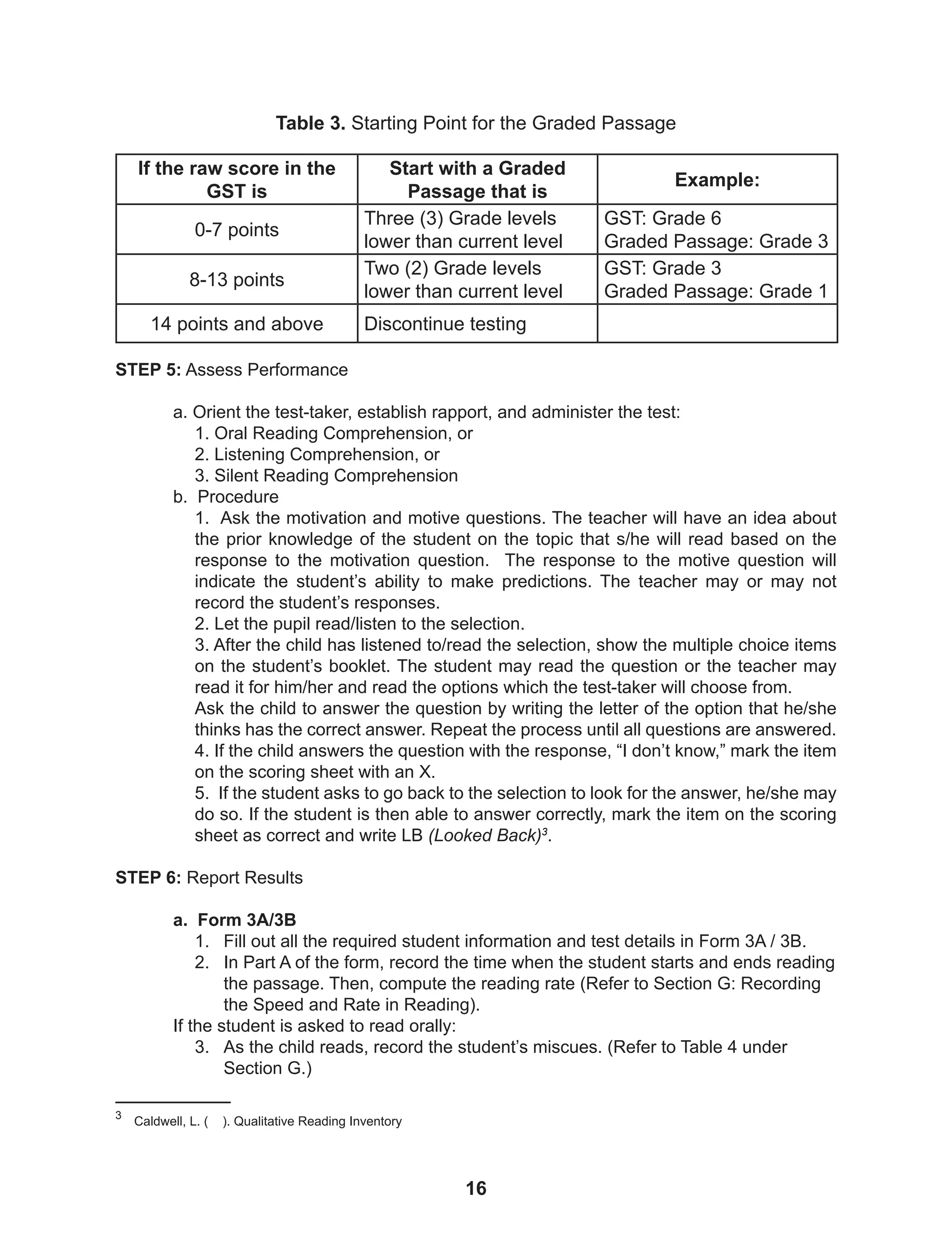
  • 703.
    696 Figure 6. Resultsof GST for Second Grade Students (Filipino Version) Students Identified to be in Need of Specialized Intervention Figure 7. Student case upon closer examination (Performance of S32) The Case of S32 Apart from using the results of the screening test, it is important to compare this information to other sources of data. (e.g. Teacher referral and written work). To illustrate, student 32 (S32) registered a raw score of 15/20. When his class adviser was consulted regarding his performance, he was identified to be one of the non-readers from her class. This information may cause us to wonder how he scored above the cut-off. Let us analyze his test paper. A closer examination of S32’s GST sheet yielded several red flags: (1) His initial answers to the test did not follow the multiple - choice format. The student instead wrote the words tama (correct) and mali (wrong) to signify his answers. *S32 scored above the cut-off. Upon closer examination of his work he was kept on the referral list. Working Towards Evidence- Based Referrals
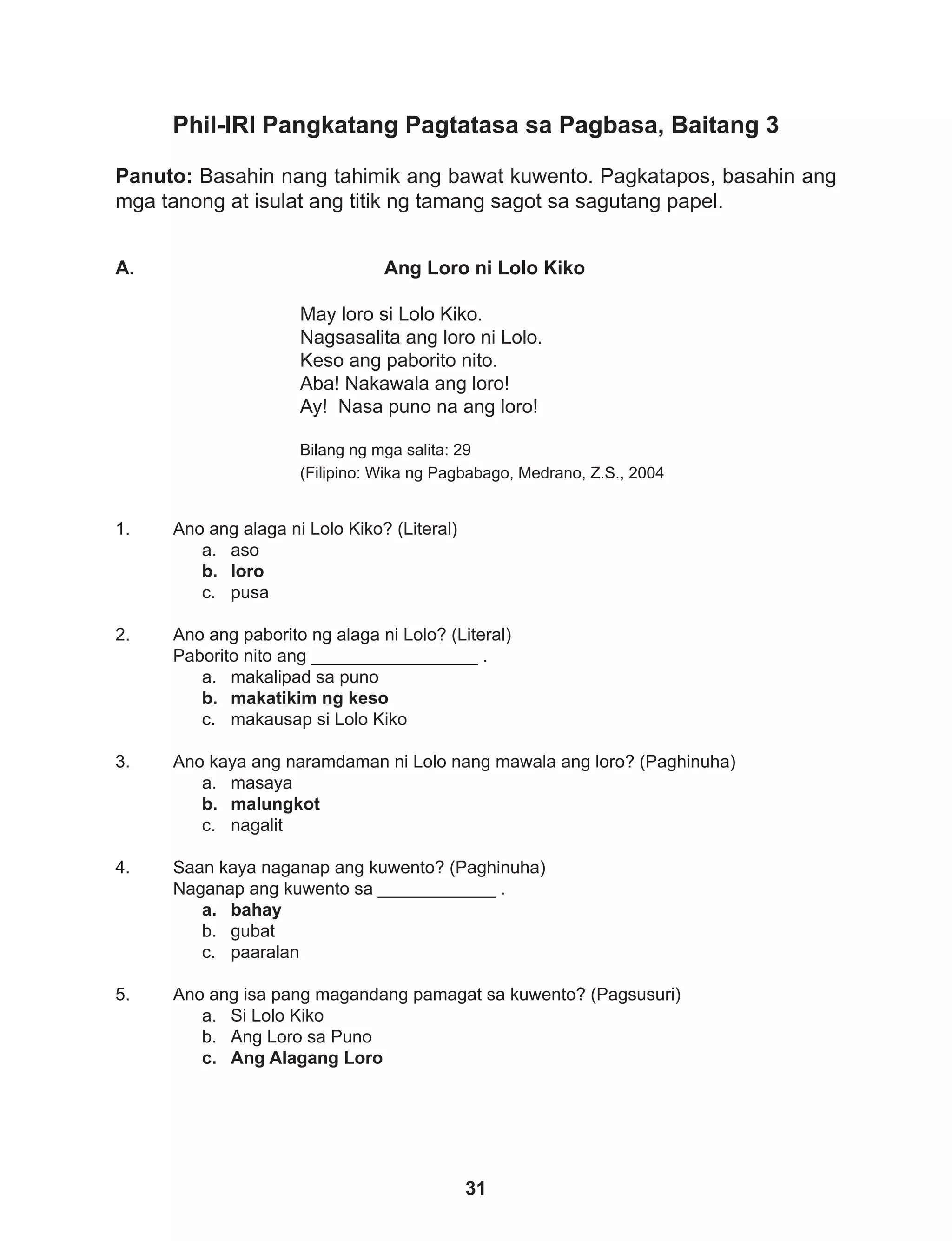
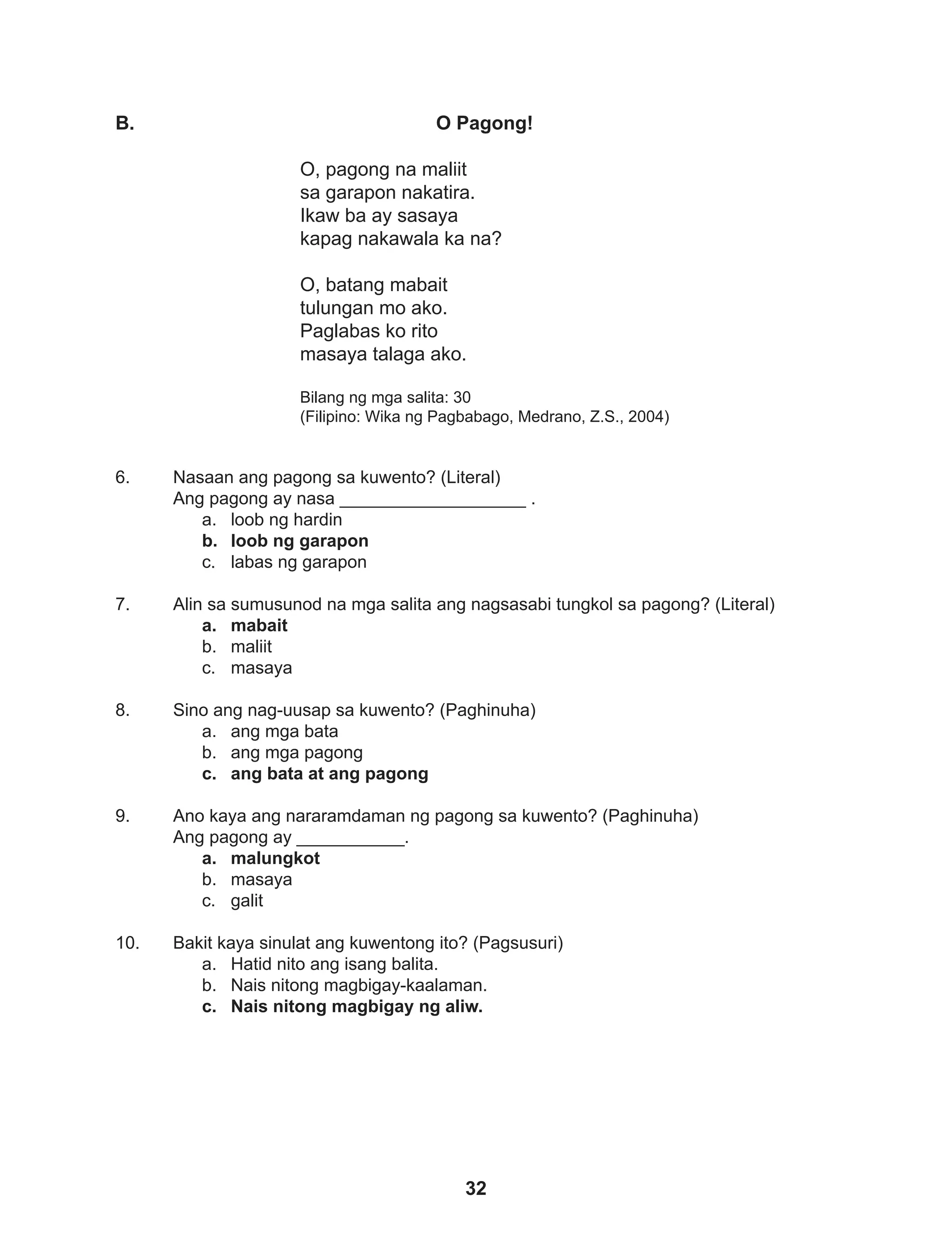
  • 704.
    697 (2) His erasuresalso show that he had changed his answers from those he had originally written. He may have noticed that his answers differed from those of his seatmates and therefore, changed them to conform to the format. (3) His score was above the cut-off which is inconsistent with the referral made by his classroomteacher.Histeacherhadearlierrecommendedhimforone-on-oneinstruction because he was identified to be that of a non-reader. If conditions in the classroom (e.g. Limited space, sharing of tables) were not addressed, it may be possible that his adequate performance be attributed to having copied from his classmate’s work. Examples of other kinds of information taken from the GST: (a) Difficulty filling in personal information (Grade & Section, Name of School) (b) Difficulty writing personal information (age) (c) Difficulty writing the date
  • 705.
    698 B. Analyzing Resultsfrom Individualized Assessment The Phil-IRI Individualized Assessment Tool. The Phil-IRI Individual Assessment Tool (IAT) can describe the kind of material that the child is able to perform well in and or has difficulty with. The individually administered Phil-IRI Graded Passages, can be used to assess the performance of students in three ways: • Oral Reading & Comprehension • Listening Comprehension • Silent Reading Comprehension When used to assess oral reading skills, the Phil-IRI may be used to describe: 1. decoding and word recognition 2. fluency 3. comprehension Tapping Background Information Before the read aloud, the student is asked to indicate whether the topic of the selection is familiar to him or her. This helps inform the teacher if the material that the child is reading about is something that he/she can relate to. Familiarity with the experience indicated in the text will allow for the tapping of background knowledge which in turn aids comprehension. A closer look at the individualized assessment of case of S32, the student was able to display familiarity with the topic of the selection which is mice. Figure 8. Familiarity with the Text Given that S32 has presented difficulties in the GST, the student was asked to read a text passage 2 levels below his grade level placement. Figure 9 shows his performance when given a kindergarten level text in Filipino. PHIL-IRI: Pagbasa sa Filipino (Talaan ng guro) Panimulang Pantatasa SET A Pangalan ng bata: S32 Baitang: Gr.2 Antas: Kindergarten Pagbasa ng Malakas sa Filipino Oral Reading Performance of S32 Mga Tanong: Sagot ng Mag-aaral Pagganyak: Nakakita ka na ba ng daga? Saan mo ito nakita? Opo. Dun sa maruruning kanina ‘Pag kumakain sila. Paglaan ng Motibo: Tingnan natin, saan makikita ang daga sa kuwento? Prediksyon:
  • 706.
    699 Figure 9. OralReading Miscue and Comprehension Performance Sheet Figure 10. Level of Performance in Word Reading and Comprehension (S32) Figure 11. Sample Specialized Program for S32 The student (S32) was only able to read 4 words out of a 40-word selection. When he was asked to answer questions after having read the selection, he was able to answer 3 out of 5 questions. When the text was reread to him and he was asked to answer the same questions, he performed better and answered 4 out of 5 questions correctly. A summary of S32’s performance shows that when provided kindergarten level text, his ability to read the text is at the frustration level and ability to comprehend is at the instructional level. Domain of Literacy Objectives Oral Language and Vocabulary To identify words with the target letter and provide their meanings Phonological and Phonemic Awareness To be able to identify sounds (sentence, word, syllable and phoneme level) Alphabet Knowledge To identify letter form, soundm key word Book/Print Orientation and Listening To b able to handle books while reading Decoding Repetitive Texts To be able to decode words and repetitive texts Comprehension To be able to note details and make predictions Writing To be able to write down words and share one’s opinions When reading K-level text Word Reading Score Comprehension Score 2% 60% Frustration Level Instructional Level
  • 707.
    700 C. Other SampleCase Studies and Recommended Intervention Case Study 1: Grade level: Grade 3 Reading level in Filipino: Grade 1 Poor word recognition in Filipino; it follows that fluency and reading comprehension are likewise poor Andro is in Grade 3. He was asked to read a short story in Filipino with a Grade 3 readability level. He tried to read each word by reading each syllable (Ka-pag . . . Kapag. . . ba-kas-. . . bakas-. . . syon . . . bakasyon. . .) Then he reads the whole word. As a result, it took him a long time to finish reading the selection. When asked questions about the selection read, he was not able to remember most of the details. Out of the six comprehension questions, he was able to answer correctly only one item. Obviously, Andro has a problem in word recognition. Since it was laborious for him to identify the whole word at once and had to resort to reading in syllables, he was not able to read with proper phrasing; fluency was not attained. And because Andro spent all his attention and energy on figuring out the words, it was difficult for him to recall the details of what was read. Comprehension suffered because of his basic problem of word recognition. Recommended intervention: Andro needs intensive training on word recognition. Marungko Approach in teaching this will help him a lot. (Refer to the sequence of lessons of the Marungko Approach). Andro specifically needs help with blending (a skill that influences decoding) and segmenting (a skill that influences spelling) sounds in a word. Practice with word lists and multisyllabic words will help develop fluency in word reading. Once Andro’s word reading performance has picked up, reading phrases and sentences should be taught next. Case Study 2: Grade level: Grade 4 Reading level in Filipino: Grade 4; Reading level in English: Grade 2 Poor word recognition and fluency in English; vocabulary in English is likewise limited Gina is in Grade 4. She read the selection in Filipino with few miscues. She manifested good fluency. She only had one error in Reading comprehension. However, when she was asked to read the Grade 4 selection in English, she did not perform as well. She read the words phonetically. Her miscues in reading included mispronunciations, repetition and refusal to read some words. She did not know the meaning of most words in the English selection that she read. Her score in Reading comprehension is one out of the 7 items. Gina’s reading problem is typical of pupils who started to read in the Mother Tongue and in Filipino. Reading the English words phonetically is a carry-over of her reading in MT and Filipino where the words are phonetically consistent.
  • 708.
    701 Recommended Intervention: Let usremember that poor performance in reading English text should not be used to interpret the child’s cognitive abilities. Her literacy performance in her Mother Tongue (Filipino) should help inform us if the comprehension difficulty stems from decoding or from poor background knowledge. Gina’s ability to read phonetically in Filipino should be used as an advantage to reading in English. Intensive instruction on word recognition in English should be given. The lessons on word families (probably starting with a review of short vowel words, then proceeding to words with consonant blends and digraphs, words with long vowel sounds . . .) will help Gina a lot. Moreover, a drill on the sight words will make word recognition in English an attainable task for her. Her performance will also greatly improve if decoding is taught hand-in-hand with vocabulary. Some level of prediction of the word will occur if there is word knowledge. Readers are better able to retain the manner by which words are read if the words are familiar to them and part of their everyday language. Oral language development will help increase familiarity with the English language. While Gina may be still struggling with reading words in English, how English words are read may be modeled to her using a read aloud. Gina can still engage in a listening comprehension exercise to expose her to the language and hone her comprehension skills. Case Study 3: Grade level is Grade 5; Reading performance in Filipino and English is Grade 3. Case manifested good listening comprehension but poor decoding and fluency. Let us consider a Grade 5 boy named Luis. Results of the group screening test and further oral /silent reading tests indicated that he is performing at the Grade 3 level both in Filipino and English. A Grade 3 at-level reader should be able to read a variety of texts of varying lengths in Filipino. On the other hand, a Grade 3 at-level reader in English should be able to read CVC words with short sounds. Luis’ reading behaviors in Filipino and English include the following: • good listening comprehension skills • word-by-word decoding of text • lack of expression in oral reading • hardly rereads text • anxious while reading • ignores punctuation An analysis of Luis’ reading behaviors shows that while he demonstrates good listening comprehension skills, he would need assistance in decoding. It is important to take note that Luis’ listening vocabulary is different from his reading vocabulary. The word-by-word reading of text may be due to lack of phonics knowledge and a good reading vocabulary.
  • 709.
    702 Recommended Intervention: It isclear that Luis need support in phonics and word recognition. See the earlier section on this. Take note that the teacher has to refer to the Grade 3 content of words to be read (both in Filipino and English). This should be the focus of phonics and word recognition activities. Giving texts at his independent reading level should be the starting point. Getting him to perform as a good reader at Grade 3 is the initial objective. To facilitate decoding of the target Grade 3 Filipino/English words, a rich oral language that uses these words should be developed. The goal is to further enrich Luis’ listening vocabulary since he displays good listening comprehension. In the process of doing this, his speaking and reading vocabulary would eventually expand. Ways to enrich his reading vocabulary may focus on providing a lot of exposures to the words to be read. This may come in the form of listening activities and games. Matching words read by the teacher to its correct picture would be a good start. If possible, he should recite poems and sing rhymes that use the target words to be read. Allow Luis to use these words as he speaks. Let him use the words as he talks about pictures related to the word. Repeated exposures to the words with matching pictures would help him make sense of text without pictorial aids eventually. To develop fluency in reading the target Grade 3 words, see the section on fluency. Case Study 4: Grade level: Grade 3; Reading performance: Grade 1 Good listening comprehension; poor decoding and fluency in Filipino Let us consider a Grade 3 girl named Marissa. Filipino is not her mother tongue. Results of the group screening test and the oral /silent reading tests indicated that she is performing at Grade 1 level in Filipino. At the end of Grade 1, students were already immersed in the Filipino language through a wide exposure to listening and speaking exercises. Marissa’s reading behaviors in Filipino include the following: • good listening comprehension skills • lacks decoding skills appropriate for the level • slowly decodes words, usually letter by letter, with a lot of pauses, hesitations, and miscues • rereads words a number of times • lacks understanding of words that are read An examination of Marissa’s reading behaviors shows that her good listening comprehension skills would be a good starting point. Her listening vocabulary can be enriched so this can be expanded to be part of her reading vocabulary. Her laborious reading may be due to lack of phonological awareness and alphabet knowledge. Thus, phonics and word recognition are tedious tasks for her.
  • 710.
    703 Recommended Intervention: Marissa needssupport in phonological awareness, alphabet knowledge, and phonics and word recognition. See the earlier section on this. Take note that the teacher has to refer to the Grade 2 systematic and explicit instruction of beginning reading in Filipino. Develop her reading vocabulary through varied exposures to the Filipino words to be read including opportunities to meet these words through listening and speaking activities. Make use of meaningful and fun games. Recite rhymes and poems and sing songs that use the words to be read. When Marissa reads words that she is familiar with, then she can make sense of print. To develop fluency in reading target Grade 2 words, see the section on fluency. Case Study 5: Grade 5; Reading level: Grade 3 Poor comprehension skills (language-based difficulty) Sam’s literacy behaviors are as follows: • Can identify letter sounds, letter forms and letter names • Can read and understand simple written instructions • Can decode two related sentences in L1 • Can create simple written text for others to read • Has difficulty predicting what will happen next in read-aloud stories • Can answer comprehension questions in the literal comprehension level • Refuses to answer how, why and what-if questions • Cannot describe new information gained by listening to a story • Cannot think of a synonym of a familiar word Sam seems to have no problem in alphabet knowledge. He can in fact decode written instructions, and even two related sentences in L1. Sam has difficulty understanding a selection, whether it is oral or written. This is evident with the behavior that he can only answer questions in the literal level, which means, he can identify details of a story if they are explicitly stated in the text. Sam has difficulty processing information that entails higher level of comprehension, like predicting, inferring and answering critical comprehension questions. His difficulty in comprehension may also be a result of his lack of vocabulary development. This is evident in the behavior that he cannot think of a synonym of a familiar word. With this demonstrated behaviors, it can be assumed that Sam is good in decoding, but is poor in comprehension skill, for both listening and reading.
  • 711.
    704 Recommended Intervention PerDomain 1. Oral Language a. Listening to story read aloud by the teacher. b. Singing together and/or reciting poems and rhymes. c. Using play activities to enhance oral language, like telephone play, pretend play using puppets or toys. d. Let students participate in small group activities. e. Provide opportunities for the students to have interactions with classmates, and teachers. f. Use creative drama. g. Story retelling by the children. h. Provide opportunities for the children to create/compose their own stories. 2. Vocabulary a. Story read aloud by the teacher b. In teaching vocabulary words, use the three critical notions of Integration (connecting the new vocabulary to their prior knowledge); Repetition (encountering/ using the term many times), and Meaningful use (multiple opportunities to use the new words in oral and written language) (Nagy, 1988). c. Brief strategies for Vocabulary Development (Stahl, 1999) • Teach synonyms. • Teach antonyms. • Paraphrase definitions. • Provide examples. • Provide nonexamples. • Ask for sentences that “show you know.” • Teach word sorting. 3. Listening Comprehension (see section on Listening and Reading Comprehension) 4. Fluency (see section on Fluency)
  • 712.
    705 Case Study 6: Goodfluency and reading comprehension in Filipino; Poor fluency and reading comprehension in English Mateo’s literacy behaviors: • Reads aloud with fluency and comprehension text in Filipino. • Can decode words with short vowel sounds in English. Mateo lacks fluency in reading the words in English. • Can answer multi-level comprehension questions in Filipino but not in English for both listening and reading. • Can easily explain the meaning of a word in Filipino, but not in English. Mateo has no problem with reading with fluency and comprehension in the first language. In reading in English, however, there are a number of identified difficulties. Mateo is used to reading in Filipino. One difference of the Filipino written language and English is that Filipino is very phonetic in nature. This is the reason why Mateo can only decode words with short vowel sounds in English. This shows that he also lacks word recognition skills in English; he needs to get used to the structure of the sounds of words in English. If Mateo can answer multi-level comprehension in Filipino, but not in English, it can be assumed that his oral language development in English is weak. Finally, he also has difficulty in giving meaning to words in English. This shows that his vocabulary development in English needs to be improved. 1. Oral language and Vocabulary development in English 2. Word recognition in English (see section on word recognition in English) 3. Fluency in English 4. Listening and Reading Comprehension in English
  • 713.
    706 PART IV. READING REMEDIATIONIN A SCHOOL READING PROGRAM A. Components of a Complete School Reading Program Basic education, in order to be effective, must have within its system the components of a complete school-based reading program. Hermosa, as adapted from a model by Dupois and Askov (1982) exerts that a complete reading program should include developmental reading - the teaching of reading in the primary, intermediate, secondary and tertiary levels, content-area reading - reading done in content-areas such as science, health and social studies and remedial reading instruction or specialized reading instruction adjusted to the needs of a student (Ocampo, 1997). Of the three components of a complete reading program, the Philippine Educational System is now moving towards enabling teachers to provide remedial instruction. B. Specialized Teaching of Reading The specialized teaching of reading or reading remediation is the application of teaching strategies designed to give the struggling readers the skills, competencies or behaviors that they need in order to improve their performance. It is the kind of instruction undertaken to enable children experiencing difficulties in aspects of reading performance to catch up or develop in appropriate ways. As shown in Figure 3, the goal of reading remediation is to create positive change. K 1 2 3 4 5 6 7 I II III IV College (Beginning Reading) Remedial Programs Content Heading Programs • Developmental • Content • Remedial (Changing Emphasis on the Components of the Reading program) Components of a School Reading Program
  • 714.
    707 To create positivechange, the reading teacher tries to present the reading task and material in a different way, slant or orientation. This kind of instruction is focused and targets specific domains of literacy that have been observed to be areas of weakness in the child while acknowledging his/her areas of strength. These lessons are delivered differently from regular classroom instruction and vary in terms of frequency or intensity depending on the child’s needs. Given that literacy “is a fundamental human right,” (Global Monitoring Report, 2006) every person should enjoy fair and equal access to literacy education and have opportunities for personal growth and development. It is therefore important to provide instruction that is tailored to the students’ needs and abilities in order to develop their ability to construct meaning when reading and heighten engagement in the task itself (Snow et. Al, 1998). Who needs it? • Children who may not be benefiting as much from regular classroom instruction • Children who are developing differently from other children • Children whose educational needs may be different than most children Principles of Remediation 1. Develop a pleasant rapport between teacher and student. 2. Choose methods and materials with flexibility. 3. Begin at a low enough level and with small enough steps to ensure initial success. 4. Use a tracking device to record progress toward important objectives. 5. Keep open lines of communication with the child’s teachers and parents. 6. Celebrate the child’s success. Give praise and support. 7. Always connect reading to daily needs and activities. 8. Keep in mind the particular reading skills that may need to be developed in an individualized situation. 9. Maintain the child in the reading program only until sufficient skills have been acquired for the regular reading program and for reading on one’s own. 10. Believe in the child. Establish 1. An area where support services are to be provided 2. Frequency/Regularity of Session (2 to 3 times a week) 3. Program for Specialized Instruction 4. Mechanism for supervision, consultation and monitoring of progress Performance Application of Teaching Strategies Intervention Development of skills CHANGE What is reading remediation?
  • 715.
    708 One factor thatgreatly contributes to literacy development is the environment. Certain aspects of the home environment, such as access to books, opportunities to read/write and shared reading benefit children’s development. Other preschool environments, such as childcare, can also have positive effects. But children from low-income environments do not have these kinds of opportunities. Children who lack such opportunities for acquiring these pre-reading skills can suffer later reading problems and delays in the development of language skills (Whitehurst, 1998). Given that students who exhibit poor early reading skills are likely to continue as poor readers, more popularly referred to as the Matthew Effect, there is a need for early intervention programs if we are to stop this cycle of failure (Good, 1998). According to Taylor in 1992, the best way to break the cycle of failure experienced by poor readers is to provide intervention as early as possible (Santos, 2007). Elbum et. Al. reiterates in their meta-analysis that “one-to-one tutoring can aid many students whose poor reading places them at risk for academic difficulties. It is well-designed and effectively implemented. More importantly, the quality of instruction mattered more than the duration of the instruction is important (Elbaum, 2000). Some specific guidelines that could aid the planning for effective tutoring include (1) having a knowledgable coordinator who provides expert guidance to tutors; (2) structure in lessons; (3) tutor training; and (4) coordination between classroom instruction and the tutoring program (Wasik, 1998). READING INTERVENTION WITHIN A REGULAR READING CLASS Differentiated Instruction During a Regular Reading Class Group remediation or reading intervention for a group of slow readers may be done by a classroom teacher during the regular Filipino or English class through differentiated activities. The teacher divides the class into two groups: the students who are performing well in Reading and the students who need reading intervention. The sample plan is detailed below: Students who are performing in Reading according to the Grade level expectation Students Who Need Intervention Regular lesson: The lesson and activities are: Lessons/activities that address their reading needs. The lesson and activities are: • planned for group progress • generally oriented towards the strengths, needs and interests of groups rather than individuals • have well-balanced skills and typical developmental progress are assumed • orientedtowardsthespecificstrengths and needs of the individuals “who have not kept up” with the others in their age group • orientedtowardsthespecificstrengths and weaknesses of the particular individuals.
  • 716.
    709 Illustration of aDifferentiated Lesson During the Reading of a Selection: Prereading Activities: (whole class) • Unlocking of difficult words • Motivation • Motive Questions Reading the Selection (differentiated activities) Students who are performing according to Grade level Students who need Reading intervention Independent activity ■ ■ Silent Reading of the selection With the teacher ■ ■ Oral Reading of the Selection • teacher asks questions about the part of the selection read after reading a paragraph or part of a selection After Reading (differentiated activities) Independent activity ■ ■ Pupils are asked to answer questions about the selection read (written activity) • comprehension: noting details, sequencing events, cause and effect . . . • vocabulary: words with multiple meanings, synonyms . . . With the teacher ■ ■ Pupils are asked to answer oral exercises about the selection read. The exercises focus on particular skills that they have not learned: • vocabulary • omprehension: noting details, sequencing events, . . . After Reading (differentiated activities) Oral work with the teacher ■ ■ Discussion of the story, answering the written exercises, other activities Independent activity ■ ■ written activity: follow-up of the oral exercise
  • 717.
    710 Conducting Reading InterventionOutside the Reading Class: When the students’ reading level is way below the expectation of the grade level, a remedial reading activity outside of the regular class hours may be done. The following procedure is suggested: 1. Plan activities according to the reading level of the student(s). 2. Plan a tentative, weekly plan, where there is a balance of activities to be done. 3. Build self-esteem and confidence along the way. 4. Continuously diagnose and adjust instruction based on present performance. Example: Activity: Listening comprehension a. Unlocking difficult words b. Motivation and Motive question c. Teacher reads the story while pupil/s listen intently. d. While reading the story, pause after a paragraph or two and ask questions about what was read. This will monitor comprehension. e. After reading the story, give oral exercises on comprehension: may focus on one comprehension skill and drill on this. (noting details, sequencing events, inferring f. feelings . . . Activity: Word Recognition a. Pick out words from the story. If the lesson is Filipino, the lesson(s ) in Marungko may be followed. If the lesson is in English, the sequence of word families may be followed. b. Vocabulary study. Unlock the words through various techniques: use of realia, pictures, demonstration, synonyms and antonyms and context clues. c. Drill the pupils on the reading of the words. Remind them that it is easier to read each word if the beginning letter is sounded. d. Ask them to give a sentence for the word (vocabulary development is integrated). e. Let them write the word/s that they can successfully read (spelling is integrated). Activity: Drill on Fluency a. Write on word cards some words from the story. Let them read the words. b. Let them read some sight words from the story Filipino: may, mga, at, ng, nang . . .; English: the, there, then, at, of, with . . . c. Write the phrases on phrase cards or on the board. Let them read these correctly (accuracy, speed (reading fast) and proper expression (They should avoid word by word reading).
  • 718.
    711 Activity: Drill onVocabulary a. Pick out 3 -5 words from the selection read. b. Let them match each word with its picture. c. Write the name of each picture. d. Show each word. Act it out. e. Use each word in their own sentence. f. Choose the synonym or antonym of each word. Activity: Drill on Reading Comprehension a. Choose the words in the story that are difficult to decode. Let them read the words. b. Write the phrases for these words. Let them do phrase reading. c. Unlock the difficult words. d. Give the Motivation and Motive Questions e. Let the pupils take turns reading a part of the story. f. Ask questions about the part of the story that was read. g. After the full story is read, let them answer written questions. h. Discuss their answers. If their answer is not correct, let them go back to the story and read the part that contains the correct answer.
  • 719.
    712 References: Airasian, P.W. (2001).The classroom as an assessment environment. New York, McGraw- Hill. Allington, R. (2009). What really matters in fluency, research-based practices across the curriculum. MA: Pearson Education Inc. Armbruster, B, Lehr, F., Osborn, J. (2003) The research building blocks for teaching children to read: Put Reading First. National Institute for Literacy. Cobb, C. (2004). Turning on a dime: Making change in literacy classrooms. The Reading Teacher, 58, 104-106 Gunning, T. (2008). creating literacy instruction for all students 6th Ed. Boston, USA: Pearson Education, Inc. Hoover, W. A., & Gough, P. B. (1990). The simple view of reading. Reading and Writing: An Interdisciplinary Journal, 2, 127-160. Palmer, R. 9 Listening strategies that develop active listeners. TESOL Connections: Keeping English language professionals connected. TESOL International Association.http:// newsmanager.commpartners.com/tesolc/issues/2014-06-01/3.html retrieved March 31, 2016. Reutzel, R. Cooter, R, Jr. (2007). Strategies for reading assessment and instruction; helping every child succeed, 3rd. Ed. NY: Pearson Education, Inc. Scharer, P. (2012). Policy into practice, Issue #1, October 2012, Ohio Resource Center, Ohio State University. Vacca, J., Vacca, T. and Gove, M. (2011) Reading and learning to read. NY: Allyn and Bacon Zoeller, E. (2015). Comprehension and the bilingual reader: thinking within a decodable text. Center for Teaching Biliteracy Building. Madison Metropolitan School District
  • 720.
    713 For inquiries orfeedback, please write or call: Department of Education - Bureau of Learning Resources (DepEd-BLR) Ground Floor, Bonifacio Bldg., DepEd Complex Meralco Avenue, Pasig City, Philippines 1600 Telefax: (632) 634-1072; 634-1054; 631-4985 Email Address: blr.lrqad@deped.gov.ph * blr.lrpd@deped.gov.ph Supported by: