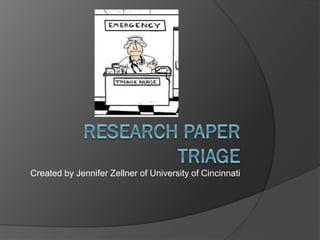
Created by Jennifer Zellner of University of Cincinnati
 Today’s activity is designed to help you
figure out a game plan for your research
paper.
 We’ll be going through and talking about
common issues in papers so you can
determine if it is an issue you need to
fix.
Generalizations
 Look through your paper
 Cross out every sentence/statement that
begins with:
 Many, or Many people
 Some, or Some people
 Most, or Most people
 People, students, researchers, etc.
 How much of your paper is crossed out?
Using Source Material
 Look through your paper
 How many sources do you cite?
 0: This needs to be addressed immediately.
 1-2: You will need to bring in more sources.
 3-4: Depending on the quality of your
sources, this may be okay, but you probably
should bring in more sources.
 5+: You should be okay in terms of quantity
Using Source Material
 Look through your paper
 What kinds of sources are you using?
 Primarily academic: Awesome, keep it up.
 A fairly even mix between academic and
non-academic: Make sure that you’re
establishing your credibility, but if you have
enough sources, this should work.
 Primarily non-academic: You’ll need to find
credible academic sources to support your
opinion and provide credibility.
Using Source Material
 Look at the last page of your paper
 Is it a Works Cited?
 Yes: Awesome, double check Purdue OWL
or the A&B to make sure it’s properly
formatted.
 No: Create a Works Cited promptly.
Addressing Counterarguments
 Look through your paper
 Do you address counterarguments?
 Yes: Good, how are you refuting them?
 No: You should address counterarguments.
If you don’t feel that your paper has a
counterargument, then you need to refocus
your paper so that it is an arguable point.
Opening Sentence
 Look at your opening sentence
 Is it interesting, attention-grabbing,
explanatory?
 Yes: Awesome
 It could be better: Work on rewriting your
opening sentence so that it is interesting,
etc.
Title
 Look at your title
 Do you have a title?
 Yes: Cool
 No: Make sure you write one
 Is your title relevant and attention
getting?
 Yes: Even more cool
 It could be better: Rewrite your title so that it
is relevant and attention getting.
Thesis
 Look at your thesis
 Does it explain your purpose and map
out the rest of your paper?
 Yes: Awesome
 It could be better: Rewrite it until it does
Transitions
 Look through your paper
 How are your transitions?
 Good, I used old before new and the ideas
tie together rather nicely: Awesome, make
sure that you keep those transitions nice
and tight as you rewrite and revise your
paper.
 Alright, some are pretty good, but most
could use some work: Transitions should be
part of your rewriting process then
 Could use work: Transitions should be a
major part of your rewriting process then
Stopping the bleeding
 How’s your paper holding up?
 If you’ve got a long list of things to address,
then you’ve obviously got a lot of work, and
you should start that promptly.
 If you’ve got a very short list of things to
address, that doesn’t mean you don’t have a
lot of rewriting ahead of you. You’ll just be
focused on a different kind of rewriting.

Research Paper Triage

  • 1.
    Created by JenniferZellner of University of Cincinnati
  • 2.
     Today’s activityis designed to help you figure out a game plan for your research paper.  We’ll be going through and talking about common issues in papers so you can determine if it is an issue you need to fix.
  • 3.
    Generalizations  Look throughyour paper  Cross out every sentence/statement that begins with:  Many, or Many people  Some, or Some people  Most, or Most people  People, students, researchers, etc.  How much of your paper is crossed out?
  • 4.
    Using Source Material Look through your paper  How many sources do you cite?  0: This needs to be addressed immediately.  1-2: You will need to bring in more sources.  3-4: Depending on the quality of your sources, this may be okay, but you probably should bring in more sources.  5+: You should be okay in terms of quantity
  • 5.
    Using Source Material Look through your paper  What kinds of sources are you using?  Primarily academic: Awesome, keep it up.  A fairly even mix between academic and non-academic: Make sure that you’re establishing your credibility, but if you have enough sources, this should work.  Primarily non-academic: You’ll need to find credible academic sources to support your opinion and provide credibility.
  • 6.
    Using Source Material Look at the last page of your paper  Is it a Works Cited?  Yes: Awesome, double check Purdue OWL or the A&B to make sure it’s properly formatted.  No: Create a Works Cited promptly.
  • 7.
    Addressing Counterarguments  Lookthrough your paper  Do you address counterarguments?  Yes: Good, how are you refuting them?  No: You should address counterarguments. If you don’t feel that your paper has a counterargument, then you need to refocus your paper so that it is an arguable point.
  • 8.
    Opening Sentence  Lookat your opening sentence  Is it interesting, attention-grabbing, explanatory?  Yes: Awesome  It could be better: Work on rewriting your opening sentence so that it is interesting, etc.
  • 9.
    Title  Look atyour title  Do you have a title?  Yes: Cool  No: Make sure you write one  Is your title relevant and attention getting?  Yes: Even more cool  It could be better: Rewrite your title so that it is relevant and attention getting.
  • 10.
    Thesis  Look atyour thesis  Does it explain your purpose and map out the rest of your paper?  Yes: Awesome  It could be better: Rewrite it until it does
  • 11.
    Transitions  Look throughyour paper  How are your transitions?  Good, I used old before new and the ideas tie together rather nicely: Awesome, make sure that you keep those transitions nice and tight as you rewrite and revise your paper.  Alright, some are pretty good, but most could use some work: Transitions should be part of your rewriting process then  Could use work: Transitions should be a major part of your rewriting process then
  • 12.
    Stopping the bleeding How’s your paper holding up?  If you’ve got a long list of things to address, then you’ve obviously got a lot of work, and you should start that promptly.  If you’ve got a very short list of things to address, that doesn’t mean you don’t have a lot of rewriting ahead of you. You’ll just be focused on a different kind of rewriting.