Workshop: Find Your
Why (for organisations)
Based on Simon Sinek’s books Start With Why and Find Your Why
Steven Mackenzie, freelance Lean Agile process coach
Agile South Coast February 26 2019
slideshare-fyw@aptile.co.uk
Twitter: @busywait
What we’re doing today
• Finding Your Why, for Groups: “A Tribe Why”
• Overview
• Practice – building a why statement for Agile South Coast
• Review our Why statements
• How is this going to be useful to us?
• Review of the process and tips
• How did we do?
Sources
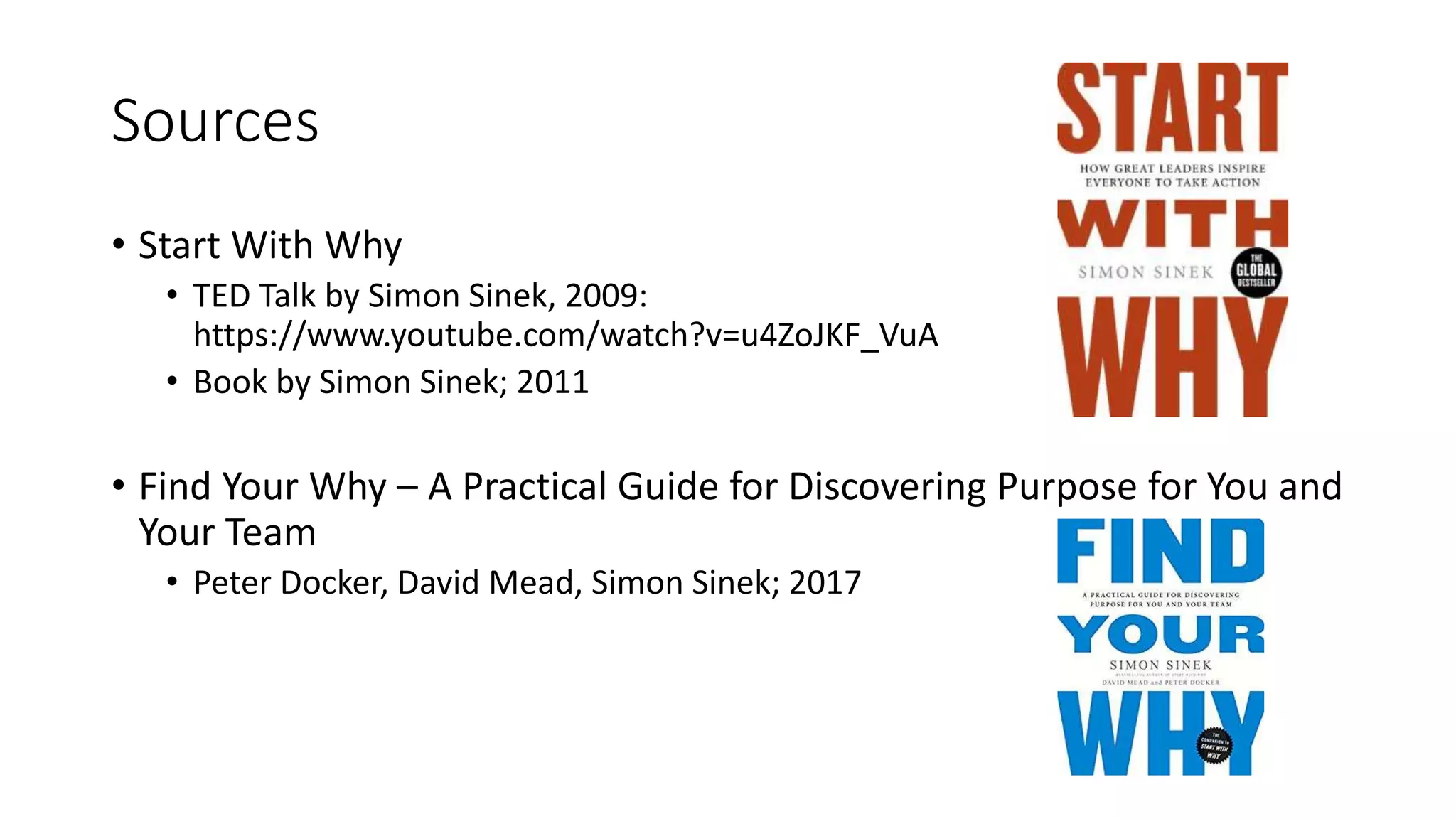
• Start With Why
• TED Talk by Simon Sinek, 2009:
https://www.youtube.com/watch?v=u4ZoJKF_VuA
• Book by Simon Sinek; 2011
• Find Your Why – A Practical Guide for Discovering Purpose for You and
Your Team
• Peter Docker, David Mead, Simon Sinek; 2017
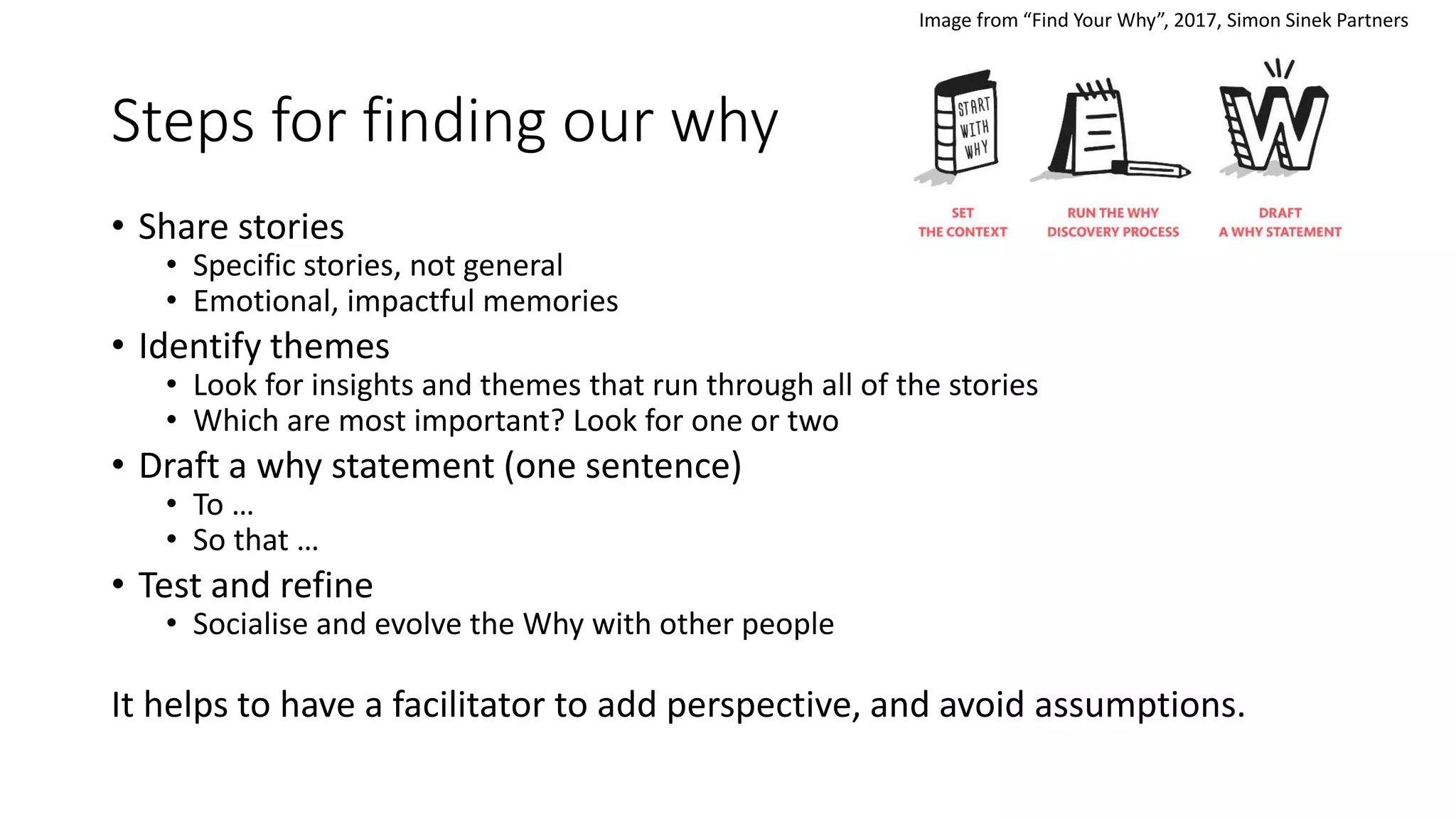
Steps for finding our why
• Share stories
• Specific stories, not general
• Emotional, impactful memories
• Identify themes
• Look for insights and themes that run through all of the stories
• Which are most important? Look for one or two
• Draft a why statement (one sentence)
• To …
• So that …
• Test and refine
• Socialise and evolve the Why with other people
It helps to have a facilitator to add perspective, and avoid assumptions.
Image from “Find Your Why”, 2017, Simon Sinek Partners
Finding your why, for groups
We’ll work through the whole process, following the group Why
Discovery format
• It’s pretty simple!
• Our group is Agile South Coast
• Our 2½ hour session is not long enough, 4 to 5 hours is recommended
The Agenda for a group Why Discovery (with
suggested times for a “real” session)
• Set the context – a senior leader (40 minutes)
• Ensure that we all understand that this is important work
• Helps to let you in to the group, with trust and attention
• What is a Why, with examples (10 minutes)
• Share examples from other contexts for individuals or for groups
• Conversations in pairs (10 minutes, 2-3 minutes each)
• Thinking back to the time that you joined the organization, what inspired you the most?
• Share back if there are interesting stories
• Introduce the Golden Circle
• Use Simons Video? https://bitly.com/GoldenCircleTalk, http://bit.ly/FYWresources
• Or a shorter version ;)
• Overview of the day – including breaks!
• Conversations in groups of 5-7: Story Sharing (2 hours)
• Specific stories that reveal both the contribution the organization makes to others
• The impact of that contribution over time
• Drafting the Why Statement (30 minutes)
• The *first* draft – 75% complete, actionable
We are Agile South Coast
This session will be useful as we look for ways to accommodate and
serve our growing membership
Our Why Statement will guide our current and future teams of
organizers
The Why Statement will appear on our Meetup group page to help
inform current and potential new members and speakers
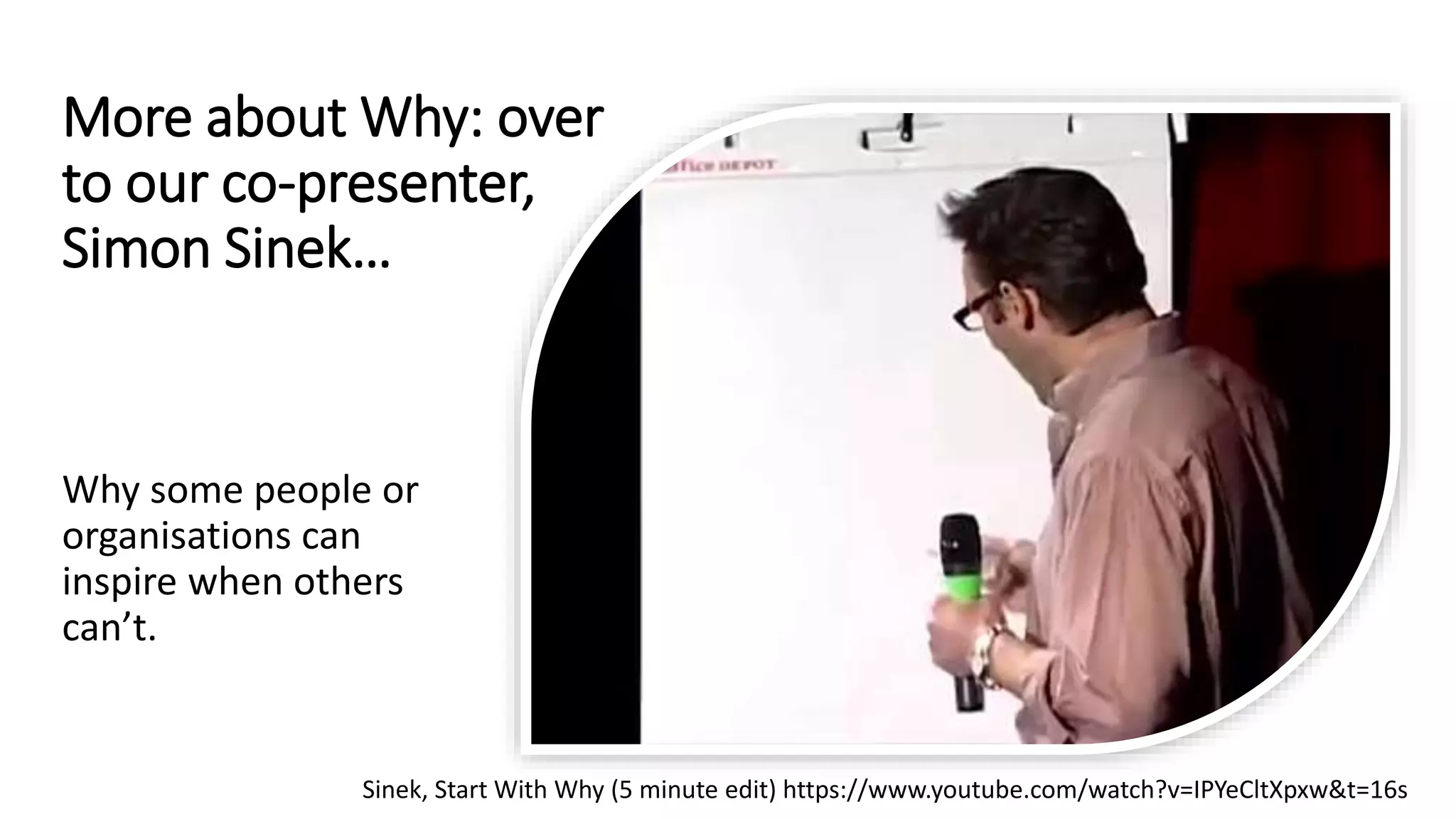
More about Why: over
to our co-presenter,
Simon Sinek…
Why some people or
organisations can
inspire when others
can’t.
Sinek, Start With Why (5 minute edit) https://www.youtube.com/watch?v=IPYeCltXpxw&t=16s
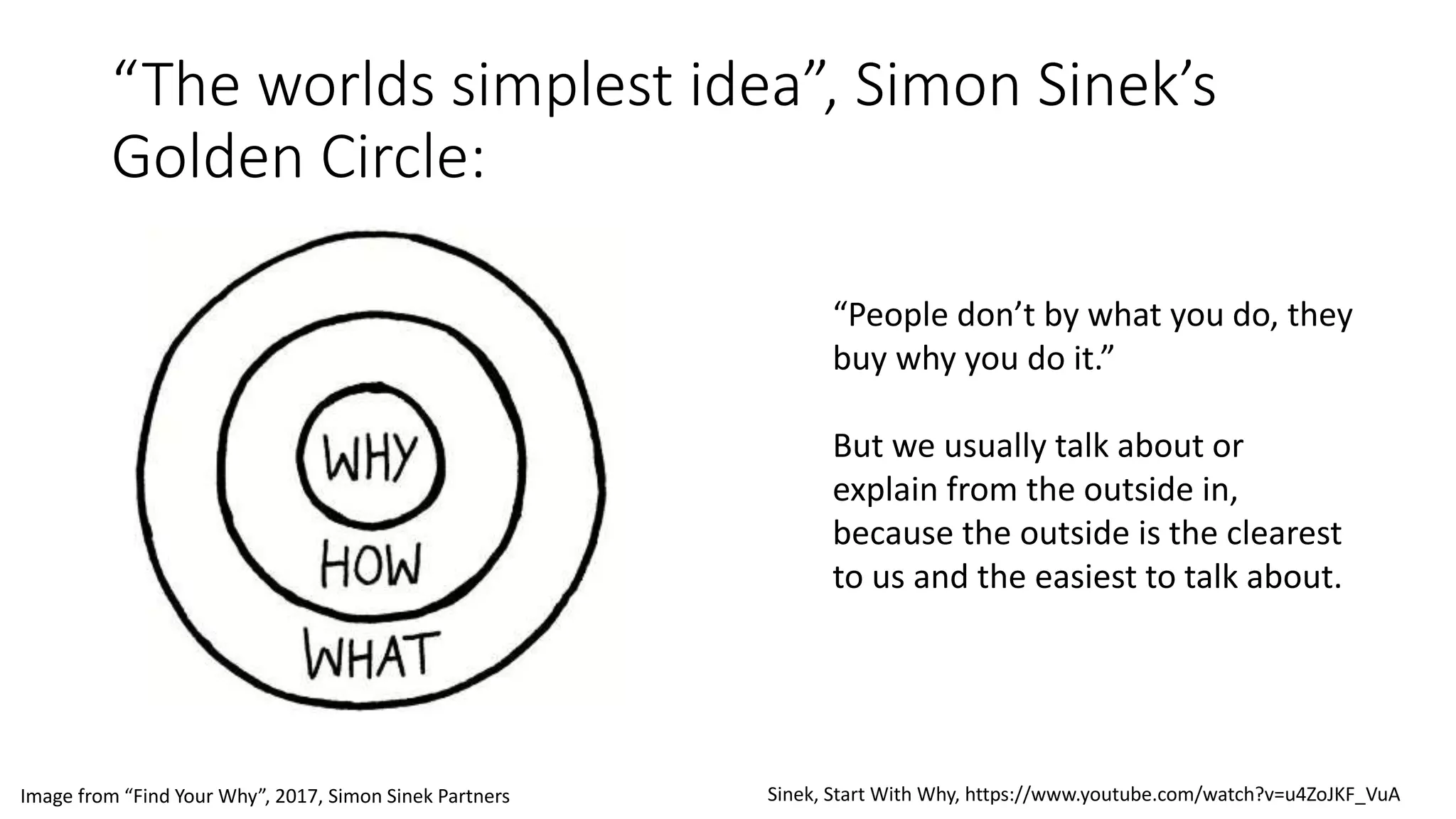
“The worlds simplest idea”, Simon Sinek’s
Golden Circle:
Sinek, Start With Why, https://www.youtube.com/watch?v=u4ZoJKF_VuA
“People don’t by what you do, they
buy why you do it.”
But we usually talk about or
explain from the outside in,
because the outside is the clearest
to us and the easiest to talk about.
Image from “Find Your Why”, 2017, Simon Sinek Partners
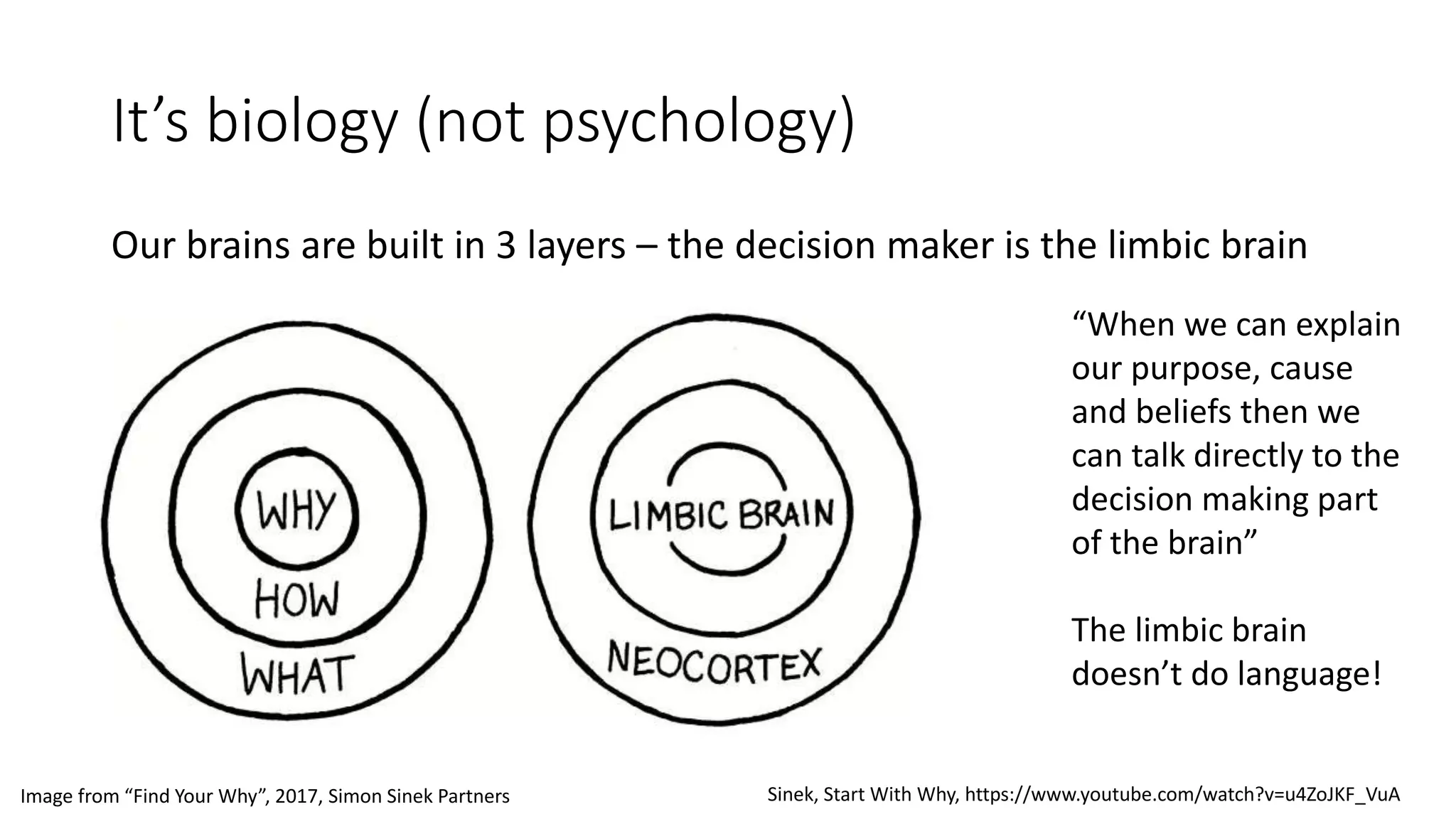
It’s biology (not psychology)
Our brains are built in 3 layers – the decision maker is the limbic brain
“When we can explain
our purpose, cause
and beliefs then we
can talk directly to the
decision making part
of the brain”
The limbic brain
doesn’t do language!
Sinek, Start With Why, https://www.youtube.com/watch?v=u4ZoJKF_VuAImage from “Find Your Why”, 2017, Simon Sinek Partners
Opening Question to the Group (with each
other, in pairs or threes)
What was it about Agile South Coast that
excited you to join, and to keep on
coming back?
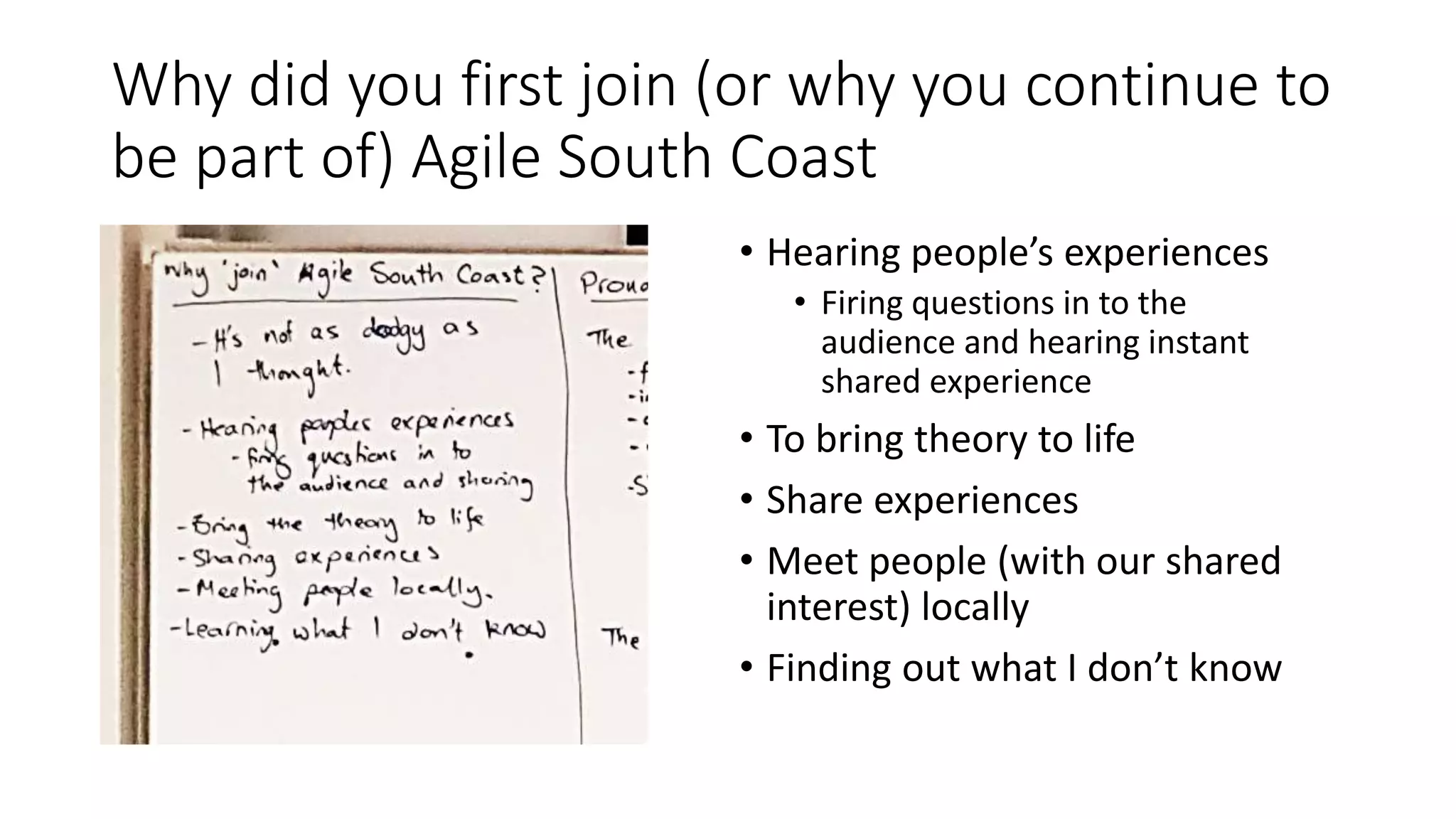
Why did you first join (or why you continue to
be part of) Agile South Coast
• Hearing people’s experiences
• Firing questions in to the
audience and hearing instant
shared experience
• To bring theory to life
• Share experiences
• Meet people (with our shared
interest) locally
• Finding out what I don’t know
Conversation 1: The Human Difference
(10 minutes, recommended 20!)
Tell specific stories of when you have
been most proud to be part of Agile
South Coast
(Write down reminder prompts for each story)
Human Difference: Reporting Out
• What stories have we told?
• Each group shares top 2 or 3 stories
• Choose the stories that give the most emotional responses
• 10 minutes (25-35 minutes recommended, allow longer if helpful)
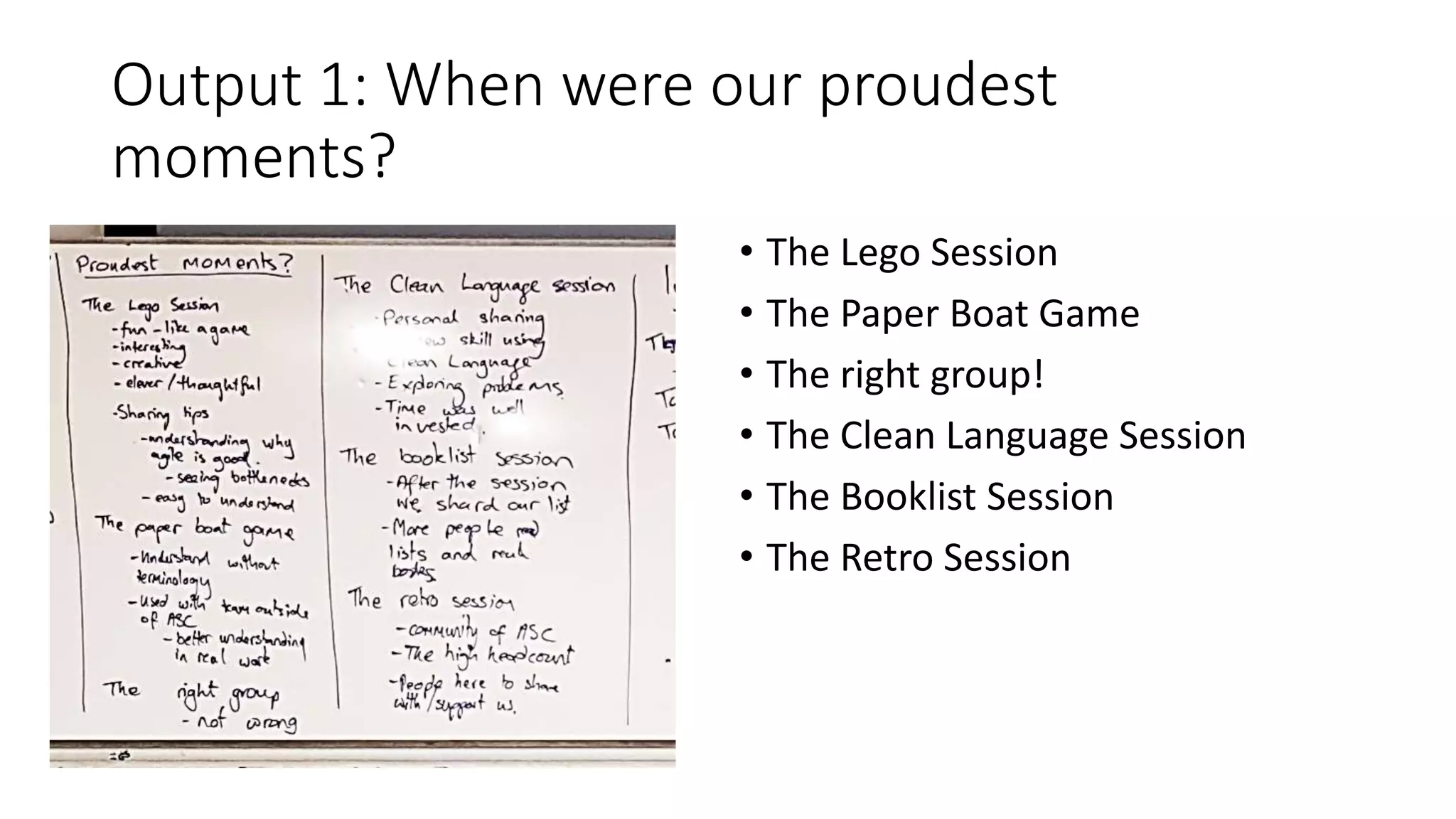
Output 1: When were our proudest
moments?
• The Lego Session
• The Paper Boat Game
• The right group!
• The Clean Language Session
• The Booklist Session
• The Retro Session
Conversation 2: What’s Our (Organisation’s)
Contribution
(5 minutes, 10 minutes recommended as enough)
In each of your stories, what was the
specific contribution that Agile South
Coast made to the life of [you and]
others?
• Note each contribution next to the related story
• Use a verb (action) phrase: “to <verb>”/”to <action>”
• At least 10, but no more than a page of contributions
Report out and consolidate
(10 minutes, 10-15 minutes recommended)
• What have we identified?
• Bring the impacts together on to a single page or board
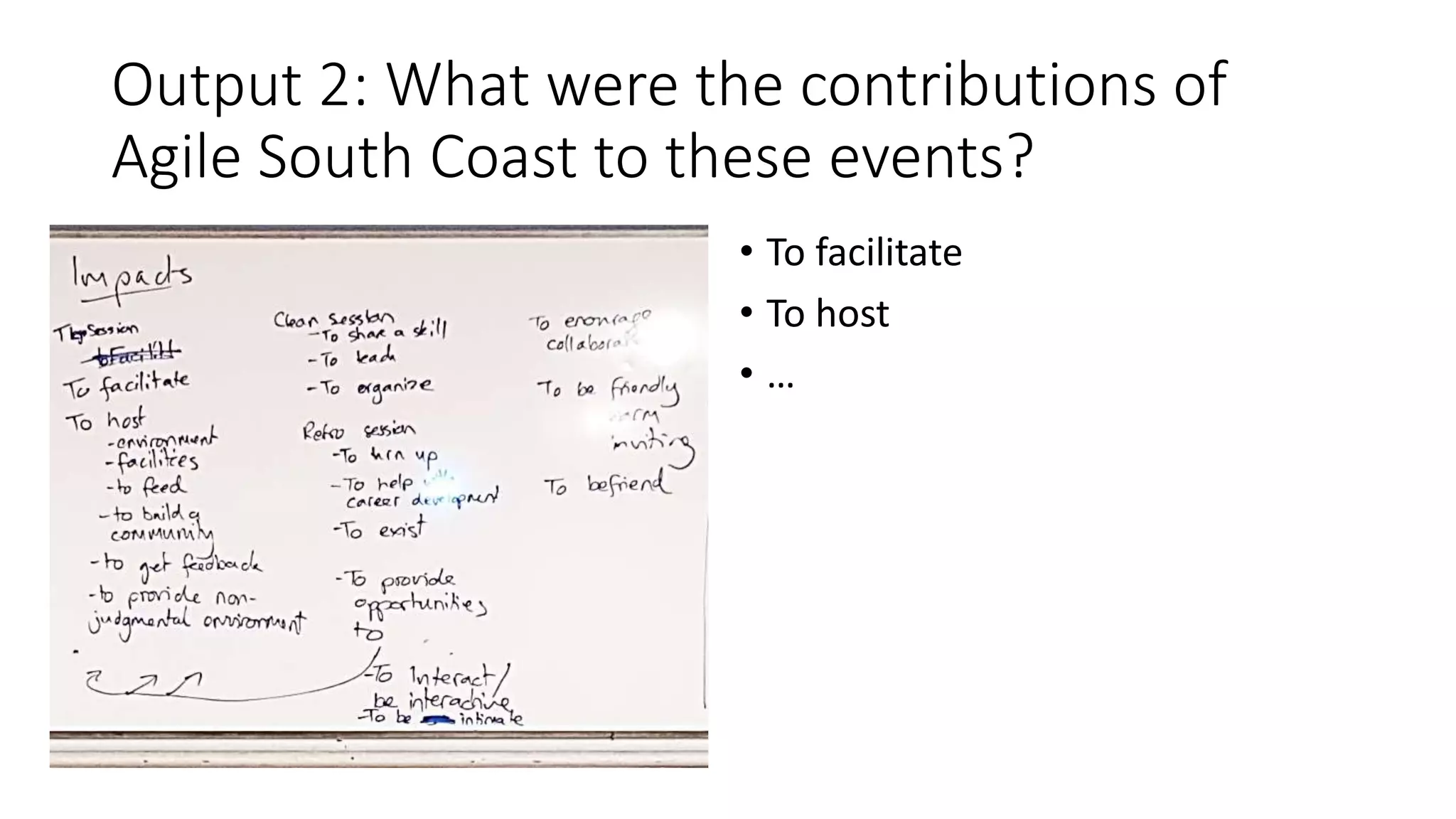
Output 2: What were the contributions of
Agile South Coast to these events?
• To facilitate
• To host
• …
Break Time
(0 minutes!, 15 minutes recommended)
• How are we doing?
• OK, we can have a short break ;)
Conversation 3: What’s Your Impact?
(10 minutes, 15 minutes recommended)
What did the contribution of Agile South
Coast allow other people to go on and
be?
How were people better after they experienced the best of Agile South
Coast?
Capturing Our Impact
• Report back
• 15 minutes (20-30 is recommended)
• Capture and summarise the impact of Agile South Coast
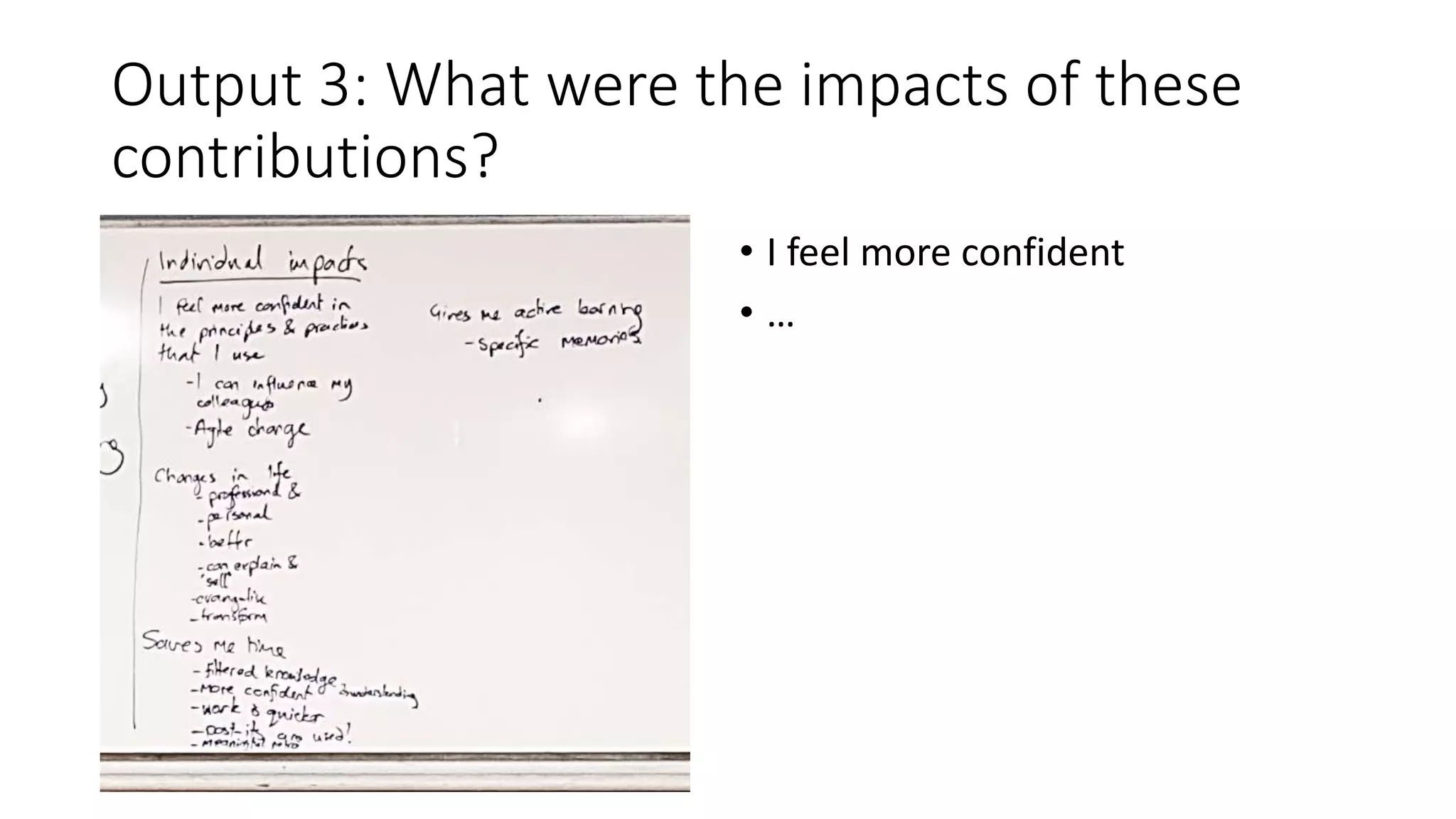
Output 3: What were the impacts of these
contributions?
• I feel more confident
• …
Propose Candidate Why Statements
• 15 Minutes (35-40 minutes recommended)
• To <do thing> so that <thing happens>
• This is simple!
• We already have a list of To phrases from Conversation 2
• We have a list of ideas for So that from Conversation 3
Consolidate Why Statements
• Share our favourite ideas
• Decide on one to take forward
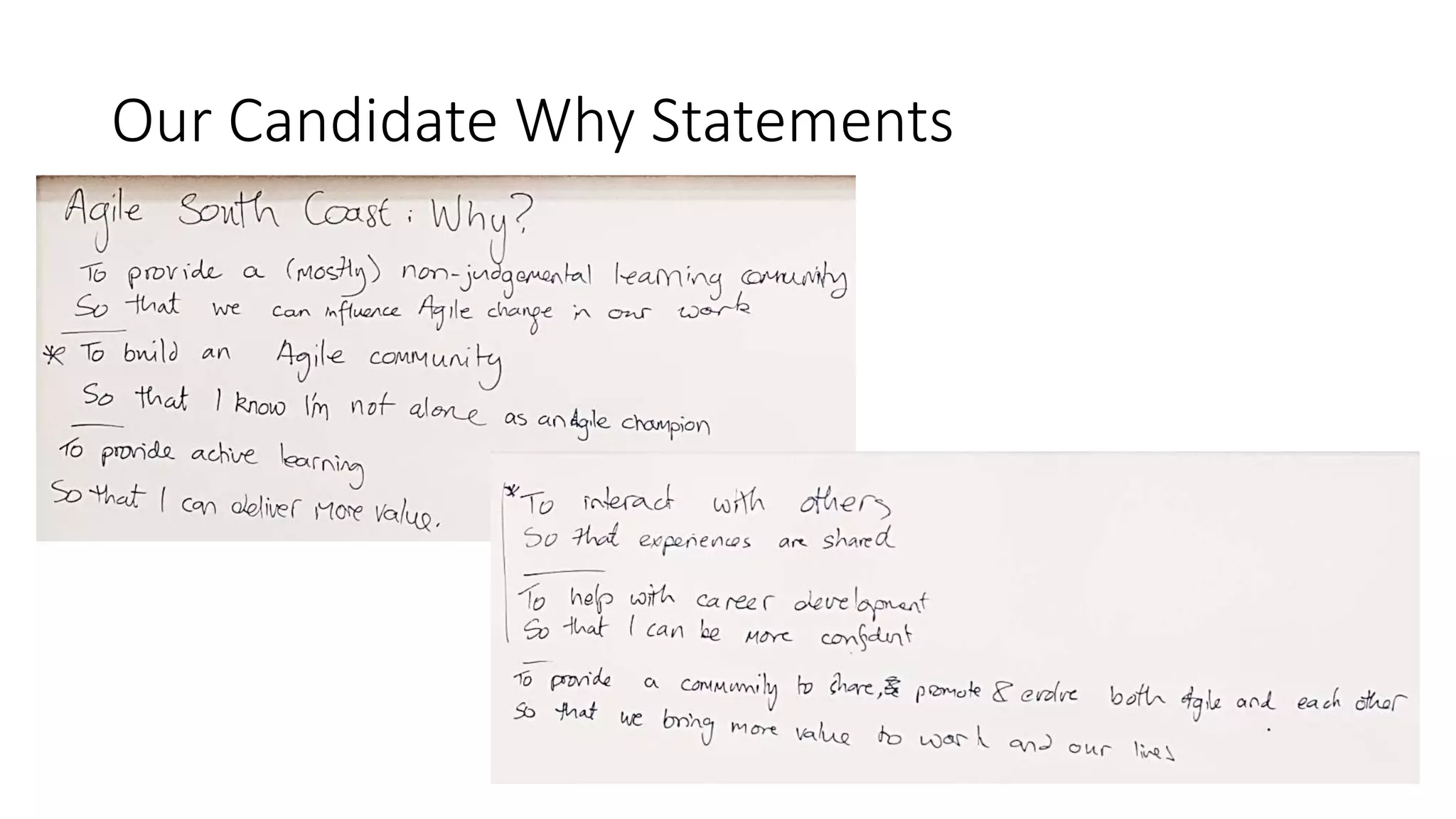
Our Candidate Why Statements
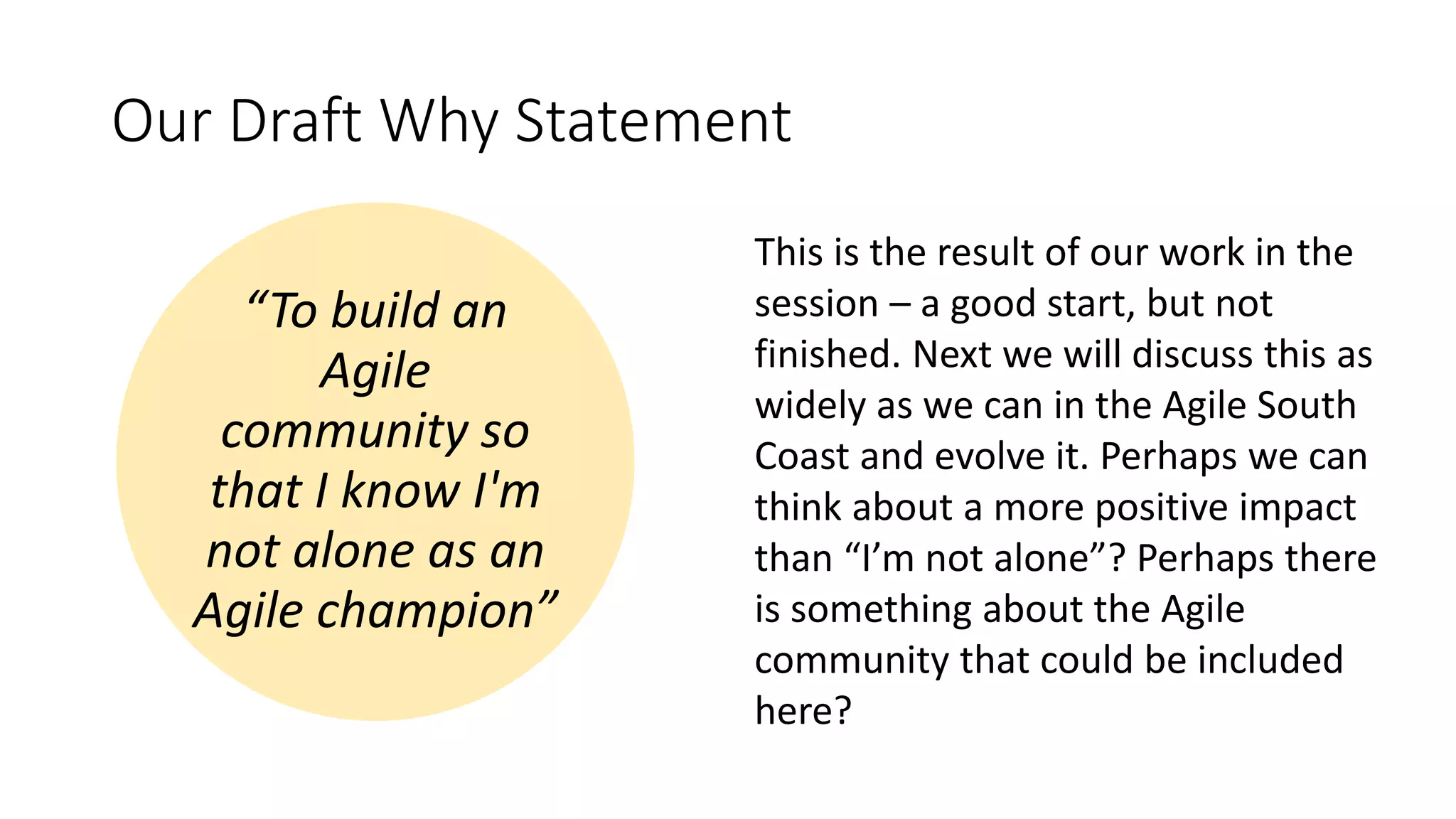
Our Draft Why Statement
“To build an
Agile
community so
that I know I'm
not alone as an
Agile champion”
This is the result of our work in the
session – a good start, but not
finished. Next we will discuss this as
widely as we can in the Agile South
Coast and evolve it. Perhaps we can
think about a more positive impact
than “I’m not alone”? Perhaps there
is something about the Agile
community that could be included
here?
So, is this useful?
• How has the session been for you?
• What was most interesting?
• What was least interesting or least understandable?
• What shall we do with our Draft Why Statement?
• Can you use this in your current work?
• 10 minutes
• Do you need to but can’t?
Get in touch!
I’m Steven Mackenzie, a freelance Lean Agile process coach based in Southampton, UK
• Email: slideshare-fyw@aptile.co.uk
• Twitter: @busywait
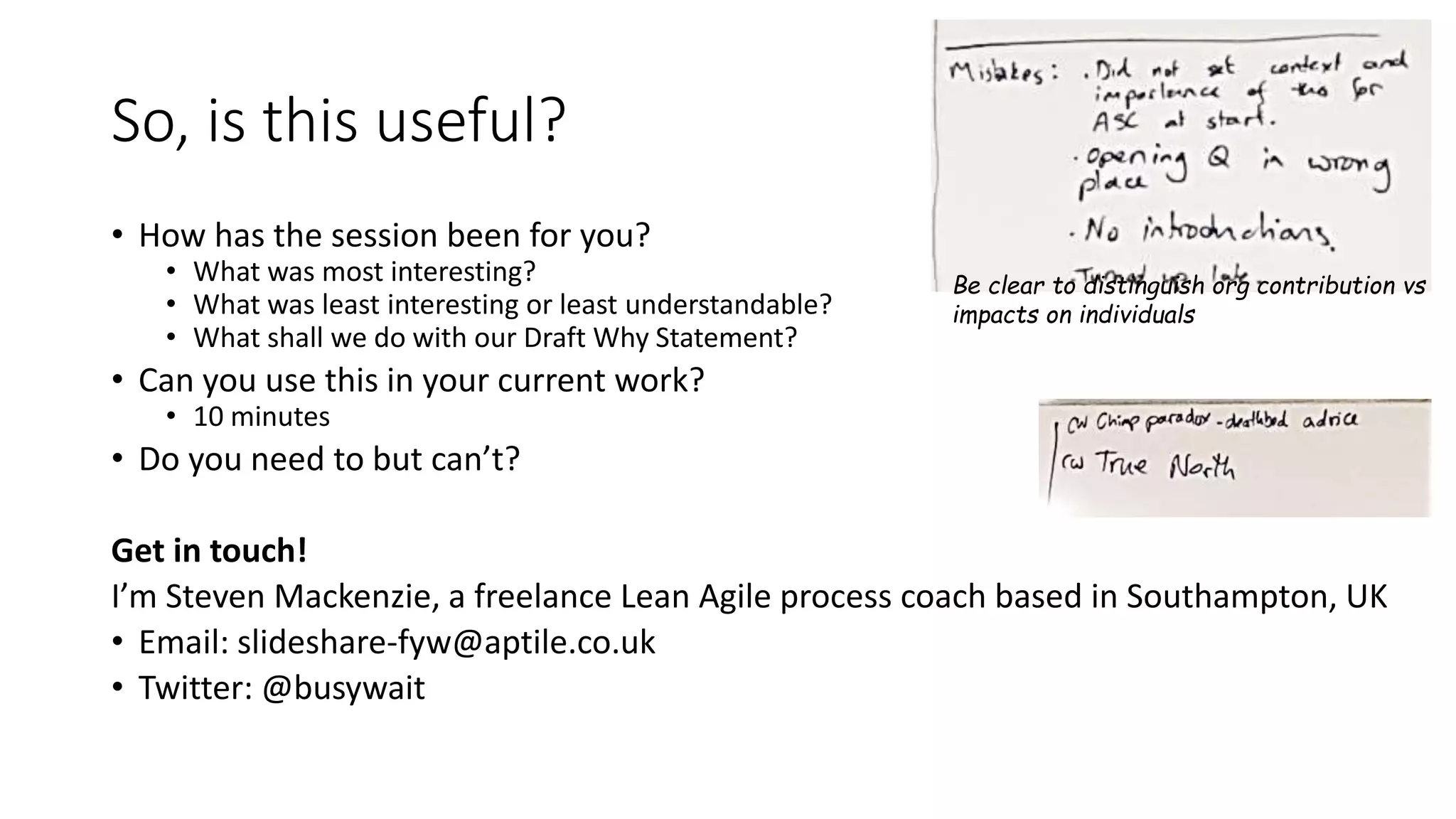
Be clear to distinguish org contribution vs
impacts on individuals
Facilitator tips
Did we follow this advice tonight?
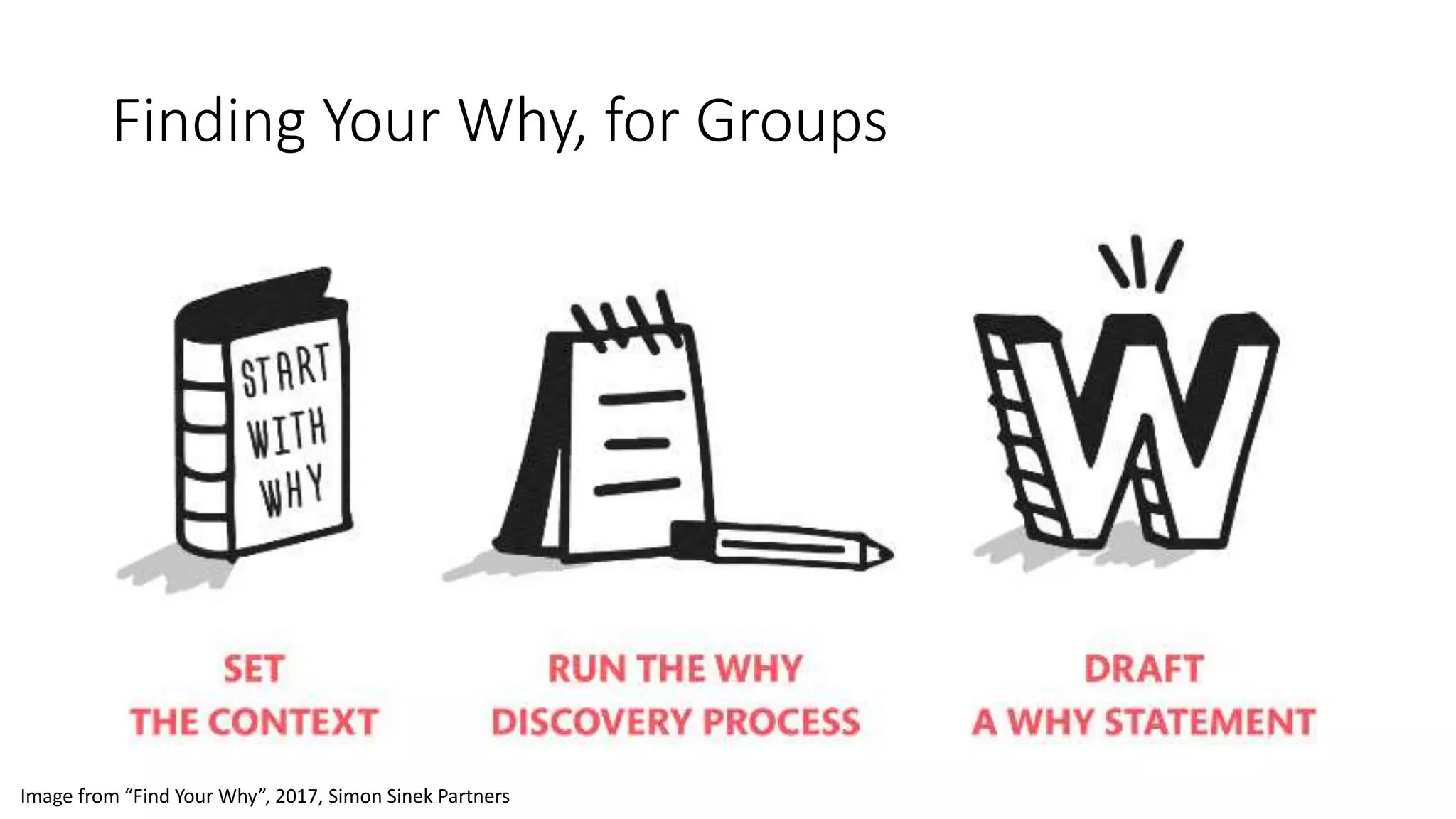
Finding Your Why, for Groups
Image from “Find Your Why”, 2017, Simon Sinek Partners
Find Your Why for Groups: Preparation
• A facilitator is required – objective with a little distance from the
group
• Manage time and logistics
• Listen actively and highlight connections
• Maintain a safe environment for contributions
• Choose someone who makes you feel comfortable (and check that
they feel comfortable!)
Find Your Why for Groups: Facilitator
Preparation
• Understand your scope – a whole organisation, or a sub-group that
serves an overall mission
• If you’re working in a sub-group start with the founder, leader, or for the
group that sits above you…
• unless you can’t!
• Talk to the leadership team to get an overview before the session
• Bring the right people together
• In the rare case that the Why discovery becomes a venting session, be
ready to advise that deeper issues need to be addressed first
Find Your Why for Groups: Facilitator Tips 1
• Practice – try out the individual Why Discovery process first
• Invites: who is important to attend and contribute?
• No fewer than 10, ideally 20-30, to discover a why that is a universal foundation
• A cross-section, not a sub-culture
• Long experience
• Some newcomers can be helpful for perspective
• Passion
• Location
• A space that inspires creativity, offers privacy, minimises distractions
• Expect to break people in to sub-groups, and allow the table and chairs to be
rearranged
Find Your Why for Groups: Facilitator Tips 2
• Allow (and insist on) enough time
• Tribe Why takes at least 4 hours, but 5 hours is better
• Although with experience you might be able to see a Why in only an hour, the
group will not feel that they own it or be inspired to bring it to life
• Set up
• A snacks and drinks table
• Furniture in a horse shoe
• Provide a way to capture ideas – flipscharts are ideal, and set them up with
other facilities that you need
• Consider the diversity that you will want in your sub-groups
• Try to cereate diverse sub-groups
Find Your Why for Groups: Facilitator Tips 3
• What out for (often senior) voices dominating
• Invite contributions from those that haven’t spoken if you sense this
happening
• Explore contributions from groups by asking for examples and detail
when it is helpful
• Manage the energy in the room, and plan (or add) breaks as needed
• Ensure that the work continues after the Why Discovery session
Get in touch!
I’m Steven Mackenzie, a freelance Lean Agile process coach based in
Southampton, UK
 Email: slideshare-fyw@aptile.co.uk
 Twitter: @busywait

Find Your Why For Groups - The Agile South Coast Tribe Why, Feb 2019

  • 1.
    Workshop: Find Your Why(for organisations) Based on Simon Sinek’s books Start With Why and Find Your Why Steven Mackenzie, freelance Lean Agile process coach Agile South Coast February 26 2019 slideshare-fyw@aptile.co.uk Twitter: @busywait
  • 2.
    What we’re doingtoday • Finding Your Why, for Groups: “A Tribe Why” • Overview • Practice – building a why statement for Agile South Coast • Review our Why statements • How is this going to be useful to us? • Review of the process and tips • How did we do?
  • 3.
    Sources • Start WithWhy • TED Talk by Simon Sinek, 2009: https://www.youtube.com/watch?v=u4ZoJKF_VuA • Book by Simon Sinek; 2011 • Find Your Why – A Practical Guide for Discovering Purpose for You and Your Team • Peter Docker, David Mead, Simon Sinek; 2017
  • 4.
    Steps for findingour why • Share stories • Specific stories, not general • Emotional, impactful memories • Identify themes • Look for insights and themes that run through all of the stories • Which are most important? Look for one or two • Draft a why statement (one sentence) • To … • So that … • Test and refine • Socialise and evolve the Why with other people It helps to have a facilitator to add perspective, and avoid assumptions. Image from “Find Your Why”, 2017, Simon Sinek Partners
  • 5.
    Finding your why,for groups We’ll work through the whole process, following the group Why Discovery format • It’s pretty simple! • Our group is Agile South Coast • Our 2½ hour session is not long enough, 4 to 5 hours is recommended
  • 6.
    The Agenda fora group Why Discovery (with suggested times for a “real” session) • Set the context – a senior leader (40 minutes) • Ensure that we all understand that this is important work • Helps to let you in to the group, with trust and attention • What is a Why, with examples (10 minutes) • Share examples from other contexts for individuals or for groups • Conversations in pairs (10 minutes, 2-3 minutes each) • Thinking back to the time that you joined the organization, what inspired you the most? • Share back if there are interesting stories • Introduce the Golden Circle • Use Simons Video? https://bitly.com/GoldenCircleTalk, http://bit.ly/FYWresources • Or a shorter version ;) • Overview of the day – including breaks! • Conversations in groups of 5-7: Story Sharing (2 hours) • Specific stories that reveal both the contribution the organization makes to others • The impact of that contribution over time • Drafting the Why Statement (30 minutes) • The *first* draft – 75% complete, actionable
  • 7.
    We are AgileSouth Coast This session will be useful as we look for ways to accommodate and serve our growing membership Our Why Statement will guide our current and future teams of organizers The Why Statement will appear on our Meetup group page to help inform current and potential new members and speakers
  • 8.
    More about Why:over to our co-presenter, Simon Sinek… Why some people or organisations can inspire when others can’t. Sinek, Start With Why (5 minute edit) https://www.youtube.com/watch?v=IPYeCltXpxw&t=16s
  • 9.
    “The worlds simplestidea”, Simon Sinek’s Golden Circle: Sinek, Start With Why, https://www.youtube.com/watch?v=u4ZoJKF_VuA “People don’t by what you do, they buy why you do it.” But we usually talk about or explain from the outside in, because the outside is the clearest to us and the easiest to talk about. Image from “Find Your Why”, 2017, Simon Sinek Partners
  • 10.
    It’s biology (notpsychology) Our brains are built in 3 layers – the decision maker is the limbic brain “When we can explain our purpose, cause and beliefs then we can talk directly to the decision making part of the brain” The limbic brain doesn’t do language! Sinek, Start With Why, https://www.youtube.com/watch?v=u4ZoJKF_VuAImage from “Find Your Why”, 2017, Simon Sinek Partners
  • 11.
    Opening Question tothe Group (with each other, in pairs or threes) What was it about Agile South Coast that excited you to join, and to keep on coming back?
  • 12.
    Why did youfirst join (or why you continue to be part of) Agile South Coast • Hearing people’s experiences • Firing questions in to the audience and hearing instant shared experience • To bring theory to life • Share experiences • Meet people (with our shared interest) locally • Finding out what I don’t know
  • 13.
    Conversation 1: TheHuman Difference (10 minutes, recommended 20!) Tell specific stories of when you have been most proud to be part of Agile South Coast (Write down reminder prompts for each story)
  • 14.
    Human Difference: ReportingOut • What stories have we told? • Each group shares top 2 or 3 stories • Choose the stories that give the most emotional responses • 10 minutes (25-35 minutes recommended, allow longer if helpful)
  • 15.
    Output 1: Whenwere our proudest moments? • The Lego Session • The Paper Boat Game • The right group! • The Clean Language Session • The Booklist Session • The Retro Session
  • 16.
    Conversation 2: What’sOur (Organisation’s) Contribution (5 minutes, 10 minutes recommended as enough) In each of your stories, what was the specific contribution that Agile South Coast made to the life of [you and] others? • Note each contribution next to the related story • Use a verb (action) phrase: “to <verb>”/”to <action>” • At least 10, but no more than a page of contributions
  • 17.
    Report out andconsolidate (10 minutes, 10-15 minutes recommended) • What have we identified? • Bring the impacts together on to a single page or board
  • 18.
    Output 2: Whatwere the contributions of Agile South Coast to these events? • To facilitate • To host • …
  • 19.
    Break Time (0 minutes!,15 minutes recommended) • How are we doing? • OK, we can have a short break ;)
  • 20.
    Conversation 3: What’sYour Impact? (10 minutes, 15 minutes recommended) What did the contribution of Agile South Coast allow other people to go on and be? How were people better after they experienced the best of Agile South Coast?
  • 21.
    Capturing Our Impact •Report back • 15 minutes (20-30 is recommended) • Capture and summarise the impact of Agile South Coast
  • 22.
    Output 3: Whatwere the impacts of these contributions? • I feel more confident • …
  • 23.
    Propose Candidate WhyStatements • 15 Minutes (35-40 minutes recommended) • To <do thing> so that <thing happens> • This is simple! • We already have a list of To phrases from Conversation 2 • We have a list of ideas for So that from Conversation 3
  • 24.
    Consolidate Why Statements •Share our favourite ideas • Decide on one to take forward
  • 25.
  • 26.
    Our Draft WhyStatement “To build an Agile community so that I know I'm not alone as an Agile champion” This is the result of our work in the session – a good start, but not finished. Next we will discuss this as widely as we can in the Agile South Coast and evolve it. Perhaps we can think about a more positive impact than “I’m not alone”? Perhaps there is something about the Agile community that could be included here?
  • 27.
    So, is thisuseful? • How has the session been for you? • What was most interesting? • What was least interesting or least understandable? • What shall we do with our Draft Why Statement? • Can you use this in your current work? • 10 minutes • Do you need to but can’t? Get in touch! I’m Steven Mackenzie, a freelance Lean Agile process coach based in Southampton, UK • Email: slideshare-fyw@aptile.co.uk • Twitter: @busywait Be clear to distinguish org contribution vs impacts on individuals
  • 28.
    Facilitator tips Did wefollow this advice tonight?
  • 29.
    Finding Your Why,for Groups Image from “Find Your Why”, 2017, Simon Sinek Partners
  • 30.
    Find Your Whyfor Groups: Preparation • A facilitator is required – objective with a little distance from the group • Manage time and logistics • Listen actively and highlight connections • Maintain a safe environment for contributions • Choose someone who makes you feel comfortable (and check that they feel comfortable!)
  • 31.
    Find Your Whyfor Groups: Facilitator Preparation • Understand your scope – a whole organisation, or a sub-group that serves an overall mission • If you’re working in a sub-group start with the founder, leader, or for the group that sits above you… • unless you can’t! • Talk to the leadership team to get an overview before the session • Bring the right people together • In the rare case that the Why discovery becomes a venting session, be ready to advise that deeper issues need to be addressed first
  • 32.
    Find Your Whyfor Groups: Facilitator Tips 1 • Practice – try out the individual Why Discovery process first • Invites: who is important to attend and contribute? • No fewer than 10, ideally 20-30, to discover a why that is a universal foundation • A cross-section, not a sub-culture • Long experience • Some newcomers can be helpful for perspective • Passion • Location • A space that inspires creativity, offers privacy, minimises distractions • Expect to break people in to sub-groups, and allow the table and chairs to be rearranged
  • 33.
    Find Your Whyfor Groups: Facilitator Tips 2 • Allow (and insist on) enough time • Tribe Why takes at least 4 hours, but 5 hours is better • Although with experience you might be able to see a Why in only an hour, the group will not feel that they own it or be inspired to bring it to life • Set up • A snacks and drinks table • Furniture in a horse shoe • Provide a way to capture ideas – flipscharts are ideal, and set them up with other facilities that you need • Consider the diversity that you will want in your sub-groups • Try to cereate diverse sub-groups
  • 34.
    Find Your Whyfor Groups: Facilitator Tips 3 • What out for (often senior) voices dominating • Invite contributions from those that haven’t spoken if you sense this happening • Explore contributions from groups by asking for examples and detail when it is helpful • Manage the energy in the room, and plan (or add) breaks as needed • Ensure that the work continues after the Why Discovery session
  • 35.
    Get in touch! I’mSteven Mackenzie, a freelance Lean Agile process coach based in Southampton, UK  Email: slideshare-fyw@aptile.co.uk  Twitter: @busywait

Editor's Notes

  • #5 The Why Statement is essentially an origin story, solid by our late teens The first blank is your contribution, the second is the impact. Eg: to inspire people to do the things that inspire them so that together we can change the world To help our customers understand the information that they hold so that their customers can trust them. Eg: To shine a light on what’s possible so that together we can change the world To propel people forward so that they can make their mark on the world
  • #6 Partly our intention in this workshop is for us to experience the format and get some confidence before we run it ourselves
  • #7 In our try-out we’re compressing the format This format is for a group, the Find Your Why book describes a separate processes to explore your “Why” as an individual.
  • #8 It’s helpful to Agile South Coast to have a statement of why we exist. We’ve got over 600 members now, and the leadership team and venues change over time. What is it that makes Agile South Coast a meetup worth our time to participate and organize? What is our core purpose that we should preserve as we grow?
  • #9 We all know what we do – perhaps most of us Many of us know how we do what we do – do you? The inspired leaders know why they do what they do [Talk about why this would be helpful in our work at the end of this session]
  • #10 We all know what we do – perhaps most of us Many of us know how we do what we do – do you? The inspired leaders know why they do what they do
  • #11 We all know what we do – perhaps most of us Many of us know how we do what we do – do you? The inspired leaders know why they do what they do
  • #12 Consider mixing up the pairs as people tend to sit next to people they feel comfortable Share back what you’re comfortable sharing
  • #14 Watch out for single voices dominating and invite conversations from others if this happens Keep the groups on track Record phrases that will remind people of each story on flip charts Be specific – no need to drill in to consequences, that’s our next conversation
  • #15 Facilitator: look for places where we can dig for details, and ask for examples; ask what rather than why. No need to drill in to consequences, that’s our next conversation.
  • #17 Using verbs helps us to make an actionable Why Not what we hope for but what we see now Directly linked to the stories Try completing the phrase – “In this story, we showed up and we …ed” Eg, engage, build, connect, bring together, enjoy life, … Slightly confused for Agile South Coast as we could be the organizers/presenters or the customers/audience
  • #18 Where similar themes are identified ask the teams if there is a consolidated phrase that can be used?
  • #19 Whoops! I put the wrong title on to the whiteboard while capturing this output. I wrote Impacts, it should say Contributions.
  • #20 Be aware of the energy in the room, break when needed
  • #21 Think about specific people and what people did or became Contributors are reinforcing their connection to the organization through this exercise Slightly confused for Agile South Coast as we could be the organizers/presenters or the customers/audience
  • #22 Facilitator listens and actively summarises People seeing possibility, …
  • #26 Why did you join Agile South Coast? What’s your proudest moment? What was the organization’s contribution? What was the impact?
  • #29 Feedback included that there was confusion between the contribution of the organization (Agile South Coast), and the impact on the people due to these contribution. Facilitation should make this clearer. The Why Statement will be used as context for the next Agile South Coast session We didn’t have enough time to talk about this – more feedback gratefully received!
  • #31 Eg: to inspire people to do the things that inspire them so that together we can change the world To help our customers understand the information that they hold so that their customers can trust them. Eg: To shine a light on what’s possible so that together we can change the world To propel people forward so that they can make their mark on the world
  • #33 The facilitator runs the process rather than being part of it It’s about who we are, not want to be some day
  • #34 You might become the tail that wags the dog – good thing? See C7 of Start With Why. The facilitator runs the process rather than being part of it