
Presented by –
Bhagya L. B. narzary
Padum Chetry
Pranjit Sarma
Arunav Bharbwaj
DEFINATION
• Sociologists Martin Albrow and Elizabeth King define globalization as
"all those processes by which the people of the world are
incorporated into a single world society”.
• In The Consequences of Modernity, Anthony Giddens writes:
"Globalization can thus be defined as the intensification of worldwide
social relations which link distant localities in such a way that local
happenings are shaped by events occurring many miles away and vice
versa.
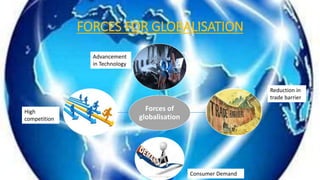
FORCES FOR GLOBALISATION
Forces of
globalisation
Consumer Demand
Reduction in
trade barrier
Advancement
in Technology
High
competition
DIMENSION OF GLOBALISATION
GLOBALIZATION AND INTERNATIONAL
TRADE
Sources of Globalization
• For reducing international trade restrictions in goods and
services and barriers in FDI
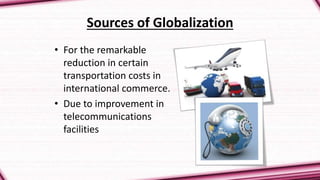
Sources of Globalization
• For the remarkable
reduction in certain
transportation costs in
international commerce.
• Due to improvement in
telecommunications
facilities
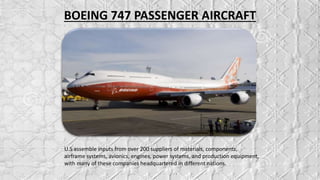
BOEING 747 PASSENGER AIRCRAFT
U.S assemble inputs from over 200 suppliers of materials, components,
airframe systems, avionics, engines, power systems, and production equipment,
with many of these companies headquartered in different nations.
Channels of Globalization
• International trade in goods and services
• Portfolio capital flows
– Instruments are traded or tradable.
– Equity securities is define to the
instruments and records acknowledging,
after the claims of all creditors have been
met, claims to the residual values of
incorporated enterprises (shares, stocks,
participation, American deposit receipts
(ADRs), mutual funds, and investment
trusts).
– Debt securities include bonds and notes,
money market securities (instruments such
as treasury bills, commercial and finance
paper, negotiable certificates of deposit
with maturities of one year or less), and
financial derivatives or secondary
instruments, such as options.
Channels of Globalization
• FDI (Foreign Direct
investments)
– A subsidiary
– An associate
– A branch
• Contract for technology
– License Agreement
– Know-how agreement.
Effects of Globalization
• benefited the nation in
terms of generating
national output
• helps to expand the size
of markets
• inefficient domestic
monopolies
FUTURE OF GLOBALIZATION
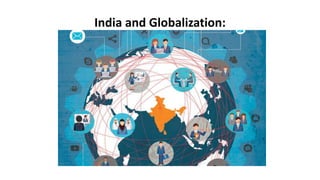
India and Globalization:
Measures
• Openness to trade and a country‘s participation in trade.
• Participation in international capital flows particularly (Foreign
Direct Investment) FDI.
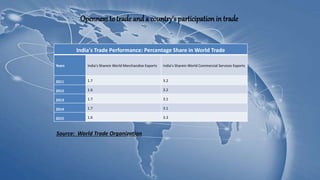
Opennessto trade and a country‘s participation in trade
India's Trade Performance: Percentage Share in World Trade
Years India's Sharein World Merchandise Exports India's Sharein World Commercial Services Exports
2011 1.7 3.2
2012 1.6 3.2
2013 1.7 3.1
2014 1.7 3.1
2015 1.6 3.3
Source: World Trade Organization
Participation in international capital flows
• The annual flow of FDI across the world is more than $ 1 trillion
• The annual FDI inflow into India is $ 44 billion
• Where China has 134 billion and US is having 391 billion.
(Source:UNCTAD, FDI/MNE database)
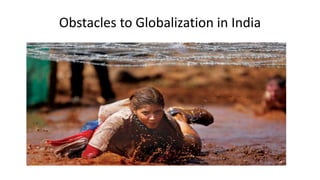
Obstacles to Globalization in India
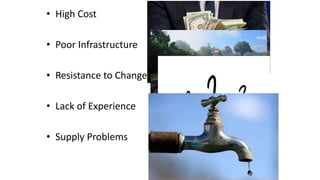
• High Cost
• Poor Infrastructure
• Resistance to Change
• Lack of Experience
• Supply Problems
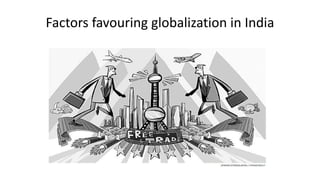
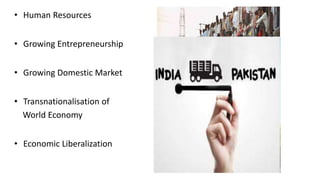
Factors favouring globalization in India
• Human Resources
• Growing Entrepreneurship
• Growing Domestic Market
• Transnationalisation of
World Economy
• Economic Liberalization
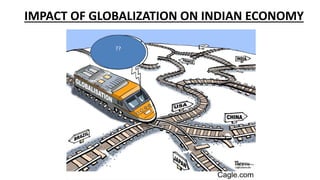
IMPACT OF GLOBALIZATION ON INDIAN ECONOMY
??
Why reforms were needed?
• change the mindset of people embracing the tradition values such
as self-reliance and socialistic policies of economic development.
• This kind of mindset and self-reliance policy of a country makes it
difficult to compete in the global race.
• To make Indian economy as fastest growing and globally
competitive economy
• the LPG policy was adopted
• It had a mammoth impact on the overall economic development of
almost all major sectors of the economy
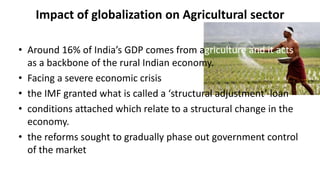
Impact of globalization on Agricultural sector
• Around 16% of India’s GDP comes from agriculture and it acts
as a backbone of the rural Indian economy.
• Facing a severe economic crisis
• the IMF granted what is called a ‘structural adjustment’ loan
• conditions attached which relate to a structural change in the
economy.
• the reforms sought to gradually phase out government control
of the market
Impact of Globalization on Industrial Sector
• that many foreign companies set up industries in India,
especially in the pharmaceutical, petroleum, manufacturing,
and chemical sectors
• this helped to reduce the problem of unemployment in the
country as well as the problem of poverty
• the foreign companies brought in highly advanced technology
with them and this helped to make the Indian Industry more
technologically advanced.
Impact on Financial Sector:
• economic liberalization measures have opened the door to
foreign competitors to enter into our domestic market.
• Innovation became a must for survival as it has increased the
competition to a high level.
• Financial intermediaries have come out of their traditional
approach and they are ready to assume more credit risks.
• transformed the financial services sector from being a
conservative industry to a very dynamic one.
Impact on Export and Import:
• Many Indian companies have started becoming respectable players
in the International scene.
• Agriculture exports account for about 13 to 18% of total annual of
annual export of the country.
• Marine products in recent years have emerged as the single largest
contributor to the total agricultural export from the country
accounting for over one fifth of the total agricultural exports
• Cereals (mostly basmati rice and non-basmati rice), oil seeds, tea
and coffee are the other prominent products each of which
accounts fro nearly 5 to 10% of the countries total agricultural
exports
Advantages of Globalization
• consumers there is a wider range of products to choose from.
• Increase in flow of investments from developed countries to
developing countries
• Greater and faster flow of information between countries and
greater cultural interaction has helped to overcome cultural
barriers
Thank You

Globalisation

  • 1.
    Presented by – BhagyaL. B. narzary Padum Chetry Pranjit Sarma Arunav Bharbwaj
  • 2.
    DEFINATION • Sociologists MartinAlbrow and Elizabeth King define globalization as "all those processes by which the people of the world are incorporated into a single world society”. • In The Consequences of Modernity, Anthony Giddens writes: "Globalization can thus be defined as the intensification of worldwide social relations which link distant localities in such a way that local happenings are shaped by events occurring many miles away and vice versa.
  • 3.
    FORCES FOR GLOBALISATION Forcesof globalisation Consumer Demand Reduction in trade barrier Advancement in Technology High competition
  • 4.
  • 6.
  • 7.
    Sources of Globalization •For reducing international trade restrictions in goods and services and barriers in FDI
  • 8.
    Sources of Globalization •For the remarkable reduction in certain transportation costs in international commerce. • Due to improvement in telecommunications facilities
  • 9.
    BOEING 747 PASSENGERAIRCRAFT U.S assemble inputs from over 200 suppliers of materials, components, airframe systems, avionics, engines, power systems, and production equipment, with many of these companies headquartered in different nations.
  • 10.
    Channels of Globalization •International trade in goods and services • Portfolio capital flows – Instruments are traded or tradable. – Equity securities is define to the instruments and records acknowledging, after the claims of all creditors have been met, claims to the residual values of incorporated enterprises (shares, stocks, participation, American deposit receipts (ADRs), mutual funds, and investment trusts). – Debt securities include bonds and notes, money market securities (instruments such as treasury bills, commercial and finance paper, negotiable certificates of deposit with maturities of one year or less), and financial derivatives or secondary instruments, such as options.
  • 11.
    Channels of Globalization •FDI (Foreign Direct investments) – A subsidiary – An associate – A branch • Contract for technology – License Agreement – Know-how agreement.
  • 12.
    Effects of Globalization •benefited the nation in terms of generating national output • helps to expand the size of markets • inefficient domestic monopolies
  • 13.
  • 15.
  • 16.
    Measures • Openness totrade and a country‘s participation in trade. • Participation in international capital flows particularly (Foreign Direct Investment) FDI.
  • 17.
    Opennessto trade anda country‘s participation in trade India's Trade Performance: Percentage Share in World Trade Years India's Sharein World Merchandise Exports India's Sharein World Commercial Services Exports 2011 1.7 3.2 2012 1.6 3.2 2013 1.7 3.1 2014 1.7 3.1 2015 1.6 3.3 Source: World Trade Organization
  • 18.
    Participation in internationalcapital flows • The annual flow of FDI across the world is more than $ 1 trillion • The annual FDI inflow into India is $ 44 billion • Where China has 134 billion and US is having 391 billion. (Source:UNCTAD, FDI/MNE database)
  • 19.
  • 20.
    • High Cost •Poor Infrastructure • Resistance to Change • Lack of Experience • Supply Problems
  • 21.
  • 22.
    • Human Resources •Growing Entrepreneurship • Growing Domestic Market • Transnationalisation of World Economy • Economic Liberalization
  • 23.
    IMPACT OF GLOBALIZATIONON INDIAN ECONOMY ??
  • 24.
    Why reforms wereneeded? • change the mindset of people embracing the tradition values such as self-reliance and socialistic policies of economic development. • This kind of mindset and self-reliance policy of a country makes it difficult to compete in the global race. • To make Indian economy as fastest growing and globally competitive economy • the LPG policy was adopted • It had a mammoth impact on the overall economic development of almost all major sectors of the economy
  • 25.
    Impact of globalizationon Agricultural sector • Around 16% of India’s GDP comes from agriculture and it acts as a backbone of the rural Indian economy. • Facing a severe economic crisis • the IMF granted what is called a ‘structural adjustment’ loan • conditions attached which relate to a structural change in the economy. • the reforms sought to gradually phase out government control of the market
  • 26.
    Impact of Globalizationon Industrial Sector • that many foreign companies set up industries in India, especially in the pharmaceutical, petroleum, manufacturing, and chemical sectors • this helped to reduce the problem of unemployment in the country as well as the problem of poverty • the foreign companies brought in highly advanced technology with them and this helped to make the Indian Industry more technologically advanced.
  • 27.
    Impact on FinancialSector: • economic liberalization measures have opened the door to foreign competitors to enter into our domestic market. • Innovation became a must for survival as it has increased the competition to a high level. • Financial intermediaries have come out of their traditional approach and they are ready to assume more credit risks. • transformed the financial services sector from being a conservative industry to a very dynamic one.
  • 28.
    Impact on Exportand Import: • Many Indian companies have started becoming respectable players in the International scene. • Agriculture exports account for about 13 to 18% of total annual of annual export of the country. • Marine products in recent years have emerged as the single largest contributor to the total agricultural export from the country accounting for over one fifth of the total agricultural exports • Cereals (mostly basmati rice and non-basmati rice), oil seeds, tea and coffee are the other prominent products each of which accounts fro nearly 5 to 10% of the countries total agricultural exports
  • 29.
    Advantages of Globalization •consumers there is a wider range of products to choose from. • Increase in flow of investments from developed countries to developing countries • Greater and faster flow of information between countries and greater cultural interaction has helped to overcome cultural barriers
  • 30.