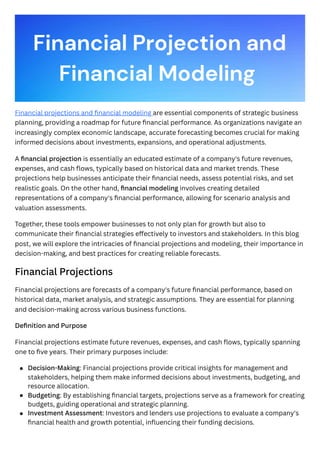
Financial projections and financial modeling are essential components of strategic business
planning, providing a roadmap for future financial performance. As organizations navigate an
increasingly complex economic landscape, accurate forecasting becomes crucial for making
informed decisions about investments, expansions, and operational adjustments.
A financial projection is essentially an educated estimate of a company's future revenues,
expenses, and cash flows, typically based on historical data and market trends. These
projections help businesses anticipate their financial needs, assess potential risks, and set
realistic goals. On the other hand, financial modeling involves creating detailed
representations of a company's financial performance, allowing for scenario analysis and
valuation assessments.
Together, these tools empower businesses to not only plan for growth but also to
communicate their financial strategies effectively to investors and stakeholders. In this blog
post, we will explore the intricacies of financial projections and modeling, their importance in
decision-making, and best practices for creating reliable forecasts.
Financial Projections
Financial projections are forecasts of a company's future financial performance, based on
historical data, market analysis, and strategic assumptions. They are essential for planning
and decision-making across various business functions.
Definition and Purpose
Financial projections estimate future revenues, expenses, and cash flows, typically spanning
one to five years. Their primary purposes include:
Financial Projection and
Financial Modeling
Decision-Making: Financial projections provide critical insights for management and
stakeholders, helping them make informed decisions about investments, budgeting, and
resource allocation.
Budgeting: By establishing financial targets, projections serve as a framework for creating
budgets, guiding operational and strategic planning.
Investment Assessment: Investors and lenders use projections to evaluate a company's
financial health and growth potential, influencing their funding decisions.
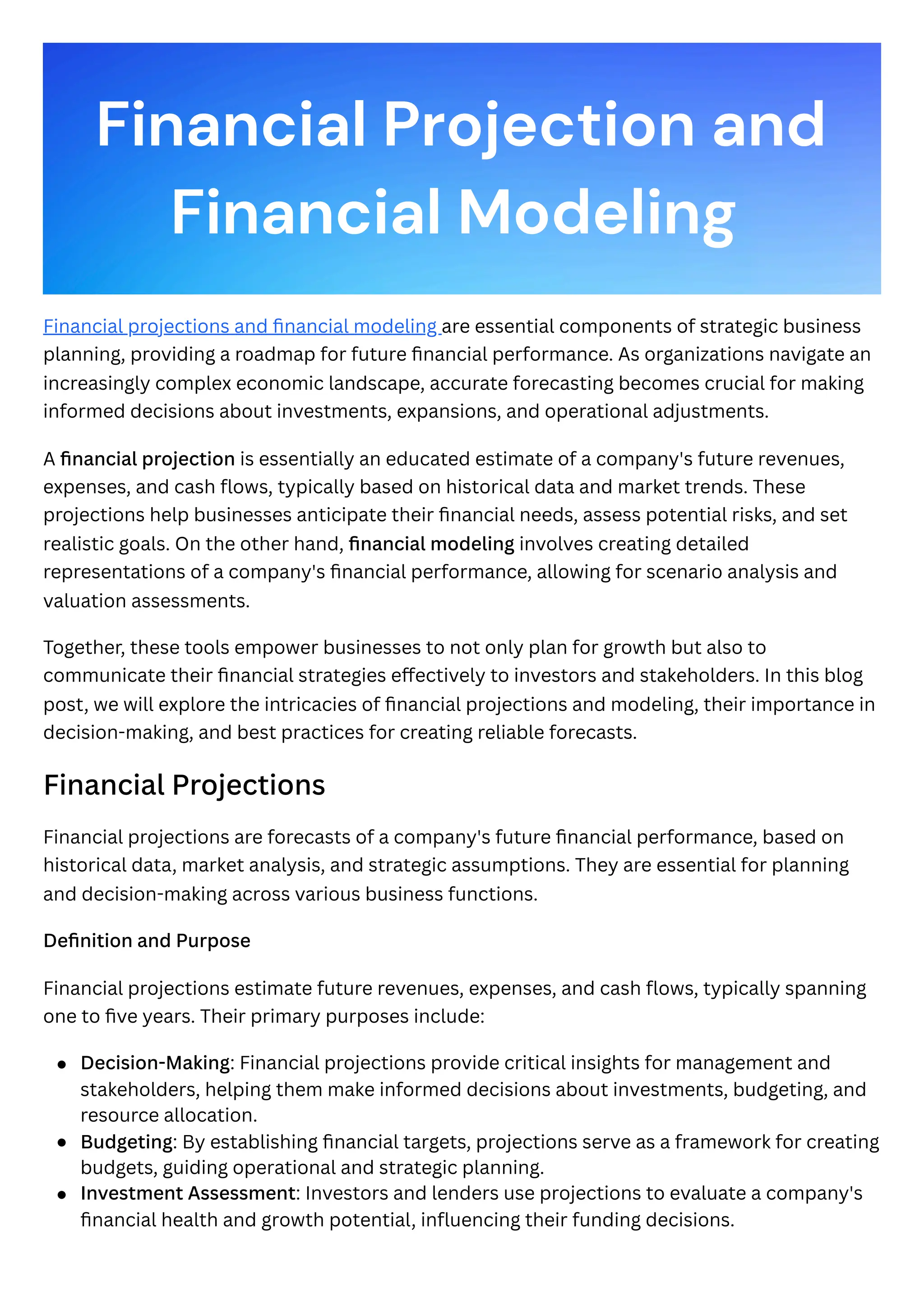
Types of Financial Projections
Financial projections can be categorized into several types:
Preparation Process
Creating financial projections involves a systematic approach:
Importance of Financial Projections
Financial projections play a crucial role in several areas:
Financial Modeling
Financial modeling is a sophisticated process that involves creating a mathematical
representation of a company's financial performance. This model is typically built in a
spreadsheet and allows for dynamic analysis of various financial scenarios.
Prospective Financial Statements: These comprehensive forecasts include projected
income statements, balance sheets, and cash flow statements, reflecting anticipated
financial performance.
Partial Presentations: Focused on specific areas, such as revenue growth or cost
management, these projections provide insights without encompassing the entire
financial picture.
Financial Forecasts: Short-term estimates, often covering a year or less, focus on
immediate capital requirements and operational needs.
Hypothetical Financial Assumptions: These projections are based on specific scenarios
or assumptions, allowing businesses to explore potential outcomes under varying
conditions.
1. Data Collection: Gather historical financial data, including past income statements,
balance sheets, and cash flow statements, to establish a baseline for projections.
2. Assumption Development: Make informed assumptions regarding market conditions,
growth rates, inflation, and operational changes based on historical data and market
research.
3. Model Creation: Develop a financial model that incorporates the collected data and
assumptions, allowing for the projection of future performance.
4. Review and Adjust: Regularly review and update projections based on actual
performance, market changes, and new information to ensure accuracy and relevance.
Identifying Growth Opportunities: They help businesses identify potential areas for
expansion, investment, and new market opportunities, guiding strategic decisions.
Risk Management: By forecasting different scenarios, businesses can prepare for
potential financial challenges, enabling proactive risk mitigation strategies.
Enhancing Credibility: Well-prepared projections enhance a company's credibility with
investors and creditors, facilitating easier access to funding and support.
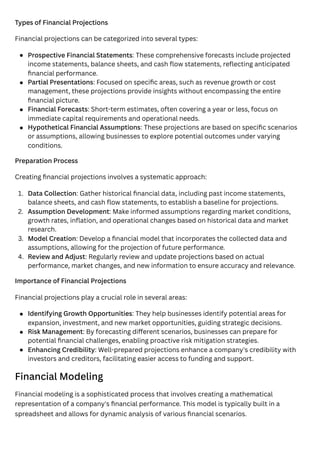
Definition and Purpose
A financial model forecasts a company's financial statements over a specified period, usually
ranging from five to ten years. It integrates historical data with future assumptions to
simulate potential outcomes based on different strategic decisions.
Uses of Financial Modeling
Financial modeling serves various purposes:
Components of Financial Modeling
Key components of a financial model include:
Building a Financial Model
To create a financial model, follow these steps:
Valuation: It helps estimate the value of a company or its assets, providing insights for
mergers, acquisitions, or investment opportunities.
Scenario Analysis: Financial models allow businesses to evaluate how different variables
(e.g., changes in sales volume, cost structures, or market conditions) affect financial
performance.
Investment Analysis: Investors use financial models to assess the viability of investment
opportunities, estimating potential returns and risks.
Mergers and Acquisitions: Financial modeling is crucial in analyzing the financial
implications of corporate transactions, helping stakeholders understand potential
synergies and costs.
Historical Financial Data: The foundation of any financial model, historical data includes
past income statements, balance sheets, and cash flow statements, providing context for
future projections.
Assumptions: Realistic assumptions regarding growth rates, cost structures, and market
conditions are critical for accurate forecasting. These assumptions should be based on
thorough research and analysis.
Output Statements: A well-structured financial model generates projected income
statements, balance sheets, and cash flow statements, allowing stakeholders to visualize
future financial performance.
1. Define Objectives: Clearly outline the purpose of the model, whether it's for valuation,
forecasting, or scenario analysis.
2. Gather Historical Data: Collect relevant financial statements and performance metrics
from previous periods to establish a baseline for projections.
3. Create Assumptions: Develop realistic assumptions based on market research, historical
performance, and industry trends, ensuring they align with the model's objectives.
4. Build the Model: Input data and assumptions into a spreadsheet, ensuring that the model
is flexible, dynamic, and easy to update as new information becomes available.
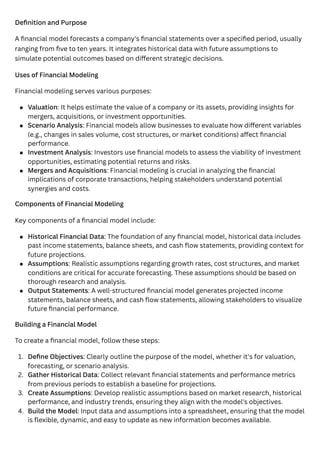
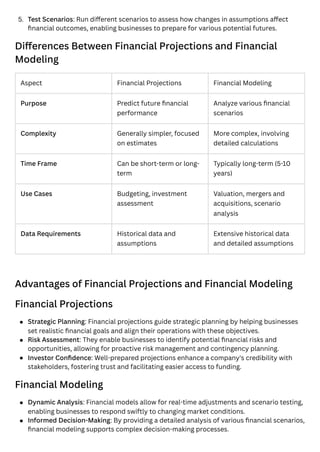
Differences Between Financial Projections and Financial
Modeling
Advantages of Financial Projections and Financial Modeling
Financial Projections
Financial Modeling
5. Test Scenarios: Run different scenarios to assess how changes in assumptions affect
financial outcomes, enabling businesses to prepare for various potential futures.
Aspect Financial Projections Financial Modeling
Purpose Predict future financial
performance
Analyze various financial
scenarios
Complexity Generally simpler, focused
on estimates
More complex, involving
detailed calculations
Time Frame Can be short-term or long-
term
Typically long-term (5-10
years)
Use Cases Budgeting, investment
assessment
Valuation, mergers and
acquisitions, scenario
analysis
Data Requirements Historical data and
assumptions
Extensive historical data
and detailed assumptions
Strategic Planning: Financial projections guide strategic planning by helping businesses
set realistic financial goals and align their operations with these objectives.
Risk Assessment: They enable businesses to identify potential financial risks and
opportunities, allowing for proactive risk management and contingency planning.
Investor Confidence: Well-prepared projections enhance a company's credibility with
stakeholders, fostering trust and facilitating easier access to funding.
Dynamic Analysis: Financial models allow for real-time adjustments and scenario testing,
enabling businesses to respond swiftly to changing market conditions.
Informed Decision-Making: By providing a detailed analysis of various financial scenarios,
financial modeling supports complex decision-making processes.
In summary, financial projections and financial modeling are essential tools for effective
financial management. While projections provide a high-level overview for planning and
decision-making, financial modeling offers a deeper analysis of potential outcomes, enabling
businesses to navigate complex financial landscapes with confidence.
Valuation Accuracy: Financial models offer a comprehensive view of a company's
financial health, enhancing the accuracy of valuations and investment assessments.

Financial Projection and Financial Modeling A Comprehensive Overview

  • 1.
    Financial projections andfinancial modeling are essential components of strategic business planning, providing a roadmap for future financial performance. As organizations navigate an increasingly complex economic landscape, accurate forecasting becomes crucial for making informed decisions about investments, expansions, and operational adjustments. A financial projection is essentially an educated estimate of a company's future revenues, expenses, and cash flows, typically based on historical data and market trends. These projections help businesses anticipate their financial needs, assess potential risks, and set realistic goals. On the other hand, financial modeling involves creating detailed representations of a company's financial performance, allowing for scenario analysis and valuation assessments. Together, these tools empower businesses to not only plan for growth but also to communicate their financial strategies effectively to investors and stakeholders. In this blog post, we will explore the intricacies of financial projections and modeling, their importance in decision-making, and best practices for creating reliable forecasts. Financial Projections Financial projections are forecasts of a company's future financial performance, based on historical data, market analysis, and strategic assumptions. They are essential for planning and decision-making across various business functions. Definition and Purpose Financial projections estimate future revenues, expenses, and cash flows, typically spanning one to five years. Their primary purposes include: Financial Projection and Financial Modeling Decision-Making: Financial projections provide critical insights for management and stakeholders, helping them make informed decisions about investments, budgeting, and resource allocation. Budgeting: By establishing financial targets, projections serve as a framework for creating budgets, guiding operational and strategic planning. Investment Assessment: Investors and lenders use projections to evaluate a company's financial health and growth potential, influencing their funding decisions.
  • 2.
    Types of FinancialProjections Financial projections can be categorized into several types: Preparation Process Creating financial projections involves a systematic approach: Importance of Financial Projections Financial projections play a crucial role in several areas: Financial Modeling Financial modeling is a sophisticated process that involves creating a mathematical representation of a company's financial performance. This model is typically built in a spreadsheet and allows for dynamic analysis of various financial scenarios. Prospective Financial Statements: These comprehensive forecasts include projected income statements, balance sheets, and cash flow statements, reflecting anticipated financial performance. Partial Presentations: Focused on specific areas, such as revenue growth or cost management, these projections provide insights without encompassing the entire financial picture. Financial Forecasts: Short-term estimates, often covering a year or less, focus on immediate capital requirements and operational needs. Hypothetical Financial Assumptions: These projections are based on specific scenarios or assumptions, allowing businesses to explore potential outcomes under varying conditions. 1. Data Collection: Gather historical financial data, including past income statements, balance sheets, and cash flow statements, to establish a baseline for projections. 2. Assumption Development: Make informed assumptions regarding market conditions, growth rates, inflation, and operational changes based on historical data and market research. 3. Model Creation: Develop a financial model that incorporates the collected data and assumptions, allowing for the projection of future performance. 4. Review and Adjust: Regularly review and update projections based on actual performance, market changes, and new information to ensure accuracy and relevance. Identifying Growth Opportunities: They help businesses identify potential areas for expansion, investment, and new market opportunities, guiding strategic decisions. Risk Management: By forecasting different scenarios, businesses can prepare for potential financial challenges, enabling proactive risk mitigation strategies. Enhancing Credibility: Well-prepared projections enhance a company's credibility with investors and creditors, facilitating easier access to funding and support.
  • 3.
    Definition and Purpose Afinancial model forecasts a company's financial statements over a specified period, usually ranging from five to ten years. It integrates historical data with future assumptions to simulate potential outcomes based on different strategic decisions. Uses of Financial Modeling Financial modeling serves various purposes: Components of Financial Modeling Key components of a financial model include: Building a Financial Model To create a financial model, follow these steps: Valuation: It helps estimate the value of a company or its assets, providing insights for mergers, acquisitions, or investment opportunities. Scenario Analysis: Financial models allow businesses to evaluate how different variables (e.g., changes in sales volume, cost structures, or market conditions) affect financial performance. Investment Analysis: Investors use financial models to assess the viability of investment opportunities, estimating potential returns and risks. Mergers and Acquisitions: Financial modeling is crucial in analyzing the financial implications of corporate transactions, helping stakeholders understand potential synergies and costs. Historical Financial Data: The foundation of any financial model, historical data includes past income statements, balance sheets, and cash flow statements, providing context for future projections. Assumptions: Realistic assumptions regarding growth rates, cost structures, and market conditions are critical for accurate forecasting. These assumptions should be based on thorough research and analysis. Output Statements: A well-structured financial model generates projected income statements, balance sheets, and cash flow statements, allowing stakeholders to visualize future financial performance. 1. Define Objectives: Clearly outline the purpose of the model, whether it's for valuation, forecasting, or scenario analysis. 2. Gather Historical Data: Collect relevant financial statements and performance metrics from previous periods to establish a baseline for projections. 3. Create Assumptions: Develop realistic assumptions based on market research, historical performance, and industry trends, ensuring they align with the model's objectives. 4. Build the Model: Input data and assumptions into a spreadsheet, ensuring that the model is flexible, dynamic, and easy to update as new information becomes available.
  • 4.
    Differences Between FinancialProjections and Financial Modeling Advantages of Financial Projections and Financial Modeling Financial Projections Financial Modeling 5. Test Scenarios: Run different scenarios to assess how changes in assumptions affect financial outcomes, enabling businesses to prepare for various potential futures. Aspect Financial Projections Financial Modeling Purpose Predict future financial performance Analyze various financial scenarios Complexity Generally simpler, focused on estimates More complex, involving detailed calculations Time Frame Can be short-term or long- term Typically long-term (5-10 years) Use Cases Budgeting, investment assessment Valuation, mergers and acquisitions, scenario analysis Data Requirements Historical data and assumptions Extensive historical data and detailed assumptions Strategic Planning: Financial projections guide strategic planning by helping businesses set realistic financial goals and align their operations with these objectives. Risk Assessment: They enable businesses to identify potential financial risks and opportunities, allowing for proactive risk management and contingency planning. Investor Confidence: Well-prepared projections enhance a company's credibility with stakeholders, fostering trust and facilitating easier access to funding. Dynamic Analysis: Financial models allow for real-time adjustments and scenario testing, enabling businesses to respond swiftly to changing market conditions. Informed Decision-Making: By providing a detailed analysis of various financial scenarios, financial modeling supports complex decision-making processes.
  • 5.
    In summary, financialprojections and financial modeling are essential tools for effective financial management. While projections provide a high-level overview for planning and decision-making, financial modeling offers a deeper analysis of potential outcomes, enabling businesses to navigate complex financial landscapes with confidence. Valuation Accuracy: Financial models offer a comprehensive view of a company's financial health, enhancing the accuracy of valuations and investment assessments.