MR.ABAJEY
INTRODUCTION
TO FINANCIAL MANAGEMENT
Business concern needs finance to meet their
requirements in the economic world. Any kind
of business activity depends on the finance.
Hence, it is called as lifeblood of business
organization. Whether the business concerns
are big or small, they need finance to fulfil
their business activities.
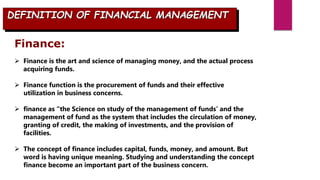
Finance:
 Finance is the art and science of managing money, and the actual process
acquiring funds.
 Finance function is the procurement of funds and their effective
utilization in business concerns.
 finance as “the Science on study of the management of funds’ and the
management of fund as the system that includes the circulation of money,
granting of credit, the making of investments, and the provision of
facilities.
 The concept of finance includes capital, funds, money, and amount. But
word is having unique meaning. Studying and understanding the concept
finance become an important part of the business concern.
DEFINITION OF FINANCIAL MANAGEMENT
BUSINESS FINANCE:
 Business finance is that business activity which concerns with the acquisition and
conversation of capital funds in meeting financial needs and overall objectives
of a business enterprise.
 “Business finance is the activity concerned with planning, raising, controlling,
of the funds used in the business”.
Corporate finance:
 Corporate finance is concerned with budgeting, financial forecasting, cash
management, credit administration, investment analysis and fund procurement of the
business concern
TYPES OF FINANCE
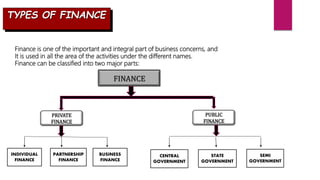
Finance is one of the important and integral part of business concerns, and
It is used in all the area of the activities under the different names.
Finance can be classified into two major parts:
FINANCE
PRIVATE
FINANCE
PUBLIC
FINANCE
INDIVIDUAL
FINANCE
PARTNERSHIP
FINANCE
BUSINESS
FINANCE
SEMI
GOVERNMENT
STATE
GOVERNMENT
CENTRAL
GOVERNMENT
Private Finance, which includes the Individual, Firms, Business or Corporate
Financial activities to meet the requirements.
Public Finance which concerns with revenue and disbursement of Government such as
Central Government, State Government and Semi-Government Financial matters.
FINANCIAL MANAGEMENT:
 Financial management is an integral part of overall management. It is concerned with
the duties of the financial managers in the business firm.
 “It is concerned with the efficient use of an important economic resource namely,
capital funds”.
 “Financial Management deals with procurement of funds and their effective
utilization in the business”.
Financial management is one of the important parts of overall management, which is directly
related with various functional departments like personnel, marketing and production.
Financial management covers wide area with multidimensional approaches can be broken
down into three major areas:
the investment, financing, and asset management decisions.
 Investment Decision
The investment decision is the most important of the firm’s three major decisions when it
comes to value creation. It begins with a determination of the total amount of assets needed
to be held by the firm.
Picture the firm’s balance sheet in your mind for a moment. Imagine liabilities and owners’
equity being listed on the right side of the balance sheet and its assets on the left. The
financial manager needs to determine the dollar amount that appears above the double lines
on the left-hand side of the balance sheet – that is, the size of the firm.
Financing Decision
The second major decision of the firm is the financing decision. Here the financial manager is
concerned with the makeup of the right-hand side of the accounting records (balance sheet)
includes the financial information of the business concern.
Hence, we can easily understand the relationship between the financial management
and accounting.
Asset Management Decision
The asset management decision have been acquired and appropriate financing provided,
these assets must be managed efficiently.
The financial manager is charged with varying degrees of operating responsibility over
existing assets.
OBJECTIVES OF FINANCIAL MANAGEMENT
Effective procurement and efficient use of finance lead to proper utilization of the finance by the
business concern. It is the essential part of the financial manager. Hence, the financial manager
must determine the basic objectives of the financial management.
Objectives of Financial Management may be broadly divided into two parts such as:
1. Profit maximization
2. Wealth maximization.
1- Profit Maximization
Frequently, profit maximization is offered as the proper objective of the firm, and
Main aim of any kind of economic activity is earning profit.
under this goal a manager could continue to show profit increases by merely issuing stock and
using the proceeds to invest in Treasury bills.
Profit maximization consists of the following important features.
 Profit maximization is also called as cashing per share maximization. It leads to
maximize the business operation for profit maximization.
 Ultimate aim of the business concern is earning profit, hence, it considers all the
possible ways to increase the profitability of the concern.
 Profit is the parameter of measuring the efficiency of the business concern.
 Profit maximization objectives help to reduce the risk of the business.
2 - Wealth Maximization
Wealth maximization is one of the modern approaches, which involves latest innovations and
improvements in the field of the business concern.
The term wealth means shareholder wealth or the wealth of the persons those who are
involved in the business concern.
Wealth maximization is also known as value maximization or net present worth
maximization. This objective is an universally accepted concept in the field of business.
FUNCTIONS OF FINANCE MANAGER
Finance manager is one of the important role players in the field of finance function.
He must have entire knowledge in the area of accounting, finance, economics and
management. His position is highly critical and analytical to solve various problems related to
finance. A person who deals finance related activities may be called finance manager.
Finance manager performs the following major functions:
1) Forecasting Financial Requirements
2) Acquiring Necessary Capital
3) Investment Decision
4) Cash Management
5) Interrelation with Other Departments
IMPORTANCE OF FINANCIAL MANAGEMENT
Finance is the lifeblood of business organization. It needs to meet the requirement of the
business concern. Each and every business concern must maintain adequate amount of
finance for their smooth running of the business concern and also maintain the business
carefully to achieve the goal of the business concern.
Some of the importance of the financial management is as follows:
 Financial Planning
 Acquisition of Funds
 Proper Use of Funds
 Financial Decision
 Increase the Value of the Firm
 Promoting Savings
Nowadays financial management is also popularly known as business finance or
corporate finances. The business concern or corporate sectors cannot function without
the importance of the financial management.
Financial managent
Financial managent

Financial managent

  • 1.
  • 2.
    INTRODUCTION TO FINANCIAL MANAGEMENT Businessconcern needs finance to meet their requirements in the economic world. Any kind of business activity depends on the finance. Hence, it is called as lifeblood of business organization. Whether the business concerns are big or small, they need finance to fulfil their business activities.
  • 3.
    Finance:  Finance isthe art and science of managing money, and the actual process acquiring funds.  Finance function is the procurement of funds and their effective utilization in business concerns.  finance as “the Science on study of the management of funds’ and the management of fund as the system that includes the circulation of money, granting of credit, the making of investments, and the provision of facilities.  The concept of finance includes capital, funds, money, and amount. But word is having unique meaning. Studying and understanding the concept finance become an important part of the business concern. DEFINITION OF FINANCIAL MANAGEMENT
  • 4.
    BUSINESS FINANCE:  Businessfinance is that business activity which concerns with the acquisition and conversation of capital funds in meeting financial needs and overall objectives of a business enterprise.  “Business finance is the activity concerned with planning, raising, controlling, of the funds used in the business”. Corporate finance:  Corporate finance is concerned with budgeting, financial forecasting, cash management, credit administration, investment analysis and fund procurement of the business concern
  • 5.
    TYPES OF FINANCE Financeis one of the important and integral part of business concerns, and It is used in all the area of the activities under the different names. Finance can be classified into two major parts: FINANCE PRIVATE FINANCE PUBLIC FINANCE INDIVIDUAL FINANCE PARTNERSHIP FINANCE BUSINESS FINANCE SEMI GOVERNMENT STATE GOVERNMENT CENTRAL GOVERNMENT
  • 6.
    Private Finance, whichincludes the Individual, Firms, Business or Corporate Financial activities to meet the requirements. Public Finance which concerns with revenue and disbursement of Government such as Central Government, State Government and Semi-Government Financial matters. FINANCIAL MANAGEMENT:  Financial management is an integral part of overall management. It is concerned with the duties of the financial managers in the business firm.  “It is concerned with the efficient use of an important economic resource namely, capital funds”.  “Financial Management deals with procurement of funds and their effective utilization in the business”.
  • 7.
    Financial management isone of the important parts of overall management, which is directly related with various functional departments like personnel, marketing and production. Financial management covers wide area with multidimensional approaches can be broken down into three major areas: the investment, financing, and asset management decisions.  Investment Decision The investment decision is the most important of the firm’s three major decisions when it comes to value creation. It begins with a determination of the total amount of assets needed to be held by the firm. Picture the firm’s balance sheet in your mind for a moment. Imagine liabilities and owners’ equity being listed on the right side of the balance sheet and its assets on the left. The financial manager needs to determine the dollar amount that appears above the double lines on the left-hand side of the balance sheet – that is, the size of the firm.
  • 8.
    Financing Decision The secondmajor decision of the firm is the financing decision. Here the financial manager is concerned with the makeup of the right-hand side of the accounting records (balance sheet) includes the financial information of the business concern. Hence, we can easily understand the relationship between the financial management and accounting. Asset Management Decision The asset management decision have been acquired and appropriate financing provided, these assets must be managed efficiently. The financial manager is charged with varying degrees of operating responsibility over existing assets.
  • 9.
    OBJECTIVES OF FINANCIALMANAGEMENT Effective procurement and efficient use of finance lead to proper utilization of the finance by the business concern. It is the essential part of the financial manager. Hence, the financial manager must determine the basic objectives of the financial management. Objectives of Financial Management may be broadly divided into two parts such as: 1. Profit maximization 2. Wealth maximization. 1- Profit Maximization Frequently, profit maximization is offered as the proper objective of the firm, and Main aim of any kind of economic activity is earning profit. under this goal a manager could continue to show profit increases by merely issuing stock and using the proceeds to invest in Treasury bills.
  • 10.
    Profit maximization consistsof the following important features.  Profit maximization is also called as cashing per share maximization. It leads to maximize the business operation for profit maximization.  Ultimate aim of the business concern is earning profit, hence, it considers all the possible ways to increase the profitability of the concern.  Profit is the parameter of measuring the efficiency of the business concern.  Profit maximization objectives help to reduce the risk of the business.
  • 11.
    2 - WealthMaximization Wealth maximization is one of the modern approaches, which involves latest innovations and improvements in the field of the business concern. The term wealth means shareholder wealth or the wealth of the persons those who are involved in the business concern. Wealth maximization is also known as value maximization or net present worth maximization. This objective is an universally accepted concept in the field of business.
  • 12.
    FUNCTIONS OF FINANCEMANAGER Finance manager is one of the important role players in the field of finance function. He must have entire knowledge in the area of accounting, finance, economics and management. His position is highly critical and analytical to solve various problems related to finance. A person who deals finance related activities may be called finance manager. Finance manager performs the following major functions: 1) Forecasting Financial Requirements 2) Acquiring Necessary Capital 3) Investment Decision 4) Cash Management 5) Interrelation with Other Departments
  • 13.
    IMPORTANCE OF FINANCIALMANAGEMENT Finance is the lifeblood of business organization. It needs to meet the requirement of the business concern. Each and every business concern must maintain adequate amount of finance for their smooth running of the business concern and also maintain the business carefully to achieve the goal of the business concern. Some of the importance of the financial management is as follows:  Financial Planning  Acquisition of Funds  Proper Use of Funds  Financial Decision  Increase the Value of the Firm  Promoting Savings Nowadays financial management is also popularly known as business finance or corporate finances. The business concern or corporate sectors cannot function without the importance of the financial management.