OVERVIEW
There is little possibility that you would come to a true
understanding of the new global business environment or
the mind set of an entrepreneur simply by reading about it,
involvement, critical thinking, and most importantly, decision
making.
The experiences you gain in this program of study will lay a
foundation for future learning in business and in life. If a
student of business covers all of the essential areas of
study but misses the "feel" or perhaps, the anguish of
making critical decisions, then that student will only partly
understand what business is all about.
INTRODUCTION
Today is an interesting time to study business.
Advances in technology are bringing rapid changes in
the ways we produce and deliver goods and services.
The Internet and other improvements in
communication now affect the way we do business.
Companies are expanding international operations,
and the workforce is more diverse than ever.
Corporations are being held responsible for the
behavior of their executives, and more people share
the opinion that companies should be good corporate
citizens.
What is Business ?
DEFINITIONS:
1. “Business may be defined as human activities directed toward
providing or acquiring wealth through buying and selling of
goods.”
2. “Every human activity which is engaged in for the sake of
earning profit may be called business.”
3. “An institution organized and operated to provide goods and
services to the society, under the incentive of private gain” is
business.
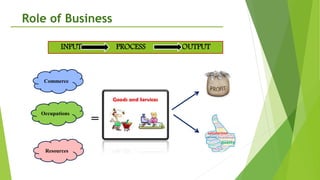
4. Business as system is a combination of business commerce,
occupations, and resources to produces and distributes the
goods and services for profit while creating value for people in a
society .
Role of Business
Commerce
Occupations
Resources
=
INPUT PROCESS OUTPUT
CHARACTERISTICS
Following are the essential characteristics of a good business:
1. Capital
Capital is the lifeblood of every business. It is the most essential and
important element of business. In case of deficiency, loans can be
taken from various financial institutions.
2. Creation of Utility
Utility is an economic term referring to that characteristic of a
certain commodity, which can satisfy any human need. Business
creates utility, which gives benefit to the entire society as well as the
businessmen.
3. Dealing in Goods and Services
Every business deals with sale, purchase, production and exchange of
goods and services for some consideration.
4. Employment
Business is a good source of employment for its owners as well as for
other people, for example, employees, agents, transporters etc.
Con…
5. Islamic Process
Business is an Islamic way of earning living. Income from business is
known as profit, which is Rizq-e-Halal. The Holy Prophet Muhammad
himself did prosperous business.
6. Organization
Every business needs an organization for its successful working. A
proper organization is helpful in the smooth running of business and
achieving the objectives.
7. Productions or Purchase of Goods
A businessman deals in production or purchase of goods. These goods
are supplied to the people. So, it is necessary that more goods should
be produced so that demand of people may be fulfilled.
8. Risks and Uncertainty
Business involves a large volume of risk and uncertainty. The risk
element in business keeps a person vigilant and he tries to ward off his
risk by executing his policies properly.
NATURE OF BUSINESS
The following points state the nature of business in brief:
1. Economic Activity
Business is an economic activity as it is concerned with creation of wealth
through the satisfaction of human wants.
2. Human Activity
Business is an economic activity and every economic activity is done by
human beings. Thus, business is one of the most important human activities.
3. Social Process
Business is run by owners and employees with the help of professionals and
customers. Thus, business is a social process.
4. System
Business is a systematic arrangement of various elements, which leads to
the attainment of particular objective, according to a well-established plan.
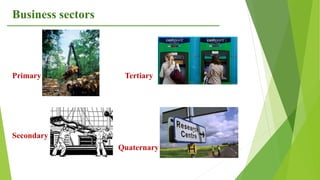
Business sectors
Primary Tertiary
Secondary
Quaternary
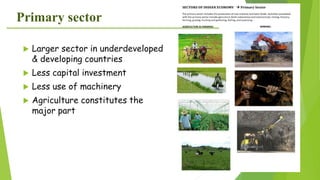
Primary sector
 Larger sector in underdeveloped
& developing countries
 Less capital investment
 Less use of machinery
 Agriculture constitutes the
major part
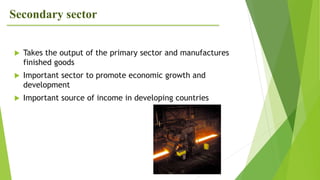
Secondary sector
 Takes the output of the primary sector and manufactures
finished goods
 Important sector to promote economic growth and
development
 Important source of income in developing countries
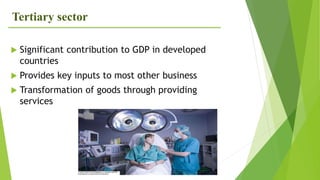
Tertiary sector
 Significant contribution to GDP in developed
countries
 Provides key inputs to most other business
 Transformation of goods through providing
services
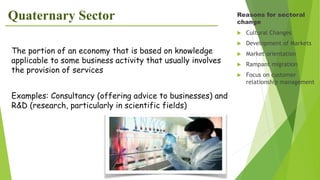
Quaternary Sector
The portion of an economy that is based on knowledge
applicable to some business activity that usually involves
the provision of services
Examples: Consultancy (offering advice to businesses) and
R&D (research, particularly in scientific fields)
Reasons for sectoral
change
 Cultural Changes
 Development of Markets
 Market orientation
 Rampant migration
 Focus on customer
relationship management
14
Types Of Business
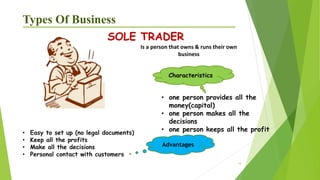
SOLE TRADER
Is a person that owns & runs their own
business
• one person provides all the
money(capital)
• one person makes all the
decisions
• one person keeps all the profit
Characteristics
• Easy to set up (no legal documents)
• Keep all the profits
• Make all the decisions
• Personal contact with customers
Advantages
15
Con…
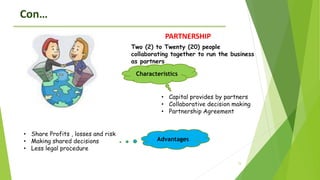
PARTNERSHIP
Two (2) to Twenty (20) people
collaborating together to run the business
as partners
• Capital provides by partners
• Collaborative decision making
• Partnership Agreement
Characteristics
• Share Profits , losses and risk
• Making shared decisions
• Less legal procedure
Advantages
16
Cont.…
Private Limited Company
A business that is owned by 2 to 50 people
• 2 to 50 owners called shareholders.
• Shares (part ownership) cannot be
bought by the general public.
• Shareholder’s receive a vote for
every share they own
• Must have Ltd. After it’s name.
• Shareholders receive a share of the
profits called a dividend.
Characteristic
s
17
• Limited liability - If the business fails
you can only lose the money that you
invested in the company. Your own
personal wealth cannot be touched.
• Business continues even when an owner
dies.
• Easier to raise finance as you have up
to 50 shareholders.
Advantages
Cont.…
• Legal Documents are needed to
set up a co.
• More costly to set up.
• Decision making and profits are
shared
Disadvantages
18
Con…
FRANCHISING
Franchising is a form of business
organization in which a firm that
already has a successful product or
service (franchisor) licenses its
trademark and method of doing
business to another business or
individual (franchisee) in exchange
for a franchise fee and an ongoing
royalty payment.
19
Con…
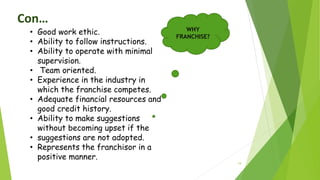
• Good work ethic.
• Ability to follow instructions.
• Ability to operate with minimal
supervision.
• Team oriented.
• Experience in the industry in
which the franchise competes.
• Adequate financial resources and
good credit history.
• Ability to make suggestions
without becoming upset if the
• suggestions are not adopted.
• Represents the franchisor in a
positive manner.
WHY
FRANCHISE?
SCOPE OF COMMERCE
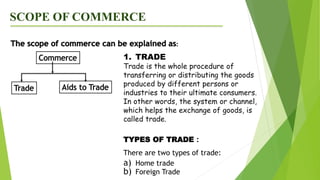
1. TRADE
Trade is the whole procedure of
transferring or distributing the goods
produced by different persons or
industries to their ultimate consumers.
In other words, the system or channel,
which helps the exchange of goods, is
called trade.
TYPES OF TRADE :
There are two types of trade:
a) Home trade
b) Foreign Trade
Con…
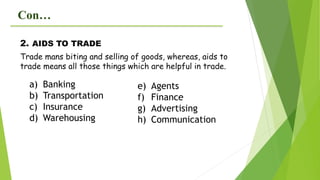
2. AIDS TO TRADE
Trade mans biting and selling of goods, whereas, aids to
trade means all those things which are helpful in trade.
a) Banking
b) Transportation
c) Insurance
d) Warehousing
e) Agents
f) Finance
g) Advertising
h) Communication
22
Social Responsibility
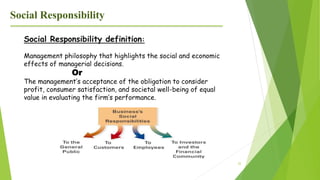
Social Responsibility definition:
Management philosophy that highlights the social and economic
effects of managerial decisions.
Or
The management’s acceptance of the obligation to consider
profit, consumer satisfaction, and societal well-being of equal
value in evaluating the firm’s performance.
23
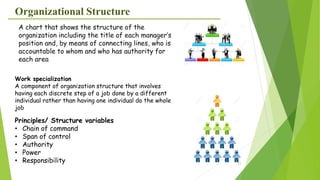
Organizational Structure
A chart that shows the structure of the
organization including the title of each manager’s
position and, by means of connecting lines, who is
accountable to whom and who has authority for
each area
Work specialization
A component of organization structure that involves
having each discrete step of a job done by a different
individual rather than having one individual do the whole
job
Principles/ Structure variables
• Chain of command
• Span of control
• Authority
• Power
• Responsibility
24
Con…
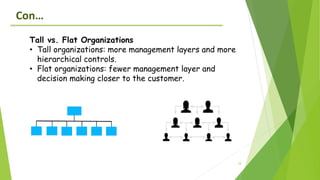
Tall vs. Flat Organizations
• Tall organizations: more management layers and more
hierarchical controls.
• Flat organizations: fewer management layer and
decision making closer to the customer.
1 introduction to business

1 introduction to business

  • 2.
    OVERVIEW There is littlepossibility that you would come to a true understanding of the new global business environment or the mind set of an entrepreneur simply by reading about it, involvement, critical thinking, and most importantly, decision making. The experiences you gain in this program of study will lay a foundation for future learning in business and in life. If a student of business covers all of the essential areas of study but misses the "feel" or perhaps, the anguish of making critical decisions, then that student will only partly understand what business is all about.
  • 3.
    INTRODUCTION Today is aninteresting time to study business. Advances in technology are bringing rapid changes in the ways we produce and deliver goods and services. The Internet and other improvements in communication now affect the way we do business. Companies are expanding international operations, and the workforce is more diverse than ever. Corporations are being held responsible for the behavior of their executives, and more people share the opinion that companies should be good corporate citizens.
  • 4.
    What is Business? DEFINITIONS: 1. “Business may be defined as human activities directed toward providing or acquiring wealth through buying and selling of goods.” 2. “Every human activity which is engaged in for the sake of earning profit may be called business.” 3. “An institution organized and operated to provide goods and services to the society, under the incentive of private gain” is business. 4. Business as system is a combination of business commerce, occupations, and resources to produces and distributes the goods and services for profit while creating value for people in a society .
  • 5.
  • 6.
    CHARACTERISTICS Following are theessential characteristics of a good business: 1. Capital Capital is the lifeblood of every business. It is the most essential and important element of business. In case of deficiency, loans can be taken from various financial institutions. 2. Creation of Utility Utility is an economic term referring to that characteristic of a certain commodity, which can satisfy any human need. Business creates utility, which gives benefit to the entire society as well as the businessmen. 3. Dealing in Goods and Services Every business deals with sale, purchase, production and exchange of goods and services for some consideration. 4. Employment Business is a good source of employment for its owners as well as for other people, for example, employees, agents, transporters etc.
  • 7.
    Con… 5. Islamic Process Businessis an Islamic way of earning living. Income from business is known as profit, which is Rizq-e-Halal. The Holy Prophet Muhammad himself did prosperous business. 6. Organization Every business needs an organization for its successful working. A proper organization is helpful in the smooth running of business and achieving the objectives. 7. Productions or Purchase of Goods A businessman deals in production or purchase of goods. These goods are supplied to the people. So, it is necessary that more goods should be produced so that demand of people may be fulfilled. 8. Risks and Uncertainty Business involves a large volume of risk and uncertainty. The risk element in business keeps a person vigilant and he tries to ward off his risk by executing his policies properly.
  • 8.
    NATURE OF BUSINESS Thefollowing points state the nature of business in brief: 1. Economic Activity Business is an economic activity as it is concerned with creation of wealth through the satisfaction of human wants. 2. Human Activity Business is an economic activity and every economic activity is done by human beings. Thus, business is one of the most important human activities. 3. Social Process Business is run by owners and employees with the help of professionals and customers. Thus, business is a social process. 4. System Business is a systematic arrangement of various elements, which leads to the attainment of particular objective, according to a well-established plan.
  • 9.
  • 10.
    Primary sector  Largersector in underdeveloped & developing countries  Less capital investment  Less use of machinery  Agriculture constitutes the major part
  • 11.
    Secondary sector  Takesthe output of the primary sector and manufactures finished goods  Important sector to promote economic growth and development  Important source of income in developing countries
  • 12.
    Tertiary sector  Significantcontribution to GDP in developed countries  Provides key inputs to most other business  Transformation of goods through providing services
  • 13.
    Quaternary Sector The portionof an economy that is based on knowledge applicable to some business activity that usually involves the provision of services Examples: Consultancy (offering advice to businesses) and R&D (research, particularly in scientific fields) Reasons for sectoral change  Cultural Changes  Development of Markets  Market orientation  Rampant migration  Focus on customer relationship management
  • 14.
    14 Types Of Business SOLETRADER Is a person that owns & runs their own business • one person provides all the money(capital) • one person makes all the decisions • one person keeps all the profit Characteristics • Easy to set up (no legal documents) • Keep all the profits • Make all the decisions • Personal contact with customers Advantages
  • 15.
    15 Con… PARTNERSHIP Two (2) toTwenty (20) people collaborating together to run the business as partners • Capital provides by partners • Collaborative decision making • Partnership Agreement Characteristics • Share Profits , losses and risk • Making shared decisions • Less legal procedure Advantages
  • 16.
    16 Cont.… Private Limited Company Abusiness that is owned by 2 to 50 people • 2 to 50 owners called shareholders. • Shares (part ownership) cannot be bought by the general public. • Shareholder’s receive a vote for every share they own • Must have Ltd. After it’s name. • Shareholders receive a share of the profits called a dividend. Characteristic s
  • 17.
    17 • Limited liability- If the business fails you can only lose the money that you invested in the company. Your own personal wealth cannot be touched. • Business continues even when an owner dies. • Easier to raise finance as you have up to 50 shareholders. Advantages Cont.… • Legal Documents are needed to set up a co. • More costly to set up. • Decision making and profits are shared Disadvantages
  • 18.
    18 Con… FRANCHISING Franchising is aform of business organization in which a firm that already has a successful product or service (franchisor) licenses its trademark and method of doing business to another business or individual (franchisee) in exchange for a franchise fee and an ongoing royalty payment.
  • 19.
    19 Con… • Good workethic. • Ability to follow instructions. • Ability to operate with minimal supervision. • Team oriented. • Experience in the industry in which the franchise competes. • Adequate financial resources and good credit history. • Ability to make suggestions without becoming upset if the • suggestions are not adopted. • Represents the franchisor in a positive manner. WHY FRANCHISE?
  • 20.
    SCOPE OF COMMERCE 1.TRADE Trade is the whole procedure of transferring or distributing the goods produced by different persons or industries to their ultimate consumers. In other words, the system or channel, which helps the exchange of goods, is called trade. TYPES OF TRADE : There are two types of trade: a) Home trade b) Foreign Trade
  • 21.
    Con… 2. AIDS TOTRADE Trade mans biting and selling of goods, whereas, aids to trade means all those things which are helpful in trade. a) Banking b) Transportation c) Insurance d) Warehousing e) Agents f) Finance g) Advertising h) Communication
  • 22.
    22 Social Responsibility Social Responsibilitydefinition: Management philosophy that highlights the social and economic effects of managerial decisions. Or The management’s acceptance of the obligation to consider profit, consumer satisfaction, and societal well-being of equal value in evaluating the firm’s performance.
  • 23.
    23 Organizational Structure A chartthat shows the structure of the organization including the title of each manager’s position and, by means of connecting lines, who is accountable to whom and who has authority for each area Work specialization A component of organization structure that involves having each discrete step of a job done by a different individual rather than having one individual do the whole job Principles/ Structure variables • Chain of command • Span of control • Authority • Power • Responsibility
  • 24.
    24 Con… Tall vs. FlatOrganizations • Tall organizations: more management layers and more hierarchical controls. • Flat organizations: fewer management layer and decision making closer to the customer.

Editor's Notes

  • #11 Despite employing 51% of the workforce, it produces just 15% of the National GDP
  • #12 Employing 22% of the workforce and contributing 26% of the nation’s GDP
  • #15 Unlimited liability ( if your business fails you could lose all your own personal wealth) Suffer all losses yourself Business ends when the owner dies
  • #16 Unlimited liability ( if your business fails you could lose all your own personal wealth) Suffer all losses yourself Business ends when the owner dies
  • #23 Image and social responsibility have become more and more important objectives of businesses. There are some reasons why businesses must consider image and social responsibility to be their objectives