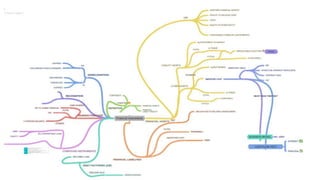
FINANCIAL INSTRUMENTS
ACCA - FINANCIAL REPORTING (FR)
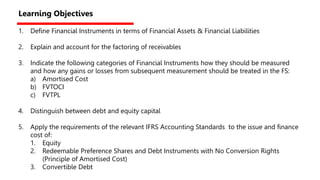
1. Define Financial Instruments in terms of Financial Assets & Financial Liabilities
2. Explain and account for the factoring of receivables
3. Indicate the following categories of Financial Instruments how they should be measured
and how any gains or losses from subsequent measurement should be treated in the FS:
a) Amortised Cost
b) FVTOCI
c) FVTPL
4. Distinguish between debt and equity capital
5. Apply the requirements of the relevant IFRS Accounting Standards to the issue and finance
cost of:
1. Equity
2. Redeemable Preference Shares and Debt Instruments with No Conversion Rights
(Principle of Amortised Cost)
3. Convertible Debt
Learning Objectives
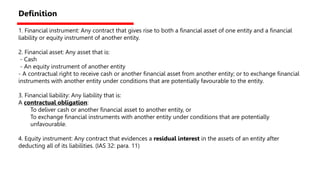
1. Financial instrument: Any contract that gives rise to both a financial asset of one entity and a financial
liability or equity instrument of another entity.
2. Financial asset: Any asset that is:
- Cash
- An equity instrument of another entity
- A contractual right to receive cash or another financial asset from another entity; or to exchange financial
instruments with another entity under conditions that are potentially favourable to the entity.
3. Financial liability: Any liability that is:
A contractual obligation:
To deliver cash or another financial asset to another entity, or
To exchange financial instruments with another entity under conditions that are potentially
unfavourable.
4. Equity instrument: Any contract that evidences a residual interest in the assets of an entity after
deducting all of its liabilities. (IAS 32: para. 11)
Definition
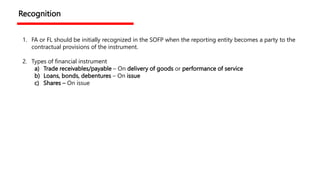
Recognition
1. FA or FL should be initially recognized in the SOFP when the reporting entity becomes a party to the
contractual provisions of the instrument.
2. Types of financial instrument
a) Trade receivables/payable – On delivery of goods or performance of service
b) Loans, bonds, debentures – On issue
c) Shares – On issue
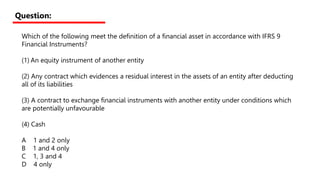
Which of the following meet the definition of a financial asset in accordance with IFRS 9
Financial Instruments?
(1) An equity instrument of another entity
(2) Any contract which evidences a residual interest in the assets of an entity after deducting
all of its liabilities
(3) A contract to exchange financial instruments with another entity under conditions which
are potentially unfavourable
(4) Cash
A 1 and 2 only
B 1 and 4 only
C 1, 3 and 4
D 4 only
Question:
1.1. Classification of FA
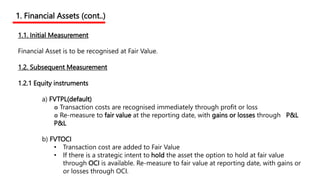
1. Financial Assets
1.1. Initial Measurement
Financial Asset is to be recognised at Fair Value.
1.2. Subsequent Measurement
1.2.1 Equity instruments
a) FVTPL(default)
๏ Transaction costs are recognised immediately through profit or loss
๏ Re-measure to fair value at the reporting date, with gains or losses through P&L
P&L
b) FVTOCI
• Transaction cost are added to Fair Value
• If there is a strategic intent to hold the asset the option to hold at fair value
through OCI is available. Re-measure to fair value at reporting date, with gains or
or losses through OCI.
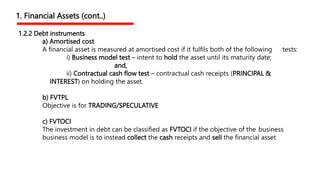
1. Financial Assets (cont..)
1.2.2 Debt instruments
a) Amortised cost
A financial asset is measured at amortised cost if it fulfils both of the following tests:
i) Business model test – intent to hold the asset until its maturity date;
and,
ii) Contractual cash flow test – contractual cash receipts (PRINCIPAL &
INTEREST) on holding the asset.
b) FVTPL
Objective is for TRADING/SPECULATIVE
c) FVTOCI
The investment in debt can be classified as FVTOCI if the objective of the business
business model is to instead collect the cash receipts and sell the financial asset
1. Financial Assets (cont..)
1.4. Derecognition
Financial assets are derecognised when sold, with gains or losses on disposal
through profit or loss.
Gains or losses previously recognised through OCI are transferred to RE through the
SOCE.
1. Financial Assets (cont..)
Question:
Included within the financial assets of Zinet Co at 31 March 20X9 are the following two recently purchased
investments in publically-traded equity shares:
Investment 1 – 10% of the issued share capital of Haruka Co. This shareholding was acquired as a long-
term investment as Zinet Co wishes to participate as an active shareholder of Haruka Co.
Investment 2 – 10% of the issued share capital of Lukas Co. This shareholding was acquired for speculative
purposes and Zinet Co expects to sell these shares in the near future.
Neither of these shareholdings gives Zinet Co significant influence over the investee companies.
Wherever possible, the directors of Zinet Co wish to avoid taking any fair value movements to profit or
loss, so as to minimise volatility in reported earnings.
How should the fair value movements in these investments be reported in Zinet Co’s financial statements
for the year ended 31 March 20X9?
A In profit or loss for both investments
B In other comprehensive income for both investments
C In profit or loss for investment 1 and in other comprehensive income for investment 2
D In other comprehensive income for investment 1 and in profit or loss for investment 2
Speculate Co is preparing its financial statements for the
year ended 30 September 20X3.
The following issues are relevant:
1. Financial assets
Shareholding A – a long-term investment in 10,000 of the
equity shares of another company. These shares were
acquired on 1 October 20X2 at a cost of $3·50 each.
Transaction costs of 1% of the purchase price were
incurred. On 30 September 20X3 the fair value of these
shares is $4·50 each.
Shareholding B – a short-term speculative investment in
2,000 of the equity shares of another company. These
shares were acquired on 1 December 20X2 at a cost of
$2·50 each. Transaction costs of 1% of the purchase price
were incurred. On 30 September 20X3 the fair value of
these shares is $3·00 each.
Where possible, Speculate Co makes an irrevocable
election for the fair value movements on financial assets to
be reported in other comprehensive income.
In respect of the financial assets of Speculate
Co, what amount will be included in other
comprehensive income
for the year ended 30 September 20X3?
A $9,650
B $10,650
C $10,000
D $0
Answer:
Shareholding A is not held for trading as an
election made – FVTOCI.
Shareholding B is held for trading and so FVTPL
(transaction costs are not included in carrying
amount).
Cost of shareholding A is 10,000 x $3·50 x 1·01 =
$35,350.
FV at 30 September 20X3 10,000 x $4·50 =
$45,000.
Gain = 45,000 – 35,350 = $9,650.
Question:
2.1. Initial measurement
๏ Initially recognise at fair value less transaction costs (‘net proceeds’)
2.2. Subsequent measurement
๏ Amortised cost
๏ Fair value though profit or loss
2.3. Derecognition
๏ Financial liabilities are derecognised when they have been paid in full or transferred to another party.
2. Financial Liabilities
• If a convertible instrument is issued, the economic substance is a combination of equity and
liability and is accounted for using split equity accounting.
• The liability element is calculated by discounting back the maximum possible amount of
cash that will be repaid assuming that the conversion doesn’t take place.
• The discount rate to be used is that of the interest rate on similar debt without and
conversion option.
• The equity element is the difference between the proceeds on issue and the initial liability
element.
• The liability element is subsequently measured at amortised cost, using the interest rate on
similar debt without the conversion option as the effective rate.
• The equity element is not subsequently changed.
3. Convertible debentures
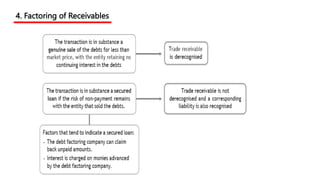
4. Factoring of Receivables
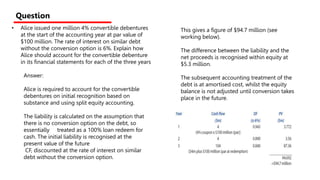
• Alice issued one million 4% convertible debentures
at the start of the accounting year at par value of
$100 million. The rate of interest on similar debt
without the conversion option is 6%. Explain how
Alice should account for the convertible debenture
in its financial statements for each of the three years
Answer:
Alice is required to account for the convertible
debentures on initial recognition based on
substance and using split equity accounting.
The liability is calculated on the assumption that
there is no conversion option on the debt, so
essentially treated as a 100% loan redeem for
cash. The initial liability is recognised at the
present value of the future
CF, discounted at the rate of interest on similar
debt without the conversion option.
Question
This gives a figure of $94.7 million (see
working below).
The difference between the liability and the
net proceeds is recognised within equity at
$5.3 million.
The subsequent accounting treatment of the
debt is at amortised cost, whilst the equity
balance is not adjusted until conversion takes
place in the future.
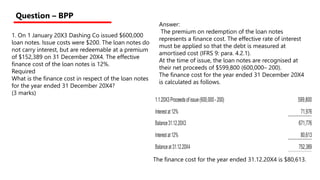
1. On 1 January 20X3 Dashing Co issued $600,000
loan notes. Issue costs were $200. The loan notes do
not carry interest, but are redeemable at a premium
of $152,389 on 31 December 20X4. The effective
finance cost of the loan notes is 12%.
Required
What is the finance cost in respect of the loan notes
for the year ended 31 December 20X4?
(3 marks)
Question – BPP
Answer:
The premium on redemption of the loan notes
represents a finance cost. The effective rate of interest
must be applied so that the debt is measured at
amortised cost (IFRS 9: para. 4.2.1).
At the time of issue, the loan notes are recognised at
their net proceeds of $599,800 (600,000– 200).
The finance cost for the year ended 31 December 20X4
is calculated as follows.
1.1.20X3Proceedsofissue(600,000–200) 599,800
Interestat12% 71,976
Balance31.12.20X3 671,776
Interestat12% 80,613
Balanceat 31.12.20X4 752,389
The finance cost for the year ended 31.12.20X4 is $80,613.
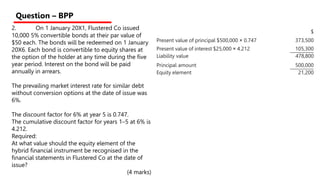
2. On 1 January 20X1, Flustered Co issued
10,000 5% convertible bonds at their par value of
$50 each. The bonds will be redeemed on 1 January
20X6. Each bond is convertible to equity shares at
the option of the holder at any time during the five
year period. Interest on the bond will be paid
annually in arrears.
The prevailing market interest rate for similar debt
without conversion options at the date of issue was
6%.
The discount factor for 6% at year 5 is 0.747.
The cumulative discount factor for years 1–5 at 6% is
4.212.
Required:
At what value should the equity element of the
hybrid financial instrument be recognised in the
financial statements in Flustered Co at the date of
issue?
(4 marks)
Question – BPP
$
Present value of principal $500,000 × 0.747 373,500
Present value of interest $25,000 × 4.212 105,300
Liability value 478,800
Principal amount 500,000
Equity element 21,200
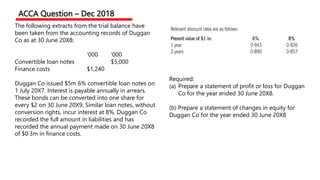
ACCA Question – Dec 2018
The following extracts from the trial balance have
been taken from the accounting records of Duggan
Co as at 30 June 20X8:
‘000 ‘000
Convertible loan notes $5,000
Finance costs $1,240
Duggan Co issued $5m 6% convertible loan notes on
1 July 20X7. Interest is payable annually in arrears.
These bonds can be converted into one share for
every $2 on 30 June 20X9. Similar loan notes, without
conversion rights, incur interest at 8%. Duggan Co
recorded the full amount in liabilities and has
recorded the annual payment made on 30 June 20X8
of $0·3m in finance costs.
Required:
(a) Prepare a statement of profit or loss for Duggan
Co for the year ended 30 June 20X8.
(b) Prepare a statement of changes in equity for
Duggan Co for the year ended 30 June 20X8
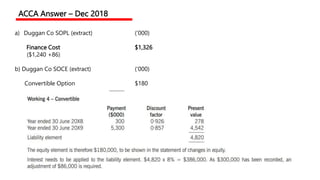
ACCA Answer – Dec 2018
a) Duggan Co SOPL (extract) (‘000)
Finance Cost $1,326
($1,240 +86)
b) Duggan Co SOCE (extract) (‘000)
Convertible Option $180
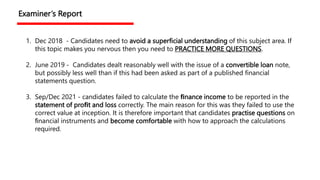
Examiner’s Report
1. Dec 2018 - Candidates need to avoid a superficial understanding of this subject area. If
this topic makes you nervous then you need to PRACTICE MORE QUESTIONS.
2. June 2019 - Candidates dealt reasonably well with the issue of a convertible loan note,
but possibly less well than if this had been asked as part of a published financial
statements question.
3. Sep/Dec 2021 - candidates failed to calculate the finance income to be reported in the
statement of profit and loss correctly. The main reason for this was they failed to use the
correct value at inception. It is therefore important that candidates practise questions on
financial instruments and become comfortable with how to approach the calculations
required.
Financial Instruments ACCA Financial Reporting .pptx

Financial Instruments ACCA Financial Reporting .pptx

  • 1.
    FINANCIAL INSTRUMENTS ACCA -FINANCIAL REPORTING (FR)
  • 2.
    1. Define FinancialInstruments in terms of Financial Assets & Financial Liabilities 2. Explain and account for the factoring of receivables 3. Indicate the following categories of Financial Instruments how they should be measured and how any gains or losses from subsequent measurement should be treated in the FS: a) Amortised Cost b) FVTOCI c) FVTPL 4. Distinguish between debt and equity capital 5. Apply the requirements of the relevant IFRS Accounting Standards to the issue and finance cost of: 1. Equity 2. Redeemable Preference Shares and Debt Instruments with No Conversion Rights (Principle of Amortised Cost) 3. Convertible Debt Learning Objectives
  • 3.
    1. Financial instrument:Any contract that gives rise to both a financial asset of one entity and a financial liability or equity instrument of another entity. 2. Financial asset: Any asset that is: - Cash - An equity instrument of another entity - A contractual right to receive cash or another financial asset from another entity; or to exchange financial instruments with another entity under conditions that are potentially favourable to the entity. 3. Financial liability: Any liability that is: A contractual obligation: To deliver cash or another financial asset to another entity, or To exchange financial instruments with another entity under conditions that are potentially unfavourable. 4. Equity instrument: Any contract that evidences a residual interest in the assets of an entity after deducting all of its liabilities. (IAS 32: para. 11) Definition
  • 4.
    Recognition 1. FA orFL should be initially recognized in the SOFP when the reporting entity becomes a party to the contractual provisions of the instrument. 2. Types of financial instrument a) Trade receivables/payable – On delivery of goods or performance of service b) Loans, bonds, debentures – On issue c) Shares – On issue
  • 5.
    Which of thefollowing meet the definition of a financial asset in accordance with IFRS 9 Financial Instruments? (1) An equity instrument of another entity (2) Any contract which evidences a residual interest in the assets of an entity after deducting all of its liabilities (3) A contract to exchange financial instruments with another entity under conditions which are potentially unfavourable (4) Cash A 1 and 2 only B 1 and 4 only C 1, 3 and 4 D 4 only Question:
  • 6.
    1.1. Classification ofFA 1. Financial Assets
  • 7.
    1.1. Initial Measurement FinancialAsset is to be recognised at Fair Value. 1.2. Subsequent Measurement 1.2.1 Equity instruments a) FVTPL(default) ๏ Transaction costs are recognised immediately through profit or loss ๏ Re-measure to fair value at the reporting date, with gains or losses through P&L P&L b) FVTOCI • Transaction cost are added to Fair Value • If there is a strategic intent to hold the asset the option to hold at fair value through OCI is available. Re-measure to fair value at reporting date, with gains or or losses through OCI. 1. Financial Assets (cont..)
  • 8.
    1.2.2 Debt instruments a)Amortised cost A financial asset is measured at amortised cost if it fulfils both of the following tests: i) Business model test – intent to hold the asset until its maturity date; and, ii) Contractual cash flow test – contractual cash receipts (PRINCIPAL & INTEREST) on holding the asset. b) FVTPL Objective is for TRADING/SPECULATIVE c) FVTOCI The investment in debt can be classified as FVTOCI if the objective of the business business model is to instead collect the cash receipts and sell the financial asset 1. Financial Assets (cont..)
  • 9.
    1.4. Derecognition Financial assetsare derecognised when sold, with gains or losses on disposal through profit or loss. Gains or losses previously recognised through OCI are transferred to RE through the SOCE. 1. Financial Assets (cont..)
  • 10.
    Question: Included within thefinancial assets of Zinet Co at 31 March 20X9 are the following two recently purchased investments in publically-traded equity shares: Investment 1 – 10% of the issued share capital of Haruka Co. This shareholding was acquired as a long- term investment as Zinet Co wishes to participate as an active shareholder of Haruka Co. Investment 2 – 10% of the issued share capital of Lukas Co. This shareholding was acquired for speculative purposes and Zinet Co expects to sell these shares in the near future. Neither of these shareholdings gives Zinet Co significant influence over the investee companies. Wherever possible, the directors of Zinet Co wish to avoid taking any fair value movements to profit or loss, so as to minimise volatility in reported earnings. How should the fair value movements in these investments be reported in Zinet Co’s financial statements for the year ended 31 March 20X9? A In profit or loss for both investments B In other comprehensive income for both investments C In profit or loss for investment 1 and in other comprehensive income for investment 2 D In other comprehensive income for investment 1 and in profit or loss for investment 2
  • 11.
    Speculate Co ispreparing its financial statements for the year ended 30 September 20X3. The following issues are relevant: 1. Financial assets Shareholding A – a long-term investment in 10,000 of the equity shares of another company. These shares were acquired on 1 October 20X2 at a cost of $3·50 each. Transaction costs of 1% of the purchase price were incurred. On 30 September 20X3 the fair value of these shares is $4·50 each. Shareholding B – a short-term speculative investment in 2,000 of the equity shares of another company. These shares were acquired on 1 December 20X2 at a cost of $2·50 each. Transaction costs of 1% of the purchase price were incurred. On 30 September 20X3 the fair value of these shares is $3·00 each. Where possible, Speculate Co makes an irrevocable election for the fair value movements on financial assets to be reported in other comprehensive income. In respect of the financial assets of Speculate Co, what amount will be included in other comprehensive income for the year ended 30 September 20X3? A $9,650 B $10,650 C $10,000 D $0 Answer: Shareholding A is not held for trading as an election made – FVTOCI. Shareholding B is held for trading and so FVTPL (transaction costs are not included in carrying amount). Cost of shareholding A is 10,000 x $3·50 x 1·01 = $35,350. FV at 30 September 20X3 10,000 x $4·50 = $45,000. Gain = 45,000 – 35,350 = $9,650. Question:
  • 12.
    2.1. Initial measurement ๏Initially recognise at fair value less transaction costs (‘net proceeds’) 2.2. Subsequent measurement ๏ Amortised cost ๏ Fair value though profit or loss 2.3. Derecognition ๏ Financial liabilities are derecognised when they have been paid in full or transferred to another party. 2. Financial Liabilities
  • 13.
    • If aconvertible instrument is issued, the economic substance is a combination of equity and liability and is accounted for using split equity accounting. • The liability element is calculated by discounting back the maximum possible amount of cash that will be repaid assuming that the conversion doesn’t take place. • The discount rate to be used is that of the interest rate on similar debt without and conversion option. • The equity element is the difference between the proceeds on issue and the initial liability element. • The liability element is subsequently measured at amortised cost, using the interest rate on similar debt without the conversion option as the effective rate. • The equity element is not subsequently changed. 3. Convertible debentures
  • 14.
    4. Factoring ofReceivables
  • 15.
    • Alice issuedone million 4% convertible debentures at the start of the accounting year at par value of $100 million. The rate of interest on similar debt without the conversion option is 6%. Explain how Alice should account for the convertible debenture in its financial statements for each of the three years Answer: Alice is required to account for the convertible debentures on initial recognition based on substance and using split equity accounting. The liability is calculated on the assumption that there is no conversion option on the debt, so essentially treated as a 100% loan redeem for cash. The initial liability is recognised at the present value of the future CF, discounted at the rate of interest on similar debt without the conversion option. Question This gives a figure of $94.7 million (see working below). The difference between the liability and the net proceeds is recognised within equity at $5.3 million. The subsequent accounting treatment of the debt is at amortised cost, whilst the equity balance is not adjusted until conversion takes place in the future.
  • 16.
    1. On 1January 20X3 Dashing Co issued $600,000 loan notes. Issue costs were $200. The loan notes do not carry interest, but are redeemable at a premium of $152,389 on 31 December 20X4. The effective finance cost of the loan notes is 12%. Required What is the finance cost in respect of the loan notes for the year ended 31 December 20X4? (3 marks) Question – BPP Answer: The premium on redemption of the loan notes represents a finance cost. The effective rate of interest must be applied so that the debt is measured at amortised cost (IFRS 9: para. 4.2.1). At the time of issue, the loan notes are recognised at their net proceeds of $599,800 (600,000– 200). The finance cost for the year ended 31 December 20X4 is calculated as follows. 1.1.20X3Proceedsofissue(600,000–200) 599,800 Interestat12% 71,976 Balance31.12.20X3 671,776 Interestat12% 80,613 Balanceat 31.12.20X4 752,389 The finance cost for the year ended 31.12.20X4 is $80,613.
  • 17.
    2. On 1January 20X1, Flustered Co issued 10,000 5% convertible bonds at their par value of $50 each. The bonds will be redeemed on 1 January 20X6. Each bond is convertible to equity shares at the option of the holder at any time during the five year period. Interest on the bond will be paid annually in arrears. The prevailing market interest rate for similar debt without conversion options at the date of issue was 6%. The discount factor for 6% at year 5 is 0.747. The cumulative discount factor for years 1–5 at 6% is 4.212. Required: At what value should the equity element of the hybrid financial instrument be recognised in the financial statements in Flustered Co at the date of issue? (4 marks) Question – BPP $ Present value of principal $500,000 × 0.747 373,500 Present value of interest $25,000 × 4.212 105,300 Liability value 478,800 Principal amount 500,000 Equity element 21,200
  • 18.
    ACCA Question –Dec 2018 The following extracts from the trial balance have been taken from the accounting records of Duggan Co as at 30 June 20X8: ‘000 ‘000 Convertible loan notes $5,000 Finance costs $1,240 Duggan Co issued $5m 6% convertible loan notes on 1 July 20X7. Interest is payable annually in arrears. These bonds can be converted into one share for every $2 on 30 June 20X9. Similar loan notes, without conversion rights, incur interest at 8%. Duggan Co recorded the full amount in liabilities and has recorded the annual payment made on 30 June 20X8 of $0·3m in finance costs. Required: (a) Prepare a statement of profit or loss for Duggan Co for the year ended 30 June 20X8. (b) Prepare a statement of changes in equity for Duggan Co for the year ended 30 June 20X8
  • 19.
    ACCA Answer –Dec 2018 a) Duggan Co SOPL (extract) (‘000) Finance Cost $1,326 ($1,240 +86) b) Duggan Co SOCE (extract) (‘000) Convertible Option $180
  • 20.
    Examiner’s Report 1. Dec2018 - Candidates need to avoid a superficial understanding of this subject area. If this topic makes you nervous then you need to PRACTICE MORE QUESTIONS. 2. June 2019 - Candidates dealt reasonably well with the issue of a convertible loan note, but possibly less well than if this had been asked as part of a published financial statements question. 3. Sep/Dec 2021 - candidates failed to calculate the finance income to be reported in the statement of profit and loss correctly. The main reason for this was they failed to use the correct value at inception. It is therefore important that candidates practise questions on financial instruments and become comfortable with how to approach the calculations required.