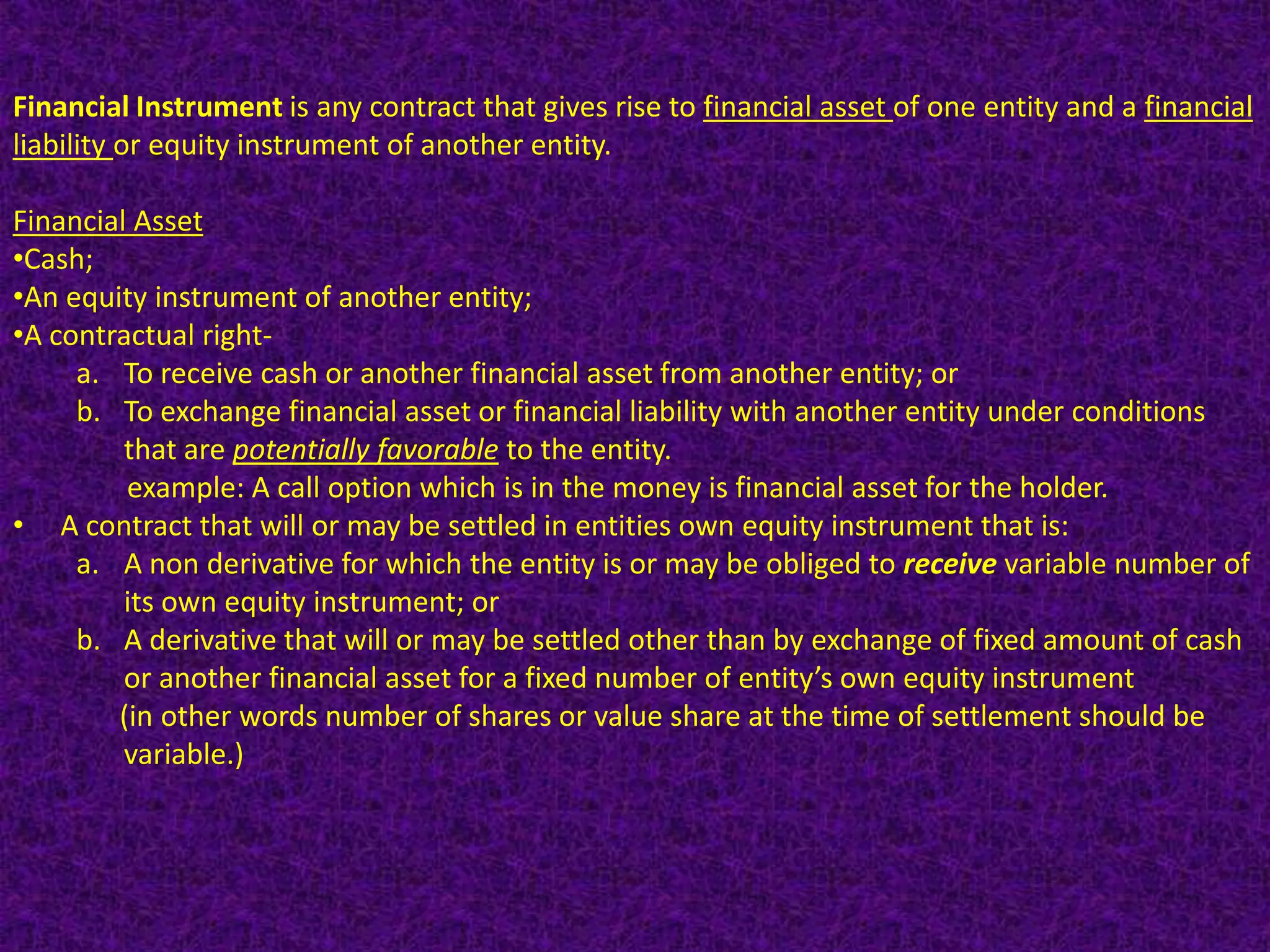
Financial Instrument is any contract that gives rise to financial asset of one entity and a financial
liability or equity instrument of another entity.

Financial Asset
•Cash;
•An equity instrument of another entity;
•A contractual right-
     a. To receive cash or another financial asset from another entity; or
     b. To exchange financial asset or financial liability with another entity under conditions
         that are potentially favorable to the entity.
         example: A call option which is in the money is financial asset for the holder.
• A contract that will or may be settled in entities own equity instrument that is:
     a. A non derivative for which the entity is or may be obliged to receive variable number of
         its own equity instrument; or
     b. A derivative that will or may be settled other than by exchange of fixed amount of cash
         or another financial asset for a fixed number of entity’s own equity instrument
        (in other words number of shares or value share at the time of settlement should be
         variable.)
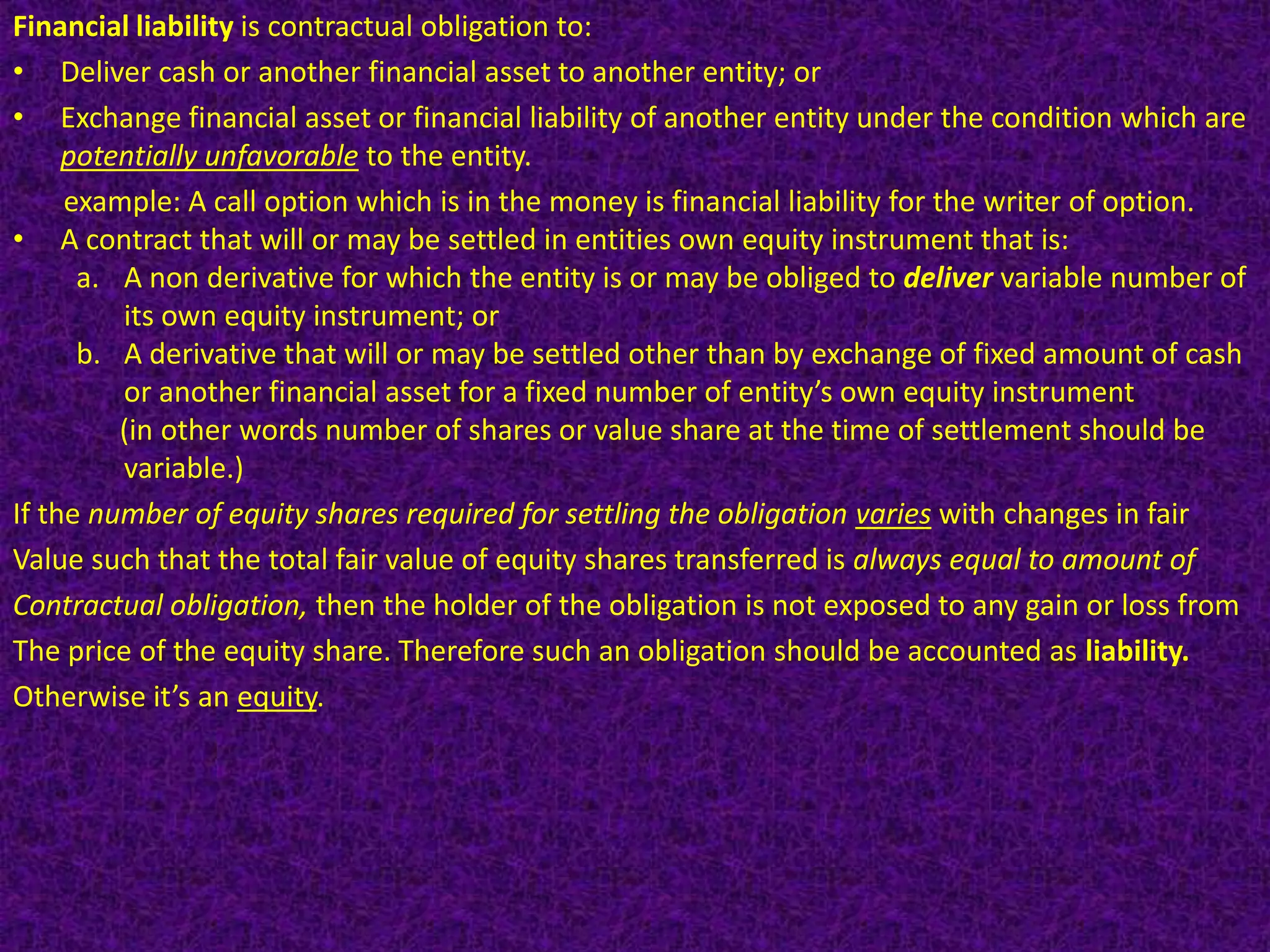
Financial liability is contractual obligation to:
• Deliver cash or another financial asset to another entity; or
• Exchange financial asset or financial liability of another entity under the condition which are
     potentially unfavorable to the entity.
     example: A call option which is in the money is financial liability for the writer of option.
• A contract that will or may be settled in entities own equity instrument that is:
      a. A non derivative for which the entity is or may be obliged to deliver variable number of
         its own equity instrument; or
      b. A derivative that will or may be settled other than by exchange of fixed amount of cash
         or another financial asset for a fixed number of entity’s own equity instrument
         (in other words number of shares or value share at the time of settlement should be
         variable.)
If the number of equity shares required for settling the obligation varies with changes in fair
Value such that the total fair value of equity shares transferred is always equal to amount of
Contractual obligation, then the holder of the obligation is not exposed to any gain or loss from
The price of the equity share. Therefore such an obligation should be accounted as liability.
Otherwise it’s an equity.
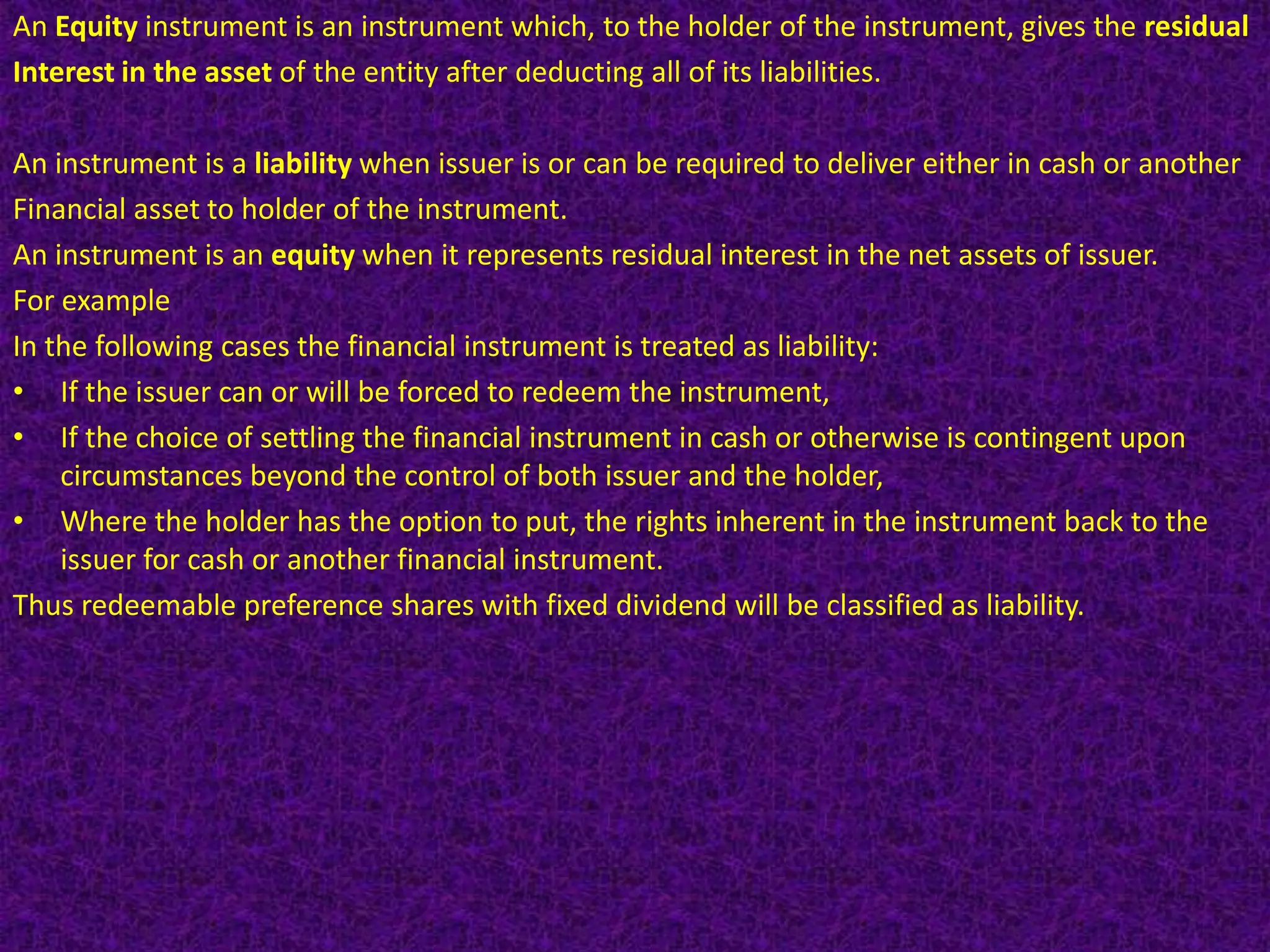
An Equity instrument is an instrument which, to the holder of the instrument, gives the residual
Interest in the asset of the entity after deducting all of its liabilities.

An instrument is a liability when issuer is or can be required to deliver either in cash or another
Financial asset to holder of the instrument.
An instrument is an equity when it represents residual interest in the net assets of issuer.
For example
In the following cases the financial instrument is treated as liability:
• If the issuer can or will be forced to redeem the instrument,
• If the choice of settling the financial instrument in cash or otherwise is contingent upon
    circumstances beyond the control of both issuer and the holder,
• Where the holder has the option to put, the rights inherent in the instrument back to the
    issuer for cash or another financial instrument.
Thus redeemable preference shares with fixed dividend will be classified as liability.
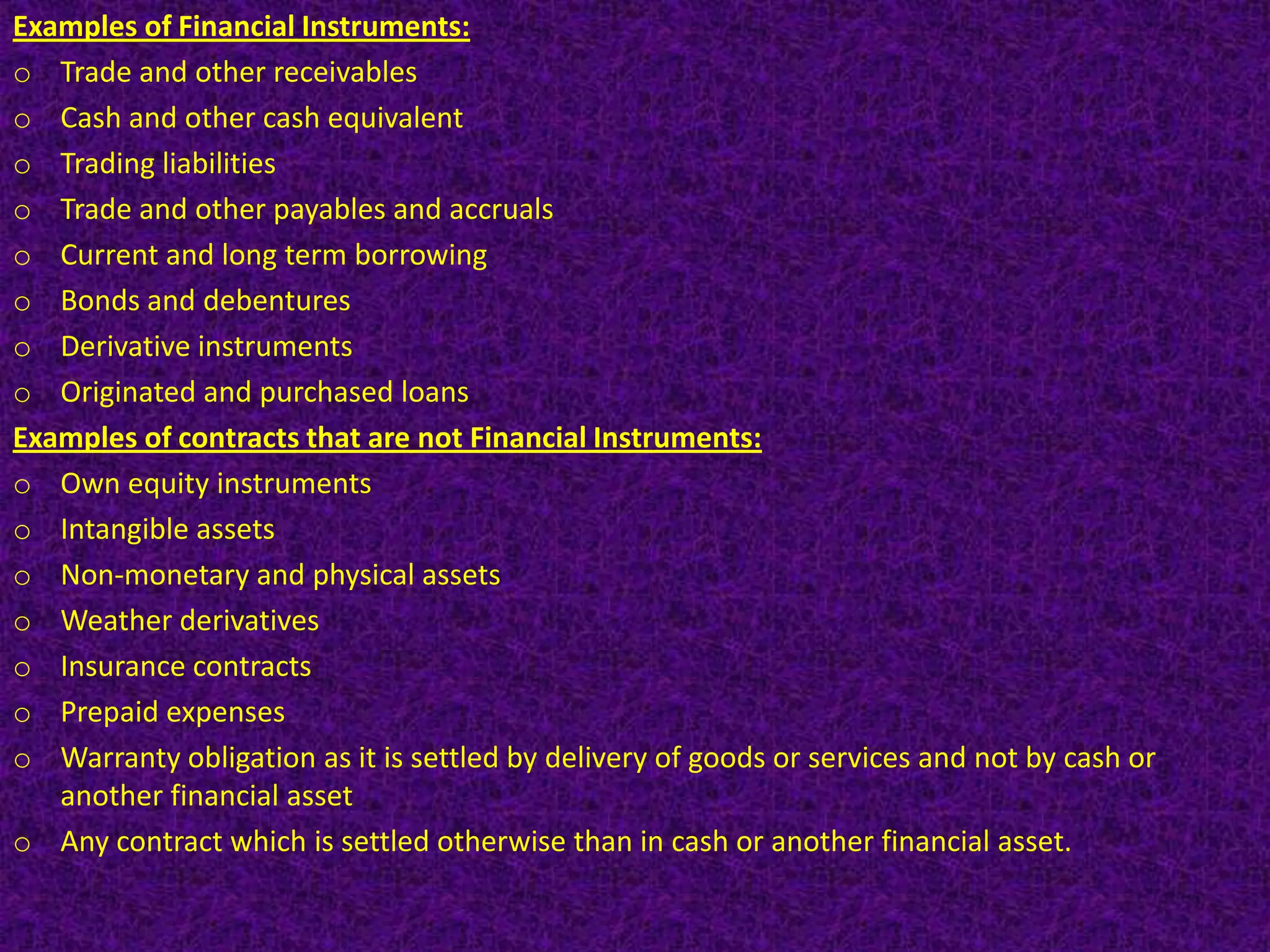
Examples of Financial Instruments:
o Trade and other receivables
o Cash and other cash equivalent
o Trading liabilities
o Trade and other payables and accruals
o Current and long term borrowing
o Bonds and debentures
o Derivative instruments
o Originated and purchased loans
Examples of contracts that are not Financial Instruments:
o Own equity instruments
o Intangible assets
o Non-monetary and physical assets
o Weather derivatives
o Insurance contracts
o Prepaid expenses
o Warranty obligation as it is settled by delivery of goods or services and not by cash or
   another financial asset
o Any contract which is settled otherwise than in cash or another financial asset.
Compound financial instrument
• It is instrument which contain elements of debt as well as equity. Eg convertible debenture
• It must be split into liability and equity component for accounting purpose.
• The liability element is determined by fair valuing cash flows excluding any equity
   component and balance is assigned to equity.
Example: 200, 5% convertible debentures issued @ Rs100 per debenture. Option of conversion
   can be exercised at end of four year. Prevailing market rate for similar debt without
   conversion option is 7%(assumed for calculation purpose)
Calculation carrying amount of liability portion                                      Rs
Present value of principal[ 20000* DF(7%, 4th year)]                                       15260
Present value of interest[1000*AF(7%, 4 year)]                                             3387
                                                                                           18647


Proceeds of issue                                                                          20000
Less: liability portion                                                                    18647
Equity portion                                                                             1353
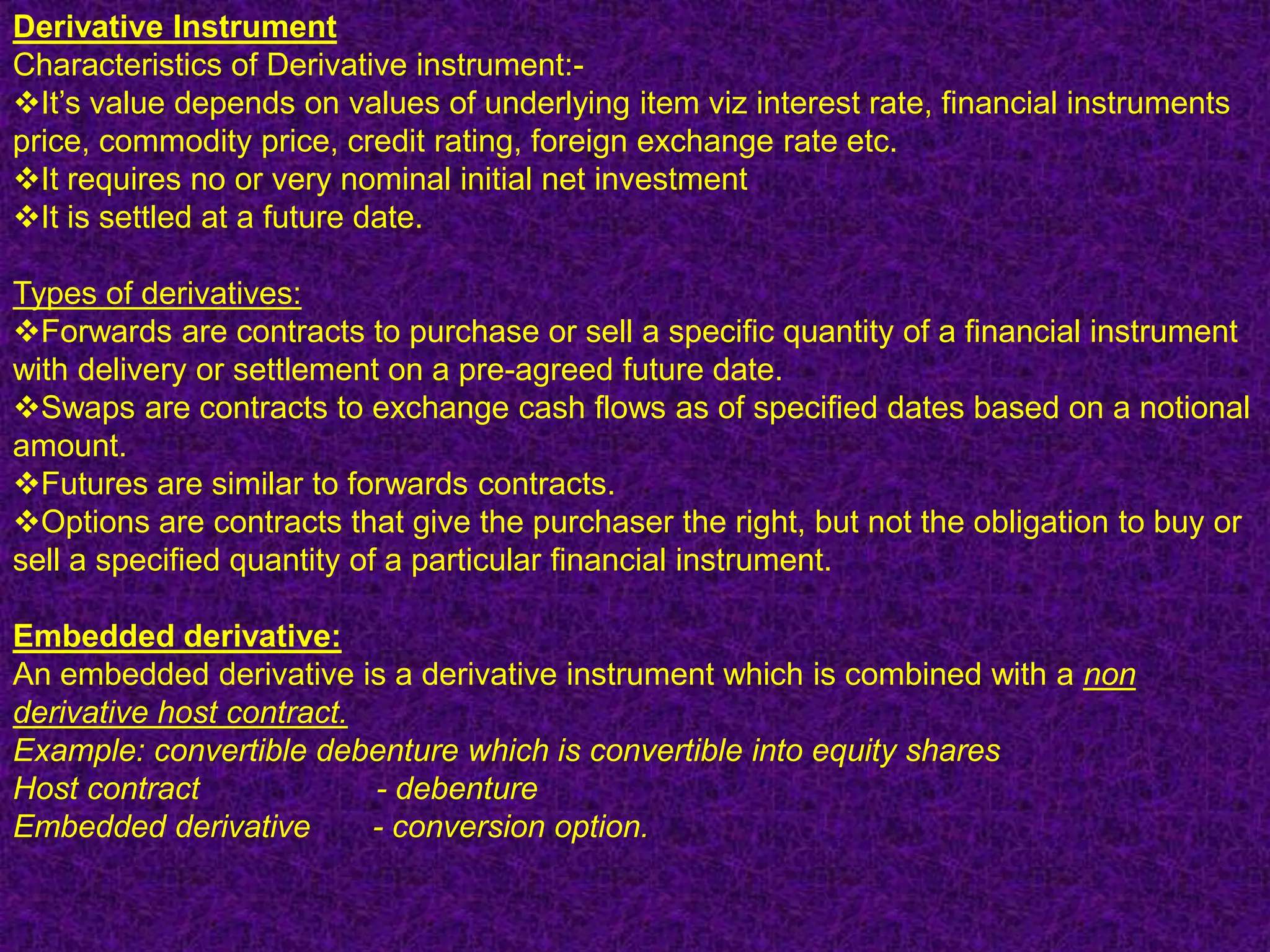
Derivative Instrument
Characteristics of Derivative instrument:-
It‟s value depends on values of underlying item viz interest rate, financial instruments
price, commodity price, credit rating, foreign exchange rate etc.
It requires no or very nominal initial net investment
It is settled at a future date.

Types of derivatives:
Forwards are contracts to purchase or sell a specific quantity of a financial instrument
with delivery or settlement on a pre-agreed future date.
Swaps are contracts to exchange cash flows as of specified dates based on a notional
amount.
Futures are similar to forwards contracts.
Options are contracts that give the purchaser the right, but not the obligation to buy or
sell a specified quantity of a particular financial instrument.

Embedded derivative:
An embedded derivative is a derivative instrument which is combined with a non
derivative host contract.
Example: convertible debenture which is convertible into equity shares
Host contract             - debenture
Embedded derivative       - conversion option.
Scope of AS 30:
The scope of the standard is very wide. So here is the negative list i.e. the financial
instruments which are out of scope of this standard
Interest in subsidiaries
Interest in joint ventures
Interest in associates
Obligation arising under insurance contracts
Employee benefit plans
Right and obligation under lease to which AS-19, “Leases” applies subject to certain
exception
These financial instruments are recognized and measured according to the respective
standards applicable to them.
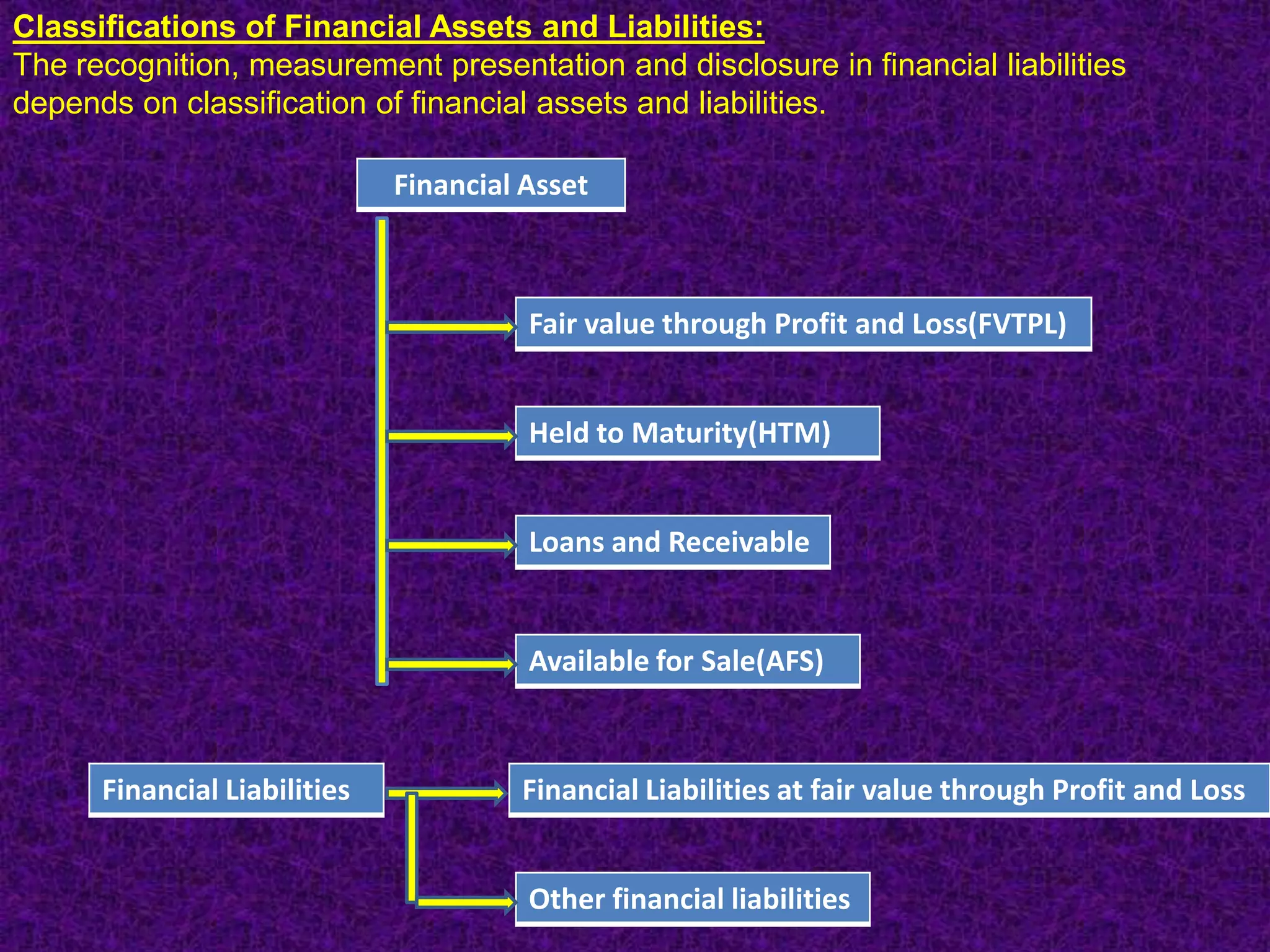
Classifications of Financial Assets and Liabilities:
The recognition, measurement presentation and disclosure in financial liabilities
depends on classification of financial assets and liabilities.

                              Financial Asset


                                        Fair value through Profit and Loss(FVTPL)


                                        Held to Maturity(HTM)


                                        Loans and Receivable


                                        Available for Sale(AFS)


      Financial Liabilities            Financial Liabilities at fair value through Profit and Loss


                                        Other financial liabilities
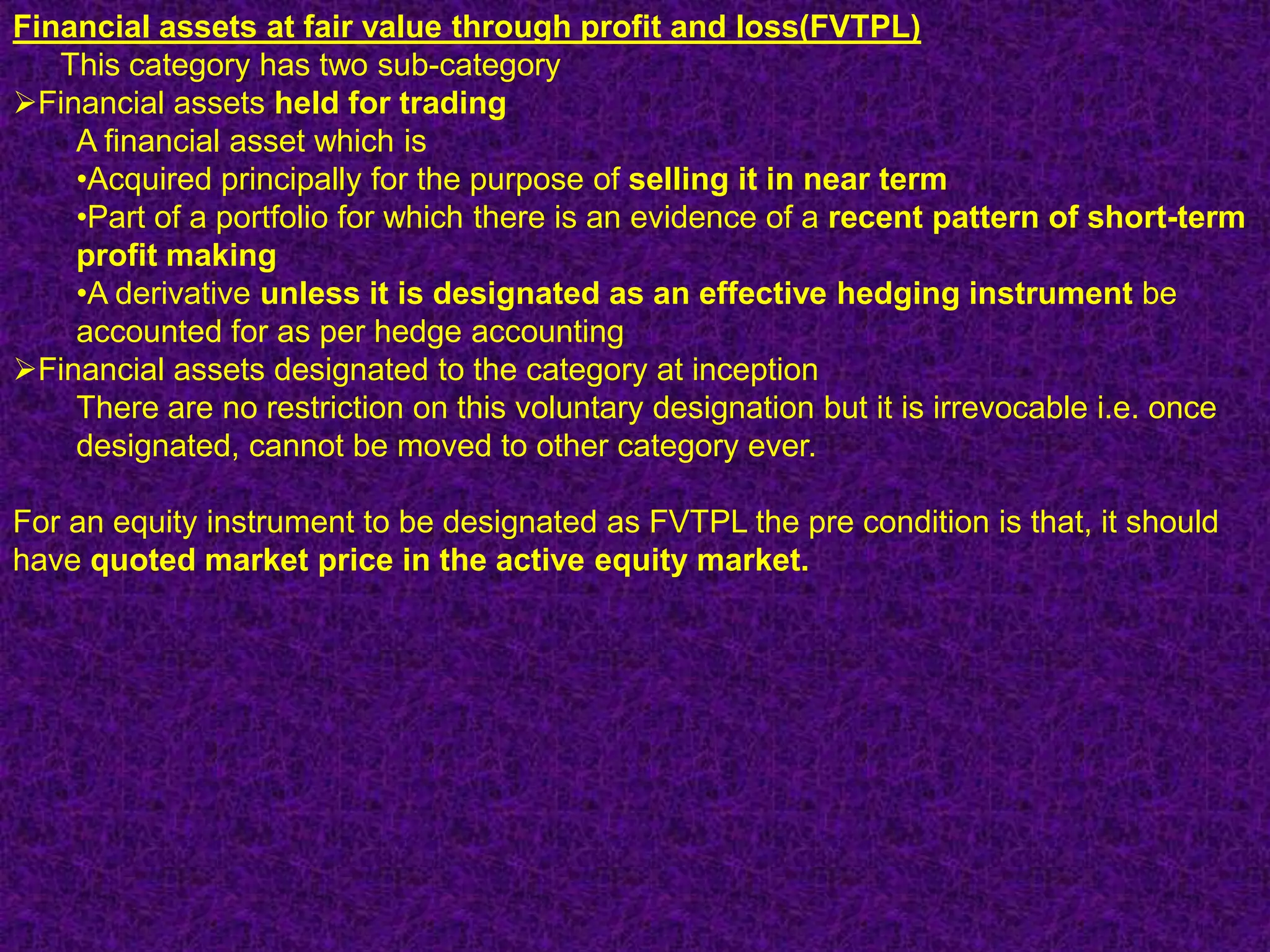
Financial assets at fair value through profit and loss(FVTPL)
   This category has two sub-category
Financial assets held for trading
    A financial asset which is
    •Acquired principally for the purpose of selling it in near term
    •Part of a portfolio for which there is an evidence of a recent pattern of short-term
    profit making
    •A derivative unless it is designated as an effective hedging instrument be
    accounted for as per hedge accounting
Financial assets designated to the category at inception
    There are no restriction on this voluntary designation but it is irrevocable i.e. once
    designated, cannot be moved to other category ever.

For an equity instrument to be designated as FVTPL the pre condition is that, it should
have quoted market price in the active equity market.
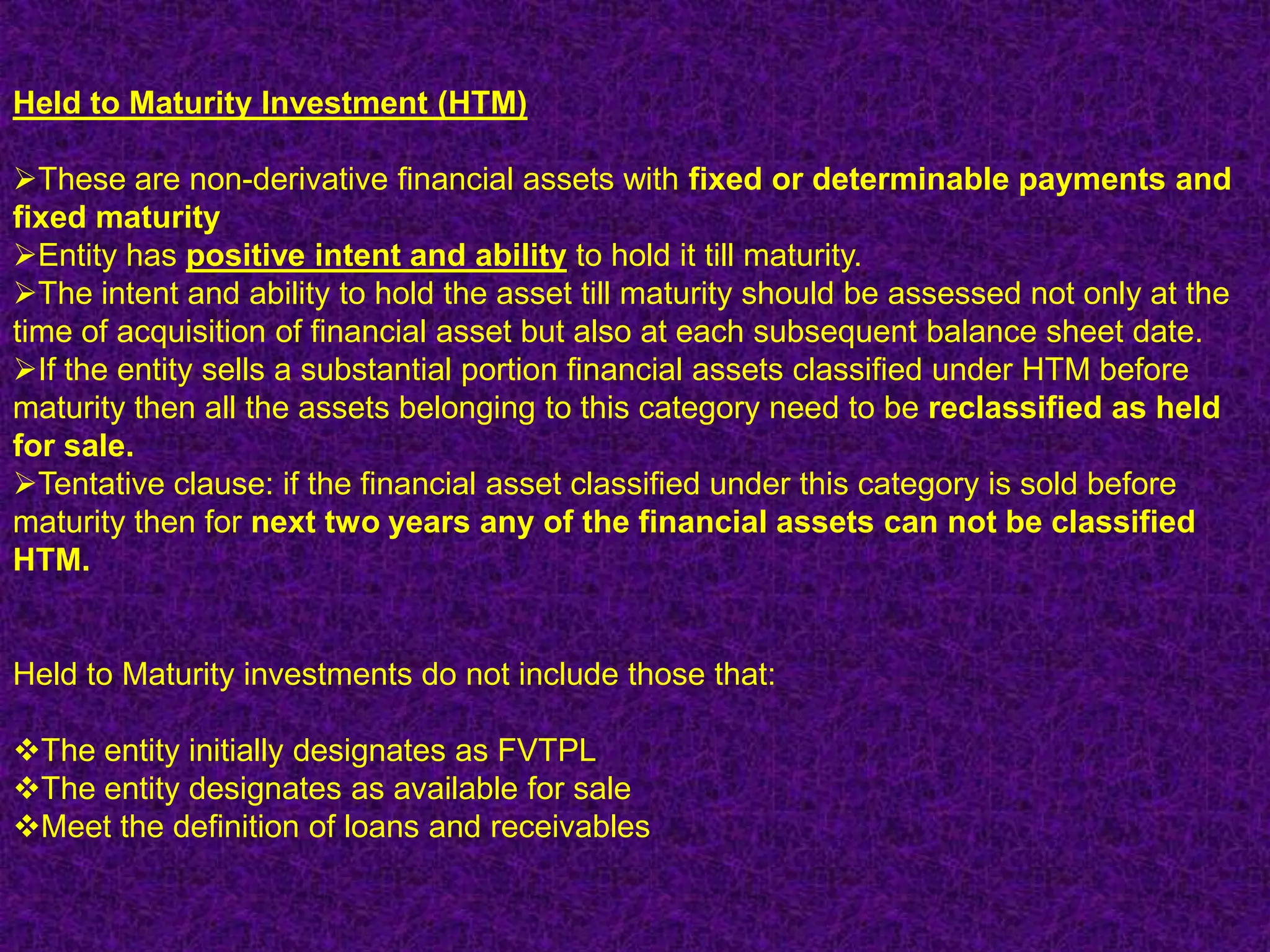
Held to Maturity Investment (HTM)

These are non-derivative financial assets with fixed or determinable payments and
fixed maturity
Entity has positive intent and ability to hold it till maturity.
The intent and ability to hold the asset till maturity should be assessed not only at the
time of acquisition of financial asset but also at each subsequent balance sheet date.
If the entity sells a substantial portion financial assets classified under HTM before
maturity then all the assets belonging to this category need to be reclassified as held
for sale.
Tentative clause: if the financial asset classified under this category is sold before
maturity then for next two years any of the financial assets can not be classified
HTM.


Held to Maturity investments do not include those that:

The entity initially designates as FVTPL
The entity designates as available for sale
Meet the definition of loans and receivables
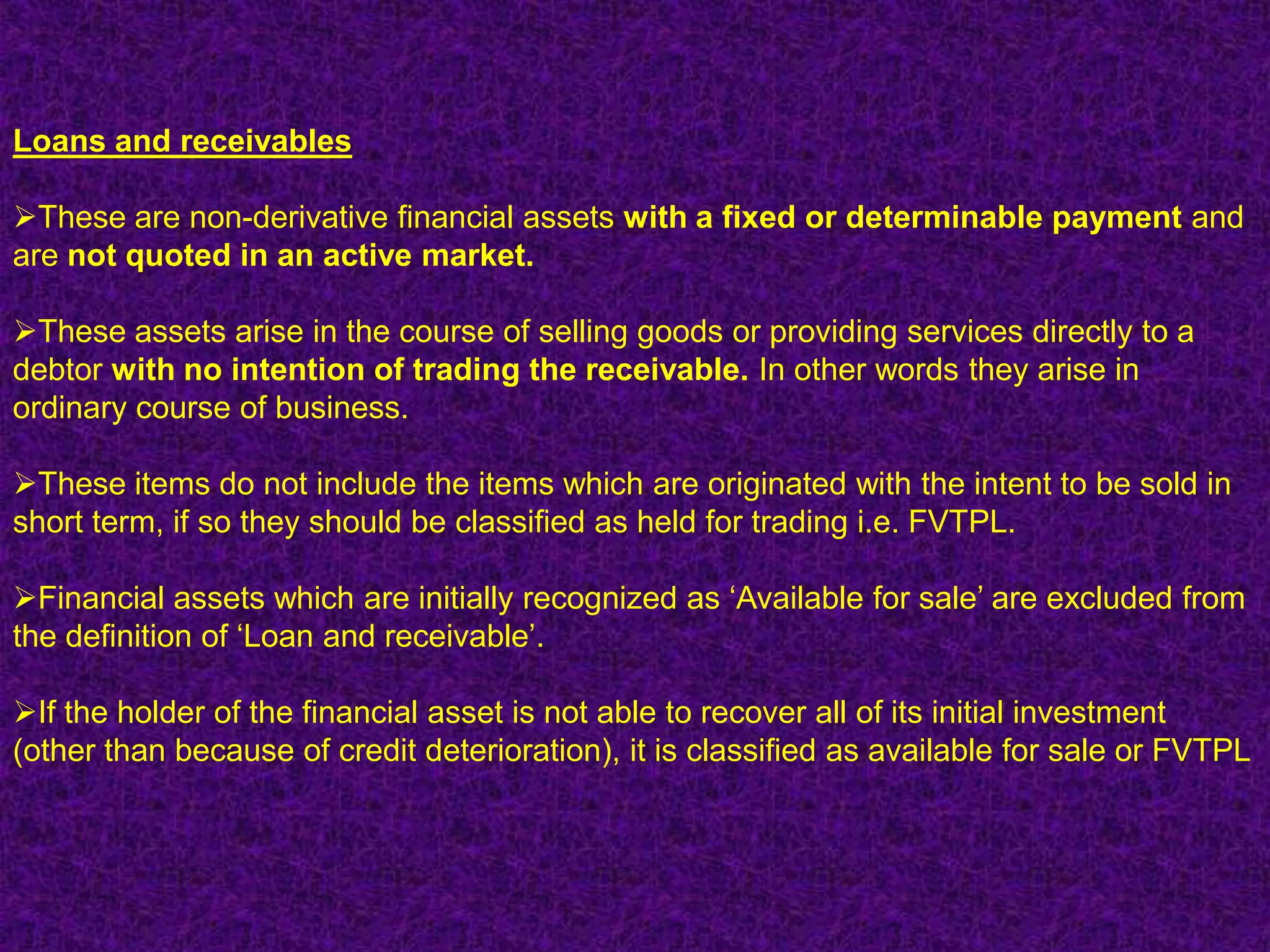
Loans and receivables

These are non-derivative financial assets with a fixed or determinable payment and
are not quoted in an active market.

These assets arise in the course of selling goods or providing services directly to a
debtor with no intention of trading the receivable. In other words they arise in
ordinary course of business.

These items do not include the items which are originated with the intent to be sold in
short term, if so they should be classified as held for trading i.e. FVTPL.

Financial assets which are initially recognized as „Available for sale‟ are excluded from
the definition of „Loan and receivable‟.

If the holder of the financial asset is not able to recover all of its initial investment
(other than because of credit deterioration), it is classified as available for sale or FVTPL
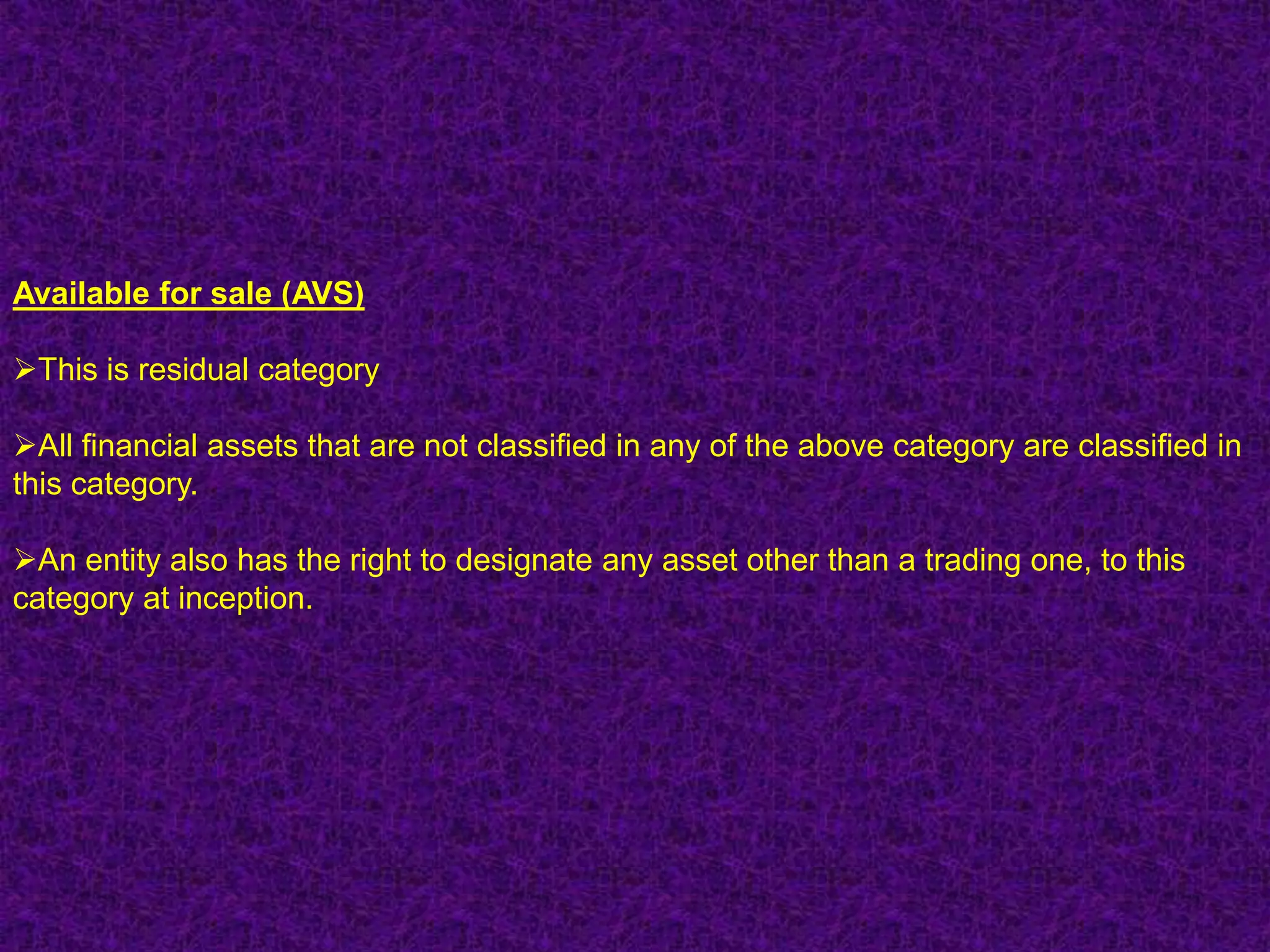
Available for sale (AVS)

This is residual category

All financial assets that are not classified in any of the above category are classified in
this category.

An entity also has the right to designate any asset other than a trading one, to this
category at inception.
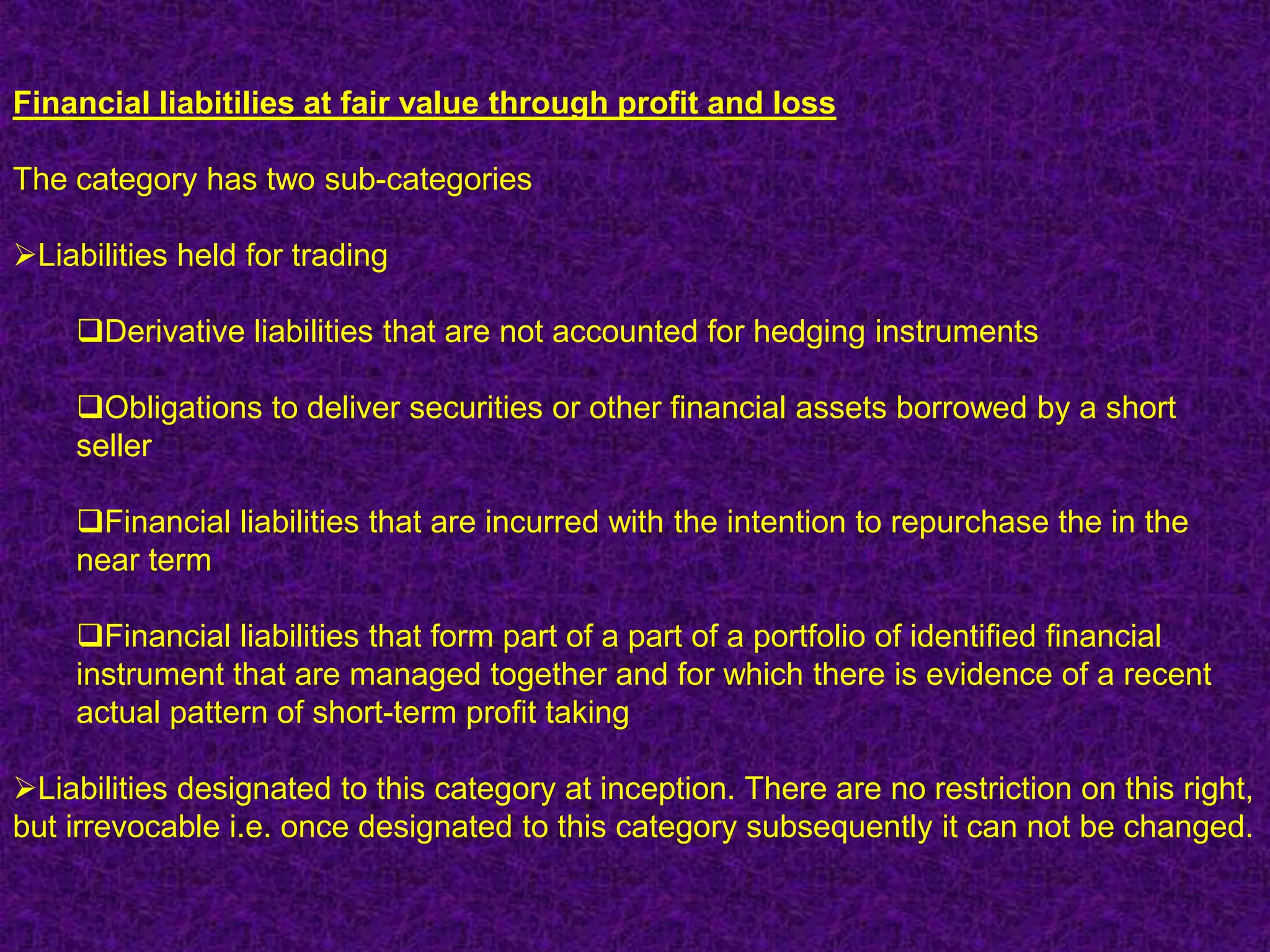
Financial liabitilies at fair value through profit and loss

The category has two sub-categories

Liabilities held for trading

    Derivative liabilities that are not accounted for hedging instruments

    Obligations to deliver securities or other financial assets borrowed by a short
    seller

    Financial liabilities that are incurred with the intention to repurchase the in the
    near term

    Financial liabilities that form part of a part of a portfolio of identified financial
    instrument that are managed together and for which there is evidence of a recent
    actual pattern of short-term profit taking

Liabilities designated to this category at inception. There are no restriction on this right,
but irrevocable i.e. once designated to this category subsequently it can not be changed.
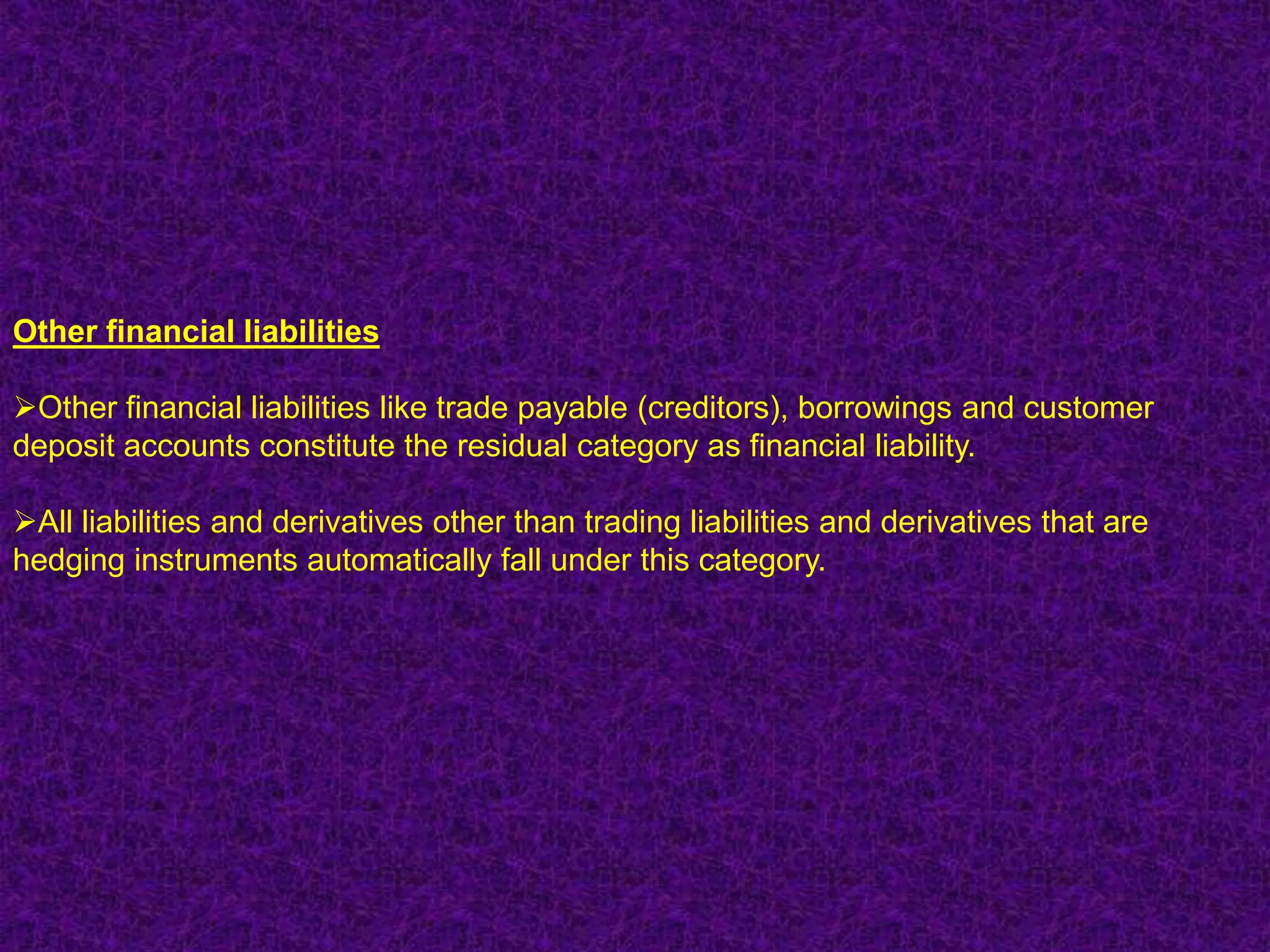
Other financial liabilities

Other financial liabilities like trade payable (creditors), borrowings and customer
deposit accounts constitute the residual category as financial liability.

All liabilities and derivatives other than trading liabilities and derivatives that are
hedging instruments automatically fall under this category.
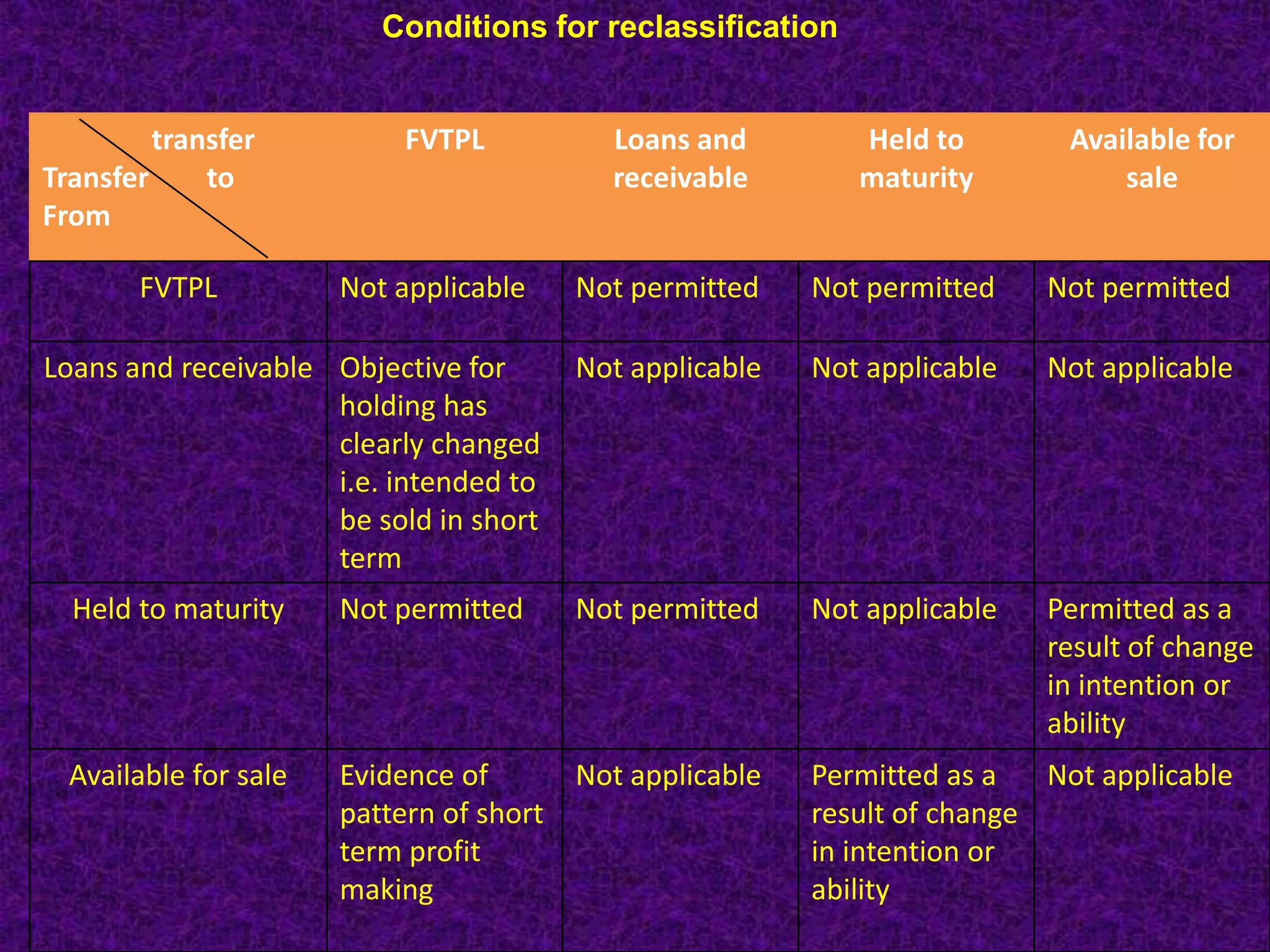
Conditions for reclassification


         transfer           FVTPL           Loans and         Held to        Available for
Transfer     to                             receivable        maturity           sale
From

       FVTPL           Not applicable     Not permitted    Not permitted    Not permitted

Loans and receivable Objective for        Not applicable   Not applicable   Not applicable
                     holding has
                     clearly changed
                     i.e. intended to
                     be sold in short
                     term
  Held to maturity     Not permitted      Not permitted    Not applicable   Permitted as a
                                                                            result of change
                                                                            in intention or
                                                                            ability
  Available for sale   Evidence of        Not applicable   Permitted as a   Not applicable
                       pattern of short                    result of change
                       term profit                         in intention or
                       making                              ability
IF YOU HAVE ANY SUGGESTION, OPINION OR FEEDBACK
         PLEASE FEEL FREE TO WRITE US AT
          roshankumar.2007@rediffmail.com
Roshankumar S Pimpalkar

AS 30 Part I

  • 2.
    Financial Instrument isany contract that gives rise to financial asset of one entity and a financial liability or equity instrument of another entity. Financial Asset •Cash; •An equity instrument of another entity; •A contractual right- a. To receive cash or another financial asset from another entity; or b. To exchange financial asset or financial liability with another entity under conditions that are potentially favorable to the entity. example: A call option which is in the money is financial asset for the holder. • A contract that will or may be settled in entities own equity instrument that is: a. A non derivative for which the entity is or may be obliged to receive variable number of its own equity instrument; or b. A derivative that will or may be settled other than by exchange of fixed amount of cash or another financial asset for a fixed number of entity’s own equity instrument (in other words number of shares or value share at the time of settlement should be variable.)
  • 3.
    Financial liability iscontractual obligation to: • Deliver cash or another financial asset to another entity; or • Exchange financial asset or financial liability of another entity under the condition which are potentially unfavorable to the entity. example: A call option which is in the money is financial liability for the writer of option. • A contract that will or may be settled in entities own equity instrument that is: a. A non derivative for which the entity is or may be obliged to deliver variable number of its own equity instrument; or b. A derivative that will or may be settled other than by exchange of fixed amount of cash or another financial asset for a fixed number of entity’s own equity instrument (in other words number of shares or value share at the time of settlement should be variable.) If the number of equity shares required for settling the obligation varies with changes in fair Value such that the total fair value of equity shares transferred is always equal to amount of Contractual obligation, then the holder of the obligation is not exposed to any gain or loss from The price of the equity share. Therefore such an obligation should be accounted as liability. Otherwise it’s an equity.
  • 4.
    An Equity instrumentis an instrument which, to the holder of the instrument, gives the residual Interest in the asset of the entity after deducting all of its liabilities. An instrument is a liability when issuer is or can be required to deliver either in cash or another Financial asset to holder of the instrument. An instrument is an equity when it represents residual interest in the net assets of issuer. For example In the following cases the financial instrument is treated as liability: • If the issuer can or will be forced to redeem the instrument, • If the choice of settling the financial instrument in cash or otherwise is contingent upon circumstances beyond the control of both issuer and the holder, • Where the holder has the option to put, the rights inherent in the instrument back to the issuer for cash or another financial instrument. Thus redeemable preference shares with fixed dividend will be classified as liability.
  • 5.
    Examples of FinancialInstruments: o Trade and other receivables o Cash and other cash equivalent o Trading liabilities o Trade and other payables and accruals o Current and long term borrowing o Bonds and debentures o Derivative instruments o Originated and purchased loans Examples of contracts that are not Financial Instruments: o Own equity instruments o Intangible assets o Non-monetary and physical assets o Weather derivatives o Insurance contracts o Prepaid expenses o Warranty obligation as it is settled by delivery of goods or services and not by cash or another financial asset o Any contract which is settled otherwise than in cash or another financial asset.
  • 6.
    Compound financial instrument •It is instrument which contain elements of debt as well as equity. Eg convertible debenture • It must be split into liability and equity component for accounting purpose. • The liability element is determined by fair valuing cash flows excluding any equity component and balance is assigned to equity. Example: 200, 5% convertible debentures issued @ Rs100 per debenture. Option of conversion can be exercised at end of four year. Prevailing market rate for similar debt without conversion option is 7%(assumed for calculation purpose) Calculation carrying amount of liability portion Rs Present value of principal[ 20000* DF(7%, 4th year)] 15260 Present value of interest[1000*AF(7%, 4 year)] 3387 18647 Proceeds of issue 20000 Less: liability portion 18647 Equity portion 1353
  • 7.
    Derivative Instrument Characteristics ofDerivative instrument:- It‟s value depends on values of underlying item viz interest rate, financial instruments price, commodity price, credit rating, foreign exchange rate etc. It requires no or very nominal initial net investment It is settled at a future date. Types of derivatives: Forwards are contracts to purchase or sell a specific quantity of a financial instrument with delivery or settlement on a pre-agreed future date. Swaps are contracts to exchange cash flows as of specified dates based on a notional amount. Futures are similar to forwards contracts. Options are contracts that give the purchaser the right, but not the obligation to buy or sell a specified quantity of a particular financial instrument. Embedded derivative: An embedded derivative is a derivative instrument which is combined with a non derivative host contract. Example: convertible debenture which is convertible into equity shares Host contract - debenture Embedded derivative - conversion option.
  • 8.
    Scope of AS30: The scope of the standard is very wide. So here is the negative list i.e. the financial instruments which are out of scope of this standard Interest in subsidiaries Interest in joint ventures Interest in associates Obligation arising under insurance contracts Employee benefit plans Right and obligation under lease to which AS-19, “Leases” applies subject to certain exception These financial instruments are recognized and measured according to the respective standards applicable to them.
  • 9.
    Classifications of FinancialAssets and Liabilities: The recognition, measurement presentation and disclosure in financial liabilities depends on classification of financial assets and liabilities. Financial Asset Fair value through Profit and Loss(FVTPL) Held to Maturity(HTM) Loans and Receivable Available for Sale(AFS) Financial Liabilities Financial Liabilities at fair value through Profit and Loss Other financial liabilities
  • 10.
    Financial assets atfair value through profit and loss(FVTPL) This category has two sub-category Financial assets held for trading A financial asset which is •Acquired principally for the purpose of selling it in near term •Part of a portfolio for which there is an evidence of a recent pattern of short-term profit making •A derivative unless it is designated as an effective hedging instrument be accounted for as per hedge accounting Financial assets designated to the category at inception There are no restriction on this voluntary designation but it is irrevocable i.e. once designated, cannot be moved to other category ever. For an equity instrument to be designated as FVTPL the pre condition is that, it should have quoted market price in the active equity market.
  • 11.
    Held to MaturityInvestment (HTM) These are non-derivative financial assets with fixed or determinable payments and fixed maturity Entity has positive intent and ability to hold it till maturity. The intent and ability to hold the asset till maturity should be assessed not only at the time of acquisition of financial asset but also at each subsequent balance sheet date. If the entity sells a substantial portion financial assets classified under HTM before maturity then all the assets belonging to this category need to be reclassified as held for sale. Tentative clause: if the financial asset classified under this category is sold before maturity then for next two years any of the financial assets can not be classified HTM. Held to Maturity investments do not include those that: The entity initially designates as FVTPL The entity designates as available for sale Meet the definition of loans and receivables
  • 12.
    Loans and receivables Theseare non-derivative financial assets with a fixed or determinable payment and are not quoted in an active market. These assets arise in the course of selling goods or providing services directly to a debtor with no intention of trading the receivable. In other words they arise in ordinary course of business. These items do not include the items which are originated with the intent to be sold in short term, if so they should be classified as held for trading i.e. FVTPL. Financial assets which are initially recognized as „Available for sale‟ are excluded from the definition of „Loan and receivable‟. If the holder of the financial asset is not able to recover all of its initial investment (other than because of credit deterioration), it is classified as available for sale or FVTPL
  • 13.
    Available for sale(AVS) This is residual category All financial assets that are not classified in any of the above category are classified in this category. An entity also has the right to designate any asset other than a trading one, to this category at inception.
  • 14.
    Financial liabitilies atfair value through profit and loss The category has two sub-categories Liabilities held for trading Derivative liabilities that are not accounted for hedging instruments Obligations to deliver securities or other financial assets borrowed by a short seller Financial liabilities that are incurred with the intention to repurchase the in the near term Financial liabilities that form part of a part of a portfolio of identified financial instrument that are managed together and for which there is evidence of a recent actual pattern of short-term profit taking Liabilities designated to this category at inception. There are no restriction on this right, but irrevocable i.e. once designated to this category subsequently it can not be changed.
  • 15.
    Other financial liabilities Otherfinancial liabilities like trade payable (creditors), borrowings and customer deposit accounts constitute the residual category as financial liability. All liabilities and derivatives other than trading liabilities and derivatives that are hedging instruments automatically fall under this category.
  • 16.
    Conditions for reclassification transfer FVTPL Loans and Held to Available for Transfer to receivable maturity sale From FVTPL Not applicable Not permitted Not permitted Not permitted Loans and receivable Objective for Not applicable Not applicable Not applicable holding has clearly changed i.e. intended to be sold in short term Held to maturity Not permitted Not permitted Not applicable Permitted as a result of change in intention or ability Available for sale Evidence of Not applicable Permitted as a Not applicable pattern of short result of change term profit in intention or making ability
  • 17.
    IF YOU HAVEANY SUGGESTION, OPINION OR FEEDBACK PLEASE FEEL FREE TO WRITE US AT roshankumar.2007@rediffmail.com
  • 18.