ACCOUNTING
Business
• It includes any activity undertaken for the purpose of
earning profit e.g:
• Banking business
• An insurance business
• A merchandise business etc
Proprietor
• He is the owner of a business. He invests capital in it,
gives his time and attention to it. He is entitled to receive
the profit or bear loss arising out of it.
Capital
• The amount with which the trader starts his business or
the amount which is actually invested in the business at
any given time is known as capital. This is the owners
financial interest or holding in the business and is
represents by the value of net assets.
Drawings
• The cash or goods taken away by the proprietor from the
business for his personal use are called his drawings.
Purchase
• Goods purchased are called purchases. When the goods
are purchased for cash they are called cash purchases
but if they are purchased for which payment will have to
be made at some future date it is known as credit
purchases.
Purchases returns
• If goods purchased are found defective or unsatisfactory,
they are sometime returned to the persons from whom
they were purchased or to suppliers are called purchases
returns or returns outwards.
Sales
• Goods sold are called sales. When goods are sold for
cash they are called cash sales but when they are sold
without having received payment, they are credit sales.
Sales returns
• If a person to whom goods have been sold find that they
are defective or unsatisfactory and returns them are
called sales returns or returns inwards.
Trade discount
• It is a rebate or allowance from the scheduled price
granted by the seller to the buyer.
• Trade discount is usually granted in the following
circumstances:
• When selling to a fellow trader
• When the buyer is an old customer
• When sales are made in bulk.
• As a custom of trade.
Cash discount
• It is deduction or allowance allowed by the creditor to a
debtor. If a person pays his debt before the due date of
payment the receipt may grant him an allowance for doing
so. This allowance is known as cash discount.
Commission
• It is a form of remuneration for services rendered by one
person to another.
• Expenditure
An expenditure takes place when assets or service is
acquired.
Expense
• It means an expenditure whose benefit is finished or
enjoyed immediately such as salaries, rent etc.
• Distinct between expense and expenditure is that the
benefit of the former is consumed by the business in
present whereas in latter case benefit will be available for
future activities of the business.
Debtor (Account Receivable)
• A person who owes money to another is a debtor. When
we say that we owe Mr. Rahim Rs. 200, we mean that we
have received from Mr. Rahim 200 rupees which we have
to repay. We stand as debtor to Mr. Rahim for Rs. 200. it
is also termed as Account Receivable.
Creditor
• A person who pays out something or to whom money is
owing is a creditor. It is also termed as account payable.
Assets
• These are things of value possessed by a trader such as
building, land, machinery, furniture etc.
Liabilities
• They are the debts due by a business to its proprietor and
others.
• Goods
• It includes all merchandise commodities which are
purchased by the business for selling.
Stock (Inventory)
• Goods or merchandise on hand, that is good remaining
unsold, is called stock, stack in trade or inventory.
Equity
• A claim which can be enforced against the assets of the
firm is called equity.
• In other words, the right to properties are called equities.
Types of equity
• Right of creditors
• Right of owners
Definition of Accounting
• Accounting is defined as the art of recording, classifying
and summarizing in terms of money transactions and
events of a financial character and interpreting the results
thereof.
Types of Accounting
• Financial accounting
• Cost accounting
• Management accounting
Financial Accounting
• It is the original form of accounting. It is mainly confined to
the preparation of financial statements for the use of
outsiders like creditors, banks and financial institutions
etc. the chief purpose of financial accounting is to
calculate profit or loss made by the business during the
year and exhibit financial position of the business as on a
particular date.
Cost Accounting
• Function of cost accounting is to ascertain the cost of a
product and to help the management in the control of
cost.
Management Accounting
• It is accounting for the management. Accounting which
provides necessary information to the management for
discharging its functions. It is the reproduction of financial
accounts in such a way as will enable the management to
take decisions and to control activities.
Functions of Accounting
• Record keeping
• Protect business properties
• Legal requirement function
• Communicating the results
Parties interested in accounting
information
• Owners
• Management
• Creditors
• Employees
• Investors
• Government
• Consumers
Systems of accounting
There are basically two systems of accounting
• Cash system of accounting
• Accrual system of accounting
Basic Terminologies of Accounting
• Accounts receivable (AR)
• Accounts payable (AP)
• Assets (fixed and current) (FA, CA)
• Asset classes
• Balance sheet (BS)
• Capital (CAP)
• Cash flow (CF)
• Cost of goods sold (COGS)
• Credit (CR)
• Debit (DR)
• Expenses (fixed, variable, accrued, operation)
(FE, VE, AE, OE)
Rules of Debit and Credit
• For Asset Account
Increase in an asset is debit.
Decrease in an asset is credit.
• For Liabilities Account
Decrease in a liability account is debit.
Increase in a liability account is credit.
Cont.
• For Proprietorship Account
Decrease in proprietorship account is debit
Increase in proprietorship account is credit
• For Revenue Account
Decrease in revenue account is debit
Increase in revenue account is credit
• For Expense account
Increase in expense account is debit
Decrease in expense account is credit
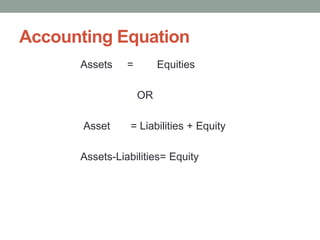
Accounting Equation
Assets = Equities
OR
Asset = Liabilities + Equity
Assets-Liabilities= Equity
Problems
1. Prepare Accounting Equation on the basis of the
following
• Rahim started business with cash 20000 rupees
• Rahim purchased furniture for cash 2000.
• Rahim paid rent 200 rupees.
• Rahim purchased goods on credit 3000 Rs.
• Rahim sold goods (cost price Rs. 2000) for Rs. 5000 on
cash.
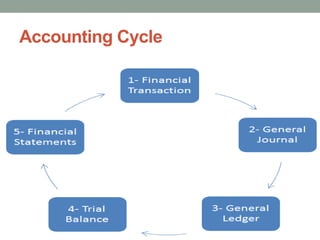
Accounting Cycle
Accounting Cycle
• It refers to a complete sequence of accounting
procedures which are required to be repeated in same
order during each accounting period. Accounting cycle
includes
a. Recording
b. Classifying
c. Summarizing
Recording
First, all transactions should be recorded in the journal or
books of Original Entry known as subsidiary books as and
when they take place.
Classifying
• All entries in the journal or books of original entry should
be posted to the appropriate ledger accounts to find out at
a glance the total effect of all such transactions in a
particular account.
Summarizing
• Last stage is to prepare the trial balance and a final
accounts with a view to ascertaining the profit or loss
made during a trading period and the financial position of
the business on a particular date.
Accounting Cycle
Transactions
• Any dealing between two persons or things is a
transaction. It may relate to purchase and sale of goods,
receipt and payment of cash and rendering of service by
one party to another.
• Transaction is of two kinds
• Cash transaction
• Credit transaction
Journal
• In accounting our object should be to record the business
transactions properly in a book. The first book to be used
for this purpose is called Journal.
• The word journal has been derived from the French word
“Jour”. Jour means day. So, journal means daily.
Transactions are recorded daily in journal and hence it
has been named so.
Cont.
• It is a book of original entry to record chronologically and
in detail the various transactions of a trader. It is also
known as “Day Book” because it contains the account of
every day’s transactions.
Characteristics of Journal
• Journal is the first successful step of the double entry
system. A transaction is recorded first of all in the journal.
So journal is called the book of original entry.
• A transaction is recorded on the same day it takes place.
So, journal is called Day Book.
• Transactions are recorded chronologically. So, journal is
called chronological Book.
Cont.
• Narration is written below each entry.
• The amount is written in the last two columns
• Debit amount in debit column
• Credit amount in credit column
Advantages of Journal
• Each transaction is recorded as soon as it takes place. So
there is no possibility of any transaction being omitted
from the books of account.
• Since the transactions are kept recorded in journal
chronologically with narration. It can be easily ascertained
when and why a transaction has taken place.
Cont.
• For each and every transaction which of the two
concerned accounts will be debited and which account
credited are clearly written in journal. So, there is no
possibility of committing any mistake in writing the ledger.
• Since all the details of transactions are recorded in
journal. It is not necessary to repeat them in ledger.
Cont.
• Journal shows the complete story of a transaction in one
entry.
• Any mistake in ledger can be easily detected with the help
of journal.
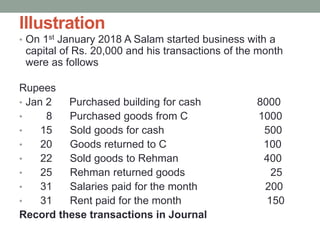
Illustration
• On 1st January 2018 A Salam started business with a
capital of Rs. 20,000 and his transactions of the month
were as follows
Rupees
• Jan 2 Purchased building for cash 8000
• 8 Purchased goods from C 1000
• 15 Sold goods for cash 500
• 20 Goods returned to C 100
• 22 Sold goods to Rehman 400
• 25 Rehman returned goods 25
• 31 Salaries paid for the month 200
• 31 Rent paid for the month 150
Record these transactions in Journal

Accounting cycle

  • 1.
  • 2.
    Business • It includesany activity undertaken for the purpose of earning profit e.g: • Banking business • An insurance business • A merchandise business etc
  • 3.
    Proprietor • He isthe owner of a business. He invests capital in it, gives his time and attention to it. He is entitled to receive the profit or bear loss arising out of it.
  • 4.
    Capital • The amountwith which the trader starts his business or the amount which is actually invested in the business at any given time is known as capital. This is the owners financial interest or holding in the business and is represents by the value of net assets.
  • 5.
    Drawings • The cashor goods taken away by the proprietor from the business for his personal use are called his drawings.
  • 6.
    Purchase • Goods purchasedare called purchases. When the goods are purchased for cash they are called cash purchases but if they are purchased for which payment will have to be made at some future date it is known as credit purchases.
  • 7.
    Purchases returns • Ifgoods purchased are found defective or unsatisfactory, they are sometime returned to the persons from whom they were purchased or to suppliers are called purchases returns or returns outwards.
  • 8.
    Sales • Goods soldare called sales. When goods are sold for cash they are called cash sales but when they are sold without having received payment, they are credit sales.
  • 9.
    Sales returns • Ifa person to whom goods have been sold find that they are defective or unsatisfactory and returns them are called sales returns or returns inwards.
  • 10.
    Trade discount • Itis a rebate or allowance from the scheduled price granted by the seller to the buyer. • Trade discount is usually granted in the following circumstances: • When selling to a fellow trader • When the buyer is an old customer • When sales are made in bulk. • As a custom of trade.
  • 11.
    Cash discount • Itis deduction or allowance allowed by the creditor to a debtor. If a person pays his debt before the due date of payment the receipt may grant him an allowance for doing so. This allowance is known as cash discount.
  • 12.
    Commission • It isa form of remuneration for services rendered by one person to another. • Expenditure An expenditure takes place when assets or service is acquired.
  • 13.
    Expense • It meansan expenditure whose benefit is finished or enjoyed immediately such as salaries, rent etc. • Distinct between expense and expenditure is that the benefit of the former is consumed by the business in present whereas in latter case benefit will be available for future activities of the business.
  • 14.
    Debtor (Account Receivable) •A person who owes money to another is a debtor. When we say that we owe Mr. Rahim Rs. 200, we mean that we have received from Mr. Rahim 200 rupees which we have to repay. We stand as debtor to Mr. Rahim for Rs. 200. it is also termed as Account Receivable.
  • 15.
    Creditor • A personwho pays out something or to whom money is owing is a creditor. It is also termed as account payable.
  • 16.
    Assets • These arethings of value possessed by a trader such as building, land, machinery, furniture etc.
  • 17.
    Liabilities • They arethe debts due by a business to its proprietor and others. • Goods • It includes all merchandise commodities which are purchased by the business for selling.
  • 18.
    Stock (Inventory) • Goodsor merchandise on hand, that is good remaining unsold, is called stock, stack in trade or inventory.
  • 19.
    Equity • A claimwhich can be enforced against the assets of the firm is called equity. • In other words, the right to properties are called equities.
  • 20.
    Types of equity •Right of creditors • Right of owners
  • 21.
    Definition of Accounting •Accounting is defined as the art of recording, classifying and summarizing in terms of money transactions and events of a financial character and interpreting the results thereof.
  • 22.
    Types of Accounting •Financial accounting • Cost accounting • Management accounting
  • 23.
    Financial Accounting • Itis the original form of accounting. It is mainly confined to the preparation of financial statements for the use of outsiders like creditors, banks and financial institutions etc. the chief purpose of financial accounting is to calculate profit or loss made by the business during the year and exhibit financial position of the business as on a particular date.
  • 24.
    Cost Accounting • Functionof cost accounting is to ascertain the cost of a product and to help the management in the control of cost.
  • 25.
    Management Accounting • Itis accounting for the management. Accounting which provides necessary information to the management for discharging its functions. It is the reproduction of financial accounts in such a way as will enable the management to take decisions and to control activities.
  • 26.
    Functions of Accounting •Record keeping • Protect business properties • Legal requirement function • Communicating the results
  • 27.
    Parties interested inaccounting information • Owners • Management • Creditors • Employees • Investors • Government • Consumers
  • 28.
    Systems of accounting Thereare basically two systems of accounting • Cash system of accounting • Accrual system of accounting
  • 29.
    Basic Terminologies ofAccounting • Accounts receivable (AR) • Accounts payable (AP) • Assets (fixed and current) (FA, CA) • Asset classes • Balance sheet (BS) • Capital (CAP) • Cash flow (CF) • Cost of goods sold (COGS) • Credit (CR) • Debit (DR) • Expenses (fixed, variable, accrued, operation) (FE, VE, AE, OE)
  • 30.
    Rules of Debitand Credit • For Asset Account Increase in an asset is debit. Decrease in an asset is credit. • For Liabilities Account Decrease in a liability account is debit. Increase in a liability account is credit.
  • 31.
    Cont. • For ProprietorshipAccount Decrease in proprietorship account is debit Increase in proprietorship account is credit • For Revenue Account Decrease in revenue account is debit Increase in revenue account is credit • For Expense account Increase in expense account is debit Decrease in expense account is credit
  • 32.
    Accounting Equation Assets =Equities OR Asset = Liabilities + Equity Assets-Liabilities= Equity
  • 33.
    Problems 1. Prepare AccountingEquation on the basis of the following • Rahim started business with cash 20000 rupees • Rahim purchased furniture for cash 2000. • Rahim paid rent 200 rupees. • Rahim purchased goods on credit 3000 Rs. • Rahim sold goods (cost price Rs. 2000) for Rs. 5000 on cash.
  • 34.
  • 35.
    Accounting Cycle • Itrefers to a complete sequence of accounting procedures which are required to be repeated in same order during each accounting period. Accounting cycle includes a. Recording b. Classifying c. Summarizing
  • 36.
    Recording First, all transactionsshould be recorded in the journal or books of Original Entry known as subsidiary books as and when they take place.
  • 37.
    Classifying • All entriesin the journal or books of original entry should be posted to the appropriate ledger accounts to find out at a glance the total effect of all such transactions in a particular account.
  • 38.
    Summarizing • Last stageis to prepare the trial balance and a final accounts with a view to ascertaining the profit or loss made during a trading period and the financial position of the business on a particular date.
  • 39.
  • 40.
    Transactions • Any dealingbetween two persons or things is a transaction. It may relate to purchase and sale of goods, receipt and payment of cash and rendering of service by one party to another. • Transaction is of two kinds • Cash transaction • Credit transaction
  • 41.
    Journal • In accountingour object should be to record the business transactions properly in a book. The first book to be used for this purpose is called Journal. • The word journal has been derived from the French word “Jour”. Jour means day. So, journal means daily. Transactions are recorded daily in journal and hence it has been named so.
  • 42.
    Cont. • It isa book of original entry to record chronologically and in detail the various transactions of a trader. It is also known as “Day Book” because it contains the account of every day’s transactions.
  • 43.
    Characteristics of Journal •Journal is the first successful step of the double entry system. A transaction is recorded first of all in the journal. So journal is called the book of original entry. • A transaction is recorded on the same day it takes place. So, journal is called Day Book. • Transactions are recorded chronologically. So, journal is called chronological Book.
  • 44.
    Cont. • Narration iswritten below each entry. • The amount is written in the last two columns • Debit amount in debit column • Credit amount in credit column
  • 45.
    Advantages of Journal •Each transaction is recorded as soon as it takes place. So there is no possibility of any transaction being omitted from the books of account. • Since the transactions are kept recorded in journal chronologically with narration. It can be easily ascertained when and why a transaction has taken place.
  • 46.
    Cont. • For eachand every transaction which of the two concerned accounts will be debited and which account credited are clearly written in journal. So, there is no possibility of committing any mistake in writing the ledger. • Since all the details of transactions are recorded in journal. It is not necessary to repeat them in ledger.
  • 47.
    Cont. • Journal showsthe complete story of a transaction in one entry. • Any mistake in ledger can be easily detected with the help of journal.
  • 48.
    Illustration • On 1stJanuary 2018 A Salam started business with a capital of Rs. 20,000 and his transactions of the month were as follows Rupees • Jan 2 Purchased building for cash 8000 • 8 Purchased goods from C 1000 • 15 Sold goods for cash 500 • 20 Goods returned to C 100 • 22 Sold goods to Rehman 400 • 25 Rehman returned goods 25 • 31 Salaries paid for the month 200 • 31 Rent paid for the month 150 Record these transactions in Journal