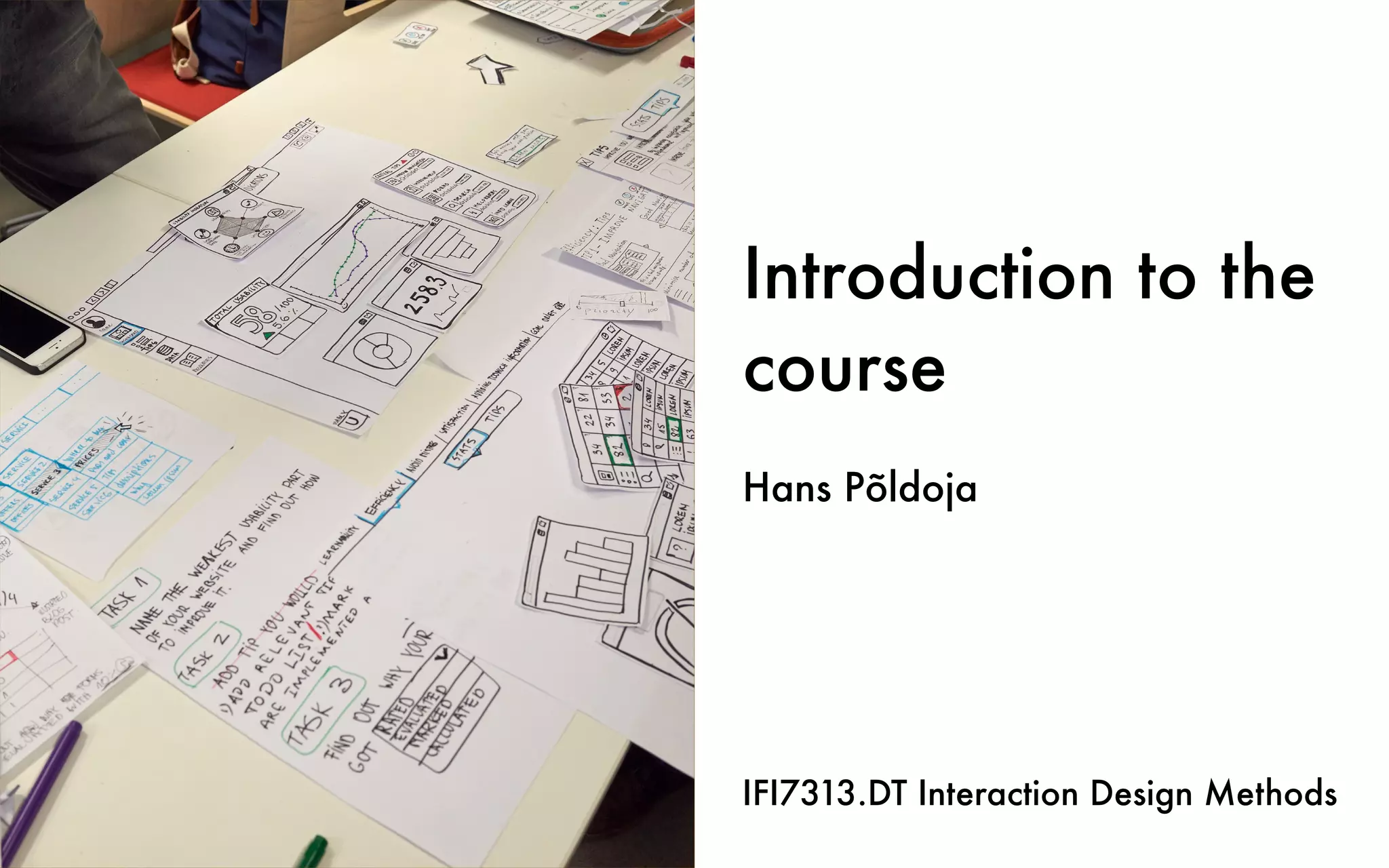
Introduction to the
course
Hans Põldoja
IFI7313.DT Interaction Design Methods
Hans Põldoja
Head of studies, lecturer of educational technology
Tallinn University, School of Digital Technologies
Education:
Aalto University, School of Arts, Design and Architecture (2016)
Tallinn Pedagogical University (2003)
hans.poldoja@tlu.ee
http://www.hanspoldoja.net
Introductions round
https://ifi7313.wordpress.com
Course objectives
• Practical: overview of interaction design methods, practical
IxD skills and group work skills
• Theoretical: working with academic literature on the field,
presenting design research in MA thesis
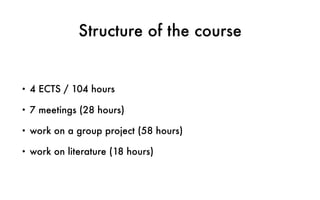
Structure of the course
• 4 ECTS / 104 hours
• 7 meetings (28 hours)
• work on a group project (58 hours)
• work on literature (18 hours)
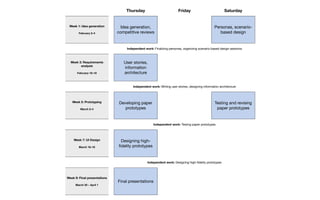
Week 1: Idea generation
February 2–4
Week 3: Requirements
analysis
February 16–18
Week 5: Prototyping
March 2–4
Week 7: UI Design
March 16–18
Idea generation,
competitive reviews
Personas, scenario-
based design
Thursday Friday Saturday
Week 9: Final presentations
March 30 – April 1
User stories,
information
architecture
Developing paper
prototypes
Designing high-
fidelity prototypes
Final presentations
Testing and revising
paper prototypes
Independent work: Finalizing personas, organizing scenario-based design sessions
Independent work: Writing user stories, designing information architecture
Independent work: Testing paper prototypes
Independent work: Designing high-fidelity prototypes
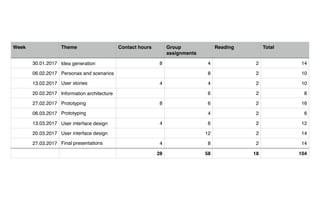
Week Theme Contact hours Group
assignments
Reading Total
30.01.2017 Idea generation 8 4 2 14
06.02.2017 Personas and scenarios 8 2 10
13.02.2017 User stories 4 4 2 10
20.02.2017 Information architecture 6 2 8
27.02.2017 Prototyping 8 6 2 16
06.03.2017 Prototyping 4 2 6
13.03.2017 User interface design 4 6 2 12
20.03.2017 User interface design 12 2 14
27.03.2017 Final presentations 4 8 2 14
28 58 18 104
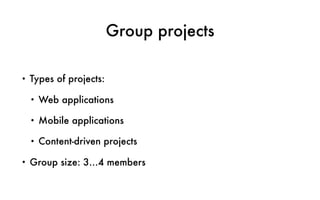
Group projects
• Types of projects:
• Web applications
• Mobile applications
• Content-driven projects
• Group size: 3…4 members
Learning environment
• Course blog: https://ifi7313.wordpress.com
• Group blogs
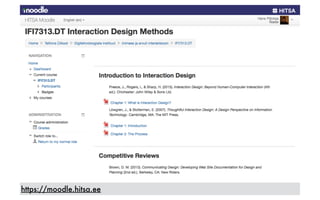
• Moodle for readings and grading: https://moodle.hitsa.ee
• GitHub
• SlideShare, YouTube, etc.
https://moodle.hitsa.ee
Assessment and grading
Assessement
• Exam
• 6 graded assignments
• 2 optional assignments
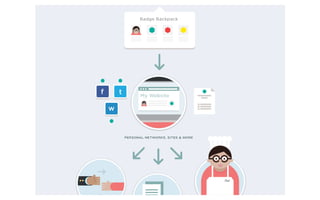
• Grading based on open badges achieved for the assignments
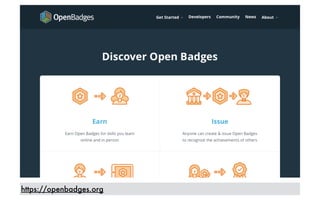
https://openbadges.org
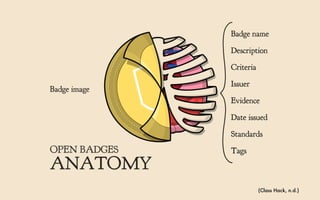
(Class Hack, n.d.)
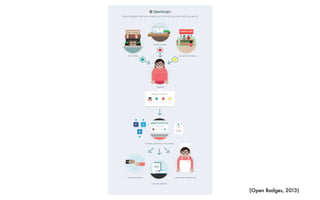
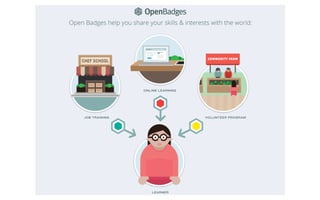
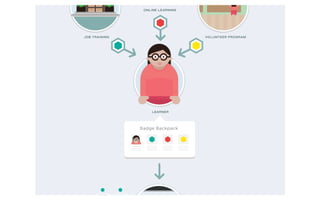
(Open Badges, 2013)
Põldoja, H., Jürgens, P., & Laanpere, M. (2016).
Design Patterns for Badge Systems in Higher
Education. In M. Spaniol, M. Temperini, D.K.W.
Chiu, I. Marenzi, & U. Nanni (eds.), Advances in
Web-Based Learning — ICWL 2016 (Vol. 10013, lk
40– 49). Cham: Springer. http://dx.doi.org/
10.1007/978-3-319-47440-3_5
Design Patterns for Badge Systems in Higher Education
Hans Põldoja
(✉)
, Pirje Jürgens, and Mart Laanpere
Tallinn University, Narva mnt 25, 10120 Tallinn, Estonia
{hans.poldoja,pirje.jurgens,mart.laanpere}@tlu.ee
Abstract. Open Badges as a method for assessment and recognition of learning
originates from the context of informal learning. Thus, it cannot be introduced
into formal higher education without reconsidering the existing assessment
processes.This paper presentsexperiencesfrom three years of using Open Badges
in a master level course. In each iteration, the badge system was revised based on
learners’ feedback. Special attention was given to supporting learners with
different learning styles. To summarize our findings, this paper proposes a set of
design patterns for developing badge systems in higher education. While the
learning styles proved to be useful as generic design guidelines for separating two
alternative learning pathways for the course, more research is needed on advanced
learning-style-based learning pathways.
Keywords: Open Badges · Assessment · Higher education
1 Introduction
Open Badges (OB’s) is a web technology for recognizing and verifying knowledge,
competencies or involvements gained in online or offline settings. In a basic sense,
badges are digital images that contain embedded information about the accomplish‐
ments. The development of the Open Badges technology started in 2010, when a group
of open education activists came up with the initial concept during the Mozilla Drumbeat
Festival. Inspired by the use of digital badges in gaming and various social apps, they
proposed that badges could be used for verifying learning. The technical specification
of the Open Badges Infrastructure (OBI) was developed together with the Mozilla
Foundation and released in 2012. While digital badges are typically used within a single
environment, OBI was developed as an open standard that allows people to collect
badges from different issuers. The initial scenarios about using open badges focused on
informal learning contexts [1]. However, in recent years there have been a number of
studies about using badges in schools [2, 3] and in higher education [4–6].
Introducing open badges to formal higher education courses provides an opportunity
to reconsider the existing assessment procedures. Recent research on open badges has
proposed a number of reasons for adopting badges. Ahn, Pellicone, and Butler [7] see
badges as motivators for behavior, pedagogical tools for promoting particular learning
activities, and credentials for recognizing learning achievements. While Jovanovic and
Devedzic [8] identify similar roles for open badges, they discuss additional benefits such
as supporting alternative forms of assessment (e.g. peer-assessment), providing learners
© Springer International Publishing AG 2016
D.K.W. Chiu et al. (Eds.): ICWL 2016, LNCS 10013, pp. 40–49, 2016.
DOI: 10.1007/978-3-319-47440-3_5
Põldoja, H., & Laanpere, M. (2014). Exploring the
Potential of Open Badges in Blog-Based University
Courses. In Y. Cao, T. Väljataga, J. K. T. Tang, H.
Leung, & M. Laanpere (Eds.), New Horizons in Web
Based Learning (Vol. 8699, pp. 172–178). Cham:
Springer. http://doi.org/
10.1007/978-3-319-13296-9_19
Exploring the Potential of Open Badges
in Blog-Based University Courses
Hans Põldoja(&)
and Mart Laanpere
Institute of Informatics, Tallinn University, Tallinn, Estonia
{hans.poldoja,mart.laanpere}@tlu.ee
Abstract. Recent developments with personal learning environments and open
online courses have led educators to experiment with opening up their formal
higher education courses. In these courses, the online learning activities take
place in open learning environments based on various Web 2.0 tools such as
blogs. Although this type of courses have a number of pedagogical benefits, they
also raise issues related to private grading of students’ works and recognizing
the learning of informal participants. This paper presents our exploratory study
on addressing these issues by introducing open badges to master’s level course
that takes place in a blog-based learning environment. Students’ perspectives on
using open badges were evaluated through focus group interviews. The results
of the study indicate, that badges could have a potential in formal higher edu-
cation, if they are used more widely and provide an explicit choice of personal
learning paths for learners.
Keywords: Open badges Á Assessment Á Blog-based courses
1 Introduction
One of the recent trends in education is the blending of formal and informal learning.
This is supported by introducing social media, personal learning environments and
various open educational practices to formal higher education [1, 2]. Students can
enrich their learning experience by using open educational resources from other uni-
versities and taking part in Massive Open Online Courses.
In many cases, such developments have led university lecturers and professors to
increase the degree of openness in their courses. One approach is to move online
learning activities to open learning environments that are based on social media and
Web 2.0 tools such as blogs. The use of blogs in online courses provides a number of
pedagogical benefits such as motivating learners, enhancing the development and
expression of ideas, fostering interaction, collaboration and group work, inviting
feedback from other learners, and enriching the learning environment [3]. The use of
blog-based learning environments also allows educators to open up their course for
informal participants or members of professional communities who are not officially
enrolled to the course.
Open blog-based courses in formal higher education raise also a number of issues
that are not present in traditional courses. For example, blog-based learning environ-
ments typically lack special features that support private feedback and grading of
© Springer International Publishing Switzerland 2014
Y. Cao et al. (Eds.): ICWL 2014 Workshops, LNCS 8699, pp. 172–178, 2014.
DOI: 10.1007/978-3-319-13296-9_19
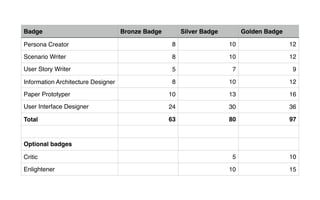
Badge Bronze Badge Silver Badge Golden Badge
Persona Creator 8 10 12
Scenario Writer 8 10 12
User Story Writer 5 7 9
Information Architecture Designer 8 10 12
Paper Prototyper 10 13 16
User Interface Designer 24 30 36
Total 63 80 97
Optional badges
Critic 5 10
Enlightener 10 15
Your project ideas?
This work is licensed under the Creative Commons Attribution-ShareAlike 4.0
International License. To view a copy of this license, visit
http://creativecommons.org/licenses/by-sa/4.0/
Hans Põldoja
hans.poldoja@tlu.ee
IFI7313.DT Interaction Design Methods
https://ifi7313.wordpress.com
Tallinn University
School of Digital Technologies

Introduction to the course

  • 1.
    Introduction to the course HansPõldoja IFI7313.DT Interaction Design Methods
  • 2.
    Hans Põldoja Head ofstudies, lecturer of educational technology Tallinn University, School of Digital Technologies Education: Aalto University, School of Arts, Design and Architecture (2016) Tallinn Pedagogical University (2003) hans.poldoja@tlu.ee http://www.hanspoldoja.net
  • 3.
  • 4.
  • 5.
    Course objectives • Practical:overview of interaction design methods, practical IxD skills and group work skills • Theoretical: working with academic literature on the field, presenting design research in MA thesis
  • 6.
    Structure of thecourse • 4 ECTS / 104 hours • 7 meetings (28 hours) • work on a group project (58 hours) • work on literature (18 hours)
  • 7.
    Week 1: Ideageneration February 2–4 Week 3: Requirements analysis February 16–18 Week 5: Prototyping March 2–4 Week 7: UI Design March 16–18 Idea generation, competitive reviews Personas, scenario- based design Thursday Friday Saturday Week 9: Final presentations March 30 – April 1 User stories, information architecture Developing paper prototypes Designing high- fidelity prototypes Final presentations Testing and revising paper prototypes Independent work: Finalizing personas, organizing scenario-based design sessions Independent work: Writing user stories, designing information architecture Independent work: Testing paper prototypes Independent work: Designing high-fidelity prototypes
  • 8.
    Week Theme Contacthours Group assignments Reading Total 30.01.2017 Idea generation 8 4 2 14 06.02.2017 Personas and scenarios 8 2 10 13.02.2017 User stories 4 4 2 10 20.02.2017 Information architecture 6 2 8 27.02.2017 Prototyping 8 6 2 16 06.03.2017 Prototyping 4 2 6 13.03.2017 User interface design 4 6 2 12 20.03.2017 User interface design 12 2 14 27.03.2017 Final presentations 4 8 2 14 28 58 18 104
  • 9.
    Group projects • Typesof projects: • Web applications • Mobile applications • Content-driven projects • Group size: 3…4 members
  • 19.
    Learning environment • Courseblog: https://ifi7313.wordpress.com • Group blogs • Moodle for readings and grading: https://moodle.hitsa.ee • GitHub • SlideShare, YouTube, etc.
  • 20.
  • 21.
  • 22.
    Assessement • Exam • 6graded assignments • 2 optional assignments • Grading based on open badges achieved for the assignments
  • 23.
  • 24.
  • 25.
  • 29.
    Põldoja, H., Jürgens,P., & Laanpere, M. (2016). Design Patterns for Badge Systems in Higher Education. In M. Spaniol, M. Temperini, D.K.W. Chiu, I. Marenzi, & U. Nanni (eds.), Advances in Web-Based Learning — ICWL 2016 (Vol. 10013, lk 40– 49). Cham: Springer. http://dx.doi.org/ 10.1007/978-3-319-47440-3_5 Design Patterns for Badge Systems in Higher Education Hans Põldoja (✉) , Pirje Jürgens, and Mart Laanpere Tallinn University, Narva mnt 25, 10120 Tallinn, Estonia {hans.poldoja,pirje.jurgens,mart.laanpere}@tlu.ee Abstract. Open Badges as a method for assessment and recognition of learning originates from the context of informal learning. Thus, it cannot be introduced into formal higher education without reconsidering the existing assessment processes.This paper presentsexperiencesfrom three years of using Open Badges in a master level course. In each iteration, the badge system was revised based on learners’ feedback. Special attention was given to supporting learners with different learning styles. To summarize our findings, this paper proposes a set of design patterns for developing badge systems in higher education. While the learning styles proved to be useful as generic design guidelines for separating two alternative learning pathways for the course, more research is needed on advanced learning-style-based learning pathways. Keywords: Open Badges · Assessment · Higher education 1 Introduction Open Badges (OB’s) is a web technology for recognizing and verifying knowledge, competencies or involvements gained in online or offline settings. In a basic sense, badges are digital images that contain embedded information about the accomplish‐ ments. The development of the Open Badges technology started in 2010, when a group of open education activists came up with the initial concept during the Mozilla Drumbeat Festival. Inspired by the use of digital badges in gaming and various social apps, they proposed that badges could be used for verifying learning. The technical specification of the Open Badges Infrastructure (OBI) was developed together with the Mozilla Foundation and released in 2012. While digital badges are typically used within a single environment, OBI was developed as an open standard that allows people to collect badges from different issuers. The initial scenarios about using open badges focused on informal learning contexts [1]. However, in recent years there have been a number of studies about using badges in schools [2, 3] and in higher education [4–6]. Introducing open badges to formal higher education courses provides an opportunity to reconsider the existing assessment procedures. Recent research on open badges has proposed a number of reasons for adopting badges. Ahn, Pellicone, and Butler [7] see badges as motivators for behavior, pedagogical tools for promoting particular learning activities, and credentials for recognizing learning achievements. While Jovanovic and Devedzic [8] identify similar roles for open badges, they discuss additional benefits such as supporting alternative forms of assessment (e.g. peer-assessment), providing learners © Springer International Publishing AG 2016 D.K.W. Chiu et al. (Eds.): ICWL 2016, LNCS 10013, pp. 40–49, 2016. DOI: 10.1007/978-3-319-47440-3_5
  • 30.
    Põldoja, H., &Laanpere, M. (2014). Exploring the Potential of Open Badges in Blog-Based University Courses. In Y. Cao, T. Väljataga, J. K. T. Tang, H. Leung, & M. Laanpere (Eds.), New Horizons in Web Based Learning (Vol. 8699, pp. 172–178). Cham: Springer. http://doi.org/ 10.1007/978-3-319-13296-9_19 Exploring the Potential of Open Badges in Blog-Based University Courses Hans Põldoja(&) and Mart Laanpere Institute of Informatics, Tallinn University, Tallinn, Estonia {hans.poldoja,mart.laanpere}@tlu.ee Abstract. Recent developments with personal learning environments and open online courses have led educators to experiment with opening up their formal higher education courses. In these courses, the online learning activities take place in open learning environments based on various Web 2.0 tools such as blogs. Although this type of courses have a number of pedagogical benefits, they also raise issues related to private grading of students’ works and recognizing the learning of informal participants. This paper presents our exploratory study on addressing these issues by introducing open badges to master’s level course that takes place in a blog-based learning environment. Students’ perspectives on using open badges were evaluated through focus group interviews. The results of the study indicate, that badges could have a potential in formal higher edu- cation, if they are used more widely and provide an explicit choice of personal learning paths for learners. Keywords: Open badges Á Assessment Á Blog-based courses 1 Introduction One of the recent trends in education is the blending of formal and informal learning. This is supported by introducing social media, personal learning environments and various open educational practices to formal higher education [1, 2]. Students can enrich their learning experience by using open educational resources from other uni- versities and taking part in Massive Open Online Courses. In many cases, such developments have led university lecturers and professors to increase the degree of openness in their courses. One approach is to move online learning activities to open learning environments that are based on social media and Web 2.0 tools such as blogs. The use of blogs in online courses provides a number of pedagogical benefits such as motivating learners, enhancing the development and expression of ideas, fostering interaction, collaboration and group work, inviting feedback from other learners, and enriching the learning environment [3]. The use of blog-based learning environments also allows educators to open up their course for informal participants or members of professional communities who are not officially enrolled to the course. Open blog-based courses in formal higher education raise also a number of issues that are not present in traditional courses. For example, blog-based learning environ- ments typically lack special features that support private feedback and grading of © Springer International Publishing Switzerland 2014 Y. Cao et al. (Eds.): ICWL 2014 Workshops, LNCS 8699, pp. 172–178, 2014. DOI: 10.1007/978-3-319-13296-9_19
  • 32.
    Badge Bronze BadgeSilver Badge Golden Badge Persona Creator 8 10 12 Scenario Writer 8 10 12 User Story Writer 5 7 9 Information Architecture Designer 8 10 12 Paper Prototyper 10 13 16 User Interface Designer 24 30 36 Total 63 80 97 Optional badges Critic 5 10 Enlightener 10 15
  • 33.
  • 34.
    This work islicensed under the Creative Commons Attribution-ShareAlike 4.0 International License. To view a copy of this license, visit http://creativecommons.org/licenses/by-sa/4.0/ Hans Põldoja hans.poldoja@tlu.ee IFI7313.DT Interaction Design Methods https://ifi7313.wordpress.com Tallinn University School of Digital Technologies