ECON 7999
            RESEARCH METHODOLOGY
                       TOPIC :
            P R O B L E M S TAT E M E N T


                 By : Dr. Dolhadi Zainudin


03/3/2012                                    1
Researchers- What’s your issues?
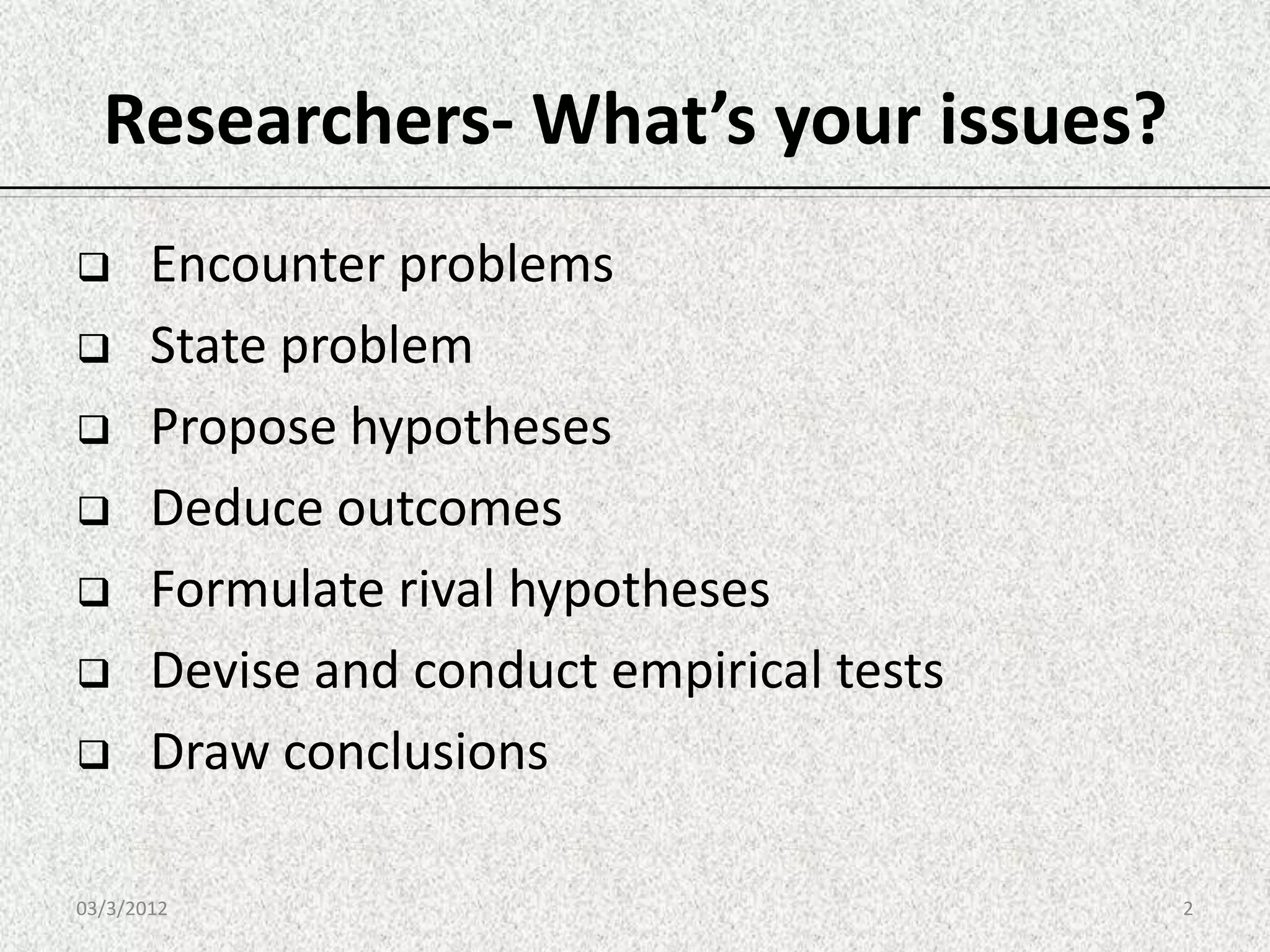
      Encounter problems
      State problem
      Propose hypotheses
      Deduce outcomes
      Formulate rival hypotheses
      Devise and conduct empirical tests
      Draw conclusions

03/3/2012                                   2
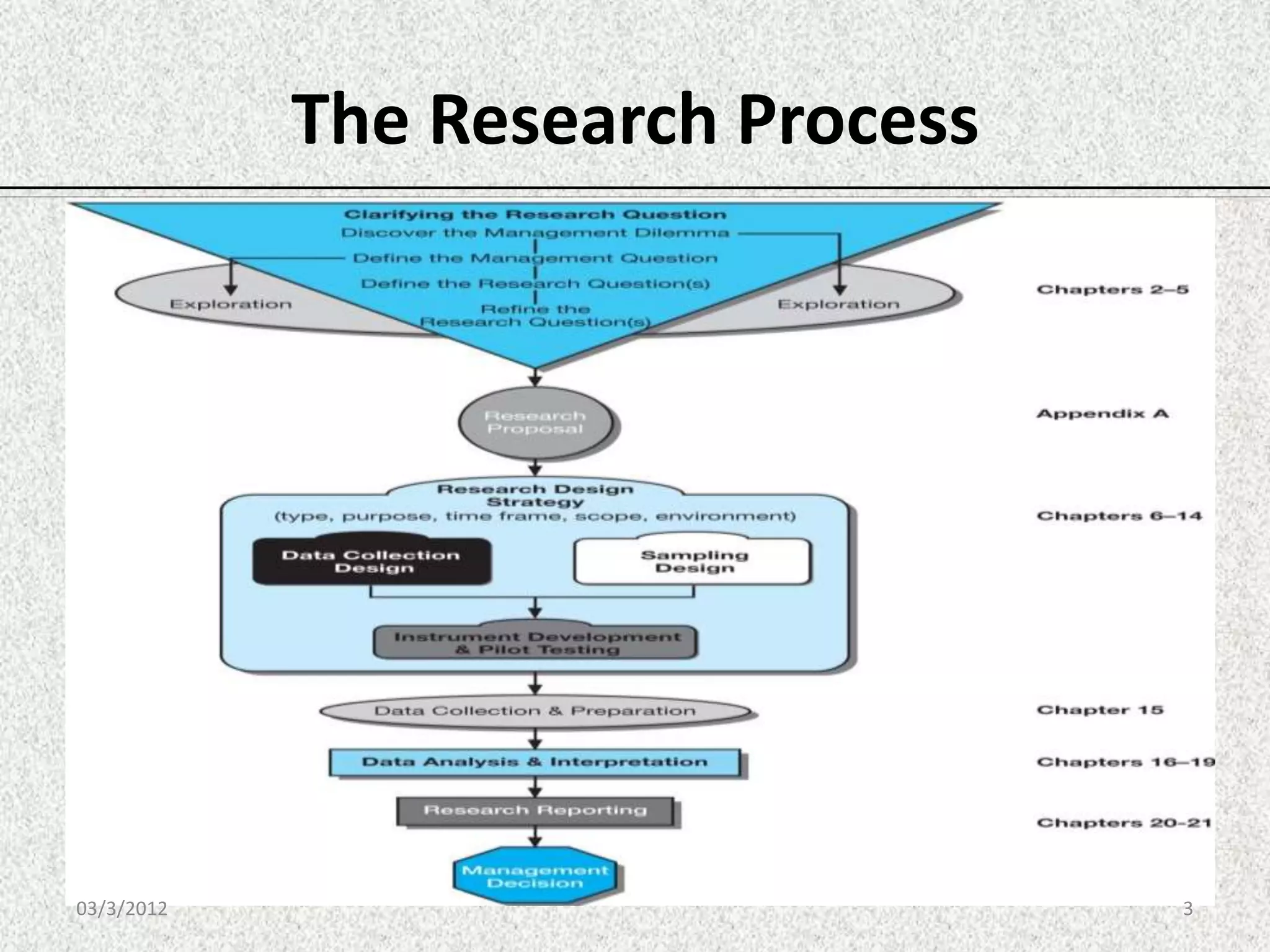
The Research Process


03/3/2012                          3
Problem Statement
        in the Research Paper


03/3/2012                       4
Problem Statement
            in the Research Paper       (1/2)


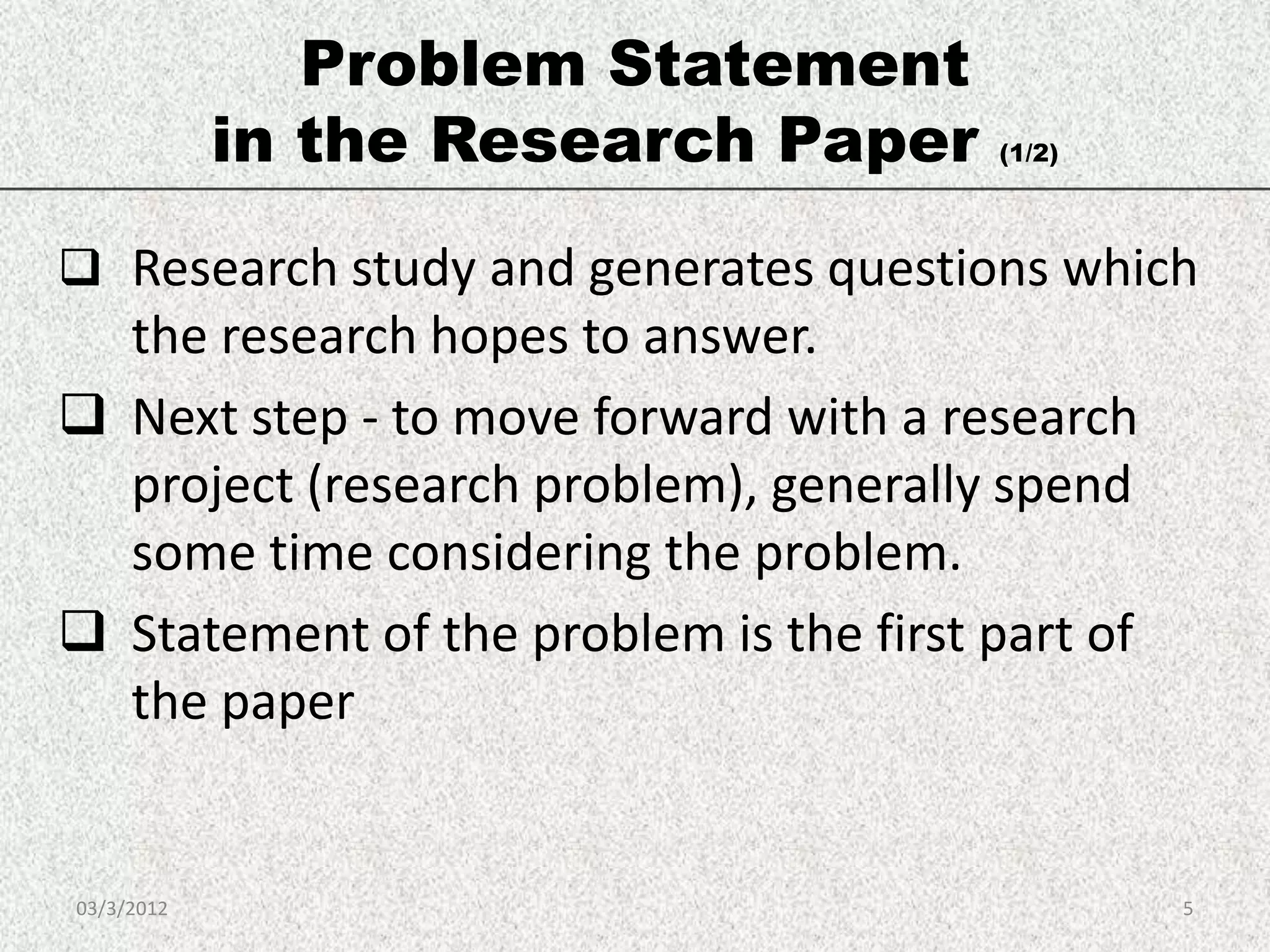
 Research study and generates questions which
  the research hopes to answer.
 Next step - to move forward with a research
  project (research problem), generally spend
  some time considering the problem.
 Statement of the problem is the first part of
  the paper


03/3/2012                                         5
Problem Statement
        in the Research Paper                   (2/2)


           You need to be able to clearly answer the
            question:
            "what is the problem"?
            "why is this problem worth my
             attention"?


03/3/2012                                               6
Problem Statement
        in the Research Paper                  (4/4)


           Limits scope by focusing on some variables
            and not others.
           Provides an opportunity for you to
            demonstrate why these variables are
            important.


03/3/2012                                              7
How Important is the
                 Problem


03/3/2012                          8
How Important is the Problem ?                 )   (1/4)


           Problem should receive considerable and
            persuasive attention.
           Clearly indicate why your problem is an
            important one by answering questions
            such as :


03/3/2012                                              9
How Important is the Problem ?                  (2/4)


           Current interest?
           Topical?
           Likely to continue into the future?
           Will more information about the problem
            have practical application?
           Will more information about the problem
            have theoretical importance?


03/3/2012                                             10
How Important is the Problem ?                     (3/4)


           How large is the population affected by the
            problem?
           How important, influential, or popular is
            this population?
           Would this study substantially revise or
            extend existing knowledge?
           Would this study create or improve an
            instrument of some utility?


03/3/2012                                               11
How Important is the Problem ?                     (4/4)


           Would research findings lead to some
            useful change in best practice?
           Is there evidence or authoritative opinion
            from others to support the need for this
            research?
           Should persuasively indicate that major
            variables can be measured in some
            meaningful way


03/3/2012                                                12
Problem Statement
                 Question


03/3/2012                       13
Problem Statement Question                   ( 1/2)


           Should close with a question.
           Contains two variables, a measurable
            relationship, and some indication of
            population.
           The purpose of the literature search that
            follows is to answer the research problem
            question. If the literature cannot answer
            the question, the research is needed to do
            so.


03/3/2012                                                  14
Problem Statement Question                 ( 2/2)


           An example question might be:
            "What is the relationship between the
             grade point average of IIUM
             Undergraduate and their use of the
             library"?
            The information needed is
                cumulative grade point average and
                some measure of library use.
03/3/2012                                                15
Bad example might be:
 “ What is the best way to teach teaching instruction"?
         This is insufficient because:
           What are the variables?
           What will be measured?
           What relationships will be examined?
           What is the population?
         The title and the problem statement question
          are often nearly identical.
           For example, the title of this research project
              would be something like this:
             "Library Circulation Use by International Islamic
 03/3/2012     University Malaysia and Their Grade Point Average"16
• Before you begin writing a grant proposal,
  take some time to map out your research
  strategy.
• A good first step is to formulate a research
  question.


03/3/2012                                        17
           Research Question
               is a statement that identifies the
                phenomenon to be studied. For
                example,
               “ What resources are helpful
                to new and minority substance abuse
                researchers?”


03/3/2012                                         18
Developing Good Research Questions
      Ask ANSWERABLE QUESTIONS
       Research ideas must be framed as questions that
            can be answered with the scientific method
              Asking empirical questions
                 Can be answered via objective   observation
                 Must be able to operationally   define variables
                     Defining a variable in terms of the operations required to
                      measure it
       Question must be translated into an empirically
            testable research hypothesis

03/3/2012                                                                      19
Reasons for Reviewing the Literature

 Avoiding needless duplication of
  effort
 Getting ideas about variables to
  include, design, materials and
  procedures
 Keeping yourself up to date on empirical
  and theoretical issues

03/3/2012                                20
IMPORTANT QUESTIONS
 Questions must justify the expense and time
   involved in doing the research
 Important questions
        Focus on variables known to affect behavior
        Clarify theoretical or empirical issues
        Address practical issues

 Unimportant questions
        Already have firmly established answers
        Focus on variables that have small effects
        Focus on variables that have no theoretical interest
        Focus on variables that you have no good reason to believe are related 21
 03/3/2012
How to develop a strong research
        question from your ideas ?
 Ask yourself about these things:
   Do I know the field and its literature well?
   What are the important research questions
   What areas need further exploration?
   Could my study fill a gap? Lead to greater
         understanding?
        Has a great deal of research already been
         conducted in this topic area?


03/3/2012                                            22
      Has this study been done before? If so, is
       there room for improvement?
      Is the timing right for this question to be
       answered? Is it a hot topic, or is it becoming
       obsolete?
      Most importantly, will my study have a
       significant impact on the field?


03/3/2012                                               23
Refining and Concretizing your ideas:

 Ask yourself: “Why is this research important?
  What have other people done? What have
  they found?”
 Based on this information, formulate a specific
  research question.
 Develop a hypothesis/hypotheses that stems
  from your research question.
 Indentify the specific aims, that is the steps
  you are going to take to test your hypothesis.
03/3/2012                                           24
      Think about the potential impact of the
       research you are proposing.
      What is the benefit of answering your
       research question?
      If you cannot make a definitive statement
       about the purpose of your research, it is
       unlikely to be funded.


03/3/2012                                          25
      It would be better to begin with a more
       focused question such as
           “What is the relationship between specific early
            childhood experiences and subsequent
            substance-abusing behaviors?”


03/3/2012                                                      26
THANK YOU

03/3/2012               27

Econ 7999 research methodology_problem statement

  • 1.
    ECON 7999 RESEARCH METHODOLOGY TOPIC : P R O B L E M S TAT E M E N T By : Dr. Dolhadi Zainudin 03/3/2012 1
  • 2.
    Researchers- What’s yourissues?  Encounter problems  State problem  Propose hypotheses  Deduce outcomes  Formulate rival hypotheses  Devise and conduct empirical tests  Draw conclusions 03/3/2012 2
  • 3.
  • 4.
    Problem Statement in the Research Paper 03/3/2012 4
  • 5.
    Problem Statement in the Research Paper (1/2)  Research study and generates questions which the research hopes to answer.  Next step - to move forward with a research project (research problem), generally spend some time considering the problem.  Statement of the problem is the first part of the paper 03/3/2012 5
  • 6.
    Problem Statement in the Research Paper (2/2)  You need to be able to clearly answer the question: "what is the problem"? "why is this problem worth my attention"? 03/3/2012 6
  • 7.
    Problem Statement in the Research Paper (4/4)  Limits scope by focusing on some variables and not others.  Provides an opportunity for you to demonstrate why these variables are important. 03/3/2012 7
  • 8.
    How Important isthe Problem 03/3/2012 8
  • 9.
    How Important isthe Problem ? ) (1/4)  Problem should receive considerable and persuasive attention.  Clearly indicate why your problem is an important one by answering questions such as : 03/3/2012 9
  • 10.
    How Important isthe Problem ? (2/4)  Current interest?  Topical?  Likely to continue into the future?  Will more information about the problem have practical application?  Will more information about the problem have theoretical importance? 03/3/2012 10
  • 11.
    How Important isthe Problem ? (3/4)  How large is the population affected by the problem?  How important, influential, or popular is this population?  Would this study substantially revise or extend existing knowledge?  Would this study create or improve an instrument of some utility? 03/3/2012 11
  • 12.
    How Important isthe Problem ? (4/4)  Would research findings lead to some useful change in best practice?  Is there evidence or authoritative opinion from others to support the need for this research?  Should persuasively indicate that major variables can be measured in some meaningful way 03/3/2012 12
  • 13.
    Problem Statement Question 03/3/2012 13
  • 14.
    Problem Statement Question ( 1/2)  Should close with a question.  Contains two variables, a measurable relationship, and some indication of population.  The purpose of the literature search that follows is to answer the research problem question. If the literature cannot answer the question, the research is needed to do so. 03/3/2012 14
  • 15.
    Problem Statement Question ( 2/2)  An example question might be: "What is the relationship between the grade point average of IIUM Undergraduate and their use of the library"? The information needed is  cumulative grade point average and  some measure of library use. 03/3/2012 15
  • 16.
    Bad example mightbe:  “ What is the best way to teach teaching instruction"?  This is insufficient because:  What are the variables?  What will be measured?  What relationships will be examined?  What is the population?  The title and the problem statement question are often nearly identical.  For example, the title of this research project would be something like this: "Library Circulation Use by International Islamic 03/3/2012 University Malaysia and Their Grade Point Average"16
  • 17.
    • Before youbegin writing a grant proposal, take some time to map out your research strategy. • A good first step is to formulate a research question. 03/3/2012 17
  • 18.
    Research Question  is a statement that identifies the phenomenon to be studied. For example,  “ What resources are helpful to new and minority substance abuse researchers?” 03/3/2012 18
  • 19.
    Developing Good ResearchQuestions  Ask ANSWERABLE QUESTIONS  Research ideas must be framed as questions that can be answered with the scientific method  Asking empirical questions  Can be answered via objective observation  Must be able to operationally define variables  Defining a variable in terms of the operations required to measure it  Question must be translated into an empirically testable research hypothesis 03/3/2012 19
  • 20.
    Reasons for Reviewingthe Literature  Avoiding needless duplication of effort  Getting ideas about variables to include, design, materials and procedures  Keeping yourself up to date on empirical and theoretical issues 03/3/2012 20
  • 21.
    IMPORTANT QUESTIONS  Questionsmust justify the expense and time involved in doing the research  Important questions  Focus on variables known to affect behavior  Clarify theoretical or empirical issues  Address practical issues  Unimportant questions  Already have firmly established answers  Focus on variables that have small effects  Focus on variables that have no theoretical interest  Focus on variables that you have no good reason to believe are related 21 03/3/2012
  • 22.
    How to developa strong research question from your ideas ?  Ask yourself about these things:  Do I know the field and its literature well?  What are the important research questions  What areas need further exploration?  Could my study fill a gap? Lead to greater understanding?  Has a great deal of research already been conducted in this topic area? 03/3/2012 22
  • 23.
    Has this study been done before? If so, is there room for improvement?  Is the timing right for this question to be answered? Is it a hot topic, or is it becoming obsolete?  Most importantly, will my study have a significant impact on the field? 03/3/2012 23
  • 24.
    Refining and Concretizingyour ideas:  Ask yourself: “Why is this research important? What have other people done? What have they found?”  Based on this information, formulate a specific research question.  Develop a hypothesis/hypotheses that stems from your research question.  Indentify the specific aims, that is the steps you are going to take to test your hypothesis. 03/3/2012 24
  • 25.
    Think about the potential impact of the research you are proposing.  What is the benefit of answering your research question?  If you cannot make a definitive statement about the purpose of your research, it is unlikely to be funded. 03/3/2012 25
  • 26.
    It would be better to begin with a more focused question such as  “What is the relationship between specific early childhood experiences and subsequent substance-abusing behaviors?” 03/3/2012 26
  • 27.