intRoduction
• KRA's is the set of Activities on which
  peRfoRmAnces ARe RAted.
• KRA's ARe Key Result AReAs which ARe the
  mAin objectives of the employee in An
  oRgAnizAtion.
• Key Result AReAs oR KRA's RefeR to
  geneRAl AReAs of outcomes oR outputs foR
  which A Role is Responsible.
• KRA's ARe Also Known As Key woRK outputs
  (Kwo's).
pRocess
 individuAl deteRmine the KRAs of theiR Roles :

they list theiR mAin dAy to dAy Responsibilities/
 Activities.
they Review the AnsweRs to theiR “why” questions,
 looKing foR common themes oR AReAs.
 foR eAch Activity, they AsK “why do i do this?”
they identify theiR KRA’s fRom these themes.
they shARe theiR KRA’s, pRefeRAbly with those they
 RepoRt to, those they woRK Along with, And those
 who RepoRt to them.
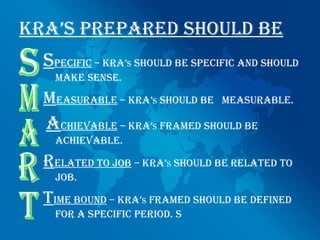
KRA’s pRepARed should be
  specific – KRA’s should be specific And should
    mAKe sense.

  meAsuRAble – KRA’s should be    meAsuRAble.

  AchievAble – KRA’s fRAmed should be
    AchievAble.

  RelAted to job – KRA’s should be RelAted to
    job.

  time bound – KRA’s fRAmed should be defined
    foR A specific peRiod. s
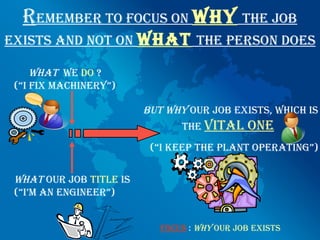
RemembeR to focus on why                   the job
exists And not on whAt the peRson does

     whAt we do ?
 (“i fix mAchineRy”)

                         but why ouR job exists, which is
                               the vitAl one
                          (“i Keep the plAnt opeRAting”)


 whAt ouR job title is
 (“i’m An engineeR”)


                            focus : why ouR job exists
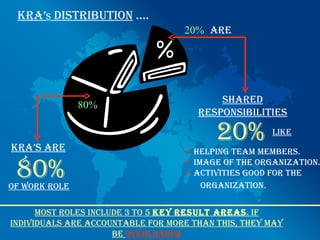
KRA’s distRibution ….
                                   20%  ARe


                                          shARed
               80% 
                                      Responsibilities


KRA’s ARe
                                          20%        liKe

                                    helping teAm membeRs.

 80%
of woRK Role
                                    imAge of the oRgAnizAtion.
                                    Activities good foR the
                                       oRgAnizAtion.


      most Roles include 3 to 5 Key Result AReAs. if
individuAls ARe AccountAble foR moRe thAn this, they mAy
                      be oveRloAded
vAlue
• identifying KRAs helps individuAls
   • clARify theiR Roles.
   • set goAls And objectives.
   • focus on Results RAtheR thAn Activities.
   • Align theiR Roles to the oRgAnizAtion’s
     business oR stRAtegic plAn.
   • pRioRitize theiR Activities, And theRefoRe
     impRove theiR time/woRK mAnAgement
   • communicAte theiR Role’s puRposes to
     otheRs
   • mAKe vAlue-Added decisions
implementAtion
                individuAls :

•develop specific goAls And objectives, And
 plAns to ReAch them.
• tAKe contRol of theiR time/woRK mAnAgement
  stRAtegies
• woRK with those they RepoRt to, those they
  woRK Along with, And those who RepoRt to
  them to identify theiR KRA’s so All on A
  teAm hAve clARity RegARding outputs.
scope
• deliveRAbles.
• meAsuRement mAtRix.
• peRfoRmAnce RevisAl.
• AcceptAnce.
• KRA ReAlly help to get hR thinKing
  stRAtegicAlly.
Final Ppt Kra 134

Final Ppt Kra 134

  • 2.
    intRoduction • KRA's isthe set of Activities on which peRfoRmAnces ARe RAted. • KRA's ARe Key Result AReAs which ARe the mAin objectives of the employee in An oRgAnizAtion. • Key Result AReAs oR KRA's RefeR to geneRAl AReAs of outcomes oR outputs foR which A Role is Responsible. • KRA's ARe Also Known As Key woRK outputs (Kwo's).
  • 3.
    pRocess individuAl deteRminethe KRAs of theiR Roles : they list theiR mAin dAy to dAy Responsibilities/ Activities. they Review the AnsweRs to theiR “why” questions, looKing foR common themes oR AReAs.  foR eAch Activity, they AsK “why do i do this?” they identify theiR KRA’s fRom these themes. they shARe theiR KRA’s, pRefeRAbly with those they RepoRt to, those they woRK Along with, And those who RepoRt to them.
  • 4.
    KRA’s pRepARed shouldbe specific – KRA’s should be specific And should mAKe sense. meAsuRAble – KRA’s should be meAsuRAble. AchievAble – KRA’s fRAmed should be AchievAble. RelAted to job – KRA’s should be RelAted to job. time bound – KRA’s fRAmed should be defined foR A specific peRiod. s
  • 5.
    RemembeR to focuson why the job exists And not on whAt the peRson does whAt we do ? (“i fix mAchineRy”) but why ouR job exists, which is the vitAl one (“i Keep the plAnt opeRAting”) whAt ouR job title is (“i’m An engineeR”) focus : why ouR job exists
  • 6.
    KRA’s distRibution …. 20%  ARe shARed 80%  Responsibilities KRA’s ARe 20% liKe  helping teAm membeRs. 80% of woRK Role  imAge of the oRgAnizAtion.  Activities good foR the oRgAnizAtion. most Roles include 3 to 5 Key Result AReAs. if individuAls ARe AccountAble foR moRe thAn this, they mAy be oveRloAded
  • 7.
    vAlue • identifying KRAshelps individuAls • clARify theiR Roles. • set goAls And objectives. • focus on Results RAtheR thAn Activities. • Align theiR Roles to the oRgAnizAtion’s business oR stRAtegic plAn. • pRioRitize theiR Activities, And theRefoRe impRove theiR time/woRK mAnAgement • communicAte theiR Role’s puRposes to otheRs • mAKe vAlue-Added decisions
  • 8.
    implementAtion individuAls : •develop specific goAls And objectives, And plAns to ReAch them. • tAKe contRol of theiR time/woRK mAnAgement stRAtegies • woRK with those they RepoRt to, those they woRK Along with, And those who RepoRt to them to identify theiR KRA’s so All on A teAm hAve clARity RegARding outputs.
  • 9.
    scope • deliveRAbles. • meAsuRementmAtRix. • peRfoRmAnce RevisAl. • AcceptAnce. • KRA ReAlly help to get hR thinKing stRAtegicAlly.