PERFORMANCE MANAGEMENT Santosh Mallick
Some Observations… Should Performance be measured or managed? Are they same? Today most of the companies have extensive performance appraisal system…then why there is a widespread dissatisfaction among employees about this issue? What should be the role of Line and HR Managers – Ownership / Partnership / Both?
Objectives of Performance Appraisal Help the employee overcome weaknesses and improve strengths Generate adequate feedback and guidance Realistic goal setting Provide inputs to salary increments, appreciations, additional responsibilities, promotions, salary administration
Objectives of Performance Appraisal Identifying employees for the purpose of counseling, training, and developing them Generate relevant and valid information about employees Creating a desirable culture in the organization
How Should the System Function Identification of KRAs Setting objectives under each KRA for the next year Critical behavioural dimensions for managerial effectiveness Periodic review of performance Facilitating and inhibiting factors in performance
How Should the System Function Performance review discussion between the employee and Reporting Officer Identification of development needs and Development Action Plan Consideration by Reviewing Officer Filing and documentation
Key Result Areas (KRAs) The KRAs of a role are those functions which require priority attention.  List out all the activities that a role occupant is expected to carry out as a part of his role Group these activities into categories which may be labeled as functions  Identify those functions which are critical for that role
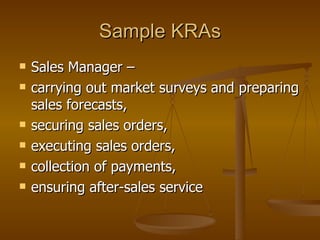
Sample KRAs Sales Manager –  carrying out market surveys and preparing sales forecasts,  securing sales orders,  executing sales orders,  collection of payments,  ensuring after-sales service
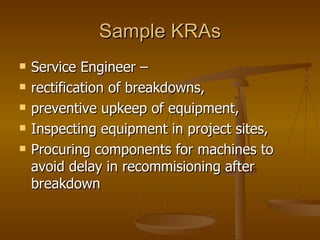
Sample KRAs Service Engineer –  rectification of breakdowns,  preventive upkeep of equipment, Inspecting equipment in project sites, Procuring components for machines to avoid delay in recommisioning after breakdown
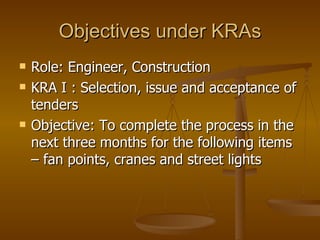
Objectives under KRAs Role: Engineer, Construction  KRA I : Selection, issue and acceptance of tenders Objective: To complete the process in the next three months for the following items – fan points, cranes and street lights
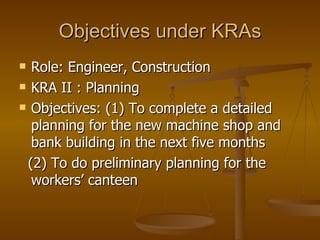
Objectives under KRAs Role: Engineer, Construction KRA II : Planning Objectives: (1) To complete a detailed planning for the new machine shop and bank building in the next five months (2) To do preliminary planning for the workers’ canteen
Objectives under KRAs Role: Engineer, Construction KRA III : Sorting out contractual problems Objective: To visit site X once a week for the next six months to sort out construction / technical / other problems
Developing KRAs KRAs for a role should not be too many Each KRA should distinctly characterize the job, and make it different from other jobs KRAs should indicate those critical functions for which the job holder can be held responsible
Developing KRAs KRAs should distinguish between an effective and ineffective job performance Under each KRA the job holder should be able to write down specific objectives Though KRAs can change from time to time over years, but once identified they should hold good for a few years
Design Mistakes Not having the right emphasis Poorly designed systems and formats Multiple objectives make a mess Multiple components may make it a sophisticated system
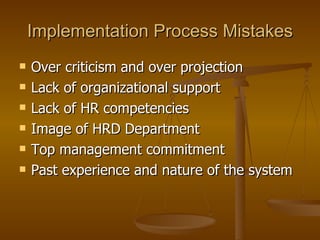
Implementation Process Mistakes Over criticism and over projection Lack of organizational support Lack of HR competencies Image of HRD Department Top management commitment Past experience and nature of the system
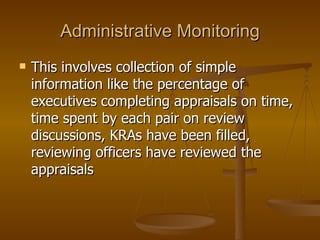
Administrative Monitoring This involves collection of simple information like the percentage of executives completing appraisals on time, time spent by each pair on review discussions, KRAs have been filled, reviewing officers have reviewed the appraisals
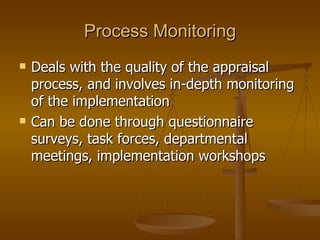
Process Monitoring Deals with the quality of the appraisal process, and involves in-depth monitoring of the implementation Can be done through questionnaire surveys, task forces, departmental meetings, implementation workshops
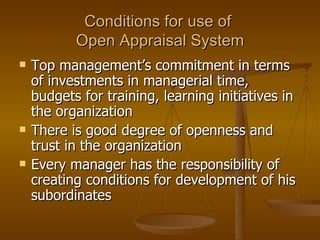
Conditions for use of  Open Appraisal System Top management’s commitment in terms of investments in managerial time, budgets for training, learning initiatives in the organization There is good degree of openness and trust in the organization Every manager has the responsibility of creating conditions for development of his subordinates
Performance Review & Coaching Employee should be given the source of feedback Should be told the limits of feedback Should be helped to view alternative career opportunities There should be opportunities to develop his potential  Relationship of the employee with others
Conditions for Review & Coaching General climate of openness & trust Helpful and empathic attitude of management Open participation by subordinates in the review process Dialogic goal setting Focus on work related behaviour, problems, and difficulties Avoid discussion of salary & rewards
Some Common Problems… If in my self-ratings, I rate myself low, what is the guarantee that my superior will not use my own rating against me? Can the system ensure justice to talented employees in terms of promotion and rewards? Would praising and recognising good performance raise expectations of employees?
Some Common Problems… Is there a possibility that in order to get good performance ratings some employees would deliberately set low goals which they can easily achieve? How do I ensure that my negative feedback does not put off the employee? How can I promise anything on the developmental needs of employees when I can not do anything in this regard?
Recent Trends   The focus is on improvements and development rather than appraisals From quantitative to qualitative assessment Process is more important than formats Multi rater assessments as a supplement Use of selective internal task forces for review mechanisms
Key Points Limit the objectives of PA to participative planning, employee development, accountability, and managerial effectiveness Remove any direct correlation between appraisal and promotion and not reducing the annual appraisals to number generation exercises
Key Points Insist that planning, reviewing, and developing subordinates is as much an important task for any executive as doing other work Qualitative data generated from appraisal process should be used for understanding executive support requirements Move away slowly from ‘Appraisal’ culture to a Planning, Reviewing, and Developmental culture
Some Problems in  Performance Appraisal The supervisors are reluctant to justify their evaluations Review is ego-damaging and seldom employees improve as a result of review Appraisal being a multi-purpose program, no one technique is suitable to accomplish all objectives
Experience in India There was no significant relationship between evaluation and promotion, transfer or placement. This was not true who were rated very poor or very good, but for the large bulk in between There was low reliability between what was reported on paper and what the managers said about their subordinates in personal face-to-face discussions
Experience in India In spite of written instructions followed by short half-day discussion sessions on how to rate employees, evaluation forms were invariably completed only a few minutes before their submission was due The superiors felt anxiety especially if their appraisal was going to be used to effect the subordinate’s career and livelihood
Experience in India Evaluation of the same employee varied from one evaluator to another The manager has to accept the responsibility to judge the performance of his subordinates. Often this responsibility is hesitantly taken because he feels uncomfortable in his role as a judge. It is this psychological barrier, which lies underneath the failure of most evaluation systems
Few Illustrations  VOLTAS – communication and counseling as important aspects of development through self improvement and casts a serious responsibility on the part of assessor for achieveing objectivity
Few Illustrations L & T – has development oriented appraisal system the main purpose of which is to improve one’s performance and develop himself. The use of facilitators is a unique part of PADS in which competent line managers are used. They have also introduced a separate system of rewards and recognition.
Few Illustrations CROMPTON GREAVES LTD. – emphasizes on team building and use of peer ratings and internal customers. Attempts to assess performance in KPAs, Leadership and team building, Innovation, risk taking and venturism.
Few Illustrations SBI – performance appraisal is seen as a potential instrument for the development of its human resources. There is no ratings in the appraisal format. Performance is to be reviewed qualitatively stating the task accomplished, narrating incidents, and making evaluative statements.
Issues in Developing  Performance Appraisal System The system must give knowledge about performance in discrete and recognisable areas of the performer’s task A personal equation between the evaluator and the evaluatee has to be developed to achieve mutual understanding of the criteria of evaluation Another area has to do with the inner conflicts and anxieties that accompany the role of a judge in our social system
Managers Need To Explore… In evaluating subordinates, how should a personal equation be developed between the evaluator and the evaluatee? How should mutually acceptable criteria be evolved? If individuals are to be appraised, what are the reliable indices of performance which can be used for the purpose? What can the evaluator do to overcome the barriers? What help can the organisation give him?
Influence of Culture on  Performance Appraisal The Indian social environment tends to emphasise concepts of – Loyalty, Regard for authority, Group solidarity Three distinct problem areas – technical problems relating to developing the system, problems relating to the appraiser, and the problems relating to the appraisee
Technical Problems Develop measures for the work assigned to individuals The strengths and weaknesses of individuals The reliability of those kinds of data for comparing the employees engaged upon a vast variety of jobs
Technical Problems Arriving at these measures is difficult because the past performance of the individual is a result of many situational, environmental, and personality factors.  Judgements relating to success and failure attributable to individual alone are difficult to make, especially in borderline cases between outstanding and very good, very good and good
Participative Goal Setting McGregor’s participative goal setting approach requires both the superior and the subordinate should have knowledge of the measures to be used for evaluating the subordinate’s work
Designing Performance  Appraisal System Does the organization need an appraisal system to aid human judgement, or is it being sought under the impression that the system could substitute human judgement, reducing the responsibility of the superior in evaluating his subordinates?
Designing Performance  Appraisal System Is there minimum trust and confidence between the superiors and the subordinates, whereby the disgruntled employees are at least able to approach their superiors to express their feelings?
Designing Performance  Appraisal System Does the top management understand the strengths and weaknesses of the system, and is it willing to give the time and attention to operate and improve the system?
Influence of Culture on  Performance Appraisal If personal loyalty is not encouraged or not rewarded in the organizational context, the officers have difficulty in adjusting to the superior and they feel uncertain, and non-recognition of this relationship makes them dejected or hostile to the superior.  Organizational tasks are performed with greater enthusiasm when they are based on person-person than role-role relationships

Pm

  • 1.
  • 2.
    Some Observations… ShouldPerformance be measured or managed? Are they same? Today most of the companies have extensive performance appraisal system…then why there is a widespread dissatisfaction among employees about this issue? What should be the role of Line and HR Managers – Ownership / Partnership / Both?
  • 3.
    Objectives of PerformanceAppraisal Help the employee overcome weaknesses and improve strengths Generate adequate feedback and guidance Realistic goal setting Provide inputs to salary increments, appreciations, additional responsibilities, promotions, salary administration
  • 4.
    Objectives of PerformanceAppraisal Identifying employees for the purpose of counseling, training, and developing them Generate relevant and valid information about employees Creating a desirable culture in the organization
  • 5.
    How Should theSystem Function Identification of KRAs Setting objectives under each KRA for the next year Critical behavioural dimensions for managerial effectiveness Periodic review of performance Facilitating and inhibiting factors in performance
  • 6.
    How Should theSystem Function Performance review discussion between the employee and Reporting Officer Identification of development needs and Development Action Plan Consideration by Reviewing Officer Filing and documentation
  • 7.
    Key Result Areas(KRAs) The KRAs of a role are those functions which require priority attention. List out all the activities that a role occupant is expected to carry out as a part of his role Group these activities into categories which may be labeled as functions Identify those functions which are critical for that role
  • 8.
    Sample KRAs SalesManager – carrying out market surveys and preparing sales forecasts, securing sales orders, executing sales orders, collection of payments, ensuring after-sales service
  • 9.
    Sample KRAs ServiceEngineer – rectification of breakdowns, preventive upkeep of equipment, Inspecting equipment in project sites, Procuring components for machines to avoid delay in recommisioning after breakdown
  • 10.
    Objectives under KRAsRole: Engineer, Construction KRA I : Selection, issue and acceptance of tenders Objective: To complete the process in the next three months for the following items – fan points, cranes and street lights
  • 11.
    Objectives under KRAsRole: Engineer, Construction KRA II : Planning Objectives: (1) To complete a detailed planning for the new machine shop and bank building in the next five months (2) To do preliminary planning for the workers’ canteen
  • 12.
    Objectives under KRAsRole: Engineer, Construction KRA III : Sorting out contractual problems Objective: To visit site X once a week for the next six months to sort out construction / technical / other problems
  • 13.
    Developing KRAs KRAsfor a role should not be too many Each KRA should distinctly characterize the job, and make it different from other jobs KRAs should indicate those critical functions for which the job holder can be held responsible
  • 14.
    Developing KRAs KRAsshould distinguish between an effective and ineffective job performance Under each KRA the job holder should be able to write down specific objectives Though KRAs can change from time to time over years, but once identified they should hold good for a few years
  • 15.
    Design Mistakes Nothaving the right emphasis Poorly designed systems and formats Multiple objectives make a mess Multiple components may make it a sophisticated system
  • 16.
    Implementation Process MistakesOver criticism and over projection Lack of organizational support Lack of HR competencies Image of HRD Department Top management commitment Past experience and nature of the system
  • 17.
    Administrative Monitoring Thisinvolves collection of simple information like the percentage of executives completing appraisals on time, time spent by each pair on review discussions, KRAs have been filled, reviewing officers have reviewed the appraisals
  • 18.
    Process Monitoring Dealswith the quality of the appraisal process, and involves in-depth monitoring of the implementation Can be done through questionnaire surveys, task forces, departmental meetings, implementation workshops
  • 19.
    Conditions for useof Open Appraisal System Top management’s commitment in terms of investments in managerial time, budgets for training, learning initiatives in the organization There is good degree of openness and trust in the organization Every manager has the responsibility of creating conditions for development of his subordinates
  • 20.
    Performance Review &Coaching Employee should be given the source of feedback Should be told the limits of feedback Should be helped to view alternative career opportunities There should be opportunities to develop his potential Relationship of the employee with others
  • 21.
    Conditions for Review& Coaching General climate of openness & trust Helpful and empathic attitude of management Open participation by subordinates in the review process Dialogic goal setting Focus on work related behaviour, problems, and difficulties Avoid discussion of salary & rewards
  • 22.
    Some Common Problems…If in my self-ratings, I rate myself low, what is the guarantee that my superior will not use my own rating against me? Can the system ensure justice to talented employees in terms of promotion and rewards? Would praising and recognising good performance raise expectations of employees?
  • 23.
    Some Common Problems…Is there a possibility that in order to get good performance ratings some employees would deliberately set low goals which they can easily achieve? How do I ensure that my negative feedback does not put off the employee? How can I promise anything on the developmental needs of employees when I can not do anything in this regard?
  • 24.
    Recent Trends The focus is on improvements and development rather than appraisals From quantitative to qualitative assessment Process is more important than formats Multi rater assessments as a supplement Use of selective internal task forces for review mechanisms
  • 25.
    Key Points Limitthe objectives of PA to participative planning, employee development, accountability, and managerial effectiveness Remove any direct correlation between appraisal and promotion and not reducing the annual appraisals to number generation exercises
  • 26.
    Key Points Insistthat planning, reviewing, and developing subordinates is as much an important task for any executive as doing other work Qualitative data generated from appraisal process should be used for understanding executive support requirements Move away slowly from ‘Appraisal’ culture to a Planning, Reviewing, and Developmental culture
  • 27.
    Some Problems in Performance Appraisal The supervisors are reluctant to justify their evaluations Review is ego-damaging and seldom employees improve as a result of review Appraisal being a multi-purpose program, no one technique is suitable to accomplish all objectives
  • 28.
    Experience in IndiaThere was no significant relationship between evaluation and promotion, transfer or placement. This was not true who were rated very poor or very good, but for the large bulk in between There was low reliability between what was reported on paper and what the managers said about their subordinates in personal face-to-face discussions
  • 29.
    Experience in IndiaIn spite of written instructions followed by short half-day discussion sessions on how to rate employees, evaluation forms were invariably completed only a few minutes before their submission was due The superiors felt anxiety especially if their appraisal was going to be used to effect the subordinate’s career and livelihood
  • 30.
    Experience in IndiaEvaluation of the same employee varied from one evaluator to another The manager has to accept the responsibility to judge the performance of his subordinates. Often this responsibility is hesitantly taken because he feels uncomfortable in his role as a judge. It is this psychological barrier, which lies underneath the failure of most evaluation systems
  • 31.
    Few Illustrations VOLTAS – communication and counseling as important aspects of development through self improvement and casts a serious responsibility on the part of assessor for achieveing objectivity
  • 32.
    Few Illustrations L& T – has development oriented appraisal system the main purpose of which is to improve one’s performance and develop himself. The use of facilitators is a unique part of PADS in which competent line managers are used. They have also introduced a separate system of rewards and recognition.
  • 33.
    Few Illustrations CROMPTONGREAVES LTD. – emphasizes on team building and use of peer ratings and internal customers. Attempts to assess performance in KPAs, Leadership and team building, Innovation, risk taking and venturism.
  • 34.
    Few Illustrations SBI– performance appraisal is seen as a potential instrument for the development of its human resources. There is no ratings in the appraisal format. Performance is to be reviewed qualitatively stating the task accomplished, narrating incidents, and making evaluative statements.
  • 35.
    Issues in Developing Performance Appraisal System The system must give knowledge about performance in discrete and recognisable areas of the performer’s task A personal equation between the evaluator and the evaluatee has to be developed to achieve mutual understanding of the criteria of evaluation Another area has to do with the inner conflicts and anxieties that accompany the role of a judge in our social system
  • 36.
    Managers Need ToExplore… In evaluating subordinates, how should a personal equation be developed between the evaluator and the evaluatee? How should mutually acceptable criteria be evolved? If individuals are to be appraised, what are the reliable indices of performance which can be used for the purpose? What can the evaluator do to overcome the barriers? What help can the organisation give him?
  • 37.
    Influence of Cultureon Performance Appraisal The Indian social environment tends to emphasise concepts of – Loyalty, Regard for authority, Group solidarity Three distinct problem areas – technical problems relating to developing the system, problems relating to the appraiser, and the problems relating to the appraisee
  • 38.
    Technical Problems Developmeasures for the work assigned to individuals The strengths and weaknesses of individuals The reliability of those kinds of data for comparing the employees engaged upon a vast variety of jobs
  • 39.
    Technical Problems Arrivingat these measures is difficult because the past performance of the individual is a result of many situational, environmental, and personality factors. Judgements relating to success and failure attributable to individual alone are difficult to make, especially in borderline cases between outstanding and very good, very good and good
  • 40.
    Participative Goal SettingMcGregor’s participative goal setting approach requires both the superior and the subordinate should have knowledge of the measures to be used for evaluating the subordinate’s work
  • 41.
    Designing Performance Appraisal System Does the organization need an appraisal system to aid human judgement, or is it being sought under the impression that the system could substitute human judgement, reducing the responsibility of the superior in evaluating his subordinates?
  • 42.
    Designing Performance Appraisal System Is there minimum trust and confidence between the superiors and the subordinates, whereby the disgruntled employees are at least able to approach their superiors to express their feelings?
  • 43.
    Designing Performance Appraisal System Does the top management understand the strengths and weaknesses of the system, and is it willing to give the time and attention to operate and improve the system?
  • 44.
    Influence of Cultureon Performance Appraisal If personal loyalty is not encouraged or not rewarded in the organizational context, the officers have difficulty in adjusting to the superior and they feel uncertain, and non-recognition of this relationship makes them dejected or hostile to the superior. Organizational tasks are performed with greater enthusiasm when they are based on person-person than role-role relationships