Enforcing Discipline in the
Workplace
JANUARY 22, 2014
3:00PM
HUMAN RESOURCE MANAGEMENT FOR
ABORIGINAL AND NORTHERN COMMUNITIES
YELLOWKNIFE, NWT
LISA PECKHAM
Learning objectives
2

 Creating a positive employment relationship
 Performance management vs. workplace discipline
 Creating workplace discipline policies
 Implementing workplace discipline policies
 Potential challenges
Purpose of Discipline
3

 Enforce the standards and rules valued by

management
 Provide feedback to employees and management
 Create a fair workplace for all by having a consistent

disciplinary program that everyone follows
Creating a positive work environment
4

 Defining a positive work environment
 10 ways to create a positive work environment
 Tools employees need to maintain a positive work

environment
 Benefits of a positive work environment
Defining a positive work environment
5

“A positive work environment is a place where
employees are happy and motivated.”
White, 2002; HRZone, 2000
10 ways to create a
positive work environment
6

 Build trust

 Be approachable

 Open communication

 Positive physical

 Set expectations

environment
 Good performance
management process
 Have fun

 Team building
 Recognition
 Give credit and take

responsibility
Tools for employees
7

 Clear policies
 Clearly communicated expectations
 Opportunities to practice desirable behaviours
 Opportunities to participate
 Communication skills
Benefits of a positive work environment
8

 Improved morale
 Better employee performance
 Increased productivity
 Cohesive teams
 Higher retention rates
 Fewer sick days
 Fewer workplace accidents and injuries
 More likely to achieve organizational goals
 More creativity and innovation
Performance management vs.
workplace discipline
9

 Defining performance management
 Defining workplace discipline
 Know which tool to use
Defining performance management
10

“Performance management is the process of creating a
work environment in which employees are enabled
to perform to the best of their abilities. It is a work
system that begins when a job is created and ends
when an employee leaves the organization.”
www.humanresources.about.com

It is designed to “motivate employees through setting
goals, measuring progress, giving feedback, coaching
for improved performance, and rewarding
achievements”.
www.toolingu.com
Elements of performance management
11

 Clear and accurate job descriptions
 Clearly communicated performance standards
 Clearly communicated desired performance

outcomes and measures
 On going coaching and feedback
 Regular formal performance reviews
 Effective compensation and recognition systems that
reward people for performance and contribution
12

Successful
performance
management
Clear and specific
communication is
the cornerstone of
successful
performance
management. It is
the employer’s
responsibility to let
employees know
the expectations.
Workplace discipline
13

 The process of correcting a lapse of conduct and

returning an employee to the desired standard of
conduct


Sometimes referred to as corrective action

 Used after the employer has attempted to address

the undesirable behaviour through training,
coaching, counselling, and mentoring
 Used only for culpable behaviour


Culpable behaviour is when the employee is aware of the rules
and expectations AND is capable of meeting them but makes a
different choice
Elements of workplace discipline
14

 Communicated
 Progressive
 Fair
 Consistent
 Documented
Successful workplace discipline
15

 Employee no longer engages in the undesirable





behaviour
Employee improves their overall conduct to meet
acceptable standards
Other employees are discouraged from engaging in
the undesirable behaviour
Other employees improve their overall conduct to
meet acceptable standards
Workplace environment continues to be positive
Know which tool to use
16

Performance management
 To help employee develop competence
 To help employee meet goals and objectives
Workplace discipline
 Behaviour causes workplace disruption
 Violation of rules, policies, and procedures
 Engaging in illegal behaviour
 Violence or harassment
Creating workplace discipline policies
17

 Define the purpose of the policy
 Ensure rules are clearly stated, fair, and accurate in

the Employee Handbook
 Ensure that expectations and consequences are
clearly stated
 Classifying misconduct


Misconduct or Serious misconduct

 Determine type of discipline to be used
Purpose of the policy
18

 Document the purpose of the workplace discipline

policy







To communicate expectations regarding behaviour and
conduct
To uphold organizational rules and standards
To provide fairness through transparency and consistency
To create a record of events
To create an action plan to help the employee improve their
behaviour or conduct
Employee Handbook
19

 Review the most current version of the employee

handbook to ensure that it contains the information
employees need to be successful in the workplace









Ethics and conduct
Conditions of employment
Substance use
Unauthorized absence
Harassment
Cyber conduct
Health and safety
Expectations and consequences
20

 Expectations for conduct and behaviour should be

stated within the Employee Handbook and restated
regularly, verbally and in writing
 Employees should understand the consequences of
misconduct and undesirable behaviour




List specific consequences within the same document that
states behaviour and conduct expectations
Statements of consequences should include steps that will be
taken within the workplace discipline policy
Classifying misconduct
21

 Misconduct
 Carelessness without intent
 No direct challenge to authority
 Serious Misconduct
 Insubordination
 Jeopardizing workplace health and safety
 Harassment
 Criminal acts
Types of workplace discipline
22

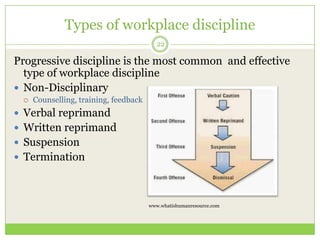
Progressive discipline is the most common and effective
type of workplace discipline
 Non-Disciplinary


Counselling, training, feedback

 Verbal reprimand
 Written reprimand

 Suspension
 Termination

www.whatishumanresource.com
Implementing workplace discipline policies
23

 Educating employees
 Educating managers
 Investigations
 Following the steps
 Verbal warning
 Written warning
 Suspension
 Termination
 Documentation
Educating employees
24

 Include workplace discipline policy in the employee





handbook
Review the policy during orientation
Provide ongoing training, coaching, and mentoring
Provide feedback through appropriate supervision
Regularly review and restate expectations for
behaviour and performance
Educating managers
25

 Ensure managers are familiar with the workplace

discipline policy and procedures
 Provide managers with tools required for effective

supervision, training, and coaching


Leadership training

 Provide managers with access to expert advice,

coaching, and support from Human Resources
What is the Appropriate Response
26

 Find out the nature of the misconduct
 Workplace culture regarding misconduct
 Employees history
 Has this happened before?
 Who was involved?
 Was the issue resolved?
Investigations
27

 Preliminary considerations
 Who should investigate? Who is involved? Is there evidence?
 Fact finding interviews
 Employee, manager, witnesses, any other involved parties
 Disciplinary conclusions
 Preliminary considerations and fact finding should be
completed before discipline is issued
 Information obtained can confirm level of discipline required
Non-Disciplinary Action
28

 Review of the policy
 Feedback from management
 Further training in appropriate behaviours
 Counselling
 Employer driven
 Employee driven
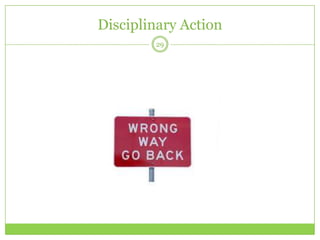
Disciplinary Action
29
Step 1: Verbal warning
30

 Employee will be given a verbal warning that clearly

confirms




The undesirable behavior or action
When, how, and where the behavior or action took place
Reason that the behaviour or action is considered unacceptable

 Manager will provide the employee with the opportunity

to explain the situation and their chosen actions
 Manager will discuss with the employee alternative
behaviours and actions that are considered acceptable
 Manager will remind the employee that further
disciplinary action, up to and including termination, may
follow if the identified unacceptable behavior continues
Step 2: Written warning
31

 Employee will be given a written warning that clearly

confirms








The undesirable behavior or action
When, how, and where the behavior or action took place
Reason that the behaviour or action is considered
unacceptable
A description of acceptable alternative behaviours or actions
Where applicable, that they have previously received at least
one verbal warning for this behaviour/action
Reminder that further disciplinary action, up to and including
termination, may follow if the identified unacceptable behavior
continues
Step 2: Written warning
32

 Manager will provide the employee with the opportunity







to explain the situation and their chosen actions
Manager will discuss with the employee alternative
behaviours or actions that are considered acceptable
A copy of the written warning will be provided to the
employee and a copy will be placed on their HR file
Employee will be required to sign the written warning
Manager will remind the employee verbally, and in
writing, that further disciplinary action, up to and
including termination, may follow if the identified
unacceptable behavior continues
Step 3: Suspension
33

 Employee will be given written documentation regarding

the suspension in relation to the undesirable behaviour
or action








When, how, and where the behavior or action took place
A summary of why the behavior or action is considered unacceptable
A description of acceptable alternative behaviours or actions
A summary of verbal and written reprimands related to this
behaviour
Duration of the suspension
Confirmation of impact of suspension on regular earnings
Reminder that further disciplinary action, up to and including
termination, may follow if the identified unacceptable behavior
continues
Step 3: Suspension
34

 Employee will be provided with a copy of the

documentation and a copy will also be placed on
their HR file
 Employee will be required to sign the documentation
Step 4: Termination
35

 Employee will be given written documentation regarding

the reason for termination









A summary of the behaviour or action that resulted in the suspension
When, how, and where the behavior or action took place
A summary of why the behavior or action is considered unacceptable
A summary of all previous disciplinary action related to the
behaviour or action
A description of acceptable alternative behaviours or actions
Confirmation of the date of termination
Confirmation of the impact of termination on regular earnings and
any other applicable employee benefits.
Step 4: Termination
36

 Employee will be provided with a copy of the

termination notice and a copy of the notice will be
placed on their HR file
 Do not hesitate to obtain legal advice before
proceeding with termination
Documentation
37

 3 rules of workplace discipline documentation
 DO IT
Helps to track and improve performance
 Supports further disciplinary action
 Provides factual evidence that policy is applied consistently and
fairly




Be professional




Documents may be reviewed by the employee, various third
parties, or legal counsel

Tell the story
Include who, what, when, where, and how
 Be factual
 Avoid including value judgments or personal opinions

Potential Challenges
38

 Consistency across the organization
 Documentation requirements
 Negative impact on individual employee

performance
 Negative impact on morale
Consistency across the organization
39

Challenge

Remedy

Ensuring managers are addressing
same issues consistently

 Training
 Documented controlled
discretion
 Ensure policy specifically applies
to commonly encountered
situations

Ensuring managers are following
steps outlined in the policy

 Training
 Make changes when required
Documentation requirements
40

Challenge

Remedy

Managers unclear on documentation
requirements

 Training

Inconsistent documentation across
managers

 Training

Cumbersome documentation
requirements

 Redesign the process to maximize
efficiency
 Provide managers with allotted time
to complete the required
documentation
Negative impact on employee performance
41

 Ensure that, when appropriate, performance

management is kept separate from workplace
discipline
 Notice and positively reinforce improvements in the
employee’s behaviour
 Notice and positively reinforce other aspects of the
employee’s work performance
 Reassure the employee that disciplinary action is
confidential
Negative impact on morale
42

 Acknowledge and discuss concerns regarding the

workplace discipline policy
 Encourage employees to ask questions and provide
input
 Notice and positively reinforce aspects of the team’s
performance or behaviour
 Lead by example
Questions?
43
THANK YOU!
44

Thank you for the opportunity to
present to you today!
About us
45

Our services
 Employer benefit plans 
 Travel insurance

 Health spending

accounts

 Salary grids
 Policy review and writing 
 Pension plans

Employee wellness
Employer of choice
Charitable giving
Charitable tax
information
Employee mental health
Contact us
46

#517-7620 Elbow Drive SW
Calgary, AB T2V 1K2
403-264-5288
www.hylton.ca
800-449-5866
info@hylton.ca
facebook.com/pages/CG-Hylton/173971246061425

twitter.com/HyltonYYC

Enforcing workplace discipline yk

  • 1.
    Enforcing Discipline inthe Workplace JANUARY 22, 2014 3:00PM HUMAN RESOURCE MANAGEMENT FOR ABORIGINAL AND NORTHERN COMMUNITIES YELLOWKNIFE, NWT LISA PECKHAM
  • 2.
    Learning objectives 2  Creatinga positive employment relationship  Performance management vs. workplace discipline  Creating workplace discipline policies  Implementing workplace discipline policies  Potential challenges
  • 3.
    Purpose of Discipline 3 Enforce the standards and rules valued by management  Provide feedback to employees and management  Create a fair workplace for all by having a consistent disciplinary program that everyone follows
  • 4.
    Creating a positivework environment 4  Defining a positive work environment  10 ways to create a positive work environment  Tools employees need to maintain a positive work environment  Benefits of a positive work environment
  • 5.
    Defining a positivework environment 5 “A positive work environment is a place where employees are happy and motivated.” White, 2002; HRZone, 2000
  • 6.
    10 ways tocreate a positive work environment 6  Build trust  Be approachable  Open communication  Positive physical  Set expectations environment  Good performance management process  Have fun  Team building  Recognition  Give credit and take responsibility
  • 7.
    Tools for employees 7 Clear policies  Clearly communicated expectations  Opportunities to practice desirable behaviours  Opportunities to participate  Communication skills
  • 8.
    Benefits of apositive work environment 8  Improved morale  Better employee performance  Increased productivity  Cohesive teams  Higher retention rates  Fewer sick days  Fewer workplace accidents and injuries  More likely to achieve organizational goals  More creativity and innovation
  • 9.
    Performance management vs. workplacediscipline 9  Defining performance management  Defining workplace discipline  Know which tool to use
  • 10.
    Defining performance management 10 “Performancemanagement is the process of creating a work environment in which employees are enabled to perform to the best of their abilities. It is a work system that begins when a job is created and ends when an employee leaves the organization.” www.humanresources.about.com It is designed to “motivate employees through setting goals, measuring progress, giving feedback, coaching for improved performance, and rewarding achievements”. www.toolingu.com
  • 11.
    Elements of performancemanagement 11  Clear and accurate job descriptions  Clearly communicated performance standards  Clearly communicated desired performance outcomes and measures  On going coaching and feedback  Regular formal performance reviews  Effective compensation and recognition systems that reward people for performance and contribution
  • 12.
    12 Successful performance management Clear and specific communicationis the cornerstone of successful performance management. It is the employer’s responsibility to let employees know the expectations.
  • 13.
    Workplace discipline 13  Theprocess of correcting a lapse of conduct and returning an employee to the desired standard of conduct  Sometimes referred to as corrective action  Used after the employer has attempted to address the undesirable behaviour through training, coaching, counselling, and mentoring  Used only for culpable behaviour  Culpable behaviour is when the employee is aware of the rules and expectations AND is capable of meeting them but makes a different choice
  • 14.
    Elements of workplacediscipline 14  Communicated  Progressive  Fair  Consistent  Documented
  • 15.
    Successful workplace discipline 15 Employee no longer engages in the undesirable     behaviour Employee improves their overall conduct to meet acceptable standards Other employees are discouraged from engaging in the undesirable behaviour Other employees improve their overall conduct to meet acceptable standards Workplace environment continues to be positive
  • 16.
    Know which toolto use 16 Performance management  To help employee develop competence  To help employee meet goals and objectives Workplace discipline  Behaviour causes workplace disruption  Violation of rules, policies, and procedures  Engaging in illegal behaviour  Violence or harassment
  • 17.
    Creating workplace disciplinepolicies 17  Define the purpose of the policy  Ensure rules are clearly stated, fair, and accurate in the Employee Handbook  Ensure that expectations and consequences are clearly stated  Classifying misconduct  Misconduct or Serious misconduct  Determine type of discipline to be used
  • 18.
    Purpose of thepolicy 18  Document the purpose of the workplace discipline policy      To communicate expectations regarding behaviour and conduct To uphold organizational rules and standards To provide fairness through transparency and consistency To create a record of events To create an action plan to help the employee improve their behaviour or conduct
  • 19.
    Employee Handbook 19  Reviewthe most current version of the employee handbook to ensure that it contains the information employees need to be successful in the workplace        Ethics and conduct Conditions of employment Substance use Unauthorized absence Harassment Cyber conduct Health and safety
  • 20.
    Expectations and consequences 20 Expectations for conduct and behaviour should be stated within the Employee Handbook and restated regularly, verbally and in writing  Employees should understand the consequences of misconduct and undesirable behaviour   List specific consequences within the same document that states behaviour and conduct expectations Statements of consequences should include steps that will be taken within the workplace discipline policy
  • 21.
    Classifying misconduct 21  Misconduct Carelessness without intent  No direct challenge to authority  Serious Misconduct  Insubordination  Jeopardizing workplace health and safety  Harassment  Criminal acts
  • 22.
    Types of workplacediscipline 22 Progressive discipline is the most common and effective type of workplace discipline  Non-Disciplinary  Counselling, training, feedback  Verbal reprimand  Written reprimand  Suspension  Termination www.whatishumanresource.com
  • 23.
    Implementing workplace disciplinepolicies 23  Educating employees  Educating managers  Investigations  Following the steps  Verbal warning  Written warning  Suspension  Termination  Documentation
  • 24.
    Educating employees 24  Includeworkplace discipline policy in the employee     handbook Review the policy during orientation Provide ongoing training, coaching, and mentoring Provide feedback through appropriate supervision Regularly review and restate expectations for behaviour and performance
  • 25.
    Educating managers 25  Ensuremanagers are familiar with the workplace discipline policy and procedures  Provide managers with tools required for effective supervision, training, and coaching  Leadership training  Provide managers with access to expert advice, coaching, and support from Human Resources
  • 26.
    What is theAppropriate Response 26  Find out the nature of the misconduct  Workplace culture regarding misconduct  Employees history  Has this happened before?  Who was involved?  Was the issue resolved?
  • 27.
    Investigations 27  Preliminary considerations Who should investigate? Who is involved? Is there evidence?  Fact finding interviews  Employee, manager, witnesses, any other involved parties  Disciplinary conclusions  Preliminary considerations and fact finding should be completed before discipline is issued  Information obtained can confirm level of discipline required
  • 28.
    Non-Disciplinary Action 28  Reviewof the policy  Feedback from management  Further training in appropriate behaviours  Counselling  Employer driven  Employee driven
  • 29.
  • 30.
    Step 1: Verbalwarning 30  Employee will be given a verbal warning that clearly confirms    The undesirable behavior or action When, how, and where the behavior or action took place Reason that the behaviour or action is considered unacceptable  Manager will provide the employee with the opportunity to explain the situation and their chosen actions  Manager will discuss with the employee alternative behaviours and actions that are considered acceptable  Manager will remind the employee that further disciplinary action, up to and including termination, may follow if the identified unacceptable behavior continues
  • 31.
    Step 2: Writtenwarning 31  Employee will be given a written warning that clearly confirms       The undesirable behavior or action When, how, and where the behavior or action took place Reason that the behaviour or action is considered unacceptable A description of acceptable alternative behaviours or actions Where applicable, that they have previously received at least one verbal warning for this behaviour/action Reminder that further disciplinary action, up to and including termination, may follow if the identified unacceptable behavior continues
  • 32.
    Step 2: Writtenwarning 32  Manager will provide the employee with the opportunity     to explain the situation and their chosen actions Manager will discuss with the employee alternative behaviours or actions that are considered acceptable A copy of the written warning will be provided to the employee and a copy will be placed on their HR file Employee will be required to sign the written warning Manager will remind the employee verbally, and in writing, that further disciplinary action, up to and including termination, may follow if the identified unacceptable behavior continues
  • 33.
    Step 3: Suspension 33 Employee will be given written documentation regarding the suspension in relation to the undesirable behaviour or action        When, how, and where the behavior or action took place A summary of why the behavior or action is considered unacceptable A description of acceptable alternative behaviours or actions A summary of verbal and written reprimands related to this behaviour Duration of the suspension Confirmation of impact of suspension on regular earnings Reminder that further disciplinary action, up to and including termination, may follow if the identified unacceptable behavior continues
  • 34.
    Step 3: Suspension 34 Employee will be provided with a copy of the documentation and a copy will also be placed on their HR file  Employee will be required to sign the documentation
  • 35.
    Step 4: Termination 35 Employee will be given written documentation regarding the reason for termination        A summary of the behaviour or action that resulted in the suspension When, how, and where the behavior or action took place A summary of why the behavior or action is considered unacceptable A summary of all previous disciplinary action related to the behaviour or action A description of acceptable alternative behaviours or actions Confirmation of the date of termination Confirmation of the impact of termination on regular earnings and any other applicable employee benefits.
  • 36.
    Step 4: Termination 36 Employee will be provided with a copy of the termination notice and a copy of the notice will be placed on their HR file  Do not hesitate to obtain legal advice before proceeding with termination
  • 37.
    Documentation 37  3 rulesof workplace discipline documentation  DO IT Helps to track and improve performance  Supports further disciplinary action  Provides factual evidence that policy is applied consistently and fairly   Be professional   Documents may be reviewed by the employee, various third parties, or legal counsel Tell the story Include who, what, when, where, and how  Be factual  Avoid including value judgments or personal opinions 
  • 38.
    Potential Challenges 38  Consistencyacross the organization  Documentation requirements  Negative impact on individual employee performance  Negative impact on morale
  • 39.
    Consistency across theorganization 39 Challenge Remedy Ensuring managers are addressing same issues consistently  Training  Documented controlled discretion  Ensure policy specifically applies to commonly encountered situations Ensuring managers are following steps outlined in the policy  Training  Make changes when required
  • 40.
    Documentation requirements 40 Challenge Remedy Managers unclearon documentation requirements  Training Inconsistent documentation across managers  Training Cumbersome documentation requirements  Redesign the process to maximize efficiency  Provide managers with allotted time to complete the required documentation
  • 41.
    Negative impact onemployee performance 41  Ensure that, when appropriate, performance management is kept separate from workplace discipline  Notice and positively reinforce improvements in the employee’s behaviour  Notice and positively reinforce other aspects of the employee’s work performance  Reassure the employee that disciplinary action is confidential
  • 42.
    Negative impact onmorale 42  Acknowledge and discuss concerns regarding the workplace discipline policy  Encourage employees to ask questions and provide input  Notice and positively reinforce aspects of the team’s performance or behaviour  Lead by example
  • 43.
  • 44.
    THANK YOU! 44 Thank youfor the opportunity to present to you today!
  • 45.
    About us 45 Our services Employer benefit plans   Travel insurance   Health spending  accounts   Salary grids  Policy review and writing   Pension plans Employee wellness Employer of choice Charitable giving Charitable tax information Employee mental health
  • 46.
    Contact us 46 #517-7620 ElbowDrive SW Calgary, AB T2V 1K2 403-264-5288 www.hylton.ca 800-449-5866 info@hylton.ca facebook.com/pages/CG-Hylton/173971246061425 twitter.com/HyltonYYC

Editor's Notes

  • #5 Like they say “the best defense is a good offense”. By creating a positive work environment you are more likely to organically discourage behaviour that requires disciplinary action. When disciplinary action is required, it is more likely to be successful due to the strong foundation built by the positive work environment.
  • #6 Simple. Effective. And. . . Not always easy to create and maintain!
  • #7 Source: http://www.insidejobscoach.com/print_files/ten_ways.htm
  • #8 Opportunities to practice desirable behaviours: If you have an area where employee performance is a concern and disciplinary action is required on a regular basis, identify opportunities to let employees practice the skills and behaviours you want them to use more frequently. Opportunities to participate: Studies have consistently shown that employees who feel that their ideas, comments, and suggestions are heard and heeded report a higher level of workplace satisfaction and loyalty to the workplace.
  • #11 Source: http://humanresources.about.com/od/glossaryp/g/perform_mgmt.htmSource:http://www.toolingu.com/definition-950130-54686-performance-management.html
  • #14 Adapted from: http://www2.gov.bc.ca/myhr/article.page?ContentID=9e9afa4b-873a-6734-2ed7-e6c79a89f6cb
  • #18 Source: http://smallbusiness.chron.com/workplace-discipline-policy-11799.html
  • #20 The policies listed above are examples of content you may want to ensure is included in the employee handbook.
  • #22 Adapted from:http://www.evansphilp.com/documents/Seminars/Discipline%20in%20the%20Workplace.pdfExamples of misconduct:Habitual latenessHorseplayTaking unauthorized breaks or unauthorized extended breaksRefusal to do one or more aspects of their position that they are capable of doingExamples of serious misconductPhysical assaultTheft or fraudHarassmentBreach of confidentialitySelling or doing drugs at work
  • #25 Source: http://hrcouncil.ca/hr-toolkit/keeping-people-discipline.cfmThe goal of employee education of workplace discipline is two fold: Employees ought reasonably know what behaviours are unacceptableManagers must provide feedback that identifies unacceptable behaviours and also identifies alternate, appropriate behaviours that an employee can use in the future.
  • #28 Adapted from: http://www.evansphilp.com/documents/Seminars/Discipline%20in%20the%20Workplace.pdfAll investigations should be conducted in a timely manner, and with fairness and impartiality. Conducting investigations has many benefits such as providing evidence and an opportunity to identify and improve workplace issues.
  • #38 Adapted from: http://www.evansphilp.com/documents/Seminars/Discipline%20in%20the%20Workplace.pdf