Final Major Project
Lecture
Jack Hurst
Year 1
Brief
This course has developed your skills in several media disciplines. It is now your chance to develop and explore these skills
further.
This unit will allow you to build upon and demonstrate your creative skills, devising your own project. You will plan and produce
a project of your choosing, exploring a topic/medium you are passionate about. You will make a final piece(s) employing the
professional conventions of the medium you have chosen.
A large media corporation has moved its headquarters to York. They plan to expand their organisation into the north of England
and want a series of products made by those who live there.
They have asked you to research existing products and the proposed audience, then plan and produce a product(s).
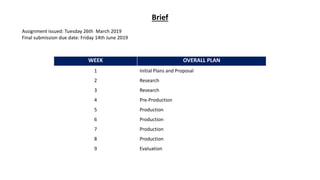
Brief
Assignment issued: Tuesday 26th March 2019
Final submission due date: Friday 14th June 2019
WEEK OVERALL PLAN
1 Initial Plans and Proposal
2 Research
3 Research
4 Pre-Production
5 Production
6 Production
7 Production
8 Production
9 Evaluation
Tasks
• Task 1 – Initial Plans
• Task 2 – Research (including experiments)
• Task 3 – Pre-production (including production schedule)
• Task 4 – Production
• Task 5 – Evaluation
• Weekly/production diary
Initial Plans
You need to produce initial plans, exploring your ideas and inspiration for the project.
• Pre-proposal which shows your initial aims
• Skill audit exploring your own strengths and weaknesses
• Mood Board (and analysis). At least 15 images that influence/inspire you. These should not just be just existing
products. Anything and everything that inspires this project should be here.
• Key influences. At least three key influences for your project with some written support about why they influence and
inspire you.
Task 1
Proposal
Finalise your concept in a formal written format discussing your idea’s;
Project title
Main area of activity
Rationale (approx 100 words)
Review your progress throughout the year- what skills and knowledge have you acquired.
Project Concept (approx 200 words)
What you plan to make
Evaluation (approx 50 words)
How you plan to evaluate the work
Proposed Bibliography
Primary and secondary sources
5 sources minimum
Schedule/Timetable
ENSURE YOU CHECK GRAMMAR AND SPELLING
Task 1
Good Sources To Use For Bibliography
YouTube
Development diaries (Dev Diaries)
Trailers
Gameplay videos
Reviews
Behind the scenes
Analysis videos
Tutorials
The Guardian
Google Books
Google Scholar
Periodicals
Library books/magazines
Official website
May be blocked
Bibliography
Set out each source in the slide’s note section like this
1. Director/Author (DATE of release/publication) Name of film/book/webpage (URL if website/Magazine if an article)
Examples
1. Truffaut, F. (1959) The 400 Blows
2. Greene, N. (2007) The French New Wave - A New Look
3. Hitchman, S. (2008) A History of French New Wave Cinema (http://www.newwavefilm.com/about/history-of-
french-new-wave.shtml)
4. Smith, J. (2014) French New Wave Cinema (Total Film, Issue 332)
5. Truffaut, F. cited in Smith, J (1994) Interview with Truffaut (Sight and Sound, issue 67)
6. Anon (accessed 2014) The French New Wave (www.realwebsite.com)
Research
Research products (at least 4) similar to those you want to create yourself. Reference;
Type of image- studio/location, angle, effects, post-production
Use of lighting/ composition/ mise en scene/ costume/ props/ location/ colours/ fonts etc.
Appeal to audience
Meaning created through content
-Written content
-Audio content (voice over, music, sound effects)
Discuss how your research will develop your final product
Common aspects in the researched products
What aspects of the research will you include in your final product
Look back at what you researched in each rotation and also think about what information you need to help you complete
your own project. Be clear about why you are researching each product.
Task 2
Research
Conduct research into your audience to understand their opinions and beliefs in regards to the product(s) you wish to produce.
Find out general information as well so you can get a general overview of the sort of person who would use/buy your product.
You could:
1. Conduct a questionnaire allowing you to generate results that will be useful to producing your final production (10
questions- use Survey Monkey to create this)
2. Conduct interviews asking qualitative questions to generate results that will be useful to producing your final
production
3. Produce and audience profile for your proposed audience
Task 2
Research
Audience research should have a purpose and influence your final product. Think carefully about who you are asking. Are they
your audience?
Think about what you will do with the answers to your questions. Will the answers have any meaningful impact on your work?
If you do carry out questionnaires or interviews, analyse the response and then discuss how this will influence your project and
how you can use this information to appeal to your audience.
Task 2
Research
Undertaking practical research is another great way to improve your project. Experimenting with techniques, equipment and
processes you might want to use in you project will help you plan for the future.
Think about what you will research. It could be studio photography, or sound recording, or post-production techniques for
video or animation techniques for a video game. Tutorials are useful here.
Make something similar but unrelated to your chosen idea.
Do not make it a version of your final product; it is an experiment
Provide a reflection of the processes you used and how it has been useful.
Don’t do something that you already know how to do.
Task 2
Research
Subject research is something else you might want to do.
This might be most relevant if you are producing a magazine or a documentary but even a fiction trailer might require some
additional research in to a particular subject.
Getting some background information on your subject would be a really good idea.
Find some resources, log them, read them and write something about them.
Task 2
Pre-Production
Pre-production is to enable effective planning for a smooth production. Your pre-production planning will help you to answer
the following questions about your project, and the different elements involved:
• What are you making? (explain what you have been asked to do)
• Why? (What is the purpose of making your Film)
• Who is it for? (Audience)
• Where will it appear/on what? (How will audience see it)
Task 3
Pre-Production
Pre-production is important for the smooth running of a project. It is for you to go through final development and organisation
for your project before you start production.
The pre-production tasks you do will depend on your project. You need to undertake appropriate tasks in order to make your
project work.
A production schedule should be in everyone’s project.
Task 3
Pre-Production
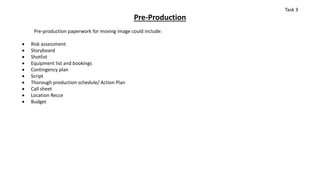
Pre-production paperwork for moving image could include:
 Risk assessment
 Storyboard
 Shotlist
 Equipment list and bookings
 Contingency plan
 Script
 Thorough production schedule/ Action Plan
 Call sheet
 Location Recce
 Budget
Task 3
Pre-Production
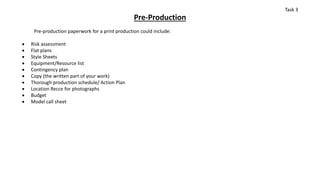
Pre-production paperwork for a print production could include:
 Risk assessment
 Flat plans
 Style Sheets
 Equipment/Resource list
 Contingency plan
 Copy (the written part of your work)
 Thorough production schedule/ Action Plan
 Location Recce for photographs
 Budget
 Model call sheet
Task 3
Pre-Production
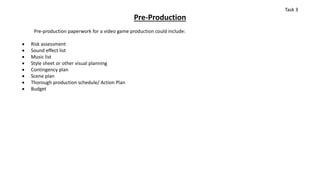
Pre-production paperwork for a video game production could include:
 Risk assessment
 Sound effect list
 Music list
 Style sheet or other visual planning
 Contingency plan
 Scene plan
 Thorough production schedule/ Action Plan
 Budget
Task 3
Pre-Production
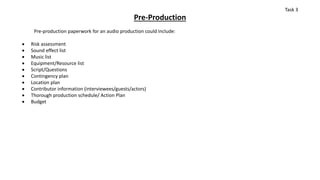
Pre-production paperwork for an audio production could include:
 Risk assessment
 Sound effect list
 Music list
 Equipment/Resource list
 Script/Questions
 Contingency plan
 Location plan
 Contributor information (interviewees/guests/actors)
 Thorough production schedule/ Action Plan
 Budget
Task 3
Pre-Production
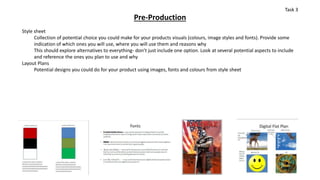
Style sheet
Collection of potential choice you could make for your products visuals (colours, image styles and fonts). Provide some
indication of which ones you will use, where you will use them and reasons why
This should explore alternatives to everything- don’t just include one option. Look at several potential aspects to include
and reference the ones you plan to use and why
Layout Plans
Potential designs you could do for your product using images, fonts and colours from style sheet
Task 3
Pre-Production
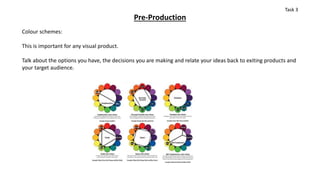
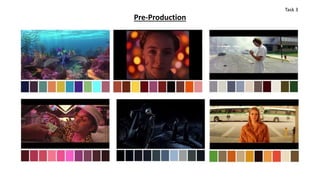
Colour schemes:
This is important for any visual product.
Talk about the options you have, the decisions you are making and relate your ideas back to exiting products and
your target audience.
Task 3
Pre-Production
Task 3
Pre-Production
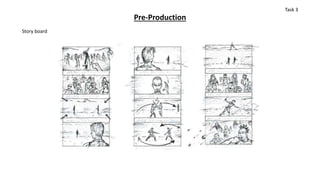
Story board
Task 3
Pre-Production
Resources
What do you need? Locations, costume and props- be very specific about what you need
Contingency Planning
What could go wrong? Technology, models, props, equipment, team members, weather, animals
Health and Safety
What could put people at risk? Equipment, props, animals, traffic, costume
Task 3
Pre-Production
Production schedules are really useful. They set out what you need to do and when.
They can help you organise which models/actors/interviewees you need on a specific day.
They can also help you understand the work you need to complete and the time you have to do it.
Things will change during production, but having an initial plan is a good place to start. Come back to it as you move through
the project and update where required.
Task 3
Production
Get it made
4 weeks
Follow the plan
Screen shot your work
Write up a regular diary, maybe even daily, about your progress
Task 4
Evaluation
Discuss the strengths and weaknesses of your;
• Planning
• Research
• Time Management
Discuss the;
• Aesthetic (the way it looks) qualities of your work
• Audience appeal of your work
• Strengths and weaknesses of the overall product
Include visual imagery as often as possible and where appropriate. This could be final products, screenshots or slides from
previous submissions
Task 5

Final Major Project - Lecture

  • 1.
  • 2.
    Brief This course hasdeveloped your skills in several media disciplines. It is now your chance to develop and explore these skills further. This unit will allow you to build upon and demonstrate your creative skills, devising your own project. You will plan and produce a project of your choosing, exploring a topic/medium you are passionate about. You will make a final piece(s) employing the professional conventions of the medium you have chosen. A large media corporation has moved its headquarters to York. They plan to expand their organisation into the north of England and want a series of products made by those who live there. They have asked you to research existing products and the proposed audience, then plan and produce a product(s).
  • 3.
    Brief Assignment issued: Tuesday26th March 2019 Final submission due date: Friday 14th June 2019 WEEK OVERALL PLAN 1 Initial Plans and Proposal 2 Research 3 Research 4 Pre-Production 5 Production 6 Production 7 Production 8 Production 9 Evaluation
  • 4.
    Tasks • Task 1– Initial Plans • Task 2 – Research (including experiments) • Task 3 – Pre-production (including production schedule) • Task 4 – Production • Task 5 – Evaluation • Weekly/production diary
  • 5.
    Initial Plans You needto produce initial plans, exploring your ideas and inspiration for the project. • Pre-proposal which shows your initial aims • Skill audit exploring your own strengths and weaknesses • Mood Board (and analysis). At least 15 images that influence/inspire you. These should not just be just existing products. Anything and everything that inspires this project should be here. • Key influences. At least three key influences for your project with some written support about why they influence and inspire you. Task 1
  • 6.
    Proposal Finalise your conceptin a formal written format discussing your idea’s; Project title Main area of activity Rationale (approx 100 words) Review your progress throughout the year- what skills and knowledge have you acquired. Project Concept (approx 200 words) What you plan to make Evaluation (approx 50 words) How you plan to evaluate the work Proposed Bibliography Primary and secondary sources 5 sources minimum Schedule/Timetable ENSURE YOU CHECK GRAMMAR AND SPELLING Task 1
  • 7.
    Good Sources ToUse For Bibliography YouTube Development diaries (Dev Diaries) Trailers Gameplay videos Reviews Behind the scenes Analysis videos Tutorials The Guardian Google Books Google Scholar Periodicals Library books/magazines Official website May be blocked
  • 8.
    Bibliography Set out eachsource in the slide’s note section like this 1. Director/Author (DATE of release/publication) Name of film/book/webpage (URL if website/Magazine if an article) Examples 1. Truffaut, F. (1959) The 400 Blows 2. Greene, N. (2007) The French New Wave - A New Look 3. Hitchman, S. (2008) A History of French New Wave Cinema (http://www.newwavefilm.com/about/history-of- french-new-wave.shtml) 4. Smith, J. (2014) French New Wave Cinema (Total Film, Issue 332) 5. Truffaut, F. cited in Smith, J (1994) Interview with Truffaut (Sight and Sound, issue 67) 6. Anon (accessed 2014) The French New Wave (www.realwebsite.com)
  • 9.
    Research Research products (atleast 4) similar to those you want to create yourself. Reference; Type of image- studio/location, angle, effects, post-production Use of lighting/ composition/ mise en scene/ costume/ props/ location/ colours/ fonts etc. Appeal to audience Meaning created through content -Written content -Audio content (voice over, music, sound effects) Discuss how your research will develop your final product Common aspects in the researched products What aspects of the research will you include in your final product Look back at what you researched in each rotation and also think about what information you need to help you complete your own project. Be clear about why you are researching each product. Task 2
  • 10.
    Research Conduct research intoyour audience to understand their opinions and beliefs in regards to the product(s) you wish to produce. Find out general information as well so you can get a general overview of the sort of person who would use/buy your product. You could: 1. Conduct a questionnaire allowing you to generate results that will be useful to producing your final production (10 questions- use Survey Monkey to create this) 2. Conduct interviews asking qualitative questions to generate results that will be useful to producing your final production 3. Produce and audience profile for your proposed audience Task 2
  • 11.
    Research Audience research shouldhave a purpose and influence your final product. Think carefully about who you are asking. Are they your audience? Think about what you will do with the answers to your questions. Will the answers have any meaningful impact on your work? If you do carry out questionnaires or interviews, analyse the response and then discuss how this will influence your project and how you can use this information to appeal to your audience. Task 2
  • 12.
    Research Undertaking practical researchis another great way to improve your project. Experimenting with techniques, equipment and processes you might want to use in you project will help you plan for the future. Think about what you will research. It could be studio photography, or sound recording, or post-production techniques for video or animation techniques for a video game. Tutorials are useful here. Make something similar but unrelated to your chosen idea. Do not make it a version of your final product; it is an experiment Provide a reflection of the processes you used and how it has been useful. Don’t do something that you already know how to do. Task 2
  • 13.
    Research Subject research issomething else you might want to do. This might be most relevant if you are producing a magazine or a documentary but even a fiction trailer might require some additional research in to a particular subject. Getting some background information on your subject would be a really good idea. Find some resources, log them, read them and write something about them. Task 2
  • 14.
    Pre-Production Pre-production is toenable effective planning for a smooth production. Your pre-production planning will help you to answer the following questions about your project, and the different elements involved: • What are you making? (explain what you have been asked to do) • Why? (What is the purpose of making your Film) • Who is it for? (Audience) • Where will it appear/on what? (How will audience see it) Task 3
  • 15.
    Pre-Production Pre-production is importantfor the smooth running of a project. It is for you to go through final development and organisation for your project before you start production. The pre-production tasks you do will depend on your project. You need to undertake appropriate tasks in order to make your project work. A production schedule should be in everyone’s project. Task 3
  • 16.
    Pre-Production Pre-production paperwork formoving image could include:  Risk assessment  Storyboard  Shotlist  Equipment list and bookings  Contingency plan  Script  Thorough production schedule/ Action Plan  Call sheet  Location Recce  Budget Task 3
  • 17.
    Pre-Production Pre-production paperwork fora print production could include:  Risk assessment  Flat plans  Style Sheets  Equipment/Resource list  Contingency plan  Copy (the written part of your work)  Thorough production schedule/ Action Plan  Location Recce for photographs  Budget  Model call sheet Task 3
  • 18.
    Pre-Production Pre-production paperwork fora video game production could include:  Risk assessment  Sound effect list  Music list  Style sheet or other visual planning  Contingency plan  Scene plan  Thorough production schedule/ Action Plan  Budget Task 3
  • 19.
    Pre-Production Pre-production paperwork foran audio production could include:  Risk assessment  Sound effect list  Music list  Equipment/Resource list  Script/Questions  Contingency plan  Location plan  Contributor information (interviewees/guests/actors)  Thorough production schedule/ Action Plan  Budget Task 3
  • 20.
    Pre-Production Style sheet Collection ofpotential choice you could make for your products visuals (colours, image styles and fonts). Provide some indication of which ones you will use, where you will use them and reasons why This should explore alternatives to everything- don’t just include one option. Look at several potential aspects to include and reference the ones you plan to use and why Layout Plans Potential designs you could do for your product using images, fonts and colours from style sheet Task 3
  • 21.
    Pre-Production Colour schemes: This isimportant for any visual product. Talk about the options you have, the decisions you are making and relate your ideas back to exiting products and your target audience. Task 3
  • 22.
  • 23.
  • 24.
    Pre-Production Resources What do youneed? Locations, costume and props- be very specific about what you need Contingency Planning What could go wrong? Technology, models, props, equipment, team members, weather, animals Health and Safety What could put people at risk? Equipment, props, animals, traffic, costume Task 3
  • 25.
    Pre-Production Production schedules arereally useful. They set out what you need to do and when. They can help you organise which models/actors/interviewees you need on a specific day. They can also help you understand the work you need to complete and the time you have to do it. Things will change during production, but having an initial plan is a good place to start. Come back to it as you move through the project and update where required. Task 3
  • 26.
    Production Get it made 4weeks Follow the plan Screen shot your work Write up a regular diary, maybe even daily, about your progress Task 4
  • 27.
    Evaluation Discuss the strengthsand weaknesses of your; • Planning • Research • Time Management Discuss the; • Aesthetic (the way it looks) qualities of your work • Audience appeal of your work • Strengths and weaknesses of the overall product Include visual imagery as often as possible and where appropriate. This could be final products, screenshots or slides from previous submissions Task 5