Critical Perspective in theCritical Perspective in the
MediaMedia
G325G325 Theoretical Evaluation of ProductionTheoretical Evaluation of Production
Section 1b:Section 1b:
Question 1(b) requires you to select one production and evaluate it in
relation to a media concept. The list of concepts to which questions
will relate is as follows:
• Genre
• Narrative
• Representation
• Audience
• Media language
You will need to learn all the
relevant theorists for each one
of these in order to use them in
the exam.
You will need to learn all the
relevant theorists for each one
of these in order to use them in
the exam.
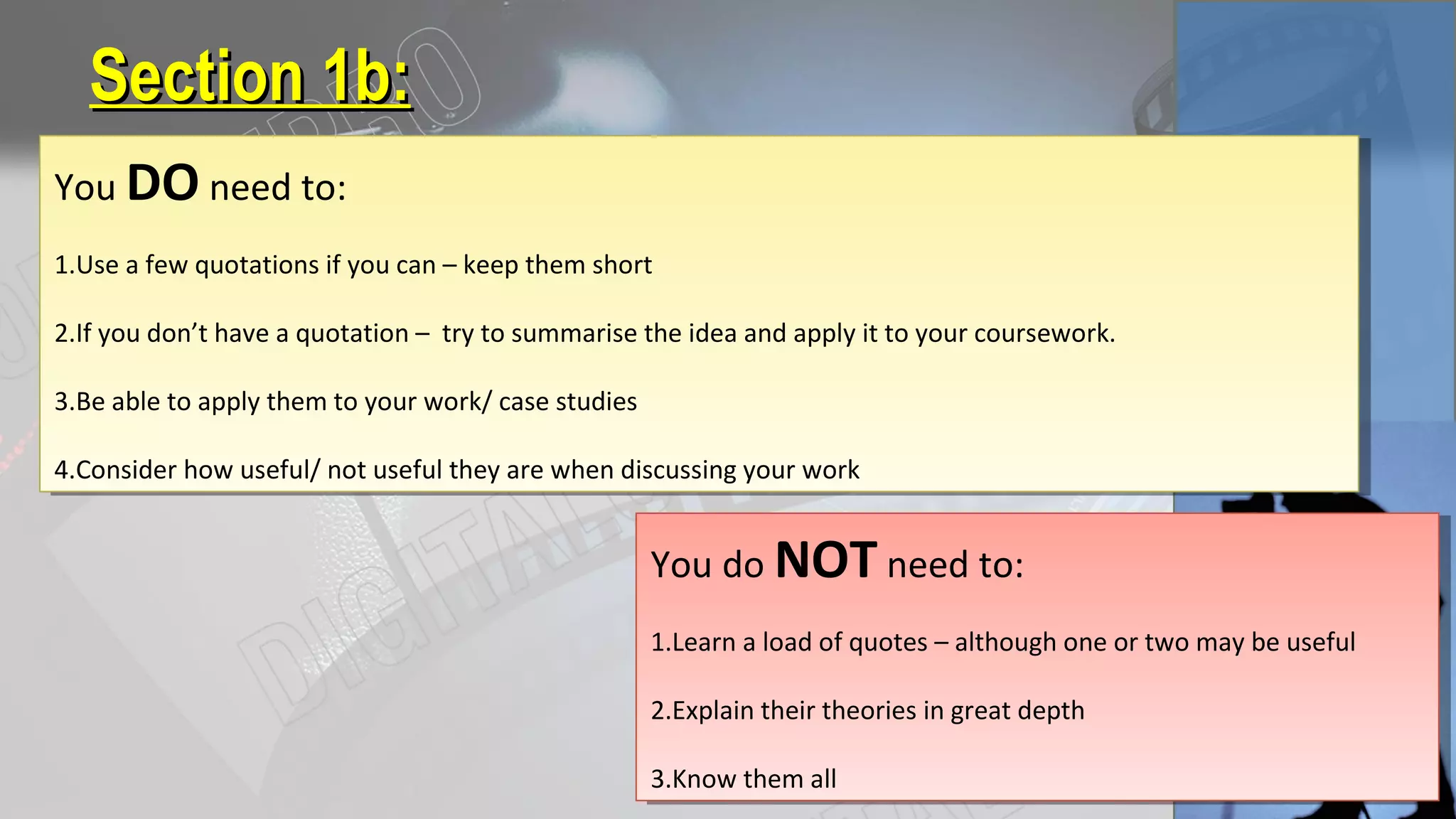
Section 1b:Section 1b:
You DO need to:
1.Use a few quotations if you can – keep them short
2.If you don’t have a quotation – try to summarise the idea and apply it to your coursework.
3.Be able to apply them to your work/ case studies
4.Consider how useful/ not useful they are when discussing your work
You DO need to:
1.Use a few quotations if you can – keep them short
2.If you don’t have a quotation – try to summarise the idea and apply it to your coursework.
3.Be able to apply them to your work/ case studies
4.Consider how useful/ not useful they are when discussing your work
You do NOT need to:
1.Learn a load of quotes – although one or two may be useful
2.Explain their theories in great depth
3.Know them all
You do NOT need to:
1.Learn a load of quotes – although one or two may be useful
2.Explain their theories in great depth
3.Know them all
Genre:Genre:
• ‘Genre’ is a critical tool that helps us study texts
and audience responses to texts by dividing
them into categories based on common
elements.
KEY WORDS:
David Chandler:
details that the word
genre comes from the
word for 'kind' or 'class'.
The term is widely used
in rhetoric, literary
theory, media theory to
refer to a “distinctive
type of ‘text’”.
Genre TheoryGenre Theory
David BuckinghamDavid Buckingham Nicholas
Abercrombie
Nicholas
Abercrombie
Christine GledhillChristine Gledhill
John FiskeJohn Fiske
Andrew GoodwinAndrew Goodwin
Stephan PrinceStephan Prince
Steve NealeSteve Neale
Barry Keith GrantBarry Keith Grant
Dennis McQuailDennis McQuail
Rick AltmanRick Altman
L.O: To be able to link THEORISTS toL.O: To be able to link THEORISTS to
courseworkcoursework
G325G325 Theoretical Evaluation of ProductionTheoretical Evaluation of Production
L.O: To be able to evaluate GENRE inL.O: To be able to evaluate GENRE in
our courseworkour coursework
G325G325 Theoretical Evaluation of ProductionTheoretical Evaluation of Production
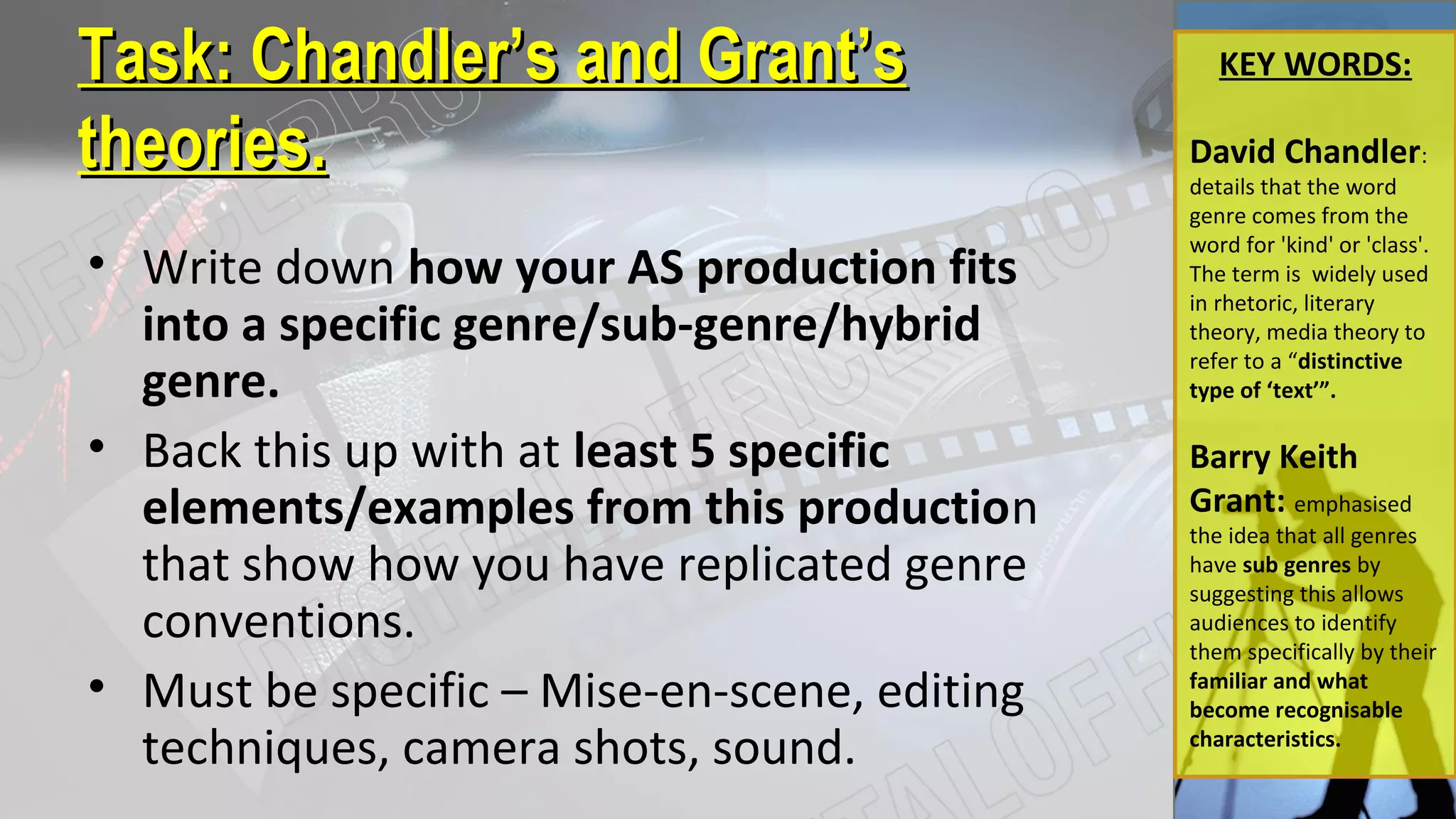
Task:Task: Chandler’s and Grant’sChandler’s and Grant’s
theories.theories.
KEY WORDS:
David Chandler:
details that the word
genre comes from the
word for 'kind' or 'class'.
The term is widely used
in rhetoric, literary
theory, media theory to
refer to a “distinctive
type of ‘text’”.
Barry Keith
Grant: emphasised
the idea that all genres
have sub genres by
suggesting this allows
audiences to identify
them specifically by their
familiar and what
become recognisable
characteristics.
• Write down how your AS production fits
into a specific genre/sub-genre/hybrid
genre.
• Back this up with at least 5 specific
elements/examples from this production
that show how you have replicated genre
conventions.
• Must be specific – Mise-en-scene, editing
techniques, camera shots, sound.
Task:Task: Altman’s and McQuail’sAltman’s and McQuail’s
theories.theories.
KEY WORDS:
Rick Altman: argues that
genre offers audiences ‘a
set of pleasures’.
Denis McQuail: audience
members get ‘uses and
gratifications’ out of
media texts for
audiences.
• Research Altman’s three pleasures. Decide
which one might relate to your product and
write down in detail 5 examples from your
product which offer this for your audience.
• Research McQuail’s four uses and
gratifications. Decide which ones might
relate to your product and write down in
detail 5 examples from your product which
offer this for your audience
Task: ‘Task: ‘Evolving’ Genre TheoriesEvolving’ Genre Theories
KEY WORDS:
Christian Metz:
argued that genres go
through a typical cycle of
changes during their
lifetime.
David
Buckingham:
argues that 'genre is
not... Simply "given" by
the culture: rather, it is
in a constant process of
negotiation and change’.
Steve Neale:
“genres are processes of
systemisation” – they
change over time.
• How is your product part of a genre that
has changed over time.
• Give 3 examples of how your product
conforms with the typical genre and 3
examples of how it challenges the genre
and shows it is evolving.
Task:Task: Genre ThemesGenre Themes
KEY WORDS:
David Bordwell:
notes, 'any theme may
appear in any genre‘.
• 5 themes that appear within your
product that are part of your genre.
• Back each one up with examples from
your work.
L.O: To be able to evaluate GENRE inL.O: To be able to evaluate GENRE in
our courseworkour coursework
G325G325 Theoretical Evaluation of ProductionTheoretical Evaluation of Production
Exam Style Question:Exam Style Question:
“Analyse one of your coursework
productions in relation to ….”.
“Analyse one of your coursework
productions in relation to ….”.
L.O: To be able to mark successfully using theL.O: To be able to mark successfully using the
MARK SCHEMEMARK SCHEME
G325G325 Theoretical Evaluation of ProductionTheoretical Evaluation of Production
D.I.R.T:D.I.R.T:
• WWW
• EBI
• D.I.R.T Task that needs to be completed to
improve this essay.
L.O: To be able to link THEORISTS toL.O: To be able to link THEORISTS to
courseworkcoursework
G325G325 Theoretical Evaluation of ProductionTheoretical Evaluation of Production
Narrative:Narrative:
• A narrative is a series of events that must be
linked in order to find meaning.
• An audience needs to be able to understand and
engage with a text easily. Therefore, media texts
must be structured clearly.
Beginning End
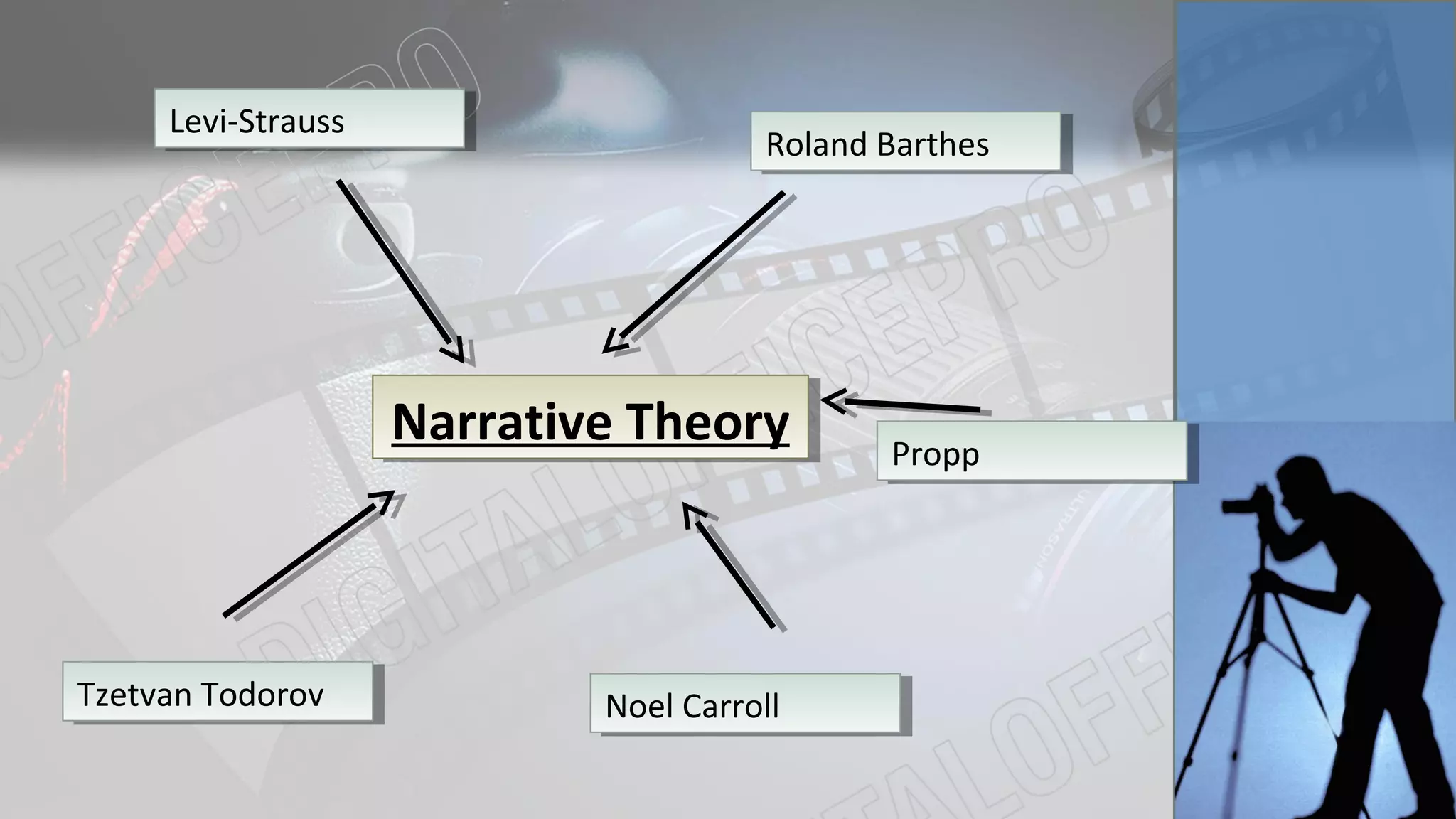
Narrative TheoryNarrative Theory
Tzetvan TodorovTzetvan Todorov
Roland BarthesRoland Barthes
Levi-StraussLevi-Strauss
ProppPropp
Noel CarrollNoel Carroll
L.O: To be able to link THEORISTS toL.O: To be able to link THEORISTS to
courseworkcoursework
G325G325 Theoretical Evaluation of ProductionTheoretical Evaluation of Production
How to use theorists:
• Quote
• Summarise
• Comment
Assume your reader knows about the theory/ theorist.
Don’t explain the theory; use it.
You DO need to:
1.Use a few quotations if
you can – keep them
short
2.If you don’t have a
quotation – try to
summarise the idea and
apply it to your
coursework.
3.Be able to apply them
to your work/ case
studies
4.Consider how useful/
not useful they are when
discussing your work
You DO need to:
1.Use a few quotations if
you can – keep them
short
2.If you don’t have a
quotation – try to
summarise the idea and
apply it to your
coursework.
3.Be able to apply them
to your work/ case
studies
4.Consider how useful/
not useful they are when
discussing your work
Applying to your coursework:Applying to your coursework:
Narrative
Explain how you used conventional and / or experimental narrative approaches in one
of your production pieces. (Exam Board Example)
• How useful is the concept of narrative in understanding your work?
• How is your narrative structured? (convergent/ parallel/ circular/ linear/ non-linear/
interweaving/ fragmented/ impressionist…?) How did you use chapters/phases?
• What pleasure(s) does your narrative offer the audience?
• How do you use characters in your narrative? How have you used protagonists/
antagonists? Is Vladimir Propp useful to understand your production?
• Some theorists and theories you may be able to apply: Story versus plot; Tzetvan
Todorov (equilibrium etc); Claude Levi-Strauss (binary opposition); Roland Barthes
(Enigma code; Action code. Also, Open and Closed texts); Pam Cook; Noam
Chomsky (narrative is fundamental to human understanding)
• How does the narrative structure/ ending shape the meaning of your production?
You DO need to:
1.Use a few quotations if
you can – keep them
short
2.If you don’t have a
quotation – try to
summarise the idea and
apply it to your
coursework.
3.Be able to apply them
to your work/ case
studies
4.Consider how useful/
not useful they are when
discussing your work
You DO need to:
1.Use a few quotations if
you can – keep them
short
2.If you don’t have a
quotation – try to
summarise the idea and
apply it to your
coursework.
3.Be able to apply them
to your work/ case
studies
4.Consider how useful/
not useful they are when
discussing your work
L.O: To be able to link THEORISTS toL.O: To be able to link THEORISTS to
courseworkcoursework
G325G325 Theoretical Evaluation of ProductionTheoretical Evaluation of Production
Representation:Representation:
• Representation is what are the connotations of the
media text - Symbolism.
• Verisimilitude – appears to look real. Socially what
they look like, and how they are represented through
society – e.g. policeman with respect.
Representation
Theory
Representation
Theory
StereotypesStereotypes Dominant ideologyDominant ideology
HegemonyHegemony
PerkinsPerkins
BaudrillardBaudrillard
Laura MulveyLaura Mulvey
PluralismPluralism
L.O: To be able to link THEORISTS toL.O: To be able to link THEORISTS to
courseworkcoursework
G325G325 Theoretical Evaluation of ProductionTheoretical Evaluation of Production
Applying to your coursework:Applying to your coursework:
Representation
Analyse media representation in one of your coursework productions. (Jan10)
 How does your video represent different social groups/ people/ places/
lifestyles? What values/ ideologies are you representing/ promoting?
 Does your production create a hegemonic representation/ does it represent
and reinforce the dominant ideology?
 What positive/ negative/ stereotypical connotations and representations are
you constructing/ using/ challenging?
 How are the representations in your production the products of your own
cultural experience/ background/ ideology/ values? – Pluralism?
 What would Laura Mulvey say about your production?
You DO need to:
1.Use a few quotations if
you can – keep them
short
2.If you don’t have a
quotation – try to
summarise the idea and
apply it to your
coursework.
3.Be able to apply them
to your work/ case
studies
4.Consider how useful/
not useful they are when
discussing your work
You DO need to:
1.Use a few quotations if
you can – keep them
short
2.If you don’t have a
quotation – try to
summarise the idea and
apply it to your
coursework.
3.Be able to apply them
to your work/ case
studies
4.Consider how useful/
not useful they are when
discussing your work
L.O: To be able to link THEORISTS toL.O: To be able to link THEORISTS to
courseworkcoursework
G325G325 Theoretical Evaluation of ProductionTheoretical Evaluation of Production
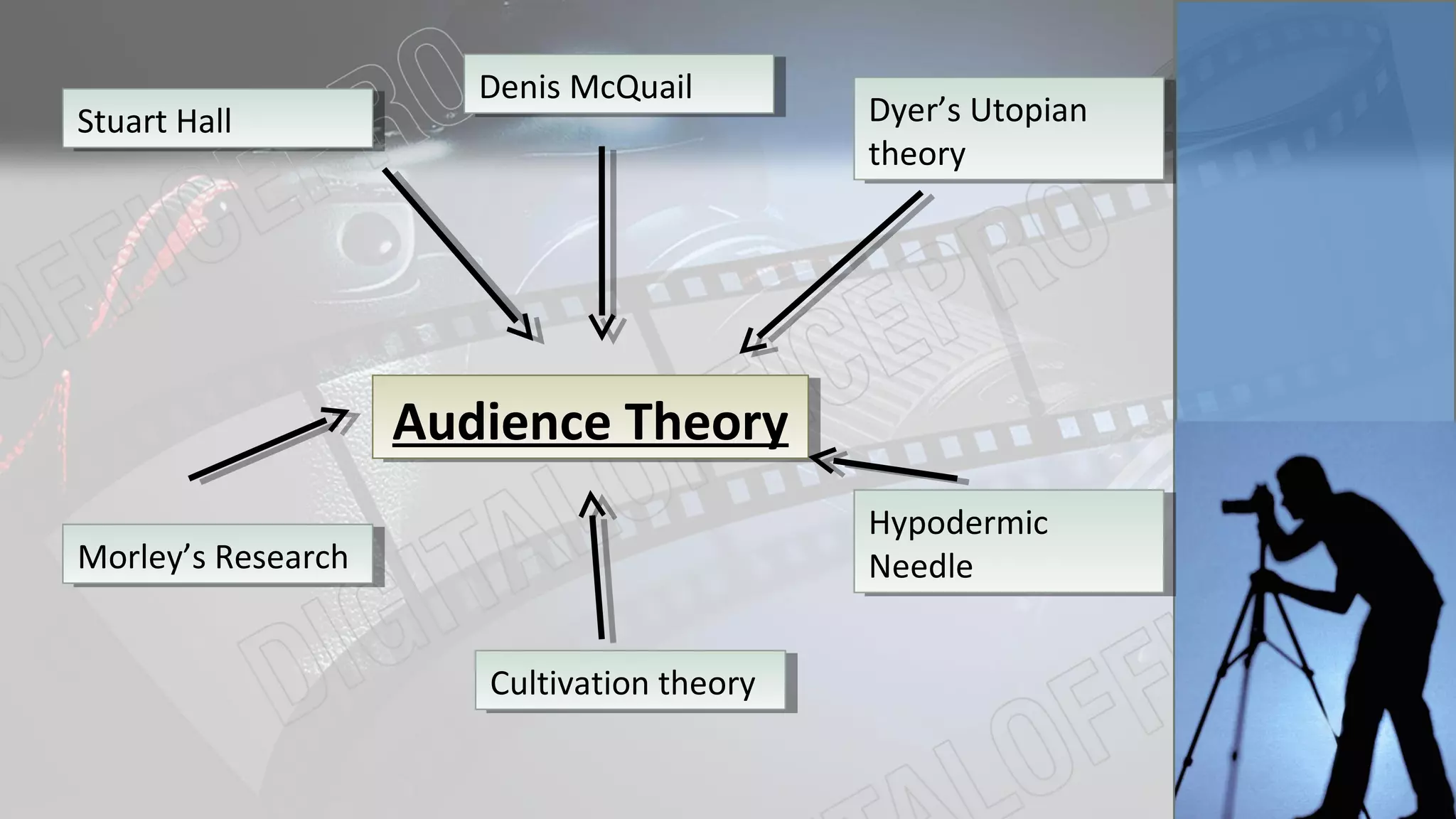
Audience TheoryAudience Theory
Stuart HallStuart Hall Dyer’s Utopian
theory
Dyer’s Utopian
theory
Morley’s ResearchMorley’s Research
Denis McQuailDenis McQuail
Hypodermic
Needle
Hypodermic
Needle
Cultivation theoryCultivation theory
L.O: To be able to link THEORISTS toL.O: To be able to link THEORISTS to
courseworkcoursework
G325G325 Theoretical Evaluation of ProductionTheoretical Evaluation of Production
Applying to your coursework:Applying to your coursework: You DO need to:
1.Use a few quotations if
you can – keep them
short
2.If you don’t have a
quotation – try to
summarise the idea and
apply it to your
coursework.
3.Be able to apply them
to your work/ case
studies
4.Consider how useful/
not useful they are when
discussing your work
You DO need to:
1.Use a few quotations if
you can – keep them
short
2.If you don’t have a
quotation – try to
summarise the idea and
apply it to your
coursework.
3.Be able to apply them
to your work/ case
studies
4.Consider how useful/
not useful they are when
discussing your work
Audience
Evaluate the ways that you constructed your media text to target a specific
audience.
• How useful is the concept of audience in understanding your work?
• Who is your target audience? How did you develop your target audience?
How does your production appeal to your target audience?
• How useful are various segmentation models to describe your target
audience? Demographics? Psychographics? Findyour tribe?
• Consider theorists and theories such as: Stuart Hall: Encoding and Decoding;
Preferred/ negotiated/ oppositional readings; Denis McQuail – (Uses and
Gratification theory); Ien Ang - “Audiencehood is becoming an even more
multifaceted, fragmented and diversified repertoire of practices and
experiences.”; Hypodermic Needle Theory
L.O: To be able to link THEORISTS toL.O: To be able to link THEORISTS to
courseworkcoursework
G325G325 Theoretical Evaluation of ProductionTheoretical Evaluation of Production
• In your case, media language refers to the ‘language of film’ or 'video' - ways in which film-
makers make meaning in ways that are specific to film/video and how audiences come to
be able to 'read' such meaning within film/video. This is closely connected to other media
concepts such as genre or narrative so you will make such connections in your answers.
• Think connotations, mise en scene, camera angles and shots, semiotics, binary oppositions,
codes and conventions.
• If you think back to the AS TV Drama exam, when you had to look at the technical codes
and how they operate, that was an exercise in applying media language analysis, so for
the A2 exam if this one comes up, I’d see it as pretty similar.
• For moving image, the language of film and television is defined by how camera, editing,
sound and mise-en-scene create meaning. Likewise an analysis of print work would involve
looking at how fonts, layout, combinations of text and image as well as the actual words
chosen creates meaning. Useful theory here might be Roland Barthes on semiotics-
denotation and connotation and for moving image work Bordwell and Thompson
Media Language:Media Language:
Bordwell and Thompson TheoryBordwell and Thompson Theory
Bordwell and Thompson offer two distinctions between story and
plot. These relate to the diegetic world of the narrative that the
audience are positioned to accept and that which the audience
actually see. This is based on the Russian Film Theory:
Fabula - This is the story. This means that all the events in the
narrative that we see and infer. It is defined as the
chronological series of events that are represented or implied.
Syuzhet - This is the plot. This means that everything that is
visible and audible are presented before the audience. Syuzhet
is seen as the order, manner and techniques or their
presentation in the narrative.
Media Language:Media Language:
• Camera Angles, shots, body language etc..
• Style and type of editing and filming
• Written, Symbolic, Technical (WST)
• Semiotics – Signs of what we see (signifier)
• Denotation/Connotation
• Iconography
• Paradigm – set of codes that we see in a media
text
Stuart Hall
Bordwell
and
Thompson
Barthes
Rickman
Stuart Hall
Bordwell
and
Thompson
Barthes
Rickman
Coursework
Mise-en-sceneMise-en-scene
SoundSound
CameraCamera
EditingEditing
• Clothing
• Facial expressions
• Props
• Lighting• Diegetic
conversations
(emphasising
people’s
attitudes)
• Non-diegetic
sound (rhythm of
music)
• Angles enforcing subordinate/dominate
characters.
• Composition of characters in the shot
(how are they stood? Why are they
stood like that?
• Quick cuts to quicken
pace?
• Wipes/fades/dissolve?
• Timings
• Effects?
• How are the technical (i.e. camera) and symbolic (i.e. costume) codes used to communicate meaning?
• How can you use semiotics to deconstruct the text?
• In what way could you say the text is conventional with regard to it’s form?

A2 media section 1b

  • 1.
    Critical Perspective intheCritical Perspective in the MediaMedia G325G325 Theoretical Evaluation of ProductionTheoretical Evaluation of Production
  • 2.
    Section 1b:Section 1b: Question1(b) requires you to select one production and evaluate it in relation to a media concept. The list of concepts to which questions will relate is as follows: • Genre • Narrative • Representation • Audience • Media language You will need to learn all the relevant theorists for each one of these in order to use them in the exam. You will need to learn all the relevant theorists for each one of these in order to use them in the exam.
  • 3.
    Section 1b:Section 1b: YouDO need to: 1.Use a few quotations if you can – keep them short 2.If you don’t have a quotation – try to summarise the idea and apply it to your coursework. 3.Be able to apply them to your work/ case studies 4.Consider how useful/ not useful they are when discussing your work You DO need to: 1.Use a few quotations if you can – keep them short 2.If you don’t have a quotation – try to summarise the idea and apply it to your coursework. 3.Be able to apply them to your work/ case studies 4.Consider how useful/ not useful they are when discussing your work You do NOT need to: 1.Learn a load of quotes – although one or two may be useful 2.Explain their theories in great depth 3.Know them all You do NOT need to: 1.Learn a load of quotes – although one or two may be useful 2.Explain their theories in great depth 3.Know them all
  • 4.
    Genre:Genre: • ‘Genre’ isa critical tool that helps us study texts and audience responses to texts by dividing them into categories based on common elements. KEY WORDS: David Chandler: details that the word genre comes from the word for 'kind' or 'class'. The term is widely used in rhetoric, literary theory, media theory to refer to a “distinctive type of ‘text’”.
  • 5.
    Genre TheoryGenre Theory DavidBuckinghamDavid Buckingham Nicholas Abercrombie Nicholas Abercrombie Christine GledhillChristine Gledhill John FiskeJohn Fiske Andrew GoodwinAndrew Goodwin Stephan PrinceStephan Prince Steve NealeSteve Neale Barry Keith GrantBarry Keith Grant Dennis McQuailDennis McQuail Rick AltmanRick Altman
  • 6.
    L.O: To beable to link THEORISTS toL.O: To be able to link THEORISTS to courseworkcoursework G325G325 Theoretical Evaluation of ProductionTheoretical Evaluation of Production
  • 8.
    L.O: To beable to evaluate GENRE inL.O: To be able to evaluate GENRE in our courseworkour coursework G325G325 Theoretical Evaluation of ProductionTheoretical Evaluation of Production
  • 9.
    Task:Task: Chandler’s andGrant’sChandler’s and Grant’s theories.theories. KEY WORDS: David Chandler: details that the word genre comes from the word for 'kind' or 'class'. The term is widely used in rhetoric, literary theory, media theory to refer to a “distinctive type of ‘text’”. Barry Keith Grant: emphasised the idea that all genres have sub genres by suggesting this allows audiences to identify them specifically by their familiar and what become recognisable characteristics. • Write down how your AS production fits into a specific genre/sub-genre/hybrid genre. • Back this up with at least 5 specific elements/examples from this production that show how you have replicated genre conventions. • Must be specific – Mise-en-scene, editing techniques, camera shots, sound.
  • 10.
    Task:Task: Altman’s andMcQuail’sAltman’s and McQuail’s theories.theories. KEY WORDS: Rick Altman: argues that genre offers audiences ‘a set of pleasures’. Denis McQuail: audience members get ‘uses and gratifications’ out of media texts for audiences. • Research Altman’s three pleasures. Decide which one might relate to your product and write down in detail 5 examples from your product which offer this for your audience. • Research McQuail’s four uses and gratifications. Decide which ones might relate to your product and write down in detail 5 examples from your product which offer this for your audience
  • 11.
    Task: ‘Task: ‘Evolving’Genre TheoriesEvolving’ Genre Theories KEY WORDS: Christian Metz: argued that genres go through a typical cycle of changes during their lifetime. David Buckingham: argues that 'genre is not... Simply "given" by the culture: rather, it is in a constant process of negotiation and change’. Steve Neale: “genres are processes of systemisation” – they change over time. • How is your product part of a genre that has changed over time. • Give 3 examples of how your product conforms with the typical genre and 3 examples of how it challenges the genre and shows it is evolving.
  • 12.
    Task:Task: Genre ThemesGenreThemes KEY WORDS: David Bordwell: notes, 'any theme may appear in any genre‘. • 5 themes that appear within your product that are part of your genre. • Back each one up with examples from your work.
  • 13.
    L.O: To beable to evaluate GENRE inL.O: To be able to evaluate GENRE in our courseworkour coursework G325G325 Theoretical Evaluation of ProductionTheoretical Evaluation of Production
  • 14.
    Exam Style Question:ExamStyle Question: “Analyse one of your coursework productions in relation to ….”. “Analyse one of your coursework productions in relation to ….”.
  • 15.
    L.O: To beable to mark successfully using theL.O: To be able to mark successfully using the MARK SCHEMEMARK SCHEME G325G325 Theoretical Evaluation of ProductionTheoretical Evaluation of Production
  • 16.
    D.I.R.T:D.I.R.T: • WWW • EBI •D.I.R.T Task that needs to be completed to improve this essay.
  • 17.
    L.O: To beable to link THEORISTS toL.O: To be able to link THEORISTS to courseworkcoursework G325G325 Theoretical Evaluation of ProductionTheoretical Evaluation of Production
  • 18.
    Narrative:Narrative: • A narrativeis a series of events that must be linked in order to find meaning. • An audience needs to be able to understand and engage with a text easily. Therefore, media texts must be structured clearly. Beginning End
  • 19.
    Narrative TheoryNarrative Theory TzetvanTodorovTzetvan Todorov Roland BarthesRoland Barthes Levi-StraussLevi-Strauss ProppPropp Noel CarrollNoel Carroll
  • 20.
    L.O: To beable to link THEORISTS toL.O: To be able to link THEORISTS to courseworkcoursework G325G325 Theoretical Evaluation of ProductionTheoretical Evaluation of Production
  • 21.
    How to usetheorists: • Quote • Summarise • Comment Assume your reader knows about the theory/ theorist. Don’t explain the theory; use it. You DO need to: 1.Use a few quotations if you can – keep them short 2.If you don’t have a quotation – try to summarise the idea and apply it to your coursework. 3.Be able to apply them to your work/ case studies 4.Consider how useful/ not useful they are when discussing your work You DO need to: 1.Use a few quotations if you can – keep them short 2.If you don’t have a quotation – try to summarise the idea and apply it to your coursework. 3.Be able to apply them to your work/ case studies 4.Consider how useful/ not useful they are when discussing your work
  • 22.
    Applying to yourcoursework:Applying to your coursework: Narrative Explain how you used conventional and / or experimental narrative approaches in one of your production pieces. (Exam Board Example) • How useful is the concept of narrative in understanding your work? • How is your narrative structured? (convergent/ parallel/ circular/ linear/ non-linear/ interweaving/ fragmented/ impressionist…?) How did you use chapters/phases? • What pleasure(s) does your narrative offer the audience? • How do you use characters in your narrative? How have you used protagonists/ antagonists? Is Vladimir Propp useful to understand your production? • Some theorists and theories you may be able to apply: Story versus plot; Tzetvan Todorov (equilibrium etc); Claude Levi-Strauss (binary opposition); Roland Barthes (Enigma code; Action code. Also, Open and Closed texts); Pam Cook; Noam Chomsky (narrative is fundamental to human understanding) • How does the narrative structure/ ending shape the meaning of your production? You DO need to: 1.Use a few quotations if you can – keep them short 2.If you don’t have a quotation – try to summarise the idea and apply it to your coursework. 3.Be able to apply them to your work/ case studies 4.Consider how useful/ not useful they are when discussing your work You DO need to: 1.Use a few quotations if you can – keep them short 2.If you don’t have a quotation – try to summarise the idea and apply it to your coursework. 3.Be able to apply them to your work/ case studies 4.Consider how useful/ not useful they are when discussing your work
  • 23.
    L.O: To beable to link THEORISTS toL.O: To be able to link THEORISTS to courseworkcoursework G325G325 Theoretical Evaluation of ProductionTheoretical Evaluation of Production
  • 24.
    Representation:Representation: • Representation iswhat are the connotations of the media text - Symbolism. • Verisimilitude – appears to look real. Socially what they look like, and how they are represented through society – e.g. policeman with respect.
  • 25.
    Representation Theory Representation Theory StereotypesStereotypes Dominant ideologyDominantideology HegemonyHegemony PerkinsPerkins BaudrillardBaudrillard Laura MulveyLaura Mulvey PluralismPluralism
  • 26.
    L.O: To beable to link THEORISTS toL.O: To be able to link THEORISTS to courseworkcoursework G325G325 Theoretical Evaluation of ProductionTheoretical Evaluation of Production
  • 27.
    Applying to yourcoursework:Applying to your coursework: Representation Analyse media representation in one of your coursework productions. (Jan10)  How does your video represent different social groups/ people/ places/ lifestyles? What values/ ideologies are you representing/ promoting?  Does your production create a hegemonic representation/ does it represent and reinforce the dominant ideology?  What positive/ negative/ stereotypical connotations and representations are you constructing/ using/ challenging?  How are the representations in your production the products of your own cultural experience/ background/ ideology/ values? – Pluralism?  What would Laura Mulvey say about your production? You DO need to: 1.Use a few quotations if you can – keep them short 2.If you don’t have a quotation – try to summarise the idea and apply it to your coursework. 3.Be able to apply them to your work/ case studies 4.Consider how useful/ not useful they are when discussing your work You DO need to: 1.Use a few quotations if you can – keep them short 2.If you don’t have a quotation – try to summarise the idea and apply it to your coursework. 3.Be able to apply them to your work/ case studies 4.Consider how useful/ not useful they are when discussing your work
  • 28.
    L.O: To beable to link THEORISTS toL.O: To be able to link THEORISTS to courseworkcoursework G325G325 Theoretical Evaluation of ProductionTheoretical Evaluation of Production
  • 29.
    Audience TheoryAudience Theory StuartHallStuart Hall Dyer’s Utopian theory Dyer’s Utopian theory Morley’s ResearchMorley’s Research Denis McQuailDenis McQuail Hypodermic Needle Hypodermic Needle Cultivation theoryCultivation theory
  • 30.
    L.O: To beable to link THEORISTS toL.O: To be able to link THEORISTS to courseworkcoursework G325G325 Theoretical Evaluation of ProductionTheoretical Evaluation of Production
  • 31.
    Applying to yourcoursework:Applying to your coursework: You DO need to: 1.Use a few quotations if you can – keep them short 2.If you don’t have a quotation – try to summarise the idea and apply it to your coursework. 3.Be able to apply them to your work/ case studies 4.Consider how useful/ not useful they are when discussing your work You DO need to: 1.Use a few quotations if you can – keep them short 2.If you don’t have a quotation – try to summarise the idea and apply it to your coursework. 3.Be able to apply them to your work/ case studies 4.Consider how useful/ not useful they are when discussing your work Audience Evaluate the ways that you constructed your media text to target a specific audience. • How useful is the concept of audience in understanding your work? • Who is your target audience? How did you develop your target audience? How does your production appeal to your target audience? • How useful are various segmentation models to describe your target audience? Demographics? Psychographics? Findyour tribe? • Consider theorists and theories such as: Stuart Hall: Encoding and Decoding; Preferred/ negotiated/ oppositional readings; Denis McQuail – (Uses and Gratification theory); Ien Ang - “Audiencehood is becoming an even more multifaceted, fragmented and diversified repertoire of practices and experiences.”; Hypodermic Needle Theory
  • 32.
    L.O: To beable to link THEORISTS toL.O: To be able to link THEORISTS to courseworkcoursework G325G325 Theoretical Evaluation of ProductionTheoretical Evaluation of Production
  • 33.
    • In yourcase, media language refers to the ‘language of film’ or 'video' - ways in which film- makers make meaning in ways that are specific to film/video and how audiences come to be able to 'read' such meaning within film/video. This is closely connected to other media concepts such as genre or narrative so you will make such connections in your answers. • Think connotations, mise en scene, camera angles and shots, semiotics, binary oppositions, codes and conventions. • If you think back to the AS TV Drama exam, when you had to look at the technical codes and how they operate, that was an exercise in applying media language analysis, so for the A2 exam if this one comes up, I’d see it as pretty similar. • For moving image, the language of film and television is defined by how camera, editing, sound and mise-en-scene create meaning. Likewise an analysis of print work would involve looking at how fonts, layout, combinations of text and image as well as the actual words chosen creates meaning. Useful theory here might be Roland Barthes on semiotics- denotation and connotation and for moving image work Bordwell and Thompson Media Language:Media Language:
  • 34.
    Bordwell and ThompsonTheoryBordwell and Thompson Theory Bordwell and Thompson offer two distinctions between story and plot. These relate to the diegetic world of the narrative that the audience are positioned to accept and that which the audience actually see. This is based on the Russian Film Theory: Fabula - This is the story. This means that all the events in the narrative that we see and infer. It is defined as the chronological series of events that are represented or implied. Syuzhet - This is the plot. This means that everything that is visible and audible are presented before the audience. Syuzhet is seen as the order, manner and techniques or their presentation in the narrative.
  • 35.
    Media Language:Media Language: •Camera Angles, shots, body language etc.. • Style and type of editing and filming • Written, Symbolic, Technical (WST) • Semiotics – Signs of what we see (signifier) • Denotation/Connotation • Iconography • Paradigm – set of codes that we see in a media text Stuart Hall Bordwell and Thompson Barthes Rickman Stuart Hall Bordwell and Thompson Barthes Rickman
  • 36.
    Coursework Mise-en-sceneMise-en-scene SoundSound CameraCamera EditingEditing • Clothing • Facialexpressions • Props • Lighting• Diegetic conversations (emphasising people’s attitudes) • Non-diegetic sound (rhythm of music) • Angles enforcing subordinate/dominate characters. • Composition of characters in the shot (how are they stood? Why are they stood like that? • Quick cuts to quicken pace? • Wipes/fades/dissolve? • Timings • Effects? • How are the technical (i.e. camera) and symbolic (i.e. costume) codes used to communicate meaning? • How can you use semiotics to deconstruct the text? • In what way could you say the text is conventional with regard to it’s form?