Personal
Production
Project
Overview
• You need to make a product package of your own choosing. This will most
likely contain lots of different products based upon a consistent concept;
– Creating a fake band and making products related to them- Poster, T-shirts,
Merchandise, CD Cover etc
• Students in the past have created;
• Magazines
• Posters
• CD Cases
• DVD Cases
• T-shirt designs
• Video Game assets
• Radio show
• Press Kit/Release
• Graphic Novels
• Point-of-Sale
• Recipe Cards
• Adverts
• Themed photography
portfolio
• Podcast
• Graphics portfolio
To Do
1. Initial plans
– General ideas you could do
2. Product research
– Research of similar products to what you’d like to do
3. Audience research
– Research who would buy your product
4. Production Experiments
– Trying out production methods
5. Proposal
– Finalise your concept in a formal written format
6. Pre-Production
– Design choices and Logistics- schedules, budgets etc
7. Production
– Making it
8. Post-Production
– Editing it
9. Exporting files
10. Peer Feedback
11. Evaluation
Initial Plans
• You need to produce initial plans, exploring
potential ideas and styles you could develop for
your final product. You must complete;
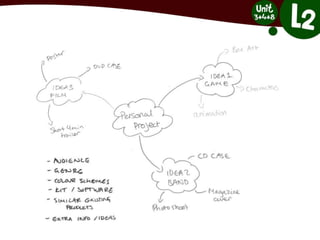
– A Mind Map exploring at least 3 separate ideas
briefly. This should explore options- consider
alternatives to everything.
– A Mind Map exploring your chosen idea in lots of
detail. Look at everything you could/want to include.
Alternative ideas should be explored.
– Mood Board (and analysis). At least 15 images that
influence/inspire you.
– Discussion of your choices and why you made them
Product Research
• Research products (at least 4) similar to those you want to
create yourself. Reference;
– Type of image- studio/location, angle, effects, post-production
– Use of lighting/ composition/ mise en scene/ costume/ props/
location/ colours/ fonts etc.
– Appeal to audience
– Meaning created through content
• Discuss how your research will develop your final product
– Common aspects in the researched products
– What aspects of the research will you include in your final
product
• 3 can be contemporary but 1 must be pre-1990
Product Research
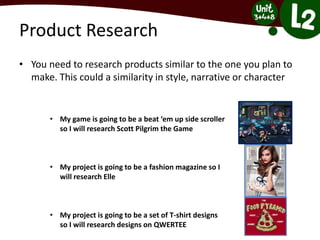
• You need to research products similar to the one you plan to
make. This could a similarity in style, narrative or character
• My game is going to be a beat ‘em up side scroller
so I will research Scott Pilgrim the Game
• My project is going to be a fashion magazine so I
will research Elle
• My project is going to be a set of T-shirt designs
so I will research designs on QWERTEE
Good sources to use
• Youtube
– Development diaries
(Dev Diaries)
– Trailers
– Gameplay videos
– Reviews
– Behind the scenes
• Kotaku/i09
– Use search engine
– Academic articles on
games/films/tv
• The Guardian
• Google Books
• Google Scholar
• Periodicals
• Library books/magazines
• Official website
– May be blocked
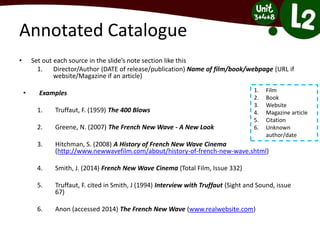
Annotated Catalogue
• Set out each source in the slide’s note section like this
1. Director/Author (DATE of release/publication) Name of film/book/webpage (URL if
website/Magazine if an article)
• Examples
1. Truffaut, F. (1959) The 400 Blows
2. Greene, N. (2007) The French New Wave - A New Look
3. Hitchman, S. (2008) A History of French New Wave Cinema
(http://www.newwavefilm.com/about/history-of-french-new-wave.shtml)
4. Smith, J. (2014) French New Wave Cinema (Total Film, Issue 332)
5. Truffaut, F. cited in Smith, J (1994) Interview with Truffaut (Sight and Sound, issue
67)
6. Anon (accessed 2014) The French New Wave (www.realwebsite.com)
1. Film
2. Book
3. Website
4. Magazine article
5. Citation
6. Unknown
author/date
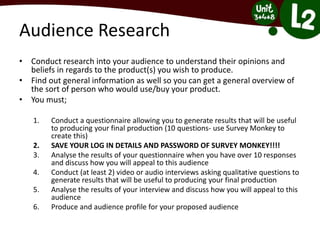
Audience Research
• Conduct research into your audience to understand their opinions and
beliefs in regards to the product(s) you wish to produce.
• Find out general information as well so you can get a general overview of
the sort of person who would use/buy your product.
• You must;
1. Conduct a questionnaire allowing you to generate results that will be useful
to producing your final production (10 questions- use Survey Monkey to
create this)
2. SAVE YOUR LOG IN DETAILS AND PASSWORD OF SURVEY MONKEY!!!!
3. Analyse the results of your questionnaire when you have over 10 responses
and discuss how you will appeal to this audience
4. Conduct (at least 2) video or audio interviews asking qualitative questions to
generate results that will be useful to producing your final production
5. Analyse the results of your interview and discuss how you will appeal to this
audience
6. Produce and audience profile for your proposed audience
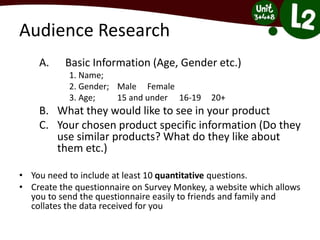
Audience Research
A. Basic Information (Age, Gender etc.)
1. Name;
2. Gender; Male Female
3. Age; 15 and under 16-19 20+
B. What they would like to see in your product
C. Your chosen product specific information (Do they
use similar products? What do they like about
them etc.)
• You need to include at least 10 quantitative questions.
• Create the questionnaire on Survey Monkey, a website which allows
you to send the questionnaire easily to friends and family and
collates the data received for you
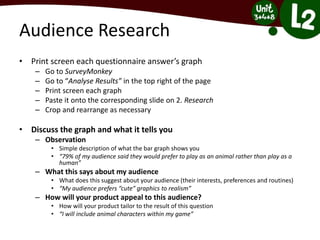
Audience Research
• Print screen each questionnaire answer’s graph
– Go to SurveyMonkey
– Go to “Analyse Results” in the top right of the page
– Print screen each graph
– Paste it onto the corresponding slide on 2. Research
– Crop and rearrange as necessary
• Discuss the graph and what it tells you
– Observation
• Simple description of what the bar graph shows you
• “79% of my audience said they would prefer to play as an animal rather than play as a
human”
– What this says about my audience
• What does this suggest about your audience (their interests, preferences and routines)
• “My audience prefers “cute” graphics to realism”
– How will your product appeal to this audience?
• How will your product tailor to the result of this question
• “I will include animal characters within my game”
Production Experiments
• You need to experiment in your chosen medium
• Make something similar but unrelated to your chosen
idea
– If you’re making a music magazine, experiment with
magazine conventions
– Do not make it a version of your final product; it is an
experiment
• Provide a brief reflection of the processes you used
and how it has been useful
• Experiment and test what you’d like to do. Look at
tutorials, play around/familiarise yourself with the
program you intend to use
Proposal
• Finalise your concept in a formal written format
discussing your idea’s;
– Working title
– Purpose
– Genre
– Content
– Audience
– Legal and Ethical Considerations
• ENSURE YOU CHECK GRAMMAR AND SPELLING
Pre-Production
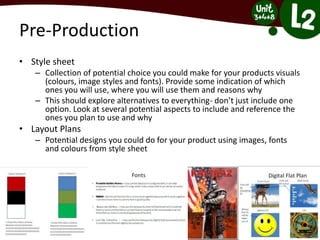
• Style sheet
– Collection of potential choice you could make for your products visuals
(colours, image styles and fonts). Provide some indication of which
ones you will use, where you will use them and reasons why
– This should explore alternatives to everything- don’t just include one
option. Look at several potential aspects to include and reference the
ones you plan to use and why
• Layout Plans
– Potential designs you could do for your product using images, fonts
and colours from style sheet
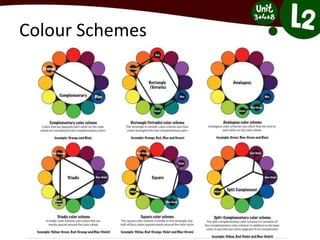
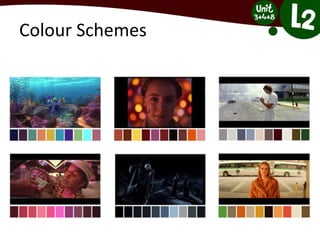
Colour Schemes
Colour Schemes
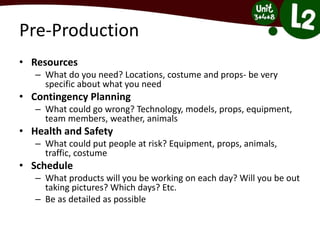
Pre-Production
• Resources
– What do you need? Locations, costume and props- be very
specific about what you need
• Contingency Planning
– What could go wrong? Technology, models, props, equipment,
team members, weather, animals
• Health and Safety
– What could put people at risk? Equipment, props, animals,
traffic, costume
• Schedule
– What products will you be working on each day? Will you be out
taking pictures? Which days? Etc.
– Be as detailed as possible
Production Reflection
IMPORTANT
• At the end of each working day, print screen
your work within the program you are using
and reflect upon your work.
• Discuss the tools and processes used in your
production.
• Log your thoughts and feelings about your
work.
Peer Feedback
• Conduct peer feedback on your products
• What do people like/dislike about your product
– Be specific
– Be helpful/supportive
– Do not use this as a chance to offend
• Summarise the results
– Answers you agreed/disagreed with
– Changes you would make based on the feedback
Evaluation
• Discuss the strengths and weaknesses of your;
– Planning
– Research
– Time Management
• Discuss the;
– Aesthetic (the way it looks) qualities of your work
– Audience appeal of your work
• Strengths and weaknesses of the overall product
• Include visual imagery as often as possible and where
appropriate. This could be final products, screenshots or
slides from previous submissions
Aim High!
• Remember – To attain those Merits and distinctions you must!:
• Dedicate time to written and practical work – do not rush! Your study day is a
STUDY DAY.
• Add detail, develop your points:
-Point, example, explanation
- What, where, how, when why?
• Include theory! – refer to unit 2
• Need audience theory help?
– Use the Audience Classification resource on Blackboard announcements
– Psychographics Hand out on Blackboard announcements
– Audience Theory Power point
• Example distinction level work for project 3 is on blackboard for reference to detail
and developed answers.
Blog Uploads
• Set up a blog on Blogger or use your Portfolio blog setup in WRL
• Make a new post for each stage of the work
• You wont be able to directly upload most of your work so you will need to
upload them to a different site and get their EMBED code
– PowerPoint or Word documents- Slideshare
– Audio products- Convert in premiere to MP4
– Video Products- Youtube embed if video upload file size is too large
• Once you have the embed code, click on the HTML section of the blog
post and paste the code in
• On the right side of the post it will ask for Labels. Use the label FMP
• When you are doing resubmissions; create a new post and state it is a
resubmission in the title; “Proposal Resubmission” etc.
• You do not have to remove the prior submission post

Personal production project

  • 1.
  • 2.
    Overview • You needto make a product package of your own choosing. This will most likely contain lots of different products based upon a consistent concept; – Creating a fake band and making products related to them- Poster, T-shirts, Merchandise, CD Cover etc • Students in the past have created; • Magazines • Posters • CD Cases • DVD Cases • T-shirt designs • Video Game assets • Radio show • Press Kit/Release • Graphic Novels • Point-of-Sale • Recipe Cards • Adverts • Themed photography portfolio • Podcast • Graphics portfolio
  • 3.
    To Do 1. Initialplans – General ideas you could do 2. Product research – Research of similar products to what you’d like to do 3. Audience research – Research who would buy your product 4. Production Experiments – Trying out production methods 5. Proposal – Finalise your concept in a formal written format 6. Pre-Production – Design choices and Logistics- schedules, budgets etc 7. Production – Making it 8. Post-Production – Editing it 9. Exporting files 10. Peer Feedback 11. Evaluation
  • 4.
    Initial Plans • Youneed to produce initial plans, exploring potential ideas and styles you could develop for your final product. You must complete; – A Mind Map exploring at least 3 separate ideas briefly. This should explore options- consider alternatives to everything. – A Mind Map exploring your chosen idea in lots of detail. Look at everything you could/want to include. Alternative ideas should be explored. – Mood Board (and analysis). At least 15 images that influence/inspire you. – Discussion of your choices and why you made them
  • 6.
    Product Research • Researchproducts (at least 4) similar to those you want to create yourself. Reference; – Type of image- studio/location, angle, effects, post-production – Use of lighting/ composition/ mise en scene/ costume/ props/ location/ colours/ fonts etc. – Appeal to audience – Meaning created through content • Discuss how your research will develop your final product – Common aspects in the researched products – What aspects of the research will you include in your final product • 3 can be contemporary but 1 must be pre-1990
  • 7.
    Product Research • Youneed to research products similar to the one you plan to make. This could a similarity in style, narrative or character • My game is going to be a beat ‘em up side scroller so I will research Scott Pilgrim the Game • My project is going to be a fashion magazine so I will research Elle • My project is going to be a set of T-shirt designs so I will research designs on QWERTEE
  • 8.
    Good sources touse • Youtube – Development diaries (Dev Diaries) – Trailers – Gameplay videos – Reviews – Behind the scenes • Kotaku/i09 – Use search engine – Academic articles on games/films/tv • The Guardian • Google Books • Google Scholar • Periodicals • Library books/magazines • Official website – May be blocked
  • 9.
    Annotated Catalogue • Setout each source in the slide’s note section like this 1. Director/Author (DATE of release/publication) Name of film/book/webpage (URL if website/Magazine if an article) • Examples 1. Truffaut, F. (1959) The 400 Blows 2. Greene, N. (2007) The French New Wave - A New Look 3. Hitchman, S. (2008) A History of French New Wave Cinema (http://www.newwavefilm.com/about/history-of-french-new-wave.shtml) 4. Smith, J. (2014) French New Wave Cinema (Total Film, Issue 332) 5. Truffaut, F. cited in Smith, J (1994) Interview with Truffaut (Sight and Sound, issue 67) 6. Anon (accessed 2014) The French New Wave (www.realwebsite.com) 1. Film 2. Book 3. Website 4. Magazine article 5. Citation 6. Unknown author/date
  • 10.
    Audience Research • Conductresearch into your audience to understand their opinions and beliefs in regards to the product(s) you wish to produce. • Find out general information as well so you can get a general overview of the sort of person who would use/buy your product. • You must; 1. Conduct a questionnaire allowing you to generate results that will be useful to producing your final production (10 questions- use Survey Monkey to create this) 2. SAVE YOUR LOG IN DETAILS AND PASSWORD OF SURVEY MONKEY!!!! 3. Analyse the results of your questionnaire when you have over 10 responses and discuss how you will appeal to this audience 4. Conduct (at least 2) video or audio interviews asking qualitative questions to generate results that will be useful to producing your final production 5. Analyse the results of your interview and discuss how you will appeal to this audience 6. Produce and audience profile for your proposed audience
  • 11.
    Audience Research A. BasicInformation (Age, Gender etc.) 1. Name; 2. Gender; Male Female 3. Age; 15 and under 16-19 20+ B. What they would like to see in your product C. Your chosen product specific information (Do they use similar products? What do they like about them etc.) • You need to include at least 10 quantitative questions. • Create the questionnaire on Survey Monkey, a website which allows you to send the questionnaire easily to friends and family and collates the data received for you
  • 12.
    Audience Research • Printscreen each questionnaire answer’s graph – Go to SurveyMonkey – Go to “Analyse Results” in the top right of the page – Print screen each graph – Paste it onto the corresponding slide on 2. Research – Crop and rearrange as necessary • Discuss the graph and what it tells you – Observation • Simple description of what the bar graph shows you • “79% of my audience said they would prefer to play as an animal rather than play as a human” – What this says about my audience • What does this suggest about your audience (their interests, preferences and routines) • “My audience prefers “cute” graphics to realism” – How will your product appeal to this audience? • How will your product tailor to the result of this question • “I will include animal characters within my game”
  • 13.
    Production Experiments • Youneed to experiment in your chosen medium • Make something similar but unrelated to your chosen idea – If you’re making a music magazine, experiment with magazine conventions – Do not make it a version of your final product; it is an experiment • Provide a brief reflection of the processes you used and how it has been useful • Experiment and test what you’d like to do. Look at tutorials, play around/familiarise yourself with the program you intend to use
  • 14.
    Proposal • Finalise yourconcept in a formal written format discussing your idea’s; – Working title – Purpose – Genre – Content – Audience – Legal and Ethical Considerations • ENSURE YOU CHECK GRAMMAR AND SPELLING
  • 15.
    Pre-Production • Style sheet –Collection of potential choice you could make for your products visuals (colours, image styles and fonts). Provide some indication of which ones you will use, where you will use them and reasons why – This should explore alternatives to everything- don’t just include one option. Look at several potential aspects to include and reference the ones you plan to use and why • Layout Plans – Potential designs you could do for your product using images, fonts and colours from style sheet
  • 16.
  • 17.
  • 18.
    Pre-Production • Resources – Whatdo you need? Locations, costume and props- be very specific about what you need • Contingency Planning – What could go wrong? Technology, models, props, equipment, team members, weather, animals • Health and Safety – What could put people at risk? Equipment, props, animals, traffic, costume • Schedule – What products will you be working on each day? Will you be out taking pictures? Which days? Etc. – Be as detailed as possible
  • 19.
    Production Reflection IMPORTANT • Atthe end of each working day, print screen your work within the program you are using and reflect upon your work. • Discuss the tools and processes used in your production. • Log your thoughts and feelings about your work.
  • 20.
    Peer Feedback • Conductpeer feedback on your products • What do people like/dislike about your product – Be specific – Be helpful/supportive – Do not use this as a chance to offend • Summarise the results – Answers you agreed/disagreed with – Changes you would make based on the feedback
  • 21.
    Evaluation • Discuss thestrengths and weaknesses of your; – Planning – Research – Time Management • Discuss the; – Aesthetic (the way it looks) qualities of your work – Audience appeal of your work • Strengths and weaknesses of the overall product • Include visual imagery as often as possible and where appropriate. This could be final products, screenshots or slides from previous submissions
  • 22.
    Aim High! • Remember– To attain those Merits and distinctions you must!: • Dedicate time to written and practical work – do not rush! Your study day is a STUDY DAY. • Add detail, develop your points: -Point, example, explanation - What, where, how, when why? • Include theory! – refer to unit 2 • Need audience theory help? – Use the Audience Classification resource on Blackboard announcements – Psychographics Hand out on Blackboard announcements – Audience Theory Power point • Example distinction level work for project 3 is on blackboard for reference to detail and developed answers.
  • 23.
    Blog Uploads • Setup a blog on Blogger or use your Portfolio blog setup in WRL • Make a new post for each stage of the work • You wont be able to directly upload most of your work so you will need to upload them to a different site and get their EMBED code – PowerPoint or Word documents- Slideshare – Audio products- Convert in premiere to MP4 – Video Products- Youtube embed if video upload file size is too large • Once you have the embed code, click on the HTML section of the blog post and paste the code in • On the right side of the post it will ask for Labels. Use the label FMP • When you are doing resubmissions; create a new post and state it is a resubmission in the title; “Proposal Resubmission” etc. • You do not have to remove the prior submission post

Editor's Notes

  • #18 https://twitter.com/CINEMAPALETTES