A2 MEDIA
STUDIES
SURVIVAL PACK
Keep Me Safe.
This is an important document. It contains all the basic information
you need to get you started in Year 13 AND some helpful tips to
make sure you get the best out of A2 Media Studies. Good luck!
Contents:
A2 Media Studies
Units
Coursework
Deadlines
Wider Reading
University
“Working hard is
very important.
You’re not going to
get anywhere
without working
extremely hard.”
George Lucas
A2 UNITS
G324 – Advanced Production Portfolio
Your coursework production piece takes a different approach from AS Media Studies. This year you
will be responsible for producing a media campaign for an original product from a choice of briefs.
The coursework is worth 50% of the year.
The portfolio will include:
 Research and planning (20 marks)
 Main task – video (40 marks)
 Two ancillary tasks – a choice of print, web or radio (10 marks each)
 Evaluation (20 marks).
You may work as an individual for the project – however due to the size of the project, I advise you
work in a group (of no more than four).
We will spend some time looking at all the potential briefs so you can make an informed choice. Once
we have done so…
You will choose ONE of the following options to complete:
1. A promotion package for the release of an album, to include a music promo video,
together with two of the following three options:
• a website homepage for the band;
• a digipak for the album’s release;
• a magazine advertisement for the digipak.
2. A promotion package for a new film, to include a trailer, together with two of the
following three options:
• a website homepage for the film;
• a film magazine front cover, featuring the film;
• a poster for the film.
7. An extract from an original documentary TV programme, lasting approximately five
minutes, together with two of the following three options:
• a radio trailer for the documentary;
• a double-page spread from a listings magazine focused on the documentary;
• a newspaper advertisement for the documentary.
Evaluation
You will be expected to complete the evaluation as a group. There are four focus questions:
1. In what ways does your media product use, develop or challenge forms and conventions of real
media products?
2. How effective is the combination of your main product and ancillary texts?
3. What have you learned from your audience feedback?
4. How did you use media technologies in the construction and research, planning and evaluation
stages?
G325 - Critical Perspectives in Media
You have one exam for A2 Media Studies, which you will complete in June. The exam is 2 hours and
worth 50% of the overall grade. It is broken down into two sections:
Section A – Critical Evaluation
This section of the exam is broken down into two questions. Both questions ask you to focus on your
media production work and evaluate it in relation to a variety of topics. It is important that you ensure
you know both your coursework pieces inside-out! There will only be one option for each question.
Question 1a – Evaluation of Progress
This question will expect you to evaluate your progress in your coursework from AS to A2
surrounding one of the five topics:
 Research and planning
 Post-production
 Digital technology
 Using real media conventions
 Creativity
The question is worth 25 marks.
You will have to reflect on a range of examples from both AS and A2 and think about how you have
developed as a media producer over this time. This may be either the improvement of skills from AS
to A2 or the development of new skills.
You will only be asked about one of the areas with the exception of creativity which will never come up
on its own. Instead, it will be paired with another topic and you will be asked how you developed your
creativity skills in that area. For example:
“Describe a range of creative decisions that you made in post-production and how these decisions
made a difference to the final outcomes. Refer to a range of examples in your answer to show how
your skills developed over time.” – Past paper question June 2012.
Question 1b – Theoretical Evaluation
This question will expect you to discuss one of your coursework pieces (I always suggest A2) and
evaluate its theoretical relevance in relation to one of the five topics:
 Genre
 Narrative
 Audience
 Representation
 Media language
The question is worth 25 marks.
You will be expected to know a range of relevant media theory and theorists and discuss them in
relation to your work. It can be tricky as you are being asked to analyze your work as if it is not your
own work. Instead you must look at it from a critical and objective point of view (imagine it’s like
another media text you haven’t made that we would study).
You will need to link these theoretical concepts to relevant and specific examples from your own work.
You will only be expected to address one theory area in your answer. An example question would be:
“Apply theories of narrative to one of your coursework productions.” – Past paper January 2011.
Section B – Collective Identity (Youth Culture)
This section of the exam requires you to have an understanding of contemporary media texts,
industries, audiences and debates.
What is contemporary?
A media text which has been published or released within five years of your exam.
You will be sitting your exam in June 2015 so for you contemporary will be any media text published
or released from 2010.
What is collective identity?
Collective identity is the shared sense of belonging to a group. It is thought of as individuals’
identifications of, identifications with, or attachment to certain groups. For example: youth and youth
culture.
You will be expected to develop a range of specific case studies to help you prepare to demonstrate
your understanding of collective identity.
This understanding must combine knowledge of:
 At least two media (e.g. television and film)
 a range of texts – you should be prepared with at least six case studies
 the role institutions play in the construction of representation and how this impacts the
audience
 an in depth awareness of relevant media theory which you can apply to your argument.
There are four core areas of study which the exam question may reflect:
 How do the contemporary media represent youth culture in different ways?
 How does contemporary representation compare to previous time periods?
 What are the social implications of different media representations of youths?
 To what extent is human identity increasingly ‘mediated’?
In order to be fully prepared for the specific requirements of the question, you must cover these three
elements:
Historical – you must summarise the development of the media forms in relation to youth culture
and how this is similar/different to today.
Contemporary – examples from five years before the examination.
Future – you must demonstrate personal engagement with debates about the future of the media
and representation in relation to youth culture..
WARNING!!!
If you only refer to one media area in their answer, the mark scheme clearly indicates that marks will
be restricted to a maximum of top of level 1 (U grade).
If you fail to discuss historical references and or future projections, marks will be restricted to a
maximum of top of level 3 for use of examples only (C-B grade).
The question is worth 50 marks.
Example question:
“How do representations influence collective idenitity? You may refer to one group of people or more
in your answer.” – Past paper January 2012
COURSEWORK
DEADLINES
The coursework is a large piece of work but you will be expected to manage
your time and ensure everything is complete by the following dates:
Friday 19th September - Selection of brief and group
Friday 3rd October - Real media and initial audience research
Friday 17th October - Pre-production planning for main and ancillary tasks
Friday 7th November - Ancillary tasks rough drafts
Friday 5th December - Rough cut
w/b Monday 8th December collect rough cut audience feedback.
Friday 30th January - Final cut of main task
Friday 6th February - Final drafts of ancillary tasks
w/b Monday 9th February collect final audience feedback
Friday 27th February – Evaluation draft
Friday 13th March - Final evaluation & close of coursework.
WIDER READING
A list of books and media texts which you may find useful – either to
support your learning on the course or to help you with wider Media
journey…
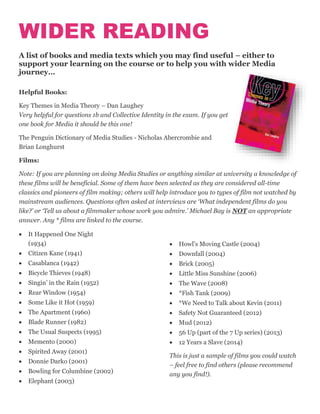
Helpful Books:
Key Themes in Media Theory – Dan Laughey
Very helpful for questions 1b and Collective Identity in the exam. If you get
one book for Media it should be this one!
The Penguin Dictionary of Media Studies - Nicholas Abercrombie and
Brian Longhurst
Films:
Note: If you are planning on doing Media Studies or anything similar at university a knowledge of
these films will be beneficial. Some of them have been selected as they are considered all-time
classics and pioneers of film making; others will help introduce you to types of film not watched by
mainstream audiences. Questions often asked at interviews are ‘What independent films do you
like?’ or ‘Tell us about a filmmaker whose work you admire.’ Michael Bay is NOT an appropriate
answer. Any * films are linked to the course.
 It Happened One Night
(1934)
 Citizen Kane (1941)
 Casablanca (1942)
 Bicycle Thieves (1948)
 Singin’ in the Rain (1952)
 Rear Window (1954)
 Some Like it Hot (1959)
 The Apartment (1960)
 Blade Runner (1982)
 The Usual Suspects (1995)
 Memento (2000)
 Spirited Away (2001)
 Donnie Darko (2001)
 Bowling for Columbine (2002)
 Elephant (2003)
 Howl’s Moving Castle (2004)
 Downfall (2004)
 Brick (2005)
 Little Miss Sunshine (2006)
 The Wave (2008)
 *Fish Tank (2009)
 *We Need to Talk about Kevin (2011)
 Safety Not Guaranteed (2012)
 Mud (2012)
 56 Up (part of the 7 Up series) (2013)
 12 Years a Slave (2014)
This is just a sample of films you could watch
– feel free to find others (please recommend
any you find!).
UNIVERSITY
Year 13 = time to think about the real world! Some of you might be thinking about studying Media at
university. Here are some things to think about…
Which One?
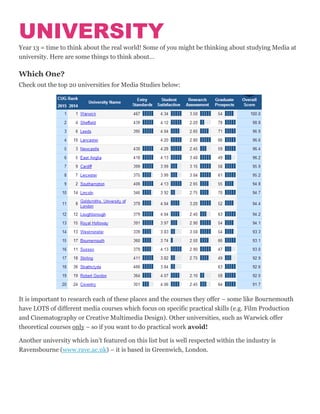
Check out the top 20 universities for Media Studies below:
It is important to research each of these places and the courses they offer – some like Bournemouth
have LOTS of different media courses which focus on specific practical skills (e.g. Film Production
and Cinematography or Creative Multimedia Design). Other universities, such as Warwick offer
theoretical courses only – so if you want to do practical work avoid!
Another university which isn’t featured on this list but is well respected within the industry is
Ravensbourne (www.rave.ac.uk) – it is based in Greenwich, London.
What should I prepare?
 If you are planning on doing a practical course the university will probably expect you to show
them a show reel of your work (to prove you are good!). This should include your AS and A2
coursework pieces and any other relevant media. It is a good idea to make your own short film
to show you are SO passionate about film making that you do it for fun!
 Think about film and television you have watched which inspires you. How does these
films/programmes influence your own work or you?
 Try to organise some work experience for yourself – there are plenty of post-production
companies in Soho. A lot of them are open to students ‘shadowing’ their staff for a day. Even
this type of experience can make the difference in your application as it will give you an insight
into the industry that others applying may not have.

A2 Media Studies Survival Pack

  • 1.
    A2 MEDIA STUDIES SURVIVAL PACK KeepMe Safe. This is an important document. It contains all the basic information you need to get you started in Year 13 AND some helpful tips to make sure you get the best out of A2 Media Studies. Good luck! Contents: A2 Media Studies Units Coursework Deadlines Wider Reading University “Working hard is very important. You’re not going to get anywhere without working extremely hard.” George Lucas
  • 2.
    A2 UNITS G324 –Advanced Production Portfolio Your coursework production piece takes a different approach from AS Media Studies. This year you will be responsible for producing a media campaign for an original product from a choice of briefs. The coursework is worth 50% of the year. The portfolio will include:  Research and planning (20 marks)  Main task – video (40 marks)  Two ancillary tasks – a choice of print, web or radio (10 marks each)  Evaluation (20 marks). You may work as an individual for the project – however due to the size of the project, I advise you work in a group (of no more than four). We will spend some time looking at all the potential briefs so you can make an informed choice. Once we have done so… You will choose ONE of the following options to complete: 1. A promotion package for the release of an album, to include a music promo video, together with two of the following three options: • a website homepage for the band; • a digipak for the album’s release; • a magazine advertisement for the digipak. 2. A promotion package for a new film, to include a trailer, together with two of the following three options: • a website homepage for the film; • a film magazine front cover, featuring the film; • a poster for the film. 7. An extract from an original documentary TV programme, lasting approximately five minutes, together with two of the following three options: • a radio trailer for the documentary; • a double-page spread from a listings magazine focused on the documentary; • a newspaper advertisement for the documentary.
  • 3.
    Evaluation You will beexpected to complete the evaluation as a group. There are four focus questions: 1. In what ways does your media product use, develop or challenge forms and conventions of real media products? 2. How effective is the combination of your main product and ancillary texts? 3. What have you learned from your audience feedback? 4. How did you use media technologies in the construction and research, planning and evaluation stages? G325 - Critical Perspectives in Media You have one exam for A2 Media Studies, which you will complete in June. The exam is 2 hours and worth 50% of the overall grade. It is broken down into two sections: Section A – Critical Evaluation This section of the exam is broken down into two questions. Both questions ask you to focus on your media production work and evaluate it in relation to a variety of topics. It is important that you ensure you know both your coursework pieces inside-out! There will only be one option for each question. Question 1a – Evaluation of Progress This question will expect you to evaluate your progress in your coursework from AS to A2 surrounding one of the five topics:  Research and planning  Post-production  Digital technology  Using real media conventions  Creativity The question is worth 25 marks. You will have to reflect on a range of examples from both AS and A2 and think about how you have developed as a media producer over this time. This may be either the improvement of skills from AS to A2 or the development of new skills. You will only be asked about one of the areas with the exception of creativity which will never come up on its own. Instead, it will be paired with another topic and you will be asked how you developed your creativity skills in that area. For example:
  • 4.
    “Describe a rangeof creative decisions that you made in post-production and how these decisions made a difference to the final outcomes. Refer to a range of examples in your answer to show how your skills developed over time.” – Past paper question June 2012. Question 1b – Theoretical Evaluation This question will expect you to discuss one of your coursework pieces (I always suggest A2) and evaluate its theoretical relevance in relation to one of the five topics:  Genre  Narrative  Audience  Representation  Media language The question is worth 25 marks. You will be expected to know a range of relevant media theory and theorists and discuss them in relation to your work. It can be tricky as you are being asked to analyze your work as if it is not your own work. Instead you must look at it from a critical and objective point of view (imagine it’s like another media text you haven’t made that we would study). You will need to link these theoretical concepts to relevant and specific examples from your own work. You will only be expected to address one theory area in your answer. An example question would be: “Apply theories of narrative to one of your coursework productions.” – Past paper January 2011. Section B – Collective Identity (Youth Culture) This section of the exam requires you to have an understanding of contemporary media texts, industries, audiences and debates. What is contemporary? A media text which has been published or released within five years of your exam. You will be sitting your exam in June 2015 so for you contemporary will be any media text published or released from 2010. What is collective identity? Collective identity is the shared sense of belonging to a group. It is thought of as individuals’ identifications of, identifications with, or attachment to certain groups. For example: youth and youth culture.
  • 5.
    You will beexpected to develop a range of specific case studies to help you prepare to demonstrate your understanding of collective identity. This understanding must combine knowledge of:  At least two media (e.g. television and film)  a range of texts – you should be prepared with at least six case studies  the role institutions play in the construction of representation and how this impacts the audience  an in depth awareness of relevant media theory which you can apply to your argument. There are four core areas of study which the exam question may reflect:  How do the contemporary media represent youth culture in different ways?  How does contemporary representation compare to previous time periods?  What are the social implications of different media representations of youths?  To what extent is human identity increasingly ‘mediated’? In order to be fully prepared for the specific requirements of the question, you must cover these three elements: Historical – you must summarise the development of the media forms in relation to youth culture and how this is similar/different to today. Contemporary – examples from five years before the examination. Future – you must demonstrate personal engagement with debates about the future of the media and representation in relation to youth culture.. WARNING!!! If you only refer to one media area in their answer, the mark scheme clearly indicates that marks will be restricted to a maximum of top of level 1 (U grade). If you fail to discuss historical references and or future projections, marks will be restricted to a maximum of top of level 3 for use of examples only (C-B grade). The question is worth 50 marks. Example question: “How do representations influence collective idenitity? You may refer to one group of people or more in your answer.” – Past paper January 2012
  • 6.
    COURSEWORK DEADLINES The coursework isa large piece of work but you will be expected to manage your time and ensure everything is complete by the following dates: Friday 19th September - Selection of brief and group Friday 3rd October - Real media and initial audience research Friday 17th October - Pre-production planning for main and ancillary tasks Friday 7th November - Ancillary tasks rough drafts Friday 5th December - Rough cut w/b Monday 8th December collect rough cut audience feedback. Friday 30th January - Final cut of main task Friday 6th February - Final drafts of ancillary tasks w/b Monday 9th February collect final audience feedback Friday 27th February – Evaluation draft Friday 13th March - Final evaluation & close of coursework.
  • 7.
    WIDER READING A listof books and media texts which you may find useful – either to support your learning on the course or to help you with wider Media journey… Helpful Books: Key Themes in Media Theory – Dan Laughey Very helpful for questions 1b and Collective Identity in the exam. If you get one book for Media it should be this one! The Penguin Dictionary of Media Studies - Nicholas Abercrombie and Brian Longhurst Films: Note: If you are planning on doing Media Studies or anything similar at university a knowledge of these films will be beneficial. Some of them have been selected as they are considered all-time classics and pioneers of film making; others will help introduce you to types of film not watched by mainstream audiences. Questions often asked at interviews are ‘What independent films do you like?’ or ‘Tell us about a filmmaker whose work you admire.’ Michael Bay is NOT an appropriate answer. Any * films are linked to the course.  It Happened One Night (1934)  Citizen Kane (1941)  Casablanca (1942)  Bicycle Thieves (1948)  Singin’ in the Rain (1952)  Rear Window (1954)  Some Like it Hot (1959)  The Apartment (1960)  Blade Runner (1982)  The Usual Suspects (1995)  Memento (2000)  Spirited Away (2001)  Donnie Darko (2001)  Bowling for Columbine (2002)  Elephant (2003)  Howl’s Moving Castle (2004)  Downfall (2004)  Brick (2005)  Little Miss Sunshine (2006)  The Wave (2008)  *Fish Tank (2009)  *We Need to Talk about Kevin (2011)  Safety Not Guaranteed (2012)  Mud (2012)  56 Up (part of the 7 Up series) (2013)  12 Years a Slave (2014) This is just a sample of films you could watch – feel free to find others (please recommend any you find!).
  • 8.
    UNIVERSITY Year 13 =time to think about the real world! Some of you might be thinking about studying Media at university. Here are some things to think about… Which One? Check out the top 20 universities for Media Studies below: It is important to research each of these places and the courses they offer – some like Bournemouth have LOTS of different media courses which focus on specific practical skills (e.g. Film Production and Cinematography or Creative Multimedia Design). Other universities, such as Warwick offer theoretical courses only – so if you want to do practical work avoid! Another university which isn’t featured on this list but is well respected within the industry is Ravensbourne (www.rave.ac.uk) – it is based in Greenwich, London.
  • 9.
    What should Iprepare?  If you are planning on doing a practical course the university will probably expect you to show them a show reel of your work (to prove you are good!). This should include your AS and A2 coursework pieces and any other relevant media. It is a good idea to make your own short film to show you are SO passionate about film making that you do it for fun!  Think about film and television you have watched which inspires you. How does these films/programmes influence your own work or you?  Try to organise some work experience for yourself – there are plenty of post-production companies in Soho. A lot of them are open to students ‘shadowing’ their staff for a day. Even this type of experience can make the difference in your application as it will give you an insight into the industry that others applying may not have.