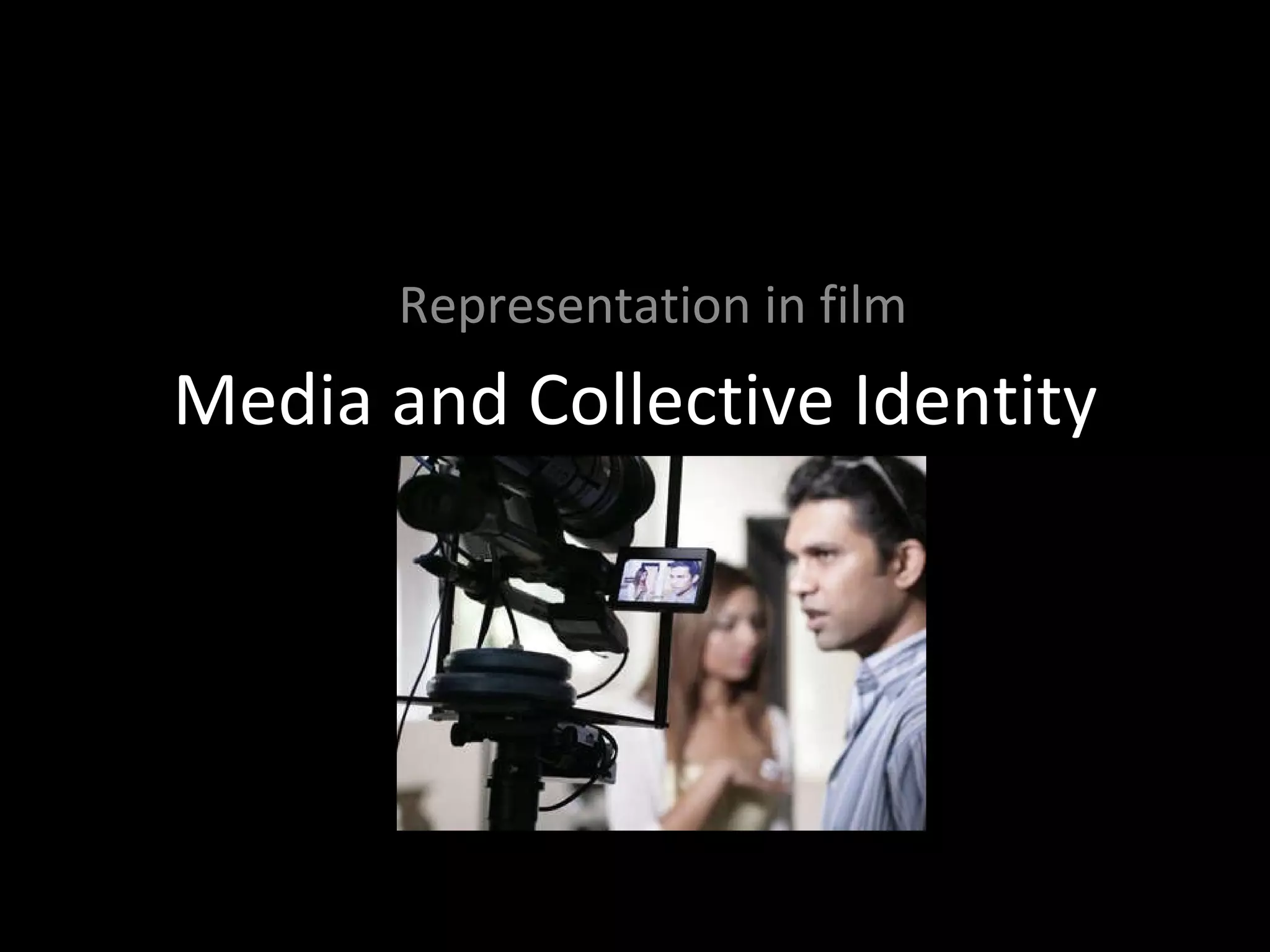
Media and Collective Identity Representation in film
“ If the hippies cut off all their hair,  I don't care”  - Jimi Hendrix Modernism (art) Structuralism (theory) British social realism Post-modernism  Brit grit – new social realism
Pick a media text (film/ TV series) Preferably one of the texts we have looked at together this year. We will be applying these theories to that text during this lesson: Binary opposition Film as commercial imperative/ cultural document Representation of class, race, gender Ideology and false consciousness
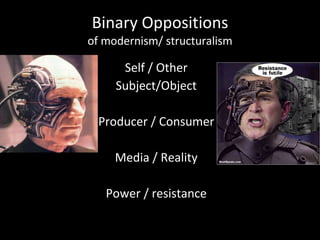
Binary Oppositions of modernism/ structuralism Self / Other Subject/Object Producer / Consumer Media / Reality Power / resistance
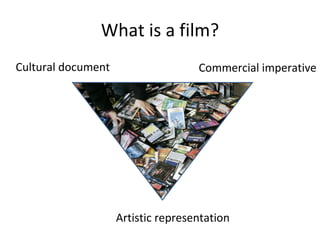
What is a film? Cultural document Commercial imperative Artistic representation
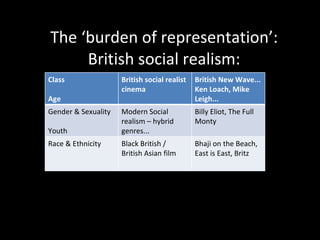
The ‘burden of representation’: British social realism: Class Age British social realist cinema British New Wave... Ken Loach, Mike Leigh... Gender & Sexuality Youth  Modern Social realism – hybrid genres...  Billy Eliot, The Full Monty Race & Ethnicity  Black British / British Asian film  Bhaji on the Beach, East is East, Britz
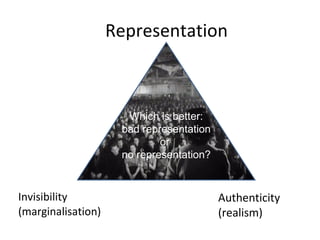
Representation Invisibility (marginalisation) Authenticity  (realism) Which is better: bad representation or  no representation?
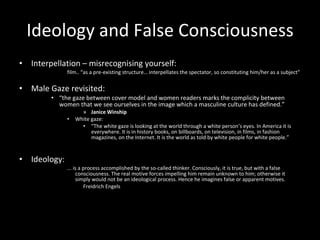
Ideology and False Consciousness Interpellation – misrecognising yourself: film.. “as a pre-existing structure… interpellates the spectator, so constituting him/her as a subject” Male Gaze revisited: “ the gaze between cover model and women readers marks the complicity between women that we see ourselves in the image which a masculine culture has defined.” Janice Winship White gaze: “ The white gaze is looking at the world through a white person’s eyes. In America it is everywhere. It is in history books, on billboards, on television, in films, in fashion magazines, on the Internet. It is the world as told by white people for white people.”  Ideology: ... is a process accomplished by the so-called thinker. Consciously, it is true, but with a false consciousness. The real motive forces impelling him remain unknown to him; otherwise it simply would not be an ideological process. Hence he imagines false or apparent motives. Freidrich Engels

Media And Collective Identity Theory

  • 1.
    Media and CollectiveIdentity Representation in film
  • 2.
    “ If thehippies cut off all their hair, I don't care” - Jimi Hendrix Modernism (art) Structuralism (theory) British social realism Post-modernism Brit grit – new social realism
  • 3.
    Pick a mediatext (film/ TV series) Preferably one of the texts we have looked at together this year. We will be applying these theories to that text during this lesson: Binary opposition Film as commercial imperative/ cultural document Representation of class, race, gender Ideology and false consciousness
  • 4.
    Binary Oppositions ofmodernism/ structuralism Self / Other Subject/Object Producer / Consumer Media / Reality Power / resistance
  • 5.
    What is afilm? Cultural document Commercial imperative Artistic representation
  • 6.
    The ‘burden ofrepresentation’: British social realism: Class Age British social realist cinema British New Wave... Ken Loach, Mike Leigh... Gender & Sexuality Youth Modern Social realism – hybrid genres... Billy Eliot, The Full Monty Race & Ethnicity Black British / British Asian film Bhaji on the Beach, East is East, Britz
  • 7.
    Representation Invisibility (marginalisation)Authenticity (realism) Which is better: bad representation or no representation?
  • 8.
    Ideology and FalseConsciousness Interpellation – misrecognising yourself: film.. “as a pre-existing structure… interpellates the spectator, so constituting him/her as a subject” Male Gaze revisited: “ the gaze between cover model and women readers marks the complicity between women that we see ourselves in the image which a masculine culture has defined.” Janice Winship White gaze: “ The white gaze is looking at the world through a white person’s eyes. In America it is everywhere. It is in history books, on billboards, on television, in films, in fashion magazines, on the Internet. It is the world as told by white people for white people.” Ideology: ... is a process accomplished by the so-called thinker. Consciously, it is true, but with a false consciousness. The real motive forces impelling him remain unknown to him; otherwise it simply would not be an ideological process. Hence he imagines false or apparent motives. Freidrich Engels