The document discusses Manufacturing Execution Systems (MES) in Good Practice (GxP) environments, defining MES, its benefits, and types. It emphasizes the importance of data integrity and regulatory compliance, outlining challenges and strategies for implementing MES in manufacturing processes. Additionally, it covers best practices for audits, focusing on transparency and user training.
• Introduction
• MESDefinition
- What is MES?
- Why MES?
• MES System Types
• GxP Design Life Cycle
- Validation of MES & Data Integrity
• Implementation of MES in GxP Environments
- New Manufacturing Processes
- Existing Manufacturing Processes
• MES in Regulatory Audits
• Q & A
Manufacturing Execution Systems
Agenda
3.
Manufacturing Execution Systems
Whatis MES?
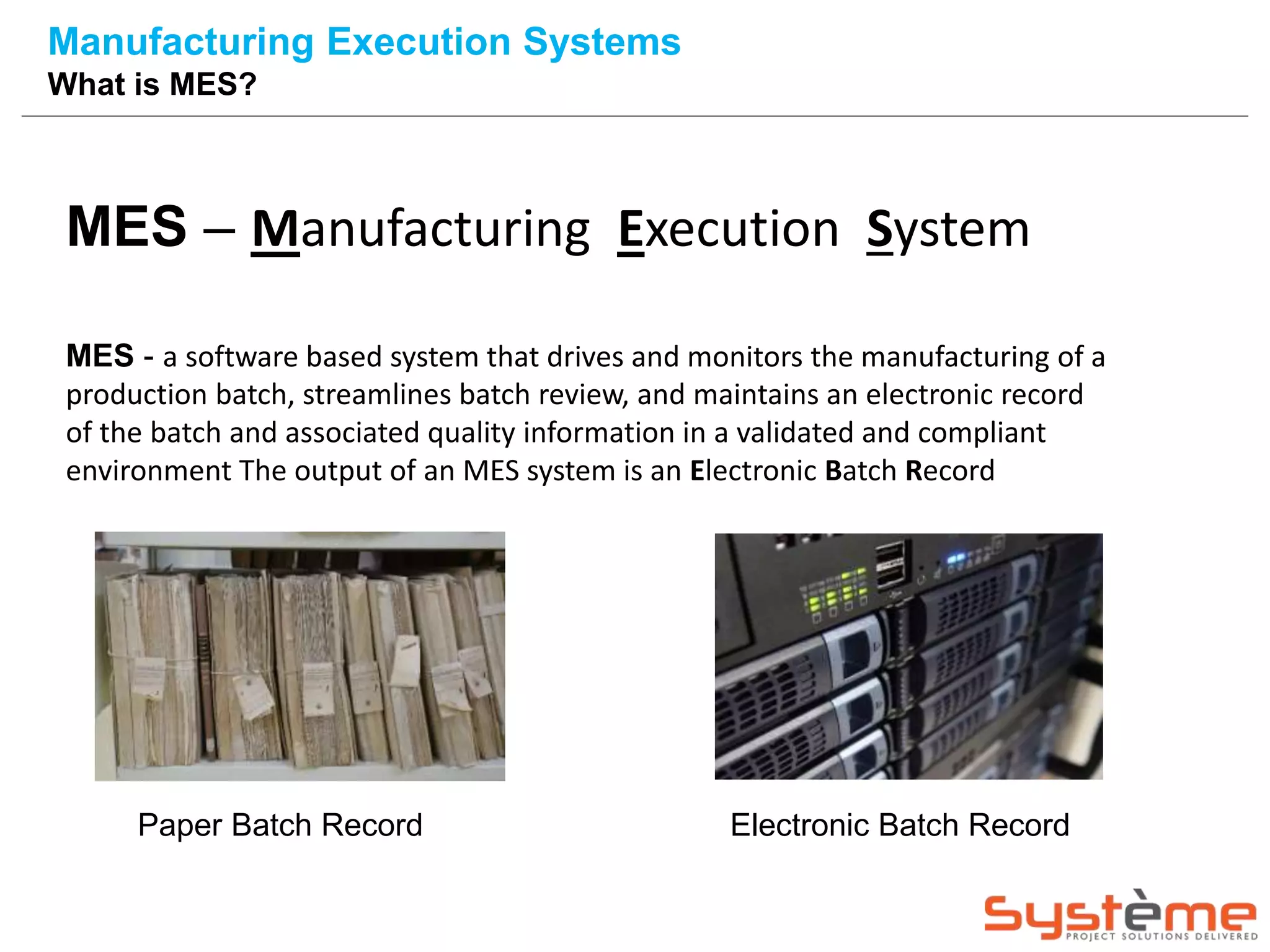
MES – Manufacturing Execution System
MES - a software based system that drives and monitors the manufacturing of a
production batch, streamlines batch review, and maintains an electronic record
of the batch and associated quality information in a validated and compliant
environment The output of an MES system is an Electronic Batch Record
Paper Batch Record Electronic Batch Record
4.
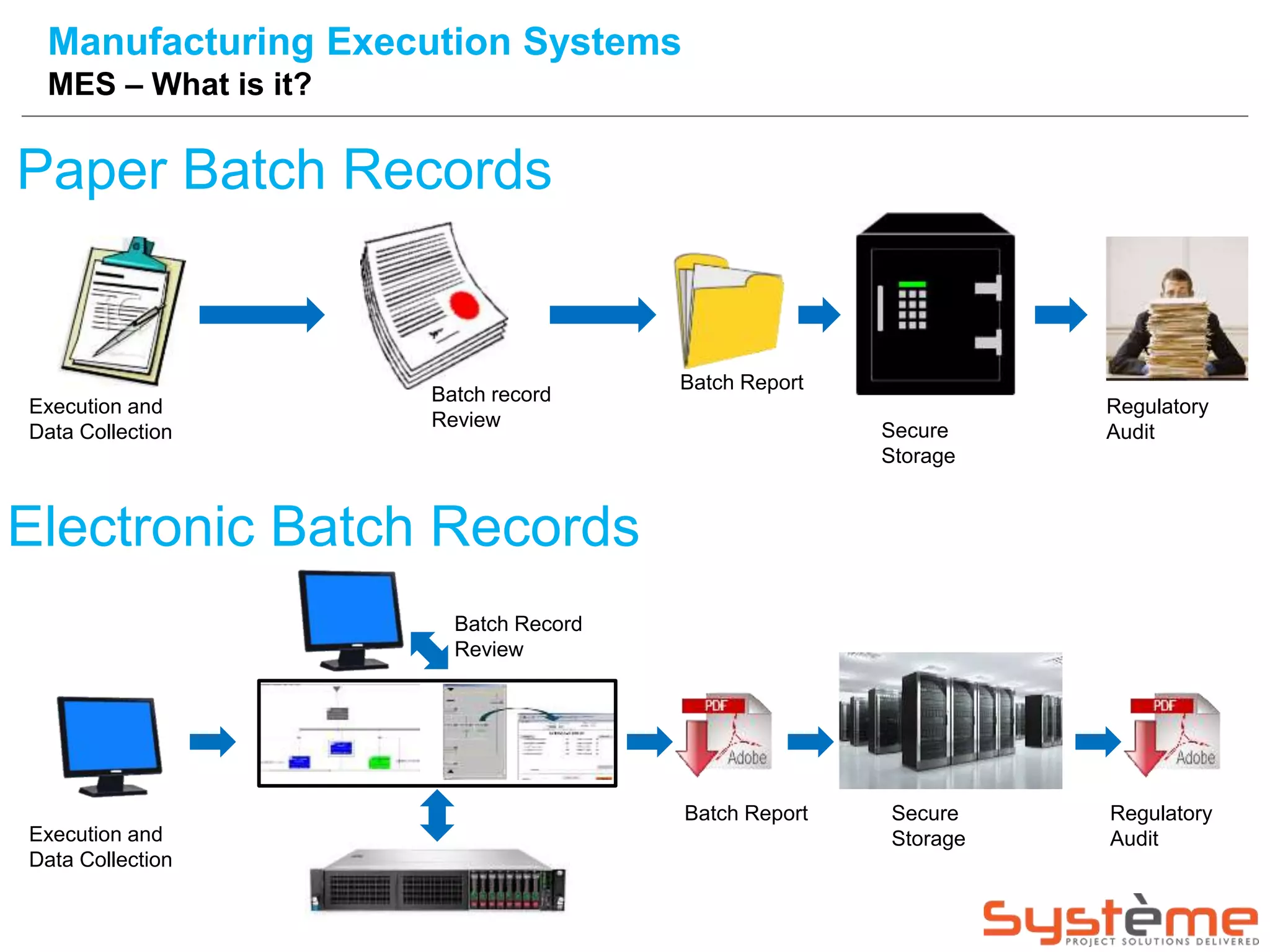
Paper Batch Records
Executionand
Data Collection
Batch Record
Review
Batch Report Secure
Storage
Regulatory
Audit
Batch record
Review
Batch Report
Secure
Storage
Regulatory
Audit
Execution and
Data Collection
Electronic Batch Records
Manufacturing Execution Systems
MES – What is it?
5.
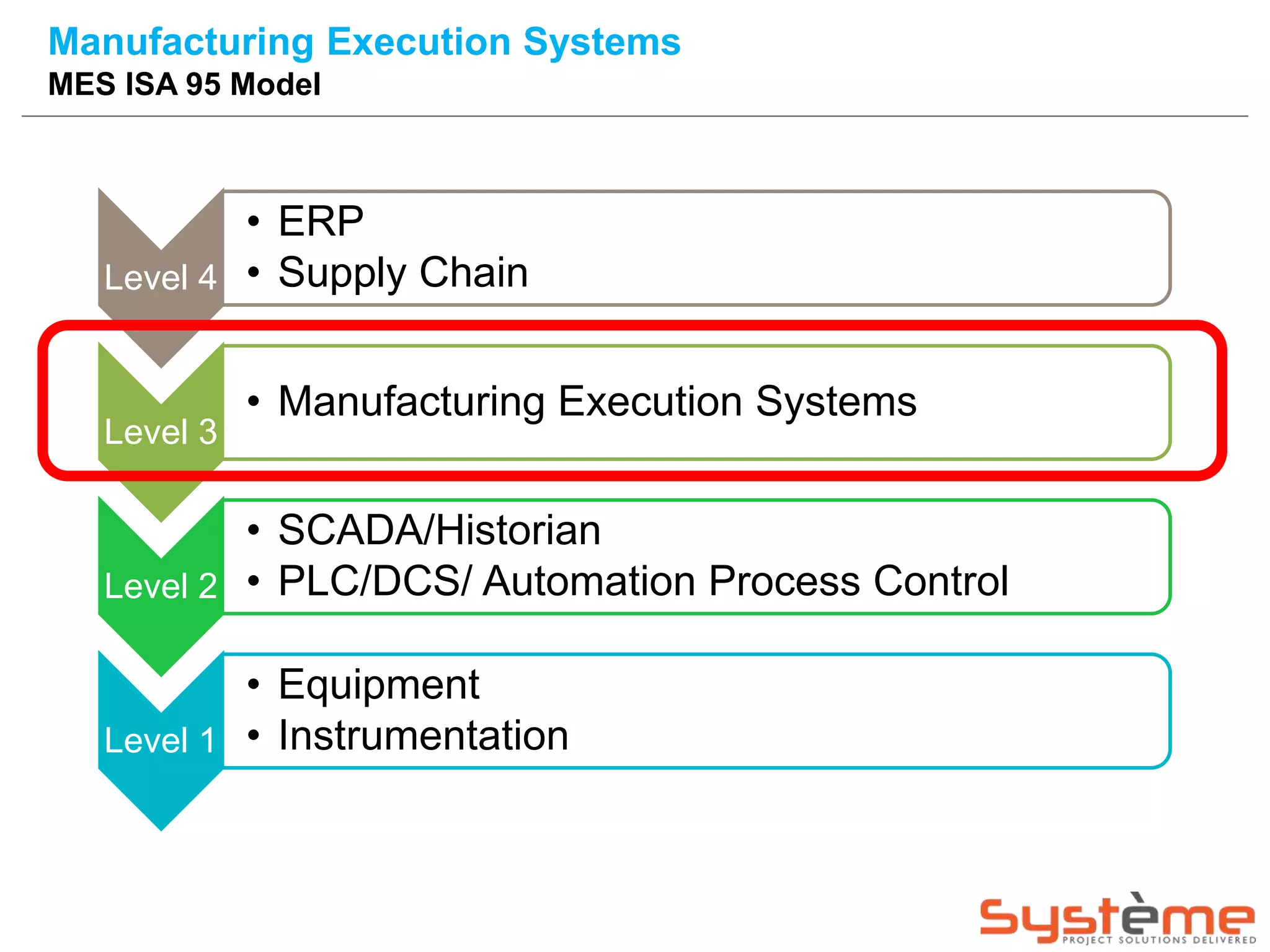
Level 4
• ERP
•Supply Chain
Level 3
• Manufacturing Execution Systems
Level 2
• SCADA/Historian
• PLC/DCS/ Automation Process Control
Level 1
• Equipment
• Instrumentation
Manufacturing Execution Systems
MES ISA 95 Model
6.
Manufacturing Execution Systems
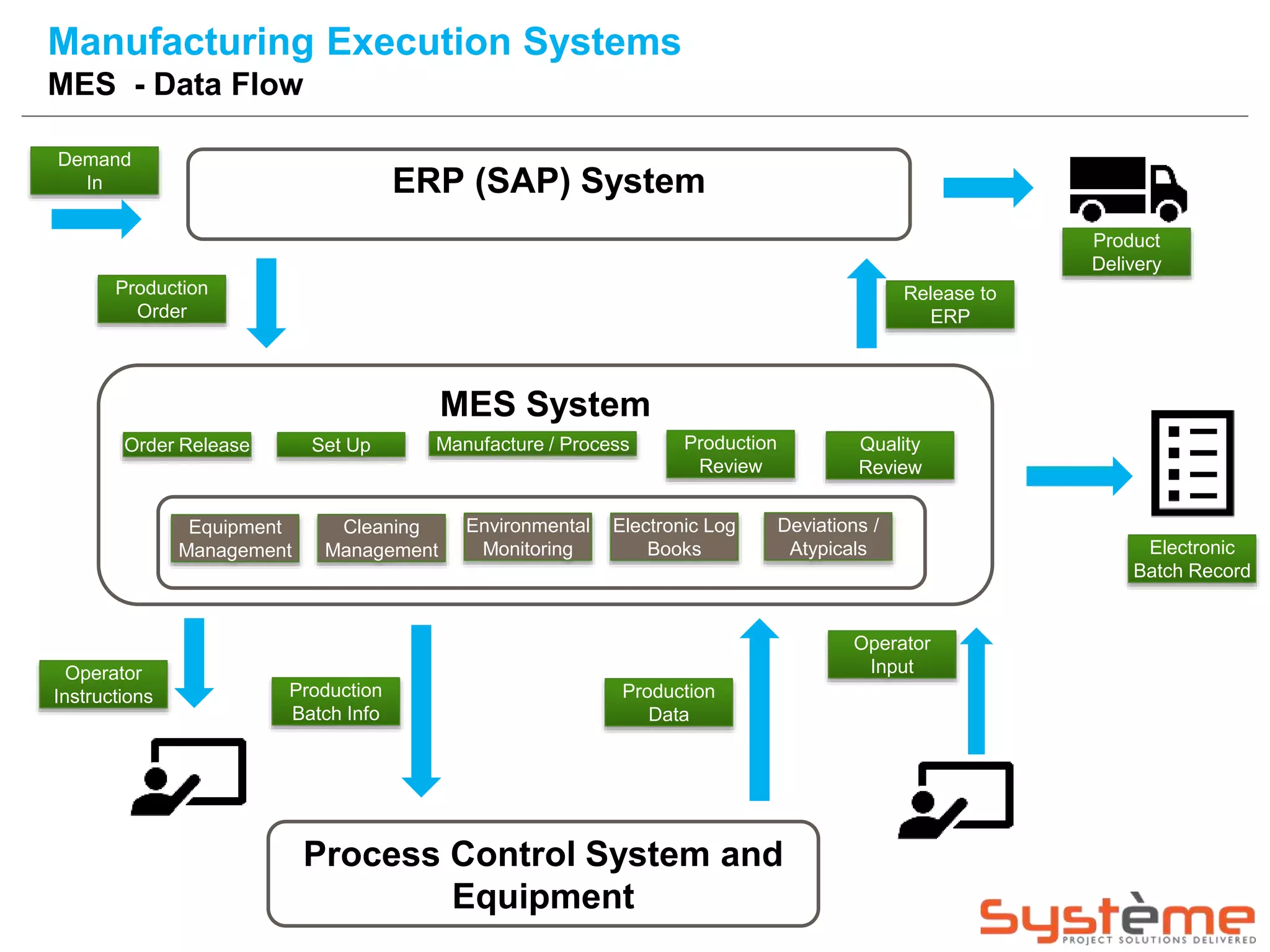
MES- Data Flow
ERP (SAP) System
MES System
Process Control System and
Equipment
Production
Order
Operator
Instructions Production
Batch Info
Production
Data
Operator
Input
Order Release Set Up Manufacture / Process Production
Review
Quality
Review
Release to
ERP
Demand
In
Equipment
Management
Cleaning
Management
Environmental
Monitoring
Electronic Log
Books
Deviations /
Atypicals Electronic
Batch Record
Product
Delivery
7.
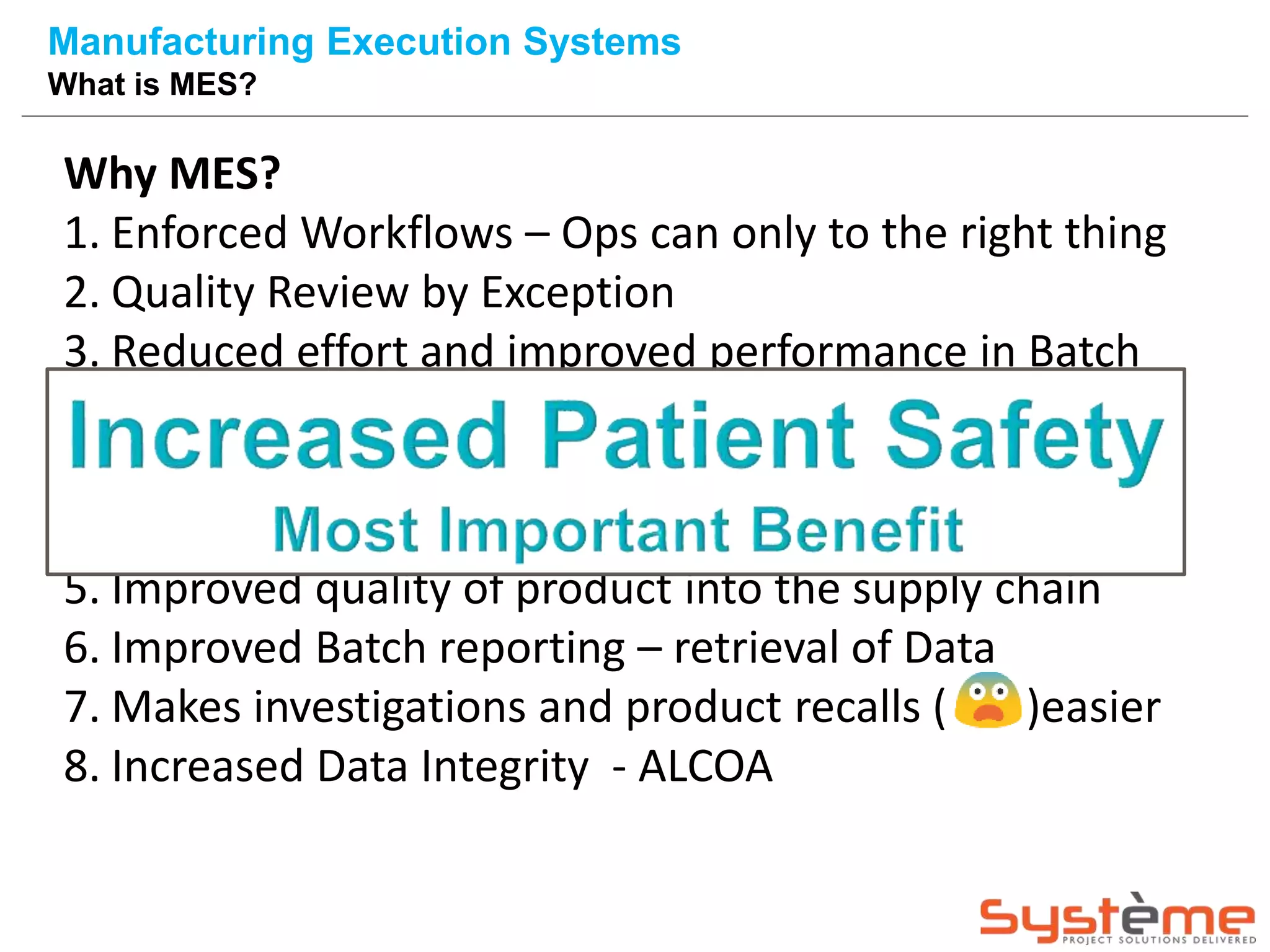
Why MES?
1. EnforcedWorkflows – Ops can only to the right thing
2. Quality Review by Exception
3. Reduced effort and improved performance in Batch
Review
4. Reduction of paper usage – resulting in elimination
of documentation errors – reduced non RFT
5. Improved quality of product into the supply chain
6. Improved Batch reporting – retrieval of Data
7. Makes investigations and product recalls ( )easier
8. Increased Data Integrity - ALCOA
Manufacturing Execution Systems
What is MES?
8.
Manufacturing Execution Systems
DataIntegrity - ALCOA
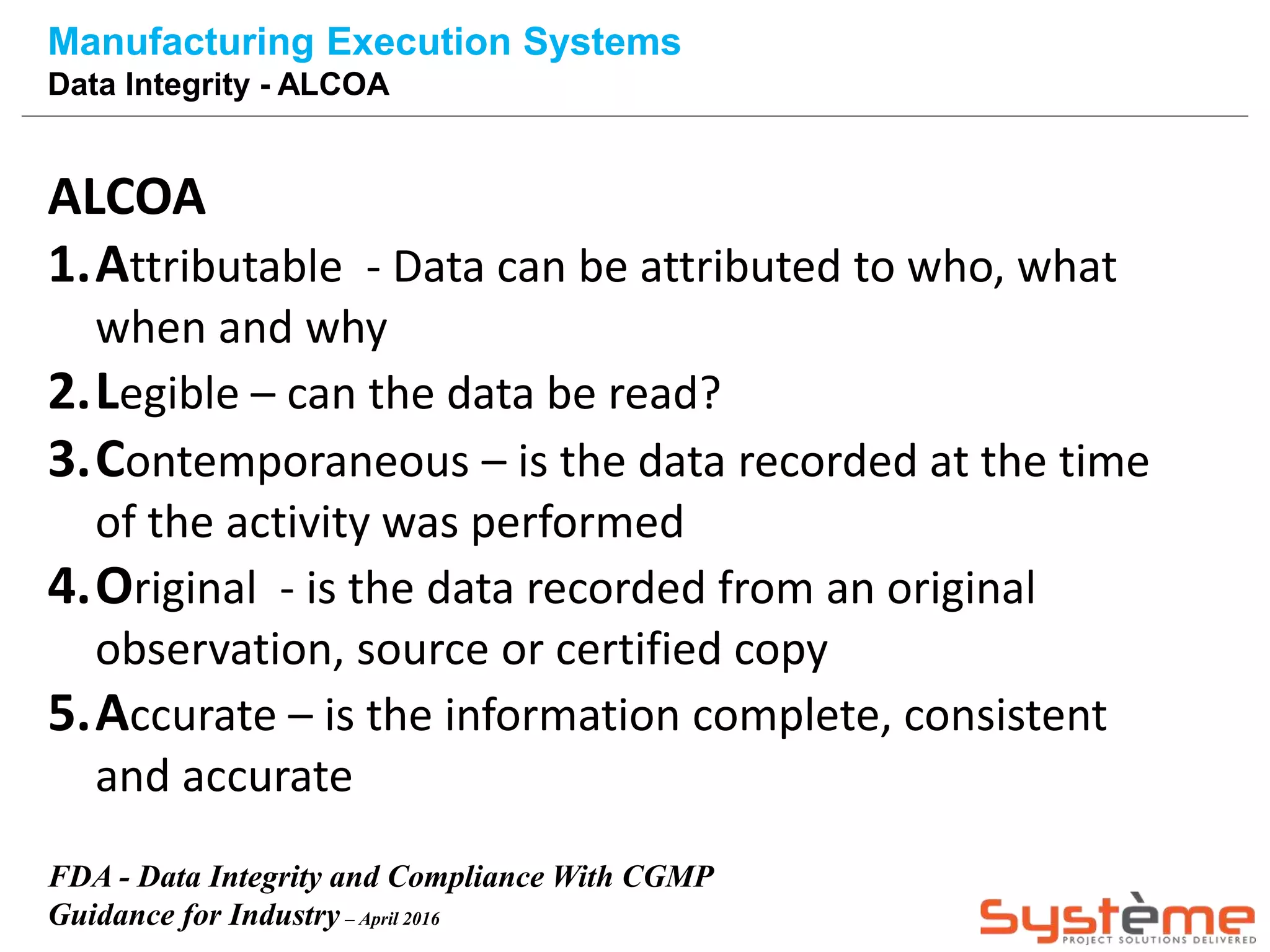
ALCOA
1.Attributable - Data can be attributed to who, what
when and why
2.Legible – can the data be read?
3.Contemporaneous – is the data recorded at the time
of the activity was performed
4.Original - is the data recorded from an original
observation, source or certified copy
5.Accurate – is the information complete, consistent
and accurate
FDA - Data Integrity and Compliance With CGMP
Guidance for Industry – April 2016
9.
Manufacturing Execution Systems
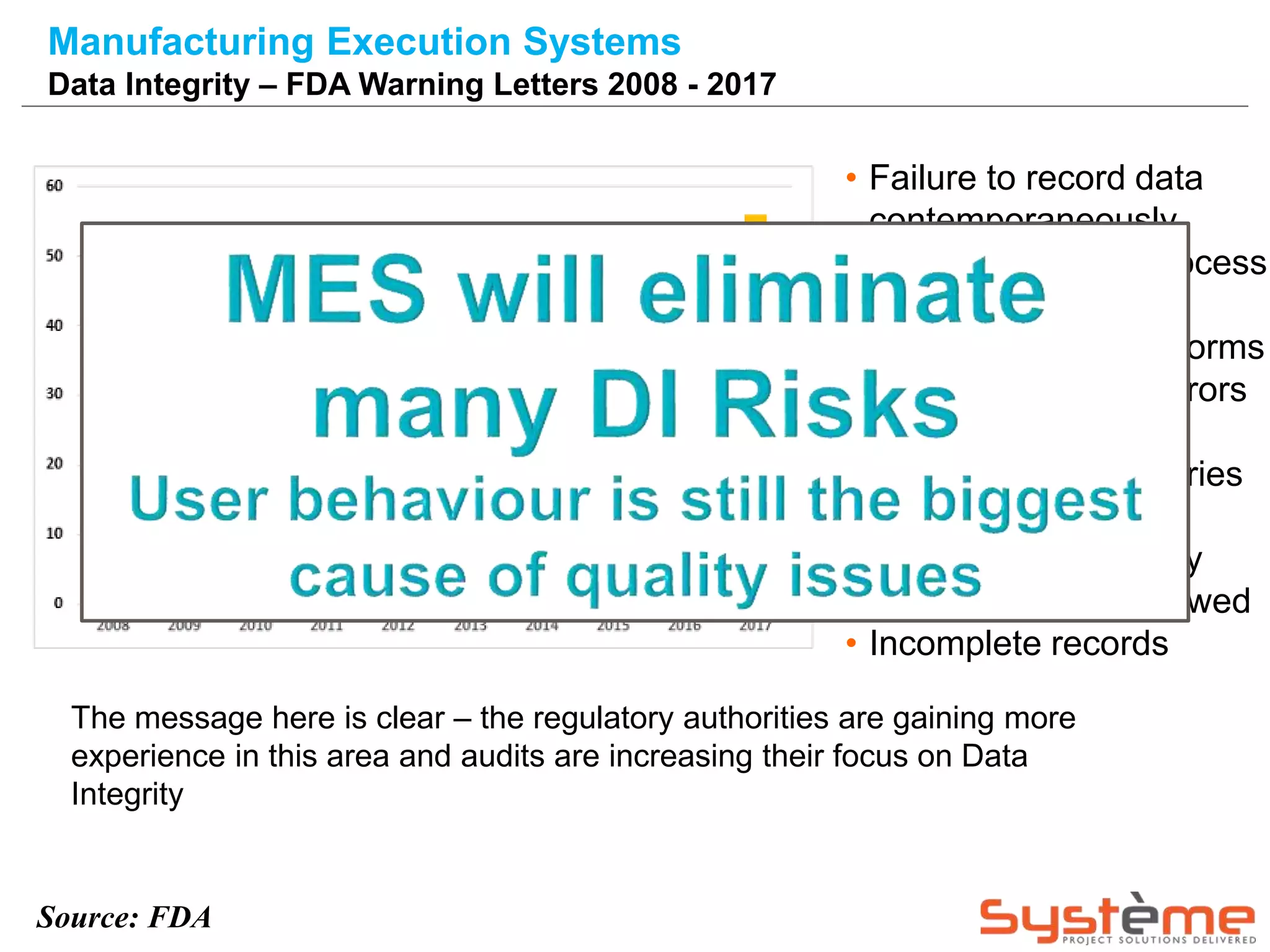
DataIntegrity – FDA Warning Letters 2008 - 2017
Source: FDA
• Failure to record data
contemporaneously
• Back-dating of in-process
checks
• Use of unapproved forms
• Data transcription errors
• Missing information
• Overwritten data entries
• Falsified Records
• Log books incorrectly
completed and reviewed
• Incomplete records
The message here is clear – the regulatory authorities are gaining more
experience in this area and audits are increasing their focus on Data
Integrity
10.
Manufacturing Execution Systems
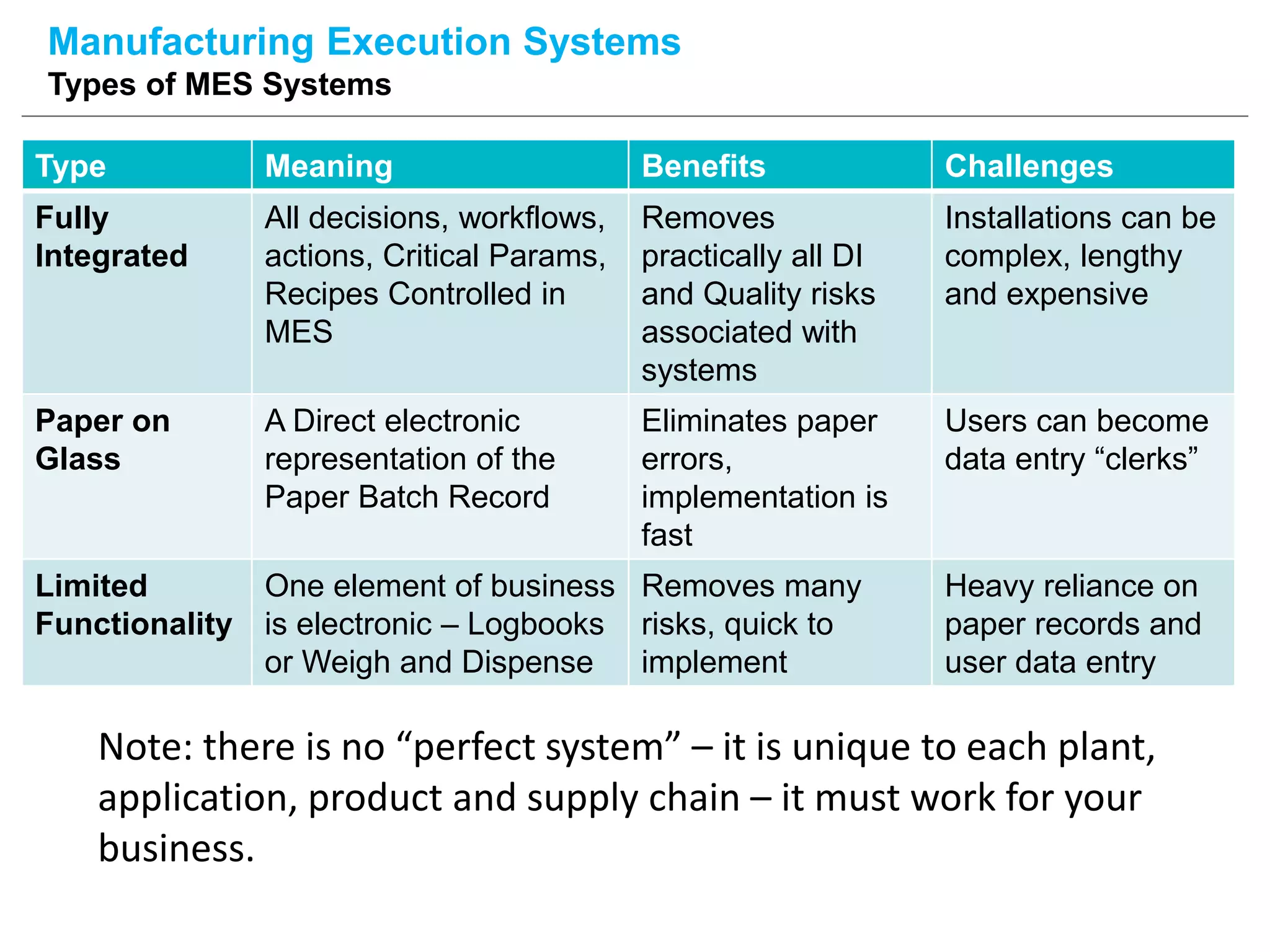
Typesof MES Systems
Type Meaning Benefits Challenges
Fully
Integrated
All decisions, workflows,
actions, Critical Params,
Recipes Controlled in
MES
Removes
practically all DI
and Quality risks
associated with
systems
Installations can be
complex, lengthy
and expensive
Paper on
Glass
A Direct electronic
representation of the
Paper Batch Record
Eliminates paper
errors,
implementation is
fast
Users can become
data entry “clerks”
Limited
Functionality
One element of business
is electronic – Logbooks
or Weigh and Dispense
Removes many
risks, quick to
implement
Heavy reliance on
paper records and
user data entry
Note: there is no “perfect system” – it is unique to each plant,
application, product and supply chain – it must work for your
business.
11.
Manufacturing Execution Systems
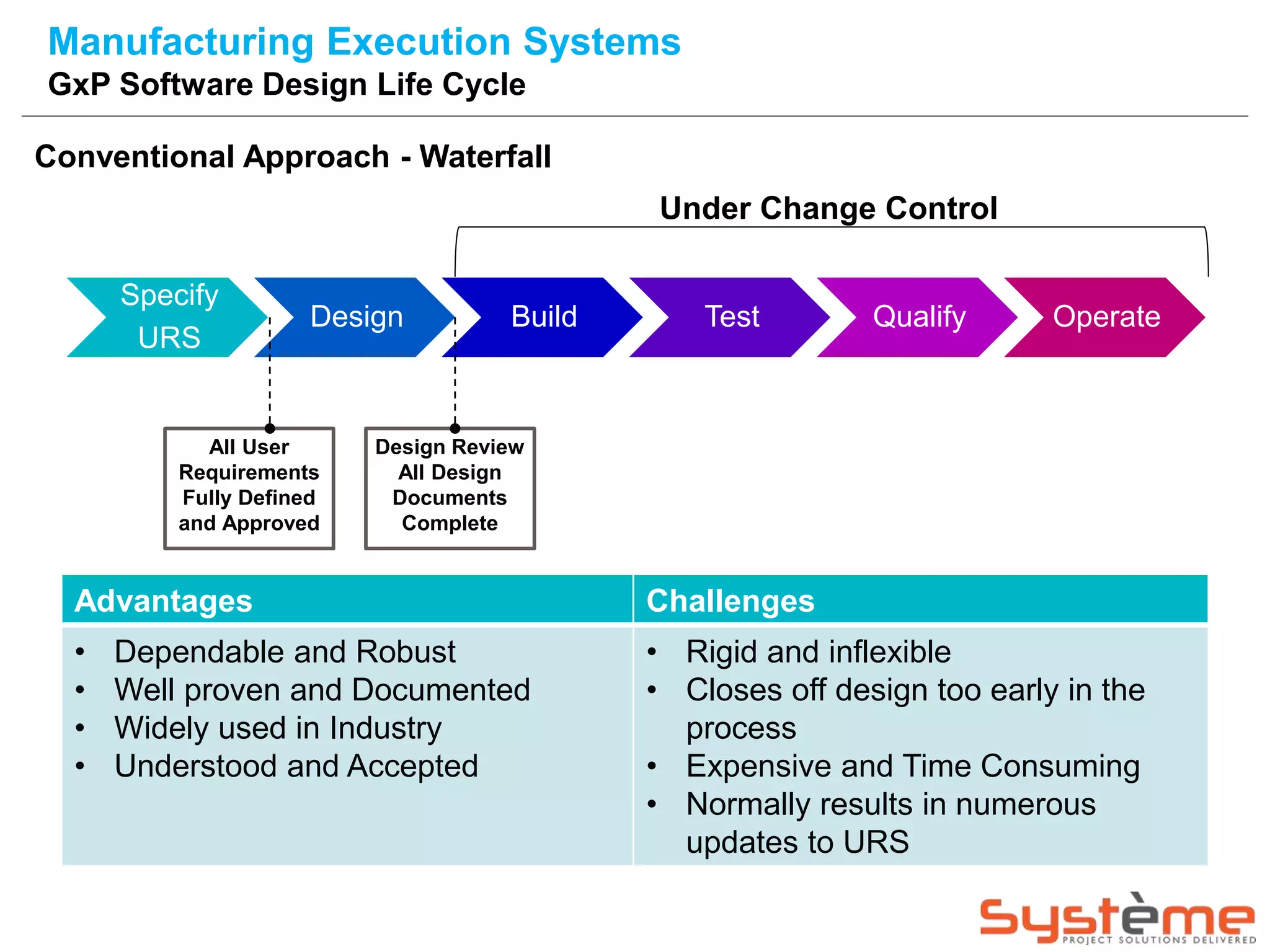
GxPSoftware Design Life Cycle
Specify
URS
Design Build Test Qualify Operate
Conventional Approach - Waterfall
Advantages Challenges
• Dependable and Robust
• Well proven and Documented
• Widely used in Industry
• Understood and Accepted
• Rigid and inflexible
• Closes off design too early in the
process
• Expensive and Time Consuming
• Normally results in numerous
updates to URS
Design Review
All Design
Documents
Complete
All User
Requirements
Fully Defined
and Approved
Under Change Control
12.
Manufacturing Execution Systems
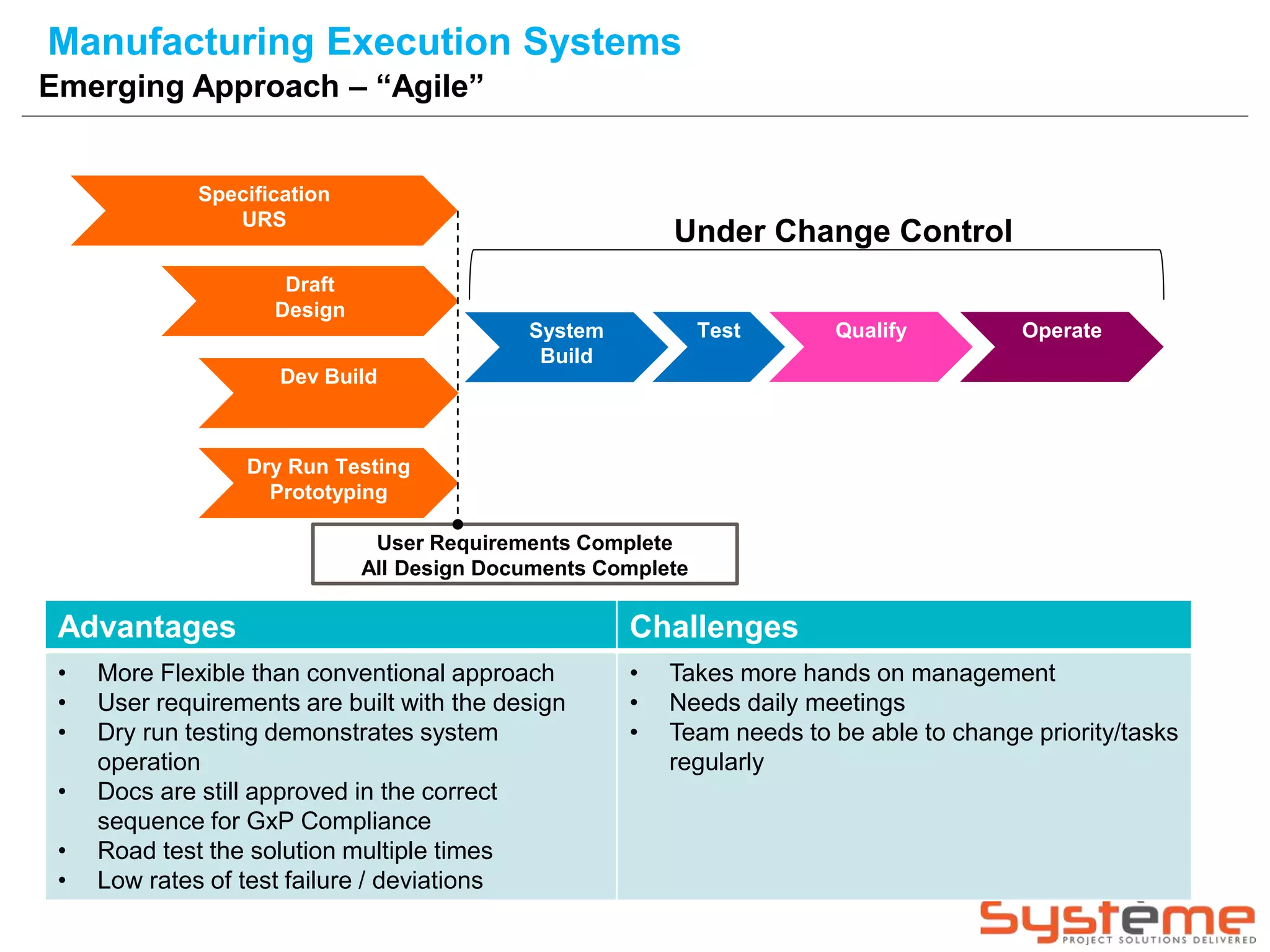
EmergingApproach – “Agile”
Advantages Challenges
• More Flexible than conventional approach
• User requirements are built with the design
• Dry run testing demonstrates system
operation
• Docs are still approved in the correct
sequence for GxP Compliance
• Road test the solution multiple times
• Low rates of test failure / deviations
• Takes more hands on management
• Needs daily meetings
• Team needs to be able to change priority/tasks
regularly
Specification
URS
Draft
Design
Dev Build
Dry Run Testing
Prototyping
User Requirements Complete
All Design Documents Complete
System
Build
Test Qualify Operate
Under Change Control
13.
Manufacturing Execution Systems
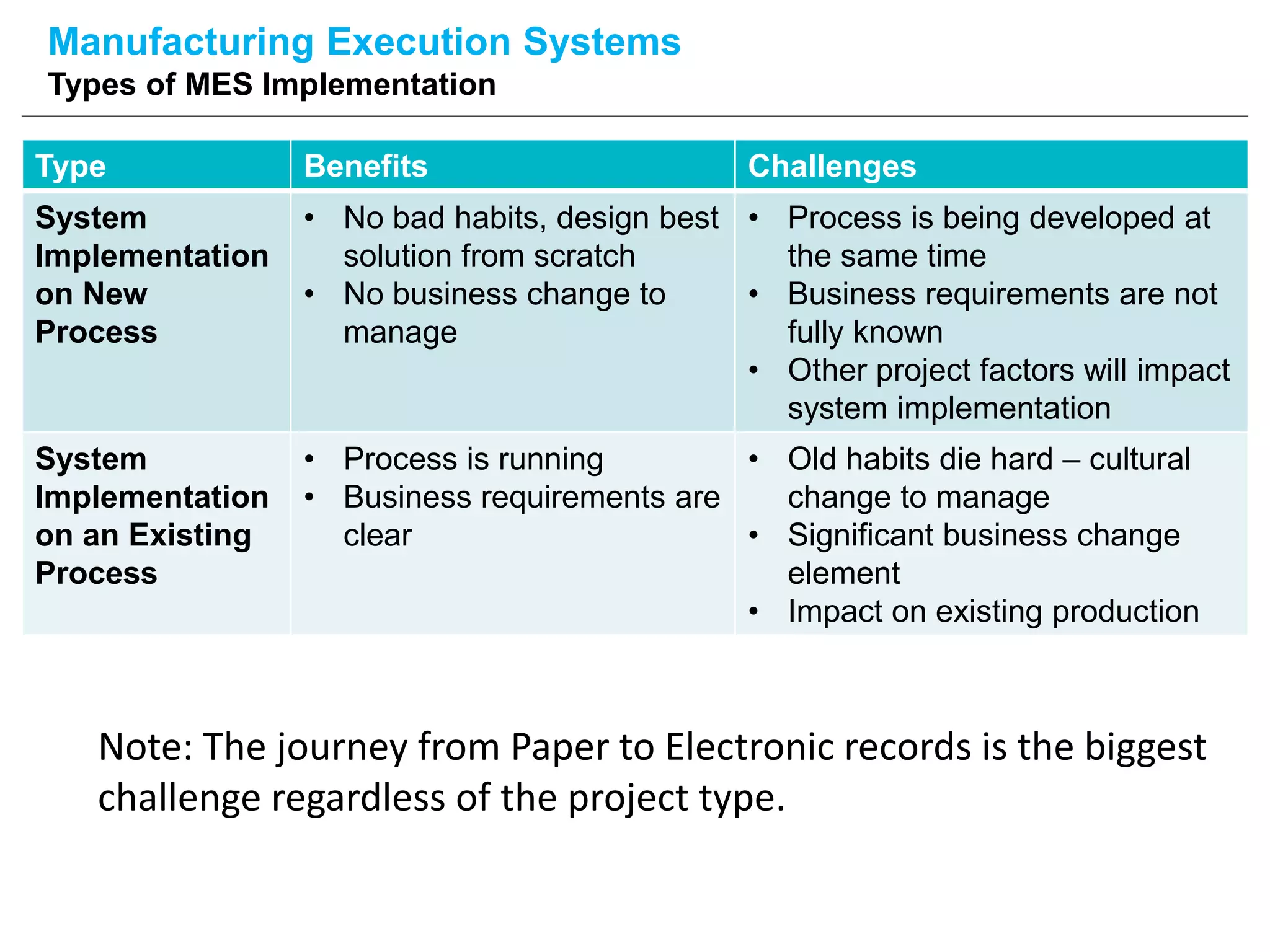
Typesof MES Implementation
Type Benefits Challenges
System
Implementation
on New
Process
• No bad habits, design best
solution from scratch
• No business change to
manage
• Process is being developed at
the same time
• Business requirements are not
fully known
• Other project factors will impact
system implementation
System
Implementation
on an Existing
Process
• Process is running
• Business requirements are
clear
• Old habits die hard – cultural
change to manage
• Significant business change
element
• Impact on existing production
Note: The journey from Paper to Electronic records is the biggest
challenge regardless of the project type.
14.
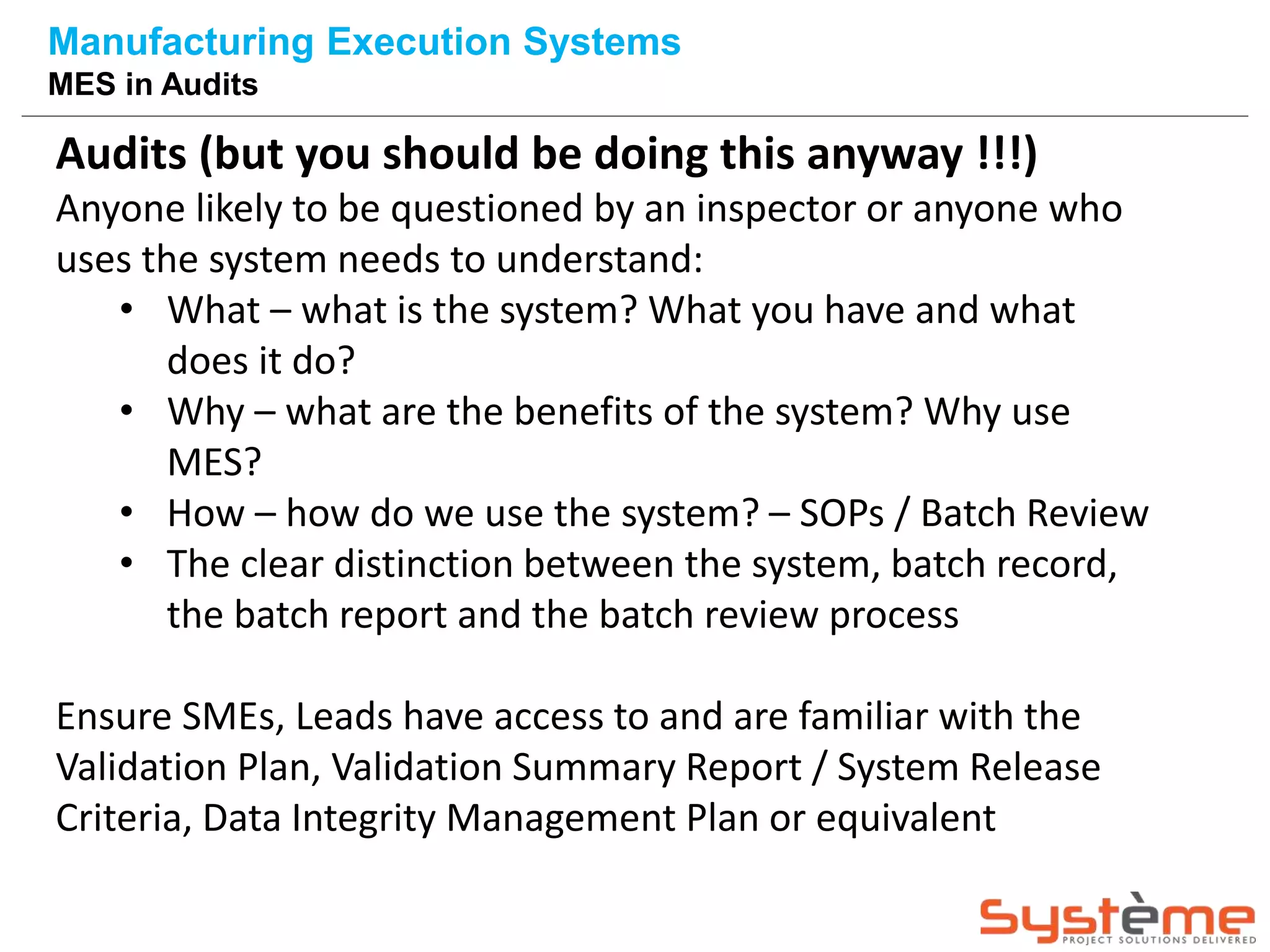
Audits (but youshould be doing this anyway !!!)
Anyone likely to be questioned by an inspector or anyone who
uses the system needs to understand:
• What – what is the system? What you have and what
does it do?
• Why – what are the benefits of the system? Why use
MES?
• How – how do we use the system? – SOPs / Batch Review
• The clear distinction between the system, batch record,
the batch report and the batch review process
Ensure SMEs, Leads have access to and are familiar with the
Validation Plan, Validation Summary Report / System Release
Criteria, Data Integrity Management Plan or equivalent
Manufacturing Execution Systems
MES in Audits
15.
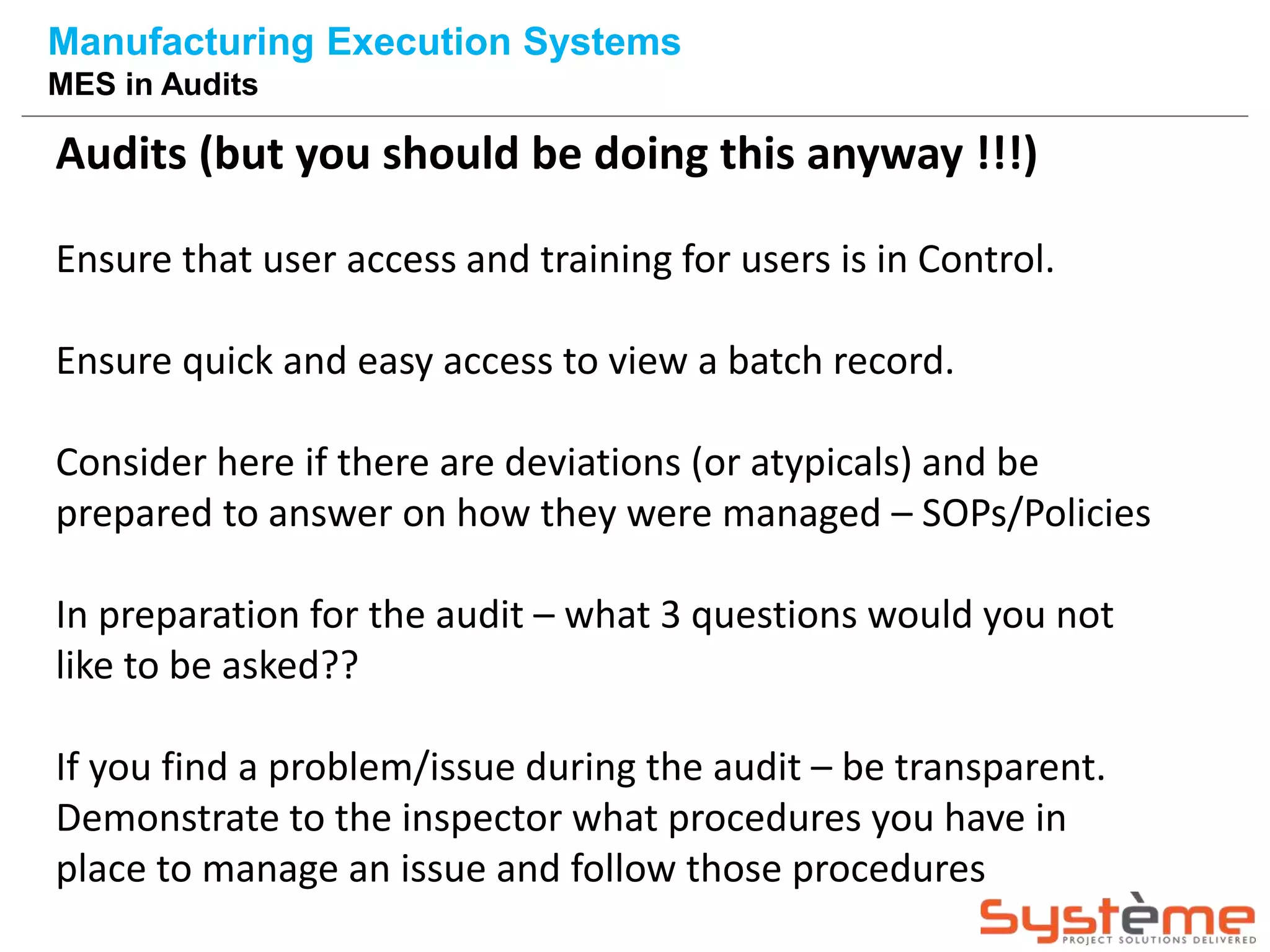
Audits (but youshould be doing this anyway !!!)
Ensure that user access and training for users is in Control.
Ensure quick and easy access to view a batch record.
Consider here if there are deviations (or atypicals) and be
prepared to answer on how they were managed – SOPs/Policies
In preparation for the audit – what 3 questions would you not
like to be asked??
If you find a problem/issue during the audit – be transparent.
Demonstrate to the inspector what procedures you have in
place to manage an issue and follow those procedures
Manufacturing Execution Systems
MES in Audits