Manufacturing Execution
Systems
Why MES?
• Missing link between PCS and corporate systems
(typically ERP)
• PCS attached to devices on factory floor
– Often proprietary technologies
– Export data as text
– Often left unconnected
– Or managed by specialists (non-IT)
– Critical systems (eg: BGE)
– Requirement for compliance
• ERP does not finish where PCS begins
• Invoke different competences
Who?
• A different set of vendors
• Specialising in manufacturing systems
(ex-CIM vendors) – eg: Camstar
• Different philosophy
– Attention to local differences
– Used to dealing with production managers
– More of a “front end” system
– Market still relatively under-equipped (unlike
ERP)
InSite Enterprise Applications
PLANT A PLANT B PLANT C
LIVERELAYRELAY Other
System
LIVEALERTALERTLIVESYNCSYNC LIVEVIEWVIEW
LIVECONNECTCONNECT
SITE
LEVEL
CO
LLABO
RATIO
N
LEVEL
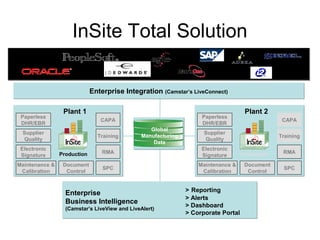
InSite Total Solution
Enterprise Integration (Camstar’s LiveConnect)Enterprise Integration (Camstar’s LiveConnect)
Enterprise
Business Intelligence
(Camstar’s LiveView and LiveAlert)
Enterprise
Business Intelligence
(Camstar’s LiveView and LiveAlert)
> Reporting
> Alerts
> Dashboard
> Corporate Portal
Plant 1Plant 1
SPC
Paperless
DHR/EBR
CAPA
Training
RMA
Supplier
Quality
Electronic
Signature
Maintenance &
Calibration
Document
Control
Production
Plant 2Plant 2
SPC
Paperless
DHR/EBR
CAPA
Training
RMA
Supplier
Quality
Electronic
Signature
Maintenance &
Calibration
Document
Control
Production
Global
Manufacturing
Data
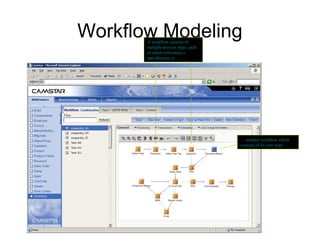
Workflow ModelingA workflow consists of
multiple process steps, each
of which references a
specification or …
… another workflow which
consists of its own steps
• InSite XML Connect
– Publishes XML documents from any transaction
– Processes all inbound transactions from XML
• Business Process Integration (BPI) Center
– Based on Microsoft's BizTalk Server EAI framework
– Business logic and process flows
– Best practices for data integration between the InSite and
ERP applications
• ERP Application Adapter
– Transforms and processes inbound transactions to ERP
– Produces and transforms outbound transactions from ERP
Mfg Order, Material List
InSite and ERP Processing
Touch Points
Planning
Raw Materials
WIP Starts
WIP
WIP Completions
Finished Goods
WIP Move WIP Quantity
Change
ERP
LiveRelay Summary
Ship
units
Receive
units
Plant A
Plant B
LiveRelay Process
Send XML
with units
Plant A
Receive XML
and units
Plant B
Deliver XML
Documents
Reply
Instructions
Execute
Instructions
Ship units
to Plant B
Start units
from Plant A
Routing
Server
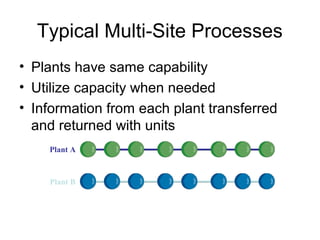
Typical Multi-Site Processes
• Plants have same capability
• Utilize capacity when needed
• Information from each plant transferred
and returned with units
Plant A
Plant B
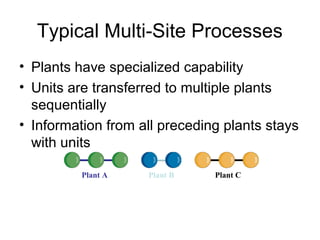
Typical Multi-Site Processes
• Plants have specialized capability
• Units are transferred to multiple plants
sequentially
• Information from all preceding plants stays
with units
Plant A Plant B Plant C
Typical Multi-Site Processes
• Units are transferred to a sub contractor,
then continue at new plant
• Information from all preceding plants stays
with units if sub contractor using InSite
Plant A
Sub
Contractor
Plant C
Conclusion on MES
• At present only manufacturing sites
• No critical mass in the market
• Not really competitors of ERP vendors but
have power to change the market
• No notion of a single instance anywhere
• Maintains local power but provide powerful
linkages

Manufacturing Execution System (MES)

  • 1.
  • 2.
    Why MES? • Missinglink between PCS and corporate systems (typically ERP) • PCS attached to devices on factory floor – Often proprietary technologies – Export data as text – Often left unconnected – Or managed by specialists (non-IT) – Critical systems (eg: BGE) – Requirement for compliance • ERP does not finish where PCS begins • Invoke different competences
  • 3.
    Who? • A differentset of vendors • Specialising in manufacturing systems (ex-CIM vendors) – eg: Camstar • Different philosophy – Attention to local differences – Used to dealing with production managers – More of a “front end” system – Market still relatively under-equipped (unlike ERP)
  • 4.
    InSite Enterprise Applications PLANTA PLANT B PLANT C LIVERELAYRELAY Other System LIVEALERTALERTLIVESYNCSYNC LIVEVIEWVIEW LIVECONNECTCONNECT SITE LEVEL CO LLABO RATIO N LEVEL
  • 5.
    InSite Total Solution EnterpriseIntegration (Camstar’s LiveConnect)Enterprise Integration (Camstar’s LiveConnect) Enterprise Business Intelligence (Camstar’s LiveView and LiveAlert) Enterprise Business Intelligence (Camstar’s LiveView and LiveAlert) > Reporting > Alerts > Dashboard > Corporate Portal Plant 1Plant 1 SPC Paperless DHR/EBR CAPA Training RMA Supplier Quality Electronic Signature Maintenance & Calibration Document Control Production Plant 2Plant 2 SPC Paperless DHR/EBR CAPA Training RMA Supplier Quality Electronic Signature Maintenance & Calibration Document Control Production Global Manufacturing Data
  • 6.
    Workflow ModelingA workflowconsists of multiple process steps, each of which references a specification or … … another workflow which consists of its own steps
  • 7.
    • InSite XMLConnect – Publishes XML documents from any transaction – Processes all inbound transactions from XML • Business Process Integration (BPI) Center – Based on Microsoft's BizTalk Server EAI framework – Business logic and process flows – Best practices for data integration between the InSite and ERP applications • ERP Application Adapter – Transforms and processes inbound transactions to ERP – Produces and transforms outbound transactions from ERP
  • 8.
    Mfg Order, MaterialList InSite and ERP Processing Touch Points Planning Raw Materials WIP Starts WIP WIP Completions Finished Goods WIP Move WIP Quantity Change ERP
  • 9.
  • 10.
    LiveRelay Process Send XML withunits Plant A Receive XML and units Plant B Deliver XML Documents Reply Instructions Execute Instructions Ship units to Plant B Start units from Plant A Routing Server
  • 11.
    Typical Multi-Site Processes •Plants have same capability • Utilize capacity when needed • Information from each plant transferred and returned with units Plant A Plant B
  • 12.
    Typical Multi-Site Processes •Plants have specialized capability • Units are transferred to multiple plants sequentially • Information from all preceding plants stays with units Plant A Plant B Plant C
  • 13.
    Typical Multi-Site Processes •Units are transferred to a sub contractor, then continue at new plant • Information from all preceding plants stays with units if sub contractor using InSite Plant A Sub Contractor Plant C
  • 14.
    Conclusion on MES •At present only manufacturing sites • No critical mass in the market • Not really competitors of ERP vendors but have power to change the market • No notion of a single instance anywhere • Maintains local power but provide powerful linkages

Editor's Notes

  • #6 Why Camstar You’ve seen other systems as well as Camstar’s InSite. If you are like others you may be saying to yourself – “What is the unique value of Camstar’s Insite that makes it the company I should partner with?” Well from our experience, we call tell you that there are three traits that are required for your long term success. What are these traits? First is flexibility - the flexibility to meet your needs today and into the future. An expertly engineered solution - not just a well marketed solution but one that is truly designed well and built correctly. And finally and very important to this stage of your decision process: to be sure the solution is a safe investment. I’m sure, that a safe investment is at the top of your list now that you’re ready to make a decision on which software package to buy.
  • #8 LiveConnect for Business Process Integration (BPI) XML Services Adapter for BPI Business Process Integration Center BPI Rapid Deployment Library LiveConnect Adapter for External Applications