THE TIMES FOR
1)

2)
3)
4)

5)
6)
7)
1)
2)
3)

4)
5)
6)
7)
 5th Generation Wireless Technology.

 Wearable device with AI Capabilities.
 Ubiquitous Computing : user can simultaneously be
connected to several wireless access technologies.
 The advanced billing interfaces of 5G technology
makes it more attractive and effective.
 5G technology is providing large broadcasting of data
in Gigabit which supporting almost 65,000
connections.
 Through remote management offered by 5G

technology a user can get better and fast solution.
 The 5G technology also support virtual private
network.
 The 5G technology is providing up to 1Gbps
connectivity Speed.
 Capable to supporting Wireless world wide
web.(WWWW).
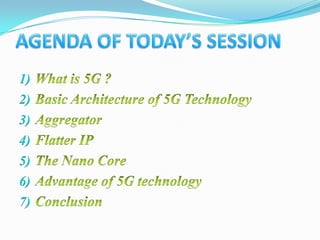
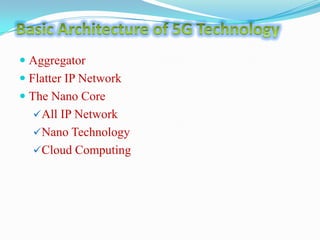
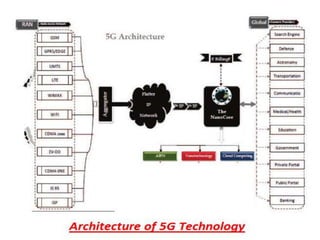
 Aggregator
 Flatter IP Network
 The Nano Core
 All IP Network
 Nano Technology
 Cloud Computing
 Subscriber traffic is aggregated at aggregation

point (BSC/RNC) and then routed to gateways.
 Flat IP architecture will lessen burden on

aggregation point and traffic will directly
move from Base station to Media gateways.
 Flat IP has shifted some of the BSC/RNC’s radio
resource functions to Base station.
 Flatter IP will shift some of the RR functions, to
Mobile devices from Base station.
 The 5G Nan0core is a convergence of below
mention technologies.
 These technologies have their own impact on
exiting wireless network which makes them in to

5G.
1. Nano Technology.
2. Cloud Computing.

3. All IP Platform.
 Nanotechnology was introduced by Nori Taniguchi in
1974 at the Tokyo international conference on
production engineering.

 Nanotechnology is the application of Nano science to
control process on nanometer scale. i.e. between 0.1
and 100nm.
 In 5G Nanocore these mobile are referred as Nano
Equipment as they are geared up with
nanotechnology.
 Specifications of Nano Equipment
 Self Cleaning
 Self Powered
 Sense the Environment
 Flexible
 Transparent
 Cloud computing is a technology that uses the internet
and central remote server to maintain data and
applications.

 In 5G network this central remote server will be our
content provider.
 To access his private account form a global content
provider through Nanocore in form of cloud.
 Cloud computing has three main segments which are
as follows:
 Applications
 Platform
 Infrastructure
 High speed, high capacity, and low cost per bit.

 Support,
 Interactive multimedia
 Voice

 Streaming Video
 Internet and other broadband services
 More effective and more attractive,

 Bi-directional, Accurate Traffic Statics.
 5G technology is providing large broadcasting of data
in gigabit which supporting almost 65,000 connection.
 Through remote management by 5G technology a user
can get better and fast solution.
Final 5G Presentation

Final 5G Presentation

  • 2.
  • 3.
  • 4.
  • 5.
     5th GenerationWireless Technology.  Wearable device with AI Capabilities.  Ubiquitous Computing : user can simultaneously be connected to several wireless access technologies.  The advanced billing interfaces of 5G technology makes it more attractive and effective.  5G technology is providing large broadcasting of data in Gigabit which supporting almost 65,000 connections.
  • 6.
     Through remotemanagement offered by 5G technology a user can get better and fast solution.  The 5G technology also support virtual private network.  The 5G technology is providing up to 1Gbps connectivity Speed.  Capable to supporting Wireless world wide web.(WWWW).
  • 7.
     Aggregator  FlatterIP Network  The Nano Core  All IP Network  Nano Technology  Cloud Computing
  • 9.
     Subscriber trafficis aggregated at aggregation point (BSC/RNC) and then routed to gateways.  Flat IP architecture will lessen burden on aggregation point and traffic will directly move from Base station to Media gateways.
  • 10.
     Flat IPhas shifted some of the BSC/RNC’s radio resource functions to Base station.  Flatter IP will shift some of the RR functions, to Mobile devices from Base station.
  • 11.
     The 5GNan0core is a convergence of below mention technologies.  These technologies have their own impact on exiting wireless network which makes them in to 5G. 1. Nano Technology. 2. Cloud Computing. 3. All IP Platform.
  • 12.
     Nanotechnology wasintroduced by Nori Taniguchi in 1974 at the Tokyo international conference on production engineering.  Nanotechnology is the application of Nano science to control process on nanometer scale. i.e. between 0.1 and 100nm.
  • 13.
     In 5GNanocore these mobile are referred as Nano Equipment as they are geared up with nanotechnology.  Specifications of Nano Equipment  Self Cleaning  Self Powered  Sense the Environment  Flexible  Transparent
  • 14.
     Cloud computingis a technology that uses the internet and central remote server to maintain data and applications.  In 5G network this central remote server will be our content provider.  To access his private account form a global content provider through Nanocore in form of cloud.
  • 15.
     Cloud computinghas three main segments which are as follows:  Applications  Platform  Infrastructure
  • 16.
     High speed,high capacity, and low cost per bit.  Support,  Interactive multimedia  Voice  Streaming Video  Internet and other broadband services  More effective and more attractive,  Bi-directional, Accurate Traffic Statics.
  • 17.
     5G technologyis providing large broadcasting of data in gigabit which supporting almost 65,000 connection.  Through remote management by 5G technology a user can get better and fast solution.