Filtration
S. I MAKRANI
Assistant Professor
Department of Pharmaceutics
Ali Allana College of Pharmacy Akkalkuwa
Content
 Definition
 Process of filtration
 Mechanisms of filtration
 Application of filtration
 Type of filtration
 Equipment's used in filtration
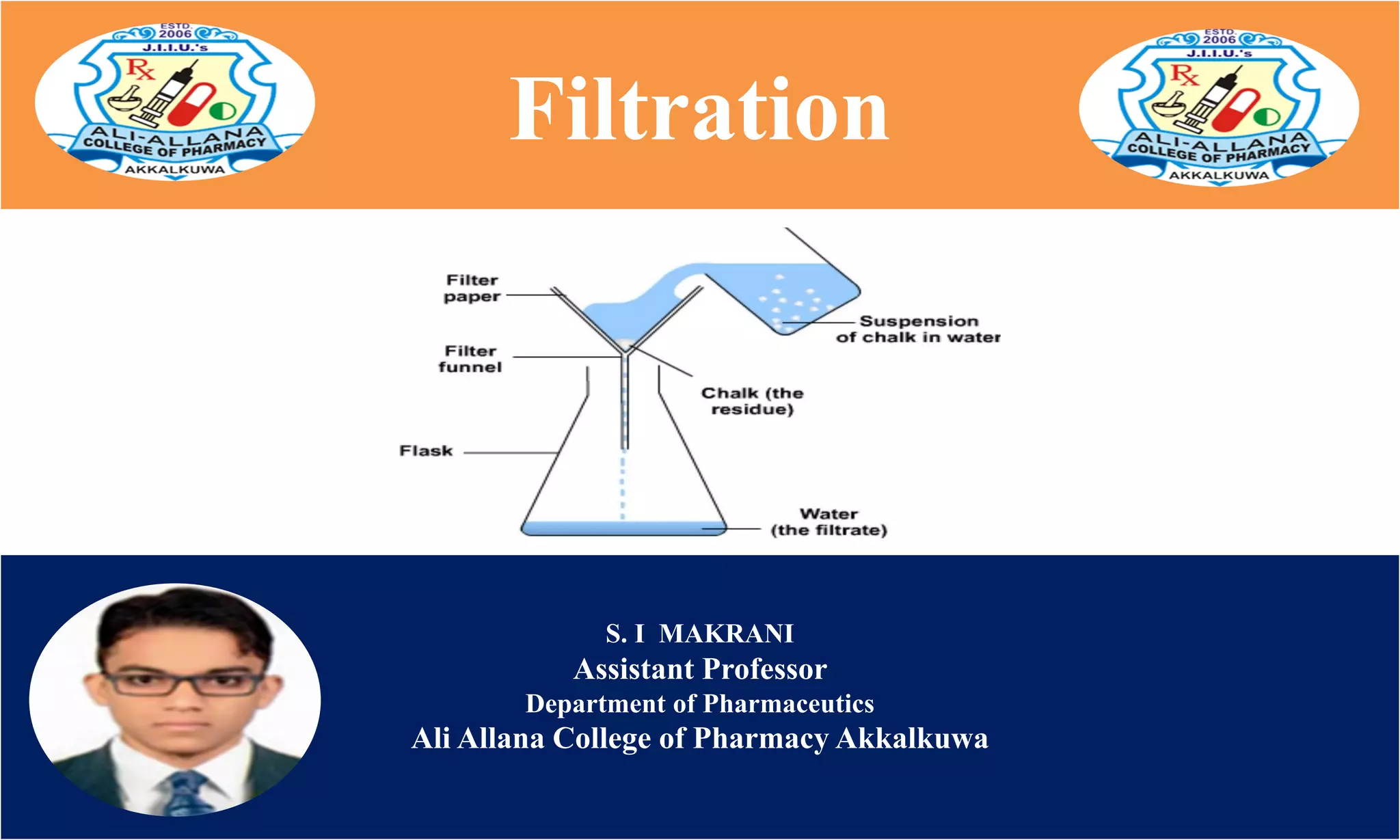
• Filtration may be defined as a process of separation of solids from a fluid by passing the
same through a porous medium that retains the solids but allows the fluid to pass
through. OR
• It is a process used to separate solid particles from a liquid with the help of a filter or
pores of filter paper. . OR
• In simple words, filteration is the action or process of filtering something.
• Examples The most common example is making tea.
• While preparing tea, a filter or a sieve is used to separate tea leaves from the water.
• Through the sieve pores, only water will pass.
• The liquid which has obtained after filtration is called the filtrate; in this case, water is
the filtrate.
• The filter can be a paper, cloth, cotton-wool, asbestos, or glass-wool, sand, or any
other porous material.
Filtration
1
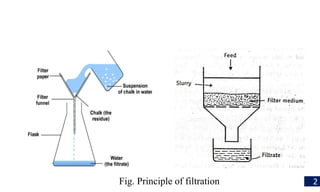
Fig. Principle of filtration 2
• The mixtures are of two main types:
• Homogeneous mixtures and Heterogeneous mixtures.
• A homogeneous mixture is a mixture that is uniform throughout.
• A heterogeneous mixture is a mixture that is not uniform throughout, i.e.,
ingredients of the mixture are distributed unequally.
• Air is a homogeneous mixture of different gases, including oxygen, nitrogen,
carbon dioxide, and water vapour.
• Homogeneous mixtures are sometimes also called solutions; especially when
it is a mixture of a solid dissolved in a liquid.
• An example of a heterogeneous mixture is the mixture of sand in water.
• On shaking, sand will stay undissolved and are distributed unevenly.
Process of filtration
3
Slurry:
• The suspension to be filtered is known as slurry.
Filter medium:
• The porous medium used to retain the solids is known as filter medium.
Filter cake:
• The accumulated solids on the filter are referred to as filter cake,
Filtrate:
• The clear liquid passing through the filter is filtrate.
Clarification:
• When solids are present in a very low concentration, i.e., not exceeding
1.0% w/v, the process of its separation from liquid is called clarification
4
• Straining
• Sedimentation
• Impaction
• Interception
• Adhesion
• Flocculation
• Chemical and Physical adsorption
• Biological growth
Figure : Steps involved in mechanism of filtration
Mechanism of filtration
5
• Some of the mechanisms are:
• Straining: Similar to sieving. i.e. the particles of larger size cannot pass
through the smaller pore size of the filter medium.
• Impingement: the solids are retained on the filter medium.
• Entanglement : Particles become entangled in the mass of fibres due to
smaller size of particles than the pore size. Thus the solids are retaincd on
the filter medium.
• Attractive forces: Solids are retained on the filter medium as a result of
attractive forces between particles and filter medium.
• Sedimentation: The particles within the filter settle on the filtering
medium.
6
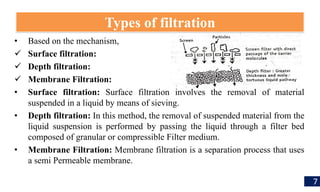
• Based on the mechanism,
 Surface filtration:
 Depth filtration:
 Membrane Filtration:
• Surface filtration: Surface filtration involves the removal of material
suspended in a liquid by means of sieving.
• Depth filtration: In this method, the removal of suspended material from the
liquid suspension is performed by passing the liquid through a filter bed
composed of granular or compressible Filter medium.
• Membrane Filtration: Membrane filtration is a separation process that uses
a semi Permeable membrane.
Types of filtration
7
 During manufacturing of sterile products, it is necessary to remove
smallest particle. Therefore, air is filtered through HEPA filters (high
efficiency particulate air filters) to get sterile air.
 The solution, suspension, eye drops, elixirs etc. should be free from
suspended solids. Filtration is major step during production of such
formulations.
 Filtration methods are used in home to clarify potable water
 Filtration is necessary to separate substances of different chemical
composition
 On industrial scale filtration is used for dewaxing of oils.
 Filtration technique is used to treat sewage and waste water
treatment.
Application of filtration
8
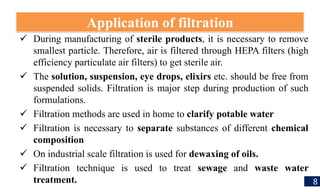
Plate and frame filter press
Figure . Construction of Plate and frame filter press 9
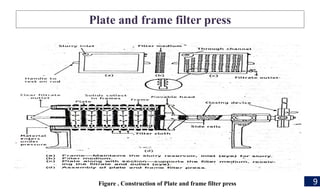
Filter leaf
Figure . Construction of Filter leaf 10
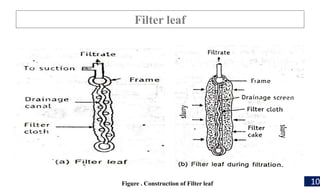
Drum filter
Figure . Construction of Drum filter 11
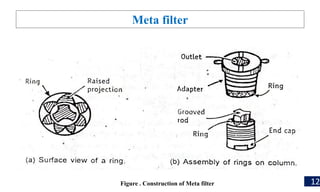
Meta filter
Figure . Construction of Meta filter 12
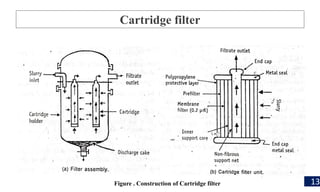
Cartridge filter
Figure . Construction of Cartridge filter 13
Thanks for stay connected
Keep Learning
Keep Growing
Stay Happy
Stay Blessed

Filtration by Makrani Shaharukh

  • 1.
    Filtration S. I MAKRANI AssistantProfessor Department of Pharmaceutics Ali Allana College of Pharmacy Akkalkuwa
  • 2.
    Content  Definition  Processof filtration  Mechanisms of filtration  Application of filtration  Type of filtration  Equipment's used in filtration
  • 3.
    • Filtration maybe defined as a process of separation of solids from a fluid by passing the same through a porous medium that retains the solids but allows the fluid to pass through. OR • It is a process used to separate solid particles from a liquid with the help of a filter or pores of filter paper. . OR • In simple words, filteration is the action or process of filtering something. • Examples The most common example is making tea. • While preparing tea, a filter or a sieve is used to separate tea leaves from the water. • Through the sieve pores, only water will pass. • The liquid which has obtained after filtration is called the filtrate; in this case, water is the filtrate. • The filter can be a paper, cloth, cotton-wool, asbestos, or glass-wool, sand, or any other porous material. Filtration 1
  • 4.
    Fig. Principle offiltration 2
  • 5.
    • The mixturesare of two main types: • Homogeneous mixtures and Heterogeneous mixtures. • A homogeneous mixture is a mixture that is uniform throughout. • A heterogeneous mixture is a mixture that is not uniform throughout, i.e., ingredients of the mixture are distributed unequally. • Air is a homogeneous mixture of different gases, including oxygen, nitrogen, carbon dioxide, and water vapour. • Homogeneous mixtures are sometimes also called solutions; especially when it is a mixture of a solid dissolved in a liquid. • An example of a heterogeneous mixture is the mixture of sand in water. • On shaking, sand will stay undissolved and are distributed unevenly. Process of filtration 3
  • 6.
    Slurry: • The suspensionto be filtered is known as slurry. Filter medium: • The porous medium used to retain the solids is known as filter medium. Filter cake: • The accumulated solids on the filter are referred to as filter cake, Filtrate: • The clear liquid passing through the filter is filtrate. Clarification: • When solids are present in a very low concentration, i.e., not exceeding 1.0% w/v, the process of its separation from liquid is called clarification 4
  • 7.
    • Straining • Sedimentation •Impaction • Interception • Adhesion • Flocculation • Chemical and Physical adsorption • Biological growth Figure : Steps involved in mechanism of filtration Mechanism of filtration 5
  • 8.
    • Some ofthe mechanisms are: • Straining: Similar to sieving. i.e. the particles of larger size cannot pass through the smaller pore size of the filter medium. • Impingement: the solids are retained on the filter medium. • Entanglement : Particles become entangled in the mass of fibres due to smaller size of particles than the pore size. Thus the solids are retaincd on the filter medium. • Attractive forces: Solids are retained on the filter medium as a result of attractive forces between particles and filter medium. • Sedimentation: The particles within the filter settle on the filtering medium. 6
  • 9.
    • Based onthe mechanism,  Surface filtration:  Depth filtration:  Membrane Filtration: • Surface filtration: Surface filtration involves the removal of material suspended in a liquid by means of sieving. • Depth filtration: In this method, the removal of suspended material from the liquid suspension is performed by passing the liquid through a filter bed composed of granular or compressible Filter medium. • Membrane Filtration: Membrane filtration is a separation process that uses a semi Permeable membrane. Types of filtration 7
  • 10.
     During manufacturingof sterile products, it is necessary to remove smallest particle. Therefore, air is filtered through HEPA filters (high efficiency particulate air filters) to get sterile air.  The solution, suspension, eye drops, elixirs etc. should be free from suspended solids. Filtration is major step during production of such formulations.  Filtration methods are used in home to clarify potable water  Filtration is necessary to separate substances of different chemical composition  On industrial scale filtration is used for dewaxing of oils.  Filtration technique is used to treat sewage and waste water treatment. Application of filtration 8
  • 11.
    Plate and framefilter press Figure . Construction of Plate and frame filter press 9
  • 12.
    Filter leaf Figure .Construction of Filter leaf 10
  • 13.
    Drum filter Figure .Construction of Drum filter 11
  • 14.
    Meta filter Figure .Construction of Meta filter 12
  • 15.
    Cartridge filter Figure .Construction of Cartridge filter 13
  • 16.
    Thanks for stayconnected Keep Learning Keep Growing Stay Happy Stay Blessed