DELIRIUM IN
ELDERLY
Marwa Mahmoud Khalifa
Case
An 83 year old recently widowed woman who lives alone
is brought to her physician by her daughter for evaluation
of falling, fever, shortness of breath, and poor oral intake.
She has a history of diabetes, hypertension, congestive
heart failure, reflux esophagitis, and depression.
She is taking metformin, enalapril, digoxin, atenolol,
ranitidine, paroxetine, and lorazepam.
On examination, she has a low-grade fever, poor skin
turgor, dry mucous membranes, and audible wheezing
and rhonchi at both lung bases. She is sleepy,
withdrawn, and not cooperative with the examination.
Her physician is concerned about pneumonia and
increased depression. Her cognitive status is not
assessed.
What’s delirium??
Acute,
fluctuating
syndrome of
altered attention,
awareness, and
cognition.
Epidemiology
The overall prevalence of delirium in the
community is just 1–2%, but in the setting of
general hospital admission this increases to
14–24%.
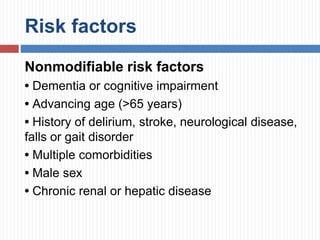
Risk factors
Nonmodifiable risk factors
• Dementia or cognitive impairment
• Advancing age (>65 years)
• History of delirium, stroke, neurological disease,
falls or gait disorder
• Multiple comorbidities
• Male sex
• Chronic renal or hepatic disease
Risk factors
Potentially modifiable risk factors
• Sensory impairment (hearing or vision)
• Immobilization (catheters or restraints)
• Acute neurological diseases (stroke, intracranial
hemorrhage, meningitis, encephalitis)
• Sustained sleep deprivation
• Intercurrent illness (infections, iatrogenic
complications, severe acute illness, anemia,
dehydration, poor nutritional status, fracture or
trauma, HIV infection)
• Metabolic derangement
• Surgery /admission to an intensive care unit)
• Pain
• Emotional distress
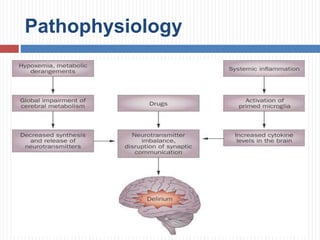
Pathophysiology
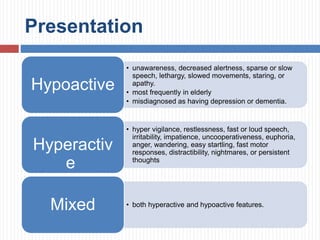
Presentation
• unawareness, decreased alertness, sparse or slow
speech, lethargy, slowed movements, staring, or
apathy.
• most frequently in elderly
• misdiagnosed as having depression or dementia.
Hypoactive
• hyper vigilance, restlessness, fast or loud speech,
irritability, impatience, uncooperativeness, euphoria,
anger, wandering, easy startling, fast motor
responses, distractibility, nightmares, or persistent
thoughts
Hyperactiv
e
• both hyperactive and hypoactive features.Mixed
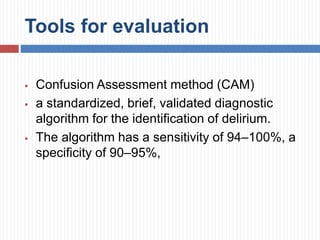
Tools for evaluation
 Confusion Assessment method (CAM)
 a standardized, brief, validated diagnostic
algorithm for the identification of delirium.
 The algorithm has a sensitivity of 94–100%, a
specificity of 90–95%,
Diagnosis
 The following criteria are derived from the
Diagnostic and Statistical Manual of Mental
Disorders.
Work up
1. Detailed assessment to search for the
precipitant
acute medical illness, a change in therapy, or the
destabilization of a chronic condition,
constipation and urinary retention
2. Physical examination
infection, volume depletion, abdominal
pathology,
deep vein thrombosis, and a neurological cause
Investigations
 ECG , troponin
 CBC with differential
 Electrolytes
 Liver enzymes, renal functions
 Thyroid function
 Chest x-ray
 Urinalysis and culture
Neuro imaging !!!
Is it mandatory ??
 Focal neurological deficits
 Suspected head trauma.
 Worsening severity or prolonged course
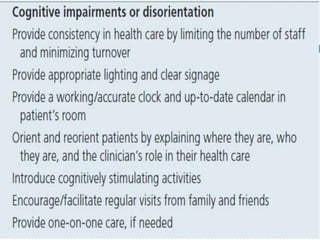
Non pharmacological strategies
for prevention
Involving the patient’s family, primary bedside
nurse, and clinical nurse leader in the creation of
a nursing care plan can also be instrumental in
the success of these non pharmacological
delirium prevention strategies
Pharmacologic treatment
Treatment with medication
 if nonpharmacological Strategies cannot
prevent aggression or severe agitation
 if there is sleep-wake disturbance or psychosis
Typical and atypical
antipsychotics
 May be considered even though inconclusive
evidence that antipsychotic use reduces
delirium severity or duration.
 For short time, and down-titration or
discontinuation should be considered on a
daily basis.
 Recent studies suggest that antipsychotics are
useful in delirium prophylaxis, particularly in
the postsurgical period.
Typical and atypical
antipsychotics
Typical and atypical
antipsychotics
Potential side effects :
 Extrapyramidal symptoms (EPS), including
parkinsonism and dystonia
 Prolongation of QT interval, particularly with
haloperidol
 Atypical antipsychotics generally have a lower
propensity to induce EPS, prolonged use in
patients with dementia has been associated
with increased mortality.
Home message
 Recognizing delirium promptly and treating the
underlying cause can prevent the significant
consequences of an acute disturbance in
cognition, which include cognitive and
functional decline, falls, and admission to long-
term care.
 Assess for delirium in all older hospitalized
patients: use simple cognitive screening and
the Confusion Assessment Method. Be sure to
get the history or timecourse of any cognitive
changes from an informed proxy.
 The presence of delirium may indicate
underlying brain vulnerability and should
therefore increase suspicion for an underlying
cognitive impairment or dementia, especially if
the precipitating insult appears
disproportionately minor.
 Evaluating medications is a high-yield
procedure (the medication list “biopsy”).
Reduce psychoactive medications as a first
step wherever possible.
 Primary prevention is the cornerstone of
delirium management and has the best
evidence for success of any intervention.
 Typical and atypical antipsychotics may be
used on an off-label basis for a short time and
if downtitration and discontinuation are
considered on a daily basis.
Delirium in elderly

Delirium in elderly

  • 1.
  • 2.
    Case An 83 yearold recently widowed woman who lives alone is brought to her physician by her daughter for evaluation of falling, fever, shortness of breath, and poor oral intake. She has a history of diabetes, hypertension, congestive heart failure, reflux esophagitis, and depression. She is taking metformin, enalapril, digoxin, atenolol, ranitidine, paroxetine, and lorazepam. On examination, she has a low-grade fever, poor skin turgor, dry mucous membranes, and audible wheezing and rhonchi at both lung bases. She is sleepy, withdrawn, and not cooperative with the examination. Her physician is concerned about pneumonia and increased depression. Her cognitive status is not assessed.
  • 3.
  • 4.
    Epidemiology The overall prevalenceof delirium in the community is just 1–2%, but in the setting of general hospital admission this increases to 14–24%.
  • 6.
    Risk factors Nonmodifiable riskfactors • Dementia or cognitive impairment • Advancing age (>65 years) • History of delirium, stroke, neurological disease, falls or gait disorder • Multiple comorbidities • Male sex • Chronic renal or hepatic disease
  • 7.
    Risk factors Potentially modifiablerisk factors • Sensory impairment (hearing or vision) • Immobilization (catheters or restraints) • Acute neurological diseases (stroke, intracranial hemorrhage, meningitis, encephalitis) • Sustained sleep deprivation
  • 9.
    • Intercurrent illness(infections, iatrogenic complications, severe acute illness, anemia, dehydration, poor nutritional status, fracture or trauma, HIV infection) • Metabolic derangement • Surgery /admission to an intensive care unit) • Pain • Emotional distress
  • 10.
  • 12.
    Presentation • unawareness, decreasedalertness, sparse or slow speech, lethargy, slowed movements, staring, or apathy. • most frequently in elderly • misdiagnosed as having depression or dementia. Hypoactive • hyper vigilance, restlessness, fast or loud speech, irritability, impatience, uncooperativeness, euphoria, anger, wandering, easy startling, fast motor responses, distractibility, nightmares, or persistent thoughts Hyperactiv e • both hyperactive and hypoactive features.Mixed
  • 13.
    Tools for evaluation Confusion Assessment method (CAM)  a standardized, brief, validated diagnostic algorithm for the identification of delirium.  The algorithm has a sensitivity of 94–100%, a specificity of 90–95%,
  • 15.
    Diagnosis  The followingcriteria are derived from the Diagnostic and Statistical Manual of Mental Disorders.
  • 17.
    Work up 1. Detailedassessment to search for the precipitant acute medical illness, a change in therapy, or the destabilization of a chronic condition, constipation and urinary retention 2. Physical examination infection, volume depletion, abdominal pathology, deep vein thrombosis, and a neurological cause
  • 18.
    Investigations  ECG ,troponin  CBC with differential  Electrolytes  Liver enzymes, renal functions  Thyroid function  Chest x-ray  Urinalysis and culture
  • 19.
    Neuro imaging !!! Isit mandatory ??  Focal neurological deficits  Suspected head trauma.  Worsening severity or prolonged course
  • 21.
  • 26.
    Involving the patient’sfamily, primary bedside nurse, and clinical nurse leader in the creation of a nursing care plan can also be instrumental in the success of these non pharmacological delirium prevention strategies
  • 27.
  • 28.
    Pharmacologic treatment Treatment withmedication  if nonpharmacological Strategies cannot prevent aggression or severe agitation  if there is sleep-wake disturbance or psychosis
  • 29.
    Typical and atypical antipsychotics May be considered even though inconclusive evidence that antipsychotic use reduces delirium severity or duration.  For short time, and down-titration or discontinuation should be considered on a daily basis.  Recent studies suggest that antipsychotics are useful in delirium prophylaxis, particularly in the postsurgical period.
  • 30.
  • 31.
    Typical and atypical antipsychotics Potentialside effects :  Extrapyramidal symptoms (EPS), including parkinsonism and dystonia  Prolongation of QT interval, particularly with haloperidol  Atypical antipsychotics generally have a lower propensity to induce EPS, prolonged use in patients with dementia has been associated with increased mortality.
  • 32.
    Home message  Recognizingdelirium promptly and treating the underlying cause can prevent the significant consequences of an acute disturbance in cognition, which include cognitive and functional decline, falls, and admission to long- term care.  Assess for delirium in all older hospitalized patients: use simple cognitive screening and the Confusion Assessment Method. Be sure to get the history or timecourse of any cognitive changes from an informed proxy.
  • 33.
     The presenceof delirium may indicate underlying brain vulnerability and should therefore increase suspicion for an underlying cognitive impairment or dementia, especially if the precipitating insult appears disproportionately minor.  Evaluating medications is a high-yield procedure (the medication list “biopsy”). Reduce psychoactive medications as a first step wherever possible.
  • 34.
     Primary preventionis the cornerstone of delirium management and has the best evidence for success of any intervention.  Typical and atypical antipsychotics may be used on an off-label basis for a short time and if downtitration and discontinuation are considered on a daily basis.