PERINATOLGY -
SONOGRAPHY
DR J.P.SONI M.D PEDIATRIC
ASSOCIATE PROF.
DR S.N. MEDICAL COLLEGE
JODHPUR
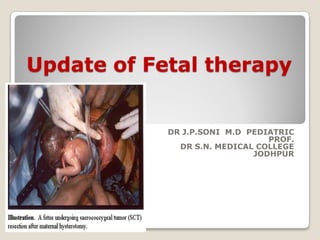
Update of Fetal therapy
DR J.P.SONI M.D PEDIATRIC
PROF.
DR S.N. MEDICAL COLLEGE
JODHPUR
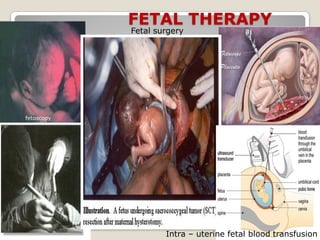
FETAL THERAPY
fetoscopy
Intra – uterine fetal blood transfusion
Fetal surgery
Fetal therapy
A
therapeutic intervention
for the purpose of
correcting or treating a
fetal anomaly or
condition is called fetal
therapy.
Fetal therapy
Personals required for it are –
Obstetrician
Pediatrician
Anesthetists
Ultrasonologist
Neurosurgeon
Social worker etc.
Fetal therapy
Tools required for it are –
Ultrasound machine
MRI
Fetoscope
laser machine etc.
Fetal therapy
Pharmacological fetal therapy –
(noninvasive)
• Surgical fetal therapy -
(Invasive)
Fetal therapy
Pharmacological fetal therapy –
Preventive pharmacotherapy
Therapeutic pharmacotherapy
Preventive pharmacotherapy
 All the women planning a pregnancy
should be given folic acid in dose
0.4mg/day for at least one month.
 Women with a prior child with NTD ,
should receive folic acid 4 mg/day for
at least one month preconceptually
and three months after the
pregnancy.
Neural tube defects
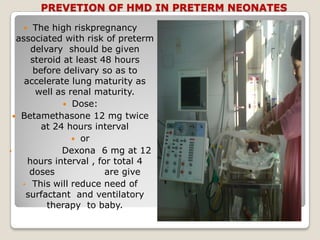
PREVETION OF HMD IN PRETERM NEONATES
 The high riskpregnancy
associated with risk of preterm
delvary should be given
steroid at least 48 hours
before delivary so as to
accelerate lung maturity as
well as renal maturity.
 Dose:
 Betamethasone 12 mg twice
at 24 hours interval
 or
• Dexona 6 mg at 12
hours interval , for total 4
doses are give
• This will reduce need of
surfactant and ventilatory
therapy to baby.
Fetal therapy

Therapeutic pharmacotherapy
CARDIAC
 Cardiac arrhythmia-
 PSVT
 ATRIL FLUTTER
 ATRIAL FIBRILLATION
 AND VENTRICULAR TACHY-CARDIA
can be treated by giving anti-arrhythmic
drugs to mother orally or
by trans-placental route.
PSVT; ATRIAL FLUTTER & FIBRILLATION
Digoxin : Oral- fetus is
normal.
If fetus have feature of
hydrops
Digoxin is given either
parenteral
or
Transplacental, 0.5- 1 mg
Adenosine :Per umbilical
0.05 to 0.2mg
Flecanide : oral 200-
300mg
Amiodarone : parenteral
600-800mg
Sotatlol : oral; 80-320
mg
COMPLETE A-V BLOCK - CAVB
 Prevalence: 1/15,000- 1/22,000 live
birth.
 Path-physiology :
 The fetal mortality rate of isolated CAVB may be as much as 30-
50%. Patients diagnosed and treated in the neonatal period have
a survival rate of 94%, and patients who are diagnosed and
treated in childhood have a survival rate of 100%.
Fetus with isolated Complete
A –V block Rx
 HR > 55/min with normal LV function
 Rx
Dexamethasone - orally to mother
• HR < 55/min with abnormal LV function
• Rx
Dexamethasone - orally with β
agonist
weekly follow up by obstetrician with
fetal
echocardiography
COMPLETE FETAL A – V BLOCK
AA A A A
At the time of diagnosis of heart
block in FETUS
maternal dexamethasone (4 or 8
mg/d for 2 weeks,
Then 4 mg/day should be
initiated
maintained for the duration of
the pregnancy, tapering at times
(2 mg/d) in the third trimester.
If the average heart rate
declined below 55 bpm,
A ß-sympathomimetic agent
should be given
salbutamol 40mg/ day for 2
weeks.
COMPLETE FETAL A – V BLOCK
AA A A A
In the presence of maternal
anti-Ro/La antibodies
,
there are no known markers that
will predict which fetus will
develop an AV conduction defect.
Little evidence suggests that the
administration of
steroids, immunoglobulins or
plasmapheresis in the mother
can reverse third-degree AV
block.
However, these therapies are
helpful if given in early to Rx
first-degree
and
second-degree heart block.
Fetus with isolated Complete
A –V block Rx
 Delivary at tetriary care center
 Uneventful fetal course - LSCS at 37 wks
 If fetus develop hydrops- Paracentesis
 LSCS
 low CO out - Immediate Pacing
 Isoprenline
 features of SLE - oral prednisolone
 Endocardial fibroelastosis – I V IgG
Premature ventricular contraction
in fetus
a benign condition
either resolve spontaneously
before
Birth or after birth of baby.
If number of PVC is more, and
fetus
Develop Hydrops: -
than β blocker can be
Used orally.
Ventricular tachycadrdia
 Fetal therapy for VT is administration of
β – blocker
Flecanide = 200-300mg/Day orally
And
Amiodarone = 600-800mg/day I.V. to
mother
FETAL THYROID GOITER
Rx
FETAL CORD BLOOD FOR THYROID
STATUS
TSH,T3,T4
IF HYPERTHYRODISM
Rx - CARBIMAZOLE
METHIMAZOLE
IF HYPOTHYRODISM
BETWEEN 29-37 WEEKS
250-500 mg LEVOTHYROXIN
INTRA AMNIOTIC
WEEKLY
THIS WILL RESULT IN
REGRESSION
OF
THYROID GOITER
CONGENITAL ADRENAL HYPERPLASIA
Congenital adrenal hyperplasia (CAH) is a family disorder
caused by reduced activity of enzymes required for cortisol
biosynthesis in the adrenal cortex.
The most common defect is 21-hydroxylase (21-OH)
deficiency, which accounts for >90% of all cases of CAH.
Classic 21-hydroxylase deficiency is found in about
1:12 000 to 1:15 000 births.
The frequency of nonclassic deficiency is unknown, although it
may occur in up to 3% of individuals in certain groups.
CONGENITAL ADRENAL HYPERPLASIA
Clinical consequences of 21-OH deficiency
arise primarily from overproduction and
accumulation of precursors proximal to the blocked
enzymatic step.
These precursors are shunted into the androgen
biosynthesis pathway, producing virilization in
the female fetus or infant and rapid postnatal
growth with accelerated skeletal maturation,
precocious puberty, and short adult stature in both
males and females
CONGENITAL ADRENAL HYPERPLASIA
Treatment should begun as early as the 4th to 6th week of
pregnancy.
The dose of dexamethasone usually ranged between 0.5 and
2 mg/d or O.3 to o.7 mg/sq m in 1 to 4 divided doses.
CVS 11-12 wks & AMNIOCENTESIS at 15 wks for DNA analysis for
CYP21B,C4 & HLA class I & II genes.
Then treatment is continued to term in female positive for
genes and stoped in male after confirmation of diagnosis by
CVS or Amniocentesis.
At birth, the external genitalia is normal in the infant whose mother
was given dexamethasone and minimally virilized in the infant
whose mother received hydrocortisone.
Fetus with maternal SLE
If mother is suffering from SLE, then
fetus is at risk to develop Complete
heart block because of damage to AV
node. This can be prevented by
giving Tab Dexamethasone 4 mg per
day during pregnancy because it
cannot be metaboized by placenta
and is Available to the fetus in an
active form.
Invasive fetal therapy
1961
Intra uterine blood transfusion
Invasive fetal therapy
1961
Intra uterine blood transfusion
The fetal anemia now can be predicted by
doing middle cerebral
Artery doppler flow study
and
intra uterine
transfusion (IUT) is done with
gamma Irradiated blood.
FETAL ANEMIA
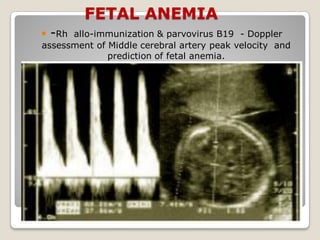
 -Rh allo-immunization & parvovirus B19 - Doppler
assessment of Middle cerebral artery peak velocity and
prediction of fetal anemia.
INTRAUTERINE FETAL TRANSFUSION
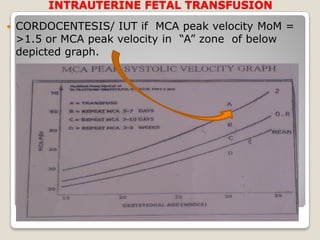
 CORDOCENTESIS/ IUT if MCA peak velocity MoM =
>1.5 or MCA peak velocity in “A” zone of below
depicted graph.
VOLUME OF BLOOD TO BE GIVEN
TO FETUS IS CALCULATED BY
Fetoplacental volume X (desired Ht – Fetal Ht)
= ------------------------------------------------------
Donor hematocrit
Feto placental volume = USG estimated weight of
fetus X 0.14
. The amount of blood given
to fetus is 20,30,40 and 50
ml to the fetus at 22,26,30
and 35 weeks of gestational
age respectively.
Intra uterine blood transfusion
F
E
T
O
S
C
O
P
Y
1970
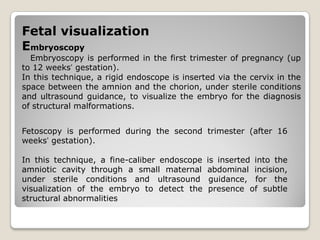
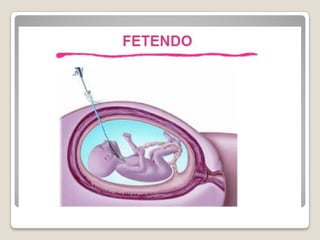
Fetoscopy is performed during the second trimester (after 16
weeks’ gestation).
In this technique, a fine-caliber endoscope is inserted into the
amniotic cavity through a small maternal abdominal incision,
under sterile conditions and ultrasound guidance, for the
visualization of the embryo to detect the presence of subtle
structural abnormalities
Fetal visualization
Embryoscopy
Embryoscopy is performed in the first trimester of pregnancy (up
to 12 weeks’ gestation).
In this technique, a rigid endoscope is inserted via the cervix in the
space between the amnion and the chorion, under sterile conditions
and ultrasound guidance, to visualize the embryo for the diagnosis
of structural malformations.
◦ An injection will be given in the lower abdomen
to numb the skin where the fetoscope will be
inserted.
◦ An ultrasound will be used to determine the
position of both the fetus and the placenta.
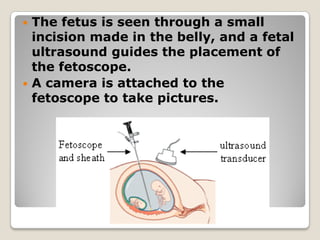
 The fetus is seen through a small
incision made in the belly, and a fetal
ultrasound guides the placement of
the fetoscope.
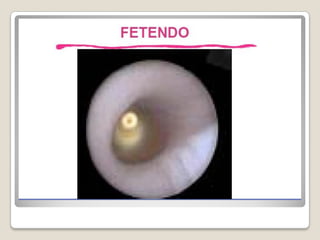
 A camera is attached to the
fetoscope to take pictures.
TWIN TO TWIN TRANSFUSION
IN MONOCHORIONIC TWIN
 Rx INDOMETHACIN
 LASER COAGULATION OF A-V
ANASTOMOSES
Laser coagulation of A –V
malformation
in case of twin to twin transfusion
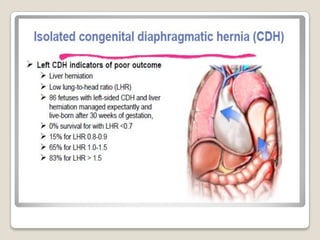
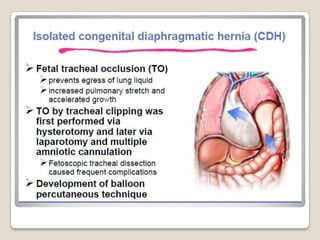
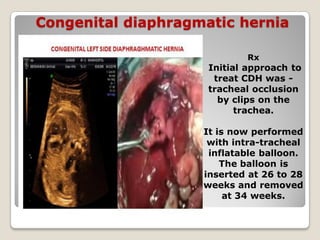
Congenital diaphragmatic hernia
Rx
Initial approach to
treat CDH was -
tracheal occlusion
by clips on the
trachea.
It is now performed
with intra-tracheal
inflatable balloon.
The balloon is
inserted at 26 to 28
weeks and removed
at 34 weeks.
Pleural effusion
One option in the
management of fetuses with
pleural effusion is
thoracocentesis and drainage
of the effusions. However, in
the majority of cases the
fluid reaccumulates within
24-48 hours requiring
repeated procedures and it is
therefore preferable to
achieve chronic drainage by
the insertion of pleural-
amniotic shunts.
GENE THERAPY
Means replacement of missing gene by introduction of foreign
Nucleic acid sequence. It is divided into two categories,
classic gene therapy and stem cell gene therapy.
In most gene therapy a normal gene is inserted into genome
To replace an abnormal, disease causing gene.
A carrier molecule called a vector (virus- lenti virus) must be
used to deliver the therapeutic gene to the patient’s target
cells
There have been several modes of gene
delivery used in experimental efforts at fetal
gene transfer. These include
intratracheal, intravascular, intraventricular,
intracardiac, intraperitoneal, intraplacental,
intramuscular and intra-amniotic injection.
Intra-amniotic gene transfer (IAGT) has
been used to target organs exposed to
amniotic fluid, that is, the skin, amniotic
membranes and the respiratory and
digestive systems
Fetal therapy

Fetal therapy

  • 1.
    PERINATOLGY - SONOGRAPHY DR J.P.SONIM.D PEDIATRIC ASSOCIATE PROF. DR S.N. MEDICAL COLLEGE JODHPUR
  • 2.
    Update of Fetaltherapy DR J.P.SONI M.D PEDIATRIC PROF. DR S.N. MEDICAL COLLEGE JODHPUR
  • 3.
    FETAL THERAPY fetoscopy Intra –uterine fetal blood transfusion Fetal surgery
  • 4.
    Fetal therapy A therapeutic intervention forthe purpose of correcting or treating a fetal anomaly or condition is called fetal therapy.
  • 5.
    Fetal therapy Personals requiredfor it are – Obstetrician Pediatrician Anesthetists Ultrasonologist Neurosurgeon Social worker etc.
  • 6.
    Fetal therapy Tools requiredfor it are – Ultrasound machine MRI Fetoscope laser machine etc.
  • 7.
    Fetal therapy Pharmacological fetaltherapy – (noninvasive) • Surgical fetal therapy - (Invasive)
  • 8.
    Fetal therapy Pharmacological fetaltherapy – Preventive pharmacotherapy Therapeutic pharmacotherapy
  • 9.
    Preventive pharmacotherapy  Allthe women planning a pregnancy should be given folic acid in dose 0.4mg/day for at least one month.  Women with a prior child with NTD , should receive folic acid 4 mg/day for at least one month preconceptually and three months after the pregnancy. Neural tube defects
  • 10.
    PREVETION OF HMDIN PRETERM NEONATES  The high riskpregnancy associated with risk of preterm delvary should be given steroid at least 48 hours before delivary so as to accelerate lung maturity as well as renal maturity.  Dose:  Betamethasone 12 mg twice at 24 hours interval  or • Dexona 6 mg at 12 hours interval , for total 4 doses are give • This will reduce need of surfactant and ventilatory therapy to baby.
  • 11.
  • 12.
    CARDIAC  Cardiac arrhythmia- PSVT  ATRIL FLUTTER  ATRIAL FIBRILLATION  AND VENTRICULAR TACHY-CARDIA can be treated by giving anti-arrhythmic drugs to mother orally or by trans-placental route.
  • 13.
    PSVT; ATRIAL FLUTTER& FIBRILLATION Digoxin : Oral- fetus is normal. If fetus have feature of hydrops Digoxin is given either parenteral or Transplacental, 0.5- 1 mg Adenosine :Per umbilical 0.05 to 0.2mg Flecanide : oral 200- 300mg Amiodarone : parenteral 600-800mg Sotatlol : oral; 80-320 mg
  • 14.
    COMPLETE A-V BLOCK- CAVB  Prevalence: 1/15,000- 1/22,000 live birth.  Path-physiology :  The fetal mortality rate of isolated CAVB may be as much as 30- 50%. Patients diagnosed and treated in the neonatal period have a survival rate of 94%, and patients who are diagnosed and treated in childhood have a survival rate of 100%.
  • 15.
    Fetus with isolatedComplete A –V block Rx  HR > 55/min with normal LV function  Rx Dexamethasone - orally to mother • HR < 55/min with abnormal LV function • Rx Dexamethasone - orally with β agonist weekly follow up by obstetrician with fetal echocardiography
  • 16.
    COMPLETE FETAL A– V BLOCK AA A A A At the time of diagnosis of heart block in FETUS maternal dexamethasone (4 or 8 mg/d for 2 weeks, Then 4 mg/day should be initiated maintained for the duration of the pregnancy, tapering at times (2 mg/d) in the third trimester. If the average heart rate declined below 55 bpm, A ß-sympathomimetic agent should be given salbutamol 40mg/ day for 2 weeks.
  • 17.
    COMPLETE FETAL A– V BLOCK AA A A A In the presence of maternal anti-Ro/La antibodies , there are no known markers that will predict which fetus will develop an AV conduction defect. Little evidence suggests that the administration of steroids, immunoglobulins or plasmapheresis in the mother can reverse third-degree AV block. However, these therapies are helpful if given in early to Rx first-degree and second-degree heart block.
  • 18.
    Fetus with isolatedComplete A –V block Rx  Delivary at tetriary care center  Uneventful fetal course - LSCS at 37 wks  If fetus develop hydrops- Paracentesis  LSCS  low CO out - Immediate Pacing  Isoprenline  features of SLE - oral prednisolone  Endocardial fibroelastosis – I V IgG
  • 19.
    Premature ventricular contraction infetus a benign condition either resolve spontaneously before Birth or after birth of baby. If number of PVC is more, and fetus Develop Hydrops: - than β blocker can be Used orally.
  • 20.
    Ventricular tachycadrdia  Fetaltherapy for VT is administration of β – blocker Flecanide = 200-300mg/Day orally And Amiodarone = 600-800mg/day I.V. to mother
  • 21.
    FETAL THYROID GOITER Rx FETALCORD BLOOD FOR THYROID STATUS TSH,T3,T4 IF HYPERTHYRODISM Rx - CARBIMAZOLE METHIMAZOLE IF HYPOTHYRODISM BETWEEN 29-37 WEEKS 250-500 mg LEVOTHYROXIN INTRA AMNIOTIC WEEKLY THIS WILL RESULT IN REGRESSION OF THYROID GOITER
  • 22.
    CONGENITAL ADRENAL HYPERPLASIA Congenitaladrenal hyperplasia (CAH) is a family disorder caused by reduced activity of enzymes required for cortisol biosynthesis in the adrenal cortex. The most common defect is 21-hydroxylase (21-OH) deficiency, which accounts for >90% of all cases of CAH. Classic 21-hydroxylase deficiency is found in about 1:12 000 to 1:15 000 births. The frequency of nonclassic deficiency is unknown, although it may occur in up to 3% of individuals in certain groups.
  • 23.
    CONGENITAL ADRENAL HYPERPLASIA Clinicalconsequences of 21-OH deficiency arise primarily from overproduction and accumulation of precursors proximal to the blocked enzymatic step. These precursors are shunted into the androgen biosynthesis pathway, producing virilization in the female fetus or infant and rapid postnatal growth with accelerated skeletal maturation, precocious puberty, and short adult stature in both males and females
  • 24.
    CONGENITAL ADRENAL HYPERPLASIA Treatmentshould begun as early as the 4th to 6th week of pregnancy. The dose of dexamethasone usually ranged between 0.5 and 2 mg/d or O.3 to o.7 mg/sq m in 1 to 4 divided doses. CVS 11-12 wks & AMNIOCENTESIS at 15 wks for DNA analysis for CYP21B,C4 & HLA class I & II genes. Then treatment is continued to term in female positive for genes and stoped in male after confirmation of diagnosis by CVS or Amniocentesis. At birth, the external genitalia is normal in the infant whose mother was given dexamethasone and minimally virilized in the infant whose mother received hydrocortisone.
  • 25.
    Fetus with maternalSLE If mother is suffering from SLE, then fetus is at risk to develop Complete heart block because of damage to AV node. This can be prevented by giving Tab Dexamethasone 4 mg per day during pregnancy because it cannot be metaboized by placenta and is Available to the fetus in an active form.
  • 26.
    Invasive fetal therapy 1961 Intrauterine blood transfusion
  • 27.
    Invasive fetal therapy 1961 Intrauterine blood transfusion The fetal anemia now can be predicted by doing middle cerebral Artery doppler flow study and intra uterine transfusion (IUT) is done with gamma Irradiated blood.
  • 28.
    FETAL ANEMIA  -Rhallo-immunization & parvovirus B19 - Doppler assessment of Middle cerebral artery peak velocity and prediction of fetal anemia.
  • 29.
    INTRAUTERINE FETAL TRANSFUSION CORDOCENTESIS/ IUT if MCA peak velocity MoM = >1.5 or MCA peak velocity in “A” zone of below depicted graph.
  • 30.
    VOLUME OF BLOODTO BE GIVEN TO FETUS IS CALCULATED BY Fetoplacental volume X (desired Ht – Fetal Ht) = ------------------------------------------------------ Donor hematocrit Feto placental volume = USG estimated weight of fetus X 0.14
  • 31.
    . The amountof blood given to fetus is 20,30,40 and 50 ml to the fetus at 22,26,30 and 35 weeks of gestational age respectively.
  • 32.
  • 39.
  • 40.
    Fetoscopy is performedduring the second trimester (after 16 weeks’ gestation). In this technique, a fine-caliber endoscope is inserted into the amniotic cavity through a small maternal abdominal incision, under sterile conditions and ultrasound guidance, for the visualization of the embryo to detect the presence of subtle structural abnormalities Fetal visualization Embryoscopy Embryoscopy is performed in the first trimester of pregnancy (up to 12 weeks’ gestation). In this technique, a rigid endoscope is inserted via the cervix in the space between the amnion and the chorion, under sterile conditions and ultrasound guidance, to visualize the embryo for the diagnosis of structural malformations.
  • 41.
    ◦ An injectionwill be given in the lower abdomen to numb the skin where the fetoscope will be inserted. ◦ An ultrasound will be used to determine the position of both the fetus and the placenta.
  • 42.
     The fetusis seen through a small incision made in the belly, and a fetal ultrasound guides the placement of the fetoscope.  A camera is attached to the fetoscope to take pictures.
  • 44.
    TWIN TO TWINTRANSFUSION IN MONOCHORIONIC TWIN  Rx INDOMETHACIN  LASER COAGULATION OF A-V ANASTOMOSES Laser coagulation of A –V malformation in case of twin to twin transfusion
  • 49.
    Congenital diaphragmatic hernia Rx Initialapproach to treat CDH was - tracheal occlusion by clips on the trachea. It is now performed with intra-tracheal inflatable balloon. The balloon is inserted at 26 to 28 weeks and removed at 34 weeks.
  • 50.
    Pleural effusion One optionin the management of fetuses with pleural effusion is thoracocentesis and drainage of the effusions. However, in the majority of cases the fluid reaccumulates within 24-48 hours requiring repeated procedures and it is therefore preferable to achieve chronic drainage by the insertion of pleural- amniotic shunts.
  • 52.
    GENE THERAPY Means replacementof missing gene by introduction of foreign Nucleic acid sequence. It is divided into two categories, classic gene therapy and stem cell gene therapy. In most gene therapy a normal gene is inserted into genome To replace an abnormal, disease causing gene. A carrier molecule called a vector (virus- lenti virus) must be used to deliver the therapeutic gene to the patient’s target cells
  • 53.
    There have beenseveral modes of gene delivery used in experimental efforts at fetal gene transfer. These include intratracheal, intravascular, intraventricular, intracardiac, intraperitoneal, intraplacental, intramuscular and intra-amniotic injection. Intra-amniotic gene transfer (IAGT) has been used to target organs exposed to amniotic fluid, that is, the skin, amniotic membranes and the respiratory and digestive systems