Fertilizers
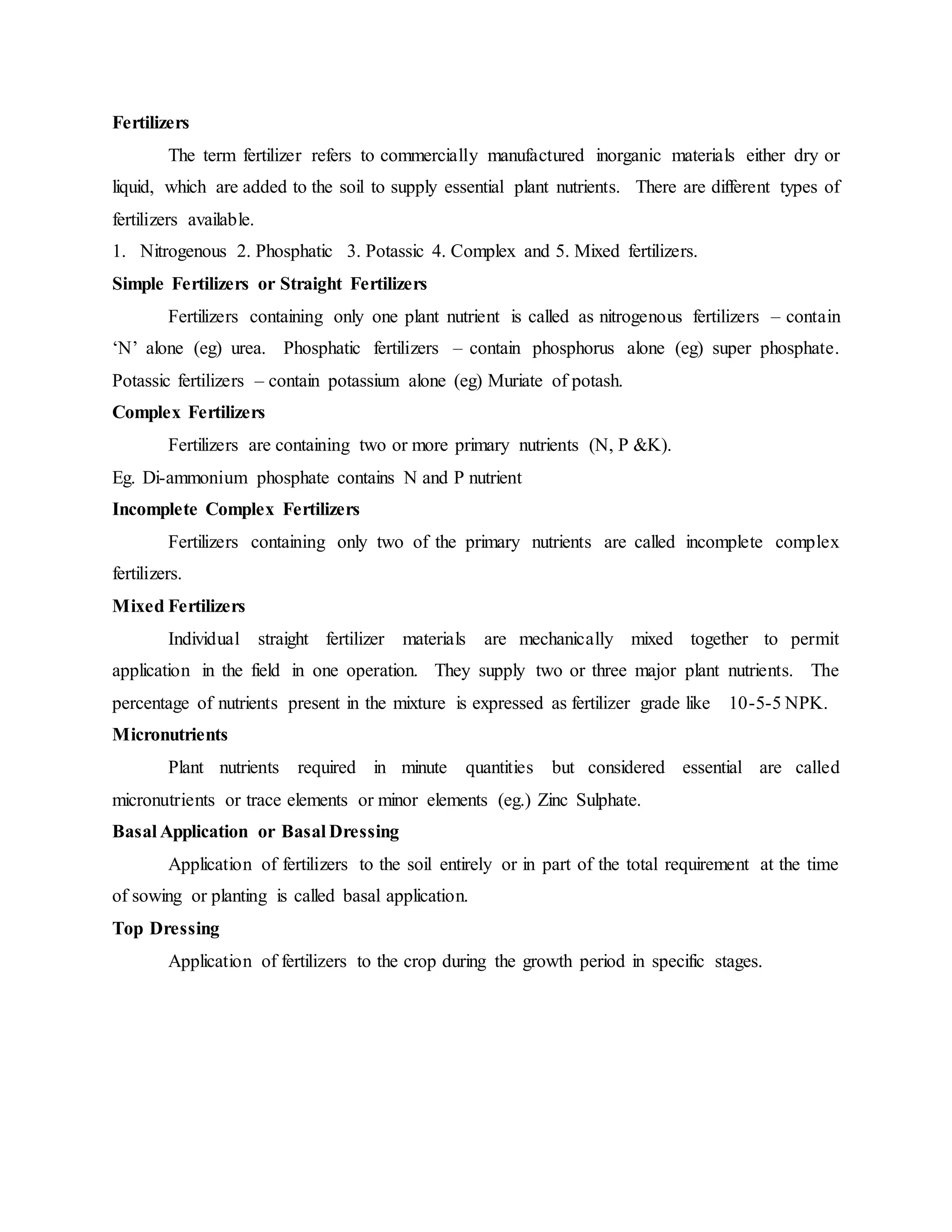
The term fertilizer refers to commercially manufactured inorganic materials either dry or
liquid, which are added to the soil to supply essential plant nutrients. There are different types of
fertilizers available.
1. Nitrogenous 2. Phosphatic 3. Potassic 4. Complex and 5. Mixed fertilizers.
Simple Fertilizers or Straight Fertilizers
Fertilizers containing only one plant nutrient is called as nitrogenous fertilizers – contain
‘N’ alone (eg) urea. Phosphatic fertilizers – contain phosphorus alone (eg) super phosphate.
Potassic fertilizers – contain potassium alone (eg) Muriate of potash.
Complex Fertilizers
Fertilizers are containing two or more primary nutrients (N, P &K).
Eg. Di-ammonium phosphate contains N and P nutrient
Incomplete Complex Fertilizers
Fertilizers containing only two of the primary nutrients are called incomplete complex
fertilizers.
Mixed Fertilizers
Individual straight fertilizer materials are mechanically mixed together to permit
application in the field in one operation. They supply two or three major plant nutrients. The
percentage of nutrients present in the mixture is expressed as fertilizer grade like 10-5-5 NPK.
Micronutrients
Plant nutrients required in minute quantities but considered essential are called
micronutrients or trace elements or minor elements (eg.) Zinc Sulphate.
Basal Application or Basal Dressing
Application of fertilizers to the soil entirely or in part of the total requirement at the time
of sowing or planting is called basal application.
Top Dressing
Application of fertilizers to the crop during the growth period in specific stages.
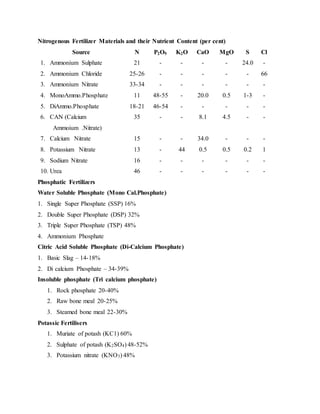
Nitrogenous Fertilizer Materials and their Nutrient Content (per cent)
Source N P2O5 K2O CaO MgO S Cl
1. Ammonium Sulphate
2. Ammonium Chloride
3. Ammonium Nitrate
4. MonoAmmo.Phosphate
5. DiAmmo.Phosphate
6. CAN (Calcium
Ammoium .Nitrate)
7. Calcium Nitrate
8. Potassium Nitrate
9. Sodium Nitrate
10. Urea
21
25-26
33-34
11
18-21
35
15
13
16
46
-
-
-
48-55
46-54
-
-
-
-
-
-
-
-
-
-
-
-
44
-
-
-
-
-
20.0
-
8.1
34.0
0.5
-
-
-
-
-
0.5
-
4.5
-
0.5
-
-
24.0
-
-
1-3
-
-
-
0.2
-
-
-
66
-
-
-
-
-
1
-
-
Phosphatic Fertilizers
Water Soluble Phosphate (Mono Cal.Phosphate)
1. Single Super Phosphate (SSP) 16%
2. Double Super Phosphate (DSP) 32%
3. Triple Super Phosphate (TSP) 48%
4. Ammonium Phosphate
Citric Acid Soluble Phosphate (Di-Calcium Phosphate)
1. Basic Slag – 14-18%
2. Di calcium Phosphate – 34-39%
Insoluble phosphate (Tri calcium phosphate)
1. Rock phosphate 20-40%
2. Raw bone meal 20-25%
3. Steamed bone meal 22-30%
Potassic Fertilisers
1. Muriate of potash (KC1) 60%
2. Sulphate of potash (K2SO4) 48-52%
3. Potassium nitrate (KNO3) 48%
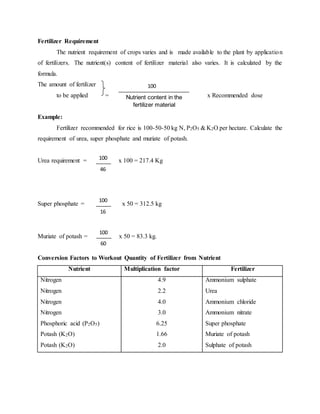
Fertilizer Requirement
The nutrient requirement of crops varies and is made available to the plant by application
of fertilizers. The nutrient(s) content of fertilizer material also varies. It is calculated by the
formula.
The amount of fertilizer
to be applied = x Recommended dose
Example:
Fertilizer recommended for rice is 100-50-50 kg N, P2O5 & K2O per hectare. Calculate the
requirement of urea, super phosphate and muriate of potash.
Urea requirement = x 100 = 217.4 Kg
Super phosphate = x 50 = 312.5 kg
Muriate of potash = x 50 = 83.3 kg.
Conversion Factors to Workout Quantity of Fertilizer from Nutrient
Nutrient Multiplication factor Fertilizer
Nitrogen 4.9 Ammonium sulphate
Nitrogen 2.2 Urea
Nitrogen 4.0 Ammonium chloride
Nitrogen 3.0 Ammonium nitrate
Phosphoric acid (P2O5) 6.25 Super phosphate
Potash (K2O) 1.66 Muriate of potash
Potash (K2O) 2.0 Sulphate of potash
100
Nutrient content in the
fertilizer material
100
46
100
16
100
60
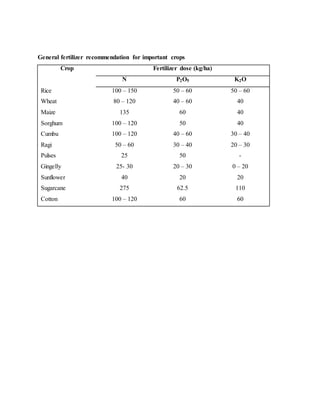
General fertilizer recommendation for important crops
Crop Fertilizer dose (kg/ha)
N P2O5 K2O
Rice 100 – 150 50 – 60 50 – 60
Wheat 80 – 120 40 – 60 40
Maize 135 60 40
Sorghum 100 – 120 50 40
Cumbu 100 – 120 40 – 60 30 – 40
Ragi 50 – 60 30 – 40 20 – 30
Pulses 25 50 -
Gingelly 25- 30 20 – 30 0 – 20
Sunflower 40 20 20
Sugarcane 275 62.5 110
Cotton 100 – 120 60 60

Fertilizer calculation (1) Agriculture

  • 1.
    Fertilizers The term fertilizerrefers to commercially manufactured inorganic materials either dry or liquid, which are added to the soil to supply essential plant nutrients. There are different types of fertilizers available. 1. Nitrogenous 2. Phosphatic 3. Potassic 4. Complex and 5. Mixed fertilizers. Simple Fertilizers or Straight Fertilizers Fertilizers containing only one plant nutrient is called as nitrogenous fertilizers – contain ‘N’ alone (eg) urea. Phosphatic fertilizers – contain phosphorus alone (eg) super phosphate. Potassic fertilizers – contain potassium alone (eg) Muriate of potash. Complex Fertilizers Fertilizers are containing two or more primary nutrients (N, P &K). Eg. Di-ammonium phosphate contains N and P nutrient Incomplete Complex Fertilizers Fertilizers containing only two of the primary nutrients are called incomplete complex fertilizers. Mixed Fertilizers Individual straight fertilizer materials are mechanically mixed together to permit application in the field in one operation. They supply two or three major plant nutrients. The percentage of nutrients present in the mixture is expressed as fertilizer grade like 10-5-5 NPK. Micronutrients Plant nutrients required in minute quantities but considered essential are called micronutrients or trace elements or minor elements (eg.) Zinc Sulphate. Basal Application or Basal Dressing Application of fertilizers to the soil entirely or in part of the total requirement at the time of sowing or planting is called basal application. Top Dressing Application of fertilizers to the crop during the growth period in specific stages.
  • 2.
    Nitrogenous Fertilizer Materialsand their Nutrient Content (per cent) Source N P2O5 K2O CaO MgO S Cl 1. Ammonium Sulphate 2. Ammonium Chloride 3. Ammonium Nitrate 4. MonoAmmo.Phosphate 5. DiAmmo.Phosphate 6. CAN (Calcium Ammoium .Nitrate) 7. Calcium Nitrate 8. Potassium Nitrate 9. Sodium Nitrate 10. Urea 21 25-26 33-34 11 18-21 35 15 13 16 46 - - - 48-55 46-54 - - - - - - - - - - - - 44 - - - - - 20.0 - 8.1 34.0 0.5 - - - - - 0.5 - 4.5 - 0.5 - - 24.0 - - 1-3 - - - 0.2 - - - 66 - - - - - 1 - - Phosphatic Fertilizers Water Soluble Phosphate (Mono Cal.Phosphate) 1. Single Super Phosphate (SSP) 16% 2. Double Super Phosphate (DSP) 32% 3. Triple Super Phosphate (TSP) 48% 4. Ammonium Phosphate Citric Acid Soluble Phosphate (Di-Calcium Phosphate) 1. Basic Slag – 14-18% 2. Di calcium Phosphate – 34-39% Insoluble phosphate (Tri calcium phosphate) 1. Rock phosphate 20-40% 2. Raw bone meal 20-25% 3. Steamed bone meal 22-30% Potassic Fertilisers 1. Muriate of potash (KC1) 60% 2. Sulphate of potash (K2SO4) 48-52% 3. Potassium nitrate (KNO3) 48%
  • 3.
    Fertilizer Requirement The nutrientrequirement of crops varies and is made available to the plant by application of fertilizers. The nutrient(s) content of fertilizer material also varies. It is calculated by the formula. The amount of fertilizer to be applied = x Recommended dose Example: Fertilizer recommended for rice is 100-50-50 kg N, P2O5 & K2O per hectare. Calculate the requirement of urea, super phosphate and muriate of potash. Urea requirement = x 100 = 217.4 Kg Super phosphate = x 50 = 312.5 kg Muriate of potash = x 50 = 83.3 kg. Conversion Factors to Workout Quantity of Fertilizer from Nutrient Nutrient Multiplication factor Fertilizer Nitrogen 4.9 Ammonium sulphate Nitrogen 2.2 Urea Nitrogen 4.0 Ammonium chloride Nitrogen 3.0 Ammonium nitrate Phosphoric acid (P2O5) 6.25 Super phosphate Potash (K2O) 1.66 Muriate of potash Potash (K2O) 2.0 Sulphate of potash 100 Nutrient content in the fertilizer material 100 46 100 16 100 60
  • 4.
    General fertilizer recommendationfor important crops Crop Fertilizer dose (kg/ha) N P2O5 K2O Rice 100 – 150 50 – 60 50 – 60 Wheat 80 – 120 40 – 60 40 Maize 135 60 40 Sorghum 100 – 120 50 40 Cumbu 100 – 120 40 – 60 30 – 40 Ragi 50 – 60 30 – 40 20 – 30 Pulses 25 50 - Gingelly 25- 30 20 – 30 0 – 20 Sunflower 40 20 20 Sugarcane 275 62.5 110 Cotton 100 – 120 60 60