Solid State Theory
Solid State Theory
Physics 545
Physics 545
Fermi Surfaces
Fermi Surfaces
F i f d El t
Fermi surfaces and Electron
dynamics
dynamics
¾Band structure calculations give E(k)
¾E(k) determines the dynamics of the electrons
¾It is E(k) at the Fermi Surface that is important
¾Form of Fermi surface is important
¾Fermi surface can be complicated due to
overlapping bands
overlapping bands.
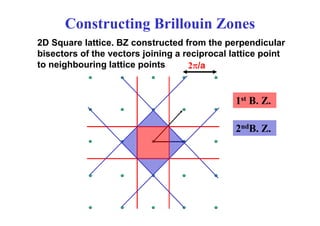
Constructing Brillouin Zones
2D Square lattice. BZ constructed from the perpendicular
bisectors of the vectors joining a reciprocal lattice point
t i hb i l tti i t
to neighbouring lattice points 2π/a
1st B. Z.
2ndB. Z.
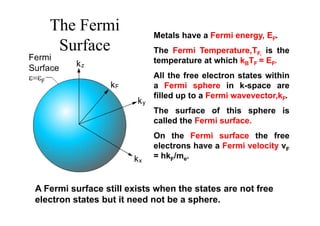
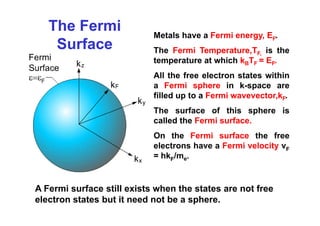
The Fermi Metals have a Fermi energy E
Surface
Metals have a Fermi energy, EF.
The Fermi Temperature,TF, is the
temperature at which kBTF = EF
temperature at which kBTF = EF.
All the free electron states within
a Fermi sphere in k-space are
a Fermi sphere in k space are
filled up to a Fermi wavevector,kF.
The surface of this sphere is
called the Fermi surface.
On the Fermi surface the free
electrons have a Fermi velocity vF
= hkF/me.
A Fermi surface still exists when the states are not free
electron states but it need not be a sphere.
Brillouin Zones and Fermi Surfaces
Empty Lattice model (limit of weak
lattice potential):
States are Bloch states.Independent
E E2
States are Bloch states.Independent
states have k-vectors in first BZ.
No energy gaps at the BZ boundaries.
E1
kx π/a
−π/a 0
ky
[100]
kx = ky
E1
E2
y
E2
1
E1
1st B Z
k
−21/2π/a 0 21/2π/a
[110]
2st B. Z.
1st B. Z.
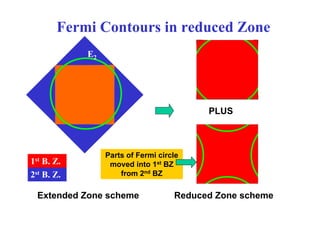
Fermi Contours in reduced Zone
E2
PLUS
PLUS
Parts of Fermi circle
moved into 1st BZ
1st B. Z. moved into 1st BZ
from 2nd BZ
2st B. Z.
. .
Reduced Zone scheme
Extended Zone scheme
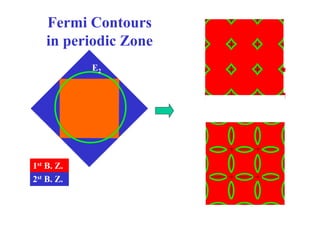
Fermi Contours
i i di Z
in periodic Zone
E2
1st B Z
2st B. Z.
1st B. Z.
E = -α –γ( Cos[kx x] - Cos[ky y]),
2D simple square
Lattice tight binding
model.
Changing Fermi
Changing Fermi
Contour with
I i F i
Increasing Fermi
Energy.
http://dept.physics.upenn.edu/~mele/phys518/anims/Kronig/FermiSurf1.gif
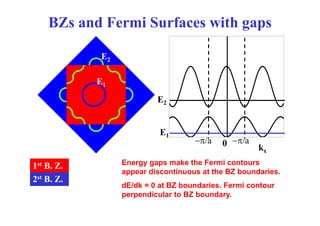
BZs and Fermi Surfaces with gaps
E2
E1
E2
/ /
E1
Energy gaps make the Fermi contours
0
−π/a −π/a
kx
1st B Z Energy gaps make the Fermi contours
appear discontinuous at the BZ boundaries.
dE/dk = 0 at BZ boundaries. Fermi contour
2st B. Z.
1st B. Z.
perpendicular to BZ boundary.
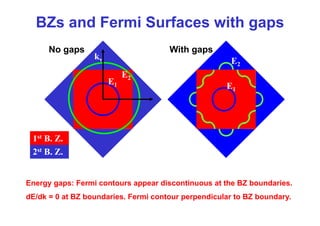
BZs and Fermi Surfaces with gaps
E
ky
No gaps With gaps
E2
E1
E1
E2
E1
1st B Z
2st B. Z.
1st B. Z.
Energy gaps: Fermi contours appear discontinuous at the BZ boundaries.
dE/dk = 0 at BZ boundaries. Fermi contour perpendicular to BZ boundary.
Fermi Surfaces with gaps “Hole
like” orbits
like orbits
Periodic zone picture of
part of the Fermi contour
at energy E1.
1
On this part of the Fermi
contour electrons behave
lik iti l h d
like positively charged
“holes”. See later
Fermi Surfaces with gaps:
“Electron like” orbits
Periodic zone picture of
part of the Fermi contour
at energy E2.
On this part of the Fermi
contour electrons behave
like negatively charged
“electrons”. See later
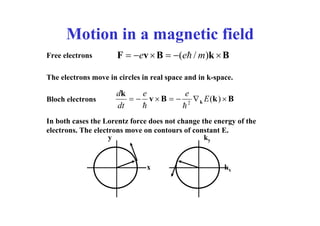
Motion in a magnetic field
Free electrons B
k
B
v
F ×
−
=
×
−
= )
/
( m
e
e =
The electrons move in circles in real space and in k-space.
Bloch electrons B
k
B
v
k
k ×
∇
−
=
×
−
= )
(
2
E
e
e
dt
d
=
=
In both cases the Lorentz force does not change the energy of the
electrons. The electrons move on contours of constant E.
y k
y ky
x kx
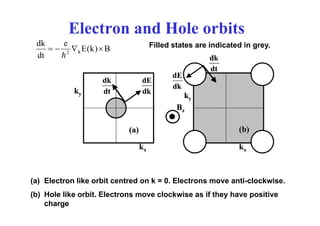
Electron and Hole orbits
dk
dk
dk
dk
B
)
k
(
E
e
dt
k
d
k
2
×
∇
−
=
=
Filled states are indicated in grey.
dE
dk
dk
dE
dt
dE
dk
dk
dE
dt
dE
dk dE
dk
dk
dE
dt
dk
dE
dt
dk
dt
dk
Bz
ky
ky dk
dt
dk
dk
dt dk
dt
dk
dk
Bz
Bz
ky
ky
(a) (b)
(a) (b)
kx
kx kx
kx
(a) Electron like orbit centred on k = 0. Electrons move anti-clockwise.
(b) Hole like orbit. Electrons move clockwise as if they have positive
charge
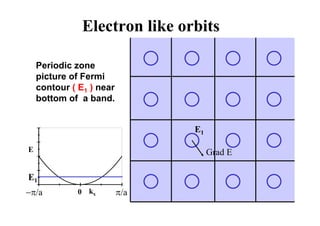
Electron like orbits
Periodic zone
picture of Fermi
contour ( E ) near
contour ( E1 ) near
bottom of a band.
E1
Grad E
E
k /
/ 0
E1
kx π/a
−π/a 0
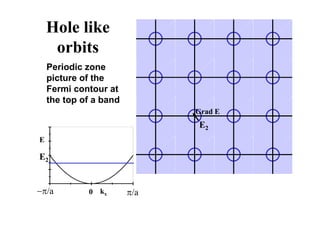
Hole like
orbits
Periodic zone
picture of the
Fermi contour at
Fermi contour at
the top of a band
Grad E
Grad E
E
E2
E
E2
k /
π/a 0 kx π/a
−π/a 0
Tight binding simple cubic
d l F i S f
model:Fermi Surfaces
-α – γ(Cos[kx x] - Cos[ky y] - Cos[kz z]
Increasing Fermi Energy
h //h i b / l l /f i i l h l
http://home.cc.umanitoba.ca/~loly/fermiarticle.html
The Fermi Metals have a Fermi energy E
Surface
Metals have a Fermi energy, EF.
The Fermi Temperature,TF, is the
temperature at which kBTF = EF
temperature at which kBTF = EF.
All the free electron states within
a Fermi sphere in k-space are
a Fermi sphere in k space are
filled up to a Fermi wavevector,kF.
The surface of this sphere is
called the Fermi surface.
On the Fermi surface the free
electrons have a Fermi velocity vF
= hkF/me.
A Fermi surface still exists when the states are not free
electron states but it need not be a sphere.
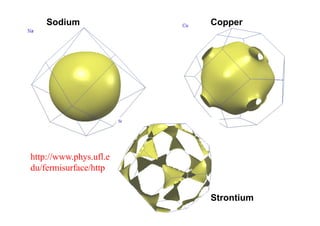
Sodium Copper
http://www.phys.ufl.e
d /f i f /h
du/fermisurface/http
Strontium
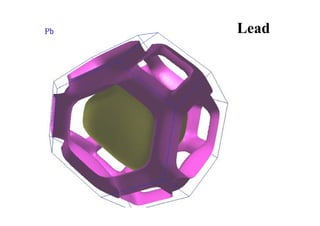
Lead
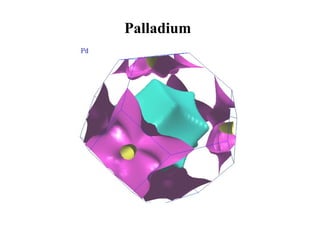
Palladium
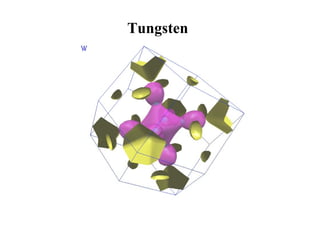
Tungsten
g
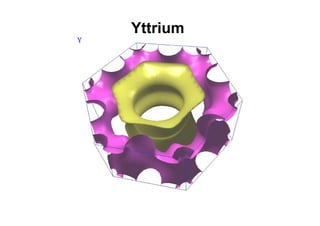
Yttrium
Y
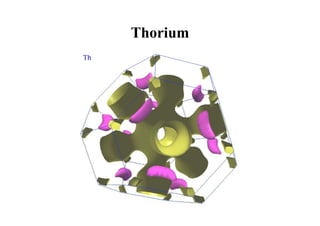
Thorium
Thorium
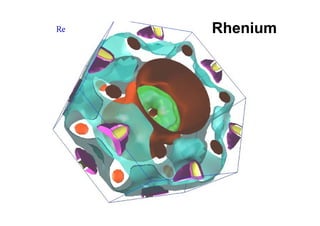
Rhenium
Re

fermi-surfaces-sperficies-de-fermi-slide.pdf

  • 1.
    Solid State Theory SolidState Theory Physics 545 Physics 545 Fermi Surfaces Fermi Surfaces
  • 2.
    F i fd El t Fermi surfaces and Electron dynamics dynamics ¾Band structure calculations give E(k) ¾Band structure calculations give E(k) ¾E(k) determines the dynamics of the electrons ¾It is E(k) at the Fermi Surface that is important ¾Form of Fermi surface is important ¾Form of Fermi surface is important ¾Fermi surface can be complicated due to overlapping bands overlapping bands.
  • 3.
    Constructing Brillouin Zones 2DSquare lattice. BZ constructed from the perpendicular bisectors of the vectors joining a reciprocal lattice point t i hb i l tti i t to neighbouring lattice points 2π/a 1st B. Z. 2ndB. Z.
  • 4.
    The Fermi Metalshave a Fermi energy E Surface Metals have a Fermi energy, EF. The Fermi Temperature,TF, is the temperature at which kBTF = EF temperature at which kBTF = EF. All the free electron states within a Fermi sphere in k-space are a Fermi sphere in k space are filled up to a Fermi wavevector,kF. The surface of this sphere is The surface of this sphere is called the Fermi surface. On the Fermi surface the free electrons have a Fermi velocity vF = hkF/me. A Fermi surface still exists when the states are not free A Fermi surface still exists when the states are not free electron states but it need not be a sphere.
  • 5.
    Brillouin Zones andFermi Surfaces Empty Lattice model (limit of weak Empty Lattice model (limit of weak lattice potential): States are Bloch states.Independent E E2 States are Bloch states.Independent states have k-vectors in first BZ. No energy gaps at the BZ boundaries. E1 kx π/a −π/a 0 ky [100] kx = ky E1 E2 y E2 1 E1 1st B Z k −21/2π/a 0 21/2π/a [110] 2st B. Z. 1st B. Z.
  • 6.
    Fermi Contours inreduced Zone E2 PLUS PLUS Parts of Fermi circle moved into 1st BZ 1st B. Z. moved into 1st BZ from 2nd BZ 2st B. Z. . . Reduced Zone scheme Extended Zone scheme
  • 7.
    Fermi Contours i idi Z in periodic Zone E2 1st B Z 2st B. Z. 1st B. Z.
  • 8.
    E = -α–γ( Cos[kx x] - Cos[ky y]), 2D simple square Lattice tight binding Lattice tight binding model. Changing Fermi Changing Fermi Contour with I i F i Increasing Fermi Energy. http://dept.physics.upenn.edu/~mele/phys518/anims/Kronig/FermiSurf1.gif
  • 9.
    BZs and FermiSurfaces with gaps E2 E1 E2 / / E1 Energy gaps make the Fermi contours 0 −π/a −π/a kx 1st B Z Energy gaps make the Fermi contours appear discontinuous at the BZ boundaries. dE/dk = 0 at BZ boundaries. Fermi contour 2st B. Z. 1st B. Z. perpendicular to BZ boundary.
  • 10.
    BZs and FermiSurfaces with gaps E ky No gaps With gaps E2 E1 E1 E2 E1 1st B Z 2st B. Z. 1st B. Z. Energy gaps: Fermi contours appear discontinuous at the BZ boundaries. dE/dk = 0 at BZ boundaries. Fermi contour perpendicular to BZ boundary.
  • 11.
    Fermi Surfaces withgaps “Hole Fermi Surfaces with gaps “Hole like” orbits like orbits Periodic zone picture of part of the Fermi contour at energy E1. 1 On this part of the Fermi contour electrons behave lik iti l h d like positively charged “holes”. See later
  • 12.
    Fermi Surfaces withgaps: Fermi Surfaces with gaps: “Electron like” orbits Periodic zone picture of Periodic zone picture of part of the Fermi contour at energy E2. On this part of the Fermi contour electrons behave like negatively charged like negatively charged “electrons”. See later
  • 13.
    Motion in amagnetic field Motion in a magnetic field Free electrons B k B v F × − = × − = ) / ( m e e = The electrons move in circles in real space and in k-space. Bloch electrons B k B v k k × ∇ − = × − = ) ( 2 E e e dt d = = In both cases the Lorentz force does not change the energy of the electrons. The electrons move on contours of constant E. y k y ky x kx
  • 14.
    Electron and Holeorbits dk dk dk dk B ) k ( E e dt k d k 2 × ∇ − = = Filled states are indicated in grey. dE dk dk dE dt dE dk dk dE dt dE dk dE dk dk dE dt dk dE dt dk dt dk Bz ky ky dk dt dk dk dt dk dt dk dk Bz Bz ky ky (a) (b) (a) (b) kx kx kx kx (a) Electron like orbit centred on k = 0. Electrons move anti-clockwise. (b) Hole like orbit. Electrons move clockwise as if they have positive charge
  • 15.
    Electron like orbits Periodiczone picture of Fermi contour ( E ) near contour ( E1 ) near bottom of a band. E1 Grad E E k / / 0 E1 kx π/a −π/a 0
  • 16.
    Hole like orbits Periodic zone pictureof the Fermi contour at Fermi contour at the top of a band Grad E Grad E E E2 E E2 k / π/a 0 kx π/a −π/a 0
  • 17.
    Tight binding simplecubic d l F i S f model:Fermi Surfaces -α – γ(Cos[kx x] - Cos[ky y] - Cos[kz z] Increasing Fermi Energy h //h i b / l l /f i i l h l http://home.cc.umanitoba.ca/~loly/fermiarticle.html
  • 18.
    The Fermi Metalshave a Fermi energy E Surface Metals have a Fermi energy, EF. The Fermi Temperature,TF, is the temperature at which kBTF = EF temperature at which kBTF = EF. All the free electron states within a Fermi sphere in k-space are a Fermi sphere in k space are filled up to a Fermi wavevector,kF. The surface of this sphere is The surface of this sphere is called the Fermi surface. On the Fermi surface the free electrons have a Fermi velocity vF = hkF/me. A Fermi surface still exists when the states are not free A Fermi surface still exists when the states are not free electron states but it need not be a sphere.
  • 19.
    Sodium Copper http://www.phys.ufl.e d /fi f /h du/fermisurface/http Strontium
  • 20.
  • 21.
  • 22.
  • 23.
  • 24.
  • 25.