Solids
Eisberg & Resnick Ch 13 & 14
RNave:
http://hyperphysics.phy-astr.gsu.edu/hbase/solcon.html#solcon
Alison Baski:
http://www.courses.vcu.edu/PHYS661/pdf/01SolidState041.ppt
Carl Hepburn, “Britney Spear’s Guide to Semiconductor Physics”.
http://britneyspears.ac/lasers.htm
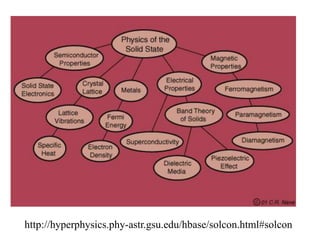
http://hyperphysics.phy-astr.gsu.edu/hbase/solcon.html#solcon
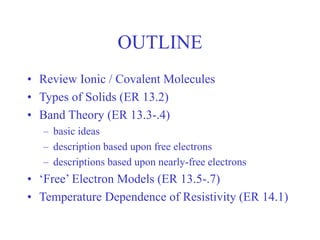
OUTLINE
• Review Ionic / Covalent Molecules
• Types of Solids (ER 13.2)
• Band Theory (ER 13.3-.4)
– basic ideas
– description based upon free electrons
– descriptions based upon nearly-free electrons
• ‘Free’ Electron Models (ER 13.5-.7)
• Temperature Dependence of Resistivity (ER 14.1)
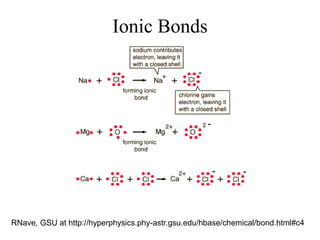
Ionic Bonds
RNave, GSU at http://hyperphysics.phy-astr.gsu.edu/hbase/chemical/bond.html#c4
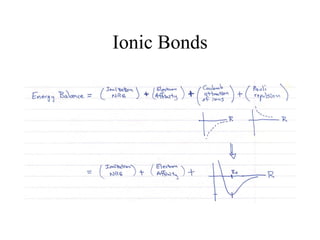
Ionic Bonds
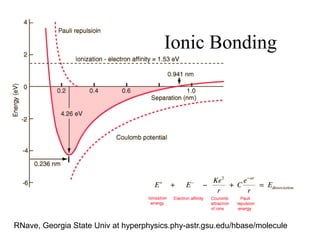
Ionic Bonding
RNave, Georgia State Univ at hyperphysics.phy-astr.gsu.edu/hbase/molecule
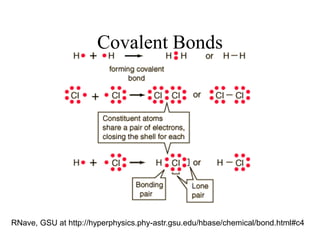
Covalent Bonds
RNave, GSU at http://hyperphysics.phy-astr.gsu.edu/hbase/chemical/bond.html#c4
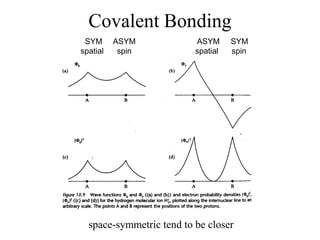
Covalent Bonding
SYM ASYM
spatial spin
ASYM SYM
spatial spin
space-symmetric tend to be closer
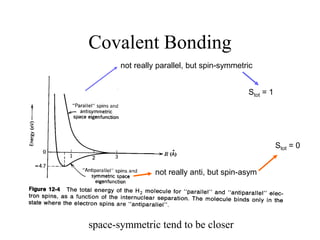
Covalent Bonding
Stot = 1
not really parallel, but spin-symmetric
not really anti, but spin-asym
Stot = 0
space-symmetric tend to be closer
TYPES OF SOLIDS (ER 13.2)
CRYSTALINE BINDING
• molecular
• ionic
• covalent
• metallic
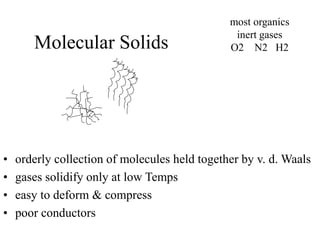
Molecular Solids
• orderly collection of molecules held together by v. d. Waals
• gases solidify only at low Temps
• easy to deform & compress
• poor conductors
most organics
inert gases
O2 N2 H2
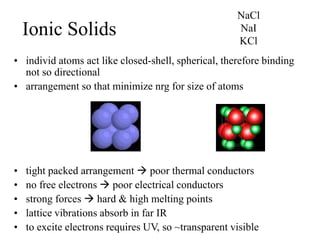
Ionic Solids
• individ atoms act like closed-shell, spherical, therefore binding
not so directional
• arrangement so that minimize nrg for size of atoms
• tight packed arrangement  poor thermal conductors
• no free electrons  poor electrical conductors
• strong forces  hard & high melting points
• lattice vibrations absorb in far IR
• to excite electrons requires UV, so ~transparent visible
NaCl
NaI
KCl
Covalent Solids
• 3D collection of atoms bound by shared valence
electrons
• difficult to deform because bonds are directional
• high melting points (b/c diff to deform)
• no free electrons  poor electrical conductors
• most solids adsorb photons in visible  opaque
Ge Si
diamond
Metallic Solids
• (weaker version of covalent bonding)
• constructed of atoms which have very weakly
bound outer electron
• large number of vacancies in orbital (not enough
nrg available to form covalent bonds)
• electrons roam around (electron gas )
• excellent conductors of heat & electricity
• absorb IR, Vis, UV  opaque
Fe Ni Co
config dhalf full
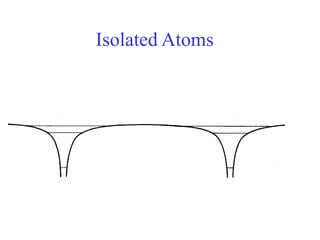
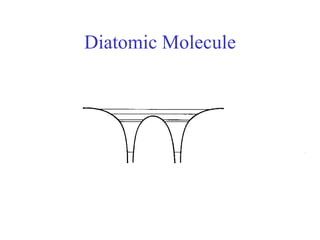
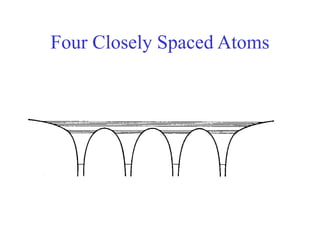
BAND STRUCTURE
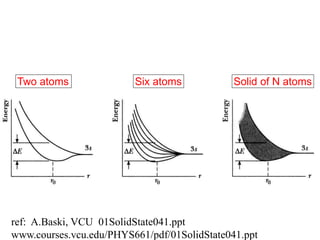
Isolated Atoms
Diatomic Molecule
Four Closely Spaced Atoms
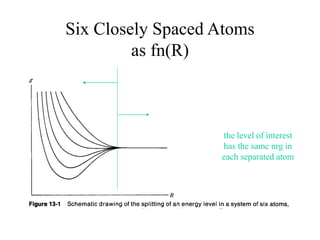
Six Closely Spaced Atoms
as fn(R)
the level of interest
has the same nrg in
each separated atom
Solid of N atoms
Two atoms Six atoms
ref: A.Baski, VCU 01SolidState041.ppt
www.courses.vcu.edu/PHYS661/pdf/01SolidState041.ppt
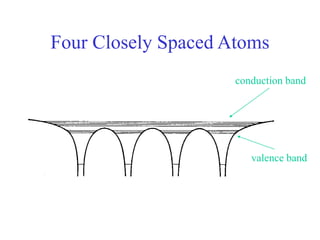
Four Closely Spaced Atoms
valence band
conduction band
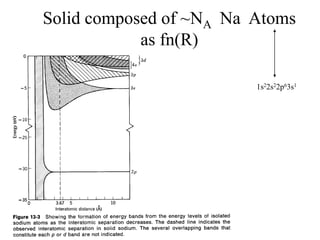
Solid composed of ~NA Na Atoms
as fn(R)
1s22s22p63s1
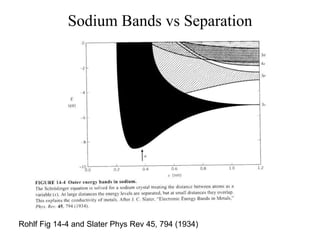
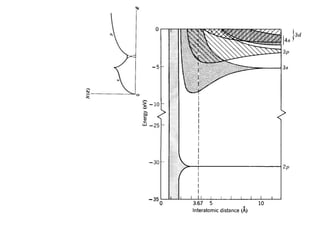
Sodium Bands vs Separation
Rohlf Fig 14-4 and Slater Phys Rev 45, 794 (1934)
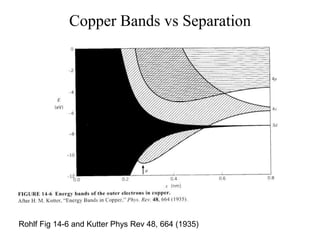
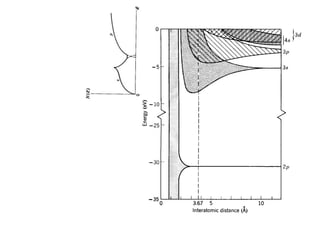
Copper Bands vs Separation
Rohlf Fig 14-6 and Kutter Phys Rev 48, 664 (1935)
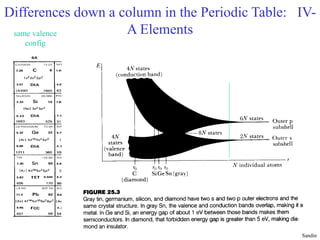
Differences down a column in the Periodic Table: IV-
A Elements
Sandin
same valence
config
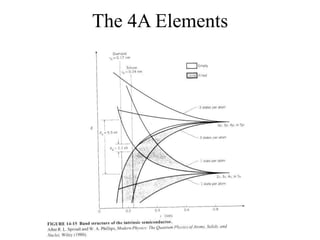
The 4A Elements
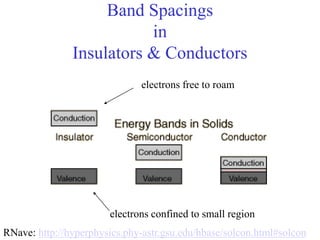
Band Spacings
in
Insulators & Conductors
electrons free to roam
electrons confined to small region
RNave: http://hyperphysics.phy-astr.gsu.edu/hbase/solcon.html#solcon
How to choose eF
and
Behavior of the Fermi function at
band gaps
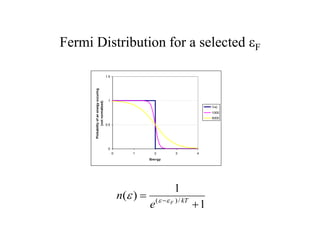
Fermi Distribution for a selected eF
0
0.5
1
1.5
0 1 2 3 4
Energy
Probability
of
an
energy
occuring
(not
normalized)
T=0
1000
5000
1
1
)
( /
)
(

  kT
F
e
n e
e
e
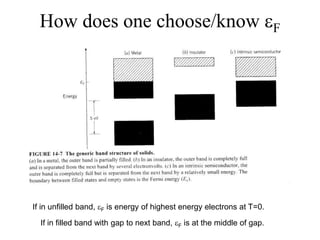
How does one choose/know eF
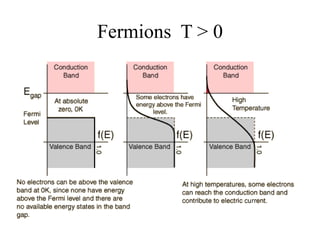
If in unfilled band, eF is energy of highest energy electrons at T=0.
If in filled band with gap to next band, eF is at the middle of gap.
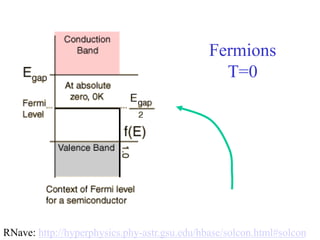
Fermions
T=0
RNave: http://hyperphysics.phy-astr.gsu.edu/hbase/solcon.html#solcon
Fermions T > 0
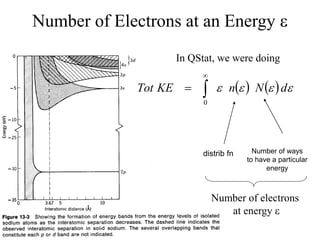
Number of Electrons at an Energy e
    e
e
e
e d
N
n
KE
Tot 


0
distrib fn Number of ways
to have a particular
energy
In QStat, we were doing
Number of electrons
at energy e
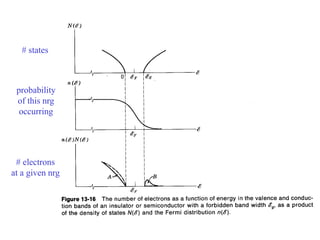
# states
probability
of this nrg
occurring
# electrons
at a given nrg
Semiconductors
ER13-9, -10
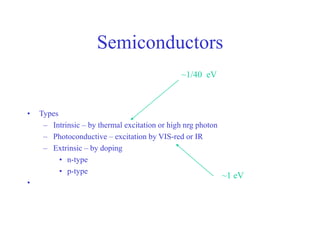
Semiconductors
• Types
– Intrinsic – by thermal excitation or high nrg photon
– Photoconductive – excitation by VIS-red or IR
– Extrinsic – by doping
• n-type
• p-type
•
~1 eV
~1/40 eV
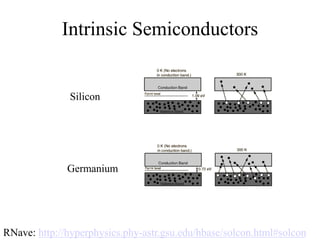
Intrinsic Semiconductors
Silicon
Germanium
RNave: http://hyperphysics.phy-astr.gsu.edu/hbase/solcon.html#solcon
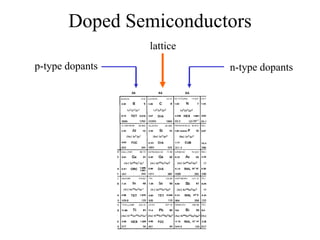
Doped Semiconductors
lattice
p-type dopants n-type dopants
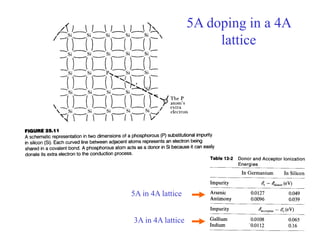
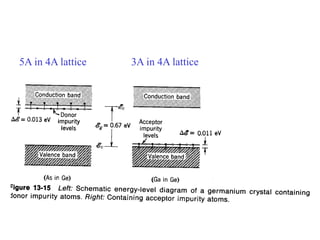
5A in 4A lattice
3A in 4A lattice
5A doping in a 4A
lattice
5A in 4A lattice 3A in 4A lattice
‘Free-Electron’ Models
• Free Electron Model (ER 13-5)
• Nearly-Free Electron Model (ER13-6,-7)
– Version 1 – SP221
– Version 2 – SP324
– Version 3 – SP425
• .
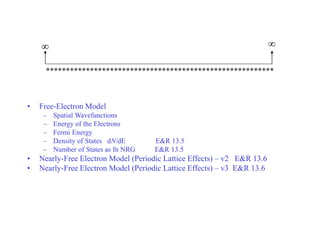
• Free-Electron Model
– Spatial Wavefunctions
– Energy of the Electrons
– Fermi Energy
– Density of States dN/dE E&R 13.5
– Number of States as fn NRG E&R 13.5
• Nearly-Free Electron Model (Periodic Lattice Effects) – v2 E&R 13.6
• Nearly-Free Electron Model (Periodic Lattice Effects) – v3 E&R 13.6
 
*********************************************************
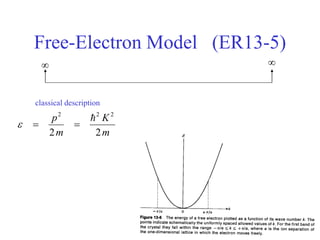
Free-Electron Model (ER13-5)
 
m
K
m
p
2
2
2
2
2



e
classical description
 






 E
m
0
2
2
2

  z
k
y
k
x
k
L
xyz z
y
x sin
sin
sin
8
3




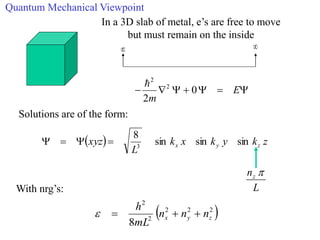
In a 3D slab of metal, e’s are free to move
but must remain on the inside
Solutions are of the form:
L
nz 
 
2
2
2
2
2
8
z
y
x n
n
n
mL
h



e
With nrg’s:
Quantum Mechanical Viewpoint
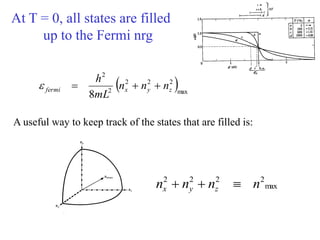
At T = 0, all states are filled
up to the Fermi nrg
 max
2
2
2
2
2
8
z
y
x
fermi n
n
n
mL
h



e
A useful way to keep track of the states that are filled is:
max
2
2
2
2
n
n
n
n z
y
x 


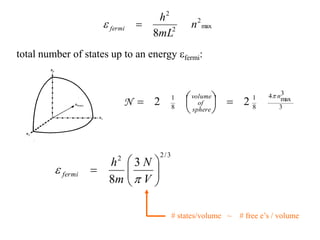
total number of states up to an energy efermi:
3
3
max
4
8
1
8
1
2
2
n
sphere
of
volume 








N
3
/
2
2
3
8 








V
N
m
h
fermi

e
max
2
2
2
8
n
mL
h
fermi 
e
# states/volume ~ # free e’s / volume
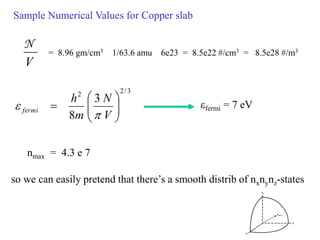
Sample Numerical Values for Copper slab
V
N
= 8.96 gm/cm3 1/63.6 amu 6e23 = 8.5e22 #/cm3 = 8.5e28 #/m3
efermi = 7 eV
3
/
2
2
3
8 








V
N
m
h
fermi

e
nmax = 4.3 e 7
so we can easily pretend that there’s a smooth distrib of nxnynz-states
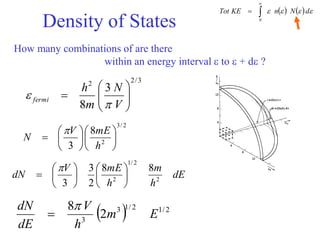
Density of States
How many combinations of are there
within an energy interval e to e + de ?
3
/
2
2
3
8 








V
N
m
h
fermi

e
2
/
3
2
8
3













h
mE
V
N

dE
h
m
h
mE
V
dN 2
2
/
1
2
8
8
2
3
3














  2
/
1
2
/
1
3
3
2
8
E
m
h
V
dE
dN 

    e
e
e
e d
N
n
KE
Tot 


0
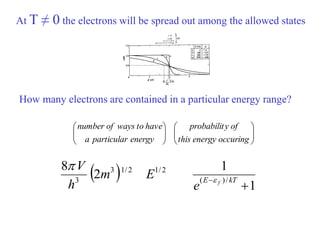
At T ≠ 0 the electrons will be spread out among the allowed states
How many electrons are contained in a particular energy range?
















occuring
energy
this
of
y
probabilit
energy
particular
a
have
to
ways
of
number
 
1
1
2
8
/
)
(
2
/
1
2
/
1
3
3

 kT
E f
e
E
m
h
V
e

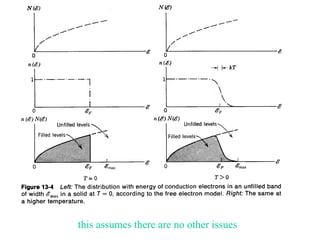
this assumes there are no other issues
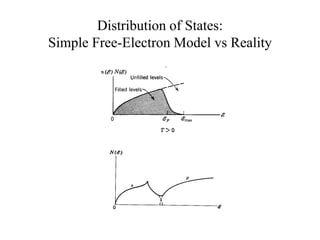
Distribution of States:
Simple Free-Electron Model vs Reality
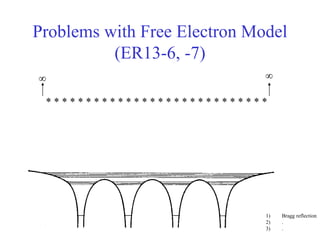
Problems with Free Electron Model
(ER13-6, -7)
 
* * * * * * * * * * * * * * * * * * * * * * * * * * * *
1) Bragg reflection
2) .
3) .
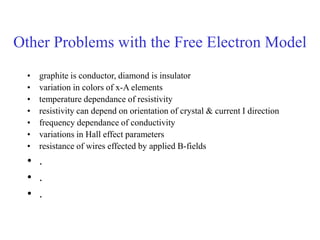
Other Problems with the Free Electron Model
• graphite is conductor, diamond is insulator
• variation in colors of x-A elements
• temperature dependance of resistivity
• resistivity can depend on orientation of crystal & current I direction
• frequency dependance of conductivity
• variations in Hall effect parameters
• resistance of wires effected by applied B-fields
• .
• .
• .
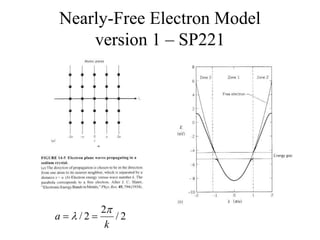
Nearly-Free Electron Model
version 1 – SP221
2
/
2
2
/
k
a

 

2
/


k
2
/
2
2
/
k
a

 

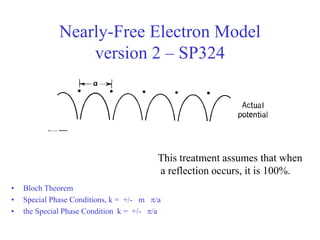
Nearly-Free Electron Model
version 2 – SP324
• Bloch Theorem
• Special Phase Conditions, k = +/- m /a
• the Special Phase Condition k = +/- /a
This treatment assumes that when
a reflection occurs, it is 100%.
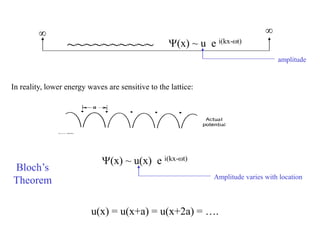
(x) ~ u e i(kx-wt)
(x) ~ u(x) e i(kx-wt)
 
~~~~~~~~~~
amplitude
In reality, lower energy waves are sensitive to the lattice:
Amplitude varies with location
u(x) = u(x+a) = u(x+2a) = ….
Bloch’s
Theorem
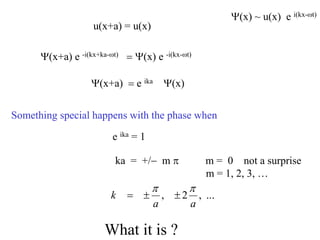
u(x+a) = u(x)
(x+a) e -i(kx+ka-wt)  (x) e -i(kx-wt)
(x) ~ u(x) e i(kx-wt)
(x+a)  e ika (x)
Something special happens with the phase when
e ika = 1
ka = +/ m  m = 0 not a surprise
m = 1, 2, 3, …
...
,
2
,
a
a
k





What it is ?
a
k



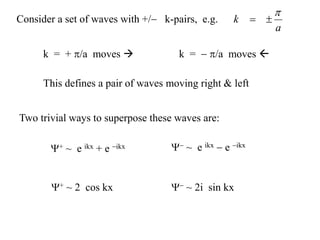
Consider a set of waves with +/ k-pairs, e.g.
k = + /a moves  k =  /a moves 
This defines a pair of waves moving right & left
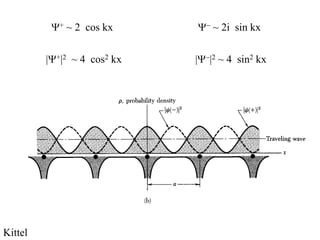
Two trivial ways to superpose these waves are:
+ ~ e ikx + e ikx  ~ e ikx  e ikx
+ ~ 2 cos kx  ~ 2i sin kx
Kittel
|+|2 ~ 4 cos2 kx ||2 ~ 4 sin2 kx
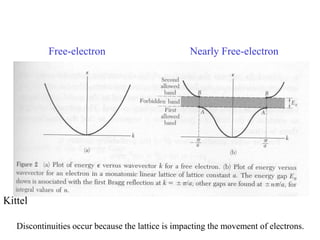
Free-electron Nearly Free-electron
Kittel
Discontinuities occur because the lattice is impacting the movement of electrons.
Effective Mass m*
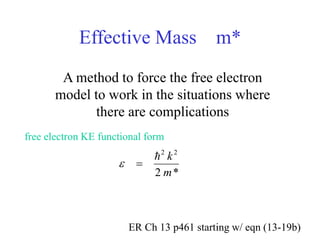
A method to force the free electron
model to work in the situations where
there are complications
ER Ch 13 p461 starting w/ eqn (13-19b)
*
2
2
2
m
k


e
free electron KE functional form
Effective Mass m*
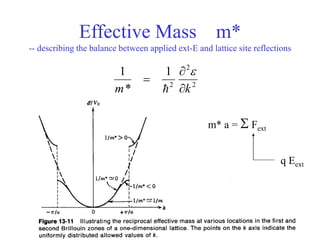
-- describing the balance between applied ext-E and lattice site reflections
2
2
2
1
*
1
k
m 


e

m* a = S Fext
q Eext
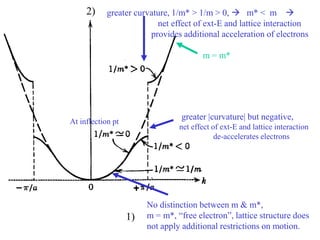
No distinction between m & m*,
m = m*, “free electron”, lattice structure does
not apply additional restrictions on motion.

m = m*
greater curvature, 1/m* > 1/m > 0,  m* < m 
net effect of ext-E and lattice interaction
provides additional acceleration of electrons
greater |curvature| but negative,
net effect of ext-E and lattice interaction
de-accelerates electrons
At inflection pt
1)
2)
*
2
2
2
2
2
2 m
k
m
k lattice
from
on
perturbati
apply




e
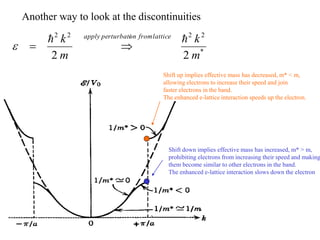
Another way to look at the discontinuities
Shift up implies effective mass has decreased, m* < m,
allowing electrons to increase their speed and join
faster electrons in the band.
The enhanced e-lattice interaction speeds up the electron.
Shift down implies effective mass has increased, m* > m,
prohibiting electrons from increasing their speed and making
them become similar to other electrons in the band.
The enhanced e-lattice interaction slows down the electron
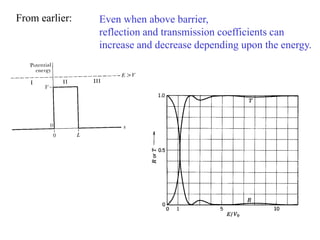
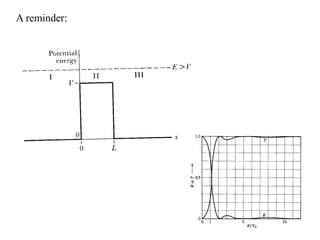
From earlier: Even when above barrier,
reflection and transmission coefficients can
increase and decrease depending upon the energy.
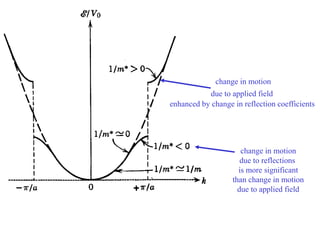
change in motion
due to reflections
is more significant
than change in motion
due to applied field
change in motion
due to applied field
enhanced by change in reflection coefficients
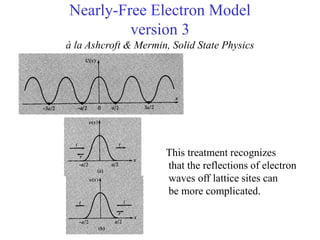
Nearly-Free Electron Model
version 3
à la Ashcroft & Mermin, Solid State Physics
This treatment recognizes
that the reflections of electron
waves off lattice sites can
be more complicated.
A reminder:
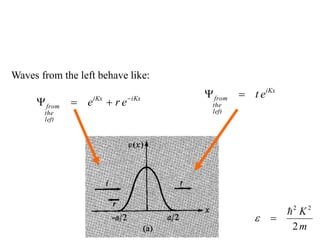
Waves from the left behave like:
iKx
iKx
left
the
from e
r
e 



iKx
left
the
from e
t


m
K
2
2
2


e
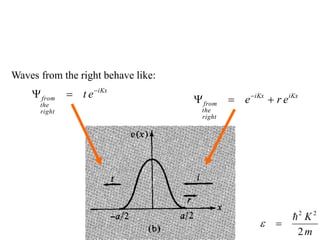
Waves from the right behave like:
iKx
iKx
right
the
from e
r
e 

 
iKx
right
the
from e
t 


m
K
2
2
2


e
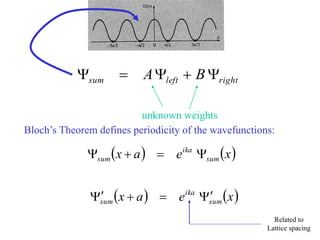
right
left
sum B
A 




Bloch’s Theorem defines periodicity of the wavefunctions:
   
x
e
a
x sum
ika
sum 



   
x
e
a
x sum
ika
sum 



unknown weights
Related to
Lattice spacing
   
x
e
a
x sum
ika
sum 


    
x
e
a
x sum
ika
sum 



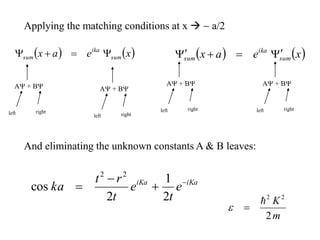
Applying the matching conditions at x   a/2
A + B
left right
A + B
left right
A + B
left right
A + B
left right
iKa
iKa
e
t
e
t
r
t
ka 



2
1
2
cos
2
2
m
K
2
2
2


e
And eliminating the unknown constants A & B leaves:
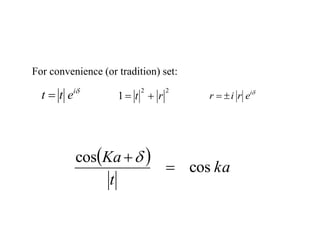
For convenience (or tradition) set:
2
2
1 r
t 


i
e
t
t  
i
e
r
i
r 

  ka
t
Ka
cos
cos


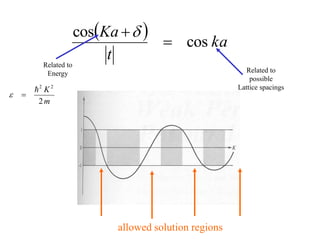
  ka
t
Ka
cos
cos


Related to
possible
Lattice spacings
Related to
Energy
m
K
2
2
2


e
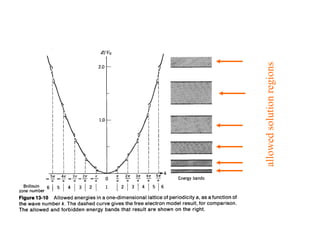
allowed solution regions
allowed
solution
regions
Superconductivity
ER 14-1, 13-4
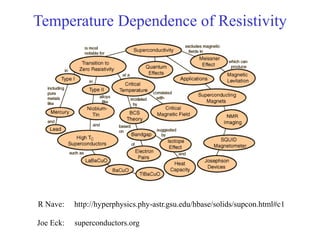
R Nave: http://hyperphysics.phy-astr.gsu.edu/hbase/solids/supcon.html#c1
Temperature Dependence of Resistivity
Joe Eck: superconductors.org
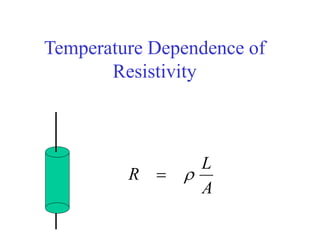
Temperature Dependence of
Resistivity
A
L
R 

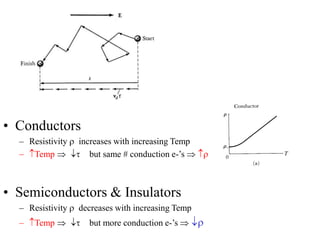
• Conductors
– Resistivity  increases with increasing Temp
– Temp  t but same # conduction e-’s  
• Semiconductors & Insulators
– Resistivity  decreases with increasing Temp
– Temp  t but more conduction e-’s  
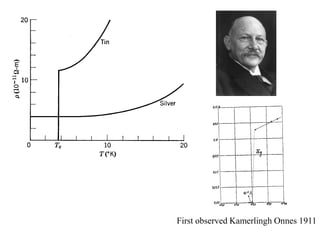
First observed Kamerlingh Onnes 1911
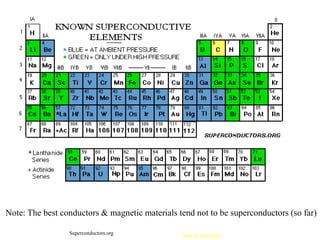
Superconductors.org Only in nanotubes
Note: The best conductors & magnetic materials tend not to be superconductors (so far)
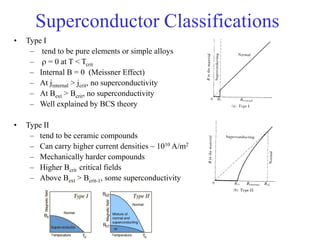
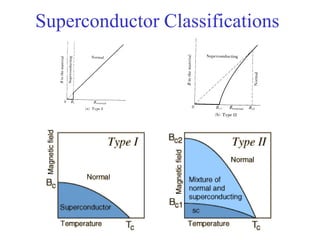
Superconductor Classifications
• Type I
– tend to be pure elements or simple alloys
–  = 0 at T < Tcrit
– Internal B = 0 (Meissner Effect)
– At jinternal > jcrit, no superconductivity
– At Bext > Bcrit, no superconductivity
– Well explained by BCS theory
• Type II
– tend to be ceramic compounds
– Can carry higher current densities ~ 1010 A/m2
– Mechanically harder compounds
– Higher Bcrit critical fields
– Above Bext > Bcrit-1, some superconductivity
Superconductor Classifications
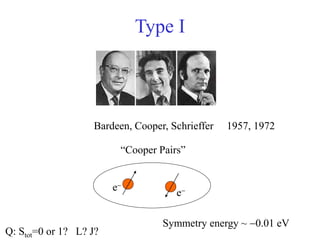
Type I
Bardeen, Cooper, Schrieffer 1957, 1972
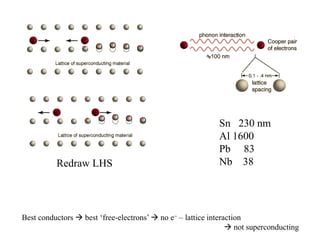
“Cooper Pairs”
Symmetry energy ~ 0.01 eV
Q: Stot=0 or 1? L? J?
e
e
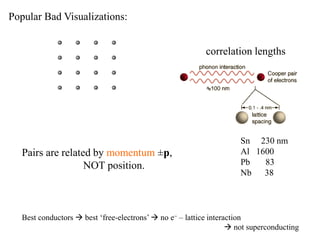
Sn 230 nm
Al 1600
Pb 83
Nb 38
Best conductors  best ‘free-electrons’  no e – lattice interaction
 not superconducting
Popular Bad Visualizations:
Pairs are related by momentum ±p,
NOT position.
correlation lengths
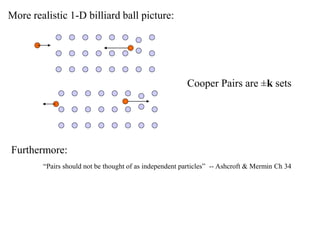
More realistic 1-D billiard ball picture:
Cooper Pairs are ±k sets
Furthermore:
“Pairs should not be thought of as independent particles” -- Ashcroft & Mermin Ch 34
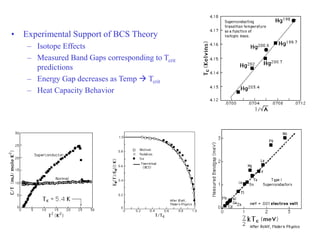
• Experimental Support of BCS Theory
– Isotope Effects
– Measured Band Gaps corresponding to Tcrit
predictions
– Energy Gap decreases as Temp  Tcrit
– Heat Capacity Behavior
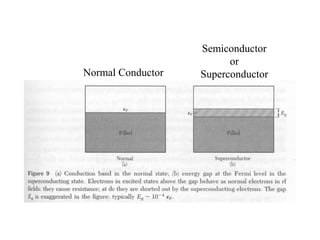
Normal Conductor
Semiconductor
or
Superconductor
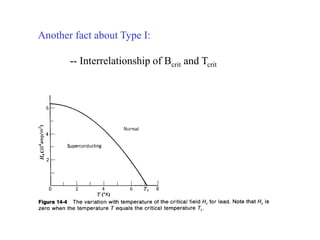
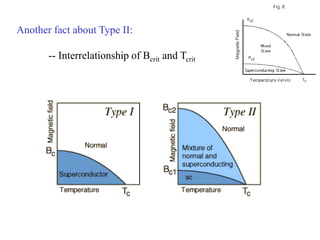
Another fact about Type I:
-- Interrelationship of Bcrit and Tcrit
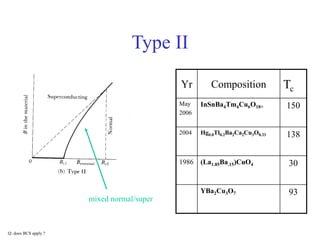
Type II
Q: does BCS apply ?
mixed normal/super
Yr Composition Tc
May
2006
InSnBa4Tm4Cu6O18+ 150
2004 Hg0.8Tl0.2Ba2Ca2Cu3O8.33 138
1986 (La1.85Ba.15)CuO4 30
YBa2Cu3O7 93
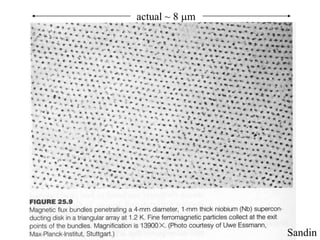
actual ~ 8 mm
Sandin
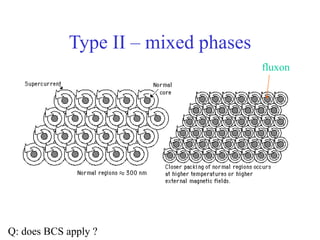
Type II – mixed phases
Q: does BCS apply ?
fluxon
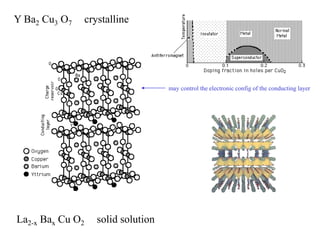
Y Ba2 Cu3 O7 crystalline
La2-x Bax Cu O2 solid solution
may control the electronic config of the conducting layer
Another fact about Type II:
-- Interrelationship of Bcrit and Tcrit
Applications
OR
Other Features of Superconductors
http://superconductors.org/Uses.htm
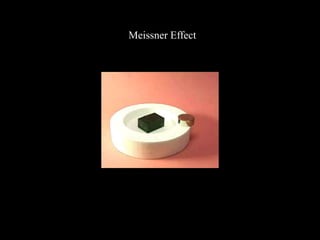
Meissner Effect
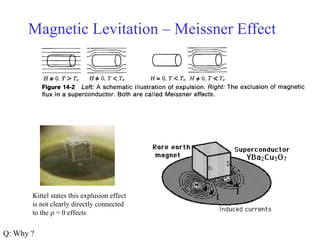
Magnetic Levitation – Meissner Effect
Q: Why ?
Kittel states this explusion effect
is not clearly directly connected
to the  = 0 effects
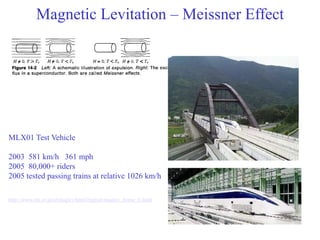
Magnetic Levitation – Meissner Effect
MLX01 Test Vehicle
2003 581 km/h 361 mph
2005 80,000+ riders
2005 tested passing trains at relative 1026 km/h
http://www.rtri.or.jp/rd/maglev/html/english/maglev_frame_E.html
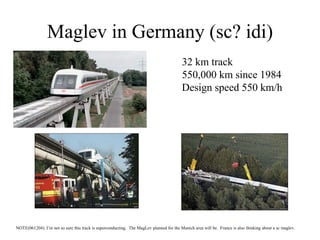
Maglev in Germany (sc? idi)
32 km track
550,000 km since 1984
Design speed 550 km/h
NOTE(061204): I’m not so sure this track is superconducting. The MagLev planned for the Munich area will be. France is also thinking about a sc maglev.
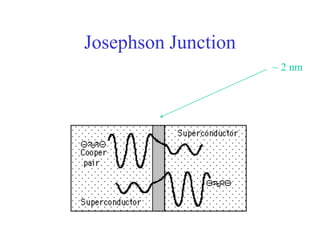
Josephson Junction
~ 2 nm
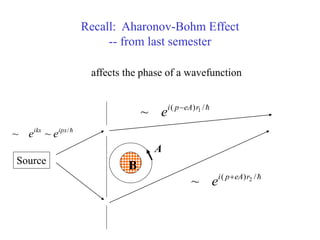
Recall: Aharonov-Bohm Effect
-- from last semester
affects the phase of a wavefunction
Source B

/
)
( 2
~ r
eA
p
i
e 

/
)
( 1
~ r
eA
p
i
e 

/
~
~ ipx
ikx
e
e
A
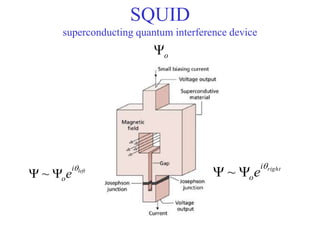
SQUID
superconducting quantum interference device
left
i
oe


 ~
right
i
oe


 ~
o


i
oe

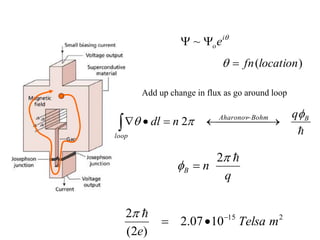
 ~
)
(location
fn



B
Bohm
Aharonov
loop
q
n
dl


 



 



 
 2
q
n
B



2

2
15
10
07
.
2
)
2
(
2
m
Telsa
e





Add up change in flux as go around loop
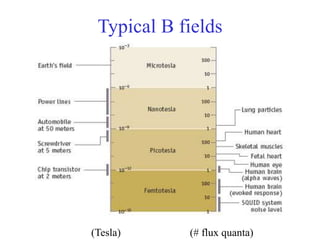
Typical B fields
(Tesla) (# flux quanta)
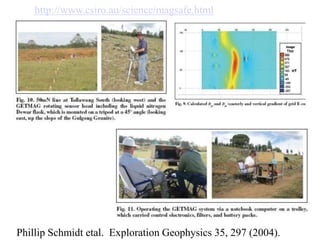
MAGSAFE will be able to locate
targets without flying close to
the surface.
Image courtesy Department of
Defence.
http://www.csiro.au/science/magsafe.html
Finding 'objects of interest' at sea with MAGSAFE
MAGSAFE is a new system for locating and identifying submarines.
Operators of MAGSAFE should be able to tell the range, depth and
bearing of a target, as well as where it’s heading, how fast it’s going
and if it’s diving.
Building on our extensive experience using highly sensitive magnetic
sensors known as Superconducting QUantum Interference Devices
(SQUIDs) for minerals exploration, MAGSAFE harnesses the power
of three SQUIDs to measure slight variations in the local magnetic
field.
MAGSAFE has higher sensitivity and greater immunity to external noise than conventional
Magnetic Anomaly Detector (MAD) systems. This is especially relevant to operation over shallow
seawater where the background noise may 100 times greater than the noise floor of a MAD
instrument.
Phillip Schmidt etal. Exploration Geophysics 35, 297 (2004).
http://www.csiro.au/science/magsafe.html
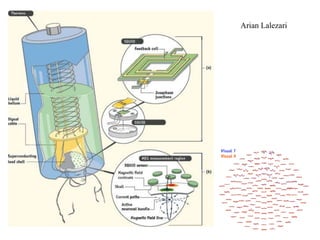
Arian Lalezari
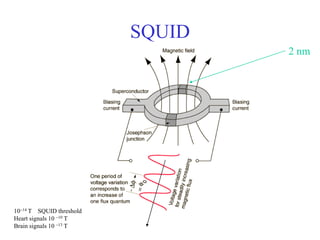
SQUID
2 nm
1014 T SQUID threshold
Heart signals 10 10 T
Brain signals 10 13 T
• Fundamentals of superconductors:
– http://www.physnet.uni-hamburg.de/home/vms/reimer/htc/pt3.html
• Basic Introduction to SQUIDs:
– http://www.abdn.ac.uk/physics/case/squids.html
• Detection of Submarines
– http://www.csiro.au/science/magsafe.html
• Fancy cross-referenced site for Josephson Junctions/Josephson:
– http://en.wikipedia.org/wiki/Josephson_junction
– http://en.wikipedia.org/wiki/B._D._Josephson
• SQUID sensitivity and other ramifications of Josephson’s work:
– http://hyperphysics.phy-astr.gsu.edu/hbase/solids/squid2.html
• Understanding a SQUID magnetometer:
– http://hyperphysics.phy-astr.gsu.edu/hbase/solids/squid.html#c1
• Some exciting applications of SQUIDs:
– http://www.lanl.gov/quarterly/q_spring03/squid_text.shtml
• Relative strengths of pertinent magnetic fields
– http://www.physics.union.edu/newmanj/2000/SQUIDs.htm
• The 1973 Nobel Prize in physics
– http://nobelprize.org/physics/laureates/1973/
• Critical overview of SQUIDs
– http://homepages.nildram.co.uk/~phekda/richdawe/squid/popular/
• Research Applications
– http://boojum.hut.fi/triennial/neuromagnetic.html
• Technical overview of SQUIDs:
– http://www.finoag.com/fitm/squid.html
– http://www.cmp.liv.ac.uk/frink/thesis/thesis/node47.html
Redraw LHS
Sn 230 nm
Al 1600
Pb 83
Nb 38
Best conductors  best ‘free-electrons’  no e – lattice interaction
 not superconducting

Solids.ppt

  • 1.
    Solids Eisberg & ResnickCh 13 & 14 RNave: http://hyperphysics.phy-astr.gsu.edu/hbase/solcon.html#solcon Alison Baski: http://www.courses.vcu.edu/PHYS661/pdf/01SolidState041.ppt Carl Hepburn, “Britney Spear’s Guide to Semiconductor Physics”. http://britneyspears.ac/lasers.htm
  • 2.
  • 3.
    OUTLINE • Review Ionic/ Covalent Molecules • Types of Solids (ER 13.2) • Band Theory (ER 13.3-.4) – basic ideas – description based upon free electrons – descriptions based upon nearly-free electrons • ‘Free’ Electron Models (ER 13.5-.7) • Temperature Dependence of Resistivity (ER 14.1)
  • 4.
    Ionic Bonds RNave, GSUat http://hyperphysics.phy-astr.gsu.edu/hbase/chemical/bond.html#c4
  • 5.
  • 6.
    Ionic Bonding RNave, GeorgiaState Univ at hyperphysics.phy-astr.gsu.edu/hbase/molecule
  • 7.
    Covalent Bonds RNave, GSUat http://hyperphysics.phy-astr.gsu.edu/hbase/chemical/bond.html#c4
  • 8.
    Covalent Bonding SYM ASYM spatialspin ASYM SYM spatial spin space-symmetric tend to be closer
  • 9.
    Covalent Bonding Stot =1 not really parallel, but spin-symmetric not really anti, but spin-asym Stot = 0 space-symmetric tend to be closer
  • 11.
    TYPES OF SOLIDS(ER 13.2) CRYSTALINE BINDING • molecular • ionic • covalent • metallic
  • 12.
    Molecular Solids • orderlycollection of molecules held together by v. d. Waals • gases solidify only at low Temps • easy to deform & compress • poor conductors most organics inert gases O2 N2 H2
  • 13.
    Ionic Solids • individatoms act like closed-shell, spherical, therefore binding not so directional • arrangement so that minimize nrg for size of atoms • tight packed arrangement  poor thermal conductors • no free electrons  poor electrical conductors • strong forces  hard & high melting points • lattice vibrations absorb in far IR • to excite electrons requires UV, so ~transparent visible NaCl NaI KCl
  • 14.
    Covalent Solids • 3Dcollection of atoms bound by shared valence electrons • difficult to deform because bonds are directional • high melting points (b/c diff to deform) • no free electrons  poor electrical conductors • most solids adsorb photons in visible  opaque Ge Si diamond
  • 15.
    Metallic Solids • (weakerversion of covalent bonding) • constructed of atoms which have very weakly bound outer electron • large number of vacancies in orbital (not enough nrg available to form covalent bonds) • electrons roam around (electron gas ) • excellent conductors of heat & electricity • absorb IR, Vis, UV  opaque Fe Ni Co config dhalf full
  • 17.
  • 18.
  • 19.
  • 20.
  • 21.
    Six Closely SpacedAtoms as fn(R) the level of interest has the same nrg in each separated atom
  • 22.
    Solid of Natoms Two atoms Six atoms ref: A.Baski, VCU 01SolidState041.ppt www.courses.vcu.edu/PHYS661/pdf/01SolidState041.ppt
  • 23.
    Four Closely SpacedAtoms valence band conduction band
  • 24.
    Solid composed of~NA Na Atoms as fn(R) 1s22s22p63s1
  • 25.
    Sodium Bands vsSeparation Rohlf Fig 14-4 and Slater Phys Rev 45, 794 (1934)
  • 26.
    Copper Bands vsSeparation Rohlf Fig 14-6 and Kutter Phys Rev 48, 664 (1935)
  • 27.
    Differences down acolumn in the Periodic Table: IV- A Elements Sandin same valence config
  • 28.
  • 29.
    Band Spacings in Insulators &Conductors electrons free to roam electrons confined to small region RNave: http://hyperphysics.phy-astr.gsu.edu/hbase/solcon.html#solcon
  • 30.
    How to chooseeF and Behavior of the Fermi function at band gaps
  • 31.
    Fermi Distribution fora selected eF 0 0.5 1 1.5 0 1 2 3 4 Energy Probability of an energy occuring (not normalized) T=0 1000 5000 1 1 ) ( / ) (    kT F e n e e e
  • 32.
    How does onechoose/know eF If in unfilled band, eF is energy of highest energy electrons at T=0. If in filled band with gap to next band, eF is at the middle of gap.
  • 33.
  • 34.
  • 35.
    Number of Electronsat an Energy e     e e e e d N n KE Tot    0 distrib fn Number of ways to have a particular energy In QStat, we were doing Number of electrons at energy e
  • 37.
    # states probability of thisnrg occurring # electrons at a given nrg
  • 39.
  • 40.
    Semiconductors • Types – Intrinsic– by thermal excitation or high nrg photon – Photoconductive – excitation by VIS-red or IR – Extrinsic – by doping • n-type • p-type • ~1 eV ~1/40 eV
  • 41.
  • 42.
  • 43.
    5A in 4Alattice 3A in 4A lattice 5A doping in a 4A lattice
  • 44.
    5A in 4Alattice 3A in 4A lattice
  • 46.
    ‘Free-Electron’ Models • FreeElectron Model (ER 13-5) • Nearly-Free Electron Model (ER13-6,-7) – Version 1 – SP221 – Version 2 – SP324 – Version 3 – SP425 • .
  • 47.
    • Free-Electron Model –Spatial Wavefunctions – Energy of the Electrons – Fermi Energy – Density of States dN/dE E&R 13.5 – Number of States as fn NRG E&R 13.5 • Nearly-Free Electron Model (Periodic Lattice Effects) – v2 E&R 13.6 • Nearly-Free Electron Model (Periodic Lattice Effects) – v3 E&R 13.6   *********************************************************
  • 48.
    Free-Electron Model (ER13-5)  m K m p 2 2 2 2 2    e classical description
  • 49.
             E m 0 2 2 2   z k y k x k L xyz z y x sin sin sin 8 3     In a 3D slab of metal, e’s are free to move but must remain on the inside Solutions are of the form: L nz    2 2 2 2 2 8 z y x n n n mL h    e With nrg’s: Quantum Mechanical Viewpoint
  • 50.
    At T =0, all states are filled up to the Fermi nrg  max 2 2 2 2 2 8 z y x fermi n n n mL h    e A useful way to keep track of the states that are filled is: max 2 2 2 2 n n n n z y x   
  • 51.
    total number ofstates up to an energy efermi: 3 3 max 4 8 1 8 1 2 2 n sphere of volume          N 3 / 2 2 3 8          V N m h fermi  e max 2 2 2 8 n mL h fermi  e # states/volume ~ # free e’s / volume
  • 52.
    Sample Numerical Valuesfor Copper slab V N = 8.96 gm/cm3 1/63.6 amu 6e23 = 8.5e22 #/cm3 = 8.5e28 #/m3 efermi = 7 eV 3 / 2 2 3 8          V N m h fermi  e nmax = 4.3 e 7 so we can easily pretend that there’s a smooth distrib of nxnynz-states
  • 53.
    Density of States Howmany combinations of are there within an energy interval e to e + de ? 3 / 2 2 3 8          V N m h fermi  e 2 / 3 2 8 3              h mE V N  dE h m h mE V dN 2 2 / 1 2 8 8 2 3 3                 2 / 1 2 / 1 3 3 2 8 E m h V dE dN       e e e e d N n KE Tot    0
  • 54.
    At T ≠0 the electrons will be spread out among the allowed states How many electrons are contained in a particular energy range?                 occuring energy this of y probabilit energy particular a have to ways of number   1 1 2 8 / ) ( 2 / 1 2 / 1 3 3   kT E f e E m h V e 
  • 55.
    this assumes thereare no other issues
  • 56.
    Distribution of States: SimpleFree-Electron Model vs Reality
  • 58.
    Problems with FreeElectron Model (ER13-6, -7)   * * * * * * * * * * * * * * * * * * * * * * * * * * * * 1) Bragg reflection 2) . 3) .
  • 59.
    Other Problems withthe Free Electron Model • graphite is conductor, diamond is insulator • variation in colors of x-A elements • temperature dependance of resistivity • resistivity can depend on orientation of crystal & current I direction • frequency dependance of conductivity • variations in Hall effect parameters • resistance of wires effected by applied B-fields • . • . • .
  • 60.
    Nearly-Free Electron Model version1 – SP221 2 / 2 2 / k a     2 /   k 2 / 2 2 / k a    
  • 61.
    Nearly-Free Electron Model version2 – SP324 • Bloch Theorem • Special Phase Conditions, k = +/- m /a • the Special Phase Condition k = +/- /a This treatment assumes that when a reflection occurs, it is 100%.
  • 62.
    (x) ~ ue i(kx-wt) (x) ~ u(x) e i(kx-wt)   ~~~~~~~~~~ amplitude In reality, lower energy waves are sensitive to the lattice: Amplitude varies with location u(x) = u(x+a) = u(x+2a) = …. Bloch’s Theorem
  • 63.
    u(x+a) = u(x) (x+a)e -i(kx+ka-wt)  (x) e -i(kx-wt) (x) ~ u(x) e i(kx-wt) (x+a)  e ika (x) Something special happens with the phase when e ika = 1 ka = +/ m  m = 0 not a surprise m = 1, 2, 3, … ... , 2 , a a k      What it is ?
  • 64.
    a k    Consider a setof waves with +/ k-pairs, e.g. k = + /a moves  k =  /a moves  This defines a pair of waves moving right & left Two trivial ways to superpose these waves are: + ~ e ikx + e ikx  ~ e ikx  e ikx + ~ 2 cos kx  ~ 2i sin kx
  • 65.
    + ~ 2cos kx  ~ 2i sin kx Kittel |+|2 ~ 4 cos2 kx ||2 ~ 4 sin2 kx
  • 66.
    Free-electron Nearly Free-electron Kittel Discontinuitiesoccur because the lattice is impacting the movement of electrons.
  • 67.
    Effective Mass m* Amethod to force the free electron model to work in the situations where there are complications ER Ch 13 p461 starting w/ eqn (13-19b) * 2 2 2 m k   e free electron KE functional form
  • 68.
    Effective Mass m* --describing the balance between applied ext-E and lattice site reflections 2 2 2 1 * 1 k m    e  m* a = S Fext q Eext
  • 69.
    No distinction betweenm & m*, m = m*, “free electron”, lattice structure does not apply additional restrictions on motion. m = m* greater curvature, 1/m* > 1/m > 0,  m* < m  net effect of ext-E and lattice interaction provides additional acceleration of electrons greater |curvature| but negative, net effect of ext-E and lattice interaction de-accelerates electrons At inflection pt 1) 2)
  • 70.
    * 2 2 2 2 2 2 m k m k lattice from on perturbati apply     e Anotherway to look at the discontinuities Shift up implies effective mass has decreased, m* < m, allowing electrons to increase their speed and join faster electrons in the band. The enhanced e-lattice interaction speeds up the electron. Shift down implies effective mass has increased, m* > m, prohibiting electrons from increasing their speed and making them become similar to other electrons in the band. The enhanced e-lattice interaction slows down the electron
  • 71.
    From earlier: Evenwhen above barrier, reflection and transmission coefficients can increase and decrease depending upon the energy.
  • 72.
    change in motion dueto reflections is more significant than change in motion due to applied field change in motion due to applied field enhanced by change in reflection coefficients
  • 73.
    Nearly-Free Electron Model version3 à la Ashcroft & Mermin, Solid State Physics This treatment recognizes that the reflections of electron waves off lattice sites can be more complicated.
  • 74.
  • 75.
    Waves from theleft behave like: iKx iKx left the from e r e     iKx left the from e t   m K 2 2 2   e
  • 76.
    Waves from theright behave like: iKx iKx right the from e r e     iKx right the from e t    m K 2 2 2   e
  • 77.
    right left sum B A      Bloch’sTheorem defines periodicity of the wavefunctions:     x e a x sum ika sum         x e a x sum ika sum     unknown weights Related to Lattice spacing
  • 78.
       x e a x sum ika sum         x e a x sum ika sum     Applying the matching conditions at x   a/2 A + B left right A + B left right A + B left right A + B left right iKa iKa e t e t r t ka     2 1 2 cos 2 2 m K 2 2 2   e And eliminating the unknown constants A & B leaves:
  • 79.
    For convenience (ortradition) set: 2 2 1 r t    i e t t   i e r i r     ka t Ka cos cos  
  • 80.
      ka t Ka cos cos   Relatedto possible Lattice spacings Related to Energy m K 2 2 2   e allowed solution regions
  • 81.
  • 82.
  • 83.
  • 84.
  • 85.
    • Conductors – Resistivity increases with increasing Temp – Temp  t but same # conduction e-’s   • Semiconductors & Insulators – Resistivity  decreases with increasing Temp – Temp  t but more conduction e-’s  
  • 86.
  • 87.
    Superconductors.org Only innanotubes Note: The best conductors & magnetic materials tend not to be superconductors (so far)
  • 88.
    Superconductor Classifications • TypeI – tend to be pure elements or simple alloys –  = 0 at T < Tcrit – Internal B = 0 (Meissner Effect) – At jinternal > jcrit, no superconductivity – At Bext > Bcrit, no superconductivity – Well explained by BCS theory • Type II – tend to be ceramic compounds – Can carry higher current densities ~ 1010 A/m2 – Mechanically harder compounds – Higher Bcrit critical fields – Above Bext > Bcrit-1, some superconductivity
  • 89.
  • 90.
    Type I Bardeen, Cooper,Schrieffer 1957, 1972 “Cooper Pairs” Symmetry energy ~ 0.01 eV Q: Stot=0 or 1? L? J? e e
  • 91.
    Sn 230 nm Al1600 Pb 83 Nb 38 Best conductors  best ‘free-electrons’  no e – lattice interaction  not superconducting Popular Bad Visualizations: Pairs are related by momentum ±p, NOT position. correlation lengths
  • 92.
    More realistic 1-Dbilliard ball picture: Cooper Pairs are ±k sets Furthermore: “Pairs should not be thought of as independent particles” -- Ashcroft & Mermin Ch 34
  • 93.
    • Experimental Supportof BCS Theory – Isotope Effects – Measured Band Gaps corresponding to Tcrit predictions – Energy Gap decreases as Temp  Tcrit – Heat Capacity Behavior
  • 94.
  • 95.
    Another fact aboutType I: -- Interrelationship of Bcrit and Tcrit
  • 96.
    Type II Q: doesBCS apply ? mixed normal/super Yr Composition Tc May 2006 InSnBa4Tm4Cu6O18+ 150 2004 Hg0.8Tl0.2Ba2Ca2Cu3O8.33 138 1986 (La1.85Ba.15)CuO4 30 YBa2Cu3O7 93
  • 97.
    actual ~ 8mm Sandin
  • 98.
    Type II –mixed phases Q: does BCS apply ? fluxon
  • 99.
    Y Ba2 Cu3O7 crystalline La2-x Bax Cu O2 solid solution may control the electronic config of the conducting layer
  • 100.
    Another fact aboutType II: -- Interrelationship of Bcrit and Tcrit
  • 101.
    Applications OR Other Features ofSuperconductors http://superconductors.org/Uses.htm
  • 102.
  • 103.
    Magnetic Levitation –Meissner Effect Q: Why ? Kittel states this explusion effect is not clearly directly connected to the  = 0 effects
  • 104.
    Magnetic Levitation –Meissner Effect MLX01 Test Vehicle 2003 581 km/h 361 mph 2005 80,000+ riders 2005 tested passing trains at relative 1026 km/h http://www.rtri.or.jp/rd/maglev/html/english/maglev_frame_E.html
  • 105.
    Maglev in Germany(sc? idi) 32 km track 550,000 km since 1984 Design speed 550 km/h NOTE(061204): I’m not so sure this track is superconducting. The MagLev planned for the Munich area will be. France is also thinking about a sc maglev.
  • 106.
  • 107.
    Recall: Aharonov-Bohm Effect --from last semester affects the phase of a wavefunction Source B  / ) ( 2 ~ r eA p i e   / ) ( 1 ~ r eA p i e   / ~ ~ ipx ikx e e A
  • 108.
    SQUID superconducting quantum interferencedevice left i oe    ~ right i oe    ~ o 
  • 109.
     i oe   ~ ) (location fn    B Bohm Aharonov loop q n dl               2 q n B    2  2 15 10 07 . 2 ) 2 ( 2 m Telsa e      Add up change in flux as go around loop
  • 110.
    Typical B fields (Tesla)(# flux quanta)
  • 111.
    MAGSAFE will beable to locate targets without flying close to the surface. Image courtesy Department of Defence. http://www.csiro.au/science/magsafe.html Finding 'objects of interest' at sea with MAGSAFE MAGSAFE is a new system for locating and identifying submarines. Operators of MAGSAFE should be able to tell the range, depth and bearing of a target, as well as where it’s heading, how fast it’s going and if it’s diving. Building on our extensive experience using highly sensitive magnetic sensors known as Superconducting QUantum Interference Devices (SQUIDs) for minerals exploration, MAGSAFE harnesses the power of three SQUIDs to measure slight variations in the local magnetic field. MAGSAFE has higher sensitivity and greater immunity to external noise than conventional Magnetic Anomaly Detector (MAD) systems. This is especially relevant to operation over shallow seawater where the background noise may 100 times greater than the noise floor of a MAD instrument.
  • 112.
    Phillip Schmidt etal.Exploration Geophysics 35, 297 (2004). http://www.csiro.au/science/magsafe.html
  • 113.
  • 114.
    SQUID 2 nm 1014 TSQUID threshold Heart signals 10 10 T Brain signals 10 13 T
  • 115.
    • Fundamentals ofsuperconductors: – http://www.physnet.uni-hamburg.de/home/vms/reimer/htc/pt3.html • Basic Introduction to SQUIDs: – http://www.abdn.ac.uk/physics/case/squids.html • Detection of Submarines – http://www.csiro.au/science/magsafe.html • Fancy cross-referenced site for Josephson Junctions/Josephson: – http://en.wikipedia.org/wiki/Josephson_junction – http://en.wikipedia.org/wiki/B._D._Josephson • SQUID sensitivity and other ramifications of Josephson’s work: – http://hyperphysics.phy-astr.gsu.edu/hbase/solids/squid2.html • Understanding a SQUID magnetometer: – http://hyperphysics.phy-astr.gsu.edu/hbase/solids/squid.html#c1 • Some exciting applications of SQUIDs: – http://www.lanl.gov/quarterly/q_spring03/squid_text.shtml
  • 116.
    • Relative strengthsof pertinent magnetic fields – http://www.physics.union.edu/newmanj/2000/SQUIDs.htm • The 1973 Nobel Prize in physics – http://nobelprize.org/physics/laureates/1973/ • Critical overview of SQUIDs – http://homepages.nildram.co.uk/~phekda/richdawe/squid/popular/ • Research Applications – http://boojum.hut.fi/triennial/neuromagnetic.html • Technical overview of SQUIDs: – http://www.finoag.com/fitm/squid.html – http://www.cmp.liv.ac.uk/frink/thesis/thesis/node47.html
  • 117.
    Redraw LHS Sn 230nm Al 1600 Pb 83 Nb 38 Best conductors  best ‘free-electrons’  no e – lattice interaction  not superconducting