E n z y m e P r o d u c t i o n
Andleeb Arif
By:
M.Sc. Biotechnology (Sem-III)
INTRODUCTION
TYPES OF ENZYME
MICROBIAL ENZYMES
APPLICATIONS OF ENZYMES
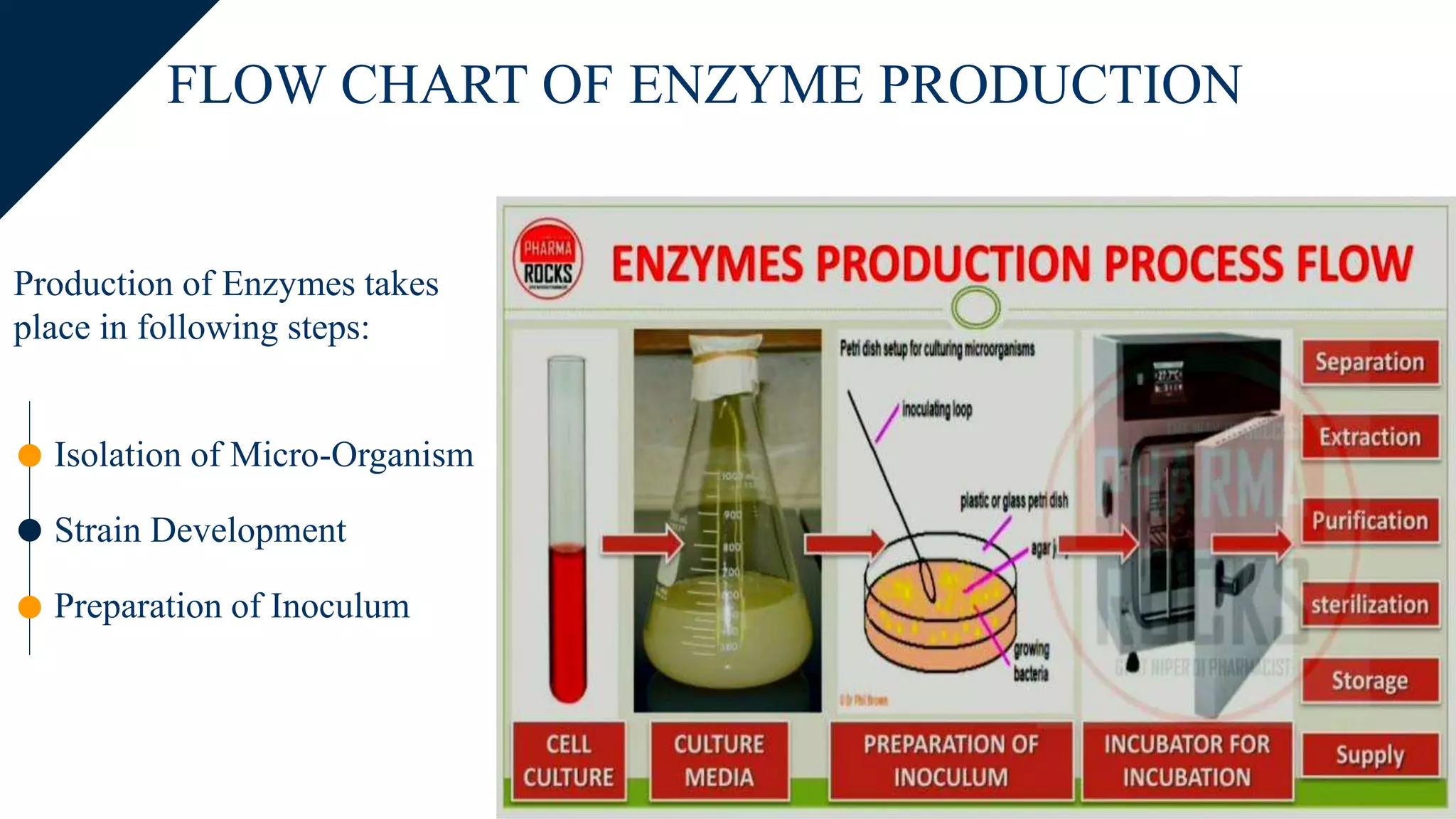
FLOW CHART OF ENZYME PRODUCTION
METHODS OF ENZYME PRODUCTION
C O N T E N T S
Enzymes are macromolecular biological catalysts.
Enzymes accelerate, or catalyze, chemical reactions.
The molecules at the beginning of the process are called substrates and the
enzyme converts these into different molecules, called products.
INTRODUCTION
ADAPTIVE
• Produced only when the need arises
E.g. When a cell is deficient of a particular nutrient.
Constitutive
• Produced always irrespective the amount of substrate.
TYPES OF ENZYME
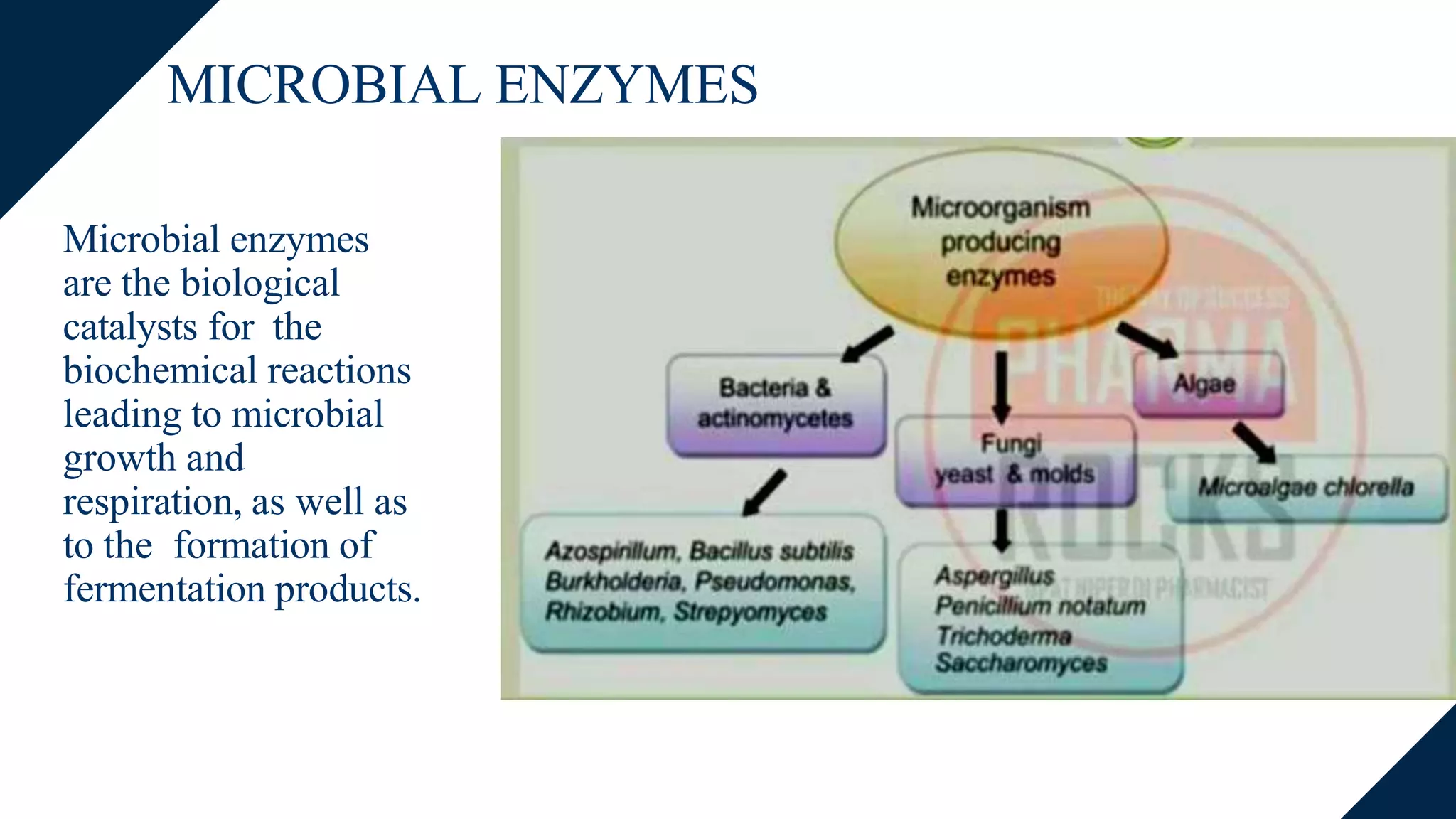
Microbial enzymes
are the biological
catalysts for the
biochemical reactions
leading to microbial
growth and
respiration, as well as
to the formation of
fermentation products.
MICROBIAL ENZYMES
Microbial Genetics
Optimization of fermentation conditions.
New cell breaking methods like Homogenizer, Bead mill, Sonication etc.
Modern purification processes like Counter current distribution, Ion-
exchange chromatography, Molecular-sieve chromatography, Affinity
chromatography and precipitation by using alcohol, acetone.
Immobilization of enzymes.
Continuous enzyme production in special reactors.
APPLICATIONS OF ENZYMES
Production of Enzymes takes
place in following steps:
FLOW CHART OF ENZYME PRODUCTION
Isolation of Micro-Organism
Strain Development
Preparation of Inoculum
METHODS OF ENZYME PRODUCTION
Submerged Culture
Semisolid Culture
SEMISOLID CULTURE
The enzyme producing culture is grown on the
surface of a suitable semi-solid substrate
(Moistened Wheat or Rice Bran with nutrients)
Preparation of Production Medium –Bran is
mixed with solution containing nutrient salts.
pH is maintained at a neutral level. Medium is
steam sterilized in an autoclave while stirring.
SEMISOLID CULTURE
The sterilized medium is spread on metal
trays up to a depth of 1-10 centimeters.
Culture is inoculated either in the
autoclave after cooling or in trays.
High enzyme concentration in a crude
fermented material.
ENZYMES PRODUCED BY SEMISOLID CULTURE
Enzyme Micro-organisms
α- Amylase Aspergillus oryzae
Glucoamylase Rhizopus spp.
Lactase A. oryzae
Pectinase A. niger
Protease A. Niger & A. oryzae
Rennet Mucor pusillus
SUBMERGED CULTURE
• Fermentation equipment used is the same as in the manufacture of
antibiotics.
• It’s a cylindrical tank of stainless steel and it is equipped with an
agitator, an aerating device, a cooling system and various ancillary
equipment (Foam control, pH monitoring device, temperature, oxygen
tension etc).
• Presence of inhibitors or inducers should also be checked in the
medium.
Example – Presence of Lactose induces the production of β-
galactosidase.
SUBMERGED CULTURE
• As the inducers are expensive, constitutive mutants are used
which do not require an inducer.
• Glucose represses the formation of some enzymes (α-
amylases).
• Either the glucose can be supplied in an incremental manner
or a slow metabolizable sugar (Lactose or metabolized starch)
• Certain surfactants in the production medium increases the yield of certain
enzymes.
• Non- ionic detergents (e.g. Tween 80, Triton) are frequently used.
T H A N K S

Enzyme production

  • 1.
    E n zy m e P r o d u c t i o n Andleeb Arif By: M.Sc. Biotechnology (Sem-III)
  • 2.
    INTRODUCTION TYPES OF ENZYME MICROBIALENZYMES APPLICATIONS OF ENZYMES FLOW CHART OF ENZYME PRODUCTION METHODS OF ENZYME PRODUCTION C O N T E N T S
  • 3.
    Enzymes are macromolecularbiological catalysts. Enzymes accelerate, or catalyze, chemical reactions. The molecules at the beginning of the process are called substrates and the enzyme converts these into different molecules, called products. INTRODUCTION
  • 4.
    ADAPTIVE • Produced onlywhen the need arises E.g. When a cell is deficient of a particular nutrient. Constitutive • Produced always irrespective the amount of substrate. TYPES OF ENZYME
  • 5.
    Microbial enzymes are thebiological catalysts for the biochemical reactions leading to microbial growth and respiration, as well as to the formation of fermentation products. MICROBIAL ENZYMES
  • 6.
    Microbial Genetics Optimization offermentation conditions. New cell breaking methods like Homogenizer, Bead mill, Sonication etc. Modern purification processes like Counter current distribution, Ion- exchange chromatography, Molecular-sieve chromatography, Affinity chromatography and precipitation by using alcohol, acetone. Immobilization of enzymes. Continuous enzyme production in special reactors. APPLICATIONS OF ENZYMES
  • 7.
    Production of Enzymestakes place in following steps: FLOW CHART OF ENZYME PRODUCTION Isolation of Micro-Organism Strain Development Preparation of Inoculum
  • 8.
    METHODS OF ENZYMEPRODUCTION Submerged Culture Semisolid Culture
  • 9.
    SEMISOLID CULTURE The enzymeproducing culture is grown on the surface of a suitable semi-solid substrate (Moistened Wheat or Rice Bran with nutrients) Preparation of Production Medium –Bran is mixed with solution containing nutrient salts. pH is maintained at a neutral level. Medium is steam sterilized in an autoclave while stirring.
  • 10.
    SEMISOLID CULTURE The sterilizedmedium is spread on metal trays up to a depth of 1-10 centimeters. Culture is inoculated either in the autoclave after cooling or in trays. High enzyme concentration in a crude fermented material.
  • 11.
    ENZYMES PRODUCED BYSEMISOLID CULTURE Enzyme Micro-organisms α- Amylase Aspergillus oryzae Glucoamylase Rhizopus spp. Lactase A. oryzae Pectinase A. niger Protease A. Niger & A. oryzae Rennet Mucor pusillus
  • 12.
    SUBMERGED CULTURE • Fermentationequipment used is the same as in the manufacture of antibiotics. • It’s a cylindrical tank of stainless steel and it is equipped with an agitator, an aerating device, a cooling system and various ancillary equipment (Foam control, pH monitoring device, temperature, oxygen tension etc). • Presence of inhibitors or inducers should also be checked in the medium. Example – Presence of Lactose induces the production of β- galactosidase.
  • 13.
    SUBMERGED CULTURE • Asthe inducers are expensive, constitutive mutants are used which do not require an inducer. • Glucose represses the formation of some enzymes (α- amylases). • Either the glucose can be supplied in an incremental manner or a slow metabolizable sugar (Lactose or metabolized starch) • Certain surfactants in the production medium increases the yield of certain enzymes. • Non- ionic detergents (e.g. Tween 80, Triton) are frequently used.
  • 14.
    T H AN K S