Fermented Product- Bread
INTRODUCTION
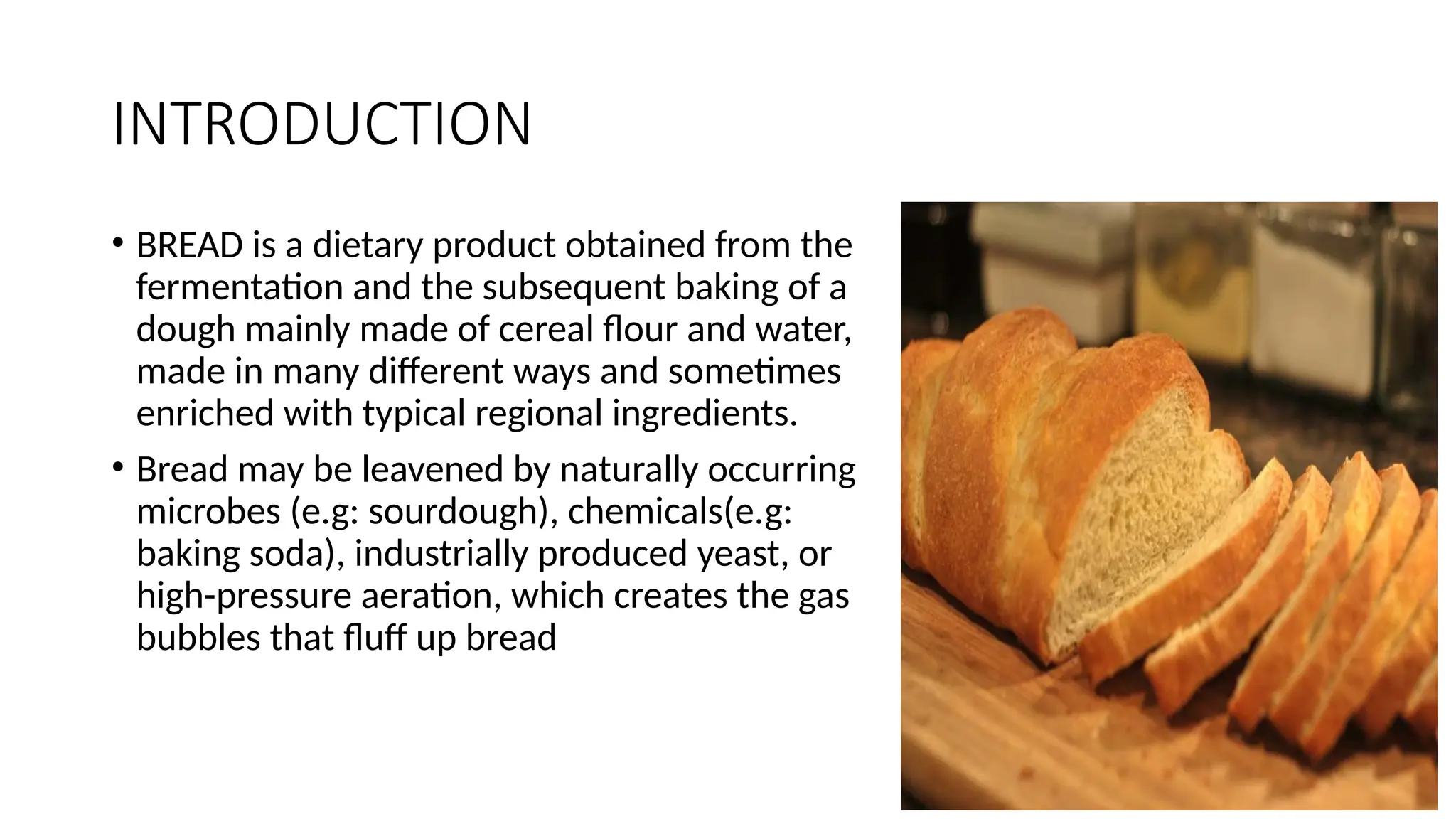
• BREAD is a dietary product obtained from the
fermentation and the subsequent baking of a
dough mainly made of cereal flour and water,
made in many different ways and sometimes
enriched with typical regional ingredients.
• Bread may be leavened by naturally occurring
microbes (e.g: sourdough), chemicals(e.g:
baking soda), industrially produced yeast, or
high-pressure aeration, which creates the gas
bubbles that fluff up bread
In bread making two main organisms involved
• Yeast-Saccharomyces Cerevisiae • Lactic Acid Bacteria-
Lactiplantibac plantarum
HISTORY:
• Bread is one of the oldest prepared foods.
• Evidence from 30,000 years ago in Europe and Australia revealed
starch residue on rocks used for pounding plants.
• It is possible that during this time, starch extract from the roots of
plants, such as cattails and ferns, was spread on a flat rock, placed
over a fire and cooked into a primitive from of flatbread.
TYPES OF BREADS:
• 1. Banana bread:
► To this category, we can also add zucchini bread. Both banana and
zucchini bread are dense, moist, sweet treats, usually chemically
leavened with baking soda and baking powder.
2. Baguette
• The long, stick-like loaf, also called French bread.
3.Brioche
• Our taste buds owe the French a huge debt of gratitude for inventing
brioche, a traditionally sweet yeast bread loaded with eggs and
butter.
4. Ciabatta
• Ciabatta hails from Italy, where the word means, "slipper" in the
native language. Usually broad, flat, and somewhat collapsed in the
middle, it’s the perfect bread to use in paninis and sandwivhes
5. Corn bread
• Made from finely ground corn, wheat flour eggs, milk, either
unleavened or with baking powder.
6. Soda Bread
• Made from soda as one of the ingredient.
7.Sour Dough
• Sourdough or Sourdough bread is a bread made by
the fermentation of dough using wild lactobacillaceae and yeast that
occur naturally. Lactic acid from fermentation imparts a sour taste and
improves keeping qualities
8. Whole Wheat Bread
• Made from flour that uses the entire grain, including the bran & germ,
fiber, protein, vitamins than white bread.
Bread Making Process
Selection of Raw ingredients
Weighing of Raw Ingredients
Preparing of Raw Ingrdients
Mixing
Fermenting
Knock Back
Floor Time
Diving And Rounding
Immediate Proofing
Moulding
Proofing
Backing
Cooling
Slicing and Wrapping
Steps in Bread Making Process:-
1) Selection of Raw Ingredients:
► Quality of the basic ingredients.
2)Weighing of Raw Materials:
► Correct weight of raw ingredients.
3. Preparing of Raw Materials:
• Basic mise-en-place.
• Seiving the flour for removal/bran& aeration
• Mixing yeast in luke warm water & addition of sugar.
• Addition of salt in the flour for even mixing.
4. Mixing:
• Glutenin& Gliadin joins together to form gluten.
• ► Initially the gluten is wet but the elasticity and WAP increases to
improve the dough till it becomes homogeneous.
• Stages of mixing:
• ► Pick up
• ► Drying up
• ▸ Clean up
• ▸ Development stage
Pick up- Even distribution of all ingredients.
Drying up- Gluten takes up water.
Clean up- Leaves sticking & leaves the sides of
the container.
Development stage- Proper homogeneous
mixing.
5) Fermentation:
• ► Yeast feed on sugar to produce carbon dioxide.
• ▸ Part of the alcohol evaporates & part is converted into acetic acid.
• ▸ 78°F to 80° F is the optimum temperature.
• ▸ 70 to 75% is the optimum relative humidity.
• ► Soft& sticky & has an open texture and collapse during proofing /
baking.
6) Knock back:
• It is done after 2/3 of the estimated fermentation.
• Centre comes on top in contact with the fresh air and the dough is
virtually turned upside down.
7) Dividing and Rounding:
• Dough is cut into pieces of desired eight according to the size of the
mould.
• The dough should not be pulled/ turn as it may disturb the gluten
strands, thus adversely affecting the final texture of the product.
8) Intermediate proofing:
• During the dividing process some gas escapes and the gluten strands
collapse, giving a rough surface.
• The cut dough is rested for some time when the pieces are again filled
with gas and gluten comes back to its original position.
9) Moulding& panning:
• Shaping into desired shapes the finished product.
• Moulding pressure should be even and uneven pressure will result in
uneven texture.
10) Proofing:
• Proofing is done under optimum conditions of temperature and
humidity for maximum fermentation (95° F to 98 F & 80-83%).
• Proofers are like chambers where a controlled conditions is provided
to the dough.
11. Baking:
• ► Temperature is 400F to 480F.
• ► Oven spring increase in volume inside the
oven is seen as the yeasts are still alive.
• ▸ At 140F yeast cells ceases functioning.
• ► Weight is reduced due to the evaporation
of moisture & the crust starts acquring
golden brown colour.
11.Cooling & slicing:
• Bread should be de-moulded immediately from the tins.
• Moisture trapped between the bread and surface of the mould will
make the product soggy (sweating).
• Breads to be sliced when it cools slightly for even slicing
12. Packaging

Fermented Bread.pptxvhjcghcghxghghjvmvmhv

  • 1.
  • 2.
    INTRODUCTION • BREAD isa dietary product obtained from the fermentation and the subsequent baking of a dough mainly made of cereal flour and water, made in many different ways and sometimes enriched with typical regional ingredients. • Bread may be leavened by naturally occurring microbes (e.g: sourdough), chemicals(e.g: baking soda), industrially produced yeast, or high-pressure aeration, which creates the gas bubbles that fluff up bread
  • 3.
    In bread makingtwo main organisms involved • Yeast-Saccharomyces Cerevisiae • Lactic Acid Bacteria- Lactiplantibac plantarum
  • 4.
    HISTORY: • Bread isone of the oldest prepared foods. • Evidence from 30,000 years ago in Europe and Australia revealed starch residue on rocks used for pounding plants. • It is possible that during this time, starch extract from the roots of plants, such as cattails and ferns, was spread on a flat rock, placed over a fire and cooked into a primitive from of flatbread.
  • 5.
    TYPES OF BREADS: •1. Banana bread: ► To this category, we can also add zucchini bread. Both banana and zucchini bread are dense, moist, sweet treats, usually chemically leavened with baking soda and baking powder.
  • 6.
    2. Baguette • Thelong, stick-like loaf, also called French bread.
  • 7.
    3.Brioche • Our tastebuds owe the French a huge debt of gratitude for inventing brioche, a traditionally sweet yeast bread loaded with eggs and butter.
  • 8.
    4. Ciabatta • Ciabattahails from Italy, where the word means, "slipper" in the native language. Usually broad, flat, and somewhat collapsed in the middle, it’s the perfect bread to use in paninis and sandwivhes
  • 9.
    5. Corn bread •Made from finely ground corn, wheat flour eggs, milk, either unleavened or with baking powder.
  • 10.
    6. Soda Bread •Made from soda as one of the ingredient.
  • 11.
    7.Sour Dough • Sourdoughor Sourdough bread is a bread made by the fermentation of dough using wild lactobacillaceae and yeast that occur naturally. Lactic acid from fermentation imparts a sour taste and improves keeping qualities
  • 12.
    8. Whole WheatBread • Made from flour that uses the entire grain, including the bran & germ, fiber, protein, vitamins than white bread.
  • 14.
    Bread Making Process Selectionof Raw ingredients Weighing of Raw Ingredients Preparing of Raw Ingrdients Mixing Fermenting Knock Back Floor Time Diving And Rounding Immediate Proofing Moulding Proofing Backing Cooling Slicing and Wrapping
  • 15.
    Steps in BreadMaking Process:- 1) Selection of Raw Ingredients: ► Quality of the basic ingredients. 2)Weighing of Raw Materials: ► Correct weight of raw ingredients.
  • 16.
    3. Preparing ofRaw Materials: • Basic mise-en-place. • Seiving the flour for removal/bran& aeration • Mixing yeast in luke warm water & addition of sugar. • Addition of salt in the flour for even mixing.
  • 17.
    4. Mixing: • Glutenin&Gliadin joins together to form gluten. • ► Initially the gluten is wet but the elasticity and WAP increases to improve the dough till it becomes homogeneous. • Stages of mixing: • ► Pick up • ► Drying up • ▸ Clean up • ▸ Development stage
  • 18.
    Pick up- Evendistribution of all ingredients. Drying up- Gluten takes up water. Clean up- Leaves sticking & leaves the sides of the container. Development stage- Proper homogeneous mixing.
  • 19.
    5) Fermentation: • ►Yeast feed on sugar to produce carbon dioxide. • ▸ Part of the alcohol evaporates & part is converted into acetic acid. • ▸ 78°F to 80° F is the optimum temperature. • ▸ 70 to 75% is the optimum relative humidity. • ► Soft& sticky & has an open texture and collapse during proofing / baking.
  • 20.
    6) Knock back: •It is done after 2/3 of the estimated fermentation. • Centre comes on top in contact with the fresh air and the dough is virtually turned upside down.
  • 21.
    7) Dividing andRounding: • Dough is cut into pieces of desired eight according to the size of the mould. • The dough should not be pulled/ turn as it may disturb the gluten strands, thus adversely affecting the final texture of the product.
  • 22.
    8) Intermediate proofing: •During the dividing process some gas escapes and the gluten strands collapse, giving a rough surface. • The cut dough is rested for some time when the pieces are again filled with gas and gluten comes back to its original position.
  • 23.
    9) Moulding& panning: •Shaping into desired shapes the finished product. • Moulding pressure should be even and uneven pressure will result in uneven texture.
  • 24.
    10) Proofing: • Proofingis done under optimum conditions of temperature and humidity for maximum fermentation (95° F to 98 F & 80-83%). • Proofers are like chambers where a controlled conditions is provided to the dough.
  • 25.
    11. Baking: • ►Temperature is 400F to 480F. • ► Oven spring increase in volume inside the oven is seen as the yeasts are still alive. • ▸ At 140F yeast cells ceases functioning. • ► Weight is reduced due to the evaporation of moisture & the crust starts acquring golden brown colour.
  • 26.
    11.Cooling & slicing: •Bread should be de-moulded immediately from the tins. • Moisture trapped between the bread and surface of the mould will make the product soggy (sweating). • Breads to be sliced when it cools slightly for even slicing
  • 27.