Genetic linkage analysis
Dotan Schreiber
According to a series of presentations by M. Fishelson
OutLine
• Introduction.
• Basic concepts and some background.
• Motivation for linkage analysis.
• Linkage analysis: main approaches.
• Latest developments.
“Genetic linkage analysis is a statistical
method that is used to associate
functionality of genes to their location on
chromosomes.“
http://bioinfo.cs.technion.ac.il/superlink/
The Main Idea/usage
:
Neighboring genes on the chromosome
have a tendency to stick together when
passed on to offsprings.
Therefore, if some disease is often passed
to offsprings along with specific marker-
genes , then it can be concluded that the
gene(s) which are responsible for the
disease are located close on the
chromosome to these markers.
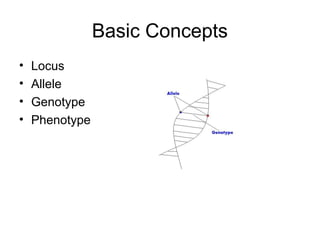
Basic Concepts
• Locus
• Allele
• Genotype
• Phenotype
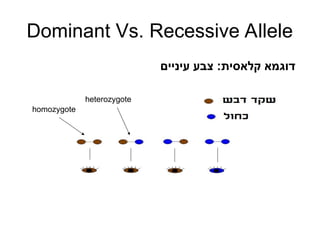
Dominant Vs. Recessive Allele
‫עיניים‬ ‫צבע‬ :‫קלאסית‬ ‫דוגמא‬
homozygote
heterozygote
(
se
)
X-Linked Allele
Most human cells contain 46 chromosomes:
• 2 sex chromosomes (X,Y):
XY – in males.
XX – in females.
• 22 pairs of chromosomes named autosomes.
Around 1000 human alleles are found only on the
X chromosome.
“…the Y chromosome essentially is reproduced via
cloning from one generation to the next. This
prevents mutant Y chromosome genes from being
eliminated from male genetic lines. Subsequently,
most of the human Y chromosome now contains
genetic junk rather than genes.”
http://anthro.palomar.edu/biobasis/bio_3b.htm
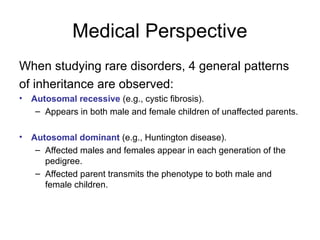
Medical Perspective
When studying rare disorders, 4 general patterns
of inheritance are observed:
• Autosomal recessive (e.g., cystic fibrosis).
– Appears in both male and female children of unaffected parents.
• Autosomal dominant (e.g., Huntington disease).
– Affected males and females appear in each generation of the
pedigree.
– Affected parent transmits the phenotype to both male and
female children.
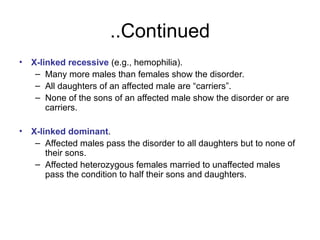
Continued
..
• X-linked recessive (e.g., hemophilia).
– Many more males than females show the disorder.
– All daughters of an affected male are “carriers”.
– None of the sons of an affected male show the disorder or are
carriers.
• X-linked dominant.
– Affected males pass the disorder to all daughters but to none of
their sons.
– Affected heterozygous females married to unaffected males
pass the condition to half their sons and daughters.
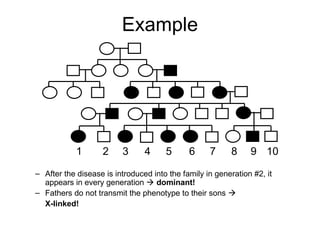
Example
– After the disease is introduced into the family in generation #2, it
appears in every generation  dominant!
– Fathers do not transmit the phenotype to their sons 
X-linked!
1 2 3 4 5 6 7 8 9 10
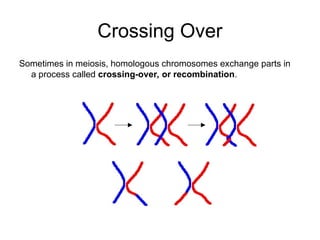
Crossing Over
Sometimes in meiosis, homologous chromosomes exchange parts in
a process called crossing-over, or recombination.
Recombination Fraction
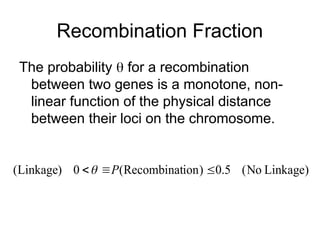
The probability  for a recombination
between two genes is a monotone, non-
linear function of the physical distance
between their loci on the chromosome.
Linkage)
No
(
5
.
0
)
ion
Recombinat
(
0
)
Linkage
( 

 P

Linkage
The further apart two genes on the same
chromosome are, the more it is likely that
a recombination between them will occur.
Two genes are called linked if the
recombination fraction between them is
small (<< 50% chance)
Linkage related Concepts
• Interference - A crossover in one region usually decreases
the probability of a crossover in an adjacent region.
• CentiMorgan (cM) - 1 cM is the distance between genes
for which the recombination frequency is 1%.
• Lod Score - a method to calculate linkage distances (to
determine the distance between genes).
Ultimate Goal: Linkage Mapping
With the following few minor problems:
– It’s impossible to make controlled crosses in
humans.
– Human progenies are rather small.
– The human genome is immense. The
distances between genes are large on
average.
Possible Solutions
• Make general assumptions:
Hardy-Weinberg Equilibrium – assumes certain probability
for a certain individual to have a certain genotype.
Linkage Equilibrium – assumes two alleles at different loci
are independent of each other.
• Incorporate those assumptions into
possible solutions:
Elston-Stewart method.
Lander-Green method.
Elston-Stewart method
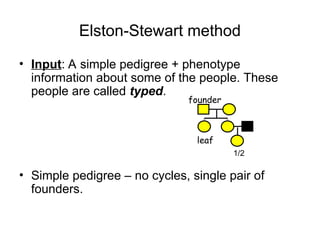
• Input: A simple pedigree + phenotype
information about some of the people. These
people are called typed.
• Simple pedigree – no cycles, single pair of
founders.
founder
leaf
1/2
..
Continued
• Output: the probability of the observed data,
given some probability model for the
transmission of alleles. Composed of:
founder probabilities - Hardy-Weinberg equilibrium
penetrance probabilities -
The probability of the phenotype, given the genotype
transmission probabilities -
the probability of a child having a certain genotype given the parents’
genotypes
..
Continued
• Bottom-Up: sum conditioned probabilities
over all possible genotypes of the children
and only then on the possible genotypes
for the parents.
• Linear in the number of people.
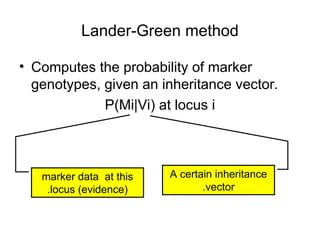
Lander-Green method
• Computes the probability of marker
genotypes, given an inheritance vector.
P(Mi|Vi) at locus i
marker data at this
locus (evidence)
.
A certain inheritance
vector
.
Main Idea
• Let a = (a1,…,a2f) be a vector of alleles assigned to
founders of the pedigree (f is the number of founders).
• We want a graph representation of the restrictions
imposed by the observed marker genotypes on the
vector a that can be assigned to the founder genes.
• The algorithm extracts only vectors a compatible with
the marker data.
• Pr[m|v] is obtained via a sum over all compatible vectors
a.
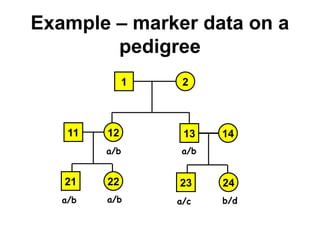
Example – marker data on a
pedigree
1 2
12
11
a/b
a/b
21
13
22
14
a/b
a/b
23 24
b/d
a/c
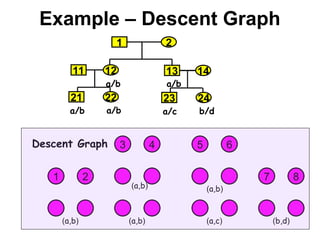
Example – Descent Graph
1 2
12
11
a/b
a/b
21
13
22
14
a/b
a/b
23 24
b/d
a/c
3 4 5 6
1 2 7 8
(
a,b
)
(
a,c
) (
b,d
)
(
a,b
)
(
a,b
)
(
a,b
)
Descent Graph
3 4 5 6
1 2 7 8
(
a,b
)
(
a,c
) (
b,d
)
(
a,b
)
(
a,b
)
(
a,b
)
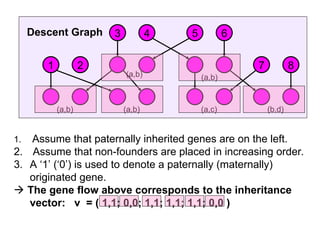
Descent Graph
1. Assume that paternally inherited genes are on the left.
2. Assume that non-founders are placed in increasing order.
3. A ‘1’ (‘0’) is used to denote a paternally (maternally)
originated gene.
 The gene flow above corresponds to the inheritance
vector: v = ( 1,1; 0,0; 1,1; 1,1; 1,1; 0,0 )
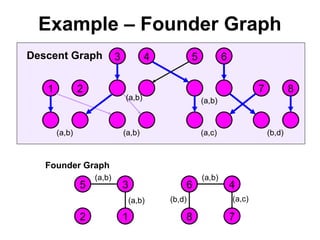
Example – Founder Graph
5 3
2 1
6 4
8 7
(
b,d
)
(
a,b
)
(
a,b
) (
a,c
)
(
a,b
)
Founder Graph
3 4 5 6
1 2 7 8
(
a,b
)
(
a,c
) (
b,d
)
(
a,b
)
(
a,b
)
(
a,b
)
Descent Graph
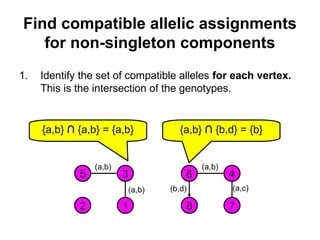
Find compatible allelic assignments
for non-singleton components
1. Identify the set of compatible alleles for each vertex.
This is the intersection of the genotypes.
5 3
2 1
6 4
8 7
(
b,d
)
(
a,b
)
(
a,b
) (
a,c
)
(
a,b
)
{a,b} ∩ {a,b} = {a,b} {a,b} ∩ {b,d} = {b}
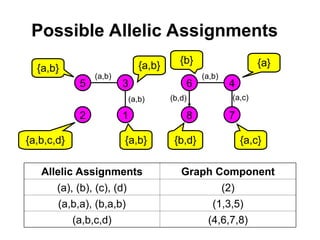
Possible Allelic Assignments
5 3
2 1
6 4
8 7
(
b,d
)
(
a,b
)
(
a,b
) (
a,c
)
(
a,b
)
{
a,b
} {
a,b
}
{
a,b
} {
a,c
}
{
a
}
{
b
}
{
b,d
}
{
a,b,c,d
}
Graph Component
Allelic Assignments
(2)
(a), (b), (c), (d)
(1,3,5)
(a,b,a), (b,a,b)
(4,6,7,8)
(a,b,c,d)
Computing P(m|v)
• If for some component there are no possible allelic
assignments, then P(m|v) = 0.
• The probability of singleton components is 1  we can
ignore them.
• Let ahi be an element of a vector of alleles assigned to the
vertices of component Ci.
]
Pr[
]
Pr[
}
:
{



i
C
j
j
j
hi a
a
]
Pr[
]
Pr[
}
:
{



i
hi A
a
h
hi
i a
C
]
Pr[
]
|
Pr[
1



m
i
i
C
v
m
over 2f elements
2
terms at most
Linear in the number of founders
Latest News: SuperLink
• Combines the covered approaches in one
unified program.
• Has other built-in abilities that increase its
computations efficiency.
• Claimed to be more capable and faster
than other related programs (by its own
makers).
• http://bioinfo.cs.technion.ac.il/superlink/
The
End

LinkageAnalysis.pptmjbhjxfzfxghvjbknknklm

  • 1.
    Genetic linkage analysis DotanSchreiber According to a series of presentations by M. Fishelson
  • 2.
    OutLine • Introduction. • Basicconcepts and some background. • Motivation for linkage analysis. • Linkage analysis: main approaches. • Latest developments.
  • 3.
    “Genetic linkage analysisis a statistical method that is used to associate functionality of genes to their location on chromosomes.“ http://bioinfo.cs.technion.ac.il/superlink/
  • 4.
    The Main Idea/usage : Neighboringgenes on the chromosome have a tendency to stick together when passed on to offsprings. Therefore, if some disease is often passed to offsprings along with specific marker- genes , then it can be concluded that the gene(s) which are responsible for the disease are located close on the chromosome to these markers.
  • 5.
    Basic Concepts • Locus •Allele • Genotype • Phenotype
  • 6.
    Dominant Vs. RecessiveAllele ‫עיניים‬ ‫צבע‬ :‫קלאסית‬ ‫דוגמא‬ homozygote heterozygote
  • 7.
    ( se ) X-Linked Allele Most humancells contain 46 chromosomes: • 2 sex chromosomes (X,Y): XY – in males. XX – in females. • 22 pairs of chromosomes named autosomes. Around 1000 human alleles are found only on the X chromosome.
  • 8.
    “…the Y chromosomeessentially is reproduced via cloning from one generation to the next. This prevents mutant Y chromosome genes from being eliminated from male genetic lines. Subsequently, most of the human Y chromosome now contains genetic junk rather than genes.” http://anthro.palomar.edu/biobasis/bio_3b.htm
  • 9.
    Medical Perspective When studyingrare disorders, 4 general patterns of inheritance are observed: • Autosomal recessive (e.g., cystic fibrosis). – Appears in both male and female children of unaffected parents. • Autosomal dominant (e.g., Huntington disease). – Affected males and females appear in each generation of the pedigree. – Affected parent transmits the phenotype to both male and female children.
  • 10.
    Continued .. • X-linked recessive(e.g., hemophilia). – Many more males than females show the disorder. – All daughters of an affected male are “carriers”. – None of the sons of an affected male show the disorder or are carriers. • X-linked dominant. – Affected males pass the disorder to all daughters but to none of their sons. – Affected heterozygous females married to unaffected males pass the condition to half their sons and daughters.
  • 11.
    Example – After thedisease is introduced into the family in generation #2, it appears in every generation  dominant! – Fathers do not transmit the phenotype to their sons  X-linked! 1 2 3 4 5 6 7 8 9 10
  • 12.
    Crossing Over Sometimes inmeiosis, homologous chromosomes exchange parts in a process called crossing-over, or recombination.
  • 13.
    Recombination Fraction The probability for a recombination between two genes is a monotone, non- linear function of the physical distance between their loci on the chromosome. Linkage) No ( 5 . 0 ) ion Recombinat ( 0 ) Linkage (    P 
  • 14.
    Linkage The further aparttwo genes on the same chromosome are, the more it is likely that a recombination between them will occur. Two genes are called linked if the recombination fraction between them is small (<< 50% chance)
  • 15.
    Linkage related Concepts •Interference - A crossover in one region usually decreases the probability of a crossover in an adjacent region. • CentiMorgan (cM) - 1 cM is the distance between genes for which the recombination frequency is 1%. • Lod Score - a method to calculate linkage distances (to determine the distance between genes).
  • 16.
    Ultimate Goal: LinkageMapping With the following few minor problems: – It’s impossible to make controlled crosses in humans. – Human progenies are rather small. – The human genome is immense. The distances between genes are large on average.
  • 17.
    Possible Solutions • Makegeneral assumptions: Hardy-Weinberg Equilibrium – assumes certain probability for a certain individual to have a certain genotype. Linkage Equilibrium – assumes two alleles at different loci are independent of each other. • Incorporate those assumptions into possible solutions: Elston-Stewart method. Lander-Green method.
  • 18.
    Elston-Stewart method • Input:A simple pedigree + phenotype information about some of the people. These people are called typed. • Simple pedigree – no cycles, single pair of founders. founder leaf 1/2
  • 19.
    .. Continued • Output: theprobability of the observed data, given some probability model for the transmission of alleles. Composed of: founder probabilities - Hardy-Weinberg equilibrium penetrance probabilities - The probability of the phenotype, given the genotype transmission probabilities - the probability of a child having a certain genotype given the parents’ genotypes
  • 20.
    .. Continued • Bottom-Up: sumconditioned probabilities over all possible genotypes of the children and only then on the possible genotypes for the parents. • Linear in the number of people.
  • 21.
    Lander-Green method • Computesthe probability of marker genotypes, given an inheritance vector. P(Mi|Vi) at locus i marker data at this locus (evidence) . A certain inheritance vector .
  • 22.
    Main Idea • Leta = (a1,…,a2f) be a vector of alleles assigned to founders of the pedigree (f is the number of founders). • We want a graph representation of the restrictions imposed by the observed marker genotypes on the vector a that can be assigned to the founder genes. • The algorithm extracts only vectors a compatible with the marker data. • Pr[m|v] is obtained via a sum over all compatible vectors a.
  • 23.
    Example – markerdata on a pedigree 1 2 12 11 a/b a/b 21 13 22 14 a/b a/b 23 24 b/d a/c
  • 24.
    Example – DescentGraph 1 2 12 11 a/b a/b 21 13 22 14 a/b a/b 23 24 b/d a/c 3 4 5 6 1 2 7 8 ( a,b ) ( a,c ) ( b,d ) ( a,b ) ( a,b ) ( a,b ) Descent Graph
  • 25.
    3 4 56 1 2 7 8 ( a,b ) ( a,c ) ( b,d ) ( a,b ) ( a,b ) ( a,b ) Descent Graph 1. Assume that paternally inherited genes are on the left. 2. Assume that non-founders are placed in increasing order. 3. A ‘1’ (‘0’) is used to denote a paternally (maternally) originated gene.  The gene flow above corresponds to the inheritance vector: v = ( 1,1; 0,0; 1,1; 1,1; 1,1; 0,0 )
  • 26.
    Example – FounderGraph 5 3 2 1 6 4 8 7 ( b,d ) ( a,b ) ( a,b ) ( a,c ) ( a,b ) Founder Graph 3 4 5 6 1 2 7 8 ( a,b ) ( a,c ) ( b,d ) ( a,b ) ( a,b ) ( a,b ) Descent Graph
  • 27.
    Find compatible allelicassignments for non-singleton components 1. Identify the set of compatible alleles for each vertex. This is the intersection of the genotypes. 5 3 2 1 6 4 8 7 ( b,d ) ( a,b ) ( a,b ) ( a,c ) ( a,b ) {a,b} ∩ {a,b} = {a,b} {a,b} ∩ {b,d} = {b}
  • 28.
    Possible Allelic Assignments 53 2 1 6 4 8 7 ( b,d ) ( a,b ) ( a,b ) ( a,c ) ( a,b ) { a,b } { a,b } { a,b } { a,c } { a } { b } { b,d } { a,b,c,d } Graph Component Allelic Assignments (2) (a), (b), (c), (d) (1,3,5) (a,b,a), (b,a,b) (4,6,7,8) (a,b,c,d)
  • 29.
    Computing P(m|v) • Iffor some component there are no possible allelic assignments, then P(m|v) = 0. • The probability of singleton components is 1  we can ignore them. • Let ahi be an element of a vector of alleles assigned to the vertices of component Ci. ] Pr[ ] Pr[ } : {    i C j j j hi a a ] Pr[ ] Pr[ } : {    i hi A a h hi i a C ] Pr[ ] | Pr[ 1    m i i C v m over 2f elements 2 terms at most Linear in the number of founders
  • 30.
    Latest News: SuperLink •Combines the covered approaches in one unified program. • Has other built-in abilities that increase its computations efficiency. • Claimed to be more capable and faster than other related programs (by its own makers). • http://bioinfo.cs.technion.ac.il/superlink/
  • 31.