Subject- Food Biotechnology
TOPIC- Production technology of Bread
Submitted to: Dr. Ranjeeta Bhari
Submitted by: Baljit Kaur
Roll No. 19011004
MSc (Hons.) in Biotechnology
Third Semester
Date: 14/09/2020
What is Bread Fermentation ?
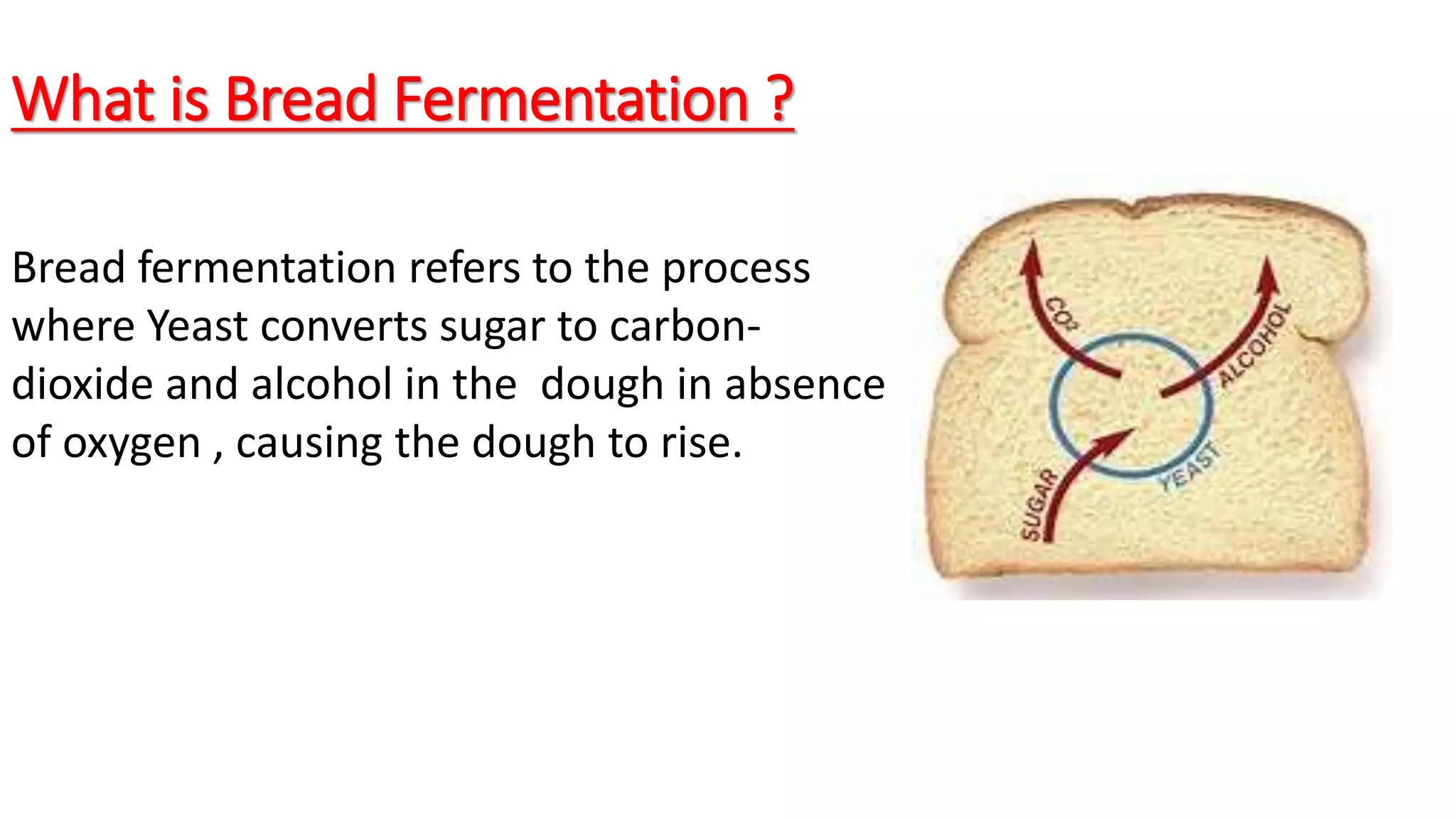
Bread fermentation refers to the process
where Yeast converts sugar to carbon-
dioxide and alcohol in the dough in absence
of oxygen , causing the dough to rise.
History
• Ancient artifacts and writings discovered in the Middle East suggest that bread-
making had its origins in the eightieth century B.C.E.,
• The first breads were probably flat breads,with little or no leavening ,
• Leavening must have been an accidental discovery when a flour-water mixture
became contaminated with wild airborne yeasts, leading to a spongy dough
principle
• strains of Saccharomyces cerevisiae yeast, wild yeast and lactic acid
bacteria (LAB). starts consuming simple sugars in the flourgenerated
by amylase. This produces CO2 and other compounds, which are
responsible for the unique flavor, leavening and texture of bread.
BREAD FORMULATION
Many different types of bread formulations have been developed so far. These
formulations are developed in different regions based on the traditional food
habits of the people. The main bread types can be classified as:
Pan bread: popular in the economically
developed countries including USA, Canada,
and European nations.
Hearth bread or sour bread: is produced
with or without lactic acid fermentation. popular in France.
Flat bread or roti/ chappati :
popular in Asian countries.
The product is unfermented and flat.
baked on a flat hot pan.
Rolls and other small fermented breads: have higher levels of sugar and fat in the
formulation and thus typically have sweeter taste and softer bite characteristics.
types of flour used
• Breads are also commonly made from a wide variety of other cereal
grains, including rye, barley, oats, corn, sorghum, and millet.
Yeast Cultures
• The yeast used for bread manufacture is Saccharomyces cerevisiae, often
referred to as simply bakers ’yeast.
Desirable properties of bakers’ yeasts
types of yeast used
• Fresh Yeast (a.k.a. Cake or Block Yeast): has the highest moisture
content of the three varieties. thus has more leavening power
• Active-Dry Yeast: Of the three types of commercial yeast available,
active dry has the longest shelf-life—.
• Instant Yeast: Instant yeast requires no blooming and activates more
quickly than active dry. This means that it can be added directly to the
dough
BREAD MAKING PROCEDURE
The following steps are generally considered essential for the production of good
quality bread:
1.SIEVING
The flour is generally sieved To aerate the flour
To remove coarse particles and other impurities
To make flour more homogeneous.
2. WEIGHING
• The next step is weighing of different ingredients as per formulation.
Salt, sugar, oxidizing agents and yeast are added in solution form.
Yeast is added as a suspension, which is mixed well each time before dispensing.
3.MIXING
• Mixing of flour and ingredients involves hydration & blending, dough
development and dough breakdown.
• The process of mixing begins with hydration of the formula ingredients which
develops of the gluten network in dough,
1. Initial hydration stage
At this stage ingredients are blended and homogenized. The dough begins to wet
and sticky.
2. Pick up stage
The gluten begins to develop in the dough system.
3. Clean up stage
Further mixing develops the gluten network in the dough. Dough becomes
extensible and elastic
4. Development stage
It gives silky and shine character.
5. Optimum stage
. Dough at this stage is elastic, silky and smooth. Forms thin membrane of uniform
thickness when stretched without breaking.
6. Break down stage
Beyond optimum stage the dough becomes sticky and demonstrates poor
machinability.
Mixing time
• If the mixing time is very short the flour can easily be over mixed, and if the
mixing time is very long it might never reach its optimum.
•
4.Fermentation
• Fermentation is achieved by yeast (Saccharomyces cerevisiae).
• The yeast in dough breaks down the sugars to carbon dioxide and ethanol. The
gas produced during fermentation leavens the dough into foam.
• The yeast performs well at 30-35ºC and relative humidity of 85 % and above.
• The optimum pH range for yeast is 4 to 6.
5.KNOCK BACK
• Punching of dough in between the fermentation
periods increases gas retaining capacity of the dough.
• The knock back also aids in the mechanical development of gluten by the
stretching and folding action.
• Usually knock back is done when 2/3 of the normal fermentation time is over.
6.DOUGH MAKE-UP
• The function of dough make-up is to transform the fermented bulk dough into
properly sealed and moulded dough piece,
• Dough make-up includes:
Scaling
Rounding
Intermediate proofing
Moulding
7.Panning
• The moulded dough pieces are immediately placed in the baking pans.
• Panning should be carried out so that the seam of the dough is placed on the
bottom of the pan.
• This will prevent subsequent opening of the seam during proofing and baking.
• Optimum pan temperature is 90°F .
8. PROVING OR PROOFING PROCESS
• fermentation of dough continues. after moulding has been accomplished and
moulded dough pieces are placed in bread pans or tins.
• It is generally carried out at 30-35ºC and at 85% relative humidity. Proofing takes
about 55-65 minutes.
• During proofing the dough increases remarkably in volume.
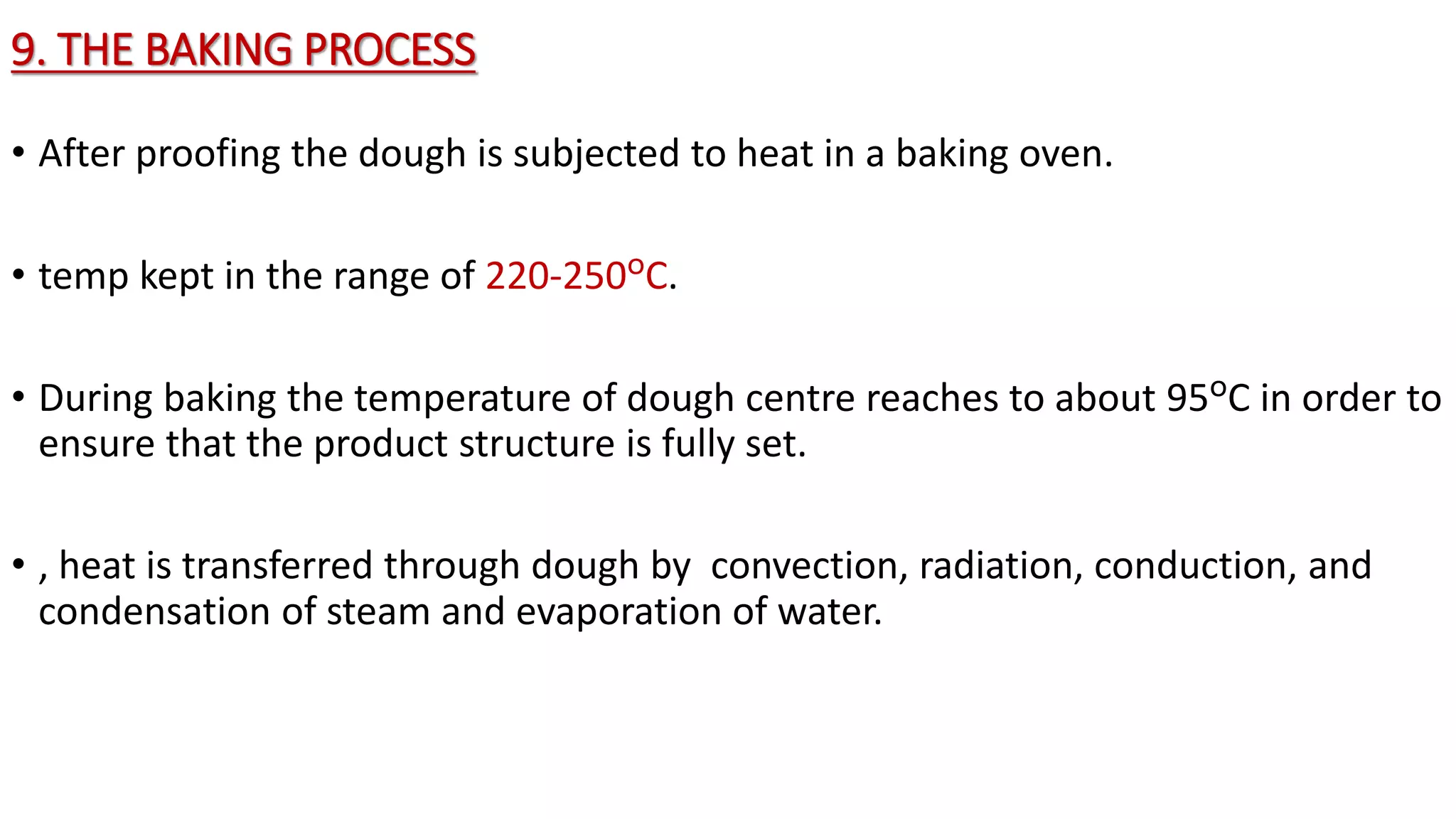
9. THE BAKING PROCESS
• After proofing the dough is subjected to heat in a baking oven.
• temp kept in the range of 220-250ºC.
• During baking the temperature of dough centre reaches to about 95ºC in order to
ensure that the product structure is fully set.
• , heat is transferred through dough by convection, radiation, conduction, and
condensation of steam and evaporation of water.
• The baking time of bread may range from 25 to 30 minutes
• After baking, bread is cooled prior to packaging and slicing Desirable temperature
of bread during slicing is 95-105°F.
references
• www.google.com

Production technology of bread

  • 1.
    Subject- Food Biotechnology TOPIC-Production technology of Bread Submitted to: Dr. Ranjeeta Bhari Submitted by: Baljit Kaur Roll No. 19011004 MSc (Hons.) in Biotechnology Third Semester Date: 14/09/2020
  • 2.
    What is BreadFermentation ? Bread fermentation refers to the process where Yeast converts sugar to carbon- dioxide and alcohol in the dough in absence of oxygen , causing the dough to rise.
  • 3.
    History • Ancient artifactsand writings discovered in the Middle East suggest that bread- making had its origins in the eightieth century B.C.E., • The first breads were probably flat breads,with little or no leavening , • Leavening must have been an accidental discovery when a flour-water mixture became contaminated with wild airborne yeasts, leading to a spongy dough
  • 4.
    principle • strains ofSaccharomyces cerevisiae yeast, wild yeast and lactic acid bacteria (LAB). starts consuming simple sugars in the flourgenerated by amylase. This produces CO2 and other compounds, which are responsible for the unique flavor, leavening and texture of bread.
  • 5.
    BREAD FORMULATION Many differenttypes of bread formulations have been developed so far. These formulations are developed in different regions based on the traditional food habits of the people. The main bread types can be classified as: Pan bread: popular in the economically developed countries including USA, Canada, and European nations. Hearth bread or sour bread: is produced with or without lactic acid fermentation. popular in France.
  • 6.
    Flat bread orroti/ chappati : popular in Asian countries. The product is unfermented and flat. baked on a flat hot pan. Rolls and other small fermented breads: have higher levels of sugar and fat in the formulation and thus typically have sweeter taste and softer bite characteristics.
  • 9.
    types of flourused • Breads are also commonly made from a wide variety of other cereal grains, including rye, barley, oats, corn, sorghum, and millet.
  • 10.
    Yeast Cultures • Theyeast used for bread manufacture is Saccharomyces cerevisiae, often referred to as simply bakers ’yeast.
  • 11.
    Desirable properties ofbakers’ yeasts
  • 12.
    types of yeastused • Fresh Yeast (a.k.a. Cake or Block Yeast): has the highest moisture content of the three varieties. thus has more leavening power • Active-Dry Yeast: Of the three types of commercial yeast available, active dry has the longest shelf-life—. • Instant Yeast: Instant yeast requires no blooming and activates more quickly than active dry. This means that it can be added directly to the dough
  • 13.
    BREAD MAKING PROCEDURE Thefollowing steps are generally considered essential for the production of good quality bread: 1.SIEVING The flour is generally sieved To aerate the flour To remove coarse particles and other impurities To make flour more homogeneous.
  • 14.
    2. WEIGHING • Thenext step is weighing of different ingredients as per formulation. Salt, sugar, oxidizing agents and yeast are added in solution form. Yeast is added as a suspension, which is mixed well each time before dispensing.
  • 15.
    3.MIXING • Mixing offlour and ingredients involves hydration & blending, dough development and dough breakdown. • The process of mixing begins with hydration of the formula ingredients which develops of the gluten network in dough,
  • 16.
    1. Initial hydrationstage At this stage ingredients are blended and homogenized. The dough begins to wet and sticky. 2. Pick up stage The gluten begins to develop in the dough system. 3. Clean up stage Further mixing develops the gluten network in the dough. Dough becomes extensible and elastic
  • 17.
    4. Development stage Itgives silky and shine character. 5. Optimum stage . Dough at this stage is elastic, silky and smooth. Forms thin membrane of uniform thickness when stretched without breaking. 6. Break down stage Beyond optimum stage the dough becomes sticky and demonstrates poor machinability.
  • 18.
    Mixing time • Ifthe mixing time is very short the flour can easily be over mixed, and if the mixing time is very long it might never reach its optimum. •
  • 19.
    4.Fermentation • Fermentation isachieved by yeast (Saccharomyces cerevisiae). • The yeast in dough breaks down the sugars to carbon dioxide and ethanol. The gas produced during fermentation leavens the dough into foam. • The yeast performs well at 30-35ºC and relative humidity of 85 % and above. • The optimum pH range for yeast is 4 to 6.
  • 20.
    5.KNOCK BACK • Punchingof dough in between the fermentation periods increases gas retaining capacity of the dough. • The knock back also aids in the mechanical development of gluten by the stretching and folding action. • Usually knock back is done when 2/3 of the normal fermentation time is over.
  • 21.
    6.DOUGH MAKE-UP • Thefunction of dough make-up is to transform the fermented bulk dough into properly sealed and moulded dough piece, • Dough make-up includes: Scaling Rounding Intermediate proofing Moulding
  • 22.
    7.Panning • The mouldeddough pieces are immediately placed in the baking pans. • Panning should be carried out so that the seam of the dough is placed on the bottom of the pan. • This will prevent subsequent opening of the seam during proofing and baking. • Optimum pan temperature is 90°F .
  • 23.
    8. PROVING ORPROOFING PROCESS • fermentation of dough continues. after moulding has been accomplished and moulded dough pieces are placed in bread pans or tins. • It is generally carried out at 30-35ºC and at 85% relative humidity. Proofing takes about 55-65 minutes. • During proofing the dough increases remarkably in volume.
  • 24.
    9. THE BAKINGPROCESS • After proofing the dough is subjected to heat in a baking oven. • temp kept in the range of 220-250ºC. • During baking the temperature of dough centre reaches to about 95ºC in order to ensure that the product structure is fully set. • , heat is transferred through dough by convection, radiation, conduction, and condensation of steam and evaporation of water.
  • 25.
    • The bakingtime of bread may range from 25 to 30 minutes • After baking, bread is cooled prior to packaging and slicing Desirable temperature of bread during slicing is 95-105°F.
  • 27.