Botanical name : Borassus flabellifer L.
Family : Palmae
Origin : Tropical Africa
Chromosome No. : 2n = 36
Kalpagathara (Tree of life) or Kalpaghataru or Kalpakavirucham
Production technology of Palmyra
Dr. M. Kumaresan (Hort.)
Department of Horticulture
Vels Institute of Science, Technology & Advanced
Studies (VISTAS)
Pallavaram, Chennai, Tamil Nadu -600117
Introduction
• Palmyra is recognized as the state tree of Tamil Nadu in 1978, recognizing it's
importance.
• All the parts of the palm are useful and over 800 various uses are reported and hence this
palm is known as kalpagathara.
• Since every part of this palm is utilized it is known as kalpakaviruchum
• Edible products of palmyra : Neera, Toddy, Sugar, Jaggary, Candy, Vinegar etc
• Commercial products of palmyra : Wood, leaves, roots, Fibre, fruit pulp, fruit fibre etc. It
is a source of food, Neera or padaneer is a transparent and sweet drink having pleasant
smell.
Research work on palmyra palm in India
• Palmyra reseach Station at Srivaliputhur, Tamil Nadu (TNAU) AICRP on palmyra at
Padiramamudi (AP) at Killikulam, Tamil Nadu (TNAU)
• Palm produces fruits when it attains 15-20 years, giving an annual crop of 50 –200
fruits in 6 – 12 bunches per tree. When the fruits are tender the seeds contain a soft,
sweet, jelly like endosperm called nongu in Tamil. The gelatinous pulp gradually
hardens into a bony kernel and develops a fibrous coat. Male and female palms can
be distinguished only when they start flowering which occurs after 15-20 years of
growth. .
• Flowering season: starts from January and continues till August with a peak during
May.
• Tapping season: Female palms = April – Dec, ( 8 to 9 months)
• Male palms = Dec – Feb, (2 to 3 months)
Introduction
Composition
• Sugar – 12- 16 per cent, Vitamin c (Ascorbic acide), Vitamin B ( B- complex) and
essential amino acids.
• Neera is drunk as such or used for preparation of secondary products. It includes;
• Toddy: Due to fermentation of neera (sugary sap) by yeast and bacteria. It contains
5 per cent alcohol.
• Jaggary: By concentration of neera through gradual boiling. The jaggary is sweet,
delicious and superior to cane jaggary.
• Palm sugar: Crystallized sap juice obtained by boiling and clarifying,
• Palm cola: Aerated soft drink containing palm sugar ( 11 %), Citric acid, cola
concentrate and food colours along with other ingredients.
Composition
Palm candy: Directly produced from the sap. It is boiled only to 107 to 108o C. Poured
in to pots , which is covered and buried under ground for some months = Crystalline
sugar candy forms. It has medicinal properties and used against cough and pulmonary
infection.
Jaggary : Jaggary of palmyra is sweet, delicious and superior to cane jaggary. Palmyra
palm jaggery (gur) is much more nutritious than crude cane sugar, containing 1.04%
protein, 0.19% fat, 76.86% sucrose, 1.66% glucose, 3.15% total minerals, 0.861 %
calcium, 0.052% phosphorus; also 11.01 mg iron per 100 g and 0.767 mg of copper per
100 g. The fresh sap is reportedly a good source of vitamin B complex.
Seedlings
• Peeled seedlings are eaten fresh or sun-dried, raw, or cooked in various ways.
• They also yield starch, which is locally made into gruel, with rice, herbs, chili
peppers, fish, or other ingredients added.
• It has been proposed for commercial starch production
• Plalmyrah roots: Three months old roots (tubers) are edible on coocking
• Fruits/ Nungu: It weighs 27 to 54 g.
• Nungu: It is tender palmyra fruit.
• It is delicious and rich in carbohydrate, Phosphorous, Iron and Vitamin - C, Niacin,
Riboflavin etc.,
Origin and Distribution
Origin
• Palmyra is believed to be a native of tropical Africa, native to tropical regions of Africa, Asia and New Guinea.
Distribution
• World : Assia, Africa and Austrelian continents. is commonly cultivated in India, Southeast Asia, Malaysia India,
Sri Lanka, Mymnar, Bangladesh,Thailand, Vietnam, Malaysia, and Indonesia.
• India : Tamil Nadu, AP, Karnatak, Kerala, MP, Orissa, WB, Bihar etc, Tamil Nadu,: In TN 5.02crore palms out of
8.06 crore palms (Accounting to 58 per cent). In Tirelveli District it is widely distributed
• It has been estimated that there are about 8.6 crores of Palmyra palms existing in India of which 5.02 crores of
palms are alone spread over Tamil Nadu and remaining 3.58 crores palms are in Andra Pradesh.
• Tamil Nadu alone contains about 60 per cent of total palms, signifying its importance Government of Tamil Nadu
recognized it as state tree of Tamil Nadu since 1978
• Andra Pradesh : 3.58/ 8.60 crore palms are located
Climate and soil
Climate
• Rainfall: It can come up in dry areas having moderate to low rainfall.
• High temperature and Heavy wind
• Altitude : It grows from sea level up to an altitude of 750m.
Soil
• It prefers deep, sandy and loamy soils, through can come up on varied types of soils. The most
congenial situations for its favorable development are Low sandy plains.
• It is distinctly wild and propagates itself readily from seed in regions where it is abundant.
• In such regions it is capable of forming pure forests or forests intermixed with wild date palm
(Phoenix sylvestris Roxb).
• It some times acts as a wind break for the plains.
• Soil depth : > 2m
• Palm Jaggary grown on calcarius soil are more sweeter
Species
• Borassus aethiopium - African Palmyra Palm (tropical Africa)
• Borassus flabellifer -Asian Palmyra Palm (southern Asia)
• Borassus heineanus- New Guinea Palmyra Palm (New Guinea)
• Borassus madagascariensis - Madagascar Palmyra Palm (Madagascar)
• Borassus sambiranensis - Sambirano Palmyra Palm (Madagascar)
• Fruit: It is botanically drupe contains three seeds and are 40 - 50 in a bunch. It is a
dioecious (rarely hermaphrodite) palm where in male flowers are embedded in
fingers where as female flowers are sessile.
Varieties
• There is no recognized variety.
• Based on fruit type (colour of fruit pericarp) there are groups of palms viz,
• Black skin : are generally more sweet and red skin / Golden skin fruit types : Fruit
and nut number per tree is more than black fruits but are generally less sweet
• SVPR-1: Palmyra research station, Srivaliputhur (T.N.A.U.) has released one
improved variety namely SVPR-1 Palmyra palm.
• Features semi-dwarf type High padaneer yield of 298 litres per palm in a tapping
duration of 95 days.
• Quality of padaneer : The padaneer of this variety has a high jaggery content (144 g
per litre of padaneer i.e., 14.40 %) and a high brix content.
Black skin fruit
• Less red pigment on the fruit skin
• Yields less but more starch & less fibre
• Pulp extraction is easier
• Contains sugar, starch & protein(77, 10, 2.5%)
• Alkaloids, mineral matter & free amino acids are
lesser
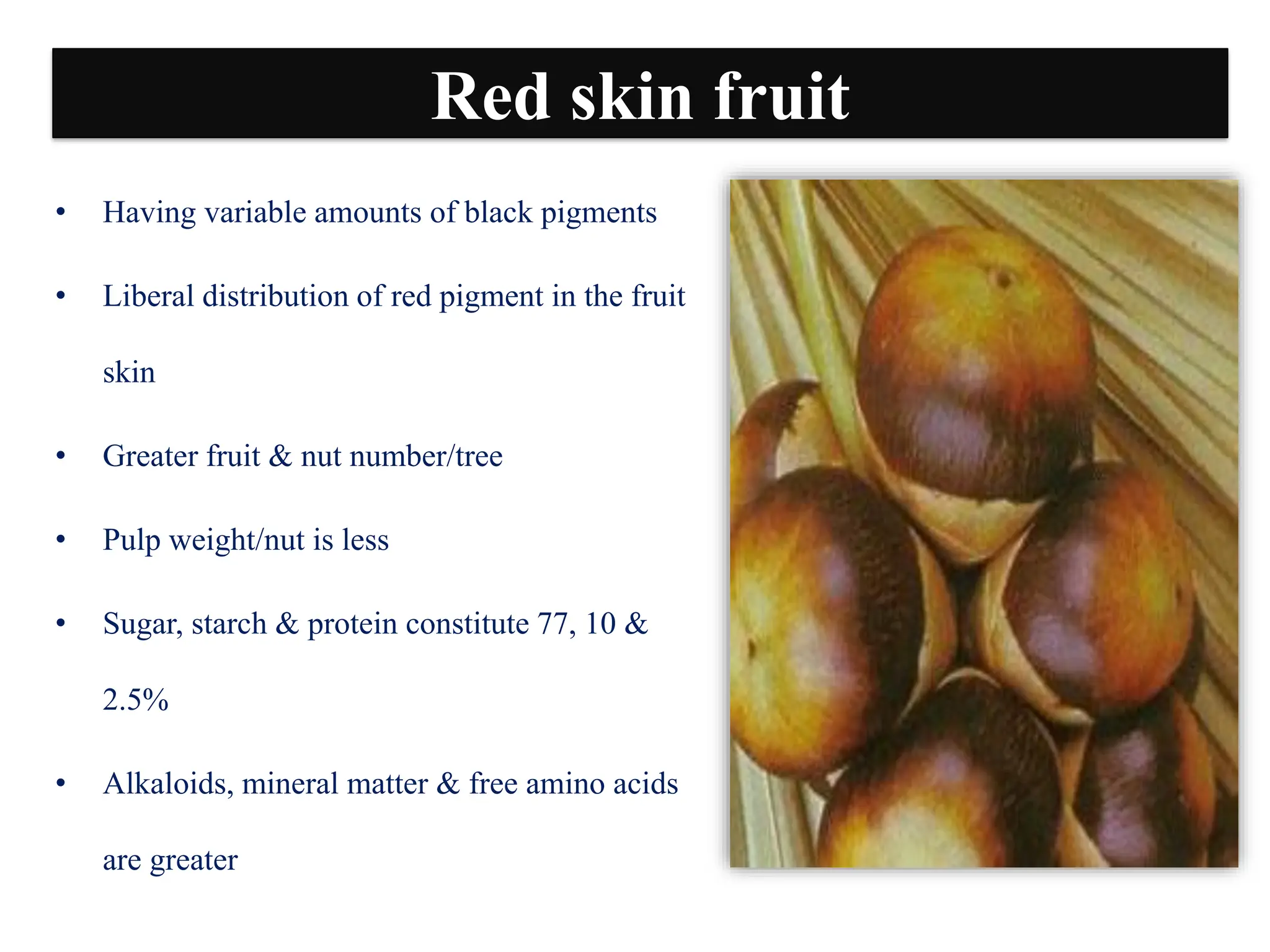
Red skin fruit
• Having variable amounts of black pigments
• Liberal distribution of red pigment in the fruit
skin
• Greater fruit & nut number/tree
• Pulp weight/nut is less
• Sugar, starch & protein constitute 77, 10 &
2.5%
• Alkaloids, mineral matter & free amino acids
are greater
Propagation
Seed propagation
• Nursery raised seedling and Self sown seedlings are used for propagation
• Mother palm selection in palmyra
• Age of the palm : Middle aged – 30 to 40 years
• Stature of canopy : Dwarf and stout palms are selected. Trees with compact leaves
are preferred to long slender stemmed trees
Selection of seed nuts
• Stage of maturity : From the fruits which are 80 to 90 per cent ripe.
• Heap the selected fruit bunches for 5 to 6 days for automatic stripping from
bunches. Select plumy and healty seed nut.
Propagation
• Removal of mesocarp : Allow fruits to ferment for easy removal of mesocarp.
While removing mesocarp, the fibre adhering to seed nut should be retained which
help in absorption of water and leading to better germination.
Sex of nuts
• Seeds of single nut give = female trees
• Double nuts give = One female and one male
• Trinuts = Two male and one female
• To maintain male and female ratios it is better to collect 10 to 15 per cent of double
nuts.
Propagation
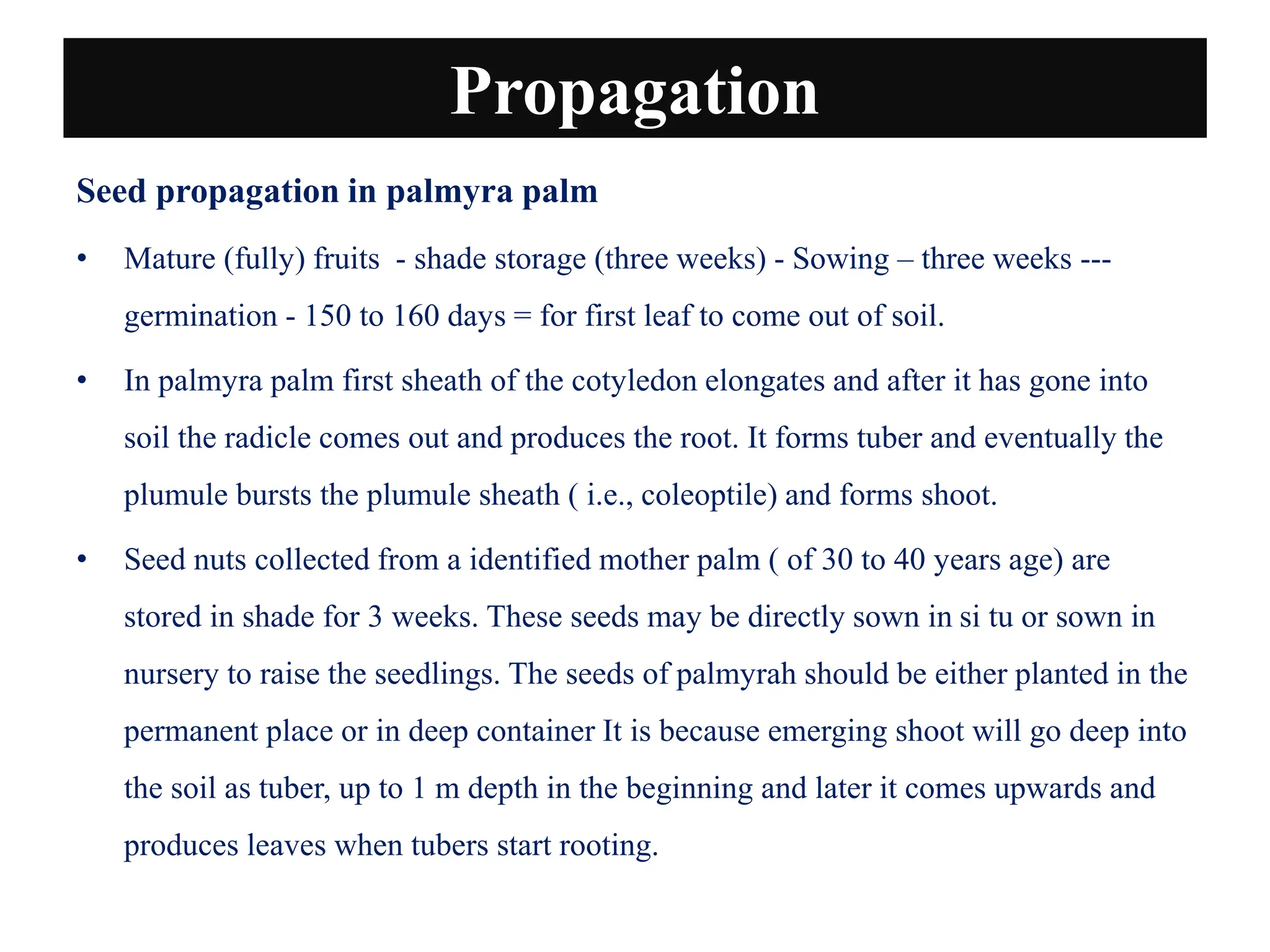
Seed propagation in palmyra palm
• Mature (fully) fruits - shade storage (three weeks) - Sowing – three weeks ---
germination - 150 to 160 days = for first leaf to come out of soil.
• In palmyra palm first sheath of the cotyledon elongates and after it has gone into
soil the radicle comes out and produces the root. It forms tuber and eventually the
plumule bursts the plumule sheath ( i.e., coleoptile) and forms shoot.
• Seed nuts collected from a identified mother palm ( of 30 to 40 years age) are
stored in shade for 3 weeks. These seeds may be directly sown in si tu or sown in
nursery to raise the seedlings. The seeds of palmyrah should be either planted in the
permanent place or in deep container It is because emerging shoot will go deep into
the soil as tuber, up to 1 m depth in the beginning and later it comes upwards and
produces leaves when tubers start rooting.
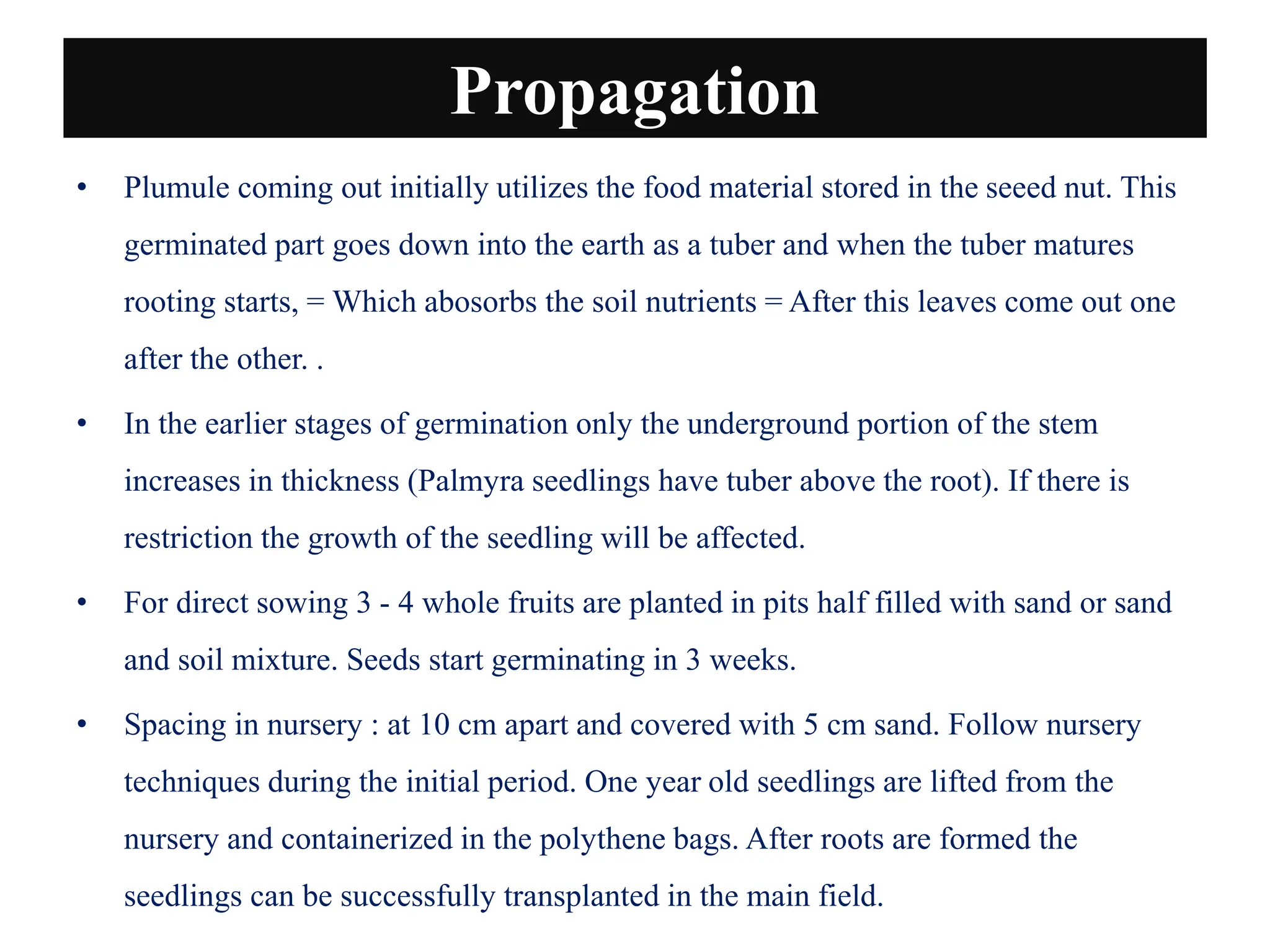
Propagation
• Plumule coming out initially utilizes the food material stored in the seeed nut. This
germinated part goes down into the earth as a tuber and when the tuber matures
rooting starts, = Which abosorbs the soil nutrients = After this leaves come out one
after the other. .
• In the earlier stages of germination only the underground portion of the stem
increases in thickness (Palmyra seedlings have tuber above the root). If there is
restriction the growth of the seedling will be affected.
• For direct sowing 3 - 4 whole fruits are planted in pits half filled with sand or sand
and soil mixture. Seeds start germinating in 3 weeks.
• Spacing in nursery : at 10 cm apart and covered with 5 cm sand. Follow nursery
techniques during the initial period. One year old seedlings are lifted from the
nursery and containerized in the polythene bags. After roots are formed the
seedlings can be successfully transplanted in the main field.
Cultural Aspects / After Cultivation
• No organized cultivation is practiced . Seeds fallen in the existing plantations ==
Self sown seeds germinate and establish
• The palm grown naturally and no particular cultivation is necessary. It requires no
artificial irrigation or manuring. However, for better performance following
cultivation practices are suggested.
Planting
• Pit size : 30 x 30 x 60 cm at
• Spacing : 3m x 3m (450 plants /ha)
• If triangular system of planting is adopted it accommodates 500 trees per ha.
• Note : Seeds can also be directly sown in the field 5 cm below soil surface with
seed eye facing down ward to the soil.
Manuring
• Prevailing practice – Before sowing of nuts = 10 kg FYM per pit is applied –
Increased biennially till the dose reaches – 60 kg per pit per year.
• A dose of 10 kg FYM per pit is applied before planting and it has to be increased
biannually till it reaches 60 kg FYM/pit/year.
• Gap filling: After cultivation consists of gap filling. Gap filling may be carried out
using containerized seedlings.
• inter ploughing, Basin rectification in the initial few years. Basin rectification
before rains helps for efficient collection and storage of rainwater.
• Defoliation: Tending : Removal of persisting leaf bases (Tending) has to be
attended in Palmyra periodically.
Intercrops/ Mixed crops
• Intercrops: Upto initial 5 to 6 years = Seasonal crops = Cowpea, moringa, green
gram, red gram, Bengal gram,
• Mixed crops: With semi arid zone fruit cops like , Anona, ber, amla, pomegranate,
moringa, carissa, west Indian cherry, guava etc appears to be good.
(Phyllanthus emblica = Bettada nelli while P. acidus is Indian goose berry,)
• Irrigation : In dry lands pitcher irrigation may be followed. Soil conservation
measures Viz., Mulching, Forming basin, Rain pits, Legume cover crops etc be
adopted.
Plant protection
Pests
• As in coconut rhinoceros beetles, red palm weevils and black headed caterpillar Eriophid mite
often cause damage.
Diseases
• Bud rot ,stem bleeding, Grey blight and tuber rot .
• Bud rot : The palm is liable to infection Phytophthora palmivora Buttler, causing a serious
fungal disease called “bud rot”. In the advanced stage of the disease the soft heart of the bud
is converted into a foul – smelling, rotten mass and the tree dies. Control : Prophylactic spray
and curative spray of Bordeaux mixture (1 %) spray or Fytolon ( 0.3 % spray) is suggested
Tapping
• Extraction of sap from the inflorescence is called tapping which is the most important use of
this palm. Tapping varies with the age and sex of the palm.
• Edible products of palmyra: Neera, Toddy, Sugar, Jaggary, Candy, Vinegar etc
• Commercial products of palmyra: Wood, leaves, roots, Fibre, fruit pulp, fruit fibre etc.
• Male palms: Only Neera is obtained
• Female palms: Neera, Fruits, and tubers from palmyra seeds can be obtained.
• It yields 30 to 50 per cent more sap than male palms.
• Age at first tapping: 10 to 12 years after planting if properly managed otherwise it is about
15 years.
• Economical life /Yielding age: The trees continue to yield for 30 to 40 years.
• The spadices of palmyrah, on tapping yield a delicious sugary sap, known as the sweet toddy.
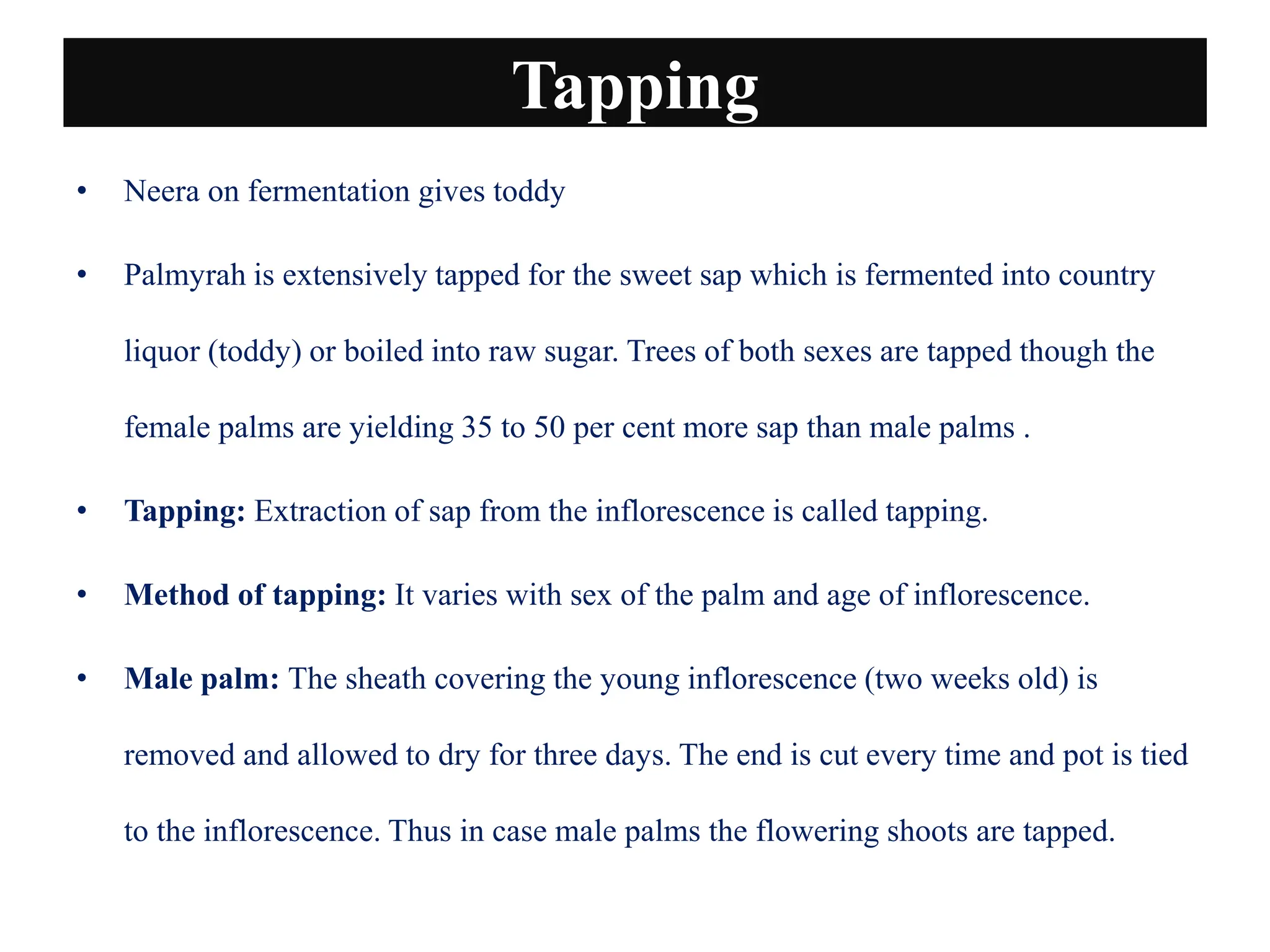
Tapping
• Neera on fermentation gives toddy
• Palmyrah is extensively tapped for the sweet sap which is fermented into country
liquor (toddy) or boiled into raw sugar. Trees of both sexes are tapped though the
female palms are yielding 35 to 50 per cent more sap than male palms .
• Tapping: Extraction of sap from the inflorescence is called tapping.
• Method of tapping: It varies with sex of the palm and age of inflorescence.
• Male palm: The sheath covering the young inflorescence (two weeks old) is
removed and allowed to dry for three days. The end is cut every time and pot is tied
to the inflorescence. Thus in case male palms the flowering shoots are tapped.
Tapping
• Male palms: Tapping period = short period ( Dec- Feb)
• Aripanai Method: In male palm sheath of young inflorescence ( using 2 weeks
old inflorescence) is removed and allowed to dry for three days. The end is cut
every time and pot is tied to the inflorescence. It is practiced for 1 to 1 ½ months.
• Vellupanai: ( Using comparatively old inflorescence of one month ) Here also
male palms are selected but inflorescences are of one month old. Each male spike
(bearing sessile flowers) is pretreated by pressing and stroking ( pettu/hodeta).
Three to 6 such spikes are brought together, wrapped with aplmyrah leaves and
fitted to a pot.
Tapping
• Female palm: The tissues of young female inflorescence are softened by hitting the main axis
of the inflorescence with iron rod and the fork is used to press the regions from which the
fruits develop. Thus in case of female palms the fruiting branches are tapped when the drupes
are still very small.
• Female palms: Tapped for longer period, i.e., April - December . It gives 30 to 50 per cent
more sap yield.
• Thattipalai: Young female inflorescence is tapped in this method. The tappers soften the
tissues by hitting the inflorescence main axis with the iron rod and fork is used to press the
region from which fruit develop.
• Kaivetty: When female inflorescence is about 2 to 3 months old. Here the inflorescences are
matured and will be having fruits. In this method fruits are sliced as the tapping progress.
Yield
Fruit yield = only in female palms = 50 to 200 fruits in 6 to 12 bunches per tree per year
Neera
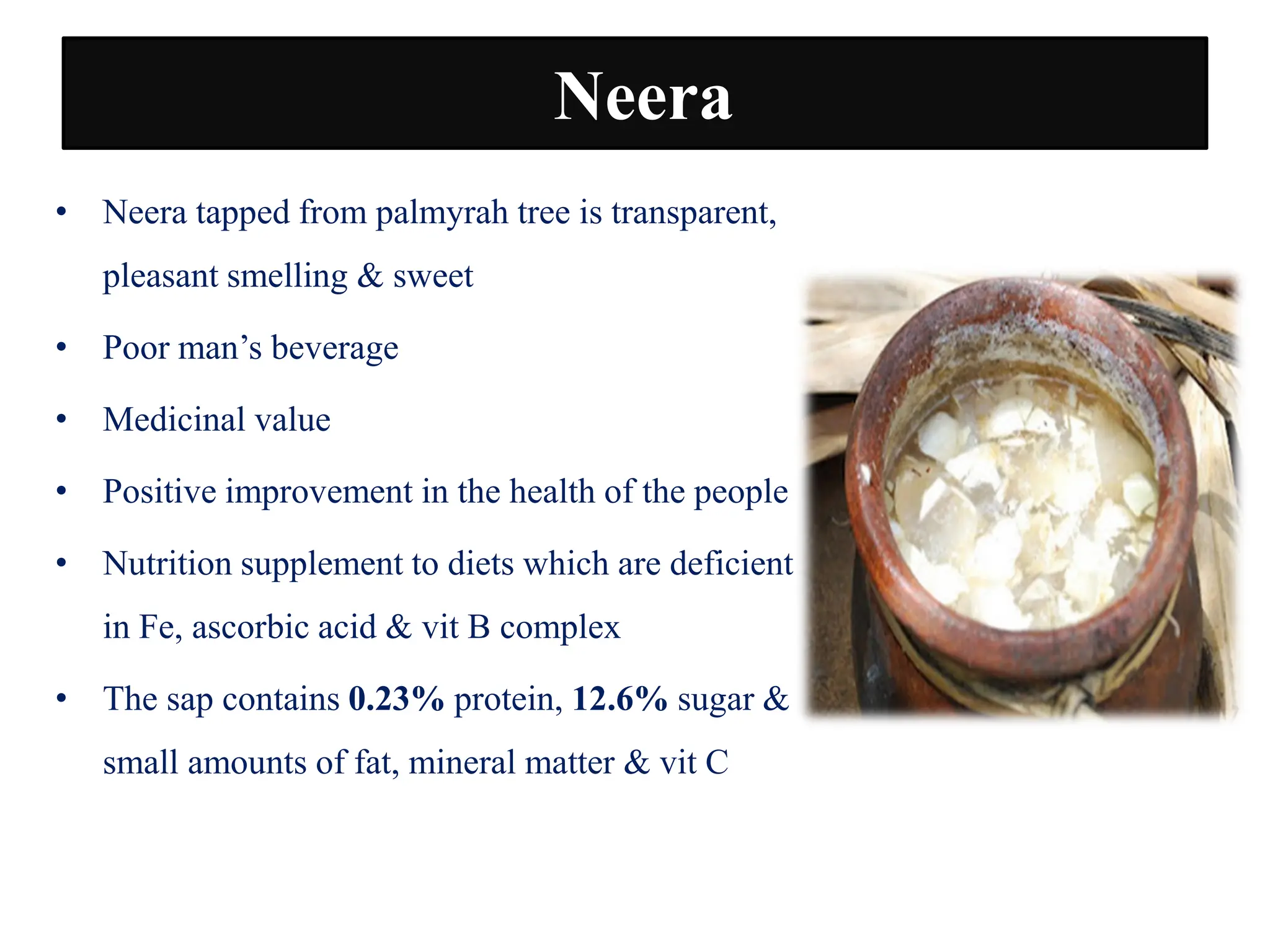
• Neera tapped from palmyrah tree is transparent,
pleasant smelling & sweet
• Poor man’s beverage
• Medicinal value
• Positive improvement in the health of the people
• Nutrition supplement to diets which are deficient
in Fe, ascorbic acid & vit B complex
• The sap contains 0.23% protein, 12.6% sugar &
small amounts of fat, mineral matter & vit C
• Sugar is mainly sucrose
• Collection of neera is done at 4 different stages
– Tapping of premature spathe
– Finger tapping
– Female spathe tapping
– Tender fruit tapping
• Sugar content of neera decreased with the lapse of time & also due to increase
in time with day light
• Neera from male tree contains 13% sugar & female tree- 16% sugar
• The taste of the neera is affected by pH (>10- slightly bitter)
Neera
Toddy
• Fermentation of sugary sap with yeast & bacteria
• Uncontrolled natural fermentation
• Alcohol content: 5%
• Major sugars of partialy fermented toddy: sucrose,
glucose & fructose
• These are all gradually converted to ethyl alcohol
• Toddy can be stored for about 6 months without
spoilage
• Palmyrah toddy is filled in 26 oz bottles with crown
corks
• Pasteurized by immersing in hot water bath at 75⁰C
• The bottled toddy is opaque in colour with its
characteristic slight bitter taste & acidic smell
Production Technology of Palmyrah (Borassus flabellifer L)

Production Technology of Palmyrah (Borassus flabellifer L)

  • 1.
    Botanical name :Borassus flabellifer L. Family : Palmae Origin : Tropical Africa Chromosome No. : 2n = 36 Kalpagathara (Tree of life) or Kalpaghataru or Kalpakavirucham Production technology of Palmyra Dr. M. Kumaresan (Hort.) Department of Horticulture Vels Institute of Science, Technology & Advanced Studies (VISTAS) Pallavaram, Chennai, Tamil Nadu -600117
  • 2.
    Introduction • Palmyra isrecognized as the state tree of Tamil Nadu in 1978, recognizing it's importance. • All the parts of the palm are useful and over 800 various uses are reported and hence this palm is known as kalpagathara. • Since every part of this palm is utilized it is known as kalpakaviruchum • Edible products of palmyra : Neera, Toddy, Sugar, Jaggary, Candy, Vinegar etc • Commercial products of palmyra : Wood, leaves, roots, Fibre, fruit pulp, fruit fibre etc. It is a source of food, Neera or padaneer is a transparent and sweet drink having pleasant smell. Research work on palmyra palm in India • Palmyra reseach Station at Srivaliputhur, Tamil Nadu (TNAU) AICRP on palmyra at Padiramamudi (AP) at Killikulam, Tamil Nadu (TNAU)
  • 3.
    • Palm producesfruits when it attains 15-20 years, giving an annual crop of 50 –200 fruits in 6 – 12 bunches per tree. When the fruits are tender the seeds contain a soft, sweet, jelly like endosperm called nongu in Tamil. The gelatinous pulp gradually hardens into a bony kernel and develops a fibrous coat. Male and female palms can be distinguished only when they start flowering which occurs after 15-20 years of growth. . • Flowering season: starts from January and continues till August with a peak during May. • Tapping season: Female palms = April – Dec, ( 8 to 9 months) • Male palms = Dec – Feb, (2 to 3 months) Introduction
  • 4.
    Composition • Sugar –12- 16 per cent, Vitamin c (Ascorbic acide), Vitamin B ( B- complex) and essential amino acids. • Neera is drunk as such or used for preparation of secondary products. It includes; • Toddy: Due to fermentation of neera (sugary sap) by yeast and bacteria. It contains 5 per cent alcohol. • Jaggary: By concentration of neera through gradual boiling. The jaggary is sweet, delicious and superior to cane jaggary. • Palm sugar: Crystallized sap juice obtained by boiling and clarifying, • Palm cola: Aerated soft drink containing palm sugar ( 11 %), Citric acid, cola concentrate and food colours along with other ingredients.
  • 5.
    Composition Palm candy: Directlyproduced from the sap. It is boiled only to 107 to 108o C. Poured in to pots , which is covered and buried under ground for some months = Crystalline sugar candy forms. It has medicinal properties and used against cough and pulmonary infection. Jaggary : Jaggary of palmyra is sweet, delicious and superior to cane jaggary. Palmyra palm jaggery (gur) is much more nutritious than crude cane sugar, containing 1.04% protein, 0.19% fat, 76.86% sucrose, 1.66% glucose, 3.15% total minerals, 0.861 % calcium, 0.052% phosphorus; also 11.01 mg iron per 100 g and 0.767 mg of copper per 100 g. The fresh sap is reportedly a good source of vitamin B complex.
  • 6.
    Seedlings • Peeled seedlingsare eaten fresh or sun-dried, raw, or cooked in various ways. • They also yield starch, which is locally made into gruel, with rice, herbs, chili peppers, fish, or other ingredients added. • It has been proposed for commercial starch production • Plalmyrah roots: Three months old roots (tubers) are edible on coocking • Fruits/ Nungu: It weighs 27 to 54 g. • Nungu: It is tender palmyra fruit. • It is delicious and rich in carbohydrate, Phosphorous, Iron and Vitamin - C, Niacin, Riboflavin etc.,
  • 7.
    Origin and Distribution Origin •Palmyra is believed to be a native of tropical Africa, native to tropical regions of Africa, Asia and New Guinea. Distribution • World : Assia, Africa and Austrelian continents. is commonly cultivated in India, Southeast Asia, Malaysia India, Sri Lanka, Mymnar, Bangladesh,Thailand, Vietnam, Malaysia, and Indonesia. • India : Tamil Nadu, AP, Karnatak, Kerala, MP, Orissa, WB, Bihar etc, Tamil Nadu,: In TN 5.02crore palms out of 8.06 crore palms (Accounting to 58 per cent). In Tirelveli District it is widely distributed • It has been estimated that there are about 8.6 crores of Palmyra palms existing in India of which 5.02 crores of palms are alone spread over Tamil Nadu and remaining 3.58 crores palms are in Andra Pradesh. • Tamil Nadu alone contains about 60 per cent of total palms, signifying its importance Government of Tamil Nadu recognized it as state tree of Tamil Nadu since 1978 • Andra Pradesh : 3.58/ 8.60 crore palms are located
  • 8.
    Climate and soil Climate •Rainfall: It can come up in dry areas having moderate to low rainfall. • High temperature and Heavy wind • Altitude : It grows from sea level up to an altitude of 750m. Soil • It prefers deep, sandy and loamy soils, through can come up on varied types of soils. The most congenial situations for its favorable development are Low sandy plains. • It is distinctly wild and propagates itself readily from seed in regions where it is abundant. • In such regions it is capable of forming pure forests or forests intermixed with wild date palm (Phoenix sylvestris Roxb). • It some times acts as a wind break for the plains. • Soil depth : > 2m • Palm Jaggary grown on calcarius soil are more sweeter
  • 9.
    Species • Borassus aethiopium- African Palmyra Palm (tropical Africa) • Borassus flabellifer -Asian Palmyra Palm (southern Asia) • Borassus heineanus- New Guinea Palmyra Palm (New Guinea) • Borassus madagascariensis - Madagascar Palmyra Palm (Madagascar) • Borassus sambiranensis - Sambirano Palmyra Palm (Madagascar) • Fruit: It is botanically drupe contains three seeds and are 40 - 50 in a bunch. It is a dioecious (rarely hermaphrodite) palm where in male flowers are embedded in fingers where as female flowers are sessile.
  • 10.
    Varieties • There isno recognized variety. • Based on fruit type (colour of fruit pericarp) there are groups of palms viz, • Black skin : are generally more sweet and red skin / Golden skin fruit types : Fruit and nut number per tree is more than black fruits but are generally less sweet • SVPR-1: Palmyra research station, Srivaliputhur (T.N.A.U.) has released one improved variety namely SVPR-1 Palmyra palm. • Features semi-dwarf type High padaneer yield of 298 litres per palm in a tapping duration of 95 days. • Quality of padaneer : The padaneer of this variety has a high jaggery content (144 g per litre of padaneer i.e., 14.40 %) and a high brix content.
  • 11.
    Black skin fruit •Less red pigment on the fruit skin • Yields less but more starch & less fibre • Pulp extraction is easier • Contains sugar, starch & protein(77, 10, 2.5%) • Alkaloids, mineral matter & free amino acids are lesser
  • 12.
    Red skin fruit •Having variable amounts of black pigments • Liberal distribution of red pigment in the fruit skin • Greater fruit & nut number/tree • Pulp weight/nut is less • Sugar, starch & protein constitute 77, 10 & 2.5% • Alkaloids, mineral matter & free amino acids are greater
  • 13.
    Propagation Seed propagation • Nurseryraised seedling and Self sown seedlings are used for propagation • Mother palm selection in palmyra • Age of the palm : Middle aged – 30 to 40 years • Stature of canopy : Dwarf and stout palms are selected. Trees with compact leaves are preferred to long slender stemmed trees Selection of seed nuts • Stage of maturity : From the fruits which are 80 to 90 per cent ripe. • Heap the selected fruit bunches for 5 to 6 days for automatic stripping from bunches. Select plumy and healty seed nut.
  • 14.
    Propagation • Removal ofmesocarp : Allow fruits to ferment for easy removal of mesocarp. While removing mesocarp, the fibre adhering to seed nut should be retained which help in absorption of water and leading to better germination. Sex of nuts • Seeds of single nut give = female trees • Double nuts give = One female and one male • Trinuts = Two male and one female • To maintain male and female ratios it is better to collect 10 to 15 per cent of double nuts.
  • 15.
    Propagation Seed propagation inpalmyra palm • Mature (fully) fruits - shade storage (three weeks) - Sowing – three weeks --- germination - 150 to 160 days = for first leaf to come out of soil. • In palmyra palm first sheath of the cotyledon elongates and after it has gone into soil the radicle comes out and produces the root. It forms tuber and eventually the plumule bursts the plumule sheath ( i.e., coleoptile) and forms shoot. • Seed nuts collected from a identified mother palm ( of 30 to 40 years age) are stored in shade for 3 weeks. These seeds may be directly sown in si tu or sown in nursery to raise the seedlings. The seeds of palmyrah should be either planted in the permanent place or in deep container It is because emerging shoot will go deep into the soil as tuber, up to 1 m depth in the beginning and later it comes upwards and produces leaves when tubers start rooting.
  • 16.
    Propagation • Plumule comingout initially utilizes the food material stored in the seeed nut. This germinated part goes down into the earth as a tuber and when the tuber matures rooting starts, = Which abosorbs the soil nutrients = After this leaves come out one after the other. . • In the earlier stages of germination only the underground portion of the stem increases in thickness (Palmyra seedlings have tuber above the root). If there is restriction the growth of the seedling will be affected. • For direct sowing 3 - 4 whole fruits are planted in pits half filled with sand or sand and soil mixture. Seeds start germinating in 3 weeks. • Spacing in nursery : at 10 cm apart and covered with 5 cm sand. Follow nursery techniques during the initial period. One year old seedlings are lifted from the nursery and containerized in the polythene bags. After roots are formed the seedlings can be successfully transplanted in the main field.
  • 17.
    Cultural Aspects /After Cultivation • No organized cultivation is practiced . Seeds fallen in the existing plantations == Self sown seeds germinate and establish • The palm grown naturally and no particular cultivation is necessary. It requires no artificial irrigation or manuring. However, for better performance following cultivation practices are suggested. Planting • Pit size : 30 x 30 x 60 cm at • Spacing : 3m x 3m (450 plants /ha) • If triangular system of planting is adopted it accommodates 500 trees per ha. • Note : Seeds can also be directly sown in the field 5 cm below soil surface with seed eye facing down ward to the soil.
  • 18.
    Manuring • Prevailing practice– Before sowing of nuts = 10 kg FYM per pit is applied – Increased biennially till the dose reaches – 60 kg per pit per year. • A dose of 10 kg FYM per pit is applied before planting and it has to be increased biannually till it reaches 60 kg FYM/pit/year. • Gap filling: After cultivation consists of gap filling. Gap filling may be carried out using containerized seedlings. • inter ploughing, Basin rectification in the initial few years. Basin rectification before rains helps for efficient collection and storage of rainwater. • Defoliation: Tending : Removal of persisting leaf bases (Tending) has to be attended in Palmyra periodically.
  • 19.
    Intercrops/ Mixed crops •Intercrops: Upto initial 5 to 6 years = Seasonal crops = Cowpea, moringa, green gram, red gram, Bengal gram, • Mixed crops: With semi arid zone fruit cops like , Anona, ber, amla, pomegranate, moringa, carissa, west Indian cherry, guava etc appears to be good. (Phyllanthus emblica = Bettada nelli while P. acidus is Indian goose berry,) • Irrigation : In dry lands pitcher irrigation may be followed. Soil conservation measures Viz., Mulching, Forming basin, Rain pits, Legume cover crops etc be adopted.
  • 20.
    Plant protection Pests • Asin coconut rhinoceros beetles, red palm weevils and black headed caterpillar Eriophid mite often cause damage. Diseases • Bud rot ,stem bleeding, Grey blight and tuber rot . • Bud rot : The palm is liable to infection Phytophthora palmivora Buttler, causing a serious fungal disease called “bud rot”. In the advanced stage of the disease the soft heart of the bud is converted into a foul – smelling, rotten mass and the tree dies. Control : Prophylactic spray and curative spray of Bordeaux mixture (1 %) spray or Fytolon ( 0.3 % spray) is suggested
  • 21.
    Tapping • Extraction ofsap from the inflorescence is called tapping which is the most important use of this palm. Tapping varies with the age and sex of the palm. • Edible products of palmyra: Neera, Toddy, Sugar, Jaggary, Candy, Vinegar etc • Commercial products of palmyra: Wood, leaves, roots, Fibre, fruit pulp, fruit fibre etc. • Male palms: Only Neera is obtained • Female palms: Neera, Fruits, and tubers from palmyra seeds can be obtained. • It yields 30 to 50 per cent more sap than male palms. • Age at first tapping: 10 to 12 years after planting if properly managed otherwise it is about 15 years. • Economical life /Yielding age: The trees continue to yield for 30 to 40 years. • The spadices of palmyrah, on tapping yield a delicious sugary sap, known as the sweet toddy.
  • 22.
    Tapping • Neera onfermentation gives toddy • Palmyrah is extensively tapped for the sweet sap which is fermented into country liquor (toddy) or boiled into raw sugar. Trees of both sexes are tapped though the female palms are yielding 35 to 50 per cent more sap than male palms . • Tapping: Extraction of sap from the inflorescence is called tapping. • Method of tapping: It varies with sex of the palm and age of inflorescence. • Male palm: The sheath covering the young inflorescence (two weeks old) is removed and allowed to dry for three days. The end is cut every time and pot is tied to the inflorescence. Thus in case male palms the flowering shoots are tapped.
  • 23.
    Tapping • Male palms:Tapping period = short period ( Dec- Feb) • Aripanai Method: In male palm sheath of young inflorescence ( using 2 weeks old inflorescence) is removed and allowed to dry for three days. The end is cut every time and pot is tied to the inflorescence. It is practiced for 1 to 1 ½ months. • Vellupanai: ( Using comparatively old inflorescence of one month ) Here also male palms are selected but inflorescences are of one month old. Each male spike (bearing sessile flowers) is pretreated by pressing and stroking ( pettu/hodeta). Three to 6 such spikes are brought together, wrapped with aplmyrah leaves and fitted to a pot.
  • 24.
    Tapping • Female palm:The tissues of young female inflorescence are softened by hitting the main axis of the inflorescence with iron rod and the fork is used to press the regions from which the fruits develop. Thus in case of female palms the fruiting branches are tapped when the drupes are still very small. • Female palms: Tapped for longer period, i.e., April - December . It gives 30 to 50 per cent more sap yield. • Thattipalai: Young female inflorescence is tapped in this method. The tappers soften the tissues by hitting the inflorescence main axis with the iron rod and fork is used to press the region from which fruit develop. • Kaivetty: When female inflorescence is about 2 to 3 months old. Here the inflorescences are matured and will be having fruits. In this method fruits are sliced as the tapping progress.
  • 25.
    Yield Fruit yield =only in female palms = 50 to 200 fruits in 6 to 12 bunches per tree per year
  • 26.
    Neera • Neera tappedfrom palmyrah tree is transparent, pleasant smelling & sweet • Poor man’s beverage • Medicinal value • Positive improvement in the health of the people • Nutrition supplement to diets which are deficient in Fe, ascorbic acid & vit B complex • The sap contains 0.23% protein, 12.6% sugar & small amounts of fat, mineral matter & vit C
  • 27.
    • Sugar ismainly sucrose • Collection of neera is done at 4 different stages – Tapping of premature spathe – Finger tapping – Female spathe tapping – Tender fruit tapping • Sugar content of neera decreased with the lapse of time & also due to increase in time with day light • Neera from male tree contains 13% sugar & female tree- 16% sugar • The taste of the neera is affected by pH (>10- slightly bitter) Neera
  • 28.
    Toddy • Fermentation ofsugary sap with yeast & bacteria • Uncontrolled natural fermentation • Alcohol content: 5% • Major sugars of partialy fermented toddy: sucrose, glucose & fructose • These are all gradually converted to ethyl alcohol • Toddy can be stored for about 6 months without spoilage • Palmyrah toddy is filled in 26 oz bottles with crown corks • Pasteurized by immersing in hot water bath at 75⁰C • The bottled toddy is opaque in colour with its characteristic slight bitter taste & acidic smell