Welcome
NAWRIN AKHTAR
NOTRE DAME UNIVERSITY BANGLADESH
1
Presentation topic 2
Feminism & media
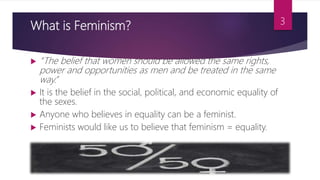
What is Feminism?
 “The belief that women should be allowed the same rights,
power and opportunities as men and be treated in the same
way.”
 It is the belief in the social, political, and economic equality of
the sexes.
 Anyone who believes in equality can be a feminist.
 Feminists would like us to believe that feminism = equality.
3
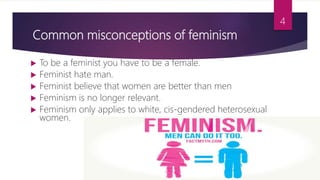
Common misconceptions of feminism
 To be a feminist you have to be a female.
 Feminist hate man.
 Feminist believe that women are better than men
 Feminism is no longer relevant.
 Feminism only applies to white, cis-gendered heterosexual
women.
4
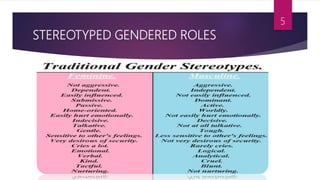
STEREOTYPED GENDERED ROLES
5
Evolution of Feminism
 Women began fighting for equal rights centuries ago. In the early 1600s,
French women began holding salons where educated women could
interact equally with men. Women's rights movements were also influenced
by the Revolutionary War and the French Revolution in the late 1700s. Then,
in the 1800s, women began fighting harder to attain equal rights.
 They have increased people's awareness of the inequalities created by
gender
 Show's how gender roles are socially constructed.
 Black feminists have exposed the color-blindness of mainstream sociology
6
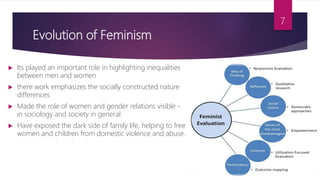
Evolution of Feminism
 Its played an important role in highlighting inequalities
between men and women
 there work emphasizes the socially constructed nature
differences
 Made the role of women and gender relations visible -
in sociology and society in general
 Have exposed the dark side of family life, helping to free
women and children from domestic violence and abuse.
7
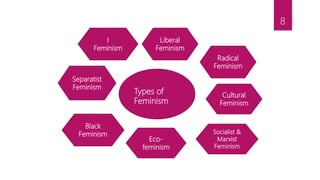
I
Feminism
Radical
Feminism
Separatist
Feminism
Black
Feminism Socialist &
Marxist
Feminism
Cultural
Feminism
Liberal
Feminism
Eco-
feminism
Types of
Feminism
8
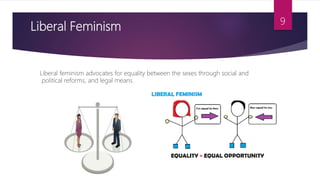
Liberal Feminism
Liberal feminism advocates for equality between the sexes through social and
political reforms, and legal means.
9
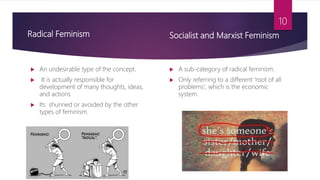
Radical Feminism
 An undesirable type of the concept.
 It is actually responsible for
development of many thoughts, ideas,
and actions
 Its shunned or avoided by the other
types of feminism.
Socialist and Marxist Feminism
 A sub-category of radical feminism.
 Only referring to a different 'root of all
problems', which is the economic
system.
10
Cultural Feminism
 Some experts feel that cultural feminism
is a branch of radical feminism, while
others feel that the two differ
considerably.
Black Feminism
Black feminism believes that racism and
gender discrimination are two sides of the
same coin.
11
Eco-feminism
Eco-feminism is actually
the combination of ecology,
and feminism, that dwells on
the symbolic relationship
between the oppression of
women, and the destruction
of the environment.
12
Separatist Feminism
Separatist feminism is against the concept of
heterosexual relationships, saying that it is not
possible to solve the sexual differences that exist
between a man and a woman
13
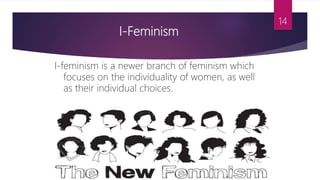
I-Feminism
I-feminism is a newer branch of feminism which
focuses on the individuality of women, as well
as their individual choices.
14
First Wave (1830’s – early 1900’s)
The main concern of first wave:
 Women’s fight for equal
contract and property rights.
 Women were encouraged to
take responsibility for their
own lives.
 Focused on allowing women
citizen’s rights
 Strong emphasis on education
Women were not allowed to-
 Vote
 Sign legal documents
 Own property
 Divorce their husband
 Attend University
 Serve on a jury
15
The second wave (1960’s-1980’s)
The main concern of 2nd wave:
 Equal pay for equal work
 Inequalities for women in defector relationships
 Other legal inequalities for other women in married relationships
 Improved sexual freedom
 Acknowledgement of women of color and queer women as part of the movement.
 Focused on opening economic educational, and political opportunities.
16
Third Wave (1990’s – present)
The main concern of 3rd wave:
 The “micro politics” of gender equality
 Continues to work towards reproductive rights, fixing the pay gap, and correcting society’s
view of women.
 Includes women of all socio-economic backgrounds.
17
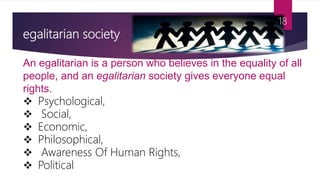
egalitarian society
An egalitarian is a person who believes in the equality of all
people, and an egalitarian society gives everyone equal
rights.
 Psychological,
 Social,
 Economic,
 Philosophical,
 Awareness Of Human Rights,
 Political
18
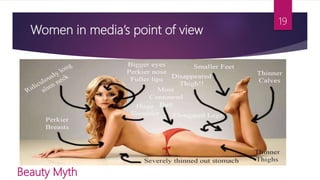
Women in media’s point of view
19
Beauty Myth
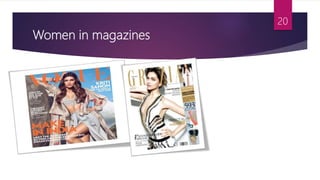
Women in magazines
20
Women in advertisements
21
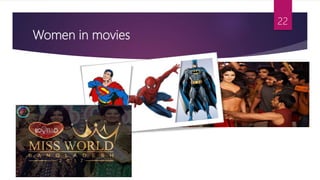
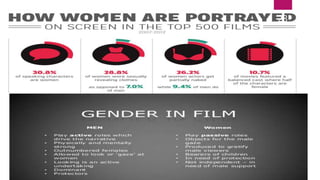
Women in movies
22
23
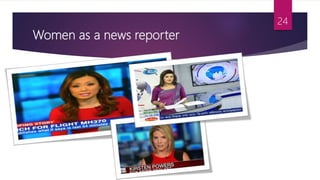
Women as a news reporter
24
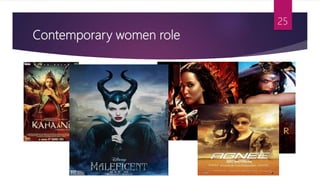
Contemporary women role
25
26

Feminism & media

  • 1.
    Welcome NAWRIN AKHTAR NOTRE DAMEUNIVERSITY BANGLADESH 1
  • 2.
  • 3.
    What is Feminism? “The belief that women should be allowed the same rights, power and opportunities as men and be treated in the same way.”  It is the belief in the social, political, and economic equality of the sexes.  Anyone who believes in equality can be a feminist.  Feminists would like us to believe that feminism = equality. 3
  • 4.
    Common misconceptions offeminism  To be a feminist you have to be a female.  Feminist hate man.  Feminist believe that women are better than men  Feminism is no longer relevant.  Feminism only applies to white, cis-gendered heterosexual women. 4
  • 5.
  • 6.
    Evolution of Feminism Women began fighting for equal rights centuries ago. In the early 1600s, French women began holding salons where educated women could interact equally with men. Women's rights movements were also influenced by the Revolutionary War and the French Revolution in the late 1700s. Then, in the 1800s, women began fighting harder to attain equal rights.  They have increased people's awareness of the inequalities created by gender  Show's how gender roles are socially constructed.  Black feminists have exposed the color-blindness of mainstream sociology 6
  • 7.
    Evolution of Feminism Its played an important role in highlighting inequalities between men and women  there work emphasizes the socially constructed nature differences  Made the role of women and gender relations visible - in sociology and society in general  Have exposed the dark side of family life, helping to free women and children from domestic violence and abuse. 7
  • 8.
  • 9.
    Liberal Feminism Liberal feminismadvocates for equality between the sexes through social and political reforms, and legal means. 9
  • 10.
    Radical Feminism  Anundesirable type of the concept.  It is actually responsible for development of many thoughts, ideas, and actions  Its shunned or avoided by the other types of feminism. Socialist and Marxist Feminism  A sub-category of radical feminism.  Only referring to a different 'root of all problems', which is the economic system. 10
  • 11.
    Cultural Feminism  Someexperts feel that cultural feminism is a branch of radical feminism, while others feel that the two differ considerably. Black Feminism Black feminism believes that racism and gender discrimination are two sides of the same coin. 11
  • 12.
    Eco-feminism Eco-feminism is actually thecombination of ecology, and feminism, that dwells on the symbolic relationship between the oppression of women, and the destruction of the environment. 12
  • 13.
    Separatist Feminism Separatist feminismis against the concept of heterosexual relationships, saying that it is not possible to solve the sexual differences that exist between a man and a woman 13
  • 14.
    I-Feminism I-feminism is anewer branch of feminism which focuses on the individuality of women, as well as their individual choices. 14
  • 15.
    First Wave (1830’s– early 1900’s) The main concern of first wave:  Women’s fight for equal contract and property rights.  Women were encouraged to take responsibility for their own lives.  Focused on allowing women citizen’s rights  Strong emphasis on education Women were not allowed to-  Vote  Sign legal documents  Own property  Divorce their husband  Attend University  Serve on a jury 15
  • 16.
    The second wave(1960’s-1980’s) The main concern of 2nd wave:  Equal pay for equal work  Inequalities for women in defector relationships  Other legal inequalities for other women in married relationships  Improved sexual freedom  Acknowledgement of women of color and queer women as part of the movement.  Focused on opening economic educational, and political opportunities. 16
  • 17.
    Third Wave (1990’s– present) The main concern of 3rd wave:  The “micro politics” of gender equality  Continues to work towards reproductive rights, fixing the pay gap, and correcting society’s view of women.  Includes women of all socio-economic backgrounds. 17
  • 18.
    egalitarian society An egalitarianis a person who believes in the equality of all people, and an egalitarian society gives everyone equal rights.  Psychological,  Social,  Economic,  Philosophical,  Awareness Of Human Rights,  Political 18
  • 19.
    Women in media’spoint of view 19 Beauty Myth
  • 20.
  • 21.
  • 22.
  • 23.
  • 24.
    Women as anews reporter 24
  • 25.
  • 26.