
1. to ‘the rule of the father’: hierarchical social system
2. Based on sex stereotypes that fix dominant/submissive
social roles (and status) for males and females respectively
3. to women’s inequitable status arising from sex differentials
which are naturalised and socially policed from the cradle to
the grave
4. to punishment for transgression of these gender norms
A society is patriarchal to the degree that it
promotes male privilege by being male
dominated, male identified, and male
centred. It is also organised around an
obsession with control and involves as one of
its key aspects the oppression of women.
(Allan G. Johnson)
Male-dominated: think of leaders of institutions,
businesses, organisations, opinion-makers
Male-centred: think of any films you know that are not
about men, for men, by men
Male-identified: men’s ideas and actions are
foregrounded, women’s are in the background,
exceptions or outsiders (e.g. malestream media)
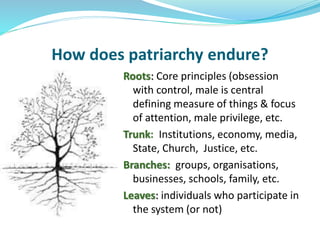
How does patriarchy endure?
Roots: Core principles (obsession
with control, male is central
defining measure of things & focus
of attention, male privilege, etc.
Trunk: Institutions, economy, media,
State, Church, Justice, etc.
Branches: groups, organisations,
businesses, schools, family, etc.
Leaves: individuals who participate in
the system (or not)
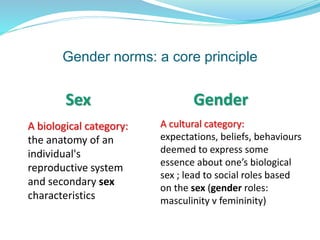
Gender norms: a core principle
Sex Gender
A biological category:
the anatomy of an
individual's
reproductive system
and secondary sex
characteristics
A cultural category:
expectations, beliefs, behaviours
deemed to express some
essence about one’s biological
sex ; lead to social roles based
on the sex (gender roles:
masculinity v femininity)
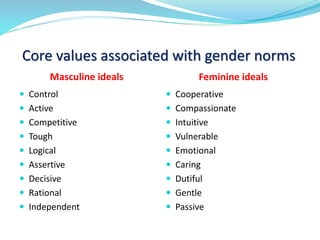
Core values associated with gender norms
Masculine ideals Feminine ideals
 Control
 Active
 Competitive
 Tough
 Logical
 Assertive
 Decisive
 Rational
 Independent
 Cooperative
 Compassionate
 Intuitive
 Vulnerable
 Emotional
 Caring
 Dutiful
 Gentle
 Passive
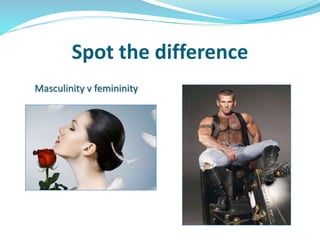
Spot the difference
Masculinity v femininity
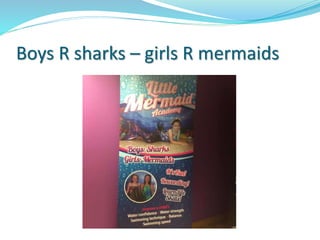
Boys R sharks – girls R mermaids
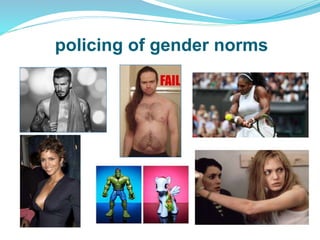
policing of gender norms
In patriarchy everything labelled as "feminine" is despised,
seen as weak and pathetic. What is actually labelled as
"feminine" are the very traits that make you human
(capacity for love, empathy, sorrow, intimacy, connection).
(Gail Dines)
1. a hierarchical social system based on primacy of
male sex class
2. facilitated by sex class differentials (gender roles)
that fix primary/secondary social status for the two
sexes respectively
3. maintained by cultural (and value-laden) gender
norms which are naturalised and socially policed
from the cradle to the grave
4. and transgression of gender norms is ‘punished’
In sum ...
So much for theory.
Here come the women.
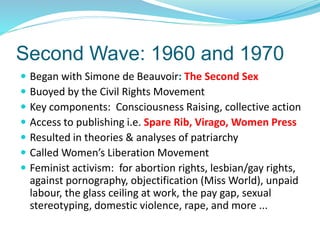
Second Wave: 1960 and 1970
 Began with Simone de Beauvoir: The Second Sex
 Buoyed by the Civil Rights Movement
 Key components: Consciousness Raising, collective action
 Access to publishing i.e. Spare Rib, Virago, Women Press
 Resulted in theories & analyses of patriarchy
 Called Women’s Liberation Movement
 Feminist activism: for abortion rights, lesbian/gay rights,
against pornography, objectification (Miss World), unpaid
labour, the glass ceiling at work, the pay gap, sexual
stereotyping, domestic violence, rape, and more ...
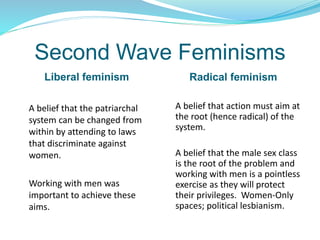
Second Wave Feminisms
Liberal feminism Radical feminism
A belief that the patriarchal
system can be changed from
within by attending to laws
that discriminate against
women.
Working with men was
important to achieve these
aims.
A belief that action must aim at
the root (hence radical) of the
system.
A belief that the male sex class
is the root of the problem and
working with men is a pointless
exercise as they will protect
their privileges. Women-Only
spaces; political lesbianism.
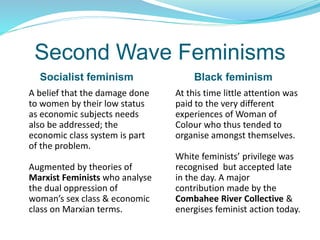
Second Wave Feminisms
Socialist feminism Black feminism
A belief that the damage done
to women by their low status
as economic subjects needs
also be addressed; the
economic class system is part
of the problem.
Augmented by theories of
Marxist Feminists who analyse
the dual oppression of
woman’s sex class & economic
class on Marxian terms.
At this time little attention was
paid to the very different
experiences of Woman of
Colour who thus tended to
organise amongst themselves.
White feminists’ privilege was
recognised but accepted late
in the day. A major
contribution made by the
Combahee River Collective &
energises feminist action today.
suddenly, the Tsunami ...
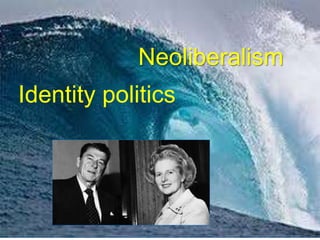
Neoliberalism
Identity politics
Individualism
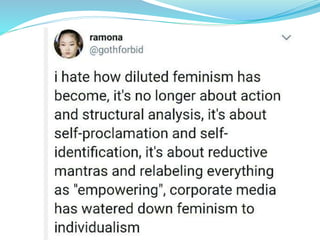
redirecting the focus AWAY from structural problems
Death of the collective Freedom to ... spend
“Political freedom cannot
exist without economic
freedom, a free mind and a
free market are corolloraries.”
i.e.
Freedom to replaces freedom
from injustice, oppression,
inequality ...
“Collectivism, as an
intellectual power and a
moral ideal, is dead. But
freedom and individualism,
and their political
expression, capitalism, have
not yet been discovered.”
(Ayn Rand)
Feminism moves into Ivory Towers
 Academia replaces Women’s Studies with
‘Gender’ Studies; women’s liberation
disappears from purview.
 Some academics write on Marxist Feminism
trying to merge sex-class, race-class and
economic class analysis
 Some academics take positions/promote
issues such as pro-prostitution, pro-porn, etc
Intersectionality arrives
 the idea that every individual at any one time will be
subjected to the combined forces of either sex-class,
and/or race-class and/or economic class discrimination.
Other forces which may also act on the person are age-
class, heteronormativity or able-bodiedness.
 the notion was first posited by Black sisters in the
Combahee River Collective in 1974 and subsequently
taken up by Kimberley Crenshaw.
Enter the Third Wave (neoliberal)
 Spearheaded by young women who had only ever known
individualism, choice and freedom to (do whatever)
 A feminist is someone who has a vagina; provided you
have one you are a feminist – if you want to.
 Prostitution is sex ‘work’ and result of agency & choice
 Pornography is empowering (agency & indiv choice)
 No need for feminism anyway; women are liberated and
can be whatever they want to be
 Young women celebrate ‘slut-walks’ to show they are
individuals agents exercising choice and freedom
some women beg to differ
 Stop Porn culture – an international campaign challenging the
£billion sex industry which commodifies bodies and sexual
relations, serving up blueprints for violence & exploitation.
 End Demand – an international campaign to criminalise sex
buyers, challenging the sex trade which exploits vulnerable
women and girls fostering sex trafficking of women and
children from around the world.
 Campaigning against cuts in women’s services, domestic
violence support & refuges, support for survivors of rape, legal
aid, childcare support and more ...
Women still doing it for themselves
 Challenge male privilege & supremacy (#meto)
 Fight objectification of women (Page 3, OBJECT)
 Fight racism
 Replace identity politics with analysis of power relations
 End Ecocide/WEN (ethical consuming, protection of envir.)
 50:50 campaign to get women into Parliament
 STEMS (girls into maths, sciences, engineering)
 Support for women’s campaigns around the world (FGM,
child brides, breast-binding, period poverty, trafficking, etc.
 FILIA women’s annual conference
For further reading
Gerda Lerner: The Creation of Patriarchy
Allan G. Johnson: The Gender Knot
Finn Mackay: Radical Feminism
Chimamanda Adiche: We should all be Feminists
Rose McGowan: Brave
Beatrix Campbell: The End of Equality
Heather Brown: Marx on gender & the family
The End

What is feminism master

  • 2.
    1. to ‘therule of the father’: hierarchical social system 2. Based on sex stereotypes that fix dominant/submissive social roles (and status) for males and females respectively 3. to women’s inequitable status arising from sex differentials which are naturalised and socially policed from the cradle to the grave 4. to punishment for transgression of these gender norms
  • 3.
    A society ispatriarchal to the degree that it promotes male privilege by being male dominated, male identified, and male centred. It is also organised around an obsession with control and involves as one of its key aspects the oppression of women. (Allan G. Johnson)
  • 4.
    Male-dominated: think ofleaders of institutions, businesses, organisations, opinion-makers Male-centred: think of any films you know that are not about men, for men, by men Male-identified: men’s ideas and actions are foregrounded, women’s are in the background, exceptions or outsiders (e.g. malestream media)
  • 5.
    How does patriarchyendure? Roots: Core principles (obsession with control, male is central defining measure of things & focus of attention, male privilege, etc. Trunk: Institutions, economy, media, State, Church, Justice, etc. Branches: groups, organisations, businesses, schools, family, etc. Leaves: individuals who participate in the system (or not)
  • 6.
    Gender norms: acore principle Sex Gender A biological category: the anatomy of an individual's reproductive system and secondary sex characteristics A cultural category: expectations, beliefs, behaviours deemed to express some essence about one’s biological sex ; lead to social roles based on the sex (gender roles: masculinity v femininity)
  • 7.
    Core values associatedwith gender norms Masculine ideals Feminine ideals  Control  Active  Competitive  Tough  Logical  Assertive  Decisive  Rational  Independent  Cooperative  Compassionate  Intuitive  Vulnerable  Emotional  Caring  Dutiful  Gentle  Passive
  • 8.
  • 9.
    Boys R sharks– girls R mermaids
  • 10.
  • 11.
    In patriarchy everythinglabelled as "feminine" is despised, seen as weak and pathetic. What is actually labelled as "feminine" are the very traits that make you human (capacity for love, empathy, sorrow, intimacy, connection). (Gail Dines)
  • 12.
    1. a hierarchicalsocial system based on primacy of male sex class 2. facilitated by sex class differentials (gender roles) that fix primary/secondary social status for the two sexes respectively 3. maintained by cultural (and value-laden) gender norms which are naturalised and socially policed from the cradle to the grave 4. and transgression of gender norms is ‘punished’ In sum ...
  • 13.
    So much fortheory. Here come the women.
  • 14.
    Second Wave: 1960and 1970  Began with Simone de Beauvoir: The Second Sex  Buoyed by the Civil Rights Movement  Key components: Consciousness Raising, collective action  Access to publishing i.e. Spare Rib, Virago, Women Press  Resulted in theories & analyses of patriarchy  Called Women’s Liberation Movement  Feminist activism: for abortion rights, lesbian/gay rights, against pornography, objectification (Miss World), unpaid labour, the glass ceiling at work, the pay gap, sexual stereotyping, domestic violence, rape, and more ...
  • 15.
    Second Wave Feminisms Liberalfeminism Radical feminism A belief that the patriarchal system can be changed from within by attending to laws that discriminate against women. Working with men was important to achieve these aims. A belief that action must aim at the root (hence radical) of the system. A belief that the male sex class is the root of the problem and working with men is a pointless exercise as they will protect their privileges. Women-Only spaces; political lesbianism.
  • 16.
    Second Wave Feminisms Socialistfeminism Black feminism A belief that the damage done to women by their low status as economic subjects needs also be addressed; the economic class system is part of the problem. Augmented by theories of Marxist Feminists who analyse the dual oppression of woman’s sex class & economic class on Marxian terms. At this time little attention was paid to the very different experiences of Woman of Colour who thus tended to organise amongst themselves. White feminists’ privilege was recognised but accepted late in the day. A major contribution made by the Combahee River Collective & energises feminist action today.
  • 17.
  • 18.
  • 19.
    Individualism redirecting the focusAWAY from structural problems
  • 20.
    Death of thecollective Freedom to ... spend “Political freedom cannot exist without economic freedom, a free mind and a free market are corolloraries.” i.e. Freedom to replaces freedom from injustice, oppression, inequality ... “Collectivism, as an intellectual power and a moral ideal, is dead. But freedom and individualism, and their political expression, capitalism, have not yet been discovered.” (Ayn Rand)
  • 21.
    Feminism moves intoIvory Towers  Academia replaces Women’s Studies with ‘Gender’ Studies; women’s liberation disappears from purview.  Some academics write on Marxist Feminism trying to merge sex-class, race-class and economic class analysis  Some academics take positions/promote issues such as pro-prostitution, pro-porn, etc
  • 22.
    Intersectionality arrives  theidea that every individual at any one time will be subjected to the combined forces of either sex-class, and/or race-class and/or economic class discrimination. Other forces which may also act on the person are age- class, heteronormativity or able-bodiedness.  the notion was first posited by Black sisters in the Combahee River Collective in 1974 and subsequently taken up by Kimberley Crenshaw.
  • 23.
    Enter the ThirdWave (neoliberal)  Spearheaded by young women who had only ever known individualism, choice and freedom to (do whatever)  A feminist is someone who has a vagina; provided you have one you are a feminist – if you want to.  Prostitution is sex ‘work’ and result of agency & choice  Pornography is empowering (agency & indiv choice)  No need for feminism anyway; women are liberated and can be whatever they want to be  Young women celebrate ‘slut-walks’ to show they are individuals agents exercising choice and freedom
  • 25.
    some women begto differ  Stop Porn culture – an international campaign challenging the £billion sex industry which commodifies bodies and sexual relations, serving up blueprints for violence & exploitation.  End Demand – an international campaign to criminalise sex buyers, challenging the sex trade which exploits vulnerable women and girls fostering sex trafficking of women and children from around the world.  Campaigning against cuts in women’s services, domestic violence support & refuges, support for survivors of rape, legal aid, childcare support and more ...
  • 26.
    Women still doingit for themselves  Challenge male privilege & supremacy (#meto)  Fight objectification of women (Page 3, OBJECT)  Fight racism  Replace identity politics with analysis of power relations  End Ecocide/WEN (ethical consuming, protection of envir.)  50:50 campaign to get women into Parliament  STEMS (girls into maths, sciences, engineering)  Support for women’s campaigns around the world (FGM, child brides, breast-binding, period poverty, trafficking, etc.  FILIA women’s annual conference
  • 27.
    For further reading GerdaLerner: The Creation of Patriarchy Allan G. Johnson: The Gender Knot Finn Mackay: Radical Feminism Chimamanda Adiche: We should all be Feminists Rose McGowan: Brave Beatrix Campbell: The End of Equality Heather Brown: Marx on gender & the family The End