FEMINIST SOCIAL THEORY
Vimal Kumar V.
Research Scholar
School of Social Sciences
Mahatma Gandhi University
Www.vimalkumar.info
Feminism
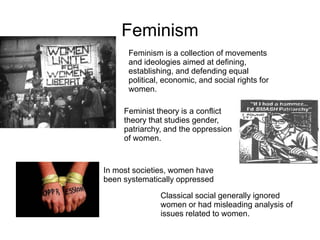
Feminism is a collection of movements
and ideologies aimed at defining,
establishing, and defending equal
political, economic, and social rights for
women.
Feminist theory is a conflict
theory that studies gender,
patriarchy, and the oppression
of women.
In most societies, women have
been systematically oppressed
Classical social generally ignored
women or had misleading analysis of
issues related to women.
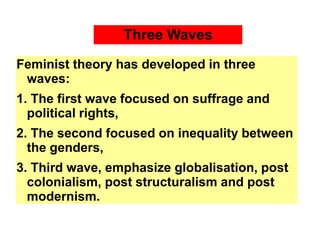
Feminist theory has developed in three
waves:
1. The first wave focused on suffrage and
political rights,
2. The second focused on inequality between
the genders,
3. Third wave, emphasize globalisation, post
colonialism, post structuralism and post
modernism.
Three Waves
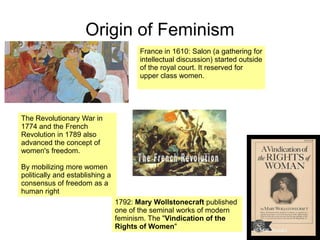
Origin of Feminism
France in 1610: Salon (a gathering for
intellectual discussion) started outside
of the royal court. It reserved for
upper class women.
1792: Mary Wollstonecraft published
one of the seminal works of modern
feminism. The "Vindication of the
Rights of Women"
The Revolutionary War in
1774 and the French
Revolution in 1789 also
advanced the concept of
women's freedom.
By mobilizing more women
politically and establishing a
consensus of freedom as a
human right
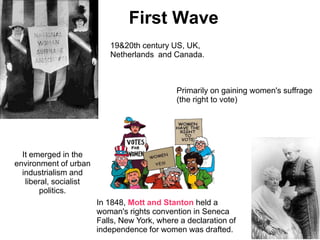
First Wave
In 1848, Mott and Stanton held a
woman's rights convention in Seneca
Falls, New York, where a declaration of
independence for women was drafted.
19&20th century US, UK,
Netherlands and Canada.
Primarily on gaining women's suffrage
(the right to vote)
It emerged in the
environment of urban
industrialism and
liberal, socialist
politics.
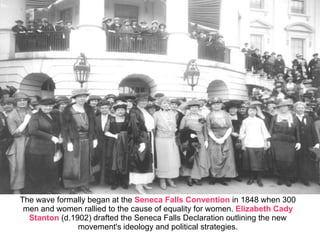
The wave formally began at the Seneca Falls Convention in 1848 when 300
men and women rallied to the cause of equality for women. Elizabeth Cady
Stanton (d.1902) drafted the Seneca Falls Declaration outlining the new
movement's ideology and political strategies.
The convention lead to the
Declaration of Sentiments.
• Modeled after the Declaration of
Independence.
• All men and women created equal.
• Spoke of the supremacy of man in regards to
divorce and education
The convention marked a 22 year battle to gain
women the right to vote in the United States.
• In 1920 US women won the right to vote.
Second Wave
Second Wave began in the early
1960's in the United states. Later it
spread to Europe and Asia. It lasted
through the early 1980's.
It focused on social inequality between genders.
It tackled the issues like sexuality, family, the
workplace, reproductive rights, de facto
inequalities, and official legal inequalities.
Published in 1949 and it deals with the
treatment of women throughout
history and is often regarded as a major
work of feminist philosophy and the
starting point of second-wave feminism.
Betty Friedan A leading figure in the women's movement in the
United States, her 1963 book The Feminine Mystique is often
credited with sparking the second wave of American feminism in the
20th century. In 1966, Friedan founded and was elected the first
president of the National Organization for Women (NOW), which
aimed to bring women "into the mainstream of American society
now [in] fully equal partnership with men".
The report of the [American] Presidential
Commission on the Status of Women found
discrimination against women in every aspect of
American life and outlined plans to achieve equality.
Specific recommendations for women in the workplace
included fair hiring practices, paid maternity leave,
and affordable childcare.
1971-The first women's liberation
march in London occurred.
1973-Women are allowed on the
floor of the London Stock
Exchange for the first time.
1974-Contraception became free
for women in the United
Kingdom.
1979- Margaret Thatcher became the
first female Prime Minister of the
United Kingdom.
Third Wave
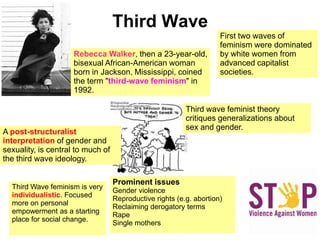
Rebecca Walker, then a 23-year-old,
bisexual African-American woman
born in Jackson, Mississippi, coined
the term "third-wave feminism" in
1992.
Third wave feminist theory
critiques generalizations about
sex and gender.
A post-structuralist
interpretation of gender and
sexuality, is central to much of
the third wave ideology.
Prominent issues
Gender violence
Reproductive rights (e.g. abortion)
Reclaiming derogatory terms
Rape
Single mothers
First two waves of
feminism were dominated
by white women from
advanced capitalist
societies.
Third Wave feminism is very
individualistic. Focused
more on personal
empowerment as a starting
place for social change.
There are several different
types of Feminist theory,
but all of them share
certain characteristics.
•They all believe that there is a
fundamental division in society between
men & women.
•That women are to some extent
exploited by men.
•That society is male dominated or
Patriarchal.
Differences between the
perspectives of
different Feminists....
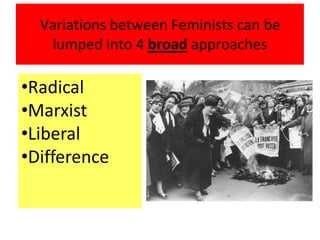
Variations between Feminists can be
lumped into 4 broad approaches
•Radical
•Marxist
•Liberal
•Difference
Radical (basically meaning extreme)
feminists Believe that men are the enemy,
and that they control, exploit &
oppress women through the process of
patriarchy (male rule or domination)
in employment, family relations,
sexual relations & status.
Radical feminism
Radical Feminists solution to this:
 Men give up their patriarchy
 Women exist without men & self-reproduce
 Women keep their lives separate from men
 Abolish the nuclear family unit
Marxist Feminism
In the 1970’s a number of women began to draw
Upon Marxist theory to explain the oppression of
Women in society.
They do not see women’s oppression arising
solely From Patriarchy, but primarily from
Capitalism that Forces them to be unpaid
labourers & nurturers in Order to maintain
capitalism.
Liberal Feminism
Liberal Feminism is less of a theoretical
perspective and more of a political movement.
They tend to criticise other Feminists for ignoring
the progress that has been made in society with
regards to gender inequality.
They are also more likely to argue that gender
Roles are also limiting for men
Difference Feminism
Basically, the 3 branches of feminism we have
just considered tend to see women as a single
group who share the same interests,
experiences & types of exploitation.
Difference Feminism, that has much in common
with Post modernism, argues that women have
a variety of interests & needs and are not one
single united group.
Conclusion
Feminism has always thrived on and grown
from internal discussions and disagreements.
Feminist movement has made changes in
Western society; right to vote, equal pay,
contraceptives etc.
Feminist theories are not capable of
addressing issues facing by women from
different cultural contexts.

Feminist social theory

  • 1.
    FEMINIST SOCIAL THEORY VimalKumar V. Research Scholar School of Social Sciences Mahatma Gandhi University Www.vimalkumar.info
  • 2.
    Feminism Feminism is acollection of movements and ideologies aimed at defining, establishing, and defending equal political, economic, and social rights for women. Feminist theory is a conflict theory that studies gender, patriarchy, and the oppression of women. In most societies, women have been systematically oppressed Classical social generally ignored women or had misleading analysis of issues related to women.
  • 5.
    Feminist theory hasdeveloped in three waves: 1. The first wave focused on suffrage and political rights, 2. The second focused on inequality between the genders, 3. Third wave, emphasize globalisation, post colonialism, post structuralism and post modernism. Three Waves
  • 6.
    Origin of Feminism Francein 1610: Salon (a gathering for intellectual discussion) started outside of the royal court. It reserved for upper class women. 1792: Mary Wollstonecraft published one of the seminal works of modern feminism. The "Vindication of the Rights of Women" The Revolutionary War in 1774 and the French Revolution in 1789 also advanced the concept of women's freedom. By mobilizing more women politically and establishing a consensus of freedom as a human right
  • 7.
    First Wave In 1848,Mott and Stanton held a woman's rights convention in Seneca Falls, New York, where a declaration of independence for women was drafted. 19&20th century US, UK, Netherlands and Canada. Primarily on gaining women's suffrage (the right to vote) It emerged in the environment of urban industrialism and liberal, socialist politics.
  • 8.
    The wave formallybegan at the Seneca Falls Convention in 1848 when 300 men and women rallied to the cause of equality for women. Elizabeth Cady Stanton (d.1902) drafted the Seneca Falls Declaration outlining the new movement's ideology and political strategies.
  • 9.
    The convention leadto the Declaration of Sentiments. • Modeled after the Declaration of Independence. • All men and women created equal. • Spoke of the supremacy of man in regards to divorce and education The convention marked a 22 year battle to gain women the right to vote in the United States. • In 1920 US women won the right to vote.
  • 10.
    Second Wave Second Wavebegan in the early 1960's in the United states. Later it spread to Europe and Asia. It lasted through the early 1980's. It focused on social inequality between genders. It tackled the issues like sexuality, family, the workplace, reproductive rights, de facto inequalities, and official legal inequalities. Published in 1949 and it deals with the treatment of women throughout history and is often regarded as a major work of feminist philosophy and the starting point of second-wave feminism. Betty Friedan A leading figure in the women's movement in the United States, her 1963 book The Feminine Mystique is often credited with sparking the second wave of American feminism in the 20th century. In 1966, Friedan founded and was elected the first president of the National Organization for Women (NOW), which aimed to bring women "into the mainstream of American society now [in] fully equal partnership with men".
  • 11.
    The report ofthe [American] Presidential Commission on the Status of Women found discrimination against women in every aspect of American life and outlined plans to achieve equality. Specific recommendations for women in the workplace included fair hiring practices, paid maternity leave, and affordable childcare. 1971-The first women's liberation march in London occurred. 1973-Women are allowed on the floor of the London Stock Exchange for the first time. 1974-Contraception became free for women in the United Kingdom. 1979- Margaret Thatcher became the first female Prime Minister of the United Kingdom.
  • 12.
    Third Wave Rebecca Walker,then a 23-year-old, bisexual African-American woman born in Jackson, Mississippi, coined the term "third-wave feminism" in 1992. Third wave feminist theory critiques generalizations about sex and gender. A post-structuralist interpretation of gender and sexuality, is central to much of the third wave ideology. Prominent issues Gender violence Reproductive rights (e.g. abortion) Reclaiming derogatory terms Rape Single mothers First two waves of feminism were dominated by white women from advanced capitalist societies. Third Wave feminism is very individualistic. Focused more on personal empowerment as a starting place for social change.
  • 13.
    There are severaldifferent types of Feminist theory, but all of them share certain characteristics.
  • 14.
    •They all believethat there is a fundamental division in society between men & women. •That women are to some extent exploited by men. •That society is male dominated or Patriarchal.
  • 15.
    Differences between the perspectivesof different Feminists....
  • 16.
    Variations between Feministscan be lumped into 4 broad approaches •Radical •Marxist •Liberal •Difference
  • 17.
    Radical (basically meaningextreme) feminists Believe that men are the enemy, and that they control, exploit & oppress women through the process of patriarchy (male rule or domination) in employment, family relations, sexual relations & status. Radical feminism
  • 18.
    Radical Feminists solutionto this:  Men give up their patriarchy  Women exist without men & self-reproduce  Women keep their lives separate from men  Abolish the nuclear family unit
  • 19.
    Marxist Feminism In the1970’s a number of women began to draw Upon Marxist theory to explain the oppression of Women in society. They do not see women’s oppression arising solely From Patriarchy, but primarily from Capitalism that Forces them to be unpaid labourers & nurturers in Order to maintain capitalism.
  • 20.
    Liberal Feminism Liberal Feminismis less of a theoretical perspective and more of a political movement. They tend to criticise other Feminists for ignoring the progress that has been made in society with regards to gender inequality. They are also more likely to argue that gender Roles are also limiting for men
  • 21.
    Difference Feminism Basically, the3 branches of feminism we have just considered tend to see women as a single group who share the same interests, experiences & types of exploitation. Difference Feminism, that has much in common with Post modernism, argues that women have a variety of interests & needs and are not one single united group.
  • 22.
    Conclusion Feminism has alwaysthrived on and grown from internal discussions and disagreements. Feminist movement has made changes in Western society; right to vote, equal pay, contraceptives etc. Feminist theories are not capable of addressing issues facing by women from different cultural contexts.