◤
Feedback In
Writing
By: Nives Migliaccio and Emily Morris
◤
What Do Grades Mean To You?
◤
Writing Comments on
Students Papers
James Bean
“The writing teachers ministry is not just to the words but to the
person who wrote the words.” - William Zinsser’s Writing to
Learn (1988)
◤
Students Responses to Teacher’s
Comments
● A major issue is that teachers’ comments on
students papers are often too short and cryptic. At
times teachers let their irritation show on the page.
What does this mean for the students emotional
state?
● Teachers know what they mean to say and the tone
in which they mean to convey it in. But does the
student? How does this make the student feel?
◤
Students Responses to Teacher’s
Comments
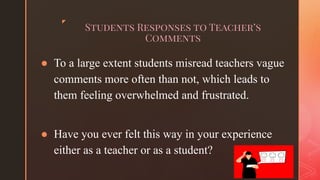
● To a large extent students misread teachers vague
comments more often than not, which leads to
them feeling overwhelmed and frustrated.
● Have you ever felt this way in your experience
either as a teacher or as a student?
◤ The Importance of Emotions in
Learning
Why are students emotions important when it
comes to feedback and grading? Many educators
forget the significance behind the grades they
assign and more importantly the weight of their
words. The extent to which students mis read
teachers comments is revealed in Spangel and
Stiggins study (1990).
◤
The Importance of Emotions in
Learning (cont.)
Students were asked to describe their reactions to
marginal comments made by their teacher on their essays.
What is important to note is: The students were asked to
not only access what they thought the comments meant but
also how it made them feel. The conclusion of the study is
telling. Negative feedback made for negative emotions, but
the positive feedback helped to build confidence and
enhances the students cognition (Zull).
◤ “The Amygdala and the Teacher.”
James E. Zull is a Professor of Biology and of
Biochemistry, and the Director of The University
Center for Innovation in Teaching and Education
(UCITE) at Case Western Reserve University. Spandel
and Stiggins insights fall within Zulls current brain
research data which shows the importance of emotions
to learning (2002).
◤
“The Amygdala and the Teacher.”
(cont.)
Zull explains that: “when we want someone to learn,
we should be aware that our learner will be quickly and
subconsciously monitoring their situation through their
amygdala [the “fear center” or “danger center” of the
brain.”] That means that fear and anxiety will block
meaningful learning. To promote meaningful learning
Zull argues teachers should build on students strengths,
evoking feelings of hope and confidence in their writing.
◤The Purpose of Commenting: To Coach
Revision
➢ When commenting on a students paper Bean suggests we play
the role of a supportive coach.
❖ It is in the act of revising that students learn most deeply about
what they want to say and what their readers need for
comprehension.
➔ Revising doesn’t mean just editing; it means
re-visioning-rethinking, reconceptualizing,“seeing again.”
● A second strategy and favorite of Bean’s is to allow rewrites
after returning the “finished” papers. This second chance
inspires most students to work hard and improve their grade.
◤
Direct vs. Mitigating Criticism
● Mitigating comments
frame criticism in a
positive way using both
positive and negative
feedback in order to
buffer students anger or
mitigate feelings of
incompetence.
● Direct criticism-no
mitigation leaves the
students to read into a
teacher’s tone which is
only focused on the
negatives. This leaves
most students feeling
defeated and angry.
◤
Writing End Comments That
Encourage Revision
Bean recommends thinking of your end comment as a
guiding revision, which helps students to work more thoroughly
on their final drafts and improve their final grade. He tells
students: That a draft is to a finished product as a caterpillar is
to a butterfly: all that is missing is the metamorphosis. Most
importantly he believes that a draft that is unsuccessful as a
final product may still be an excellent draft in the making.
Teachers should never give up on their students writing and
focus on their budding potential.
◤
A Review of James Bean’s General
Principals
➔ General Procedures: Comment first on ideas and organization. Encourage students
to solve higher-order problems. Whenever possible make positive comments and
give praise. Try to write an end comment that reveals your interest in the students
ideas. Avoid over commenting. Indicate your reaction to specific passages. Give
praise to parts you like. Resist the urge to circle misspellings, punctuation errors,
and so forth.
➔ Marking for Ideas: The end comment should summarize your assessments of the
strengths and weaknesses of the writers ideas. Challenge writers to deepen their
thoughts at a level appropriate to their development.
◤
A Review of James Bean’s General
Principals (cont.)
➔ Marking for Organization:
Use marginal comments to
indicate places where structure
becomes confusing. PRAISE
good titles, good thesis
statements, good transitions,
and so forth. Give positive
feedback if the structure of the
essay is solid.
★ Marking for Sentence
Structure: Marking or circling
errors is not suggested but a
teacher should consider placing
check marks in the margins
where errors occur. Consider
withholding grades or lower the
grade until students have re
edited their work. Students are
capable of fixing their errors.
◤
A Review of James Bean’s General
Principals (cont.)
★ Some Further Principles: Try
to make comments as legible
and as straightforward as
possible. Teachers comments
are often unintentional examples
of first-draft writing-clear to the
teacher but baffling to the
student.
★ Whenever possible use
one-on-one conferences instead
of commenting on papers.
Inviting the student to come see
you for individual help shows
the student you care and are
personalizing the grading
experience. Lastly use your tone
as a supportive coach.
◤“The best kind of commentary
enhances the writer’s feeling of
dignity.” - James Bean
◤
Ranking, Evaluating, and
Liking: Sorting Out
Three Forms of Judgement
Peter Elbow
“People are obviously far more anxious to express their
approval and disapproval of things than to describe them” -C.S.
Lewis
◤
The Problems with Ranking and the
Benefits of Evaluating
▪ Ranking- the act of summing up one’s judgement of a
performance or person into a single, holistic number or score
▪ Evaluating- the act of expressing one’s judgement of
performance or person by pointing out the strengths and
weaknesses of different features or dimensions
◤
The Problems with Ranking and the
Benefits of Evaluating
▪ Do you feel as if there is a problem with
ranking? If so/not, explain?
▪ What’s your take on evaluating? Do you
think it can hurt or help the child?
◤
The Problems with Ranking and the
Benefits of Evaluating
Three problems with ranking:
1. Unreliability
2. Uncommunicative
3. Oversimple Quantitative Verdicts
◤
The Problems with Ranking and the
Benefits of Evaluating
1. Unreliability
a. to give a fair number
b. students have shown inconsistency of handling same papers to
different teachers resulting in different grades
c. “What do you want for an A?”
The reliability in holistic scoring is not a measure of how texts are
valued by real readers in natural settings, but only how they are
valued in artificial settings with imposed agreements (189).
◤
The Problems with Ranking and the
Benefits of Evaluating1.
2. Uncommunicative
a. nothing but points on a continuum from “yea” to “boo”
b. 100% evaluation & 0% description or information
c. The degree of approval or disapproval
We need a system for communicating our judgements that pushes
those to move beyond these holistic feelings and to articulate the
basis of our feeling--a process that often leads us to change our
feeling (190).
◤
The Problems with Ranking and the
Benefits of Evaluating
1.
2.
3. Oversimple Quantitative Verdicts
a. unsuccessful students begin to doubt their intelligence
b. success students feel like frauds due to giving what the teacher
wants them to write
c. might be tempted to put up with the inaccuracy or unfairness of
grades
It’s obviously easier and quicker to express global feeling with a
single number than to figure out what the strengths and
weaknesses are and what one’s criteria are (190).
◤
◤
The Problems with Ranking and the
Benefits of Evaluating
The process of evaluating helps us make the following kinds of
statements about any piece of writing:
▪ the thinking and ideas seem interesting and creative
▪ the overall structure or sequences seems confusing
▪ the writing is perfectly clear at the level of individual sentences and even
paragraphs
▪ there is an odd, angry tone of voice that seems unrelated or inappropriate to
what the writer is saying
▪ there are a fair number of mistakes in grammar or spelling
◤
The Limitations of Evaluation and the
Benefits of Evaluation-free Zones
▪ Evaluation tends to imply fairness or reliability or getting
beyond personal or subjective preferences
▪ Evaluation takes more time and work
▪ holistic scoring is cheaper than analytic scoring
▪ Evaluation harms the
climate for learning and
teaching
◤
The Limitations of Evaluation and the
Benefits of Evaluation-free Zones
1. Freewrite
a. ten minutes, nonstop
2. Sketch
a. writing that won’t be revised
3. “Jumpstart”
a. more writing for homework than usual
◤
The Limitations of Evaluation and the
Benefits of Evaluation-free Zones
Do you remember any writing course where
you might have experienced any of the three
Evaluation-free Zones?
“Students have a better time writing these unevaluated pieces; they enjoy
hearing and appreciating them when they don’t have to evaluate” (199).
◤
The Benefits and Feasibility of Liking
1. First you improve
the faults and then
you like it.
1.
2. First you like it and
then you improve
faults.
In what group would you categorize
yourself in when you write?
◤
◤
The Benefits and Feasibility of Liking
A. Lots of private writing and merely shared writing
B. Have students share lots of writing with each other
C. Better finding of what is good--or potentially good
D. Take steps to get to know them as a person
E. The more you expose yourself, the easier it is to like them
and their writing
F. Work on your own writing--and work on learning to like it
◤
The Benefits and Feasibility of Liking
Final Points
▪ Less ranking and grading
▪ Use more evaluation, not too much
▪ Establish some Evaluation-free Zones
▪ Learn to better likers of your own and our students’
writing
◤
Class Discussion

Feedback Group Discussion

  • 1.
    ◤ Feedback In Writing By: NivesMigliaccio and Emily Morris
  • 2.
    ◤ What Do GradesMean To You?
  • 3.
    ◤ Writing Comments on StudentsPapers James Bean “The writing teachers ministry is not just to the words but to the person who wrote the words.” - William Zinsser’s Writing to Learn (1988)
  • 4.
    ◤ Students Responses toTeacher’s Comments ● A major issue is that teachers’ comments on students papers are often too short and cryptic. At times teachers let their irritation show on the page. What does this mean for the students emotional state? ● Teachers know what they mean to say and the tone in which they mean to convey it in. But does the student? How does this make the student feel?
  • 5.
    ◤ Students Responses toTeacher’s Comments ● To a large extent students misread teachers vague comments more often than not, which leads to them feeling overwhelmed and frustrated. ● Have you ever felt this way in your experience either as a teacher or as a student?
  • 6.
    ◤ The Importanceof Emotions in Learning Why are students emotions important when it comes to feedback and grading? Many educators forget the significance behind the grades they assign and more importantly the weight of their words. The extent to which students mis read teachers comments is revealed in Spangel and Stiggins study (1990).
  • 7.
    ◤ The Importance ofEmotions in Learning (cont.) Students were asked to describe their reactions to marginal comments made by their teacher on their essays. What is important to note is: The students were asked to not only access what they thought the comments meant but also how it made them feel. The conclusion of the study is telling. Negative feedback made for negative emotions, but the positive feedback helped to build confidence and enhances the students cognition (Zull).
  • 8.
    ◤ “The Amygdalaand the Teacher.” James E. Zull is a Professor of Biology and of Biochemistry, and the Director of The University Center for Innovation in Teaching and Education (UCITE) at Case Western Reserve University. Spandel and Stiggins insights fall within Zulls current brain research data which shows the importance of emotions to learning (2002).
  • 9.
    ◤ “The Amygdala andthe Teacher.” (cont.) Zull explains that: “when we want someone to learn, we should be aware that our learner will be quickly and subconsciously monitoring their situation through their amygdala [the “fear center” or “danger center” of the brain.”] That means that fear and anxiety will block meaningful learning. To promote meaningful learning Zull argues teachers should build on students strengths, evoking feelings of hope and confidence in their writing.
  • 10.
    ◤The Purpose ofCommenting: To Coach Revision ➢ When commenting on a students paper Bean suggests we play the role of a supportive coach. ❖ It is in the act of revising that students learn most deeply about what they want to say and what their readers need for comprehension. ➔ Revising doesn’t mean just editing; it means re-visioning-rethinking, reconceptualizing,“seeing again.” ● A second strategy and favorite of Bean’s is to allow rewrites after returning the “finished” papers. This second chance inspires most students to work hard and improve their grade.
  • 11.
    ◤ Direct vs. MitigatingCriticism ● Mitigating comments frame criticism in a positive way using both positive and negative feedback in order to buffer students anger or mitigate feelings of incompetence. ● Direct criticism-no mitigation leaves the students to read into a teacher’s tone which is only focused on the negatives. This leaves most students feeling defeated and angry.
  • 12.
    ◤ Writing End CommentsThat Encourage Revision Bean recommends thinking of your end comment as a guiding revision, which helps students to work more thoroughly on their final drafts and improve their final grade. He tells students: That a draft is to a finished product as a caterpillar is to a butterfly: all that is missing is the metamorphosis. Most importantly he believes that a draft that is unsuccessful as a final product may still be an excellent draft in the making. Teachers should never give up on their students writing and focus on their budding potential.
  • 13.
    ◤ A Review ofJames Bean’s General Principals ➔ General Procedures: Comment first on ideas and organization. Encourage students to solve higher-order problems. Whenever possible make positive comments and give praise. Try to write an end comment that reveals your interest in the students ideas. Avoid over commenting. Indicate your reaction to specific passages. Give praise to parts you like. Resist the urge to circle misspellings, punctuation errors, and so forth. ➔ Marking for Ideas: The end comment should summarize your assessments of the strengths and weaknesses of the writers ideas. Challenge writers to deepen their thoughts at a level appropriate to their development.
  • 14.
    ◤ A Review ofJames Bean’s General Principals (cont.) ➔ Marking for Organization: Use marginal comments to indicate places where structure becomes confusing. PRAISE good titles, good thesis statements, good transitions, and so forth. Give positive feedback if the structure of the essay is solid. ★ Marking for Sentence Structure: Marking or circling errors is not suggested but a teacher should consider placing check marks in the margins where errors occur. Consider withholding grades or lower the grade until students have re edited their work. Students are capable of fixing their errors.
  • 15.
    ◤ A Review ofJames Bean’s General Principals (cont.) ★ Some Further Principles: Try to make comments as legible and as straightforward as possible. Teachers comments are often unintentional examples of first-draft writing-clear to the teacher but baffling to the student. ★ Whenever possible use one-on-one conferences instead of commenting on papers. Inviting the student to come see you for individual help shows the student you care and are personalizing the grading experience. Lastly use your tone as a supportive coach.
  • 17.
    ◤“The best kindof commentary enhances the writer’s feeling of dignity.” - James Bean
  • 18.
    ◤ Ranking, Evaluating, and Liking:Sorting Out Three Forms of Judgement Peter Elbow “People are obviously far more anxious to express their approval and disapproval of things than to describe them” -C.S. Lewis
  • 19.
    ◤ The Problems withRanking and the Benefits of Evaluating ▪ Ranking- the act of summing up one’s judgement of a performance or person into a single, holistic number or score ▪ Evaluating- the act of expressing one’s judgement of performance or person by pointing out the strengths and weaknesses of different features or dimensions
  • 20.
    ◤ The Problems withRanking and the Benefits of Evaluating ▪ Do you feel as if there is a problem with ranking? If so/not, explain? ▪ What’s your take on evaluating? Do you think it can hurt or help the child?
  • 21.
    ◤ The Problems withRanking and the Benefits of Evaluating Three problems with ranking: 1. Unreliability 2. Uncommunicative 3. Oversimple Quantitative Verdicts
  • 22.
    ◤ The Problems withRanking and the Benefits of Evaluating 1. Unreliability a. to give a fair number b. students have shown inconsistency of handling same papers to different teachers resulting in different grades c. “What do you want for an A?” The reliability in holistic scoring is not a measure of how texts are valued by real readers in natural settings, but only how they are valued in artificial settings with imposed agreements (189).
  • 23.
    ◤ The Problems withRanking and the Benefits of Evaluating1. 2. Uncommunicative a. nothing but points on a continuum from “yea” to “boo” b. 100% evaluation & 0% description or information c. The degree of approval or disapproval We need a system for communicating our judgements that pushes those to move beyond these holistic feelings and to articulate the basis of our feeling--a process that often leads us to change our feeling (190).
  • 24.
    ◤ The Problems withRanking and the Benefits of Evaluating 1. 2. 3. Oversimple Quantitative Verdicts a. unsuccessful students begin to doubt their intelligence b. success students feel like frauds due to giving what the teacher wants them to write c. might be tempted to put up with the inaccuracy or unfairness of grades It’s obviously easier and quicker to express global feeling with a single number than to figure out what the strengths and weaknesses are and what one’s criteria are (190).
  • 25.
  • 26.
    ◤ The Problems withRanking and the Benefits of Evaluating The process of evaluating helps us make the following kinds of statements about any piece of writing: ▪ the thinking and ideas seem interesting and creative ▪ the overall structure or sequences seems confusing ▪ the writing is perfectly clear at the level of individual sentences and even paragraphs ▪ there is an odd, angry tone of voice that seems unrelated or inappropriate to what the writer is saying ▪ there are a fair number of mistakes in grammar or spelling
  • 27.
    ◤ The Limitations ofEvaluation and the Benefits of Evaluation-free Zones ▪ Evaluation tends to imply fairness or reliability or getting beyond personal or subjective preferences ▪ Evaluation takes more time and work ▪ holistic scoring is cheaper than analytic scoring ▪ Evaluation harms the climate for learning and teaching
  • 28.
    ◤ The Limitations ofEvaluation and the Benefits of Evaluation-free Zones 1. Freewrite a. ten minutes, nonstop 2. Sketch a. writing that won’t be revised 3. “Jumpstart” a. more writing for homework than usual
  • 29.
    ◤ The Limitations ofEvaluation and the Benefits of Evaluation-free Zones Do you remember any writing course where you might have experienced any of the three Evaluation-free Zones? “Students have a better time writing these unevaluated pieces; they enjoy hearing and appreciating them when they don’t have to evaluate” (199).
  • 30.
    ◤ The Benefits andFeasibility of Liking 1. First you improve the faults and then you like it. 1. 2. First you like it and then you improve faults. In what group would you categorize yourself in when you write?
  • 31.
  • 32.
    ◤ The Benefits andFeasibility of Liking A. Lots of private writing and merely shared writing B. Have students share lots of writing with each other C. Better finding of what is good--or potentially good D. Take steps to get to know them as a person E. The more you expose yourself, the easier it is to like them and their writing F. Work on your own writing--and work on learning to like it
  • 33.
    ◤ The Benefits andFeasibility of Liking Final Points ▪ Less ranking and grading ▪ Use more evaluation, not too much ▪ Establish some Evaluation-free Zones ▪ Learn to better likers of your own and our students’ writing
  • 34.