FEBRILE NEUTROPENIA
Mathew Varghese V
MSN(RAK),FHNP (CMC Vellore),
CPEPC
Nursing officer
AIIMS Delhi
03/06/2019
1
mathewvmaths@yahoo.co.in
03/06/2019
2
mathewvmaths@yahoo.co.in
FEBRILE NEUTROPENIA
 Febrile neutropenia is one of the common
oncological emergencies.
 It is mainly seen on patients who take
chemotherapy
 Nurses should specifically trained in the recognition
and management of neutropenic sepsis, so that
rapid assessment and administration of first line
antibiotics can be achieved.
03/06/2019
3
mathewvmaths@yahoo.co.in
EPIDEMIOLOGY
 The highest rate of febrile neutropenia is seen on
patients with haematological malignancies ,which
accounts above 80 %.
 10%–50% of patients with solid tumors are also
prone to get febrile neutropenia.
 It commonly develops after first few cycles of
chemotherapy.
03/06/2019
4
mathewvmaths@yahoo.co.in
EPIDEMIOLOGY
 Considered primary cause of mortality in 36% of
cancer patients
 Considered secondary cause of mortality in 68% of
cancer patients.
 It is the most common cause of mortality &
morbidity in cancer patients.
03/06/2019
5
mathewvmaths@yahoo.co.in
FEBRILE NEUTROPENIA
03/06/20196
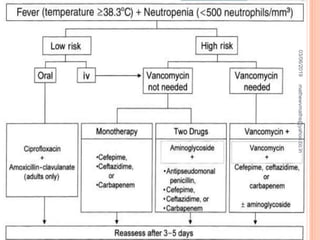
 Febrile neutropenia (FN) is defined as an oral
temperature >38.3°C (101F) or two consecutive readings
of >38.0°C(100.4F) for 2 hrs. and an absolute neutrophil
count (ANC) <500cells/mm3, or expected to fall below
500cells/mm3 in next 48 hrs.
IDSA - Infectious Diseases Society of America
mathewvmaths@yahoo.co.in
WHAT IS FEBRILE NEUTROPENIA?
Febrile neutropenia (FN) is defined as
 An oral temperature
 >38.3°C (101F) or
 two consecutive readings of >38.0°C(100.4F) for 2 hrs.
&
 An absolute neutrophil count (ANC)
 <500cells/mm3, or
 expected to fall below 500cells/mm3 in next 48 hrs.
(Definition by IDSA - Infectious Diseases Society of
America)
03/06/2019
7
mathewvmaths@yahoo.co.in
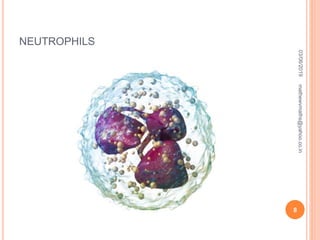
NEUTROPHILS
03/06/2019
8
mathewvmaths@yahoo.co.in
WHAT IS NEUTROPENIA?
03/06/20199
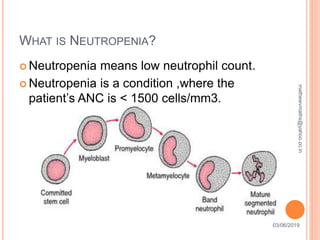
 Neutropenia means low neutrophil count.
 Neutropenia is a condition ,where the
patient’s ANC is < 1500 cells/mm3.
mathewvmaths@yahoo.co.in
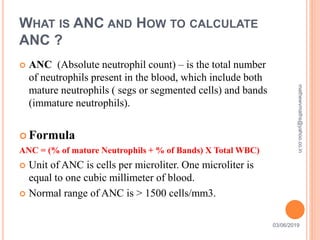
WHAT IS ANC AND HOW TO CALCULATE
ANC ?
03/06/201910
 ANC (Absolute neutrophil count) – is the total number
of neutrophils present in the blood, which include both
mature neutrophils ( segs or segmented cells) and bands
(immature neutrophils).
 Formula
ANC = (% of mature Neutrophils + % of Bands) X Total WBC)
 Unit of ANC is cells per microliter. One microliter is
equal to one cubic millimeter of blood.
 Normal range of ANC is > 1500 cells/mm3.
mathewvmaths@yahoo.co.in
TYPES OF NEUTROPENIA
Type ANC Count
Mild Neutropenia 1000-1500 cells/mm3
Moderate Neutropenia 500-999 cells/mm3
Severe Neutropenia <500 cells/mm3
Profound Neutropenia <100 cells/mm3
03/06/2019
11
mathewvmaths@yahoo.co.in
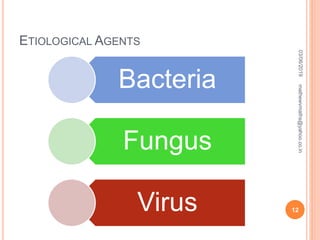
ETIOLOGICAL AGENTS
Bacteria
Fungus
Virus
03/06/2019
12
mathewvmaths@yahoo.co.in
03/06/2019
13
mathewvmaths@yahoo.co.in
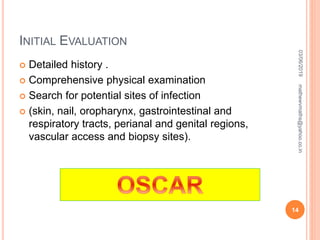
INITIAL EVALUATION
 Detailed history .
 Comprehensive physical examination
 Search for potential sites of infection
 (skin, nail, oropharynx, gastrointestinal and
respiratory tracts, perianal and genital regions,
vascular access and biopsy sites).
03/06/2019
14
mathewvmaths@yahoo.co.in
CLINICAL EXAMINATION
O
S
C
A
R
Oral inspection
Skin integrity
Catheter site
Anal region inspection
Routine vital signs
03/06/201915
mathewvmaths@yahoo.co.in
INITIAL EVALUATION
 Blood cultures
 For bacterial and fungal organisms
 Peripheral blood, and Central catheter lumen.
 Sputum microscopy and culture
 Chest radiograph: baseline and with symptoms –
CT of the chest
 Urine cultures: symptoms or catheter in place.
 Cerebrospinal fluid
 Joint fluid: if local infection suspected.
03/06/2019
16
mathewvmaths@yahoo.co.in
INITIAL EVALUATION
 Diarrheal stools: cultures, ova/parasites, C difficile
toxin assays .
 Cutaneous lesions: (aspirate / biopsy / wash )
culture.
 CBC, LFTs, RFTs, electrolyte panel: at baseline and
every 3-4 days, as necessary.
 Drainage sites: stain and culture (bacteremia, AFB,
fungi, viruses).
03/06/2019
17
mathewvmaths@yahoo.co.in
CLINICAL FEATURES
 Fever
 Irritability
 Hot or cold shivers,
sweating
 Warm forehead with
flushed or pale face
 Rapid heart rate
 Skin rash
 Vomiting
 Abdominal pain
 A sore which does not
heal
 Mouth ulcers
 Pain on swallowing
 Coughing
 Diarrhea
 Change in level of
consciousness
 Painful or frequent
urination
03/06/2019
18
mathewvmaths@yahoo.co.in
03/06/2019
19
mathewvmaths@yahoo.co.in
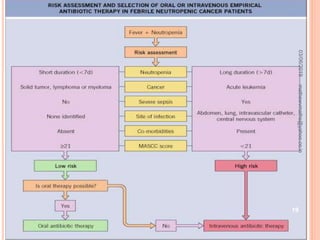
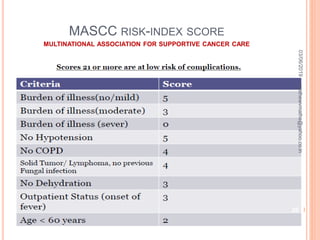
MASCC RISK-INDEX SCORE
MULTINATIONAL ASSOCIATION FOR SUPPORTIVE CANCER CARE
03/06/2019
20
mathewvmaths@yahoo.co.in
03/06/2019
21
mathewvmaths@yahoo.co.in
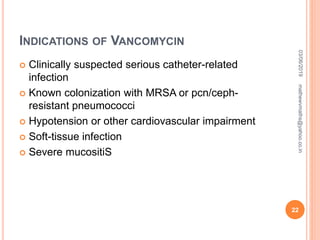
INDICATIONS OF VANCOMYCIN
 Clinically suspected serious catheter-related
infection
 Known colonization with MRSA or pcn/ceph-
resistant pneumococci
 Hypotension or other cardiovascular impairment
 Soft-tissue infection
 Severe mucositiS
03/06/2019
22
mathewvmaths@yahoo.co.in
03/06/2019
23
mathewvmaths@yahoo.co.in
03/06/2019
24
mathewvmaths@yahoo.co.in
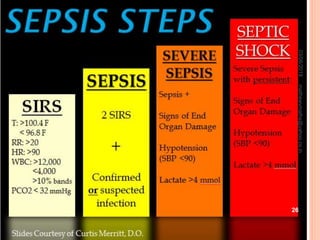
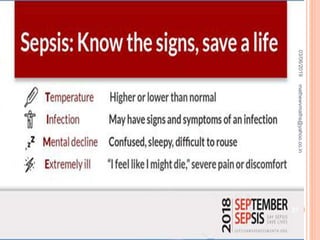
COMPLICATION
03/06/2019
25
mathewvmaths@yahoo.co.in
03/06/2019
26
mathewvmaths@yahoo.co.in
03/06/2019
27
mathewvmaths@yahoo.co.in
NURSING INTERVENTIONS
03/06/201928
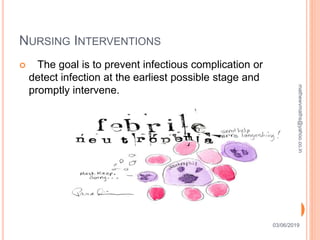
 The goal is to prevent infectious complication or
detect infection at the earliest possible stage and
promptly intervene.
mathewvmaths@yahoo.co.in
PATIENT AND FAMILY EDUCATION
03/06/201929
Explanation of the function of while blood
cells
Meaning of nadir
Instructions for temperature taking
Signs and symptoms of infection (e.g.
fever, malaise, those related to specific
organs such as cough, urinary frequency
with or without dysuria, etc.)
Hygiene practices emphasizing hand
washing
mathewvmaths@yahoo.co.in
PATIENT AND FAMILY EDUCATION
03/06/201930
 Identification and assessment of high‐risk
areas for infection (chest, urinary tract, skin)
 Care of access devices (e.g. Hartman line,
urinary catheter)
 Avoidance of exposure to persons with
communicable or infectious illnesses, stay
away from crowds and animals
 Maintain nutritional status by a balanced diet
 Specific directions for access to healthcare
systems (clinic or emergency)
mathewvmaths@yahoo.co.in
THANK YOU
03/06/2019mathewvmaths@yahoo.co.in31

Febrile neutropenia -Nursing ppt

  • 1.
    FEBRILE NEUTROPENIA Mathew VargheseV MSN(RAK),FHNP (CMC Vellore), CPEPC Nursing officer AIIMS Delhi 03/06/2019 1 mathewvmaths@yahoo.co.in
  • 2.
  • 3.
    FEBRILE NEUTROPENIA  Febrileneutropenia is one of the common oncological emergencies.  It is mainly seen on patients who take chemotherapy  Nurses should specifically trained in the recognition and management of neutropenic sepsis, so that rapid assessment and administration of first line antibiotics can be achieved. 03/06/2019 3 mathewvmaths@yahoo.co.in
  • 4.
    EPIDEMIOLOGY  The highestrate of febrile neutropenia is seen on patients with haematological malignancies ,which accounts above 80 %.  10%–50% of patients with solid tumors are also prone to get febrile neutropenia.  It commonly develops after first few cycles of chemotherapy. 03/06/2019 4 mathewvmaths@yahoo.co.in
  • 5.
    EPIDEMIOLOGY  Considered primarycause of mortality in 36% of cancer patients  Considered secondary cause of mortality in 68% of cancer patients.  It is the most common cause of mortality & morbidity in cancer patients. 03/06/2019 5 mathewvmaths@yahoo.co.in
  • 6.
    FEBRILE NEUTROPENIA 03/06/20196  Febrileneutropenia (FN) is defined as an oral temperature >38.3°C (101F) or two consecutive readings of >38.0°C(100.4F) for 2 hrs. and an absolute neutrophil count (ANC) <500cells/mm3, or expected to fall below 500cells/mm3 in next 48 hrs. IDSA - Infectious Diseases Society of America mathewvmaths@yahoo.co.in
  • 7.
    WHAT IS FEBRILENEUTROPENIA? Febrile neutropenia (FN) is defined as  An oral temperature  >38.3°C (101F) or  two consecutive readings of >38.0°C(100.4F) for 2 hrs. &  An absolute neutrophil count (ANC)  <500cells/mm3, or  expected to fall below 500cells/mm3 in next 48 hrs. (Definition by IDSA - Infectious Diseases Society of America) 03/06/2019 7 mathewvmaths@yahoo.co.in
  • 8.
  • 9.
    WHAT IS NEUTROPENIA? 03/06/20199 Neutropenia means low neutrophil count.  Neutropenia is a condition ,where the patient’s ANC is < 1500 cells/mm3. mathewvmaths@yahoo.co.in
  • 10.
    WHAT IS ANCAND HOW TO CALCULATE ANC ? 03/06/201910  ANC (Absolute neutrophil count) – is the total number of neutrophils present in the blood, which include both mature neutrophils ( segs or segmented cells) and bands (immature neutrophils).  Formula ANC = (% of mature Neutrophils + % of Bands) X Total WBC)  Unit of ANC is cells per microliter. One microliter is equal to one cubic millimeter of blood.  Normal range of ANC is > 1500 cells/mm3. mathewvmaths@yahoo.co.in
  • 11.
    TYPES OF NEUTROPENIA TypeANC Count Mild Neutropenia 1000-1500 cells/mm3 Moderate Neutropenia 500-999 cells/mm3 Severe Neutropenia <500 cells/mm3 Profound Neutropenia <100 cells/mm3 03/06/2019 11 mathewvmaths@yahoo.co.in
  • 12.
  • 13.
  • 14.
    INITIAL EVALUATION  Detailedhistory .  Comprehensive physical examination  Search for potential sites of infection  (skin, nail, oropharynx, gastrointestinal and respiratory tracts, perianal and genital regions, vascular access and biopsy sites). 03/06/2019 14 mathewvmaths@yahoo.co.in
  • 15.
    CLINICAL EXAMINATION O S C A R Oral inspection Skinintegrity Catheter site Anal region inspection Routine vital signs 03/06/201915 mathewvmaths@yahoo.co.in
  • 16.
    INITIAL EVALUATION  Bloodcultures  For bacterial and fungal organisms  Peripheral blood, and Central catheter lumen.  Sputum microscopy and culture  Chest radiograph: baseline and with symptoms – CT of the chest  Urine cultures: symptoms or catheter in place.  Cerebrospinal fluid  Joint fluid: if local infection suspected. 03/06/2019 16 mathewvmaths@yahoo.co.in
  • 17.
    INITIAL EVALUATION  Diarrhealstools: cultures, ova/parasites, C difficile toxin assays .  Cutaneous lesions: (aspirate / biopsy / wash ) culture.  CBC, LFTs, RFTs, electrolyte panel: at baseline and every 3-4 days, as necessary.  Drainage sites: stain and culture (bacteremia, AFB, fungi, viruses). 03/06/2019 17 mathewvmaths@yahoo.co.in
  • 18.
    CLINICAL FEATURES  Fever Irritability  Hot or cold shivers, sweating  Warm forehead with flushed or pale face  Rapid heart rate  Skin rash  Vomiting  Abdominal pain  A sore which does not heal  Mouth ulcers  Pain on swallowing  Coughing  Diarrhea  Change in level of consciousness  Painful or frequent urination 03/06/2019 18 mathewvmaths@yahoo.co.in
  • 19.
  • 20.
    MASCC RISK-INDEX SCORE MULTINATIONALASSOCIATION FOR SUPPORTIVE CANCER CARE 03/06/2019 20 mathewvmaths@yahoo.co.in
  • 21.
  • 22.
    INDICATIONS OF VANCOMYCIN Clinically suspected serious catheter-related infection  Known colonization with MRSA or pcn/ceph- resistant pneumococci  Hypotension or other cardiovascular impairment  Soft-tissue infection  Severe mucositiS 03/06/2019 22 mathewvmaths@yahoo.co.in
  • 23.
  • 24.
  • 25.
  • 26.
  • 27.
  • 28.
    NURSING INTERVENTIONS 03/06/201928  Thegoal is to prevent infectious complication or detect infection at the earliest possible stage and promptly intervene. mathewvmaths@yahoo.co.in
  • 29.
    PATIENT AND FAMILYEDUCATION 03/06/201929 Explanation of the function of while blood cells Meaning of nadir Instructions for temperature taking Signs and symptoms of infection (e.g. fever, malaise, those related to specific organs such as cough, urinary frequency with or without dysuria, etc.) Hygiene practices emphasizing hand washing mathewvmaths@yahoo.co.in
  • 30.
    PATIENT AND FAMILYEDUCATION 03/06/201930  Identification and assessment of high‐risk areas for infection (chest, urinary tract, skin)  Care of access devices (e.g. Hartman line, urinary catheter)  Avoidance of exposure to persons with communicable or infectious illnesses, stay away from crowds and animals  Maintain nutritional status by a balanced diet  Specific directions for access to healthcare systems (clinic or emergency) mathewvmaths@yahoo.co.in
  • 31.